Cambridge A Level Travel and Tourism 9395 — 2017 Oct/Nov Paper 3 · Variant 2
9395/32/O/N/17 · 50 marks · ≈56 min
The question paper and its mark scheme, free to read here and free to download. This is Cambridge’s own paper, exactly as it was sat.
Question paper8 pages
Mark scheme7 pages
Answers below. Sit the paper first if you are practising.
Paper as text
Question paper, page 1
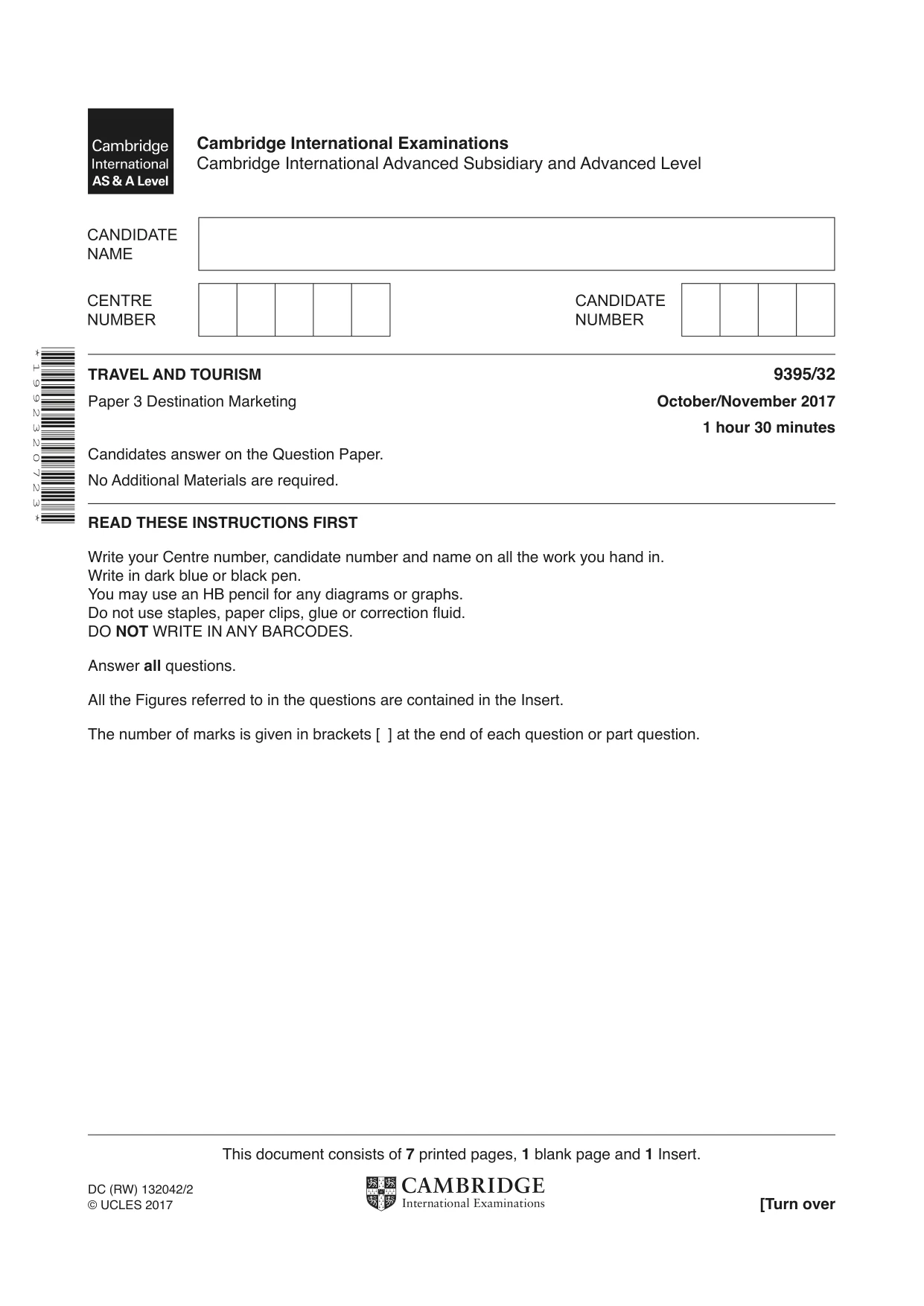
This document consists of 7 printed pages, 1 blank page and 1 Insert. DC (RW) 132042/2 © UCLES 2017 [Turn over Cambridge International Examinations Cambridge International Advanced Subsidiary and Advanced Level * 1 9 9 2 3 2 0 7 2 3 * TRAVEL AND TOURISM 9395/32 Paper 3 Destination Marketing October/November 2017 1 hour 30 minutes Candidates answer on the Question Paper. No Additional Materials are required. READ THESE INSTRUCTIONS FIRST Write your Centre number, candidate number and name on all the work you hand in. Write in dark blue or black pen. You may use an HB pencil for any diagrams or graphs. Do not use staples, paper clips, glue or correction fluid. DO NOT WRITE IN ANY BARCODES. Answer all questions. All the Figures referred to in the questions are contained in the Insert. The number of marks is given in brackets [ ] at the end of each question or part question.
Question paper, page 2
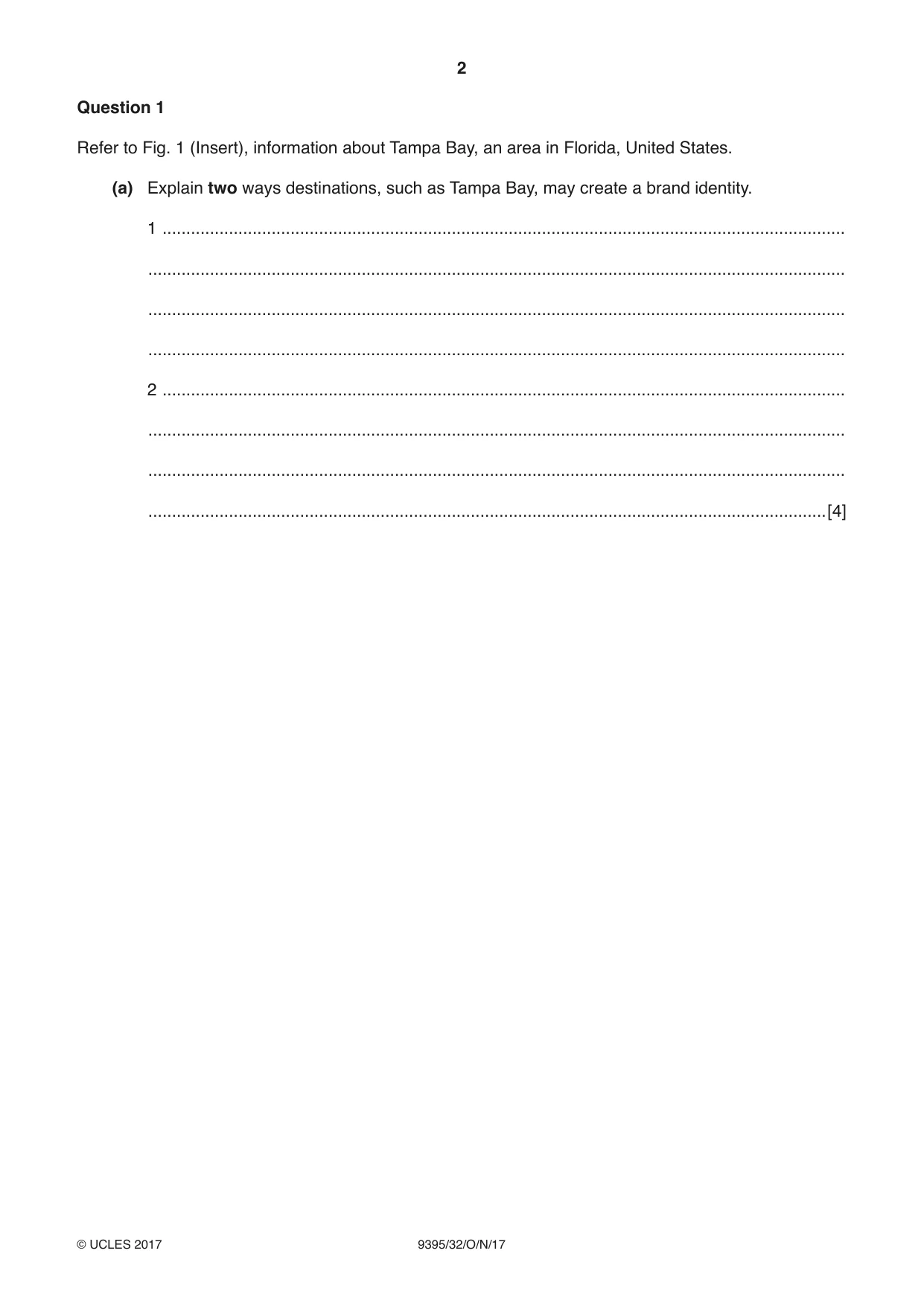
2 9395/32/O/N/17 © UCLES 2017 Question 1 Refer to Fig. 1 (Insert), information about Tampa Bay, an area in Florida, United States. (a) Explain two ways destinations, such as Tampa Bay, may create a brand identity. 1 … … … … 2 … … … …[4]
Question paper, page 3
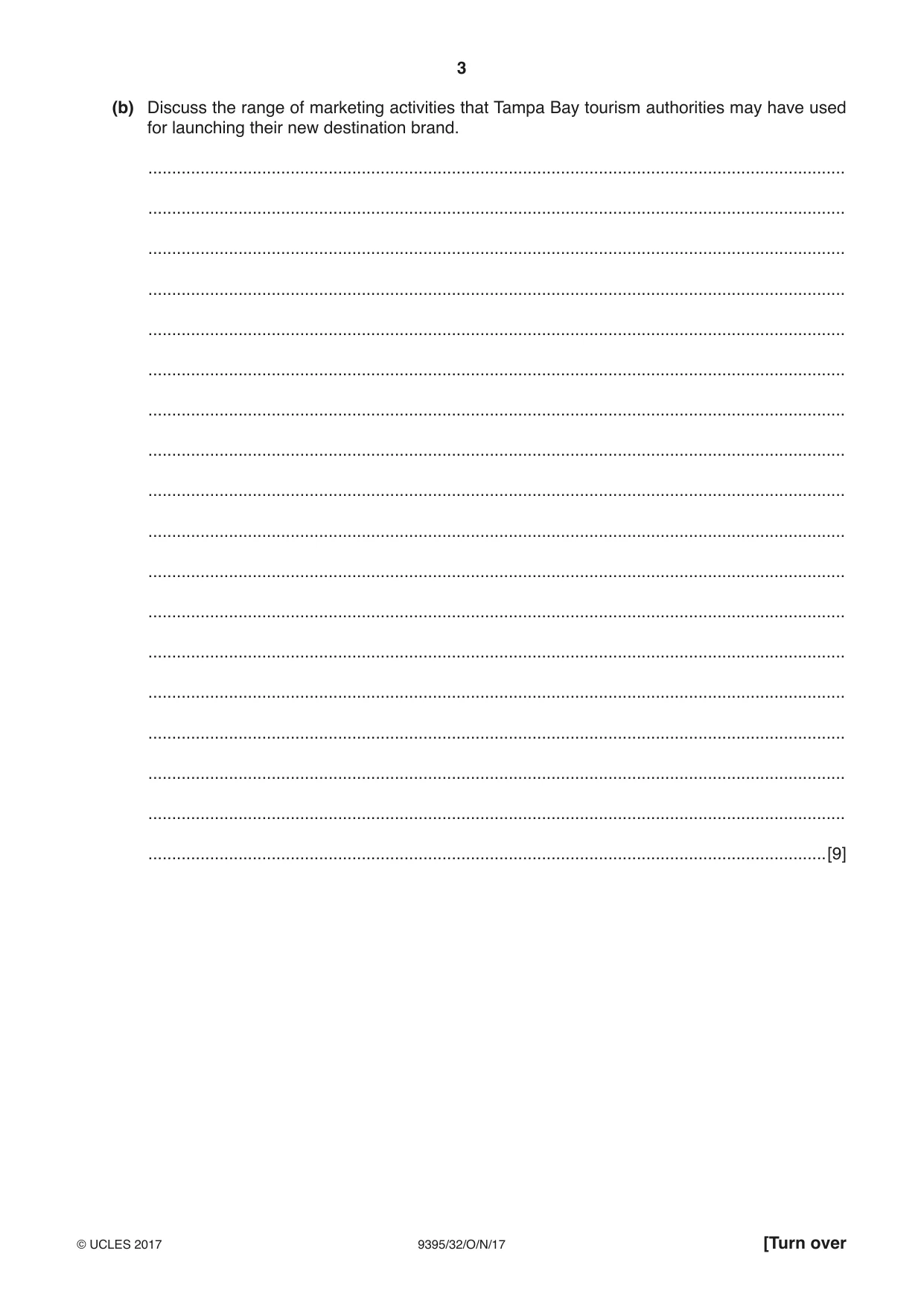
3 9395/32/O/N/17 © UCLES 2017 [Turn over (b) Discuss the range of marketing activities that Tampa Bay tourism authorities may have used for launching their new destination brand. … … … … … … … … … … … … … … … … … …[9]
Question paper, page 4
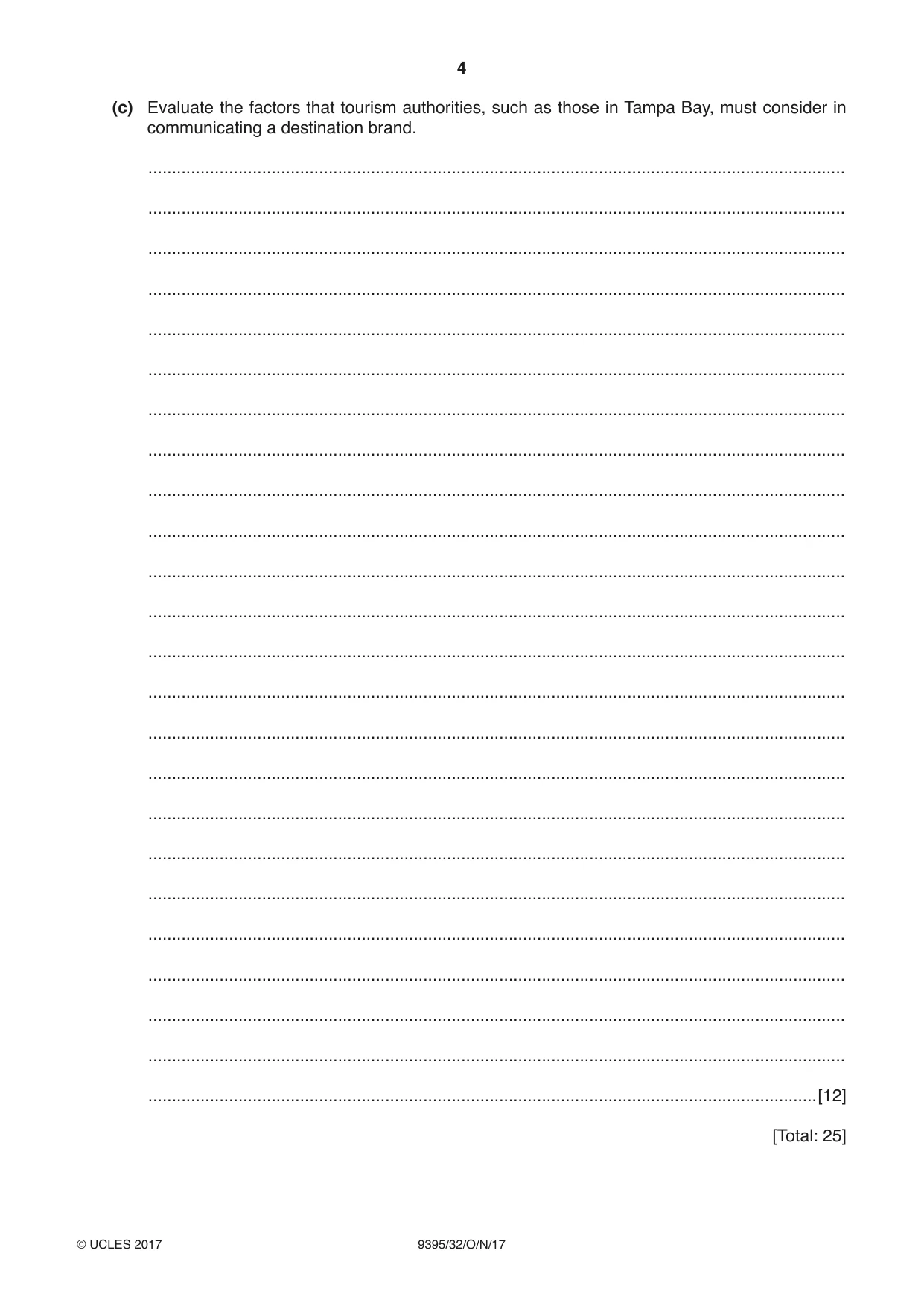
4 9395/32/O/N/17 © UCLES 2017 (c) Evaluate the factors that tourism authorities, such as those in Tampa Bay, must consider in communicating a destination brand. … … … … … … … … … … … … … … … … … … … … … … … …[12] [Total: 25]
Question paper, page 5
5 9395/32/O/N/17 © UCLES 2017 [Turn over Question 2 Refer to Fig. 2 (Insert), information about the Seychelles ‘Another World’ brand. Seychelles is a group of 115 islands in the Indian Ocean. (a) Explain two likely aims of the market research carried out by the Seychelles Tourism Board in creating the new destination brand. 1 … … … … 2 … … … …[4]
Question paper, page 6
6 9395/32/O/N/17 © UCLES 2017 (b) Assess the benefits to the Seychelles Tourism Board of using a range of media to communicate the destination’s new brand identity. … … … … … … … … … … … … … … … … … …[9]
Question paper, page 7
7 9395/32/O/N/17 © UCLES 2017 (c) Discuss the challenges faced by the Seychelles in implementing the new destination brand. … … … … … … … … … … … … … … … … … … … … … … … …[12] [Total: 25]
Question paper, page 8
8 9395/32/O/N/17 © UCLES 2017 BLANK PAGE Permission to reproduce items where third-party owned material protected by copyright is included has been sought and cleared where possible. Every reasonable effort has been made by the publisher (UCLES) to trace copyright holders, but if any items requiring clearance have unwittingly been included, the publisher will be pleased to make amends at the earliest possible opportunity. To avoid the issue of disclosure of answer-related information to candidates, all copyright acknowledgements are reproduced online in the Cambridge International Examinations Copyright Acknowledgements Booklet. This is produced for each series of examinations and is freely available to download at www.cie.org.uk after the live examination series. Cambridge International Examinations is part of the Cambridge Assessment Group. Cambridge Assessment is the brand name of University of Cambridge Local Examinations Syndicate (UCLES), which is itself a department of the University of Cambridge.
Mark scheme, page 1
® IGCSE is a registered trademark. This document consists of 7 printed pages. © UCLES 2017 [Turn over Cambridge Assessment International Education Cambridge International Advanced Subsidiary and Advanced Level TRAVEL AND TOURISM 9395/32 Paper 3 Destination Marketing October/November 2017 MARK SCHEME Maximum Mark: 50 Published This mark scheme is published as an aid to teachers and candidates, to indicate the requirements of the examination. It shows the basis on which Examiners were instructed to award marks. It does not indicate the details of the discussions that took place at an Examiners’ meeting before marking began, which would have considered the acceptability of alternative answers. Mark schemes should be read in conjunction with the question paper and the Principal Examiner Report for Teachers. Cambridge International will not enter into discussions about these mark schemes. Cambridge International is publishing the mark schemes for the October/November 2017 series for most Cambridge IGCSE®, Cambridge International A and AS Level components and some Cambridge O Level components.
Mark scheme, page 2
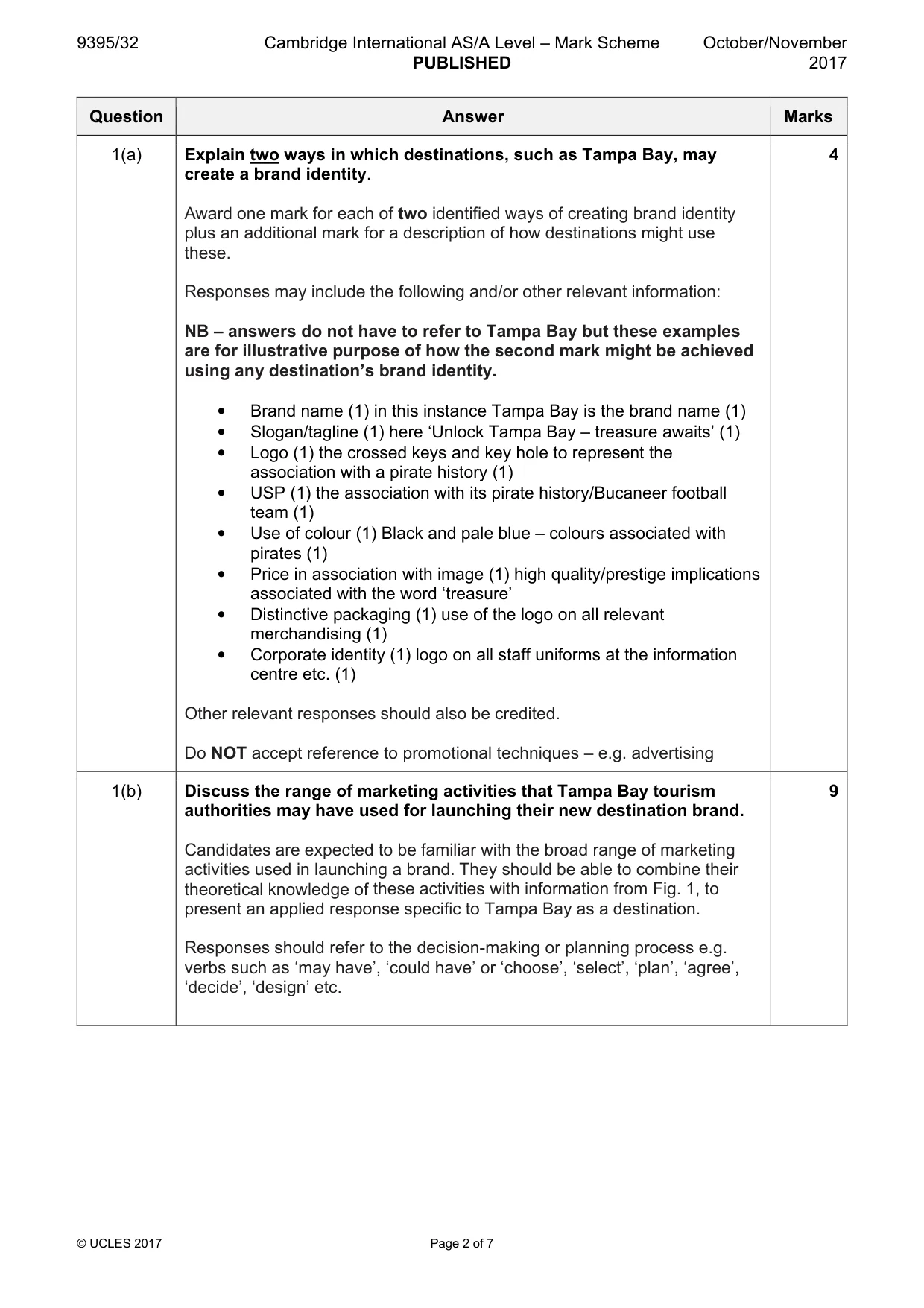
9395/32 Cambridge International AS/A Level – Mark Scheme PUBLISHED October/November 2017 © UCLES 2017 Page 2 of 7 Question Answer Marks 1(a) Explain two ways in which destinations, such as Tampa Bay, may create a brand identity. Award one mark for each of two identified ways of creating brand identity plus an additional mark for a description of how destinations might use these. Responses may include the following and/or other relevant information: NB – answers do not have to refer to Tampa Bay but these examples are for illustrative purpose of how the second mark might be achieved using any destination’s brand identity. • Brand name (1) in this instance Tampa Bay is the brand name (1) • Slogan/tagline (1) here ‘Unlock Tampa Bay – treasure awaits’ (1) • Logo (1) the crossed keys and key hole to represent the association with a pirate history (1) • USP (1) the association with its pirate history/Bucaneer football team (1) • Use of colour (1) Black and pale blue – colours associated with pirates (1) • Price in association with image (1) high quality/prestige implications associated with the word ‘treasure’ • Distinctive packaging (1) use of the logo on all relevant merchandising (1) • Corporate identity (1) logo on all staff uniforms at the information centre etc. (1) Other relevant responses should also be credited. Do NOT accept reference to promotional techniques – e.g. advertising 4 1(b) Discuss the range of marketing activities that Tampa Bay tourism authorities may have used for launching their new destination brand. Candidates are expected to be familiar with the broad range of marketing activities used in launching a brand. They should be able to combine their theoretical knowledge of these activities with information from Fig. 1, to present an applied response specific to Tampa Bay as a destination. Responses should refer to the decision-making or planning process e.g. verbs such as ‘may have’, ‘could have’ or ‘choose’, ‘select’, ‘plan’, ‘agree’, ‘decide’, ‘design’ etc. 9
Mark scheme, page 3
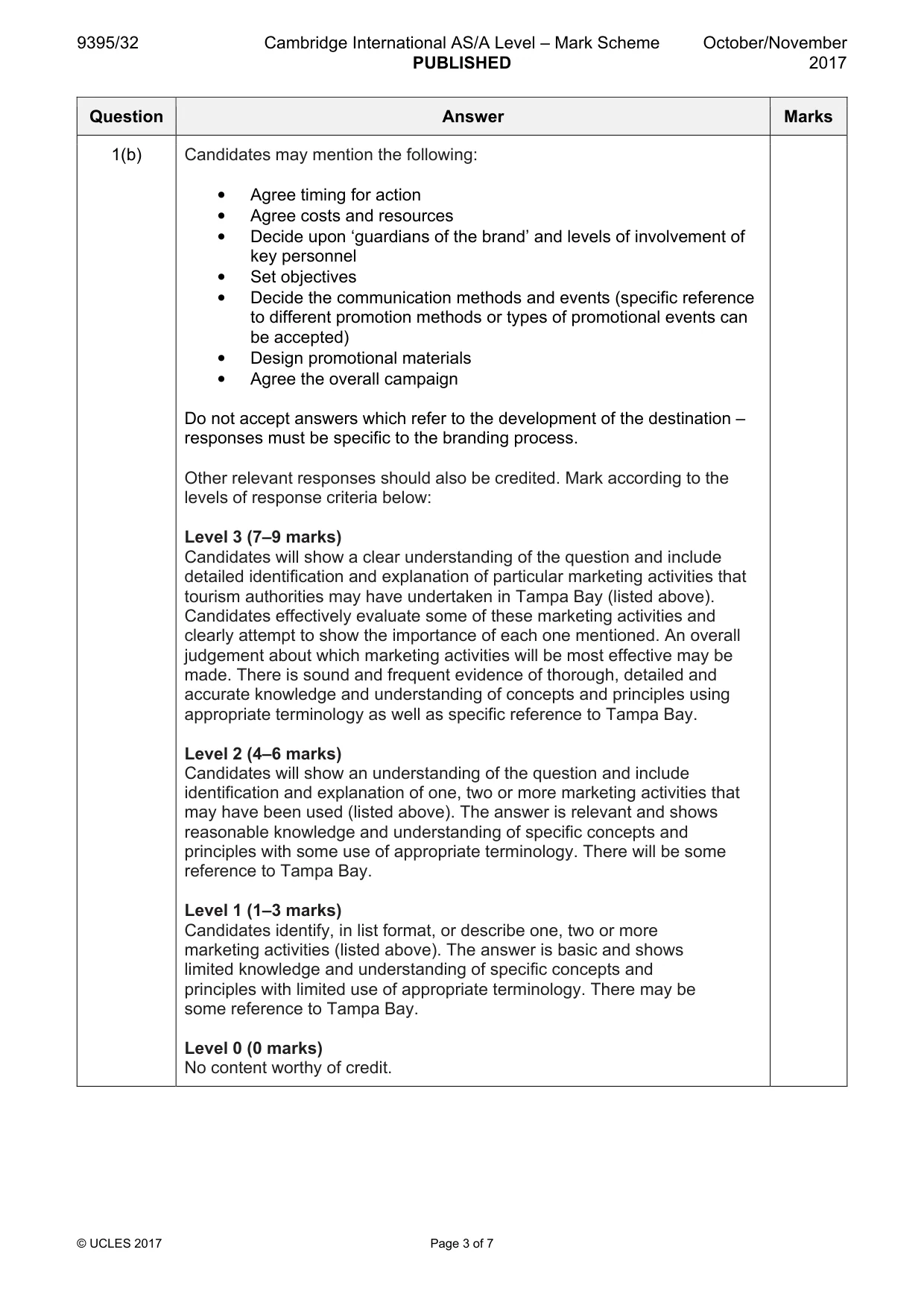
9395/32 Cambridge International AS/A Level – Mark Scheme PUBLISHED October/November 2017 © UCLES 2017 Page 3 of 7 Question Answer Marks 1(b) Candidates may mention the following: • Agree timing for action • Agree costs and resources • Decide upon ‘guardians of the brand’ and levels of involvement of key personnel • Set objectives • Decide the communication methods and events (specific reference to different promotion methods or types of promotional events can be accepted) • Design promotional materials • Agree the overall campaign Do not accept answers which refer to the development of the destination – responses must be specific to the branding process. Other relevant responses should also be credited. Mark according to the levels of response criteria below: Level 3 (7–9 marks) Candidates will show a clear understanding of the question and include detailed identification and explanation of particular marketing activities that tourism authorities may have undertaken in Tampa Bay (listed above). Candidates effectively evaluate some of these marketing activities and clearly attempt to show the importance of each one mentioned. An overall judgement about which marketing activities will be most effective may be made. There is sound and frequent evidence of thorough, detailed and accurate knowledge and understanding of concepts and principles using appropriate terminology as well as specific reference to Tampa Bay. Level 2 (4–6 marks) Candidates will show an understanding of the question and include identification and explanation of one, two or more marketing activities that may have been used (listed above). The answer is relevant and shows reasonable knowledge and understanding of specific concepts and principles with some use of appropriate terminology. There will be some reference to Tampa Bay. Level 1 (1–3 marks) Candidates identify, in list format, or describe one, two or more marketing activities (listed above). The answer is basic and shows limited knowledge and understanding of specific concepts and principles with limited use of appropriate terminology. There may be some reference to Tampa Bay. Level 0 (0 marks) No content worthy of credit.
Mark scheme, page 4
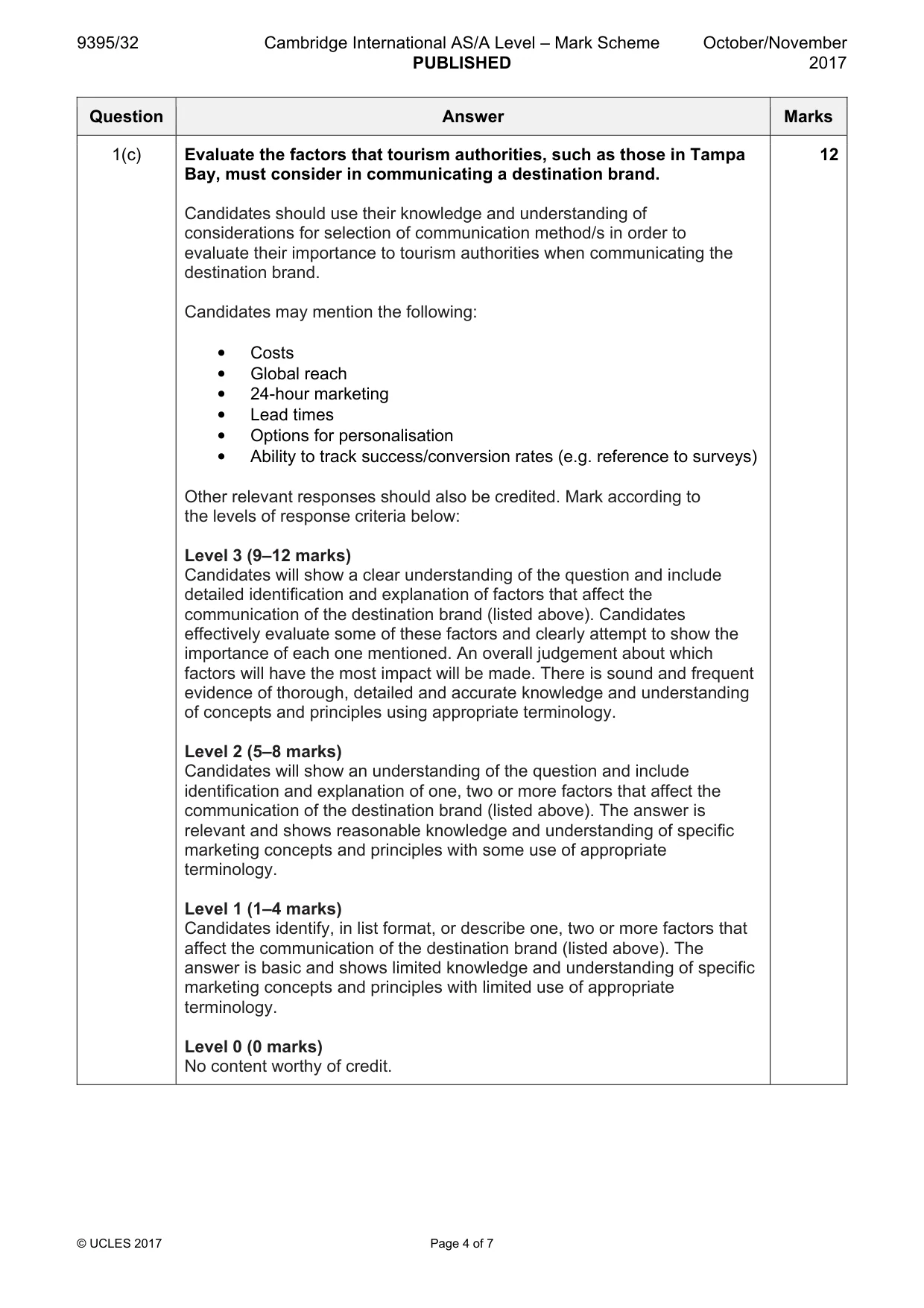
9395/32 Cambridge International AS/A Level – Mark Scheme PUBLISHED October/November 2017 © UCLES 2017 Page 4 of 7 Question Answer Marks 1(c) Evaluate the factors that tourism authorities, such as those in Tampa Bay, must consider in communicating a destination brand. Candidates should use their knowledge and understanding of considerations for selection of communication method/s in order to evaluate their importance to tourism authorities when communicating the destination brand. Candidates may mention the following: • Costs • Global reach • 24-hour marketing • Lead times • Options for personalisation • Ability to track success/conversion rates (e.g. reference to surveys) Other relevant responses should also be credited. Mark according to the levels of response criteria below: Level 3 (9–12 marks) Candidates will show a clear understanding of the question and include detailed identification and explanation of factors that affect the communication of the destination brand (listed above). Candidates effectively evaluate some of these factors and clearly attempt to show the importance of each one mentioned. An overall judgement about which factors will have the most impact will be made. There is sound and frequent evidence of thorough, detailed and accurate knowledge and understanding of concepts and principles using appropriate terminology. Level 2 (5–8 marks) Candidates will show an understanding of the question and include identification and explanation of one, two or more factors that affect the communication of the destination brand (listed above). The answer is relevant and shows reasonable knowledge and understanding of specific marketing concepts and principles with some use of appropriate terminology. Level 1 (1–4 marks) Candidates identify, in list format, or describe one, two or more factors that affect the communication of the destination brand (listed above). The answer is basic and shows limited knowledge and understanding of specific marketing concepts and principles with limited use of appropriate terminology. Level 0 (0 marks) No content worthy of credit. 12
Mark scheme, page 5
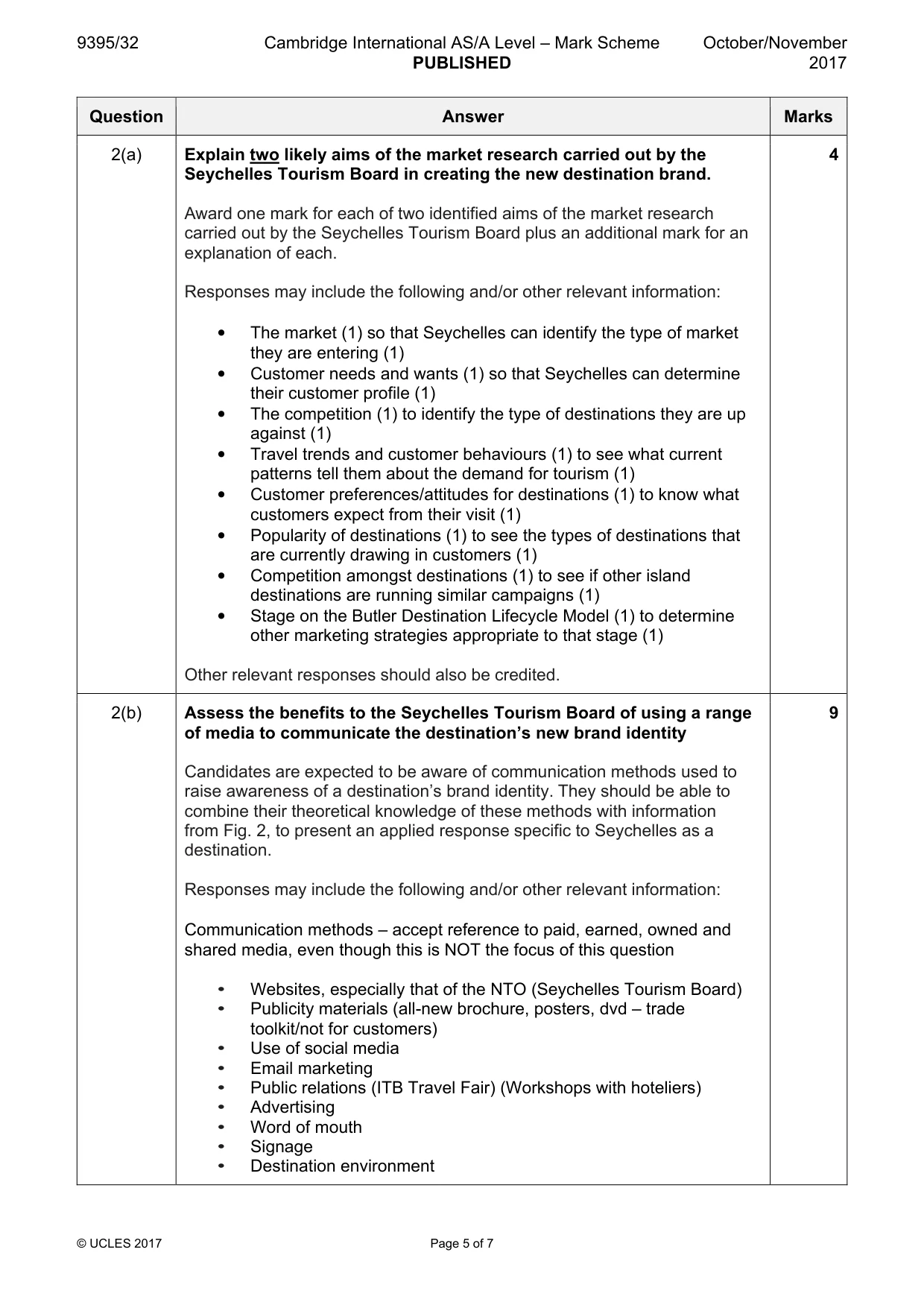
9395/32 Cambridge International AS/A Level – Mark Scheme PUBLISHED October/November 2017 © UCLES 2017 Page 5 of 7 Question Answer Marks 2(a) Explain two likely aims of the market research carried out by the Seychelles Tourism Board in creating the new destination brand. Award one mark for each of two identified aims of the market research carried out by the Seychelles Tourism Board plus an additional mark for an explanation of each. Responses may include the following and/or other relevant information: • The market (1) so that Seychelles can identify the type of market they are entering (1) • Customer needs and wants (1) so that Seychelles can determine their customer profile (1) • The competition (1) to identify the type of destinations they are up against (1) • Travel trends and customer behaviours (1) to see what current patterns tell them about the demand for tourism (1) • Customer preferences/attitudes for destinations (1) to know what customers expect from their visit (1) • Popularity of destinations (1) to see the types of destinations that are currently drawing in customers (1) • Competition amongst destinations (1) to see if other island destinations are running similar campaigns (1) • Stage on the Butler Destination Lifecycle Model (1) to determine other marketing strategies appropriate to that stage (1) Other relevant responses should also be credited. 4 2(b) Assess the benefits to the Seychelles Tourism Board of using a range of media to communicate the destination’s new brand identity Candidates are expected to be aware of communication methods used to raise awareness of a destination’s brand identity. They should be able to combine their theoretical knowledge of these methods with information from Fig. 2, to present an applied response specific to Seychelles as a destination. Responses may include the following and/or other relevant information: Communication methods – accept reference to paid, earned, owned and shared media, even though this is NOT the focus of this question • Websites, especially that of the NTO (Seychelles Tourism Board) • Publicity materials (all-new brochure, posters, dvd – trade toolkit/not for customers) • Use of social media • Email marketing • Public relations (ITB Travel Fair) (Workshops with hoteliers) • Advertising • Word of mouth • Signage • Destination environment 9
Mark scheme, page 6
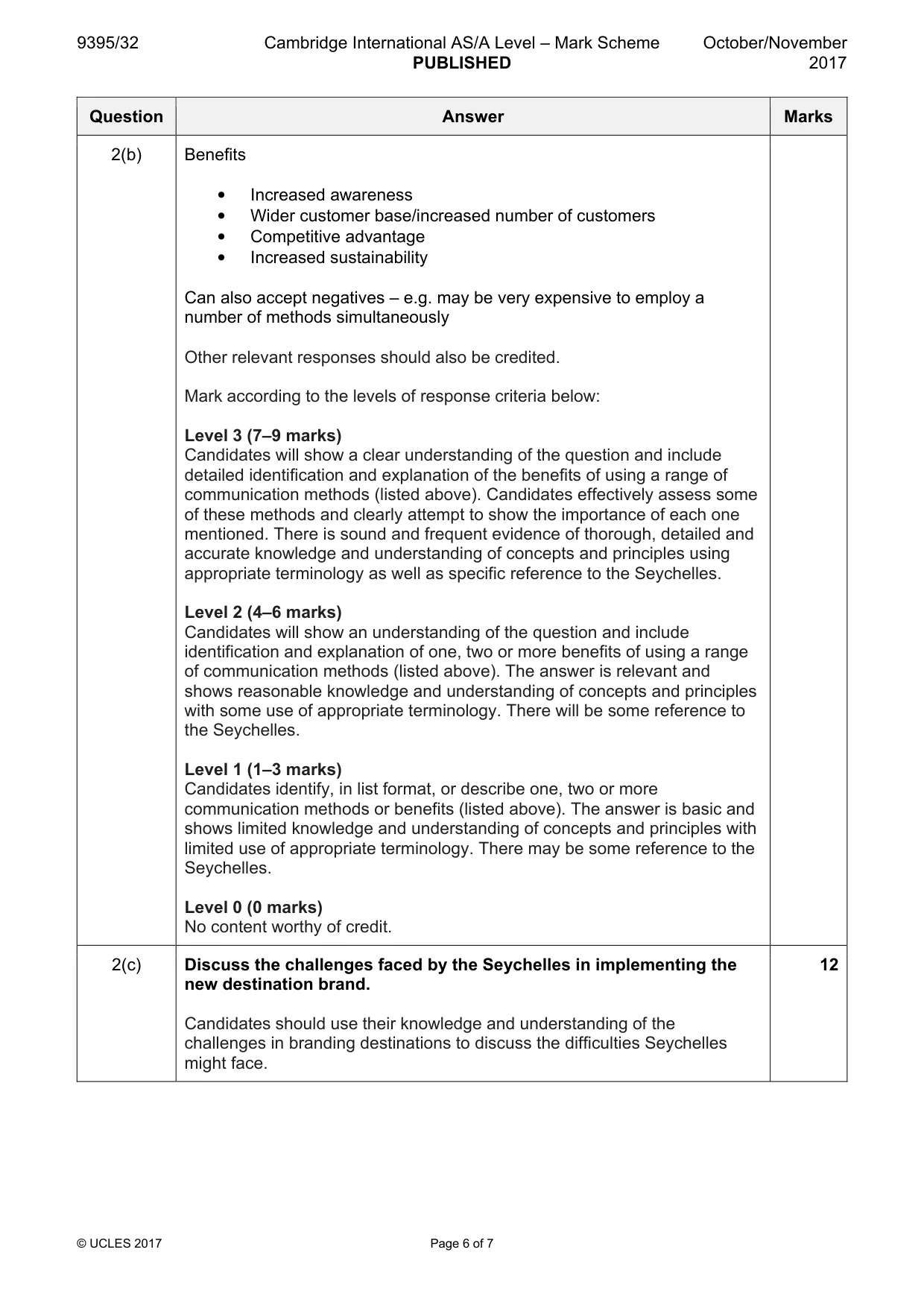
9395/32 Cambridge International AS/A Level – Mark Scheme PUBLISHED October/November 2017 © UCLES 2017 Page 6 of 7 Question Answer Marks 2(b) Benefits • Increased awareness • Wider customer base/increased number of customers • Competitive advantage • Increased sustainability Can also accept negatives – e.g. may be very expensive to employ a number of methods simultaneously Other relevant responses should also be credited. Mark according to the levels of response criteria below: Level 3 (7–9 marks) Candidates will show a clear understanding of the question and include detailed identification and explanation of the benefits of using a range of communication methods (listed above). Candidates effectively assess some of these methods and clearly attempt to show the importance of each one mentioned. There is sound and frequent evidence of thorough, detailed and accurate knowledge and understanding of concepts and principles using appropriate terminology as well as specific reference to the Seychelles. Level 2 (4–6 marks) Candidates will show an understanding of the question and include identification and explanation of one, two or more benefits of using a range of communication methods (listed above). The answer is relevant and shows reasonable knowledge and understanding of concepts and principles with some use of appropriate terminology. There will be some reference to the Seychelles. Level 1 (1–3 marks) Candidates identify, in list format, or describe one, two or more communication methods or benefits (listed above). The answer is basic and shows limited knowledge and understanding of concepts and principles with limited use of appropriate terminology. There may be some reference to the Seychelles. Level 0 (0 marks) No content worthy of credit. 2(c) Discuss the challenges faced by the Seychelles in implementing the new destination brand. Candidates should use their knowledge and understanding of the challenges in branding destinations to discuss the difficulties Seychelles might face. 12
Mark scheme, page 7
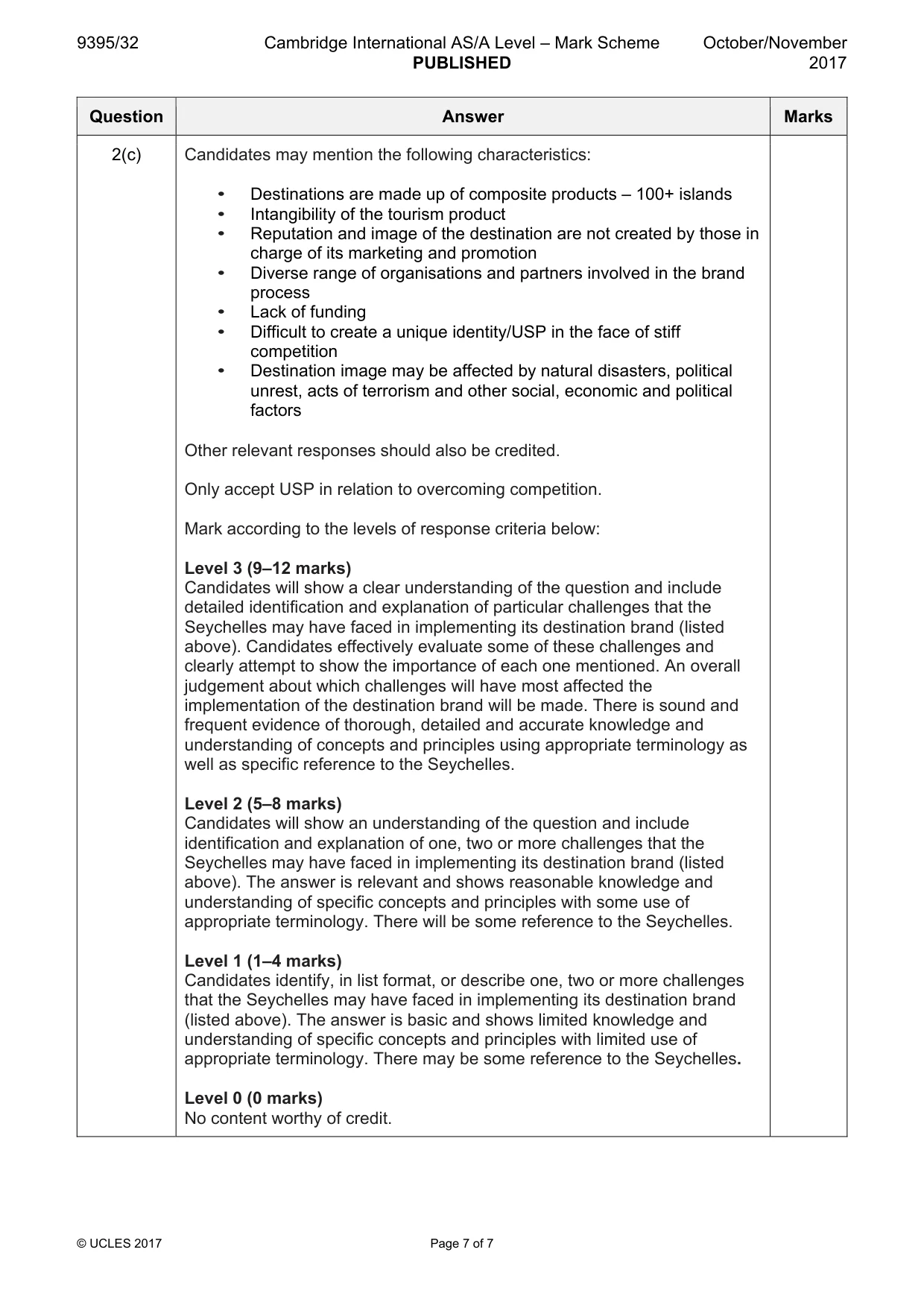
9395/32 Cambridge International AS/A Level – Mark Scheme PUBLISHED October/November 2017 © UCLES 2017 Page 7 of 7 Question Answer Marks 2(c) Candidates may mention the following characteristics: • Destinations are made up of composite products – 100+ islands • Intangibility of the tourism product • Reputation and image of the destination are not created by those in charge of its marketing and promotion • Diverse range of organisations and partners involved in the brand process • Lack of funding • Difficult to create a unique identity/USP in the face of stiff competition • Destination image may be affected by natural disasters, political unrest, acts of terrorism and other social, economic and political factors Other relevant responses should also be credited. Only accept USP in relation to overcoming competition. Mark according to the levels of response criteria below: Level 3 (9–12 marks) Candidates will show a clear understanding of the question and include detailed identification and explanation of particular challenges that the Seychelles may have faced in implementing its destination brand (listed above). Candidates effectively evaluate some of these challenges and clearly attempt to show the importance of each one mentioned. An overall judgement about which challenges will have most affected the implementation of the destination brand will be made. There is sound and frequent evidence of thorough, detailed and accurate knowledge and understanding of concepts and principles using appropriate terminology as well as specific reference to the Seychelles. Level 2 (5–8 marks) Candidates will show an understanding of the question and include identification and explanation of one, two or more challenges that the Seychelles may have faced in implementing its destination brand (listed above). The answer is relevant and shows reasonable knowledge and understanding of specific concepts and principles with some use of appropriate terminology. There will be some reference to the Seychelles. Level 1 (1–4 marks) Candidates identify, in list format, or describe one, two or more challenges that the Seychelles may have faced in implementing its destination brand (listed above). The answer is basic and shows limited knowledge and understanding of specific concepts and principles with limited use of appropriate terminology. There may be some reference to the Seychelles. Level 0 (0 marks) No content worthy of credit.
What you needed in this session
Cambridge’s own grade thresholds for 2017 Oct/Nov, Paper 3 · Variant 2. A higher threshold means an easier paper — the bar moves with how the cohort did.