Cambridge A Level Travel and Tourism 9395 — 2017 Oct/Nov Paper 3 · Variant 3
9395/33/O/N/17 · 50 marks · ≈56 min
The question paper and its mark scheme, free to read here and free to download. This is Cambridge’s own paper, exactly as it was sat.
Question paper8 pages


Mark scheme7 pages
Answers below. Sit the paper first if you are practising.
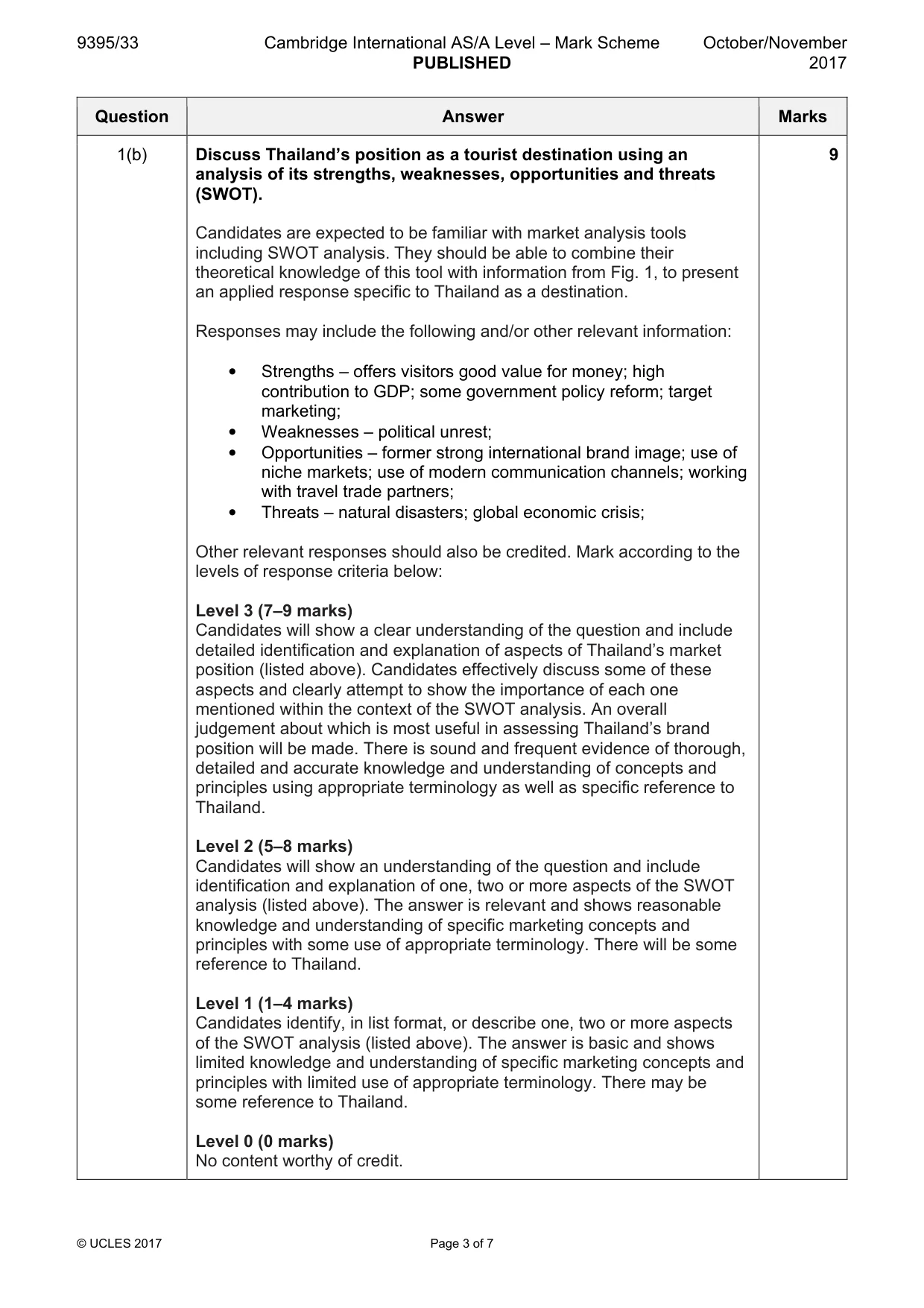
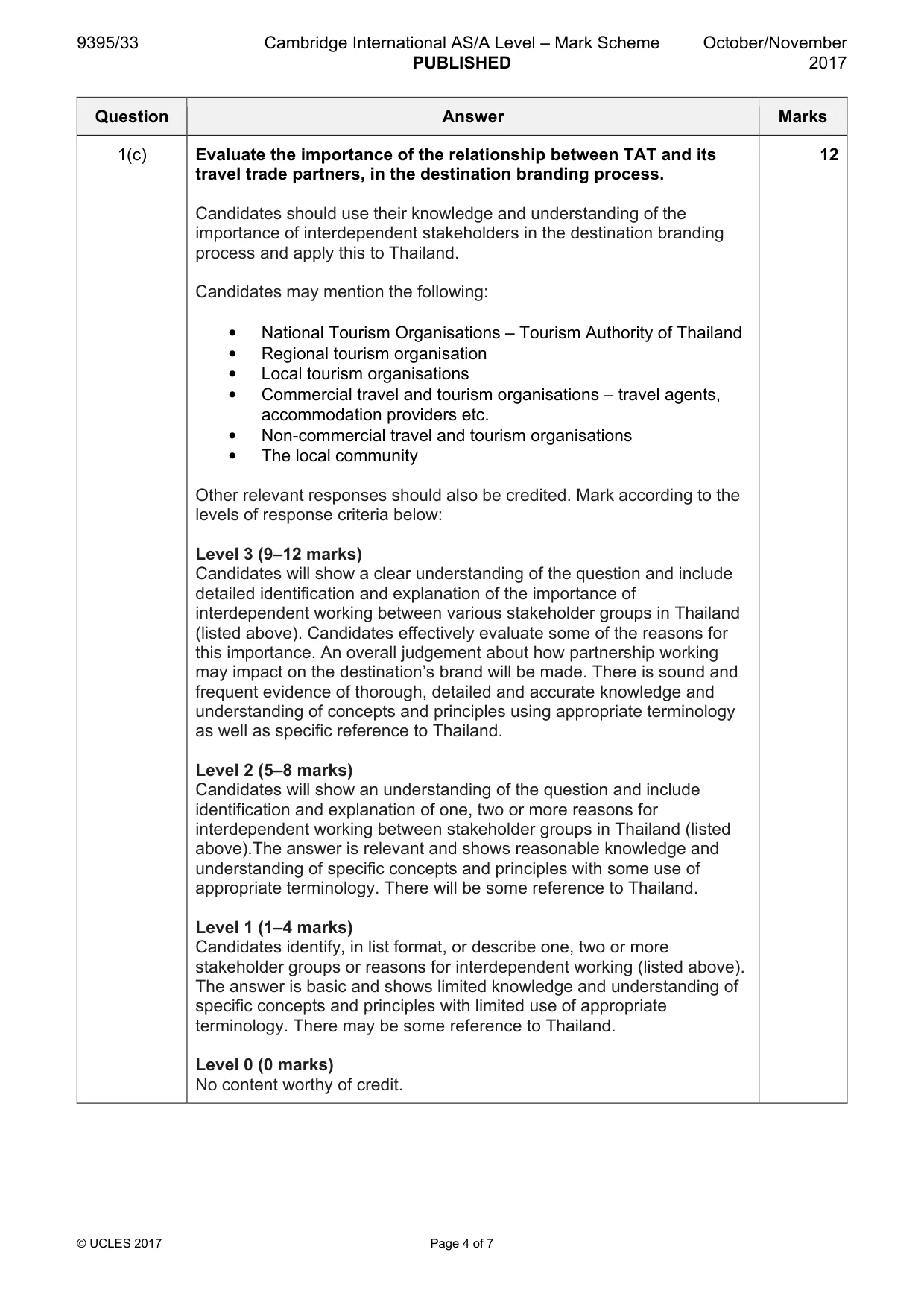
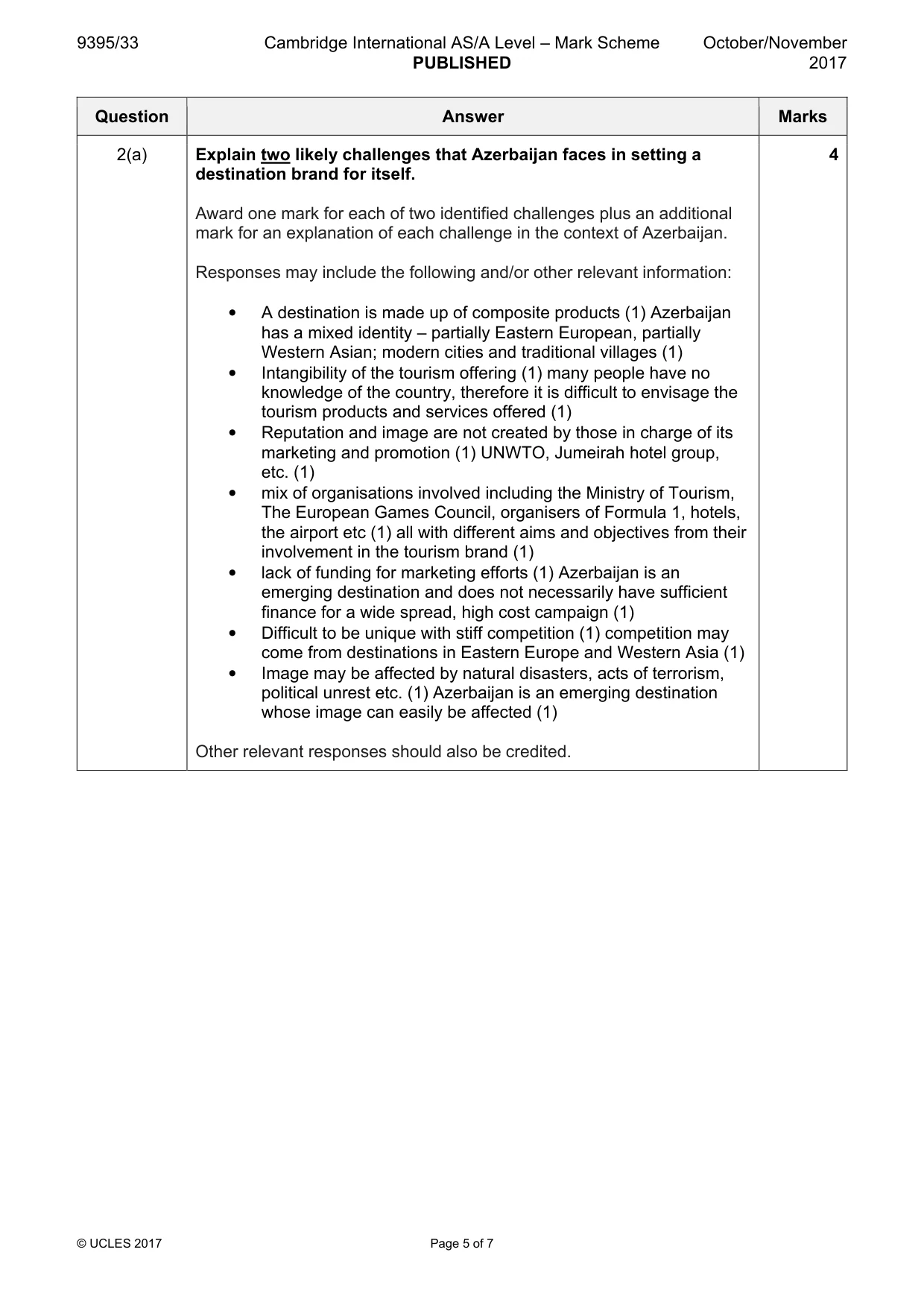
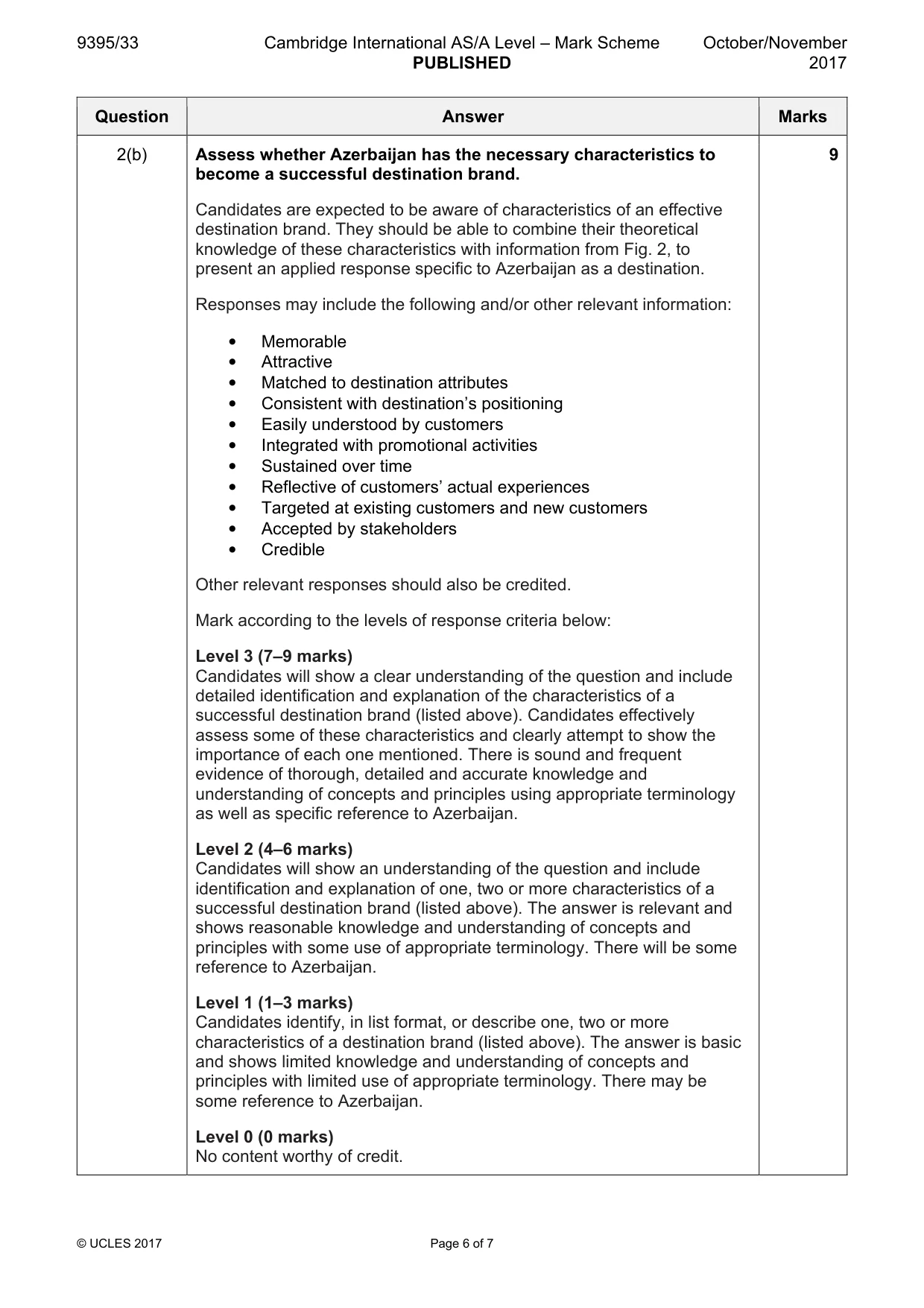
Paper as text
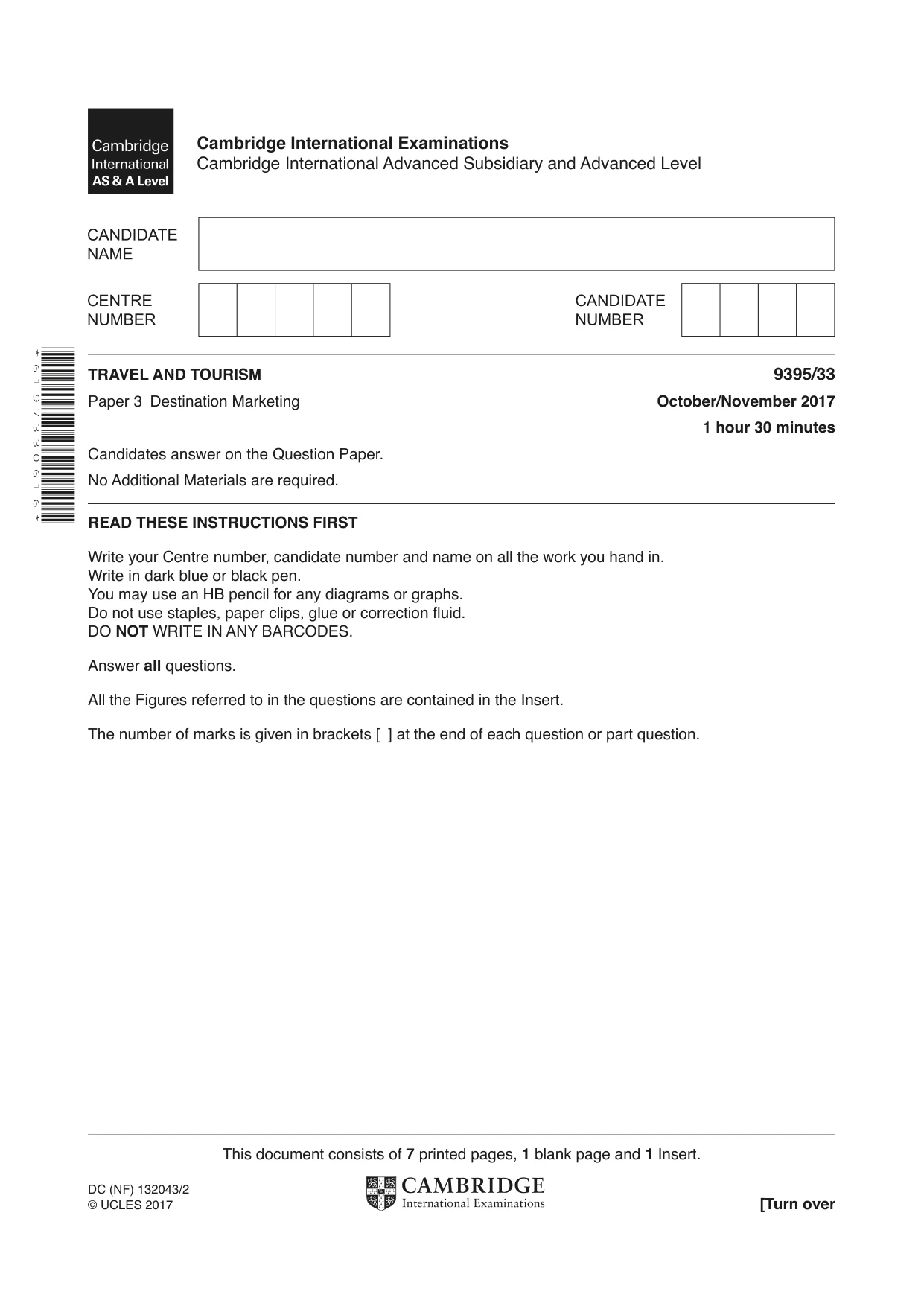
Question paper, page 1
This document consists of 7 printed pages, 1 blank page and 1 Insert. DC (NF) 132043/2 © UCLES 2017 [Turn over * 6 1 9 7 3 3 0 6 1 6 * TRAVEL AND TOURISM 9395/33 Paper 3 Destination Marketing October/November 2017 1 hour 30 minutes Candidates answer on the Question Paper. No Additional Materials are required. READ THESE INSTRUCTIONS FIRST Write your Centre number, candidate number and name on all the work you hand in. Write in dark blue or black pen. You may use an HB pencil for any diagrams or graphs. Do not use staples, paper clips, glue or correction fluid. DO NOT WRITE IN ANY BARCODES. Answer all questions. All the Figures referred to in the questions are contained in the Insert. The number of marks is given in brackets [ ] at the end of each question or part question. Cambridge International Examinations Cambridge International Advanced Subsidiary and Advanced Level
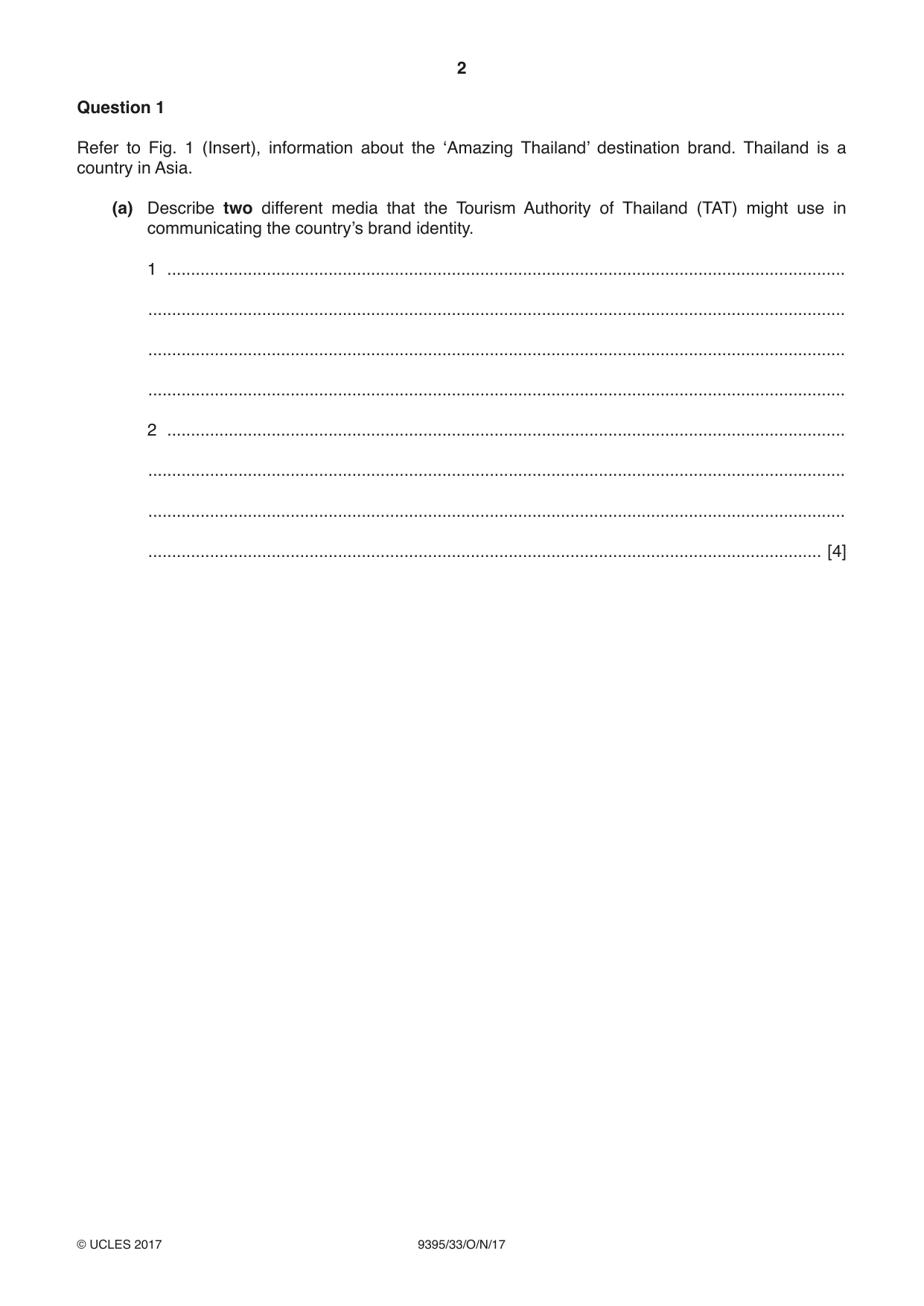
Question paper, page 2
2 9395/33/O/N/17 © UCLES 2017 Question 1 Refer to Fig. 1 (Insert), information about the ‘Amazing Thailand’ destination brand. Thailand is a country in Asia. (a) Describe two different media that the Tourism Authority of Thailand (TAT) might use in communicating the country’s brand identity. 1 … … … … 2 … … … … [4]
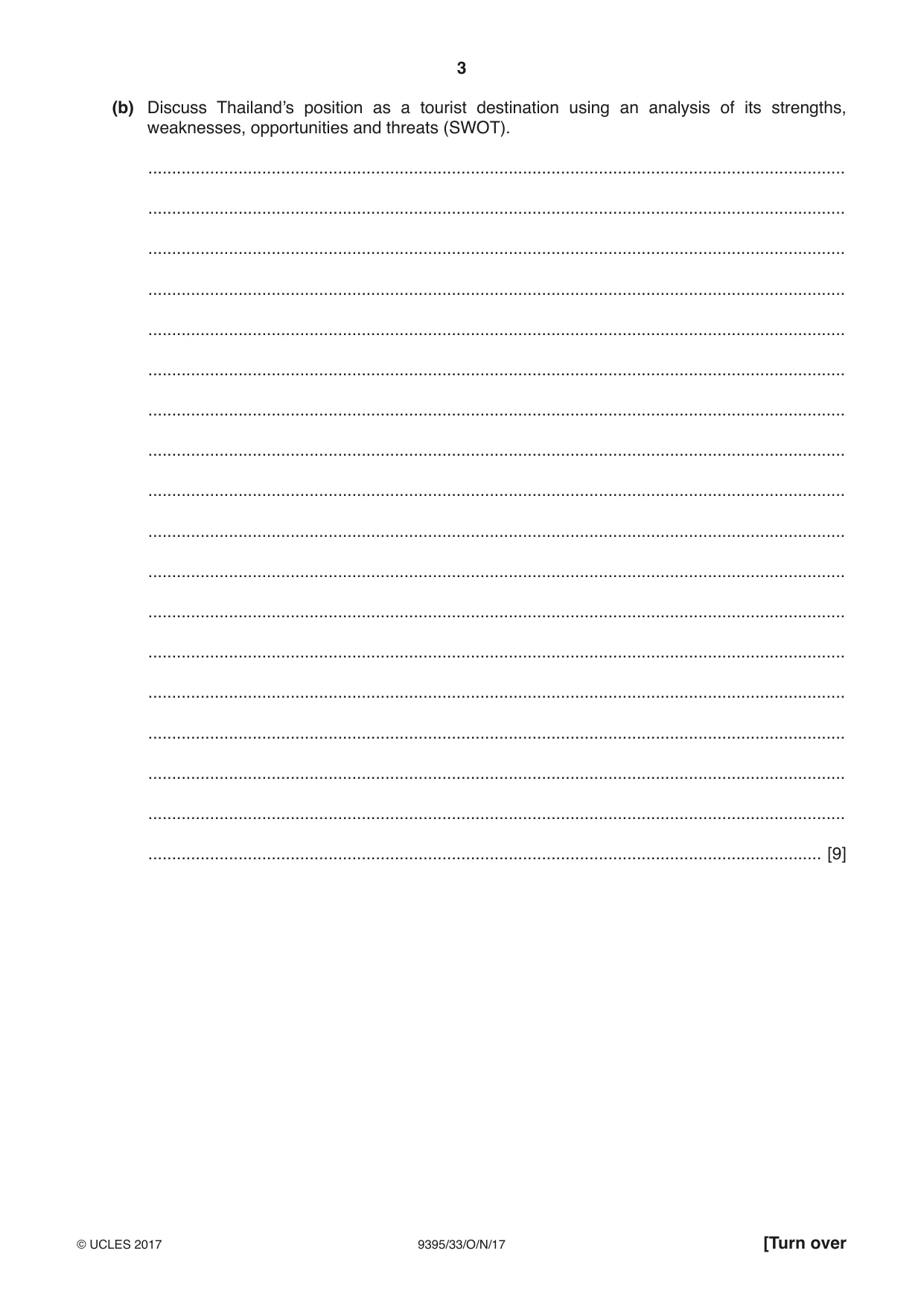
Question paper, page 3
3 9395/33/O/N/17 © UCLES 2017 [Turn over (b) Discuss Thailand’s position as a tourist destination using an analysis of its strengths, weaknesses, opportunities and threats (SWOT). … … … … … … … … … … … … … … … … … … [9]
Question paper, page 4
4 9395/33/O/N/17 © UCLES 2017 (c) Evaluate the importance of the relationship between TAT and its travel trade partners, in the destination branding process. … … … … … … … … … … … … … … … … … … … … … … … … [12] [Total: 25]
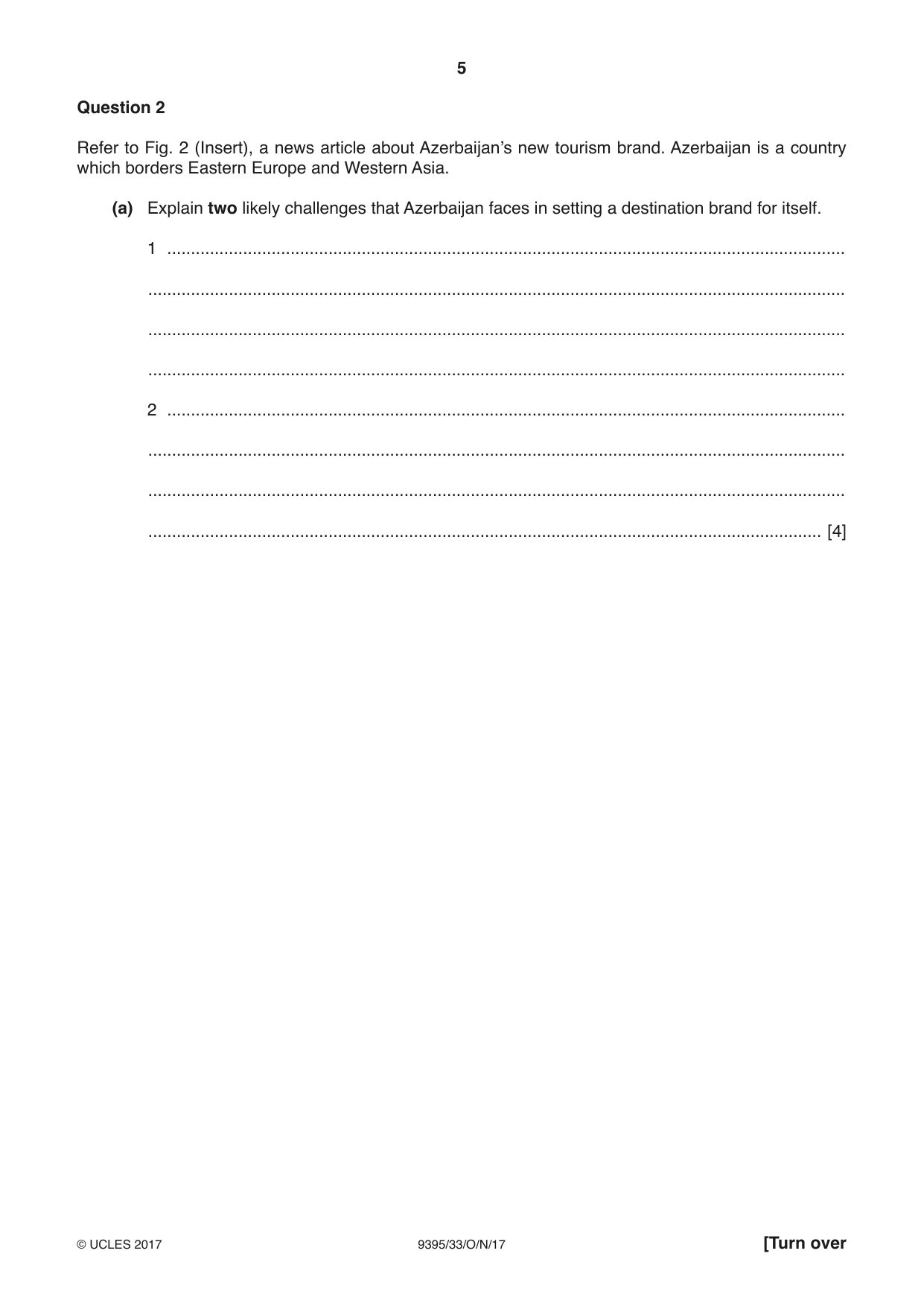
Question paper, page 5
5 9395/33/O/N/17 © UCLES 2017 [Turn over Question 2 Refer to Fig. 2 (Insert), a news article about Azerbaijan’s new tourism brand. Azerbaijan is a country which borders Eastern Europe and Western Asia. (a) Explain two likely challenges that Azerbaijan faces in setting a destination brand for itself. 1 … … … … 2 … … … … [4]
Question paper, page 6
6 9395/33/O/N/17 © UCLES 2017 (b) Assess whether Azerbaijan has the necessary characteristics to become a successful destination brand. … … … … … … … … … … … … … … … … … … [9]
Question paper, page 7
7 9395/33/O/N/17 © UCLES 2017 (c) Discuss the methods that Azerbaijan’s tourism authorities might use in monitoring costs and marketing activities for their destination brand. … … … … … … … … … … … … … … … … … … … … … … … … [12] [Total: 25]
Question paper, page 8
8 9395/33/O/N/17 © UCLES 2017 BLANK PAGE Permission to reproduce items where third-party owned material protected by copyright is included has been sought and cleared where possible. Every reasonable effort has been made by the publisher (UCLES) to trace copyright holders, but if any items requiring clearance have unwittingly been included, the publisher will be pleased to make amends at the earliest possible opportunity. To avoid the issue of disclosure of answer-related information to candidates, all copyright acknowledgements are reproduced online in the Cambridge International Examinations Copyright Acknowledgements Booklet. This is produced for each series of examinations and is freely available to download at www.cie.org.uk after the live examination series. Cambridge International Examinations is part of the Cambridge Assessment Group. Cambridge Assessment is the brand name of University of Cambridge Local Examinations Syndicate (UCLES), which is itself a department of the University of Cambridge.
Mark scheme, page 1
® IGCSE is a registered trademark. This document consists of 7 printed pages. © UCLES 2017 [Turn over Cambridge Assessment International Education Cambridge International Advanced Subsidiary and Advanced Level TRAVEL AND TOURISM 9395/33 Paper 3 Destination Marketing October/November 2017 MARK SCHEME Maximum Mark: 50 Published This mark scheme is published as an aid to teachers and candidates, to indicate the requirements of the examination. It shows the basis on which Examiners were instructed to award marks. It does not indicate the details of the discussions that took place at an Examiners’ meeting before marking began, which would have considered the acceptability of alternative answers. Mark schemes should be read in conjunction with the question paper and the Principal Examiner Report for Teachers. Cambridge International will not enter into discussions about these mark schemes. Cambridge International is publishing the mark schemes for the October/November 2017 series for most Cambridge IGCSE®, Cambridge International A and AS Level components and some Cambridge O Level components.
Mark scheme, page 2
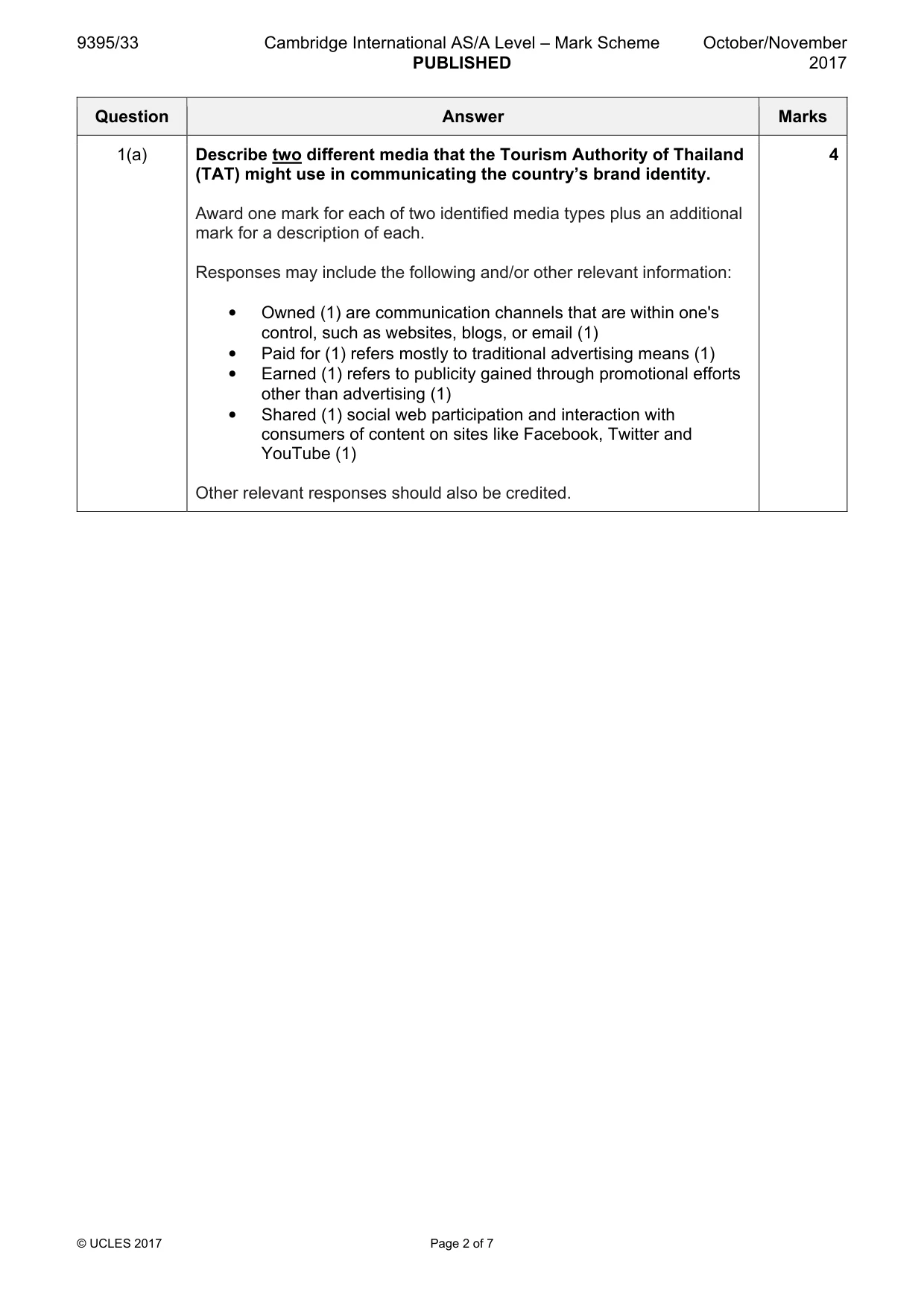
9395/33 Cambridge International AS/A Level – Mark Scheme PUBLISHED October/November 2017 © UCLES 2017 Page 2 of 7 Question Answer Marks 1(a) Describe two different media that the Tourism Authority of Thailand (TAT) might use in communicating the country’s brand identity. Award one mark for each of two identified media types plus an additional mark for a description of each. Responses may include the following and/or other relevant information: • Owned (1) are communication channels that are within one's control, such as websites, blogs, or email (1) • Paid for (1) refers mostly to traditional advertising means (1) • Earned (1) refers to publicity gained through promotional efforts other than advertising (1) • Shared (1) social web participation and interaction with consumers of content on sites like Facebook, Twitter and YouTube (1) Other relevant responses should also be credited. 4
Mark scheme, page 3
9395/33 Cambridge International AS/A Level – Mark Scheme PUBLISHED October/November 2017 © UCLES 2017 Page 3 of 7 Question Answer Marks 1(b) Discuss Thailand’s position as a tourist destination using an analysis of its strengths, weaknesses, opportunities and threats (SWOT). Candidates are expected to be familiar with market analysis tools including SWOT analysis. They should be able to combine their theoretical knowledge of this tool with information from Fig. 1, to present an applied response specific to Thailand as a destination. Responses may include the following and/or other relevant information: • Strengths – offers visitors good value for money; high contribution to GDP; some government policy reform; target marketing; • Weaknesses – political unrest; • Opportunities – former strong international brand image; use of niche markets; use of modern communication channels; working with travel trade partners; • Threats – natural disasters; global economic crisis; Other relevant responses should also be credited. Mark according to the levels of response criteria below: Level 3 (7–9 marks) Candidates will show a clear understanding of the question and include detailed identification and explanation of aspects of Thailand’s market position (listed above). Candidates effectively discuss some of these aspects and clearly attempt to show the importance of each one mentioned within the context of the SWOT analysis. An overall judgement about which is most useful in assessing Thailand’s brand position will be made. There is sound and frequent evidence of thorough, detailed and accurate knowledge and understanding of concepts and principles using appropriate terminology as well as specific reference to Thailand. Level 2 (5–8 marks) Candidates will show an understanding of the question and include identification and explanation of one, two or more aspects of the SWOT analysis (listed above). The answer is relevant and shows reasonable knowledge and understanding of specific marketing concepts and principles with some use of appropriate terminology. There will be some reference to Thailand. Level 1 (1–4 marks) Candidates identify, in list format, or describe one, two or more aspects of the SWOT analysis (listed above). The answer is basic and shows limited knowledge and understanding of specific marketing concepts and principles with limited use of appropriate terminology. There may be some reference to Thailand. Level 0 (0 marks) No content worthy of credit. 9
Mark scheme, page 4
9395/33 Cambridge International AS/A Level – Mark Scheme PUBLISHED October/November 2017 © UCLES 2017 Page 4 of 7 Question Answer Marks 1(c) Evaluate the importance of the relationship between TAT and its travel trade partners, in the destination branding process. Candidates should use their knowledge and understanding of the importance of interdependent stakeholders in the destination branding process and apply this to Thailand. Candidates may mention the following: • National Tourism Organisations – Tourism Authority of Thailand • Regional tourism organisation • Local tourism organisations • Commercial travel and tourism organisations – travel agents, accommodation providers etc. • Non-commercial travel and tourism organisations • The local community Other relevant responses should also be credited. Mark according to the levels of response criteria below: Level 3 (9–12 marks) Candidates will show a clear understanding of the question and include detailed identification and explanation of the importance of interdependent working between various stakeholder groups in Thailand (listed above). Candidates effectively evaluate some of the reasons for this importance. An overall judgement about how partnership working may impact on the destination’s brand will be made. There is sound and frequent evidence of thorough, detailed and accurate knowledge and understanding of concepts and principles using appropriate terminology as well as specific reference to Thailand. Level 2 (5–8 marks) Candidates will show an understanding of the question and include identification and explanation of one, two or more reasons for interdependent working between stakeholder groups in Thailand (listed above).The answer is relevant and shows reasonable knowledge and understanding of specific concepts and principles with some use of appropriate terminology. There will be some reference to Thailand. Level 1 (1–4 marks) Candidates identify, in list format, or describe one, two or more stakeholder groups or reasons for interdependent working (listed above). The answer is basic and shows limited knowledge and understanding of specific concepts and principles with limited use of appropriate terminology. There may be some reference to Thailand. Level 0 (0 marks) No content worthy of credit. 12
Mark scheme, page 5
9395/33 Cambridge International AS/A Level – Mark Scheme PUBLISHED October/November 2017 © UCLES 2017 Page 5 of 7 Question Answer Marks 2(a) Explain two likely challenges that Azerbaijan faces in setting a destination brand for itself. Award one mark for each of two identified challenges plus an additional mark for an explanation of each challenge in the context of Azerbaijan. Responses may include the following and/or other relevant information: • A destination is made up of composite products (1) Azerbaijan has a mixed identity – partially Eastern European, partially Western Asian; modern cities and traditional villages (1) • Intangibility of the tourism offering (1) many people have no knowledge of the country, therefore it is difficult to envisage the tourism products and services offered (1) • Reputation and image are not created by those in charge of its marketing and promotion (1) UNWTO, Jumeirah hotel group, etc. (1) • mix of organisations involved including the Ministry of Tourism, The European Games Council, organisers of Formula 1, hotels, the airport etc (1) all with different aims and objectives from their involvement in the tourism brand (1) • lack of funding for marketing efforts (1) Azerbaijan is an emerging destination and does not necessarily have sufficient finance for a wide spread, high cost campaign (1) • Difficult to be unique with stiff competition (1) competition may come from destinations in Eastern Europe and Western Asia (1) • Image may be affected by natural disasters, acts of terrorism, political unrest etc. (1) Azerbaijan is an emerging destination whose image can easily be affected (1) Other relevant responses should also be credited. 4
Mark scheme, page 6
9395/33 Cambridge International AS/A Level – Mark Scheme PUBLISHED October/November 2017 © UCLES 2017 Page 6 of 7 Question Answer Marks 2(b) Assess whether Azerbaijan has the necessary characteristics to become a successful destination brand. Candidates are expected to be aware of characteristics of an effective destination brand. They should be able to combine their theoretical knowledge of these characteristics with information from Fig. 2, to present an applied response specific to Azerbaijan as a destination. Responses may include the following and/or other relevant information: • Memorable • Attractive • Matched to destination attributes • Consistent with destination’s positioning • Easily understood by customers • Integrated with promotional activities • Sustained over time • Reflective of customers’ actual experiences • Targeted at existing customers and new customers • Accepted by stakeholders • Credible Other relevant responses should also be credited. Mark according to the levels of response criteria below: Level 3 (7–9 marks) Candidates will show a clear understanding of the question and include detailed identification and explanation of the characteristics of a successful destination brand (listed above). Candidates effectively assess some of these characteristics and clearly attempt to show the importance of each one mentioned. There is sound and frequent evidence of thorough, detailed and accurate knowledge and understanding of concepts and principles using appropriate terminology as well as specific reference to Azerbaijan. Level 2 (4–6 marks) Candidates will show an understanding of the question and include identification and explanation of one, two or more characteristics of a successful destination brand (listed above). The answer is relevant and shows reasonable knowledge and understanding of concepts and principles with some use of appropriate terminology. There will be some reference to Azerbaijan. Level 1 (1–3 marks) Candidates identify, in list format, or describe one, two or more characteristics of a destination brand (listed above). The answer is basic and shows limited knowledge and understanding of concepts and principles with limited use of appropriate terminology. There may be some reference to Azerbaijan. Level 0 (0 marks) No content worthy of credit. 9
Mark scheme, page 7
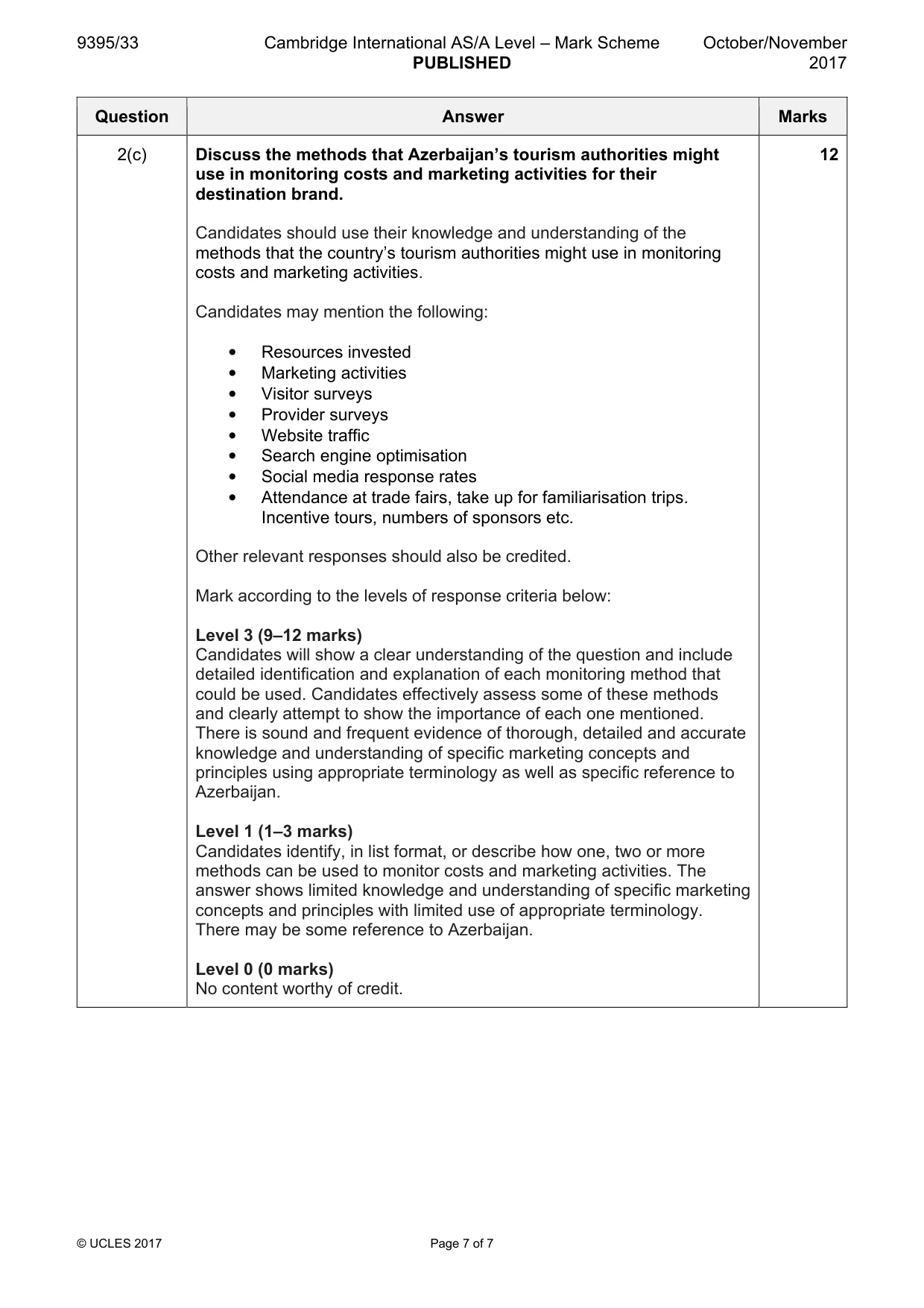
9395/33 Cambridge International AS/A Level – Mark Scheme PUBLISHED October/November 2017 © UCLES 2017 Page 7 of 7 Question Answer Marks 2(c) Discuss the methods that Azerbaijan’s tourism authorities might use in monitoring costs and marketing activities for their destination brand. Candidates should use their knowledge and understanding of the methods that the country’s tourism authorities might use in monitoring costs and marketing activities. Candidates may mention the following: • Resources invested • Marketing activities • Visitor surveys • Provider surveys • Website traffic • Search engine optimisation • Social media response rates • Attendance at trade fairs, take up for familiarisation trips. Incentive tours, numbers of sponsors etc. Other relevant responses should also be credited. Mark according to the levels of response criteria below: Level 3 (9–12 marks) Candidates will show a clear understanding of the question and include detailed identification and explanation of each monitoring method that could be used. Candidates effectively assess some of these methods and clearly attempt to show the importance of each one mentioned. There is sound and frequent evidence of thorough, detailed and accurate knowledge and understanding of specific marketing concepts and principles using appropriate terminology as well as specific reference to Azerbaijan. Level 1 (1–3 marks) Candidates identify, in list format, or describe how one, two or more methods can be used to monitor costs and marketing activities. The answer shows limited knowledge and understanding of specific marketing concepts and principles with limited use of appropriate terminology. There may be some reference to Azerbaijan. Level 0 (0 marks) No content worthy of credit. 12
What you needed in this session
Cambridge’s own grade thresholds for 2017 Oct/Nov, Paper 3 · Variant 3. A higher threshold means an easier paper — the bar moves with how the cohort did.