Cambridge A Level Travel and Tourism 9395 — 2016 May/June Paper 1 · Variant 2
9395/12/M/J/16 · 100 marks · ≈113 min
The question paper and its mark scheme, free to read here and free to download. This is Cambridge’s own paper, exactly as it was sat.
Question paper16 pages



Mark scheme9 pages
Answers below. Sit the paper first if you are practising.
Paper as text
Question paper, page 1
This document consists of 13 printed pages, 3 blank pages and 1 insert. DC (ST) 113335/2 © UCLES 2016 [Turn over Cambridge International Examinations Cambridge International Advanced Subsidiary and Advanced Level * 5 9 0 9 9 4 8 3 2 6 * TRAVEL AND TOURISM 9395/12 Paper 1 Core May/June 2016 2 hours and 30 minutes Candidates answer on the Question Paper. No Additional Materials are required. READ THESE INSTRUCTIONS FIRST Write your Centre number, candidate number and name on all the work you hand in. Write in dark blue or black pen. You may use an HB pencil for any diagrams or graphs. Do not use staples, paper clips, glue or correction fluid. DO NOT WRITE IN ANY BARCODES. Answer all questions. All the Figures referred to in the questions are contained in the Insert. The number of marks is given in brackets [ ] at the end of each question or part question.
Question paper, page 2
2 9395/12/M/J/16 © UCLES 2016 Question 1 Refer to Fig. 1 (Insert), information about some of the tourist attractions to be found in Brussels, Belgium. (a) Using only information from Fig. 1 (Insert), explain two ways in which Scott’s café-bar will benefit from locating on the Rue Montagnes aux Herbes Potageres. 1 … … … … 2 … … … … [4] (b) Fig. 1 (Insert) suggests that Brussels is likely to attract international visitors interested in specialised niche tourism for either art, shopping or food and drink. State three other types of specialised niche tourism and give a definition to indicate what each involves. Type 1 … Definition … … … Type 2 … Definition … … … Type 3 … Definition … … … [6]
Question paper, page 3
3 9395/12/M/J/16 © UCLES 2016 [Turn over (c) Brussels is an important destination for business tourism. Discuss the reasons why business tourism tends to be less seasonal than leisure tourism. … … … … … … … … … … … …[6]
Question paper, page 4
4 9395/12/M/J/16 © UCLES 2016 (d) Evaluate the venues which are used for business tourism events within one destination. Chosen destination … … … … … … … … … … … … … … … … … … … … … … … … … …[9] [Total: 25]
Question paper, page 5
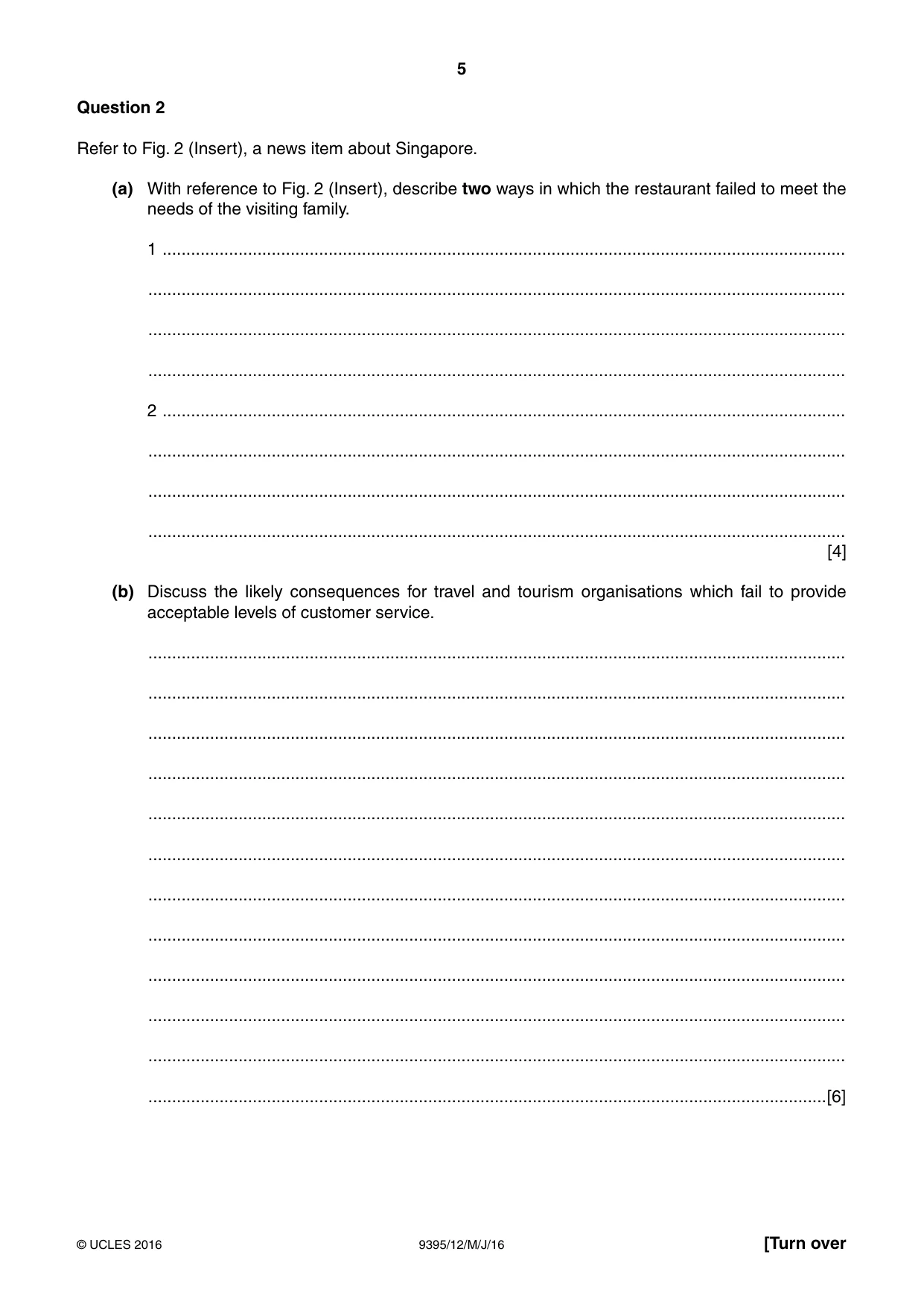
5 9395/12/M/J/16 © UCLES 2016 [Turn over Question 2 Refer to Fig. 2 (Insert), a news item about Singapore. (a) With reference to Fig. 2 (Insert), describe two ways in which the restaurant failed to meet the needs of the visiting family. 1 … … … … 2 … … … … [4] (b) Discuss the likely consequences for travel and tourism organisations which fail to provide acceptable levels of customer service. … … … … … … … … … … … …[6]
Question paper, page 6
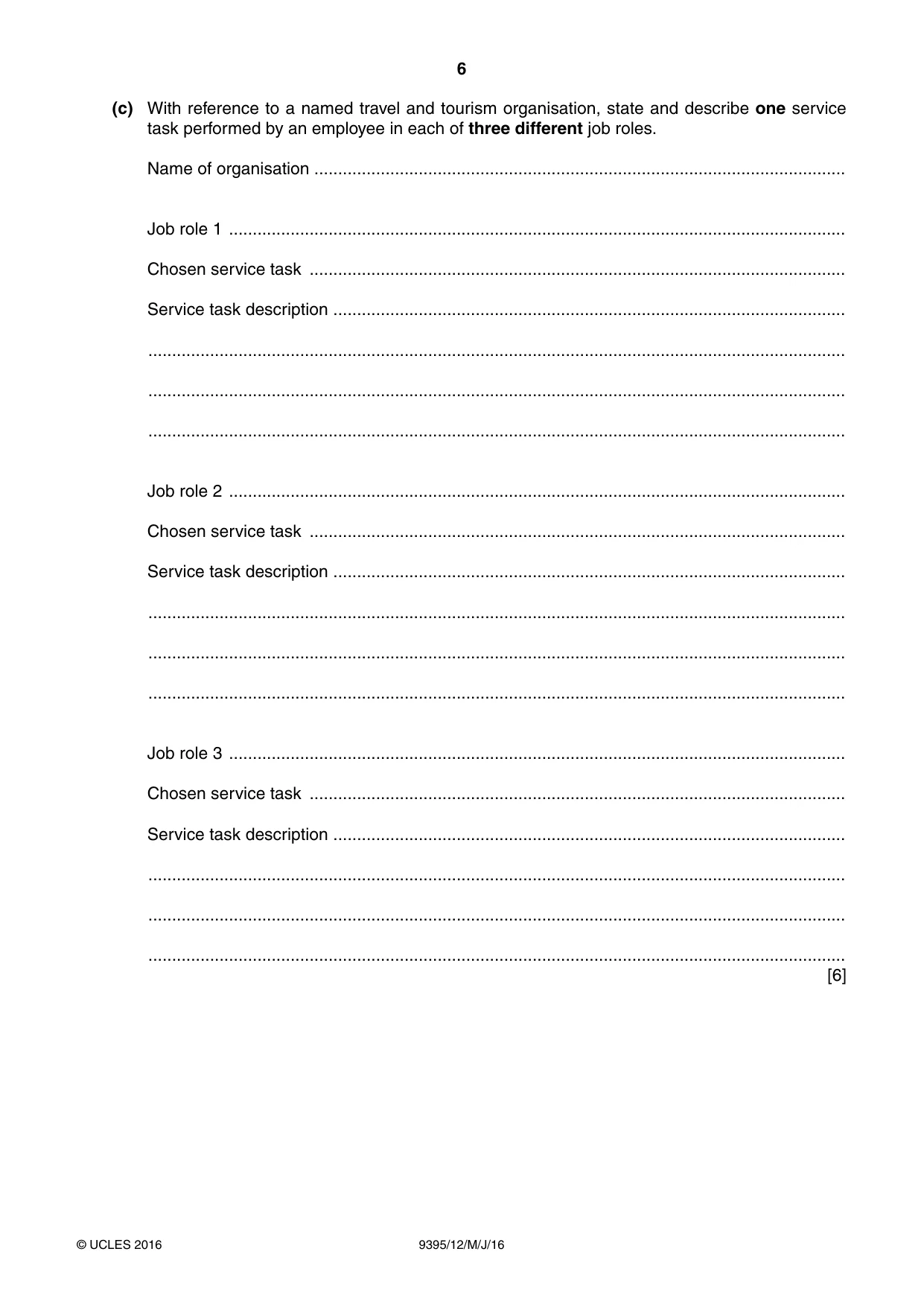
6 9395/12/M/J/16 © UCLES 2016 (c) With reference to a named travel and tourism organisation, state and describe one service task performed by an employee in each of three different job roles. Name of organisation … Job role 1 … Chosen service task … Service task description … … … … Job role 2 … Chosen service task … Service task description … … … … Job role 3 … Chosen service task … Service task description … … … … [6]
Question paper, page 7
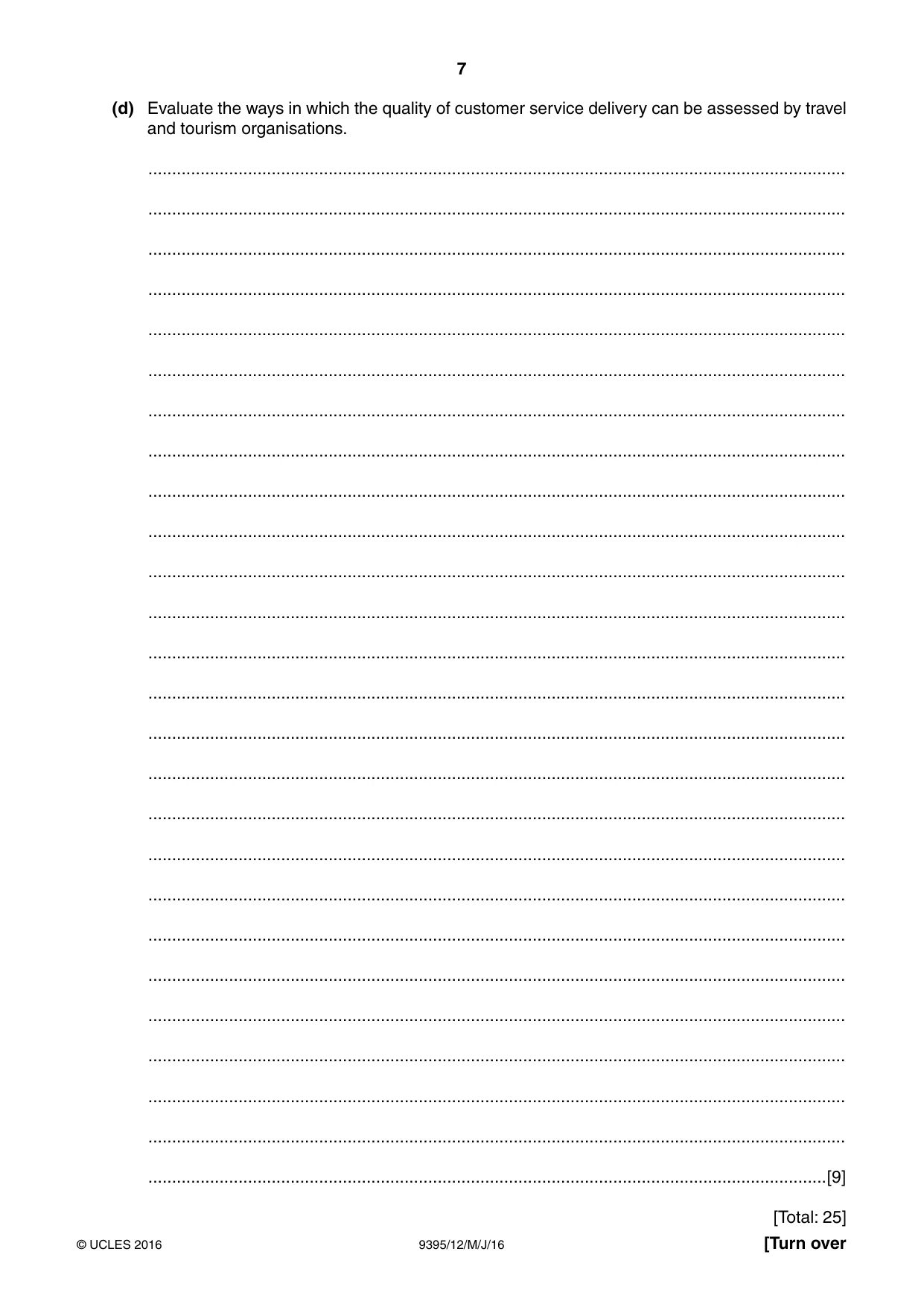
7 9395/12/M/J/16 © UCLES 2016 [Turn over (d) Evaluate the ways in which the quality of customer service delivery can be assessed by travel and tourism organisations. … … … … … … … … … … … … … … … … … … … … … … … … … …[9] [Total: 25]
Question paper, page 8
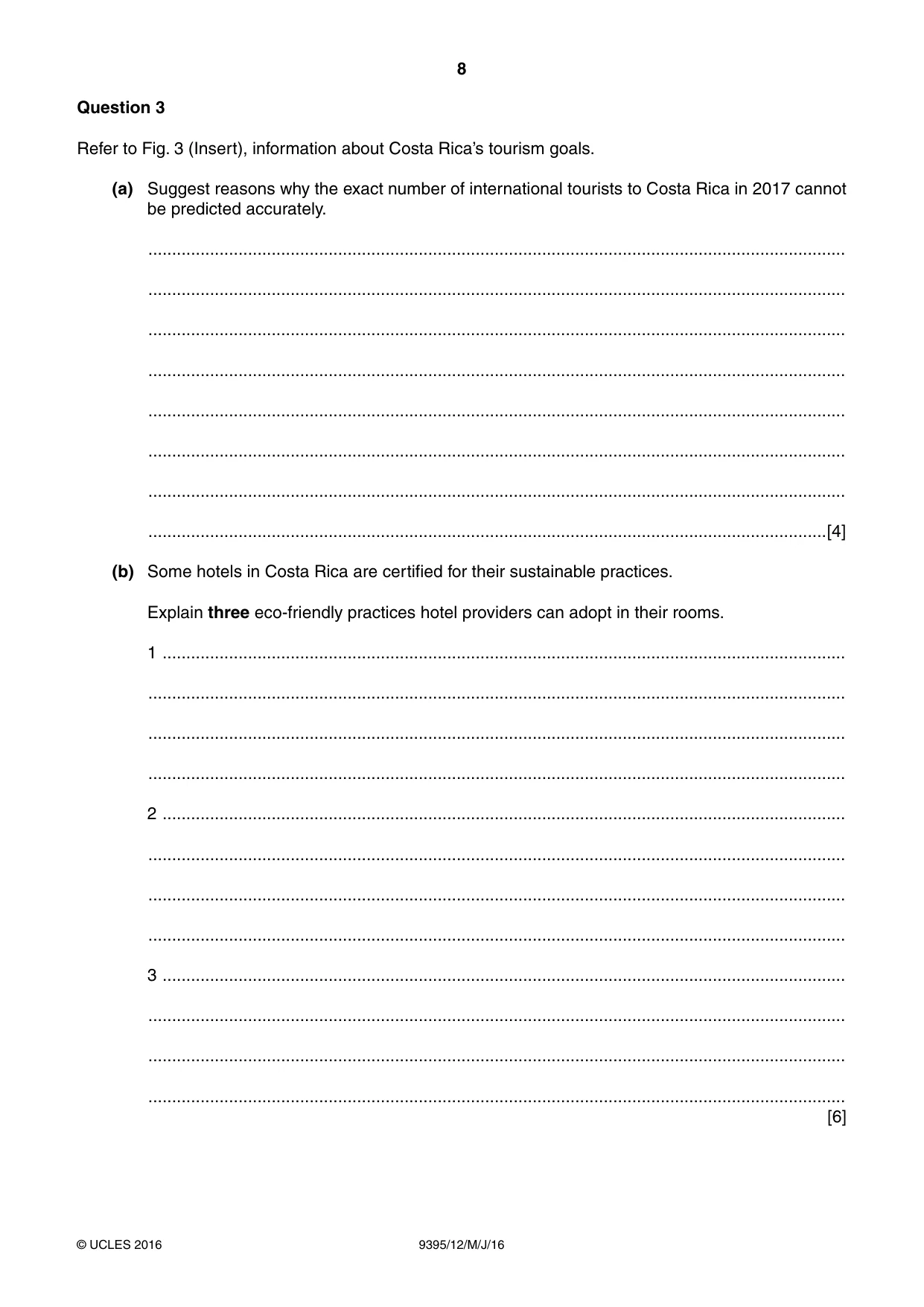
8 9395/12/M/J/16 © UCLES 2016 Question 3 Refer to Fig. 3 (Insert), information about Costa Rica’s tourism goals. (a) Suggest reasons why the exact number of international tourists to Costa Rica in 2017 cannot be predicted accurately. … … … … … … … …[4] (b) Some hotels in Costa Rica are certified for their sustainable practices. Explain three eco-friendly practices hotel providers can adopt in their rooms. 1 … … … … 2 … … … … 3 … … … … [6]
Question paper, page 9
9 9395/12/M/J/16 © UCLES 2016 [Turn over (c) Costa Rica is a less economically developed country (LEDC). Explain why the development of its tourism industry might result in each of the following: • export leakage … … … … • import leakage … … … … • increased living costs … … … … [6]
Question paper, page 10
10 9395/12/M/J/16 © UCLES 2016 (d) With reference to Photograph A (Insert), evaluate the negative environmental impacts which are likely to be caused by tourists visiting this destination. … … … … … … … … … … … … … … … … … … … … … … … … … …[9] [Total: 25]
Question paper, page 11
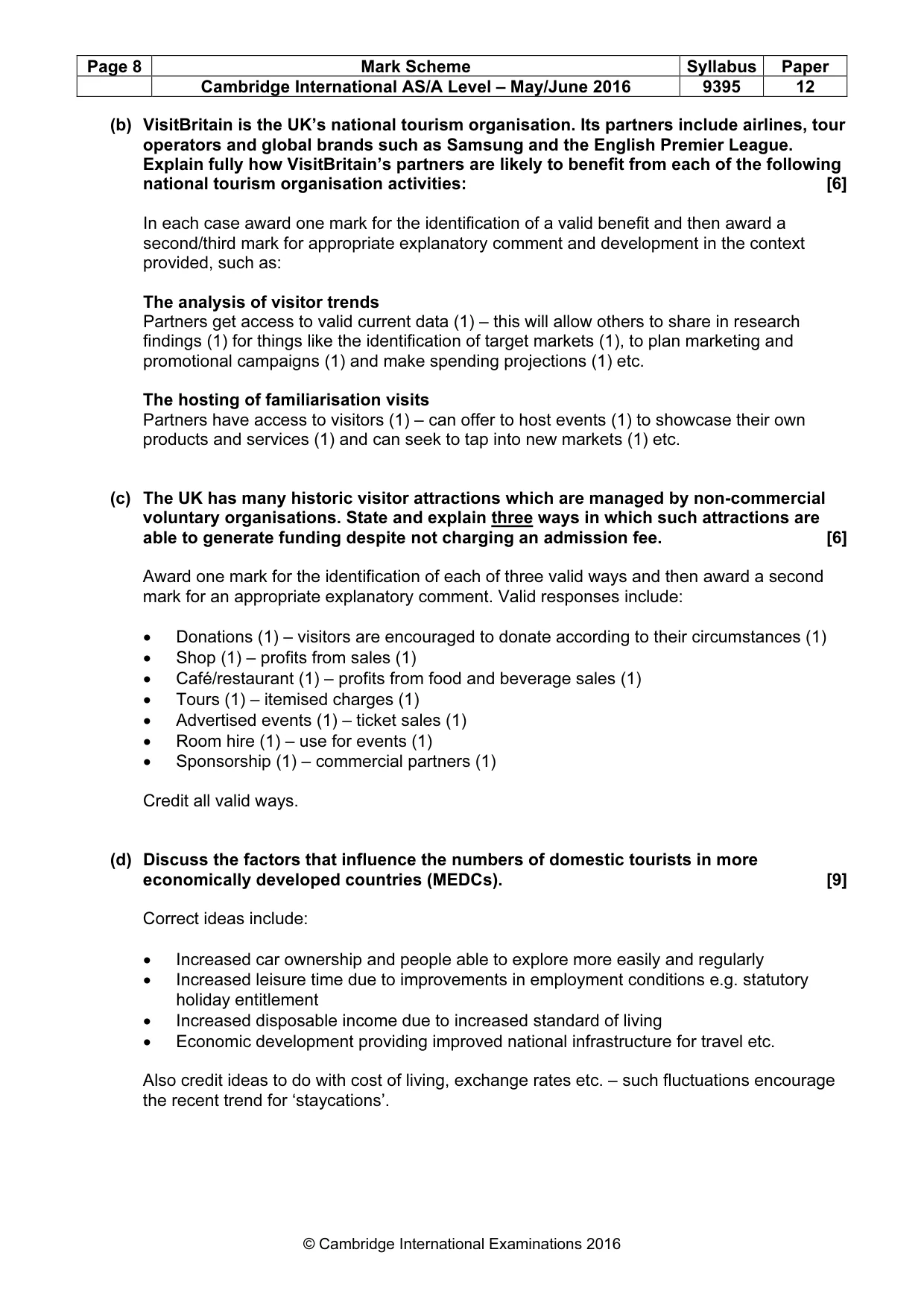
11 9395/12/M/J/16 © UCLES 2016 [Turn over Question 4 Refer to Fig. 4 (Insert), information about inbound tourism to the UK in 2013. (a) Identify from Fig. 4 (Insert), the following: • the country in the UK receiving the fewest international tourists in 2013 … • the UK’s most important source market for international visitor numbers in 2013 … • the UK’s highest spending European source market in 2013 … • the amount spent by international visitors to London in 2013 … [4] (b) VisitBritain is the UK’s national tourism organisation. Its partners include airlines, tour operators and global brands such as Samsung and the English Premier League. Explain fully how VisitBritain’s partners are likely to benefit from each of the following national tourism organisation activities: • the analysis of visitor trends … … … … … … • the hosting of familiarisation visits … … … … … … [6]
Question paper, page 12
12 9395/12/M/J/16 © UCLES 2016 (c) The UK has many historic visitor attractions which are managed by non-commercial voluntary organisations. State and explain three ways in which such attractions are able to generate funding despite not charging an admission fee. 1 … … … … 2 … … … … 3 … … … … [6]
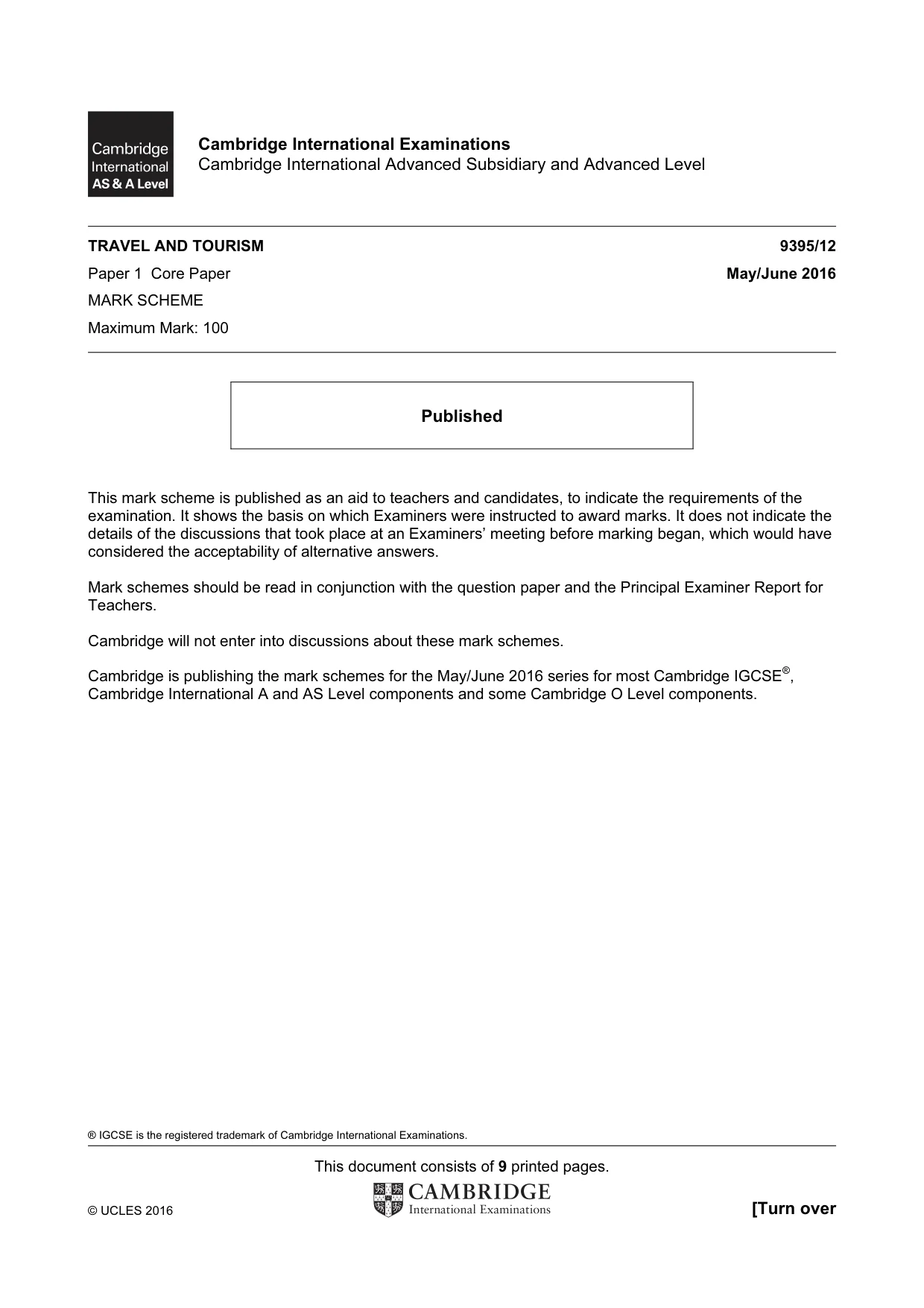
Question paper, page 13
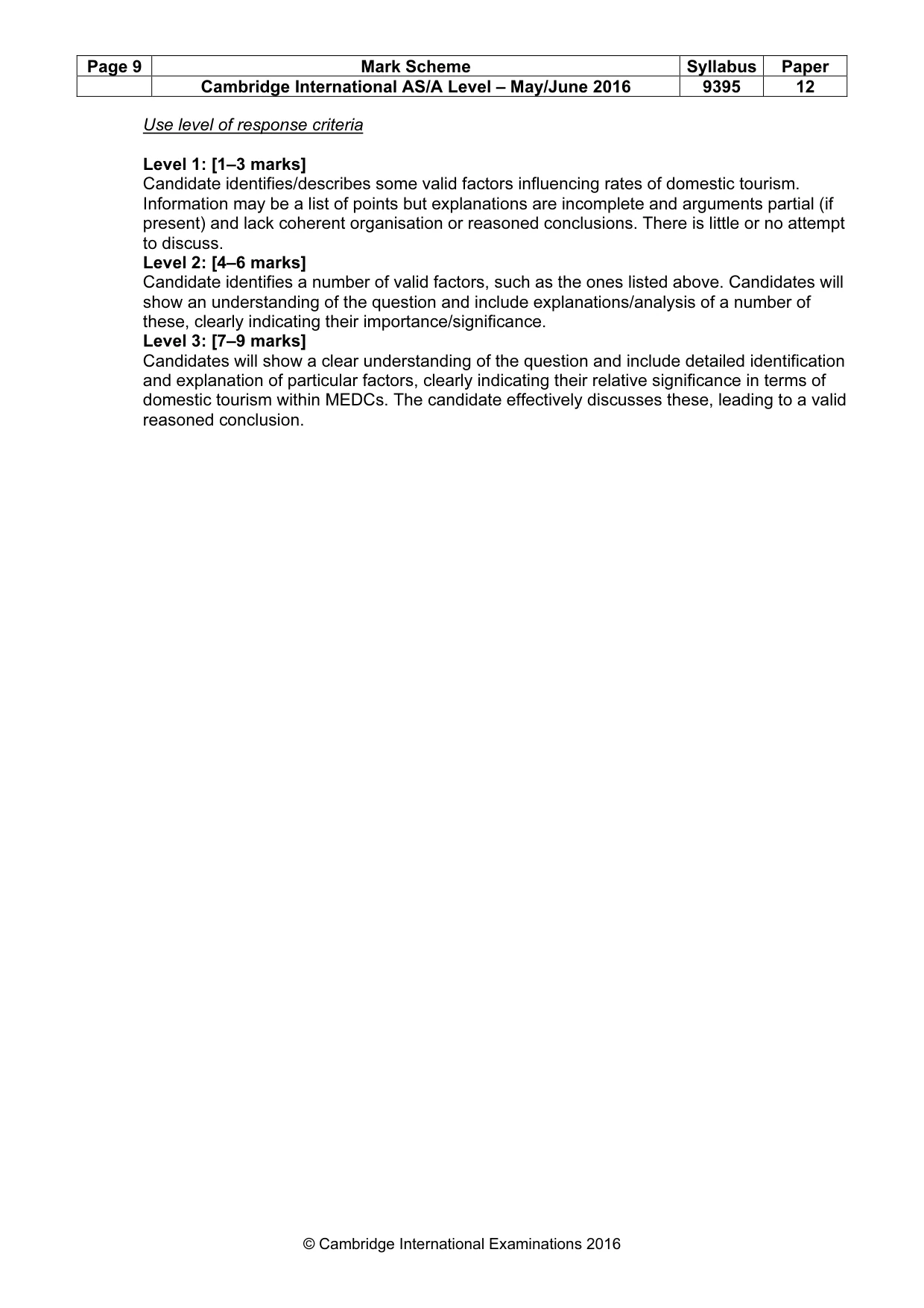
13 9395/12/M/J/16 © UCLES 2016 (d) Discuss the factors that influence the numbers of domestic tourists in more economically developed countries (MEDCs). … … … … … … … … … … … … … … … … … … … … … … … … … …[9] [Total: 25]
Question paper, page 14
14 9395/12/M/J/16 © UCLES 2016 BLANK PAGE
Question paper, page 15
15 9395/12/M/J/16 © UCLES 2016 BLANK PAGE
Question paper, page 16
16 9395/12/M/J/16 © UCLES 2016 Permission to reproduce items where third-party owned material protected by copyright is included has been sought and cleared where possible. Every reasonable effort has been made by the publisher (UCLES) to trace copyright holders, but if any items requiring clearance have unwittingly been included, the publisher will be pleased to make amends at the earliest possible opportunity. To avoid the issue of disclosure of answer-related information to candidates, all copyright acknowledgements are reproduced online in the Cambridge International Examinations Copyright Acknowledgements Booklet. This is produced for each series of examinations and is freely available to download at www.cie.org.uk after the live examination series. Cambridge International Examinations is part of the Cambridge Assessment Group. Cambridge Assessment is the brand name of University of Cambridge Local Examinations Syndicate (UCLES), which is itself a department of the University of Cambridge. BLANK PAGE
Mark scheme, page 1
® IGCSE is the registered trademark of Cambridge International Examinations. This document consists of 9 printed pages. © UCLES 2016 [Turn over Cambridge International Examinations Cambridge International Advanced Subsidiary and Advanced Level TRAVEL AND TOURISM 9395/12 Paper 1 Core Paper May/June 2016 MARK SCHEME Maximum Mark: 100 Published This mark scheme is published as an aid to teachers and candidates, to indicate the requirements of the examination. It shows the basis on which Examiners were instructed to award marks. It does not indicate the details of the discussions that took place at an Examiners’ meeting before marking began, which would have considered the acceptability of alternative answers. Mark schemes should be read in conjunction with the question paper and the Principal Examiner Report for Teachers. Cambridge will not enter into discussions about these mark schemes. Cambridge is publishing the mark schemes for the May/June 2016 series for most Cambridge IGCSE®, Cambridge International A and AS Level components and some Cambridge O Level components.
Mark scheme, page 2
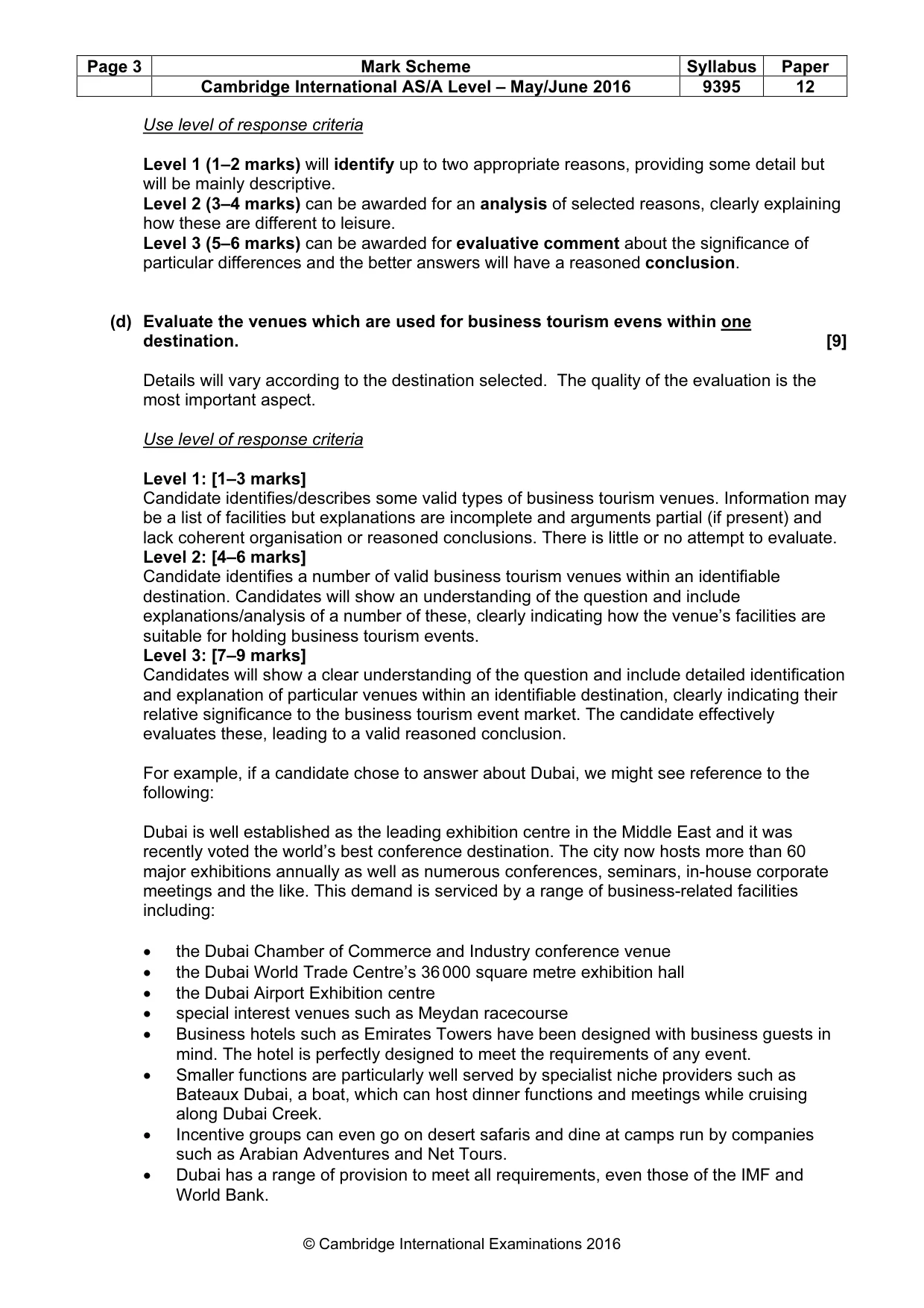
Page 2 Mark Scheme Syllabus Paper Cambridge International AS/A Level – May/June 2016 9395 12 © Cambridge International Examinations 2016 1 (a) Using only information from Fig. 1 (Insert), explain two ways in which Scott’s café-bar will benefit from locating on the Rue Montagnes aux Herbes Potageres. [4] Award one mark for the identification of each of two aspects of the location and then award a second mark for an explanatory statement about the benefit. Valid responses are: • By ‘Cat on bike’ (1) – can appeal to sight-seeing visitors (1) • By the Galeries Royales (1) – can appeal to shoppers (1) • Only 200 m from Gare Central (1) – can appeal to travellers (1) • In a building which dates back to 1865 (1) – image suggests historic interest (1)/or likely to have large area (floor space) for commercial development (1) • Wide pavement (1) – space for tables (1) Credit all valid reasoning. (b) Fig. 1 (Insert) suggests that Brussels is likely to attract international visitors interested in specialised niche tourism for either art, shopping or food and drink. State three other types of specialised niche tourism and give a definition to indicate what each involves. [6] Award one mark for the identification of each of three valid niches and award a second mark for an appropriate definition of each, such as: • Medical tourism (1) – medical packages which offer cheaper general or cosmetic surgery abroad, followed by recuperation (1) • Religious tourism (1) – religious journeys or pilgrimages to destinations (1) • Adventure tourism (1) – such as trekking in the jungles or mountains (1) • Cultural tourism (1) – heritage tours visiting historical and cultural sites, often in cities (1) • Ecotourism (1) – trips to experience the unspoilt natural environment and wildlife in destinations (1) • Sports tourism (1) – trips to see a cricket or rugby team in a competition abroad or attending the FIFA World Cup or Olympic Games (1) • Spa tourism (1) – visits to spa resorts which offer health therapy and beauty treatments in luxurious, relaxing surroundings (1) • Dark tourism (1) – trips to the locations of former conflicts, such as battlefields or concentration camps (1) (c) Brussels is an important destination for business tourism. Discuss the reasons why business tourism tends to be less seasonal than leisure tourism. [6] Correct ideas include: • Not influenced by weather • No high or low season • Indoor meetings • Not subject to same cost considerations • Takes place according to need
Mark scheme, page 3
Page 3 Mark Scheme Syllabus Paper Cambridge International AS/A Level – May/June 2016 9395 12 © Cambridge International Examinations 2016 Use level of response criteria Level 1 (1–2 marks) will identify up to two appropriate reasons, providing some detail but will be mainly descriptive. Level 2 (3–4 marks) can be awarded for an analysis of selected reasons, clearly explaining how these are different to leisure. Level 3 (5–6 marks) can be awarded for evaluative comment about the significance of particular differences and the better answers will have a reasoned conclusion. (d) Evaluate the venues which are used for business tourism evens within one destination. [9] Details will vary according to the destination selected. The quality of the evaluation is the most important aspect. Use level of response criteria Level 1: [1–3 marks] Candidate identifies/describes some valid types of business tourism venues. Information may be a list of facilities but explanations are incomplete and arguments partial (if present) and lack coherent organisation or reasoned conclusions. There is little or no attempt to evaluate. Level 2: [4–6 marks] Candidate identifies a number of valid business tourism venues within an identifiable destination. Candidates will show an understanding of the question and include explanations/analysis of a number of these, clearly indicating how the venue’s facilities are suitable for holding business tourism events. Level 3: [7–9 marks] Candidates will show a clear understanding of the question and include detailed identification and explanation of particular venues within an identifiable destination, clearly indicating their relative significance to the business tourism event market. The candidate effectively evaluates these, leading to a valid reasoned conclusion. For example, if a candidate chose to answer about Dubai, we might see reference to the following: Dubai is well established as the leading exhibition centre in the Middle East and it was recently voted the world’s best conference destination. The city now hosts more than 60 major exhibitions annually as well as numerous conferences, seminars, in-house corporate meetings and the like. This demand is serviced by a range of business-related facilities including: • the Dubai Chamber of Commerce and Industry conference venue • the Dubai World Trade Centre’s 36 000 square metre exhibition hall • the Dubai Airport Exhibition centre • special interest venues such as Meydan racecourse • Business hotels such as Emirates Towers have been designed with business guests in mind. The hotel is perfectly designed to meet the requirements of any event. • Smaller functions are particularly well served by specialist niche providers such as Bateaux Dubai, a boat, which can host dinner functions and meetings while cruising along Dubai Creek. • Incentive groups can even go on desert safaris and dine at camps run by companies such as Arabian Adventures and Net Tours. • Dubai has a range of provision to meet all requirements, even those of the IMF and World Bank.
Mark scheme, page 4
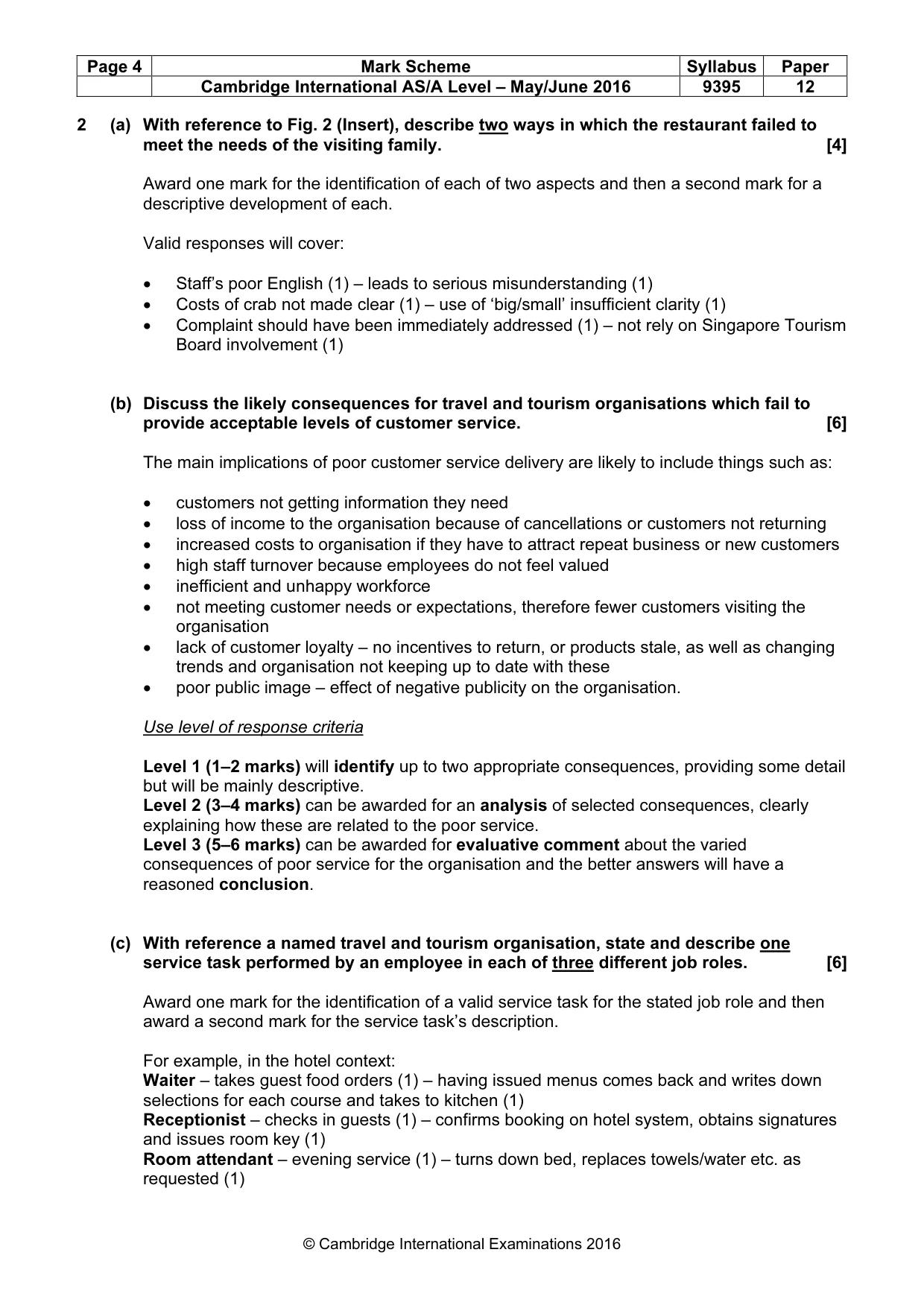
Page 4 Mark Scheme Syllabus Paper Cambridge International AS/A Level – May/June 2016 9395 12 © Cambridge International Examinations 2016 2 (a) With reference to Fig. 2 (Insert), describe two ways in which the restaurant failed to meet the needs of the visiting family. [4] Award one mark for the identification of each of two aspects and then a second mark for a descriptive development of each. Valid responses will cover: • Staff’s poor English (1) – leads to serious misunderstanding (1) • Costs of crab not made clear (1) – use of ‘big/small’ insufficient clarity (1) • Complaint should have been immediately addressed (1) – not rely on Singapore Tourism Board involvement (1) (b) Discuss the likely consequences for travel and tourism organisations which fail to provide acceptable levels of customer service. [6] The main implications of poor customer service delivery are likely to include things such as: • customers not getting information they need • loss of income to the organisation because of cancellations or customers not returning • increased costs to organisation if they have to attract repeat business or new customers • high staff turnover because employees do not feel valued • inefficient and unhappy workforce • not meeting customer needs or expectations, therefore fewer customers visiting the organisation • lack of customer loyalty – no incentives to return, or products stale, as well as changing trends and organisation not keeping up to date with these • poor public image – effect of negative publicity on the organisation. Use level of response criteria Level 1 (1–2 marks) will identify up to two appropriate consequences, providing some detail but will be mainly descriptive. Level 2 (3–4 marks) can be awarded for an analysis of selected consequences, clearly explaining how these are related to the poor service. Level 3 (5–6 marks) can be awarded for evaluative comment about the varied consequences of poor service for the organisation and the better answers will have a reasoned conclusion. (c) With reference a named travel and tourism organisation, state and describe one service task performed by an employee in each of three different job roles. [6] Award one mark for the identification of a valid service task for the stated job role and then award a second mark for the service task’s description. For example, in the hotel context: Waiter – takes guest food orders (1) – having issued menus comes back and writes down selections for each course and takes to kitchen (1) Receptionist – checks in guests (1) – confirms booking on hotel system, obtains signatures and issues room key (1) Room attendant – evening service (1) – turns down bed, replaces towels/water etc. as requested (1)
Mark scheme, page 5
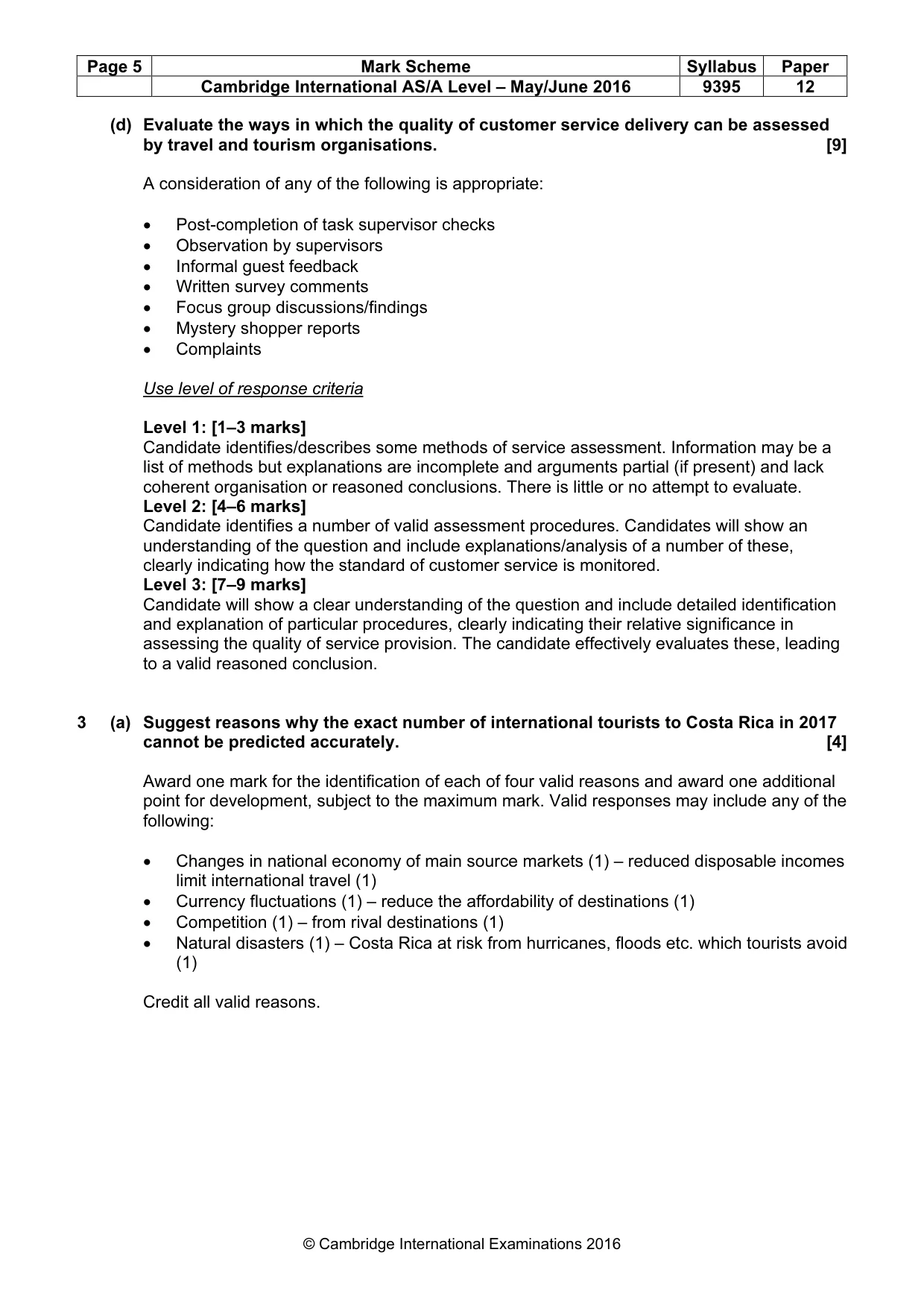
Page 5 Mark Scheme Syllabus Paper Cambridge International AS/A Level – May/June 2016 9395 12 © Cambridge International Examinations 2016 (d) Evaluate the ways in which the quality of customer service delivery can be assessed by travel and tourism organisations. [9] A consideration of any of the following is appropriate: • Post-completion of task supervisor checks • Observation by supervisors • Informal guest feedback • Written survey comments • Focus group discussions/findings • Mystery shopper reports • Complaints Use level of response criteria Level 1: [1–3 marks] Candidate identifies/describes some methods of service assessment. Information may be a list of methods but explanations are incomplete and arguments partial (if present) and lack coherent organisation or reasoned conclusions. There is little or no attempt to evaluate. Level 2: [4–6 marks] Candidate identifies a number of valid assessment procedures. Candidates will show an understanding of the question and include explanations/analysis of a number of these, clearly indicating how the standard of customer service is monitored. Level 3: [7–9 marks] Candidate will show a clear understanding of the question and include detailed identification and explanation of particular procedures, clearly indicating their relative significance in assessing the quality of service provision. The candidate effectively evaluates these, leading to a valid reasoned conclusion. 3 (a) Suggest reasons why the exact number of international tourists to Costa Rica in 2017 cannot be predicted accurately. [4] Award one mark for the identification of each of four valid reasons and award one additional point for development, subject to the maximum mark. Valid responses may include any of the following: • Changes in national economy of main source markets (1) – reduced disposable incomes limit international travel (1) • Currency fluctuations (1) – reduce the affordability of destinations (1) • Competition (1) – from rival destinations (1) • Natural disasters (1) – Costa Rica at risk from hurricanes, floods etc. which tourists avoid (1) Credit all valid reasons.
Mark scheme, page 6
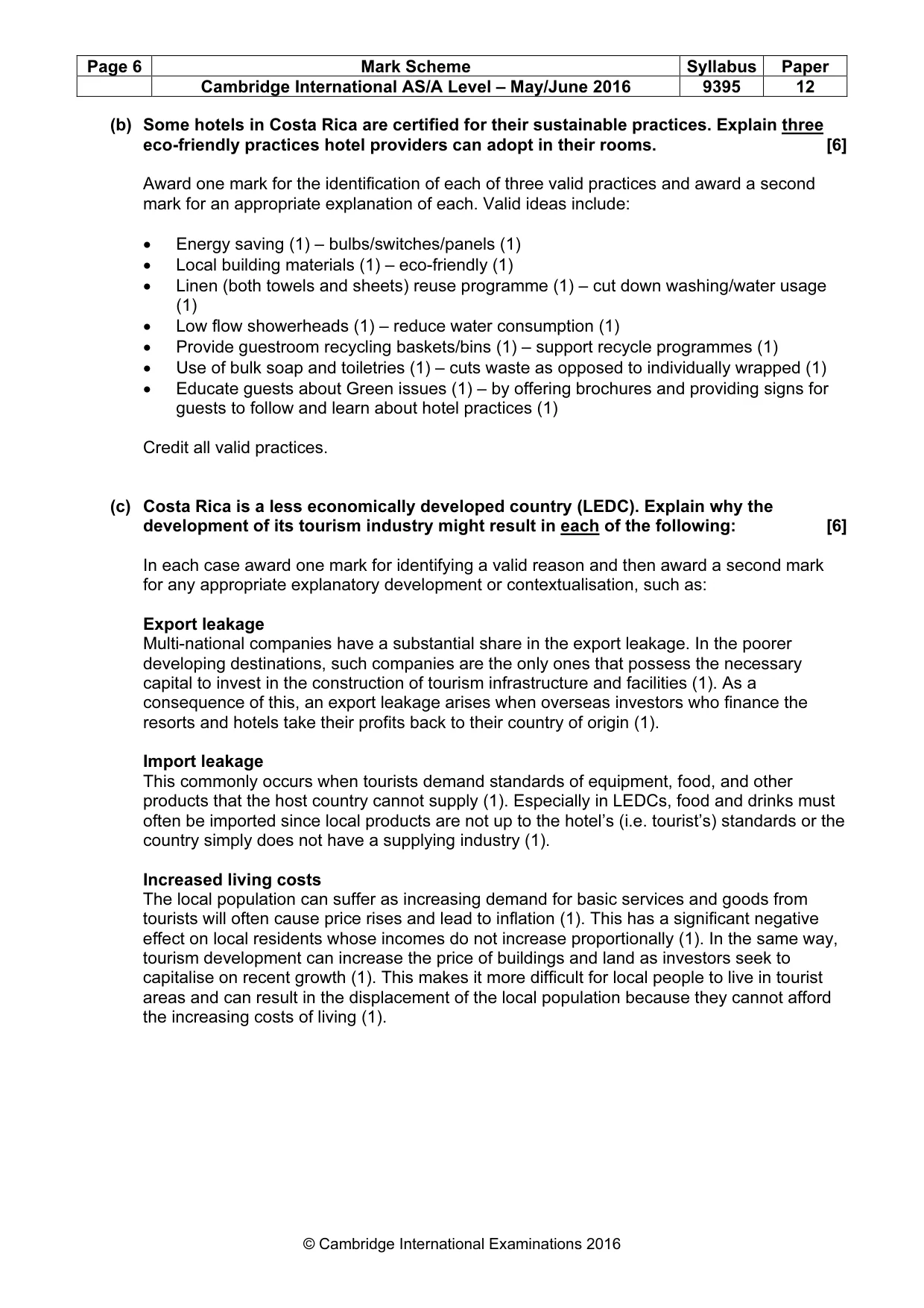
Page 6 Mark Scheme Syllabus Paper Cambridge International AS/A Level – May/June 2016 9395 12 © Cambridge International Examinations 2016 (b) Some hotels in Costa Rica are certified for their sustainable practices. Explain three eco-friendly practices hotel providers can adopt in their rooms. [6] Award one mark for the identification of each of three valid practices and award a second mark for an appropriate explanation of each. Valid ideas include: • Energy saving (1) – bulbs/switches/panels (1) • Local building materials (1) – eco-friendly (1) • Linen (both towels and sheets) reuse programme (1) – cut down washing/water usage (1) • Low flow showerheads (1) – reduce water consumption (1) • Provide guestroom recycling baskets/bins (1) – support recycle programmes (1) • Use of bulk soap and toiletries (1) – cuts waste as opposed to individually wrapped (1) • Educate guests about Green issues (1) – by offering brochures and providing signs for guests to follow and learn about hotel practices (1) Credit all valid practices. (c) Costa Rica is a less economically developed country (LEDC). Explain why the development of its tourism industry might result in each of the following: [6] In each case award one mark for identifying a valid reason and then award a second mark for any appropriate explanatory development or contextualisation, such as: Export leakage Multi-national companies have a substantial share in the export leakage. In the poorer developing destinations, such companies are the only ones that possess the necessary capital to invest in the construction of tourism infrastructure and facilities (1). As a consequence of this, an export leakage arises when overseas investors who finance the resorts and hotels take their profits back to their country of origin (1). Import leakage This commonly occurs when tourists demand standards of equipment, food, and other products that the host country cannot supply (1). Especially in LEDCs, food and drinks must often be imported since local products are not up to the hotel’s (i.e. tourist’s) standards or the country simply does not have a supplying industry (1). Increased living costs The local population can suffer as increasing demand for basic services and goods from tourists will often cause price rises and lead to inflation (1). This has a significant negative effect on local residents whose incomes do not increase proportionally (1). In the same way, tourism development can increase the price of buildings and land as investors seek to capitalise on recent growth (1). This makes it more difficult for local people to live in tourist areas and can result in the displacement of the local population because they cannot afford the increasing costs of living (1).
Mark scheme, page 7
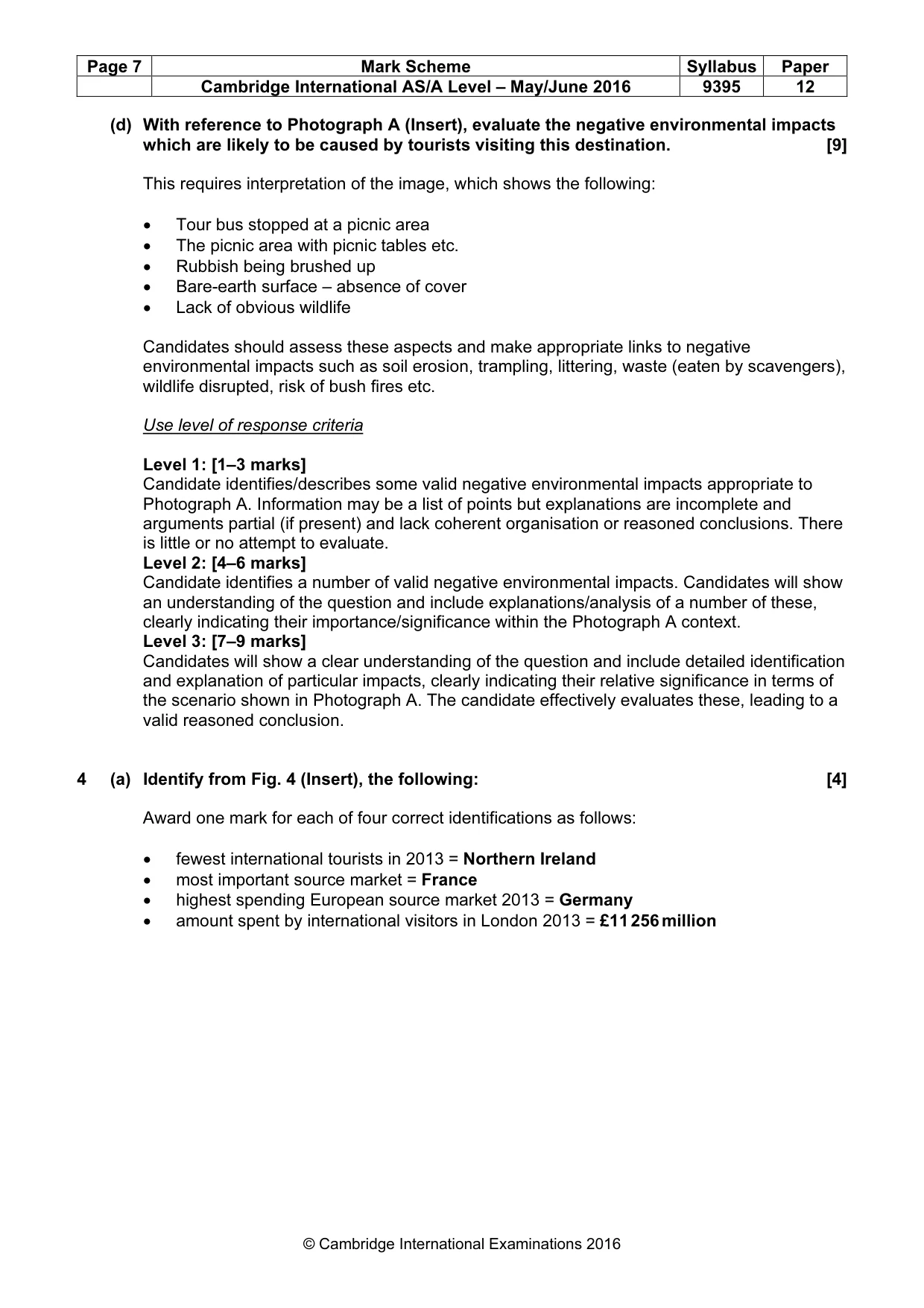
Page 7 Mark Scheme Syllabus Paper Cambridge International AS/A Level – May/June 2016 9395 12 © Cambridge International Examinations 2016 (d) With reference to Photograph A (Insert), evaluate the negative environmental impacts which are likely to be caused by tourists visiting this destination. [9] This requires interpretation of the image, which shows the following: • Tour bus stopped at a picnic area • The picnic area with picnic tables etc. • Rubbish being brushed up • Bare-earth surface – absence of cover • Lack of obvious wildlife Candidates should assess these aspects and make appropriate links to negative environmental impacts such as soil erosion, trampling, littering, waste (eaten by scavengers), wildlife disrupted, risk of bush fires etc. Use level of response criteria Level 1: [1–3 marks] Candidate identifies/describes some valid negative environmental impacts appropriate to Photograph A. Information may be a list of points but explanations are incomplete and arguments partial (if present) and lack coherent organisation or reasoned conclusions. There is little or no attempt to evaluate. Level 2: [4–6 marks] Candidate identifies a number of valid negative environmental impacts. Candidates will show an understanding of the question and include explanations/analysis of a number of these, clearly indicating their importance/significance within the Photograph A context. Level 3: [7–9 marks] Candidates will show a clear understanding of the question and include detailed identification and explanation of particular impacts, clearly indicating their relative significance in terms of the scenario shown in Photograph A. The candidate effectively evaluates these, leading to a valid reasoned conclusion. 4 (a) Identify from Fig. 4 (Insert), the following: [4] Award one mark for each of four correct identifications as follows: • fewest international tourists in 2013 = Northern Ireland • most important source market = France • highest spending European source market 2013 = Germany • amount spent by international visitors in London 2013 = £11 256 million
Mark scheme, page 8
Page 8 Mark Scheme Syllabus Paper Cambridge International AS/A Level – May/June 2016 9395 12 © Cambridge International Examinations 2016 (b) VisitBritain is the UK’s national tourism organisation. Its partners include airlines, tour operators and global brands such as Samsung and the English Premier League. Explain fully how VisitBritain’s partners are likely to benefit from each of the following national tourism organisation activities: [6] In each case award one mark for the identification of a valid benefit and then award a second/third mark for appropriate explanatory comment and development in the context provided, such as: The analysis of visitor trends Partners get access to valid current data (1) – this will allow others to share in research findings (1) for things like the identification of target markets (1), to plan marketing and promotional campaigns (1) and make spending projections (1) etc. The hosting of familiarisation visits Partners have access to visitors (1) – can offer to host events (1) to showcase their own products and services (1) and can seek to tap into new markets (1) etc. (c) The UK has many historic visitor attractions which are managed by non-commercial voluntary organisations. State and explain three ways in which such attractions are able to generate funding despite not charging an admission fee. [6] Award one mark for the identification of each of three valid ways and then award a second mark for an appropriate explanatory comment. Valid responses include: • Donations (1) – visitors are encouraged to donate according to their circumstances (1) • Shop (1) – profits from sales (1) • Café/restaurant (1) – profits from food and beverage sales (1) • Tours (1) – itemised charges (1) • Advertised events (1) – ticket sales (1) • Room hire (1) – use for events (1) • Sponsorship (1) – commercial partners (1) Credit all valid ways. (d) Discuss the factors that influence the numbers of domestic tourists in more economically developed countries (MEDCs). [9] Correct ideas include: • Increased car ownership and people able to explore more easily and regularly • Increased leisure time due to improvements in employment conditions e.g. statutory holiday entitlement • Increased disposable income due to increased standard of living • Economic development providing improved national infrastructure for travel etc. Also credit ideas to do with cost of living, exchange rates etc. – such fluctuations encourage the recent trend for ‘staycations’.
Mark scheme, page 9
Page 9 Mark Scheme Syllabus Paper Cambridge International AS/A Level – May/June 2016 9395 12 © Cambridge International Examinations 2016 Use level of response criteria Level 1: [1–3 marks] Candidate identifies/describes some valid factors influencing rates of domestic tourism. Information may be a list of points but explanations are incomplete and arguments partial (if present) and lack coherent organisation or reasoned conclusions. There is little or no attempt to discuss. Level 2: [4–6 marks] Candidate identifies a number of valid factors, such as the ones listed above. Candidates will show an understanding of the question and include explanations/analysis of a number of these, clearly indicating their importance/significance. Level 3: [7–9 marks] Candidates will show a clear understanding of the question and include detailed identification and explanation of particular factors, clearly indicating their relative significance in terms of domestic tourism within MEDCs. The candidate effectively discusses these, leading to a valid reasoned conclusion.
What you needed in this session
Cambridge’s own grade thresholds for 2016 May/June, Paper 1 · Variant 2. A higher threshold means an easier paper — the bar moves with how the cohort did.