Cambridge A Level Travel and Tourism 9395 — 2016 May/June Paper 1 · Variant 3
9395/13/M/J/16 · 100 marks · ≈113 min
The question paper and its mark scheme, free to read here and free to download. This is Cambridge’s own paper, exactly as it was sat.
Question paper16 pages



Mark scheme9 pages
Answers below. Sit the paper first if you are practising.
Paper as text
Question paper, page 1
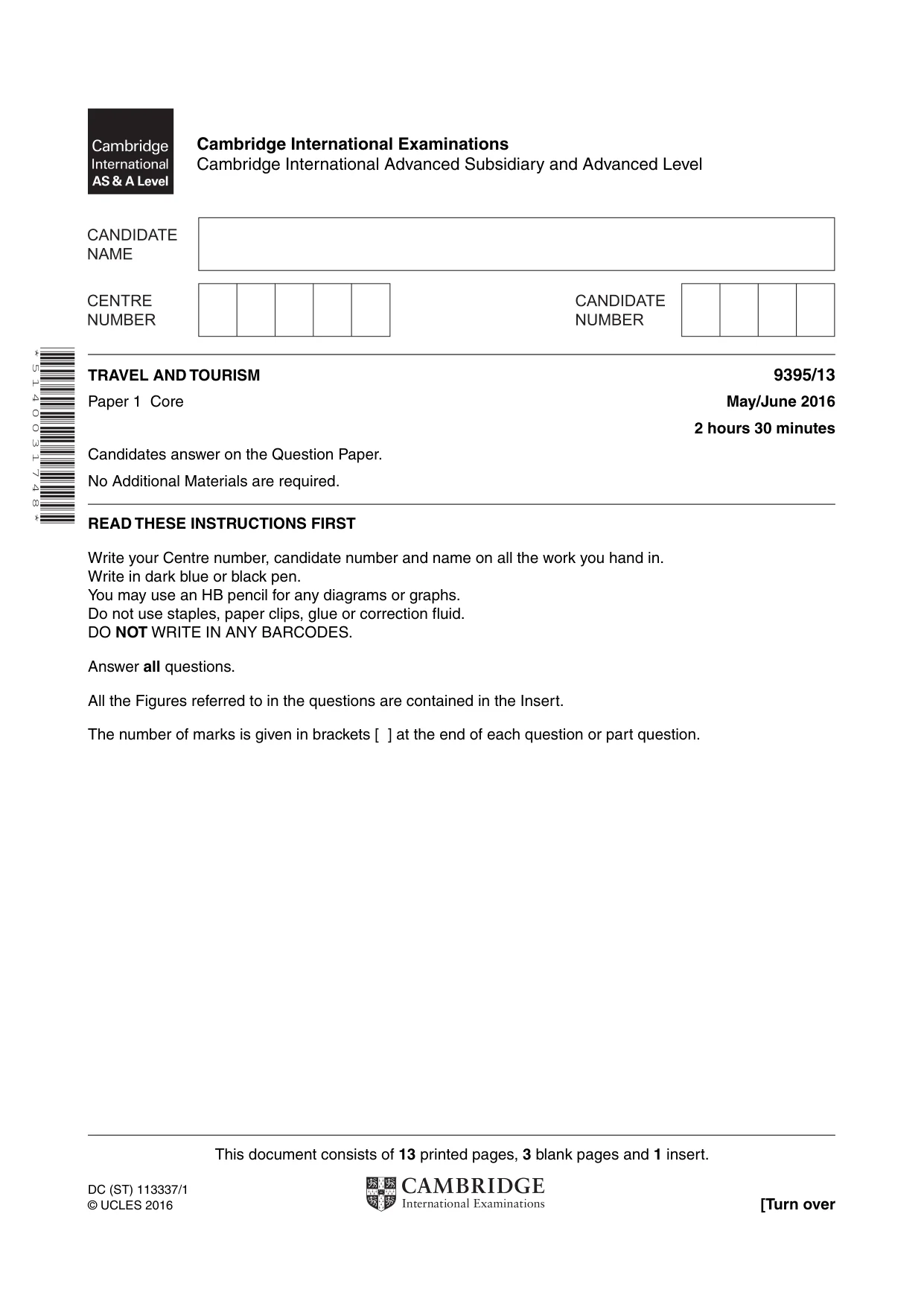
This document consists of 13 printed pages, 3 blank pages and 1 insert. DC (ST) 113337/1 © UCLES 2016 [Turn over Cambridge International Examinations Cambridge International Advanced Subsidiary and Advanced Level * 5 1 4 0 0 3 1 7 4 8 * TRAVEL AND TOURISM 9395/13 Paper 1 Core May/June 2016 2 hours 30 minutes Candidates answer on the Question Paper. No Additional Materials are required. READ THESE INSTRUCTIONS FIRST Write your Centre number, candidate number and name on all the work you hand in. Write in dark blue or black pen. You may use an HB pencil for any diagrams or graphs. Do not use staples, paper clips, glue or correction fluid. DO NOT WRITE IN ANY BARCODES. Answer all questions. All the Figures referred to in the questions are contained in the Insert. The number of marks is given in brackets [ ] at the end of each question or part question.
Question paper, page 2
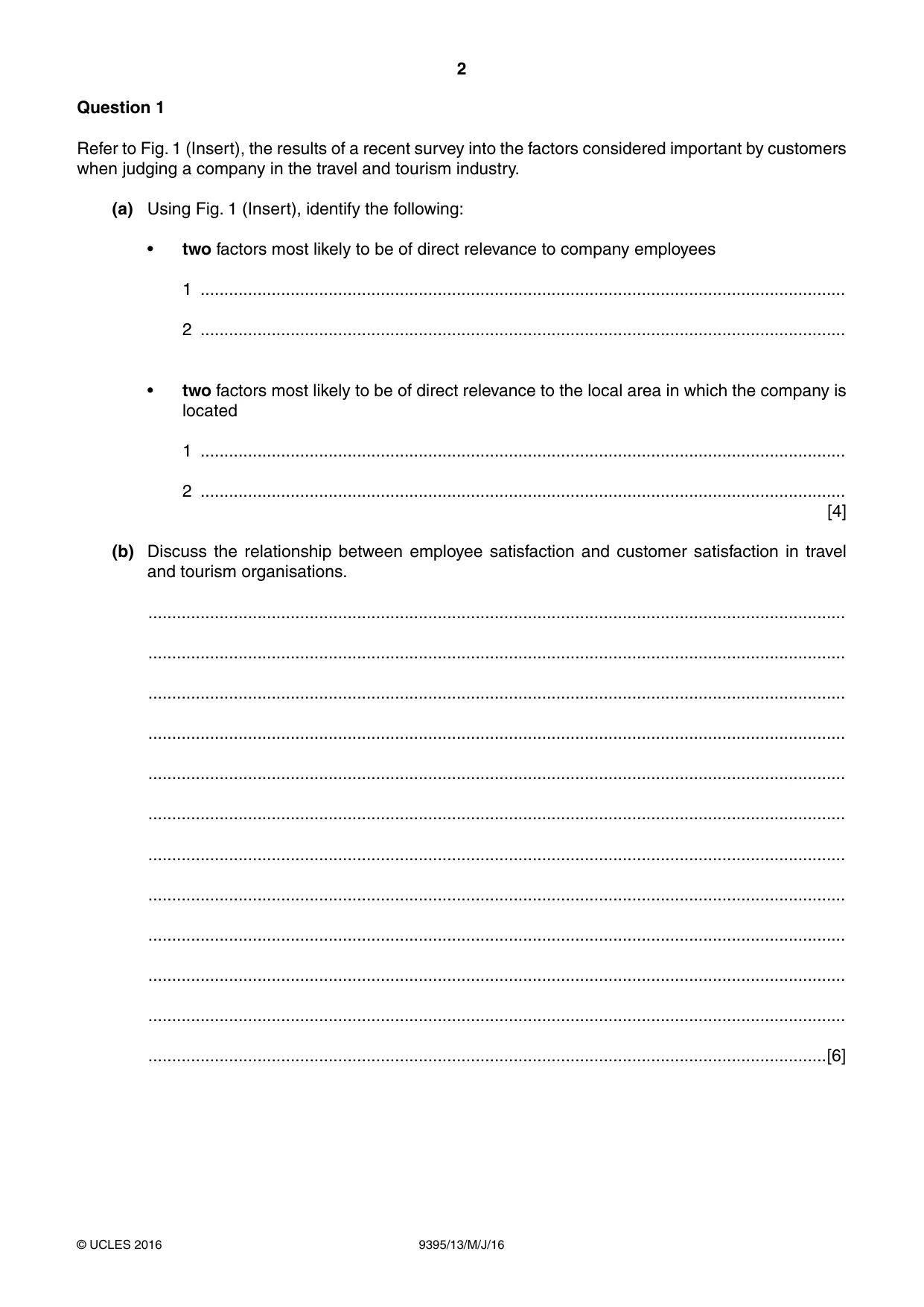
2 9395/13/M/J/16 © UCLES 2016 Question 1 Refer to Fig. 1 (Insert), the results of a recent survey into the factors considered important by customers when judging a company in the travel and tourism industry. (a) Using Fig. 1 (Insert), identify the following: • two factors most likely to be of direct relevance to company employees 1 … 2 … • two factors most likely to be of direct relevance to the local area in which the company is located 1 … 2 … [4] (b) Discuss the relationship between employee satisfaction and customer satisfaction in travel and tourism organisations. … … … … … … … … … … … …[6]
Question paper, page 3
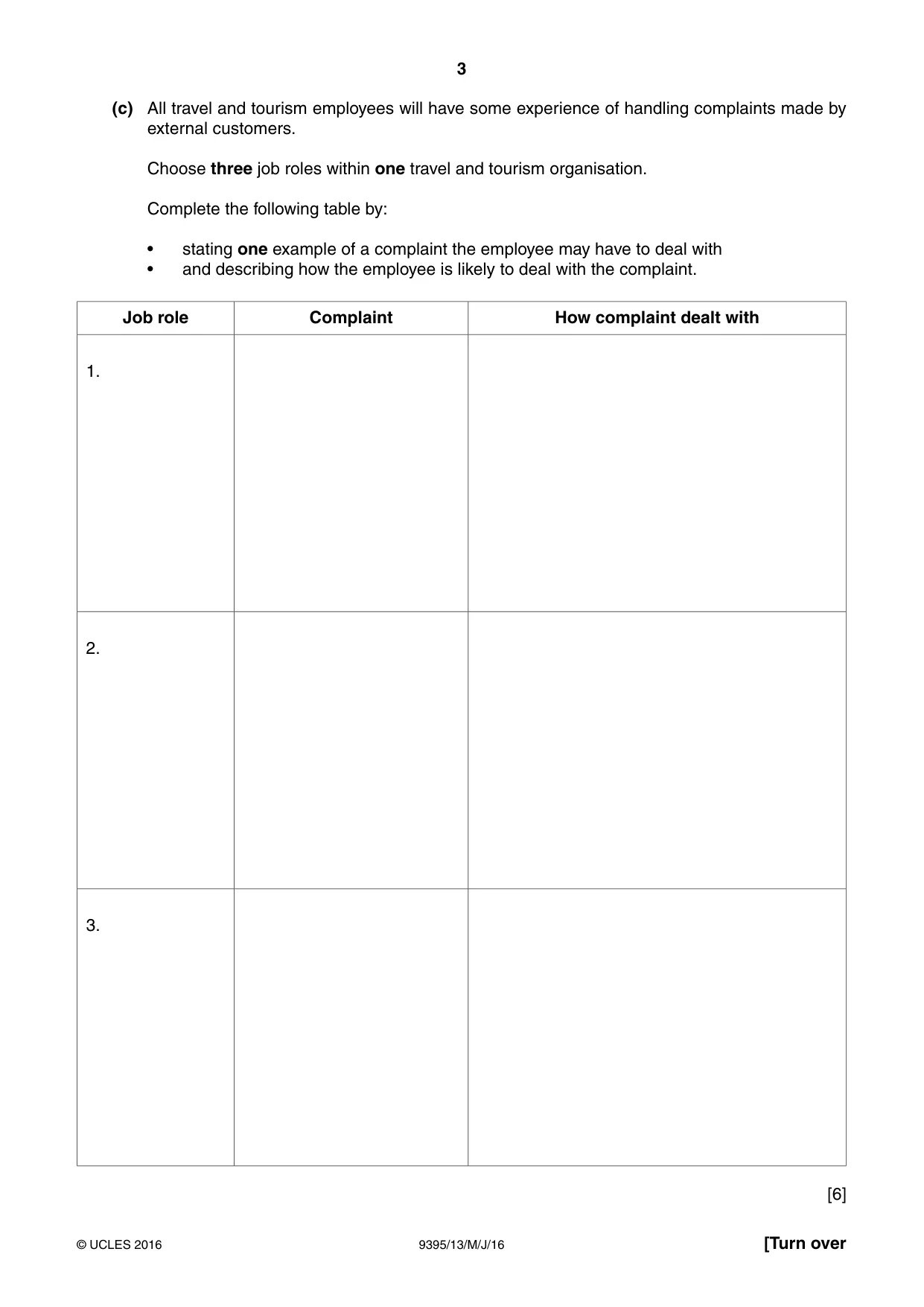
3 9395/13/M/J/16 © UCLES 2016 [Turn over (c) All travel and tourism employees will have some experience of handling complaints made by external customers. Choose three job roles within one travel and tourism organisation. Complete the following table by: • stating one example of a complaint the employee may have to deal with • and describing how the employee is likely to deal with the complaint. Job role Complaint How complaint dealt with 1. 2. 3. [6]
Question paper, page 4
4 9395/13/M/J/16 © UCLES 2016 (d) Discuss the ways in which travel and tourism organisations can improve staff performance. … … … … … … … … … … … … … … … … … … … … … … … … … …[9] [Total: 25]
Question paper, page 5
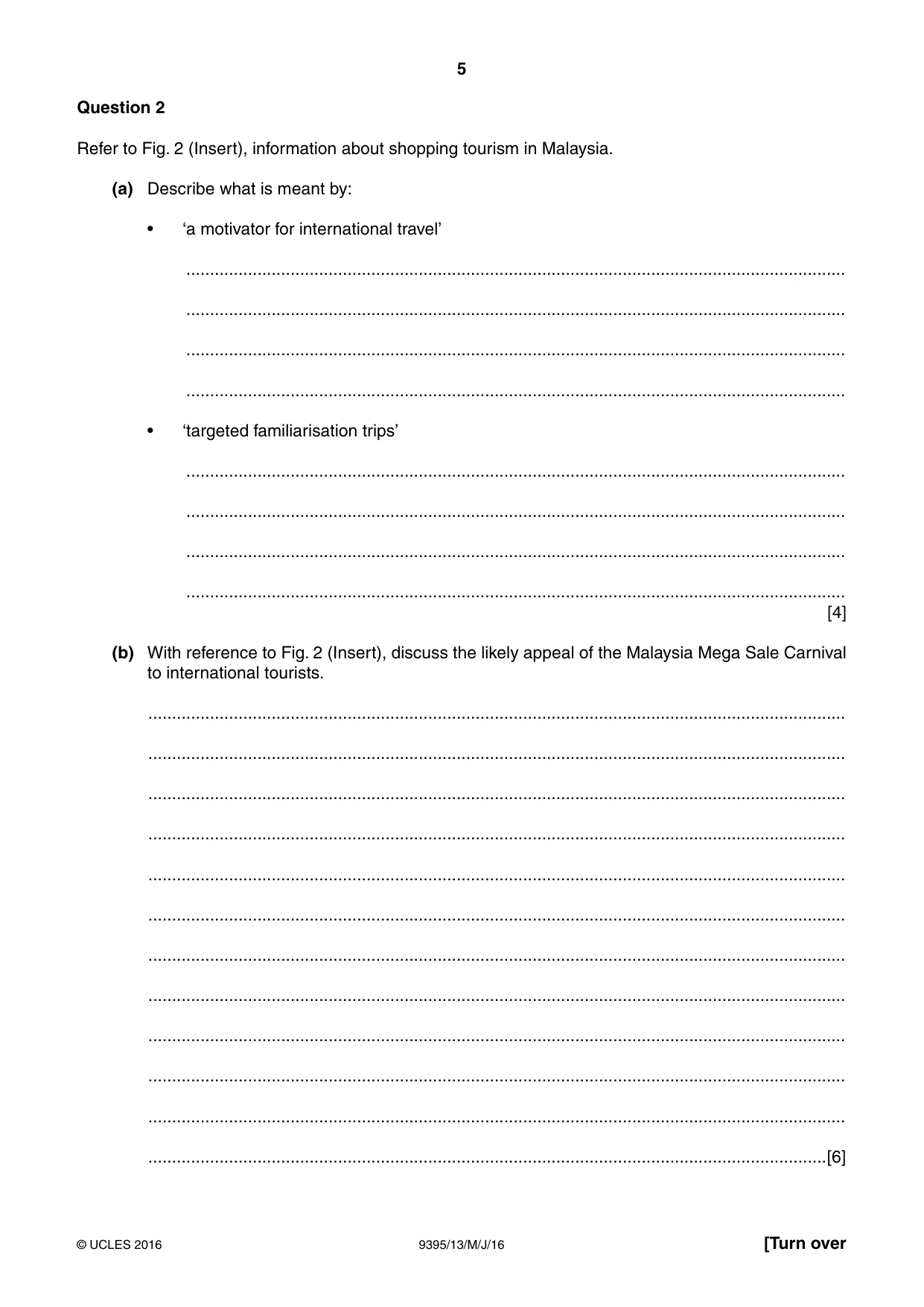
5 9395/13/M/J/16 © UCLES 2016 [Turn over Question 2 Refer to Fig. 2 (Insert), information about shopping tourism in Malaysia. (a) Describe what is meant by: • ‘a motivator for international travel’ … … … … • ‘targeted familiarisation trips’ … … … … [4] (b) With reference to Fig. 2 (Insert), discuss the likely appeal of the Malaysia Mega Sale Carnival to international tourists. … … … … … … … … … … … …[6]
Question paper, page 6
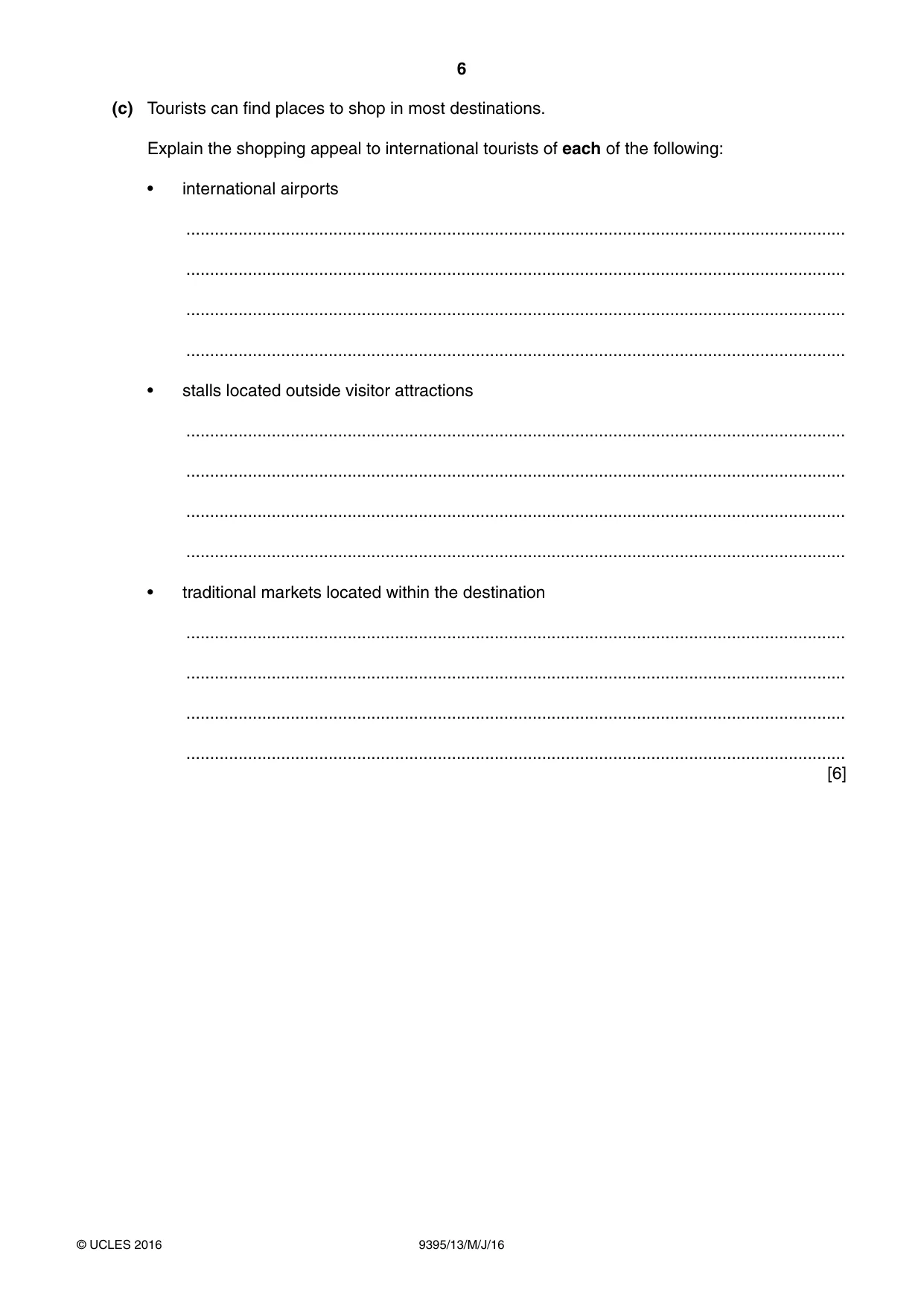
6 9395/13/M/J/16 © UCLES 2016 (c) Tourists can find places to shop in most destinations. Explain the shopping appeal to international tourists of each of the following: • international airports … … … … • stalls located outside visitor attractions … … … … • traditional markets located within the destination … … … … [6]
Question paper, page 7
7 9395/13/M/J/16 © UCLES 2016 [Turn over (d) Assess the negative socio-economic impacts which can arise when a destination in a less economically developed country (LEDC) starts to attract a growing number of wealthy shopping tourists. … … … … … … … … … … … … … … … … … … … … … … … … …[9] [Total: 25]
Question paper, page 8
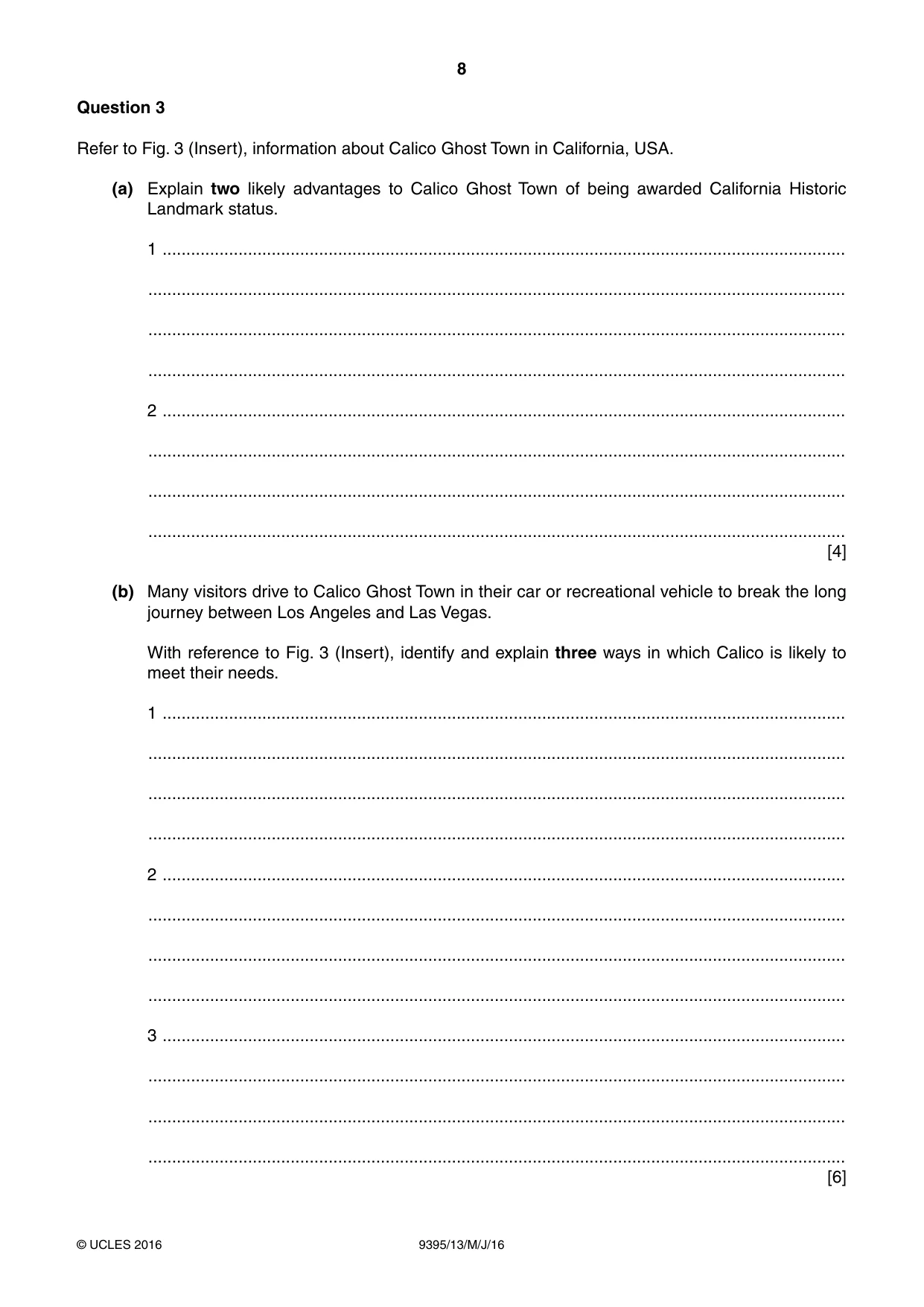
8 9395/13/M/J/16 © UCLES 2016 Question 3 Refer to Fig. 3 (Insert), information about Calico Ghost Town in California, USA. (a) Explain two likely advantages to Calico Ghost Town of being awarded California Historic Landmark status. 1 … … … … 2 … … … … [4] (b) Many visitors drive to Calico Ghost Town in their car or recreational vehicle to break the long journey between Los Angeles and Las Vegas. With reference to Fig. 3 (Insert), identify and explain three ways in which Calico is likely to meet their needs. 1 … … … … 2 … … … … 3 … … … … [6]
Question paper, page 9
9 9395/13/M/J/16 © UCLES 2016 [Turn over (c) Many destinations have historic attractions such as castles and cathedrals. Explain three ways in which these types of attraction are likely to appeal to the events market. 1 … … … … 2 … … … … 3 … … … … [6]
Question paper, page 10
10 9395/13/M/J/16 © UCLES 2016 (d) With reference to any destination, assess the extent to which it will be able to cope with an increase in visitor numbers. Chosen destination … … … … … … … … … … … … … … … … … … … … … … … … … …[9] [Total: 25]
Question paper, page 11
11 9395/13/M/J/16 © UCLES 2016 [Turn over Question 4 Refer to Photographs A and B together with Fig. 4 (Insert), a map showing the Dubai Water Taxi Stations along the coast of Dubai. The photographs were taken by a leisure tourist staying at the Jebel Ali Golf Resort in Dubai. The tourist was using the Dubai Water Taxi service to travel along the full length of the coast (shown in Fig. 4) from Jebel Ali to Dubai Creek. (a) Using evidence from Photographs A and B together with Fig. 4 (Insert), describe two reasons for the appeal to the leisure tourist of making this journey by water taxi. 1 … … … … 2 … … … … [4] (b) In some destinations the development of coastal infrastructure can cause negative environmental impacts. Explain three negative environmental impacts associated with the development of marinas. 1 … … … … 2 … … … … 3 … … … … [6]
Question paper, page 12
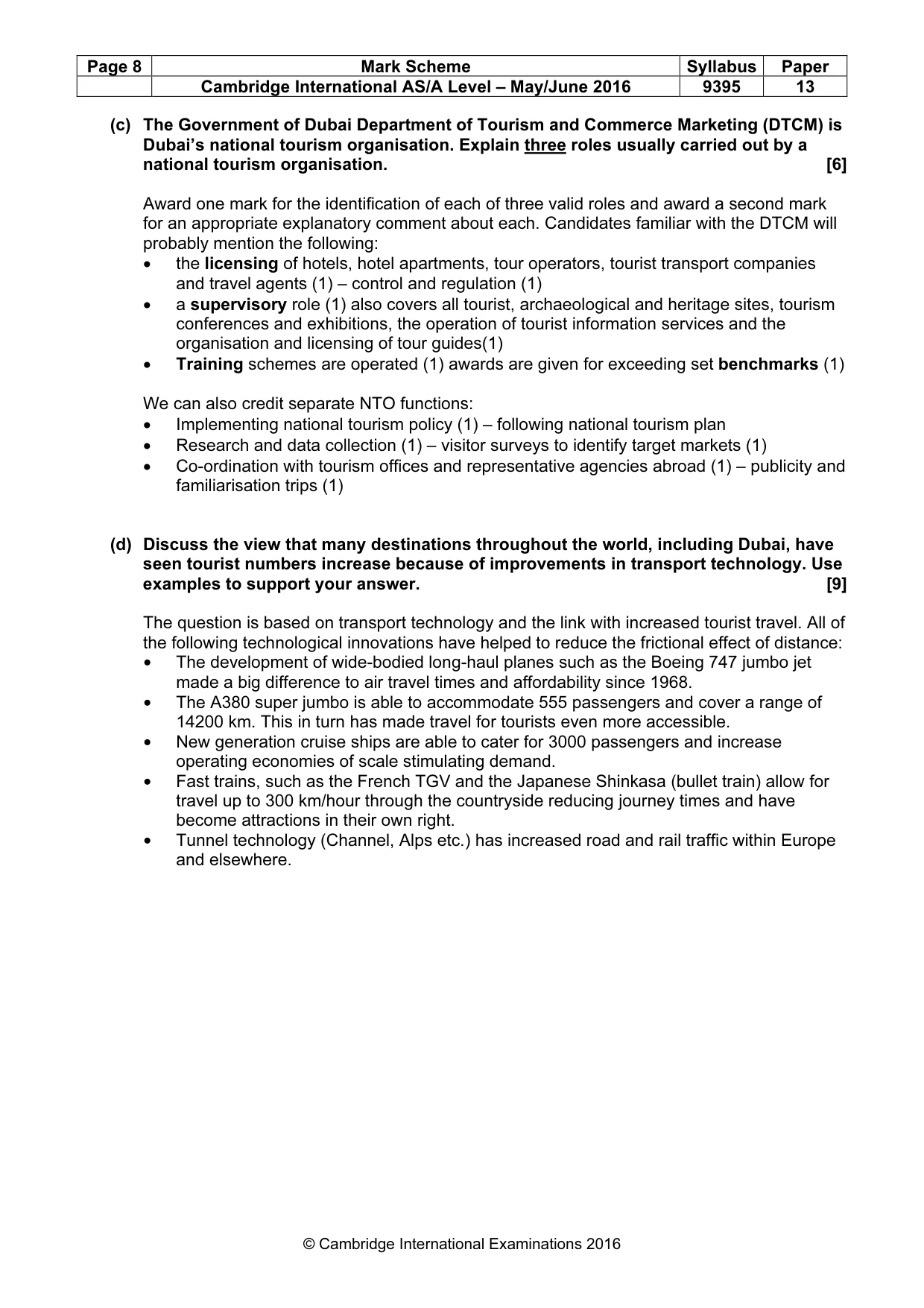
12 9395/13/M/J/16 © UCLES 2016 (c) The Government of Dubai Department of Tourism and Commerce Marketing (DTCM) is Dubai’s national tourism organisation. Explain three roles usually carried out by a national tourism organisation. 1 … … … … 2 … … … … 3 … … … … [6]
Question paper, page 13
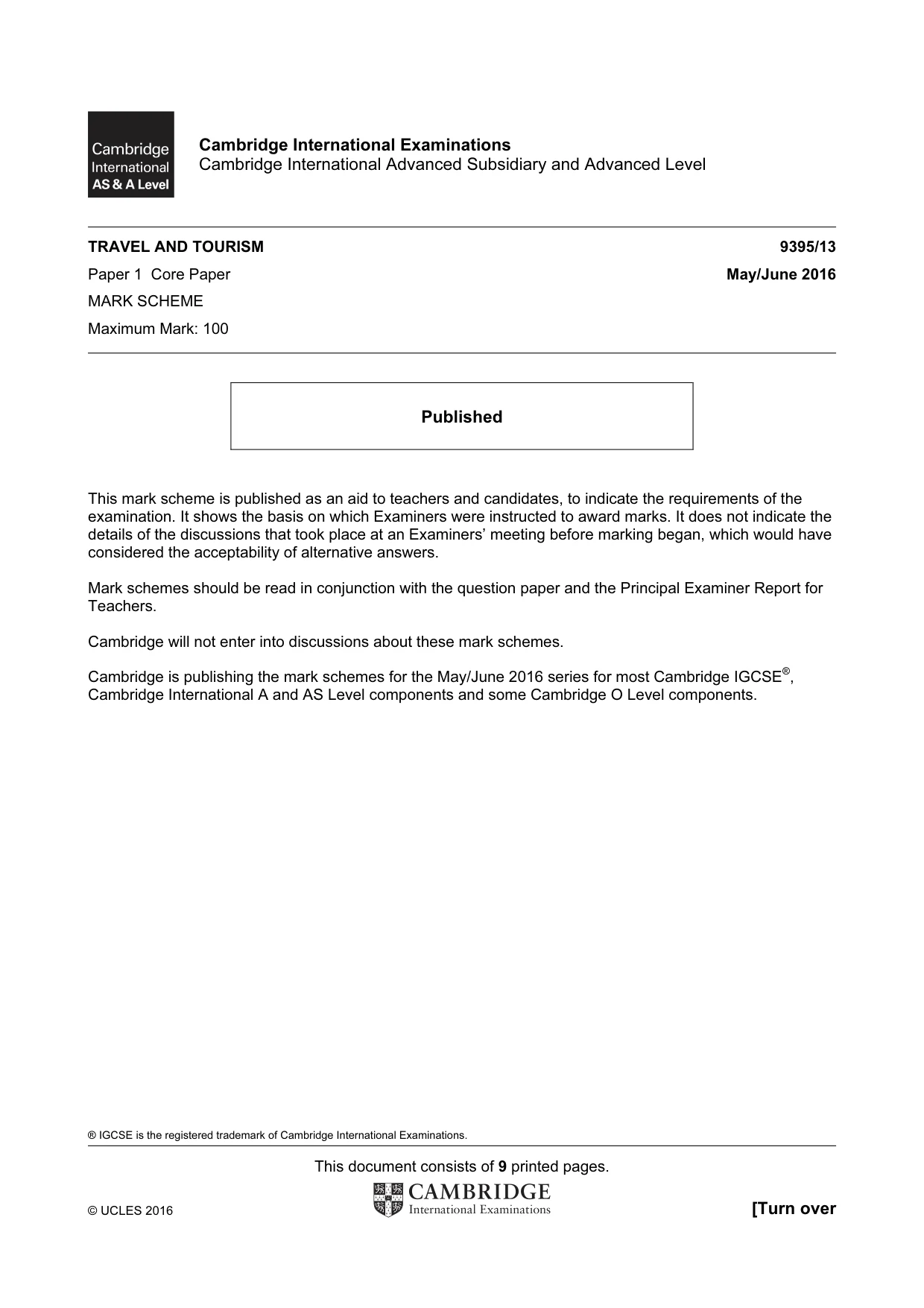
13 9395/13/M/J/16 © UCLES 2016 (d) Discuss the view that many destinations throughout the world, including Dubai, have seen tourist numbers increase because of improvements in transport technology. Use examples to support your answer. … … … … … … … … … … … … … … … … … … … … … … … … …[9] [Total: 25]
Question paper, page 14
14 9395/13/M/J/16 © UCLES 2016 BLANK PAGE
Question paper, page 15
15 9395/13/M/J/16 © UCLES 2016 BLANK PAGE
Question paper, page 16
16 9395/13/M/J/16 © UCLES 2016 Permission to reproduce items where third-party owned material protected by copyright is included has been sought and cleared where possible. Every reasonable effort has been made by the publisher (UCLES) to trace copyright holders, but if any items requiring clearance have unwittingly been included, the publisher will be pleased to make amends at the earliest possible opportunity. To avoid the issue of disclosure of answer-related information to candidates, all copyright acknowledgements are reproduced online in the Cambridge International Examinations Copyright Acknowledgements Booklet. This is produced for each series of examinations and is freely available to download at www.cie.org.uk after the live examination series. Cambridge International Examinations is part of the Cambridge Assessment Group. Cambridge Assessment is the brand name of University of Cambridge Local Examinations Syndicate (UCLES), which is itself a department of the University of Cambridge. BLANK PAGE
Mark scheme, page 1
® IGCSE is the registered trademark of Cambridge International Examinations. This document consists of 9 printed pages. © UCLES 2016 [Turn over Cambridge International Examinations Cambridge International Advanced Subsidiary and Advanced Level TRAVEL AND TOURISM 9395/13 Paper 1 Core Paper May/June 2016 MARK SCHEME Maximum Mark: 100 Published This mark scheme is published as an aid to teachers and candidates, to indicate the requirements of the examination. It shows the basis on which Examiners were instructed to award marks. It does not indicate the details of the discussions that took place at an Examiners’ meeting before marking began, which would have considered the acceptability of alternative answers. Mark schemes should be read in conjunction with the question paper and the Principal Examiner Report for Teachers. Cambridge will not enter into discussions about these mark schemes. Cambridge is publishing the mark schemes for the May/June 2016 series for most Cambridge IGCSE®, Cambridge International A and AS Level components and some Cambridge O Level components.
Mark scheme, page 2
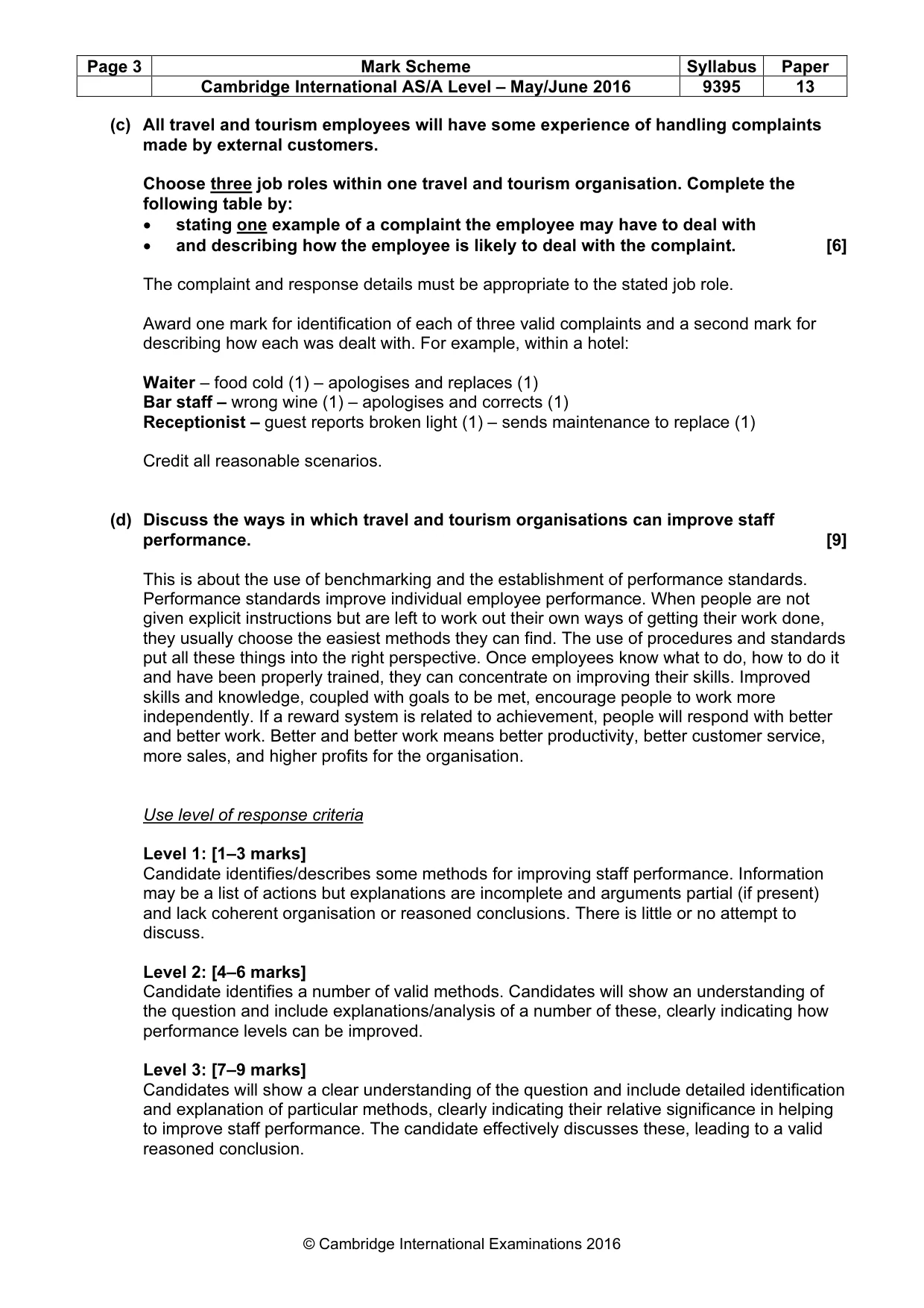
Page 2 Mark Scheme Syllabus Paper Cambridge International AS/A Level – May/June 2016 9395 13 © Cambridge International Examinations 2016 1 (a) Using Fig. 1 (Insert), identify the following: [4] Award one mark for the correct identification of each of two aspects as follows: two factors most likely to be of direct relevance to company employees • Work conditions (1) • Wages (1) • Treatment of staff (1) • Good management (1) two factors most likely to be of direct relevance to the local area in which the company is located • Environmental concern (1) • Involvement in the community (1) • Expansion/growth (1) (b) Discuss the relationship between employee satisfaction and customer satisfaction in travel and tourism organisations. [6] There are several ways in which employee satisfaction affects customer satisfaction: • Employees that interact with customers are in a position to develop awareness of and respond to customer goals and needs. • Satisfied employees are motivated employees; that is, they have the motivational resources to deliver adequate effort and care. • Satisfied employees are empowered employees; in other words, they have the resources, training, and responsibilities to understand and serve customer needs and demands. • Satisfied employees have high energy and willingness to give good service: at a very minimum, they can deliver a more positive perception of the service/product provided. • Satisfied employees can provide customers with adequate explanations for undesirable outcomes and therefore satisfied employees have enough emotional resources to show empathy, understanding, respect, and concern to the external customers with which they have direct contact. Use level of response criteria Level 1 (1–2 marks) will identify up to two appropriate aspects, providing some detail but will be mainly descriptive. Level 2 (3–4 marks) can be awarded for an analysis of selected aspects, clearly explaining how these are related to satisfaction levels. Level 3 (5–6 marks) can be awarded for evaluative comment about the ways in which levels of employee satisfaction influence customer satisfaction and the better answers will have a reasoned conclusion.
Mark scheme, page 3
Page 3 Mark Scheme Syllabus Paper Cambridge International AS/A Level – May/June 2016 9395 13 © Cambridge International Examinations 2016 (c) All travel and tourism employees will have some experience of handling complaints made by external customers. Choose three job roles within one travel and tourism organisation. Complete the following table by: • stating one example of a complaint the employee may have to deal with • and describing how the employee is likely to deal with the complaint. [6] The complaint and response details must be appropriate to the stated job role. Award one mark for identification of each of three valid complaints and a second mark for describing how each was dealt with. For example, within a hotel: Waiter – food cold (1) – apologises and replaces (1) Bar staff – wrong wine (1) – apologises and corrects (1) Receptionist – guest reports broken light (1) – sends maintenance to replace (1) Credit all reasonable scenarios. (d) Discuss the ways in which travel and tourism organisations can improve staff performance. [9] This is about the use of benchmarking and the establishment of performance standards. Performance standards improve individual employee performance. When people are not given explicit instructions but are left to work out their own ways of getting their work done, they usually choose the easiest methods they can find. The use of procedures and standards put all these things into the right perspective. Once employees know what to do, how to do it and have been properly trained, they can concentrate on improving their skills. Improved skills and knowledge, coupled with goals to be met, encourage people to work more independently. If a reward system is related to achievement, people will respond with better and better work. Better and better work means better productivity, better customer service, more sales, and higher profits for the organisation. Use level of response criteria Level 1: [1–3 marks] Candidate identifies/describes some methods for improving staff performance. Information may be a list of actions but explanations are incomplete and arguments partial (if present) and lack coherent organisation or reasoned conclusions. There is little or no attempt to discuss. Level 2: [4–6 marks] Candidate identifies a number of valid methods. Candidates will show an understanding of the question and include explanations/analysis of a number of these, clearly indicating how performance levels can be improved. Level 3: [7–9 marks] Candidates will show a clear understanding of the question and include detailed identification and explanation of particular methods, clearly indicating their relative significance in helping to improve staff performance. The candidate effectively discusses these, leading to a valid reasoned conclusion.
Mark scheme, page 4
Page 4 Mark Scheme Syllabus Paper Cambridge International AS/A Level – May/June 2016 9395 13 © Cambridge International Examinations 2016 2 (a) Describe what is meant by: [4] Correct ideas include: A motivator for international travel = reason or attraction (1) for going overseas (1) Targeted familiarisation trips = arranged visits to a destination (1) limited to a particular market group (1) Credit all appropriate descriptions (b) With reference to Fig. 2 (Insert), discuss the likely appeal of the Malaysia Mega Sale Carnival to international tourists. [6] Candidates may consider any of the following from Fig 2: • Lasted for11 weeks (28 June to 1 September) • discounts from retailers, hotels, visitor attractions, and restaurants • a strong cultural offering – fashion industry parades and shows, artistic displays and music • KL is in Top 12 global shopping destinations • One of world’s biggest malls Use level of response criteria Level 1 (1–2 marks) will identify up to two appropriate aspects, providing some detail but will be mainly descriptive. Level 2 (3–4 marks) can be awarded for an analysis of selected aspects, clearly explaining how these are likely to appeal to international visitors. Level 3 (5–6 marks) can be awarded for evaluative comment about aspects of the event’s appeal and the better answers will have a reasoned conclusion. (c) Tourists can find places to shop in most destinations. Explain the shopping appeal to international tourists of each of the following: [6] In each case award one mark for valid identification of an aspect of shopping appeal and then award a second mark for an appropriate explanatory comment about each, such as: International airports • Duty Free stores (1) – make savings (1) • Convenience stores (1) – last minute purchases for trip (1) Stalls located outside visitor attractions • Sell ethnic goods (1) – buy as souvenirs, novelty gifts etc. (1) • No fixed price (1) – can haggle (1) Traditional markets located within the destination • Clear cultural appeal (1) – souks, bazaars etc. (1) • Exotic (1) – mix of goods, foods and spices, traditional craftwork etc. (1)
Mark scheme, page 5
Page 5 Mark Scheme Syllabus Paper Cambridge International AS/A Level – May/June 2016 9395 13 © Cambridge International Examinations 2016 (d) Assess the negative socio-economic impacts which can arise when a destination in a less economically developed country (LEDC) starts to attract a growing number of wealthy shopping tourists. [9] Responses should consider a mix of: • Price inflation • Import leakage • Globalisation • Social exclusion • Crime etc. Use level of response criteria Level 1: [1–3 marks] Candidate identifies/describes some valid negative socio-economic impacts within LEDC shopping destinations. Information may be a list of actions but explanations are incomplete and arguments partial (if present) and lack coherent organisation or reasoned conclusions. There is little or no attempt to assess. Level 2: [4–6 marks] Candidate identifies a number of valid impacts. Candidates will show an understanding of the question and include explanations/analysis of a number of these, clearly indicating how an influx of rich shopping tourists can generate these. Level 3: [7–9 marks] Candidates will show a clear understanding of the question and include detailed identification and explanation of particular socio-economic negative impacts, clearly indicating their relative significance in relation to LEDC destinations. The candidate effectively assesses these, leading to a valid reasoned conclusion. 3 (a) Explain two likely advantages to Calico Ghost Town of being awarded California Historic Landmark status. [4] Award one mark for correct identification of each of two valid advantages and award a second mark for an appropriate explanatory development for each. Valid advantages include: • Comparative advantage (1) – over rival attractions that have not been awarded California Historic Landmark status (1) • Will attract historical niche visitors (1) – recognition that Calico is something worth seeing (1) • Use of award logo (1) – enhanced promotional materials (1) Credit all valid reasoning.
Mark scheme, page 6
Page 6 Mark Scheme Syllabus Paper Cambridge International AS/A Level – May/June 2016 9395 13 © Cambridge International Examinations 2016 (b) Many visitors drive to Calico Ghost Town in their car or recreational vehicle to break the long journey between Los Angeles and Las Vegas. With reference to Fig. 3 (Insert), identify and explain three ways in which Calico is likely to meet their needs. [6] The focus here is on meeting travellers’ needs while breaking the journey. Award one mark for the identification of each of three appropriate ways and award a second mark for a valid explanatory comment about each. Fig. 3 indicates the following: • Easily seen and accessed from Highway 15 (1) – convenient stop in desert area (1) • Restaurants (1) – food and drink (1) • Accommodation available (1) – saves travelling overnight (1) • General store (1) – supplies etc. (1) (c) Many destinations have historic attractions such as castles and cathedrals. Explain three ways in which these types of attraction are likely to appeal to the events market. [6] The task is to match a facility or service for use with a particular type of events market requirement. Award one mark for each of three facility identifications and a second mark for explanation of meeting an events market need. Correct responses will include: • Rooms (1) – hired out for business meetings (1) • Grounds/floor space (1) – used for holding events (1), wedding marquees/photos (1) • Dining rooms (1) – wedding receptions (1), gala dinners (1) • Historic setting offers prestige (1) – gives organiser something ‘special’ to the event (1) Credit all valid reasoning in the context provided. (d) With reference to any destination, assess the extent to which it will be able to cope with an increase in visitor numbers. [9] Credit consideration of any of the following: • Airport capacity • No. of rooms available • Existing seasonal issues • Existing congestion levels • Carrying capacity observations • Existing negative impacts • Proposed new projects • Government policy goals
Mark scheme, page 7
Page 7 Mark Scheme Syllabus Paper Cambridge International AS/A Level – May/June 2016 9395 13 © Cambridge International Examinations 2016 Use level of response criteria Level 1: [1–3 marks] Candidate identifies/describes some valid destination facilities that are likely to attract extra visitors. Information may be a list of aspects but explanations are incomplete and arguments partial (if present) and lack coherent organisation or reasoned conclusions. There is little or no attempt to assess. Level 2: [4–6 marks] Candidate identifies a number of valid aspects relating to an identifiable destination. Candidates will show an understanding of the question and include explanations/analysis of a number of these, clearly indicating how an influx of additional tourists may or may not be coped with. Level 3: [7–9 marks] Candidates will show a clear understanding of the question and include detailed identification and explanation of particular destination facilities (existing or planned), clearly indicating their relative significance in relation to visitor growth. The candidate effectively assesses these, leading to a valid reasoned conclusion. 4 (a) Using evidence from Photographs A and B together with Fig. 4 (Insert), describe two reasons for the appeal to the leisure tourist of making this journey by water taxi. [4] Award one mark for the identification of each of two valid reasons shown and award a second mark for an appropriate amplificatory comment about each. Correct ideas include: • Comfort (1) – airline seats (1) • Convenience (1) – pick-up on-site (1) • Sightseeing (1) – view of coast whole trip (1) Credit all points supported by photo and Fig. 4 evidence. (b) In some destinations the development of coastal infrastructure can cause negative environmental impacts. Explain three negative environmental impacts associated with the development of marinas. [6] Award one mark for the correct identification of each of three valid negative environmental impacts and award a second mark for an appropriate explanatory comment about each. Correct ideas include: • Visual pollution (1) – both during construction and possibly after (1) • Noise pollution (1) – heavy site machinery during construction (1) • Waste material/litter (1) – blows into sea during construction work (1) • Water pollution (1) – oils leaks from craft (1) • Habitat disruption (1) – beach ecosystem destroyed (1) Credit references to post-completion activities (e.g. dive boats/reef damage etc.). However, each impact and associated comment must clearly link together and avoid repetition.
Mark scheme, page 8
Page 8 Mark Scheme Syllabus Paper Cambridge International AS/A Level – May/June 2016 9395 13 © Cambridge International Examinations 2016 (c) The Government of Dubai Department of Tourism and Commerce Marketing (DTCM) is Dubai’s national tourism organisation. Explain three roles usually carried out by a national tourism organisation. [6] Award one mark for the identification of each of three valid roles and award a second mark for an appropriate explanatory comment about each. Candidates familiar with the DTCM will probably mention the following: • the licensing of hotels, hotel apartments, tour operators, tourist transport companies and travel agents (1) – control and regulation (1) • a supervisory role (1) also covers all tourist, archaeological and heritage sites, tourism conferences and exhibitions, the operation of tourist information services and the organisation and licensing of tour guides(1) • Training schemes are operated (1) awards are given for exceeding set benchmarks (1) We can also credit separate NTO functions: • Implementing national tourism policy (1) – following national tourism plan • Research and data collection (1) – visitor surveys to identify target markets (1) • Co-ordination with tourism offices and representative agencies abroad (1) – publicity and familiarisation trips (1) (d) Discuss the view that many destinations throughout the world, including Dubai, have seen tourist numbers increase because of improvements in transport technology. Use examples to support your answer. [9] The question is based on transport technology and the link with increased tourist travel. All of the following technological innovations have helped to reduce the frictional effect of distance: • The development of wide-bodied long-haul planes such as the Boeing 747 jumbo jet made a big difference to air travel times and affordability since 1968. • The A380 super jumbo is able to accommodate 555 passengers and cover a range of 14200 km. This in turn has made travel for tourists even more accessible. • New generation cruise ships are able to cater for 3000 passengers and increase operating economies of scale stimulating demand. • Fast trains, such as the French TGV and the Japanese Shinkasa (bullet train) allow for travel up to 300 km/hour through the countryside reducing journey times and have become attractions in their own right. • Tunnel technology (Channel, Alps etc.) has increased road and rail traffic within Europe and elsewhere.
Mark scheme, page 9
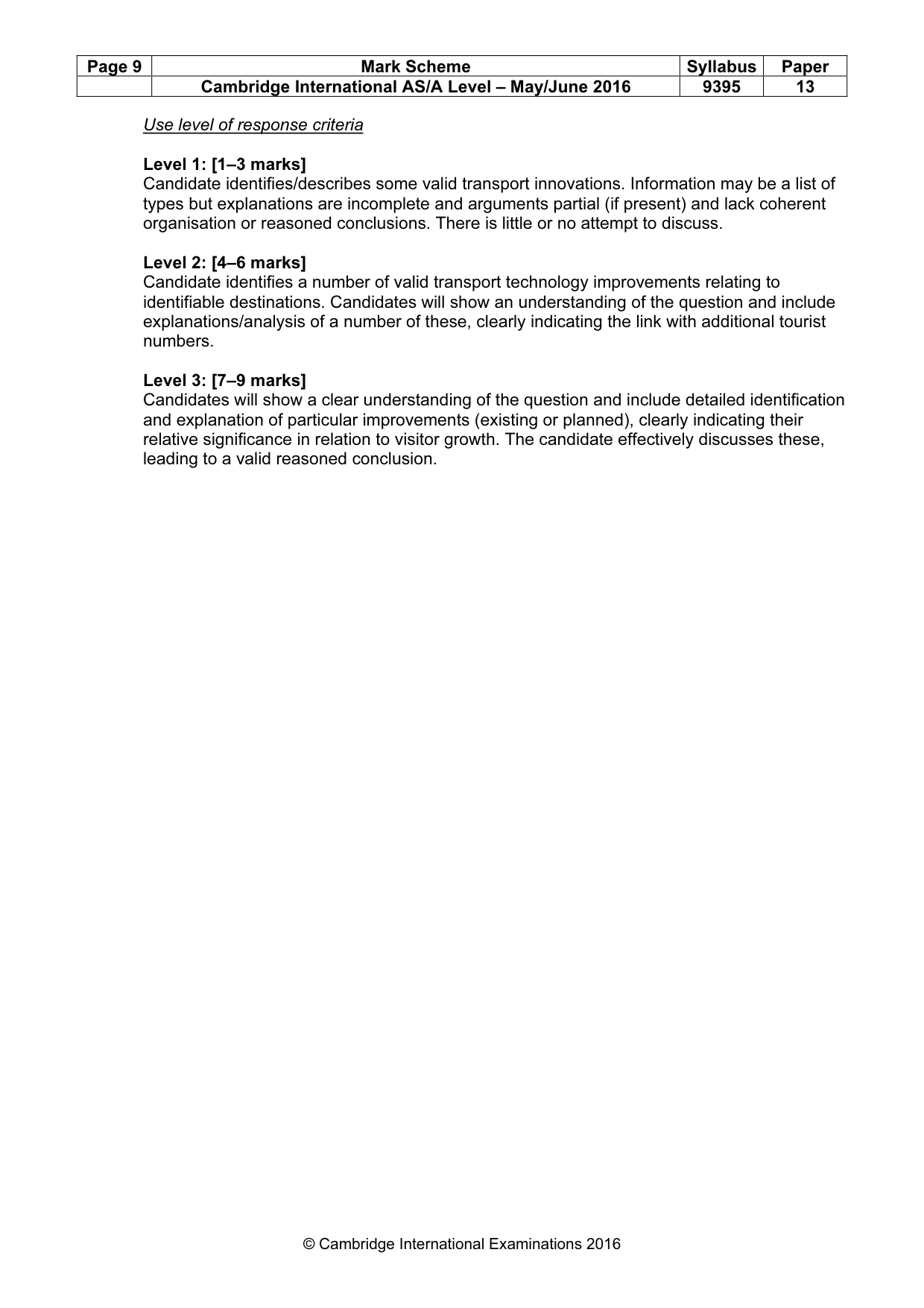
Page 9 Mark Scheme Syllabus Paper Cambridge International AS/A Level – May/June 2016 9395 13 © Cambridge International Examinations 2016 Use level of response criteria Level 1: [1–3 marks] Candidate identifies/describes some valid transport innovations. Information may be a list of types but explanations are incomplete and arguments partial (if present) and lack coherent organisation or reasoned conclusions. There is little or no attempt to discuss. Level 2: [4–6 marks] Candidate identifies a number of valid transport technology improvements relating to identifiable destinations. Candidates will show an understanding of the question and include explanations/analysis of a number of these, clearly indicating the link with additional tourist numbers. Level 3: [7–9 marks] Candidates will show a clear understanding of the question and include detailed identification and explanation of particular improvements (existing or planned), clearly indicating their relative significance in relation to visitor growth. The candidate effectively discusses these, leading to a valid reasoned conclusion.
What you needed in this session
Cambridge’s own grade thresholds for 2016 May/June, Paper 1 · Variant 3. A higher threshold means an easier paper — the bar moves with how the cohort did.