Cambridge A Level Travel and Tourism 9395 — 2016 May/June Paper 1 · Variant 1
9395/11/M/J/16 · 100 marks · ≈113 min
The question paper and its mark scheme, free to read here and free to download. This is Cambridge’s own paper, exactly as it was sat.
Question paper16 pages


Mark scheme8 pages
Answers below. Sit the paper first if you are practising.
Paper as text
Question paper, page 1
This document consists of 13 printed pages, 3 blank pages and 1 insert. DC (ST) 113300/1 © UCLES 2016 [Turn over Cambridge International Examinations Cambridge International Advanced Subsidiary and Advanced Level * 5 1 5 3 9 7 3 6 7 1 * TRAVEL AND TOURISM 9395/11 Paper 1 Core May/June 2016 2 hours 30 minutes Candidates answer on the Question Paper. No Additional Materials are required. READ THESE INSTRUCTIONS FIRST Write your Centre number, candidate number and name on all the work you hand in. Write in dark blue or black pen. You may use an HB pencil for any diagrams or graphs. Do not use staples, paper clips, glue or correction fluid. DO NOT WRITE IN ANY BARCODES. Answer all questions. All the Figures referred to in the questions are contained in the Insert. The number of marks is given in brackets [ ] at the end of each question or part question.
Question paper, page 2
2 9395/11/M/J/16 © UCLES 2016 Question 1 Refer to Fig. 1 (Insert), an online job advertisement placed by a motel in Ouray, a small community located in the Rocky Mountains of Colorado, USA. (a) State four types of information that guests are likely to ask of a front desk agent. 1 … 2 … 3 … 4 … [4] (b) With reference to Fig. 1 (Insert), assess the extent to which the front desk agent’s responsibilities cover all stages of a guest’s stay at the motel. … … … … … … … … … … … …[6]
Question paper, page 3
3 9395/11/M/J/16 © UCLES 2016 [Turn over (c) Explain three ways in which the front desk agent is likely to receive feedback about the quality of customer service provided by the motel. 1 … … … … 2 … … … … 3 … … … …[6]
Question paper, page 4
4 9395/11/M/J/16 © UCLES 2016 (d) With reference to one job role within a travel and tourism organisation, discuss how product knowledge can be used to increase customer satisfaction. Job role/organisation … … … … … … … … … … … … … … … … … … … … … … … … … …[9] [Total: 25]
Question paper, page 5
5 9395/11/M/J/16 © UCLES 2016 [Turn over Question 2 Refer to Fig. 2 (Insert), information about VisitEngland’s action plan for rural tourism. (a) Identify from Fig. 2 (Insert), four outdoor recreational activities which help support the development of rural tourism. 1 … 2 … 3 … 4 … [4] (b) Refer to photographs A and B (Insert), which were taken in a small English village with a population of less than 300 inhabitants. Explain two negative social impacts that are likely to result if the village shown in Photographs A and B (Insert), starts to attract an increased number of day visitors on a regular basis. 1 … … … … … … 2 … … … … … …[6]
Question paper, page 6
6 9395/11/M/J/16 © UCLES 2016 (c) Areas of outstanding natural beauty can suffer from a variety of negative environmental impacts. State three risks to the environment caused by tourists in such areas and describe how each risk can be managed to minimise the negative impact. Risk 1 … How managed … … … … Risk 2 … How managed … … … … Risk 3 … How managed … … … …[6]
Question paper, page 7
7 9395/11/M/J/16 © UCLES 2016 [Turn over (d) Using examples, discuss how tourist destinations have been able to generate business opportunities suited to local environments and communities. … … … … … … … … … … … … … … … … … … … … … … … … … …[9] [Total: 25]
Question paper, page 8
8 9395/11/M/J/16 © UCLES 2016 Question 3 Refer to Fig. 3 (Insert), information about tourism in Sub-Saharan Africa (SSA). (a) Identify from Fig. 3 (Insert), four Sub-Saharan African countries which the World Bank classifies as being the most advanced in terms of tourism development. 1 … 2 … 3 … 4 … [4] (b) Using information from Fig. 3 (Insert), discuss the relationship between GDP and tourism development in Sub-Saharan Africa. … … … … … … … … … … … …[6]
Question paper, page 9
9 9395/11/M/J/16 © UCLES 2016 [Turn over (c) Tourism development in the Sub-Saharan region of Africa is vulnerable to a variety of external factors. Explain how each of the following is likely to pose a threat to the development of tourism in the region. • climate change … … … … • currency fluctuations … … … … • civil unrest … … … …[6]
Question paper, page 10
10 9395/11/M/J/16 © UCLES 2016 (d) The World Bank recognises that different countries are at different stages of tourism development. For one tourist destination, evaluate the natural and/or built attractions which have influenced its current stage of development. Chosen destination … … … … … … … … … … … … … … … … … … … … … … … …[9] [Total: 25]
Question paper, page 11
11 9395/11/M/J/16 © UCLES 2016 [Turn over Question 4 Refer to Fig. 4 (Insert), an extract from promotional material produced by the Indian tour operator Special Holidays Travel. The company provides tours and holiday packages for the inbound, outbound and domestic markets. (a) State four components of a holiday package. 1 … 2 … 3 … 4 … [4] (b) The tours and holiday packages offered by Special Holidays Travel are examples of intangible products. Explain how Special Holidays Travel can overcome product intangibility. … … … … … … … … … … … …[6]
Question paper, page 12
12 9395/11/M/J/16 © UCLES 2016 (c) One of the products offered by Special Holidays Travel is ‘Cultural Packages’. Explain three positive cultural impacts that such packages may have on the host population. 1 … … … … 2 … … … … 3 … … … …[6]
Question paper, page 13
13 9395/11/M/J/16 © UCLES 2016 (d) Discuss the ways in which tour operators can encourage responsible tourism. … … … … … … … … … … … … … … … … … … … … … … … … … …[9] [Total: 25]
Question paper, page 14
14 9395/11/M/J/16 © UCLES 2016 BLANK PAGE
Question paper, page 15
15 9395/11/M/J/16 © UCLES 2016 BLANK PAGE
Question paper, page 16
16 9395/11/M/J/16 © UCLES 2016 Permission to reproduce items where third-party owned material protected by copyright is included has been sought and cleared where possible. Every reasonable effort has been made by the publisher (UCLES) to trace copyright holders, but if any items requiring clearance have unwittingly been included, the publisher will be pleased to make amends at the earliest possible opportunity. To avoid the issue of disclosure of answer-related information to candidates, all copyright acknowledgements are reproduced online in the Cambridge International Examinations Copyright Acknowledgements Booklet. This is produced for each series of examinations and is freely available to download at www.cie.org.uk after the live examination series. Cambridge International Examinations is part of the Cambridge Assessment Group. Cambridge Assessment is the brand name of University of Cambridge Local Examinations Syndicate (UCLES), which is itself a department of the University of Cambridge. BLANK PAGE
Mark scheme, page 1
® IGCSE is the registered trademark of Cambridge International Examinations. This document consists of 8 printed pages. © UCLES 2016 [Turn over Cambridge International Examinations Cambridge International Advanced Subsidiary and Advanced Level TRAVEL AND TOURISM 9395/11 Paper 1 Core Paper May/June 2016 MARK SCHEME Maximum Mark: 100 Published This mark scheme is published as an aid to teachers and candidates, to indicate the requirements of the examination. It shows the basis on which Examiners were instructed to award marks. It does not indicate the details of the discussions that took place at an Examiners’ meeting before marking began, which would have considered the acceptability of alternative answers. Mark schemes should be read in conjunction with the question paper and the Principal Examiner Report for Teachers. Cambridge will not enter into discussions about these mark schemes. Cambridge is publishing the mark schemes for the May/June 2016 series for most Cambridge IGCSE®, Cambridge International A and AS Level components and some Cambridge O Level components.
Mark scheme, page 2
Page 2 Mark Scheme Syllabus Paper Cambridge International AS/A Level – May/June 2016 9395 11 © Cambridge International Examinations 2016 1 (a) State four types of information that guests are likely to ask of a front desk agent. [4] Award one mark for the identification of each of four valid types including: • motel services (1) • registration issues (1) • local shopping (1) • local dining (1) • travel directions (1) • Bill itemisation/breakdown (1) Credit all appropriate responses. (b) With reference to Fig. 1 (Insert), assess the extent to which the front desk agent’s responsibilities cover all stages of a guest’s stay at the motel. [6] Fig. 1 is very clear about this and all stages of the ‘guest cycle’ are itemised: • Welcoming guests • Register and assign rooms • Issue room keys • Addressing inquiries and solve guests’ concerns • Compute bill and collect payment Use level of response criteria Level 1 (1–2 marks) will identify up to two appropriate stages, providing some detail but will be mainly descriptive. Level 2 (3–4 marks) can be awarded for an analysis of selected stages, clearly explaining how these are related to the agent’s responsibilities. Level 3 (5–6 marks) can be awarded for evaluative comment about the comprehensive nature of the responsibilities and the better answers will have a reasoned conclusion. (c) Explain three ways in which the front desk agent is likely to receive feedback about the quality of customer service provided by the motel. [6] Award one mark for the correct identification of each of three valid ways and award a second mark for an appropriate explanatory statement indicating how or why the agent is able access the information. We should expect to see reference to the following: • Informal feedback (1) – guest comments made in passing (1) • Comment cards (1) – analysing returns (1) • Dealing with complaints (1) – both written and verbal as received (1) • Mystery shopper assessment (1) – manager shares information (1) Credit all valid reasoning in context.
Mark scheme, page 3
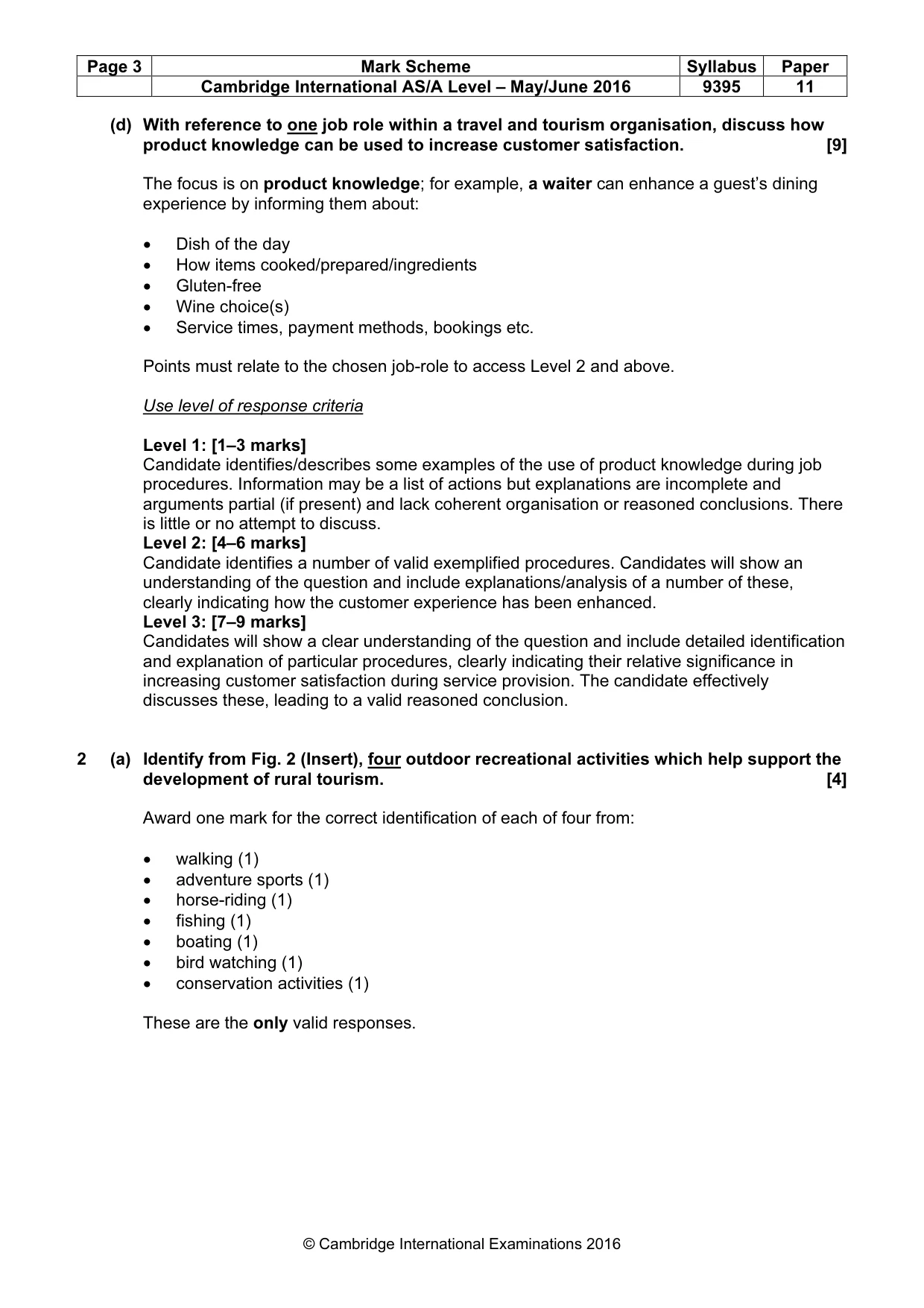
Page 3 Mark Scheme Syllabus Paper Cambridge International AS/A Level – May/June 2016 9395 11 © Cambridge International Examinations 2016 (d) With reference to one job role within a travel and tourism organisation, discuss how product knowledge can be used to increase customer satisfaction. [9] The focus is on product knowledge; for example, a waiter can enhance a guest’s dining experience by informing them about: • Dish of the day • How items cooked/prepared/ingredients • Gluten-free • Wine choice(s) • Service times, payment methods, bookings etc. Points must relate to the chosen job-role to access Level 2 and above. Use level of response criteria Level 1: [1–3 marks] Candidate identifies/describes some examples of the use of product knowledge during job procedures. Information may be a list of actions but explanations are incomplete and arguments partial (if present) and lack coherent organisation or reasoned conclusions. There is little or no attempt to discuss. Level 2: [4–6 marks] Candidate identifies a number of valid exemplified procedures. Candidates will show an understanding of the question and include explanations/analysis of a number of these, clearly indicating how the customer experience has been enhanced. Level 3: [7–9 marks] Candidates will show a clear understanding of the question and include detailed identification and explanation of particular procedures, clearly indicating their relative significance in increasing customer satisfaction during service provision. The candidate effectively discusses these, leading to a valid reasoned conclusion. 2 (a) Identify from Fig. 2 (Insert), four outdoor recreational activities which help support the development of rural tourism. [4] Award one mark for the correct identification of each of four from: • walking (1) • adventure sports (1) • horse-riding (1) • fishing (1) • boating (1) • bird watching (1) • conservation activities (1) These are the only valid responses.
Mark scheme, page 4
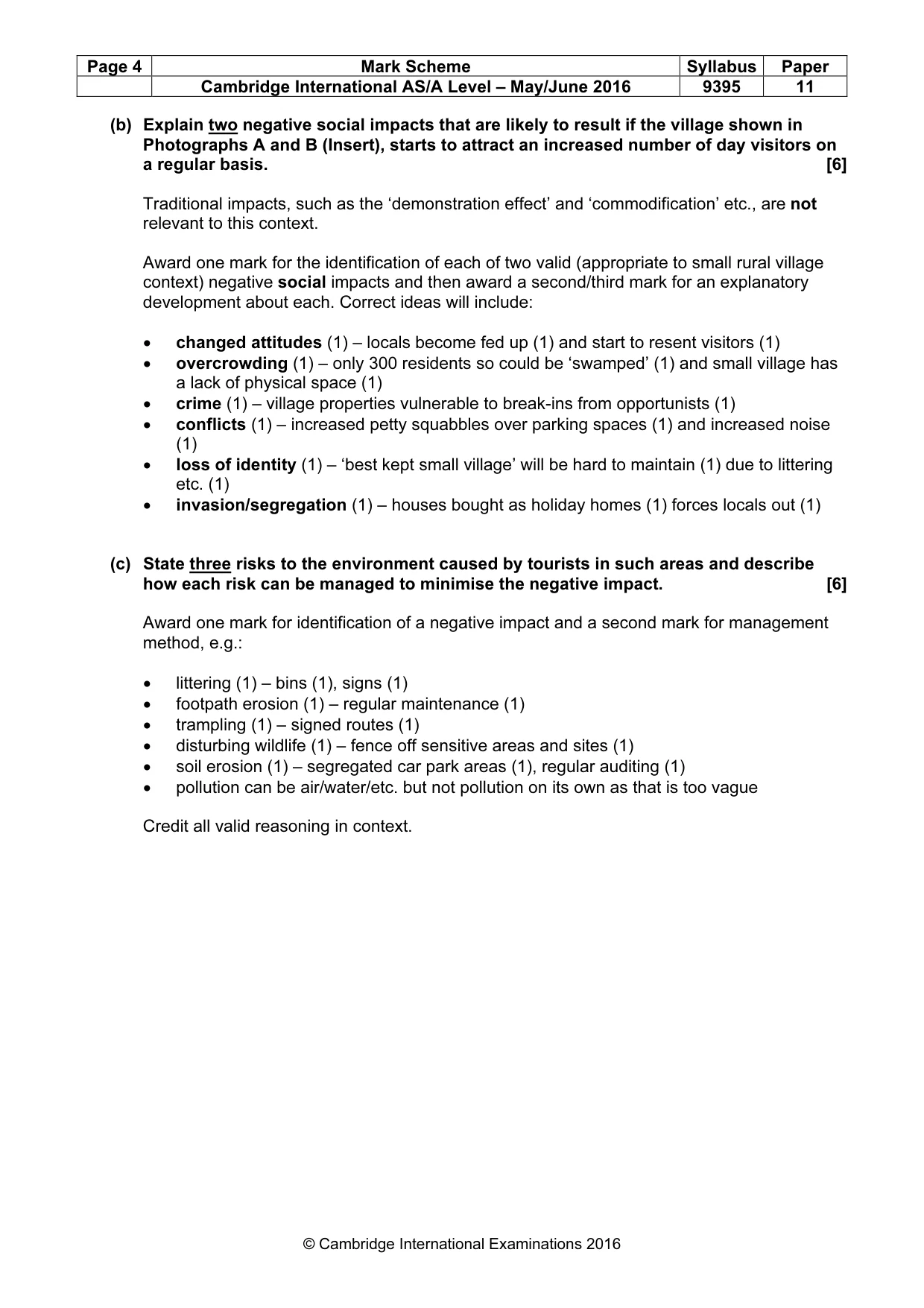
Page 4 Mark Scheme Syllabus Paper Cambridge International AS/A Level – May/June 2016 9395 11 © Cambridge International Examinations 2016 (b) Explain two negative social impacts that are likely to result if the village shown in Photographs A and B (Insert), starts to attract an increased number of day visitors on a regular basis. [6] Traditional impacts, such as the ‘demonstration effect’ and ‘commodification’ etc., are not relevant to this context. Award one mark for the identification of each of two valid (appropriate to small rural village context) negative social impacts and then award a second/third mark for an explanatory development about each. Correct ideas will include: • changed attitudes (1) – locals become fed up (1) and start to resent visitors (1) • overcrowding (1) – only 300 residents so could be ‘swamped’ (1) and small village has a lack of physical space (1) • crime (1) – village properties vulnerable to break-ins from opportunists (1) • conflicts (1) – increased petty squabbles over parking spaces (1) and increased noise (1) • loss of identity (1) – ‘best kept small village’ will be hard to maintain (1) due to littering etc. (1) • invasion/segregation (1) – houses bought as holiday homes (1) forces locals out (1) (c) State three risks to the environment caused by tourists in such areas and describe how each risk can be managed to minimise the negative impact. [6] Award one mark for identification of a negative impact and a second mark for management method, e.g.: • littering (1) – bins (1), signs (1) • footpath erosion (1) – regular maintenance (1) • trampling (1) – signed routes (1) • disturbing wildlife (1) – fence off sensitive areas and sites (1) • soil erosion (1) – segregated car park areas (1), regular auditing (1) • pollution can be air/water/etc. but not pollution on its own as that is too vague Credit all valid reasoning in context.
Mark scheme, page 5
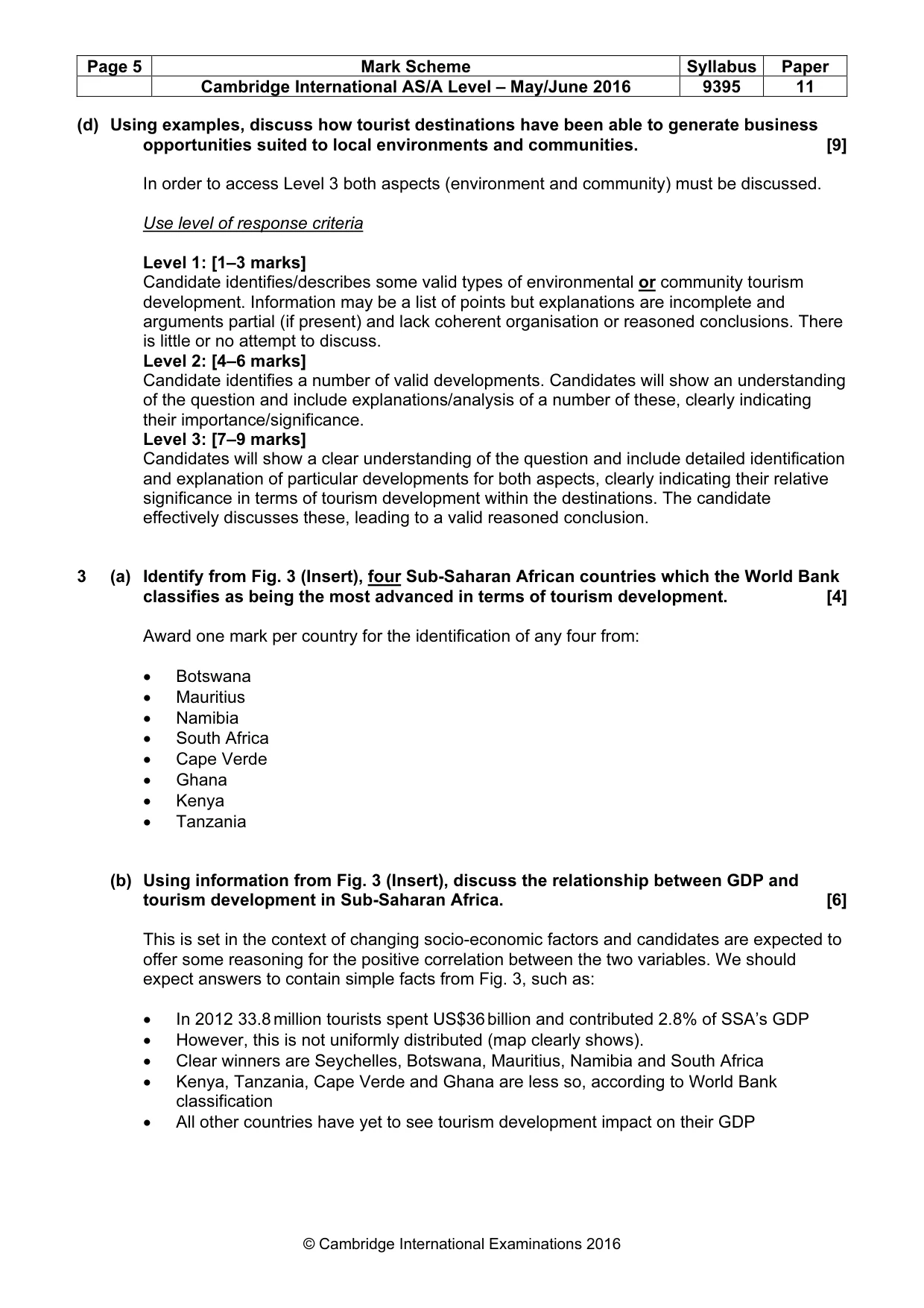
Page 5 Mark Scheme Syllabus Paper Cambridge International AS/A Level – May/June 2016 9395 11 © Cambridge International Examinations 2016 (d) Using examples, discuss how tourist destinations have been able to generate business opportunities suited to local environments and communities. [9] In order to access Level 3 both aspects (environment and community) must be discussed. Use level of response criteria Level 1: [1–3 marks] Candidate identifies/describes some valid types of environmental or community tourism development. Information may be a list of points but explanations are incomplete and arguments partial (if present) and lack coherent organisation or reasoned conclusions. There is little or no attempt to discuss. Level 2: [4–6 marks] Candidate identifies a number of valid developments. Candidates will show an understanding of the question and include explanations/analysis of a number of these, clearly indicating their importance/significance. Level 3: [7–9 marks] Candidates will show a clear understanding of the question and include detailed identification and explanation of particular developments for both aspects, clearly indicating their relative significance in terms of tourism development within the destinations. The candidate effectively discusses these, leading to a valid reasoned conclusion. 3 (a) Identify from Fig. 3 (Insert), four Sub-Saharan African countries which the World Bank classifies as being the most advanced in terms of tourism development. [4] Award one mark per country for the identification of any four from: • Botswana • Mauritius • Namibia • South Africa • Cape Verde • Ghana • Kenya • Tanzania (b) Using information from Fig. 3 (Insert), discuss the relationship between GDP and tourism development in Sub-Saharan Africa. [6] This is set in the context of changing socio-economic factors and candidates are expected to offer some reasoning for the positive correlation between the two variables. We should expect answers to contain simple facts from Fig. 3, such as: • In 2012 33.8 million tourists spent US$36 billion and contributed 2.8% of SSA’s GDP • However, this is not uniformly distributed (map clearly shows). • Clear winners are Seychelles, Botswana, Mauritius, Namibia and South Africa • Kenya, Tanzania, Cape Verde and Ghana are less so, according to World Bank classification • All other countries have yet to see tourism development impact on their GDP
Mark scheme, page 6
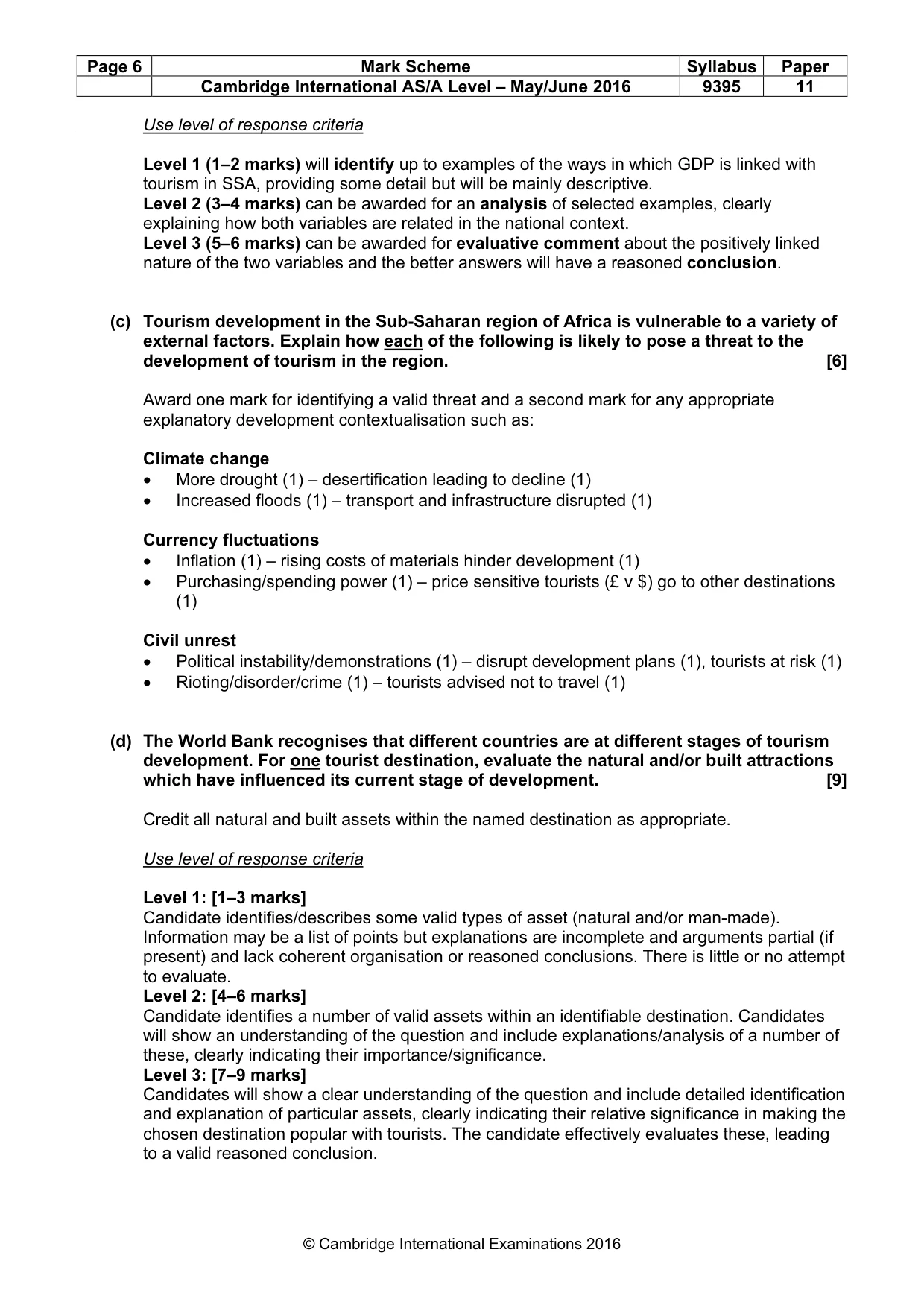
Page 6 Mark Scheme Syllabus Paper Cambridge International AS/A Level – May/June 2016 9395 11 © Cambridge International Examinations 2016 Use level of response criteria Level 1 (1–2 marks) will identify up to examples of the ways in which GDP is linked with tourism in SSA, providing some detail but will be mainly descriptive. Level 2 (3–4 marks) can be awarded for an analysis of selected examples, clearly explaining how both variables are related in the national context. Level 3 (5–6 marks) can be awarded for evaluative comment about the positively linked nature of the two variables and the better answers will have a reasoned conclusion. (c) Tourism development in the Sub-Saharan region of Africa is vulnerable to a variety of external factors. Explain how each of the following is likely to pose a threat to the development of tourism in the region. [6] Award one mark for identifying a valid threat and a second mark for any appropriate explanatory development contextualisation such as: Climate change • More drought (1) – desertification leading to decline (1) • Increased floods (1) – transport and infrastructure disrupted (1) Currency fluctuations • Inflation (1) – rising costs of materials hinder development (1) • Purchasing/spending power (1) – price sensitive tourists (£ v $) go to other destinations (1) Civil unrest • Political instability/demonstrations (1) – disrupt development plans (1), tourists at risk (1) • Rioting/disorder/crime (1) – tourists advised not to travel (1) (d) The World Bank recognises that different countries are at different stages of tourism development. For one tourist destination, evaluate the natural and/or built attractions which have influenced its current stage of development. [9] Credit all natural and built assets within the named destination as appropriate. Use level of response criteria Level 1: [1–3 marks] Candidate identifies/describes some valid types of asset (natural and/or man-made). Information may be a list of points but explanations are incomplete and arguments partial (if present) and lack coherent organisation or reasoned conclusions. There is little or no attempt to evaluate. Level 2: [4–6 marks] Candidate identifies a number of valid assets within an identifiable destination. Candidates will show an understanding of the question and include explanations/analysis of a number of these, clearly indicating their importance/significance. Level 3: [7–9 marks] Candidates will show a clear understanding of the question and include detailed identification and explanation of particular assets, clearly indicating their relative significance in making the chosen destination popular with tourists. The candidate effectively evaluates these, leading to a valid reasoned conclusion.
Mark scheme, page 7
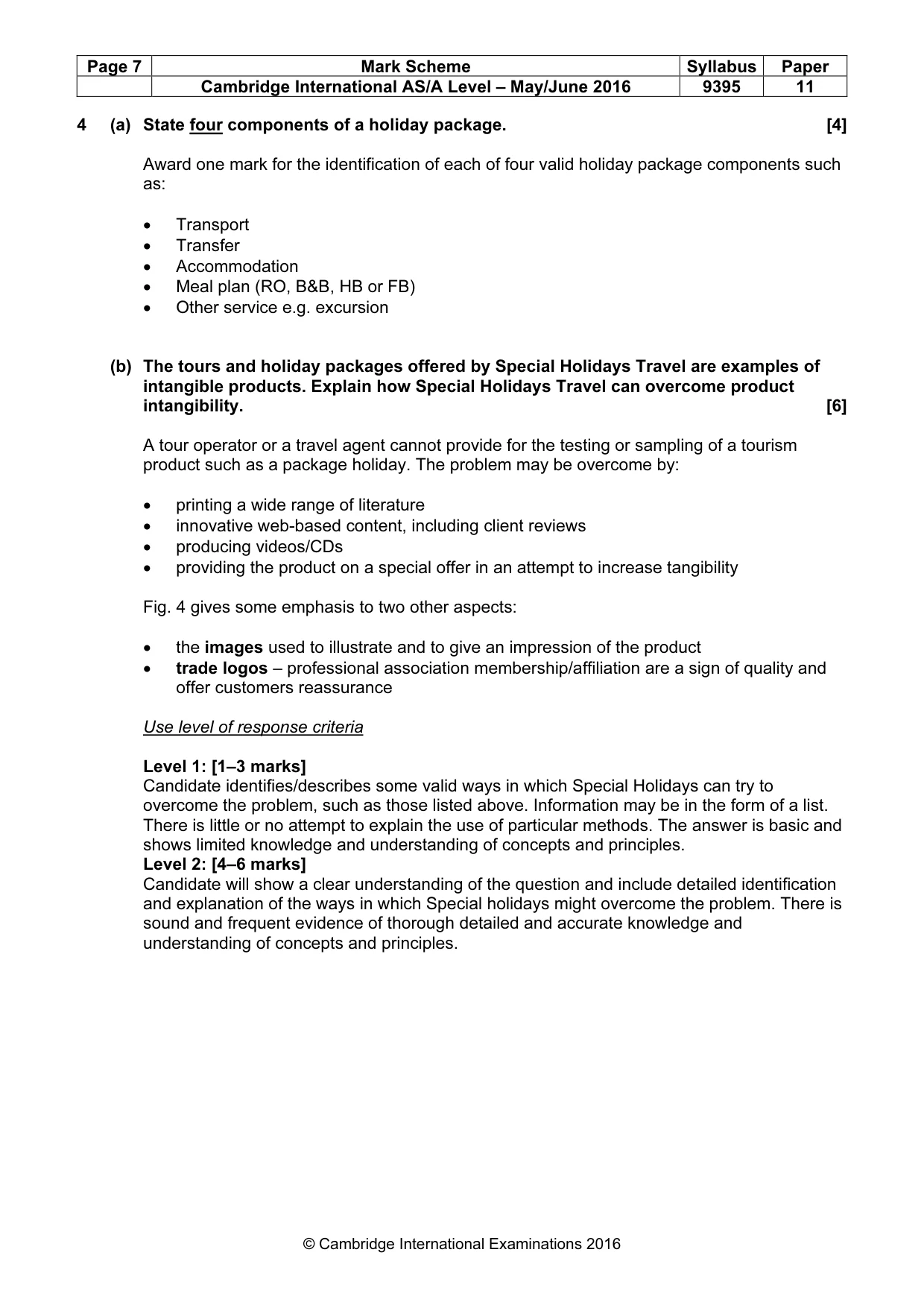
Page 7 Mark Scheme Syllabus Paper Cambridge International AS/A Level – May/June 2016 9395 11 © Cambridge International Examinations 2016 4 (a) State four components of a holiday package. [4] Award one mark for the identification of each of four valid holiday package components such as: • Transport • Transfer • Accommodation • Meal plan (RO, B&B, HB or FB) • Other service e.g. excursion (b) The tours and holiday packages offered by Special Holidays Travel are examples of intangible products. Explain how Special Holidays Travel can overcome product intangibility. [6] A tour operator or a travel agent cannot provide for the testing or sampling of a tourism product such as a package holiday. The problem may be overcome by: • printing a wide range of literature • innovative web-based content, including client reviews • producing videos/CDs • providing the product on a special offer in an attempt to increase tangibility Fig. 4 gives some emphasis to two other aspects: • the images used to illustrate and to give an impression of the product • trade logos – professional association membership/affiliation are a sign of quality and offer customers reassurance Use level of response criteria Level 1: [1–3 marks] Candidate identifies/describes some valid ways in which Special Holidays can try to overcome the problem, such as those listed above. Information may be in the form of a list. There is little or no attempt to explain the use of particular methods. The answer is basic and shows limited knowledge and understanding of concepts and principles. Level 2: [4–6 marks] Candidate will show a clear understanding of the question and include detailed identification and explanation of the ways in which Special holidays might overcome the problem. There is sound and frequent evidence of thorough detailed and accurate knowledge and understanding of concepts and principles.
Mark scheme, page 8
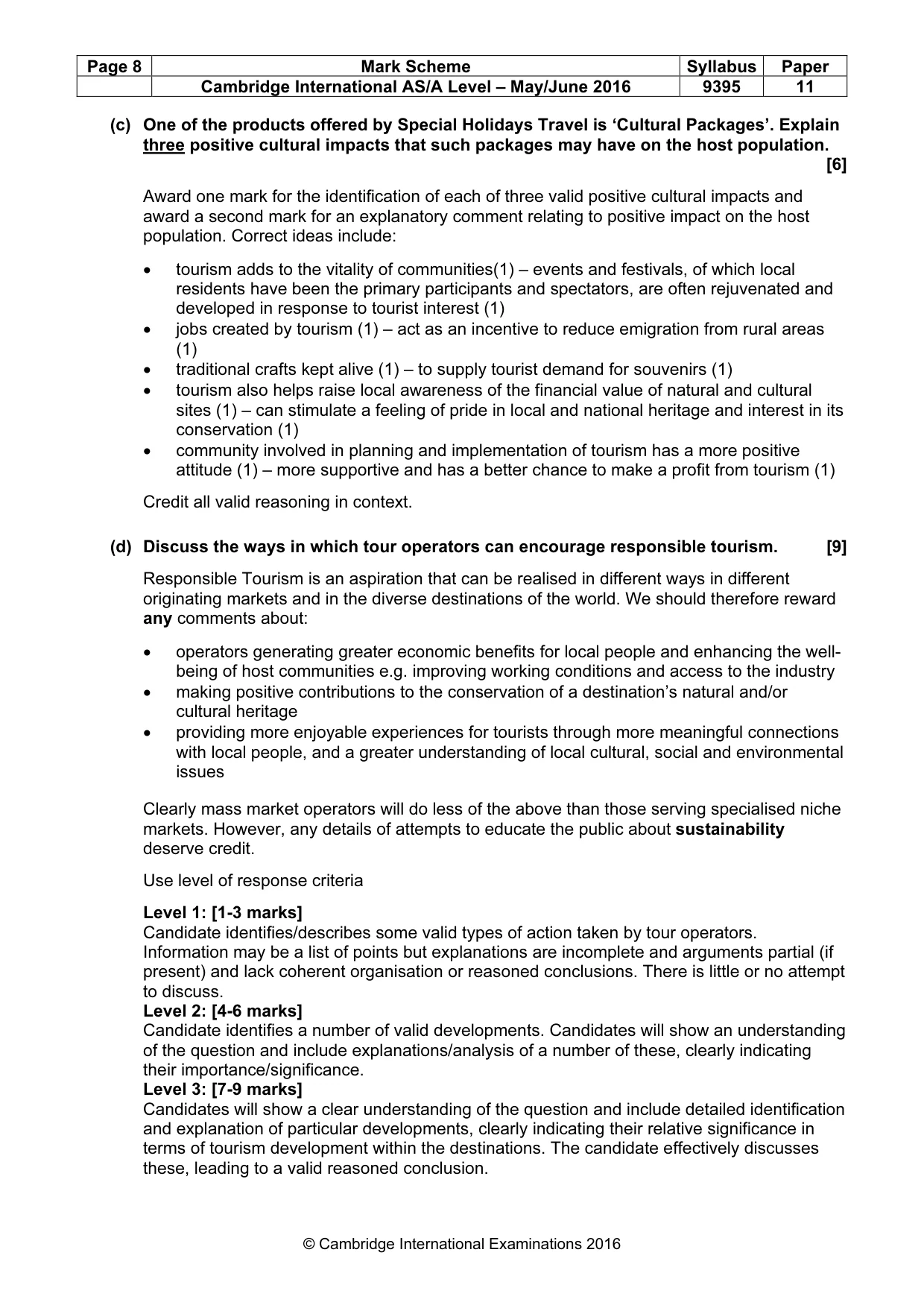
Page 8 Mark Scheme Syllabus Paper Cambridge International AS/A Level – May/June 2016 9395 11 © Cambridge International Examinations 2016 (c) One of the products offered by Special Holidays Travel is ‘Cultural Packages’. Explain three positive cultural impacts that such packages may have on the host population. [6] Award one mark for the identification of each of three valid positive cultural impacts and award a second mark for an explanatory comment relating to positive impact on the host population. Correct ideas include: • tourism adds to the vitality of communities(1) – events and festivals, of which local residents have been the primary participants and spectators, are often rejuvenated and developed in response to tourist interest (1) • jobs created by tourism (1) – act as an incentive to reduce emigration from rural areas (1) • traditional crafts kept alive (1) – to supply tourist demand for souvenirs (1) • tourism also helps raise local awareness of the financial value of natural and cultural sites (1) – can stimulate a feeling of pride in local and national heritage and interest in its conservation (1) • community involved in planning and implementation of tourism has a more positive attitude (1) – more supportive and has a better chance to make a profit from tourism (1) Credit all valid reasoning in context. (d) Discuss the ways in which tour operators can encourage responsible tourism. [9] Responsible Tourism is an aspiration that can be realised in different ways in different originating markets and in the diverse destinations of the world. We should therefore reward any comments about: • operators generating greater economic benefits for local people and enhancing the well- being of host communities e.g. improving working conditions and access to the industry • making positive contributions to the conservation of a destination’s natural and/or cultural heritage • providing more enjoyable experiences for tourists through more meaningful connections with local people, and a greater understanding of local cultural, social and environmental issues Clearly mass market operators will do less of the above than those serving specialised niche markets. However, any details of attempts to educate the public about sustainability deserve credit. Use level of response criteria Level 1: [1-3 marks] Candidate identifies/describes some valid types of action taken by tour operators. Information may be a list of points but explanations are incomplete and arguments partial (if present) and lack coherent organisation or reasoned conclusions. There is little or no attempt to discuss. Level 2: [4-6 marks] Candidate identifies a number of valid developments. Candidates will show an understanding of the question and include explanations/analysis of a number of these, clearly indicating their importance/significance. Level 3: [7-9 marks] Candidates will show a clear understanding of the question and include detailed identification and explanation of particular developments, clearly indicating their relative significance in terms of tourism development within the destinations. The candidate effectively discusses these, leading to a valid reasoned conclusion.
What you needed in this session
Cambridge’s own grade thresholds for 2016 May/June, Paper 1 · Variant 1. A higher threshold means an easier paper — the bar moves with how the cohort did.