Cambridge A Level Travel and Tourism 9395 — 2015 May/June Paper 1 · Variant 2
9395/12/M/J/15 · 100 marks · ≈113 min
The question paper and its mark scheme, free to read here and free to download. This is Cambridge’s own paper, exactly as it was sat.
Question paper16 pages



Mark scheme8 pages
Answers below. Sit the paper first if you are practising.
Paper as text
Question paper, page 1
This document consists of 13 printed pages, 3 blank pages and 1 Insert. DC (CW) 89829/2 © UCLES 2015 [Turn over Cambridge International Examinations Cambridge International Advanced Subsidiary and Advanced Level * 3 0 5 2 7 2 8 9 0 2 * TRAVEL AND TOURISM 9395/12 Paper 1 Core May/June 2015 2 hours and 30 minutes Candidates answer on the Question Paper. No Additional Materials are required. READ THESE INSTRUCTIONS FIRST Write your Centre number, candidate number and name on all the work you hand in. Write in dark blue or black pen. You may use an HB pencil for any diagrams or graphs. Do not use staples, paper clips, glue or correction fluid. DO NOT WRITE IN ANY BARCODES. Answer all questions. All the Figures referred to in the questions are contained in the Insert. The number of marks is given in brackets [ ] at the end of each question or part question.
Question paper, page 2
2 9395/12/M/J/15 © UCLES 2015 Question 1 Refer to Fig. 1 (Insert), details of a ‘National Code of Practice for Visitor Attractions’ and Photographs A, B, C and D (Insert). (a) Photographs A, B, C and D (Insert), taken at different visitor attractions, show ways in which aspects of the ‘National Code of Practice for Visitor Attractions’ have been put in place. Identify, using Fig. 1 (Insert), which aspect of the Code of Practice each photograph illustrates. Photograph A: Code of Practice number … Photograph B: Code of Practice number … Photograph C: Code of Practice number … Photograph D: Code of Practice number … [4] (b) Attractions that follow the Code of Practice will meet the needs of most external customers. Explain three ‘reasonable adjustments’ for disabled people that are found at many visitor attractions. 1 … … … … 2 … … … … 3 … … … … [6]
Question paper, page 3
3 9395/12/M/J/15 © UCLES 2015 [Turn over (c) Explain three ways by which many travel and tourism organisations meet the needs of customers for whom English is not their first language. 1 … … … … 2 … … … … 3 … … … … [6]
Question paper, page 4
4 9395/12/M/J/15 © UCLES 2015 (d) With reference to specific job roles within one travel and tourism organisation with which you are familiar, assess what is done to ensure customer comfort and safety. Chosen organisation … … … … … … … … … … … … … … … … … … … … … … … … … …[9] [Total: 25]
Question paper, page 5
5 9395/12/M/J/15 © UCLES 2015 [Turn over Question 2 Refer to Fig. 2 (Insert), a news item about cruises to Papua New Guinea, a destination in the south-western Pacific Ocean. (a) Identify from Fig. 2 (Insert) the following: • the two cruise ships that carry ‘Zodiacs’ 1 … 2 … • the two ports in Australia from which Papua New Guinea cruises depart. 1 … 2 … [4] (b) With reference to Fig. 2 (Insert), discuss the view that P&O Cruises to Papua New Guinea will appeal to a wide variety of cruise enthusiasts. … … … … … … … … … … … …[6]
Question paper, page 6
6 9395/12/M/J/15 © UCLES 2015 (c) State two negative environmental impacts which could be caused by tourists visiting fragile coastal environments. Explain fully how each impact might be managed in a sustainable way. Negative impact 1 … … … … … … … Negative impact 2 … … … … … … … [6]
Question paper, page 7
7 9395/12/M/J/15 © UCLES 2015 [Turn over (d) Discuss the ways in which tourism development can help support the traditional culture of a Less Economically Developed Country (LEDC) such as Papua New Guinea. … … … … … … … … … … … … … … … … … … … … … … … … … …[9] [Total: 25]
Question paper, page 8
8 9395/12/M/J/15 © UCLES 2015 Question 3 Refer to Fig. 3 (Insert), tourism data for selected Asian countries in 2012. (a) With reference to Fig. 3 (Insert), describe the variations in the growth of outbound travel from Asia in 2012. … … … … … … … …[4] (b) Discuss the factors that are likely to have caused the variations in outbound travel shown in Fig. 3 (Insert). … … … … … … … … … … … …[6]
Question paper, page 9
9 9395/12/M/J/15 © UCLES 2015 [Turn over (c) Explain three ways in which national tourist boards can encourage inbound tourism. 1 … … … … 2 … … … … 3 … … … … [6]
Question paper, page 10
10 9395/12/M/J/15 © UCLES 2015 (d) All destinations experience changes in their visitor numbers over time. With reference to one destination with which you are familiar, discuss the factors that cause visitor numbers to fluctuate. Chosen destination … … … … … … … … … … … … … … … … … … … … … … … … …[9] [Total: 25]
Question paper, page 11
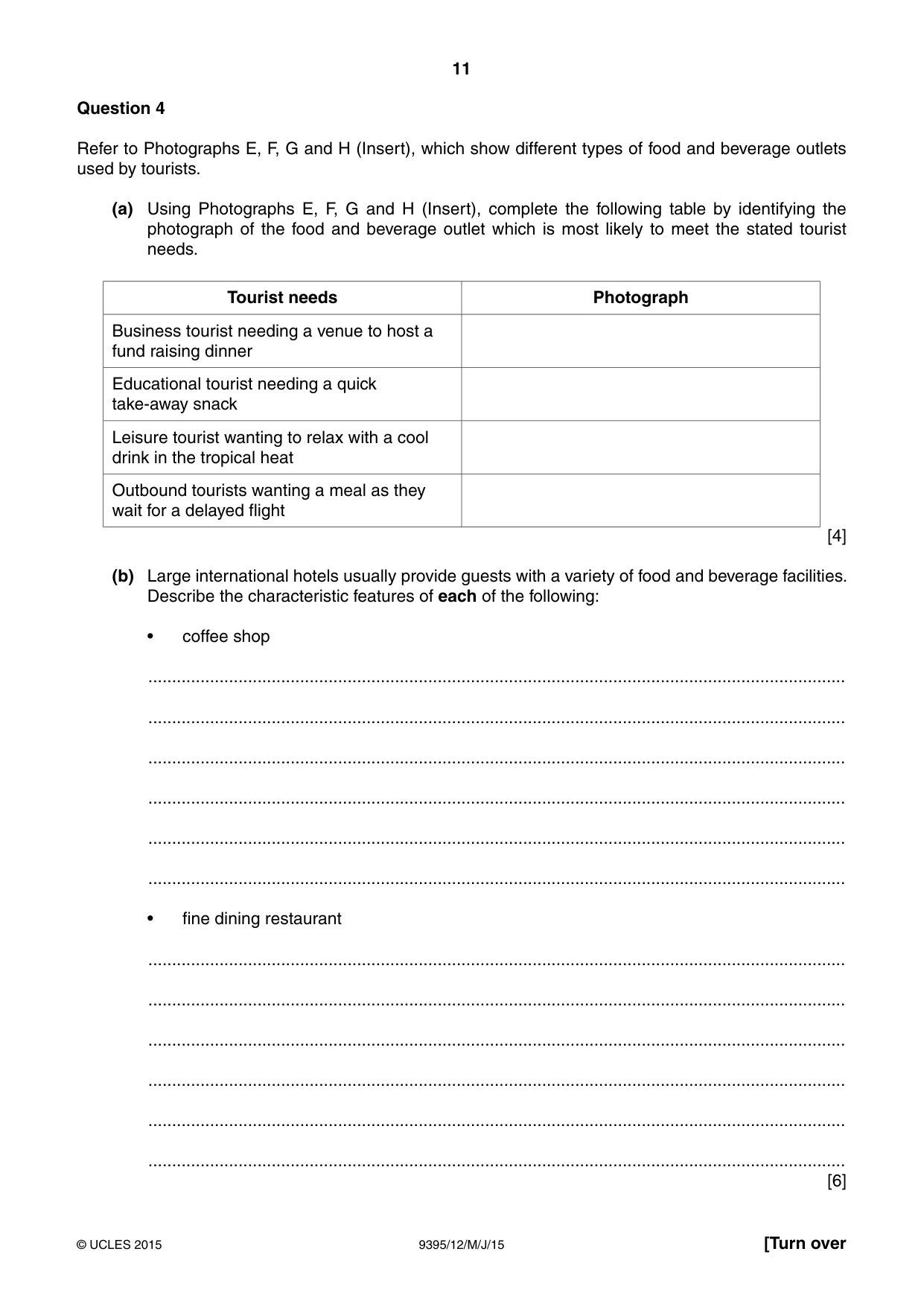
11 9395/12/M/J/15 © UCLES 2015 [Turn over Question 4 Refer to Photographs E, F, G and H (Insert), which show different types of food and beverage outlets used by tourists. (a) Using Photographs E, F, G and H (Insert), complete the following table by identifying the photograph of the food and beverage outlet which is most likely to meet the stated tourist needs. Tourist needs Photograph Business tourist needing a venue to host a fund raising dinner Educational tourist needing a quick take-away snack Leisure tourist wanting to relax with a cool drink in the tropical heat Outbound tourists wanting a meal as they wait for a delayed flight [4] (b) Large international hotels usually provide guests with a variety of food and beverage facilities. Describe the characteristic features of each of the following: • coffee shop … … … … … … • fine dining restaurant … … … … … … [6]
Question paper, page 12
12 9395/12/M/J/15 © UCLES 2015 (c) State three services usually provided by large international hotels for business customers and for each explain how it meets a customer need. 1 … … … … 2 … … … … 3 … … … … [6]
Question paper, page 13
13 9395/12/M/J/15 © UCLES 2015 (d) Discuss the ways in which a leisure tourist’s needs and motivation for travel change with age. … … … … … … … … … … … … … … … … … … … … … … … … … …[9] [Total: 25]
Question paper, page 14
14 9395/12/M/J/15 © UCLES 2015 BLANK PAGE
Question paper, page 15
15 9395/12/M/J/15 © UCLES 2015 BLANK PAGE
Question paper, page 16
16 9395/12/M/J/15 © UCLES 2015 BLANK PAGE Permission to reproduce items where third-party owned material protected by copyright is included has been sought and cleared where possible. Every reasonable effort has been made by the publisher (UCLES) to trace copyright holders, but if any items requiring clearance have unwittingly been included, the publisher will be pleased to make amends at the earliest possible opportunity. To avoid the issue of disclosure of answer-related information to candidates, all copyright acknowledgements are reproduced online in the Cambridge International Examinations Copyright Acknowledgements Booklet. This is produced for each series of examinations and is freely available to download at www.cie.org.uk after the live examination series. Cambridge International Examinations is part of the Cambridge Assessment Group. Cambridge Assessment is the brand name of University of Cambridge Local Examinations Syndicate (UCLES), which is itself a department of the University of Cambridge.
Mark scheme, page 1
® IGCSE is the registered trademark of Cambridge International Examinations. CAMBRIDGE INTERNATIONAL EXAMINATIONS Cambridge International Advanced Subsidiary and Advanced Level MARK SCHEME for the May/June 2015 series 9395 TRAVEL AND TOURISM 9395/12 Paper 1 (Core Paper), maximum raw mark 100 This mark scheme is published as an aid to teachers and candidates, to indicate the requirements of the examination. It shows the basis on which Examiners were instructed to award marks. It does not indicate the details of the discussions that took place at an Examiners’ meeting before marking began, which would have considered the acceptability of alternative answers. Mark schemes should be read in conjunction with the question paper and the Principal Examiner Report for Teachers. Cambridge will not enter into discussions about these mark schemes. Cambridge is publishing the mark schemes for the May/June 2015 series for most Cambridge IGCSE®, Cambridge International A and AS Level components and some Cambridge O Level components.
Mark scheme, page 2
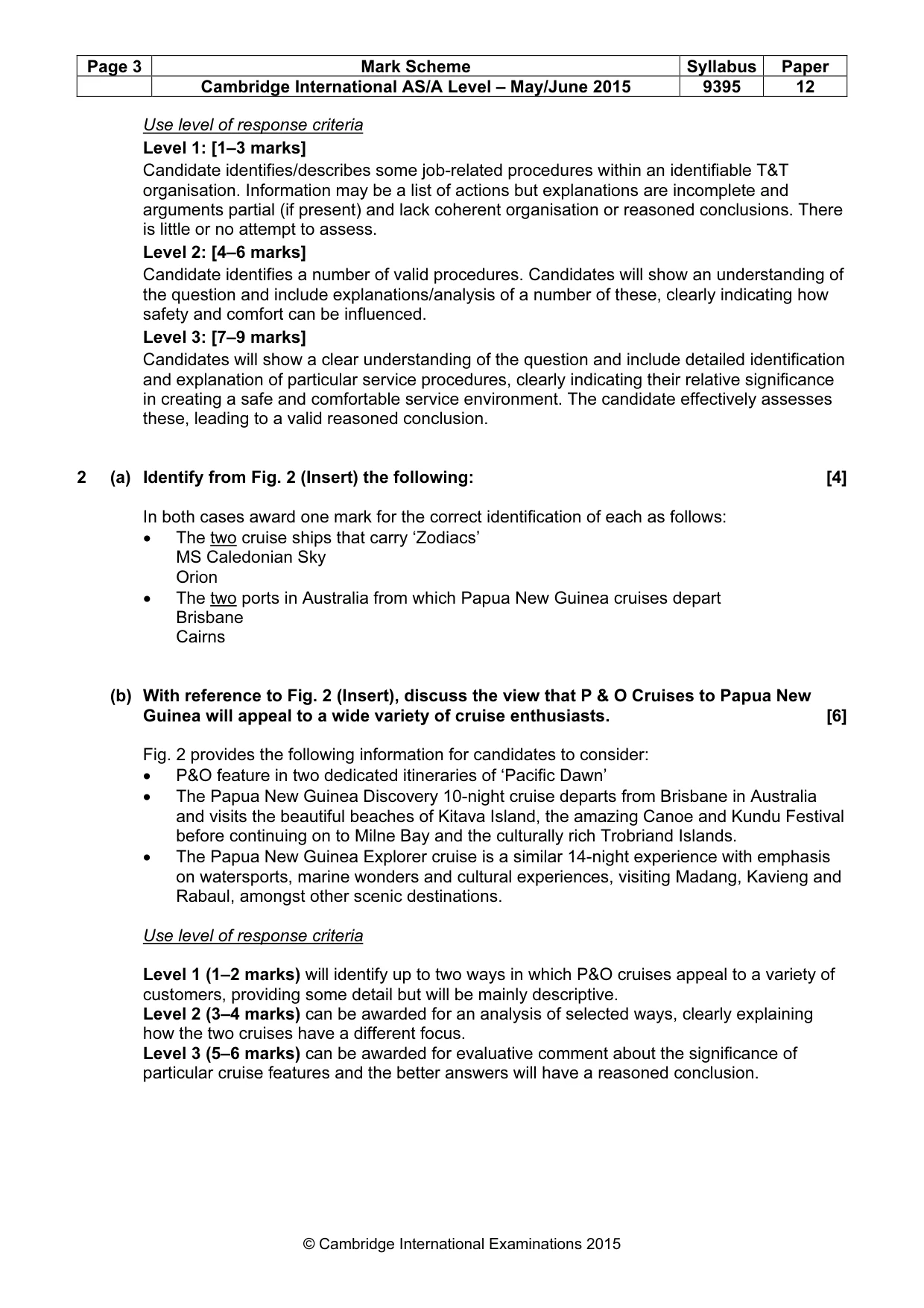
Page 2 Mark Scheme Syllabus Paper Cambridge International AS/A Level – May/June 2015 9395 12 © Cambridge International Examinations 2015 1 (a) Identify using Fig.1 (Insert) which aspect of the Code of Practice each photograph illustrates. [4] In each case award one mark for the correct identification of the appropriate number as follows: • Photograph A = #12 • Photograph B = #7 • Photograph C = #4 • Photograph D = #9 (b) Attractions that follow the Code of Practice will meet the needs of most external customers. Explain three ‘reasonable adjustments’ for disabled people that are found at many visitor attractions. [6] Award one mark for the identification of each of three valid adjustments and award a second mark for an appropriate explanatory comment about each. However, it should be clear that an adjustment or alteration to an existing facility is being made. Correct ideas include: • Ramps (1) – allow wheelchair access (1) • Lifts (1) – avoid using stairs (1) • Hearing loops (1) – for deaf (1) • Tactile signs (1) – for blind (1) Credit other valid aspects such as door widening, counter lowering and disabled toilet etc. (c) Explain three ways by which many travel and tourism organisations meet the needs of customers for whom English is not their first language. [6] Be careful of candidates repeating themselves and avoid awarding double credit. Award one mark for the correct identification of each of three appropriate methods and award a second mark for an explanatory development of each. Correct ideas will include: • Multi-lingual staff (1) – to communicate effectively with customers in person (1) • Print material/website in different languages (1) – so that customers can read (1) • Tours & attractions have language tapes (1) – so customers understand (1) • International signage (1) – symbols understood by all (1) Credit all valid reasoning. (d) With reference to specific job roles within one travel and tourism organisation with which you are familiar, assess what is done to ensure customer comfort and safety. [9] The syllabus requires candidates to be familiar with three job roles. The question requires candidates to identify at least one comfort and one safety idea. However, points must relate to selected jobs – what can go wrong to cause a risk to customer safety? What is done to ensure the customer is comfortable? Depending on the job roles selected, issues can include: • Preparation of service environment • Removal of offending items • Following set task-related procedures • Checking faulty good/product/item • Clearing spills/damage etc. This is all about the context and candidates making generic statements about non-specific job roles cannot move into Level 2. Max 5 if only covering comfort or safety, both aspects must be covered to exceed 6 marks.
Mark scheme, page 3
Page 3 Mark Scheme Syllabus Paper Cambridge International AS/A Level – May/June 2015 9395 12 © Cambridge International Examinations 2015 Use level of response criteria Level 1: [1–3 marks] Candidate identifies/describes some job-related procedures within an identifiable T&T organisation. Information may be a list of actions but explanations are incomplete and arguments partial (if present) and lack coherent organisation or reasoned conclusions. There is little or no attempt to assess. Level 2: [4–6 marks] Candidate identifies a number of valid procedures. Candidates will show an understanding of the question and include explanations/analysis of a number of these, clearly indicating how safety and comfort can be influenced. Level 3: [7–9 marks] Candidates will show a clear understanding of the question and include detailed identification and explanation of particular service procedures, clearly indicating their relative significance in creating a safe and comfortable service environment. The candidate effectively assesses these, leading to a valid reasoned conclusion. 2 (a) Identify from Fig. 2 (Insert) the following: [4] In both cases award one mark for the correct identification of each as follows: • The two cruise ships that carry ‘Zodiacs’ MS Caledonian Sky Orion • The two ports in Australia from which Papua New Guinea cruises depart Brisbane Cairns (b) With reference to Fig. 2 (Insert), discuss the view that P & O Cruises to Papua New Guinea will appeal to a wide variety of cruise enthusiasts. [6] Fig. 2 provides the following information for candidates to consider: • P&O feature in two dedicated itineraries of ‘Pacific Dawn’ • The Papua New Guinea Discovery 10-night cruise departs from Brisbane in Australia and visits the beautiful beaches of Kitava Island, the amazing Canoe and Kundu Festival before continuing on to Milne Bay and the culturally rich Trobriand Islands. • The Papua New Guinea Explorer cruise is a similar 14-night experience with emphasis on watersports, marine wonders and cultural experiences, visiting Madang, Kavieng and Rabaul, amongst other scenic destinations. Use level of response criteria Level 1 (1–2 marks) will identify up to two ways in which P&O cruises appeal to a variety of customers, providing some detail but will be mainly descriptive. Level 2 (3–4 marks) can be awarded for an analysis of selected ways, clearly explaining how the two cruises have a different focus. Level 3 (5–6 marks) can be awarded for evaluative comment about the significance of particular cruise features and the better answers will have a reasoned conclusion.
Mark scheme, page 4
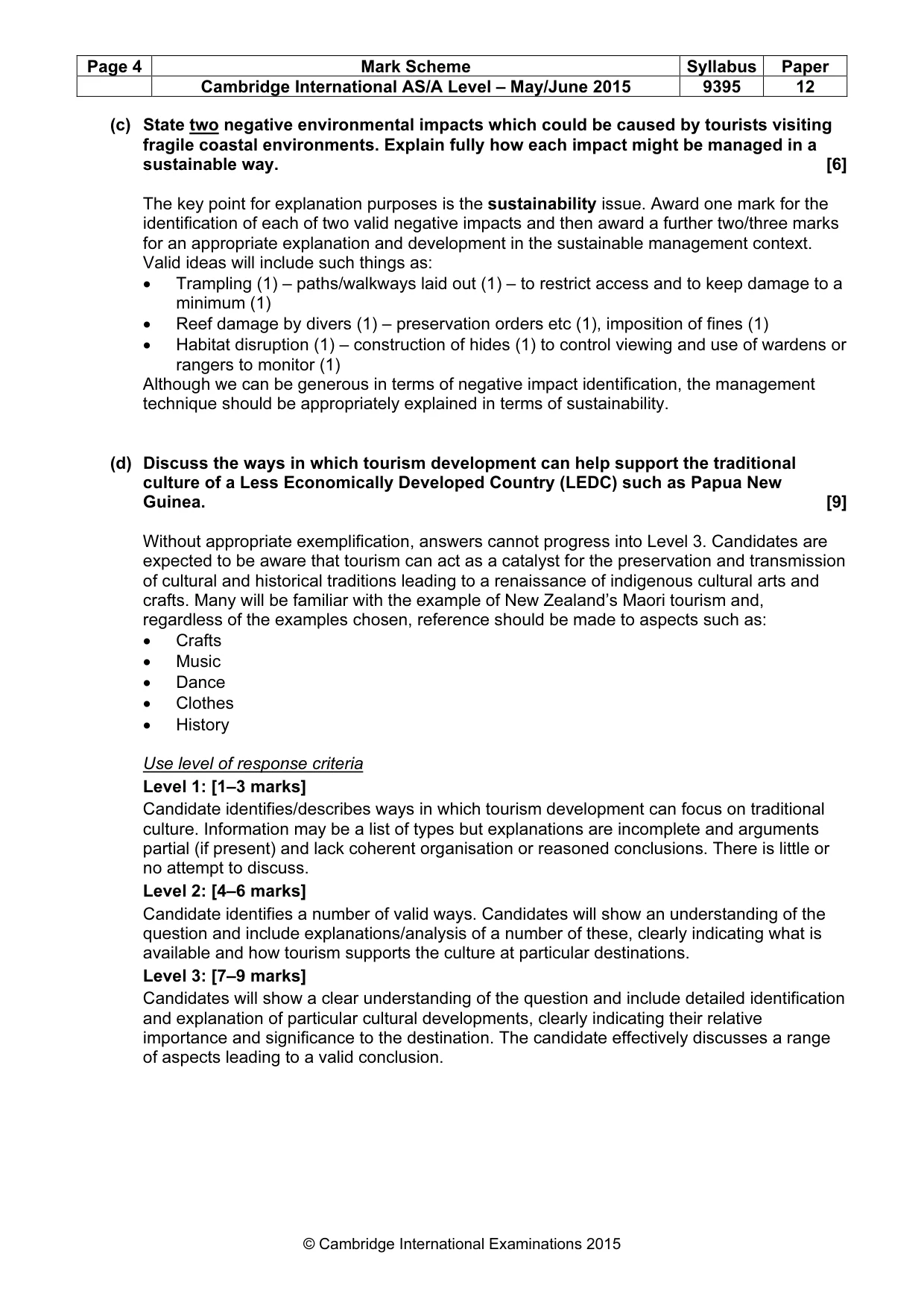
Page 4 Mark Scheme Syllabus Paper Cambridge International AS/A Level – May/June 2015 9395 12 © Cambridge International Examinations 2015 (c) State two negative environmental impacts which could be caused by tourists visiting fragile coastal environments. Explain fully how each impact might be managed in a sustainable way. [6] The key point for explanation purposes is the sustainability issue. Award one mark for the identification of each of two valid negative impacts and then award a further two/three marks for an appropriate explanation and development in the sustainable management context. Valid ideas will include such things as: • Trampling (1) – paths/walkways laid out (1) – to restrict access and to keep damage to a minimum (1) • Reef damage by divers (1) – preservation orders etc (1), imposition of fines (1) • Habitat disruption (1) – construction of hides (1) to control viewing and use of wardens or rangers to monitor (1) Although we can be generous in terms of negative impact identification, the management technique should be appropriately explained in terms of sustainability. (d) Discuss the ways in which tourism development can help support the traditional culture of a Less Economically Developed Country (LEDC) such as Papua New Guinea. [9] Without appropriate exemplification, answers cannot progress into Level 3. Candidates are expected to be aware that tourism can act as a catalyst for the preservation and transmission of cultural and historical traditions leading to a renaissance of indigenous cultural arts and crafts. Many will be familiar with the example of New Zealand’s Maori tourism and, regardless of the examples chosen, reference should be made to aspects such as: • Crafts • Music • Dance • Clothes • History Use level of response criteria Level 1: [1–3 marks] Candidate identifies/describes ways in which tourism development can focus on traditional culture. Information may be a list of types but explanations are incomplete and arguments partial (if present) and lack coherent organisation or reasoned conclusions. There is little or no attempt to discuss. Level 2: [4–6 marks] Candidate identifies a number of valid ways. Candidates will show an understanding of the question and include explanations/analysis of a number of these, clearly indicating what is available and how tourism supports the culture at particular destinations. Level 3: [7–9 marks] Candidates will show a clear understanding of the question and include detailed identification and explanation of particular cultural developments, clearly indicating their relative importance and significance to the destination. The candidate effectively discusses a range of aspects leading to a valid conclusion.
Mark scheme, page 5
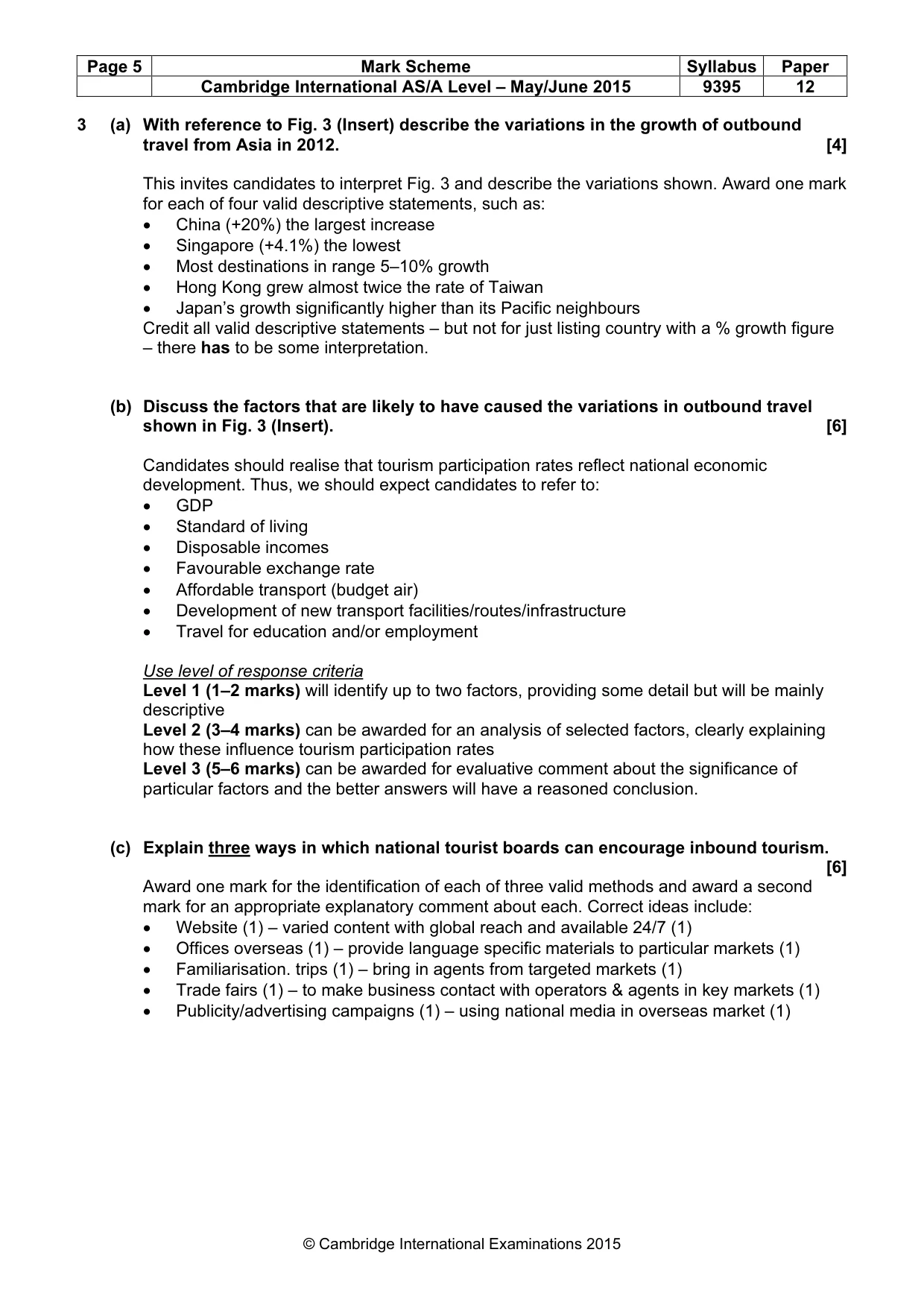
Page 5 Mark Scheme Syllabus Paper Cambridge International AS/A Level – May/June 2015 9395 12 © Cambridge International Examinations 2015 3 (a) With reference to Fig. 3 (Insert) describe the variations in the growth of outbound travel from Asia in 2012. [4] This invites candidates to interpret Fig. 3 and describe the variations shown. Award one mark for each of four valid descriptive statements, such as: • China (+20%) the largest increase • Singapore (+4.1%) the lowest • Most destinations in range 5–10% growth • Hong Kong grew almost twice the rate of Taiwan • Japan’s growth significantly higher than its Pacific neighbours Credit all valid descriptive statements – but not for just listing country with a % growth figure – there has to be some interpretation. (b) Discuss the factors that are likely to have caused the variations in outbound travel shown in Fig. 3 (Insert). [6] Candidates should realise that tourism participation rates reflect national economic development. Thus, we should expect candidates to refer to: • GDP • Standard of living • Disposable incomes • Favourable exchange rate • Affordable transport (budget air) • Development of new transport facilities/routes/infrastructure • Travel for education and/or employment Use level of response criteria Level 1 (1–2 marks) will identify up to two factors, providing some detail but will be mainly descriptive Level 2 (3–4 marks) can be awarded for an analysis of selected factors, clearly explaining how these influence tourism participation rates Level 3 (5–6 marks) can be awarded for evaluative comment about the significance of particular factors and the better answers will have a reasoned conclusion. (c) Explain three ways in which national tourist boards can encourage inbound tourism. [6] Award one mark for the identification of each of three valid methods and award a second mark for an appropriate explanatory comment about each. Correct ideas include: • Website (1) – varied content with global reach and available 24/7 (1) • Offices overseas (1) – provide language specific materials to particular markets (1) • Familiarisation. trips (1) – bring in agents from targeted markets (1) • Trade fairs (1) – to make business contact with operators & agents in key markets (1) • Publicity/advertising campaigns (1) – using national media in overseas market (1)
Mark scheme, page 6
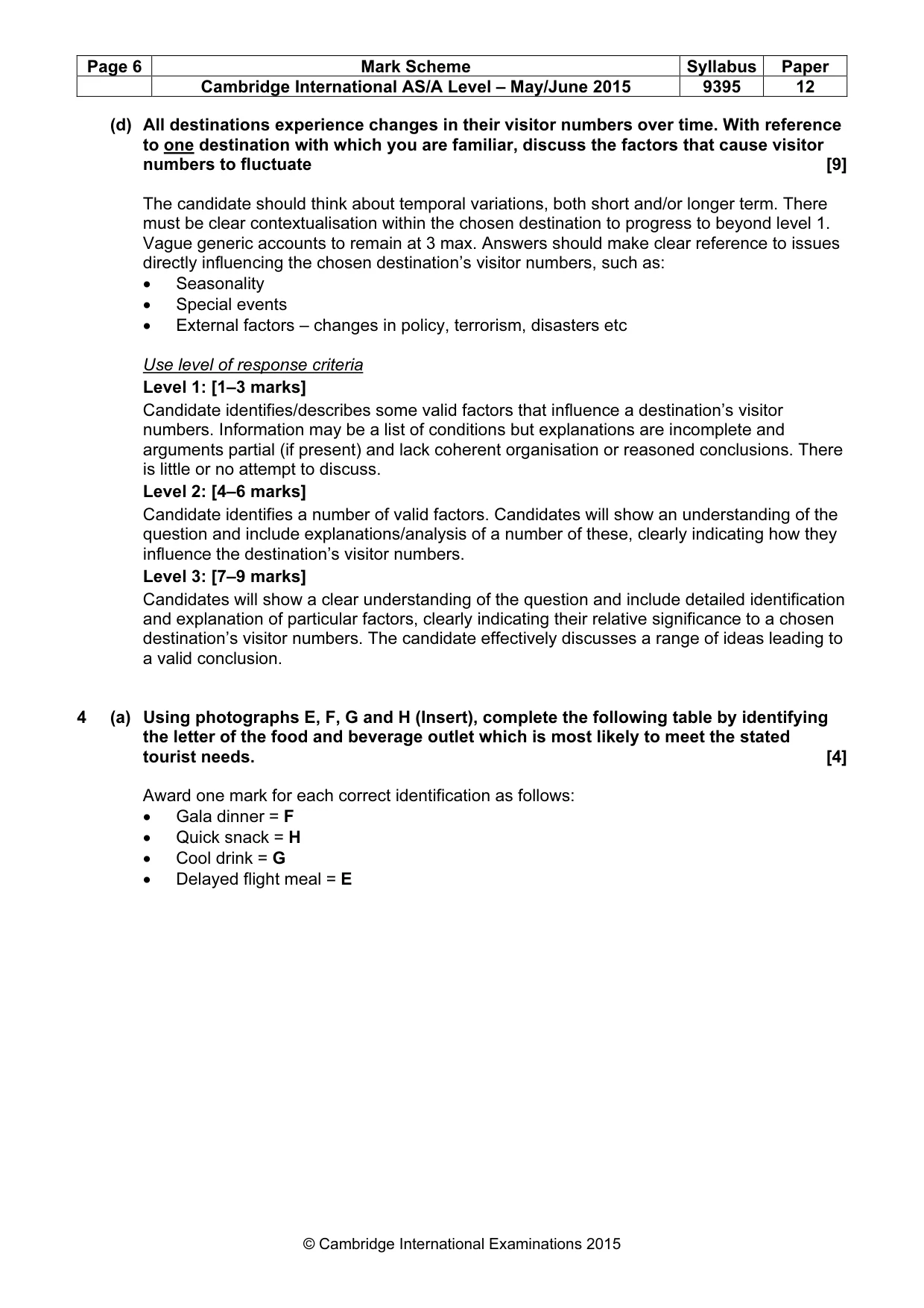
Page 6 Mark Scheme Syllabus Paper Cambridge International AS/A Level – May/June 2015 9395 12 © Cambridge International Examinations 2015 (d) All destinations experience changes in their visitor numbers over time. With reference to one destination with which you are familiar, discuss the factors that cause visitor numbers to fluctuate [9] The candidate should think about temporal variations, both short and/or longer term. There must be clear contextualisation within the chosen destination to progress to beyond level 1. Vague generic accounts to remain at 3 max. Answers should make clear reference to issues directly influencing the chosen destination’s visitor numbers, such as: • Seasonality • Special events • External factors – changes in policy, terrorism, disasters etc Use level of response criteria Level 1: [1–3 marks] Candidate identifies/describes some valid factors that influence a destination’s visitor numbers. Information may be a list of conditions but explanations are incomplete and arguments partial (if present) and lack coherent organisation or reasoned conclusions. There is little or no attempt to discuss. Level 2: [4–6 marks] Candidate identifies a number of valid factors. Candidates will show an understanding of the question and include explanations/analysis of a number of these, clearly indicating how they influence the destination’s visitor numbers. Level 3: [7–9 marks] Candidates will show a clear understanding of the question and include detailed identification and explanation of particular factors, clearly indicating their relative significance to a chosen destination’s visitor numbers. The candidate effectively discusses a range of ideas leading to a valid conclusion. 4 (a) Using photographs E, F, G and H (Insert), complete the following table by identifying the letter of the food and beverage outlet which is most likely to meet the stated tourist needs. [4] Award one mark for each correct identification as follows: • Gala dinner = F • Quick snack = H • Cool drink = G • Delayed flight meal = E
Mark scheme, page 7
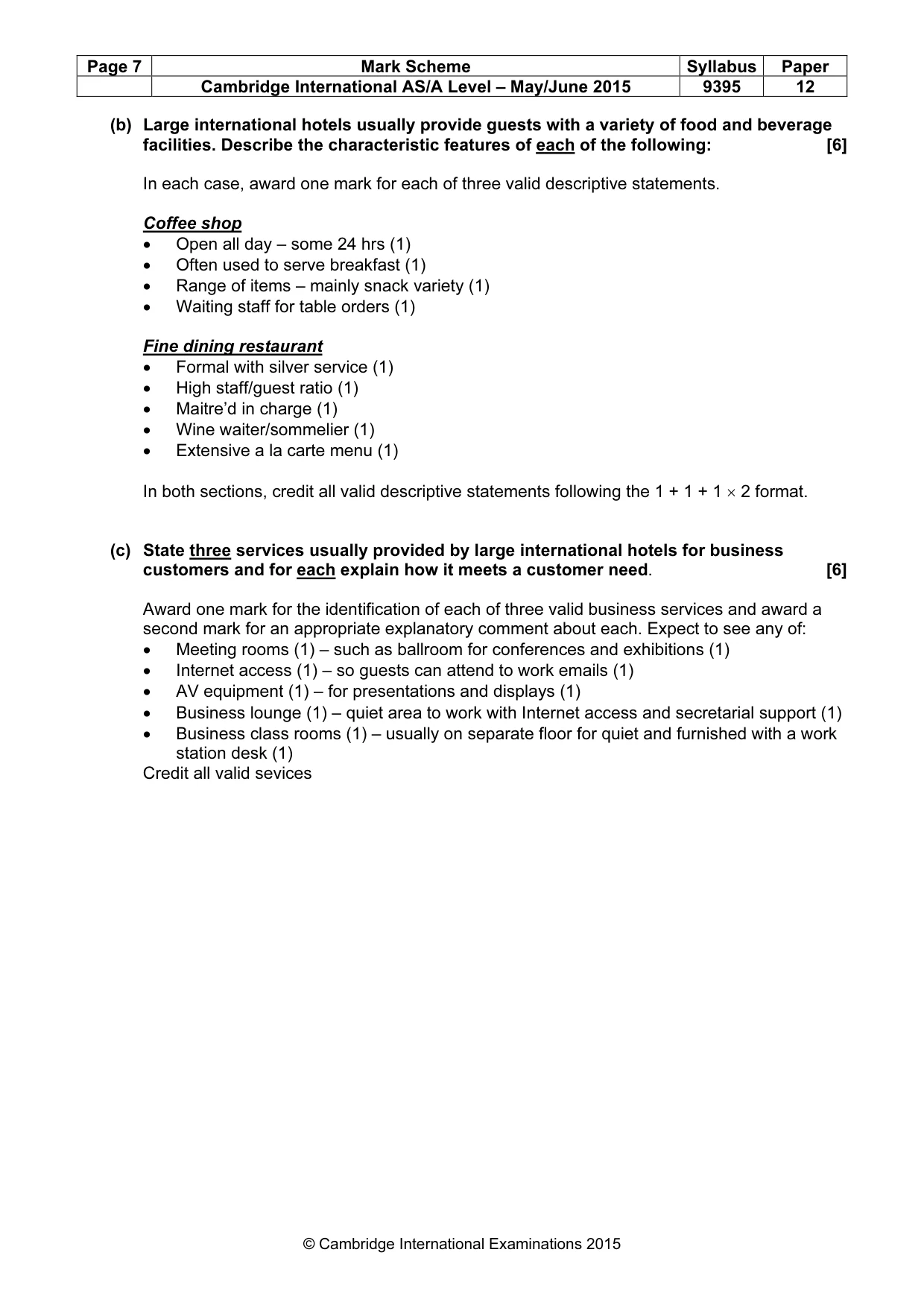
Page 7 Mark Scheme Syllabus Paper Cambridge International AS/A Level – May/June 2015 9395 12 © Cambridge International Examinations 2015 (b) Large international hotels usually provide guests with a variety of food and beverage facilities. Describe the characteristic features of each of the following: [6] In each case, award one mark for each of three valid descriptive statements. Coffee shop • Open all day – some 24 hrs (1) • Often used to serve breakfast (1) • Range of items – mainly snack variety (1) • Waiting staff for table orders (1) Fine dining restaurant • Formal with silver service (1) • High staff/guest ratio (1) • Maitre’d in charge (1) • Wine waiter/sommelier (1) • Extensive a la carte menu (1) In both sections, credit all valid descriptive statements following the 1 + 1 + 1 × 2 format. (c) State three services usually provided by large international hotels for business customers and for each explain how it meets a customer need. [6] Award one mark for the identification of each of three valid business services and award a second mark for an appropriate explanatory comment about each. Expect to see any of: • Meeting rooms (1) – such as ballroom for conferences and exhibitions (1) • Internet access (1) – so guests can attend to work emails (1) • AV equipment (1) – for presentations and displays (1) • Business lounge (1) – quiet area to work with Internet access and secretarial support (1) • Business class rooms (1) – usually on separate floor for quiet and furnished with a work station desk (1) Credit all valid sevices
Mark scheme, page 8
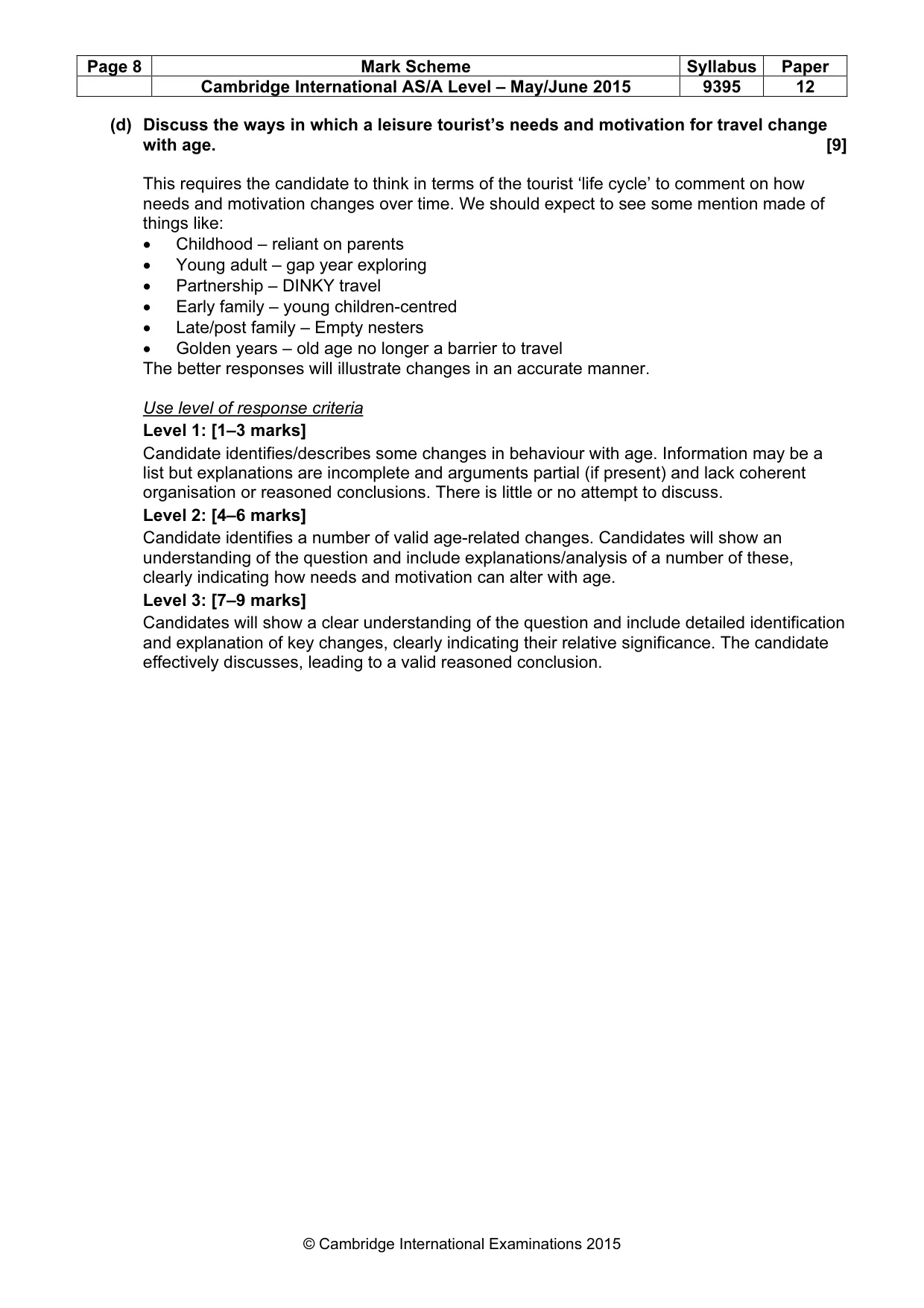
Page 8 Mark Scheme Syllabus Paper Cambridge International AS/A Level – May/June 2015 9395 12 © Cambridge International Examinations 2015 (d) Discuss the ways in which a leisure tourist’s needs and motivation for travel change with age. [9] This requires the candidate to think in terms of the tourist ‘life cycle’ to comment on how needs and motivation changes over time. We should expect to see some mention made of things like: • Childhood – reliant on parents • Young adult – gap year exploring • Partnership – DINKY travel • Early family – young children-centred • Late/post family – Empty nesters • Golden years – old age no longer a barrier to travel The better responses will illustrate changes in an accurate manner. Use level of response criteria Level 1: [1–3 marks] Candidate identifies/describes some changes in behaviour with age. Information may be a list but explanations are incomplete and arguments partial (if present) and lack coherent organisation or reasoned conclusions. There is little or no attempt to discuss. Level 2: [4–6 marks] Candidate identifies a number of valid age-related changes. Candidates will show an understanding of the question and include explanations/analysis of a number of these, clearly indicating how needs and motivation can alter with age. Level 3: [7–9 marks] Candidates will show a clear understanding of the question and include detailed identification and explanation of key changes, clearly indicating their relative significance. The candidate effectively discusses, leading to a valid reasoned conclusion.
What you needed in this session
Cambridge’s own grade thresholds for 2015 May/June, Paper 1 · Variant 2. A higher threshold means an easier paper — the bar moves with how the cohort did.