Cambridge A Level Travel and Tourism 9395 — 2015 May/June Paper 1 · Variant 3
9395/13/M/J/15 · 100 marks · ≈113 min
The question paper and its mark scheme, free to read here and free to download. This is Cambridge’s own paper, exactly as it was sat.
Question paper16 pages


Mark scheme8 pages
Answers below. Sit the paper first if you are practising.
Paper as text
Question paper, page 1
This document consists of 13 printed pages, 3 blank pages and 1 insert. DC (AC) 100111/1 © UCLES 2015 [Turn over Cambridge International Examinations Cambridge International Advanced Subsidiary and Advanced Level * 3 3 1 9 0 4 9 8 8 1 * TRAVEL AND TOURISM 9395/13 Paper 1 Core May/June 2015 2 hours 30 minutes Candidates answer on the Question Paper. No Additional Materials are required. READ THESE INSTRUCTIONS FIRST Write your Centre number, candidate number and name on all the work you hand in. Write in dark blue or black pen. You may use an HB pencil for any diagrams or graphs. Do not use staples, paper clips, glue or correction fluid. DO NOT WRITE IN ANY BARCODES. Answer all questions. All the Figures referred to in the questions are contained in the Insert. The number of marks is given in brackets [ ] at the end of each question or part question.
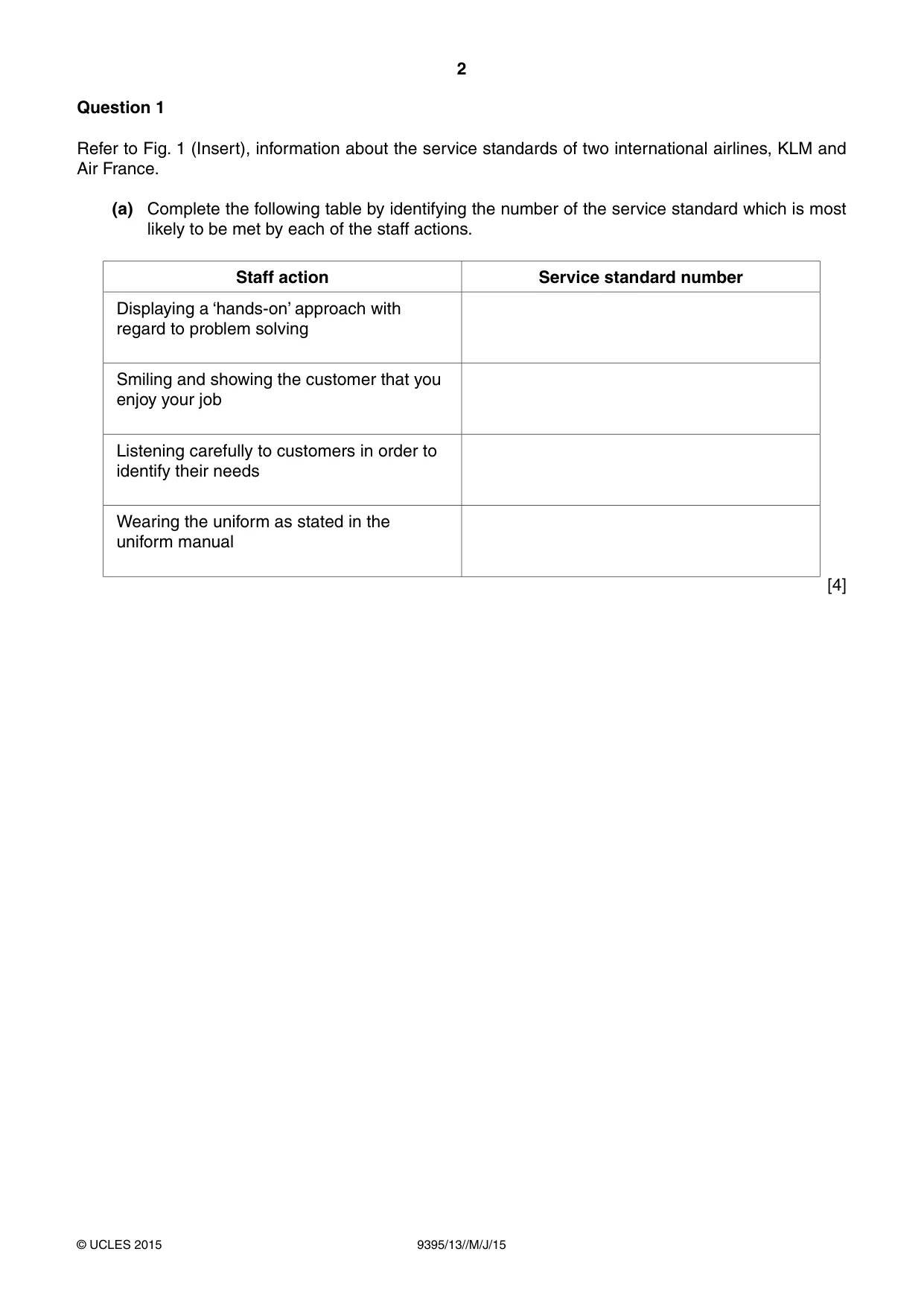
Question paper, page 2
2 9395/13//M/J/15 © UCLES 2015 Question 1 Refer to Fig. 1 (Insert), information about the service standards of two international airlines, KLM and Air France. (a) Complete the following table by identifying the number of the service standard which is most likely to be met by each of the staff actions. Staff action Service standard number Displaying a ‘hands-on’ approach with regard to problem solving Smiling and showing the customer that you enjoy your job Listening carefully to customers in order to identify their needs Wearing the uniform as stated in the uniform manual [4]
Question paper, page 3
3 9395/13//M/J/15 © UCLES 2015 [Turn over (b) Describe three ways in which travel and tourism organisations are likely to ‘provide relevant information regularly’ to their internal customers. 1 … … … … 2 … … … … 3 … … … … [6] (c) With reference to one travel and tourism job role with which you are familiar, state three different skills used by the employee and describe how each skill is used in order to provide customers with quality service. Chosen job role … 1 … … … … 2 … … … … 3 … … … … [6]
Question paper, page 4
4 9395/13//M/J/15 © UCLES 2015 (d) Assess the extent to which one travel and tourism organisation with which you are familiar has been able to ‘create a welcoming environment’ for its employees. Chosen organisation … … … … … … … … … … … … … … … … … … … … … … … … … … … [9] [Total: 25]
Question paper, page 5
5 9395/13//M/J/15 © UCLES 2015 [Turn over Question 2 Refer to Photographs A, B, C and D (Insert), taken at coastal locations in different destinations. The areas of coastline shown are at contrasting stages of tourism development, as suggested by the Butler model of destination evolution. (a) Complete the following table by identifying the letter of the photograph which is most likely to represent each Butler stage. Butler Stage Photograph Stagnation Involvement Exploration Development [4] (b) Discuss the ways in which declining coastal destinations can be rejuvenated. … … … … … … … … … … … … [6]
Question paper, page 6
6 9395/13//M/J/15 © UCLES 2015 (c) Explain three negative social impacts on the local host population which are associated with tourism development in coastal areas. 1 … … … … 2 … … … … 3 … … … … [6]
Question paper, page 7
7 9395/13//M/J/15 © UCLES 2015 [Turn over (d) Discuss how tourist facilities within established resorts are likely to vary. … … … … … … … … … … … … … … … … … … … … … … … … … … … [9] [Total: 25]
Question paper, page 8
8 9395/13//M/J/15 © UCLES 2015 Question 3 Refer to Fig. 2 (Insert), information about the problem of seasonality in European tourism. (a) Identify from Fig. 2 (Insert), the following: • two negative environmental impacts resulting from the seasonality of European tourism 1 … … 2 … … • two negative economic impacts resulting from the seasonality of European tourism 1 … … 2 … … [4] (b) Explain fully two strategies which are frequently used by tourist attractions in an attempt to overcome the problem of seasonality. Strategy 1 … … … … … … Strategy 2 … … … … … … [6]
Question paper, page 9
9 9395/13//M/J/15 © UCLES 2015 [Turn over (c) Discuss the ways in which legislation, such as the EU Directive on Package Travel, benefits tourists. … … … … … … … … … … … … [6]
Question paper, page 10
10 9395/13//M/J/15 © UCLES 2015 (d) Assess the extent to which one public sector organisation with which you are familiar has been able to meet its tourism-related objectives. Chosen organisation … … … … … … … … … … … … … … … … … … … … … … … … … … … [9] [Total: 25]
Question paper, page 11
11 9395/13//M/J/15 © UCLES 2015 [Turn over Question 4 Refer to Figs 3 and 4 (Insert), a list of characteristics likely to be considered by tourists before visiting a particular destination and a tourist map of Las Vegas, Nevada in the USA. (a) Fig. 4 (Insert), shows four locations in the Las Vegas area labelled A, B, C and D. Complete the following table by matching each location with the most appropriate characteristic number from Fig. 3 (Insert). Location Characteristic number A B C D [4] (b) Describe fully how each of the following is likely to influence the popularity of Las Vegas as a destination: • the Las Vegas Convention and Visitors Authority … … … … … … • films and television programmes made on location in the city … … … … … … [6]
Question paper, page 12
12 9395/13//M/J/15 © UCLES 2015 (c) Many visitors to Las Vegas will explore the surrounding countryside. Explain three ways in which National Parks are managed to minimise damage to the environment. 1 … … … … 2 … … … … 3 … … … … [6]
Question paper, page 13
13 9395/13//M/J/15 © UCLES 2015 (d) For one destination with which you are familiar evaluate its appeal to tourists of different ages. Chosen destination … … … … … … … … … … … … … … … … … … … … … … … … … … … [9] [Total: 25]
Question paper, page 14
14 9395/13//M/J/15 © UCLES 2015 BLANK PAGE
Question paper, page 15
15 9395/13//M/J/15 © UCLES 2015 BLANK PAGE
Question paper, page 16
16 9395/13//M/J/15 © UCLES 2015 Permission to reproduce items where third-party owned material protected by copyright is included has been sought and cleared where possible. Every reasonable effort has been made by the publisher (UCLES) to trace copyright holders, but if any items requiring clearance have unwittingly been included, the publisher will be pleased to make amends at the earliest possible opportunity. To avoid the issue of disclosure of answer-related information to candidates, all copyright acknowledgements are reproduced online in the Cambridge International Examinations Copyright Acknowledgements Booklet. This is produced for each series of examinations and is freely available to download at www.cie.org.uk after the live examination series. Cambridge International Examinations is part of the Cambridge Assessment Group. Cambridge Assessment is the brand name of University of Cambridge Local Examinations Syndicate (UCLES), which is itself a department of the University of Cambridge. BLANK PAGE
Mark scheme, page 1
® IGCSE is the registered trademark of Cambridge International Examinations. CAMBRIDGE INTERNATIONAL EXAMINATIONS Cambridge International Advanced Subsidiary and Advanced Level MARK SCHEME for the May/June 2015 series 9395 TRAVEL AND TOURISM 9395/13 Paper 1 (Core Paper), maximum raw mark 100 This mark scheme is published as an aid to teachers and candidates, to indicate the requirements of the examination. It shows the basis on which Examiners were instructed to award marks. It does not indicate the details of the discussions that took place at an Examiners’ meeting before marking began, which would have considered the acceptability of alternative answers. Mark schemes should be read in conjunction with the question paper and the Principal Examiner Report for Teachers. Cambridge will not enter into discussions about these mark schemes. Cambridge is publishing the mark schemes for the May/June 2015 series for most Cambridge IGCSE®, Cambridge International A and AS Level components and some Cambridge O Level components.
Mark scheme, page 2
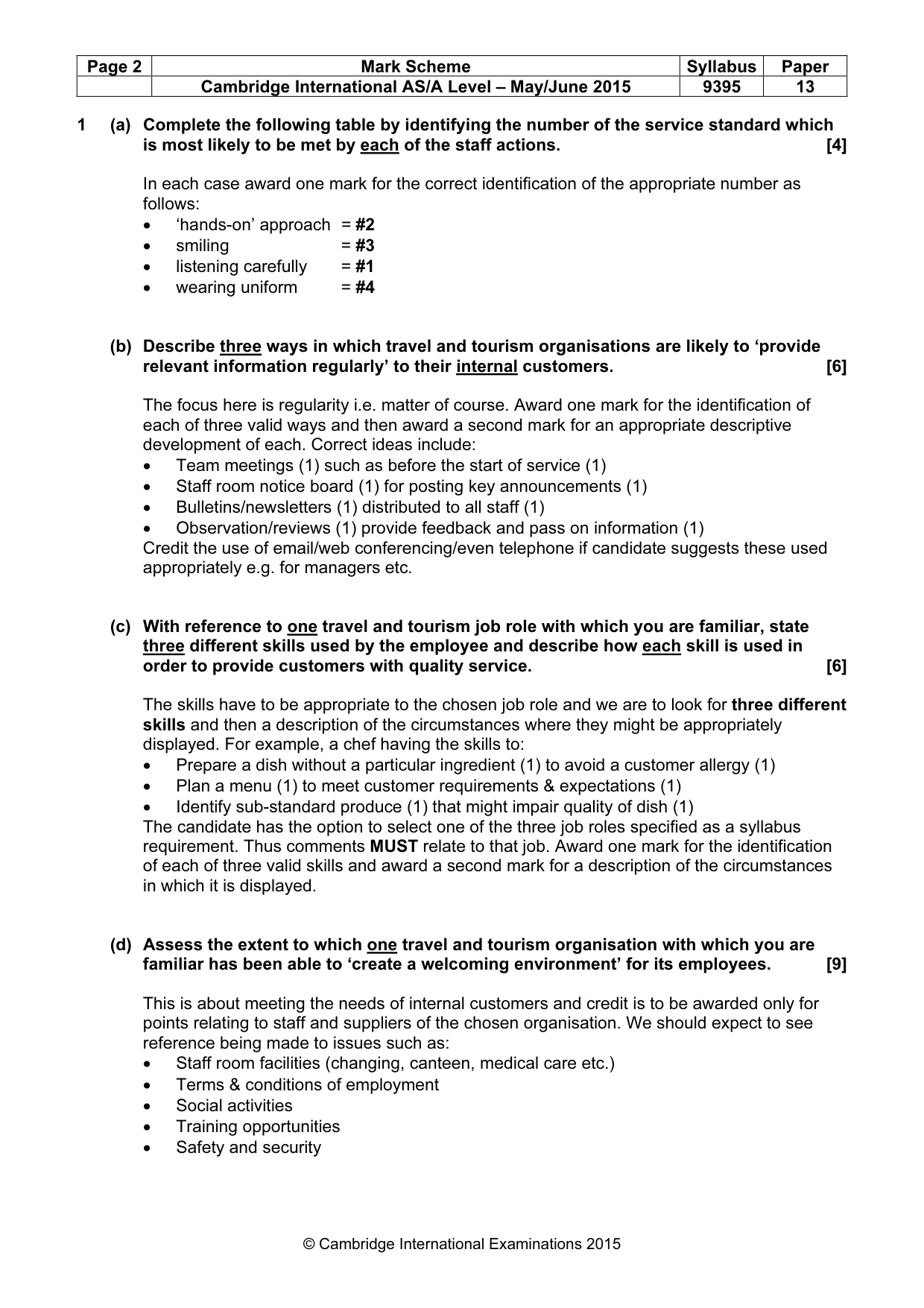
Page 2 Mark Scheme Syllabus Paper Cambridge International AS/A Level – May/June 2015 9395 13 © Cambridge International Examinations 2015 1 (a) Complete the following table by identifying the number of the service standard which is most likely to be met by each of the staff actions. [4] In each case award one mark for the correct identification of the appropriate number as follows: • ‘hands-on’ approach = #2 • smiling = #3 • listening carefully = #1 • wearing uniform = #4 (b) Describe three ways in which travel and tourism organisations are likely to ‘provide relevant information regularly’ to their internal customers. [6] The focus here is regularity i.e. matter of course. Award one mark for the identification of each of three valid ways and then award a second mark for an appropriate descriptive development of each. Correct ideas include: • Team meetings (1) such as before the start of service (1) • Staff room notice board (1) for posting key announcements (1) • Bulletins/newsletters (1) distributed to all staff (1) • Observation/reviews (1) provide feedback and pass on information (1) Credit the use of email/web conferencing/even telephone if candidate suggests these used appropriately e.g. for managers etc. (c) With reference to one travel and tourism job role with which you are familiar, state three different skills used by the employee and describe how each skill is used in order to provide customers with quality service. [6] The skills have to be appropriate to the chosen job role and we are to look for three different skills and then a description of the circumstances where they might be appropriately displayed. For example, a chef having the skills to: • Prepare a dish without a particular ingredient (1) to avoid a customer allergy (1) • Plan a menu (1) to meet customer requirements & expectations (1) • Identify sub-standard produce (1) that might impair quality of dish (1) The candidate has the option to select one of the three job roles specified as a syllabus requirement. Thus comments MUST relate to that job. Award one mark for the identification of each of three valid skills and award a second mark for a description of the circumstances in which it is displayed. (d) Assess the extent to which one travel and tourism organisation with which you are familiar has been able to ‘create a welcoming environment’ for its employees. [9] This is about meeting the needs of internal customers and credit is to be awarded only for points relating to staff and suppliers of the chosen organisation. We should expect to see reference being made to issues such as: • Staff room facilities (changing, canteen, medical care etc.) • Terms & conditions of employment • Social activities • Training opportunities • Safety and security
Mark scheme, page 3
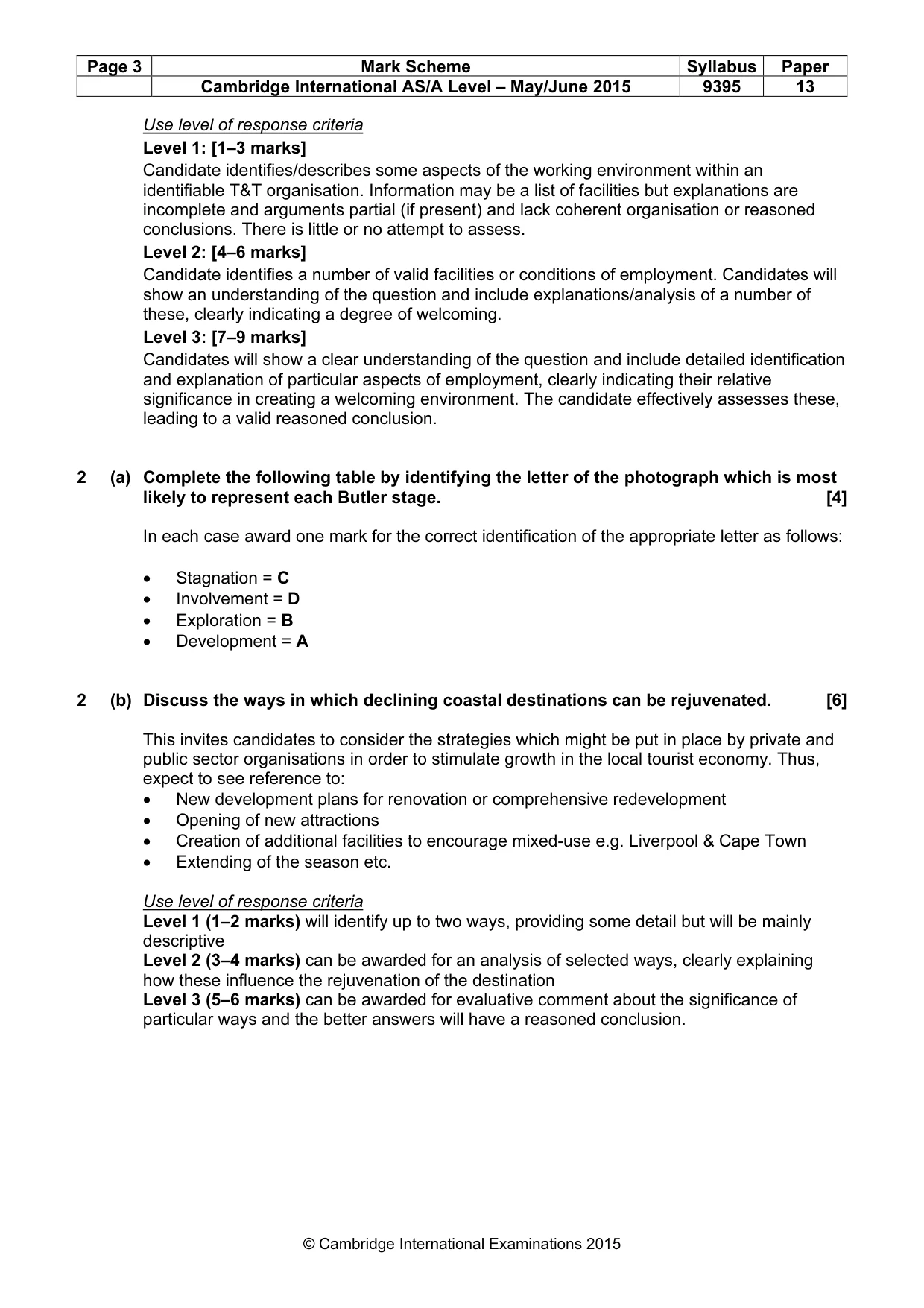
Page 3 Mark Scheme Syllabus Paper Cambridge International AS/A Level – May/June 2015 9395 13 © Cambridge International Examinations 2015 Use level of response criteria Level 1: [1–3 marks] Candidate identifies/describes some aspects of the working environment within an identifiable T&T organisation. Information may be a list of facilities but explanations are incomplete and arguments partial (if present) and lack coherent organisation or reasoned conclusions. There is little or no attempt to assess. Level 2: [4–6 marks] Candidate identifies a number of valid facilities or conditions of employment. Candidates will show an understanding of the question and include explanations/analysis of a number of these, clearly indicating a degree of welcoming. Level 3: [7–9 marks] Candidates will show a clear understanding of the question and include detailed identification and explanation of particular aspects of employment, clearly indicating their relative significance in creating a welcoming environment. The candidate effectively assesses these, leading to a valid reasoned conclusion. 2 (a) Complete the following table by identifying the letter of the photograph which is most likely to represent each Butler stage. [4] In each case award one mark for the correct identification of the appropriate letter as follows: • Stagnation = C • Involvement = D • Exploration = B • Development = A 2 (b) Discuss the ways in which declining coastal destinations can be rejuvenated. [6] This invites candidates to consider the strategies which might be put in place by private and public sector organisations in order to stimulate growth in the local tourist economy. Thus, expect to see reference to: • New development plans for renovation or comprehensive redevelopment • Opening of new attractions • Creation of additional facilities to encourage mixed-use e.g. Liverpool & Cape Town • Extending of the season etc. Use level of response criteria Level 1 (1–2 marks) will identify up to two ways, providing some detail but will be mainly descriptive Level 2 (3–4 marks) can be awarded for an analysis of selected ways, clearly explaining how these influence the rejuvenation of the destination Level 3 (5–6 marks) can be awarded for evaluative comment about the significance of particular ways and the better answers will have a reasoned conclusion.
Mark scheme, page 4
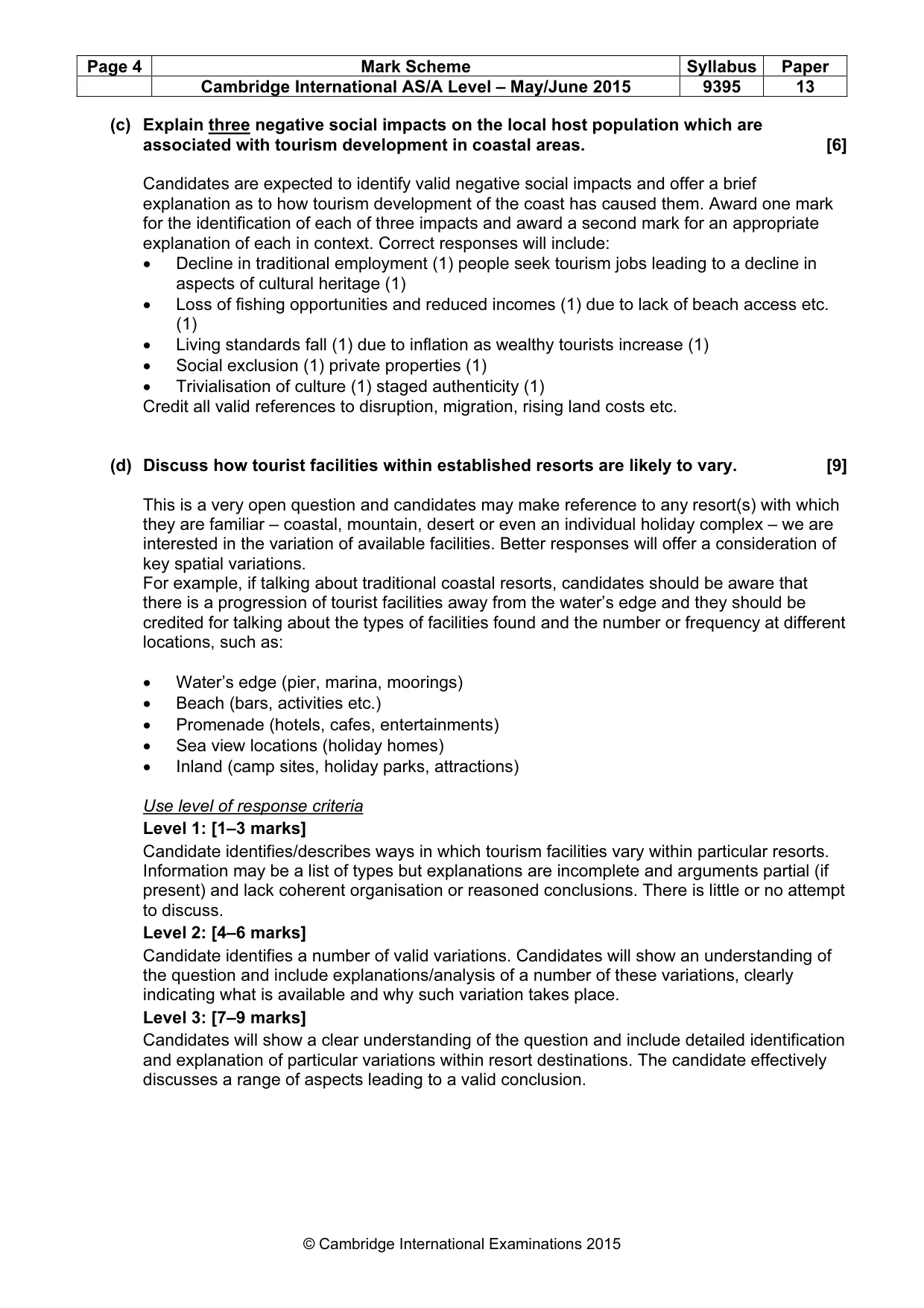
Page 4 Mark Scheme Syllabus Paper Cambridge International AS/A Level – May/June 2015 9395 13 © Cambridge International Examinations 2015 (c) Explain three negative social impacts on the local host population which are associated with tourism development in coastal areas. [6] Candidates are expected to identify valid negative social impacts and offer a brief explanation as to how tourism development of the coast has caused them. Award one mark for the identification of each of three impacts and award a second mark for an appropriate explanation of each in context. Correct responses will include: • Decline in traditional employment (1) people seek tourism jobs leading to a decline in aspects of cultural heritage (1) • Loss of fishing opportunities and reduced incomes (1) due to lack of beach access etc. (1) • Living standards fall (1) due to inflation as wealthy tourists increase (1) • Social exclusion (1) private properties (1) • Trivialisation of culture (1) staged authenticity (1) Credit all valid references to disruption, migration, rising land costs etc. (d) Discuss how tourist facilities within established resorts are likely to vary. [9] This is a very open question and candidates may make reference to any resort(s) with which they are familiar – coastal, mountain, desert or even an individual holiday complex – we are interested in the variation of available facilities. Better responses will offer a consideration of key spatial variations. For example, if talking about traditional coastal resorts, candidates should be aware that there is a progression of tourist facilities away from the water’s edge and they should be credited for talking about the types of facilities found and the number or frequency at different locations, such as: • Water’s edge (pier, marina, moorings) • Beach (bars, activities etc.) • Promenade (hotels, cafes, entertainments) • Sea view locations (holiday homes) • Inland (camp sites, holiday parks, attractions) Use level of response criteria Level 1: [1–3 marks] Candidate identifies/describes ways in which tourism facilities vary within particular resorts. Information may be a list of types but explanations are incomplete and arguments partial (if present) and lack coherent organisation or reasoned conclusions. There is little or no attempt to discuss. Level 2: [4–6 marks] Candidate identifies a number of valid variations. Candidates will show an understanding of the question and include explanations/analysis of a number of these variations, clearly indicating what is available and why such variation takes place. Level 3: [7–9 marks] Candidates will show a clear understanding of the question and include detailed identification and explanation of particular variations within resort destinations. The candidate effectively discusses a range of aspects leading to a valid conclusion.
Mark scheme, page 5
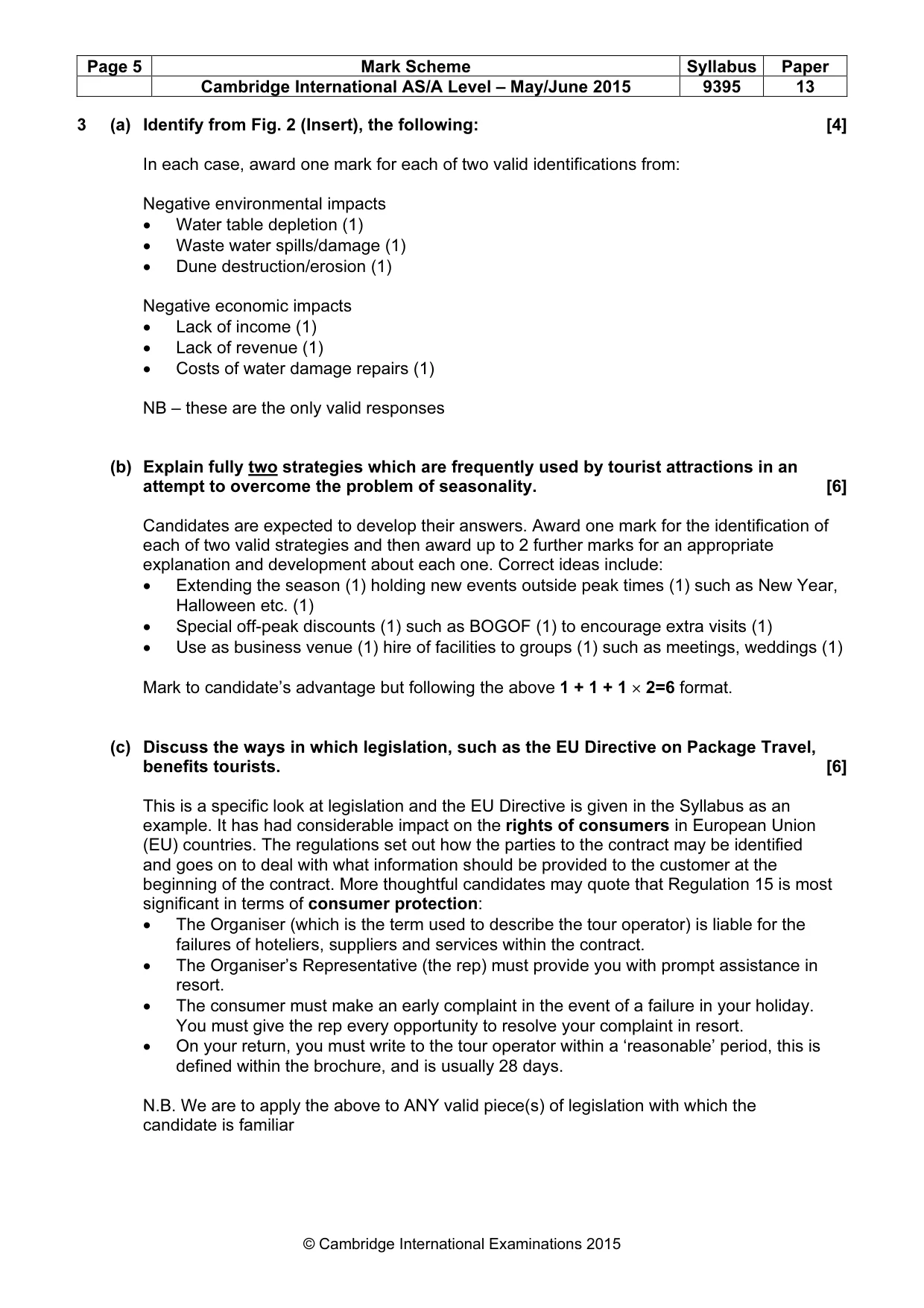
Page 5 Mark Scheme Syllabus Paper Cambridge International AS/A Level – May/June 2015 9395 13 © Cambridge International Examinations 2015 3 (a) Identify from Fig. 2 (Insert), the following: [4] In each case, award one mark for each of two valid identifications from: Negative environmental impacts • Water table depletion (1) • Waste water spills/damage (1) • Dune destruction/erosion (1) Negative economic impacts • Lack of income (1) • Lack of revenue (1) • Costs of water damage repairs (1) NB – these are the only valid responses (b) Explain fully two strategies which are frequently used by tourist attractions in an attempt to overcome the problem of seasonality. [6] Candidates are expected to develop their answers. Award one mark for the identification of each of two valid strategies and then award up to 2 further marks for an appropriate explanation and development about each one. Correct ideas include: • Extending the season (1) holding new events outside peak times (1) such as New Year, Halloween etc. (1) • Special off-peak discounts (1) such as BOGOF (1) to encourage extra visits (1) • Use as business venue (1) hire of facilities to groups (1) such as meetings, weddings (1) Mark to candidate’s advantage but following the above 1 + 1 + 1 × 2=6 format. (c) Discuss the ways in which legislation, such as the EU Directive on Package Travel, benefits tourists. [6] This is a specific look at legislation and the EU Directive is given in the Syllabus as an example. It has had considerable impact on the rights of consumers in European Union (EU) countries. The regulations set out how the parties to the contract may be identified and goes on to deal with what information should be provided to the customer at the beginning of the contract. More thoughtful candidates may quote that Regulation 15 is most significant in terms of consumer protection: • The Organiser (which is the term used to describe the tour operator) is liable for the failures of hoteliers, suppliers and services within the contract. • The Organiser’s Representative (the rep) must provide you with prompt assistance in resort. • The consumer must make an early complaint in the event of a failure in your holiday. You must give the rep every opportunity to resolve your complaint in resort. • On your return, you must write to the tour operator within a ‘reasonable’ period, this is defined within the brochure, and is usually 28 days. N.B. We are to apply the above to ANY valid piece(s) of legislation with which the candidate is familiar
Mark scheme, page 6
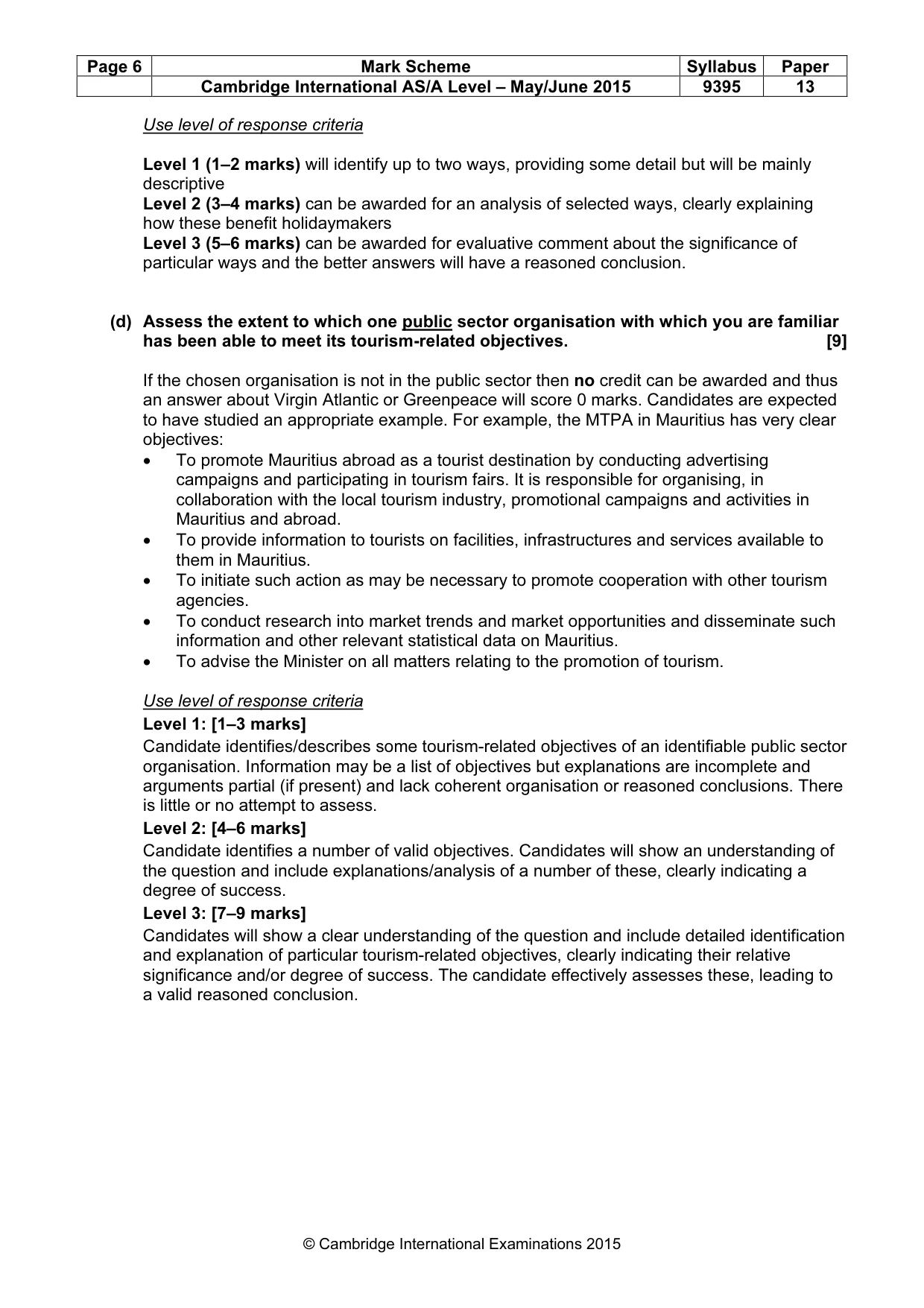
Page 6 Mark Scheme Syllabus Paper Cambridge International AS/A Level – May/June 2015 9395 13 © Cambridge International Examinations 2015 Use level of response criteria Level 1 (1–2 marks) will identify up to two ways, providing some detail but will be mainly descriptive Level 2 (3–4 marks) can be awarded for an analysis of selected ways, clearly explaining how these benefit holidaymakers Level 3 (5–6 marks) can be awarded for evaluative comment about the significance of particular ways and the better answers will have a reasoned conclusion. (d) Assess the extent to which one public sector organisation with which you are familiar has been able to meet its tourism-related objectives. [9] If the chosen organisation is not in the public sector then no credit can be awarded and thus an answer about Virgin Atlantic or Greenpeace will score 0 marks. Candidates are expected to have studied an appropriate example. For example, the MTPA in Mauritius has very clear objectives: • To promote Mauritius abroad as a tourist destination by conducting advertising campaigns and participating in tourism fairs. It is responsible for organising, in collaboration with the local tourism industry, promotional campaigns and activities in Mauritius and abroad. • To provide information to tourists on facilities, infrastructures and services available to them in Mauritius. • To initiate such action as may be necessary to promote cooperation with other tourism agencies. • To conduct research into market trends and market opportunities and disseminate such information and other relevant statistical data on Mauritius. • To advise the Minister on all matters relating to the promotion of tourism. Use level of response criteria Level 1: [1–3 marks] Candidate identifies/describes some tourism-related objectives of an identifiable public sector organisation. Information may be a list of objectives but explanations are incomplete and arguments partial (if present) and lack coherent organisation or reasoned conclusions. There is little or no attempt to assess. Level 2: [4–6 marks] Candidate identifies a number of valid objectives. Candidates will show an understanding of the question and include explanations/analysis of a number of these, clearly indicating a degree of success. Level 3: [7–9 marks] Candidates will show a clear understanding of the question and include detailed identification and explanation of particular tourism-related objectives, clearly indicating their relative significance and/or degree of success. The candidate effectively assesses these, leading to a valid reasoned conclusion.
Mark scheme, page 7
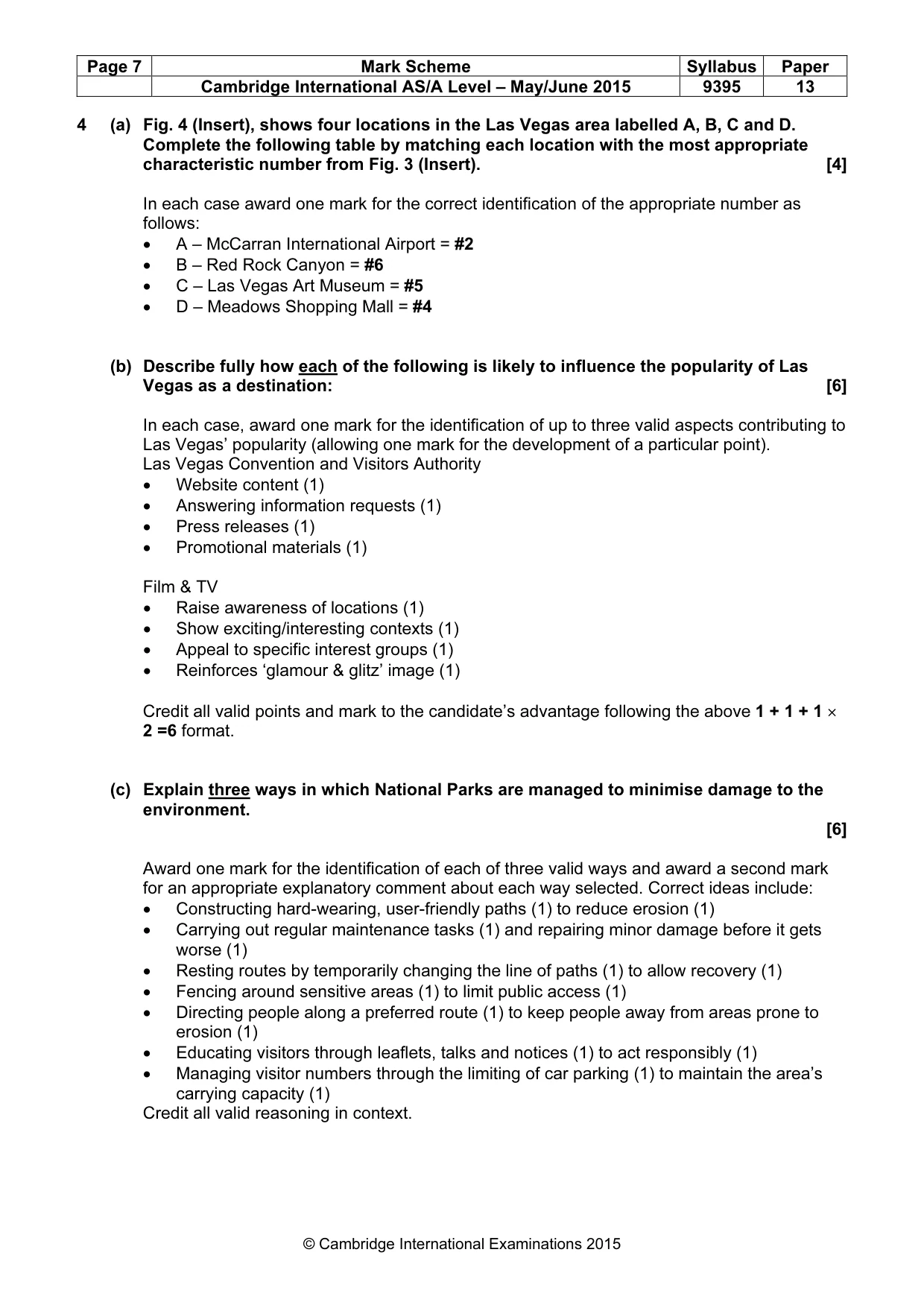
Page 7 Mark Scheme Syllabus Paper Cambridge International AS/A Level – May/June 2015 9395 13 © Cambridge International Examinations 2015 4 (a) Fig. 4 (Insert), shows four locations in the Las Vegas area labelled A, B, C and D. Complete the following table by matching each location with the most appropriate characteristic number from Fig. 3 (Insert). [4] In each case award one mark for the correct identification of the appropriate number as follows: • A – McCarran International Airport = #2 • B – Red Rock Canyon = #6 • C – Las Vegas Art Museum = #5 • D – Meadows Shopping Mall = #4 (b) Describe fully how each of the following is likely to influence the popularity of Las Vegas as a destination: [6] In each case, award one mark for the identification of up to three valid aspects contributing to Las Vegas’ popularity (allowing one mark for the development of a particular point). Las Vegas Convention and Visitors Authority • Website content (1) • Answering information requests (1) • Press releases (1) • Promotional materials (1) Film & TV • Raise awareness of locations (1) • Show exciting/interesting contexts (1) • Appeal to specific interest groups (1) • Reinforces ‘glamour & glitz’ image (1) Credit all valid points and mark to the candidate’s advantage following the above 1 + 1 + 1 × 2 =6 format. (c) Explain three ways in which National Parks are managed to minimise damage to the environment. [6] Award one mark for the identification of each of three valid ways and award a second mark for an appropriate explanatory comment about each way selected. Correct ideas include: • Constructing hard-wearing, user-friendly paths (1) to reduce erosion (1) • Carrying out regular maintenance tasks (1) and repairing minor damage before it gets worse (1) • Resting routes by temporarily changing the line of paths (1) to allow recovery (1) • Fencing around sensitive areas (1) to limit public access (1) • Directing people along a preferred route (1) to keep people away from areas prone to erosion (1) • Educating visitors through leaflets, talks and notices (1) to act responsibly (1) • Managing visitor numbers through the limiting of car parking (1) to maintain the area’s carrying capacity (1) Credit all valid reasoning in context.
Mark scheme, page 8
Page 8 Mark Scheme Syllabus Paper Cambridge International AS/A Level – May/June 2015 9395 13 © Cambridge International Examinations 2015 (d) For one destination with which you are familiar evaluate its appeal to tourists of different ages. [9] Candidates may examine any destination, what matters is the quality of the evaluation and not the scale of the location under consideration. However, the answer must be specific to a particular destination or it remains in Level 1. Key aspects of a better response will include: • What is available and what happens where and when? • Who is attracted? • Why? Use level of response criteria Level 1: [1–3 marks] Candidate identifies/describes some valid types of facilities/events within an identifiable destination. Information may be a list of types but explanations are incomplete and arguments partial (if present) and lack coherent organisation or reasoned conclusions. There is little or no attempt to evaluate. Level 2: [4–6 marks] Candidate identifies a number of valid age-related facilities/events. Candidates will show an understanding of the question and include explanations/analysis of a number of these, clearly indicating what is available and why particular age groups are attracted. Level 3: [7–9 marks] Candidates will show a clear understanding of the question and include detailed identification and explanation of particular facilities/events, clearly indicating their relative importance and significance to the different visitor age groups. The candidate effectively evaluates a range of aspects leading to a valid conclusion.
What you needed in this session
Cambridge’s own grade thresholds for 2015 May/June, Paper 1 · Variant 3. A higher threshold means an easier paper — the bar moves with how the cohort did.