Cambridge A Level Travel and Tourism 9395 — 2015 May/June Paper 1 · Variant 1
9395/11/M/J/15 · 100 marks · ≈113 min
The question paper and its mark scheme, free to read here and free to download. This is Cambridge’s own paper, exactly as it was sat.
Question paper8 pages

Mark scheme9 pages
Answers below. Sit the paper first if you are practising.
Paper as text
Question paper, page 1
This document consists of 7 printed pages and 1 blank page. DC (LK/SW) 91631/3 © UCLES 2015 [Turn over * 4 6 7 9 0 5 0 1 7 0 - I * TRAVEL AND TOURISM 9395/11 Paper 1 Core May/June 2015 INSERT 2 hours 30 minutes READ THESE INSTRUCTIONS FIRST This Insert contains all the Figures referred to in the questions. Anything the candidate writes on this Insert will not be marked. Cambridge International Examinations Cambridge International Advanced Subsidiary and Advanced Level
Question paper, page 2
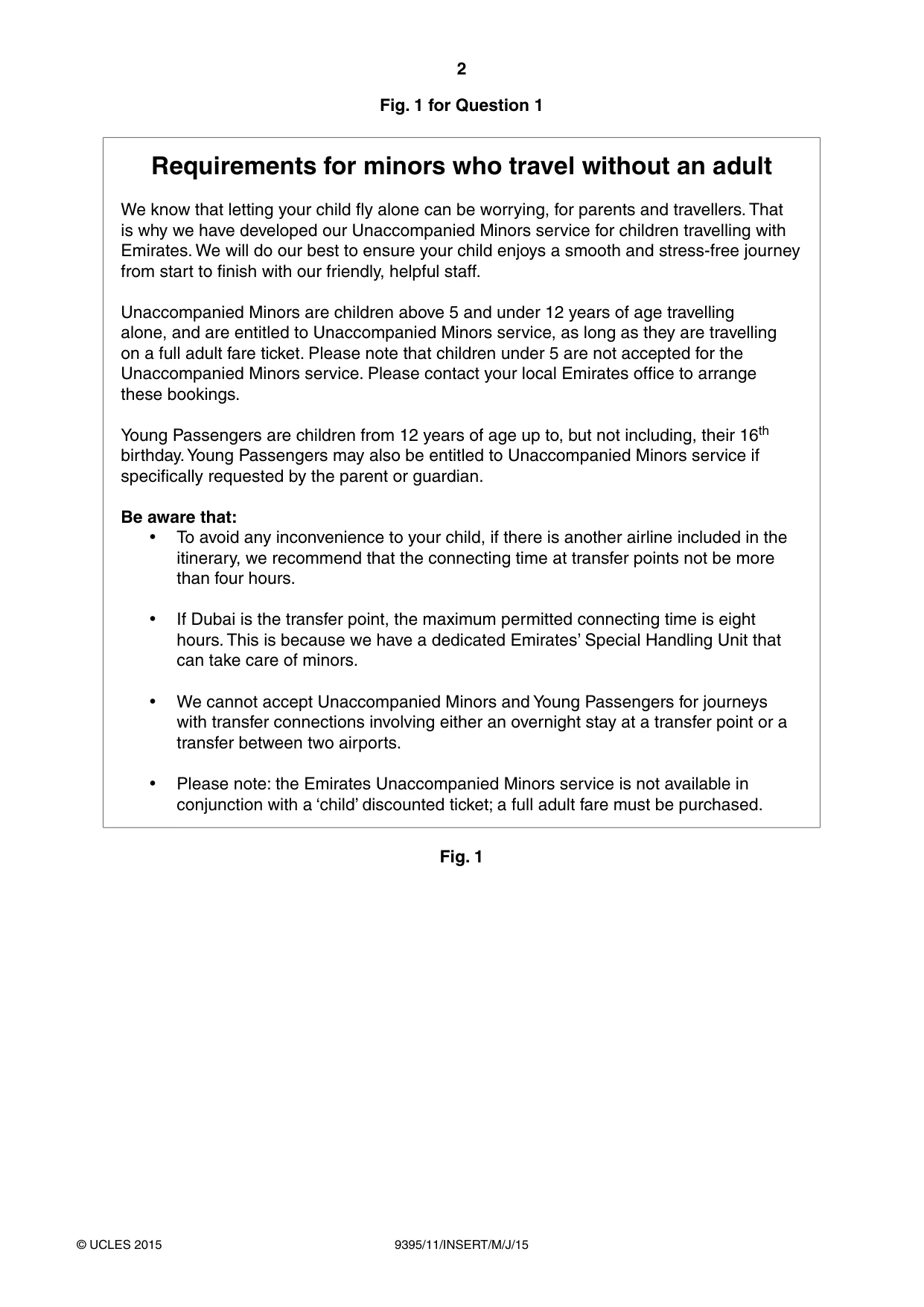
2 9395/11/INSERT/M/J/15 © UCLES 2015 Fig. 1 for Question 1 Requirements for minors who travel without an adult We know that letting your child fl y alone can be worrying, for parents and travellers. That is why we have developed our Unaccompanied Minors service for children travelling with Emirates. We will do our best to ensure your child enjoys a smooth and stress-free journey from start to fi nish with our friendly, helpful staff. Unaccompanied Minors are children above 5 and under 12 years of age travelling alone, and are entitled to Unaccompanied Minors service, as long as they are travelling on a full adult fare ticket. Please note that children under 5 are not accepted for the Unaccompanied Minors service. Please contact your local Emirates offi ce to arrange these bookings. Young Passengers are children from 12 years of age up to, but not including, their 16th birthday. Young Passengers may also be entitled to Unaccompanied Minors service if specifi cally requested by the parent or guardian. Be aware that: • To avoid any inconvenience to your child, if there is another airline included in the itinerary, we recommend that the connecting time at transfer points not be more than four hours. • If Dubai is the transfer point, the maximum permitted connecting time is eight hours. This is because we have a dedicated Emirates’ Special Handling Unit that can take care of minors. • We cannot accept Unaccompanied Minors and Young Passengers for journeys with transfer connections involving either an overnight stay at a transfer point or a transfer between two airports. • Please note: the Emirates Unaccompanied Minors service is not available in conjunction with a ‘child’ discounted ticket; a full adult fare must be purchased. Fig. 1
Question paper, page 3
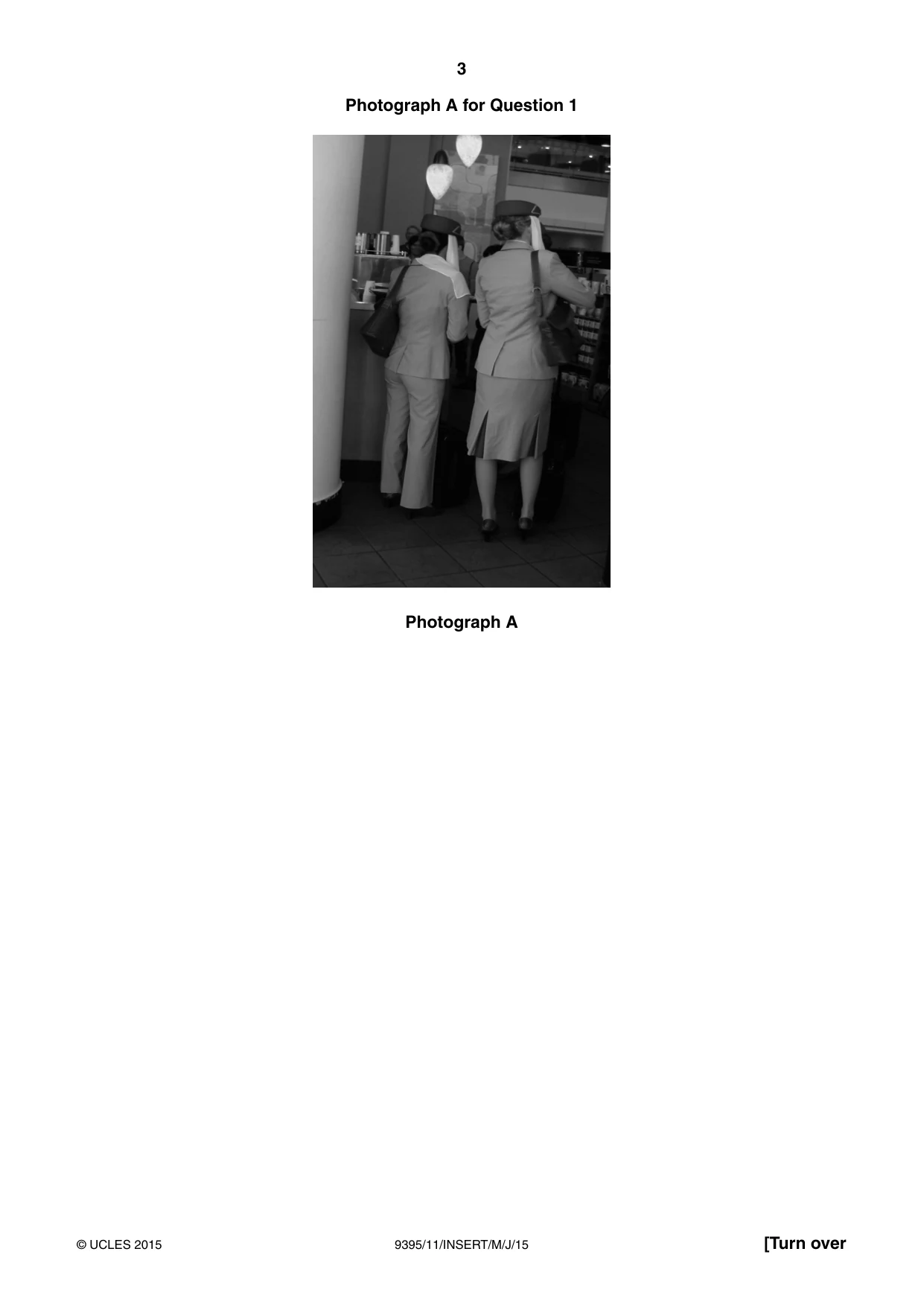
3 9395/11/INSERT/M/J/15 © UCLES 2015 [Turn over Photograph A for Question 1 Photograph A
Question paper, page 4
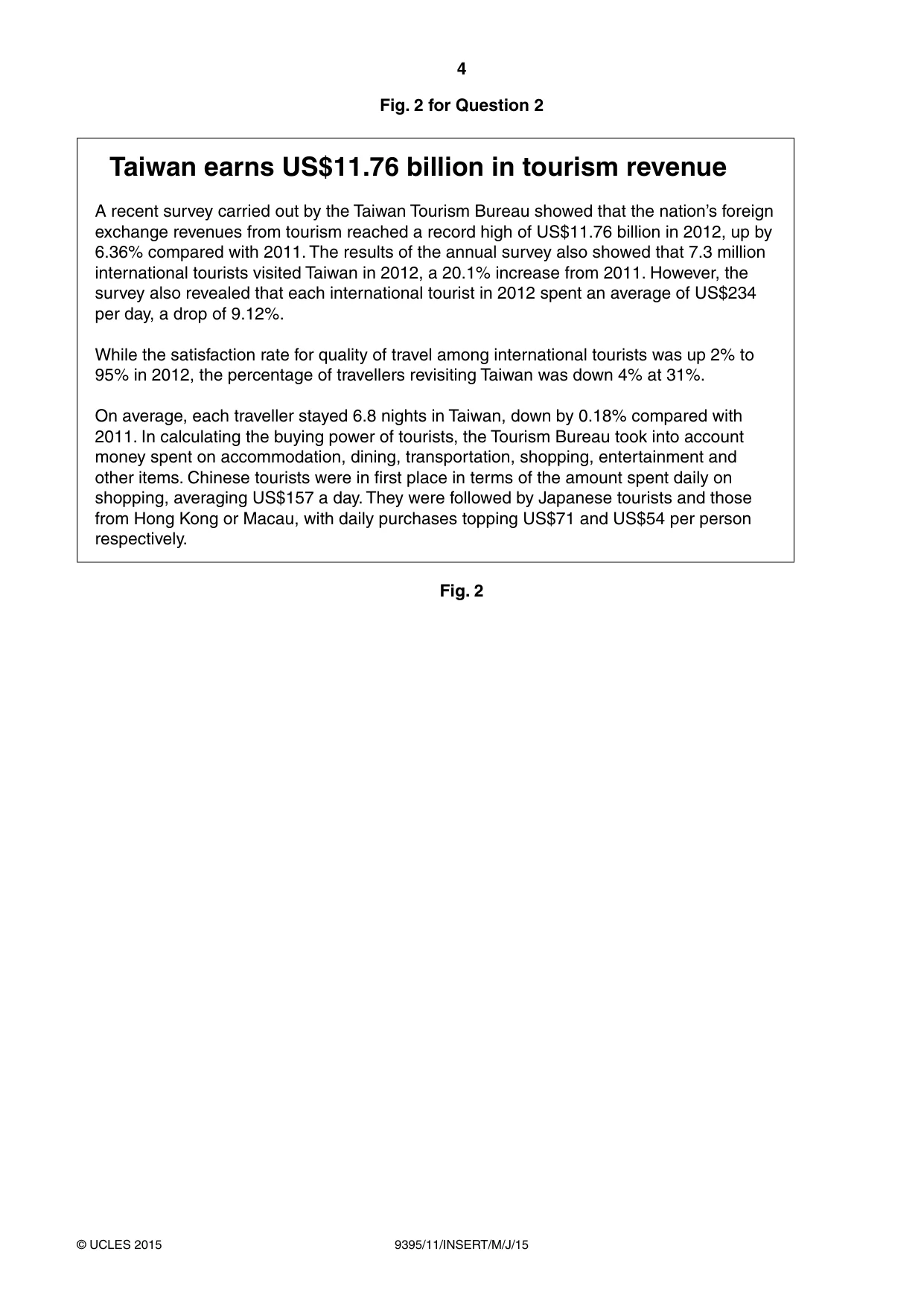
4 9395/11/INSERT/M/J/15 © UCLES 2015 Fig. 2 for Question 2 Taiwan earns US$11.76 billion in tourism revenue A recent survey carried out by the Taiwan Tourism Bureau showed that the nation’s foreign exchange revenues from tourism reached a record high of US$11.76 billion in 2012, up by 6.36% compared with 2011. The results of the annual survey also showed that 7.3 million international tourists visited Taiwan in 2012, a 20.1% increase from 2011. However, the survey also revealed that each international tourist in 2012 spent an average of US$234 per day, a drop of 9.12%. While the satisfaction rate for quality of travel among international tourists was up 2% to 95% in 2012, the percentage of travellers revisiting Taiwan was down 4% at 31%. On average, each traveller stayed 6.8 nights in Taiwan, down by 0.18% compared with 2011. In calculating the buying power of tourists, the Tourism Bureau took into account money spent on accommodation, dining, transportation, shopping, entertainment and other items. Chinese tourists were in fi rst place in terms of the amount spent daily on shopping, averaging US$157 a day. They were followed by Japanese tourists and those from Hong Kong or Macau, with daily purchases topping US$71 and US$54 per person respectively. Fig. 2
Question paper, page 5
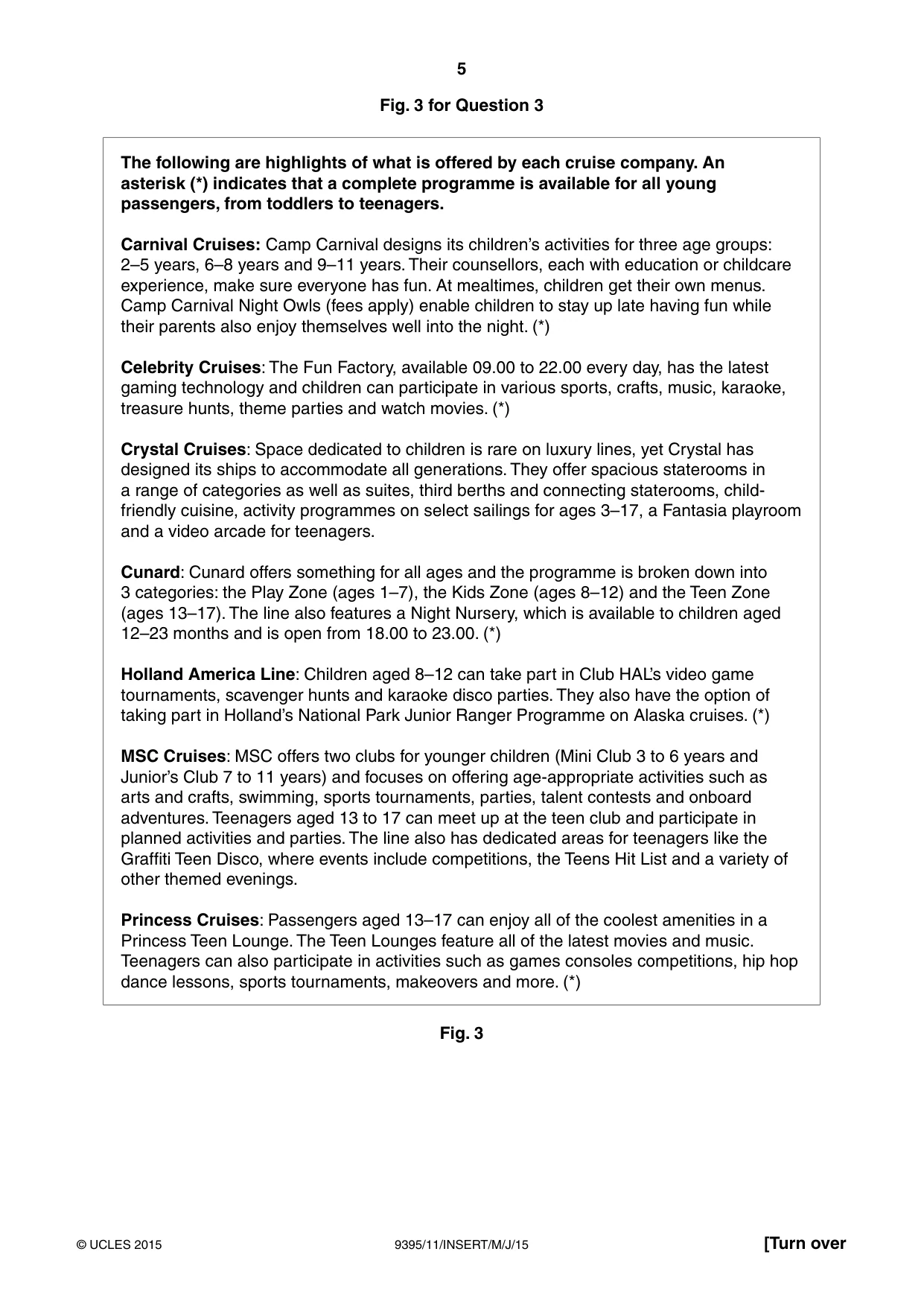
5 9395/11/INSERT/M/J/15 © UCLES 2015 [Turn over Fig. 3 for Question 3 The following are highlights of what is offered by each cruise company. An asterisk (*) indicates that a complete programme is available for all young passengers, from toddlers to teenagers. Carnival Cruises: Camp Carnival designs its children’s activities for three age groups: 2–5 years, 6–8 years and 9–11 years. Their counsellors, each with education or childcare experience, make sure everyone has fun. At mealtimes, children get their own menus. Camp Carnival Night Owls (fees apply) enable children to stay up late having fun while their parents also enjoy themselves well into the night. (*) Celebrity Cruises: The Fun Factory, available 09.00 to 22.00 every day, has the latest gaming technology and children can participate in various sports, crafts, music, karaoke, treasure hunts, theme parties and watch movies. (*) Crystal Cruises: Space dedicated to children is rare on luxury lines, yet Crystal has designed its ships to accommodate all generations. They offer spacious staterooms in a range of categories as well as suites, third berths and connecting staterooms, child- friendly cuisine, activity programmes on select sailings for ages 3–17, a Fantasia playroom and a video arcade for teenagers. Cunard: Cunard offers something for all ages and the programme is broken down into 3 categories: the Play Zone (ages 1–7), the Kids Zone (ages 8–12) and the Teen Zone (ages 13–17). The line also features a Night Nursery, which is available to children aged 12–23 months and is open from 18.00 to 23.00. (*) Holland America Line: Children aged 8–12 can take part in Club HAL’s video game tournaments, scavenger hunts and karaoke disco parties. They also have the option of taking part in Holland’s National Park Junior Ranger Programme on Alaska cruises. (*) MSC Cruises: MSC offers two clubs for younger children (Mini Club 3 to 6 years and Junior’s Club 7 to 11 years) and focuses on offering age-appropriate activities such as arts and crafts, swimming, sports tournaments, parties, talent contests and onboard adventures. Teenagers aged 13 to 17 can meet up at the teen club and participate in planned activities and parties. The line also has dedicated areas for teenagers like the Graffi ti Teen Disco, where events include competitions, the Teens Hit List and a variety of other themed evenings. Princess Cruises: Passengers aged 13–17 can enjoy all of the coolest amenities in a Princess Teen Lounge. The Teen Lounges feature all of the latest movies and music. Teenagers can also participate in activities such as games consoles competitions, hip hop dance lessons, sports tournaments, makeovers and more. (*) Fig. 3
Question paper, page 6
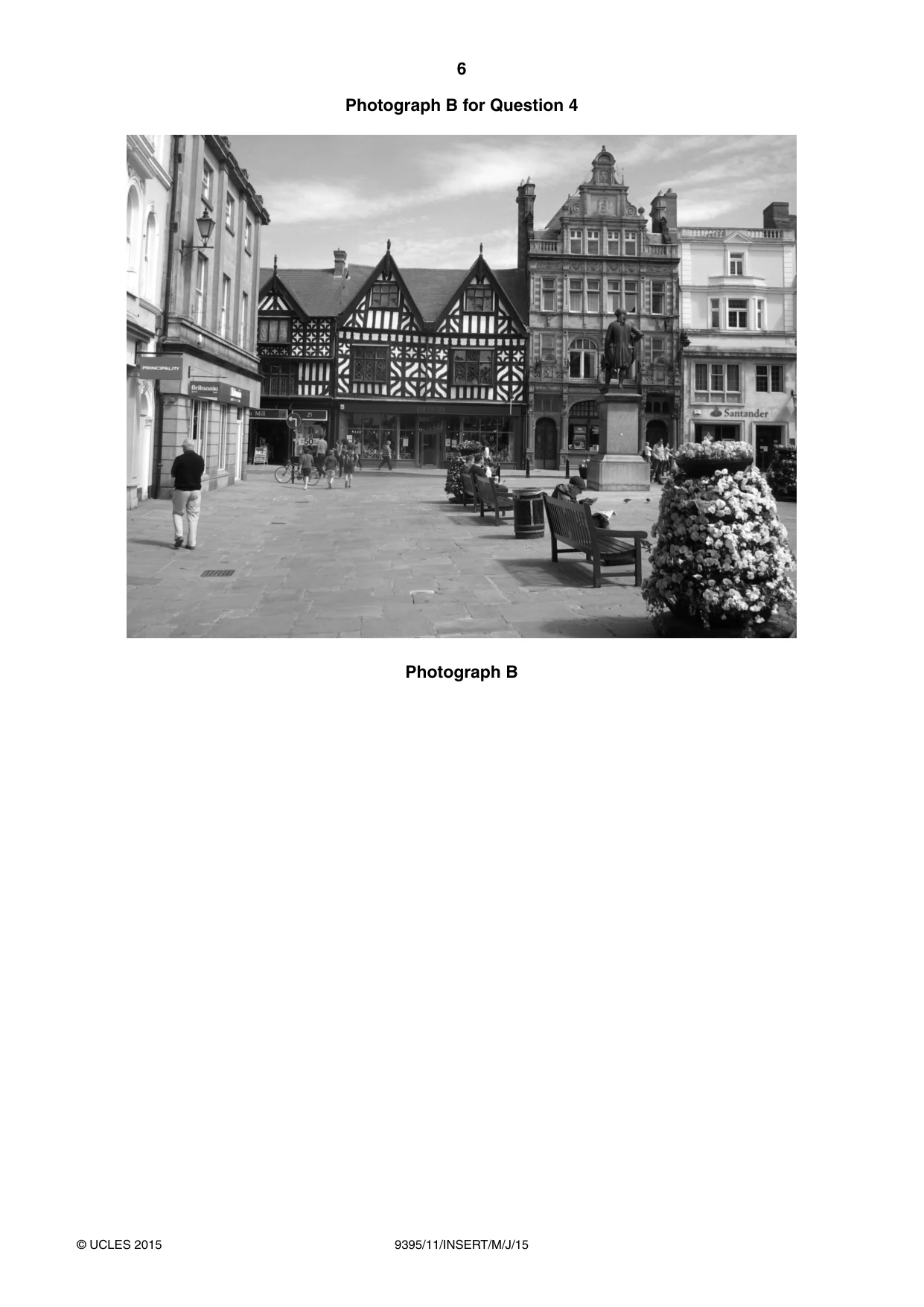
6 9395/11/INSERT/M/J/15 © UCLES 2015 Photograph B for Question 4 Photograph B
Question paper, page 7
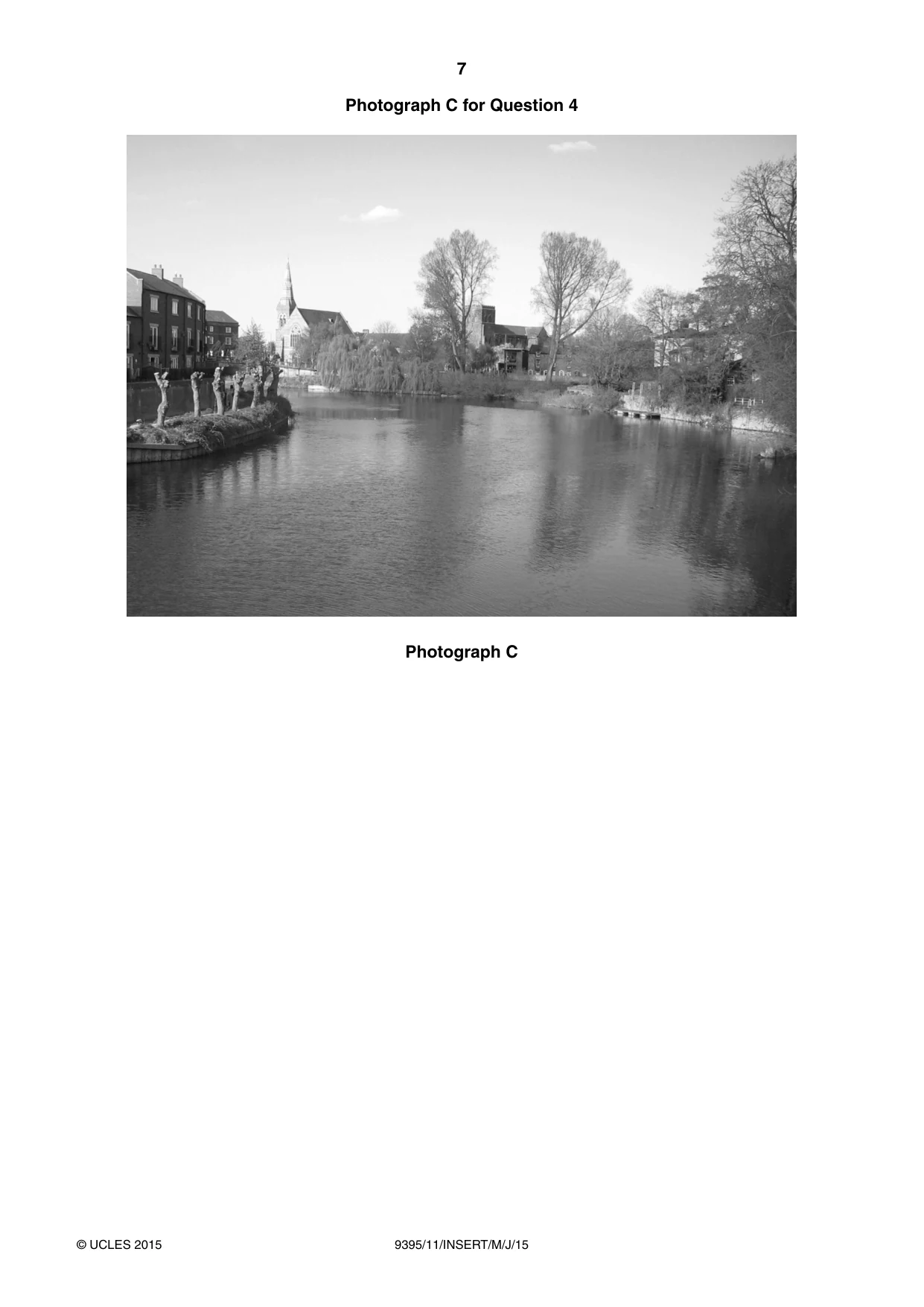
7 9395/11/INSERT/M/J/15 © UCLES 2015 Photograph C for Question 4 Photograph C
Question paper, page 8
8 9395/11/INSERT/M/J/15 © UCLES 2015 Permission to reproduce items where third-party owned material protected by copyright is included has been sought and cleared where possible. Every reasonable effort has been made by the publisher (UCLES) to trace copyright holders, but if any items requiring clearance have unwittingly been included, the publisher will be pleased to make amends at the earliest possible opportunity. To avoid the issue of disclosure of answer-related information to candidates, all copyright acknowledgements are reproduced online in the Cambridge International Examinations Copyright Acknowledgements Booklet. This is produced for each series of examinations and is freely available to download at www.cie.org.uk after the live examination series. Cambridge International Examinations is part of the Cambridge Assessment Group. Cambridge Assessment is the brand name of University of Cambridge Local Examinations Syndicate (UCLES), which is itself a department of the University of Cambridge. BLANK PAGE
Mark scheme, page 1
® IGCSE is the registered trademark of Cambridge International Examinations. CAMBRIDGE INTERNATIONAL EXAMINATIONS Cambridge International Advanced Subsidiary and Advanced Level MARK SCHEME for the May/June 2015 series 9395 TRAVEL AND TOURISM 9395/11 Paper 1 (Core Paper), maximum raw mark 100 This mark scheme is published as an aid to teachers and candidates, to indicate the requirements of the examination. It shows the basis on which Examiners were instructed to award marks. It does not indicate the details of the discussions that took place at an Examiners’ meeting before marking began, which would have considered the acceptability of alternative answers. Mark schemes should be read in conjunction with the question paper and the Principal Examiner Report for Teachers. Cambridge will not enter into discussions about these mark schemes. Cambridge is publishing the mark schemes for the May/June 2015 series for most Cambridge IGCSE®, Cambridge International A and AS Level components and some Cambridge O Level components.
Mark scheme, page 2
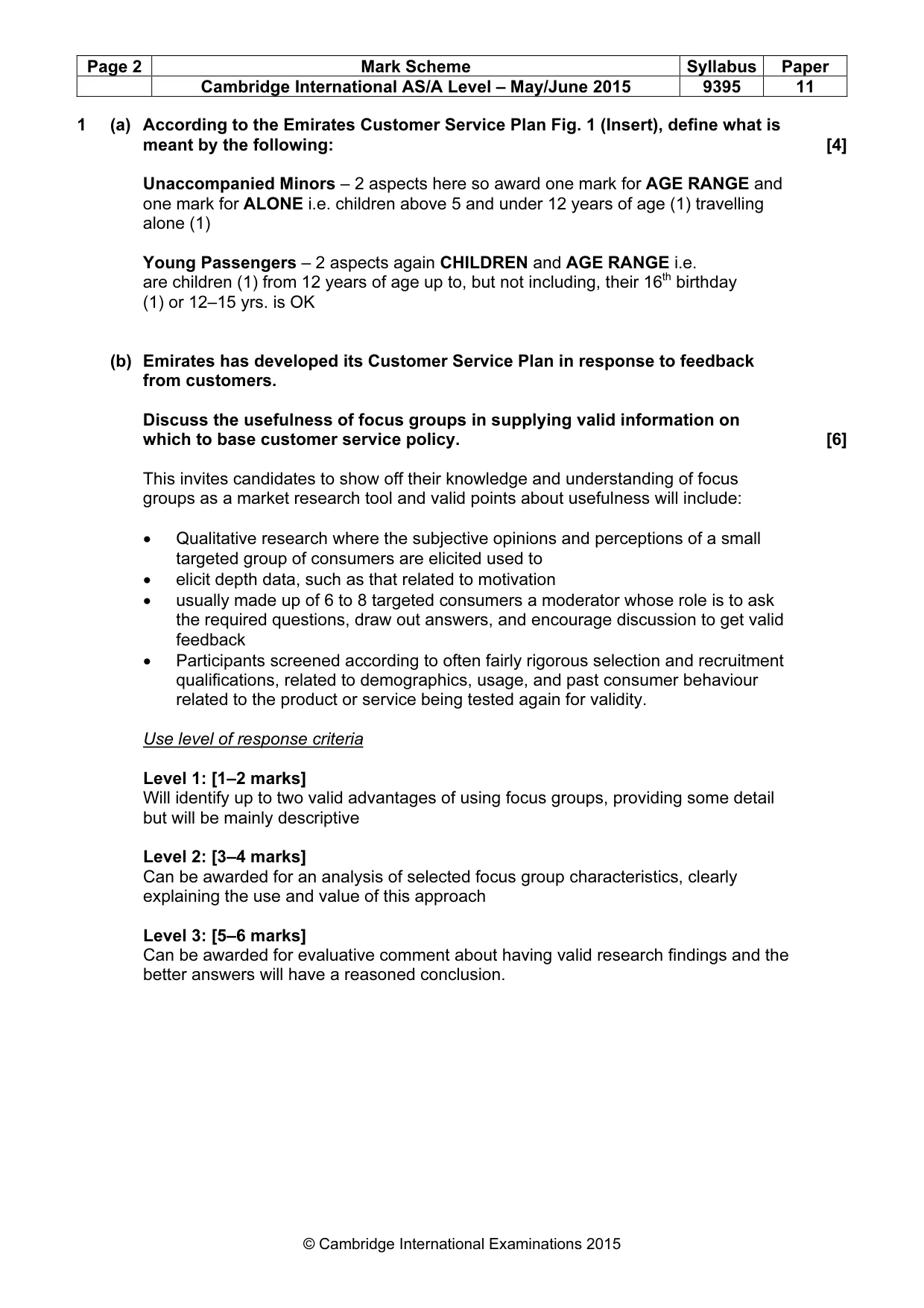
Page 2 Mark Scheme Syllabus Paper Cambridge International AS/A Level – May/June 2015 9395 11 © Cambridge International Examinations 2015 1 (a) According to the Emirates Customer Service Plan Fig. 1 (Insert), define what is meant by the following: [4] Unaccompanied Minors – 2 aspects here so award one mark for AGE RANGE and one mark for ALONE i.e. children above 5 and under 12 years of age (1) travelling alone (1) Young Passengers – 2 aspects again CHILDREN and AGE RANGE i.e. are children (1) from 12 years of age up to, but not including, their 16th birthday (1) or 12–15 yrs. is OK (b) Emirates has developed its Customer Service Plan in response to feedback from customers. Discuss the usefulness of focus groups in supplying valid information on which to base customer service policy. [6] This invites candidates to show off their knowledge and understanding of focus groups as a market research tool and valid points about usefulness will include: • Qualitative research where the subjective opinions and perceptions of a small targeted group of consumers are elicited used to • elicit depth data, such as that related to motivation • usually made up of 6 to 8 targeted consumers a moderator whose role is to ask the required questions, draw out answers, and encourage discussion to get valid feedback • Participants screened according to often fairly rigorous selection and recruitment qualifications, related to demographics, usage, and past consumer behaviour related to the product or service being tested again for validity. Use level of response criteria Level 1: [1–2 marks] Will identify up to two valid advantages of using focus groups, providing some detail but will be mainly descriptive Level 2: [3–4 marks] Can be awarded for an analysis of selected focus group characteristics, clearly explaining the use and value of this approach Level 3: [5–6 marks] Can be awarded for evaluative comment about having valid research findings and the better answers will have a reasoned conclusion.
Mark scheme, page 3
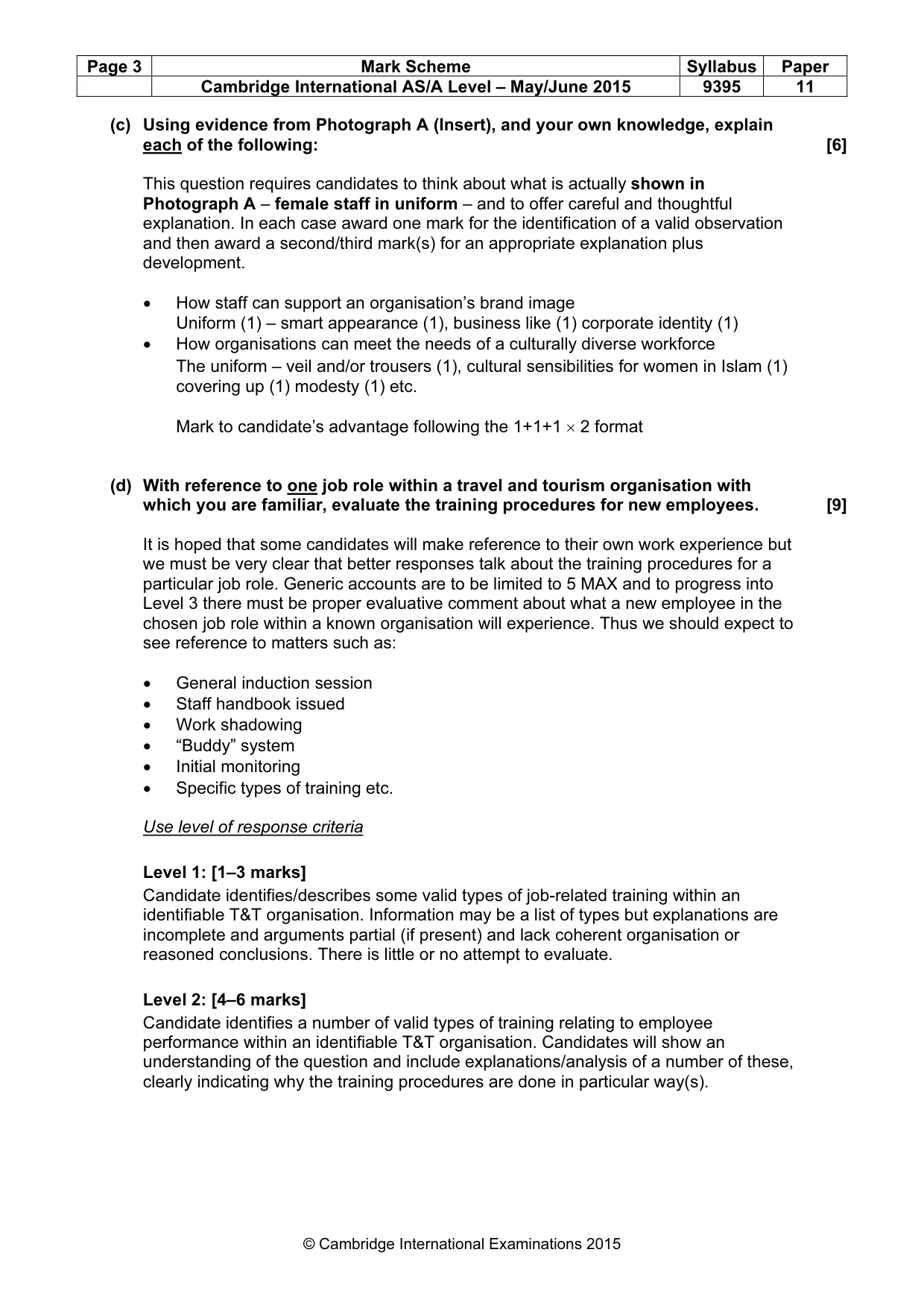
Page 3 Mark Scheme Syllabus Paper Cambridge International AS/A Level – May/June 2015 9395 11 © Cambridge International Examinations 2015 (c) Using evidence from Photograph A (Insert), and your own knowledge, explain each of the following: [6] This question requires candidates to think about what is actually shown in Photograph A – female staff in uniform – and to offer careful and thoughtful explanation. In each case award one mark for the identification of a valid observation and then award a second/third mark(s) for an appropriate explanation plus development. • How staff can support an organisation’s brand image Uniform (1) – smart appearance (1), business like (1) corporate identity (1) • How organisations can meet the needs of a culturally diverse workforce The uniform – veil and/or trousers (1), cultural sensibilities for women in Islam (1) covering up (1) modesty (1) etc. Mark to candidate’s advantage following the 1+1+1 × 2 format (d) With reference to one job role within a travel and tourism organisation with which you are familiar, evaluate the training procedures for new employees. [9] It is hoped that some candidates will make reference to their own work experience but we must be very clear that better responses talk about the training procedures for a particular job role. Generic accounts are to be limited to 5 MAX and to progress into Level 3 there must be proper evaluative comment about what a new employee in the chosen job role within a known organisation will experience. Thus we should expect to see reference to matters such as: • General induction session • Staff handbook issued • Work shadowing • “Buddy” system • Initial monitoring • Specific types of training etc. Use level of response criteria Level 1: [1–3 marks] Candidate identifies/describes some valid types of job-related training within an identifiable T&T organisation. Information may be a list of types but explanations are incomplete and arguments partial (if present) and lack coherent organisation or reasoned conclusions. There is little or no attempt to evaluate. Level 2: [4–6 marks] Candidate identifies a number of valid types of training relating to employee performance within an identifiable T&T organisation. Candidates will show an understanding of the question and include explanations/analysis of a number of these, clearly indicating why the training procedures are done in particular way(s).
Mark scheme, page 4
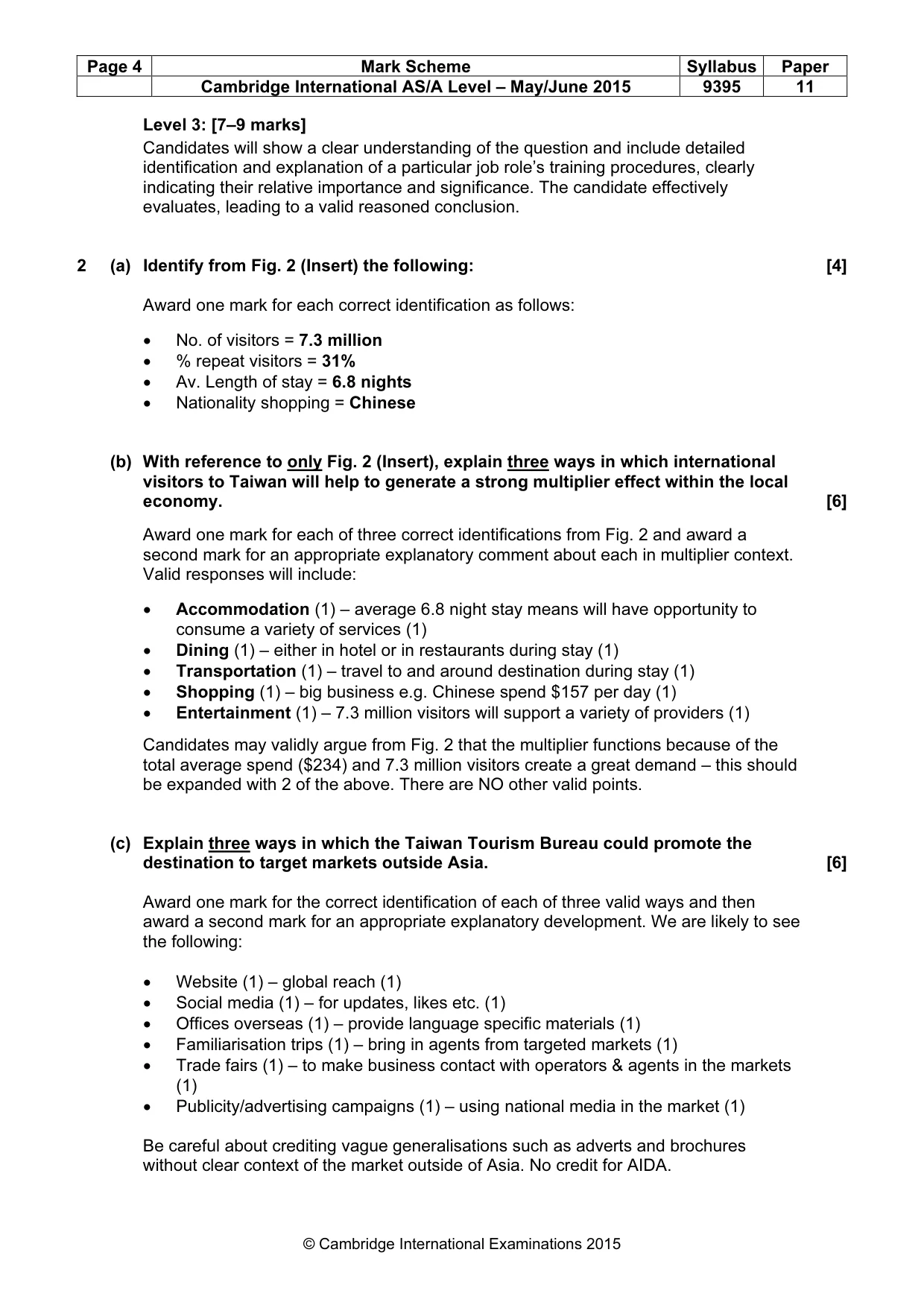
Page 4 Mark Scheme Syllabus Paper Cambridge International AS/A Level – May/June 2015 9395 11 © Cambridge International Examinations 2015 Level 3: [7–9 marks] Candidates will show a clear understanding of the question and include detailed identification and explanation of a particular job role’s training procedures, clearly indicating their relative importance and significance. The candidate effectively evaluates, leading to a valid reasoned conclusion. 2 (a) Identify from Fig. 2 (Insert) the following: [4] Award one mark for each correct identification as follows: • No. of visitors = 7.3 million • % repeat visitors = 31% • Av. Length of stay = 6.8 nights • Nationality shopping = Chinese (b) With reference to only Fig. 2 (Insert), explain three ways in which international visitors to Taiwan will help to generate a strong multiplier effect within the local economy. [6] Award one mark for each of three correct identifications from Fig. 2 and award a second mark for an appropriate explanatory comment about each in multiplier context. Valid responses will include: • Accommodation (1) – average 6.8 night stay means will have opportunity to consume a variety of services (1) • Dining (1) – either in hotel or in restaurants during stay (1) • Transportation (1) – travel to and around destination during stay (1) • Shopping (1) – big business e.g. Chinese spend $157 per day (1) • Entertainment (1) – 7.3 million visitors will support a variety of providers (1) Candidates may validly argue from Fig. 2 that the multiplier functions because of the total average spend ($234) and 7.3 million visitors create a great demand – this should be expanded with 2 of the above. There are NO other valid points. (c) Explain three ways in which the Taiwan Tourism Bureau could promote the destination to target markets outside Asia. [6] Award one mark for the correct identification of each of three valid ways and then award a second mark for an appropriate explanatory development. We are likely to see the following: • Website (1) – global reach (1) • Social media (1) – for updates, likes etc. (1) • Offices overseas (1) – provide language specific materials (1) • Familiarisation trips (1) – bring in agents from targeted markets (1) • Trade fairs (1) – to make business contact with operators & agents in the markets (1) • Publicity/advertising campaigns (1) – using national media in the market (1) Be careful about crediting vague generalisations such as adverts and brochures without clear context of the market outside of Asia. No credit for AIDA.
Mark scheme, page 5
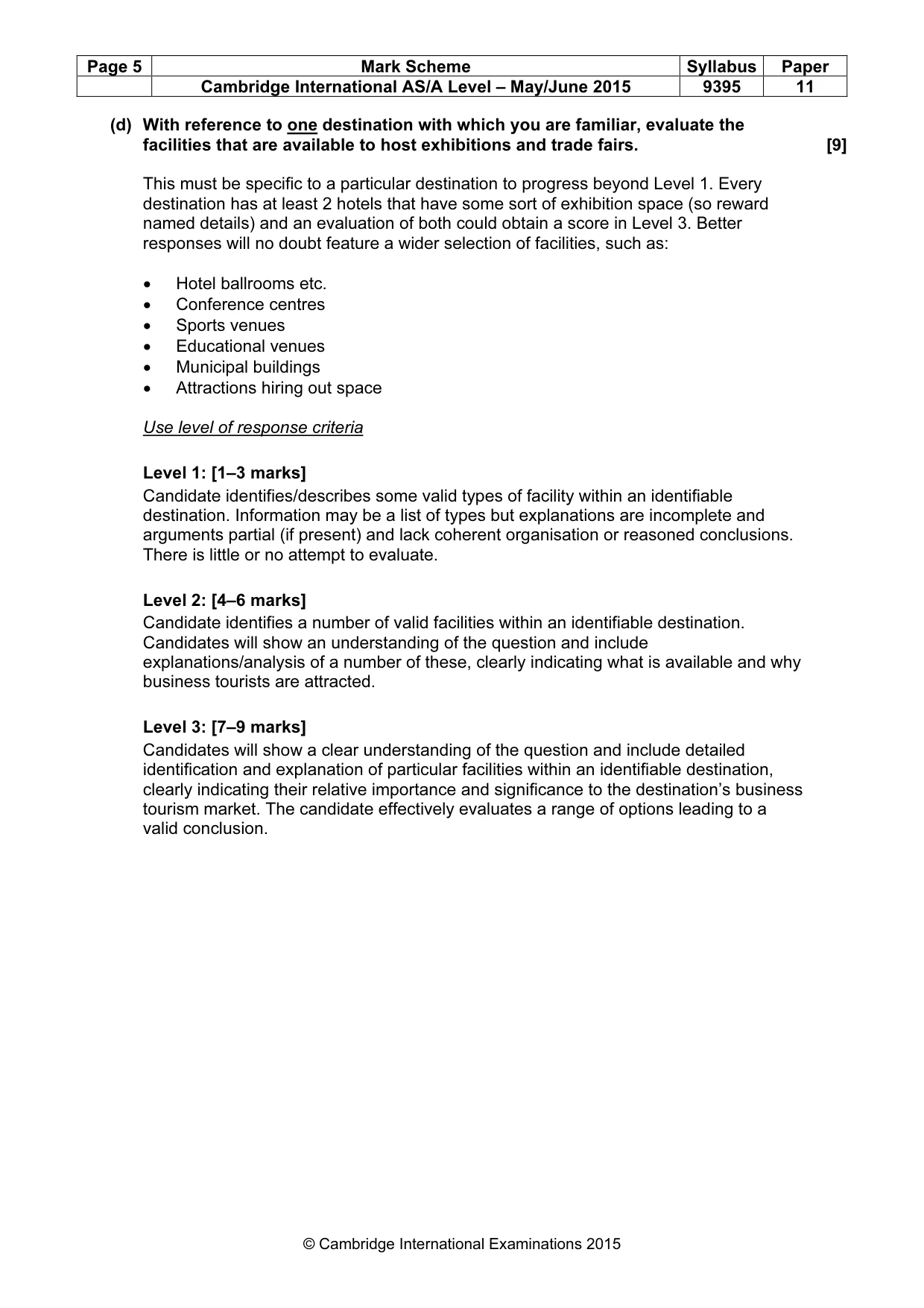
Page 5 Mark Scheme Syllabus Paper Cambridge International AS/A Level – May/June 2015 9395 11 © Cambridge International Examinations 2015 (d) With reference to one destination with which you are familiar, evaluate the facilities that are available to host exhibitions and trade fairs. [9] This must be specific to a particular destination to progress beyond Level 1. Every destination has at least 2 hotels that have some sort of exhibition space (so reward named details) and an evaluation of both could obtain a score in Level 3. Better responses will no doubt feature a wider selection of facilities, such as: • Hotel ballrooms etc. • Conference centres • Sports venues • Educational venues • Municipal buildings • Attractions hiring out space Use level of response criteria Level 1: [1–3 marks] Candidate identifies/describes some valid types of facility within an identifiable destination. Information may be a list of types but explanations are incomplete and arguments partial (if present) and lack coherent organisation or reasoned conclusions. There is little or no attempt to evaluate. Level 2: [4–6 marks] Candidate identifies a number of valid facilities within an identifiable destination. Candidates will show an understanding of the question and include explanations/analysis of a number of these, clearly indicating what is available and why business tourists are attracted. Level 3: [7–9 marks] Candidates will show a clear understanding of the question and include detailed identification and explanation of particular facilities within an identifiable destination, clearly indicating their relative importance and significance to the destination’s business tourism market. The candidate effectively evaluates a range of options leading to a valid conclusion.
Mark scheme, page 6
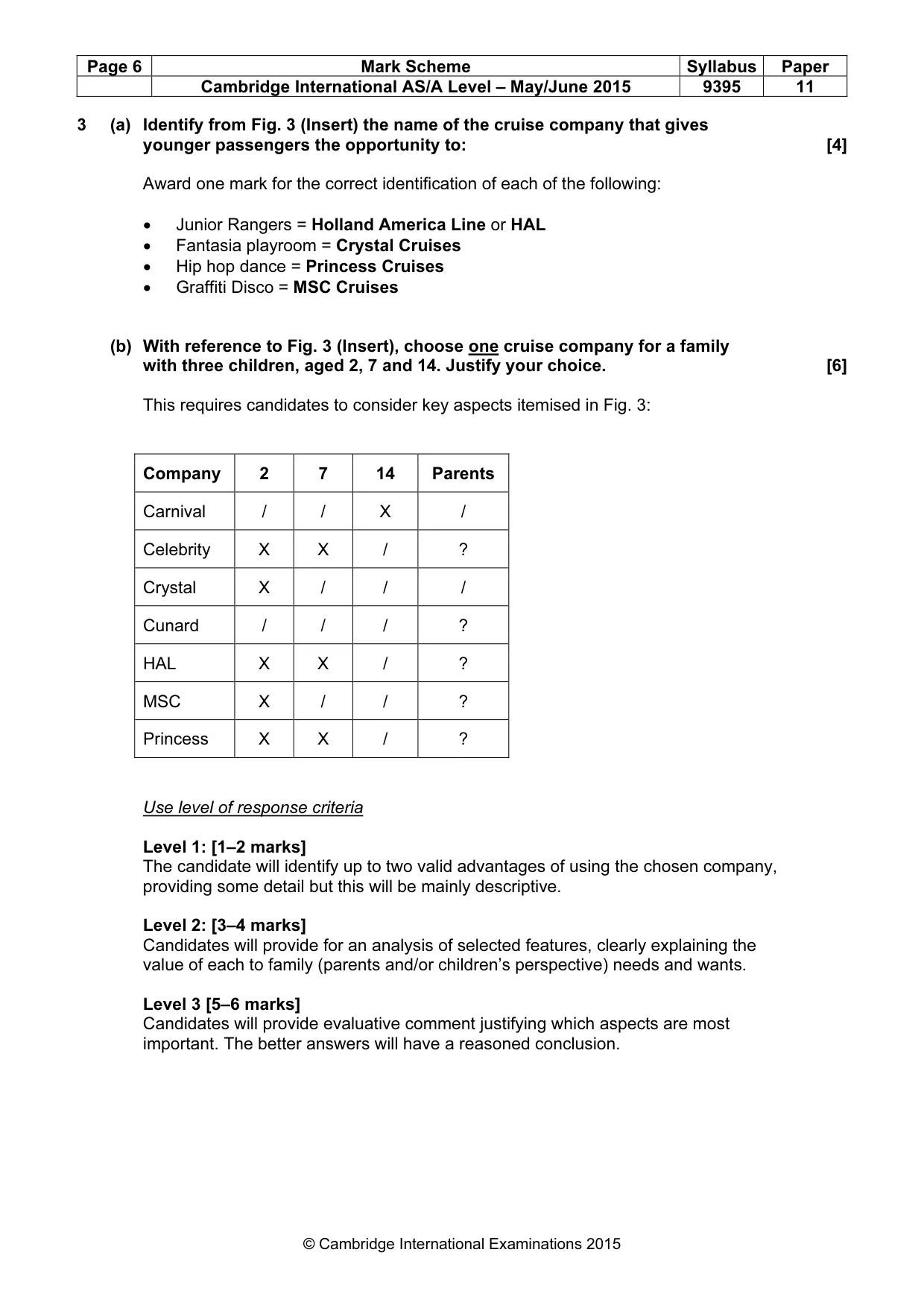
Page 6 Mark Scheme Syllabus Paper Cambridge International AS/A Level – May/June 2015 9395 11 © Cambridge International Examinations 2015 3 (a) Identify from Fig. 3 (Insert) the name of the cruise company that gives younger passengers the opportunity to: [4] Award one mark for the correct identification of each of the following: • Junior Rangers = Holland America Line or HAL • Fantasia playroom = Crystal Cruises • Hip hop dance = Princess Cruises • Graffiti Disco = MSC Cruises (b) With reference to Fig. 3 (Insert), choose one cruise company for a family with three children, aged 2, 7 and 14. Justify your choice. [6] This requires candidates to consider key aspects itemised in Fig. 3: Company 2 7 14 Parents Carnival / / X / Celebrity X X / ? Crystal X / / / Cunard / / / ? HAL X X / ? MSC X / / ? Princess X X / ? Use level of response criteria Level 1: [1–2 marks] The candidate will identify up to two valid advantages of using the chosen company, providing some detail but this will be mainly descriptive. Level 2: [3–4 marks] Candidates will provide for an analysis of selected features, clearly explaining the value of each to family (parents and/or children’s perspective) needs and wants. Level 3 [5–6 marks] Candidates will provide evaluative comment justifying which aspects are most important. The better answers will have a reasoned conclusion.
Mark scheme, page 7
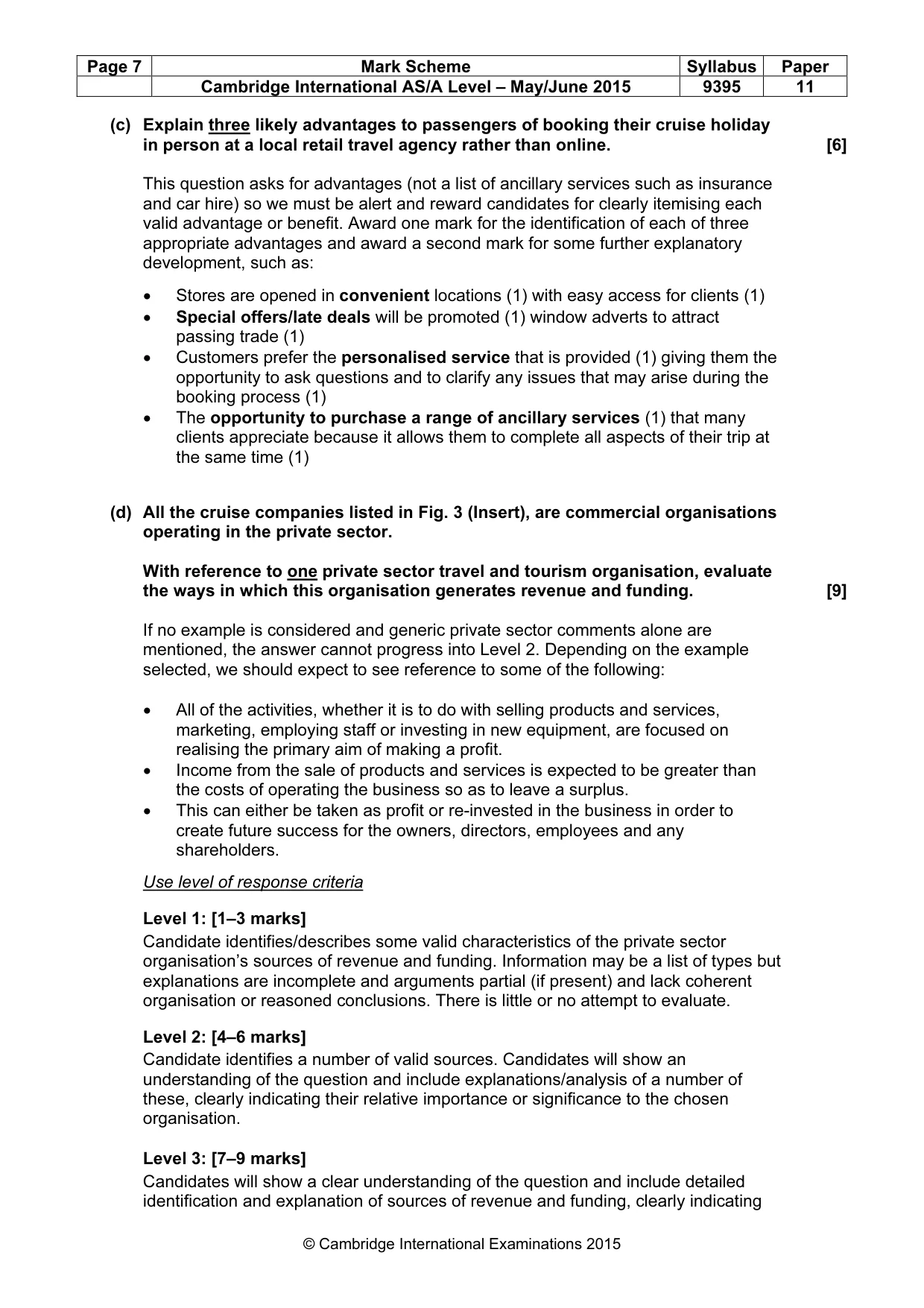
Page 7 Mark Scheme Syllabus Paper Cambridge International AS/A Level – May/June 2015 9395 11 © Cambridge International Examinations 2015 (c) Explain three likely advantages to passengers of booking their cruise holiday in person at a local retail travel agency rather than online. [6] This question asks for advantages (not a list of ancillary services such as insurance and car hire) so we must be alert and reward candidates for clearly itemising each valid advantage or benefit. Award one mark for the identification of each of three appropriate advantages and award a second mark for some further explanatory development, such as: • Stores are opened in convenient locations (1) with easy access for clients (1) • Special offers/late deals will be promoted (1) window adverts to attract passing trade (1) • Customers prefer the personalised service that is provided (1) giving them the opportunity to ask questions and to clarify any issues that may arise during the booking process (1) • The opportunity to purchase a range of ancillary services (1) that many clients appreciate because it allows them to complete all aspects of their trip at the same time (1) (d) All the cruise companies listed in Fig. 3 (Insert), are commercial organisations operating in the private sector. With reference to one private sector travel and tourism organisation, evaluate the ways in which this organisation generates revenue and funding. [9] If no example is considered and generic private sector comments alone are mentioned, the answer cannot progress into Level 2. Depending on the example selected, we should expect to see reference to some of the following: • All of the activities, whether it is to do with selling products and services, marketing, employing staff or investing in new equipment, are focused on realising the primary aim of making a profit. • Income from the sale of products and services is expected to be greater than the costs of operating the business so as to leave a surplus. • This can either be taken as profit or re-invested in the business in order to create future success for the owners, directors, employees and any shareholders. Use level of response criteria Level 1: [1–3 marks] Candidate identifies/describes some valid characteristics of the private sector organisation’s sources of revenue and funding. Information may be a list of types but explanations are incomplete and arguments partial (if present) and lack coherent organisation or reasoned conclusions. There is little or no attempt to evaluate. Level 2: [4–6 marks] Candidate identifies a number of valid sources. Candidates will show an understanding of the question and include explanations/analysis of a number of these, clearly indicating their relative importance or significance to the chosen organisation. Level 3: [7–9 marks] Candidates will show a clear understanding of the question and include detailed identification and explanation of sources of revenue and funding, clearly indicating
Mark scheme, page 8
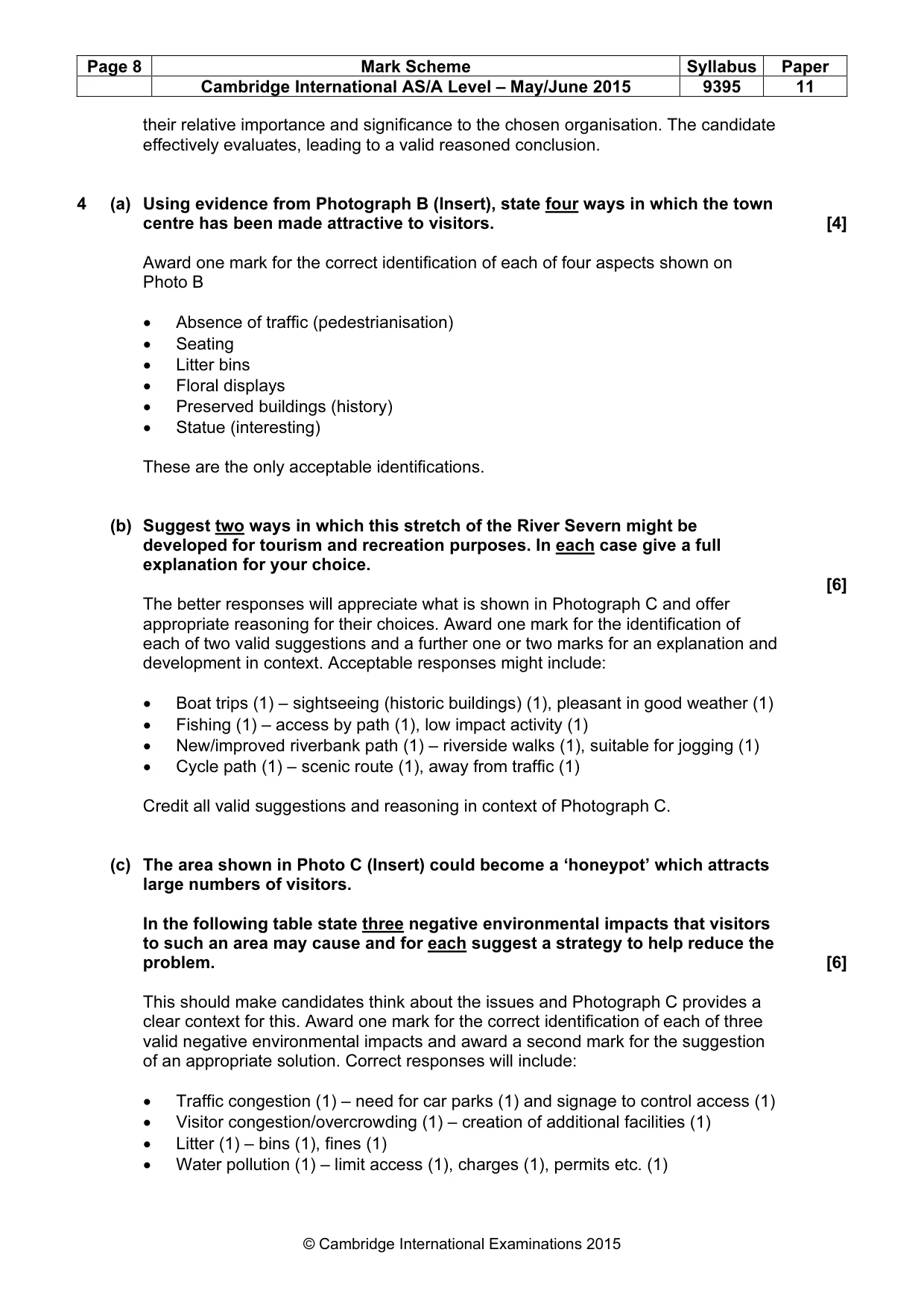
Page 8 Mark Scheme Syllabus Paper Cambridge International AS/A Level – May/June 2015 9395 11 © Cambridge International Examinations 2015 their relative importance and significance to the chosen organisation. The candidate effectively evaluates, leading to a valid reasoned conclusion. 4 (a) Using evidence from Photograph B (Insert), state four ways in which the town centre has been made attractive to visitors. [4] Award one mark for the correct identification of each of four aspects shown on Photo B • Absence of traffic (pedestrianisation) • Seating • Litter bins • Floral displays • Preserved buildings (history) • Statue (interesting) These are the only acceptable identifications. (b) Suggest two ways in which this stretch of the River Severn might be developed for tourism and recreation purposes. In each case give a full explanation for your choice. [6] The better responses will appreciate what is shown in Photograph C and offer appropriate reasoning for their choices. Award one mark for the identification of each of two valid suggestions and a further one or two marks for an explanation and development in context. Acceptable responses might include: • Boat trips (1) – sightseeing (historic buildings) (1), pleasant in good weather (1) • Fishing (1) – access by path (1), low impact activity (1) • New/improved riverbank path (1) – riverside walks (1), suitable for jogging (1) • Cycle path (1) – scenic route (1), away from traffic (1) Credit all valid suggestions and reasoning in context of Photograph C. (c) The area shown in Photo C (Insert) could become a ‘honeypot’ which attracts large numbers of visitors. In the following table state three negative environmental impacts that visitors to such an area may cause and for each suggest a strategy to help reduce the problem. [6] This should make candidates think about the issues and Photograph C provides a clear context for this. Award one mark for the correct identification of each of three valid negative environmental impacts and award a second mark for the suggestion of an appropriate solution. Correct responses will include: • Traffic congestion (1) – need for car parks (1) and signage to control access (1) • Visitor congestion/overcrowding (1) – creation of additional facilities (1) • Litter (1) – bins (1), fines (1) • Water pollution (1) – limit access (1), charges (1), permits etc. (1)
Mark scheme, page 9
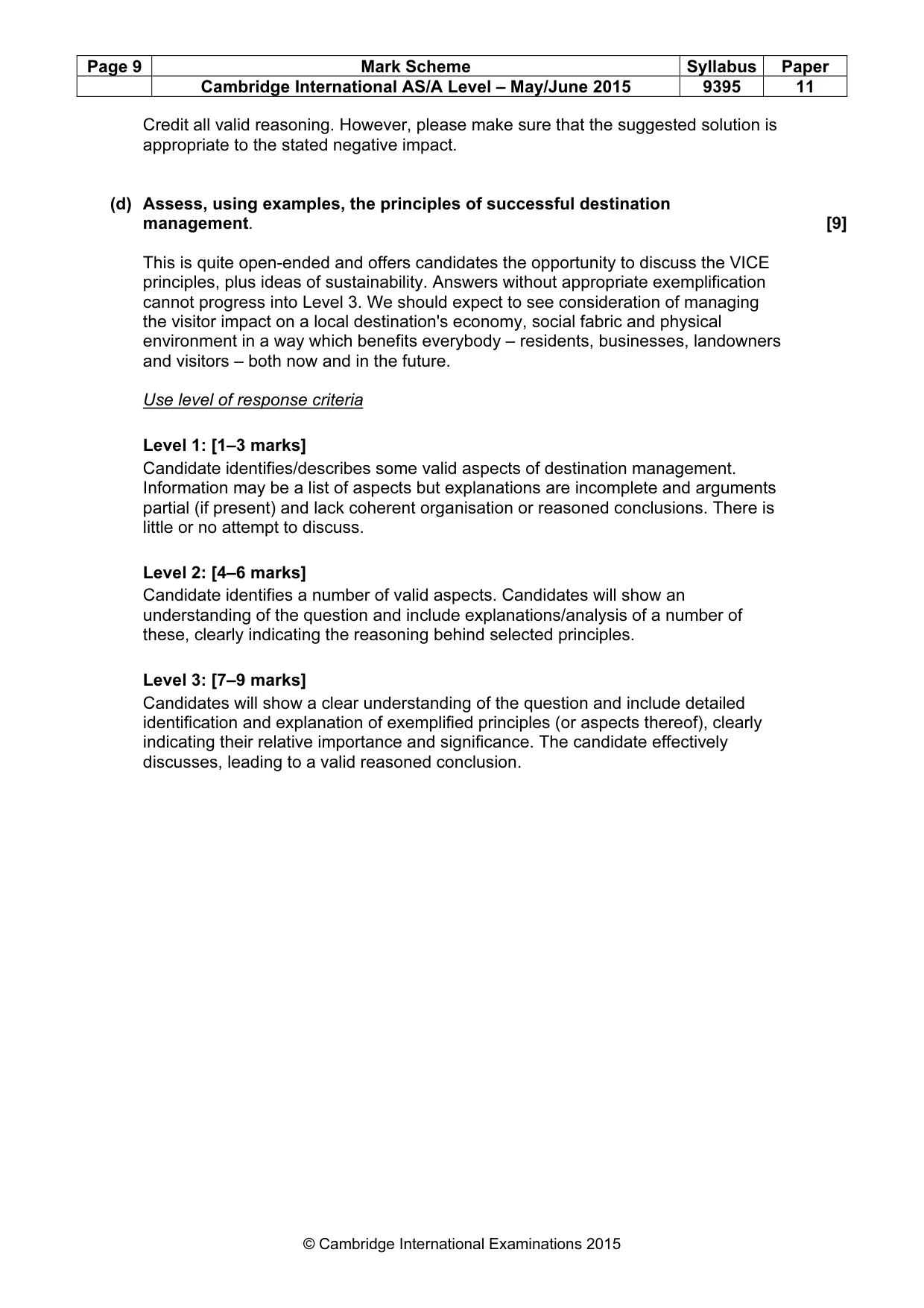
Page 9 Mark Scheme Syllabus Paper Cambridge International AS/A Level – May/June 2015 9395 11 © Cambridge International Examinations 2015 Credit all valid reasoning. However, please make sure that the suggested solution is appropriate to the stated negative impact. (d) Assess, using examples, the principles of successful destination management. [9] This is quite open-ended and offers candidates the opportunity to discuss the VICE principles, plus ideas of sustainability. Answers without appropriate exemplification cannot progress into Level 3. We should expect to see consideration of managing the visitor impact on a local destination's economy, social fabric and physical environment in a way which benefits everybody – residents, businesses, landowners and visitors – both now and in the future. Use level of response criteria Level 1: [1–3 marks] Candidate identifies/describes some valid aspects of destination management. Information may be a list of aspects but explanations are incomplete and arguments partial (if present) and lack coherent organisation or reasoned conclusions. There is little or no attempt to discuss. Level 2: [4–6 marks] Candidate identifies a number of valid aspects. Candidates will show an understanding of the question and include explanations/analysis of a number of these, clearly indicating the reasoning behind selected principles. Level 3: [7–9 marks] Candidates will show a clear understanding of the question and include detailed identification and explanation of exemplified principles (or aspects thereof), clearly indicating their relative importance and significance. The candidate effectively discusses, leading to a valid reasoned conclusion.
What you needed in this session
Cambridge’s own grade thresholds for 2015 May/June, Paper 1 · Variant 1. A higher threshold means an easier paper — the bar moves with how the cohort did.