Cambridge A Level Travel and Tourism 9395 — 2023 Oct/Nov Paper 3 · Variant 3
9395/33/O/N/23 · 50 marks · ≈56 min
The question paper and its mark scheme, free to read here and free to download. This is Cambridge’s own paper, exactly as it was sat.
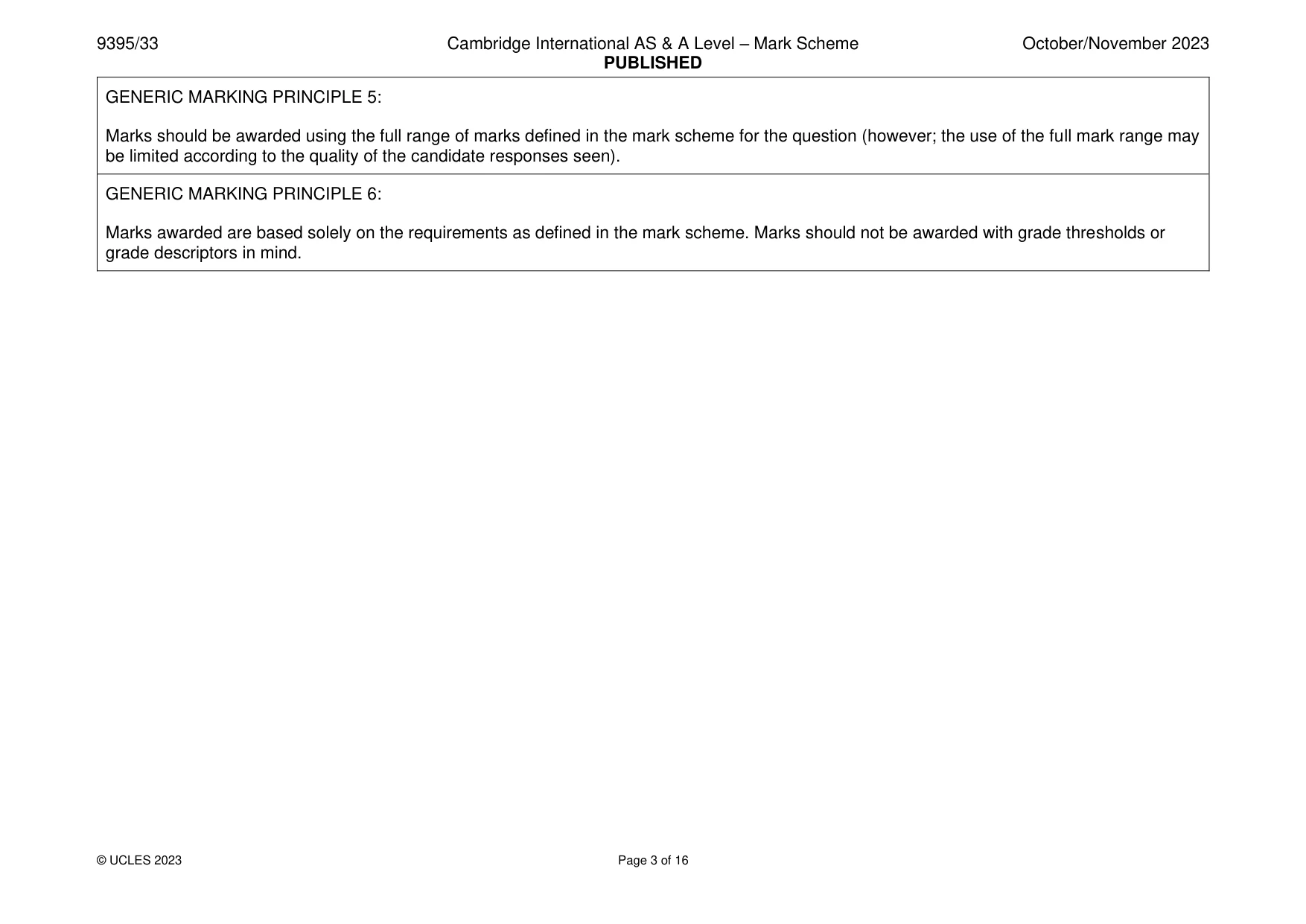
Question paper12 pages


Mark scheme16 pages
Answers below. Sit the paper first if you are practising.
Paper as text
Question paper, page 1
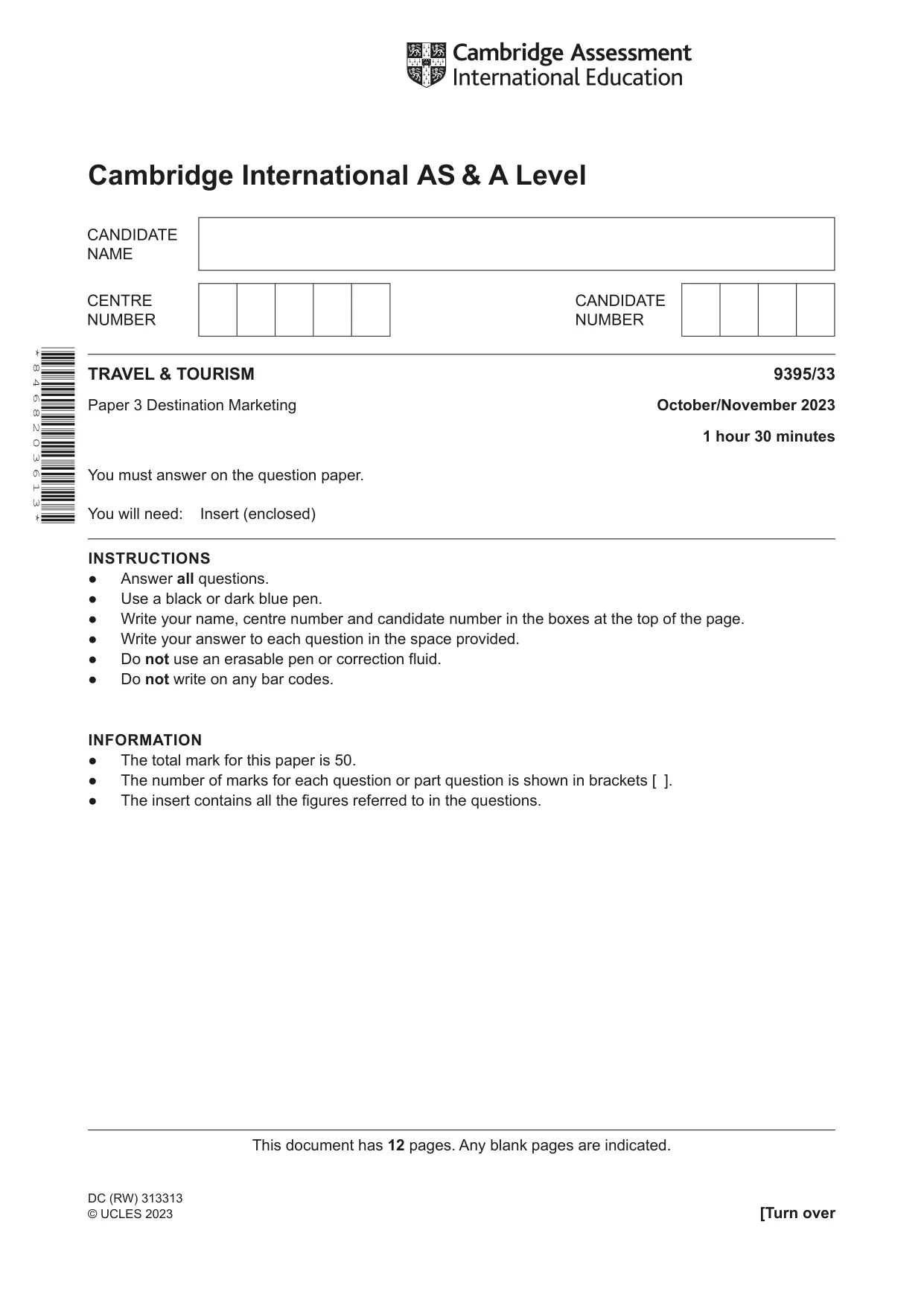
This document has 12 pages. Any blank pages are indicated. [Turn over Cambridge International AS & A Level * 8 4 6 8 2 0 3 6 1 3 * TRAVEL & TOURISM 9395/33 Paper 3 Destination Marketing October/November 2023 1 hour 30 minutes You must answer on the question paper. You will need: Insert (enclosed) INSTRUCTIONS ● Answer all questions. ● Use a black or dark blue pen. ● Write your name, centre number and candidate number in the boxes at the top of the page. ● Write your answer to each question in the space provided. ● Do not use an erasable pen or correction fluid. ● Do not write on any bar codes. INFORMATION ● The total mark for this paper is 50. ● The number of marks for each question or part question is shown in brackets [ ]. ● The insert contains all the figures referred to in the questions. DC (RW) 313313 © UCLES 2023
Question paper, page 2
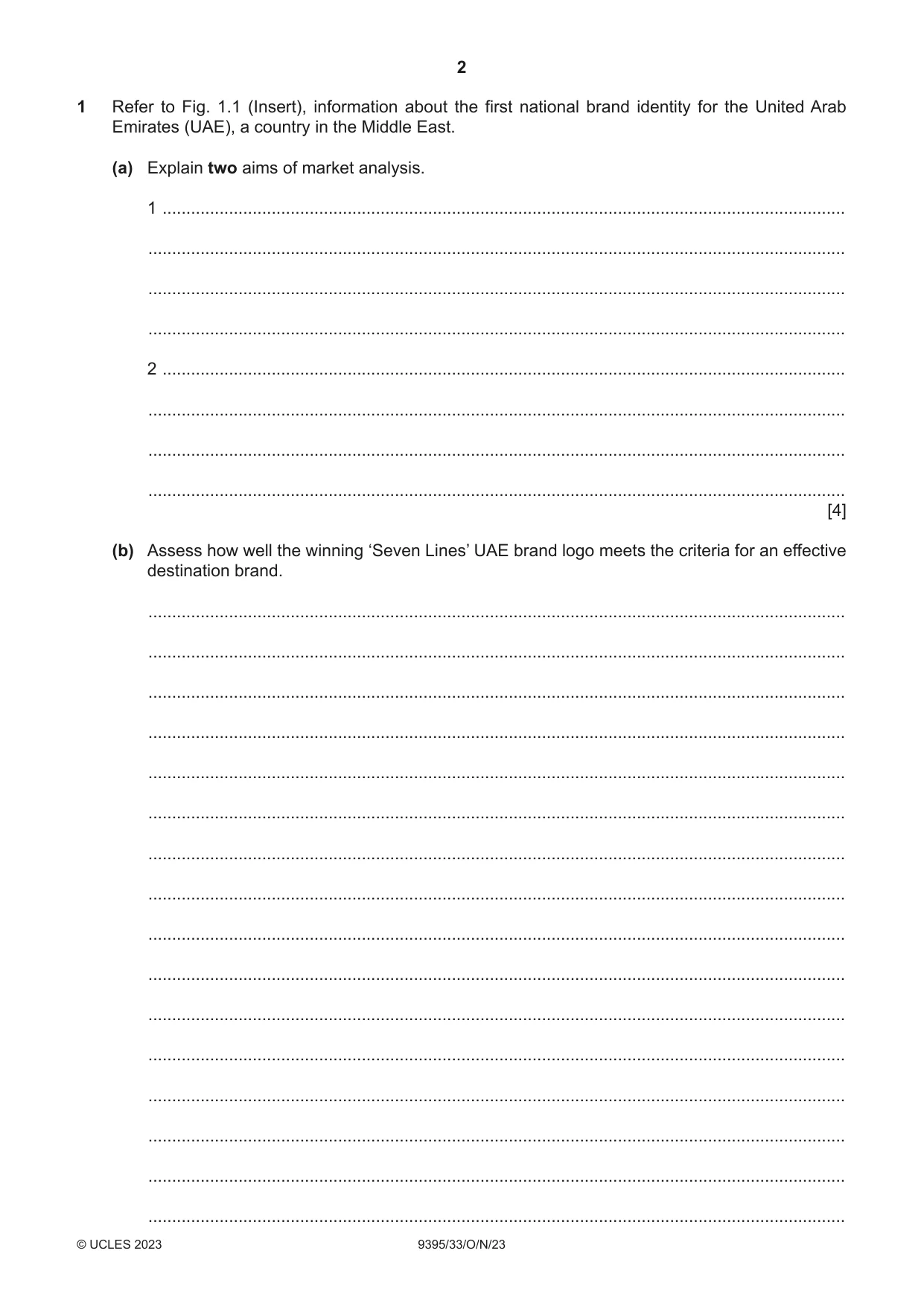
2 9395/33/O/N/23 © UCLES 2023 1 Refer to Fig. 1.1 (Insert), information about the first national brand identity for the United Arab Emirates (UAE), a country in the Middle East. (a) Explain two aims of market analysis. 1 … … … … 2 … … … … [4] (b) Assess how well the winning ‘Seven Lines’ UAE brand logo meets the criteria for an effective destination brand. … … … … … … … … … … … … … … … …
Question paper, page 3
3 9395/33/O/N/23 © UCLES 2023 [Turn over … … … … … … … … … … … … … … … … … … … … … … … … … … … … [9]
Question paper, page 4
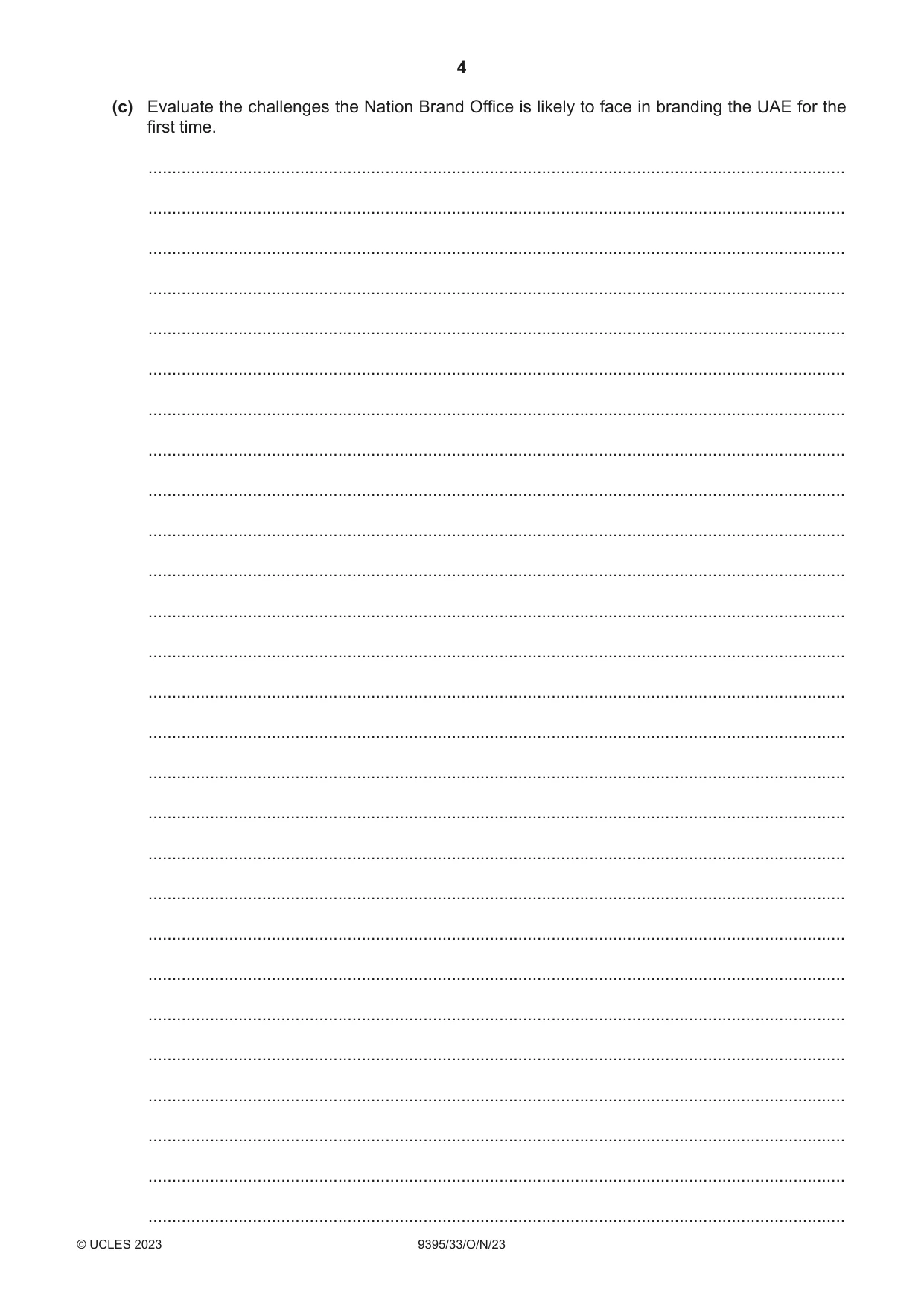
4 9395/33/O/N/23 © UCLES 2023 (c) Evaluate the challenges the Nation Brand Office is likely to face in branding the UAE for the first time. … … … … … … … … … … … … … … … … … … … … … … … … … … …
Question paper, page 5
5 9395/33/O/N/23 © UCLES 2023 [Turn over … … … … … … … … … … … … … … … … … … … … … … … … … … … [12] [Total: 25]
Question paper, page 6
6 9395/33/O/N/23 © UCLES 2023 2 Refer to Fig. 2.1 (Insert), information about the Nebraska Tourism Commission’s (NTC) approach to destination marketing. Nebraska is a midwestern state in the USA. (a) Explain two roles of a destination marketing organisation (DMO). 1 … … … … 2 … … … … [4] (b) Discuss how the destination environment might be used to raise awareness of a destination and its brand identity. … … … … … … … … … … … … … … … …
Question paper, page 7
7 9395/33/O/N/23 © UCLES 2023 [Turn over … … … … … … … … … … … … … … … … … … … … … … … … … … … … [9]
Question paper, page 8
8 9395/33/O/N/23 © UCLES 2023 (c) Evaluate the range of KPIs which are most useful in measuring the brand success of Nebraska’s destination brand. … … … … … … … … … … … … … … … … … … … … … … … … … … …
Question paper, page 9
9 9395/33/O/N/23 © UCLES 2023 … … … … … … … … … … … … … … … … … … … … … … … … … … … [12] [Total: 25]
Question paper, page 10
10 9395/33/O/N/23 © UCLES 2023 BLANK PAGE
Question paper, page 11
11 9395/33/O/N/23 © UCLES 2023 BLANK PAGE
Question paper, page 12
12 9395/33/O/N/23 © UCLES 2023 The boundaries and names shown, the designations used and the presentation of material on any maps contained in this question paper/insert do not imply official endorsement or acceptance by Cambridge Assessment International Education concerning the legal status of any country, territory, or area or any of its authorities, or of the delimitation of its frontiers or boundaries. Permission to reproduce items where third-party owned material protected by copyright is included has been sought and cleared where possible. Every reasonable effort has been made by the publisher (UCLES) to trace copyright holders, but if any items requiring clearance have unwittingly been included, the publisher will be pleased to make amends at the earliest possible opportunity. To avoid the issue of disclosure of answer-related information to candidates, all copyright acknowledgements are reproduced online in the Cambridge Assessment International Education Copyright Acknowledgements Booklet. This is produced for each series of examinations and is freely available to download at www.cambridgeinternational.org after the live examination series. Cambridge Assessment International Education is part of Cambridge Assessment. Cambridge Assessment is the brand name of the University of Cambridge Local Examinations Syndicate (UCLES), which is a department of the University of Cambridge. BLANK PAGE
Mark scheme, page 1
This document consists of 16 printed pages. © UCLES 2023 [Turn over Cambridge International AS & A Level TRAVEL & TOURISM 9395/33 Paper 3 Destination Marketing October/November 2023 MARK SCHEME Maximum Mark: 50 Published This mark scheme is published as an aid to teachers and candidates, to indicate the requirements of the examination. It shows the basis on which Examiners were instructed to award marks. It does not indicate the details of the discussions that took place at an Examiners’ meeting before marking began, which would have considered the acceptability of alternative answers. Mark schemes should be read in conjunction with the question paper and the Principal Examiner Report for Teachers. Cambridge International will not enter into discussions about these mark schemes. Cambridge International is publishing the mark schemes for the October/November 2023 series for most Cambridge IGCSE, Cambridge International A and AS Level components, and some Cambridge O Level components.
Mark scheme, page 2
9395/33 Cambridge International AS & A Level – Mark Scheme PUBLISHED October/November 2023 © UCLES 2023 Page 2 of 16 Generic Marking Principles These general marking principles must be applied by all examiners when marking candidate answers. They should be applied alongside the specific content of the mark scheme or generic level descriptors for a question. Each question paper and mark scheme will also comply with these marking principles. GENERIC MARKING PRINCIPLE 1: Marks must be awarded in line with: • the specific content of the mark scheme or the generic level descriptors for the question • the specific skills defined in the mark scheme or in the generic level descriptors for the question • the standard of response required by a candidate as exemplified by the standardisation scripts. GENERIC MARKING PRINCIPLE 2: Marks awarded are always whole marks (not half marks, or other fractions). GENERIC MARKING PRINCIPLE 3: Marks must be awarded positively: • marks are awarded for correct/valid answers, as defined in the mark scheme. However, credit is given for valid answers which go beyond the scope of the syllabus and mark scheme, referring to your Team Leader as appropriate • marks are awarded when candidates clearly demonstrate what they know and can do • marks are not deducted for errors • marks are not deducted for omissions • answers should only be judged on the quality of spelling, punctuation and grammar when these features are specifically assessed by the question as indicated by the mark scheme. The meaning, however, should be unambiguous. GENERIC MARKING PRINCIPLE 4: Rules must be applied consistently, e.g. in situations where candidates have not followed instructions or in the application of generic level descriptors.
Mark scheme, page 3
9395/33 Cambridge International AS & A Level – Mark Scheme PUBLISHED October/November 2023 © UCLES 2023 Page 3 of 16 GENERIC MARKING PRINCIPLE 5: Marks should be awarded using the full range of marks defined in the mark scheme for the question (however; the use of the full mark range may be limited according to the quality of the candidate responses seen). GENERIC MARKING PRINCIPLE 6: Marks awarded are based solely on the requirements as defined in the mark scheme. Marks should not be awarded with grade thresholds or grade descriptors in mind.
Mark scheme, page 4
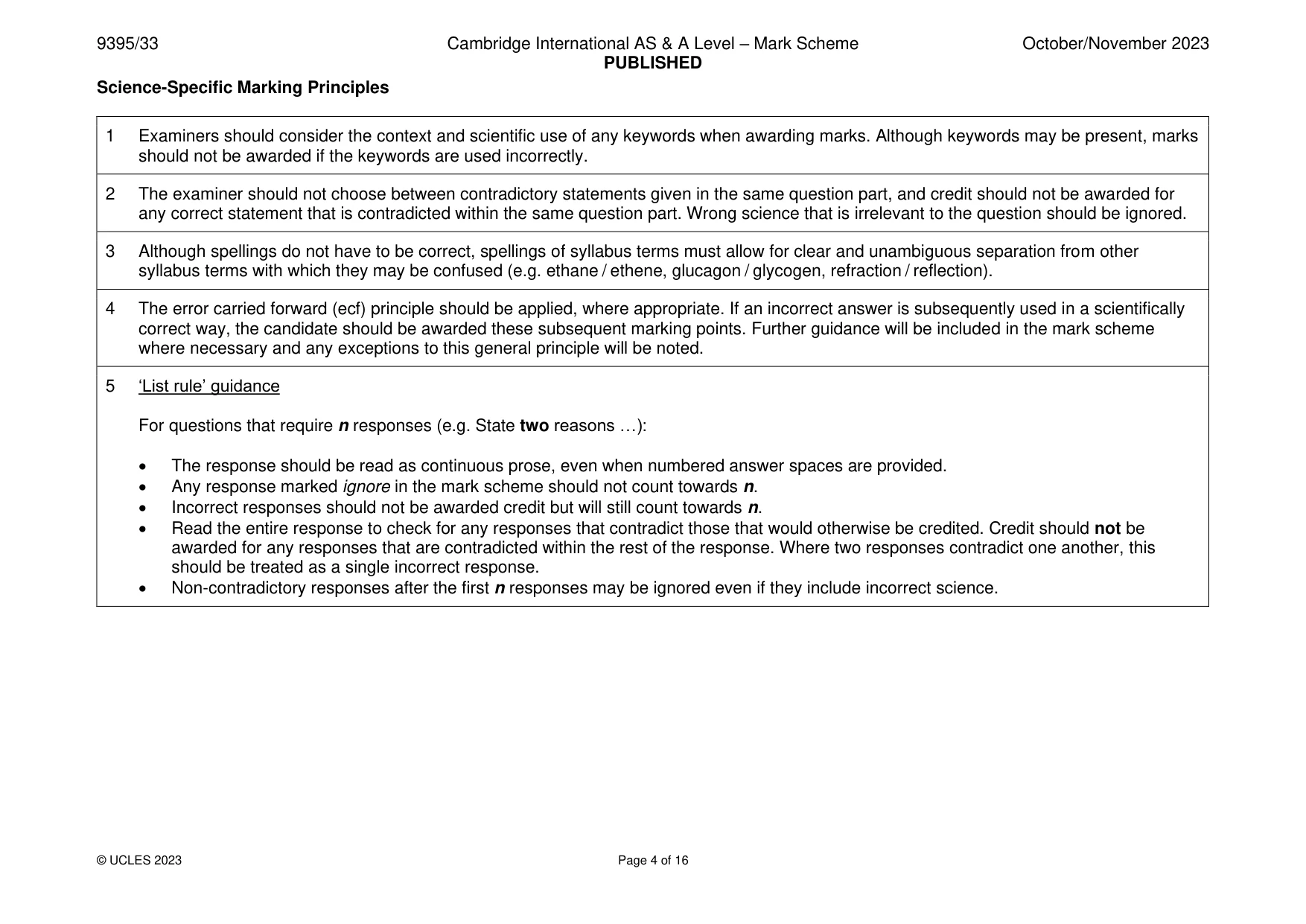
9395/33 Cambridge International AS & A Level – Mark Scheme PUBLISHED October/November 2023 © UCLES 2023 Page 4 of 16 Science-Specific Marking Principles 1 Examiners should consider the context and scientific use of any keywords when awarding marks. Although keywords may be present, marks should not be awarded if the keywords are used incorrectly. 2 The examiner should not choose between contradictory statements given in the same question part, and credit should not be awarded for any correct statement that is contradicted within the same question part. Wrong science that is irrelevant to the question should be ignored. 3 Although spellings do not have to be correct, spellings of syllabus terms must allow for clear and unambiguous separation from other syllabus terms with which they may be confused (e.g. ethane / ethene, glucagon / glycogen, refraction / reflection). 4 The error carried forward (ecf) principle should be applied, where appropriate. If an incorrect answer is subsequently used in a scientifically correct way, the candidate should be awarded these subsequent marking points. Further guidance will be included in the mark scheme where necessary and any exceptions to this general principle will be noted. 5 ‘List rule’ guidance For questions that require n responses (e.g. State two reasons …): • The response should be read as continuous prose, even when numbered answer spaces are provided. • Any response marked ignore in the mark scheme should not count towards n. • Incorrect responses should not be awarded credit but will still count towards n. • Read the entire response to check for any responses that contradict those that would otherwise be credited. Credit should not be awarded for any responses that are contradicted within the rest of the response. Where two responses contradict one another, this should be treated as a single incorrect response. • Non-contradictory responses after the first n responses may be ignored even if they include incorrect science.
Mark scheme, page 5
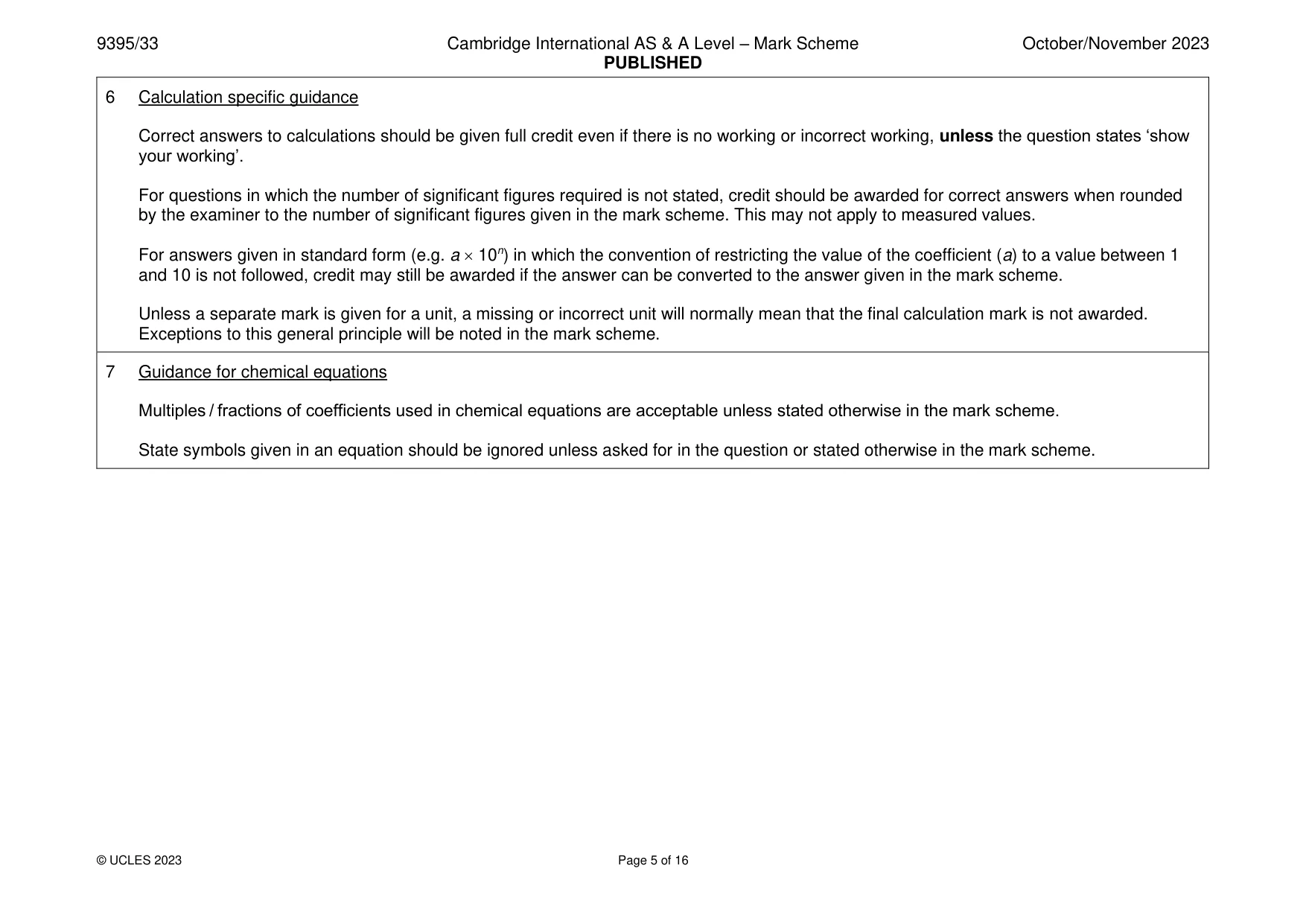
9395/33 Cambridge International AS & A Level – Mark Scheme PUBLISHED October/November 2023 © UCLES 2023 Page 5 of 16 6 Calculation specific guidance Correct answers to calculations should be given full credit even if there is no working or incorrect working, unless the question states ‘show your working’. For questions in which the number of significant figures required is not stated, credit should be awarded for correct answers when rounded by the examiner to the number of significant figures given in the mark scheme. This may not apply to measured values. For answers given in standard form (e.g. a 10n) in which the convention of restricting the value of the coefficient (a) to a value between 1 and 10 is not followed, credit may still be awarded if the answer can be converted to the answer given in the mark scheme. Unless a separate mark is given for a unit, a missing or incorrect unit will normally mean that the final calculation mark is not awarded. Exceptions to this general principle will be noted in the mark scheme. 7 Guidance for chemical equations Multiples / fractions of coefficients used in chemical equations are acceptable unless stated otherwise in the mark scheme. State symbols given in an equation should be ignored unless asked for in the question or stated otherwise in the mark scheme.
Mark scheme, page 6
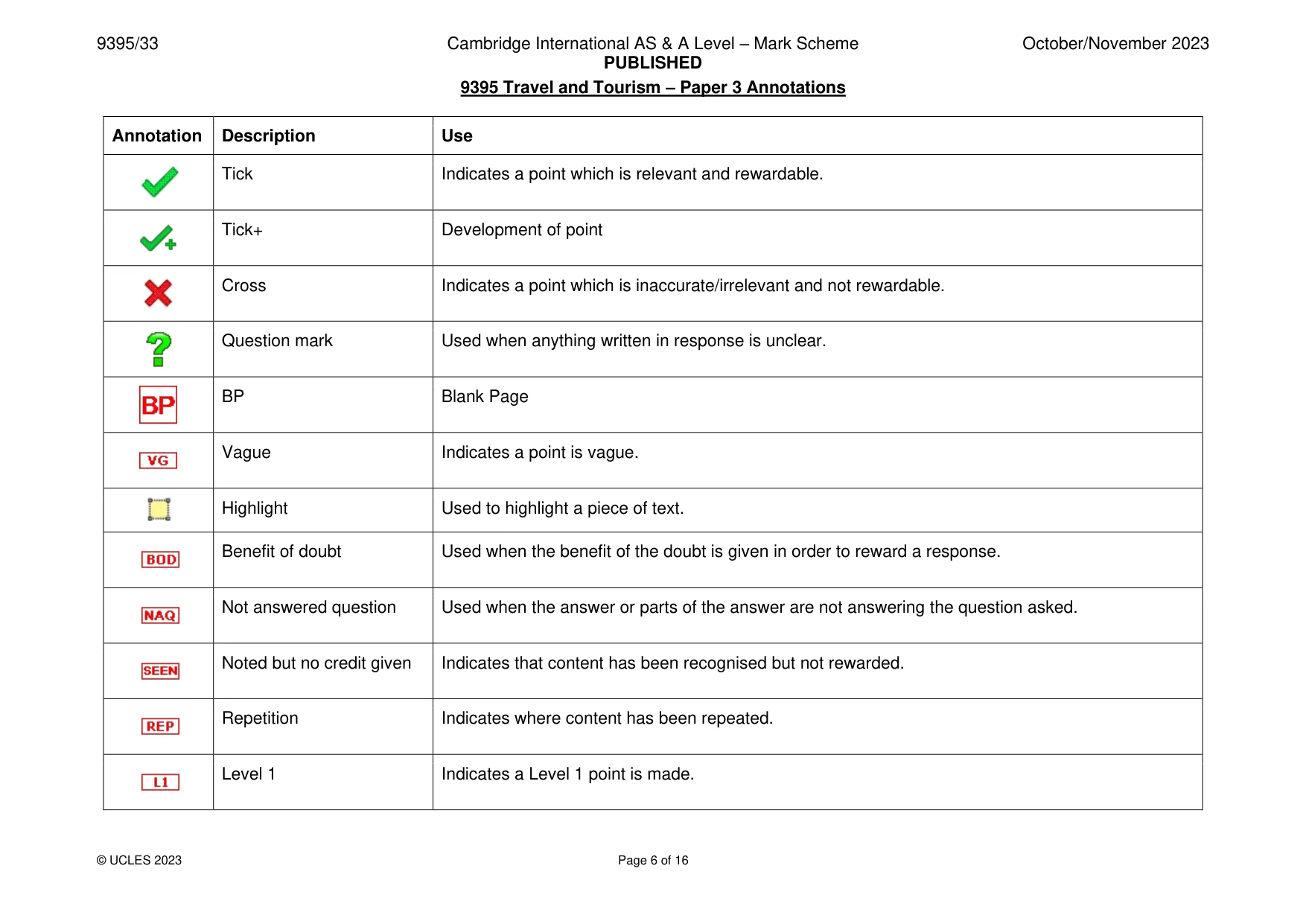
9395/33 Cambridge International AS & A Level – Mark Scheme PUBLISHED October/November 2023 © UCLES 2023 Page 6 of 16 9395 Travel and Tourism – Paper 3 Annotations Annotation Description Use Tick Indicates a point which is relevant and rewardable. Tick+ Development of point Cross Indicates a point which is inaccurate/irrelevant and not rewardable. Question mark Used when anything written in response is unclear. BP Blank Page Vague Indicates a point is vague. Highlight Used to highlight a piece of text. Benefit of doubt Used when the benefit of the doubt is given in order to reward a response. Not answered question Used when the answer or parts of the answer are not answering the question asked. Noted but no credit given Indicates that content has been recognised but not rewarded. Repetition Indicates where content has been repeated. Level 1 Indicates a Level 1 point is made.
Mark scheme, page 7
9395/33 Cambridge International AS & A Level – Mark Scheme PUBLISHED October/November 2023 © UCLES 2023 Page 7 of 16 Level 2 Indicates a Level 2 point is made. Level 3 Indicates a Level 3 point is made. Off Page Comment Used to add comments to responses – displayed at the bottom of the screen when clicking the comments button/toggle.
Mark scheme, page 8
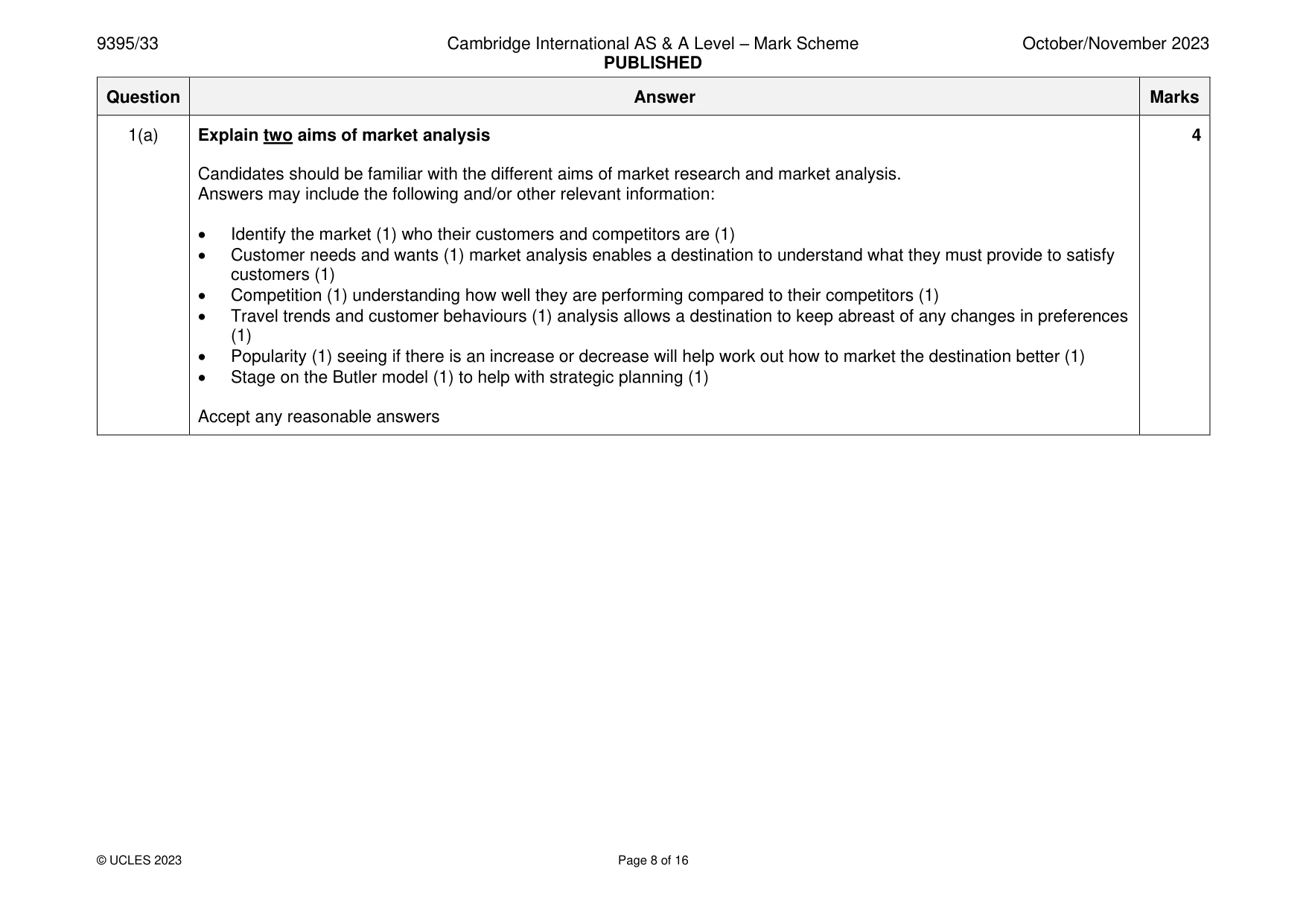
9395/33 Cambridge International AS & A Level – Mark Scheme PUBLISHED October/November 2023 © UCLES 2023 Page 8 of 16 Question Answer Marks 1(a) Explain two aims of market analysis Candidates should be familiar with the different aims of market research and market analysis. Answers may include the following and/or other relevant information: • Identify the market (1) who their customers and competitors are (1) • Customer needs and wants (1) market analysis enables a destination to understand what they must provide to satisfy customers (1) • Competition (1) understanding how well they are performing compared to their competitors (1) • Travel trends and customer behaviours (1) analysis allows a destination to keep abreast of any changes in preferences (1) • Popularity (1) seeing if there is an increase or decrease will help work out how to market the destination better (1) • Stage on the Butler model (1) to help with strategic planning (1) Accept any reasonable answers 4
Mark scheme, page 9
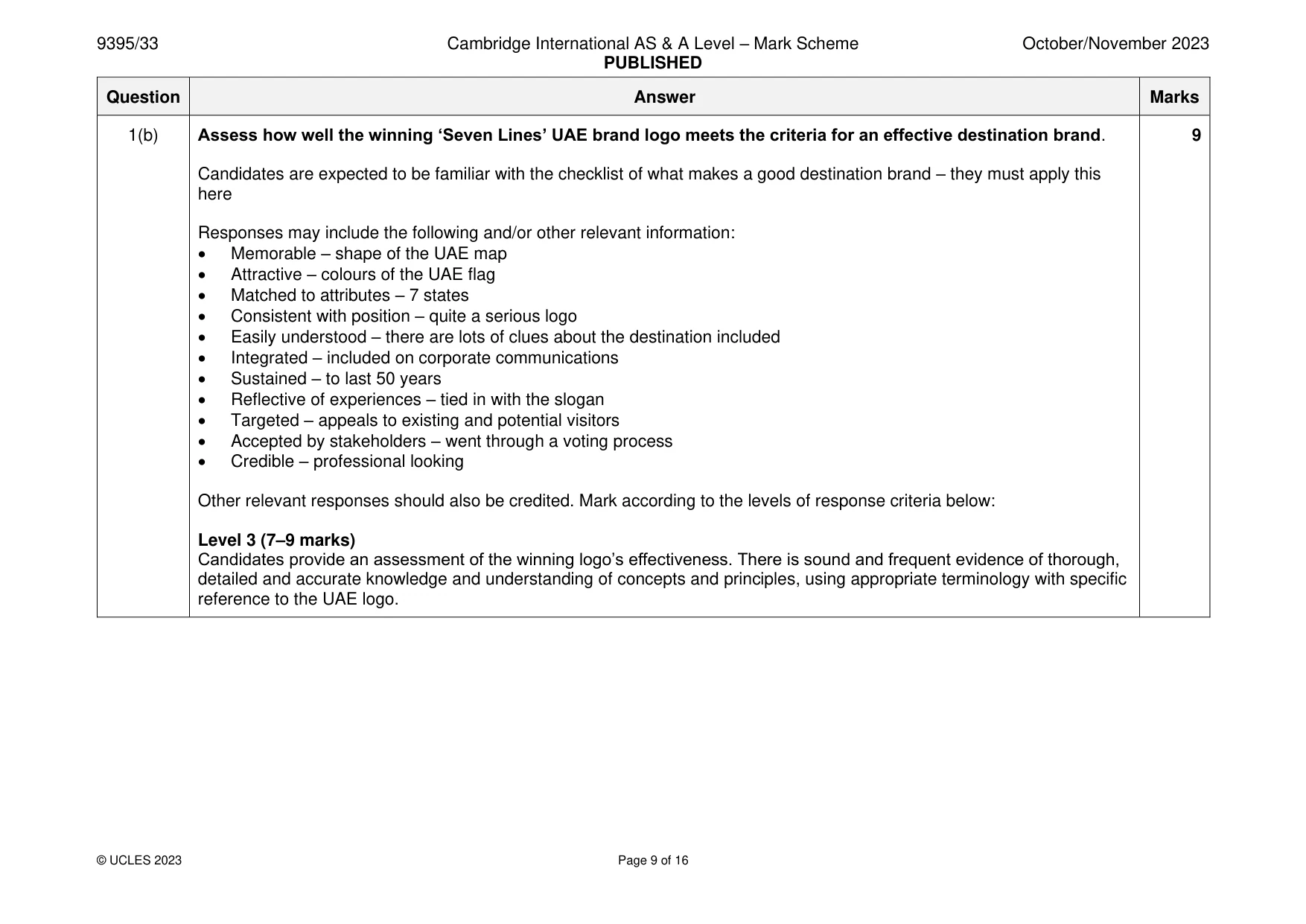
9395/33 Cambridge International AS & A Level – Mark Scheme PUBLISHED October/November 2023 © UCLES 2023 Page 9 of 16 Question Answer Marks 1(b) Assess how well the winning ‘Seven Lines’ UAE brand logo meets the criteria for an effective destination brand. Candidates are expected to be familiar with the checklist of what makes a good destination brand – they must apply this here Responses may include the following and/or other relevant information: • Memorable – shape of the UAE map • Attractive – colours of the UAE flag • Matched to attributes – 7 states • Consistent with position – quite a serious logo • Easily understood – there are lots of clues about the destination included • Integrated – included on corporate communications • Sustained – to last 50 years • Reflective of experiences – tied in with the slogan • Targeted – appeals to existing and potential visitors • Accepted by stakeholders – went through a voting process • Credible – professional looking Other relevant responses should also be credited. Mark according to the levels of response criteria below: Level 3 (7–9 marks) Candidates provide an assessment of the winning logo’s effectiveness. There is sound and frequent evidence of thorough, detailed and accurate knowledge and understanding of concepts and principles, using appropriate terminology with specific reference to the UAE logo. 9
Mark scheme, page 10
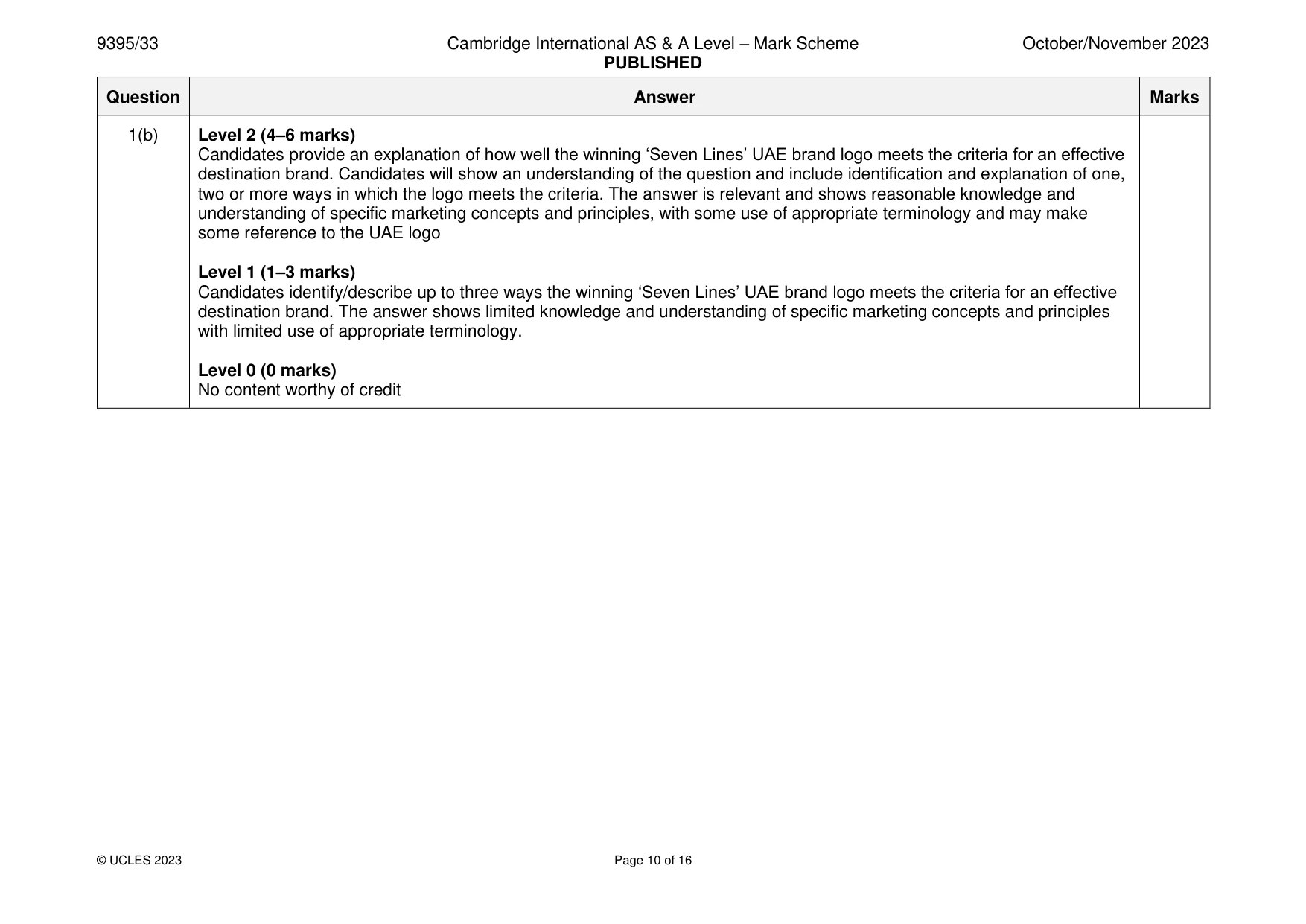
9395/33 Cambridge International AS & A Level – Mark Scheme PUBLISHED October/November 2023 © UCLES 2023 Page 10 of 16 Question Answer Marks 1(b) Level 2 (4–6 marks) Candidates provide an explanation of how well the winning ‘Seven Lines’ UAE brand logo meets the criteria for an effective destination brand. Candidates will show an understanding of the question and include identification and explanation of one, two or more ways in which the logo meets the criteria. The answer is relevant and shows reasonable knowledge and understanding of specific marketing concepts and principles, with some use of appropriate terminology and may make some reference to the UAE logo Level 1 (1–3 marks) Candidates identify/describe up to three ways the winning ‘Seven Lines’ UAE brand logo meets the criteria for an effective destination brand. The answer shows limited knowledge and understanding of specific marketing concepts and principles with limited use of appropriate terminology. Level 0 (0 marks) No content worthy of credit
Mark scheme, page 11
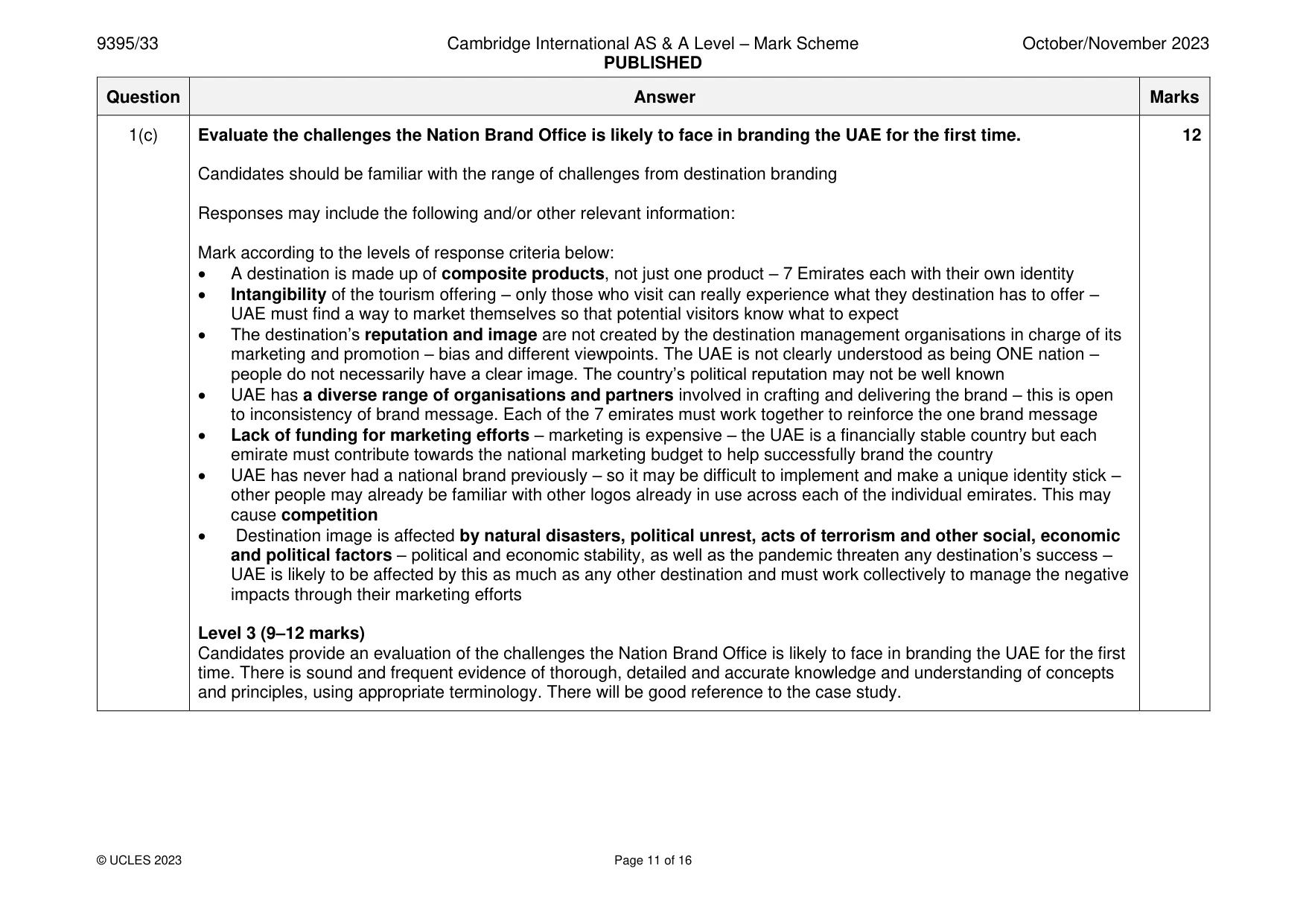
9395/33 Cambridge International AS & A Level – Mark Scheme PUBLISHED October/November 2023 © UCLES 2023 Page 11 of 16 Question Answer Marks 1(c) Evaluate the challenges the Nation Brand Office is likely to face in branding the UAE for the first time. Candidates should be familiar with the range of challenges from destination branding Responses may include the following and/or other relevant information: Mark according to the levels of response criteria below: • A destination is made up of composite products, not just one product – 7 Emirates each with their own identity • Intangibility of the tourism offering – only those who visit can really experience what they destination has to offer – UAE must find a way to market themselves so that potential visitors know what to expect • The destination’s reputation and image are not created by the destination management organisations in charge of its marketing and promotion – bias and different viewpoints. The UAE is not clearly understood as being ONE nation – people do not necessarily have a clear image. The country’s political reputation may not be well known • UAE has a diverse range of organisations and partners involved in crafting and delivering the brand – this is open to inconsistency of brand message. Each of the 7 emirates must work together to reinforce the one brand message • Lack of funding for marketing efforts – marketing is expensive – the UAE is a financially stable country but each emirate must contribute towards the national marketing budget to help successfully brand the country • UAE has never had a national brand previously – so it may be difficult to implement and make a unique identity stick – other people may already be familiar with other logos already in use across each of the individual emirates. This may cause competition • Destination image is affected by natural disasters, political unrest, acts of terrorism and other social, economic and political factors – political and economic stability, as well as the pandemic threaten any destination’s success – UAE is likely to be affected by this as much as any other destination and must work collectively to manage the negative impacts through their marketing efforts Level 3 (9–12 marks) Candidates provide an evaluation of the challenges the Nation Brand Office is likely to face in branding the UAE for the first time. There is sound and frequent evidence of thorough, detailed and accurate knowledge and understanding of concepts and principles, using appropriate terminology. There will be good reference to the case study. 12
Mark scheme, page 12
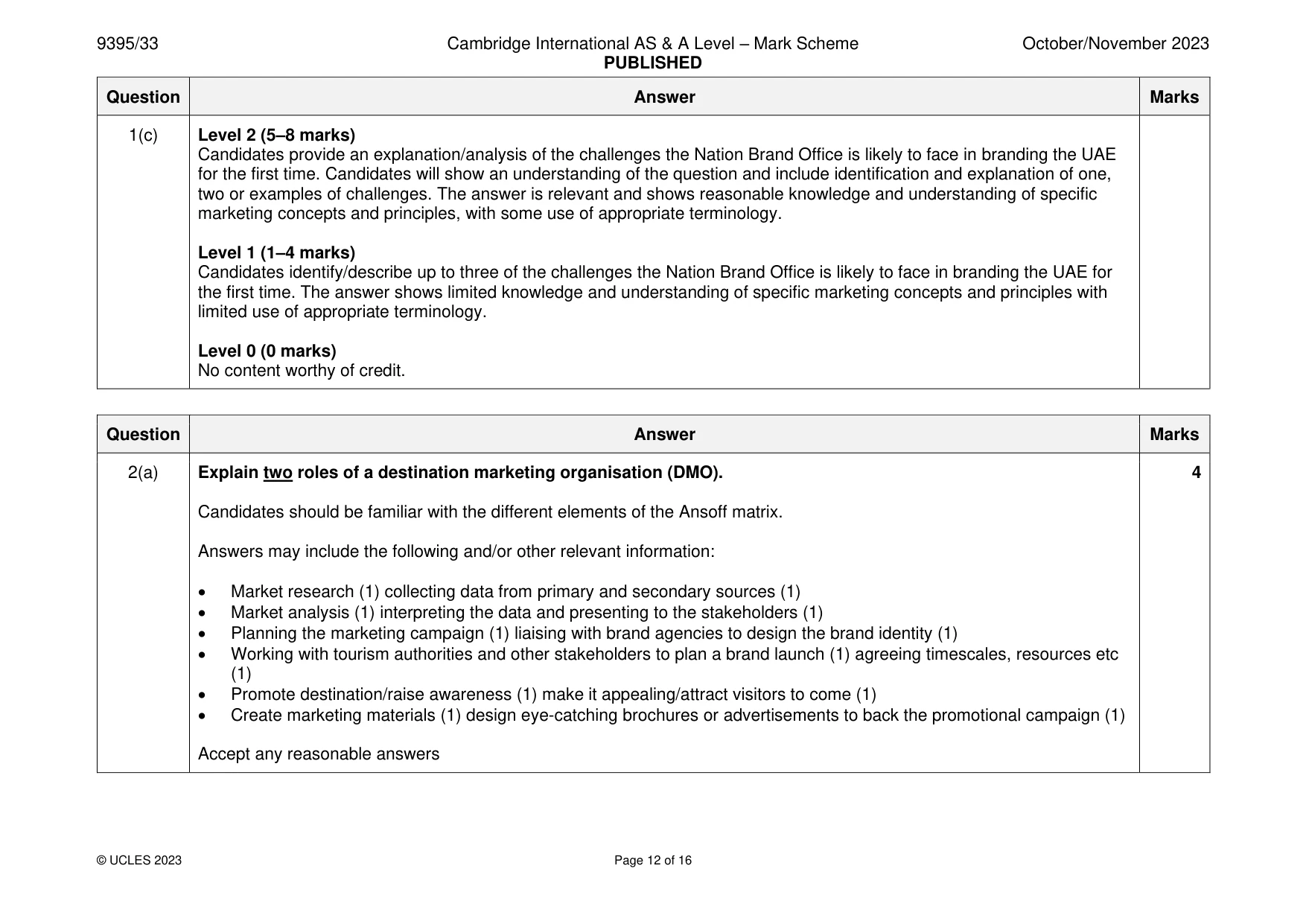
9395/33 Cambridge International AS & A Level – Mark Scheme PUBLISHED October/November 2023 © UCLES 2023 Page 12 of 16 Question Answer Marks 1(c) Level 2 (5–8 marks) Candidates provide an explanation/analysis of the challenges the Nation Brand Office is likely to face in branding the UAE for the first time. Candidates will show an understanding of the question and include identification and explanation of one, two or examples of challenges. The answer is relevant and shows reasonable knowledge and understanding of specific marketing concepts and principles, with some use of appropriate terminology. Level 1 (1–4 marks) Candidates identify/describe up to three of the challenges the Nation Brand Office is likely to face in branding the UAE for the first time. The answer shows limited knowledge and understanding of specific marketing concepts and principles with limited use of appropriate terminology. Level 0 (0 marks) No content worthy of credit. Question Answer Marks 2(a) Explain two roles of a destination marketing organisation (DMO). Candidates should be familiar with the different elements of the Ansoff matrix. Answers may include the following and/or other relevant information: • Market research (1) collecting data from primary and secondary sources (1) • Market analysis (1) interpreting the data and presenting to the stakeholders (1) • Planning the marketing campaign (1) liaising with brand agencies to design the brand identity (1) • Working with tourism authorities and other stakeholders to plan a brand launch (1) agreeing timescales, resources etc (1) • Promote destination/raise awareness (1) make it appealing/attract visitors to come (1) • Create marketing materials (1) design eye-catching brochures or advertisements to back the promotional campaign (1) Accept any reasonable answers 4
Mark scheme, page 13
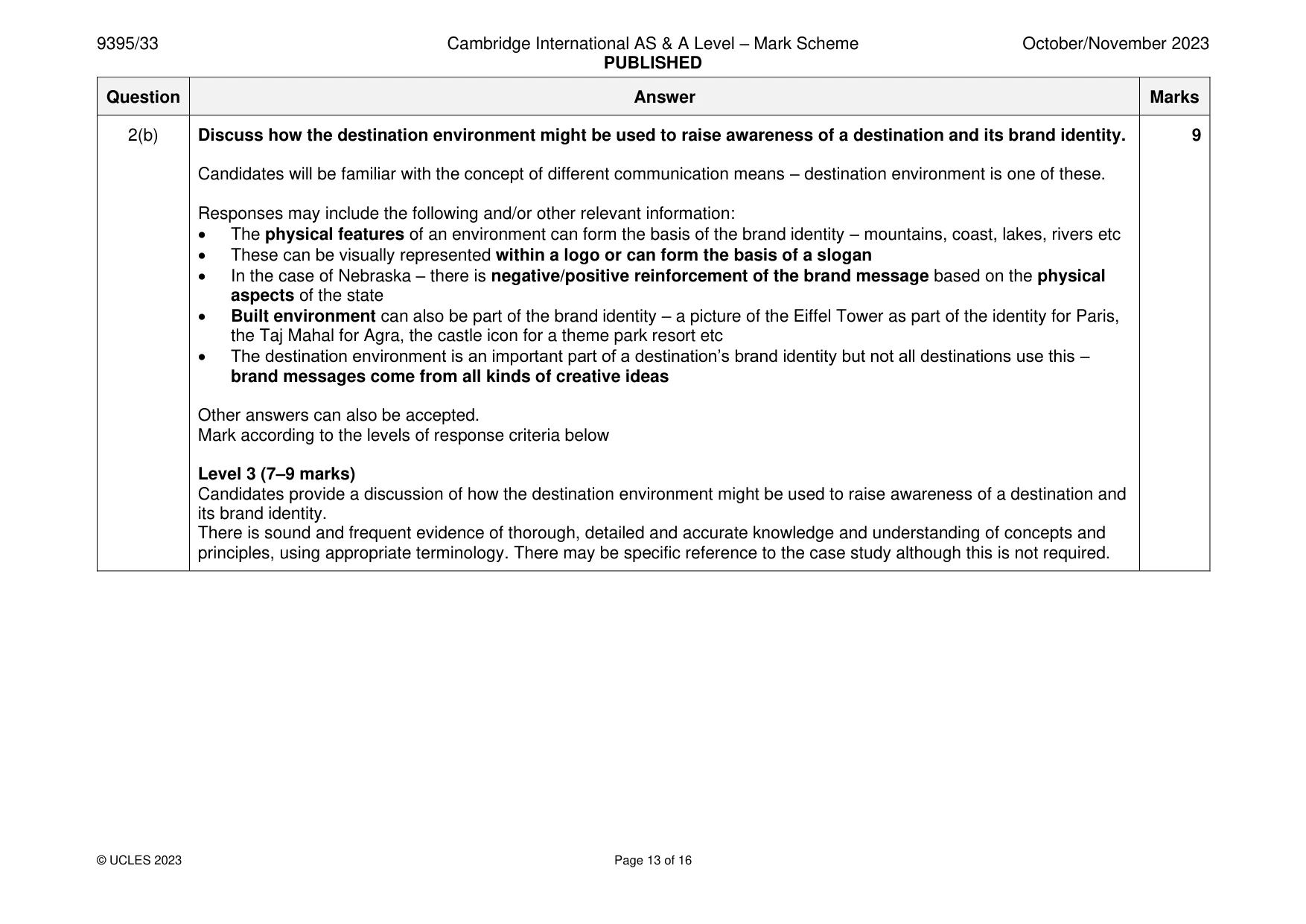
9395/33 Cambridge International AS & A Level – Mark Scheme PUBLISHED October/November 2023 © UCLES 2023 Page 13 of 16 Question Answer Marks 2(b) Discuss how the destination environment might be used to raise awareness of a destination and its brand identity. Candidates will be familiar with the concept of different communication means – destination environment is one of these. Responses may include the following and/or other relevant information: • The physical features of an environment can form the basis of the brand identity – mountains, coast, lakes, rivers etc • These can be visually represented within a logo or can form the basis of a slogan • In the case of Nebraska – there is negative/positive reinforcement of the brand message based on the physical aspects of the state • Built environment can also be part of the brand identity – a picture of the Eiffel Tower as part of the identity for Paris, the Taj Mahal for Agra, the castle icon for a theme park resort etc • The destination environment is an important part of a destination’s brand identity but not all destinations use this – brand messages come from all kinds of creative ideas Other answers can also be accepted. Mark according to the levels of response criteria below Level 3 (7–9 marks) Candidates provide a discussion of how the destination environment might be used to raise awareness of a destination and its brand identity. There is sound and frequent evidence of thorough, detailed and accurate knowledge and understanding of concepts and principles, using appropriate terminology. There may be specific reference to the case study although this is not required. 9
Mark scheme, page 14
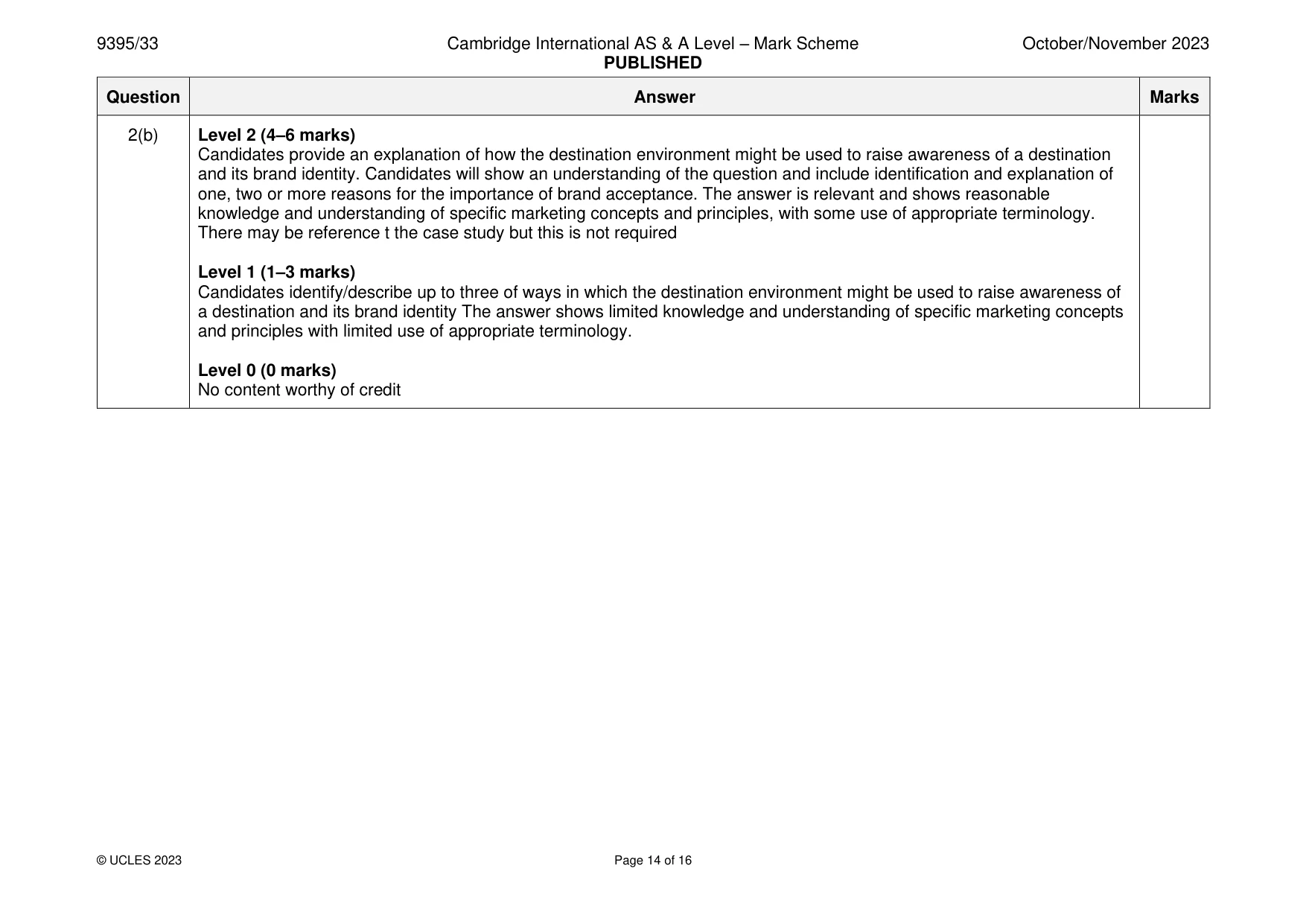
9395/33 Cambridge International AS & A Level – Mark Scheme PUBLISHED October/November 2023 © UCLES 2023 Page 14 of 16 Question Answer Marks 2(b) Level 2 (4–6 marks) Candidates provide an explanation of how the destination environment might be used to raise awareness of a destination and its brand identity. Candidates will show an understanding of the question and include identification and explanation of one, two or more reasons for the importance of brand acceptance. The answer is relevant and shows reasonable knowledge and understanding of specific marketing concepts and principles, with some use of appropriate terminology. There may be reference t the case study but this is not required Level 1 (1–3 marks) Candidates identify/describe up to three of ways in which the destination environment might be used to raise awareness of a destination and its brand identity The answer shows limited knowledge and understanding of specific marketing concepts and principles with limited use of appropriate terminology. Level 0 (0 marks) No content worthy of credit
Mark scheme, page 15
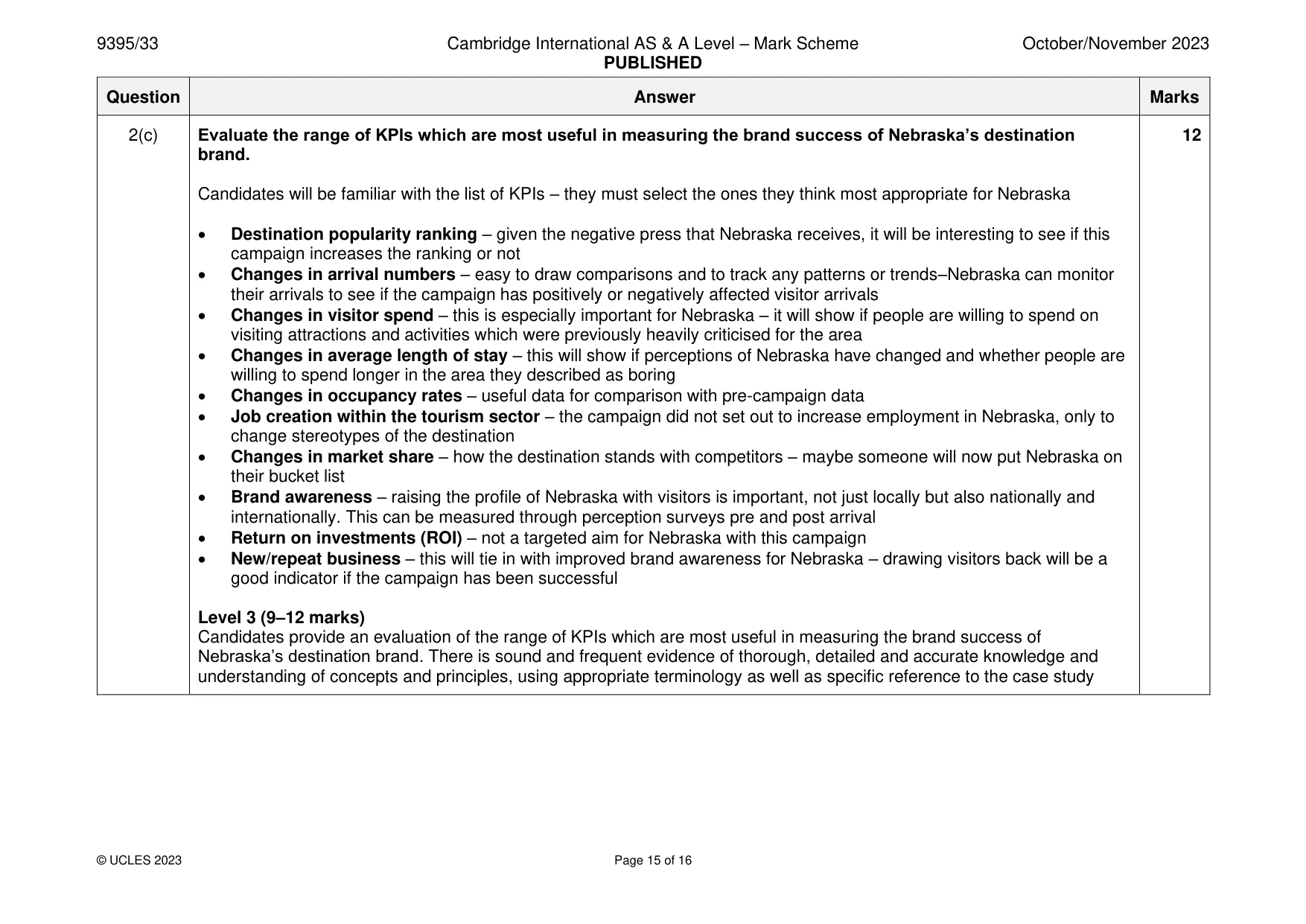
9395/33 Cambridge International AS & A Level – Mark Scheme PUBLISHED October/November 2023 © UCLES 2023 Page 15 of 16 Question Answer Marks 2(c) Evaluate the range of KPIs which are most useful in measuring the brand success of Nebraska’s destination brand. Candidates will be familiar with the list of KPIs – they must select the ones they think most appropriate for Nebraska • Destination popularity ranking – given the negative press that Nebraska receives, it will be interesting to see if this campaign increases the ranking or not • Changes in arrival numbers – easy to draw comparisons and to track any patterns or trends–Nebraska can monitor their arrivals to see if the campaign has positively or negatively affected visitor arrivals • Changes in visitor spend – this is especially important for Nebraska – it will show if people are willing to spend on visiting attractions and activities which were previously heavily criticised for the area • Changes in average length of stay – this will show if perceptions of Nebraska have changed and whether people are willing to spend longer in the area they described as boring • Changes in occupancy rates – useful data for comparison with pre-campaign data • Job creation within the tourism sector – the campaign did not set out to increase employment in Nebraska, only to change stereotypes of the destination • Changes in market share – how the destination stands with competitors – maybe someone will now put Nebraska on their bucket list • Brand awareness – raising the profile of Nebraska with visitors is important, not just locally but also nationally and internationally. This can be measured through perception surveys pre and post arrival • Return on investments (ROI) – not a targeted aim for Nebraska with this campaign • New/repeat business – this will tie in with improved brand awareness for Nebraska – drawing visitors back will be a good indicator if the campaign has been successful Level 3 (9–12 marks) Candidates provide an evaluation of the range of KPIs which are most useful in measuring the brand success of Nebraska’s destination brand. There is sound and frequent evidence of thorough, detailed and accurate knowledge and understanding of concepts and principles, using appropriate terminology as well as specific reference to the case study 12
Mark scheme, page 16
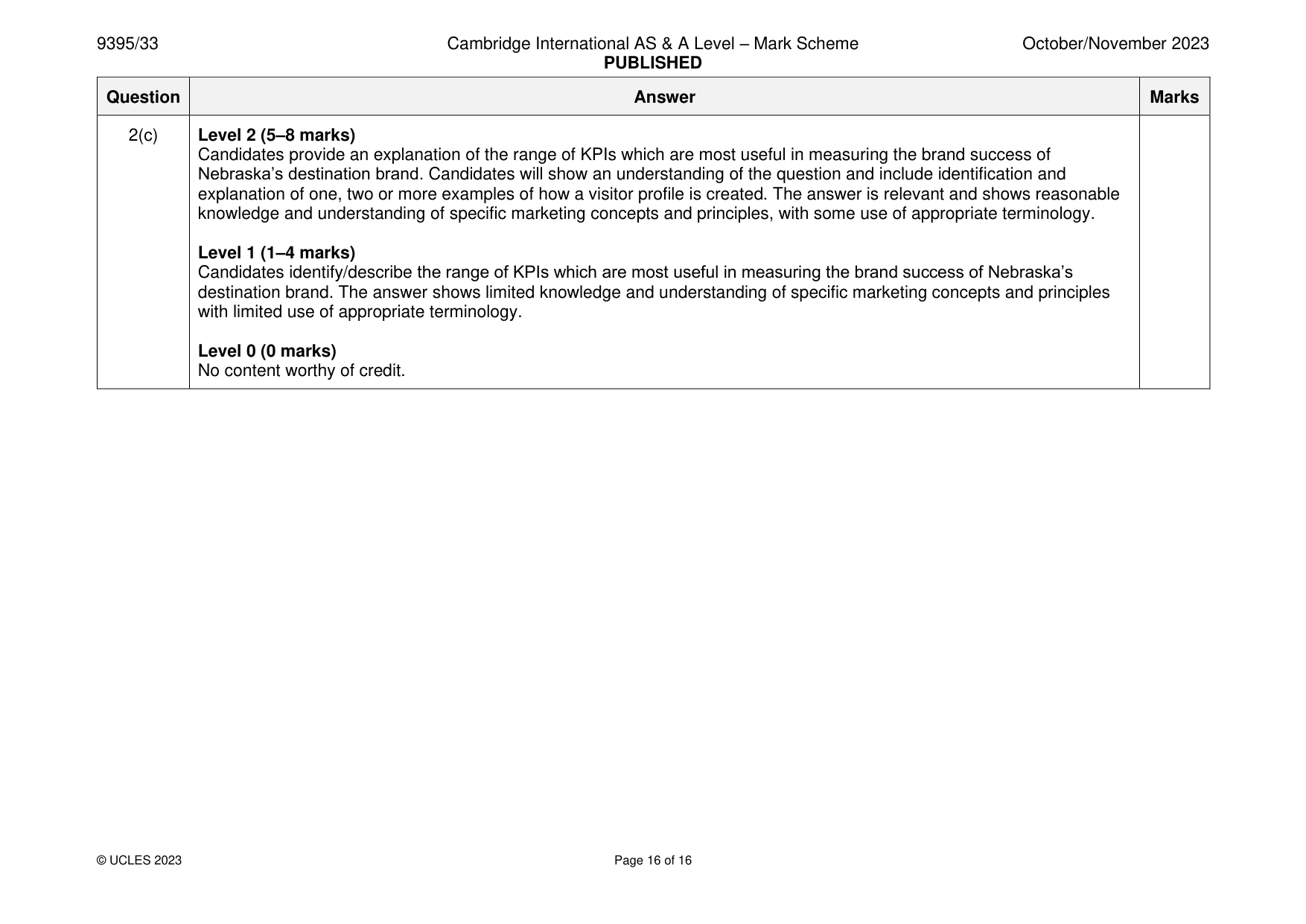
9395/33 Cambridge International AS & A Level – Mark Scheme PUBLISHED October/November 2023 © UCLES 2023 Page 16 of 16 Question Answer Marks 2(c) Level 2 (5–8 marks) Candidates provide an explanation of the range of KPIs which are most useful in measuring the brand success of Nebraska’s destination brand. Candidates will show an understanding of the question and include identification and explanation of one, two or more examples of how a visitor profile is created. The answer is relevant and shows reasonable knowledge and understanding of specific marketing concepts and principles, with some use of appropriate terminology. Level 1 (1–4 marks) Candidates identify/describe the range of KPIs which are most useful in measuring the brand success of Nebraska’s destination brand. The answer shows limited knowledge and understanding of specific marketing concepts and principles with limited use of appropriate terminology. Level 0 (0 marks) No content worthy of credit.
What you needed in this session
Cambridge’s own grade thresholds for 2023 Oct/Nov, Paper 3 · Variant 3. A higher threshold means an easier paper — the bar moves with how the cohort did.