Cambridge A Level Thinking Skills 9694 — 2021 May/June Paper 1 · Variant 1
9694/11/M/J/21 · 50 marks · ≈56 min
The question paper and its mark scheme, free to read here and free to download. This is Cambridge’s own paper, exactly as it was sat.
Question paper16 pages
Mark scheme8 pages
Answers below. Sit the paper first if you are practising.
Paper as text
Question paper, page 1
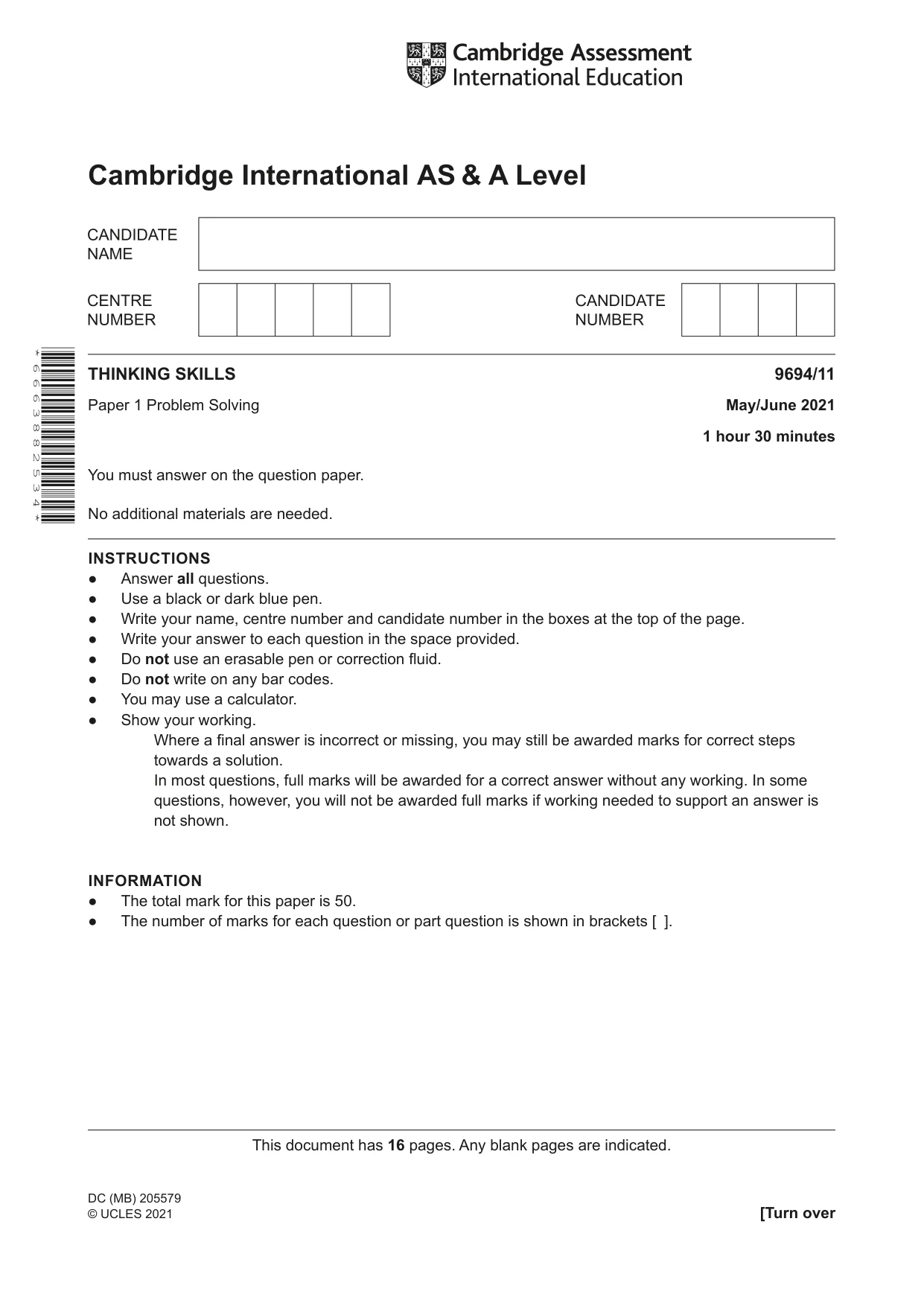
This document has 16 pages. Any blank pages are indicated. Cambridge International AS & A Level THINKING SKILLS 9694/11 Paper 1 Problem Solving May/June 2021 1 hour 30 minutes You must answer on the question paper. No additional materials are needed. INSTRUCTIONS ● Answer all questions. ● Use a black or dark blue pen. ● Write your name, centre number and candidate number in the boxes at the top of the page. ● Write your answer to each question in the space provided. ● Do not use an erasable pen or correction fluid. ● Do not write on any bar codes. ● You may use a calculator. ● Show your working. Where a final answer is incorrect or missing, you may still be awarded marks for correct steps towards a solution. In most questions, full marks will be awarded for a correct answer without any working. In some questions, however, you will not be awarded full marks if working needed to support an answer is not shown. INFORMATION ● The total mark for this paper is 50. ● The number of marks for each question or part question is shown in brackets [ ]. * 6 6 6 3 8 8 2 5 3 4 * DC (MB) 205579 © UCLES 2021 [Turn over
Question paper, page 2
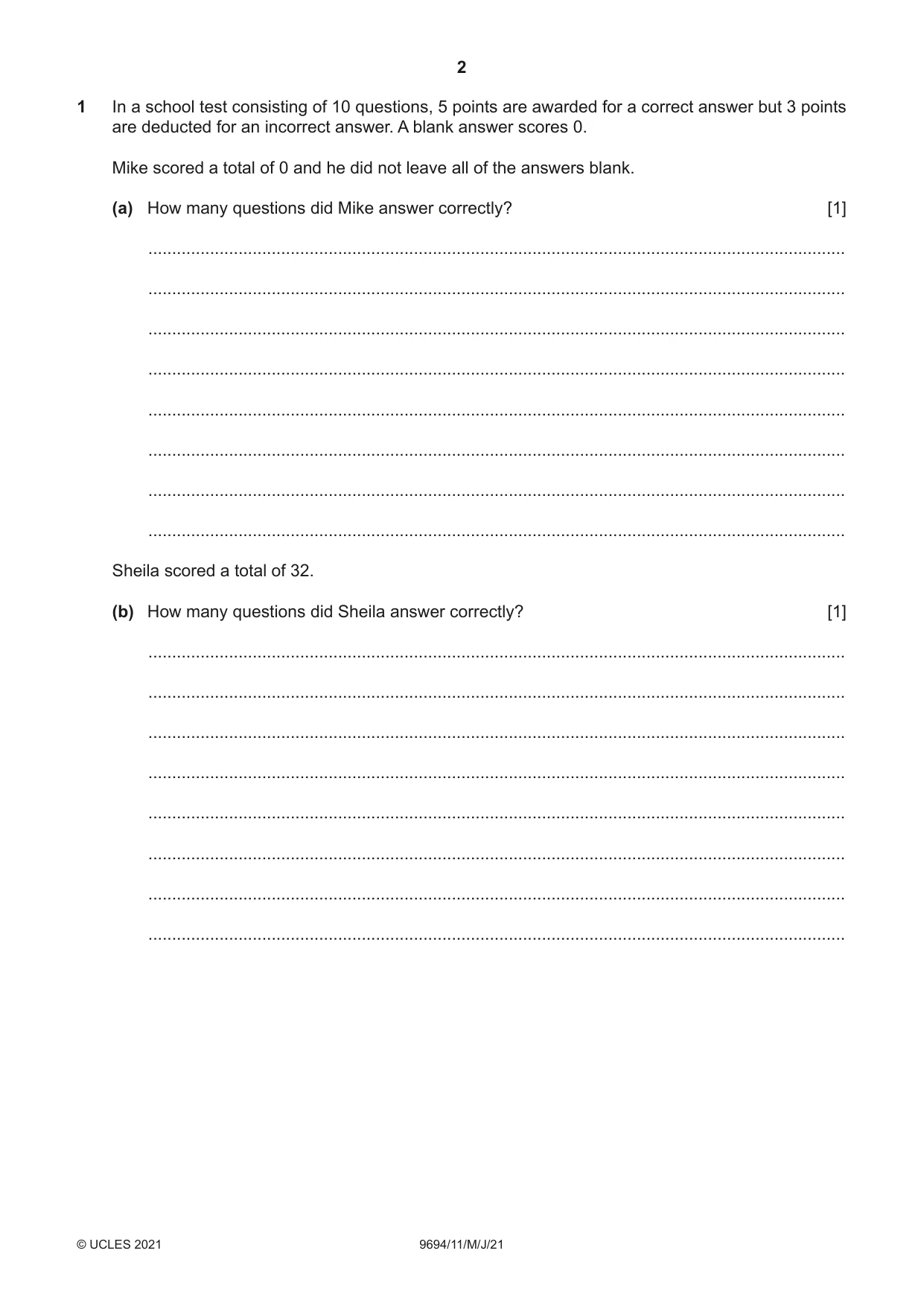
2 9694/11/M/J/21 © UCLES 2021 1 In a school test consisting of 10 questions, 5 points are awarded for a correct answer but 3 points are deducted for an incorrect answer. A blank answer scores 0. Mike scored a total of 0 and he did not leave all of the answers blank. (a) How many questions did Mike answer correctly? [1] … … … … … … … … Sheila scored a total of 32. (b) How many questions did Sheila answer correctly? [1] … … … … … … … …
Question paper, page 3
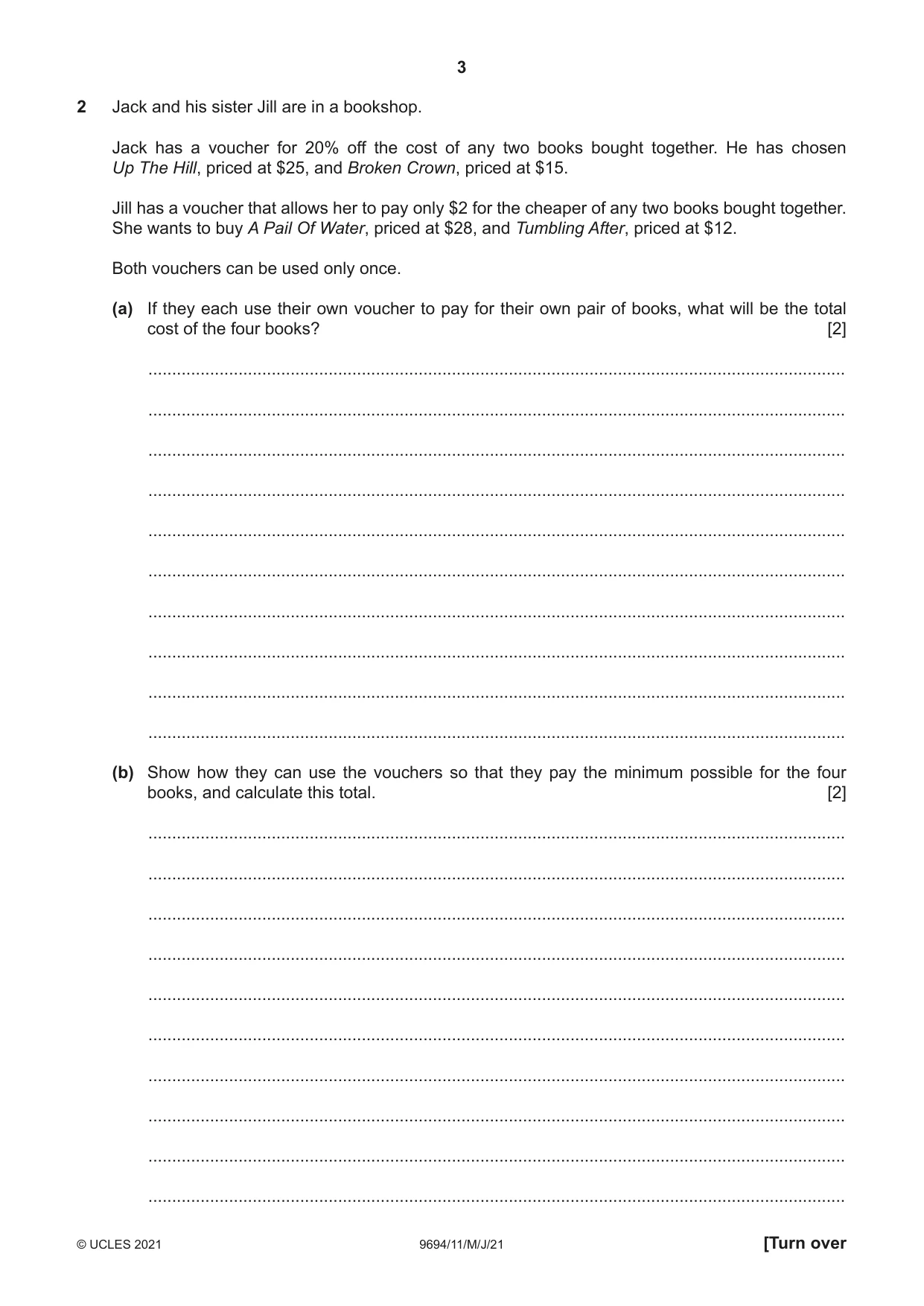
3 9694/11/M/J/21 © UCLES 2021 [Turn over 2 Jack and his sister Jill are in a bookshop. Jack has a voucher for 20% off the cost of any two books bought together. He has chosen Up The Hill, priced at $25, and Broken Crown, priced at $15. Jill has a voucher that allows her to pay only $2 for the cheaper of any two books bought together. She wants to buy A Pail Of Water, priced at $28, and Tumbling After, priced at $12. Both vouchers can be used only once. (a) If they each use their own voucher to pay for their own pair of books, what will be the total cost of the four books? [2] … … … … … … … … … … (b) Show how they can use the vouchers so that they pay the minimum possible for the four books, and calculate this total. [2] … … … … … … … … … …
Question paper, page 4
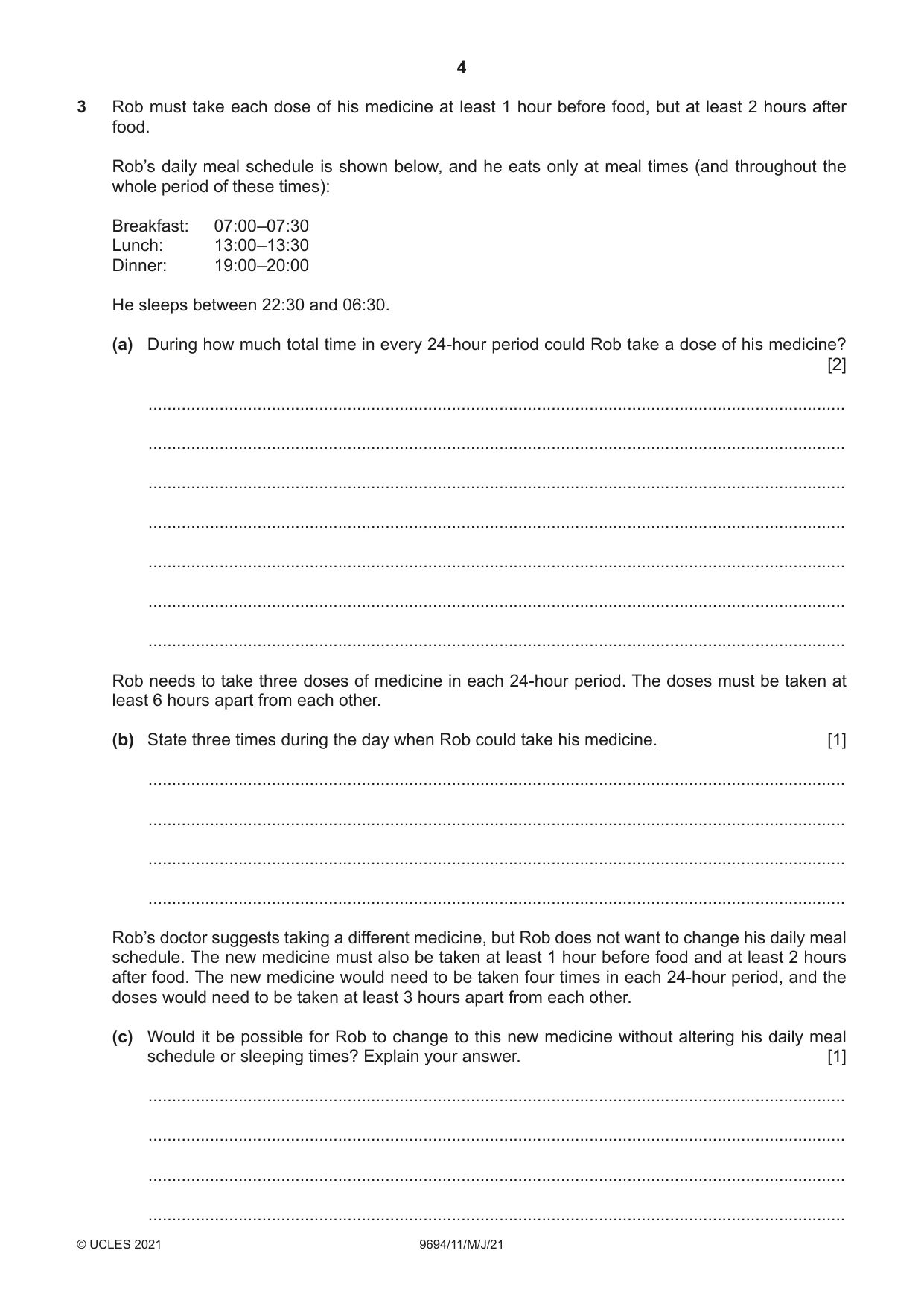
4 9694/11/M/J/21 © UCLES 2021 3 Rob must take each dose of his medicine at least 1 hour before food, but at least 2 hours after food. Rob’s daily meal schedule is shown below, and he eats only at meal times (and throughout the whole period of these times): Breakfast: 07:00–07:30 Lunch: 13:00–13:30 Dinner: 19:00–20:00 He sleeps between 22:30 and 06:30. (a) During how much total time in every 24-hour period could Rob take a dose of his medicine? [2] … … … … … … … Rob needs to take three doses of medicine in each 24-hour period. The doses must be taken at least 6 hours apart from each other. (b) State three times during the day when Rob could take his medicine. [1] … … … … Rob’s doctor suggests taking a different medicine, but Rob does not want to change his daily meal schedule. The new medicine must also be taken at least 1 hour before food and at least 2 hours after food. The new medicine would need to be taken four times in each 24-hour period, and the doses would need to be taken at least 3 hours apart from each other. (c) Would it be possible for Rob to change to this new medicine without altering his daily meal schedule or sleeping times? Explain your answer. [1] … … … …
Question paper, page 5
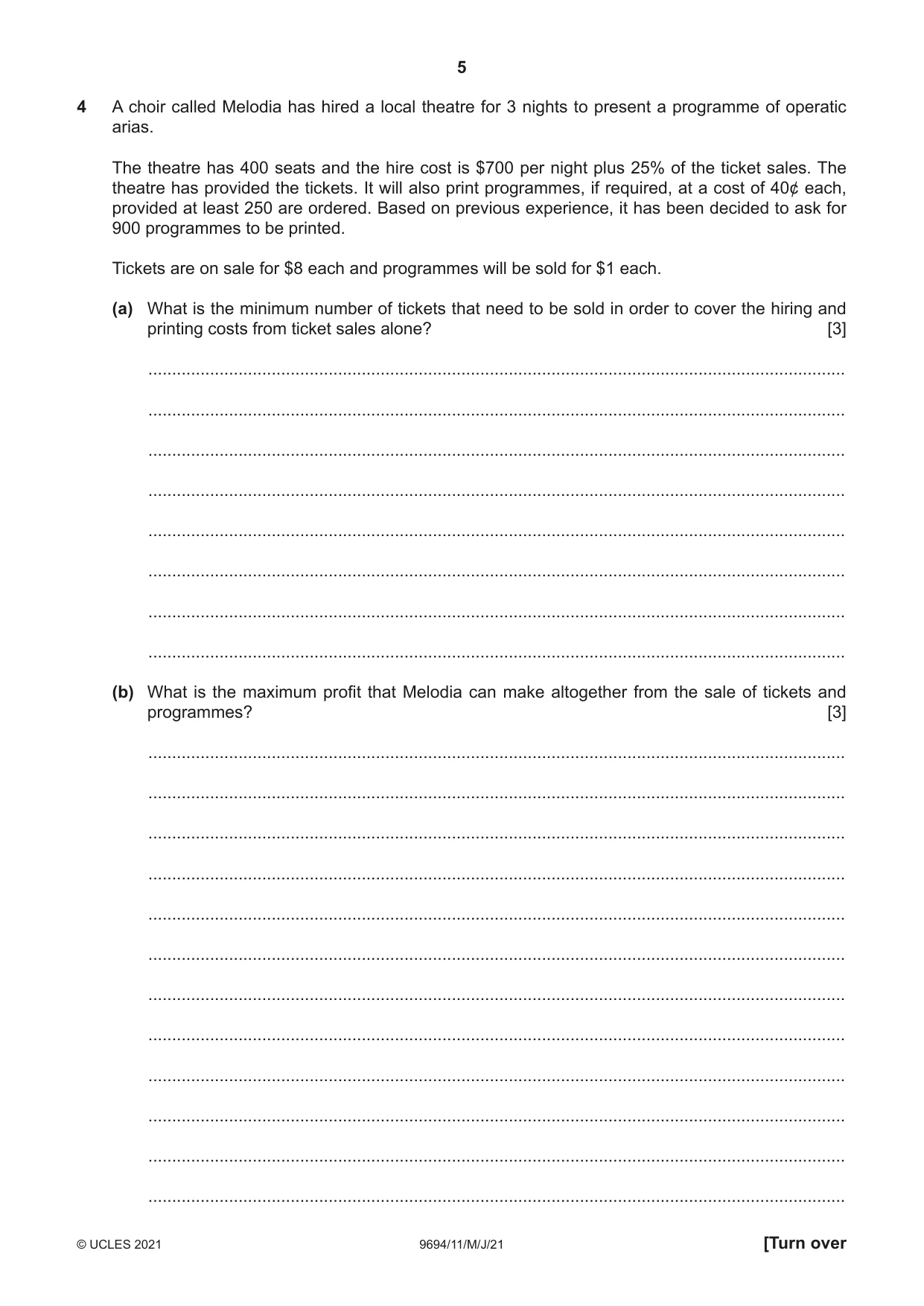
5 9694/11/M/J/21 © UCLES 2021 [Turn over 4 A choir called Melodia has hired a local theatre for 3 nights to present a programme of operatic arias. The theatre has 400 seats and the hire cost is $700 per night plus 25% of the ticket sales. The theatre has provided the tickets. It will also print programmes, if required, at a cost of 40¢ each, provided at least 250 are ordered. Based on previous experience, it has been decided to ask for 900 programmes to be printed. Tickets are on sale for $8 each and programmes will be sold for $1 each. (a) What is the minimum number of tickets that need to be sold in order to cover the hiring and printing costs from ticket sales alone? [3] … … … … … … … … (b) What is the maximum profit that Melodia can make altogether from the sale of tickets and programmes? [3] … … … … … … … … … … … …
Question paper, page 6
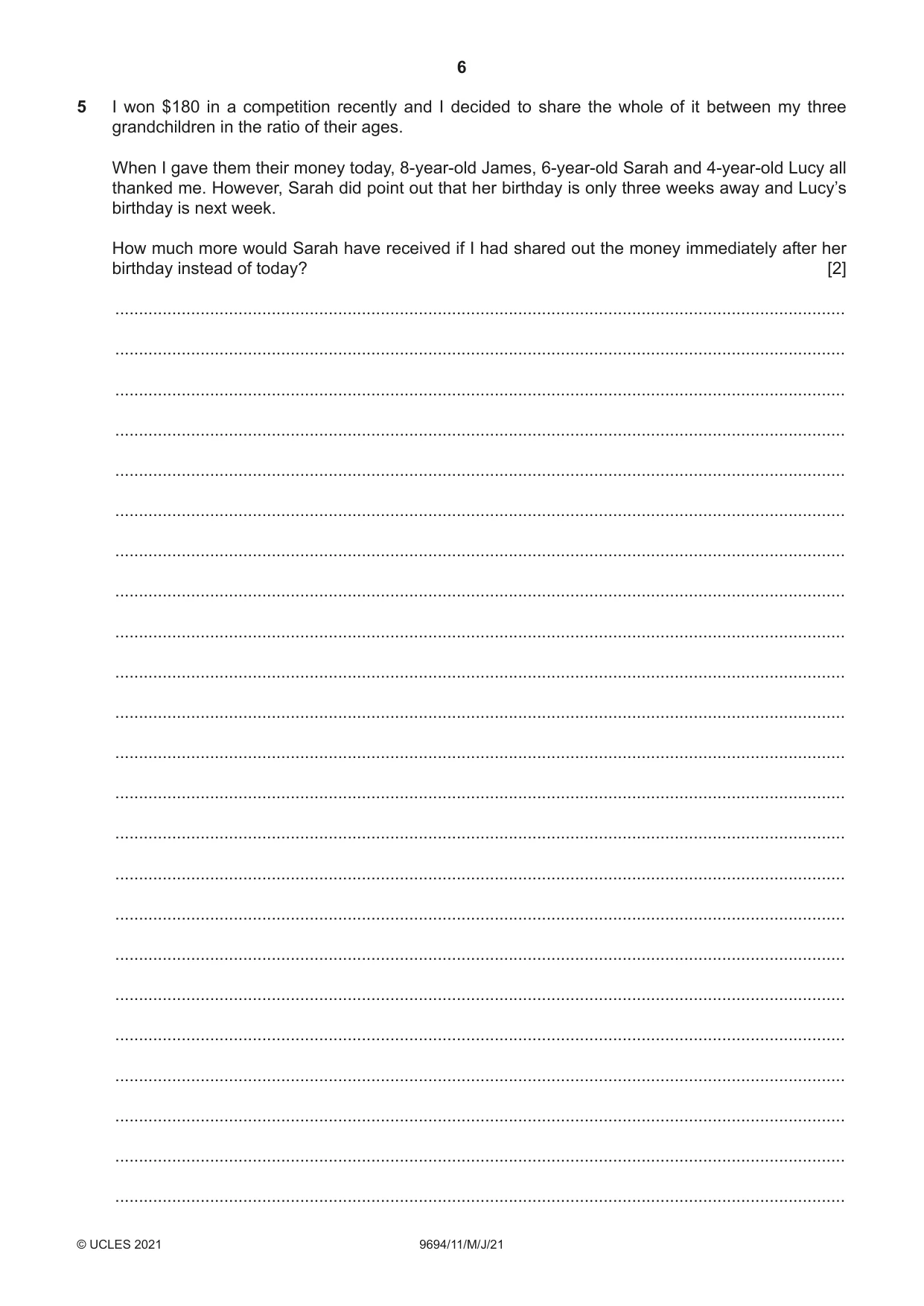
6 9694/11/M/J/21 © UCLES 2021 5 I won $180 in a competition recently and I decided to share the whole of it between my three grandchildren in the ratio of their ages. When I gave them their money today, 8-year-old James, 6-year-old Sarah and 4-year-old Lucy all thanked me. However, Sarah did point out that her birthday is only three weeks away and Lucy’s birthday is next week. How much more would Sarah have received if I had shared out the money immediately after her birthday instead of today? [2] … … … … … … … … … … … … … … … … … … … … … … …
Question paper, page 7
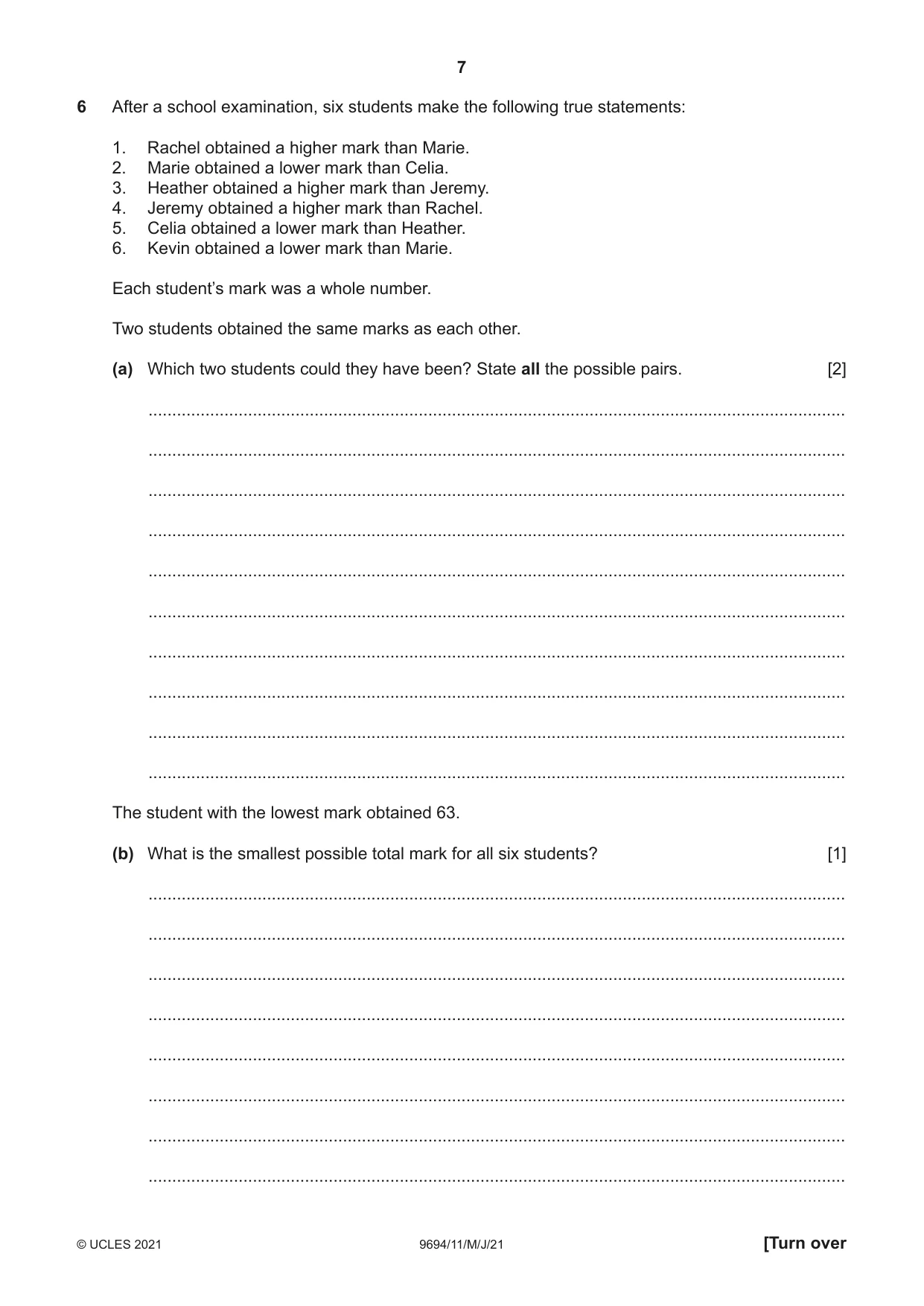
7 9694/11/M/J/21 © UCLES 2021 [Turn over 6 After a school examination, six students make the following true statements: 1. Rachel obtained a higher mark than Marie. 2. Marie obtained a lower mark than Celia. 3. Heather obtained a higher mark than Jeremy. 4. Jeremy obtained a higher mark than Rachel. 5. Celia obtained a lower mark than Heather. 6. Kevin obtained a lower mark than Marie. Each student’s mark was a whole number. Two students obtained the same marks as each other. (a) Which two students could they have been? State all the possible pairs. [2] … … … … … … … … … … The student with the lowest mark obtained 63. (b) What is the smallest possible total mark for all six students? [1] … … … … … … … …
Question paper, page 8
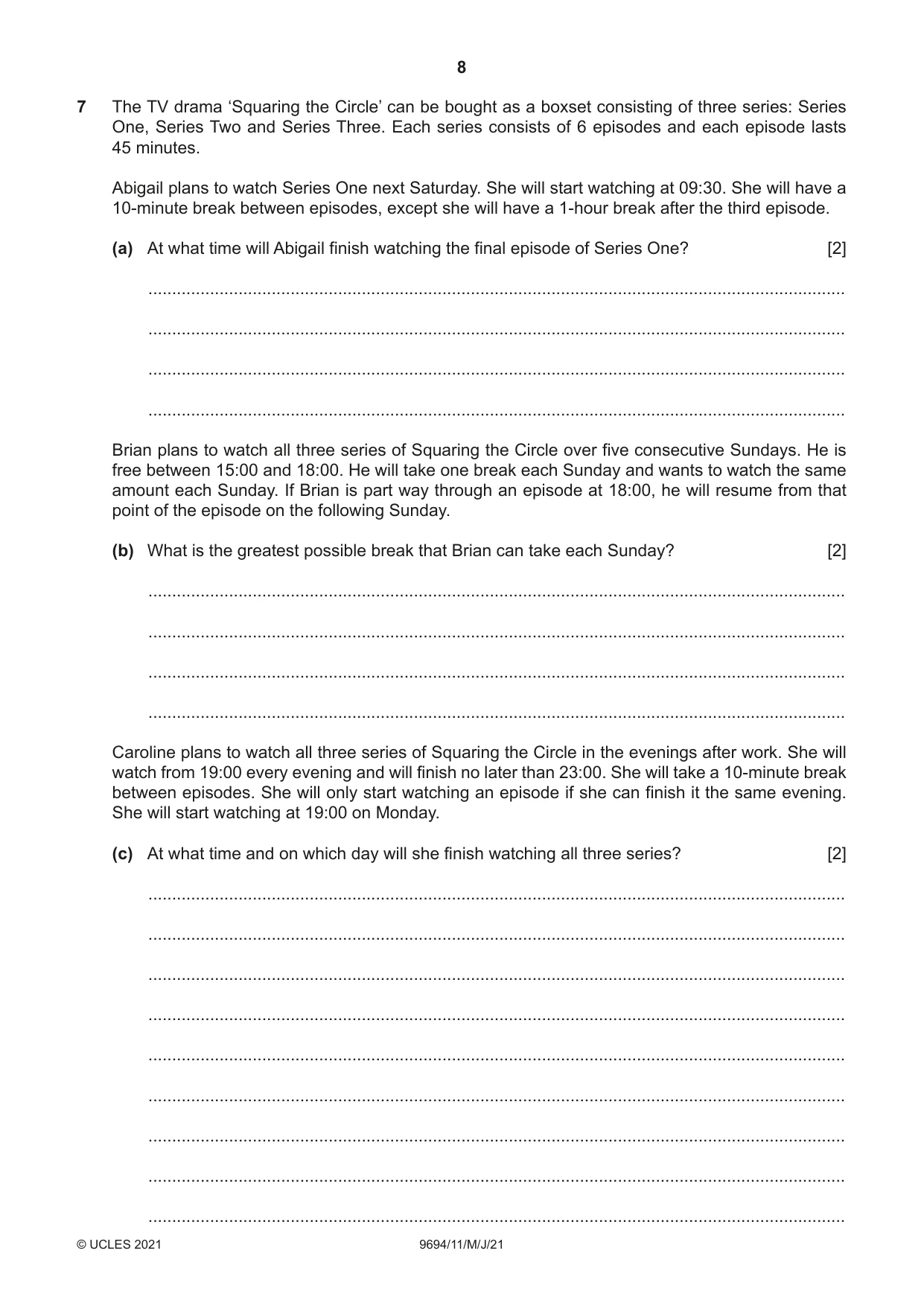
8 9694/11/M/J/21 © UCLES 2021 7 The TV drama ‘Squaring the Circle’ can be bought as a boxset consisting of three series: Series One, Series Two and Series Three. Each series consists of 6 episodes and each episode lasts 45 minutes. Abigail plans to watch Series One next Saturday. She will start watching at 09:30. She will have a 10-minute break between episodes, except she will have a 1-hour break after the third episode. (a) At what time will Abigail finish watching the final episode of Series One? [2] … … … … Brian plans to watch all three series of Squaring the Circle over five consecutive Sundays. He is free between 15:00 and 18:00. He will take one break each Sunday and wants to watch the same amount each Sunday. If Brian is part way through an episode at 18:00, he will resume from that point of the episode on the following Sunday. (b) What is the greatest possible break that Brian can take each Sunday? [2] … … … … Caroline plans to watch all three series of Squaring the Circle in the evenings after work. She will watch from 19:00 every evening and will finish no later than 23:00. She will take a 10-minute break between episodes. She will only start watching an episode if she can finish it the same evening. She will start watching at 19:00 on Monday. (c) At what time and on which day will she finish watching all three series? [2] … … … … … … … … …
Question paper, page 9
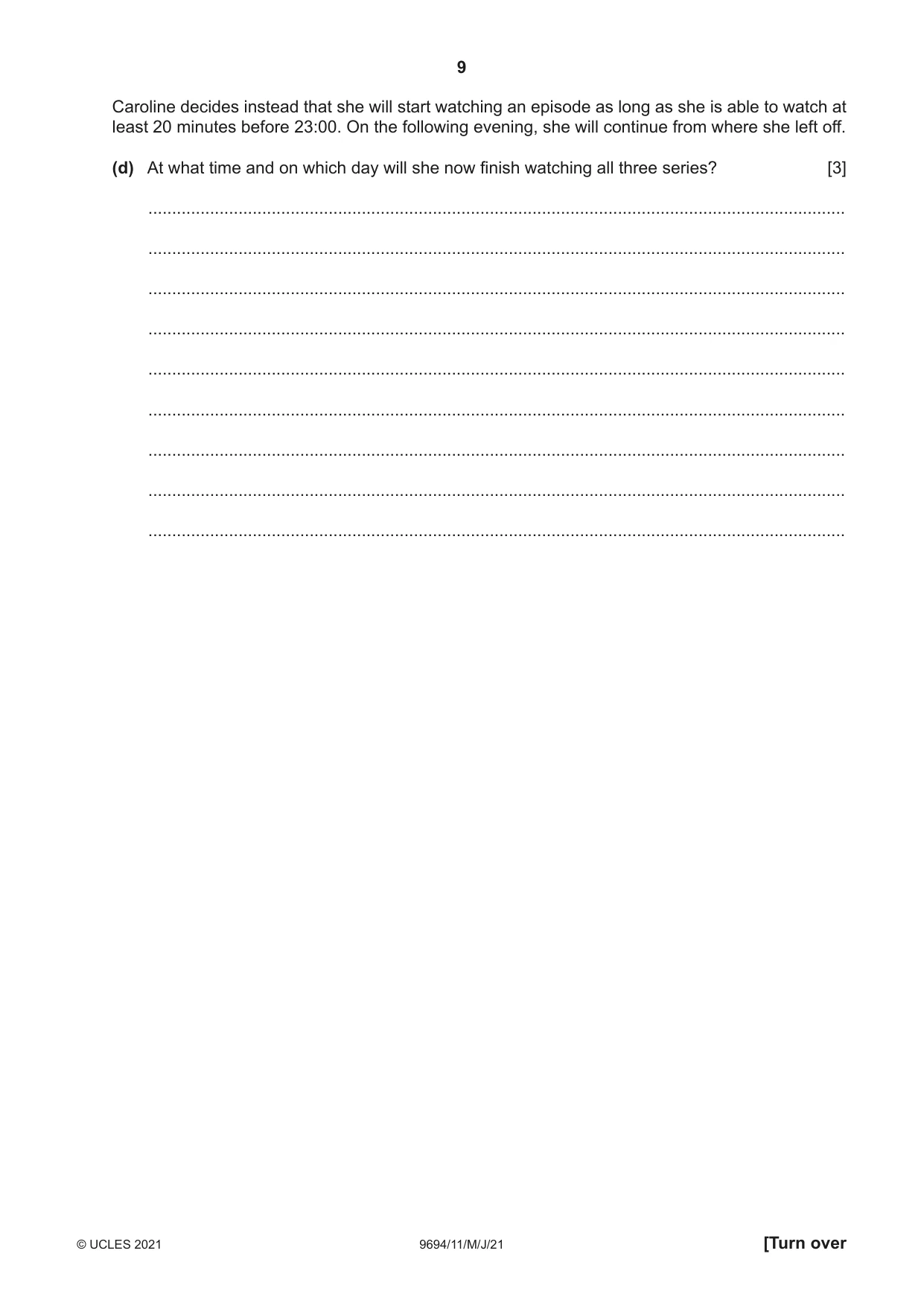
9 9694/11/M/J/21 © UCLES 2021 [Turn over Caroline decides instead that she will start watching an episode as long as she is able to watch at least 20 minutes before 23:00. On the following evening, she will continue from where she left off. (d) At what time and on which day will she now finish watching all three series? [3] … … … … … … … … …
Question paper, page 10
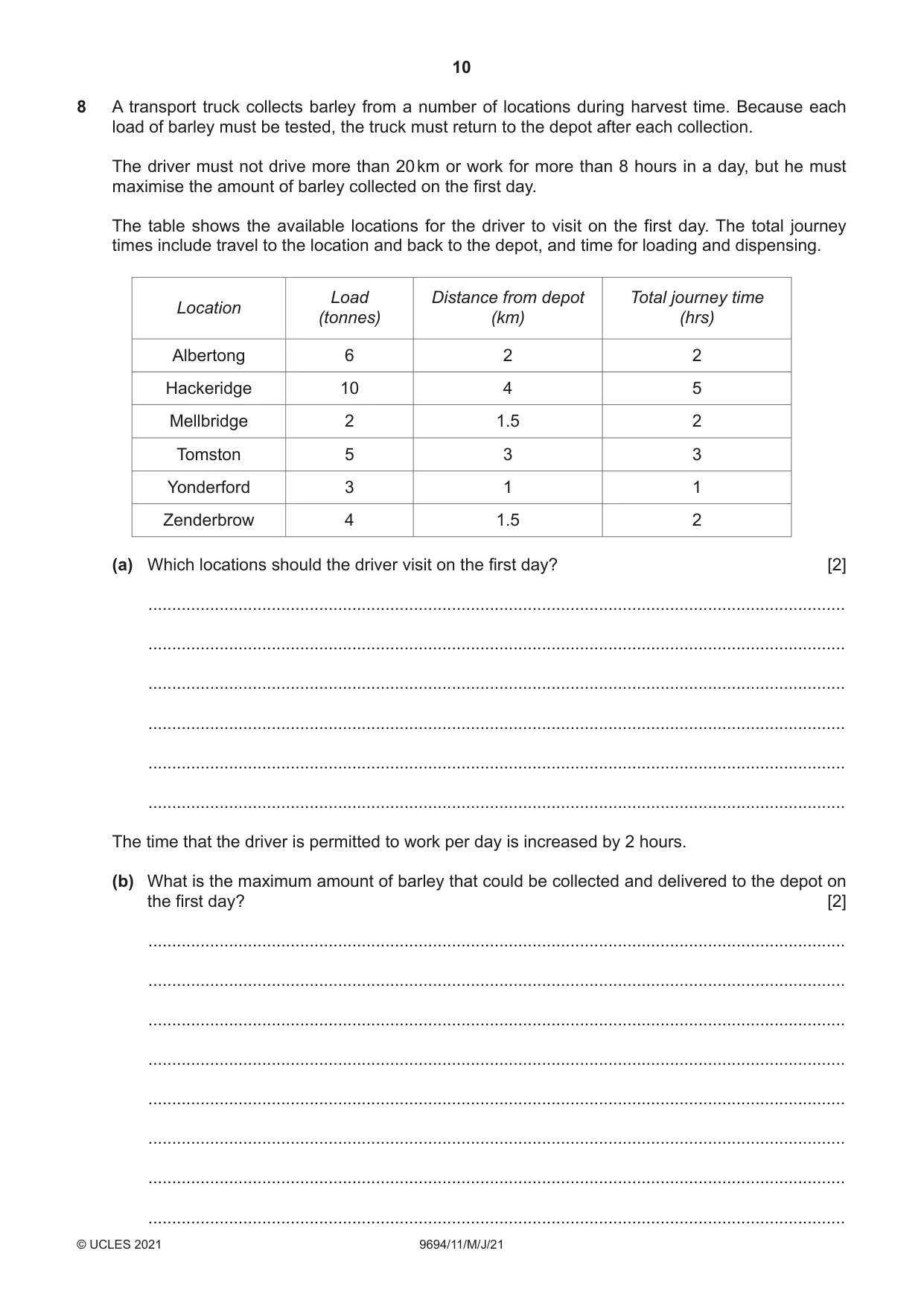
10 9694/11/M/J/21 © UCLES 2021 8 A transport truck collects barley from a number of locations during harvest time. Because each load of barley must be tested, the truck must return to the depot after each collection. The driver must not drive more than 20 km or work for more than 8 hours in a day, but he must maximise the amount of barley collected on the first day. The table shows the available locations for the driver to visit on the first day. The total journey times include travel to the location and back to the depot, and time for loading and dispensing. Location Load (tonnes) Distance from depot (km) Total journey time (hrs) Albertong 6 2 2 Hackeridge 10 4 5 Mellbridge 2 1.5 2 Tomston 5 3 3 Yonderford 3 1 1 Zenderbrow 4 1.5 2 (a) Which locations should the driver visit on the first day? [2] … … … … … … The time that the driver is permitted to work per day is increased by 2 hours. (b) What is the maximum amount of barley that could be collected and delivered to the depot on the first day? [2] … … … … … … … …
Question paper, page 11
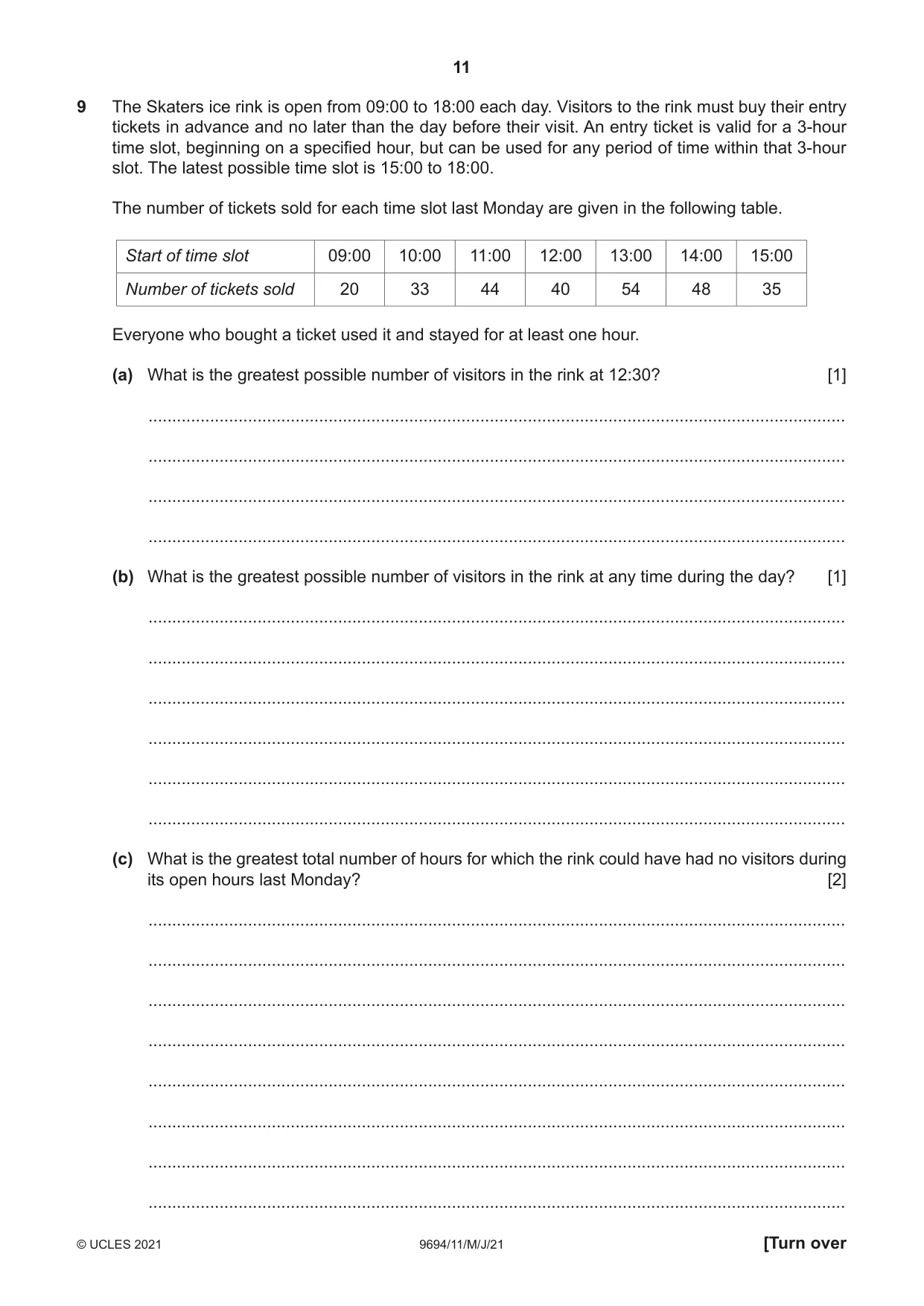
11 9694/11/M/J/21 © UCLES 2021 [Turn over 9 The Skaters ice rink is open from 09:00 to 18:00 each day. Visitors to the rink must buy their entry tickets in advance and no later than the day before their visit. An entry ticket is valid for a 3-hour time slot, beginning on a specified hour, but can be used for any period of time within that 3-hour slot. The latest possible time slot is 15:00 to 18:00. The number of tickets sold for each time slot last Monday are given in the following table. Start of time slot 09:00 10:00 11:00 12:00 13:00 14:00 15:00 Number of tickets sold 20 33 44 40 54 48 35 Everyone who bought a ticket used it and stayed for at least one hour. (a) What is the greatest possible number of visitors in the rink at 12:30? [1] … … … … (b) What is the greatest possible number of visitors in the rink at any time during the day? [1] … … … … … … (c) What is the greatest total number of hours for which the rink could have had no visitors during its open hours last Monday? [2] … … … … … … … …
Question paper, page 12
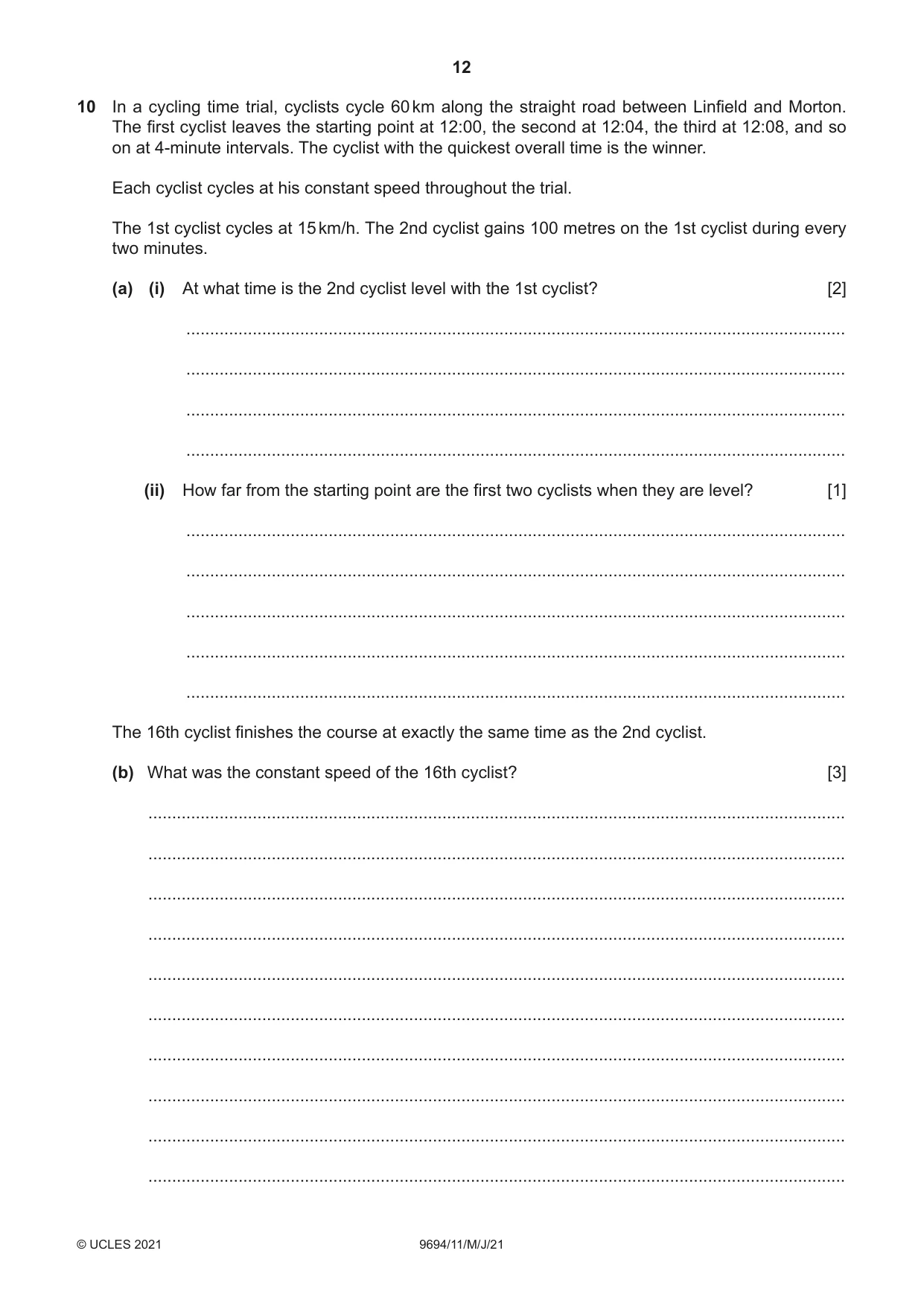
12 9694/11/M/J/21 © UCLES 2021 10 In a cycling time trial, cyclists cycle 60 km along the straight road between Linfield and Morton. The first cyclist leaves the starting point at 12:00, the second at 12:04, the third at 12:08, and so on at 4-minute intervals. The cyclist with the quickest overall time is the winner. Each cyclist cycles at his constant speed throughout the trial. The 1st cyclist cycles at 15 km/h. The 2nd cyclist gains 100 metres on the 1st cyclist during every two minutes. (a) (i) At what time is the 2nd cyclist level with the 1st cyclist? [2] … … … … (ii) How far from the starting point are the first two cyclists when they are level? [1] … … … … … The 16th cyclist finishes the course at exactly the same time as the 2nd cyclist. (b) What was the constant speed of the 16th cyclist? [3] … … … … … … … … … …
Question paper, page 13
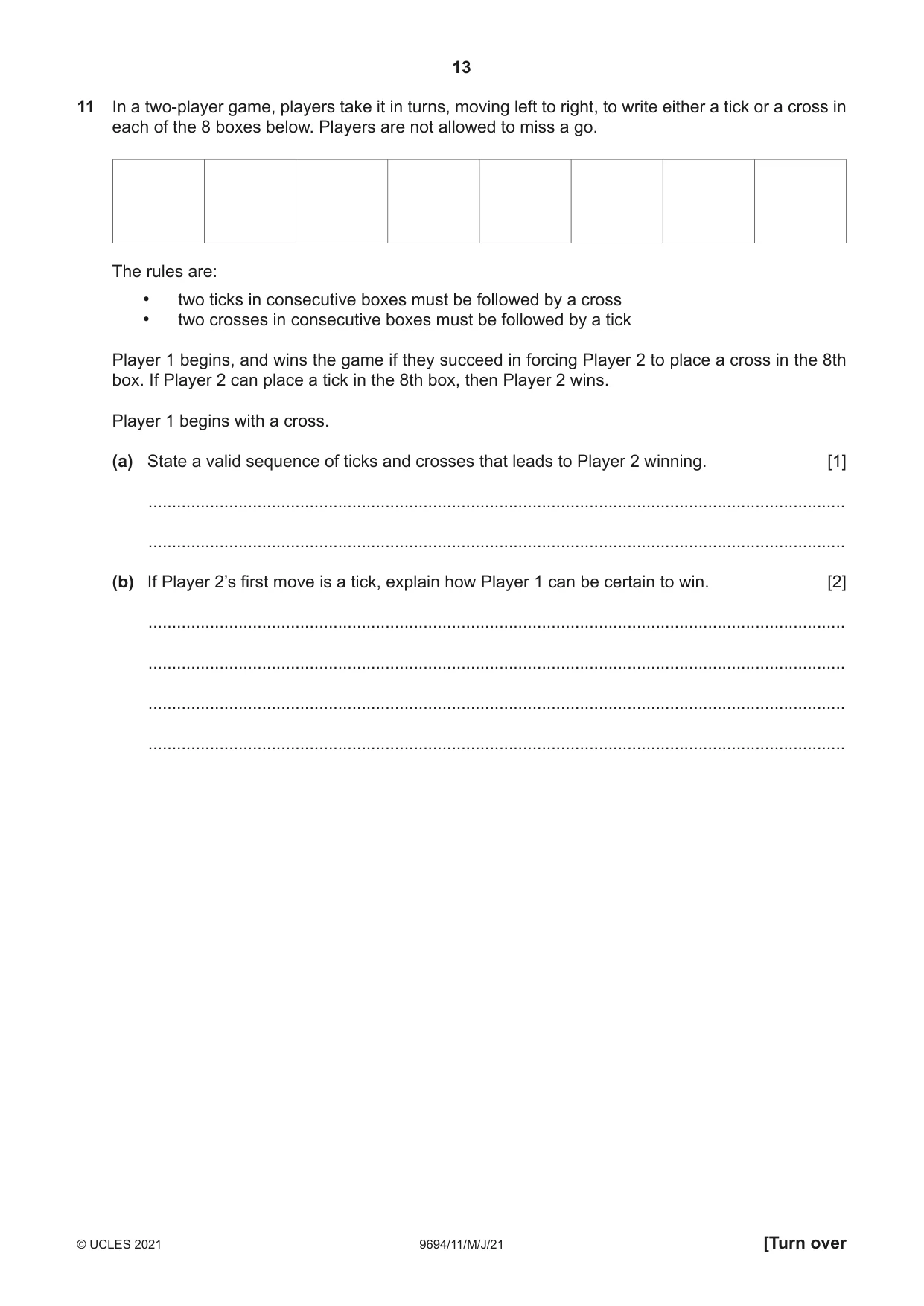
13 9694/11/M/J/21 © UCLES 2021 [Turn over 11 In a two-player game, players take it in turns, moving left to right, to write either a tick or a cross in each of the 8 boxes below. Players are not allowed to miss a go. The rules are: • two ticks in consecutive boxes must be followed by a cross • two crosses in consecutive boxes must be followed by a tick Player 1 begins, and wins the game if they succeed in forcing Player 2 to place a cross in the 8th box. If Player 2 can place a tick in the 8th box, then Player 2 wins. Player 1 begins with a cross. (a) State a valid sequence of ticks and crosses that leads to Player 2 winning. [1] … … (b) If Player 2’s first move is a tick, explain how Player 1 can be certain to win. [2] … … … …
Question paper, page 14
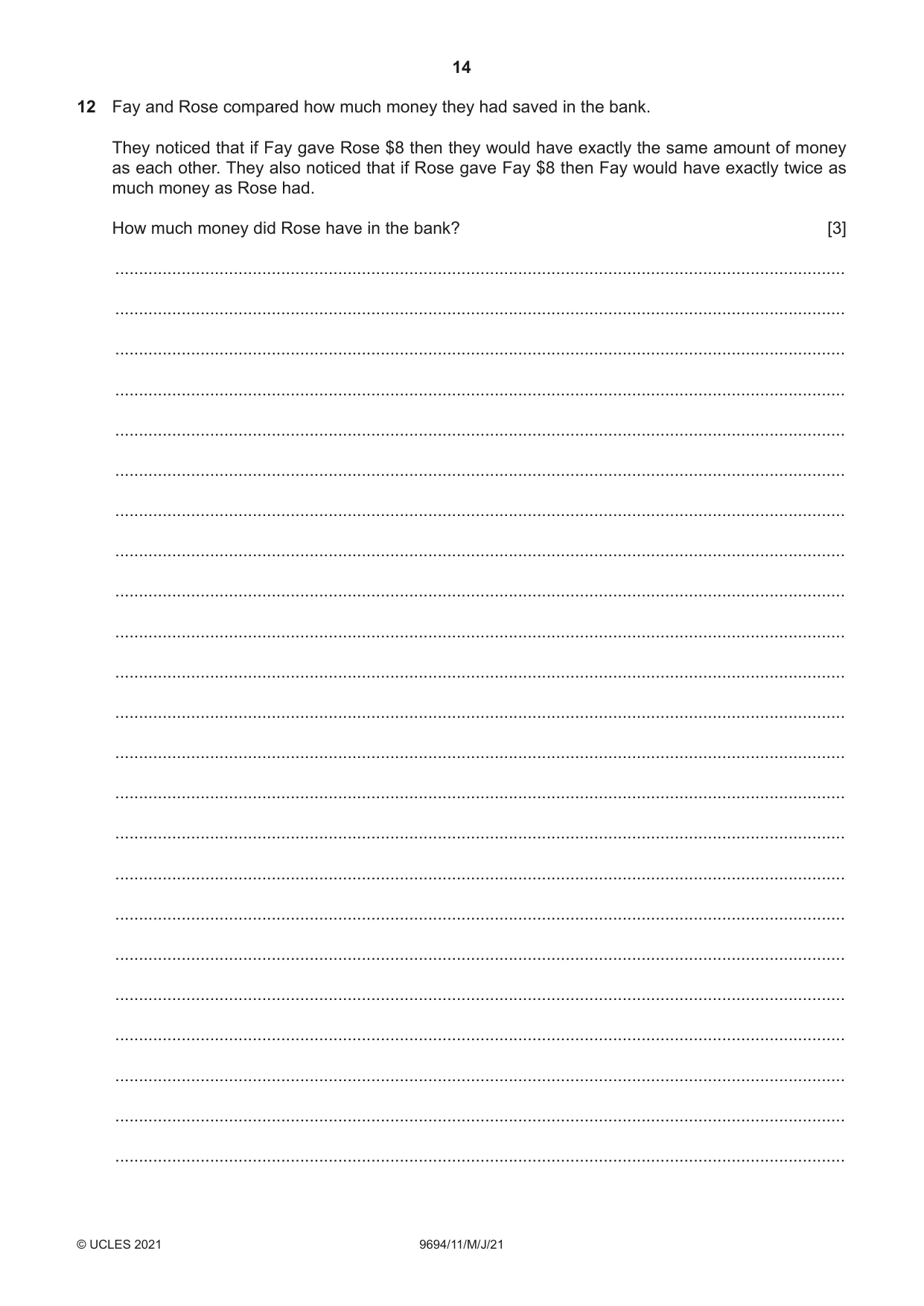
14 9694/11/M/J/21 © UCLES 2021 12 Fay and Rose compared how much money they had saved in the bank. They noticed that if Fay gave Rose $8 then they would have exactly the same amount of money as each other. They also noticed that if Rose gave Fay $8 then Fay would have exactly twice as much money as Rose had. How much money did Rose have in the bank? [3] … … … … … … … … … … … … … … … … … … … … … … …
Question paper, page 15
15 9694/11/M/J/21 © UCLES 2021 BLANK PAGE
Question paper, page 16
16 9694/11/M/J/21 © UCLES 2021 Permission to reproduce items where third-party owned material protected by copyright is included has been sought and cleared where possible. Every reasonable effort has been made by the publisher (UCLES) to trace copyright holders, but if any items requiring clearance have unwittingly been included, the publisher will be pleased to make amends at the earliest possible opportunity. To avoid the issue of disclosure of answer-related information to candidates, all copyright acknowledgements are reproduced online in the Cambridge Assessment International Education Copyright Acknowledgements Booklet. This is produced for each series of examinations and is freely available to download at www.cambridgeinternational.org after the live examination series. Cambridge Assessment International Education is part of the Cambridge Assessment Group. Cambridge Assessment is the brand name of the University of Cambridge Local Examinations Syndicate (UCLES), which itself is a department of the University of Cambridge. BLANK PAGE
Mark scheme, page 1
This document consists of 8 printed pages. © UCLES 2021 [Turn over Cambridge International AS & A Level THINKING SKILLS 9694/11 Paper 1 Problem Solving May/June 2021 MARK SCHEME Maximum Mark: 50 Published This mark scheme is published as an aid to teachers and candidates, to indicate the requirements of the examination. It shows the basis on which Examiners were instructed to award marks. It does not indicate the details of the discussions that took place at an Examiners’ meeting before marking began, which would have considered the acceptability of alternative answers. Mark schemes should be read in conjunction with the question paper and the Principal Examiner Report for Teachers. Cambridge International will not enter into discussions about these mark schemes. Cambridge International is publishing the mark schemes for the May/June 2021 series for most Cambridge IGCSE™, Cambridge International A and AS Level components and some Cambridge O Level components.
Mark scheme, page 2
9694/11 Cambridge International AS & A Level – Mark Scheme PUBLISHED May/June 2021 © UCLES 2021 Page 2 of 8 Generic Marking Principles These general marking principles must be applied by all examiners when marking candidate answers. They should be applied alongside the specific content of the mark scheme or generic level descriptors for a question. Each question paper and mark scheme will also comply with these marking principles. GENERIC MARKING PRINCIPLE 1: Marks must be awarded in line with: • the specific content of the mark scheme or the generic level descriptors for the question • the specific skills defined in the mark scheme or in the generic level descriptors for the question • the standard of response required by a candidate as exemplified by the standardisation scripts. GENERIC MARKING PRINCIPLE 2: Marks awarded are always whole marks (not half marks, or other fractions). GENERIC MARKING PRINCIPLE 3: Marks must be awarded positively: • marks are awarded for correct/valid answers, as defined in the mark scheme. However, credit is given for valid answers which go beyond the scope of the syllabus and mark scheme, referring to your Team Leader as appropriate • marks are awarded when candidates clearly demonstrate what they know and can do • marks are not deducted for errors • marks are not deducted for omissions • answers should only be judged on the quality of spelling, punctuation and grammar when these features are specifically assessed by the question as indicated by the mark scheme. The meaning, however, should be unambiguous. GENERIC MARKING PRINCIPLE 4: Rules must be applied consistently, e.g. in situations where candidates have not followed instructions or in the application of generic level descriptors. GENERIC MARKING PRINCIPLE 5: Marks should be awarded using the full range of marks defined in the mark scheme for the question (however; the use of the full mark range may be limited according to the quality of the candidate responses seen). GENERIC MARKING PRINCIPLE 6: Marks awarded are based solely on the requirements as defined in the mark scheme. Marks should not be awarded with grade thresholds or grade descriptors in mind.
Mark scheme, page 3
9694/11 Cambridge International AS & A Level – Mark Scheme PUBLISHED May/June 2021 © UCLES 2021 Page 3 of 8 NOTES FOR MARKERS Working Where a final answer is underlined in the mark scheme, full marks are awarded for a correct answer, regardless of whether there is any supporting working, unless an exception is noted in the mark scheme. For partial credit, the evidence needed to award the mark will usually be shown on its own line in the mark scheme, or else will be defined in italic text. For explanations and verbal justifications, apply the principle of ‘words to that effect’. No response If there is any attempt at a solution award 0 marks not NR. “-” or “?” constitute no attempt at a solution. Abbreviations The following abbreviations may be used in a mark scheme: AG answer given (on question paper) awrt answer which rounds to FT follow through (from earlier error) oe or equivalent SC special case soi seen or implied
Mark scheme, page 4
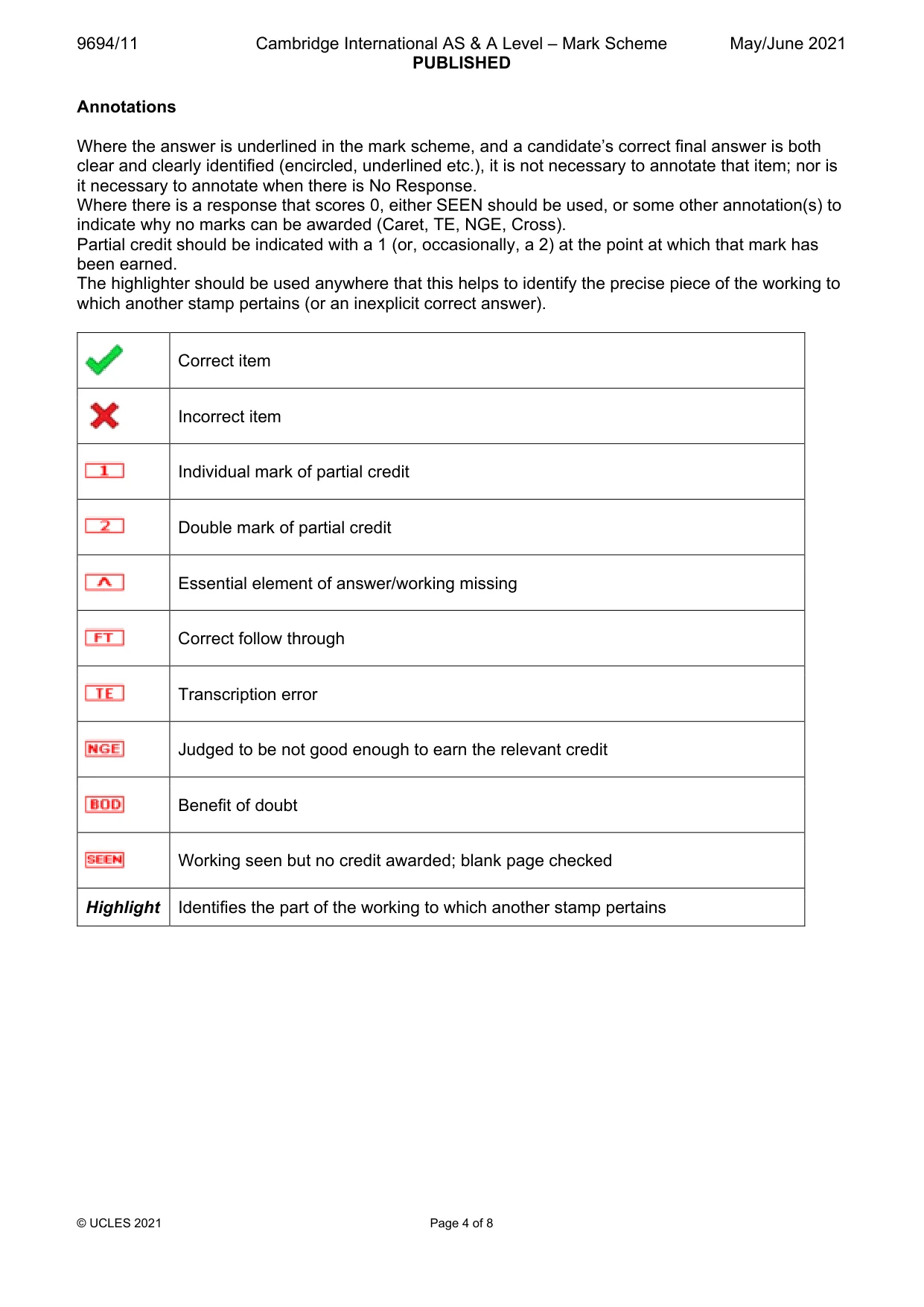
9694/11 Cambridge International AS & A Level – Mark Scheme PUBLISHED May/June 2021 © UCLES 2021 Page 4 of 8 Annotations Where the answer is underlined in the mark scheme, and a candidate’s correct final answer is both clear and clearly identified (encircled, underlined etc.), it is not necessary to annotate that item; nor is it necessary to annotate when there is No Response. Where there is a response that scores 0, either SEEN should be used, or some other annotation(s) to indicate why no marks can be awarded (Caret, TE, NGE, Cross). Partial credit should be indicated with a 1 (or, occasionally, a 2) at the point at which that mark has been earned. The highlighter should be used anywhere that this helps to identify the precise piece of the working to which another stamp pertains (or an inexplicit correct answer). Correct item Incorrect item Individual mark of partial credit Double mark of partial credit Essential element of answer/working missing Correct follow through Transcription error Judged to be not good enough to earn the relevant credit Benefit of doubt Working seen but no credit awarded; blank page checked Highlight Identifies the part of the working to which another stamp pertains
Mark scheme, page 5
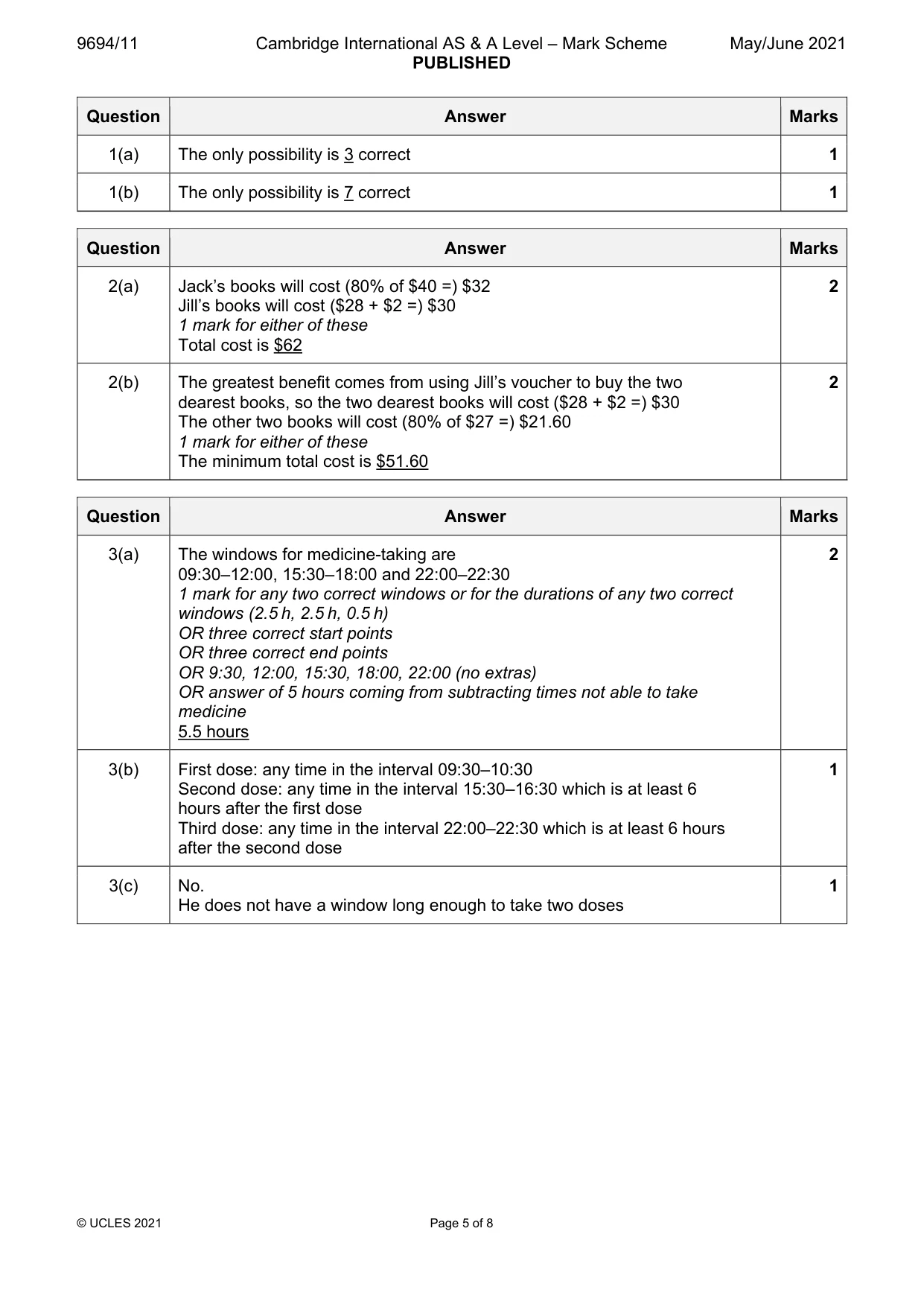
9694/11 Cambridge International AS & A Level – Mark Scheme PUBLISHED May/June 2021 © UCLES 2021 Page 5 of 8 Question Answer Marks 1(a) The only possibility is 3 correct 1 1(b) The only possibility is 7 correct 1 Question Answer Marks 2(a) Jack’s books will cost (80% of $40 =) $32 Jill’s books will cost ($28 + $2 =) $30 1 mark for either of these Total cost is $62 2 2(b) The greatest benefit comes from using Jill’s voucher to buy the two dearest books, so the two dearest books will cost ($28 + $2 =) $30 The other two books will cost (80% of $27 =) $21.60 1 mark for either of these The minimum total cost is $51.60 2 Question Answer Marks 3(a) The windows for medicine-taking are 09:30–12:00, 15:30–18:00 and 22:00–22:30 1 mark for any two correct windows or for the durations of any two correct windows (2.5 h, 2.5 h, 0.5 h) OR three correct start points OR three correct end points OR 9:30, 12:00, 15:30, 18:00, 22:00 (no extras) OR answer of 5 hours coming from subtracting times not able to take medicine 5.5 hours 2 3(b) First dose: any time in the interval 09:30–10:30 Second dose: any time in the interval 15:30–16:30 which is at least 6 hours after the first dose Third dose: any time in the interval 22:00–22:30 which is at least 6 hours after the second dose 1 3(c) No. He does not have a window long enough to take two doses 1
Mark scheme, page 6
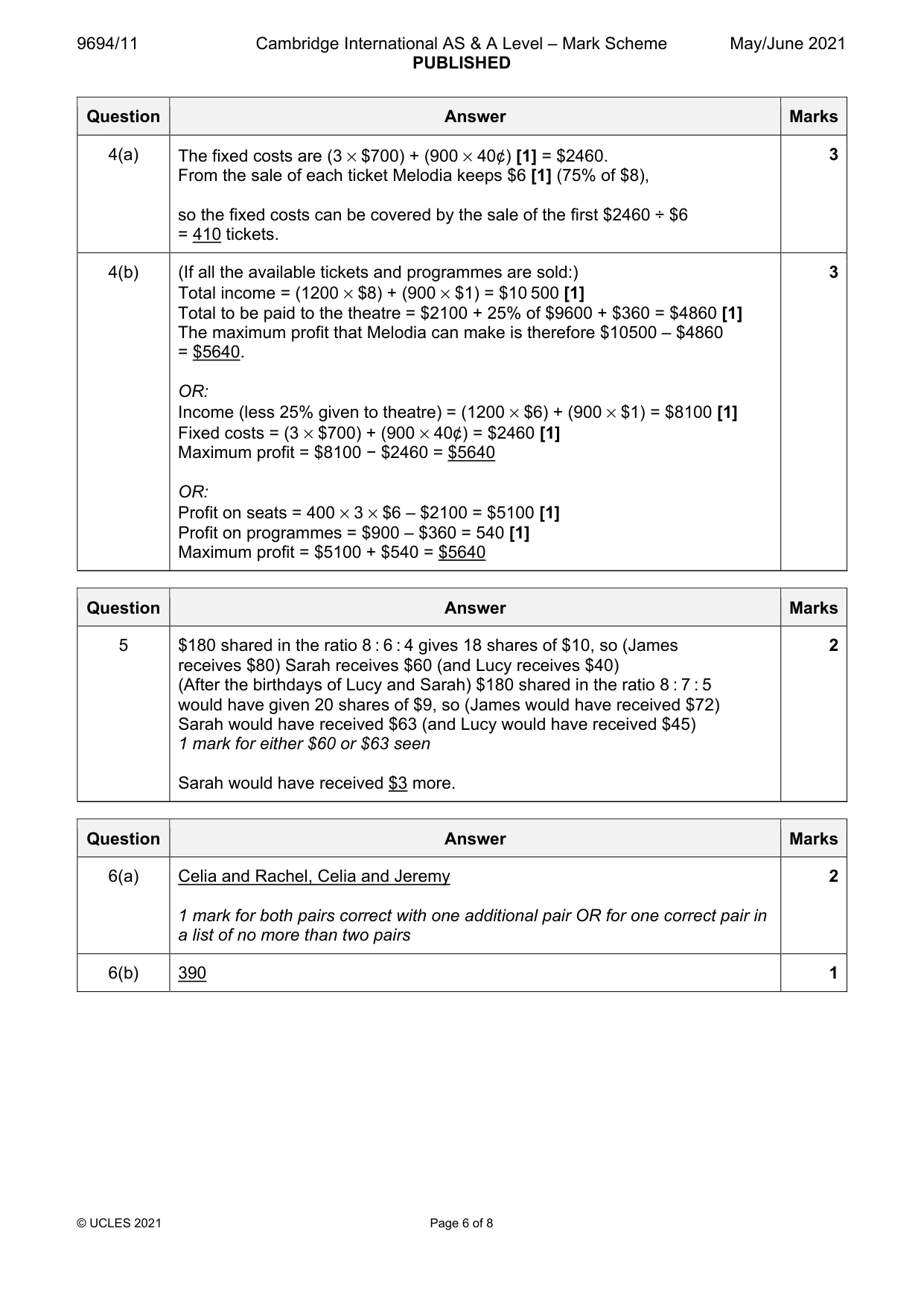
9694/11 Cambridge International AS & A Level – Mark Scheme PUBLISHED May/June 2021 © UCLES 2021 Page 6 of 8 Question Answer Marks 4(a) The fixed costs are (3 × $700) + (900 × 40¢) [1] = $2460. From the sale of each ticket Melodia keeps $6 [1] (75% of $8), so the fixed costs can be covered by the sale of the first $2460 ÷ $6 = 410 tickets. 3 4(b) (If all the available tickets and programmes are sold:) Total income = (1200 × $8) + (900 × $1) = $10 500 [1] Total to be paid to the theatre = $2100 + 25% of $9600 + $360 = $4860 [1] The maximum profit that Melodia can make is therefore $10500 – $4860 = $5640. OR: Income (less 25% given to theatre) = (1200 × $6) + (900 × $1) = $8100 [1] Fixed costs = (3 × $700) + (900 × 40¢) = $2460 [1] Maximum profit = $8100 − $2460 = $5640 OR: Profit on seats = 400 × 3 × $6 – $2100 = $5100 [1] Profit on programmes = $900 – $360 = 540 [1] Maximum profit = $5100 + $540 = $5640 3 Question Answer Marks 5 $180 shared in the ratio 8 : 6 : 4 gives 18 shares of $10, so (James receives $80) Sarah receives $60 (and Lucy receives $40) (After the birthdays of Lucy and Sarah) $180 shared in the ratio 8 : 7 : 5 would have given 20 shares of $9, so (James would have received $72) Sarah would have received $63 (and Lucy would have received $45) 1 mark for either $60 or $63 seen Sarah would have received $3 more. 2 Question Answer Marks 6(a) Celia and Rachel, Celia and Jeremy 1 mark for both pairs correct with one additional pair OR for one correct pair in a list of no more than two pairs 2 6(b) 390 1
Mark scheme, page 7
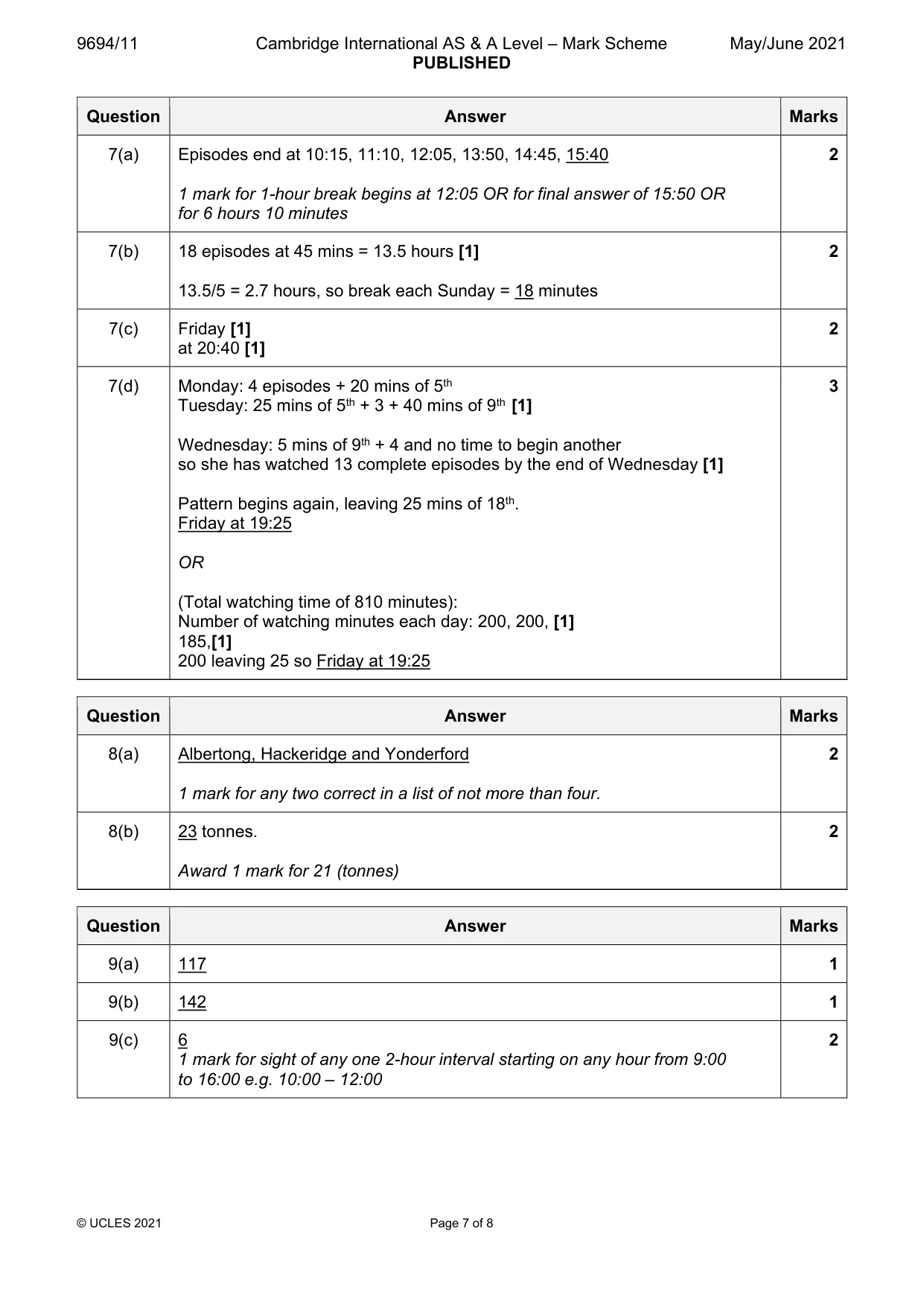
9694/11 Cambridge International AS & A Level – Mark Scheme PUBLISHED May/June 2021 © UCLES 2021 Page 7 of 8 Question Answer Marks 7(a) Episodes end at 10:15, 11:10, 12:05, 13:50, 14:45, 15:40 1 mark for 1-hour break begins at 12:05 OR for final answer of 15:50 OR for 6 hours 10 minutes 2 7(b) 18 episodes at 45 mins = 13.5 hours [1] 13.5/5 = 2.7 hours, so break each Sunday = 18 minutes 2 7(c) Friday [1] at 20:40 [1] 2 7(d) Monday: 4 episodes + 20 mins of 5th Tuesday: 25 mins of 5th + 3 + 40 mins of 9th [1] Wednesday: 5 mins of 9th + 4 and no time to begin another so she has watched 13 complete episodes by the end of Wednesday [1] Pattern begins again, leaving 25 mins of 18th. Friday at 19:25 OR (Total watching time of 810 minutes): Number of watching minutes each day: 200, 200, [1] 185,[1] 200 leaving 25 so Friday at 19:25 3 Question Answer Marks 8(a) Albertong, Hackeridge and Yonderford 1 mark for any two correct in a list of not more than four. 2 8(b) 23 tonnes. Award 1 mark for 21 (tonnes) 2 Question Answer Marks 9(a) 117 1 9(b) 142 1 9(c) 6 1 mark for sight of any one 2-hour interval starting on any hour from 9:00 to 16:00 e.g. 10:00 – 12:00 2
Mark scheme, page 8
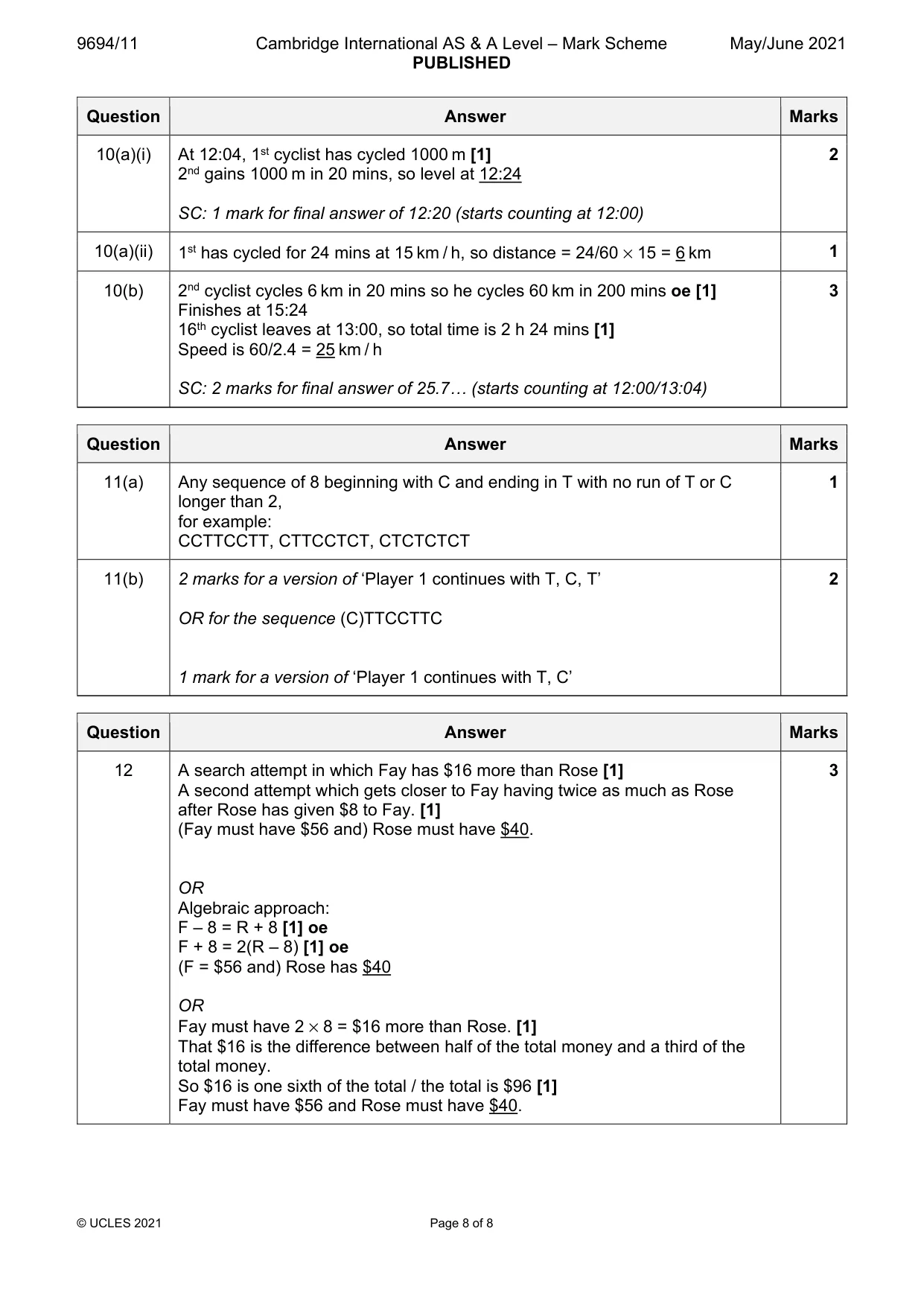
9694/11 Cambridge International AS & A Level – Mark Scheme PUBLISHED May/June 2021 © UCLES 2021 Page 8 of 8 Question Answer Marks 10(a)(i) At 12:04, 1st cyclist has cycled 1000 m [1] 2nd gains 1000 m in 20 mins, so level at 12:24 SC: 1 mark for final answer of 12:20 (starts counting at 12:00) 2 10(a)(ii) 1st has cycled for 24 mins at 15 km / h, so distance = 24/60 × 15 = 6 km 1 10(b) 2nd cyclist cycles 6 km in 20 mins so he cycles 60 km in 200 mins oe [1] Finishes at 15:24 16th cyclist leaves at 13:00, so total time is 2 h 24 mins [1] Speed is 60/2.4 = 25 km / h SC: 2 marks for final answer of 25.7… (starts counting at 12:00/13:04) 3 Question Answer Marks 11(a) Any sequence of 8 beginning with C and ending in T with no run of T or C longer than 2, for example: CCTTCCTT, CTTCCTCT, CTCTCTCT 1 11(b) 2 marks for a version of ‘Player 1 continues with T, C, T’ OR for the sequence (C)TTCCTTC 1 mark for a version of ‘Player 1 continues with T, C’ 2 Question Answer Marks 12 A search attempt in which Fay has $16 more than Rose [1] A second attempt which gets closer to Fay having twice as much as Rose after Rose has given $8 to Fay. [1] (Fay must have $56 and) Rose must have $40. OR Algebraic approach: F – 8 = R + 8 [1] oe F + 8 = 2(R – 8) [1] oe (F = $56 and) Rose has $40 OR Fay must have 2 × 8 = $16 more than Rose. [1] That $16 is the difference between half of the total money and a third of the total money. So $16 is one sixth of the total / the total is $96 [1] Fay must have $56 and Rose must have $40. 3
What you needed in this session
Cambridge’s own grade thresholds for 2021 May/June, Paper 1 · Variant 1. A higher threshold means an easier paper — the bar moves with how the cohort did.