Cambridge A Level Thinking Skills 9694 — 2025 Oct/Nov Paper 3 · Variant 3
9694/33/O/N/25 · 4 questions · 50 marks · ≈56 min
The question paper and its mark scheme, free to read here and free to download. This is Cambridge’s own paper, exactly as it was sat.
Question paper12 pages





Mark scheme8 pages
Answers below. Sit the paper first if you are practising.
Questions as text
Q1 · A government scheme for supporting the poor was badly designed
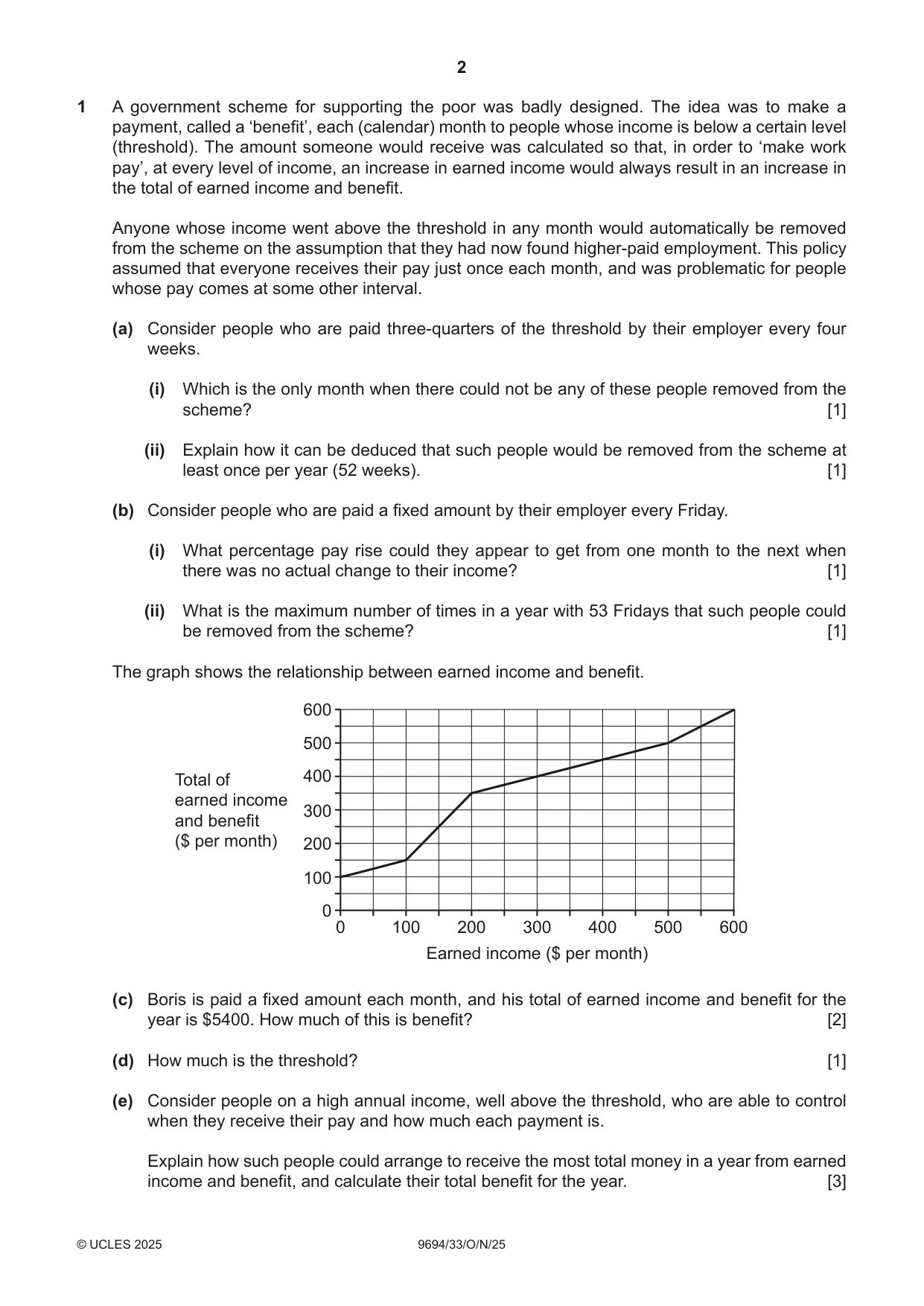
1 A government scheme for supporting the poor was badly designed. The idea was to make a payment, called a ‘benefit’, each (calendar) month to people whose income is below a certain level (threshold). The amount someone would receive was calculated so that, in order to ‘make work pay’, at every level of income, an increase in earned income would always result in an increase in the total of earned income and benefit. Anyone whose income went above the threshold in any month would automatically be removed from the scheme on the assumption that they had now found higher-paid employment. This policy assumed that everyone receives their pay just once each month, and was problematic for people whose pay comes at some other interval. (a) Consider people who are paid three-quarters of the threshold by their employer every four weeks. (i) Which is the only month when there could not be any of these people removed from the scheme? [1] (ii) Explain how it can be deduced that such people would be removed from the scheme at least once per year (52 weeks). [1] (b) Consider people who are paid a fixed amount by their employer every Friday. (i) What percentage pay rise could they appear to get from one month to the next when there was no actual change to their income? [1] (ii) What is the maximum number of times in a year with 53 Fridays that such people could be removed from the scheme? [1] The graph shows the relationship between earned income and benefit. 600 500 Total of 400 earned income 300 and benefit ($ per month) 200 100 0 0 100 200 300 400 500 600 Earned income ($ per month) (c) Boris is paid a fixed amount each month, and his total of earned income and benefit for the year is $5400. How much of this is benefit? [2] (d) How much is the threshold? [1] (e) Consider people on a high annual income, well above the threshold, who are able to control when they receive their pay and how much each payment is. Explain how such people could arrange to receive the most total money in a year from earned income and benefit, and calculate their total benefit for the year. [3] [Turn over for Question 2]
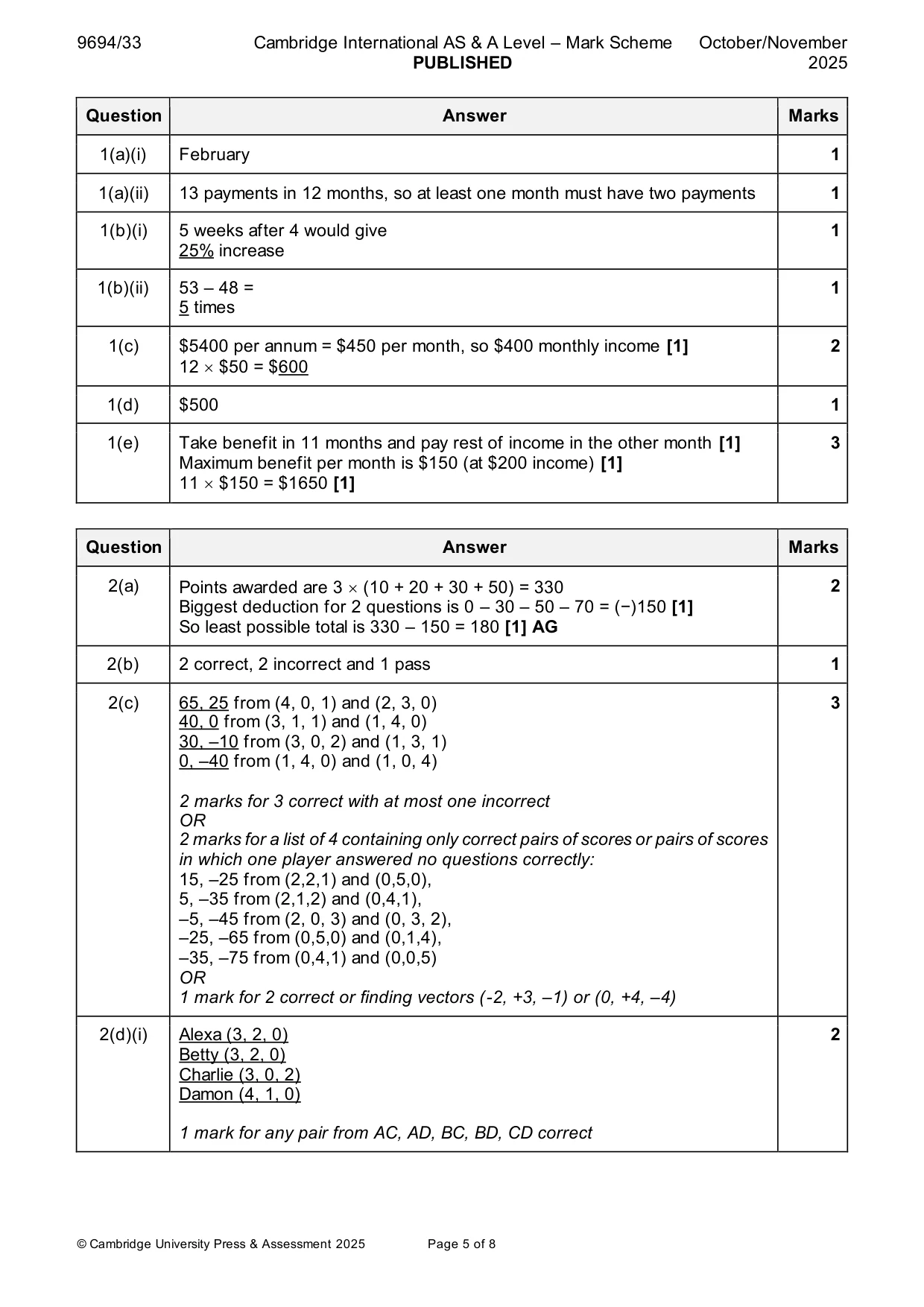
Mark scheme: Question Answer Marks 1(a)(i) February 1 1(a)(ii) 13 payments in 12 months, so at least one month must have two payments 1 1(b)(i) 5 weeks after 4 would give 1 25% increase 1(b)(ii) 53 – 48 = 1 5 times 1(c) $5400 per annum = $450 per month, so $400 monthly income [1] 2 12 $50 = $600 1(d) $500 1 1(e) Take benefit in 11 months and pay rest of income in the other month [1] 3 Maximum benefit per month is $150 (at $200 income) [1] 11 $150 = $1650 [1]
Q2 · In the Double Triple Quiz there are 4 rounds of questions
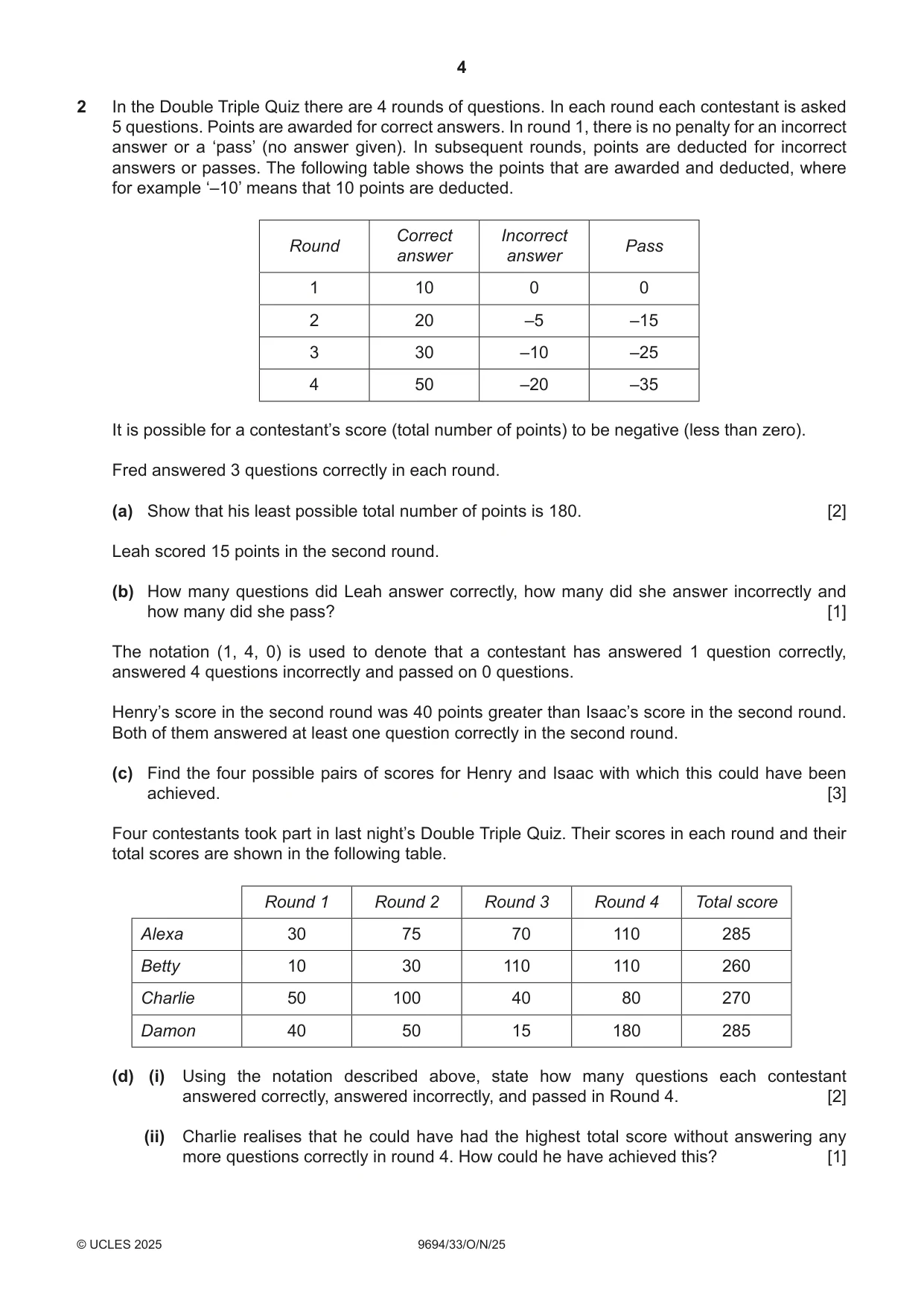
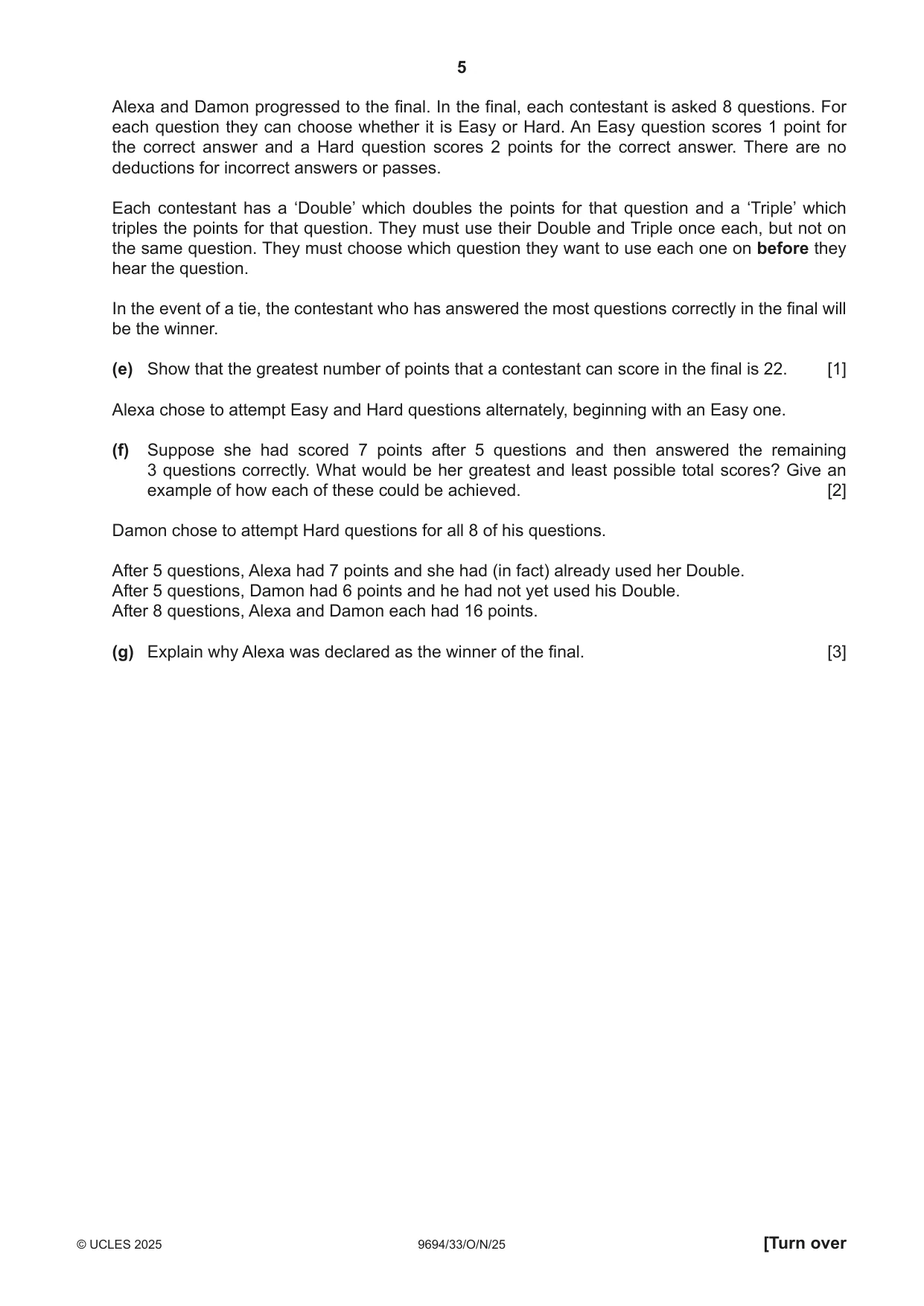
2 In the Double Triple Quiz there are 4 rounds of questions. In each round each contestant is asked 5 questions. Points are awarded for correct answers. In round 1, there is no penalty for an incorrect answer or a ‘pass’ (no answer given). In subsequent rounds, points are deducted for incorrect answers or passes. The following table shows the points that are awarded and deducted, where for example ‘–10’ means that 10 points are deducted. Correct Incorrect Round Pass answer answer 1 10 0 0 2 20 –5 –15 3 30 –10 –25 4 50 –20 –35 It is possible for a contestant’s score (total number of points) to be negative (less than zero). Fred answered 3 questions correctly in each round. (a) Show that his least possible total number of points is 180. [2] Leah scored 15 points in the second round. (b) How many questions did Leah answer correctly, how many did she answer incorrectly and how many did she pass? [1] The notation (1, 4, 0) is used to denote that a contestant has answered 1 question correctly, answered 4 questions incorrectly and passed on 0 questions. Henry’s score in the second round was 40 points greater than Isaac’s score in the second round. Both of them answered at least one question correctly in the second round. (c) Find the four possible pairs of scores for Henry and Isaac with which this could have been achieved. [3] Four contestants took part in last night’s Double Triple Quiz. Their scores in each round and their total scores are shown in the following table. Round 1 Round 2 Round 3 Round 4 Total score Alexa 30 75 70 110 285 Betty 10 30 110 110 260 Charlie 50 100 40 80 270 Damon 40 50 15 180 285 (d) (i) Using the notation described above, state how many questions each contestant answered correctly, answered incorrectly, and passed in Round 4. [2] (ii) Charlie realises that he could have had the highest total score without answering any more questions correctly in round 4. How could he have achieved this? [1] Alexa and Damon progressed to the final. In the final, each contestant is asked 8 questions. For each question they can choose whether it is Easy or Hard. An Easy question scores 1 point for the correct answer and a Hard question scores 2 points for the correct answer. There are no deductions for incorrect answers or passes. Each contestant has a ‘Double’ which doubles the points for that question and a ‘Triple’ which triples the points for that question. They must use their Double and Triple once each, but not on the same question. They must choose which question they want to use each one on before they hear the question. In the event of a tie, the contestant who has answered the most questions correctly in the final will be the winner. (e) Show that the greatest number of points that a contestant can score in the final is 22. [1] Alexa chose to attempt Easy and Hard questions alternately, beginning with an Easy one. (f) Suppose she had scored 7 points after 5 questions and then answered the remaining 3 questions correctly. What would be her greatest and least possible total scores? Give an example of how each of these could be achieved. [2] Damon chose to attempt Hard questions for all 8 of his questions. After 5 questions, Alexa had 7 points and she had (in fact) already used her Double. After 5 questions, Damon had 6 points and he had not yet used his Double. After 8 questions, Alexa and Damon each had 16 points. (g) Explain why Alexa was declared as the winner of the final. [3]
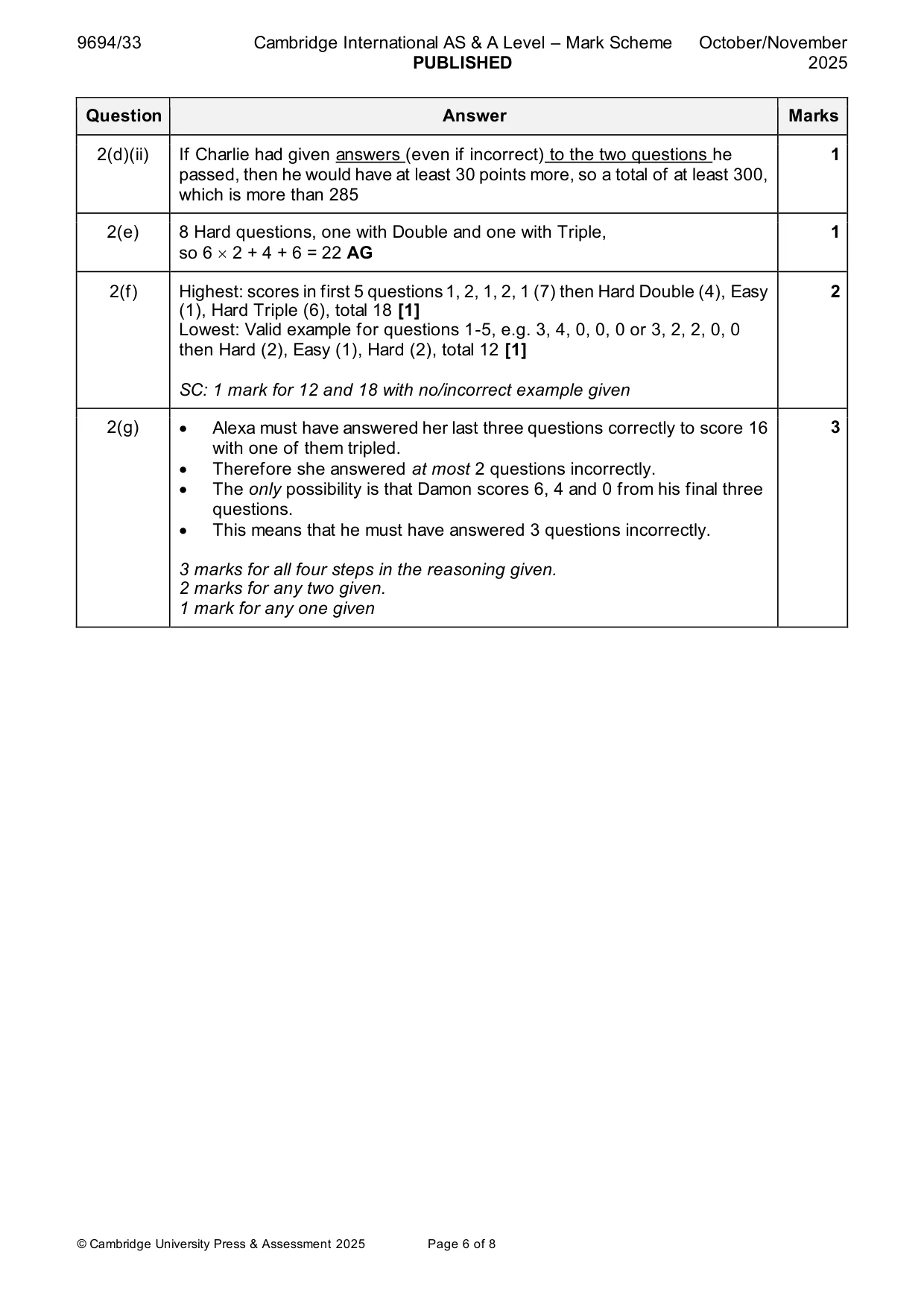
Mark scheme: 2(a) Points awarded are 3 (10 + 20 + 30 + 50) = 330 2 Biggest deduction for 2 questions is 0 – 30 – 50 – 70 = (−)150 [1] So least possible total is 330 – 150 = 180 [1] AG 2(b) 2 correct, 2 incorrect and 1 pass 1 2(c) 65, 25 from (4, 0, 1) and (2, 3, 0) 3 40, 0 from (3, 1, 1) and (1, 4, 0) 30, –10 from (3, 0, 2) and (1, 3, 1) 0, –40 from (1, 4, 0) and (1, 0, 4) 2 marks for 3 correct with at most one incorrect OR 2 marks for a list of 4 containing only correct pairs of scores or pairs of scores in which one player answered no questions correctly: 15, –25 from (2,2,1) and (0,5,0), 5, –35 from (2,1,2) and (0,4,1), –5, –45 from (2, 0, 3) and (0, 3, 2), –25, –65 from (0,5,0) and (0,1,4), –35, –75 from (0,4,1) and (0,0,5) OR 1 mark for 2 correct or finding vectors (-2, +3, –1) or (0, +4, –4) 2(d)(i) Alexa (3, 2, 0) 2 Betty (3, 2, 0) Charlie (3, 0, 2) Damon (4, 1, 0) 1 mark for any pair from AC, AD, BC, BD, CD correct 2(d)(ii) If Charlie had given answers (even if incorrect) to the two questions he 1 passed, then he would have at least 30 points more, so a total of at least 300, which is more than 285 2(e) 8 Hard questions, one with Double and one with Triple, 1 so 6 2 + 4 + 6 = 22 AG 2(f) Highest: scores in first 5 questions 1, 2, 1, 2, 1 (7) then Hard Double (4), Easy 2 (1), Hard Triple (6), total 18 [1] Lowest: Valid example for questions 1-5, e.g. 3, 4, 0, 0, 0 or 3, 2, 2, 0, 0 then Hard (2), Easy (1), Hard (2), total 12 [1] SC: 1 mark for 12 and 18 with no/incorrect example given 2(g) • Alexa must have answered her last three questions correctly to score 16 3 with one of them tripled. • Therefore she answered at most 2 questions incorrectly. • The only possibility is that Damon scores 6, 4 and 0 from his final three questions. • This means that he must have answered 3 questions incorrectly. 3 marks for all four steps in the reasoning given. 2 marks for any two given. 1 mark for any one given
More questions on Identify cases that satisfy given criteria
Q3 · A satellite navigation system (SatNav) for cars requires the user to enter a destination…
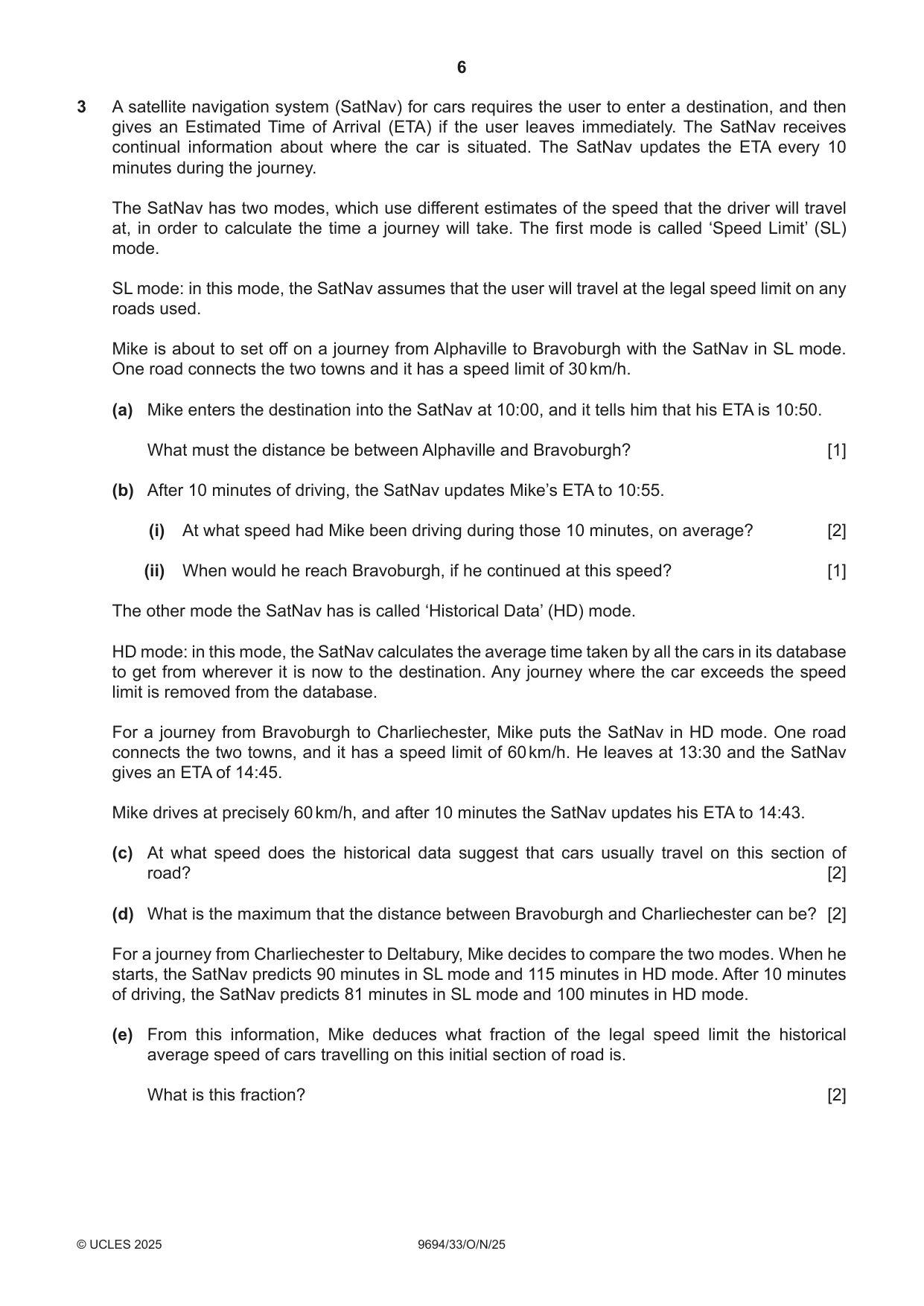
3 A satellite navigation system (SatNav) for cars requires the user to enter a destination, and then gives an Estimated Time of Arrival (ETA) if the user leaves immediately. The SatNav receives continual information about where the car is situated. The SatNav updates the ETA every 10 minutes during the journey. The SatNav has two modes, which use different estimates of the speed that the driver will travel at, in order to calculate the time a journey will take. The first mode is called ‘Speed Limit’ (SL) mode. SL mode: in this mode, the SatNav assumes that the user will travel at the legal speed limit on any roads used. Mike is about to set off on a journey from Alphaville to Bravoburgh with the SatNav in SL mode. One road connects the two towns and it has a speed limit of 30 km/h. (a) Mike enters the destination into the SatNav at 10:00, and it tells him that his ETA is 10:50. What must the distance be between Alphaville and Bravoburgh? [1] (b) After 10 minutes of driving, the SatNav updates Mike’s ETA to 10:55. (i) At what speed had Mike been driving during those 10 minutes, on average? [2] (ii) When would he reach Bravoburgh, if he continued at this speed? [1] The other mode the SatNav has is called ‘Historical Data’ (HD) mode. HD mode: in this mode, the SatNav calculates the average time taken by all the cars in its database to get from wherever it is now to the destination. Any journey where the car exceeds the speed limit is removed from the database. For a journey from Bravoburgh to Charliechester, Mike puts the SatNav in HD mode. One road connects the two towns, and it has a speed limit of 60 km/h. He leaves at 13:30 and the SatNav gives an ETA of 14:45. Mike drives at precisely 60 km/h, and after 10 minutes the SatNav updates his ETA to 14:43. (c) At what speed does the historical data suggest that cars usually travel on this section of road? [2] (d) What is the maximum that the distance between Bravoburgh and Charliechester can be? [2] For a journey from Charliechester to Deltabury, Mike decides to compare the two modes. When he starts, the SatNav predicts 90 minutes in SL mode and 115 minutes in HD mode. After 10 minutes of driving, the SatNav predicts 81 minutes in SL mode and 100 minutes in HD mode. (e) From this information, Mike deduces what fraction of the legal speed limit the historical average speed of cars travelling on this initial section of road is. What is this fraction? [2] [Turn over for Question 4]
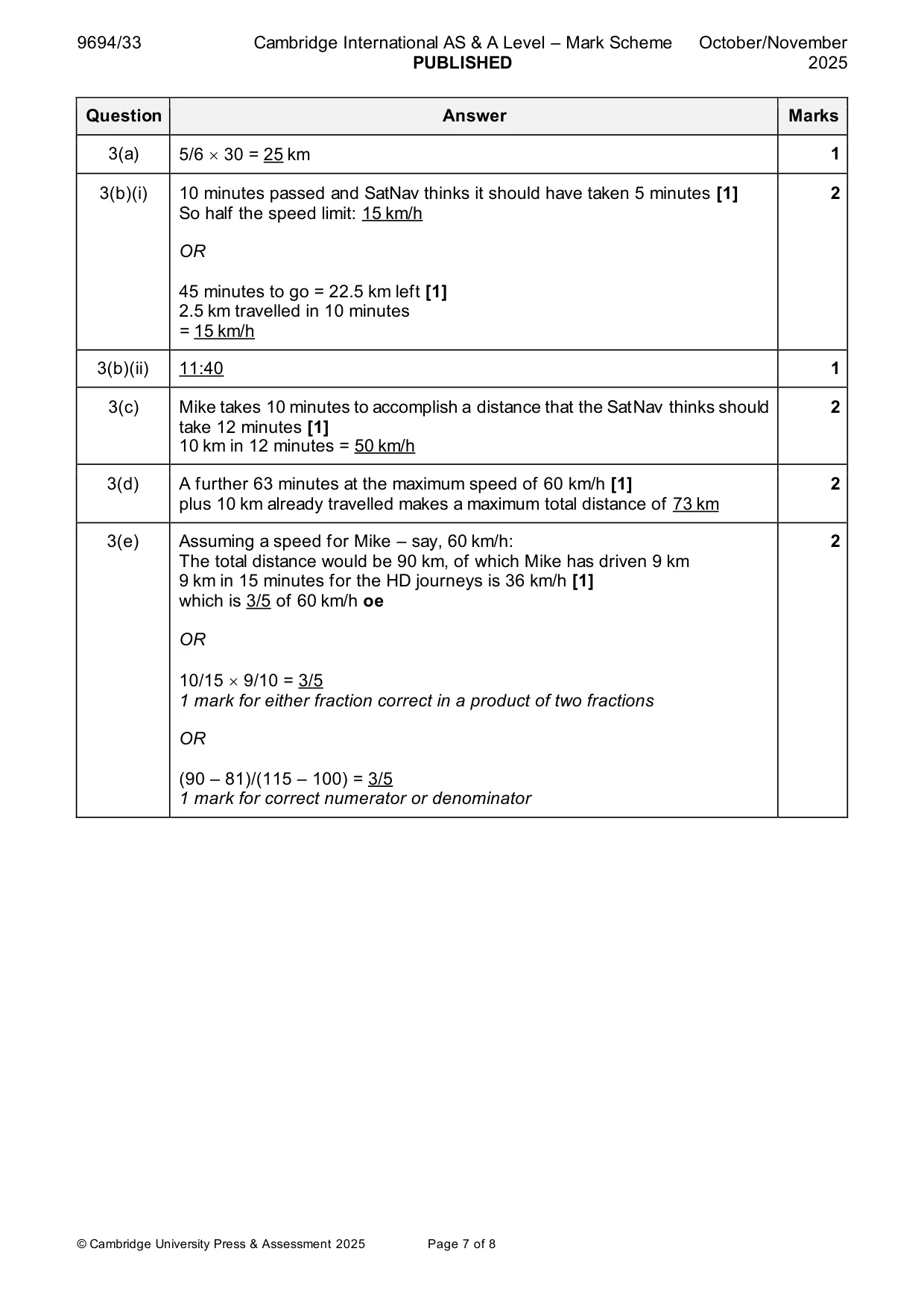
Mark scheme: 3(a) 5/6 30 = 25 km 1 3(b)(i) 10 minutes passed and SatNav thinks it should have taken 5 minutes [1] 2 So half the speed limit: 15 km/h OR 45 minutes to go = 22.5 km left [1] 2.5 km travelled in 10 minutes = 15 km/h 3(b)(ii) 11:40 1 3(c) Mike takes 10 minutes to accomplish a distance that the SatNav thinks should 2 take 12 minutes [1] 10 km in 12 minutes = 50 km/h 3(d) A further 63 minutes at the maximum speed of 60 km/h [1] 2 plus 10 km already travelled makes a maximum total distance of 73 km 3(e) Assuming a speed for Mike – say, 60 km/h: 2 The total distance would be 90 km, of which Mike has driven 9 km 9 km in 15 minutes for the HD journeys is 36 km/h [1] which is 3/5 of 60 km/h oe OR 10/15 9/10 = 3/5 1 mark for either fraction correct in a product of two fractions OR (90 – 81)/(115 – 100) = 3/5 1 mark for correct numerator or denominator
Q4 · George and Rachel are playing a game of CounterBid
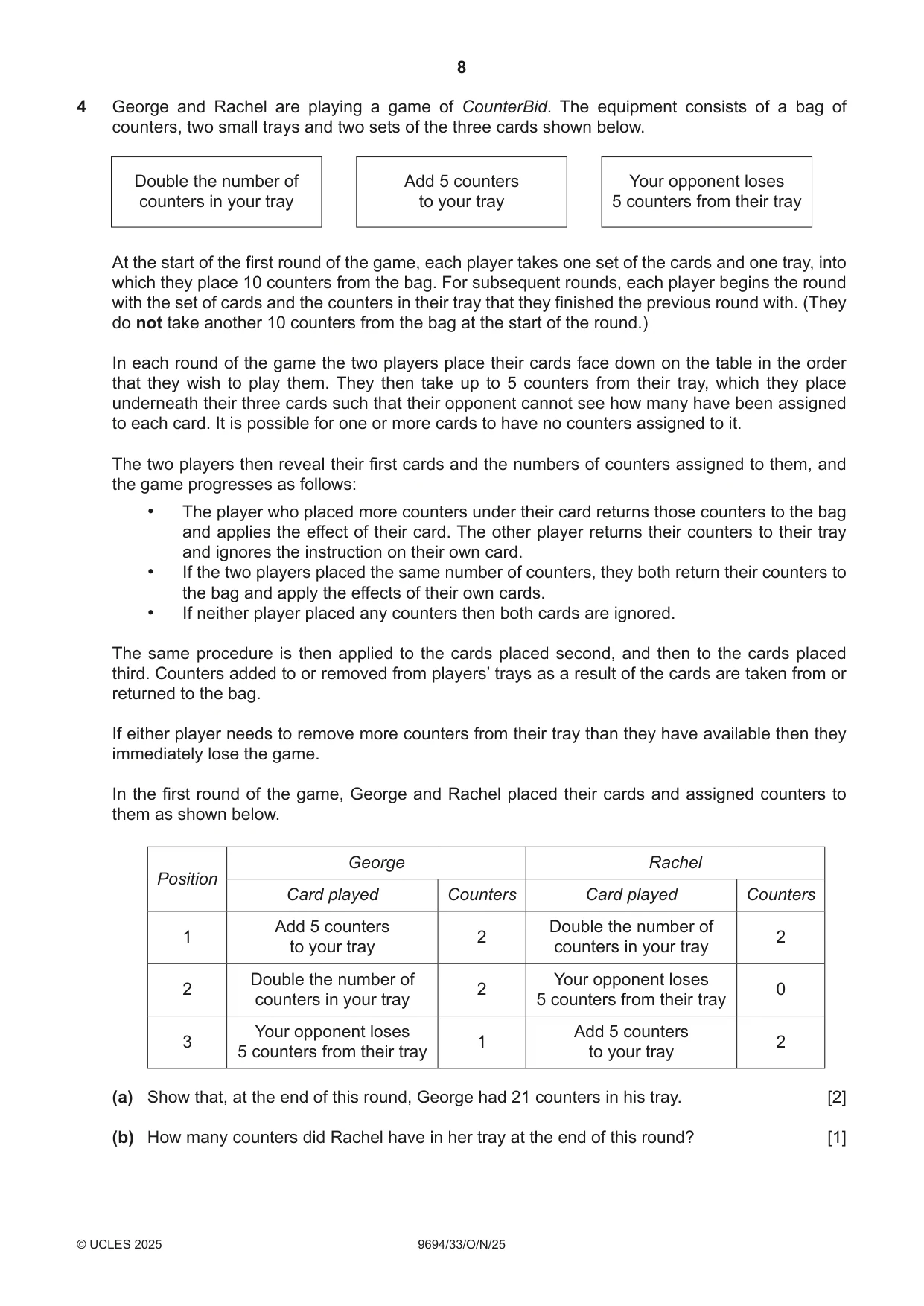
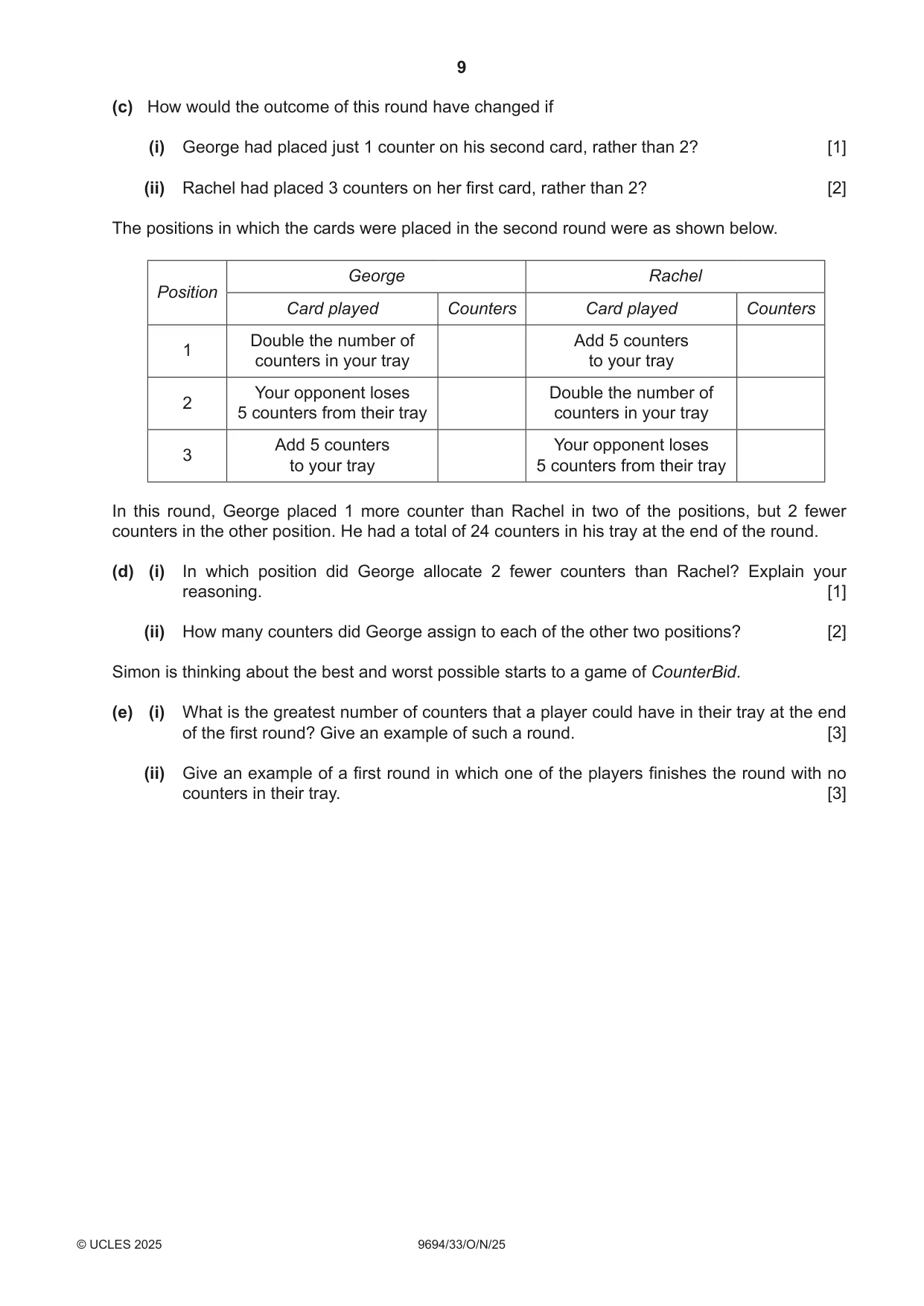
4 George and Rachel are playing a game of CounterBid. The equipment consists of a bag of counters, two small trays and two sets of the three cards shown below. Double the number of Add 5 counters Your opponent loses counters in your tray to your tray 5 counters from their tray At the start of the first round of the game, each player takes one set of the cards and one tray, into which they place 10 counters from the bag. For subsequent rounds, each player begins the round with the set of cards and the counters in their tray that they finished the previous round with. (They do not take another 10 counters from the bag at the start of the round.) In each round of the game the two players place their cards face down on the table in the order that they wish to play them. They then take up to 5 counters from their tray, which they place underneath their three cards such that their opponent cannot see how many have been assigned to each card. It is possible for one or more cards to have no counters assigned to it. The two players then reveal their first cards and the numbers of counters assigned to them, and the game progresses as follows: • The player who placed more counters under their card returns those counters to the bag and applies the effect of their card. The other player returns their counters to their tray and ignores the instruction on their own card. • If the two players placed the same number of counters, they both return their counters to the bag and apply the effects of their own cards. • If neither player placed any counters then both cards are ignored. The same procedure is then applied to the cards placed second, and then to the cards placed third. Counters added to or removed from players’ trays as a result of the cards are taken from or returned to the bag. If either player needs to remove more counters from their tray than they have available then they immediately lose the game. In the first round of the game, George and Rachel placed their cards and assigned counters to them as shown below. George Rachel Position Card played Counters Card played Counters Add 5 counters Double the number of 1 2 2 to your tray counters in your tray Double the number of Your opponent loses 2 2 0 counters in your tray 5 counters from their tray Your opponent loses Add 5 counters 3 1 2 5 counters from their tray to your tray (a) Show that, at the end of this round, George had 21 counters in his tray. [2] (b) How many counters did Rachel have in her tray at the end of this round? [1] (c) How would the outcome of this round have changed if (i) George had placed just 1 counter on his second card, rather than 2? [1] (ii) Rachel had placed 3 counters on her first card, rather than 2? [2] The positions in which the cards were placed in the second round were as shown below. George Rachel Position Card played Counters Card played Counters Double the number of Add 5 counters 1 counters in your tray to your tray Your opponent loses Double the number of 2 5 counters from their tray counters in your tray Add 5 counters Your opponent loses 3 to your tray 5 counters from their tray In this round, George placed 1 more counter than Rachel in two of the positions, but 2 fewer counters in the other position. He had a total of 24 counters in his tray at the end of the round. (d) (i) In which position did George allocate 2 fewer counters than Rachel? Explain your reasoning. [1] (ii) How many counters did George assign to each of the other two positions? [2] Simon is thinking about the best and worst possible starts to a game of CounterBid. (e) (i) What is the greatest number of counters that a player could have in their tray at the end of the first round? Give an example of such a round. [3] (ii) Give an example of a first round in which one of the players finishes the round with no counters in their tray. [3]
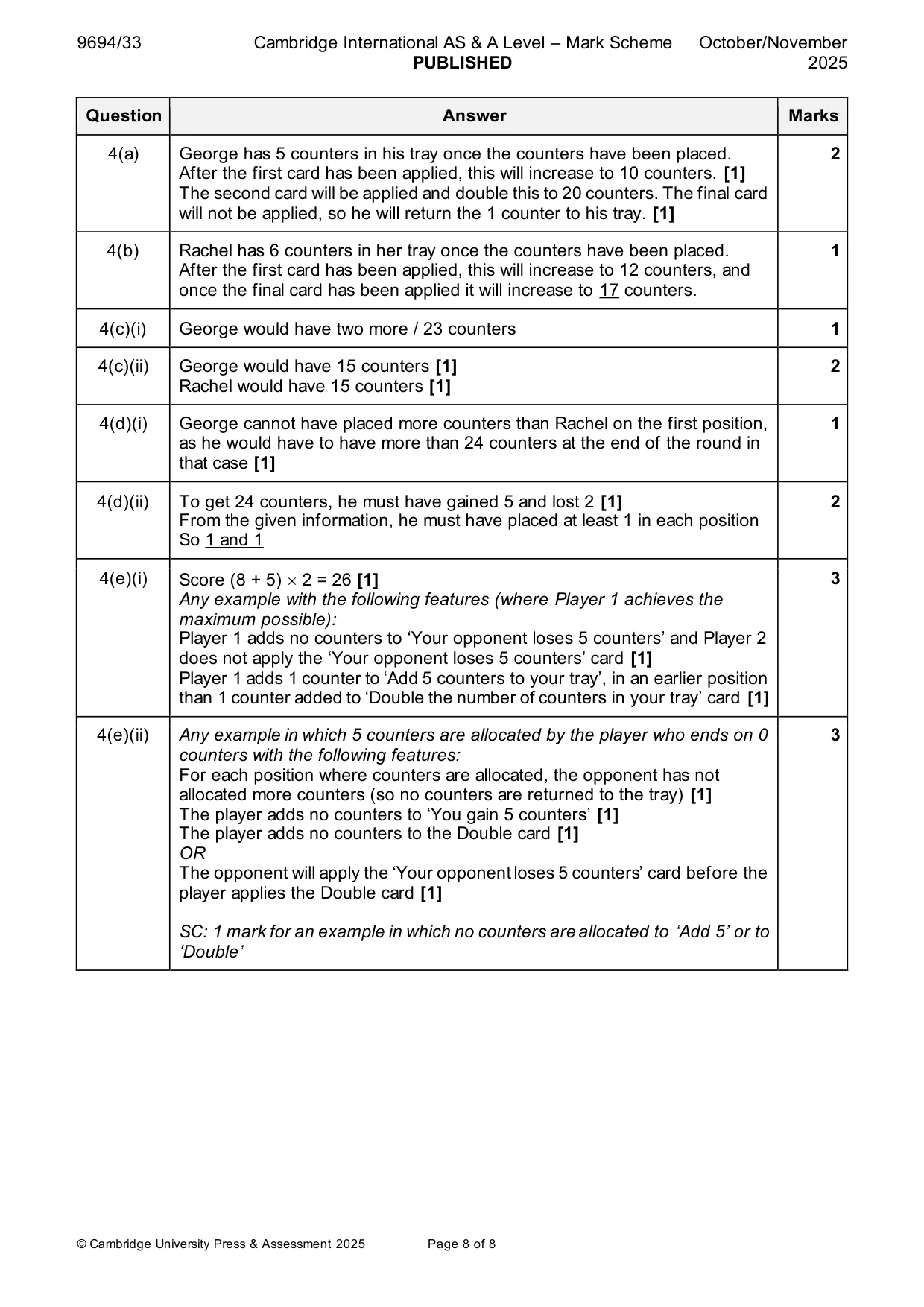
Mark scheme: 4(a) George has 5 counters in his tray once the counters have been placed. 2 After the first card has been applied, this will increase to 10 counters. [1] The second card will be applied and double this to 20 counters. The final card will not be applied, so he will return the 1 counter to his tray. [1] 4(b) Rachel has 6 counters in her tray once the counters have been placed. 1 After the first card has been applied, this will increase to 12 counters, and once the final card has been applied it will increase to 17 counters. 4(c)(i) George would have two more / 23 counters 1 4(c)(ii) George would have 15 counters [1] 2 Rachel would have 15 counters [1] 4(d)(i) George cannot have placed more counters than Rachel on the first position, 1 as he would have to have more than 24 counters at the end of the round in that case [1] 4(d)(ii) To get 24 counters, he must have gained 5 and lost 2 [1] 2 From the given information, he must have placed at least 1 in each position So 1 and 1 4(e)(i) Score (8 + 5) 2 = 26 [1] 3 Any example with the following features (where Player 1 achieves the maximum possible): Player 1 adds no counters to ‘Your opponent loses 5 counters’ and Player 2 does not apply the ‘Your opponent loses 5 counters’ card [1] Player 1 adds 1 counter to ‘Add 5 counters to your tray’, in an earlier position than 1 counter added to ‘Double the number of counters in your tray’ card [1] 4(e)(ii) Any example in which 5 counters are allocated by the player who ends on 0 3 counters with the following features: For each position where counters are allocated, the opponent has not allocated more counters (so no counters are returned to the tray) [1] The player adds no counters to ‘You gain 5 counters’ [1] The player adds no counters to the Double card [1] OR The opponent will apply the ‘Your opponent loses 5 counters’ card before the player applies the Double card [1] SC: 1 mark for an example in which no counters are allocated to ‘Add 5’ or to ‘Double’
What was in this paper
The subtopics covered by these 4 questions, and how many questions each got. Open one in a new tab to see every Cambridge question on it.
What you needed in this session
Cambridge’s own grade thresholds for 2025 Oct/Nov, Paper 3 · Variant 3. A higher threshold means an easier paper — the bar moves with how the cohort did.