Cambridge A Level Thinking Skills 9694 — 2013 Oct/Nov Paper 3 · Variant 3
9694/33/O/N/13 · 50 marks · ≈56 min
The question paper and its mark scheme, free to read here and free to download. This is Cambridge’s own paper, exactly as it was sat.
Question paper12 pages



Mark scheme9 pages
Answers below. Sit the paper first if you are practising.
Paper as text
Question paper, page 1
This document consists of 9 printed pages and 3 blank pages. IB13 11_9694_33/FP © UCLES 2013 [Turn over *3019947673* UNIVERSITY OF CAMBRIDGE INTERNATIONAL EXAMINATIONS General Certificate of Education Advanced Level THINKING SKILLS 9694/33 Paper 3 Problem Analysis and Solution October/November 2013 1 hour 30 minutes Additional Materials: Answer Booklet/Paper Electronic Calculator READ THESE INSTRUCTIONS FIRST If you have been given an Answer Booklet, follow the instructions on the front cover of the booklet. Write your Centre number, candidate number and name on all the work you hand in. Write in dark blue or black pen. Do not use staples, paper clips, highlighters, glue or correction fluid. DO NOT WRITE IN ANY BARCODES. Answer all the questions. Start each question on a new answer sheet. Calculators should be used where appropriate. At the end of the examination, fasten all your work securely together. The number of marks is given in brackets [ ] at the end of each question or part question.
Question paper, page 2
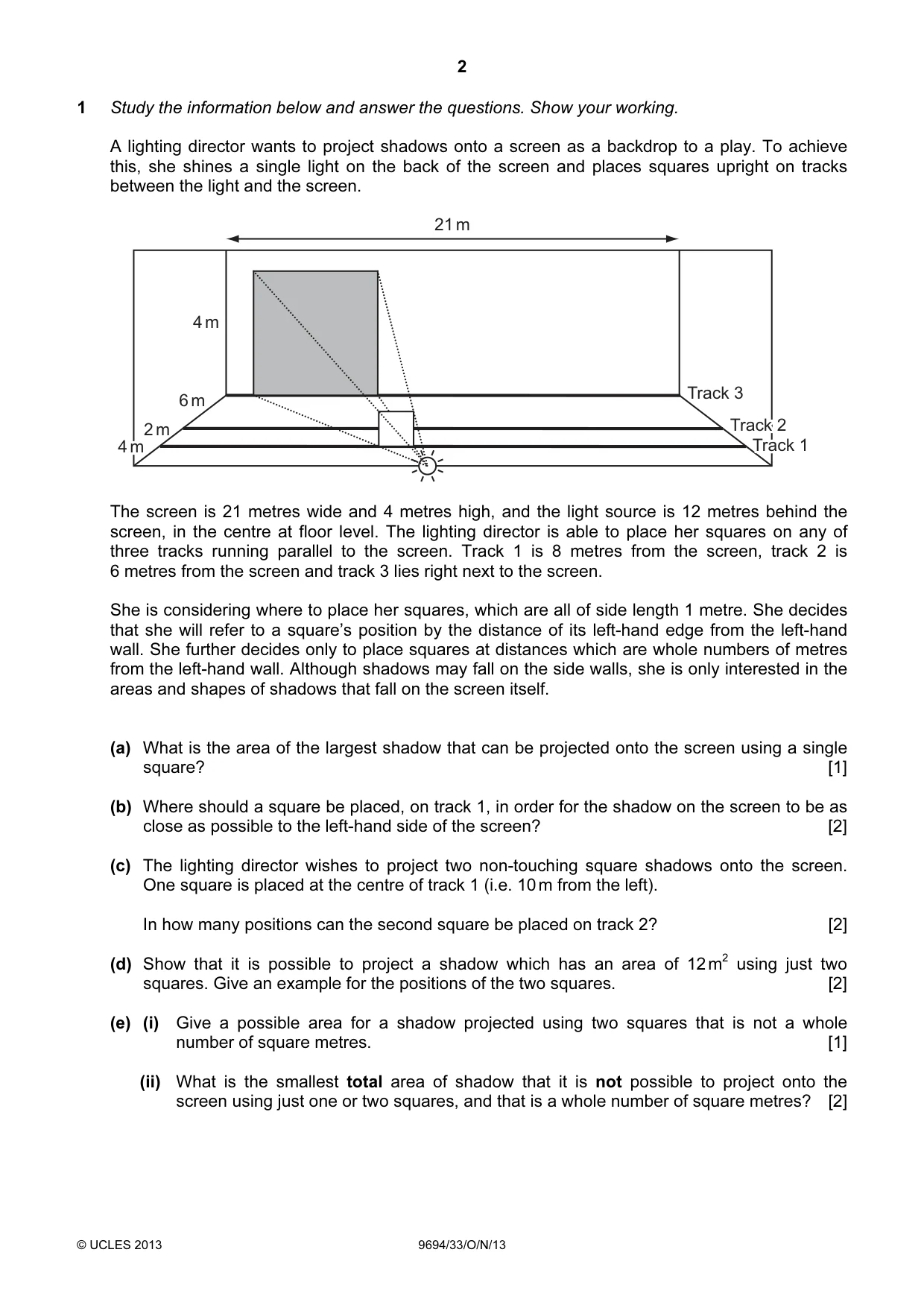
2 © UCLES 2013 9694/33/O/N/13 1 Study the information below and answer the questions. Show your working. A lighting director wants to project shadows onto a screen as a backdrop to a play. To achieve this, she shines a single light on the back of the screen and places squares upright on tracks between the light and the screen. 21 m 4 m 6 m 2 m 4 m 4 m Track 3 Track 2 Track 2 Track 1 Track 1 Track 2 Track 1 The screen is 21 metres wide and 4 metres high, and the light source is 12 metres behind the screen, in the centre at floor level. The lighting director is able to place her squares on any of three tracks running parallel to the screen. Track 1 is 8 metres from the screen, track 2 is 6 metres from the screen and track 3 lies right next to the screen. She is considering where to place her squares, which are all of side length 1 metre. She decides that she will refer to a square’s position by the distance of its left-hand edge from the left-hand wall. She further decides only to place squares at distances which are whole numbers of metres from the left-hand wall. Although shadows may fall on the side walls, she is only interested in the areas and shapes of shadows that fall on the screen itself. (a) What is the area of the largest shadow that can be projected onto the screen using a single square? [1] (b) Where should a square be placed, on track 1, in order for the shadow on the screen to be as close as possible to the left-hand side of the screen? [2] (c) The lighting director wishes to project two non-touching square shadows onto the screen. One square is placed at the centre of track 1 (i.e. 10 m from the left). In how many positions can the second square be placed on track 2? [2] (d) Show that it is possible to project a shadow which has an area of 12 m2 using just two squares. Give an example for the positions of the two squares. [2] (e) (i) Give a possible area for a shadow projected using two squares that is not a whole number of square metres. [1] (ii) What is the smallest total area of shadow that it is not possible to project onto the screen using just one or two squares, and that is a whole number of square metres? [2]
Question paper, page 3
3 © UCLES 2013 9694/33/O/N/13 [Turn over [Turn over for Question 2]
Question paper, page 4
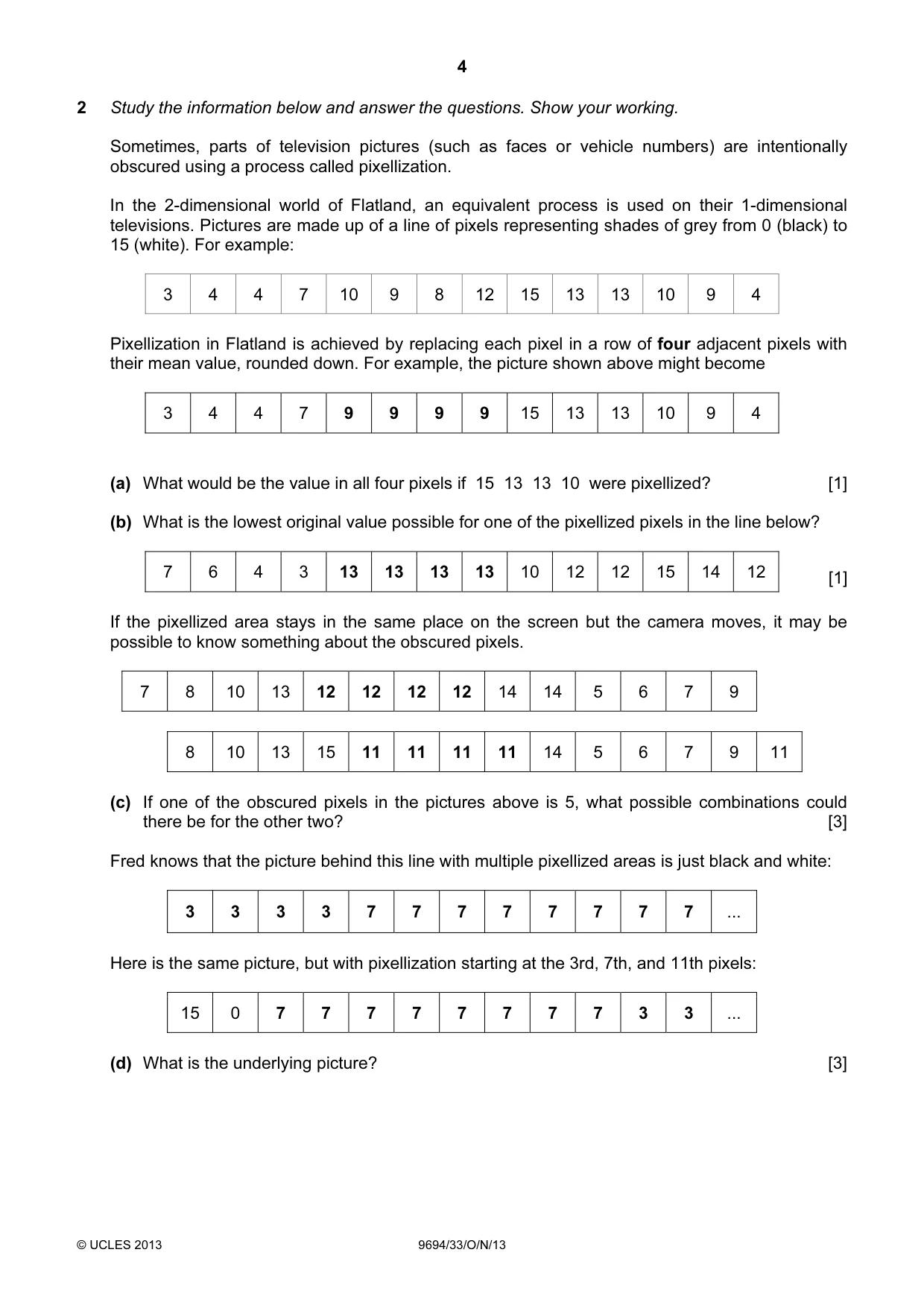
4 © UCLES 2013 9694/33/O/N/13 2 Study the information below and answer the questions. Show your working. Sometimes, parts of television pictures (such as faces or vehicle numbers) are intentionally obscured using a process called pixellization. In the 2-dimensional world of Flatland, an equivalent process is used on their 1-dimensional televisions. Pictures are made up of a line of pixels representing shades of grey from 0 (black) to 15 (white). For example: 3 4 4 7 10 9 8 12 15 13 13 10 9 4 Pixellization in Flatland is achieved by replacing each pixel in a row of four adjacent pixels with their mean value, rounded down. For example, the picture shown above might become 3 4 4 7 9 9 9 9 15 13 13 10 9 4 (a) What would be the value in all four pixels if 15 13 13 10 were pixellized? [1] (b) What is the lowest original value possible for one of the pixellized pixels in the line below? 7 6 4 3 13 13 13 13 10 12 12 15 14 12 [1] If the pixellized area stays in the same place on the screen but the camera moves, it may be possible to know something about the obscured pixels. 7 8 10 13 12 12 12 12 14 14 5 6 7 9 8 10 13 15 11 11 11 11 14 5 6 7 9 11 (c) If one of the obscured pixels in the pictures above is 5, what possible combinations could there be for the other two? [3] Fred knows that the picture behind this line with multiple pixellized areas is just black and white: 3 3 3 3 7 7 7 7 7 7 7 7 ... Here is the same picture, but with pixellization starting at the 3rd, 7th, and 11th pixels: 15 0 7 7 7 7 7 7 7 7 3 3 ... (d) What is the underlying picture? [3]
Question paper, page 5
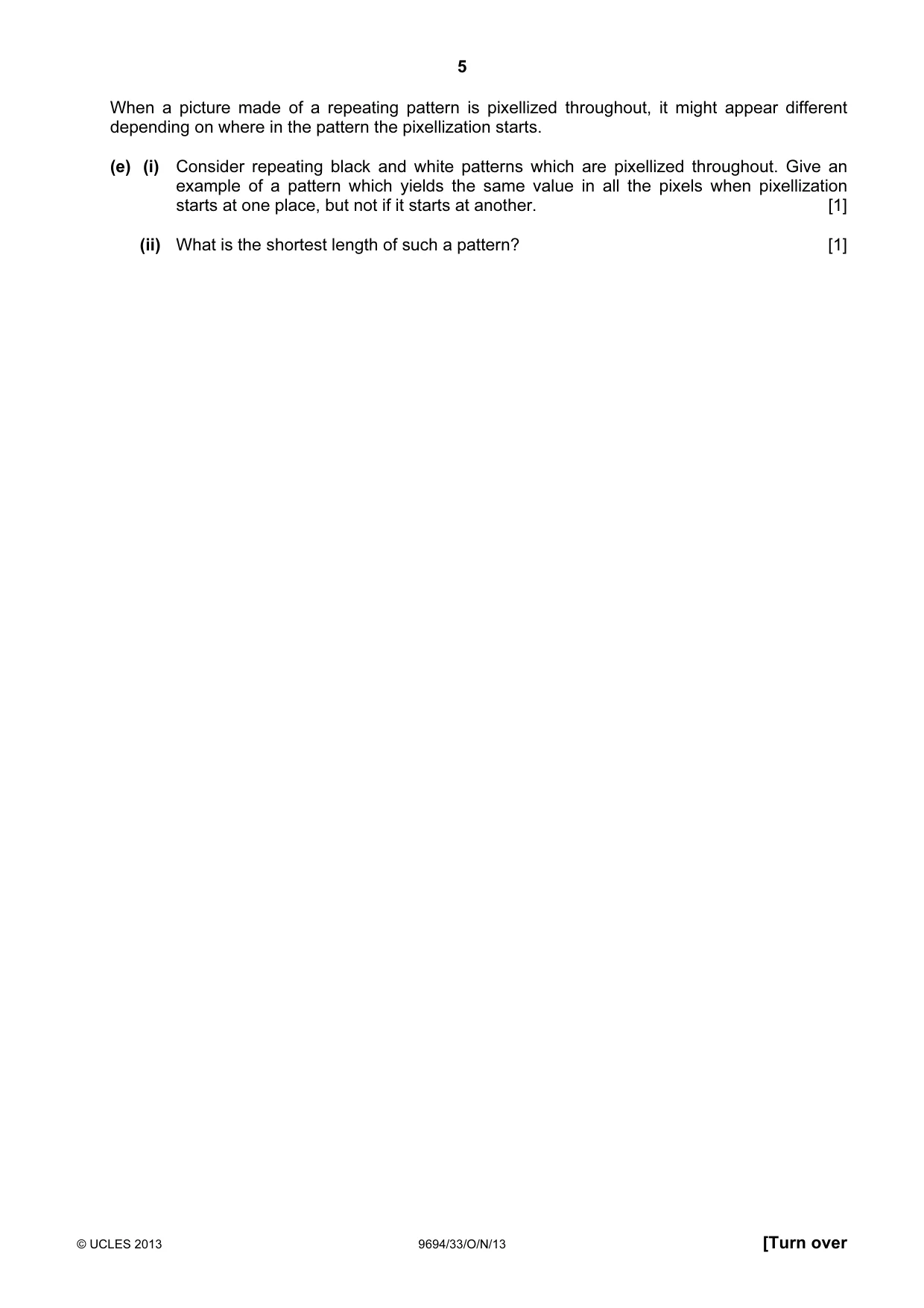
5 © UCLES 2013 9694/33/O/N/13 [Turn over When a picture made of a repeating pattern is pixellized throughout, it might appear different depending on where in the pattern the pixellization starts. (e) (i) Consider repeating black and white patterns which are pixellized throughout. Give an example of a pattern which yields the same value in all the pixels when pixellization starts at one place, but not if it starts at another. [1] (ii) What is the shortest length of such a pattern? [1]
Question paper, page 6
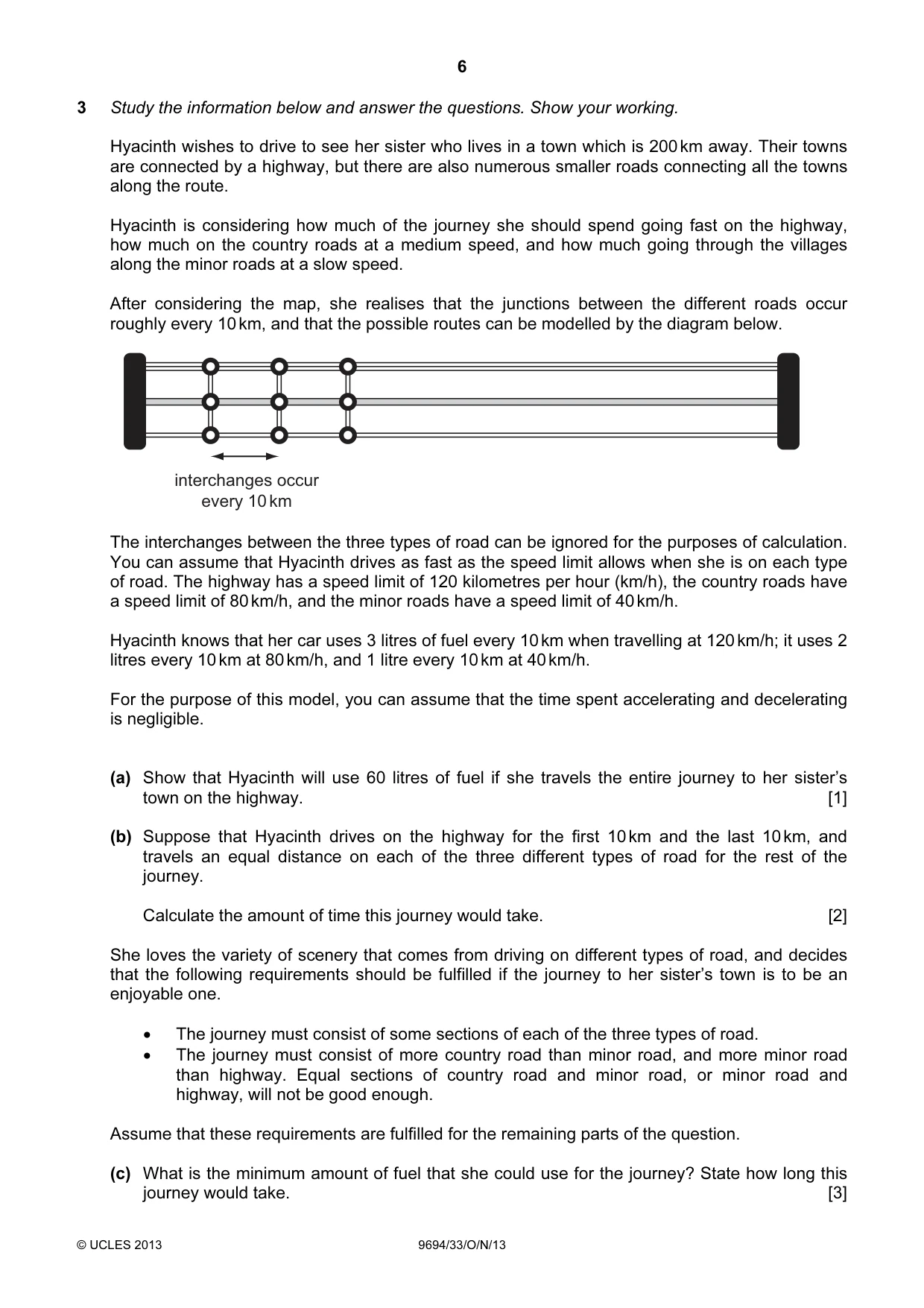
6 © UCLES 2013 9694/33/O/N/13 3 Study the information below and answer the questions. Show your working. Hyacinth wishes to drive to see her sister who lives in a town which is 200 km away. Their towns are connected by a highway, but there are also numerous smaller roads connecting all the towns along the route. Hyacinth is considering how much of the journey she should spend going fast on the highway, how much on the country roads at a medium speed, and how much going through the villages along the minor roads at a slow speed. After considering the map, she realises that the junctions between the different roads occur roughly every 10 km, and that the possible routes can be modelled by the diagram below. interchanges occur every 10 km The interchanges between the three types of road can be ignored for the purposes of calculation. You can assume that Hyacinth drives as fast as the speed limit allows when she is on each type of road. The highway has a speed limit of 120 kilometres per hour (km/h), the country roads have a speed limit of 80 km/h, and the minor roads have a speed limit of 40 km/h. Hyacinth knows that her car uses 3 litres of fuel every 10 km when travelling at 120 km/h; it uses 2 litres every 10 km at 80 km/h, and 1 litre every 10 km at 40 km/h. For the purpose of this model, you can assume that the time spent accelerating and decelerating is negligible. (a) Show that Hyacinth will use 60 litres of fuel if she travels the entire journey to her sister’s town on the highway. [1] (b) Suppose that Hyacinth drives on the highway for the first 10 km and the last 10 km, and travels an equal distance on each of the three different types of road for the rest of the journey. Calculate the amount of time this journey would take. [2] She loves the variety of scenery that comes from driving on different types of road, and decides that the following requirements should be fulfilled if the journey to her sister’s town is to be an enjoyable one. • The journey must consist of some sections of each of the three types of road. • The journey must consist of more country road than minor road, and more minor road than highway. Equal sections of country road and minor road, or minor road and highway, will not be good enough. Assume that these requirements are fulfilled for the remaining parts of the question. (c) What is the minimum amount of fuel that she could use for the journey? State how long this journey would take. [3]
Question paper, page 7
7 © UCLES 2013 9694/33/O/N/13 [Turn over (d) If she maximises the amount of time she spends on the highway, what is the minimum amount of time that the journey would take? State how much fuel this journey would use. [3] (e) Show that is it possible to complete an enjoyable journey in less than 3 hours, using only 37 litres of fuel. [3] A further requirement that she places on an ideal journey is that no part shall consist of more than 20 km uninterrupted on any one type of road. (f) Show that it is possible to complete a journey that fulfils all three requirements and takes less than 3 hours. Give an example listing the different parts of the journey and the order in which they should be driven. [3]
Question paper, page 8
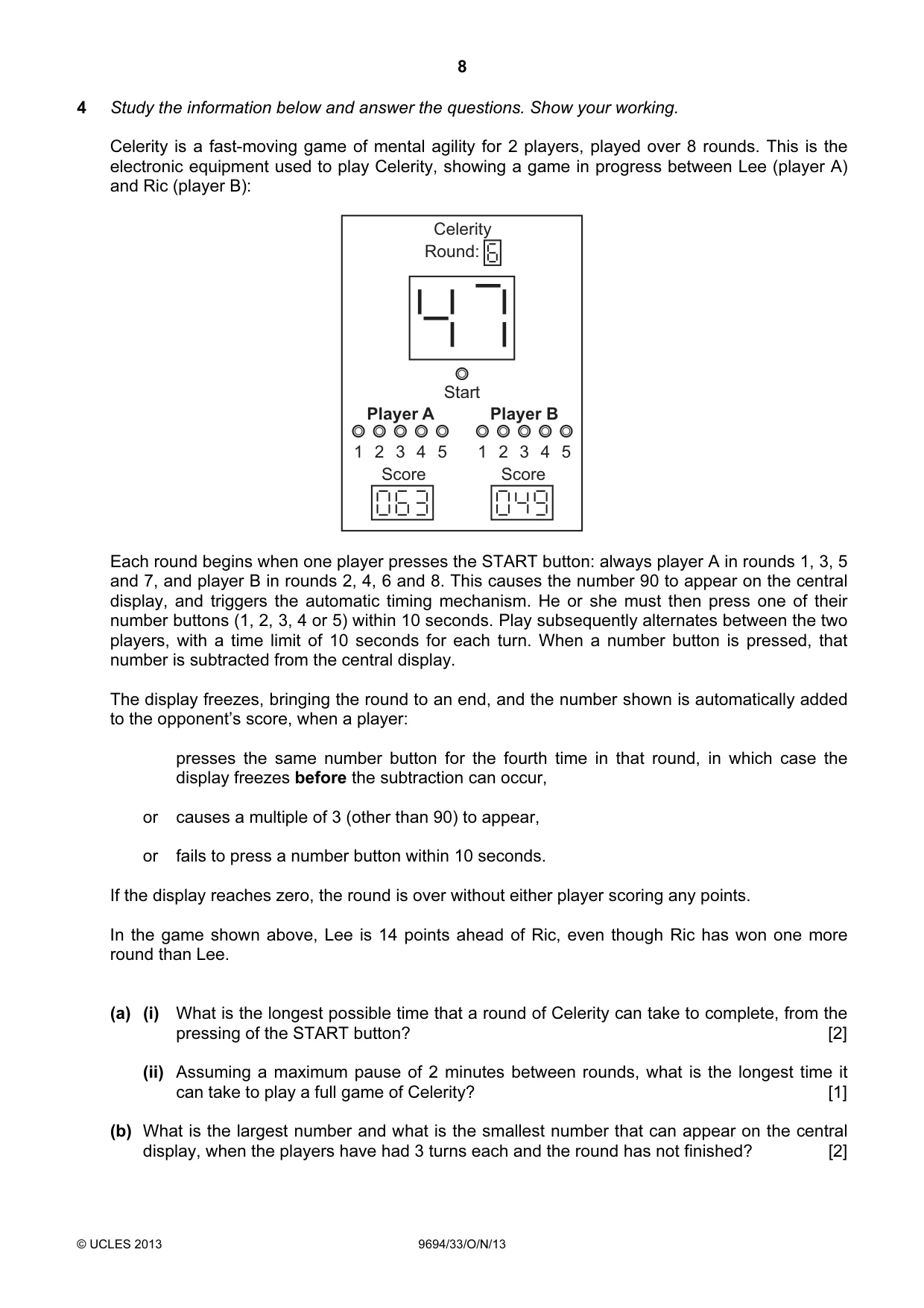
8 © UCLES 2013 9694/33/O/N/13 4 Study the information below and answer the questions. Show your working. Celerity is a fast-moving game of mental agility for 2 players, played over 8 rounds. This is the electronic equipment used to play Celerity, showing a game in progress between Lee (player A) and Ric (player B): Celerity Round: Start Player A Score 1 2 3 4 5 1 2 3 4 5 Player B Score Each round begins when one player presses the START button: always player A in rounds 1, 3, 5 and 7, and player B in rounds 2, 4, 6 and 8. This causes the number 90 to appear on the central display, and triggers the automatic timing mechanism. He or she must then press one of their number buttons (1, 2, 3, 4 or 5) within 10 seconds. Play subsequently alternates between the two players, with a time limit of 10 seconds for each turn. When a number button is pressed, that number is subtracted from the central display. The display freezes, bringing the round to an end, and the number shown is automatically added to the opponent’s score, when a player: presses the same number button for the fourth time in that round, in which case the display freezes before the subtraction can occur, or causes a multiple of 3 (other than 90) to appear, or fails to press a number button within 10 seconds. If the display reaches zero, the round is over without either player scoring any points. In the game shown above, Lee is 14 points ahead of Ric, even though Ric has won one more round than Lee. (a) (i) What is the longest possible time that a round of Celerity can take to complete, from the pressing of the START button? [2] (ii) Assuming a maximum pause of 2 minutes between rounds, what is the longest time it can take to play a full game of Celerity? [1] (b) What is the largest number and what is the smallest number that can appear on the central display, when the players have had 3 turns each and the round has not finished? [2]
Question paper, page 9
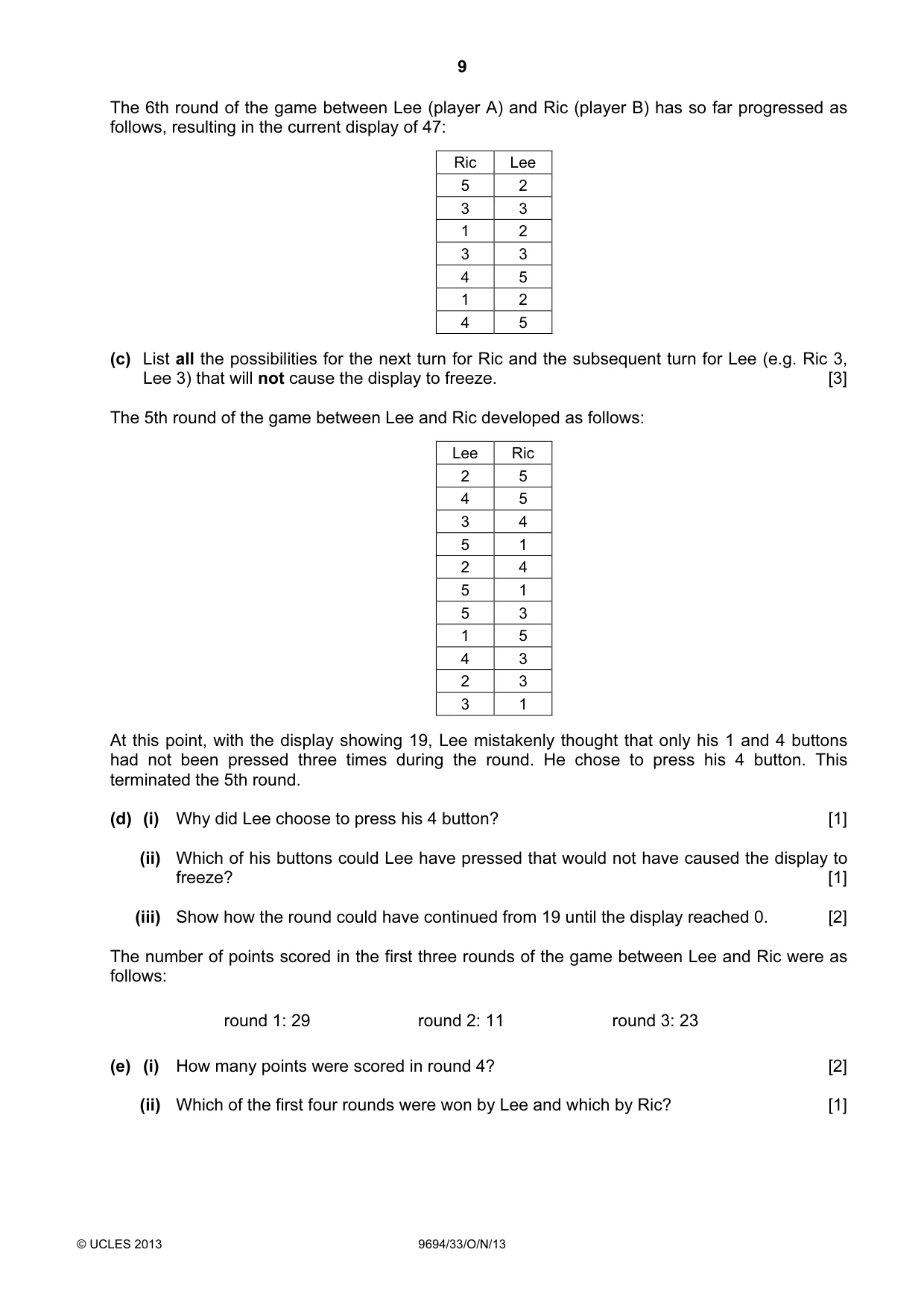
9 © UCLES 2013 9694/33/O/N/13 The 6th round of the game between Lee (player A) and Ric (player B) has so far progressed as follows, resulting in the current display of 47: Ric Lee 5 2 3 3 1 2 3 3 4 5 1 2 4 5 (c) List all the possibilities for the next turn for Ric and the subsequent turn for Lee (e.g. Ric 3, Lee 3) that will not cause the display to freeze. [3] The 5th round of the game between Lee and Ric developed as follows: Lee Ric 2 5 4 5 3 4 5 1 2 4 5 1 5 3 1 5 4 3 2 3 3 1 At this point, with the display showing 19, Lee mistakenly thought that only his 1 and 4 buttons had not been pressed three times during the round. He chose to press his 4 button. This terminated the 5th round. (d) (i) Why did Lee choose to press his 4 button? [1] (ii) Which of his buttons could Lee have pressed that would not have caused the display to freeze? [1] (iii) Show how the round could have continued from 19 until the display reached 0. [2] The number of points scored in the first three rounds of the game between Lee and Ric were as follows: round 1: 29 round 2: 11 round 3: 23 (e) (i) How many points were scored in round 4? [2] (ii) Which of the first four rounds were won by Lee and which by Ric? [1]
Question paper, page 10
10 © UCLES 2013 9694/33/O/N/13 BLANK PAGE
Question paper, page 11
11 © UCLES 2013 9694/33/O/N/13 BLANK PAGE
Question paper, page 12
12 Permission to reproduce items where third-party owned material protected by copyright is included has been sought and cleared where possible. Every reasonable effort has been made by the publisher (UCLES) to trace copyright holders, but if any items requiring clearance have unwittingly been included, the publisher will be pleased to make amends at the earliest possible opportunity. University of Cambridge International Examinations is part of the Cambridge Assessment Group. Cambridge Assessment is the brand name of University of Cambridge Local Examinations Syndicate (UCLES), which is itself a department of the University of Cambridge. © UCLES 2013 9694/33/O/N/13 BLANK PAGE
Mark scheme, page 1
CAMBRIDGE INTERNATIONAL EXAMINATIONS GCE Advanced Level MARK SCHEME for the October/November 2013 series 9694 THINKING SKILLS 9694/33 Paper 3 (Problem Analysis and Solution), maximum raw mark 50 This mark scheme is published as an aid to teachers and candidates, to indicate the requirements of the examination. It shows the basis on which Examiners were instructed to award marks. It does not indicate the details of the discussions that took place at an Examiners’ meeting before marking began, which would have considered the acceptability of alternative answers. Mark schemes should be read in conjunction with the question paper and the Principal Examiner Report for Teachers. Cambridge will not enter into discussions about these mark schemes. Cambridge is publishing the mark schemes for the October/November 2013 series for most IGCSE, GCE Advanced Level and Advanced Subsidiary Level components and some Ordinary Level components.
Mark scheme, page 2
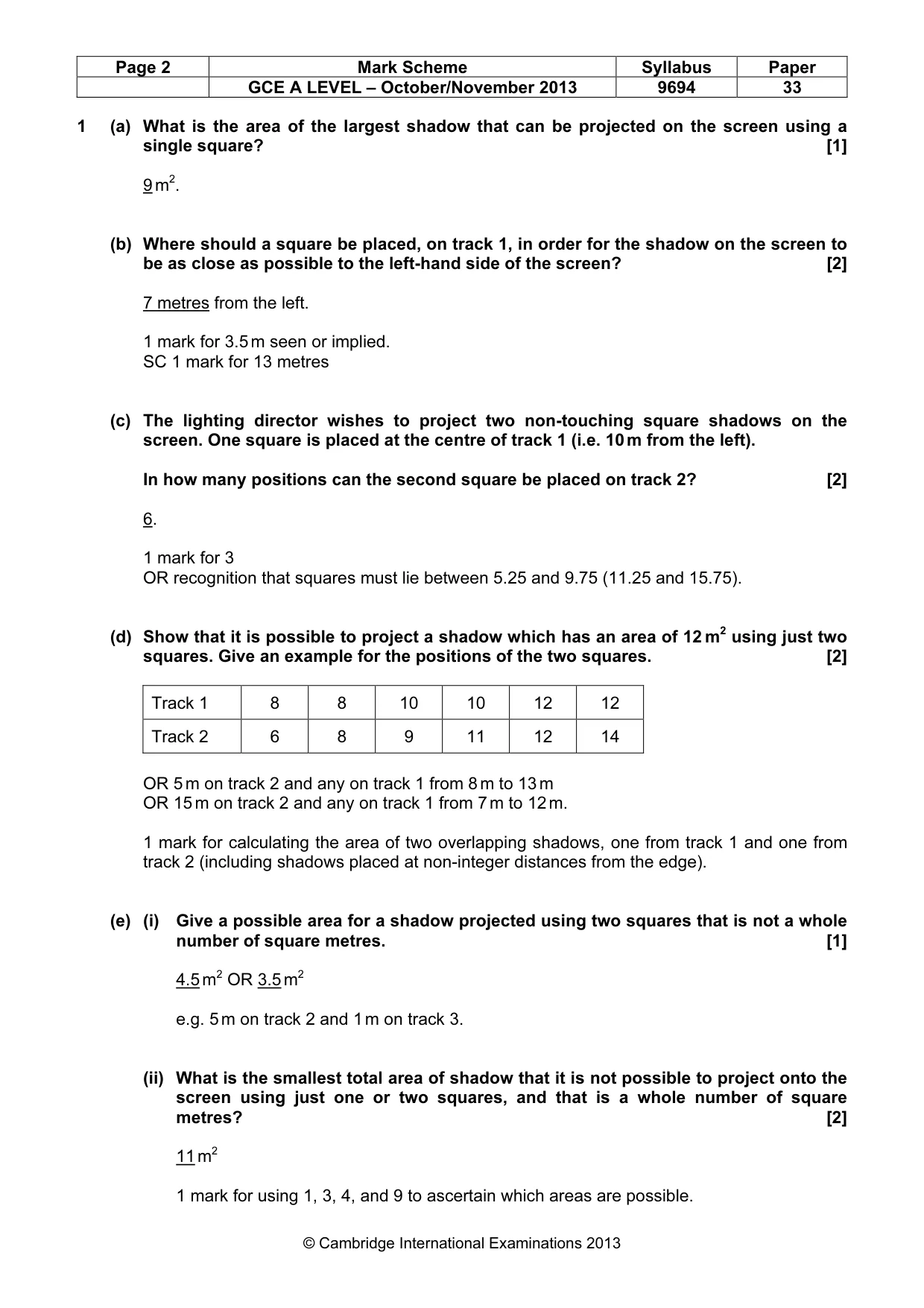
Page 2 Mark Scheme Syllabus Paper GCE A LEVEL – October/November 2013 9694 33 © Cambridge International Examinations 2013 1 (a) What is the area of the largest shadow that can be projected on the screen using a single square? [1] 9 m2. (b) Where should a square be placed, on track 1, in order for the shadow on the screen to be as close as possible to the left-hand side of the screen? [2] 7 metres from the left. 1 mark for 3.5 m seen or implied. SC 1 mark for 13 metres (c) The lighting director wishes to project two non-touching square shadows on the screen. One square is placed at the centre of track 1 (i.e. 10 m from the left). In how many positions can the second square be placed on track 2? [2] 6. 1 mark for 3 OR recognition that squares must lie between 5.25 and 9.75 (11.25 and 15.75). (d) Show that it is possible to project a shadow which has an area of 12 m2 using just two squares. Give an example for the positions of the two squares. [2] Track 1 8 8 10 10 12 12 Track 2 6 8 9 11 12 14 OR 5 m on track 2 and any on track 1 from 8 m to 13 m OR 15 m on track 2 and any on track 1 from 7 m to 12 m. 1 mark for calculating the area of two overlapping shadows, one from track 1 and one from track 2 (including shadows placed at non-integer distances from the edge). (e) (i) Give a possible area for a shadow projected using two squares that is not a whole number of square metres. [1] 4.5 m2 OR 3.5 m2 e.g. 5 m on track 2 and 1 m on track 3. (ii) What is the smallest total area of shadow that it is not possible to project onto the screen using just one or two squares, and that is a whole number of square metres? [2] 11 m2 1 mark for using 1, 3, 4, and 9 to ascertain which areas are possible.
Mark scheme, page 3
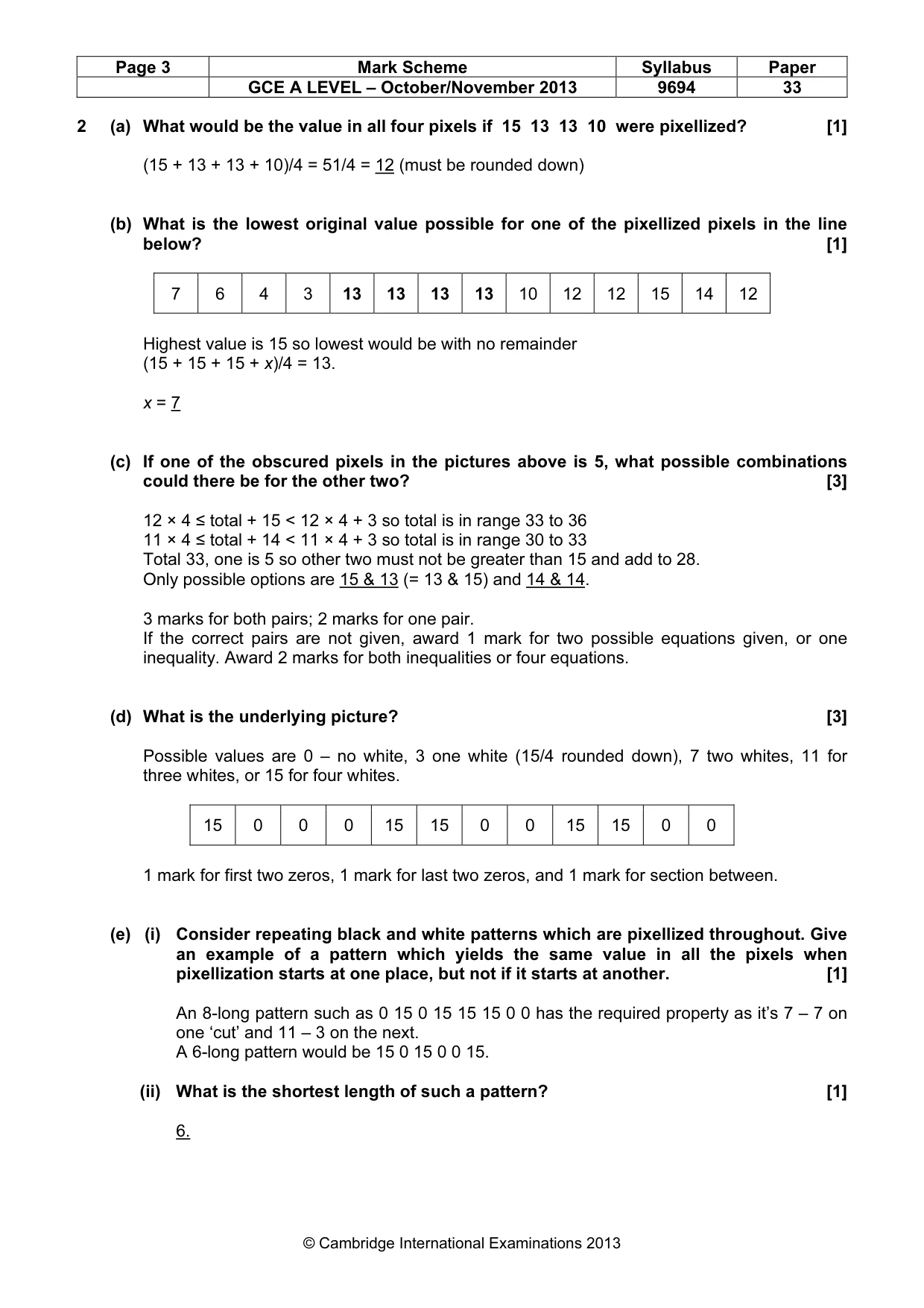
Page 3 Mark Scheme Syllabus Paper GCE A LEVEL – October/November 2013 9694 33 © Cambridge International Examinations 2013 2 (a) What would be the value in all four pixels if 15 13 13 10 were pixellized? [1] (15 + 13 + 13 + 10)/4 = 51/4 = 12 (must be rounded down) (b) What is the lowest original value possible for one of the pixellized pixels in the line below? [1] 7 6 4 3 13 13 13 13 10 12 12 15 14 12 Highest value is 15 so lowest would be with no remainder (15 + 15 + 15 + x)/4 = 13. x = 7 (c) If one of the obscured pixels in the pictures above is 5, what possible combinations could there be for the other two? [3] 12 × 4 ≤ total + 15 < 12 × 4 + 3 so total is in range 33 to 36 11 × 4 ≤ total + 14 < 11 × 4 + 3 so total is in range 30 to 33 Total 33, one is 5 so other two must not be greater than 15 and add to 28. Only possible options are 15 & 13 (= 13 & 15) and 14 & 14. 3 marks for both pairs; 2 marks for one pair. If the correct pairs are not given, award 1 mark for two possible equations given, or one inequality. Award 2 marks for both inequalities or four equations. (d) What is the underlying picture? [3] Possible values are 0 – no white, 3 one white (15/4 rounded down), 7 two whites, 11 for three whites, or 15 for four whites. 15 0 0 0 15 15 0 0 15 15 0 0 1 mark for first two zeros, 1 mark for last two zeros, and 1 mark for section between. (e) (i) Consider repeating black and white patterns which are pixellized throughout. Give an example of a pattern which yields the same value in all the pixels when pixellization starts at one place, but not if it starts at another. [1] An 8-long pattern such as 0 15 0 15 15 15 0 0 has the required property as it’s 7 – 7 on one ‘cut’ and 11 – 3 on the next. A 6-long pattern would be 15 0 15 0 0 15. (ii) What is the shortest length of such a pattern? [1] 6.
Mark scheme, page 4
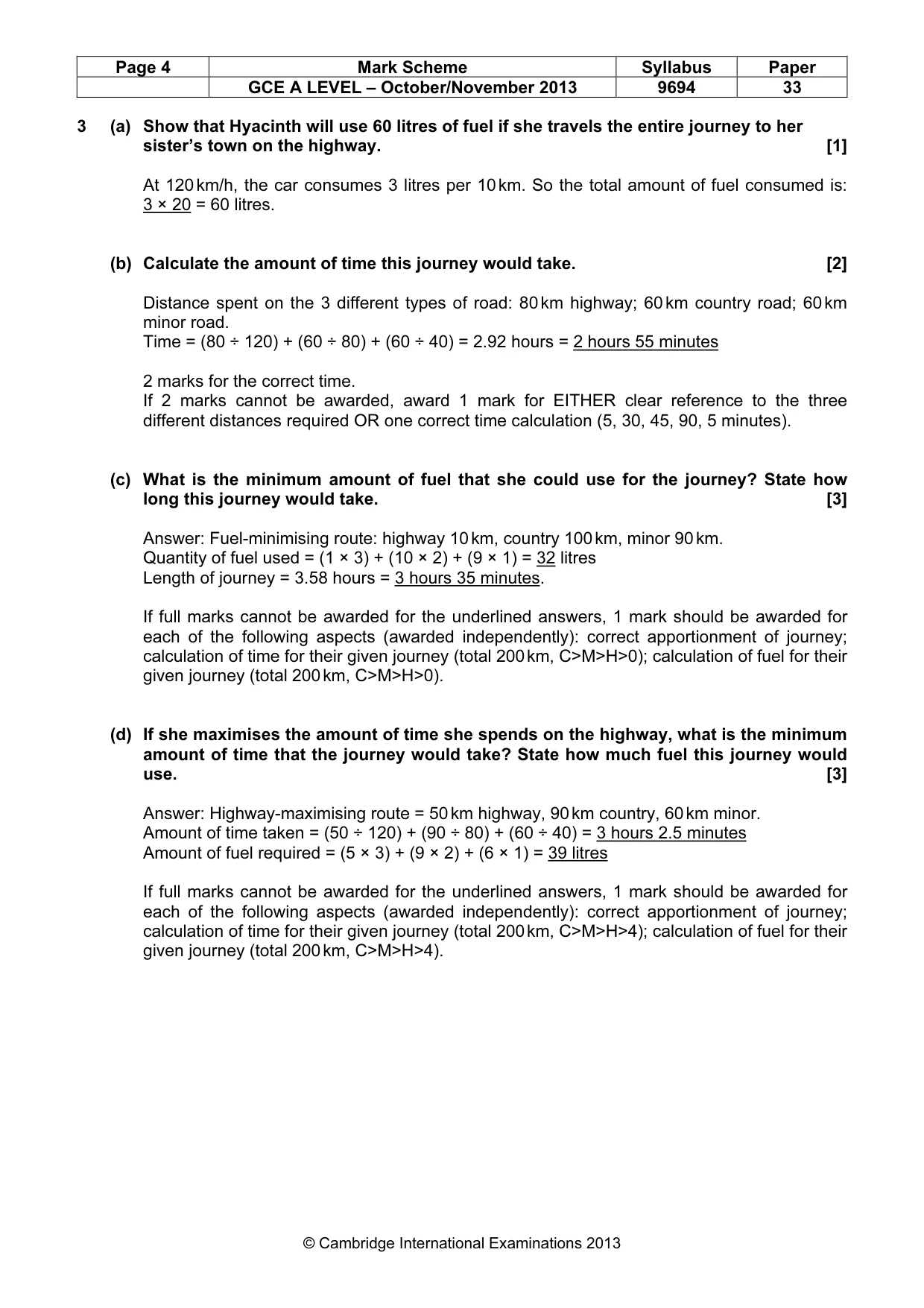
Page 4 Mark Scheme Syllabus Paper GCE A LEVEL – October/November 2013 9694 33 © Cambridge International Examinations 2013 3 (a) Show that Hyacinth will use 60 litres of fuel if she travels the entire journey to her sister’s town on the highway. [1] At 120 km/h, the car consumes 3 litres per 10 km. So the total amount of fuel consumed is: 3 × 20 = 60 litres. (b) Calculate the amount of time this journey would take. [2] Distance spent on the 3 different types of road: 80 km highway; 60 km country road; 60 km minor road. Time = (80 ÷ 120) + (60 ÷ 80) + (60 ÷ 40) = 2.92 hours = 2 hours 55 minutes 2 marks for the correct time. If 2 marks cannot be awarded, award 1 mark for EITHER clear reference to the three different distances required OR one correct time calculation (5, 30, 45, 90, 5 minutes). (c) What is the minimum amount of fuel that she could use for the journey? State how long this journey would take. [3] Answer: Fuel-minimising route: highway 10 km, country 100 km, minor 90 km. Quantity of fuel used = (1 × 3) + (10 × 2) + (9 × 1) = 32 litres Length of journey = 3.58 hours = 3 hours 35 minutes. If full marks cannot be awarded for the underlined answers, 1 mark should be awarded for each of the following aspects (awarded independently): correct apportionment of journey; calculation of time for their given journey (total 200 km, C>M>H>0); calculation of fuel for their given journey (total 200 km, C>M>H>0). (d) If she maximises the amount of time she spends on the highway, what is the minimum amount of time that the journey would take? State how much fuel this journey would use. [3] Answer: Highway-maximising route = 50 km highway, 90 km country, 60 km minor. Amount of time taken = (50 ÷ 120) + (90 ÷ 80) + (60 ÷ 40) = 3 hours 2.5 minutes Amount of fuel required = (5 × 3) + (9 × 2) + (6 × 1) = 39 litres If full marks cannot be awarded for the underlined answers, 1 mark should be awarded for each of the following aspects (awarded independently): correct apportionment of journey; calculation of time for their given journey (total 200 km, C>M>H>4); calculation of fuel for their given journey (total 200 km, C>M>H>4).
Mark scheme, page 5
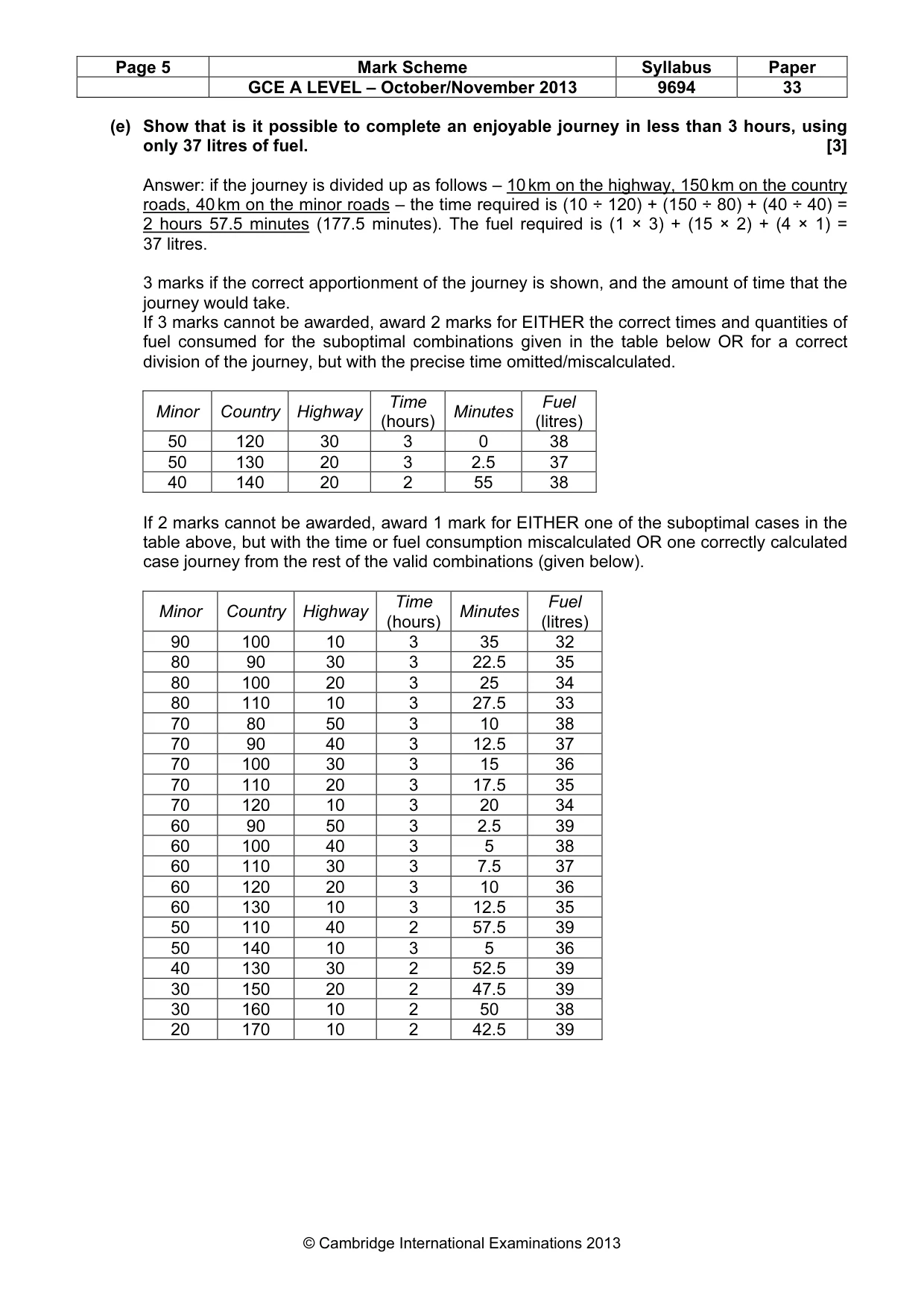
Page 5 Mark Scheme Syllabus Paper GCE A LEVEL – October/November 2013 9694 33 © Cambridge International Examinations 2013 (e) Show that is it possible to complete an enjoyable journey in less than 3 hours, using only 37 litres of fuel. [3] Answer: if the journey is divided up as follows – 10 km on the highway, 150 km on the country roads, 40 km on the minor roads – the time required is (10 ÷ 120) + (150 ÷ 80) + (40 ÷ 40) = 2 hours 57.5 minutes (177.5 minutes). The fuel required is (1 × 3) + (15 × 2) + (4 × 1) = 37 litres. 3 marks if the correct apportionment of the journey is shown, and the amount of time that the journey would take. If 3 marks cannot be awarded, award 2 marks for EITHER the correct times and quantities of fuel consumed for the suboptimal combinations given in the table below OR for a correct division of the journey, but with the precise time omitted/miscalculated. Minor Country Highway Time (hours) Minutes Fuel (litres) 50 120 30 3 0 38 50 130 20 3 2.5 37 40 140 20 2 55 38 If 2 marks cannot be awarded, award 1 mark for EITHER one of the suboptimal cases in the table above, but with the time or fuel consumption miscalculated OR one correctly calculated case journey from the rest of the valid combinations (given below). Minor Country Highway Time (hours) Minutes Fuel (litres) 90 100 10 3 35 32 80 90 30 3 22.5 35 80 100 20 3 25 34 80 110 10 3 27.5 33 70 80 50 3 10 38 70 90 40 3 12.5 37 70 100 30 3 15 36 70 110 20 3 17.5 35 70 120 10 3 20 34 60 90 50 3 2.5 39 60 100 40 3 5 38 60 110 30 3 7.5 37 60 120 20 3 10 36 60 130 10 3 12.5 35 50 110 40 2 57.5 39 50 140 10 3 5 36 40 130 30 2 52.5 39 30 150 20 2 47.5 39 30 160 10 2 50 38 20 170 10 2 42.5 39
Mark scheme, page 6
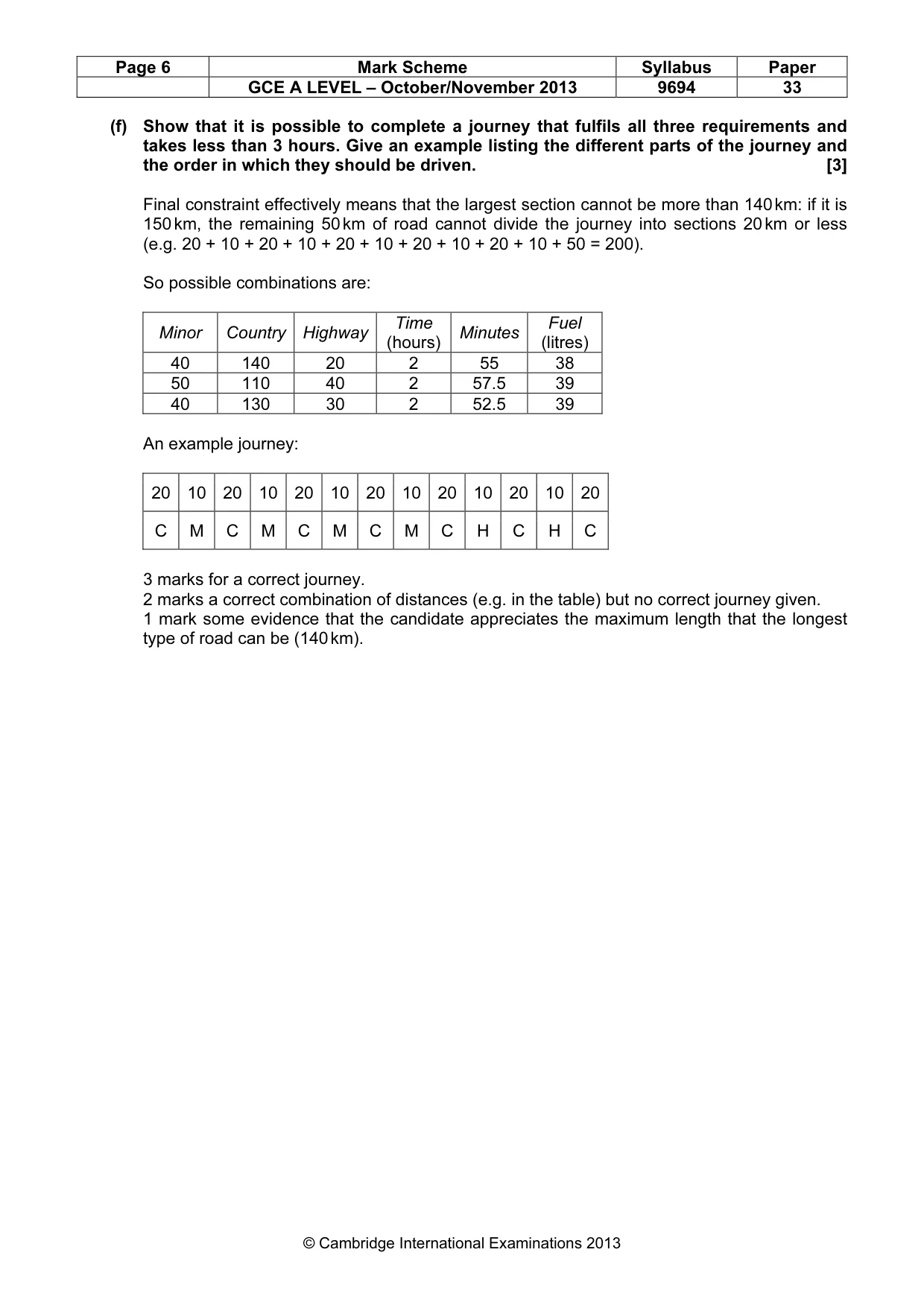
Page 6 Mark Scheme Syllabus Paper GCE A LEVEL – October/November 2013 9694 33 © Cambridge International Examinations 2013 (f) Show that it is possible to complete a journey that fulfils all three requirements and takes less than 3 hours. Give an example listing the different parts of the journey and the order in which they should be driven. [3] Final constraint effectively means that the largest section cannot be more than 140 km: if it is 150 km, the remaining 50 km of road cannot divide the journey into sections 20 km or less (e.g. 20 + 10 + 20 + 10 + 20 + 10 + 20 + 10 + 20 + 10 + 50 = 200). So possible combinations are: Minor Country Highway Time (hours) Minutes Fuel (litres) 40 140 20 2 55 38 50 110 40 2 57.5 39 40 130 30 2 52.5 39 An example journey: 20 10 20 10 20 10 20 10 20 10 20 10 20 C M C M C M C M C H C H C 3 marks for a correct journey. 2 marks a correct combination of distances (e.g. in the table) but no correct journey given. 1 mark some evidence that the candidate appreciates the maximum length that the longest type of road can be (140 km).
Mark scheme, page 7
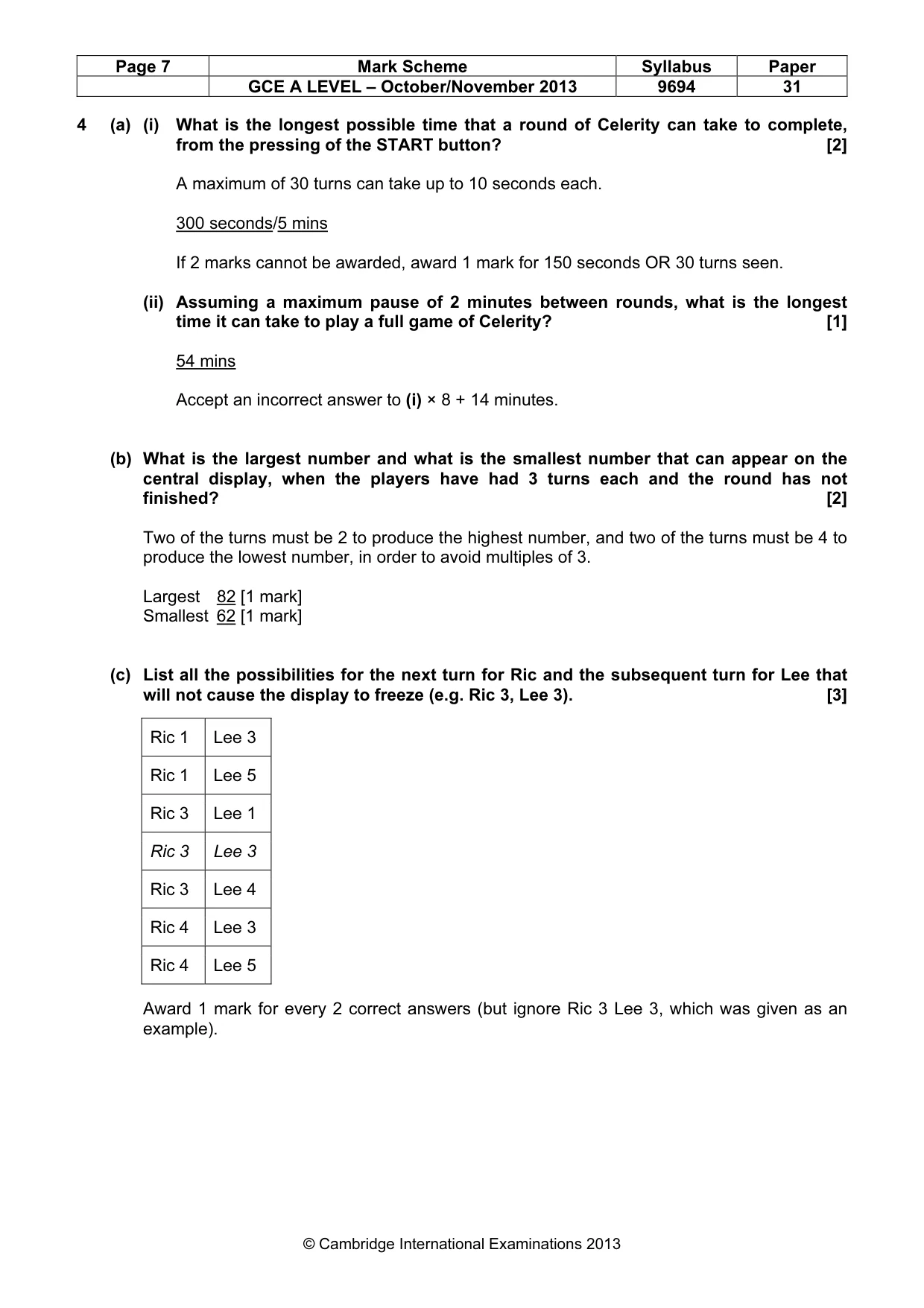
Page 7 Mark Scheme Syllabus Paper GCE A LEVEL – October/November 2013 9694 31 © Cambridge International Examinations 2013 4 (a) (i) What is the longest possible time that a round of Celerity can take to complete, from the pressing of the START button? [2] A maximum of 30 turns can take up to 10 seconds each. 300 seconds/5 mins If 2 marks cannot be awarded, award 1 mark for 150 seconds OR 30 turns seen. (ii) Assuming a maximum pause of 2 minutes between rounds, what is the longest time it can take to play a full game of Celerity? [1] 54 mins Accept an incorrect answer to (i) × 8 + 14 minutes. (b) What is the largest number and what is the smallest number that can appear on the central display, when the players have had 3 turns each and the round has not finished? [2] Two of the turns must be 2 to produce the highest number, and two of the turns must be 4 to produce the lowest number, in order to avoid multiples of 3. Largest 82 [1 mark] Smallest 62 [1 mark] (c) List all the possibilities for the next turn for Ric and the subsequent turn for Lee that will not cause the display to freeze (e.g. Ric 3, Lee 3). [3] Award 1 mark for every 2 correct answers (but ignore Ric 3 Lee 3, which was given as an example). Ric 1 Lee 3 Ric 1 Lee 5 Ric 3 Lee 1 Ric 3 Lee 3 Ric 3 Lee 4 Ric 4 Lee 3 Ric 4 Lee 5
Mark scheme, page 8
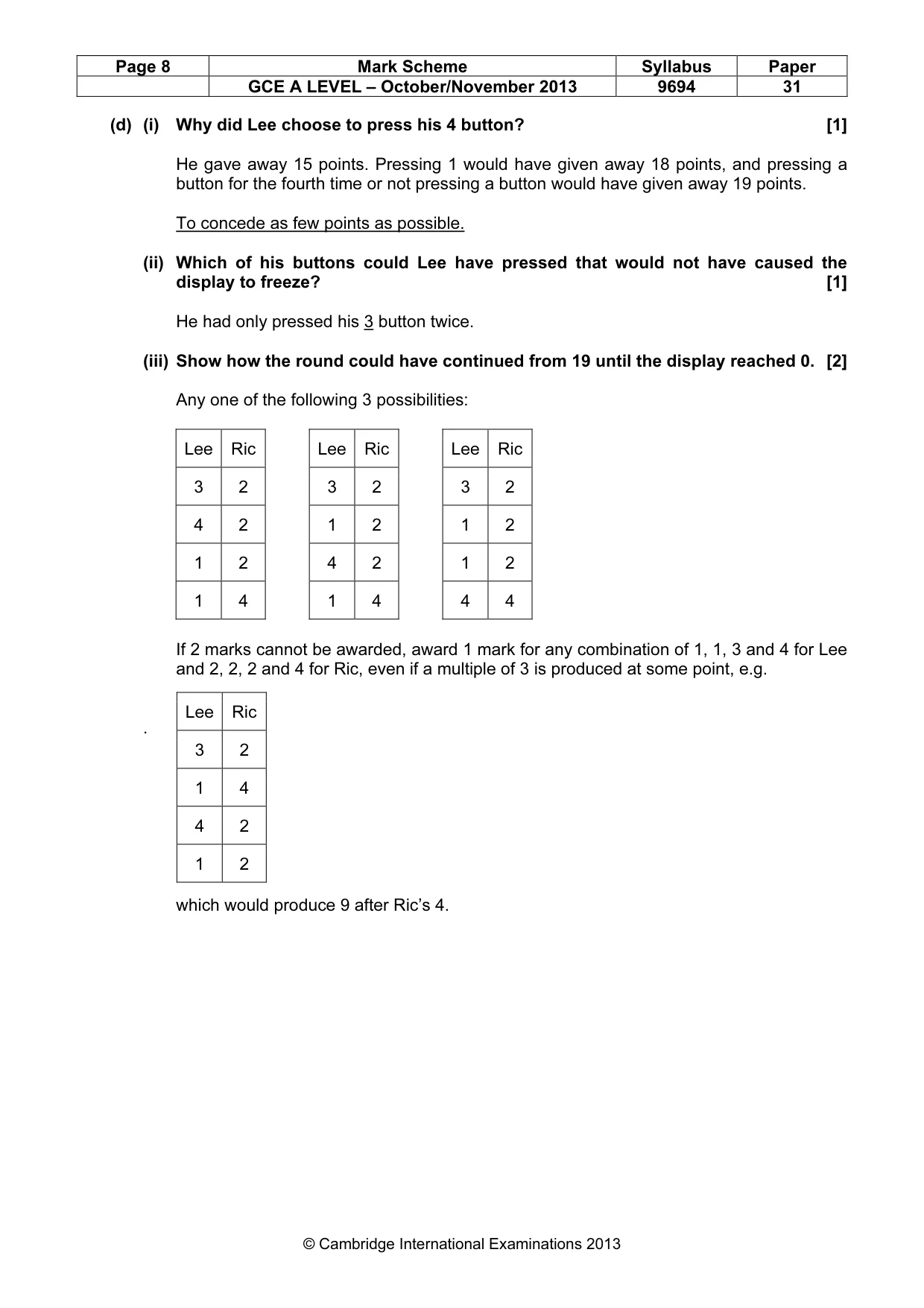
Page 8 Mark Scheme Syllabus Paper GCE A LEVEL – October/November 2013 9694 31 © Cambridge International Examinations 2013 (d) (i) Why did Lee choose to press his 4 button? [1] He gave away 15 points. Pressing 1 would have given away 18 points, and pressing a button for the fourth time or not pressing a button would have given away 19 points. To concede as few points as possible. (ii) Which of his buttons could Lee have pressed that would not have caused the display to freeze? [1] He had only pressed his 3 button twice. (iii) Show how the round could have continued from 19 until the display reached 0. [2] Any one of the following 3 possibilities: Lee Ric Lee Ric Lee Ric 3 2 3 2 3 2 4 2 1 2 1 2 1 2 4 2 1 2 1 4 1 4 4 4 If 2 marks cannot be awarded, award 1 mark for any combination of 1, 1, 3 and 4 for Lee and 2, 2, 2 and 4 for Ric, even if a multiple of 3 is produced at some point, e.g. . which would produce 9 after Ric’s 4. Lee Ric 3 2 1 4 4 2 1 2
Mark scheme, page 9
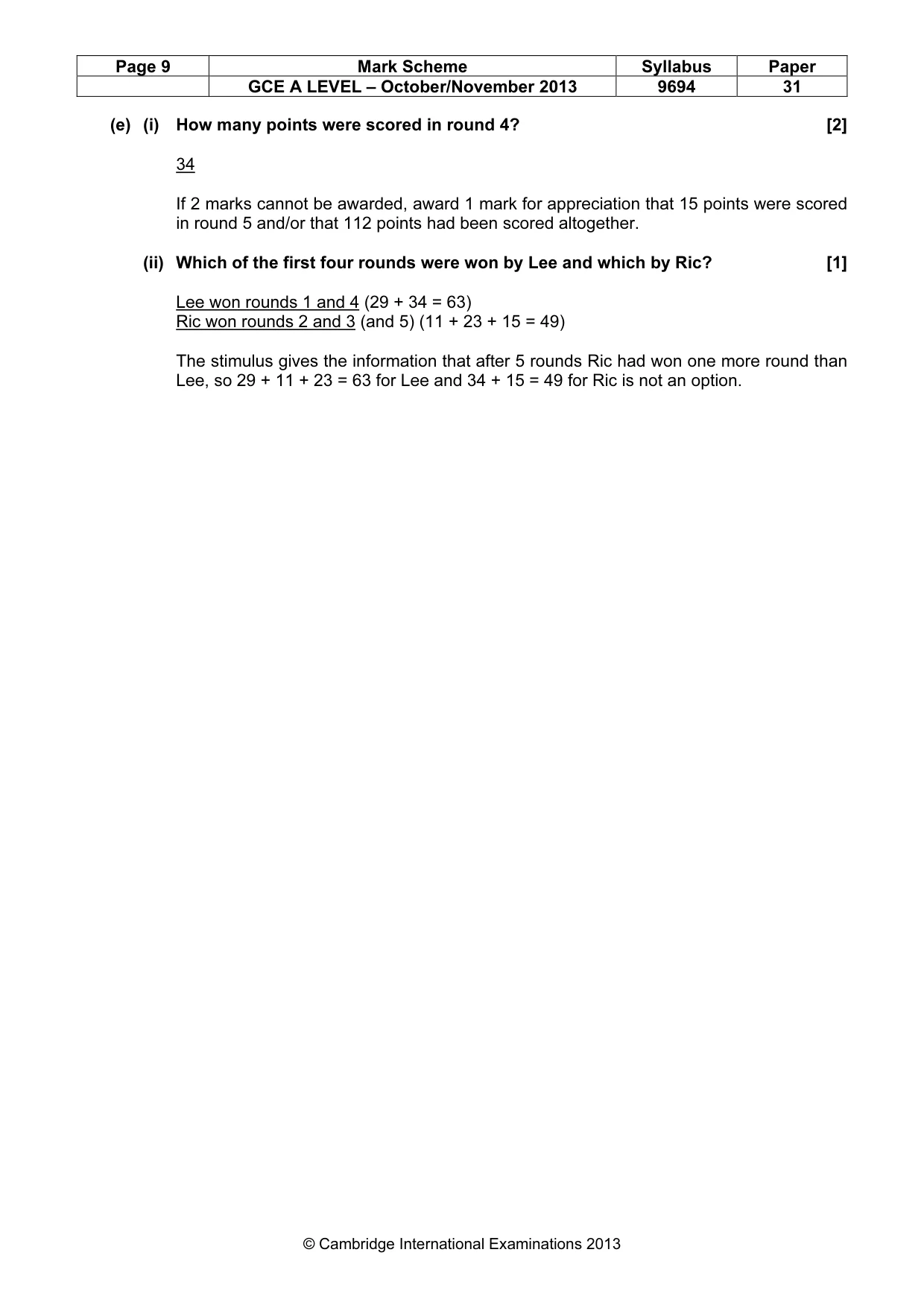
Page 9 Mark Scheme Syllabus Paper GCE A LEVEL – October/November 2013 9694 31 © Cambridge International Examinations 2013 (e) (i) How many points were scored in round 4? [2] 34 If 2 marks cannot be awarded, award 1 mark for appreciation that 15 points were scored in round 5 and/or that 112 points had been scored altogether. (ii) Which of the first four rounds were won by Lee and which by Ric? [1] Lee won rounds 1 and 4 (29 + 34 = 63) Ric won rounds 2 and 3 (and 5) (11 + 23 + 15 = 49) The stimulus gives the information that after 5 rounds Ric had won one more round than Lee, so 29 + 11 + 23 = 63 for Lee and 34 + 15 = 49 for Ric is not an option.
What you needed in this session
Cambridge’s own grade thresholds for 2013 Oct/Nov, Paper 3 · Variant 3. A higher threshold means an easier paper — the bar moves with how the cohort did.