Cambridge A Level Thinking Skills 9694 — 2013 Oct/Nov Paper 3 · Variant 2
9694/32/O/N/13 · 50 marks · ≈56 min
The question paper and its mark scheme, free to read here and free to download. This is Cambridge’s own paper, exactly as it was sat.
Question paper8 pages

Mark scheme9 pages
Answers below. Sit the paper first if you are practising.
Paper as text
Question paper, page 1
This document consists of 7 printed pages and 1 blank page. IB13 11_9694_32/3RP © UCLES 2013 [Turn over *6523374187* UNIVERSITY OF CAMBRIDGE INTERNATIONAL EXAMINATIONS General Certificate of Education Advanced Level THINKING SKILLS 9694/32 Paper 3 Problem Analysis and Solution October/November 2013 1 hour 30 minutes Additional Materials: Answer Booklet/Paper Electronic Calculator READ THESE INSTRUCTIONS FIRST If you have been given an Answer Booklet, follow the instructions on the front cover of the booklet. Write your Centre number, candidate number and name on all the work you hand in. Write in dark blue or black pen. Do not use staples, paper clips, highlighters, glue or correction fluid. DO NOT WRITE IN ANY BARCODES. Answer all the questions. Start each question on a new answer sheet. Calculators should be used where appropriate. At the end of the examination, fasten all your work securely together. The number of marks is given in brackets [ ] at the end of each question or part question.
Question paper, page 2
2 © UCLES 2013 9694/32/O/N/13 1 Study the information below and answer the questions. Show your working. The results in a sailing regatta are decided by adding up the positions each crew achieves in each race. It is not possible to finish at exactly the same time as another crew in a race, so each race position is always awarded to only one crew. Your rank in the regatta is determined by the number of crews ahead of you. The crew with the lowest total score in the regatta is ranked 1st overall, the second-lowest is ranked 2nd etc. If two or more crews tie for a particular rank, then subsequent rankings are adjusted accordingly. For example, if two crews are both ranked 6th in the regatta then the next rank awarded is 8th (since there are seven crews ahead). The rankings are recalculated after each race. There are 10 crews competing in the regatta, and they all finish every race. (a) Show that it is possible to finish 3rd in each of the first three races, and yet be ranked 4th so far, by listing possible positions for the crews ahead of you. [2] (b) What is the best ranking you could have after two races, if you finished 6th in both of them? [2] (c) If you finish 4th in every race in a five-race regatta, what is the worst final ranking you can have? Suggest positions for the crews who beat you. [3] (d) What is the lowest position you could finish in the first three races, if you finished in the same position each time (e.g. 2nd, 2nd, 2nd), and still be able to be ranked 1st before the fourth race? Justify your answer. [3]
Question paper, page 3
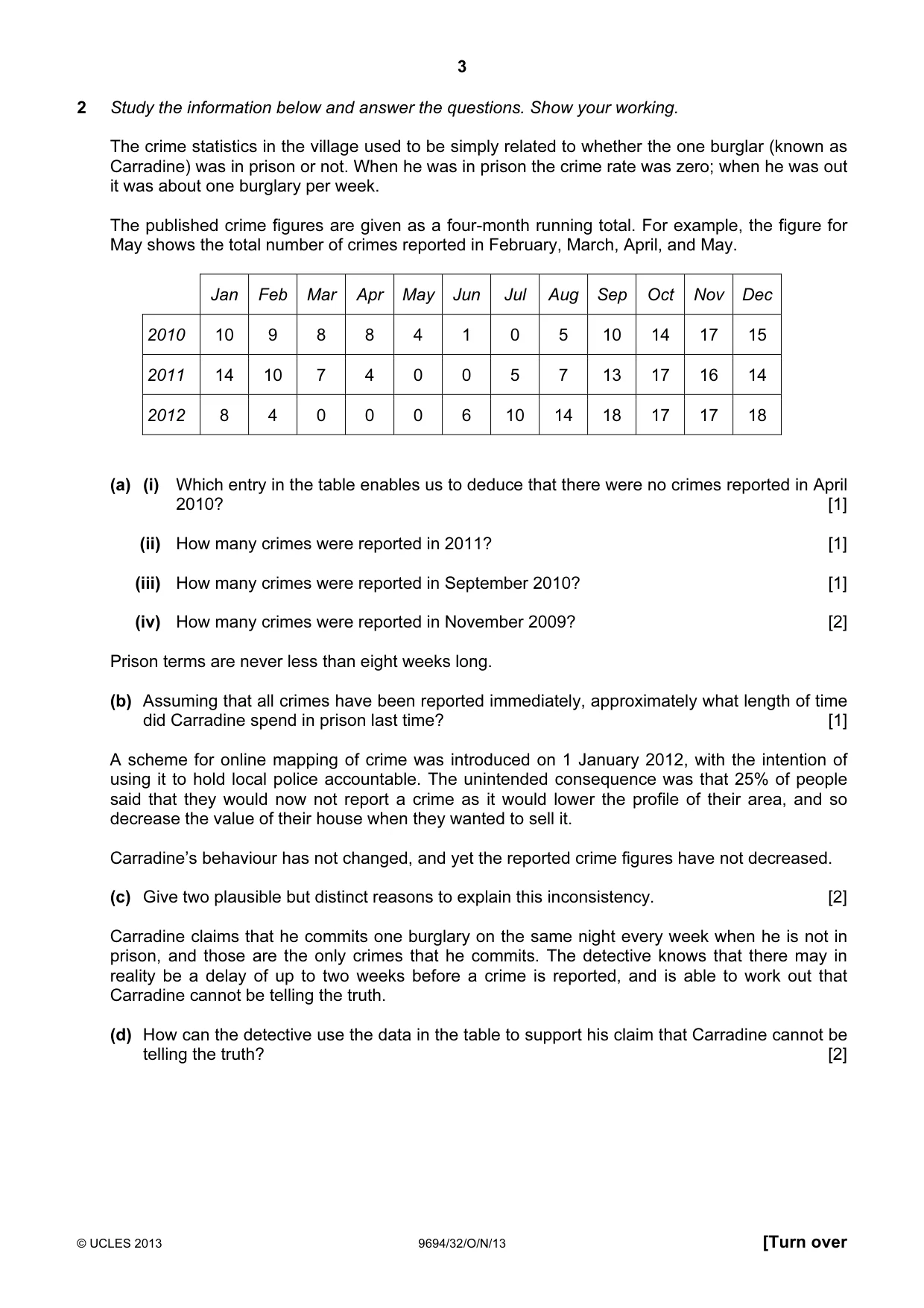
3 © UCLES 2013 9694/32/O/N/13 [Turn over 2 Study the information below and answer the questions. Show your working. The crime statistics in the village used to be simply related to whether the one burglar (known as Carradine) was in prison or not. When he was in prison the crime rate was zero; when he was out it was about one burglary per week. The published crime figures are given as a four-month running total. For example, the figure for May shows the total number of crimes reported in February, March, April, and May. Jan Feb Mar Apr May Jun Jul Aug Sep Oct Nov Dec 2010 10 9 8 8 4 1 0 5 10 14 17 15 2011 14 10 7 4 0 0 5 7 13 17 16 14 2012 8 4 0 0 0 6 10 14 18 17 17 18 (a) (i) Which entry in the table enables us to deduce that there were no crimes reported in April 2010? [1] (ii) How many crimes were reported in 2011? [1] (iii) How many crimes were reported in September 2010? [1] (iv) How many crimes were reported in November 2009? [2] Prison terms are never less than eight weeks long. (b) Assuming that all crimes have been reported immediately, approximately what length of time did Carradine spend in prison last time? [1] A scheme for online mapping of crime was introduced on 1 January 2012, with the intention of using it to hold local police accountable. The unintended consequence was that 25% of people said that they would now not report a crime as it would lower the profile of their area, and so decrease the value of their house when they wanted to sell it. Carradine’s behaviour has not changed, and yet the reported crime figures have not decreased. (c) Give two plausible but distinct reasons to explain this inconsistency. [2] Carradine claims that he commits one burglary on the same night every week when he is not in prison, and those are the only crimes that he commits. The detective knows that there may in reality be a delay of up to two weeks before a crime is reported, and is able to work out that Carradine cannot be telling the truth. (d) How can the detective use the data in the table to support his claim that Carradine cannot be telling the truth? [2]
Question paper, page 4
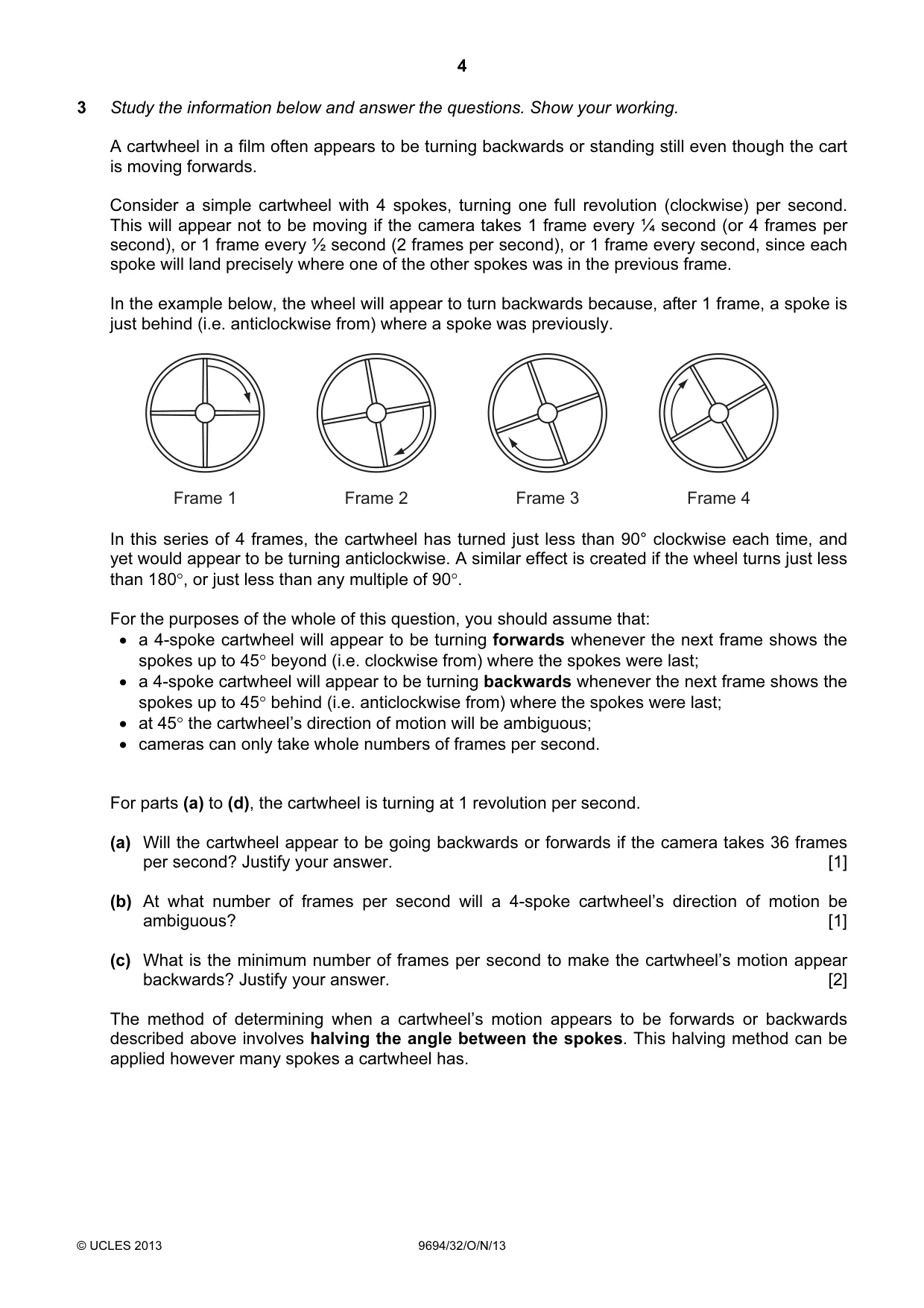
4 © UCLES 2013 9694/32/O/N/13 3 Study the information below and answer the questions. Show your working. A cartwheel in a film often appears to be turning backwards or standing still even though the cart is moving forwards. Consider a simple cartwheel with 4 spokes, turning one full revolution (clockwise) per second. This will appear not to be moving if the camera takes 1 frame every ¼ second (or 4 frames per second), or 1 frame every ½ second (2 frames per second), or 1 frame every second, since each spoke will land precisely where one of the other spokes was in the previous frame. In the example below, the wheel will appear to turn backwards because, after 1 frame, a spoke is just behind (i.e. anticlockwise from) where a spoke was previously. Frame 1 Frame 2 Frame 3 Frame 4 In this series of 4 frames, the cartwheel has turned just less than 90° clockwise each time, and yet would appear to be turning anticlockwise. A similar effect is created if the wheel turns just less than 180°, or just less than any multiple of 90°. For the purposes of the whole of this question, you should assume that: • a 4-spoke cartwheel will appear to be turning forwards whenever the next frame shows the spokes up to 45° beyond (i.e. clockwise from) where the spokes were last; • a 4-spoke cartwheel will appear to be turning backwards whenever the next frame shows the spokes up to 45° behind (i.e. anticlockwise from) where the spokes were last; • at 45° the cartwheel’s direction of motion will be ambiguous; • cameras can only take whole numbers of frames per second. For parts (a) to (d), the cartwheel is turning at 1 revolution per second. (a) Will the cartwheel appear to be going backwards or forwards if the camera takes 36 frames per second? Justify your answer. [1] (b) At what number of frames per second will a 4-spoke cartwheel’s direction of motion be ambiguous? [1] (c) What is the minimum number of frames per second to make the cartwheel’s motion appear backwards? Justify your answer. [2] The method of determining when a cartwheel’s motion appears to be forwards or backwards described above involves halving the angle between the spokes. This halving method can be applied however many spokes a cartwheel has.
Question paper, page 5
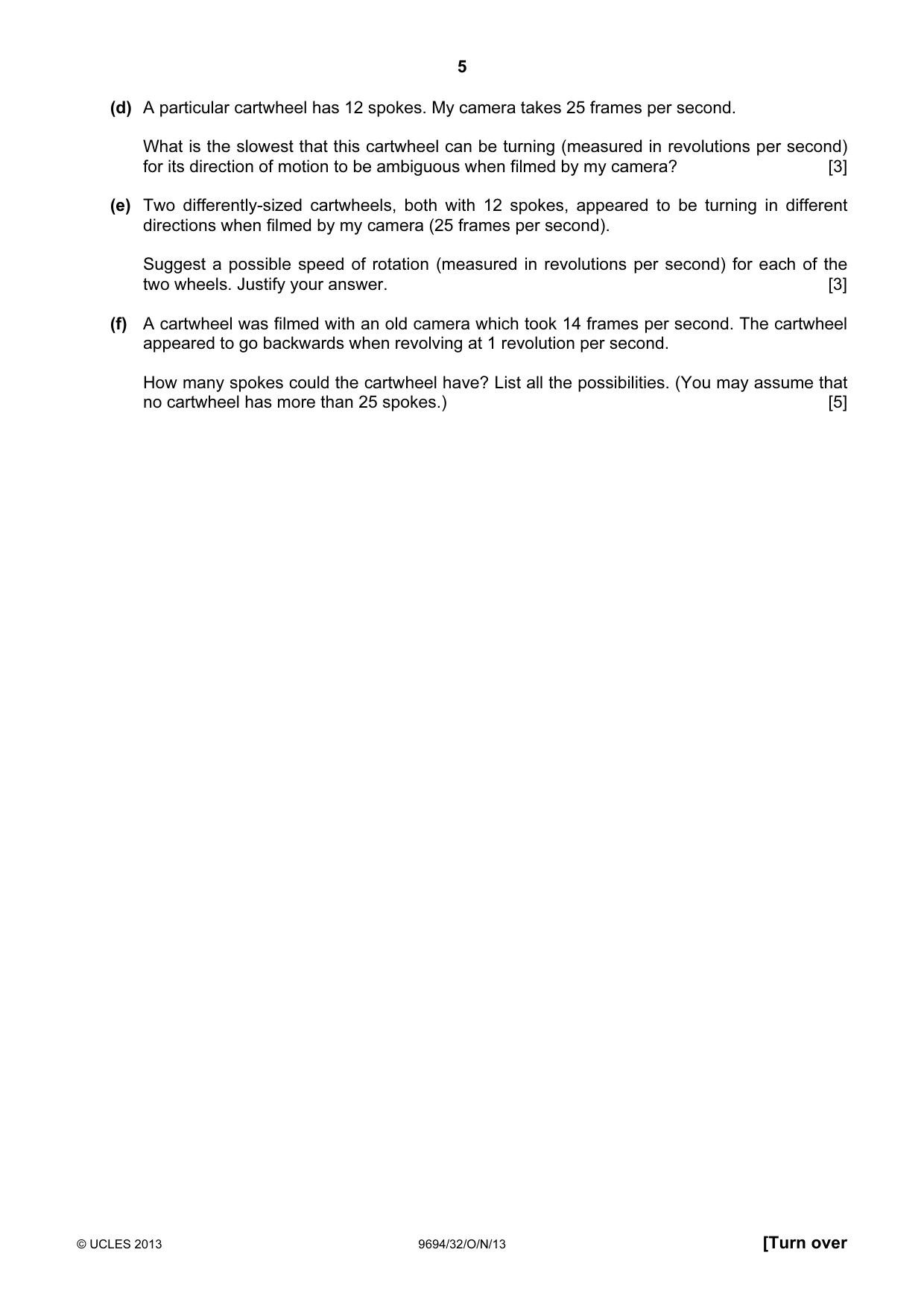
5 © UCLES 2013 9694/32/O/N/13 [Turn over (d) A particular cartwheel has 12 spokes. My camera takes 25 frames per second. What is the slowest that this cartwheel can be turning (measured in revolutions per second) for its direction of motion to be ambiguous when filmed by my camera? [3] (e) Two differently-sized cartwheels, both with 12 spokes, appeared to be turning in different directions when filmed by my camera (25 frames per second). Suggest a possible speed of rotation (measured in revolutions per second) for each of the two wheels. Justify your answer. [3] (f) A cartwheel was filmed with an old camera which took 14 frames per second. The cartwheel appeared to go backwards when revolving at 1 revolution per second. How many spokes could the cartwheel have? List all the possibilities. (You may assume that no cartwheel has more than 25 spokes.) [5]
Question paper, page 6
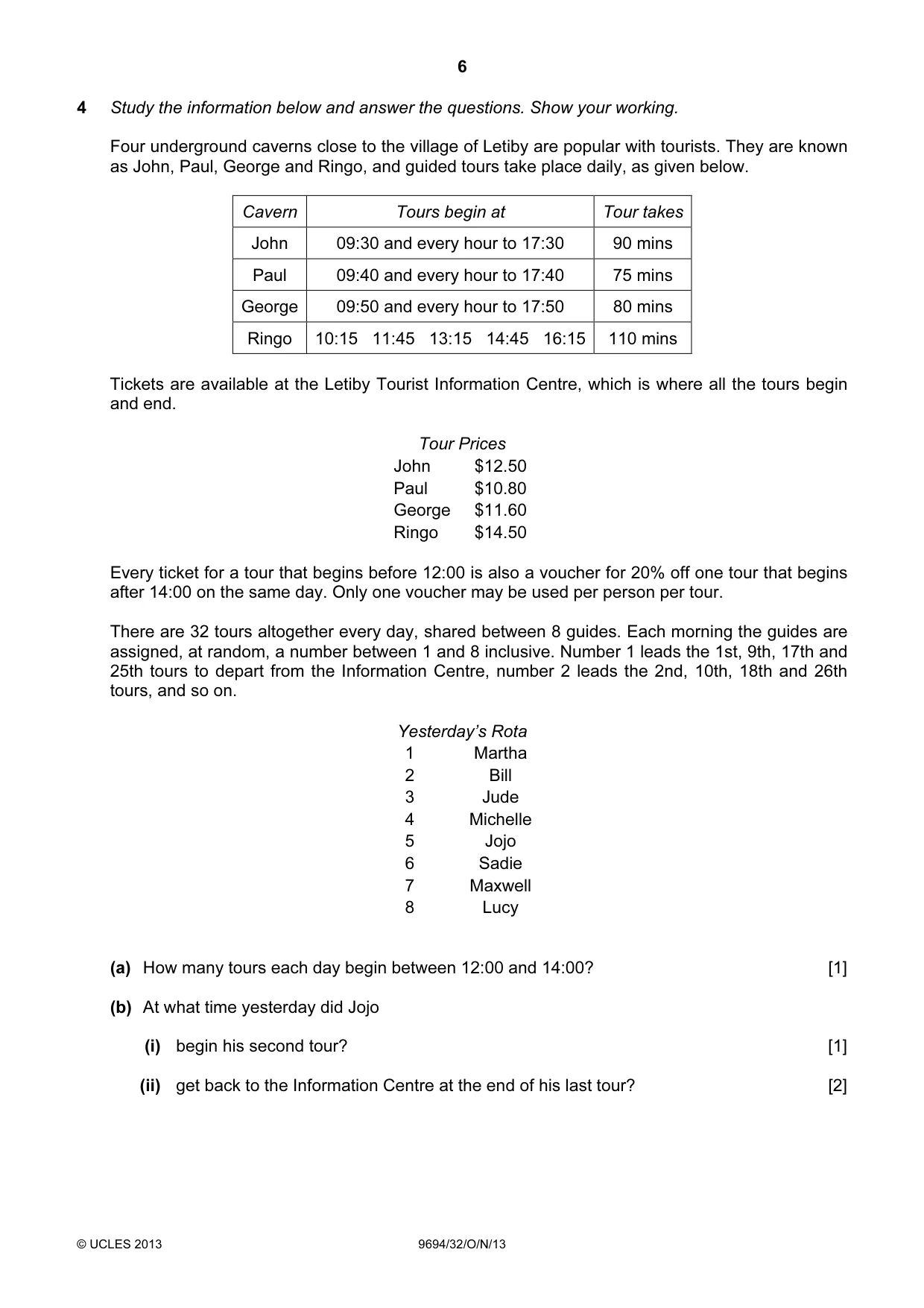
6 © UCLES 2013 9694/32/O/N/13 4 Study the information below and answer the questions. Show your working. Four underground caverns close to the village of Letiby are popular with tourists. They are known as John, Paul, George and Ringo, and guided tours take place daily, as given below. Cavern Tours begin at Tour takes John 09:30 and every hour to 17:30 90 mins Paul 09:40 and every hour to 17:40 75 mins George 09:50 and every hour to 17:50 80 mins Ringo 10:15 11:45 13:15 14:45 16:15 110 mins Tickets are available at the Letiby Tourist Information Centre, which is where all the tours begin and end. Tour Prices John $12.50 Paul $10.80 George $11.60 Ringo $14.50 Every ticket for a tour that begins before 12:00 is also a voucher for 20% off one tour that begins after 14:00 on the same day. Only one voucher may be used per person per tour. There are 32 tours altogether every day, shared between 8 guides. Each morning the guides are assigned, at random, a number between 1 and 8 inclusive. Number 1 leads the 1st, 9th, 17th and 25th tours to depart from the Information Centre, number 2 leads the 2nd, 10th, 18th and 26th tours, and so on. Yesterday’s Rota 1 Martha 2 Bill 3 Jude 4 Michelle 5 Jojo 6 Sadie 7 Maxwell 8 Lucy (a) How many tours each day begin between 12:00 and 14:00? [1] (b) At what time yesterday did Jojo (i) begin his second tour? [1] (ii) get back to the Information Centre at the end of his last tour? [2]
Question paper, page 7
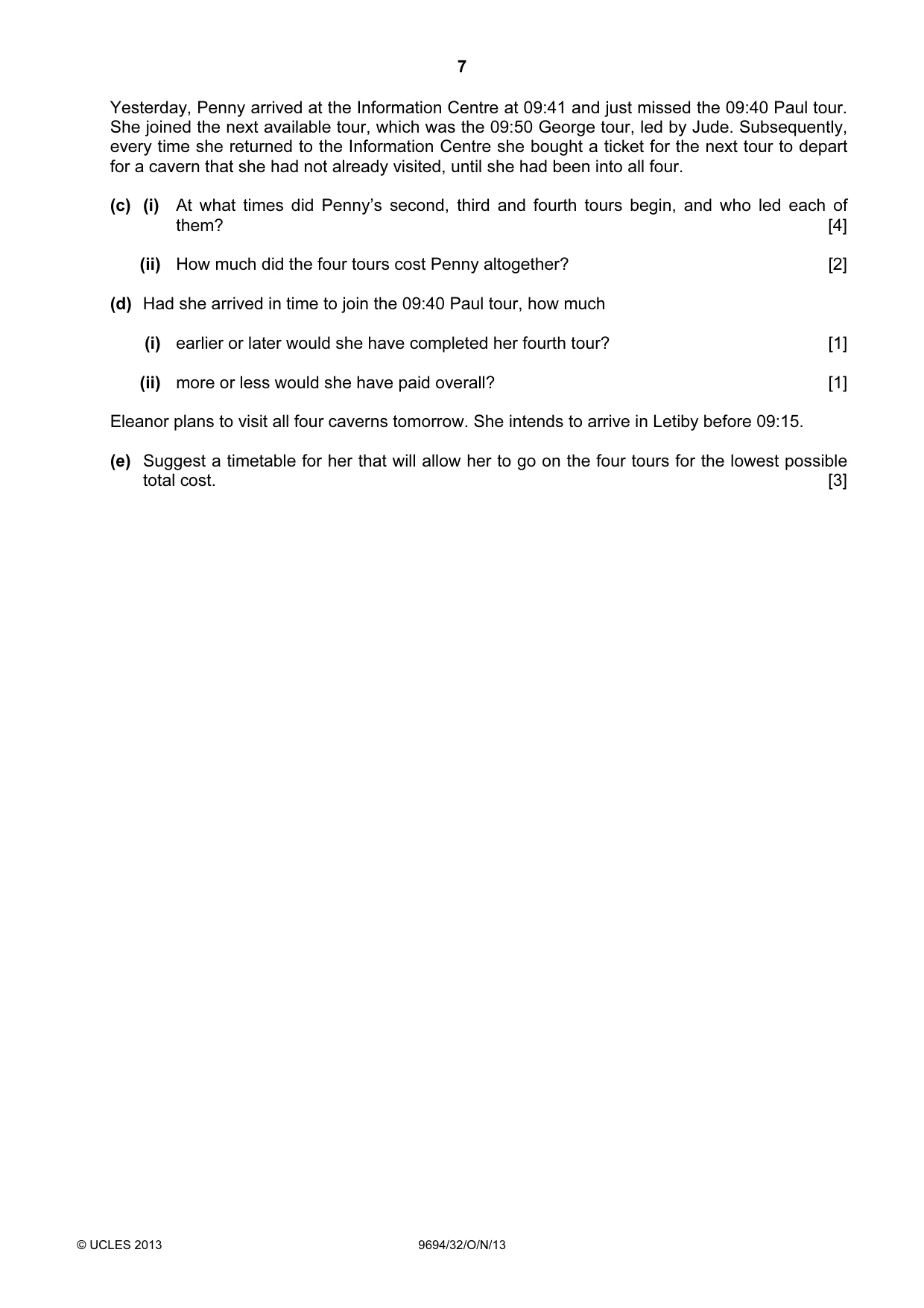
7 © UCLES 2013 9694/32/O/N/13 Yesterday, Penny arrived at the Information Centre at 09:41 and just missed the 09:40 Paul tour. She joined the next available tour, which was the 09:50 George tour, led by Jude. Subsequently, every time she returned to the Information Centre she bought a ticket for the next tour to depart for a cavern that she had not already visited, until she had been into all four. (c) (i) At what times did Penny’s second, third and fourth tours begin, and who led each of them? [4] (ii) How much did the four tours cost Penny altogether? [2] (d) Had she arrived in time to join the 09:40 Paul tour, how much (i) earlier or later would she have completed her fourth tour? [1] (ii) more or less would she have paid overall? [1] Eleanor plans to visit all four caverns tomorrow. She intends to arrive in Letiby before 09:15. (e) Suggest a timetable for her that will allow her to go on the four tours for the lowest possible total cost. [3]
Question paper, page 8
8 Permission to reproduce items where third-party owned material protected by copyright is included has been sought and cleared where possible. Every reasonable effort has been made by the publisher (UCLES) to trace copyright holders, but if any items requiring clearance have unwittingly been included, the publisher will be pleased to make amends at the earliest possible opportunity. University of Cambridge International Examinations is part of the Cambridge Assessment Group. Cambridge Assessment is the brand name of University of Cambridge Local Examinations Syndicate (UCLES), which is itself a department of the University of Cambridge. © UCLES 2013 9694/32/O/N/13 BLANK PAGE
Mark scheme, page 1
CAMBRIDGE INTERNATIONAL EXAMINATIONS GCE Advanced Level MARK SCHEME for the October/November 2013 series 9694 THINKING SKILLS 9694/32 Paper 2 (Problem Analysis and Solution), maximum raw mark 50 This mark scheme is published as an aid to teachers and candidates, to indicate the requirements of the examination. It shows the basis on which Examiners were instructed to award marks. It does not indicate the details of the discussions that took place at an Examiners’ meeting before marking began, which would have considered the acceptability of alternative answers. Mark schemes should be read in conjunction with the question paper and the Principal Examiner Report for Teachers. Cambridge will not enter into discussions about these mark schemes. Cambridge is publishing the mark schemes for the October/November 2013 series for most IGCSE, GCE Advanced Level and Advanced Subsidiary Level components and some Ordinary Level components.
Mark scheme, page 2
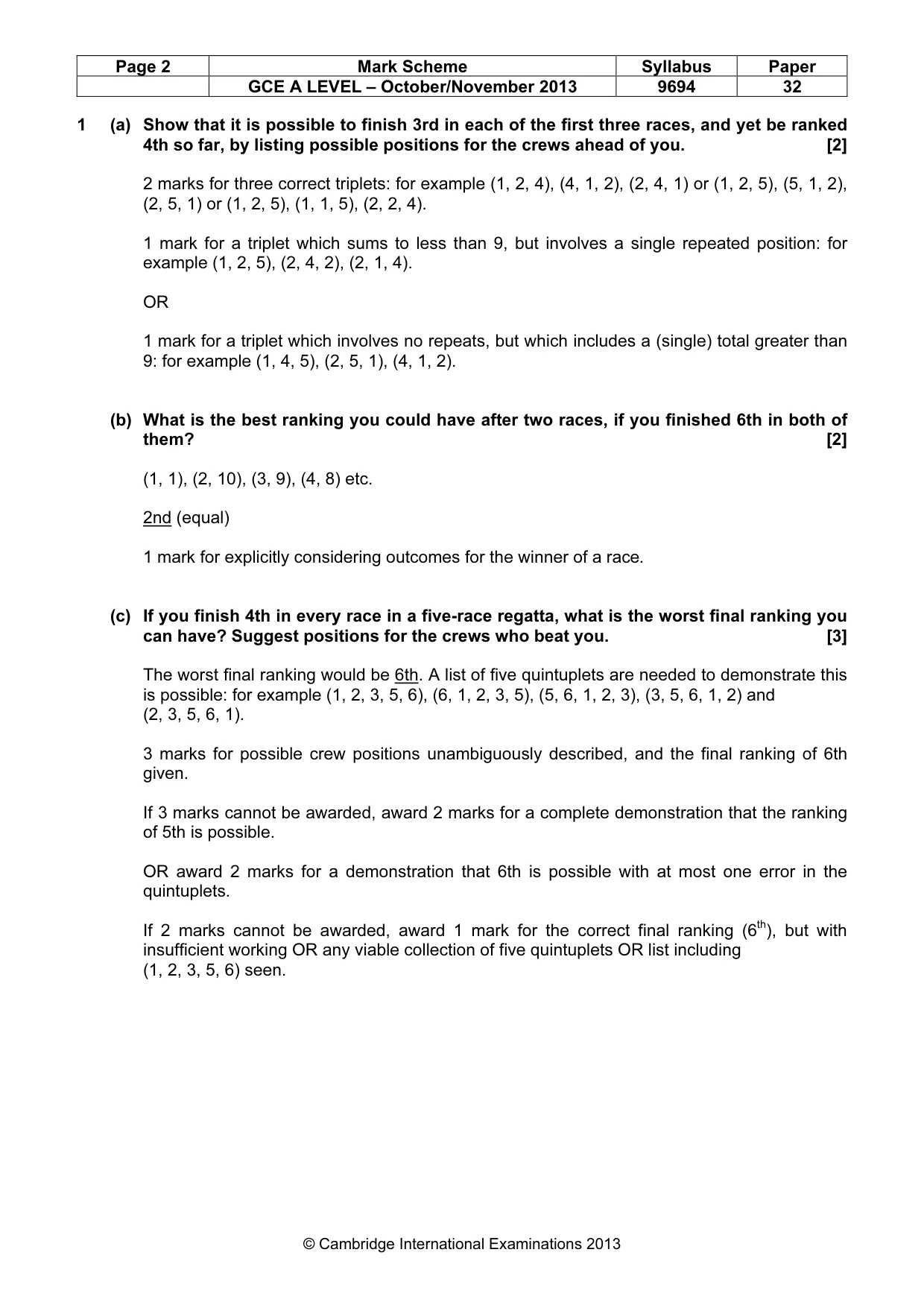
Page 2 Mark Scheme Syllabus Paper GCE A LEVEL – October/November 2013 9694 32 © Cambridge International Examinations 2013 1 (a) Show that it is possible to finish 3rd in each of the first three races, and yet be ranked 4th so far, by listing possible positions for the crews ahead of you. [2] 2 marks for three correct triplets: for example (1, 2, 4), (4, 1, 2), (2, 4, 1) or (1, 2, 5), (5, 1, 2), (2, 5, 1) or (1, 2, 5), (1, 1, 5), (2, 2, 4). 1 mark for a triplet which sums to less than 9, but involves a single repeated position: for example (1, 2, 5), (2, 4, 2), (2, 1, 4). OR 1 mark for a triplet which involves no repeats, but which includes a (single) total greater than 9: for example (1, 4, 5), (2, 5, 1), (4, 1, 2). (b) What is the best ranking you could have after two races, if you finished 6th in both of them? [2] (1, 1), (2, 10), (3, 9), (4, 8) etc. 2nd (equal) 1 mark for explicitly considering outcomes for the winner of a race. (c) If you finish 4th in every race in a five-race regatta, what is the worst final ranking you can have? Suggest positions for the crews who beat you. [3] The worst final ranking would be 6th. A list of five quintuplets are needed to demonstrate this is possible: for example (1, 2, 3, 5, 6), (6, 1, 2, 3, 5), (5, 6, 1, 2, 3), (3, 5, 6, 1, 2) and (2, 3, 5, 6, 1). 3 marks for possible crew positions unambiguously described, and the final ranking of 6th given. If 3 marks cannot be awarded, award 2 marks for a complete demonstration that the ranking of 5th is possible. OR award 2 marks for a demonstration that 6th is possible with at most one error in the quintuplets. If 2 marks cannot be awarded, award 1 mark for the correct final ranking (6th), but with insufficient working OR any viable collection of five quintuplets OR list including (1, 2, 3, 5, 6) seen.
Mark scheme, page 3
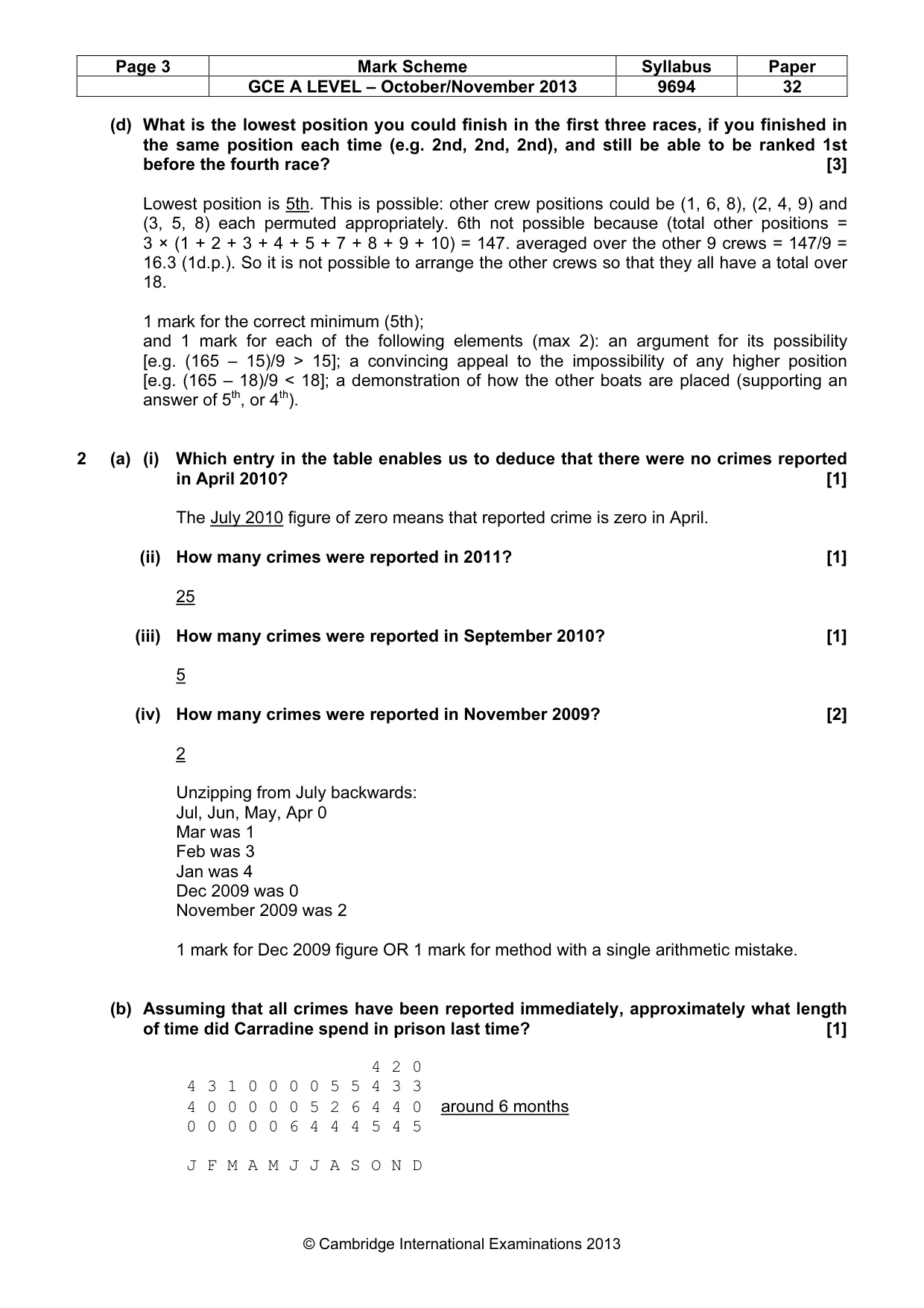
Page 3 Mark Scheme Syllabus Paper GCE A LEVEL – October/November 2013 9694 32 © Cambridge International Examinations 2013 (d) What is the lowest position you could finish in the first three races, if you finished in the same position each time (e.g. 2nd, 2nd, 2nd), and still be able to be ranked 1st before the fourth race? [3] Lowest position is 5th. This is possible: other crew positions could be (1, 6, 8), (2, 4, 9) and (3, 5, 8) each permuted appropriately. 6th not possible because (total other positions = 3 × (1 + 2 + 3 + 4 + 5 + 7 + 8 + 9 + 10) = 147. averaged over the other 9 crews = 147/9 = 16.3 (1d.p.). So it is not possible to arrange the other crews so that they all have a total over 18. 1 mark for the correct minimum (5th); and 1 mark for each of the following elements (max 2): an argument for its possibility [e.g. (165 – 15)/9 > 15]; a convincing appeal to the impossibility of any higher position [e.g. (165 – 18)/9 < 18]; a demonstration of how the other boats are placed (supporting an answer of 5th, or 4th). 2 (a) (i) Which entry in the table enables us to deduce that there were no crimes reported in April 2010? [1] The July 2010 figure of zero means that reported crime is zero in April. (ii) How many crimes were reported in 2011? [1] 25 (iii) How many crimes were reported in September 2010? [1] 5 (iv) How many crimes were reported in November 2009? [2] 2 Unzipping from July backwards: Jul, Jun, May, Apr 0 Mar was 1 Feb was 3 Jan was 4 Dec 2009 was 0 November 2009 was 2 1 mark for Dec 2009 figure OR 1 mark for method with a single arithmetic mistake. (b) Assuming that all crimes have been reported immediately, approximately what length of time did Carradine spend in prison last time? [1] 4 2 0 4 3 1 0 0 0 0 5 5 4 3 3 4 0 0 0 0 0 5 2 6 4 4 0 around 6 months 0 0 0 0 0 6 4 4 4 5 4 5 J F M A M J J A S O N D
Mark scheme, page 4
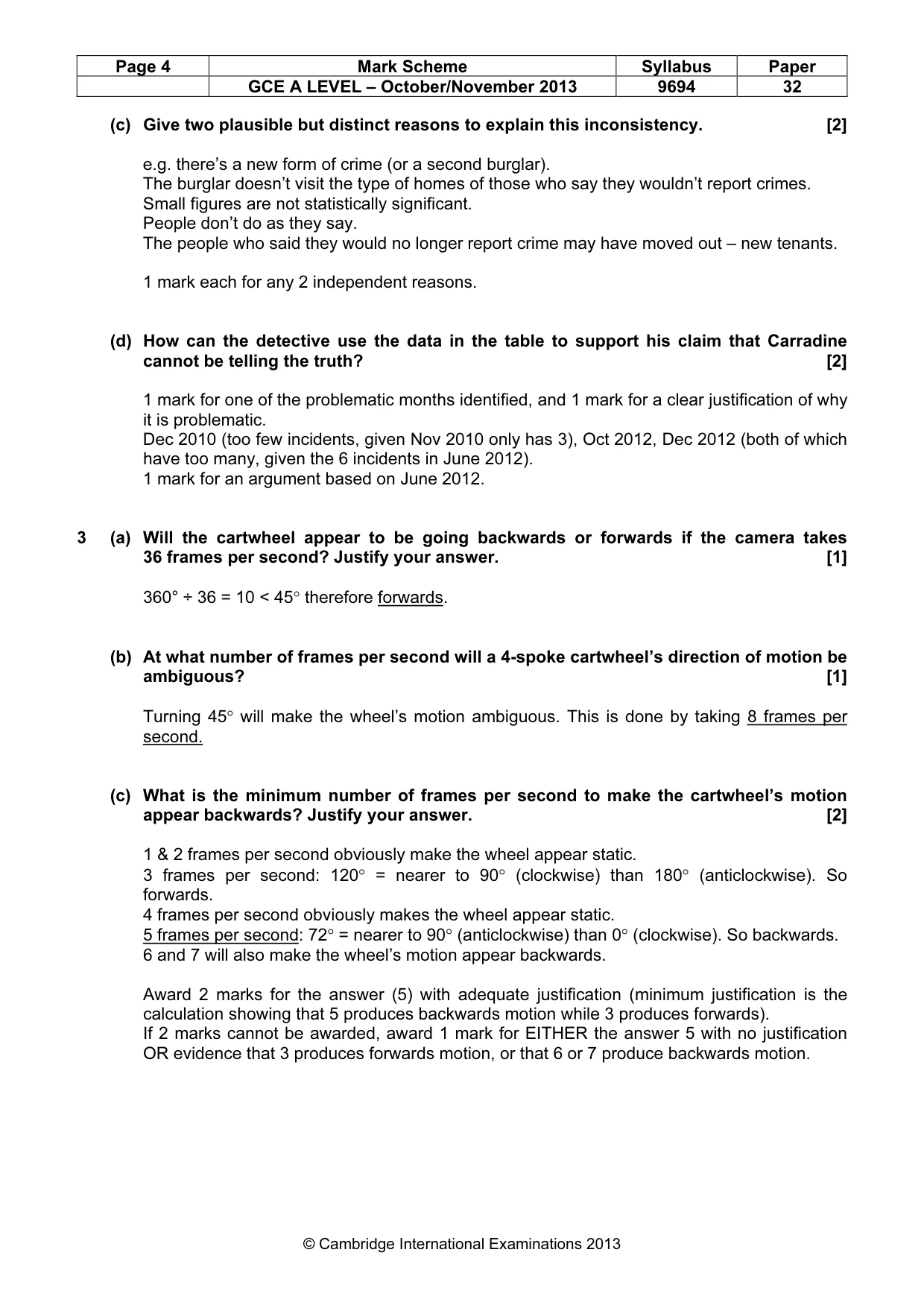
Page 4 Mark Scheme Syllabus Paper GCE A LEVEL – October/November 2013 9694 32 © Cambridge International Examinations 2013 (c) Give two plausible but distinct reasons to explain this inconsistency. [2] e.g. there’s a new form of crime (or a second burglar). The burglar doesn’t visit the type of homes of those who say they wouldn’t report crimes. Small figures are not statistically significant. People don’t do as they say. The people who said they would no longer report crime may have moved out – new tenants. 1 mark each for any 2 independent reasons. (d) How can the detective use the data in the table to support his claim that Carradine cannot be telling the truth? [2] 1 mark for one of the problematic months identified, and 1 mark for a clear justification of why it is problematic. Dec 2010 (too few incidents, given Nov 2010 only has 3), Oct 2012, Dec 2012 (both of which have too many, given the 6 incidents in June 2012). 1 mark for an argument based on June 2012. 3 (a) Will the cartwheel appear to be going backwards or forwards if the camera takes 36 frames per second? Justify your answer. [1] 360° ÷ 36 = 10 < 45° therefore forwards. (b) At what number of frames per second will a 4-spoke cartwheel’s direction of motion be ambiguous? [1] Turning 45° will make the wheel’s motion ambiguous. This is done by taking 8 frames per second. (c) What is the minimum number of frames per second to make the cartwheel’s motion appear backwards? Justify your answer. [2] 1 & 2 frames per second obviously make the wheel appear static. 3 frames per second: 120° = nearer to 90° (clockwise) than 180° (anticlockwise). So forwards. 4 frames per second obviously makes the wheel appear static. 5 frames per second: 72° = nearer to 90° (anticlockwise) than 0° (clockwise). So backwards. 6 and 7 will also make the wheel’s motion appear backwards. Award 2 marks for the answer (5) with adequate justification (minimum justification is the calculation showing that 5 produces backwards motion while 3 produces forwards). If 2 marks cannot be awarded, award 1 mark for EITHER the answer 5 with no justification OR evidence that 3 produces forwards motion, or that 6 or 7 produce backwards motion.
Mark scheme, page 5
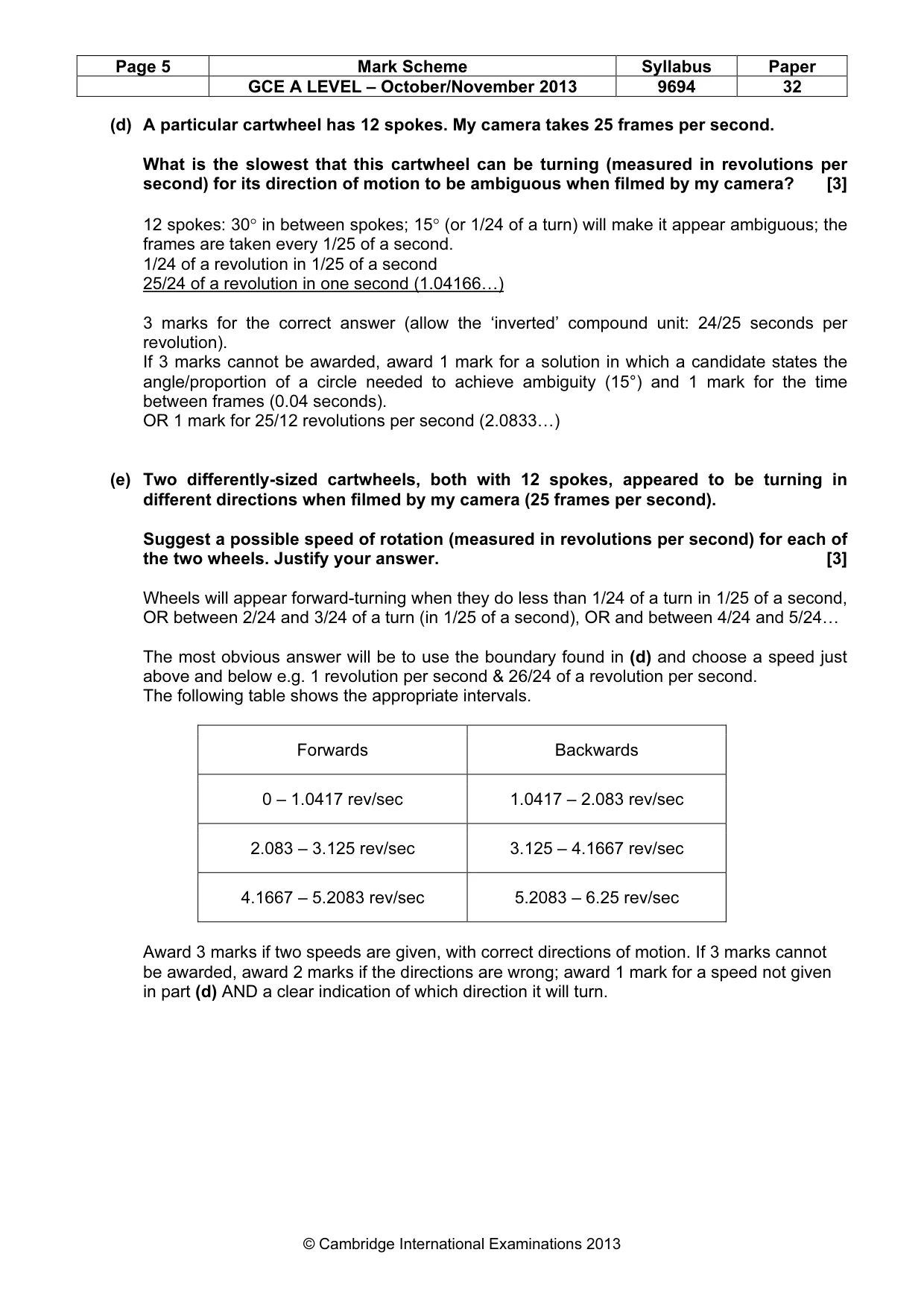
Page 5 Mark Scheme Syllabus Paper GCE A LEVEL – October/November 2013 9694 32 © Cambridge International Examinations 2013 (d) A particular cartwheel has 12 spokes. My camera takes 25 frames per second. What is the slowest that this cartwheel can be turning (measured in revolutions per second) for its direction of motion to be ambiguous when filmed by my camera? [3] 12 spokes: 30° in between spokes; 15° (or 1/24 of a turn) will make it appear ambiguous; the frames are taken every 1/25 of a second. 1/24 of a revolution in 1/25 of a second 25/24 of a revolution in one second (1.04166…) 3 marks for the correct answer (allow the ‘inverted’ compound unit: 24/25 seconds per revolution). If 3 marks cannot be awarded, award 1 mark for a solution in which a candidate states the angle/proportion of a circle needed to achieve ambiguity (15°) and 1 mark for the time between frames (0.04 seconds). OR 1 mark for 25/12 revolutions per second (2.0833…) (e) Two differently-sized cartwheels, both with 12 spokes, appeared to be turning in different directions when filmed by my camera (25 frames per second). Suggest a possible speed of rotation (measured in revolutions per second) for each of the two wheels. Justify your answer. [3] Wheels will appear forward-turning when they do less than 1/24 of a turn in 1/25 of a second, OR between 2/24 and 3/24 of a turn (in 1/25 of a second), OR and between 4/24 and 5/24… The most obvious answer will be to use the boundary found in (d) and choose a speed just above and below e.g. 1 revolution per second & 26/24 of a revolution per second. The following table shows the appropriate intervals. Forwards Backwards 0 – 1.0417 rev/sec 1.0417 – 2.083 rev/sec 2.083 – 3.125 rev/sec 3.125 – 4.1667 rev/sec 4.1667 – 5.2083 rev/sec 5.2083 – 6.25 rev/sec Award 3 marks if two speeds are given, with correct directions of motion. If 3 marks cannot be awarded, award 2 marks if the directions are wrong; award 1 mark for a speed not given in part (d) AND a clear indication of which direction it will turn.
Mark scheme, page 6
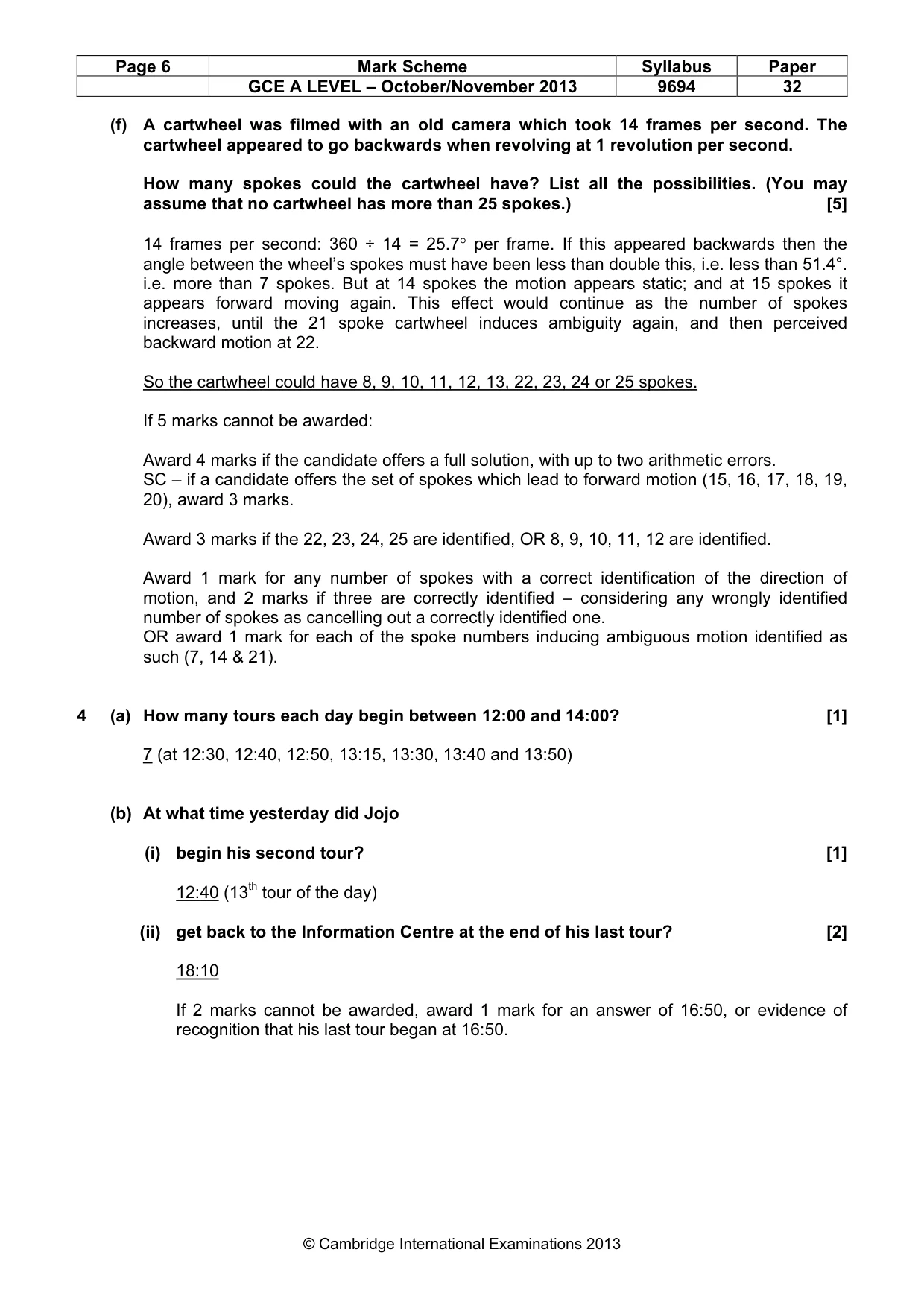
Page 6 Mark Scheme Syllabus Paper GCE A LEVEL – October/November 2013 9694 32 © Cambridge International Examinations 2013 (f) A cartwheel was filmed with an old camera which took 14 frames per second. The cartwheel appeared to go backwards when revolving at 1 revolution per second. How many spokes could the cartwheel have? List all the possibilities. (You may assume that no cartwheel has more than 25 spokes.) [5] 14 frames per second: 360 ÷ 14 = 25.7° per frame. If this appeared backwards then the angle between the wheel’s spokes must have been less than double this, i.e. less than 51.4°. i.e. more than 7 spokes. But at 14 spokes the motion appears static; and at 15 spokes it appears forward moving again. This effect would continue as the number of spokes increases, until the 21 spoke cartwheel induces ambiguity again, and then perceived backward motion at 22. So the cartwheel could have 8, 9, 10, 11, 12, 13, 22, 23, 24 or 25 spokes. If 5 marks cannot be awarded: Award 4 marks if the candidate offers a full solution, with up to two arithmetic errors. SC – if a candidate offers the set of spokes which lead to forward motion (15, 16, 17, 18, 19, 20), award 3 marks. Award 3 marks if the 22, 23, 24, 25 are identified, OR 8, 9, 10, 11, 12 are identified. Award 1 mark for any number of spokes with a correct identification of the direction of motion, and 2 marks if three are correctly identified – considering any wrongly identified number of spokes as cancelling out a correctly identified one. OR award 1 mark for each of the spoke numbers inducing ambiguous motion identified as such (7, 14 & 21). 4 (a) How many tours each day begin between 12:00 and 14:00? [1] 7 (at 12:30, 12:40, 12:50, 13:15, 13:30, 13:40 and 13:50) (b) At what time yesterday did Jojo (i) begin his second tour? [1] 12:40 (13th tour of the day) (ii) get back to the Information Centre at the end of his last tour? [2] 18:10 If 2 marks cannot be awarded, award 1 mark for an answer of 16:50, or evidence of recognition that his last tour began at 16:50.
Mark scheme, page 7
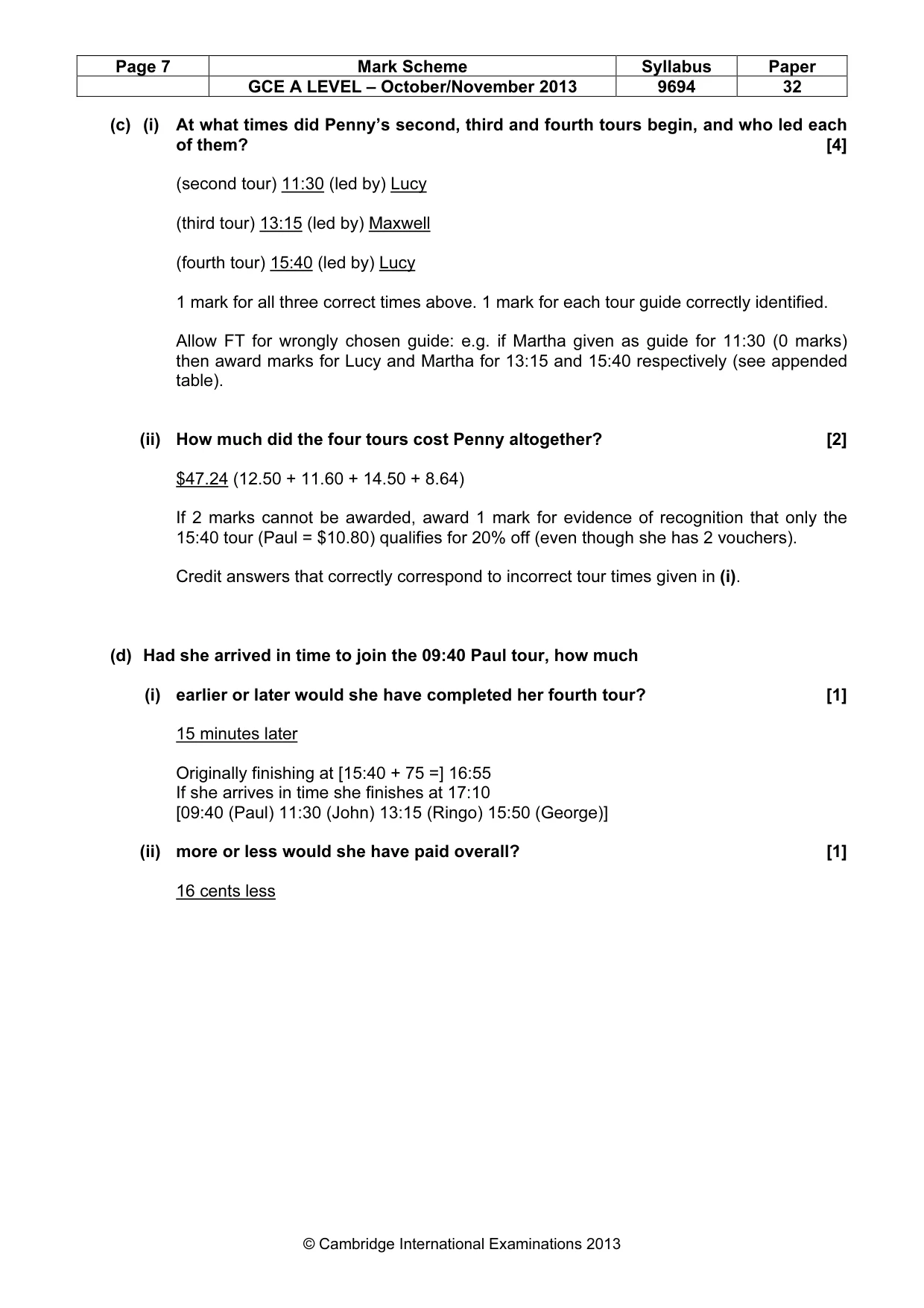
Page 7 Mark Scheme Syllabus Paper GCE A LEVEL – October/November 2013 9694 32 © Cambridge International Examinations 2013 (c) (i) At what times did Penny’s second, third and fourth tours begin, and who led each of them? [4] (second tour) 11:30 (led by) Lucy (third tour) 13:15 (led by) Maxwell (fourth tour) 15:40 (led by) Lucy 1 mark for all three correct times above. 1 mark for each tour guide correctly identified. Allow FT for wrongly chosen guide: e.g. if Martha given as guide for 11:30 (0 marks) then award marks for Lucy and Martha for 13:15 and 15:40 respectively (see appended table). (ii) How much did the four tours cost Penny altogether? [2] $47.24 (12.50 + 11.60 + 14.50 + 8.64) If 2 marks cannot be awarded, award 1 mark for evidence of recognition that only the 15:40 tour (Paul = $10.80) qualifies for 20% off (even though she has 2 vouchers). Credit answers that correctly correspond to incorrect tour times given in (i). (d) Had she arrived in time to join the 09:40 Paul tour, how much (i) earlier or later would she have completed her fourth tour? [1] 15 minutes later Originally finishing at [15:40 + 75 =] 16:55 If she arrives in time she finishes at 17:10 [09:40 (Paul) 11:30 (John) 13:15 (Ringo) 15:50 (George)] (ii) more or less would she have paid overall? [1] 16 cents less
Mark scheme, page 8
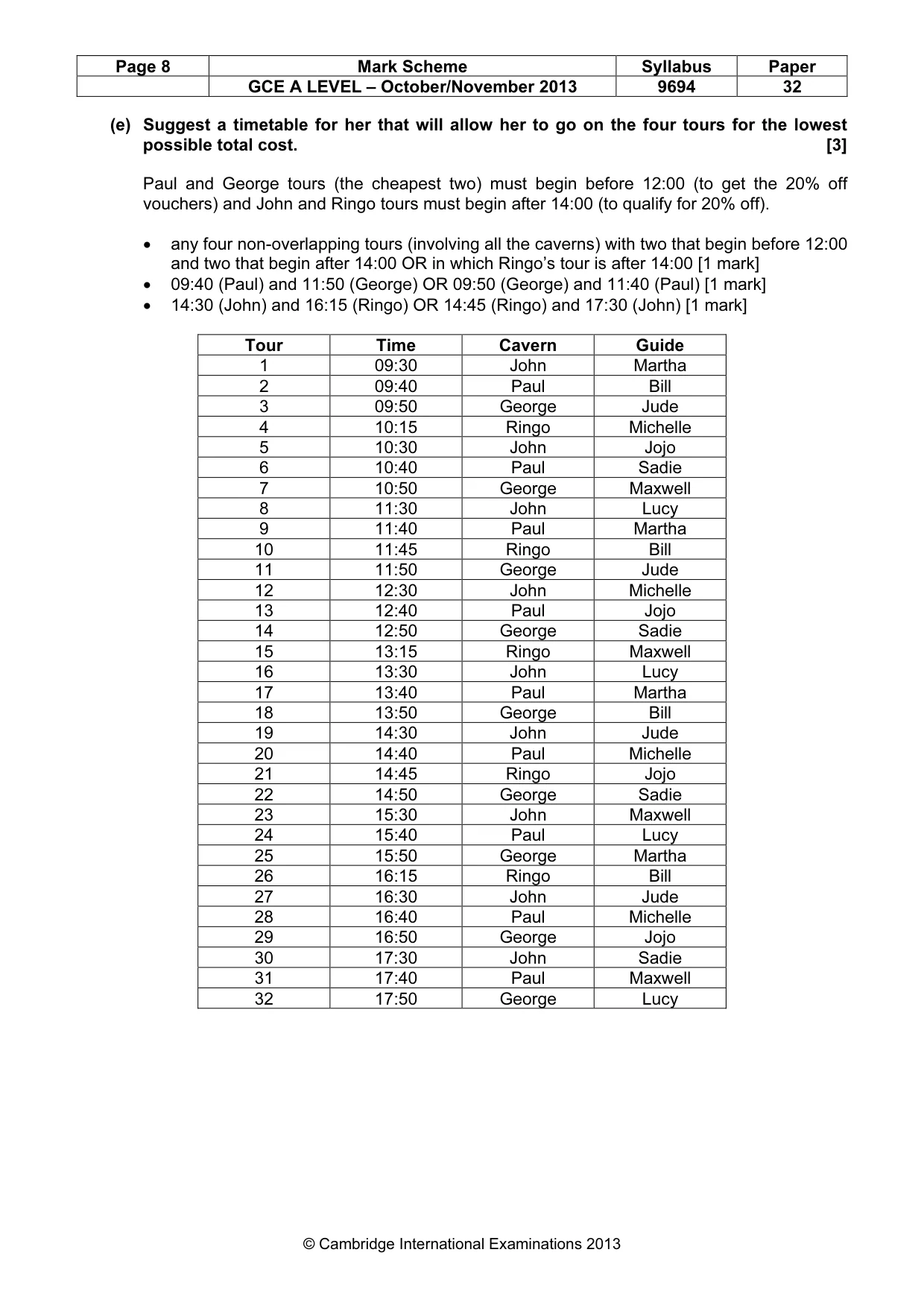
Page 8 Mark Scheme Syllabus Paper GCE A LEVEL – October/November 2013 9694 32 © Cambridge International Examinations 2013 (e) Suggest a timetable for her that will allow her to go on the four tours for the lowest possible total cost. [3] Paul and George tours (the cheapest two) must begin before 12:00 (to get the 20% off vouchers) and John and Ringo tours must begin after 14:00 (to qualify for 20% off). • any four non-overlapping tours (involving all the caverns) with two that begin before 12:00 and two that begin after 14:00 OR in which Ringo’s tour is after 14:00 [1 mark] • 09:40 (Paul) and 11:50 (George) OR 09:50 (George) and 11:40 (Paul) [1 mark] • 14:30 (John) and 16:15 (Ringo) OR 14:45 (Ringo) and 17:30 (John) [1 mark] Tour Time Cavern Guide 1 09:30 John Martha 2 09:40 Paul Bill 3 09:50 George Jude 4 10:15 Ringo Michelle 5 10:30 John Jojo 6 10:40 Paul Sadie 7 10:50 George Maxwell 8 11:30 John Lucy 9 11:40 Paul Martha 10 11:45 Ringo Bill 11 11:50 George Jude 12 12:30 John Michelle 13 12:40 Paul Jojo 14 12:50 George Sadie 15 13:15 Ringo Maxwell 16 13:30 John Lucy 17 13:40 Paul Martha 18 13:50 George Bill 19 14:30 John Jude 20 14:40 Paul Michelle 21 14:45 Ringo Jojo 22 14:50 George Sadie 23 15:30 John Maxwell 24 15:40 Paul Lucy 25 15:50 George Martha 26 16:15 Ringo Bill 27 16:30 John Jude 28 16:40 Paul Michelle 29 16:50 George Jojo 30 17:30 John Sadie 31 17:40 Paul Maxwell 32 17:50 George Lucy
Mark scheme, page 9
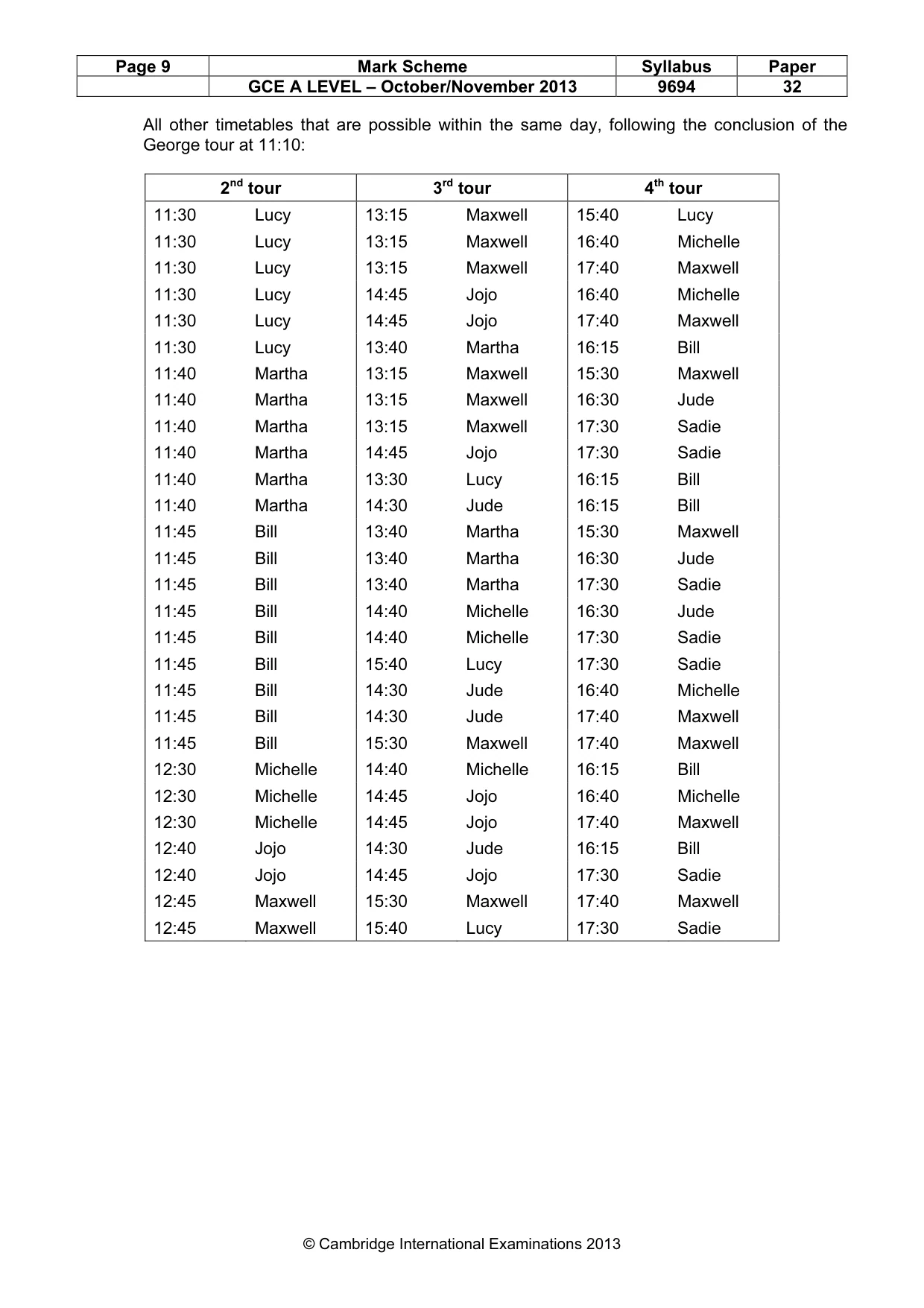
Page 9 Mark Scheme Syllabus Paper GCE A LEVEL – October/November 2013 9694 32 © Cambridge International Examinations 2013 All other timetables that are possible within the same day, following the conclusion of the George tour at 11:10: 2nd tour 3rd tour 4th tour 11:30 Lucy 13:15 Maxwell 15:40 Lucy 11:30 Lucy 13:15 Maxwell 16:40 Michelle 11:30 Lucy 13:15 Maxwell 17:40 Maxwell 11:30 Lucy 14:45 Jojo 16:40 Michelle 11:30 Lucy 14:45 Jojo 17:40 Maxwell 11:30 Lucy 13:40 Martha 16:15 Bill 11:40 Martha 13:15 Maxwell 15:30 Maxwell 11:40 Martha 13:15 Maxwell 16:30 Jude 11:40 Martha 13:15 Maxwell 17:30 Sadie 11:40 Martha 14:45 Jojo 17:30 Sadie 11:40 Martha 13:30 Lucy 16:15 Bill 11:40 Martha 14:30 Jude 16:15 Bill 11:45 Bill 13:40 Martha 15:30 Maxwell 11:45 Bill 13:40 Martha 16:30 Jude 11:45 Bill 13:40 Martha 17:30 Sadie 11:45 Bill 14:40 Michelle 16:30 Jude 11:45 Bill 14:40 Michelle 17:30 Sadie 11:45 Bill 15:40 Lucy 17:30 Sadie 11:45 Bill 14:30 Jude 16:40 Michelle 11:45 Bill 14:30 Jude 17:40 Maxwell 11:45 Bill 15:30 Maxwell 17:40 Maxwell 12:30 Michelle 14:40 Michelle 16:15 Bill 12:30 Michelle 14:45 Jojo 16:40 Michelle 12:30 Michelle 14:45 Jojo 17:40 Maxwell 12:40 Jojo 14:30 Jude 16:15 Bill 12:40 Jojo 14:45 Jojo 17:30 Sadie 12:45 Maxwell 15:30 Maxwell 17:40 Maxwell 12:45 Maxwell 15:40 Lucy 17:30 Sadie
What you needed in this session
Cambridge’s own grade thresholds for 2013 Oct/Nov, Paper 3 · Variant 2. A higher threshold means an easier paper — the bar moves with how the cohort did.