Cambridge A Level Thinking Skills 9694 — 2012 May/June Paper 3 · Variant 3
9694/33/M/J/12 · 50 marks · ≈56 min
The question paper and its mark scheme, free to read here and free to download. This is Cambridge’s own paper, exactly as it was sat.
Question paper12 pages



Mark scheme7 pages
Answers below. Sit the paper first if you are practising.
Paper as text
Question paper, page 1
This document consists of 8 printed pages and 4 blank pages. IB12 06_9694_33/FP © UCLES 2012 [Turn over *8183349645* UNIVERSITY OF CAMBRIDGE INTERNATIONAL EXAMINATIONS General Certificate of Education Advanced Level THINKING SKILLS 9694/33 Paper 3 Problem Analysis and Solution May/June 2012 1 hour 30 minutes Additional Materials: Answer Booklet/Paper Electronic Calculator READ THESE INSTRUCTIONS FIRST If you have been given an Answer Booklet, follow the instructions on the front cover of the booklet. Write your Centre number, candidate number and name on all the work you hand in. Write in dark blue or black pen. Do not use staples, paper clips, highlighters, glue or correction fluid. DO NOT WRITE ON ANY BARCODES. Calculators should be used where appropriate. Answer all the questions. Start each question on a new answer sheet. At the end of the examination, fasten all your work securely together. The number of marks is given in brackets [ ] at the end of each question or part question.
Question paper, page 2
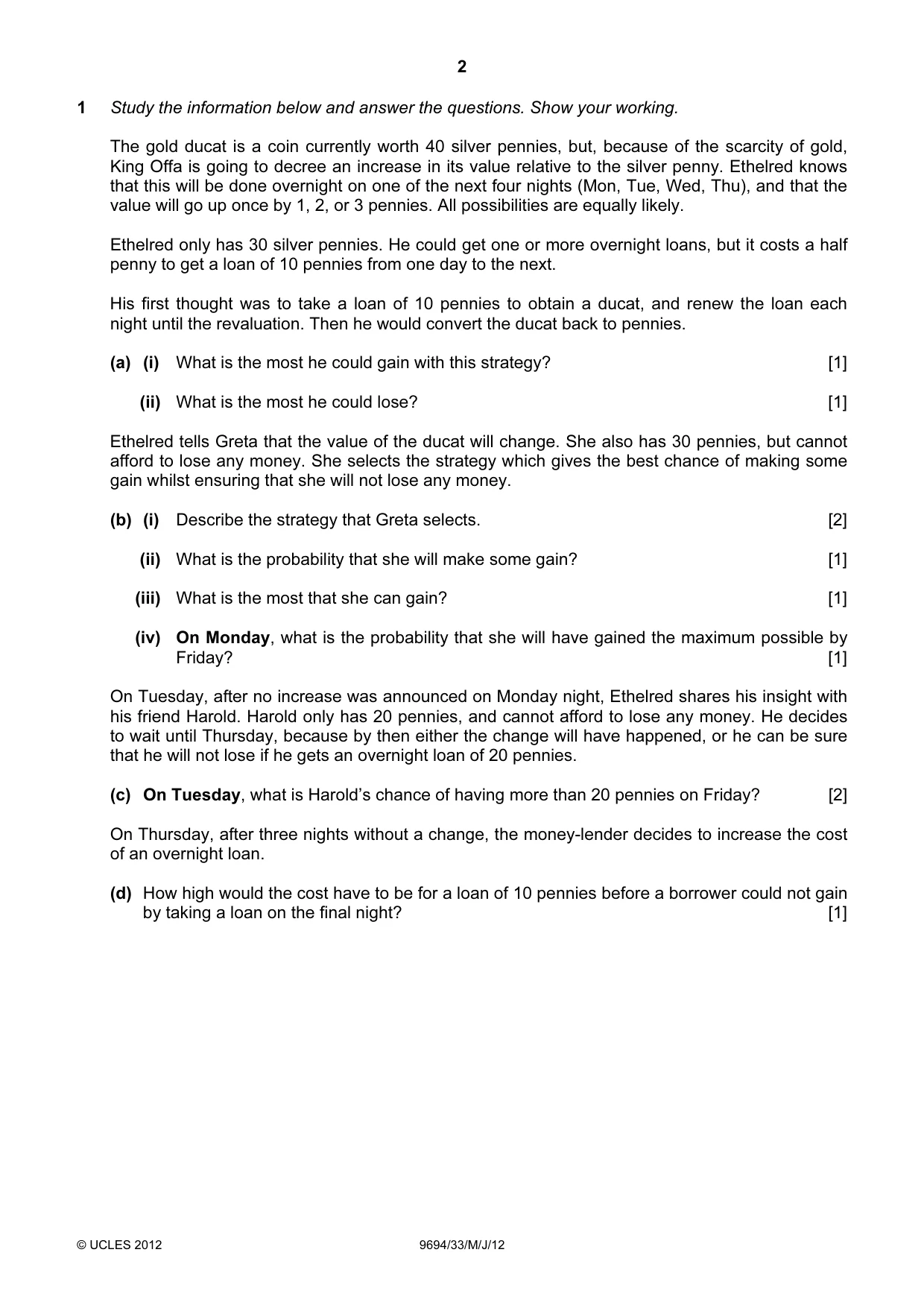
2 © UCLES 2012 9694/33/M/J/12 1 Study the information below and answer the questions. Show your working. The gold ducat is a coin currently worth 40 silver pennies, but, because of the scarcity of gold, King Offa is going to decree an increase in its value relative to the silver penny. Ethelred knows that this will be done overnight on one of the next four nights (Mon, Tue, Wed, Thu), and that the value will go up once by 1, 2, or 3 pennies. All possibilities are equally likely. Ethelred only has 30 silver pennies. He could get one or more overnight loans, but it costs a half penny to get a loan of 10 pennies from one day to the next. His first thought was to take a loan of 10 pennies to obtain a ducat, and renew the loan each night until the revaluation. Then he would convert the ducat back to pennies. (a) (i) What is the most he could gain with this strategy? [1] (ii) What is the most he could lose? [1] Ethelred tells Greta that the value of the ducat will change. She also has 30 pennies, but cannot afford to lose any money. She selects the strategy which gives the best chance of making some gain whilst ensuring that she will not lose any money. (b) (i) Describe the strategy that Greta selects. [2] (ii) What is the probability that she will make some gain? [1] (iii) What is the most that she can gain? [1] (iv) On Monday, what is the probability that she will have gained the maximum possible by Friday? [1] On Tuesday, after no increase was announced on Monday night, Ethelred shares his insight with his friend Harold. Harold only has 20 pennies, and cannot afford to lose any money. He decides to wait until Thursday, because by then either the change will have happened, or he can be sure that he will not lose if he gets an overnight loan of 20 pennies. (c) On Tuesday, what is Harold’s chance of having more than 20 pennies on Friday? [2] On Thursday, after three nights without a change, the money-lender decides to increase the cost of an overnight loan. (d) How high would the cost have to be for a loan of 10 pennies before a borrower could not gain by taking a loan on the final night? [1]
Question paper, page 3
3 © UCLES 2012 9694/33/M/J/12 [Turn over BLANK PAGE [Question 2 is printed on the next page]
Question paper, page 4
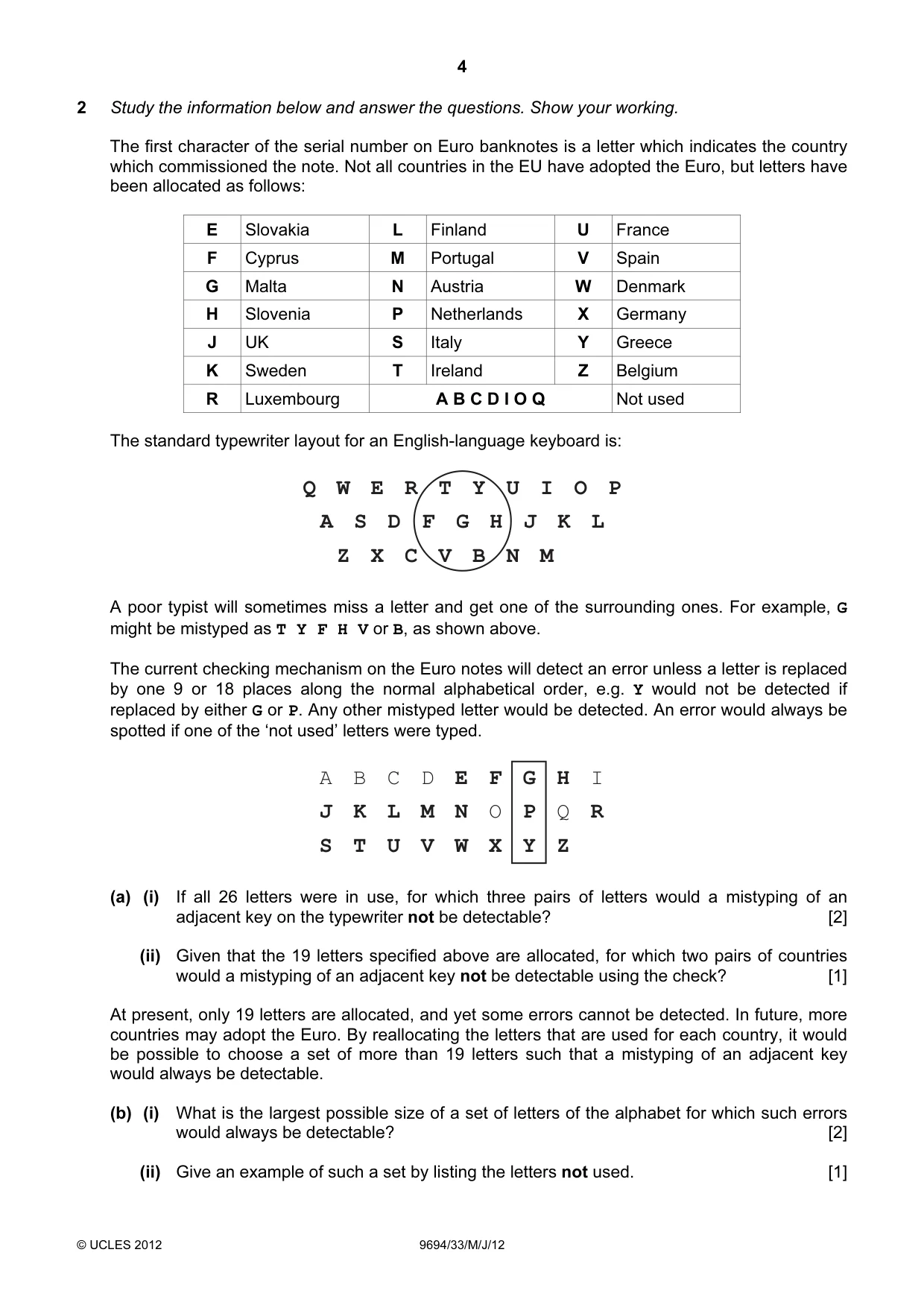
4 © UCLES 2012 9694/33/M/J/12 2 Study the information below and answer the questions. Show your working. The first character of the serial number on Euro banknotes is a letter which indicates the country which commissioned the note. Not all countries in the EU have adopted the Euro, but letters have been allocated as follows: E Slovakia L Finland U France F Cyprus M Portugal V Spain G Malta N Austria W Denmark H Slovenia P Netherlands X Germany J UK S Italy Y Greece K Sweden T Ireland Z Belgium R Luxembourg A B C D I O Q Not used The standard typewriter layout for an English-language keyboard is: Q W E R T Y U I O A S D F G H J K Z X C V B N M L P A poor typist will sometimes miss a letter and get one of the surrounding ones. For example, G might be mistyped as T Y F H V or B, as shown above. The current checking mechanism on the Euro notes will detect an error unless a letter is replaced by one 9 or 18 places along the normal alphabetical order, e.g. Y would not be detected if replaced by either G or P. Any other mistyped letter would be detected. An error would always be spotted if one of the ‘not used’ letters were typed. A B C D E F G H I J K L M N O P Q S T U V W X Y Z R (a) (i) If all 26 letters were in use, for which three pairs of letters would a mistyping of an adjacent key on the typewriter not be detectable? [2] (ii) Given that the 19 letters specified above are allocated, for which two pairs of countries would a mistyping of an adjacent key not be detectable using the check? [1] At present, only 19 letters are allocated, and yet some errors cannot be detected. In future, more countries may adopt the Euro. By reallocating the letters that are used for each country, it would be possible to choose a set of more than 19 letters such that a mistyping of an adjacent key would always be detectable. (b) (i) What is the largest possible size of a set of letters of the alphabet for which such errors would always be detectable? [2] (ii) Give an example of such a set by listing the letters not used. [1]
Question paper, page 5
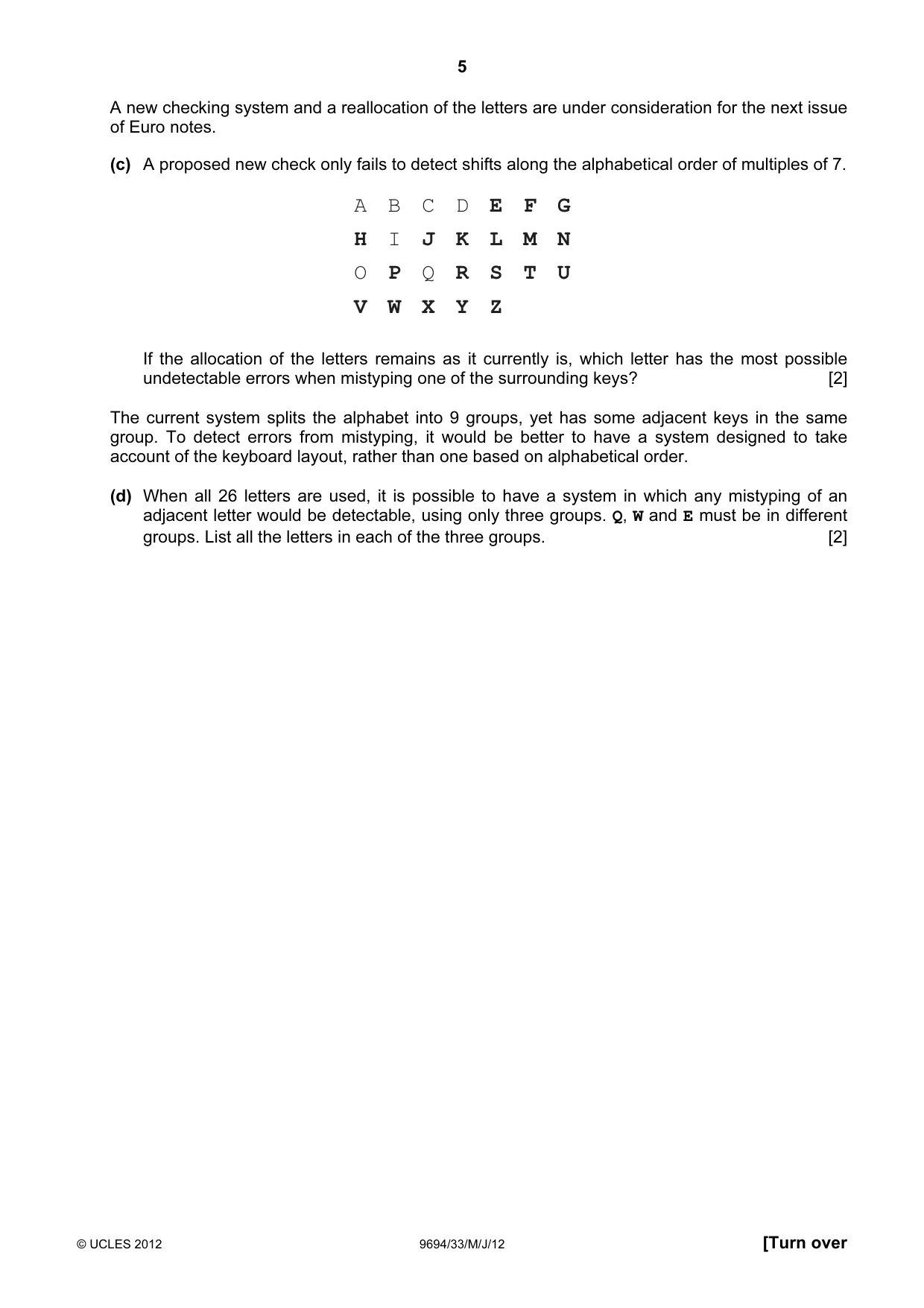
5 © UCLES 2012 9694/33/M/J/12 [Turn over A new checking system and a reallocation of the letters are under consideration for the next issue of Euro notes. (c) A proposed new check only fails to detect shifts along the alphabetical order of multiples of 7. A B C D E F G H I J K L M N O P Q S T U V W X Y Z R If the allocation of the letters remains as it currently is, which letter has the most possible undetectable errors when mistyping one of the surrounding keys? [2] The current system splits the alphabet into 9 groups, yet has some adjacent keys in the same group. To detect errors from mistyping, it would be better to have a system designed to take account of the keyboard layout, rather than one based on alphabetical order. (d) When all 26 letters are used, it is possible to have a system in which any mistyping of an adjacent letter would be detectable, using only three groups. Q, W and E must be in different groups. List all the letters in each of the three groups. [2]
Question paper, page 6
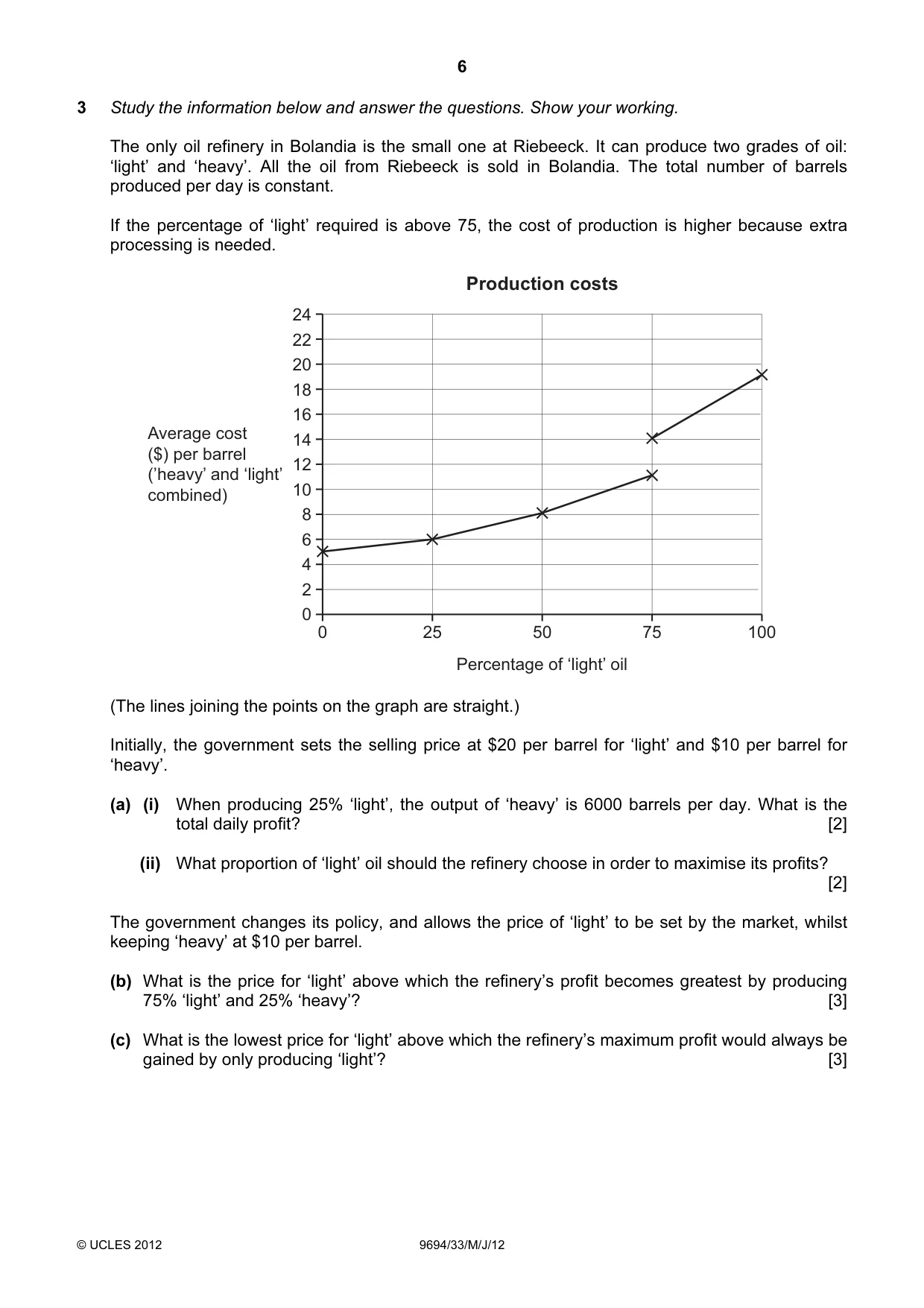
6 © UCLES 2012 9694/33/M/J/12 3 Study the information below and answer the questions. Show your working. The only oil refinery in Bolandia is the small one at Riebeeck. It can produce two grades of oil: ‘light’ and ‘heavy’. All the oil from Riebeeck is sold in Bolandia. The total number of barrels produced per day is constant. If the percentage of ‘light’ required is above 75, the cost of production is higher because extra processing is needed. 24 22 20 18 16 14 12 10 8 6 4 2 0 0 25 50 Percentage of ‘light’ oil Production costs 75 100 Average cost ($) per barrel (’heavy’ and ‘light’ combined) (The lines joining the points on the graph are straight.) Initially, the government sets the selling price at $20 per barrel for ‘light’ and $10 per barrel for ‘heavy’. (a) (i) When producing 25% ‘light’, the output of ‘heavy’ is 6000 barrels per day. What is the total daily profit? [2] (ii) What proportion of ‘light’ oil should the refinery choose in order to maximise its profits? [2] The government changes its policy, and allows the price of ‘light’ to be set by the market, whilst keeping ‘heavy’ at $10 per barrel. (b) What is the price for ‘light’ above which the refinery’s profit becomes greatest by producing 75% ‘light’ and 25% ‘heavy’? [3] (c) What is the lowest price for ‘light’ above which the refinery’s maximum profit would always be gained by only producing ‘light’? [3]
Question paper, page 7
7 © UCLES 2012 9694/33/M/J/12 [Turn over The crude oil used to make imported oil has a different chemical composition from that processed in Bolandia, so the costs of the two grades are not the same as for the Bolandian production. Imported oil has production costs of $6 per barrel for ‘heavy’ and $17 per barrel for ‘light’, regardless of the proportions produced. The consumption of oil in Bolandia is constant at 16 000 barrels per day, of which half is imported. Half of the total consumption is ‘light’ and half is ‘heavy’. The price of ‘light’ is set by the importers (while the price of ‘heavy’ is fixed at $10 per barrel). The refinery then decides what proportions of ‘light’ and ‘heavy’ to produce (seeking to maximise its own profit), and the importers supply the remainder. (d) Determine what the importers’ total daily profit would be if they set the price of ‘light’ at (i) $43 per barrel, [2] (ii) $29 per barrel, [2] (iii) $21 per barrel. [1]
Question paper, page 8
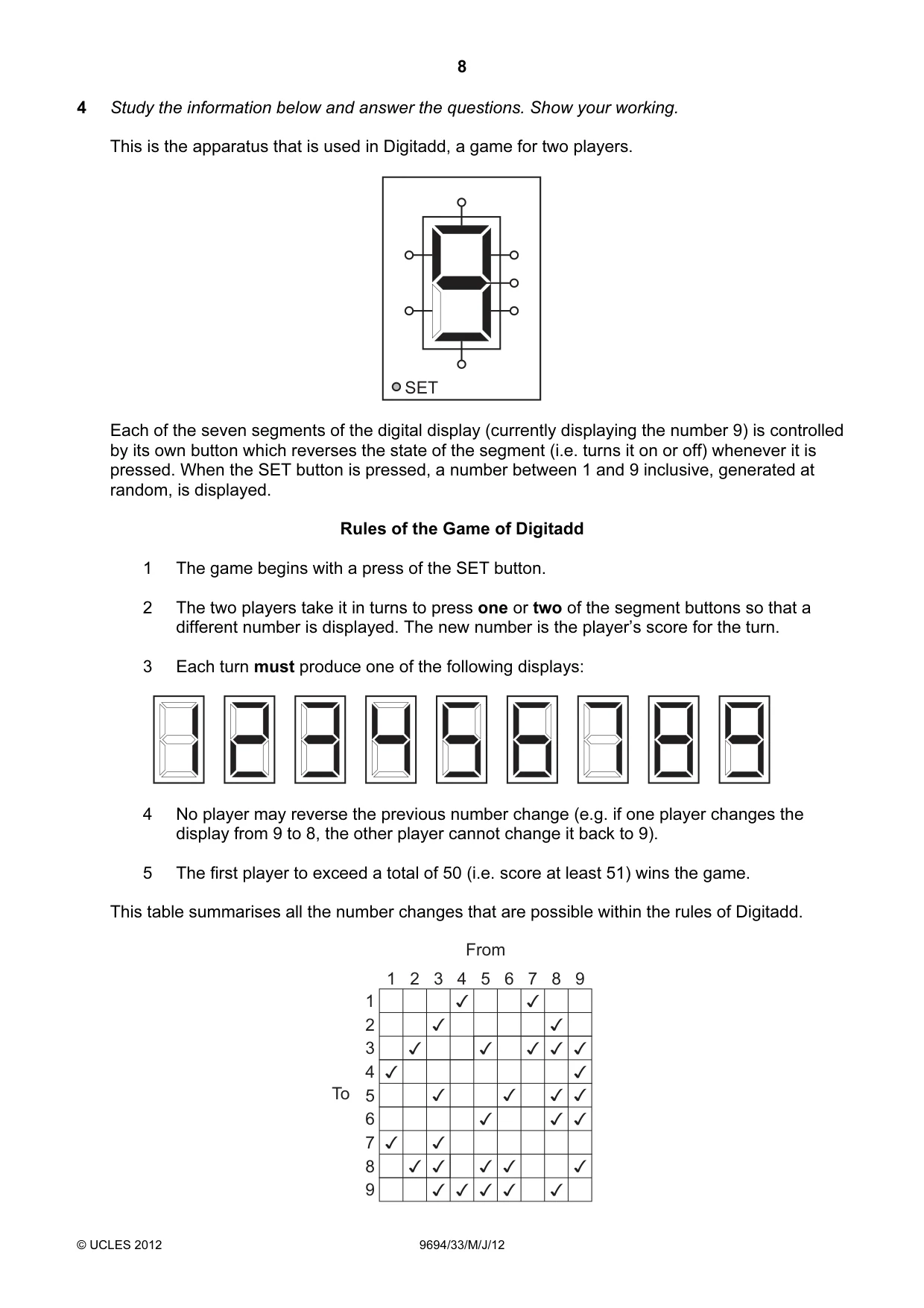
8 © UCLES 2012 9694/33/M/J/12 4 Study the information below and answer the questions. Show your working. This is the apparatus that is used in Digitadd, a game for two players. SET Each of the seven segments of the digital display (currently displaying the number 9) is controlled by its own button which reverses the state of the segment (i.e. turns it on or off) whenever it is pressed. When the SET button is pressed, a number between 1 and 9 inclusive, generated at random, is displayed. Rules of the Game of Digitadd 1 The game begins with a press of the SET button. 2 The two players take it in turns to press one or two of the segment buttons so that a different number is displayed. The new number is the player’s score for the turn. 3 Each turn must produce one of the following displays: 4 No player may reverse the previous number change (e.g. if one player changes the display from 9 to 8, the other player cannot change it back to 9). 5 The first player to exceed a total of 50 (i.e. score at least 51) wins the game. This table summarises all the number changes that are possible within the rules of Digitadd. 1 1 2 3 4 5 6 7 8 9 2 3 4 5 6 7 8 9 From To
Question paper, page 9
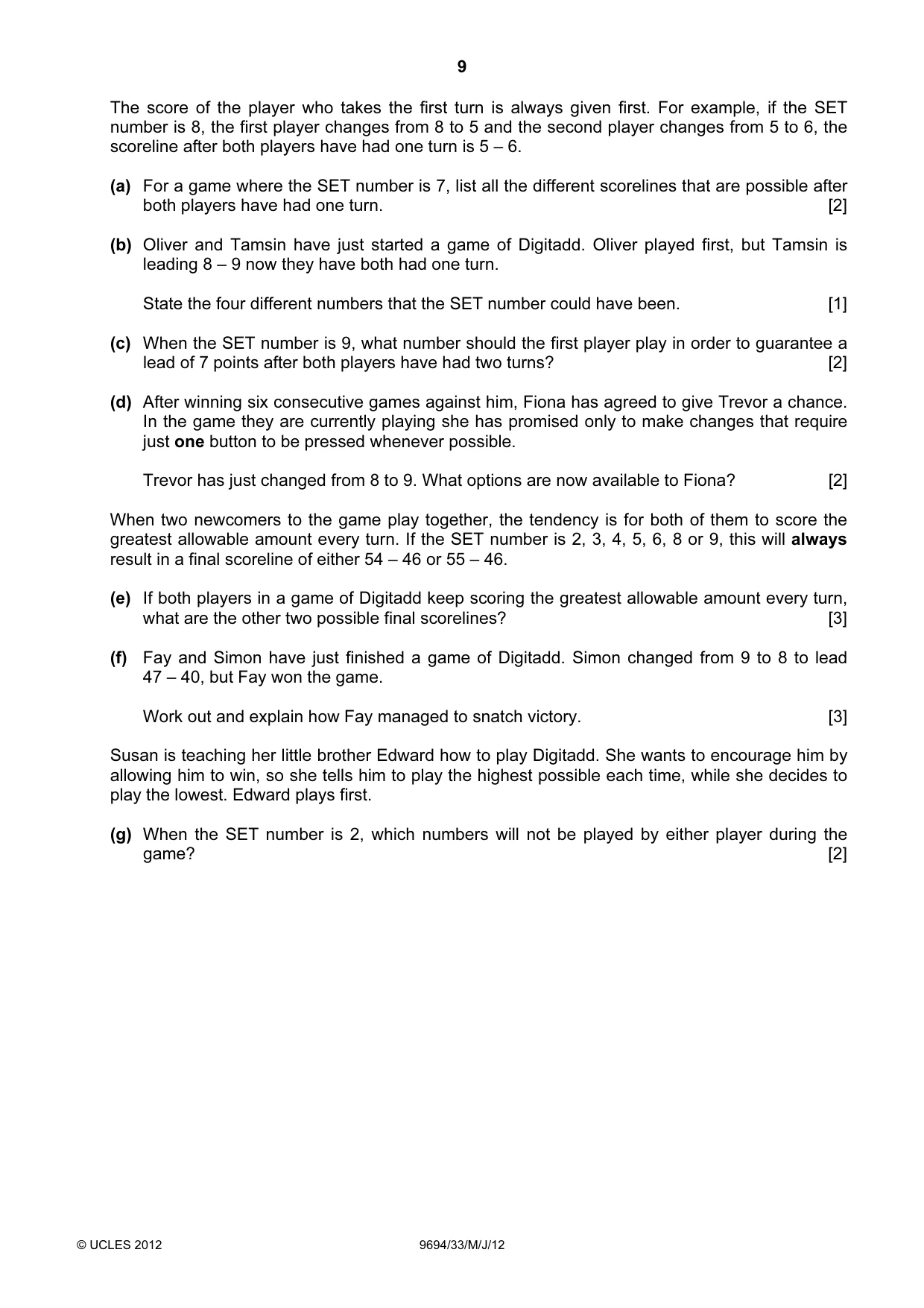
9 © UCLES 2012 9694/33/M/J/12 The score of the player who takes the first turn is always given first. For example, if the SET number is 8, the first player changes from 8 to 5 and the second player changes from 5 to 6, the scoreline after both players have had one turn is 5 – 6. (a) For a game where the SET number is 7, list all the different scorelines that are possible after both players have had one turn. [2] (b) Oliver and Tamsin have just started a game of Digitadd. Oliver played first, but Tamsin is leading 8 – 9 now they have both had one turn. State the four different numbers that the SET number could have been. [1] (c) When the SET number is 9, what number should the first player play in order to guarantee a lead of 7 points after both players have had two turns? [2] (d) After winning six consecutive games against him, Fiona has agreed to give Trevor a chance. In the game they are currently playing she has promised only to make changes that require just one button to be pressed whenever possible. Trevor has just changed from 8 to 9. What options are now available to Fiona? [2] When two newcomers to the game play together, the tendency is for both of them to score the greatest allowable amount every turn. If the SET number is 2, 3, 4, 5, 6, 8 or 9, this will always result in a final scoreline of either 54 – 46 or 55 – 46. (e) If both players in a game of Digitadd keep scoring the greatest allowable amount every turn, what are the other two possible final scorelines? [3] (f) Fay and Simon have just finished a game of Digitadd. Simon changed from 9 to 8 to lead 47 – 40, but Fay won the game. Work out and explain how Fay managed to snatch victory. [3] Susan is teaching her little brother Edward how to play Digitadd. She wants to encourage him by allowing him to win, so she tells him to play the highest possible each time, while she decides to play the lowest. Edward plays first. (g) When the SET number is 2, which numbers will not be played by either player during the game? [2]
Question paper, page 10
10 © UCLES 2012 9694/33/M/J/12 BLANK PAGE
Question paper, page 11
11 © UCLES 2012 9694/33/M/J/12 BLANK PAGE
Question paper, page 12
12 Permission to reproduce items where third-party owned material protected by copyright is included has been sought and cleared where possible. Every reasonable effort has been made by the publisher (UCLES) to trace copyright holders, but if any items requiring clearance have unwittingly been included, the publisher will be pleased to make amends at the earliest possible opportunity. University of Cambridge International Examinations is part of the Cambridge Assessment Group. Cambridge Assessment is the brand name of University of Cambridge Local Examinations Syndicate (UCLES), which is itself a department of the University of Cambridge. © UCLES 2012 9694/33/M/J/12 BLANK PAGE
Mark scheme, page 1
UNIVERSITY OF CAMBRIDGE INTERNATIONAL EXAMINATIONS GCE Advanced Level MARK SCHEME for the May/June 2012 question paper for the guidance of teachers 9694 THINKING SKILLS 9694/33 Paper 3 (Problem Analysis and Solution), maximum raw mark 50 This mark scheme is published as an aid to teachers and candidates, to indicate the requirements of the examination. It shows the basis on which Examiners were instructed to award marks. It does not indicate the details of the discussions that took place at an Examiners’ meeting before marking began, which would have considered the acceptability of alternative answers. Mark schemes must be read in conjunction with the question papers and the report on the examination. • Cambridge will not enter into discussions or correspondence in connection with these mark schemes. Cambridge is publishing the mark schemes for the May/June 2012 question papers for most IGCSE, GCE Advanced Level and Advanced Subsidiary Level syllabuses and some Ordinary Level syllabuses.
Mark scheme, page 2
Page 2 Mark Scheme: Teachers’ version Syllabus Paper GCE A LEVEL – May/June 2012 9694 33 © University of Cambridge International Examinations 2012 1 (a) (i) What is the most he could gain with this strategy? [1] The highest would come from the maximum increase on the first day: +3 – 0.5 = 2.5. (ii) What is the most he could lose? [1] The most he could lose is if the least possible increase happens on the last day: +1 – 2 = –1. A loss of 1 penny. (b) (i) Describe the strategy that Greta selects. [2] Because it is possible that the gain is only 1 penny, Greta can only risk two nights. [1 mark for noting this limit.] These must be the last two nights [1 mark] as otherwise she might be left having spent the penny. If two nights are not suggested, candidates should be awarded 1 mark for recommending waiting until Thursday, or waiting until Wednesday with the possible implication that she would take out a loan on both nights (but not explicitly stated). (ii) What is the probability that she will make some gain? [1] If the change is on Wednesday then she gains from all three possible increases, having only put forward half a penny. If Thursday, she only gains from two. So (3 + 2) of the twelve gives a 5/12 chance of a gain. (iii) What is the most that she can gain? [1] The most she can gain is 2.5, (with the maximum increase on Wednesday). (iv) On Monday, what is the probability that she will have gained the maximum possible by Friday? [1] There is only one possible way to get the maximum, so 1/12 (8.3% or 8% permitted). (c) On Tuesday, what is Harold’s chance of having more than 20 pennies on Friday? [2] 2/9 (22.2% or 22% permitted) [2 marks]. His 1 penny cost will be exceeded by gains only if the value goes up by 2 or 3. There are only three days left so the chance is 2/9. 1 mark if the candidate shows appreciation that in two out of the three scenarios he will make a gain, or one out of three days he could make a gain. (d) How high would the cost have to be for a loan of 10 pennies before a borrower could not gain by taking a loan on the final night? [1] If the price is three pennies or more then there is no chance of gaining on the night.
Mark scheme, page 3
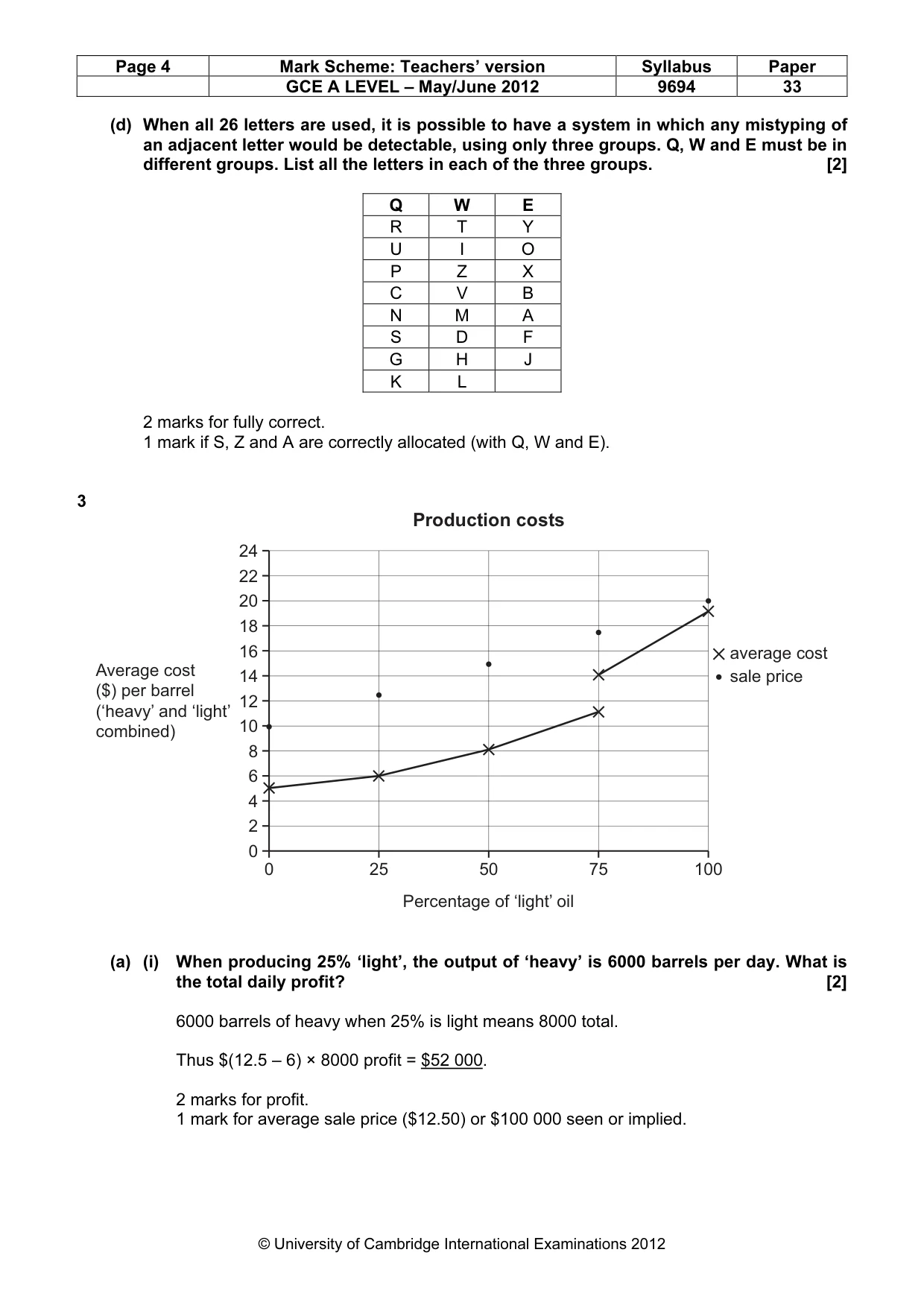
Page 3 Mark Scheme: Teachers’ version Syllabus Paper GCE A LEVEL – May/June 2012 9694 33 © University of Cambridge International Examinations 2012 2 (a) (i) If all 26 letters were in use, for which three pairs of letters would a mistyping of an adjacent key not be detectable? [2] A & S, W & E, G & Y. 2 marks for all three correct (and no extras). Deduct one mark if a fourth answer is given. 1 mark for any correct pair (and not more than 3 given). (ii) Given that the 19 letters specified above are allocated, for which two pairs of countries would a mistyping of an adjacent key not be detectable using the check? [1] Denmark and Slovakia, Malta and Greece. Allow W and E, G and Y. (b) (i) What is the largest possible size of a set of letters of the alphabet for which such errors would always be detectable? [2] 23. 1 mark for 26 – 3, or 26 – 6, or 20, or “3 missing”. (ii) Give an example of such a set by listing the letters not used. [1] S or A and W or E and G or Y. (c) A proposed new check only fails to detect shifts along the alphabetical order of multiples of 7. If the allocation of the letters remains as it currently is, which letter has the most possible undetectable errors when mistyping one of the surrounding keys? [2] S (two errors, E and Z). 1 mark for any of the letters F, T, E or Z.
Mark scheme, page 4
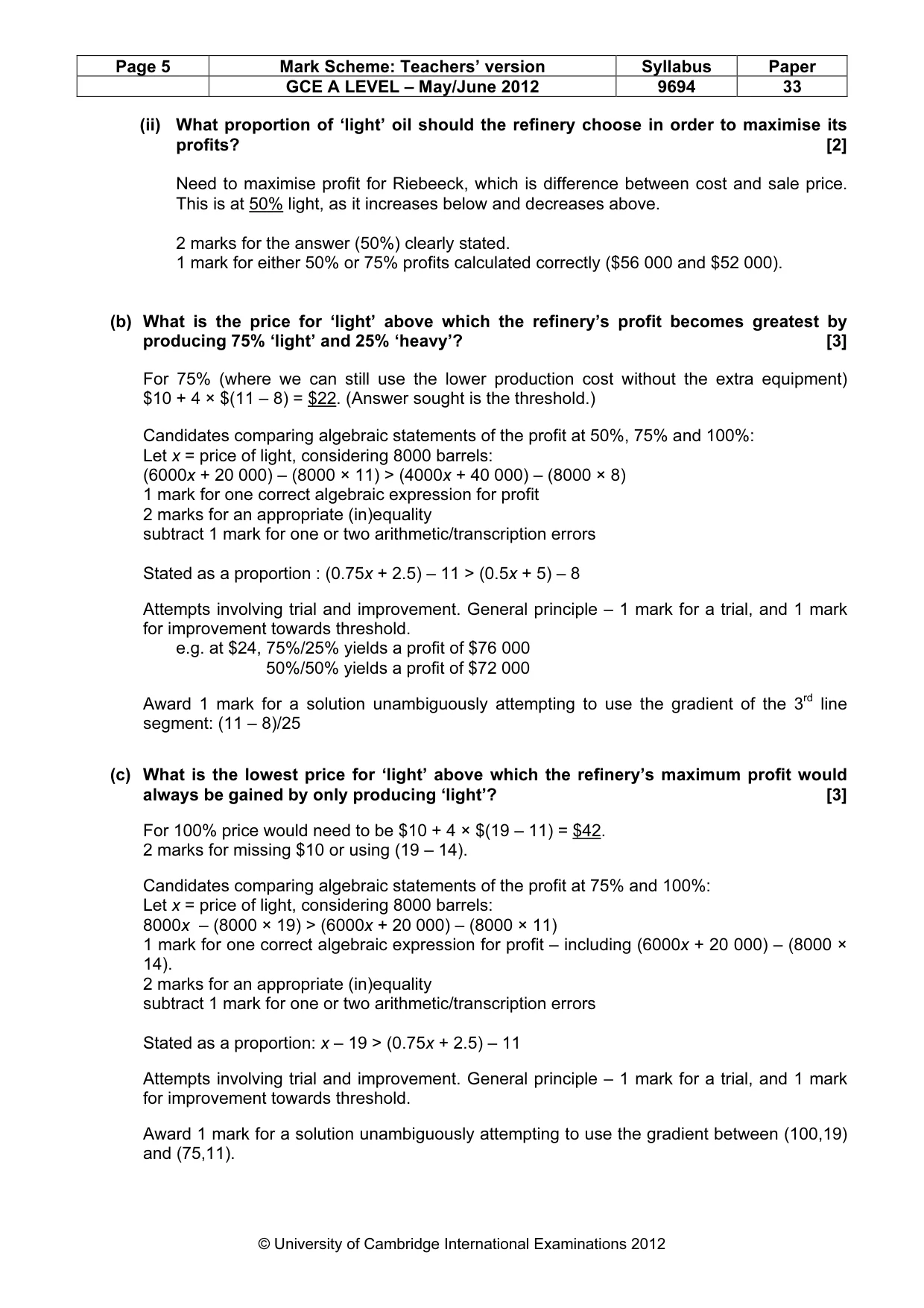
Page 4 Mark Scheme: Teachers’ version Syllabus Paper GCE A LEVEL – May/June 2012 9694 33 © University of Cambridge International Examinations 2012 (d) When all 26 letters are used, it is possible to have a system in which any mistyping of an adjacent letter would be detectable, using only three groups. Q, W and E must be in different groups. List all the letters in each of the three groups. [2] Q W E R T Y U I O P Z X C V B N M A S D F G H J K L 2 marks for fully correct. 1 mark if S, Z and A are correctly allocated (with Q, W and E). 3 24 22 20 18 16 14 12 10 8 6 4 2 0 0 25 50 Percentage of ‘light’ oil Production costs 75 100 Average cost ($) per barrel (‘heavy’ and ‘light’ combined) average cost sale price (a) (i) When producing 25% ‘light’, the output of ‘heavy’ is 6000 barrels per day. What is the total daily profit? [2] 6000 barrels of heavy when 25% is light means 8000 total. Thus $(12.5 – 6) × 8000 profit = $52 000. 2 marks for profit. 1 mark for average sale price ($12.50) or $100 000 seen or implied.
Mark scheme, page 5
Page 5 Mark Scheme: Teachers’ version Syllabus Paper GCE A LEVEL – May/June 2012 9694 33 © University of Cambridge International Examinations 2012 (ii) What proportion of ‘light’ oil should the refinery choose in order to maximise its profits? [2] Need to maximise profit for Riebeeck, which is difference between cost and sale price. This is at 50% light, as it increases below and decreases above. 2 marks for the answer (50%) clearly stated. 1 mark for either 50% or 75% profits calculated correctly ($56 000 and $52 000). (b) What is the price for ‘light’ above which the refinery’s profit becomes greatest by producing 75% ‘light’ and 25% ‘heavy’? [3] For 75% (where we can still use the lower production cost without the extra equipment) $10 + 4 × $(11 – 8) = $22. (Answer sought is the threshold.) Candidates comparing algebraic statements of the profit at 50%, 75% and 100%: Let x = price of light, considering 8000 barrels: (6000x + 20 000) – (8000 × 11) > (4000x + 40 000) – (8000 × 8) 1 mark for one correct algebraic expression for profit 2 marks for an appropriate (in)equality subtract 1 mark for one or two arithmetic/transcription errors Stated as a proportion : (0.75x + 2.5) – 11 > (0.5x + 5) – 8 Attempts involving trial and improvement. General principle – 1 mark for a trial, and 1 mark for improvement towards threshold. e.g. at $24, 75%/25% yields a profit of $76 000 50%/50% yields a profit of $72 000 Award 1 mark for a solution unambiguously attempting to use the gradient of the 3rd line segment: (11 – 8)/25 (c) What is the lowest price for ‘light’ above which the refinery’s maximum profit would always be gained by only producing ‘light’? [3] For 100% price would need to be $10 + 4 × $(19 – 11) = $42. 2 marks for missing $10 or using (19 – 14). Candidates comparing algebraic statements of the profit at 75% and 100%: Let x = price of light, considering 8000 barrels: 8000x – (8000 × 19) > (6000x + 20 000) – (8000 × 11) 1 mark for one correct algebraic expression for profit – including (6000x + 20 000) – (8000 × 14). 2 marks for an appropriate (in)equality subtract 1 mark for one or two arithmetic/transcription errors Stated as a proportion: x – 19 > (0.75x + 2.5) – 11 Attempts involving trial and improvement. General principle – 1 mark for a trial, and 1 mark for improvement towards threshold. Award 1 mark for a solution unambiguously attempting to use the gradient between (100,19) and (75,11).
Mark scheme, page 6
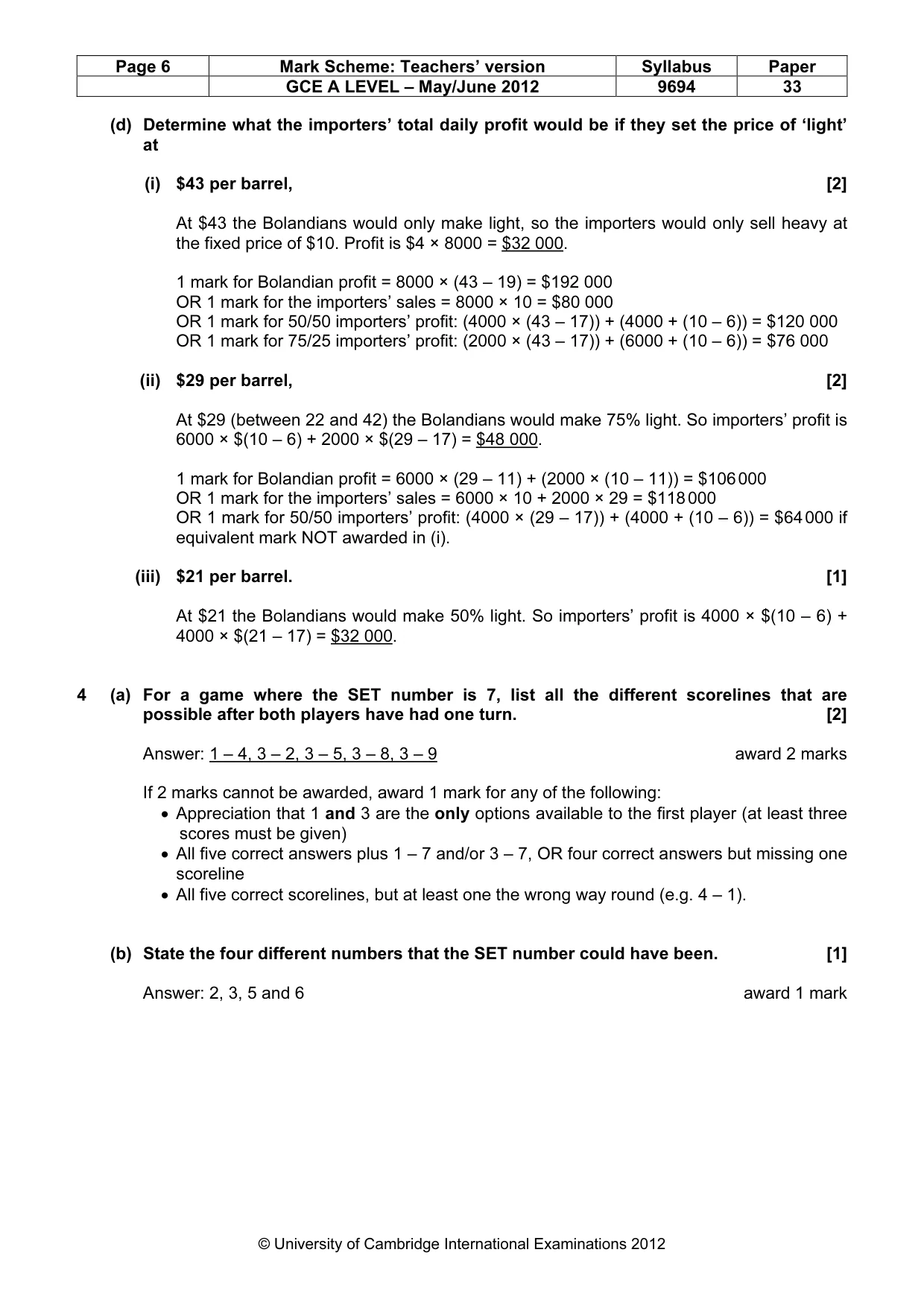
Page 6 Mark Scheme: Teachers’ version Syllabus Paper GCE A LEVEL – May/June 2012 9694 33 © University of Cambridge International Examinations 2012 (d) Determine what the importers’ total daily profit would be if they set the price of ‘light’ at (i) $43 per barrel, [2] At $43 the Bolandians would only make light, so the importers would only sell heavy at the fixed price of $10. Profit is $4 × 8000 = $32 000. 1 mark for Bolandian profit = 8000 × (43 – 19) = $192 000 OR 1 mark for the importers’ sales = 8000 × 10 = $80 000 OR 1 mark for 50/50 importers’ profit: (4000 × (43 – 17)) + (4000 + (10 – 6)) = $120 000 OR 1 mark for 75/25 importers’ profit: (2000 × (43 – 17)) + (6000 + (10 – 6)) = $76 000 (ii) $29 per barrel, [2] At $29 (between 22 and 42) the Bolandians would make 75% light. So importers’ profit is 6000 × $(10 – 6) + 2000 × $(29 – 17) = $48 000. 1 mark for Bolandian profit = 6000 × (29 – 11) + (2000 × (10 – 11)) = $106 000 OR 1 mark for the importers’ sales = 6000 × 10 + 2000 × 29 = $118 000 OR 1 mark for 50/50 importers’ profit: (4000 × (29 – 17)) + (4000 + (10 – 6)) = $64 000 if equivalent mark NOT awarded in (i). (iii) $21 per barrel. [1] At $21 the Bolandians would make 50% light. So importers’ profit is 4000 × $(10 – 6) + 4000 × $(21 – 17) = $32 000. 4 (a) For a game where the SET number is 7, list all the different scorelines that are possible after both players have had one turn. [2] Answer: 1 – 4, 3 – 2, 3 – 5, 3 – 8, 3 – 9 award 2 marks If 2 marks cannot be awarded, award 1 mark for any of the following: • Appreciation that 1 and 3 are the only options available to the first player (at least three scores must be given) • All five correct answers plus 1 – 7 and/or 3 – 7, OR four correct answers but missing one scoreline • All five correct scorelines, but at least one the wrong way round (e.g. 4 – 1). (b) State the four different numbers that the SET number could have been. [1] Answer: 2, 3, 5 and 6 award 1 mark
Mark scheme, page 7
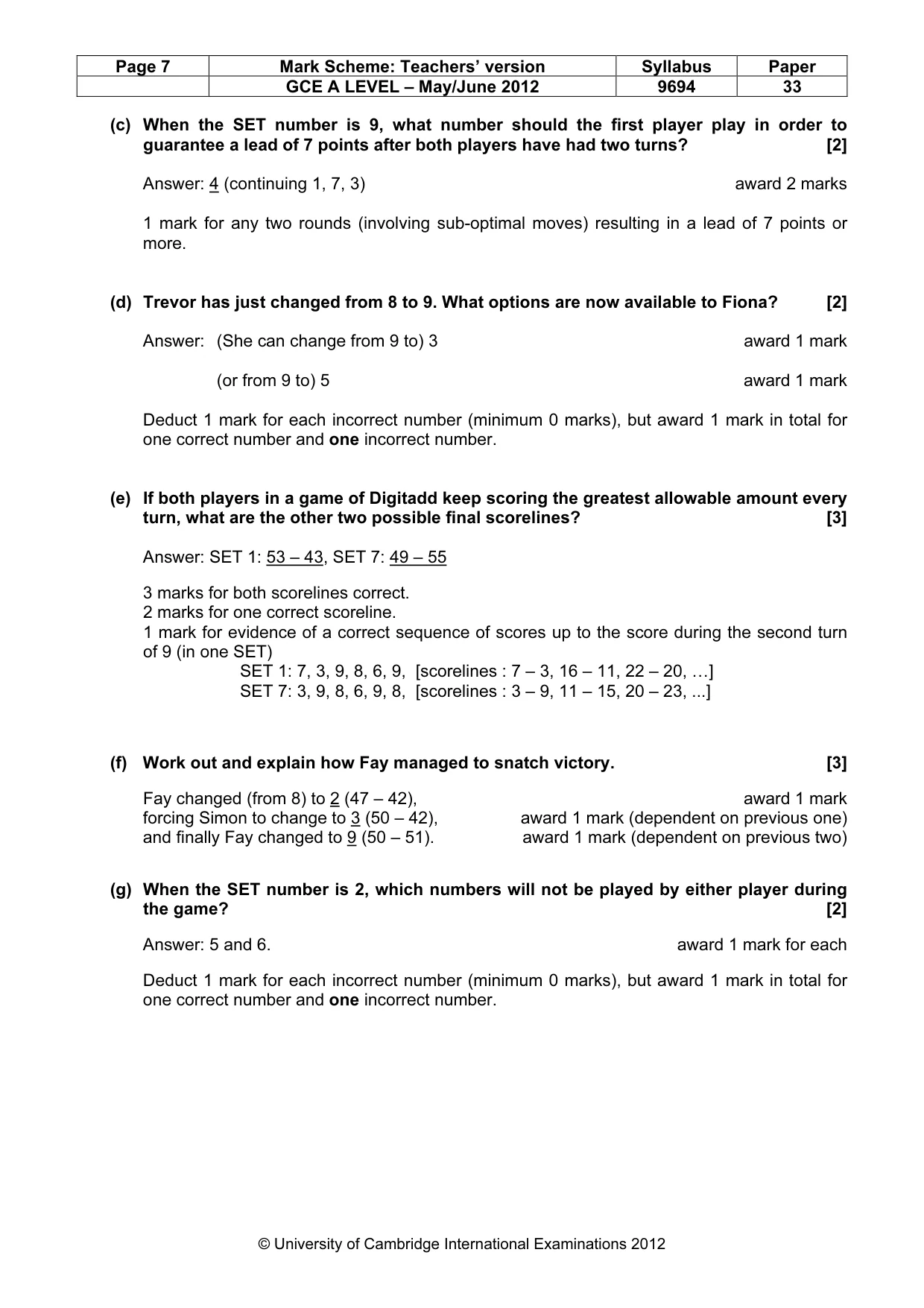
Page 7 Mark Scheme: Teachers’ version Syllabus Paper GCE A LEVEL – May/June 2012 9694 33 © University of Cambridge International Examinations 2012 (c) When the SET number is 9, what number should the first player play in order to guarantee a lead of 7 points after both players have had two turns? [2] Answer: 4 (continuing 1, 7, 3) award 2 marks 1 mark for any two rounds (involving sub-optimal moves) resulting in a lead of 7 points or more. (d) Trevor has just changed from 8 to 9. What options are now available to Fiona? [2] Answer: (She can change from 9 to) 3 award 1 mark (or from 9 to) 5 award 1 mark Deduct 1 mark for each incorrect number (minimum 0 marks), but award 1 mark in total for one correct number and one incorrect number. (e) If both players in a game of Digitadd keep scoring the greatest allowable amount every turn, what are the other two possible final scorelines? [3] Answer: SET 1: 53 – 43, SET 7: 49 – 55 3 marks for both scorelines correct. 2 marks for one correct scoreline. 1 mark for evidence of a correct sequence of scores up to the score during the second turn of 9 (in one SET) SET 1: 7, 3, 9, 8, 6, 9, [scorelines : 7 – 3, 16 – 11, 22 – 20, …] SET 7: 3, 9, 8, 6, 9, 8, [scorelines : 3 – 9, 11 – 15, 20 – 23, ...] (f) Work out and explain how Fay managed to snatch victory. [3] Fay changed (from 8) to 2 (47 – 42), award 1 mark forcing Simon to change to 3 (50 – 42), award 1 mark (dependent on previous one) and finally Fay changed to 9 (50 – 51). award 1 mark (dependent on previous two) (g) When the SET number is 2, which numbers will not be played by either player during the game? [2] Answer: 5 and 6. award 1 mark for each Deduct 1 mark for each incorrect number (minimum 0 marks), but award 1 mark in total for one correct number and one incorrect number.
What you needed in this session
Cambridge’s own grade thresholds for 2012 May/June, Paper 3 · Variant 3. A higher threshold means an easier paper — the bar moves with how the cohort did.