Cambridge A Level Thinking Skills 9694 — 2012 May/June Paper 3 · Variant 2
9694/32/M/J/12 · 50 marks · ≈56 min
The question paper and its mark scheme, free to read here and free to download. This is Cambridge’s own paper, exactly as it was sat.
Question paper8 pages
Mark scheme8 pages
Answers below. Sit the paper first if you are practising.
Paper as text
Question paper, page 1
This document consists of 8 printed pages. IB12 06_9694_32/4RP © UCLES 2012 [Turn over *0738131002* UNIVERSITY OF CAMBRIDGE INTERNATIONAL EXAMINATIONS General Certificate of Education Advanced Level THINKING SKILLS 9694/32 Paper 3 Problem Analysis and Solution May/June 2012 1 hour 30 minutes Additional Materials: Answer Booklet/Paper Electronic Calculator READ THESE INSTRUCTIONS FIRST If you have been given an Answer Booklet, follow the instructions on the front cover of the booklet. Write your Centre number, candidate number and name on all the work you hand in. Write in dark blue or black pen. Do not use staples, paper clips, highlighters, glue or correction fluid. DO NOT WRITE ON ANY BARCODES. Calculators should be used where appropriate. Answer all the questions. Start each question on a new answer sheet. At the end of the examination, fasten all your work securely together. The number of marks is given in brackets [ ] at the end of each question or part question.
Question paper, page 2
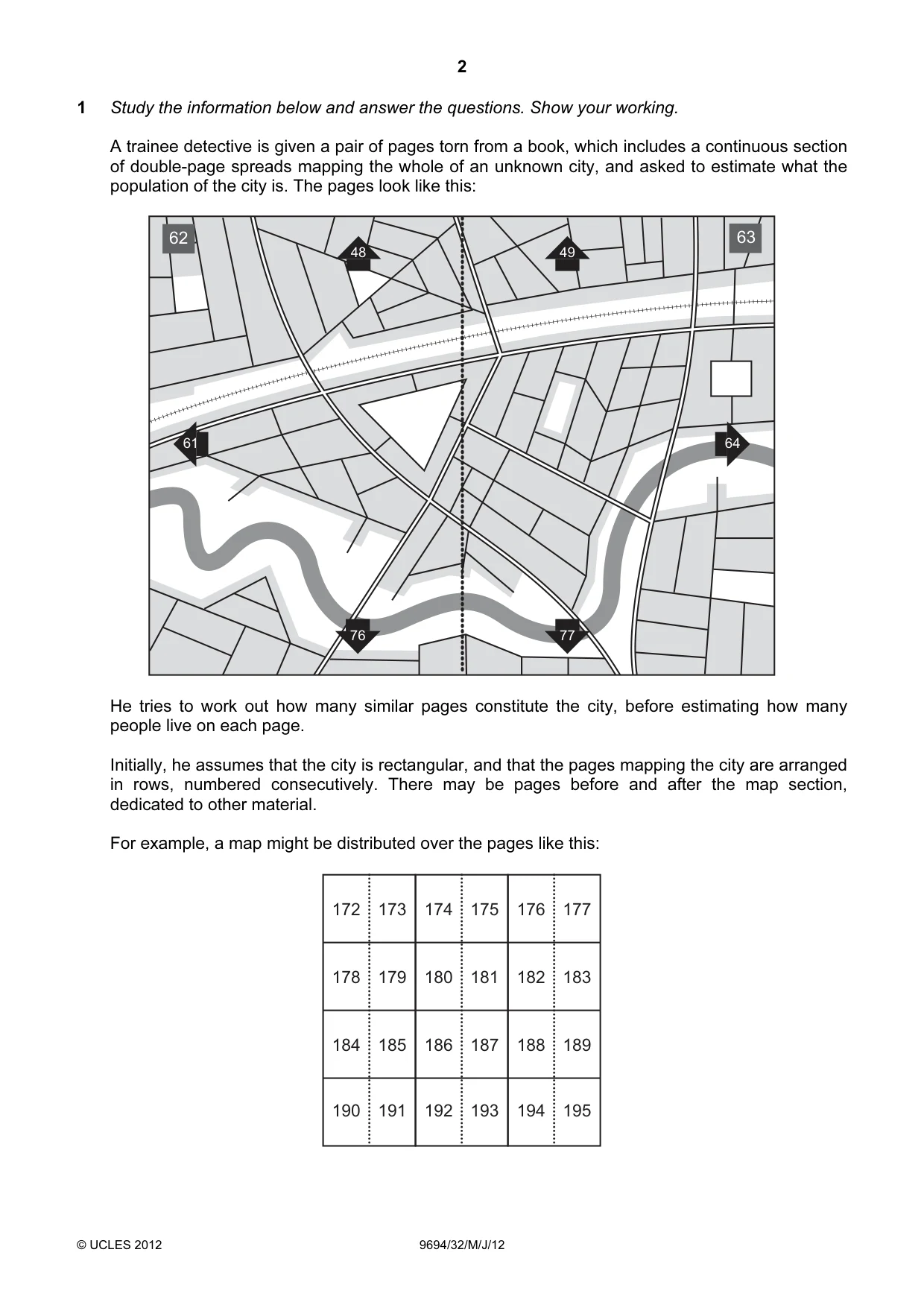
2 © UCLES 2012 9694/32/M/J/12 1 Study the information below and answer the questions. Show your working. A trainee detective is given a pair of pages torn from a book, which includes a continuous section of double-page spreads mapping the whole of an unknown city, and asked to estimate what the population of the city is. The pages look like this: 48 49 77 76 61 64 62 63 He tries to work out how many similar pages constitute the city, before estimating how many people live on each page. Initially, he assumes that the city is rectangular, and that the pages mapping the city are arranged in rows, numbered consecutively. There may be pages before and after the map section, dedicated to other material. For example, a map might be distributed over the pages like this: 172 173 178 179 184 185 190 191 174 175 180 181 186 187 192 193 176 177 182 183 188 189 194 195
Question paper, page 3
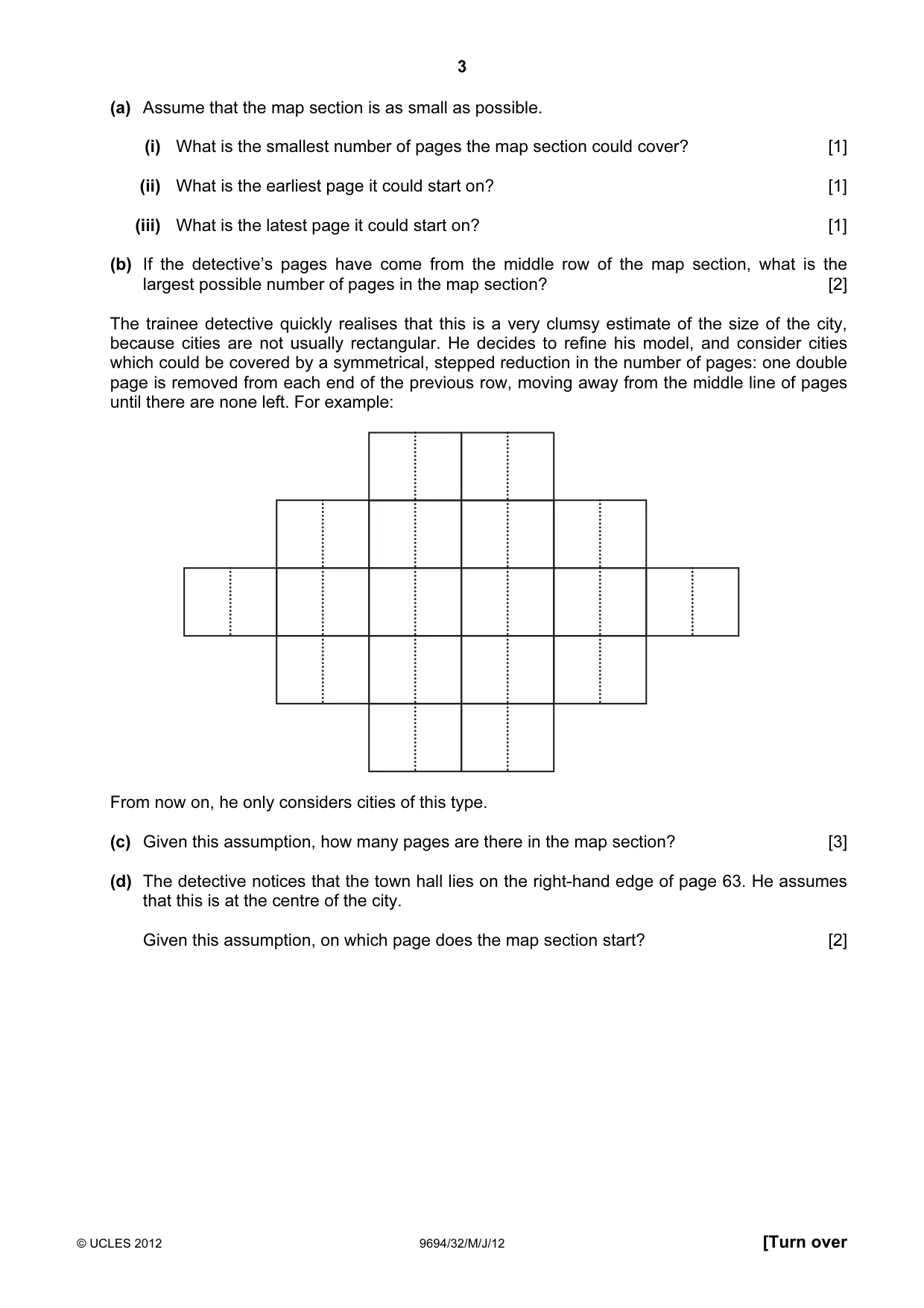
3 © UCLES 2012 9694/32/M/J/12 [Turn over (a) Assume that the map section is as small as possible. (i) What is the smallest number of pages the map section could cover? [1] (ii) What is the earliest page it could start on? [1] (iii) What is the latest page it could start on? [1] (b) If the detective’s pages have come from the middle row of the map section, what is the largest possible number of pages in the map section? [2] The trainee detective quickly realises that this is a very clumsy estimate of the size of the city, because cities are not usually rectangular. He decides to refine his model, and consider cities which could be covered by a symmetrical, stepped reduction in the number of pages: one double page is removed from each end of the previous row, moving away from the middle line of pages until there are none left. For example: From now on, he only considers cities of this type. (c) Given this assumption, how many pages are there in the map section? [3] (d) The detective notices that the town hall lies on the right-hand edge of page 63. He assumes that this is at the centre of the city. Given this assumption, on which page does the map section start? [2]
Question paper, page 4
4 © UCLES 2012 9694/32/M/J/12 2 Study the information below and answer the questions. Show your working. Albert and his three colleagues were employed to paint the sixteen arches of Stoppard bridge. It took them four years to do, and when they had finished they needed to start again immediately. Two painters never work on the same arch at the same time. A new type of paint was produced which takes the same effort to apply, and costs twice as much, but lasts for 16 years. Albert’s colleagues immediately lost their jobs (were made redundant) and each received the redundancy payment. Albert continued to work on the bridge, and switched to using the new paint. One painter’s pay (per year) $20 000 Redundancy payment $5000 Old paint (per painter per year) $1000 New paint (per painter per year) $2000 (a) How long was it before the bridge became unsafe because some parts had insufficient paint? [1] (b) Instead of getting rid of Albert’s colleagues immediately, it had been suggested employing 12 more painters who would be employed for one year (and then making all the painters redundant). If this had been done, with everyone using the new paint, what would the cost have been over a 16-year period? [2] (c) If the original four painters had switched over to using the new paint, they would all have been made redundant at the end of four years. How much would that have saved, compared with simply continuing with the old paint, over a 16-year period? [2] (d) A gradual reduction to having just Albert painting full time could have been arranged, without any arch being painted before it needed to be. (i) Describe the way this could have been done, noting which paint would be used by each painter. [2] (ii) At what stage would Albert have become the only painter? [1] (iii) How much would this have cost over a 16-year period? [2]
Question paper, page 5
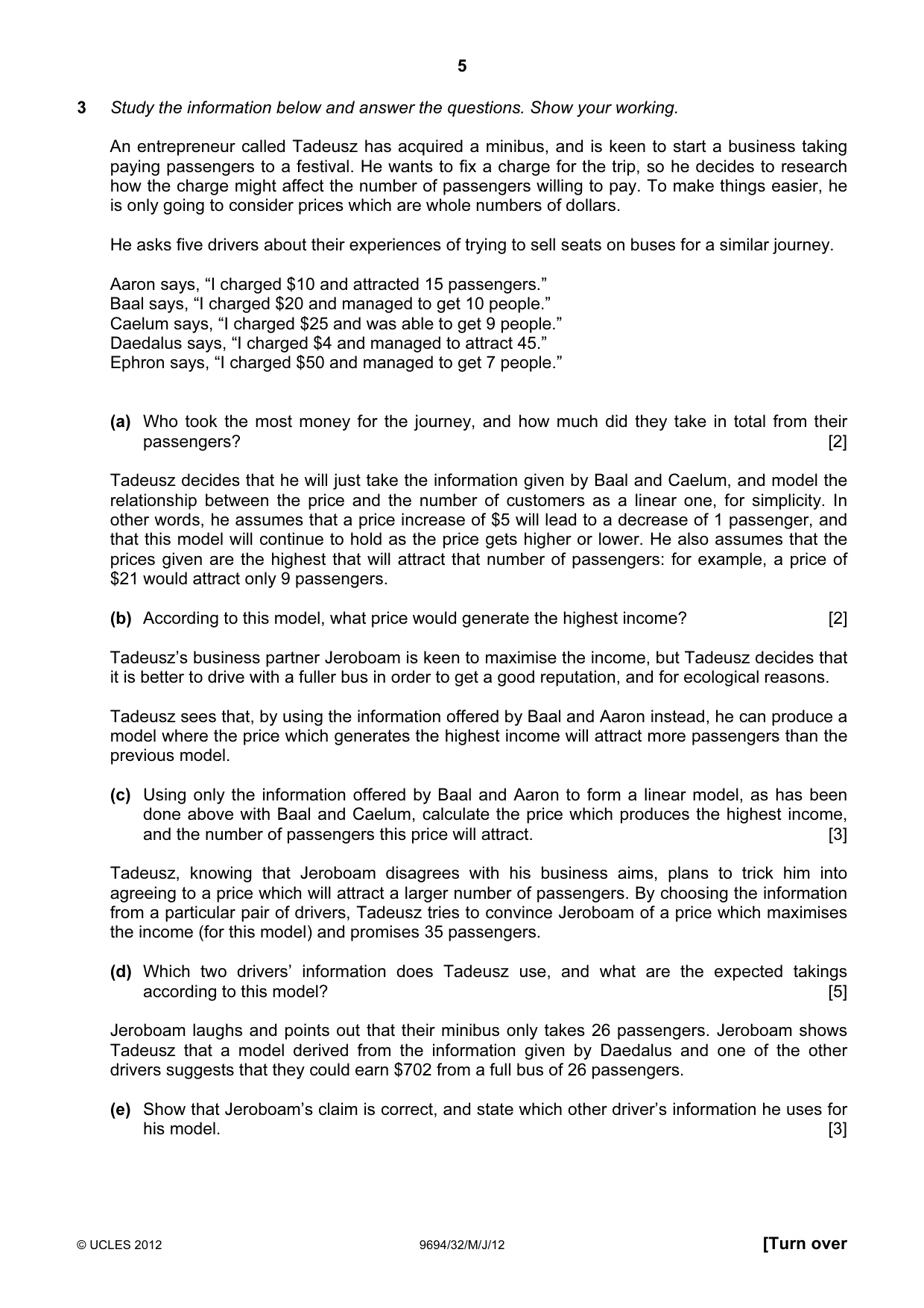
5 © UCLES 2012 9694/32/M/J/12 [Turn over 3 Study the information below and answer the questions. Show your working. An entrepreneur called Tadeusz has acquired a minibus, and is keen to start a business taking paying passengers to a festival. He wants to fix a charge for the trip, so he decides to research how the charge might affect the number of passengers willing to pay. To make things easier, he is only going to consider prices which are whole numbers of dollars. He asks five drivers about their experiences of trying to sell seats on buses for a similar journey. Aaron says, “I charged $10 and attracted 15 passengers.” Baal says, “I charged $20 and managed to get 10 people.” Caelum says, “I charged $25 and was able to get 9 people.” Daedalus says, “I charged $4 and managed to attract 45.” Ephron says, “I charged $50 and managed to get 7 people.” (a) Who took the most money for the journey, and how much did they take in total from their passengers? [2] Tadeusz decides that he will just take the information given by Baal and Caelum, and model the relationship between the price and the number of customers as a linear one, for simplicity. In other words, he assumes that a price increase of $5 will lead to a decrease of 1 passenger, and that this model will continue to hold as the price gets higher or lower. He also assumes that the prices given are the highest that will attract that number of passengers: for example, a price of $21 would attract only 9 passengers. (b) According to this model, what price would generate the highest income? [2] Tadeusz’s business partner Jeroboam is keen to maximise the income, but Tadeusz decides that it is better to drive with a fuller bus in order to get a good reputation, and for ecological reasons. Tadeusz sees that, by using the information offered by Baal and Aaron instead, he can produce a model where the price which generates the highest income will attract more passengers than the previous model. (c) Using only the information offered by Baal and Aaron to form a linear model, as has been done above with Baal and Caelum, calculate the price which produces the highest income, and the number of passengers this price will attract. [3] Tadeusz, knowing that Jeroboam disagrees with his business aims, plans to trick him into agreeing to a price which will attract a larger number of passengers. By choosing the information from a particular pair of drivers, Tadeusz tries to convince Jeroboam of a price which maximises the income (for this model) and promises 35 passengers. (d) Which two drivers’ information does Tadeusz use, and what are the expected takings according to this model? [5] Jeroboam laughs and points out that their minibus only takes 26 passengers. Jeroboam shows Tadeusz that a model derived from the information given by Daedalus and one of the other drivers suggests that they could earn $702 from a full bus of 26 passengers. (e) Show that Jeroboam’s claim is correct, and state which other driver’s information he uses for his model. [3]
Question paper, page 6
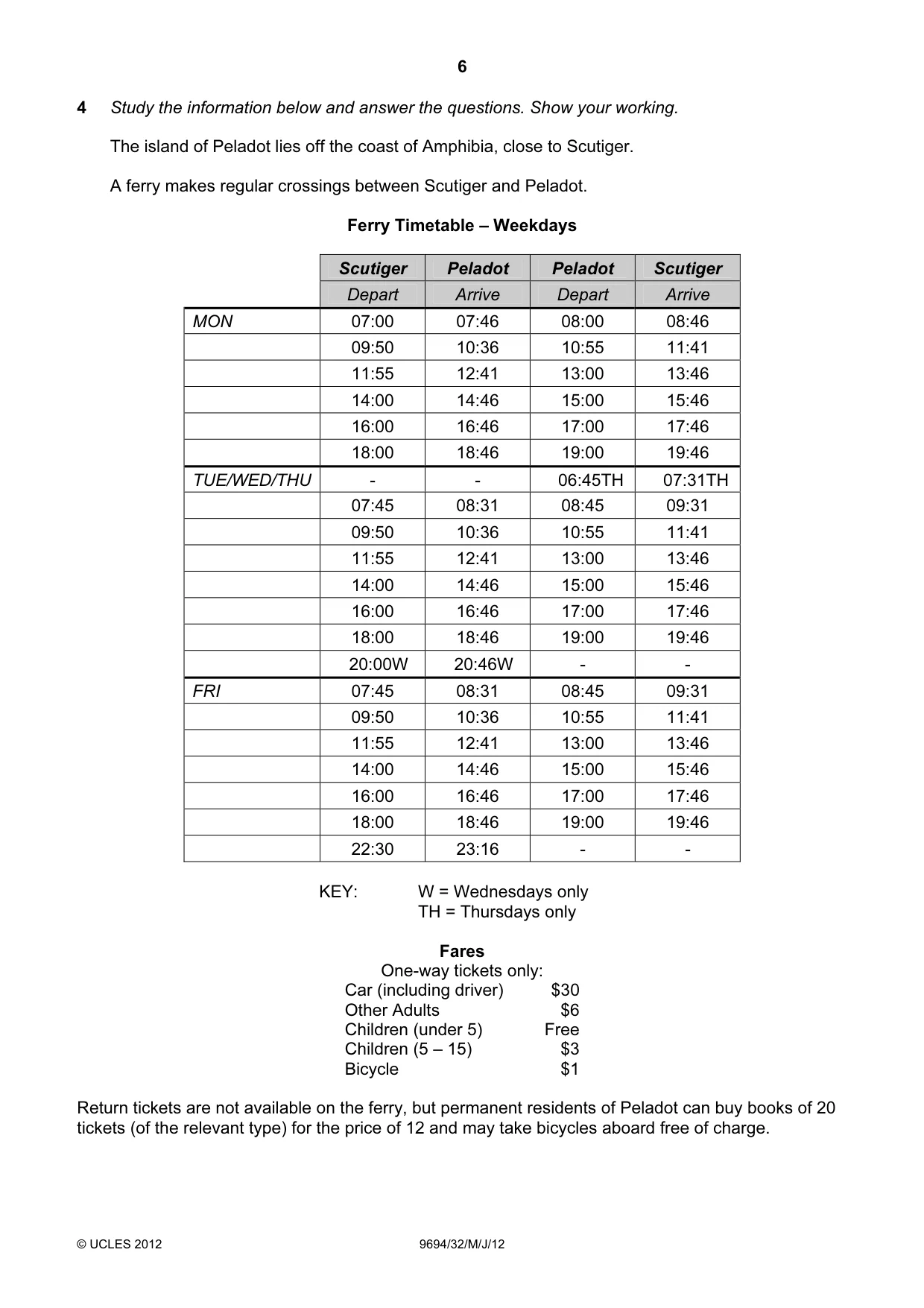
6 © UCLES 2012 9694/32/M/J/12 4 Study the information below and answer the questions. Show your working. The island of Peladot lies off the coast of Amphibia, close to Scutiger. A ferry makes regular crossings between Scutiger and Peladot. Ferry Timetable – Weekdays Scutiger Peladot Peladot Scutiger Depart Arrive Depart Arrive MON 07:00 07:46 08:00 08:46 09:50 10:36 10:55 11:41 11:55 12:41 13:00 13:46 14:00 14:46 15:00 15:46 16:00 16:46 17:00 17:46 18:00 18:46 19:00 19:46 TUE/WED/THU - - 06:45TH 07:31TH 07:45 08:31 08:45 09:31 09:50 10:36 10:55 11:41 11:55 12:41 13:00 13:46 14:00 14:46 15:00 15:46 16:00 16:46 17:00 17:46 18:00 18:46 19:00 19:46 20:00W 20:46W - - FRI 07:45 08:31 08:45 09:31 09:50 10:36 10:55 11:41 11:55 12:41 13:00 13:46 14:00 14:46 15:00 15:46 16:00 16:46 17:00 17:46 18:00 18:46 19:00 19:46 22:30 23:16 - - KEY: W = Wednesdays only TH = Thursdays only Fares One-way tickets only: Car (including driver) $30 Other Adults $6 Children (under 5) Free Children (5 – 15) $3 Bicycle $1 Return tickets are not available on the ferry, but permanent residents of Peladot can buy books of 20 tickets (of the relevant type) for the price of 12 and may take bicycles aboard free of charge.
Question paper, page 7
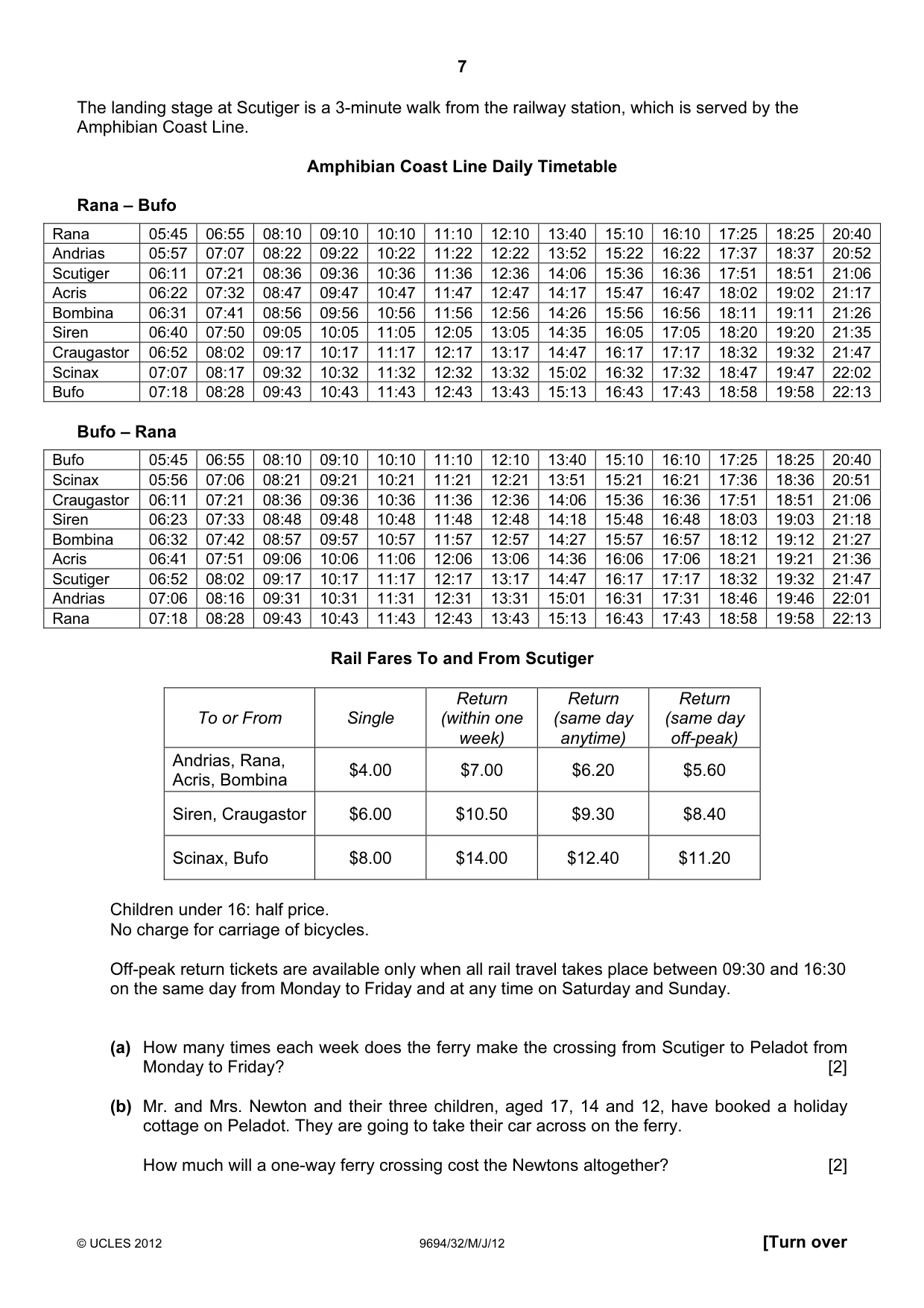
7 © UCLES 2012 9694/32/M/J/12 [Turn over The landing stage at Scutiger is a 3-minute walk from the railway station, which is served by the Amphibian Coast Line. Amphibian Coast Line Daily Timetable Rana – Bufo Bufo – Rana Rail Fares To and From Scutiger To or From Single Return (within one week) Return (same day anytime) Return (same day off-peak) Andrias, Rana, Acris, Bombina $4.00 $7.00 $6.20 $5.60 Siren, Craugastor $6.00 $10.50 $9.30 $8.40 Scinax, Bufo $8.00 $14.00 $12.40 $11.20 Children under 16: half price. No charge for carriage of bicycles. Off-peak return tickets are available only when all rail travel takes place between 09:30 and 16:30 on the same day from Monday to Friday and at any time on Saturday and Sunday. (a) How many times each week does the ferry make the crossing from Scutiger to Peladot from Monday to Friday? [2] (b) Mr. and Mrs. Newton and their three children, aged 17, 14 and 12, have booked a holiday cottage on Peladot. They are going to take their car across on the ferry. How much will a one-way ferry crossing cost the Newtons altogether? [2] Rana 05:45 06:55 08:10 09:10 10:10 11:10 12:10 13:40 15:10 16:10 17:25 18:25 20:40 Andrias 05:57 07:07 08:22 09:22 10:22 11:22 12:22 13:52 15:22 16:22 17:37 18:37 20:52 Scutiger 06:11 07:21 08:36 09:36 10:36 11:36 12:36 14:06 15:36 16:36 17:51 18:51 21:06 Acris 06:22 07:32 08:47 09:47 10:47 11:47 12:47 14:17 15:47 16:47 18:02 19:02 21:17 Bombina 06:31 07:41 08:56 09:56 10:56 11:56 12:56 14:26 15:56 16:56 18:11 19:11 21:26 Siren 06:40 07:50 09:05 10:05 11:05 12:05 13:05 14:35 16:05 17:05 18:20 19:20 21:35 Craugastor 06:52 08:02 09:17 10:17 11:17 12:17 13:17 14:47 16:17 17:17 18:32 19:32 21:47 Scinax 07:07 08:17 09:32 10:32 11:32 12:32 13:32 15:02 16:32 17:32 18:47 19:47 22:02 Bufo 07:18 08:28 09:43 10:43 11:43 12:43 13:43 15:13 16:43 17:43 18:58 19:58 22:13 Bufo 05:45 06:55 08:10 09:10 10:10 11:10 12:10 13:40 15:10 16:10 17:25 18:25 20:40 Scinax 05:56 07:06 08:21 09:21 10:21 11:21 12:21 13:51 15:21 16:21 17:36 18:36 20:51 Craugastor 06:11 07:21 08:36 09:36 10:36 11:36 12:36 14:06 15:36 16:36 17:51 18:51 21:06 Siren 06:23 07:33 08:48 09:48 10:48 11:48 12:48 14:18 15:48 16:48 18:03 19:03 21:18 Bombina 06:32 07:42 08:57 09:57 10:57 11:57 12:57 14:27 15:57 16:57 18:12 19:12 21:27 Acris 06:41 07:51 09:06 10:06 11:06 12:06 13:06 14:36 16:06 17:06 18:21 19:21 21:36 Scutiger 06:52 08:02 09:17 10:17 11:17 12:17 13:17 14:47 16:17 17:17 18:32 19:32 21:47 Andrias 07:06 08:16 09:31 10:31 11:31 12:31 13:31 15:01 16:31 17:31 18:46 19:46 22:01 Rana 07:18 08:28 09:43 10:43 11:43 12:43 13:43 15:13 16:43 17:43 18:58 19:58 22:13
Question paper, page 8
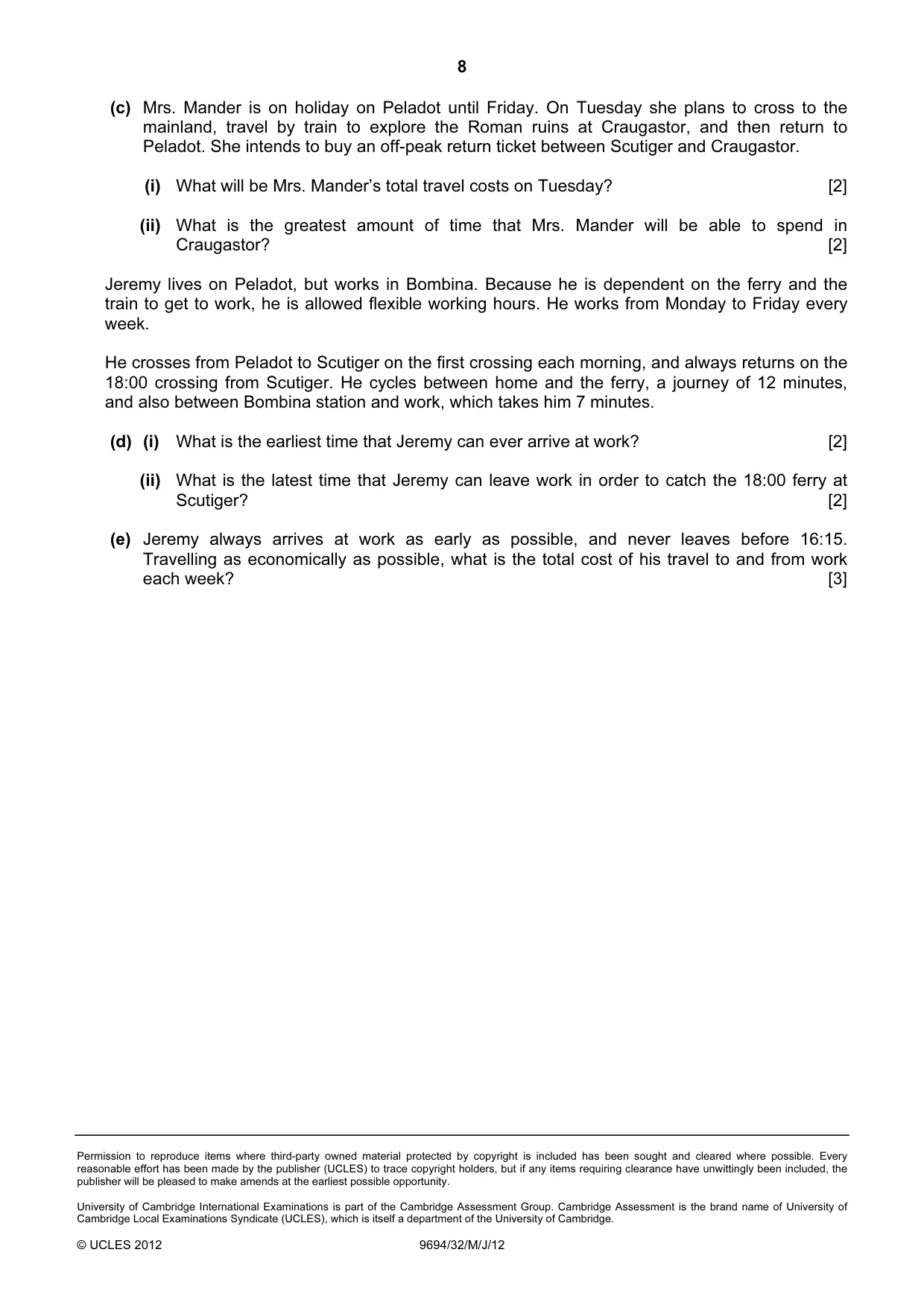
8 Permission to reproduce items where third-party owned material protected by copyright is included has been sought and cleared where possible. Every reasonable effort has been made by the publisher (UCLES) to trace copyright holders, but if any items requiring clearance have unwittingly been included, the publisher will be pleased to make amends at the earliest possible opportunity. University of Cambridge International Examinations is part of the Cambridge Assessment Group. Cambridge Assessment is the brand name of University of Cambridge Local Examinations Syndicate (UCLES), which is itself a department of the University of Cambridge. © UCLES 2012 9694/32/M/J/12 (c) Mrs. Mander is on holiday on Peladot until Friday. On Tuesday she plans to cross to the mainland, travel by train to explore the Roman ruins at Craugastor, and then return to Peladot. She intends to buy an off-peak return ticket between Scutiger and Craugastor. (i) What will be Mrs. Mander’s total travel costs on Tuesday? [2] (ii) What is the greatest amount of time that Mrs. Mander will be able to spend in Craugastor? [2] Jeremy lives on Peladot, but works in Bombina. Because he is dependent on the ferry and the train to get to work, he is allowed flexible working hours. He works from Monday to Friday every week. He crosses from Peladot to Scutiger on the first crossing each morning, and always returns on the 18:00 crossing from Scutiger. He cycles between home and the ferry, a journey of 12 minutes, and also between Bombina station and work, which takes him 7 minutes. (d) (i) What is the earliest time that Jeremy can ever arrive at work? [2] (ii) What is the latest time that Jeremy can leave work in order to catch the 18:00 ferry at Scutiger? [2] (e) Jeremy always arrives at work as early as possible, and never leaves before 16:15. Travelling as economically as possible, what is the total cost of his travel to and from work each week? [3]
Mark scheme, page 1
UNIVERSITY OF CAMBRIDGE INTERNATIONAL EXAMINATIONS GCE Advanced Level MARK SCHEME for the May/June 2012 question paper for the guidance of teachers 9694 THINKING SKILLS 9694/32 Paper 3 (Problem Analysis and Solution), maximum raw mark 50 This mark scheme is published as an aid to teachers and candidates, to indicate the requirements of the examination. It shows the basis on which Examiners were instructed to award marks. It does not indicate the details of the discussions that took place at an Examiners’ meeting before marking began, which would have considered the acceptability of alternative answers. Mark schemes must be read in conjunction with the question papers and the report on the examination. • Cambridge will not enter into discussions or correspondence in connection with these mark schemes. Cambridge is publishing the mark schemes for the May/June 2012 question papers for most IGCSE, GCE Advanced Level and Advanced Subsidiary Level syllabuses and some Ordinary Level syllabuses.
Mark scheme, page 2
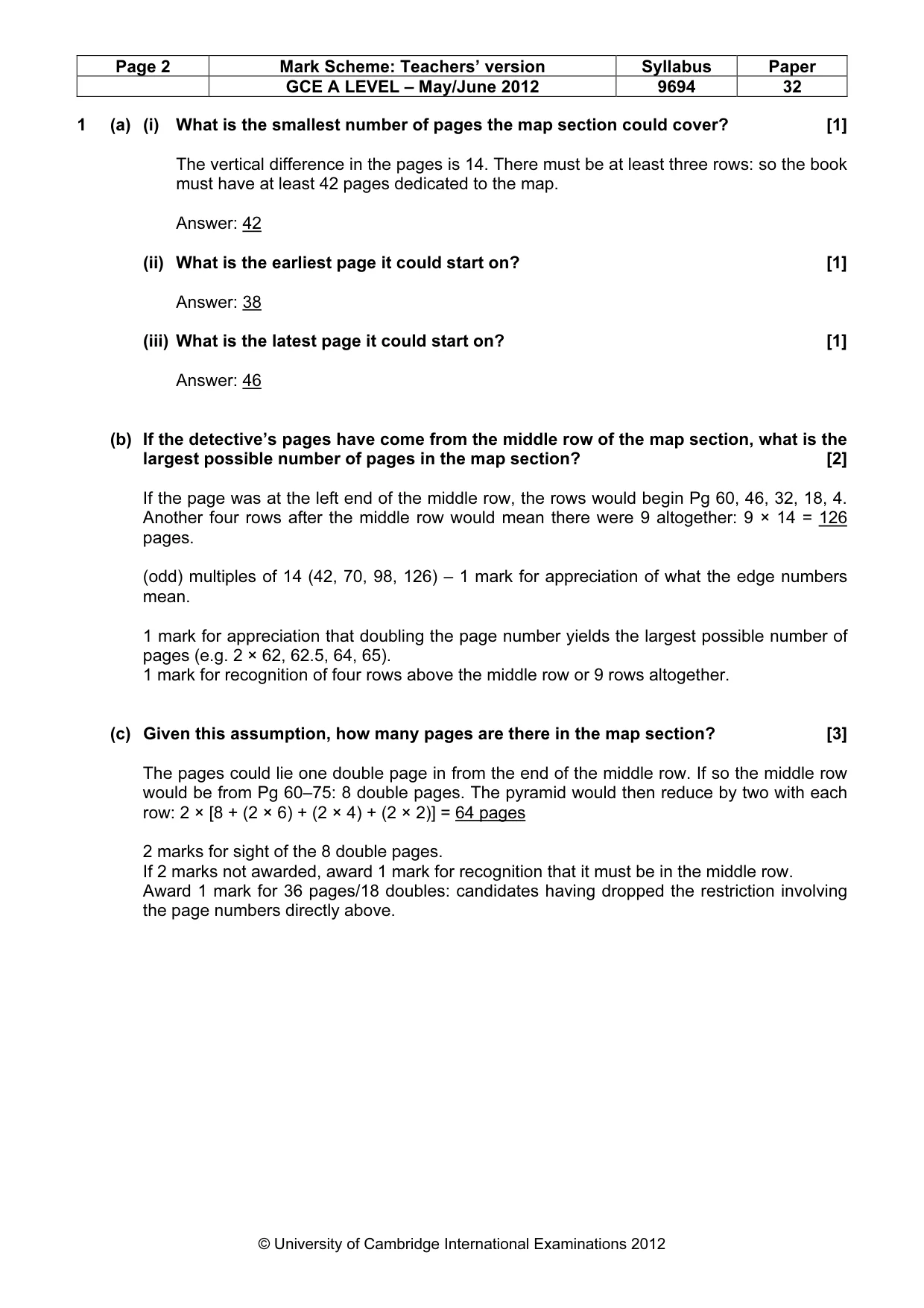
Page 2 Mark Scheme: Teachers’ version Syllabus Paper GCE A LEVEL – May/June 2012 9694 32 © University of Cambridge International Examinations 2012 1 (a) (i) What is the smallest number of pages the map section could cover? [1] The vertical difference in the pages is 14. There must be at least three rows: so the book must have at least 42 pages dedicated to the map. Answer: 42 (ii) What is the earliest page it could start on? [1] Answer: 38 (iii) What is the latest page it could start on? [1] Answer: 46 (b) If the detective’s pages have come from the middle row of the map section, what is the largest possible number of pages in the map section? [2] If the page was at the left end of the middle row, the rows would begin Pg 60, 46, 32, 18, 4. Another four rows after the middle row would mean there were 9 altogether: 9 × 14 = 126 pages. (odd) multiples of 14 (42, 70, 98, 126) – 1 mark for appreciation of what the edge numbers mean. 1 mark for appreciation that doubling the page number yields the largest possible number of pages (e.g. 2 × 62, 62.5, 64, 65). 1 mark for recognition of four rows above the middle row or 9 rows altogether. (c) Given this assumption, how many pages are there in the map section? [3] The pages could lie one double page in from the end of the middle row. If so the middle row would be from Pg 60–75: 8 double pages. The pyramid would then reduce by two with each row: 2 × [8 + (2 × 6) + (2 × 4) + (2 × 2)] = 64 pages 2 marks for sight of the 8 double pages. If 2 marks not awarded, award 1 mark for recognition that it must be in the middle row. Award 1 mark for 36 pages/18 doubles: candidates having dropped the restriction involving the page numbers directly above.
Mark scheme, page 3
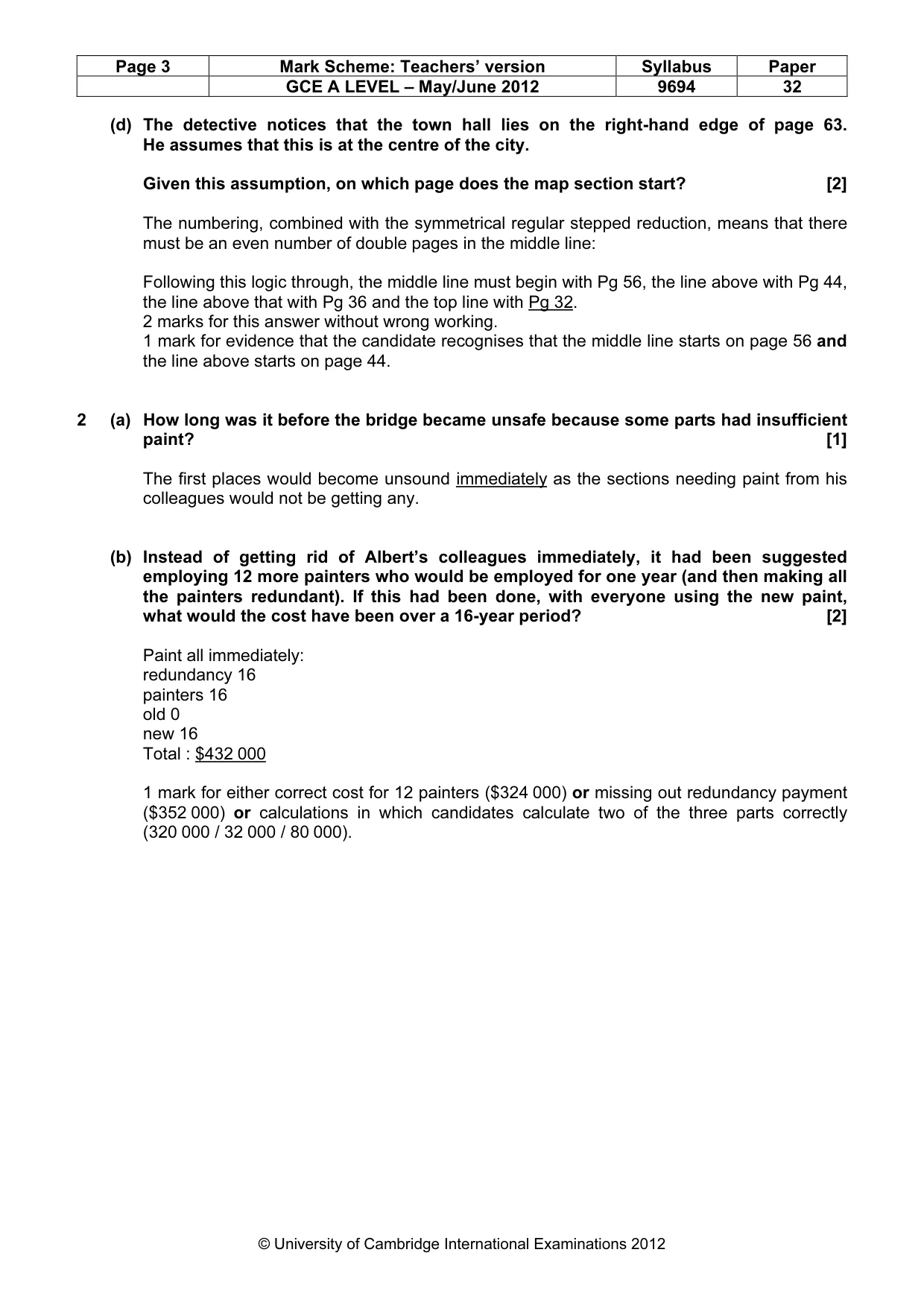
Page 3 Mark Scheme: Teachers’ version Syllabus Paper GCE A LEVEL – May/June 2012 9694 32 © University of Cambridge International Examinations 2012 (d) The detective notices that the town hall lies on the right-hand edge of page 63. He assumes that this is at the centre of the city. Given this assumption, on which page does the map section start? [2] The numbering, combined with the symmetrical regular stepped reduction, means that there must be an even number of double pages in the middle line: Following this logic through, the middle line must begin with Pg 56, the line above with Pg 44, the line above that with Pg 36 and the top line with Pg 32. 2 marks for this answer without wrong working. 1 mark for evidence that the candidate recognises that the middle line starts on page 56 and the line above starts on page 44. 2 (a) How long was it before the bridge became unsafe because some parts had insufficient paint? [1] The first places would become unsound immediately as the sections needing paint from his colleagues would not be getting any. (b) Instead of getting rid of Albert’s colleagues immediately, it had been suggested employing 12 more painters who would be employed for one year (and then making all the painters redundant). If this had been done, with everyone using the new paint, what would the cost have been over a 16-year period? [2] Paint all immediately: redundancy 16 painters 16 old 0 new 16 Total : $432 000 1 mark for either correct cost for 12 painters ($324 000) or missing out redundancy payment ($352 000) or calculations in which candidates calculate two of the three parts correctly (320 000 / 32 000 / 80 000).
Mark scheme, page 4
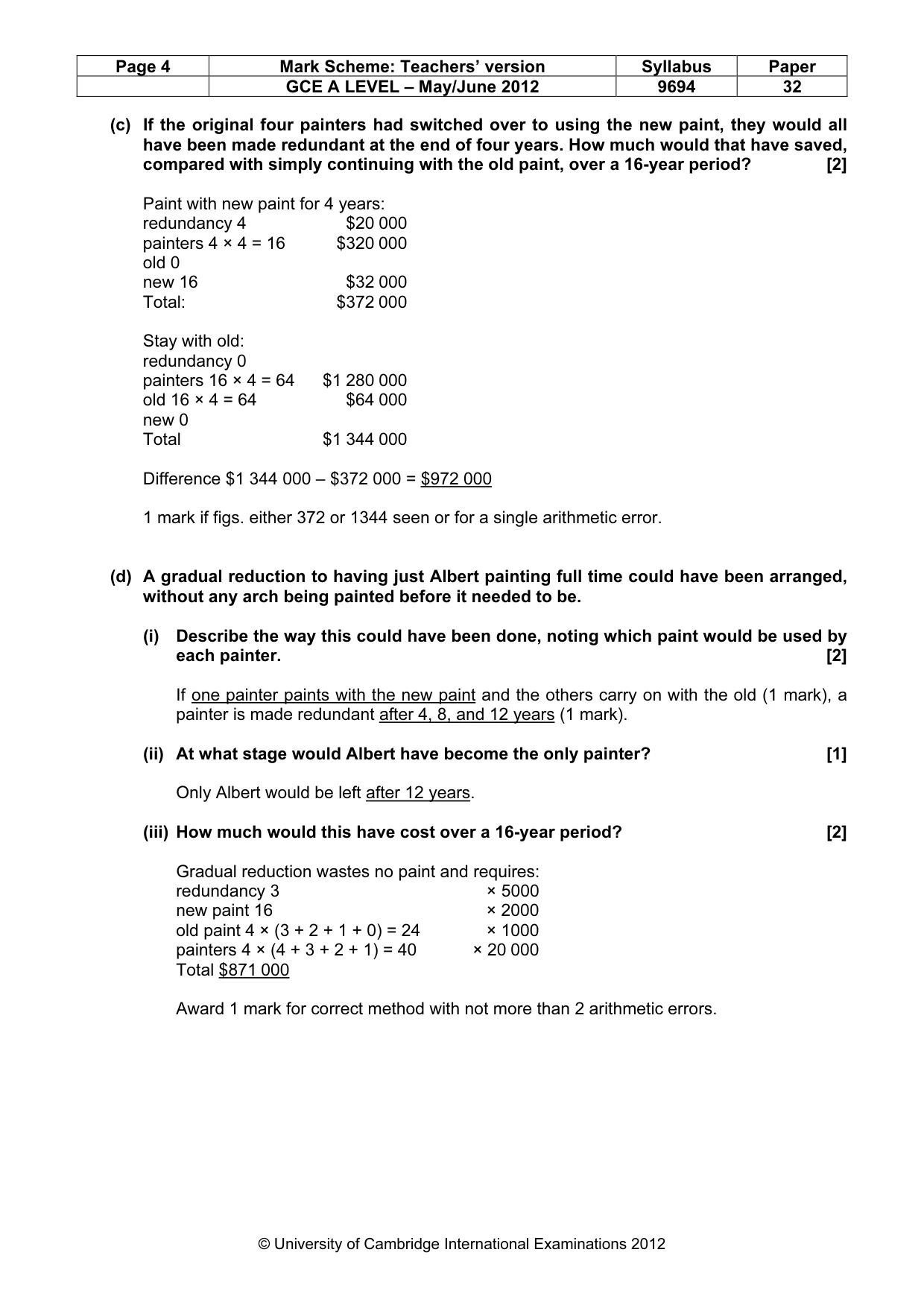
Page 4 Mark Scheme: Teachers’ version Syllabus Paper GCE A LEVEL – May/June 2012 9694 32 © University of Cambridge International Examinations 2012 (c) If the original four painters had switched over to using the new paint, they would all have been made redundant at the end of four years. How much would that have saved, compared with simply continuing with the old paint, over a 16-year period? [2] Paint with new paint for 4 years: redundancy 4 $20 000 painters 4 × 4 = 16 $320 000 old 0 new 16 $32 000 Total: $372 000 Stay with old: redundancy 0 painters 16 × 4 = 64 $1 280 000 old 16 × 4 = 64 $64 000 new 0 Total $1 344 000 Difference $1 344 000 – $372 000 = $972 000 1 mark if figs. either 372 or 1344 seen or for a single arithmetic error. (d) A gradual reduction to having just Albert painting full time could have been arranged, without any arch being painted before it needed to be. (i) Describe the way this could have been done, noting which paint would be used by each painter. [2] If one painter paints with the new paint and the others carry on with the old (1 mark), a painter is made redundant after 4, 8, and 12 years (1 mark). (ii) At what stage would Albert have become the only painter? [1] Only Albert would be left after 12 years. (iii) How much would this have cost over a 16-year period? [2] Gradual reduction wastes no paint and requires: redundancy 3 × 5000 new paint 16 × 2000 old paint 4 × (3 + 2 + 1 + 0) = 24 × 1000 painters 4 × (4 + 3 + 2 + 1) = 40 × 20 000 Total $871 000 Award 1 mark for correct method with not more than 2 arithmetic errors.
Mark scheme, page 5
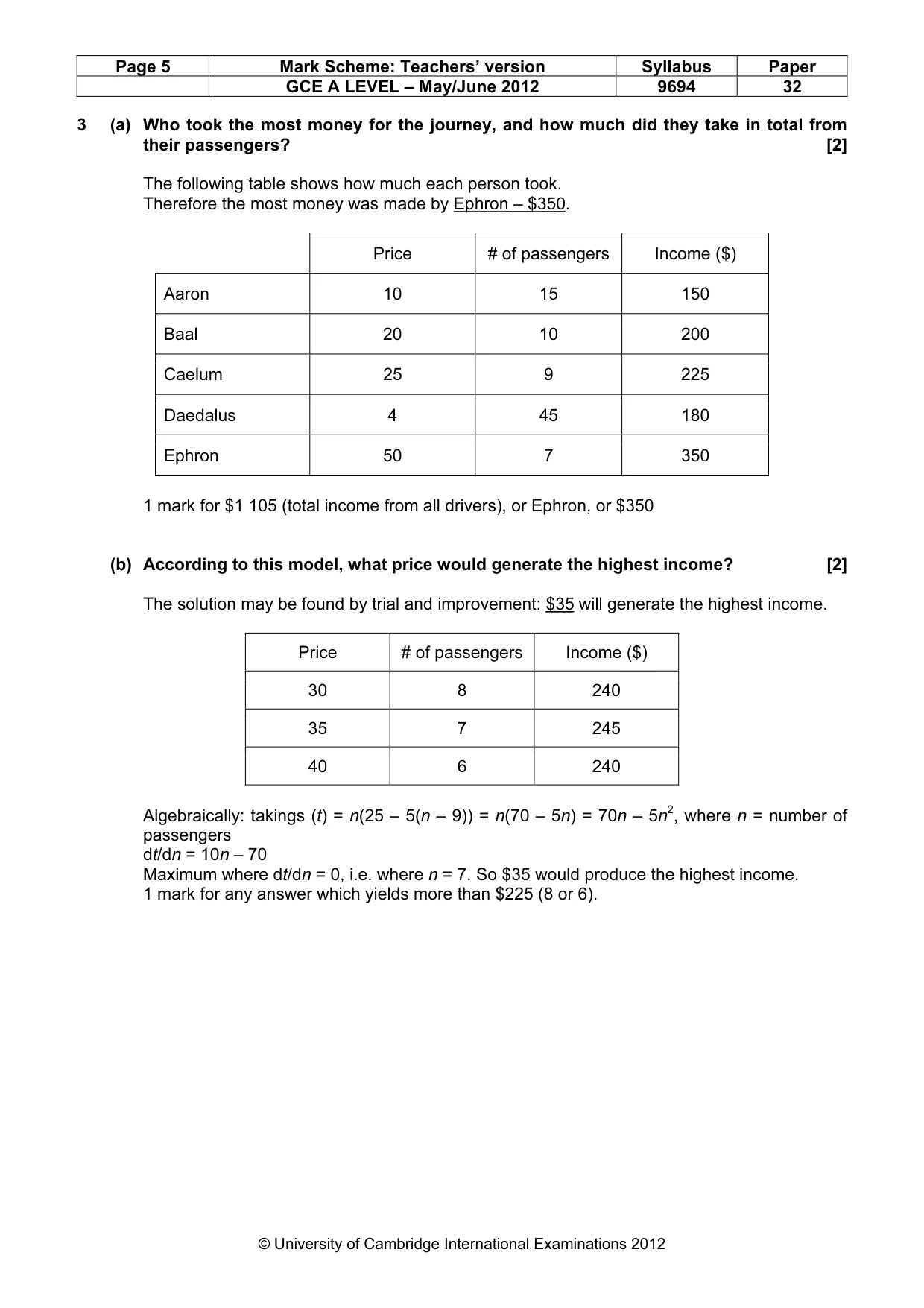
Page 5 Mark Scheme: Teachers’ version Syllabus Paper GCE A LEVEL – May/June 2012 9694 32 © University of Cambridge International Examinations 2012 3 (a) Who took the most money for the journey, and how much did they take in total from their passengers? [2] The following table shows how much each person took. Therefore the most money was made by Ephron – $350. Price # of passengers Income ($) Aaron 10 15 150 Baal 20 10 200 Caelum 25 9 225 Daedalus 4 45 180 Ephron 50 7 350 1 mark for $1 105 (total income from all drivers), or Ephron, or $350 (b) According to this model, what price would generate the highest income? [2] The solution may be found by trial and improvement: $35 will generate the highest income. Price # of passengers Income ($) 30 8 240 35 7 245 40 6 240 Algebraically: takings (t) = n(25 – 5(n – 9)) = n(70 – 5n) = 70n – 5n2, where n = number of passengers dt/dn = 10n – 70 Maximum where dt/dn = 0, i.e. where n = 7. So $35 would produce the highest income. 1 mark for any answer which yields more than $225 (8 or 6).
Mark scheme, page 6
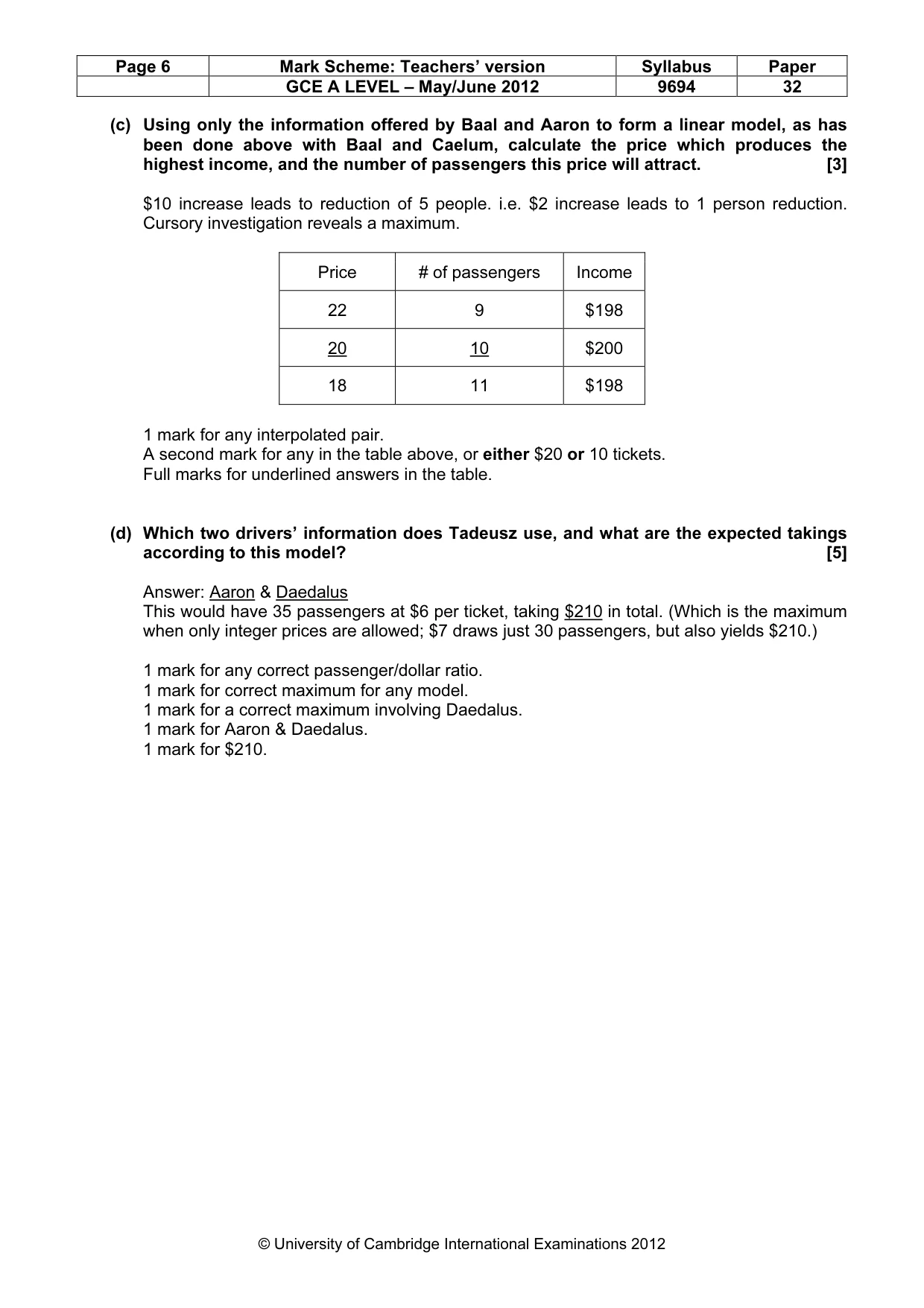
Page 6 Mark Scheme: Teachers’ version Syllabus Paper GCE A LEVEL – May/June 2012 9694 32 © University of Cambridge International Examinations 2012 (c) Using only the information offered by Baal and Aaron to form a linear model, as has been done above with Baal and Caelum, calculate the price which produces the highest income, and the number of passengers this price will attract. [3] $10 increase leads to reduction of 5 people. i.e. $2 increase leads to 1 person reduction. Cursory investigation reveals a maximum. Price # of passengers Income 22 9 $198 20 10 $200 18 11 $198 1 mark for any interpolated pair. A second mark for any in the table above, or either $20 or 10 tickets. Full marks for underlined answers in the table. (d) Which two drivers’ information does Tadeusz use, and what are the expected takings according to this model? [5] Answer: Aaron & Daedalus This would have 35 passengers at $6 per ticket, taking $210 in total. (Which is the maximum when only integer prices are allowed; $7 draws just 30 passengers, but also yields $210.) 1 mark for any correct passenger/dollar ratio. 1 mark for correct maximum for any model. 1 mark for a correct maximum involving Daedalus. 1 mark for Aaron & Daedalus. 1 mark for $210.
Mark scheme, page 7
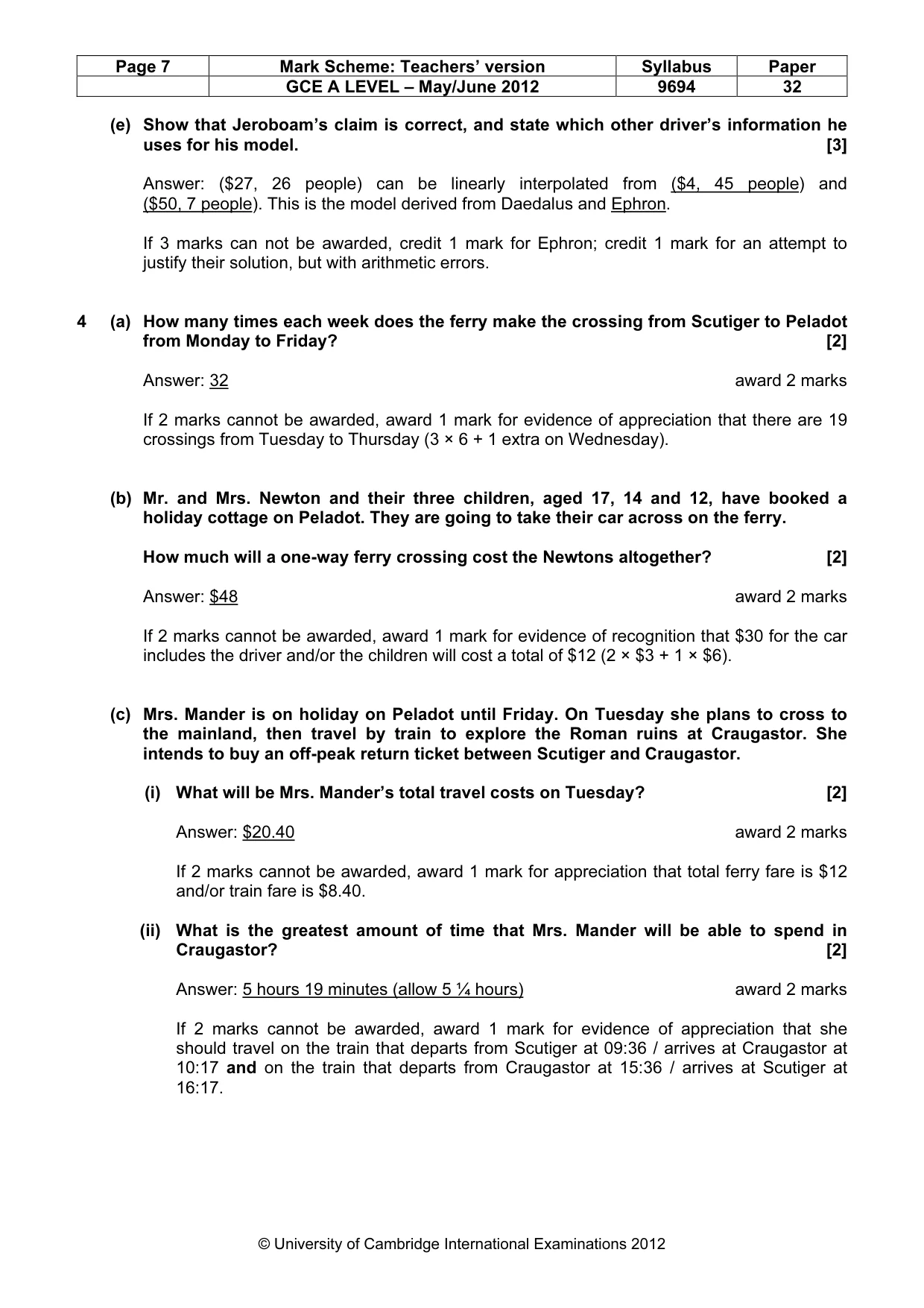
Page 7 Mark Scheme: Teachers’ version Syllabus Paper GCE A LEVEL – May/June 2012 9694 32 © University of Cambridge International Examinations 2012 (e) Show that Jeroboam’s claim is correct, and state which other driver’s information he uses for his model. [3] Answer: ($27, 26 people) can be linearly interpolated from ($4, 45 people) and ($50, 7 people). This is the model derived from Daedalus and Ephron. If 3 marks can not be awarded, credit 1 mark for Ephron; credit 1 mark for an attempt to justify their solution, but with arithmetic errors. 4 (a) How many times each week does the ferry make the crossing from Scutiger to Peladot from Monday to Friday? [2] Answer: 32 award 2 marks If 2 marks cannot be awarded, award 1 mark for evidence of appreciation that there are 19 crossings from Tuesday to Thursday (3 × 6 + 1 extra on Wednesday). (b) Mr. and Mrs. Newton and their three children, aged 17, 14 and 12, have booked a holiday cottage on Peladot. They are going to take their car across on the ferry. How much will a one-way ferry crossing cost the Newtons altogether? [2] Answer: $48 award 2 marks If 2 marks cannot be awarded, award 1 mark for evidence of recognition that $30 for the car includes the driver and/or the children will cost a total of $12 (2 × $3 + 1 × $6). (c) Mrs. Mander is on holiday on Peladot until Friday. On Tuesday she plans to cross to the mainland, then travel by train to explore the Roman ruins at Craugastor. She intends to buy an off-peak return ticket between Scutiger and Craugastor. (i) What will be Mrs. Mander’s total travel costs on Tuesday? [2] Answer: $20.40 award 2 marks If 2 marks cannot be awarded, award 1 mark for appreciation that total ferry fare is $12 and/or train fare is $8.40. (ii) What is the greatest amount of time that Mrs. Mander will be able to spend in Craugastor? [2] Answer: 5 hours 19 minutes (allow 5 ¼ hours) award 2 marks If 2 marks cannot be awarded, award 1 mark for evidence of appreciation that she should travel on the train that departs from Scutiger at 09:36 / arrives at Craugastor at 10:17 and on the train that departs from Craugastor at 15:36 / arrives at Scutiger at 16:17.
Mark scheme, page 8
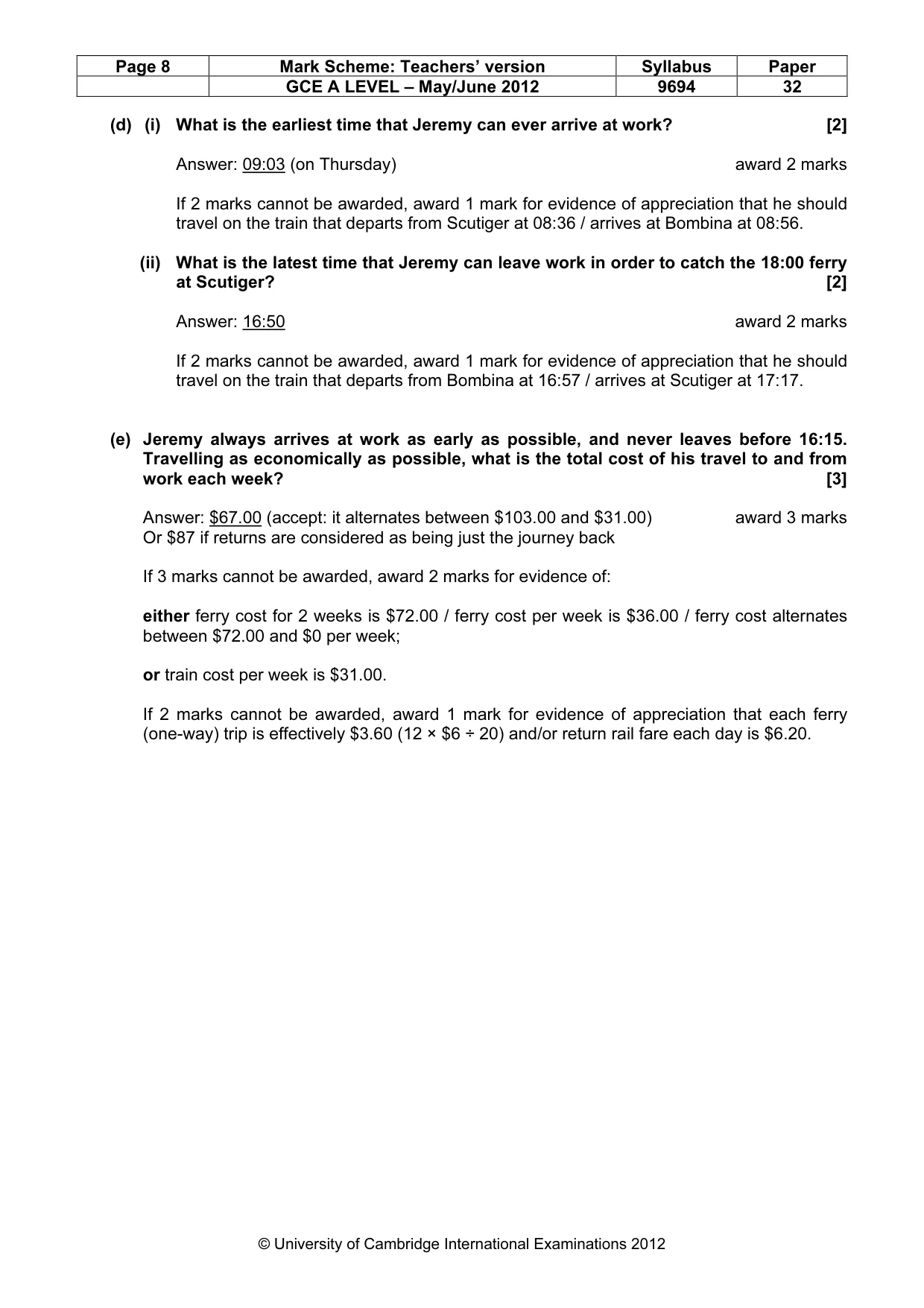
Page 8 Mark Scheme: Teachers’ version Syllabus Paper GCE A LEVEL – May/June 2012 9694 32 © University of Cambridge International Examinations 2012 (d) (i) What is the earliest time that Jeremy can ever arrive at work? [2] Answer: 09:03 (on Thursday) award 2 marks If 2 marks cannot be awarded, award 1 mark for evidence of appreciation that he should travel on the train that departs from Scutiger at 08:36 / arrives at Bombina at 08:56. (ii) What is the latest time that Jeremy can leave work in order to catch the 18:00 ferry at Scutiger? [2] Answer: 16:50 award 2 marks If 2 marks cannot be awarded, award 1 mark for evidence of appreciation that he should travel on the train that departs from Bombina at 16:57 / arrives at Scutiger at 17:17. (e) Jeremy always arrives at work as early as possible, and never leaves before 16:15. Travelling as economically as possible, what is the total cost of his travel to and from work each week? [3] Answer: $67.00 (accept: it alternates between $103.00 and $31.00) award 3 marks Or $87 if returns are considered as being just the journey back If 3 marks cannot be awarded, award 2 marks for evidence of: either ferry cost for 2 weeks is $72.00 / ferry cost per week is $36.00 / ferry cost alternates between $72.00 and $0 per week; or train cost per week is $31.00. If 2 marks cannot be awarded, award 1 mark for evidence of appreciation that each ferry (one-way) trip is effectively $3.60 (12 × $6 ÷ 20) and/or return rail fare each day is $6.20.
What you needed in this session
Cambridge’s own grade thresholds for 2012 May/June, Paper 3 · Variant 2. A higher threshold means an easier paper — the bar moves with how the cohort did.