Cambridge A Level Tamil 9689 — 2021 Oct/Nov Paper 5 · Variant 2
9689/52/O/N/21 · 40 marks · ≈45 min
The question paper and its mark scheme, free to read here and free to download. This is Cambridge’s own paper, exactly as it was sat.
Question paper4 pages
Mark scheme9 pages
Answers below. Sit the paper first if you are practising.
Paper as text
Question paper, page 1
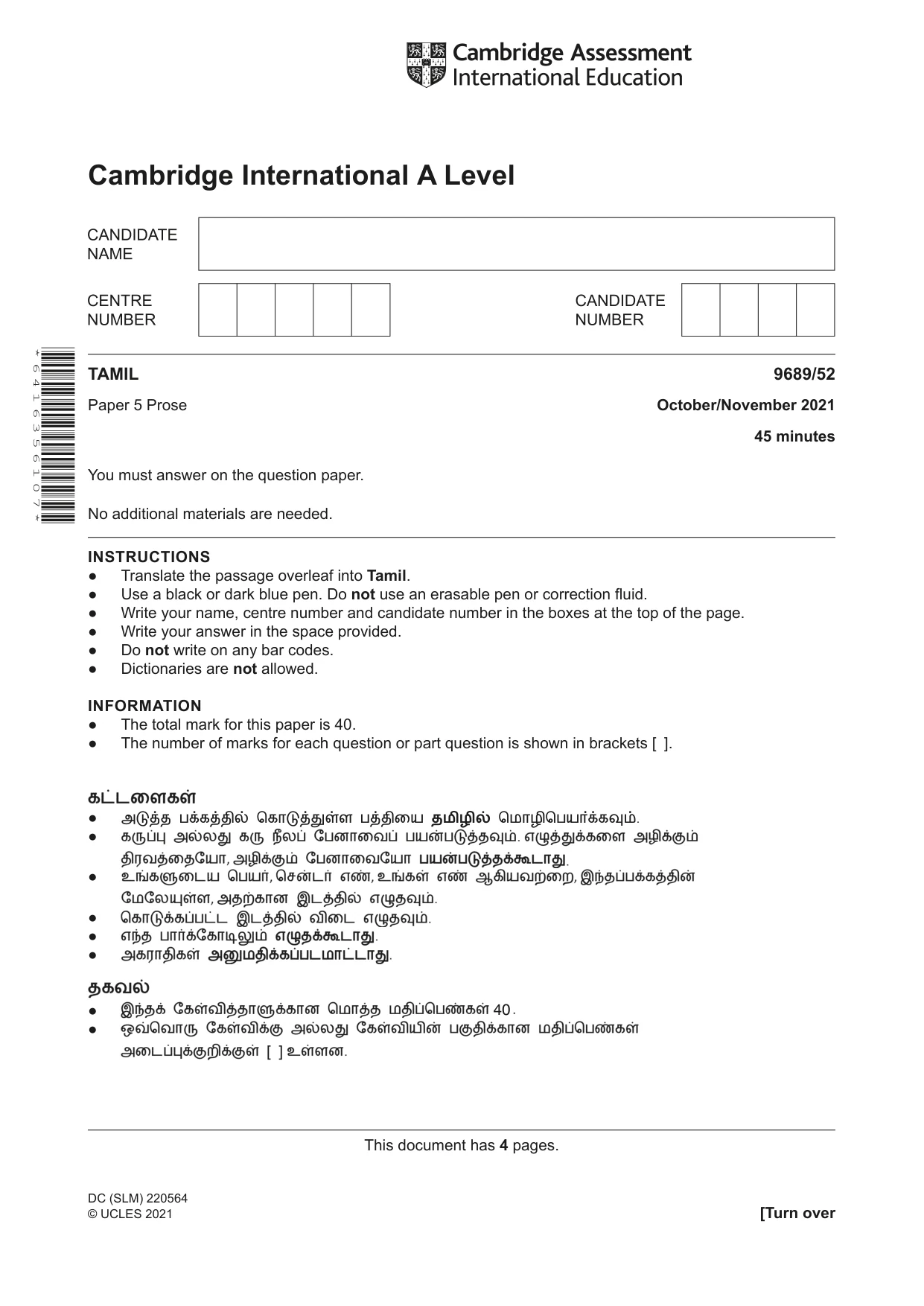
● அடுத்த பக்கத்ததில் க்கொடுத¢ள்ள பத்ததியை தமிழில் கMொழதிகபைொ்க்கவும். ● ● ● ● ● ● ● 40 [ ] This document has 4 pages. Cambridge International A Level TAMIL 9689/52 Paper 5 Prose October/November 2021 45 minutes You must answer on the question paper. No additional materials are needed. INSTRUCTIONS ● Translate the passage overleaf into Tamil. ● Use a black or dark blue pen. Do not use an erasable pen or correction fluid. ● Write your name, centre number and candidate number in the boxes at the top of the page. ● Write your answer in the space provided. ● Do not write on any bar codes. ● Dictionaries are not allowed. INFORMATION ● The total mark for this paper is 40. ● The number of marks for each question or part question is shown in brackets [ ]. * 6 4 1 6 3 5 6 1 0 7 * DC (SLM) 220564 © UCLES 2021 [Turn over
Question paper, page 2
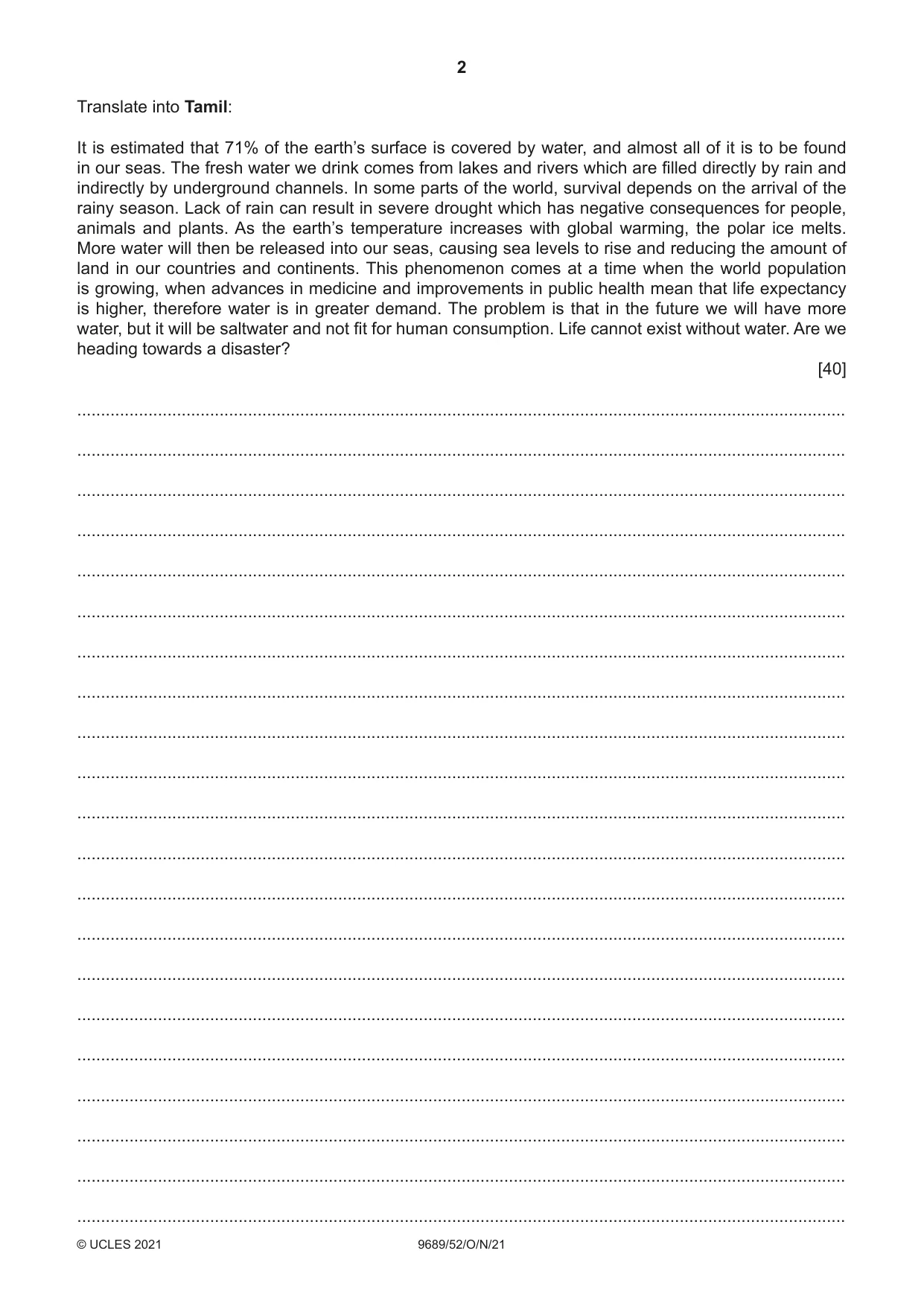
2 9689/52/O/N/21 © UCLES 2021 Translate into Tamil: It is estimated that 71% of the earth’s surface is covered by water, and almost all of it is to be found in our seas. The fresh water we drink comes from lakes and rivers which are filled directly by rain and indirectly by underground channels. In some parts of the world, survival depends on the arrival of the rainy season. Lack of rain can result in severe drought which has negative consequences for people, animals and plants. As the earth’s temperature increases with global warming, the polar ice melts. More water will then be released into our seas, causing sea levels to rise and reducing the amount of land in our countries and continents. This phenomenon comes at a time when the world population is growing, when advances in medicine and improvements in public health mean that life expectancy is higher, therefore water is in greater demand. The problem is that in the future we will have more water, but it will be saltwater and not fit for human consumption. Life cannot exist without water. Are we heading towards a disaster? [40] … … … … … … … … … … … … … … … … … … … … …
Question paper, page 3
3 9689/52/O/N/21 © UCLES 2021 [Turn over … … … … … … … … … … … … … … … … … … … … … … … … … … … …
Question paper, page 4
4 9689/52/O/N/21 © UCLES 2021 Permission to reproduce items where third-party owned material protected by copyright is included has been sought and cleared where possible. Every reasonable effort has been made by the publisher (UCLES) to trace copyright holders, but if any items requiring clearance have unwittingly been included, the publisher will be pleased to make amends at the earliest possible opportunity. To avoid the issue of disclosure of answer-related information to candidates, all copyright acknowledgements are reproduced online in the Cambridge Assessment International Education Copyright Acknowledgements Booklet. This is produced for each series of examinations and is freely available to download at www.cambridgeinternational.org after the live examination series. Cambridge Assessment International Education is part of the Cambridge Assessment Group. Cambridge Assessment is the brand name of the University of Cambridge Local Examinations Syndicate (UCLES), which itself is a department of the University of Cambridge. … … … … … … … … … … … … … … … … … … … … … … … …
Mark scheme, page 1
This document consists of 9 printed pages. © UCLES 2021 [Turn over Cambridge International A Level TAMIL 9689/52 Paper 5 Prose October/November 2021 MARK SCHEME Maximum Mark: 40 Published This mark scheme is published as an aid to teachers and candidates, to indicate the requirements of the examination. It shows the basis on which Examiners were instructed to award marks. It does not indicate the details of the discussions that took place at an Examiners’ meeting before marking began, which would have considered the acceptability of alternative answers. Mark schemes should be read in conjunction with the question paper and the Principal Examiner Report for Teachers. Cambridge International will not enter into discussions about these mark schemes. Cambridge International is publishing the mark schemes for the October/November 2021 series for most Cambridge IGCSE™, Cambridge International A and AS Level components and some Cambridge O Level components.
Mark scheme, page 2
9689/52 Cambridge International A Level – Mark Scheme PUBLISHED October/November 2021 © UCLES 2021 Page 2 of 9 Generic Marking Principles These general marking principles must be applied by all examiners when marking candidate answers. They should be applied alongside the specific content of the mark scheme or generic level descriptors for a question. Each question paper and mark scheme will also comply with these marking principles. GENERIC MARKING PRINCIPLE 1: Marks must be awarded in line with: • the specific content of the mark scheme or the generic level descriptors for the question • the specific skills defined in the mark scheme or in the generic level descriptors for the question • the standard of response required by a candidate as exemplified by the standardisation scripts. GENERIC MARKING PRINCIPLE 2: Marks awarded are always whole marks (not half marks, or other fractions). GENERIC MARKING PRINCIPLE 3: Marks must be awarded positively: • marks are awarded for correct/valid answers, as defined in the mark scheme. However, credit is given for valid answers which go beyond the scope of the syllabus and mark scheme, referring to your Team Leader as appropriate • marks are awarded when candidates clearly demonstrate what they know and can do • marks are not deducted for errors • marks are not deducted for omissions • answers should only be judged on the quality of spelling, punctuation and grammar when these features are specifically assessed by the question as indicated by the mark scheme. The meaning, however, should be unambiguous. GENERIC MARKING PRINCIPLE 4: Rules must be applied consistently, e.g. in situations where candidates have not followed instructions or in the application of generic level descriptors.
Mark scheme, page 3
9689/52 Cambridge International A Level – Mark Scheme PUBLISHED October/November 2021 © UCLES 2021 Page 3 of 9 GENERIC MARKING PRINCIPLE 5: Marks should be awarded using the full range of marks defined in the mark scheme for the question (however; the use of the full mark range may be limited according to the quality of the candidate responses seen). GENERIC MARKING PRINCIPLE 6: Marks awarded are based solely on the requirements as defined in the mark scheme. Marks should not be awarded with grade thresholds or grade descriptors in mind.
Mark scheme, page 4
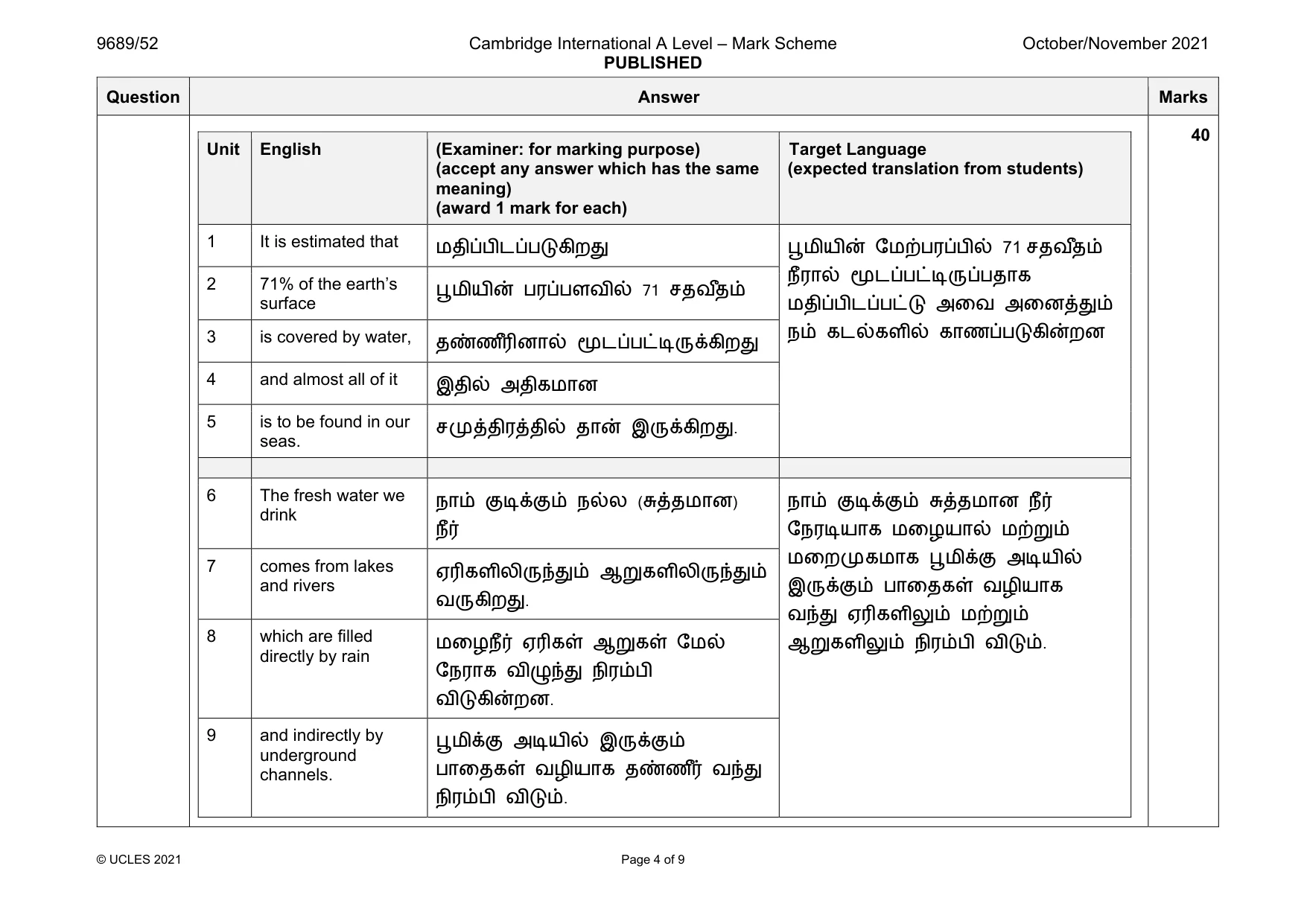
9689/52 Cambridge International A Level – Mark Scheme PUBLISHED October/November 2021 © UCLES 2021 Page 4 of 9 Question Answer Marks Unit English (Examiner: for marking purpose) (accept any answer which has the same meaning) (award 1 mark for each) Target Language (expected translation from students) 1 It is estimated that மதி~பட~பகிற¢ ªமிய} ேமபர~ப 71 சதவத நரா ¬ட~பy¯~பதாக மதி~பட~பy அைவ அைன{¢ ந கடகள காண~பகி}றன 2 71% of the earth’s surface ªமிய} பர~பளவ 71 சதவத 3 is covered by water, தzணƬனா ¬ட~பy¯tகிற¢ 4 and almost all of it இதி அதிகமான 5 is to be found in our seas. ச«{திர{தி தா} இ¯tகிற¢. 6 The fresh water we drink நா t நல ({தமான) நƫ நா t {தமான நƫ ேநரயாக மைழயா ம² மைற«கமாக ªமிt அய இ¯t பாைதக வழியாக வ|¢ ஏƬகள´ ம² ஆ²கள´ நிரப வ. 7 comes from lakes and rivers ஏƬகளலி¯|¢ ஆ²களலி¯|¢ வ¯கிற¢. 8 which are filled directly by rain மைழநƫ ஏƬக ஆ²க ேம ேநராக வ¸|¢ நிரப வகி}றன. 9 and indirectly by underground channels. ªமிt அய இ¯t பாைதக வழியாக தzணƫ வ|¢ நிரப வ. 40
Mark scheme, page 5
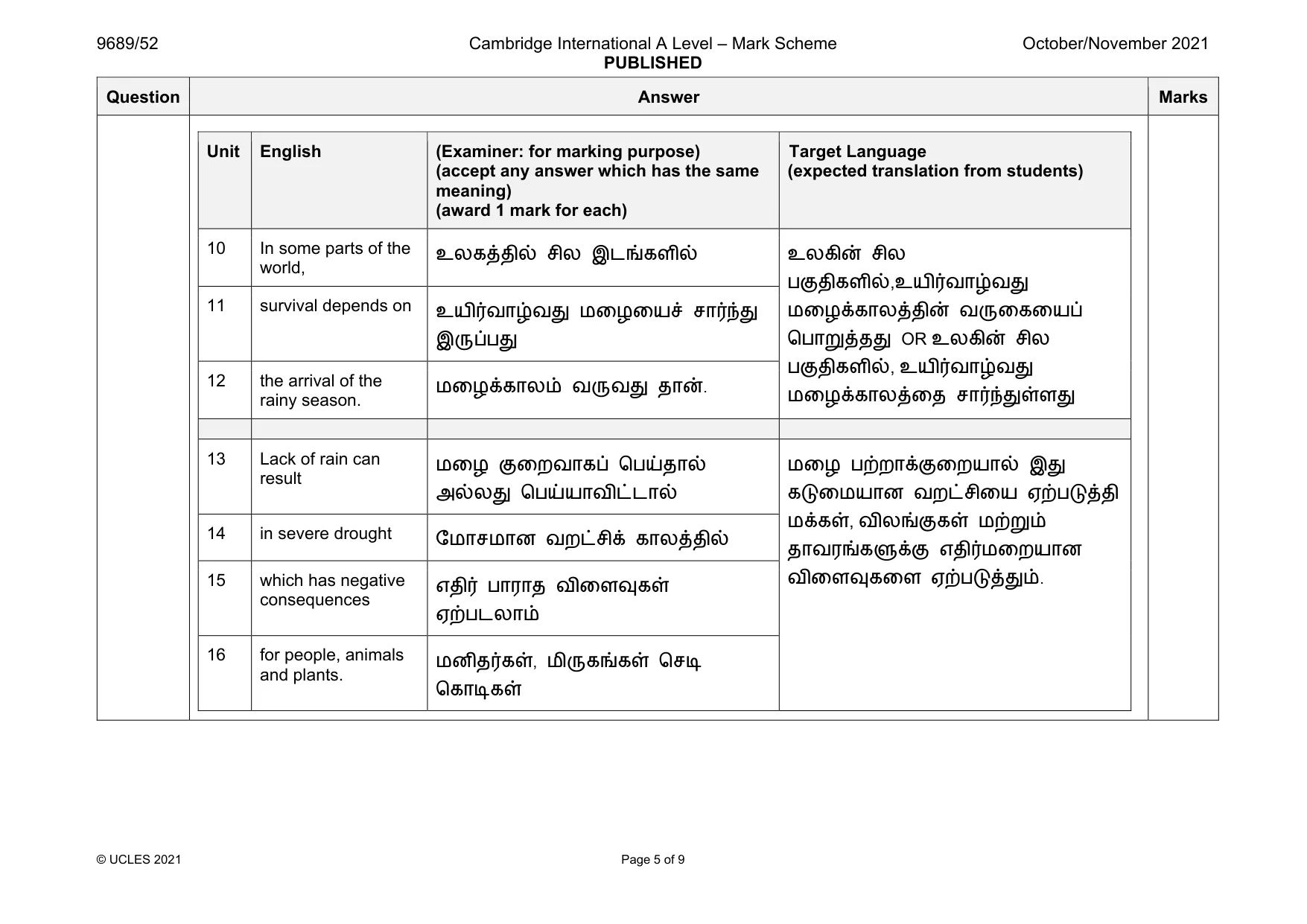
9689/52 Cambridge International A Level – Mark Scheme PUBLISHED October/November 2021 © UCLES 2021 Page 5 of 9 Question Answer Marks Unit English (Examiner: for marking purpose) (accept any answer which has the same meaning) (award 1 mark for each) Target Language (expected translation from students) 10 In some parts of the world, உலக{தி சில இடuகள உலகி} சில பதிகள,உயƫவா வ¢ மைழtகால{தி} வ¯ைகைய~ ெபா²{த¢ OR உலகி} சில பதிகள, உயƫவா வ¢ மைழtகால{ைத சாƫ|¢ள¢ 11 survival depends on உயƫவா வ¢ மைழையv சாƫ|¢ இ¯~ப¢ 12 the arrival of the rainy season. மைழtகால வ¯வ¢ தா}. 13 Lack of rain can result மைழ ைறவாக~ ெபதா அல¢ ெபயாவyடா மைழ பறாtைறயா இ¢ கைமயான வறyசிைய ஏப{தி மtக, வலuக ம² தாவரuக¶t எதிƫமைறயான வைளºகைள ஏப{¢. 14 in severe drought ேமாசமான வறyசிt கால{தி 15 which has negative consequences எதிƫ பாராத வைளºக ஏபடலா 16 for people, animals and plants. மனதƫக, மி¯கuக ெச ெகாக
Mark scheme, page 6
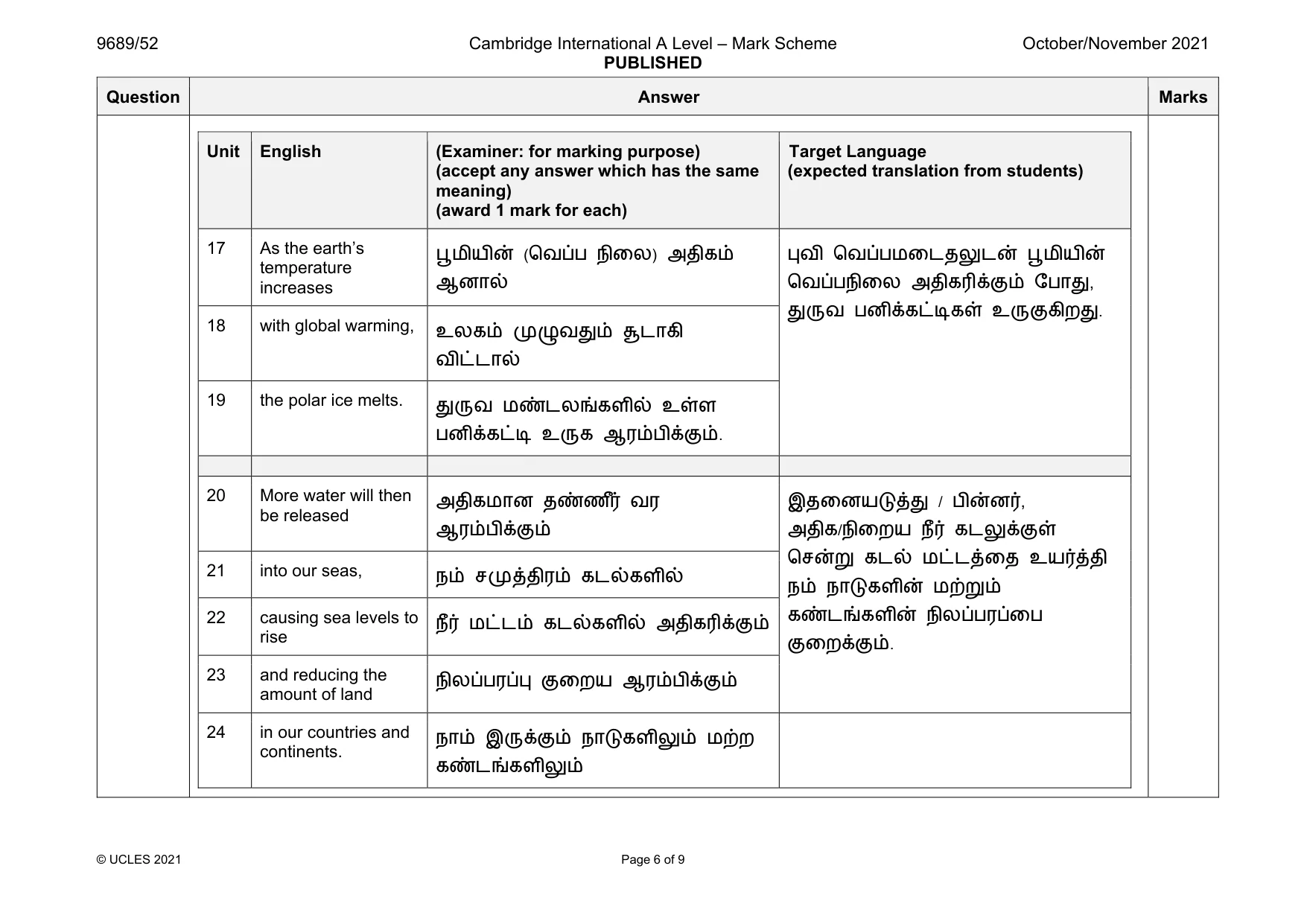
9689/52 Cambridge International A Level – Mark Scheme PUBLISHED October/November 2021 © UCLES 2021 Page 6 of 9 Question Answer Marks Unit English (Examiner: for marking purpose) (accept any answer which has the same meaning) (award 1 mark for each) Target Language (expected translation from students) 17 As the earth’s temperature increases ªமிய} (ெவ~ப நிைல) அதிக ஆனா ©வ ெவ~பமைடத´ட} ªமிய} ெவ~பநிைல அதிகƬt ேபா¢, ¢¯வ பனtகyக உ¯கிற¢. 18 with global warming, உலக «¸வ¢ டாகி வyடா 19 the polar ice melts. ¢¯வ மzடலuகள உள பனtகy உ¯க ஆரபt. 20 More water will then be released அதிகமான தzணƫ வர ஆரபt இதைனய{¢ / ப}னƫ, அதிக/நிைறய நƫ கட´t ெச}² கட மyட{ைத உயƫ{தி ந நாகள} ம² கzடuகள} நில~பர~ைப ைறt. 21 into our seas, ந ச«{திர கடகள 22 causing sea levels to rise நƫ மyட கடகள அதிகƬt 23 and reducing the amount of land நில~பர~© ைறய ஆரபt 24 in our countries and continents. நா இ¯t நாகள´ மற கzடuகள´
Mark scheme, page 7
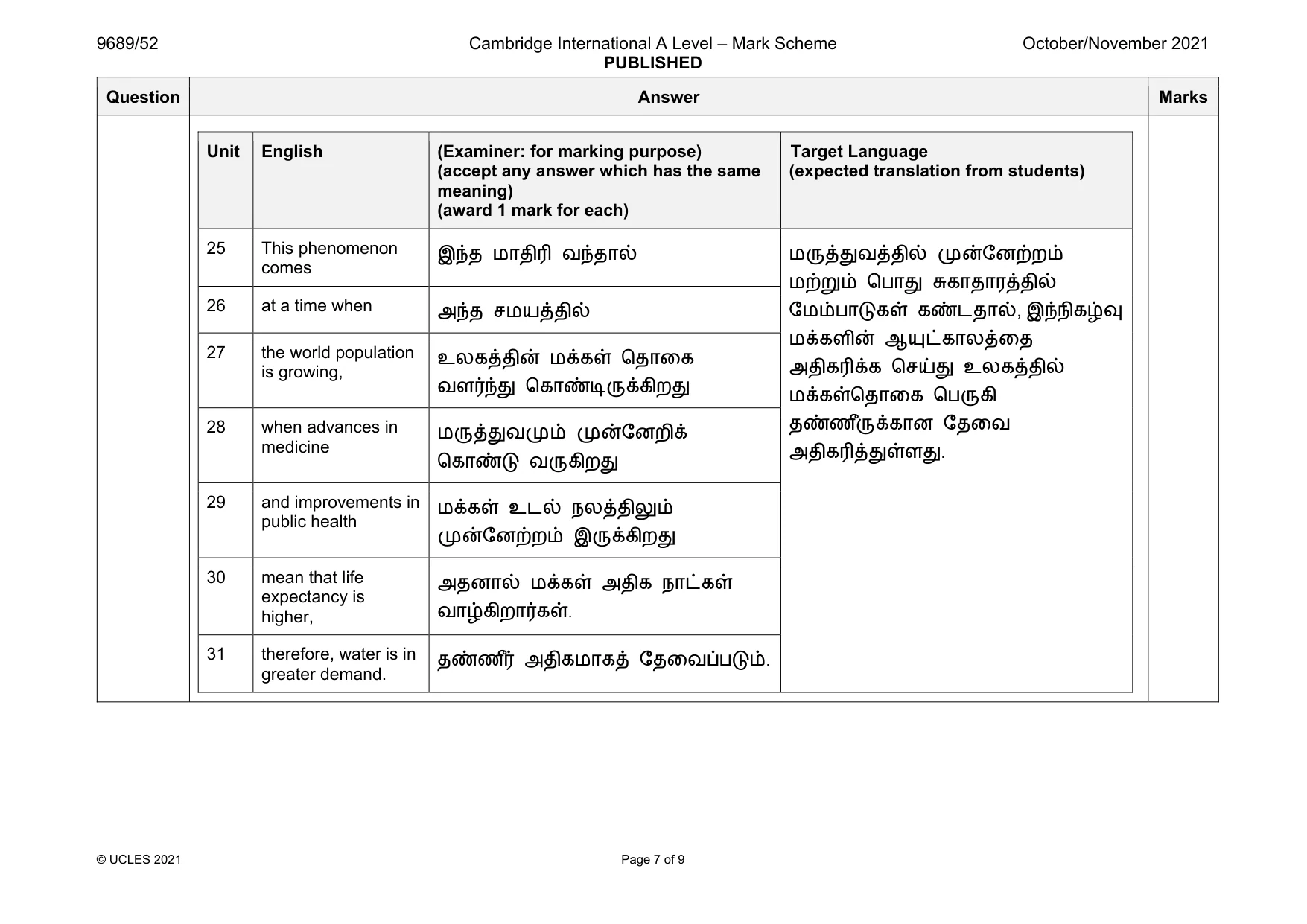
9689/52 Cambridge International A Level – Mark Scheme PUBLISHED October/November 2021 © UCLES 2021 Page 7 of 9 Question Answer Marks Unit English (Examiner: for marking purpose) (accept any answer which has the same meaning) (award 1 mark for each) Target Language (expected translation from students) 25 This phenomenon comes இ|த மாதிƬ வ|தா ம¯{¢வ{தி «}ேனற ம² ெபா¢ காதார{தி ேமபாக கzடதா, இ|நிக º மtகள} ஆyகால{ைத அதிகƬtக ெச¢ உலக{தி மtகெதாைக ெப¯கி தzண¯tகான ேதைவ அதிகƬ{¢ள¢. 26 at a time when அ|த சமய{தி 27 the world population is growing, உலக{தி} மtக ெதாைக வளƫ|¢ ெகாz¯tகிற¢ 28 when advances in medicine ம¯{¢வ« «}ேனறிt ெகாz வ¯கிற¢ 29 and improvements in public health மtக உட நல{தி´ «}ேனற இ¯tகிற¢ 30 mean that life expectancy is higher, அதனா மtக அதிக நாyக வா கிறாƫக. 31 therefore, water is in greater demand. தzணƫ அதிகமாக{ ேதைவ~ப.
Mark scheme, page 8
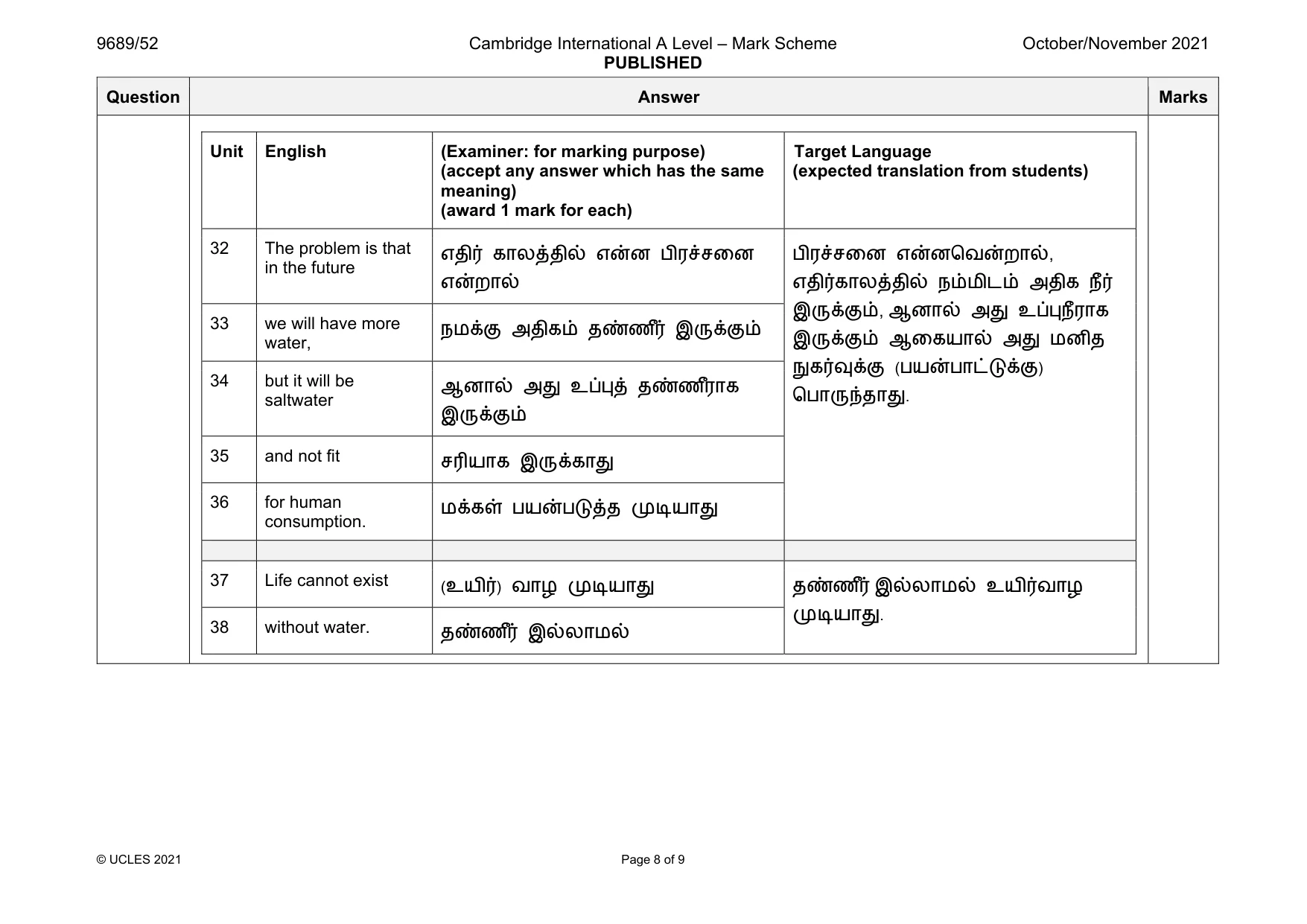
9689/52 Cambridge International A Level – Mark Scheme PUBLISHED October/November 2021 © UCLES 2021 Page 8 of 9 Question Answer Marks Unit English (Examiner: for marking purpose) (accept any answer which has the same meaning) (award 1 mark for each) Target Language (expected translation from students) 32 The problem is that in the future எதிƫ கால{தி எ}ன பரvசைன எ}றா பரvசைன எ}னெவ}றா, எதிƫகால{தி நமிட அதிக நƫ இ¯t, ஆனா அ¢ உ~©நராக இ¯t ஆைகயா அ¢ மனத ¤கƫºt (பய}பாyt) ெபா¯|தா¢. 33 we will have more water, நமt அதிக தzணƫ இ¯t 34 but it will be saltwater ஆனா அ¢ உ~©{ தzணராக இ¯t 35 and not fit சƬயாக இ¯tகா¢ 36 for human consumption. மtக பய}ப{த «யா¢ 37 Life cannot exist (உயƫ) வாழ «யா¢ தzணƫ இலாம உயƫவாழ «யா¢. 38 without water. தzணƫ இலாம
Mark scheme, page 9
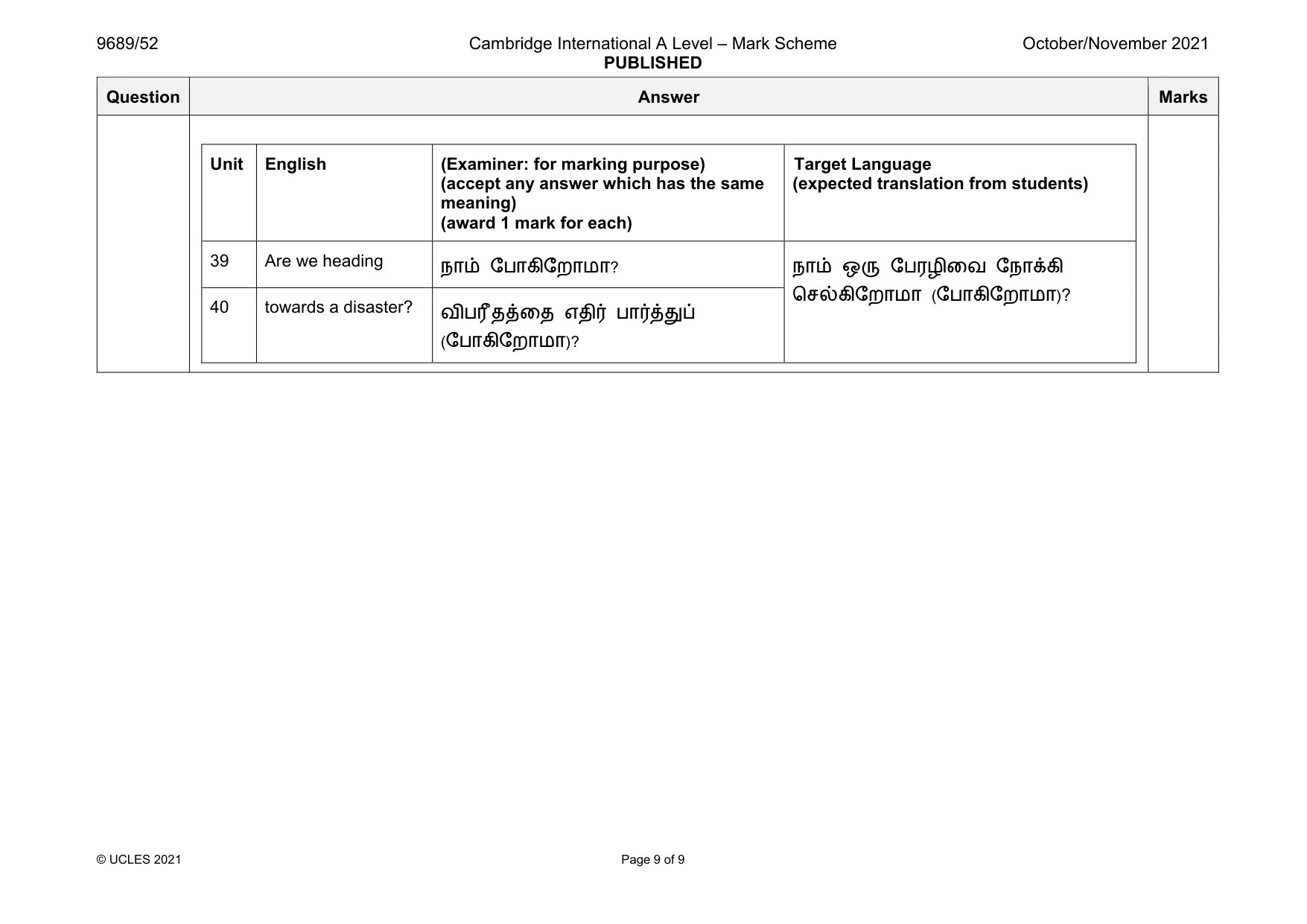
9689/52 Cambridge International A Level – Mark Scheme PUBLISHED October/November 2021 © UCLES 2021 Page 9 of 9 Question Answer Marks Unit English (Examiner: for marking purpose) (accept any answer which has the same meaning) (award 1 mark for each) Target Language (expected translation from students) 39 Are we heading நா ேபாகிேறாமா? நா ஒ¯ ேபரழிைவ ேநாtகி ெசகிேறாமா (ேபாகிேறாமா)? 40 towards a disaster? வபƭத{ைத எதிƫ பாƫ{¢~ (ேபாகிேறாமா)?
What you needed in this session
Cambridge’s own grade thresholds for 2021 Oct/Nov, Paper 5 · Variant 2. A higher threshold means an easier paper — the bar moves with how the cohort did.