Cambridge A Level Sociology 9699 — 2017 May/June Paper 3 · Variant 2
9699/32/M/J/17 · 75 marks · ≈84 min
The question paper and its mark scheme, free to read here and free to download. This is Cambridge’s own paper, exactly as it was sat.
Question paper4 pages

Mark scheme15 pages
Answers below. Sit the paper first if you are practising.
Paper as text
Question paper, page 1
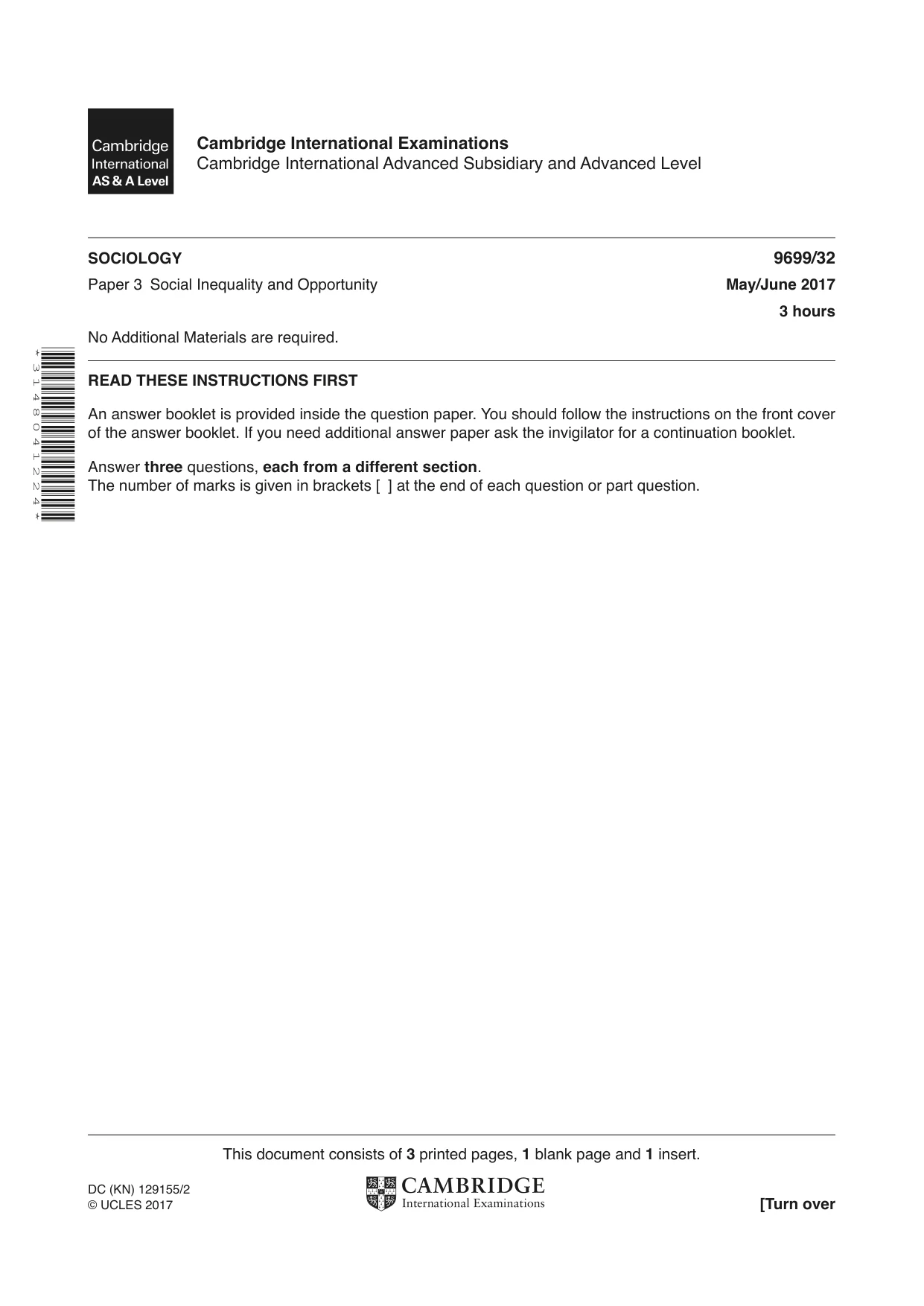
This document consists of 3 printed pages, 1 blank page and 1 insert. DC (KN) 129155/2 © UCLES 2017 [Turn over Cambridge International Examinations Cambridge International Advanced Subsidiary and Advanced Level * 3 1 4 8 0 4 1 2 2 4 * SOCIOLOGY 9699/32 Paper 3 Social Inequality and Opportunity May/June 2017 3 hours No Additional Materials are required. READ THESE INSTRUCTIONS FIRST An answer booklet is provided inside the question paper. You should follow the instructions on the front cover of the answer booklet. If you need additional answer paper ask the invigilator for a continuation booklet. Answer three questions, each from a different section. The number of marks is given in brackets [ ] at the end of each question or part question.
Question paper, page 2
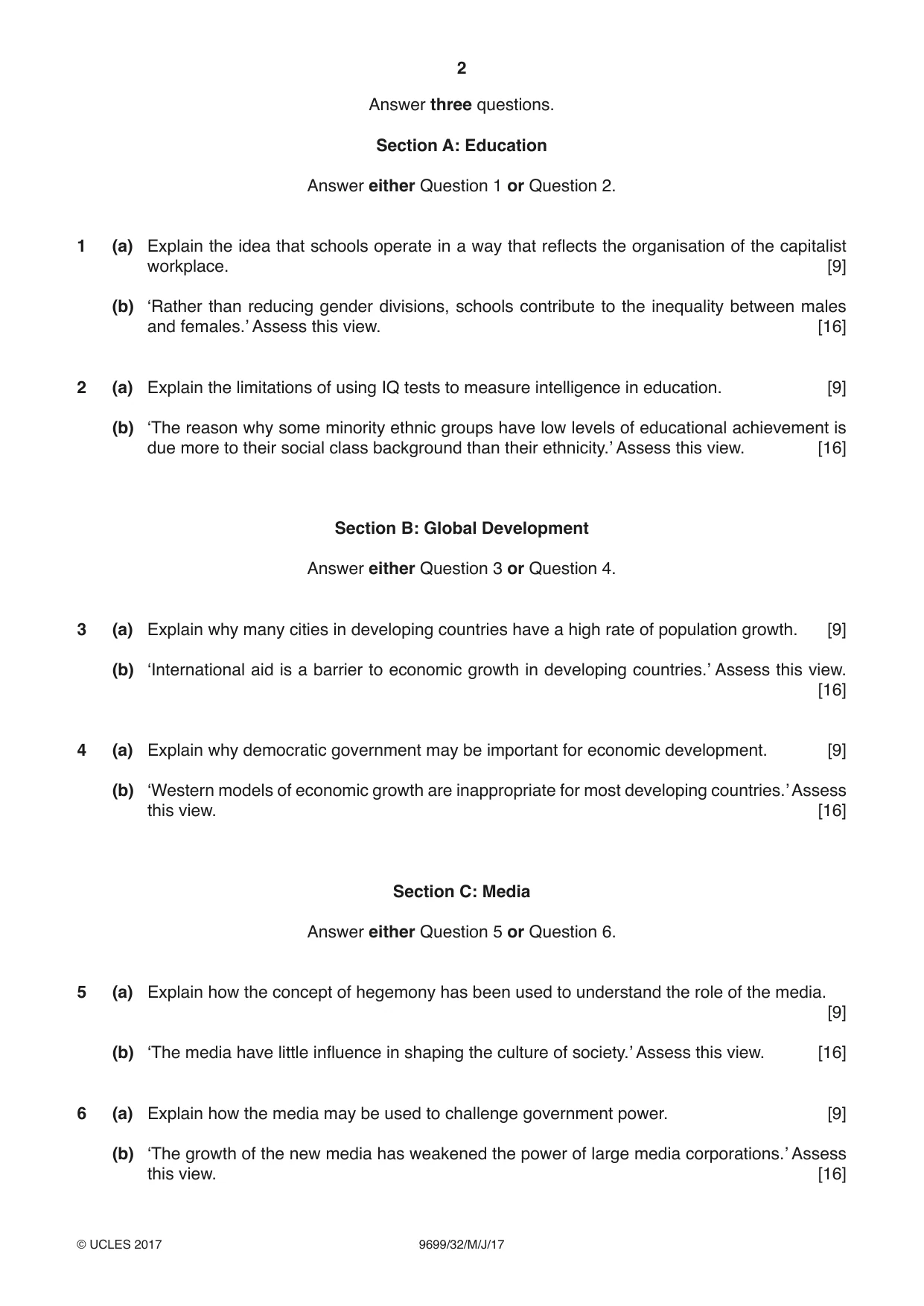
2 9699/32/M/J/17 © UCLES 2017 Answer three questions. Section A: Education Answer either Question 1 or Question 2. 1 (a) Explain the idea that schools operate in a way that reflects the organisation of the capitalist workplace. [9] (b) ‘Rather than reducing gender divisions, schools contribute to the inequality between males and females.’ Assess this view. [16] 2 (a) Explain the limitations of using IQ tests to measure intelligence in education. [9] (b) ‘The reason why some minority ethnic groups have low levels of educational achievement is due more to their social class background than their ethnicity.’ Assess this view. [16] Section B: Global Development Answer either Question 3 or Question 4. 3 (a) Explain why many cities in developing countries have a high rate of population growth. [9] (b) ‘International aid is a barrier to economic growth in developing countries.’ Assess this view. [16] 4 (a) Explain why democratic government may be important for economic development. [9] (b) ‘Western models of economic growth are inappropriate for most developing countries.’ Assess this view. [16] Section C: Media Answer either Question 5 or Question 6. 5 (a) Explain how the concept of hegemony has been used to understand the role of the media. [9] (b) ‘The media have little influence in shaping the culture of society.’ Assess this view. [16] 6 (a) Explain how the media may be used to challenge government power. [9] (b) ‘The growth of the new media has weakened the power of large media corporations.’ Assess this view. [16]
Question paper, page 3
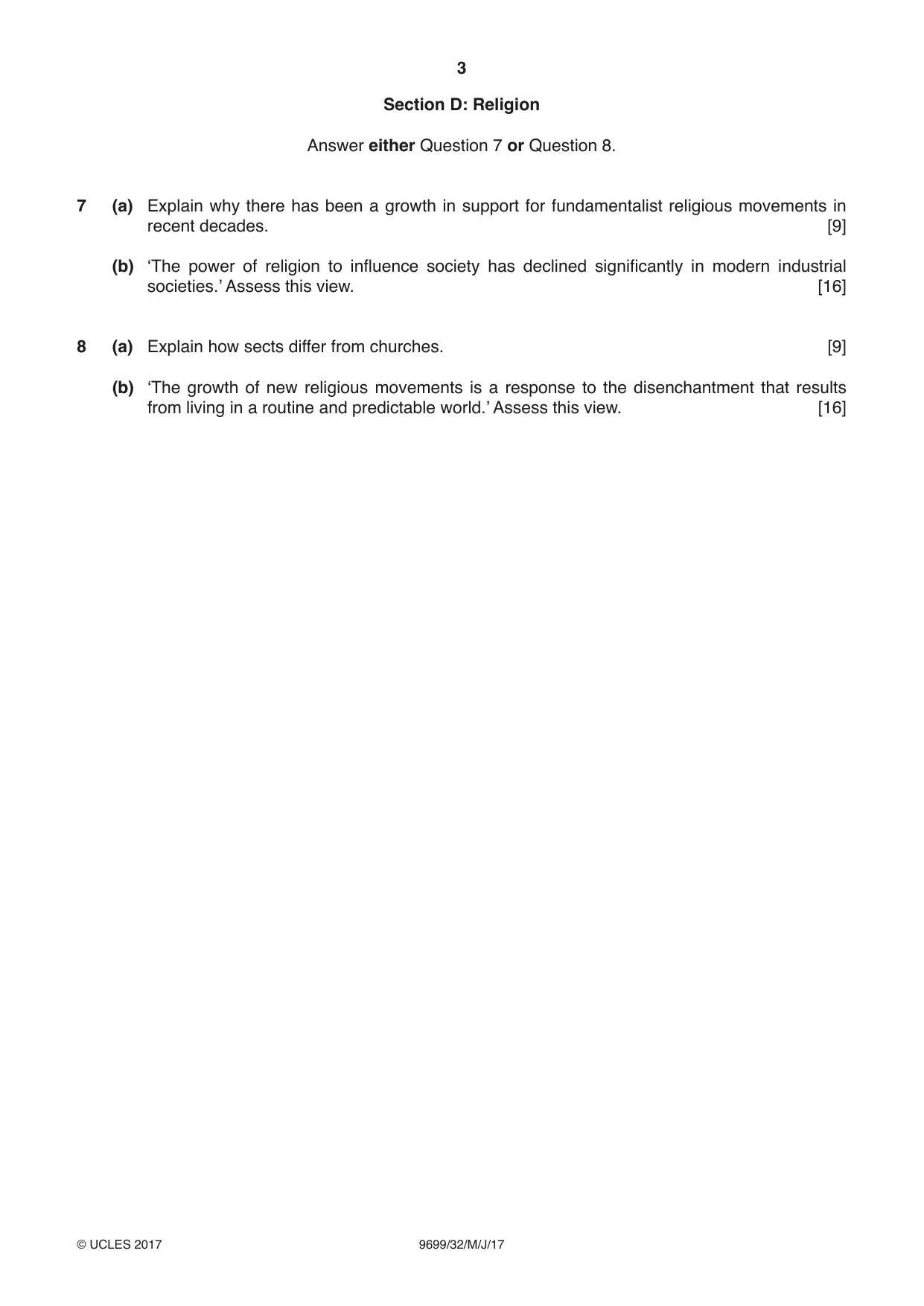
3 9699/32/M/J/17 © UCLES 2017 Section D: Religion Answer either Question 7 or Question 8. 7 (a) Explain why there has been a growth in support for fundamentalist religious movements in recent decades. [9] (b) ‘The power of religion to influence society has declined significantly in modern industrial societies.’ Assess this view. [16] 8 (a) Explain how sects differ from churches. [9] (b) ‘The growth of new religious movements is a response to the disenchantment that results from living in a routine and predictable world.’ Assess this view. [16]
Question paper, page 4
4 9699/32/M/J/17 © UCLES 2017 Permission to reproduce items where third-party owned material protected by copyright is included has been sought and cleared where possible. Every reasonable effort has been made by the publisher (UCLES) to trace copyright holders, but if any items requiring clearance have unwittingly been included, the publisher will be pleased to make amends at the earliest possible opportunity. To avoid the issue of disclosure of answer-related information to candidates, all copyright acknowledgements are reproduced online in the Cambridge International Examinations Copyright Acknowledgements Booklet. This is produced for each series of examinations and is freely available to download at www.cie.org.uk after the live examination series. Cambridge International Examinations is part of the Cambridge Assessment Group. Cambridge Assessment is the brand name of University of Cambridge Local Examinations Syndicate (UCLES), which is itself a department of the University of Cambridge. BLANK PAGE
Mark scheme, page 1
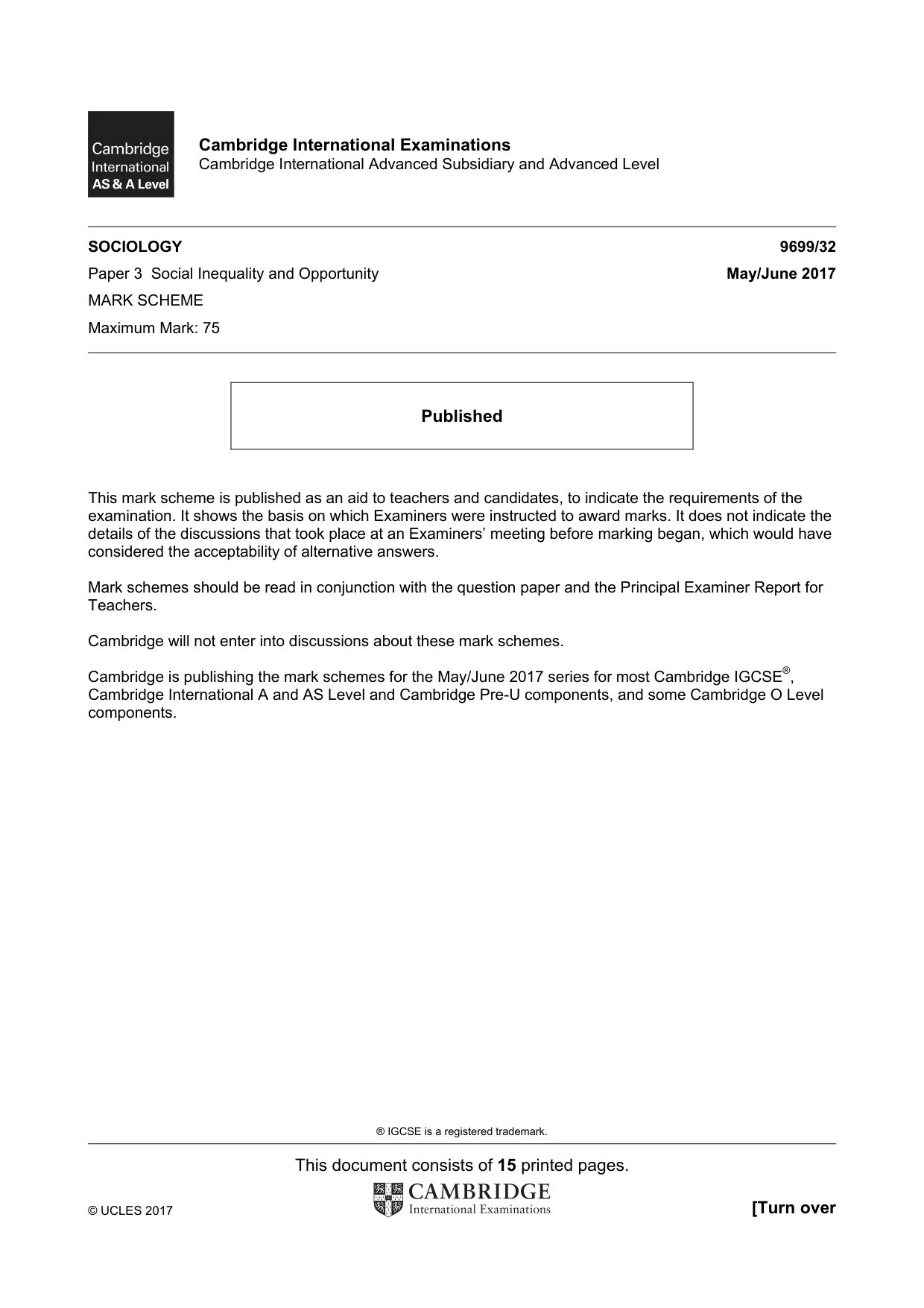
® IGCSE is a registered trademark. This document consists of 15 printed pages. © UCLES 2017 [Turn over Cambridge International Examinations Cambridge International Advanced Subsidiary and Advanced Level SOCIOLOGY 9699/32 Paper 3 Social Inequality and Opportunity May/June 2017 MARK SCHEME Maximum Mark: 75 Published This mark scheme is published as an aid to teachers and candidates, to indicate the requirements of the examination. It shows the basis on which Examiners were instructed to award marks. It does not indicate the details of the discussions that took place at an Examiners’ meeting before marking began, which would have considered the acceptability of alternative answers. Mark schemes should be read in conjunction with the question paper and the Principal Examiner Report for Teachers. Cambridge will not enter into discussions about these mark schemes. Cambridge is publishing the mark schemes for the May/June 2017 series for most Cambridge IGCSE®, Cambridge International A and AS Level and Cambridge Pre-U components, and some Cambridge O Level components.
Mark scheme, page 2
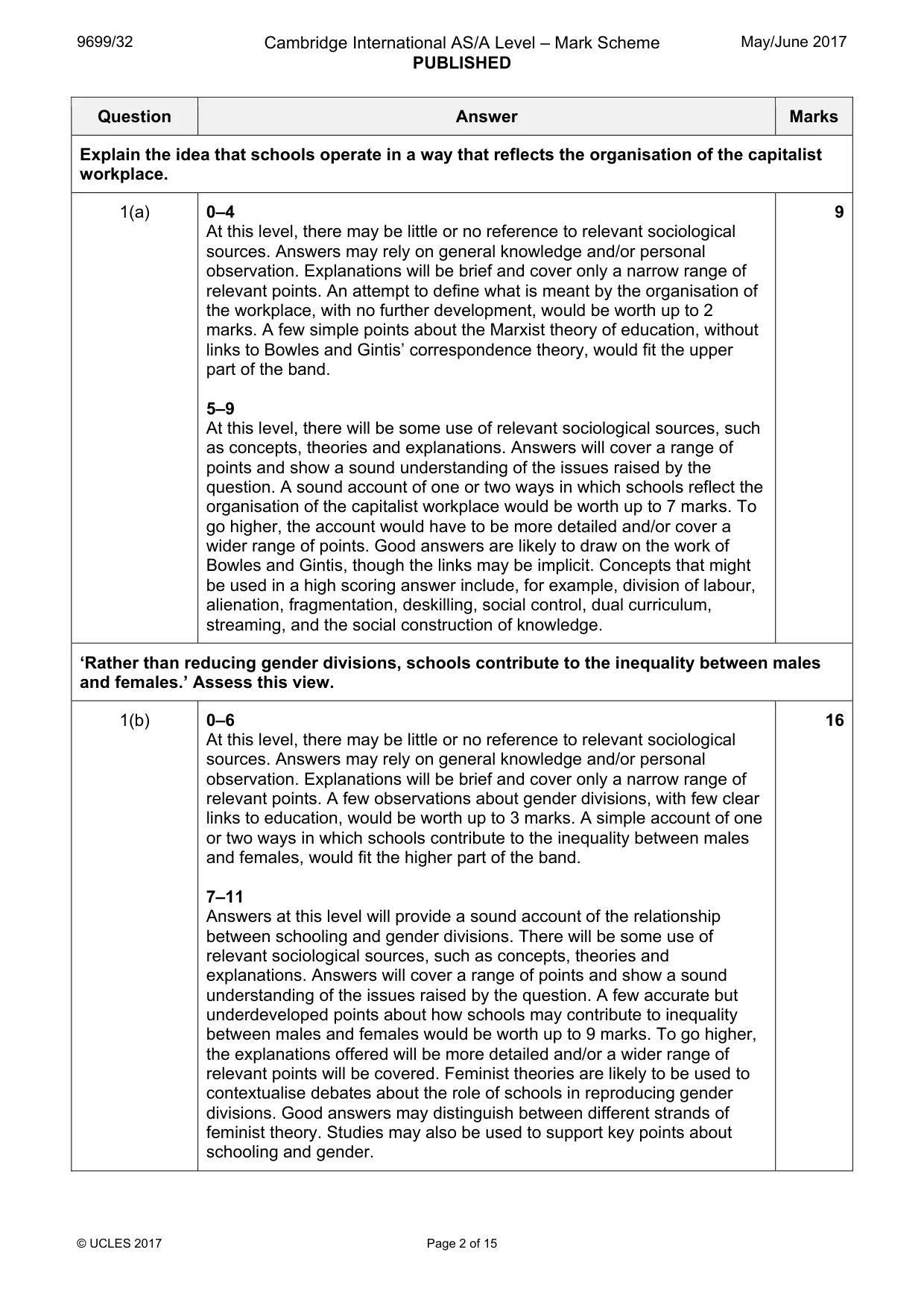
9699/32 Cambridge International AS/A Level – Mark Scheme PUBLISHED May/June 2017 © UCLES 2017 Page 2 of 15 Question Answer Marks Explain the idea that schools operate in a way that reflects the organisation of the capitalist workplace. 1(a) 0–4 At this level, there may be little or no reference to relevant sociological sources. Answers may rely on general knowledge and/or personal observation. Explanations will be brief and cover only a narrow range of relevant points. An attempt to define what is meant by the organisation of the workplace, with no further development, would be worth up to 2 marks. A few simple points about the Marxist theory of education, without links to Bowles and Gintis’ correspondence theory, would fit the upper part of the band. 5–9 At this level, there will be some use of relevant sociological sources, such as concepts, theories and explanations. Answers will cover a range of points and show a sound understanding of the issues raised by the question. A sound account of one or two ways in which schools reflect the organisation of the capitalist workplace would be worth up to 7 marks. To go higher, the account would have to be more detailed and/or cover a wider range of points. Good answers are likely to draw on the work of Bowles and Gintis, though the links may be implicit. Concepts that might be used in a high scoring answer include, for example, division of labour, alienation, fragmentation, deskilling, social control, dual curriculum, streaming, and the social construction of knowledge. 9 ‘Rather than reducing gender divisions, schools contribute to the inequality between males and females.’ Assess this view. 1(b) 0–6 At this level, there may be little or no reference to relevant sociological sources. Answers may rely on general knowledge and/or personal observation. Explanations will be brief and cover only a narrow range of relevant points. A few observations about gender divisions, with few clear links to education, would be worth up to 3 marks. A simple account of one or two ways in which schools contribute to the inequality between males and females, would fit the higher part of the band. 7–11 Answers at this level will provide a sound account of the relationship between schooling and gender divisions. There will be some use of relevant sociological sources, such as concepts, theories and explanations. Answers will cover a range of points and show a sound understanding of the issues raised by the question. A few accurate but underdeveloped points about how schools may contribute to inequality between males and females would be worth up to 9 marks. To go higher, the explanations offered will be more detailed and/or a wider range of relevant points will be covered. Feminist theories are likely to be used to contextualise debates about the role of schools in reproducing gender divisions. Good answers may distinguish between different strands of feminist theory. Studies may also be used to support key points about schooling and gender. 16
Mark scheme, page 3
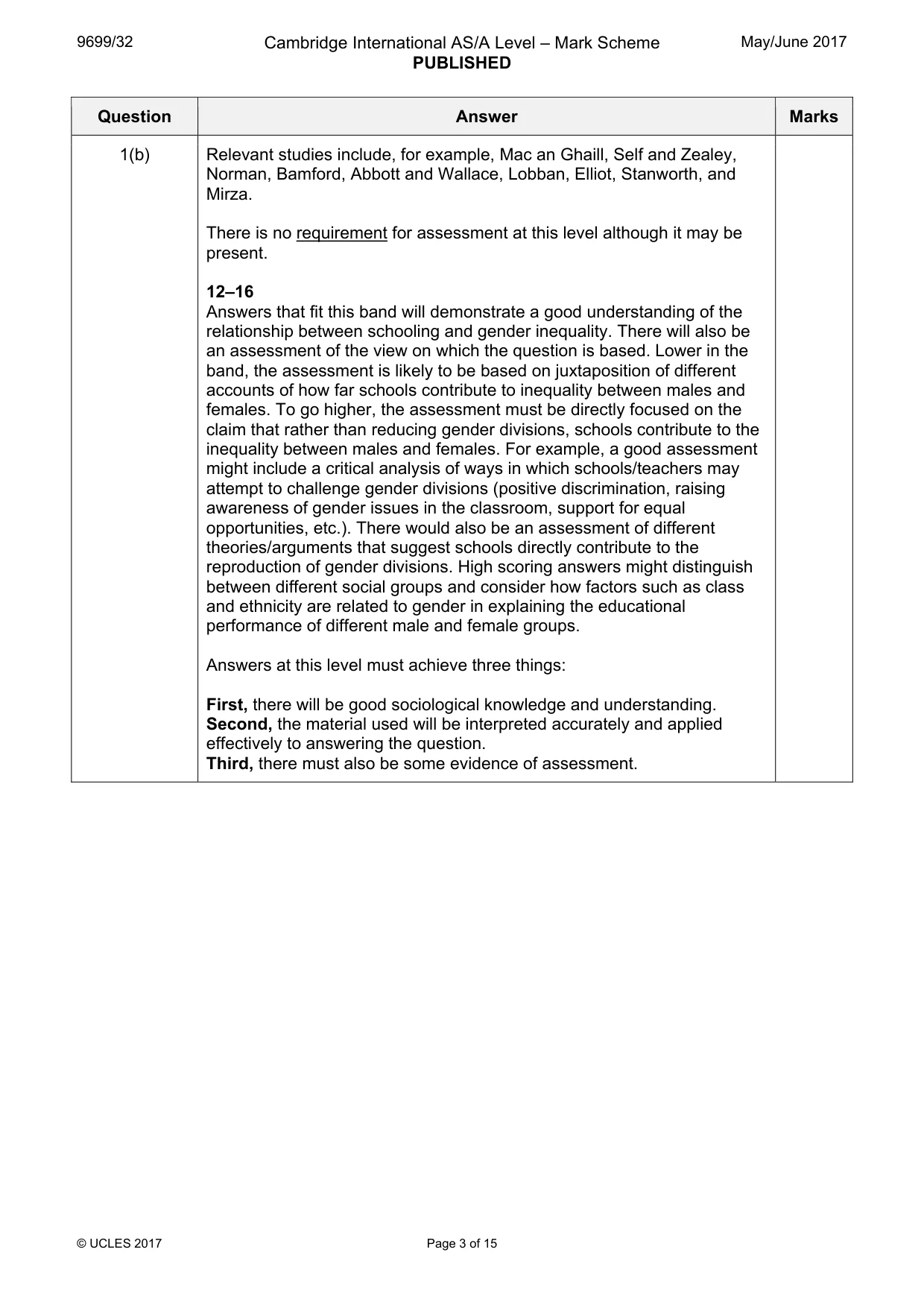
9699/32 Cambridge International AS/A Level – Mark Scheme PUBLISHED May/June 2017 © UCLES 2017 Page 3 of 15 Question Answer Marks 1(b) Relevant studies include, for example, Mac an Ghaill, Self and Zealey, Norman, Bamford, Abbott and Wallace, Lobban, Elliot, Stanworth, and Mirza. There is no requirement for assessment at this level although it may be present. 12–16 Answers that fit this band will demonstrate a good understanding of the relationship between schooling and gender inequality. There will also be an assessment of the view on which the question is based. Lower in the band, the assessment is likely to be based on juxtaposition of different accounts of how far schools contribute to inequality between males and females. To go higher, the assessment must be directly focused on the claim that rather than reducing gender divisions, schools contribute to the inequality between males and females. For example, a good assessment might include a critical analysis of ways in which schools/teachers may attempt to challenge gender divisions (positive discrimination, raising awareness of gender issues in the classroom, support for equal opportunities, etc.). There would also be an assessment of different theories/arguments that suggest schools directly contribute to the reproduction of gender divisions. High scoring answers might distinguish between different social groups and consider how factors such as class and ethnicity are related to gender in explaining the educational performance of different male and female groups. Answers at this level must achieve three things: First, there will be good sociological knowledge and understanding. Second, the material used will be interpreted accurately and applied effectively to answering the question. Third, there must also be some evidence of assessment.
Mark scheme, page 4
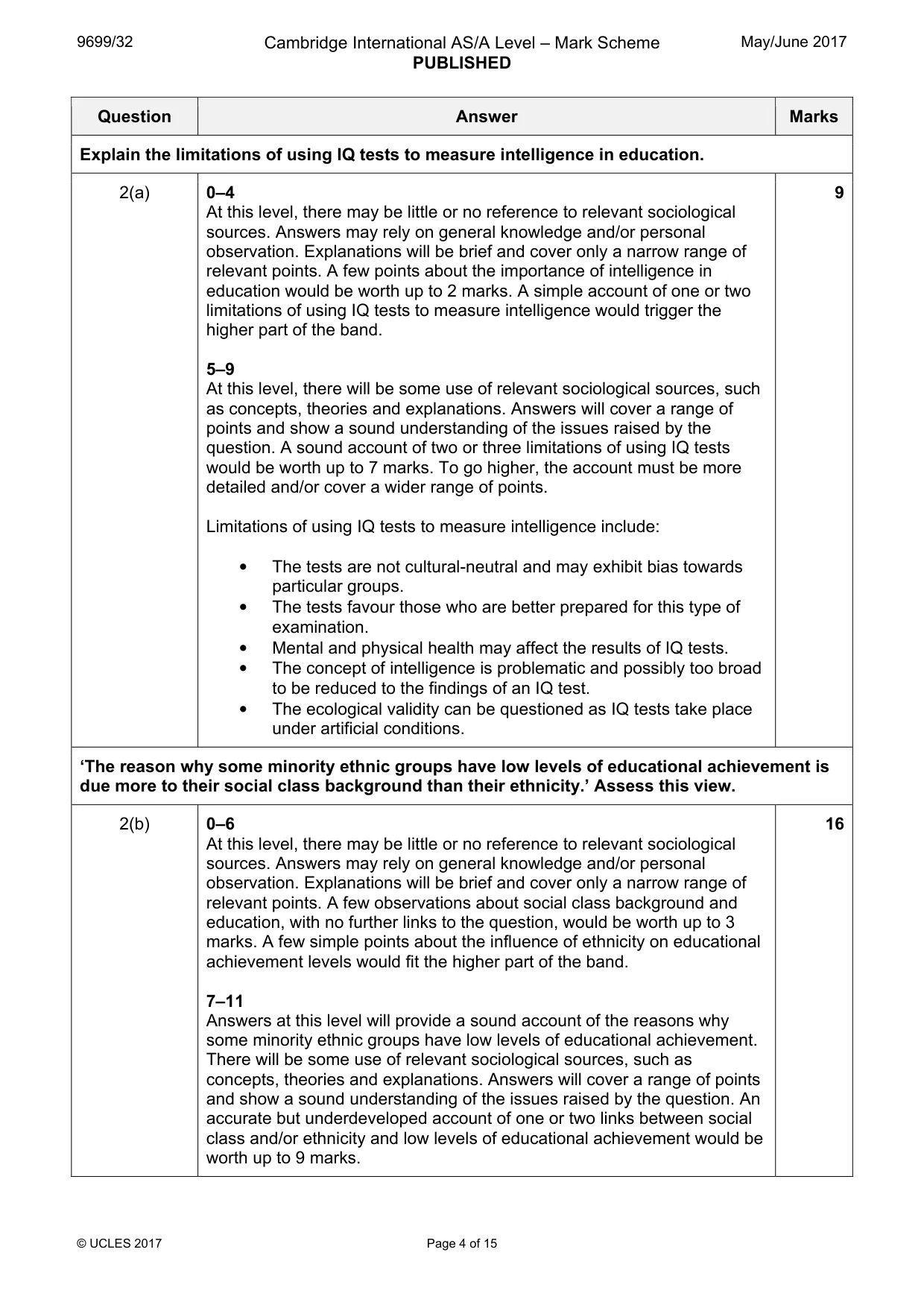
9699/32 Cambridge International AS/A Level – Mark Scheme PUBLISHED May/June 2017 © UCLES 2017 Page 4 of 15 Question Answer Marks Explain the limitations of using IQ tests to measure intelligence in education. 2(a) 0–4 At this level, there may be little or no reference to relevant sociological sources. Answers may rely on general knowledge and/or personal observation. Explanations will be brief and cover only a narrow range of relevant points. A few points about the importance of intelligence in education would be worth up to 2 marks. A simple account of one or two limitations of using IQ tests to measure intelligence would trigger the higher part of the band. 5–9 At this level, there will be some use of relevant sociological sources, such as concepts, theories and explanations. Answers will cover a range of points and show a sound understanding of the issues raised by the question. A sound account of two or three limitations of using IQ tests would be worth up to 7 marks. To go higher, the account must be more detailed and/or cover a wider range of points. Limitations of using IQ tests to measure intelligence include: • The tests are not cultural-neutral and may exhibit bias towards particular groups. • The tests favour those who are better prepared for this type of examination. • Mental and physical health may affect the results of IQ tests. • The concept of intelligence is problematic and possibly too broad to be reduced to the findings of an IQ test. • The ecological validity can be questioned as IQ tests take place under artificial conditions. 9 ‘The reason why some minority ethnic groups have low levels of educational achievement is due more to their social class background than their ethnicity.’ Assess this view. 2(b) 0–6 At this level, there may be little or no reference to relevant sociological sources. Answers may rely on general knowledge and/or personal observation. Explanations will be brief and cover only a narrow range of relevant points. A few observations about social class background and education, with no further links to the question, would be worth up to 3 marks. A few simple points about the influence of ethnicity on educational achievement levels would fit the higher part of the band. 7–11 Answers at this level will provide a sound account of the reasons why some minority ethnic groups have low levels of educational achievement. There will be some use of relevant sociological sources, such as concepts, theories and explanations. Answers will cover a range of points and show a sound understanding of the issues raised by the question. An accurate but underdeveloped account of one or two links between social class and/or ethnicity and low levels of educational achievement would be worth up to 9 marks. 16
Mark scheme, page 5
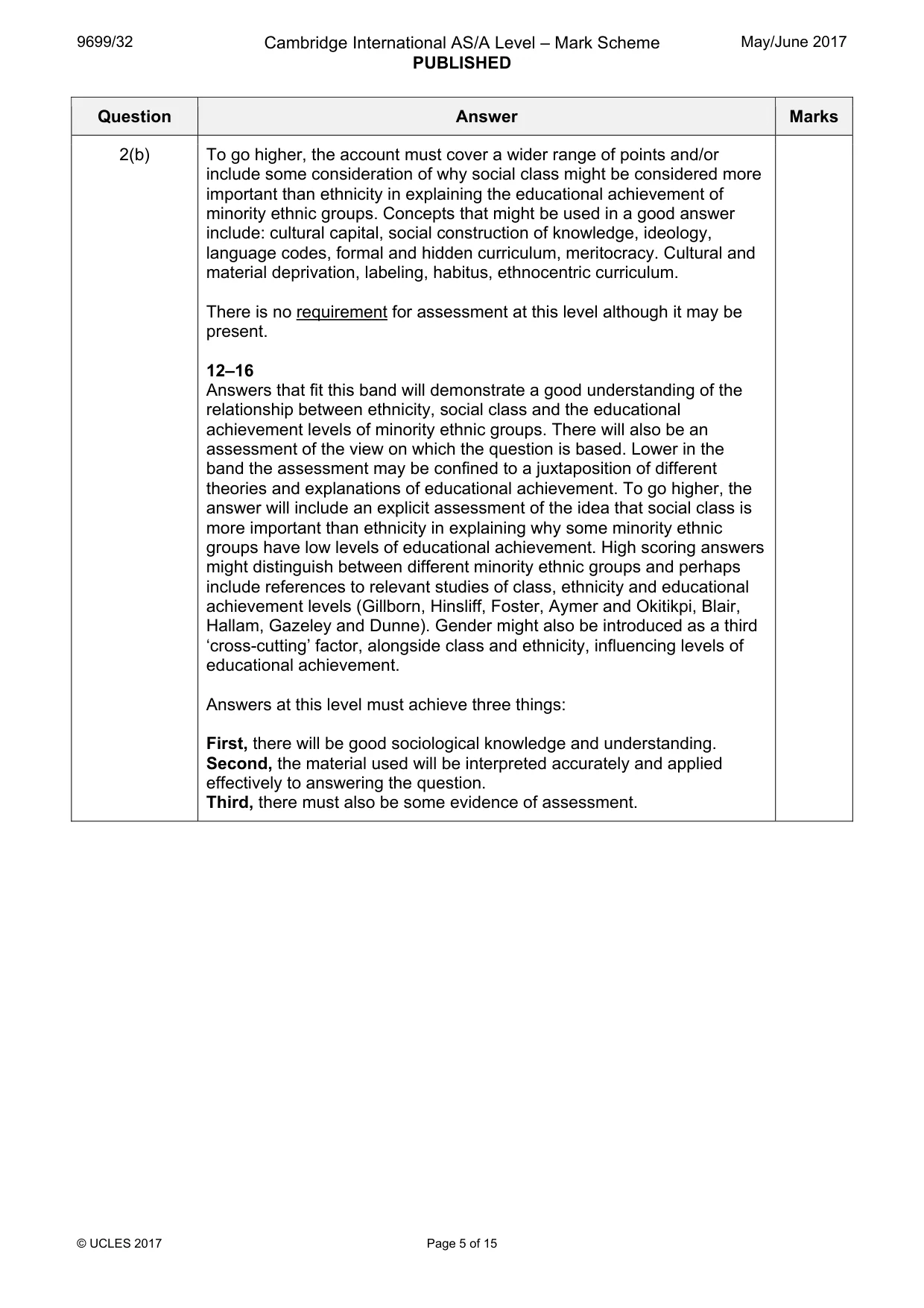
9699/32 Cambridge International AS/A Level – Mark Scheme PUBLISHED May/June 2017 © UCLES 2017 Page 5 of 15 Question Answer Marks 2(b) To go higher, the account must cover a wider range of points and/or include some consideration of why social class might be considered more important than ethnicity in explaining the educational achievement of minority ethnic groups. Concepts that might be used in a good answer include: cultural capital, social construction of knowledge, ideology, language codes, formal and hidden curriculum, meritocracy. Cultural and material deprivation, labeling, habitus, ethnocentric curriculum. There is no requirement for assessment at this level although it may be present. 12–16 Answers that fit this band will demonstrate a good understanding of the relationship between ethnicity, social class and the educational achievement levels of minority ethnic groups. There will also be an assessment of the view on which the question is based. Lower in the band the assessment may be confined to a juxtaposition of different theories and explanations of educational achievement. To go higher, the answer will include an explicit assessment of the idea that social class is more important than ethnicity in explaining why some minority ethnic groups have low levels of educational achievement. High scoring answers might distinguish between different minority ethnic groups and perhaps include references to relevant studies of class, ethnicity and educational achievement levels (Gillborn, Hinsliff, Foster, Aymer and Okitikpi, Blair, Hallam, Gazeley and Dunne). Gender might also be introduced as a third ‘cross-cutting’ factor, alongside class and ethnicity, influencing levels of educational achievement. Answers at this level must achieve three things: First, there will be good sociological knowledge and understanding. Second, the material used will be interpreted accurately and applied effectively to answering the question. Third, there must also be some evidence of assessment.
Mark scheme, page 6
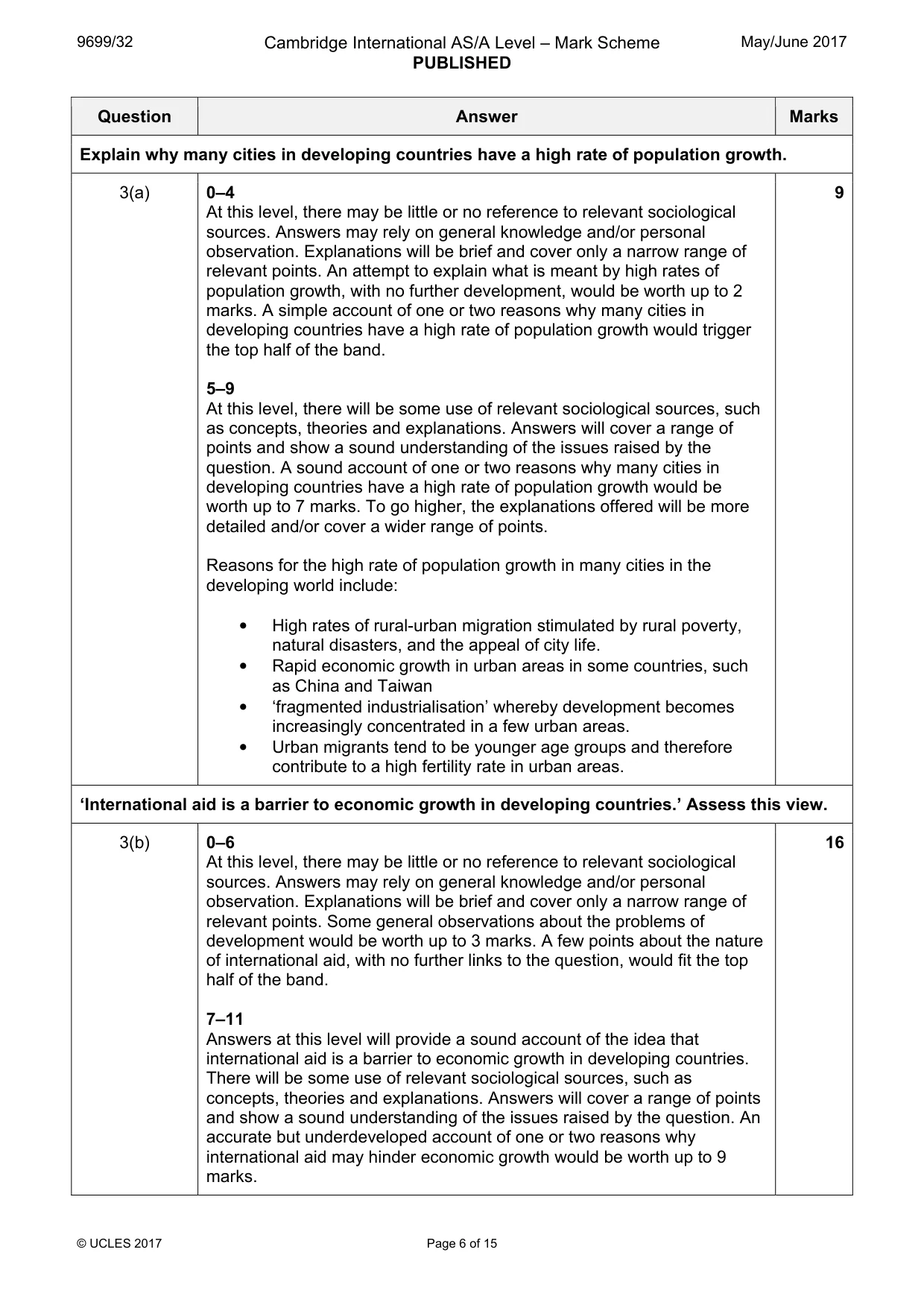
9699/32 Cambridge International AS/A Level – Mark Scheme PUBLISHED May/June 2017 © UCLES 2017 Page 6 of 15 Question Answer Marks Explain why many cities in developing countries have a high rate of population growth. 3(a) 0–4 At this level, there may be little or no reference to relevant sociological sources. Answers may rely on general knowledge and/or personal observation. Explanations will be brief and cover only a narrow range of relevant points. An attempt to explain what is meant by high rates of population growth, with no further development, would be worth up to 2 marks. A simple account of one or two reasons why many cities in developing countries have a high rate of population growth would trigger the top half of the band. 5–9 At this level, there will be some use of relevant sociological sources, such as concepts, theories and explanations. Answers will cover a range of points and show a sound understanding of the issues raised by the question. A sound account of one or two reasons why many cities in developing countries have a high rate of population growth would be worth up to 7 marks. To go higher, the explanations offered will be more detailed and/or cover a wider range of points. Reasons for the high rate of population growth in many cities in the developing world include: • High rates of rural-urban migration stimulated by rural poverty, natural disasters, and the appeal of city life. • Rapid economic growth in urban areas in some countries, such as China and Taiwan • ‘fragmented industrialisation’ whereby development becomes increasingly concentrated in a few urban areas. • Urban migrants tend to be younger age groups and therefore contribute to a high fertility rate in urban areas. 9 ‘International aid is a barrier to economic growth in developing countries.’ Assess this view. 3(b) 0–6 At this level, there may be little or no reference to relevant sociological sources. Answers may rely on general knowledge and/or personal observation. Explanations will be brief and cover only a narrow range of relevant points. Some general observations about the problems of development would be worth up to 3 marks. A few points about the nature of international aid, with no further links to the question, would fit the top half of the band. 7–11 Answers at this level will provide a sound account of the idea that international aid is a barrier to economic growth in developing countries. There will be some use of relevant sociological sources, such as concepts, theories and explanations. Answers will cover a range of points and show a sound understanding of the issues raised by the question. An accurate but underdeveloped account of one or two reasons why international aid may hinder economic growth would be worth up to 9 marks. 16
Mark scheme, page 7
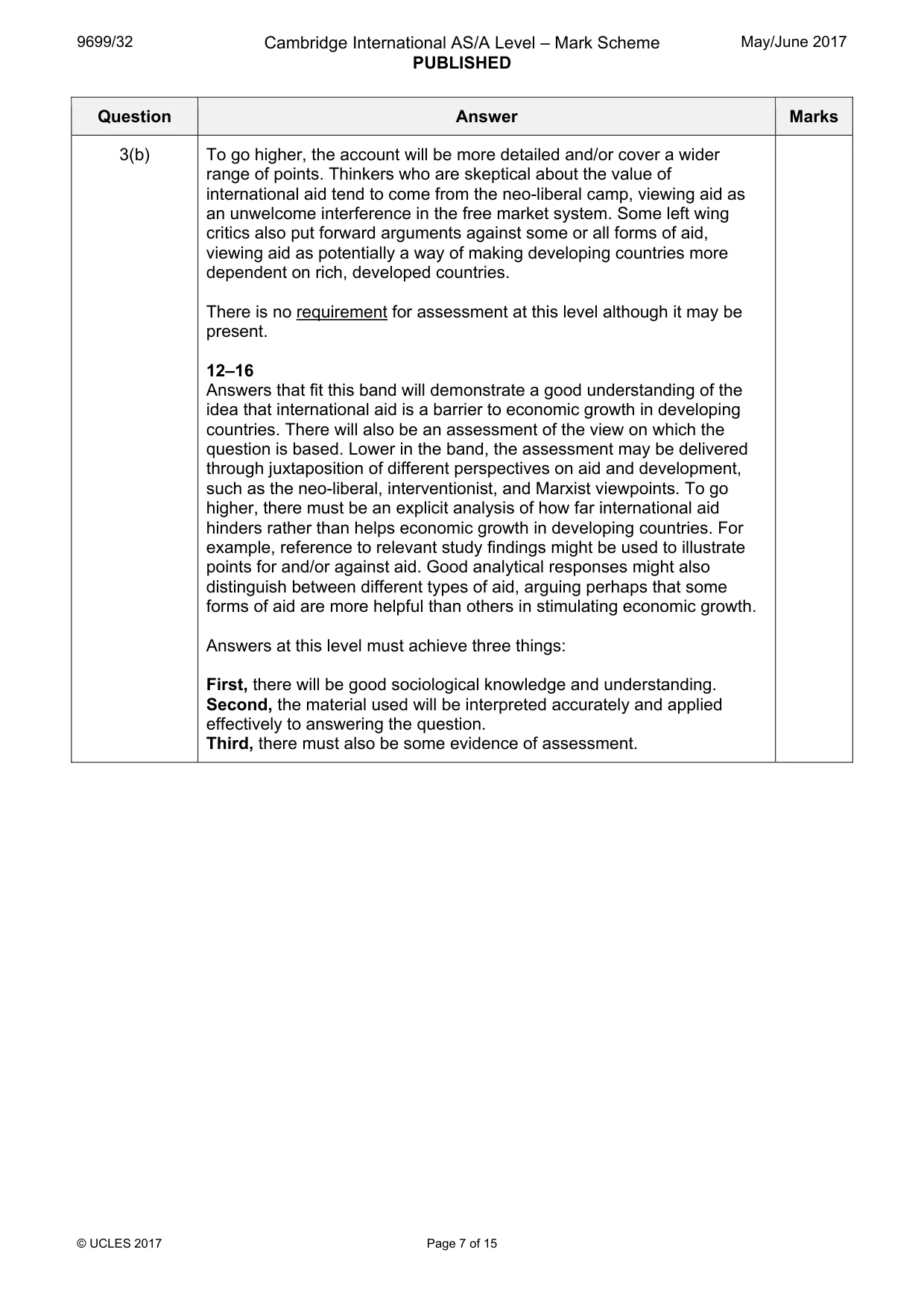
9699/32 Cambridge International AS/A Level – Mark Scheme PUBLISHED May/June 2017 © UCLES 2017 Page 7 of 15 Question Answer Marks 3(b) To go higher, the account will be more detailed and/or cover a wider range of points. Thinkers who are skeptical about the value of international aid tend to come from the neo-liberal camp, viewing aid as an unwelcome interference in the free market system. Some left wing critics also put forward arguments against some or all forms of aid, viewing aid as potentially a way of making developing countries more dependent on rich, developed countries. There is no requirement for assessment at this level although it may be present. 12–16 Answers that fit this band will demonstrate a good understanding of the idea that international aid is a barrier to economic growth in developing countries. There will also be an assessment of the view on which the question is based. Lower in the band, the assessment may be delivered through juxtaposition of different perspectives on aid and development, such as the neo-liberal, interventionist, and Marxist viewpoints. To go higher, there must be an explicit analysis of how far international aid hinders rather than helps economic growth in developing countries. For example, reference to relevant study findings might be used to illustrate points for and/or against aid. Good analytical responses might also distinguish between different types of aid, arguing perhaps that some forms of aid are more helpful than others in stimulating economic growth. Answers at this level must achieve three things: First, there will be good sociological knowledge and understanding. Second, the material used will be interpreted accurately and applied effectively to answering the question. Third, there must also be some evidence of assessment.
Mark scheme, page 8
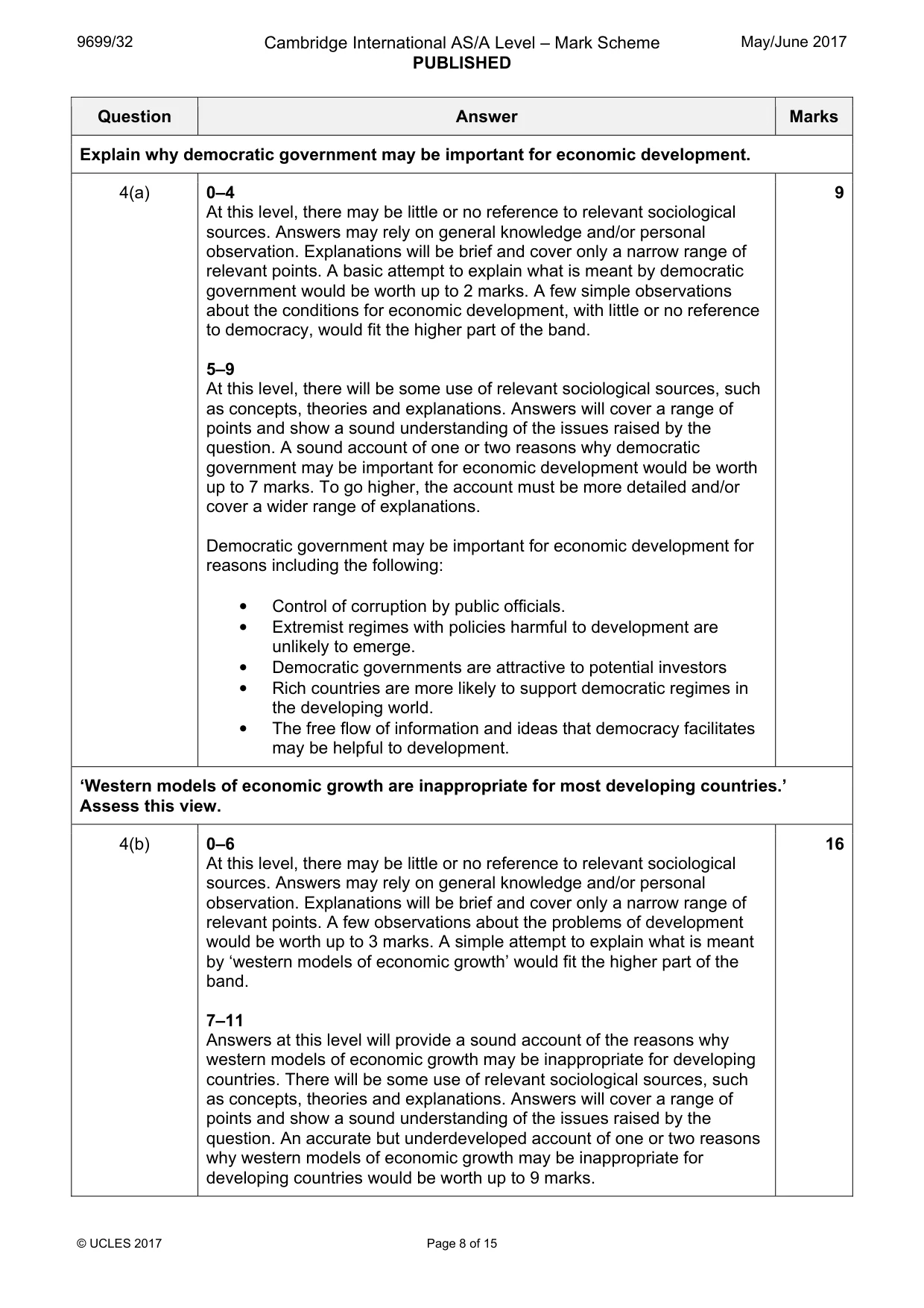
9699/32 Cambridge International AS/A Level – Mark Scheme PUBLISHED May/June 2017 © UCLES 2017 Page 8 of 15 Question Answer Marks Explain why democratic government may be important for economic development. 4(a) 0–4 At this level, there may be little or no reference to relevant sociological sources. Answers may rely on general knowledge and/or personal observation. Explanations will be brief and cover only a narrow range of relevant points. A basic attempt to explain what is meant by democratic government would be worth up to 2 marks. A few simple observations about the conditions for economic development, with little or no reference to democracy, would fit the higher part of the band. 5–9 At this level, there will be some use of relevant sociological sources, such as concepts, theories and explanations. Answers will cover a range of points and show a sound understanding of the issues raised by the question. A sound account of one or two reasons why democratic government may be important for economic development would be worth up to 7 marks. To go higher, the account must be more detailed and/or cover a wider range of explanations. Democratic government may be important for economic development for reasons including the following: • Control of corruption by public officials. • Extremist regimes with policies harmful to development are unlikely to emerge. • Democratic governments are attractive to potential investors • Rich countries are more likely to support democratic regimes in the developing world. • The free flow of information and ideas that democracy facilitates may be helpful to development. 9 ‘Western models of economic growth are inappropriate for most developing countries.’ Assess this view. 4(b) 0–6 At this level, there may be little or no reference to relevant sociological sources. Answers may rely on general knowledge and/or personal observation. Explanations will be brief and cover only a narrow range of relevant points. A few observations about the problems of development would be worth up to 3 marks. A simple attempt to explain what is meant by ‘western models of economic growth’ would fit the higher part of the band. 7–11 Answers at this level will provide a sound account of the reasons why western models of economic growth may be inappropriate for developing countries. There will be some use of relevant sociological sources, such as concepts, theories and explanations. Answers will cover a range of points and show a sound understanding of the issues raised by the question. An accurate but underdeveloped account of one or two reasons why western models of economic growth may be inappropriate for developing countries would be worth up to 9 marks. 16
Mark scheme, page 9
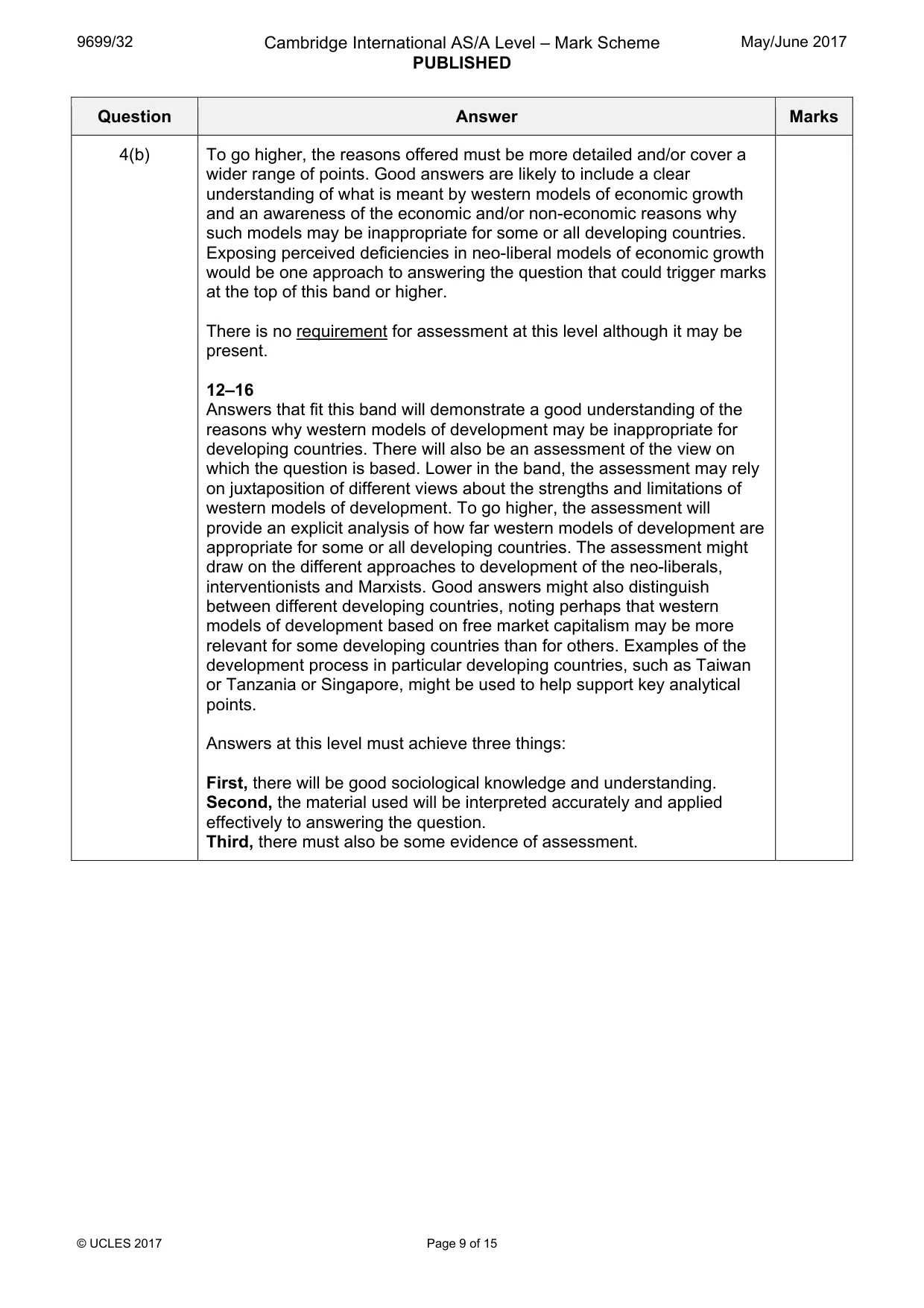
9699/32 Cambridge International AS/A Level – Mark Scheme PUBLISHED May/June 2017 © UCLES 2017 Page 9 of 15 Question Answer Marks 4(b) To go higher, the reasons offered must be more detailed and/or cover a wider range of points. Good answers are likely to include a clear understanding of what is meant by western models of economic growth and an awareness of the economic and/or non-economic reasons why such models may be inappropriate for some or all developing countries. Exposing perceived deficiencies in neo-liberal models of economic growth would be one approach to answering the question that could trigger marks at the top of this band or higher. There is no requirement for assessment at this level although it may be present. 12–16 Answers that fit this band will demonstrate a good understanding of the reasons why western models of development may be inappropriate for developing countries. There will also be an assessment of the view on which the question is based. Lower in the band, the assessment may rely on juxtaposition of different views about the strengths and limitations of western models of development. To go higher, the assessment will provide an explicit analysis of how far western models of development are appropriate for some or all developing countries. The assessment might draw on the different approaches to development of the neo-liberals, interventionists and Marxists. Good answers might also distinguish between different developing countries, noting perhaps that western models of development based on free market capitalism may be more relevant for some developing countries than for others. Examples of the development process in particular developing countries, such as Taiwan or Tanzania or Singapore, might be used to help support key analytical points. Answers at this level must achieve three things: First, there will be good sociological knowledge and understanding. Second, the material used will be interpreted accurately and applied effectively to answering the question. Third, there must also be some evidence of assessment.
Mark scheme, page 10
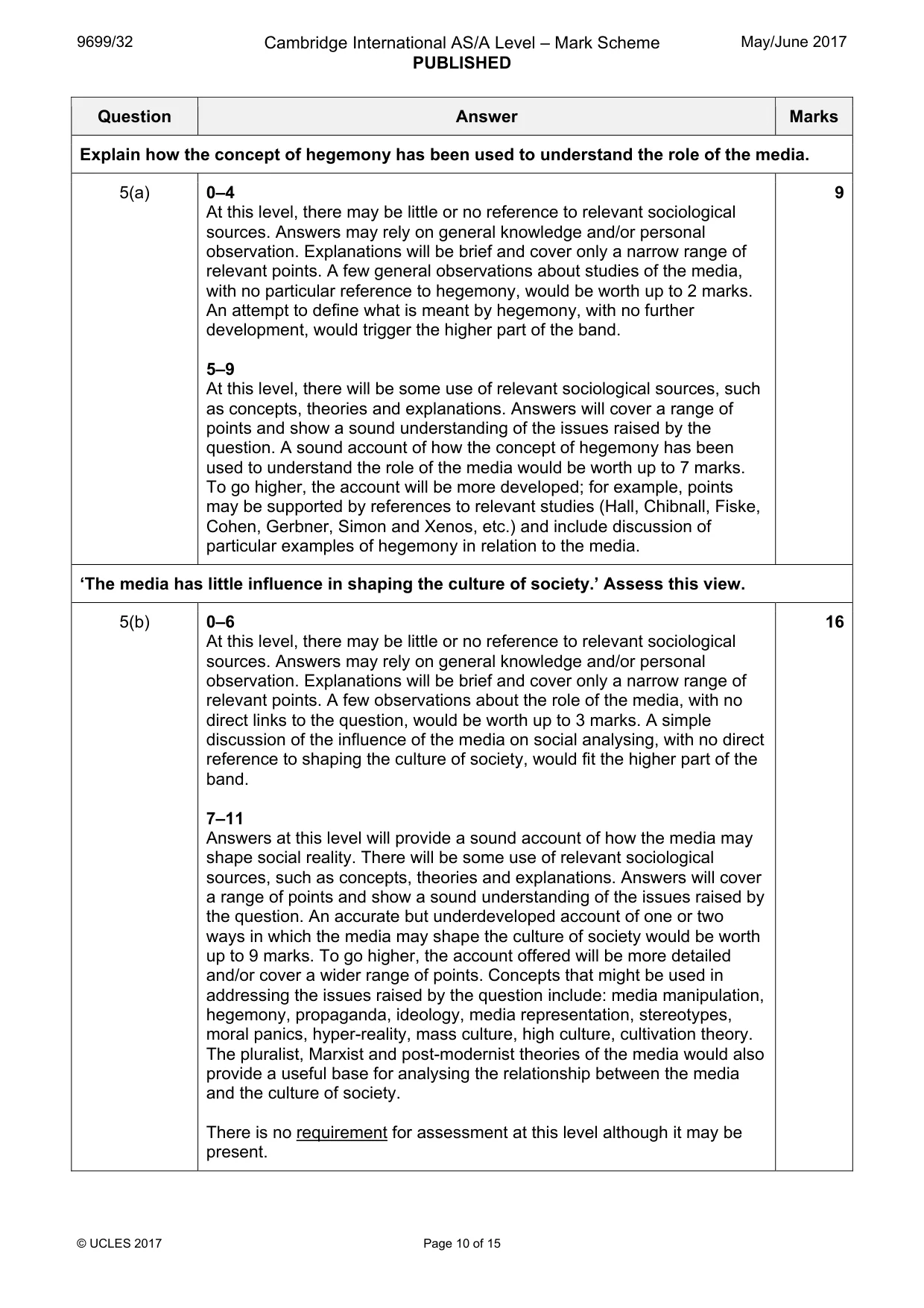
9699/32 Cambridge International AS/A Level – Mark Scheme PUBLISHED May/June 2017 © UCLES 2017 Page 10 of 15 Question Answer Marks Explain how the concept of hegemony has been used to understand the role of the media. 5(a) 0–4 At this level, there may be little or no reference to relevant sociological sources. Answers may rely on general knowledge and/or personal observation. Explanations will be brief and cover only a narrow range of relevant points. A few general observations about studies of the media, with no particular reference to hegemony, would be worth up to 2 marks. An attempt to define what is meant by hegemony, with no further development, would trigger the higher part of the band. 5–9 At this level, there will be some use of relevant sociological sources, such as concepts, theories and explanations. Answers will cover a range of points and show a sound understanding of the issues raised by the question. A sound account of how the concept of hegemony has been used to understand the role of the media would be worth up to 7 marks. To go higher, the account will be more developed; for example, points may be supported by references to relevant studies (Hall, Chibnall, Fiske, Cohen, Gerbner, Simon and Xenos, etc.) and include discussion of particular examples of hegemony in relation to the media. 9 ‘The media has little influence in shaping the culture of society.’ Assess this view. 5(b) 0–6 At this level, there may be little or no reference to relevant sociological sources. Answers may rely on general knowledge and/or personal observation. Explanations will be brief and cover only a narrow range of relevant points. A few observations about the role of the media, with no direct links to the question, would be worth up to 3 marks. A simple discussion of the influence of the media on social analysing, with no direct reference to shaping the culture of society, would fit the higher part of the band. 7–11 Answers at this level will provide a sound account of how the media may shape social reality. There will be some use of relevant sociological sources, such as concepts, theories and explanations. Answers will cover a range of points and show a sound understanding of the issues raised by the question. An accurate but underdeveloped account of one or two ways in which the media may shape the culture of society would be worth up to 9 marks. To go higher, the account offered will be more detailed and/or cover a wider range of points. Concepts that might be used in addressing the issues raised by the question include: media manipulation, hegemony, propaganda, ideology, media representation, stereotypes, moral panics, hyper-reality, mass culture, high culture, cultivation theory. The pluralist, Marxist and post-modernist theories of the media would also provide a useful base for analysing the relationship between the media and the culture of society. There is no requirement for assessment at this level although it may be present. 16
Mark scheme, page 11
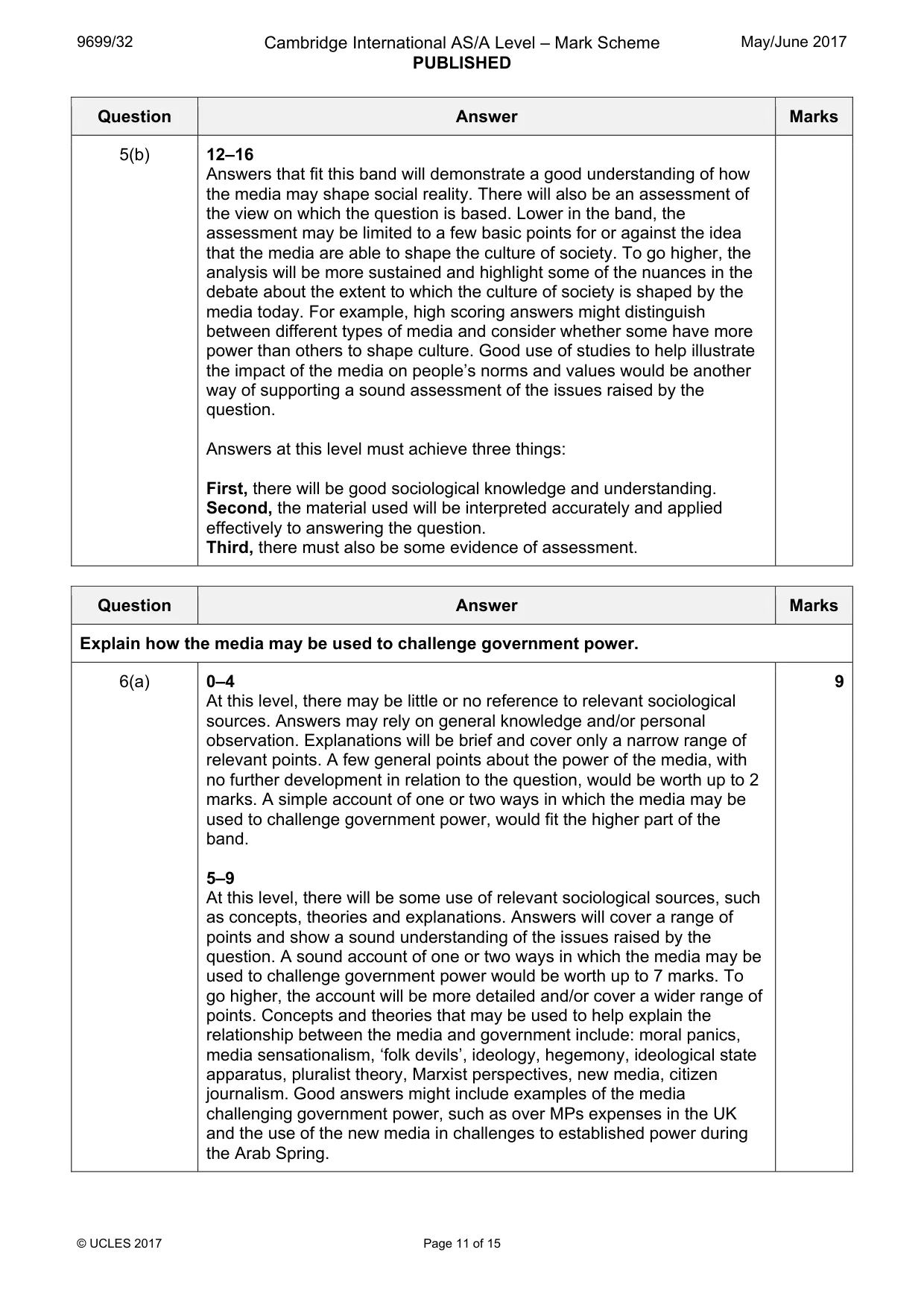
9699/32 Cambridge International AS/A Level – Mark Scheme PUBLISHED May/June 2017 © UCLES 2017 Page 11 of 15 Question Answer Marks 5(b) 12–16 Answers that fit this band will demonstrate a good understanding of how the media may shape social reality. There will also be an assessment of the view on which the question is based. Lower in the band, the assessment may be limited to a few basic points for or against the idea that the media are able to shape the culture of society. To go higher, the analysis will be more sustained and highlight some of the nuances in the debate about the extent to which the culture of society is shaped by the media today. For example, high scoring answers might distinguish between different types of media and consider whether some have more power than others to shape culture. Good use of studies to help illustrate the impact of the media on people’s norms and values would be another way of supporting a sound assessment of the issues raised by the question. Answers at this level must achieve three things: First, there will be good sociological knowledge and understanding. Second, the material used will be interpreted accurately and applied effectively to answering the question. Third, there must also be some evidence of assessment. Question Answer Marks Explain how the media may be used to challenge government power. 6(a) 0–4 At this level, there may be little or no reference to relevant sociological sources. Answers may rely on general knowledge and/or personal observation. Explanations will be brief and cover only a narrow range of relevant points. A few general points about the power of the media, with no further development in relation to the question, would be worth up to 2 marks. A simple account of one or two ways in which the media may be used to challenge government power, would fit the higher part of the band. 5–9 At this level, there will be some use of relevant sociological sources, such as concepts, theories and explanations. Answers will cover a range of points and show a sound understanding of the issues raised by the question. A sound account of one or two ways in which the media may be used to challenge government power would be worth up to 7 marks. To go higher, the account will be more detailed and/or cover a wider range of points. Concepts and theories that may be used to help explain the relationship between the media and government include: moral panics, media sensationalism, ‘folk devils’, ideology, hegemony, ideological state apparatus, pluralist theory, Marxist perspectives, new media, citizen journalism. Good answers might include examples of the media challenging government power, such as over MPs expenses in the UK and the use of the new media in challenges to established power during the Arab Spring. 9
Mark scheme, page 12
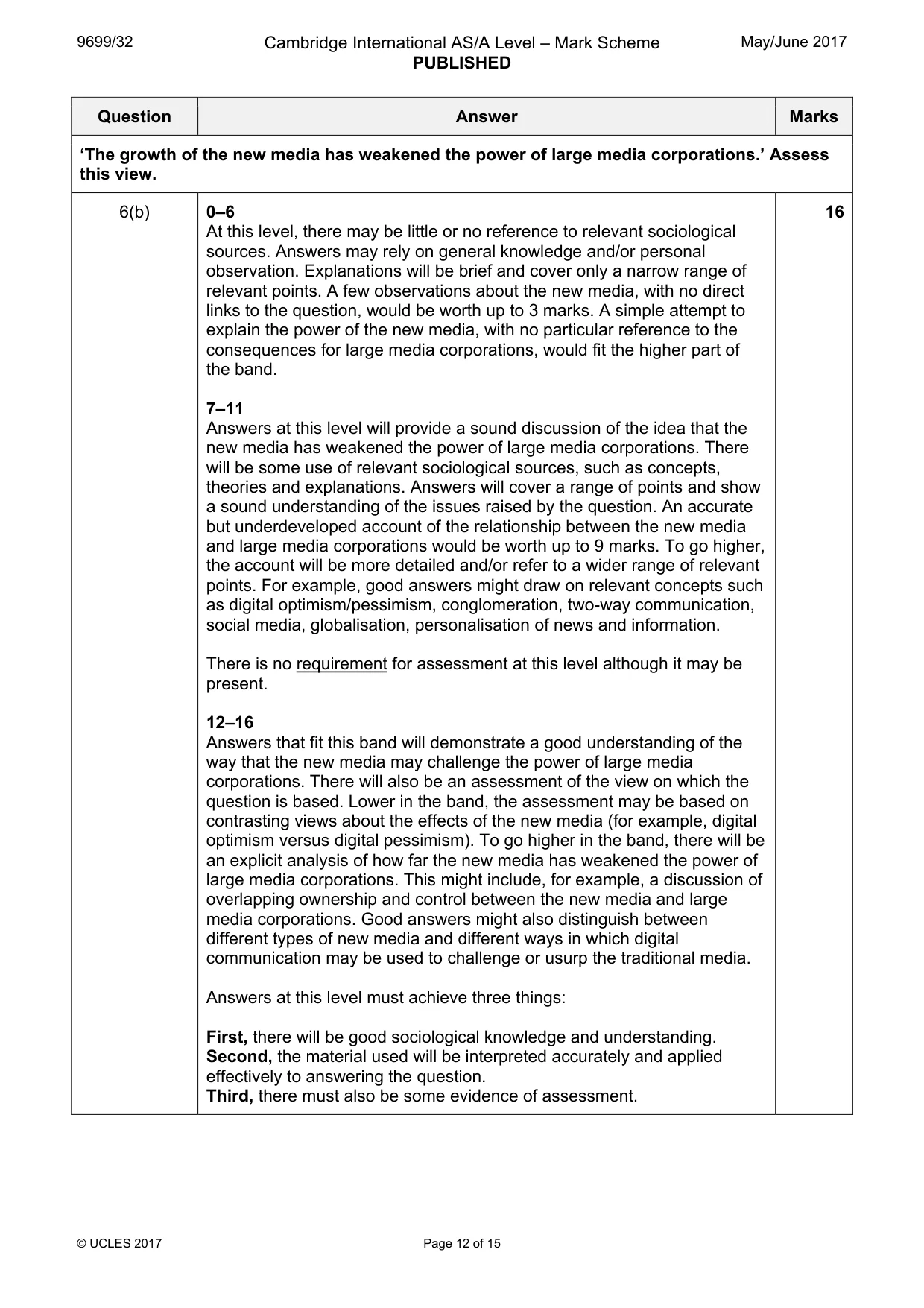
9699/32 Cambridge International AS/A Level – Mark Scheme PUBLISHED May/June 2017 © UCLES 2017 Page 12 of 15 Question Answer Marks ‘The growth of the new media has weakened the power of large media corporations.’ Assess this view. 6(b) 0–6 At this level, there may be little or no reference to relevant sociological sources. Answers may rely on general knowledge and/or personal observation. Explanations will be brief and cover only a narrow range of relevant points. A few observations about the new media, with no direct links to the question, would be worth up to 3 marks. A simple attempt to explain the power of the new media, with no particular reference to the consequences for large media corporations, would fit the higher part of the band. 7–11 Answers at this level will provide a sound discussion of the idea that the new media has weakened the power of large media corporations. There will be some use of relevant sociological sources, such as concepts, theories and explanations. Answers will cover a range of points and show a sound understanding of the issues raised by the question. An accurate but underdeveloped account of the relationship between the new media and large media corporations would be worth up to 9 marks. To go higher, the account will be more detailed and/or refer to a wider range of relevant points. For example, good answers might draw on relevant concepts such as digital optimism/pessimism, conglomeration, two-way communication, social media, globalisation, personalisation of news and information. There is no requirement for assessment at this level although it may be present. 12–16 Answers that fit this band will demonstrate a good understanding of the way that the new media may challenge the power of large media corporations. There will also be an assessment of the view on which the question is based. Lower in the band, the assessment may be based on contrasting views about the effects of the new media (for example, digital optimism versus digital pessimism). To go higher in the band, there will be an explicit analysis of how far the new media has weakened the power of large media corporations. This might include, for example, a discussion of overlapping ownership and control between the new media and large media corporations. Good answers might also distinguish between different types of new media and different ways in which digital communication may be used to challenge or usurp the traditional media. Answers at this level must achieve three things: First, there will be good sociological knowledge and understanding. Second, the material used will be interpreted accurately and applied effectively to answering the question. Third, there must also be some evidence of assessment. 16
Mark scheme, page 13
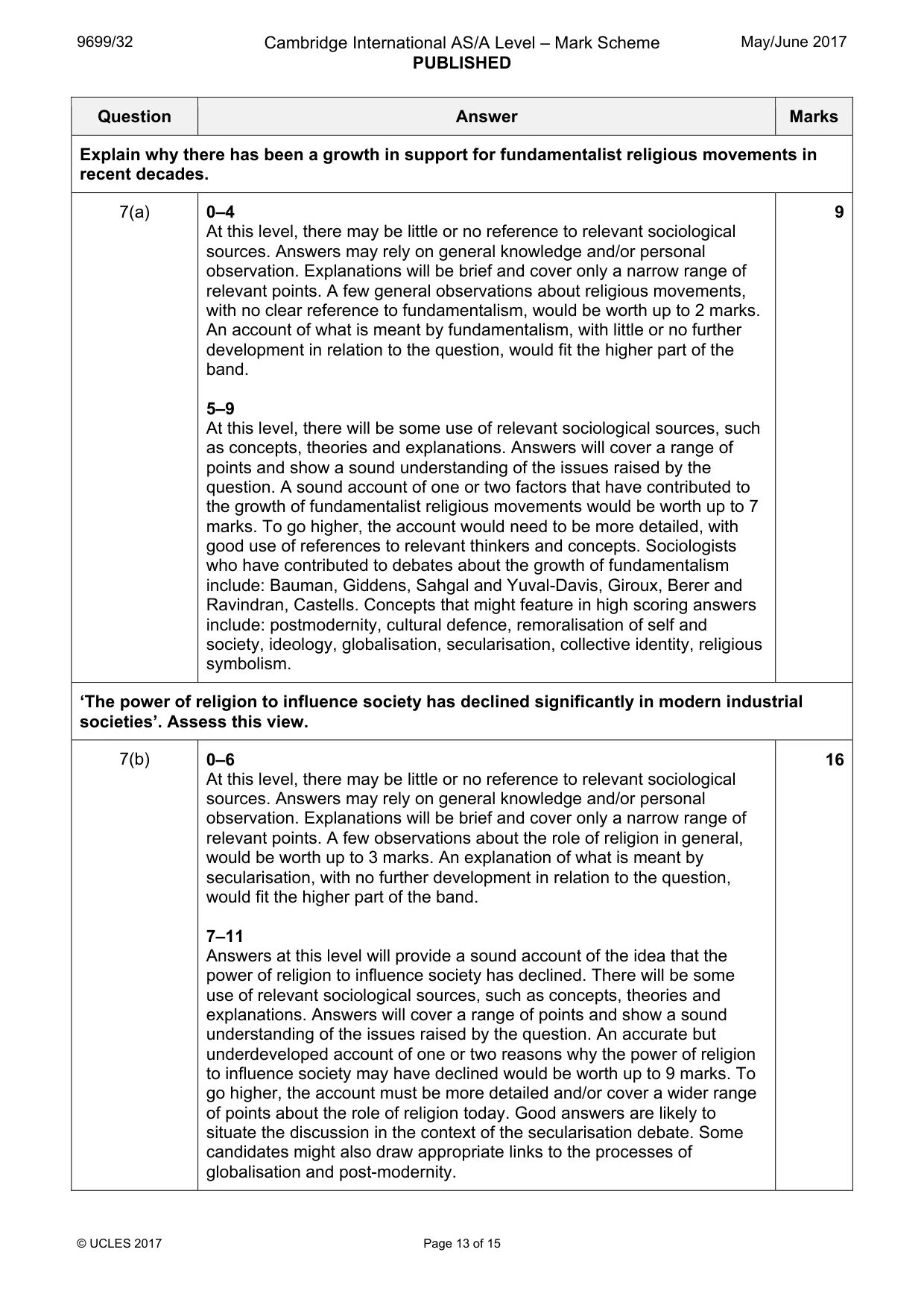
9699/32 Cambridge International AS/A Level – Mark Scheme PUBLISHED May/June 2017 © UCLES 2017 Page 13 of 15 Question Answer Marks Explain why there has been a growth in support for fundamentalist religious movements in recent decades. 7(a) 0–4 At this level, there may be little or no reference to relevant sociological sources. Answers may rely on general knowledge and/or personal observation. Explanations will be brief and cover only a narrow range of relevant points. A few general observations about religious movements, with no clear reference to fundamentalism, would be worth up to 2 marks. An account of what is meant by fundamentalism, with little or no further development in relation to the question, would fit the higher part of the band. 5–9 At this level, there will be some use of relevant sociological sources, such as concepts, theories and explanations. Answers will cover a range of points and show a sound understanding of the issues raised by the question. A sound account of one or two factors that have contributed to the growth of fundamentalist religious movements would be worth up to 7 marks. To go higher, the account would need to be more detailed, with good use of references to relevant thinkers and concepts. Sociologists who have contributed to debates about the growth of fundamentalism include: Bauman, Giddens, Sahgal and Yuval-Davis, Giroux, Berer and Ravindran, Castells. Concepts that might feature in high scoring answers include: postmodernity, cultural defence, remoralisation of self and society, ideology, globalisation, secularisation, collective identity, religious symbolism. 9 ‘The power of religion to influence society has declined significantly in modern industrial societies’. Assess this view. 7(b) 0–6 At this level, there may be little or no reference to relevant sociological sources. Answers may rely on general knowledge and/or personal observation. Explanations will be brief and cover only a narrow range of relevant points. A few observations about the role of religion in general, would be worth up to 3 marks. An explanation of what is meant by secularisation, with no further development in relation to the question, would fit the higher part of the band. 7–11 Answers at this level will provide a sound account of the idea that the power of religion to influence society has declined. There will be some use of relevant sociological sources, such as concepts, theories and explanations. Answers will cover a range of points and show a sound understanding of the issues raised by the question. An accurate but underdeveloped account of one or two reasons why the power of religion to influence society may have declined would be worth up to 9 marks. To go higher, the account must be more detailed and/or cover a wider range of points about the role of religion today. Good answers are likely to situate the discussion in the context of the secularisation debate. Some candidates might also draw appropriate links to the processes of globalisation and post-modernity. 16
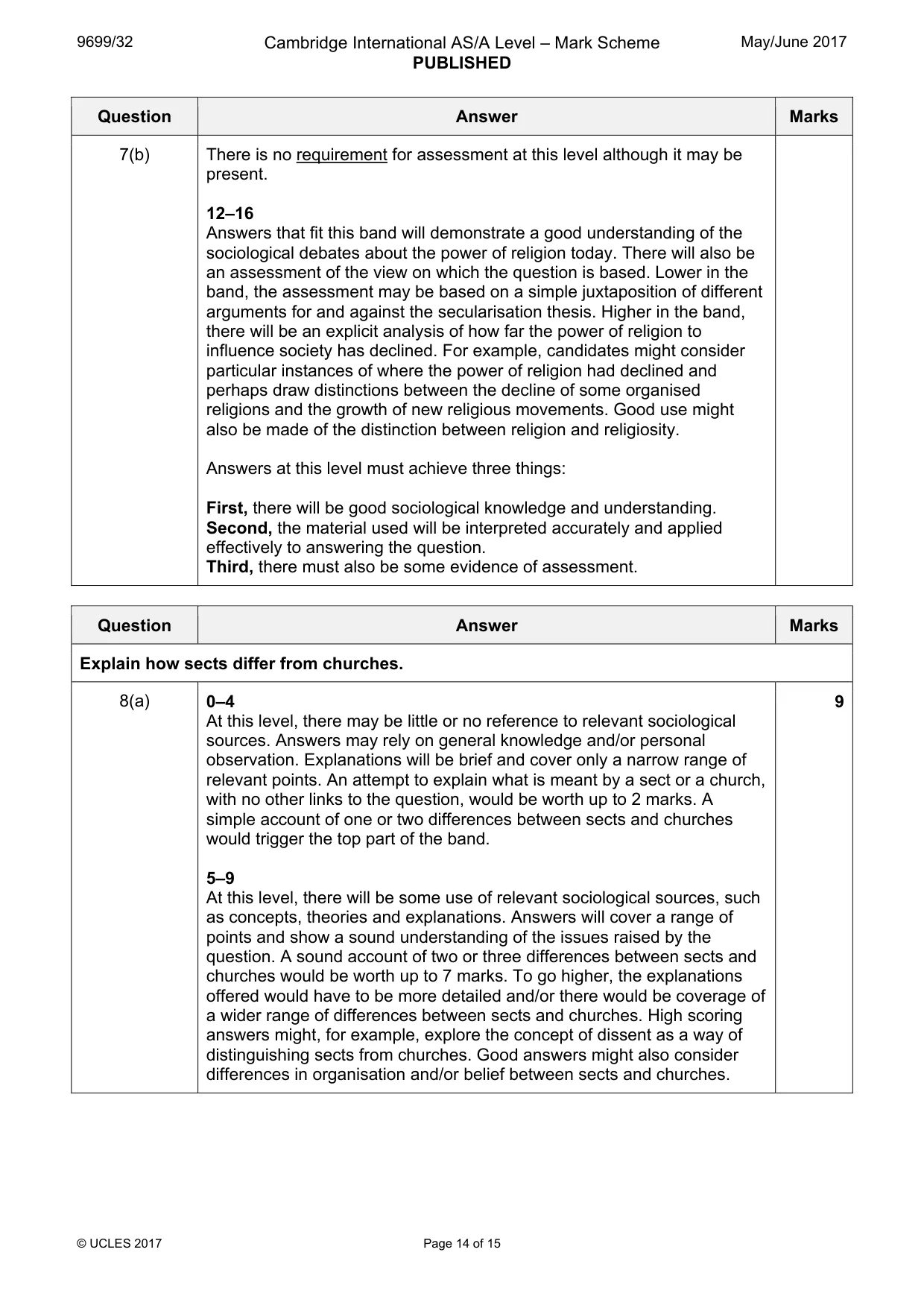
Mark scheme, page 14
9699/32 Cambridge International AS/A Level – Mark Scheme PUBLISHED May/June 2017 © UCLES 2017 Page 14 of 15 Question Answer Marks 7(b) There is no requirement for assessment at this level although it may be present. 12–16 Answers that fit this band will demonstrate a good understanding of the sociological debates about the power of religion today. There will also be an assessment of the view on which the question is based. Lower in the band, the assessment may be based on a simple juxtaposition of different arguments for and against the secularisation thesis. Higher in the band, there will be an explicit analysis of how far the power of religion to influence society has declined. For example, candidates might consider particular instances of where the power of religion had declined and perhaps draw distinctions between the decline of some organised religions and the growth of new religious movements. Good use might also be made of the distinction between religion and religiosity. Answers at this level must achieve three things: First, there will be good sociological knowledge and understanding. Second, the material used will be interpreted accurately and applied effectively to answering the question. Third, there must also be some evidence of assessment. Question Answer Marks Explain how sects differ from churches. 8(a) 0–4 At this level, there may be little or no reference to relevant sociological sources. Answers may rely on general knowledge and/or personal observation. Explanations will be brief and cover only a narrow range of relevant points. An attempt to explain what is meant by a sect or a church, with no other links to the question, would be worth up to 2 marks. A simple account of one or two differences between sects and churches would trigger the top part of the band. 5–9 At this level, there will be some use of relevant sociological sources, such as concepts, theories and explanations. Answers will cover a range of points and show a sound understanding of the issues raised by the question. A sound account of two or three differences between sects and churches would be worth up to 7 marks. To go higher, the explanations offered would have to be more detailed and/or there would be coverage of a wider range of differences between sects and churches. High scoring answers might, for example, explore the concept of dissent as a way of distinguishing sects from churches. Good answers might also consider differences in organisation and/or belief between sects and churches. 9
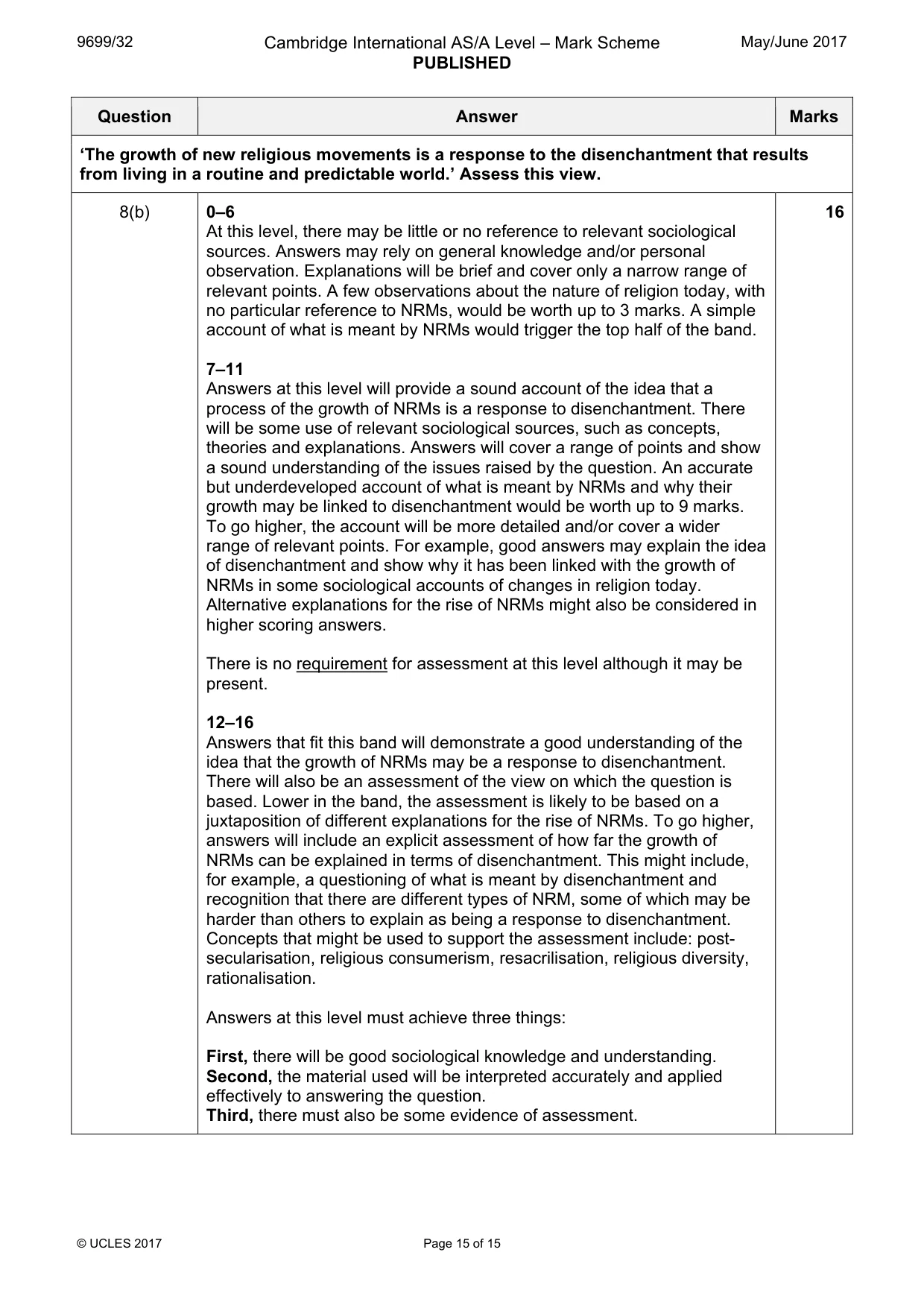
Mark scheme, page 15
9699/32 Cambridge International AS/A Level – Mark Scheme PUBLISHED May/June 2017 © UCLES 2017 Page 15 of 15 Question Answer Marks ‘The growth of new religious movements is a response to the disenchantment that results from living in a routine and predictable world.’ Assess this view. 8(b) 0–6 At this level, there may be little or no reference to relevant sociological sources. Answers may rely on general knowledge and/or personal observation. Explanations will be brief and cover only a narrow range of relevant points. A few observations about the nature of religion today, with no particular reference to NRMs, would be worth up to 3 marks. A simple account of what is meant by NRMs would trigger the top half of the band. 7–11 Answers at this level will provide a sound account of the idea that a process of the growth of NRMs is a response to disenchantment. There will be some use of relevant sociological sources, such as concepts, theories and explanations. Answers will cover a range of points and show a sound understanding of the issues raised by the question. An accurate but underdeveloped account of what is meant by NRMs and why their growth may be linked to disenchantment would be worth up to 9 marks. To go higher, the account will be more detailed and/or cover a wider range of relevant points. For example, good answers may explain the idea of disenchantment and show why it has been linked with the growth of NRMs in some sociological accounts of changes in religion today. Alternative explanations for the rise of NRMs might also be considered in higher scoring answers. There is no requirement for assessment at this level although it may be present. 12–16 Answers that fit this band will demonstrate a good understanding of the idea that the growth of NRMs may be a response to disenchantment. There will also be an assessment of the view on which the question is based. Lower in the band, the assessment is likely to be based on a juxtaposition of different explanations for the rise of NRMs. To go higher, answers will include an explicit assessment of how far the growth of NRMs can be explained in terms of disenchantment. This might include, for example, a questioning of what is meant by disenchantment and recognition that there are different types of NRM, some of which may be harder than others to explain as being a response to disenchantment. Concepts that might be used to support the assessment include: post- secularisation, religious consumerism, resacrilisation, religious diversity, rationalisation. Answers at this level must achieve three things: First, there will be good sociological knowledge and understanding. Second, the material used will be interpreted accurately and applied effectively to answering the question. Third, there must also be some evidence of assessment. 16
What you needed in this session
Cambridge’s own grade thresholds for 2017 May/June, Paper 3 · Variant 2. A higher threshold means an easier paper — the bar moves with how the cohort did.