Cambridge A Level Sociology 9699 — 2017 May/June Paper 3 · Variant 3
9699/33/M/J/17 · 75 marks · ≈84 min
The question paper and its mark scheme, free to read here and free to download. This is Cambridge’s own paper, exactly as it was sat.
Question paper4 pages

Mark scheme17 pages
Answers below. Sit the paper first if you are practising.
Paper as text
Question paper, page 1
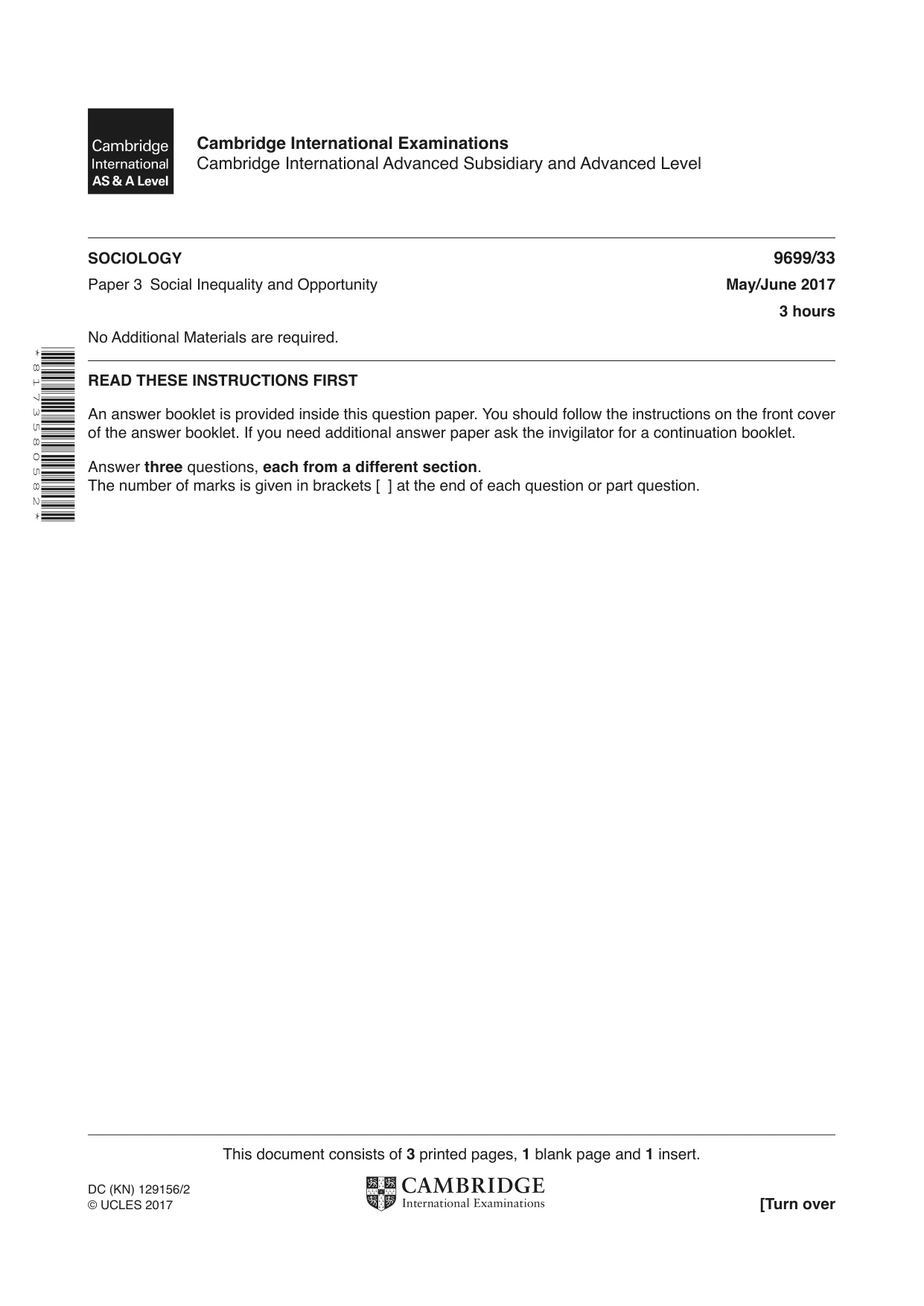
This document consists of 3 printed pages, 1 blank page and 1 insert. DC (KN) 129156/2 © UCLES 2017 [Turn over Cambridge International Examinations Cambridge International Advanced Subsidiary and Advanced Level * 8 1 7 3 5 8 0 5 8 2 * SOCIOLOGY 9699/33 Paper 3 Social Inequality and Opportunity May/June 2017 3 hours No Additional Materials are required. READ THESE INSTRUCTIONS FIRST An answer booklet is provided inside this question paper. You should follow the instructions on the front cover of the answer booklet. If you need additional answer paper ask the invigilator for a continuation booklet. Answer three questions, each from a different section. The number of marks is given in brackets [ ] at the end of each question or part question.
Question paper, page 2
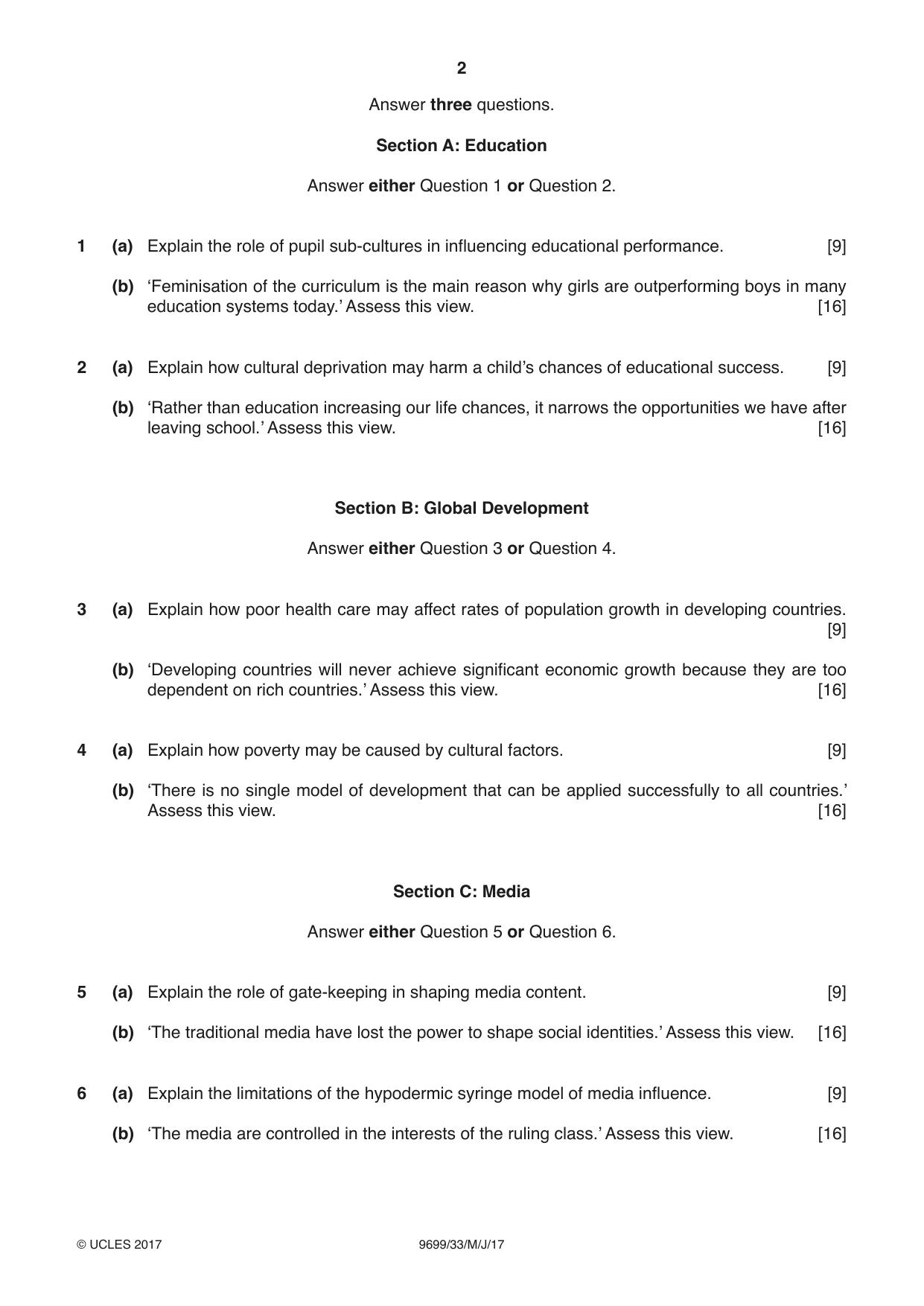
2 9699/33/M/J/17 © UCLES 2017 Answer three questions. Section A: Education Answer either Question 1 or Question 2. 1 (a) Explain the role of pupil sub-cultures in influencing educational performance. [9] (b) ‘Feminisation of the curriculum is the main reason why girls are outperforming boys in many education systems today.’ Assess this view. [16] 2 (a) Explain how cultural deprivation may harm a child’s chances of educational success. [9] (b) ‘Rather than education increasing our life chances, it narrows the opportunities we have after leaving school.’ Assess this view. [16] Section B: Global Development Answer either Question 3 or Question 4. 3 (a) Explain how poor health care may affect rates of population growth in developing countries. [9] (b) ‘Developing countries will never achieve significant economic growth because they are too dependent on rich countries.’ Assess this view. [16] 4 (a) Explain how poverty may be caused by cultural factors. [9] (b) ‘There is no single model of development that can be applied successfully to all countries.’ Assess this view. [16] Section C: Media Answer either Question 5 or Question 6. 5 (a) Explain the role of gate-keeping in shaping media content. [9] (b) ‘The traditional media have lost the power to shape social identities.’ Assess this view. [16] 6 (a) Explain the limitations of the hypodermic syringe model of media influence. [9] (b) ‘The media are controlled in the interests of the ruling class.’ Assess this view. [16]
Question paper, page 3
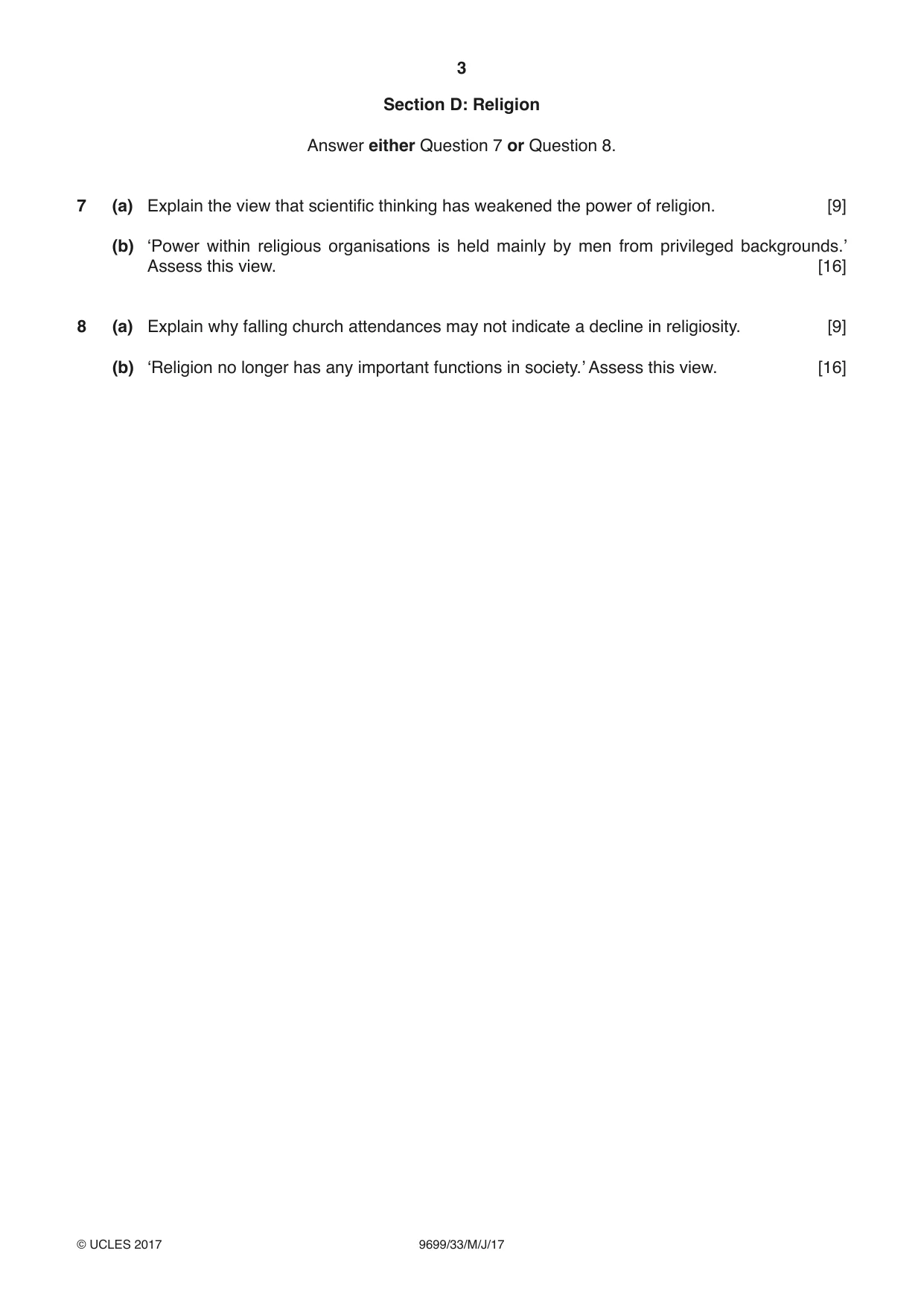
3 9699/33/M/J/17 © UCLES 2017 Section D: Religion Answer either Question 7 or Question 8. 7 (a) Explain the view that scientific thinking has weakened the power of religion. [9] (b) ‘Power within religious organisations is held mainly by men from privileged backgrounds.’ Assess this view. [16] 8 (a) Explain why falling church attendances may not indicate a decline in religiosity. [9] (b) ‘Religion no longer has any important functions in society.’ Assess this view. [16]
Question paper, page 4
4 9699/33/M/J/17 © UCLES 2017 BLANK PAGE Permission to reproduce items where third-party owned material protected by copyright is included has been sought and cleared where possible. Every reasonable effort has been made by the publisher (UCLES) to trace copyright holders, but if any items requiring clearance have unwittingly been included, the publisher will be pleased to make amends at the earliest possible opportunity. To avoid the issue of disclosure of answer-related information to candidates, all copyright acknowledgements are reproduced online in the Cambridge International Examinations Copyright Acknowledgements Booklet. This is produced for each series of examinations and is freely available to download at www.cie.org.uk after the live examination series. Cambridge International Examinations is part of the Cambridge Assessment Group. Cambridge Assessment is the brand name of University of Cambridge Local Examinations Syndicate (UCLES), which is itself a department of the University of Cambridge.
Mark scheme, page 1
® IGCSE is a registered trademark. This document consists of 17 printed pages. © UCLES 2017 [Turn over Cambridge International Examinations Cambridge International Advanced Subsidiary and Advanced Level SOCIOLOGY 9699/33 Paper 3 Social Inequality and Opportunity May/June 2017 MARK SCHEME Maximum Mark: 75 Published This mark scheme is published as an aid to teachers and candidates, to indicate the requirements of the examination. It shows the basis on which Examiners were instructed to award marks. It does not indicate the details of the discussions that took place at an Examiners’ meeting before marking began, which would have considered the acceptability of alternative answers. Mark schemes should be read in conjunction with the question paper and the Principal Examiner Report for Teachers. Cambridge will not enter into discussions about these mark schemes. Cambridge is publishing the mark schemes for the May/June 2017 series for most Cambridge IGCSE®, Cambridge International A and AS Level and Cambridge Pre-U components, and some Cambridge O Level components.
Mark scheme, page 2
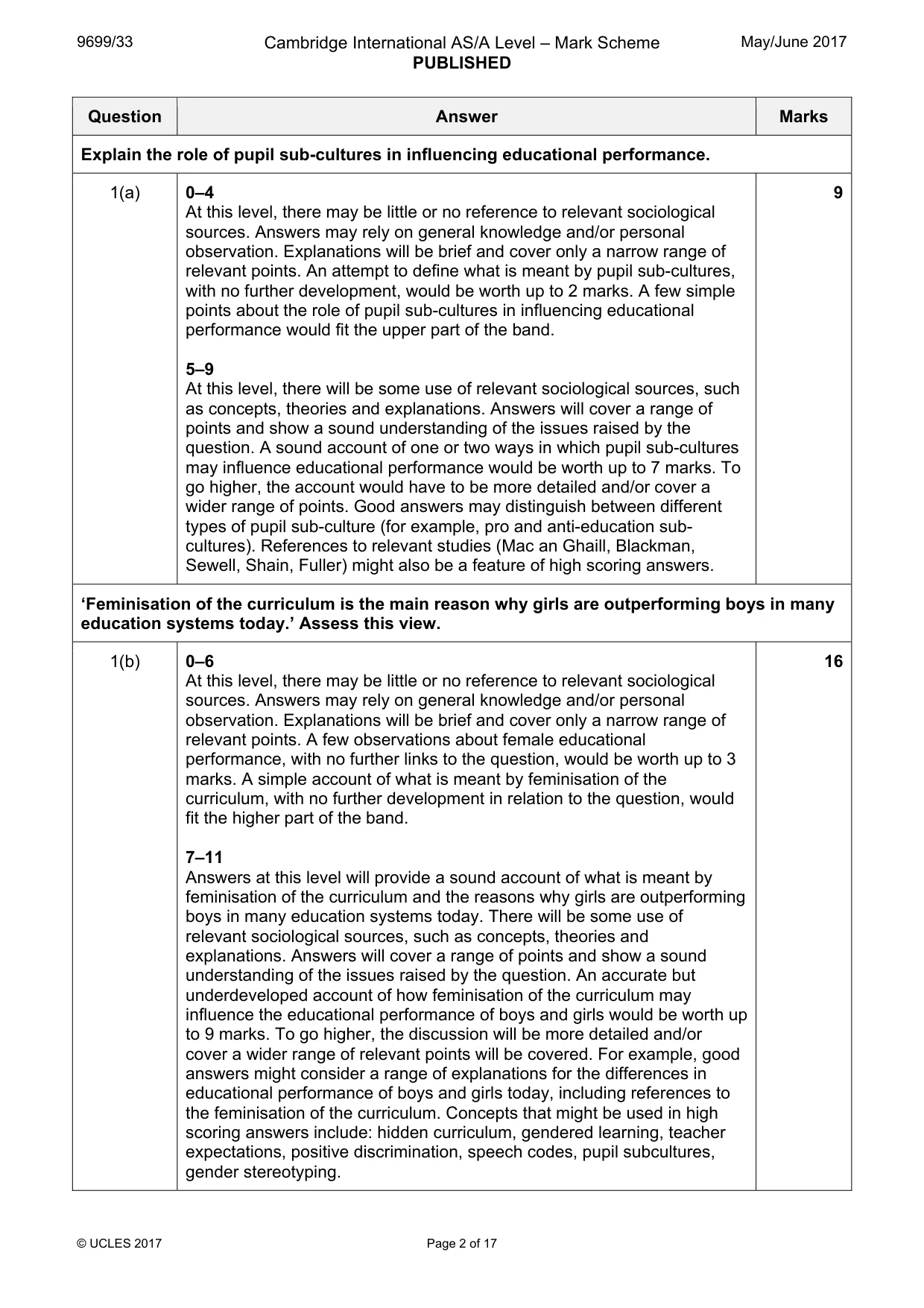
9699/33 Cambridge International AS/A Level – Mark Scheme PUBLISHED May/June 2017 © UCLES 2017 Page 2 of 17 Question Answer Marks Explain the role of pupil sub-cultures in influencing educational performance. 1(a) 0–4 At this level, there may be little or no reference to relevant sociological sources. Answers may rely on general knowledge and/or personal observation. Explanations will be brief and cover only a narrow range of relevant points. An attempt to define what is meant by pupil sub-cultures, with no further development, would be worth up to 2 marks. A few simple points about the role of pupil sub-cultures in influencing educational performance would fit the upper part of the band. 5–9 At this level, there will be some use of relevant sociological sources, such as concepts, theories and explanations. Answers will cover a range of points and show a sound understanding of the issues raised by the question. A sound account of one or two ways in which pupil sub-cultures may influence educational performance would be worth up to 7 marks. To go higher, the account would have to be more detailed and/or cover a wider range of points. Good answers may distinguish between different types of pupil sub-culture (for example, pro and anti-education sub- cultures). References to relevant studies (Mac an Ghaill, Blackman, Sewell, Shain, Fuller) might also be a feature of high scoring answers. 9 ‘Feminisation of the curriculum is the main reason why girls are outperforming boys in many education systems today.’ Assess this view. 1(b) 0–6 At this level, there may be little or no reference to relevant sociological sources. Answers may rely on general knowledge and/or personal observation. Explanations will be brief and cover only a narrow range of relevant points. A few observations about female educational performance, with no further links to the question, would be worth up to 3 marks. A simple account of what is meant by feminisation of the curriculum, with no further development in relation to the question, would fit the higher part of the band. 7–11 Answers at this level will provide a sound account of what is meant by feminisation of the curriculum and the reasons why girls are outperforming boys in many education systems today. There will be some use of relevant sociological sources, such as concepts, theories and explanations. Answers will cover a range of points and show a sound understanding of the issues raised by the question. An accurate but underdeveloped account of how feminisation of the curriculum may influence the educational performance of boys and girls would be worth up to 9 marks. To go higher, the discussion will be more detailed and/or cover a wider range of relevant points will be covered. For example, good answers might consider a range of explanations for the differences in educational performance of boys and girls today, including references to the feminisation of the curriculum. Concepts that might be used in high scoring answers include: hidden curriculum, gendered learning, teacher expectations, positive discrimination, speech codes, pupil subcultures, gender stereotyping. 16
Mark scheme, page 3
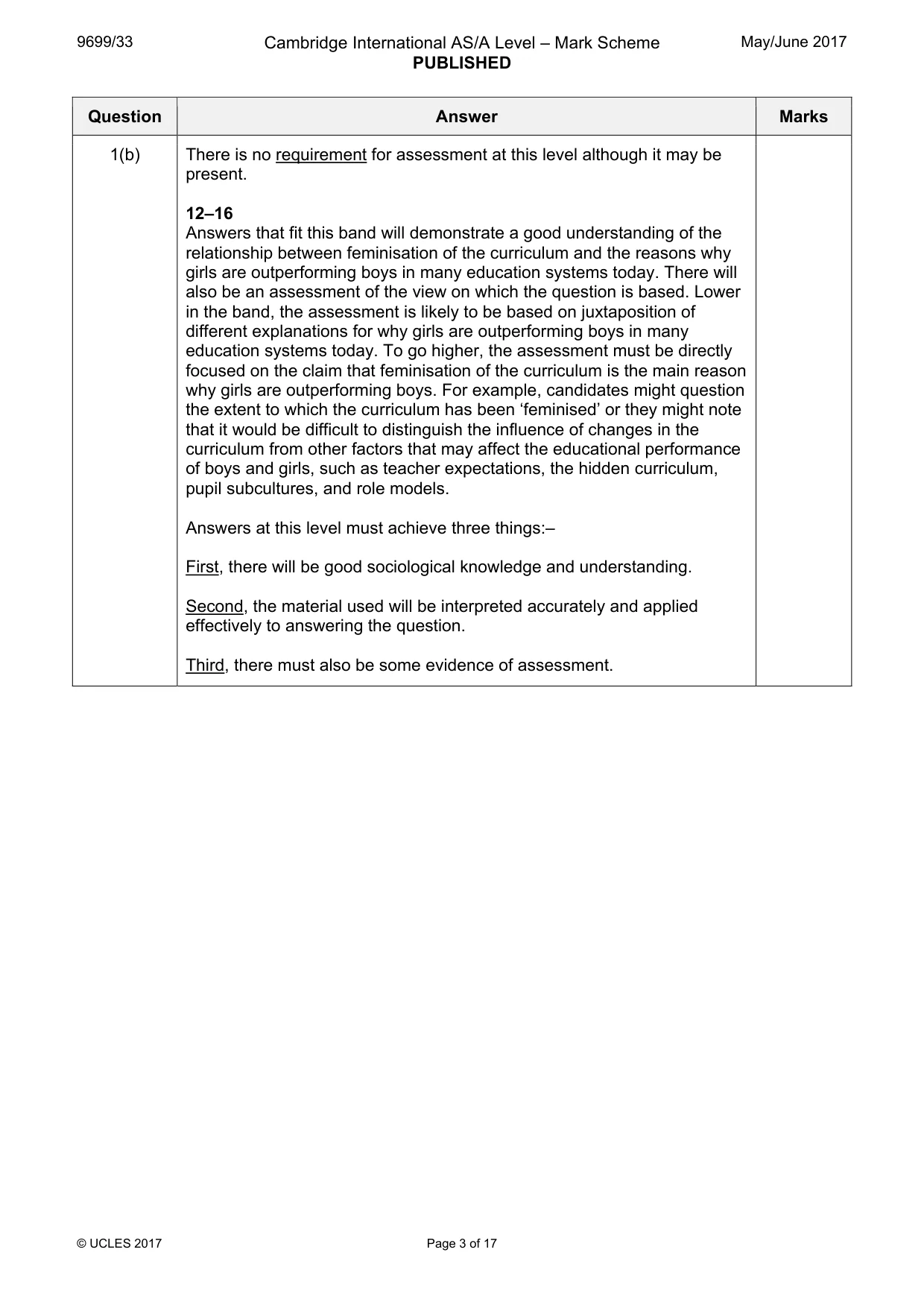
9699/33 Cambridge International AS/A Level – Mark Scheme PUBLISHED May/June 2017 © UCLES 2017 Page 3 of 17 Question Answer Marks 1(b) There is no requirement for assessment at this level although it may be present. 12–16 Answers that fit this band will demonstrate a good understanding of the relationship between feminisation of the curriculum and the reasons why girls are outperforming boys in many education systems today. There will also be an assessment of the view on which the question is based. Lower in the band, the assessment is likely to be based on juxtaposition of different explanations for why girls are outperforming boys in many education systems today. To go higher, the assessment must be directly focused on the claim that feminisation of the curriculum is the main reason why girls are outperforming boys. For example, candidates might question the extent to which the curriculum has been ‘feminised’ or they might note that it would be difficult to distinguish the influence of changes in the curriculum from other factors that may affect the educational performance of boys and girls, such as teacher expectations, the hidden curriculum, pupil subcultures, and role models. Answers at this level must achieve three things:– First, there will be good sociological knowledge and understanding. Second, the material used will be interpreted accurately and applied effectively to answering the question. Third, there must also be some evidence of assessment.
Mark scheme, page 4
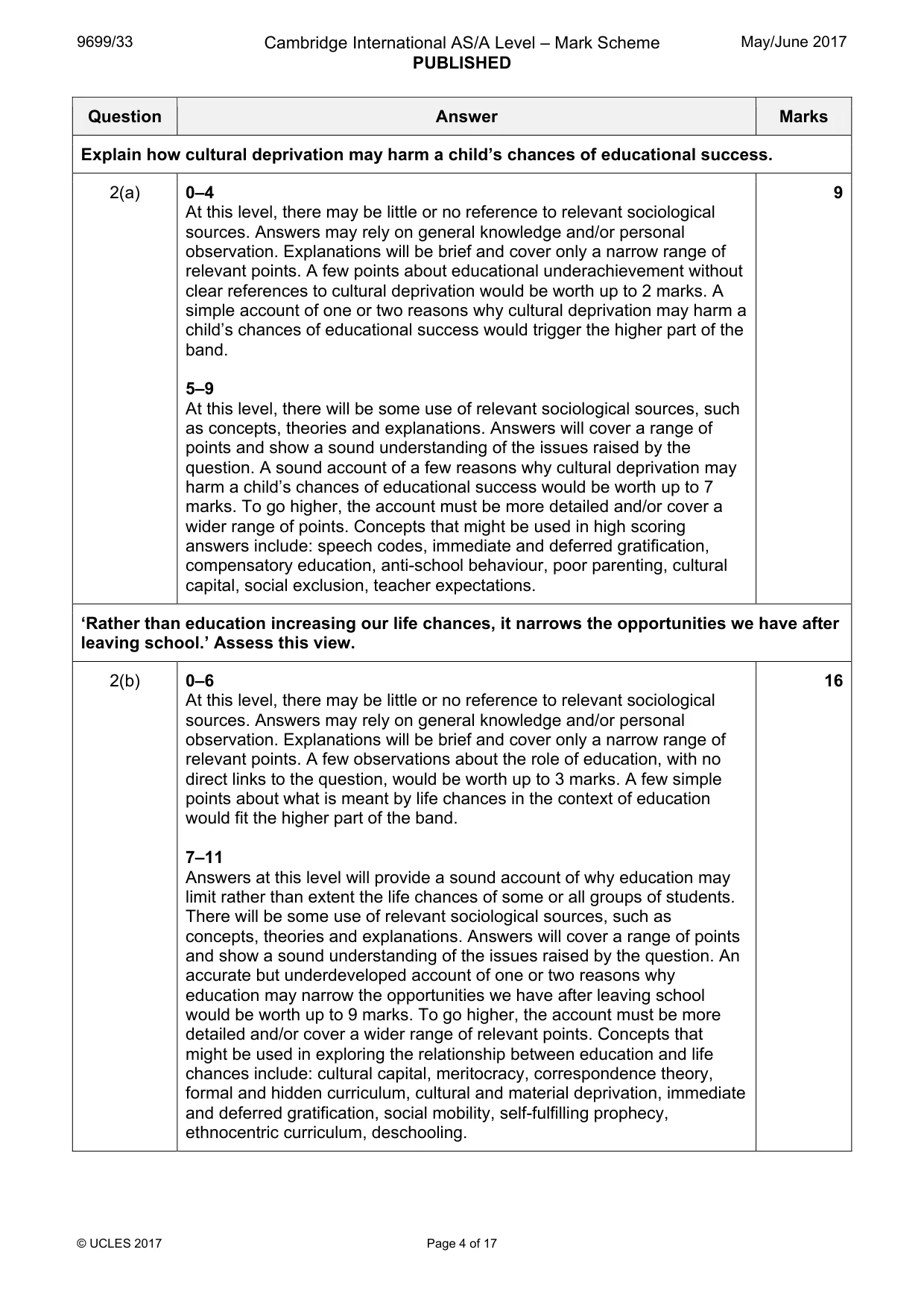
9699/33 Cambridge International AS/A Level – Mark Scheme PUBLISHED May/June 2017 © UCLES 2017 Page 4 of 17 Question Answer Marks Explain how cultural deprivation may harm a child’s chances of educational success. 2(a) 0–4 At this level, there may be little or no reference to relevant sociological sources. Answers may rely on general knowledge and/or personal observation. Explanations will be brief and cover only a narrow range of relevant points. A few points about educational underachievement without clear references to cultural deprivation would be worth up to 2 marks. A simple account of one or two reasons why cultural deprivation may harm a child’s chances of educational success would trigger the higher part of the band. 5–9 At this level, there will be some use of relevant sociological sources, such as concepts, theories and explanations. Answers will cover a range of points and show a sound understanding of the issues raised by the question. A sound account of a few reasons why cultural deprivation may harm a child’s chances of educational success would be worth up to 7 marks. To go higher, the account must be more detailed and/or cover a wider range of points. Concepts that might be used in high scoring answers include: speech codes, immediate and deferred gratification, compensatory education, anti-school behaviour, poor parenting, cultural capital, social exclusion, teacher expectations. 9 ‘Rather than education increasing our life chances, it narrows the opportunities we have after leaving school.’ Assess this view. 2(b) 0–6 At this level, there may be little or no reference to relevant sociological sources. Answers may rely on general knowledge and/or personal observation. Explanations will be brief and cover only a narrow range of relevant points. A few observations about the role of education, with no direct links to the question, would be worth up to 3 marks. A few simple points about what is meant by life chances in the context of education would fit the higher part of the band. 7–11 Answers at this level will provide a sound account of why education may limit rather than extent the life chances of some or all groups of students. There will be some use of relevant sociological sources, such as concepts, theories and explanations. Answers will cover a range of points and show a sound understanding of the issues raised by the question. An accurate but underdeveloped account of one or two reasons why education may narrow the opportunities we have after leaving school would be worth up to 9 marks. To go higher, the account must be more detailed and/or cover a wider range of relevant points. Concepts that might be used in exploring the relationship between education and life chances include: cultural capital, meritocracy, correspondence theory, formal and hidden curriculum, cultural and material deprivation, immediate and deferred gratification, social mobility, self-fulfilling prophecy, ethnocentric curriculum, deschooling. 16
Mark scheme, page 5
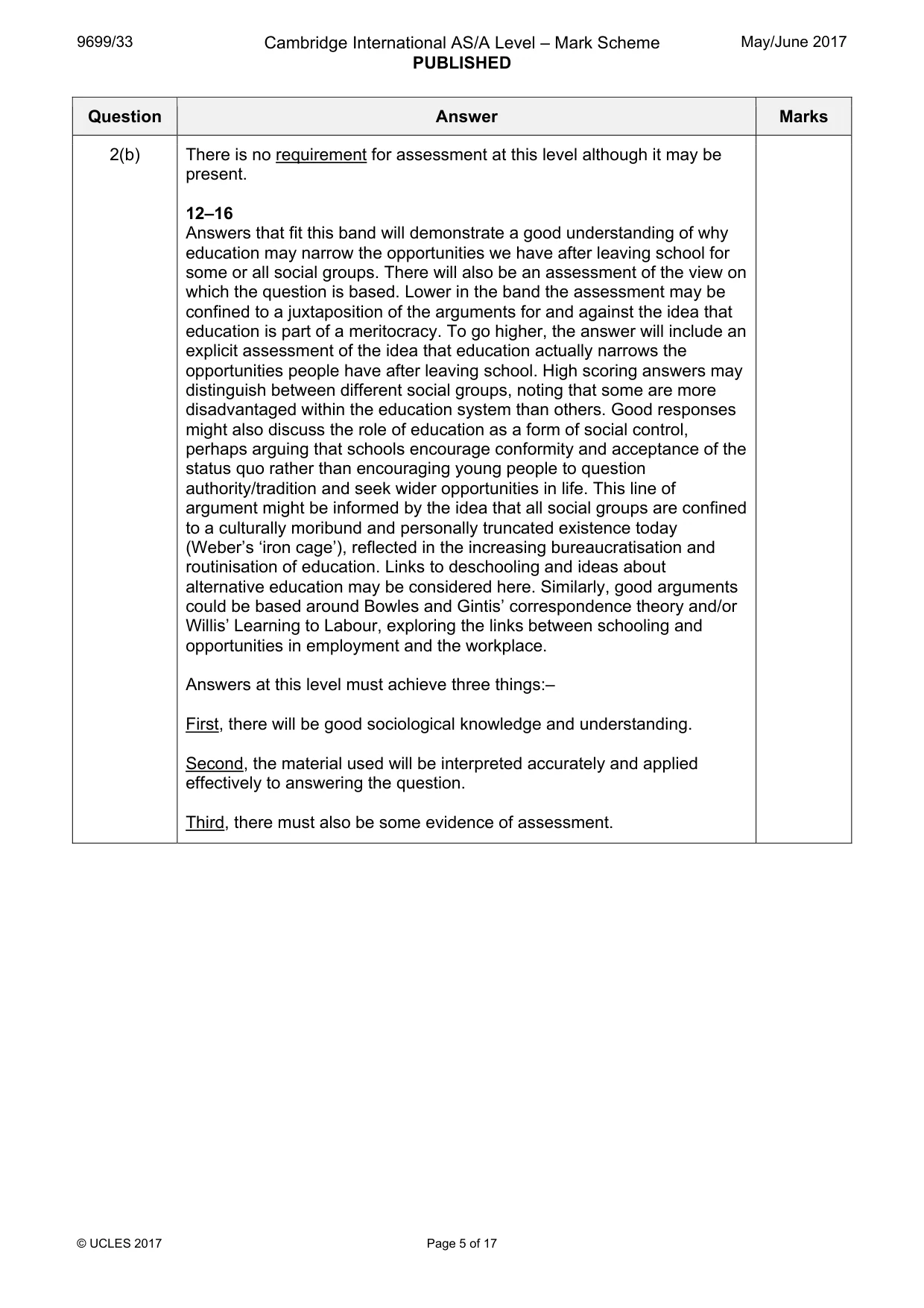
9699/33 Cambridge International AS/A Level – Mark Scheme PUBLISHED May/June 2017 © UCLES 2017 Page 5 of 17 Question Answer Marks 2(b) There is no requirement for assessment at this level although it may be present. 12–16 Answers that fit this band will demonstrate a good understanding of why education may narrow the opportunities we have after leaving school for some or all social groups. There will also be an assessment of the view on which the question is based. Lower in the band the assessment may be confined to a juxtaposition of the arguments for and against the idea that education is part of a meritocracy. To go higher, the answer will include an explicit assessment of the idea that education actually narrows the opportunities people have after leaving school. High scoring answers may distinguish between different social groups, noting that some are more disadvantaged within the education system than others. Good responses might also discuss the role of education as a form of social control, perhaps arguing that schools encourage conformity and acceptance of the status quo rather than encouraging young people to question authority/tradition and seek wider opportunities in life. This line of argument might be informed by the idea that all social groups are confined to a culturally moribund and personally truncated existence today (Weber’s ‘iron cage’), reflected in the increasing bureaucratisation and routinisation of education. Links to deschooling and ideas about alternative education may be considered here. Similarly, good arguments could be based around Bowles and Gintis’ correspondence theory and/or Willis’ Learning to Labour, exploring the links between schooling and opportunities in employment and the workplace. Answers at this level must achieve three things:– First, there will be good sociological knowledge and understanding. Second, the material used will be interpreted accurately and applied effectively to answering the question. Third, there must also be some evidence of assessment.
Mark scheme, page 6
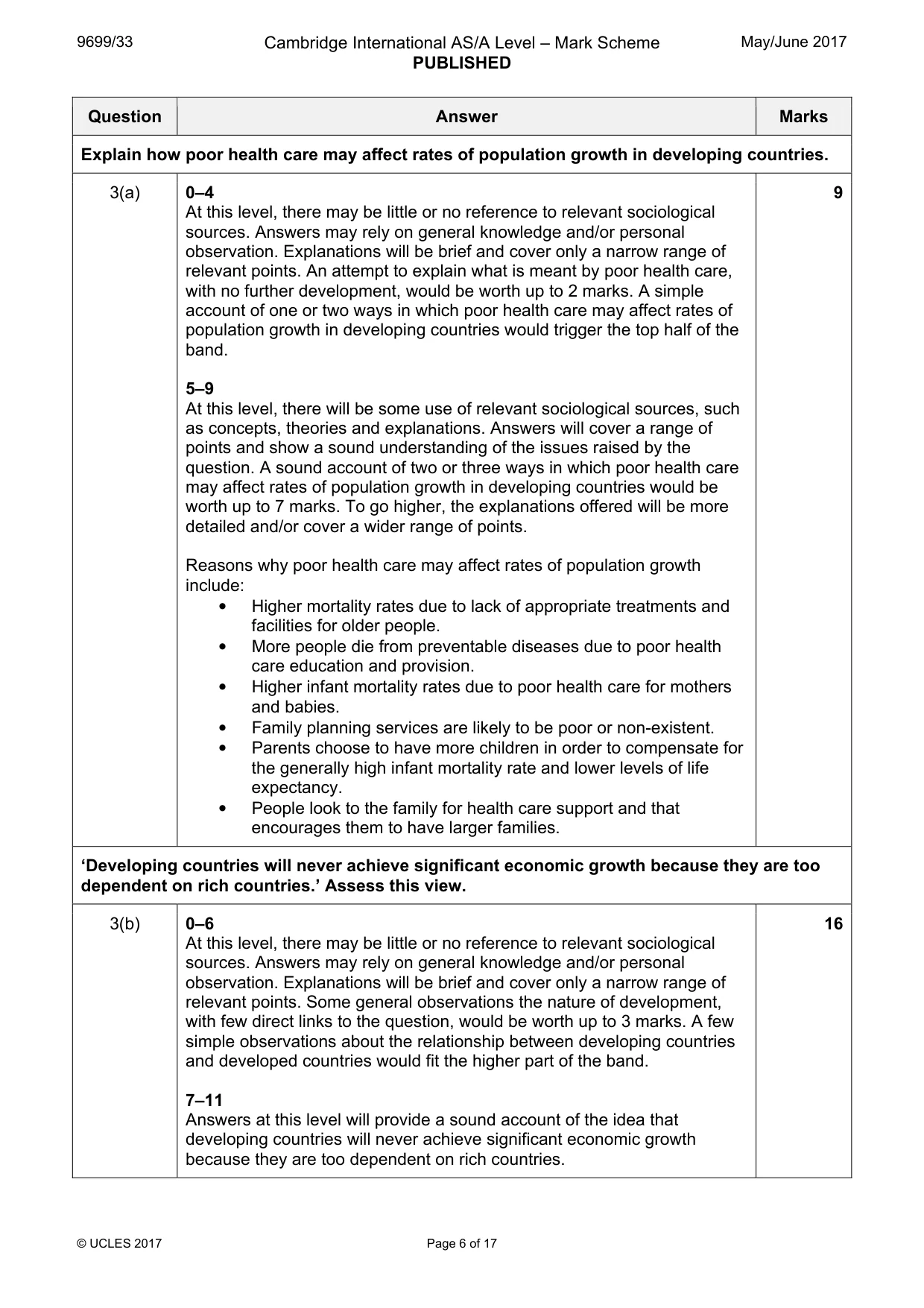
9699/33 Cambridge International AS/A Level – Mark Scheme PUBLISHED May/June 2017 © UCLES 2017 Page 6 of 17 Question Answer Marks Explain how poor health care may affect rates of population growth in developing countries. 3(a) 0–4 At this level, there may be little or no reference to relevant sociological sources. Answers may rely on general knowledge and/or personal observation. Explanations will be brief and cover only a narrow range of relevant points. An attempt to explain what is meant by poor health care, with no further development, would be worth up to 2 marks. A simple account of one or two ways in which poor health care may affect rates of population growth in developing countries would trigger the top half of the band. 5–9 At this level, there will be some use of relevant sociological sources, such as concepts, theories and explanations. Answers will cover a range of points and show a sound understanding of the issues raised by the question. A sound account of two or three ways in which poor health care may affect rates of population growth in developing countries would be worth up to 7 marks. To go higher, the explanations offered will be more detailed and/or cover a wider range of points. Reasons why poor health care may affect rates of population growth include: • Higher mortality rates due to lack of appropriate treatments and facilities for older people. • More people die from preventable diseases due to poor health care education and provision. • Higher infant mortality rates due to poor health care for mothers and babies. • Family planning services are likely to be poor or non-existent. • Parents choose to have more children in order to compensate for the generally high infant mortality rate and lower levels of life expectancy. • People look to the family for health care support and that encourages them to have larger families. 9 ‘Developing countries will never achieve significant economic growth because they are too dependent on rich countries.’ Assess this view. 3(b) 0–6 At this level, there may be little or no reference to relevant sociological sources. Answers may rely on general knowledge and/or personal observation. Explanations will be brief and cover only a narrow range of relevant points. Some general observations the nature of development, with few direct links to the question, would be worth up to 3 marks. A few simple observations about the relationship between developing countries and developed countries would fit the higher part of the band. 7–11 Answers at this level will provide a sound account of the idea that developing countries will never achieve significant economic growth because they are too dependent on rich countries. 16
Mark scheme, page 7
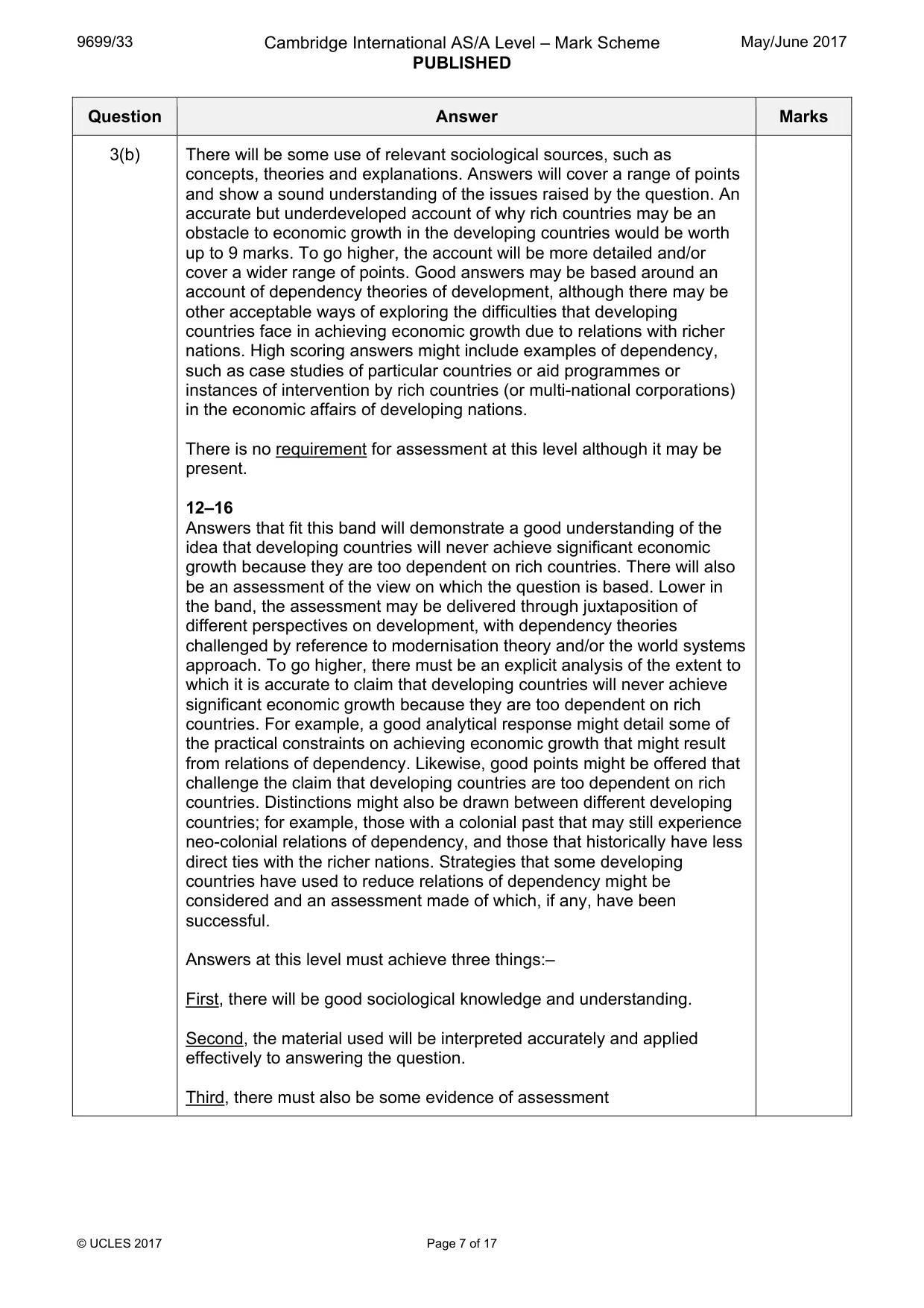
9699/33 Cambridge International AS/A Level – Mark Scheme PUBLISHED May/June 2017 © UCLES 2017 Page 7 of 17 Question Answer Marks 3(b) There will be some use of relevant sociological sources, such as concepts, theories and explanations. Answers will cover a range of points and show a sound understanding of the issues raised by the question. An accurate but underdeveloped account of why rich countries may be an obstacle to economic growth in the developing countries would be worth up to 9 marks. To go higher, the account will be more detailed and/or cover a wider range of points. Good answers may be based around an account of dependency theories of development, although there may be other acceptable ways of exploring the difficulties that developing countries face in achieving economic growth due to relations with richer nations. High scoring answers might include examples of dependency, such as case studies of particular countries or aid programmes or instances of intervention by rich countries (or multi-national corporations) in the economic affairs of developing nations. There is no requirement for assessment at this level although it may be present. 12–16 Answers that fit this band will demonstrate a good understanding of the idea that developing countries will never achieve significant economic growth because they are too dependent on rich countries. There will also be an assessment of the view on which the question is based. Lower in the band, the assessment may be delivered through juxtaposition of different perspectives on development, with dependency theories challenged by reference to modernisation theory and/or the world systems approach. To go higher, there must be an explicit analysis of the extent to which it is accurate to claim that developing countries will never achieve significant economic growth because they are too dependent on rich countries. For example, a good analytical response might detail some of the practical constraints on achieving economic growth that might result from relations of dependency. Likewise, good points might be offered that challenge the claim that developing countries are too dependent on rich countries. Distinctions might also be drawn between different developing countries; for example, those with a colonial past that may still experience neo-colonial relations of dependency, and those that historically have less direct ties with the richer nations. Strategies that some developing countries have used to reduce relations of dependency might be considered and an assessment made of which, if any, have been successful. Answers at this level must achieve three things:– First, there will be good sociological knowledge and understanding. Second, the material used will be interpreted accurately and applied effectively to answering the question. Third, there must also be some evidence of assessment
Mark scheme, page 8
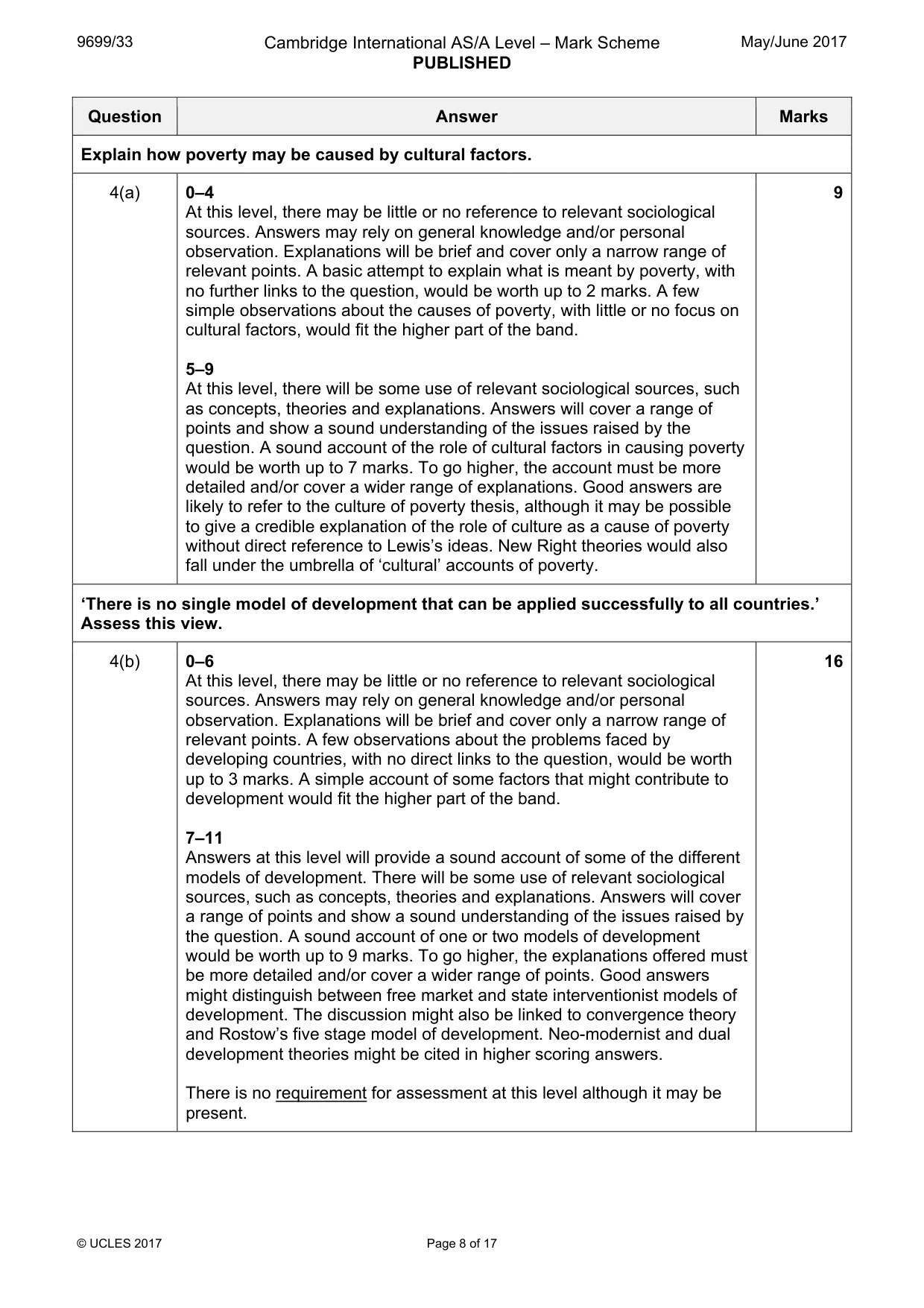
9699/33 Cambridge International AS/A Level – Mark Scheme PUBLISHED May/June 2017 © UCLES 2017 Page 8 of 17 Question Answer Marks Explain how poverty may be caused by cultural factors. 4(a) 0–4 At this level, there may be little or no reference to relevant sociological sources. Answers may rely on general knowledge and/or personal observation. Explanations will be brief and cover only a narrow range of relevant points. A basic attempt to explain what is meant by poverty, with no further links to the question, would be worth up to 2 marks. A few simple observations about the causes of poverty, with little or no focus on cultural factors, would fit the higher part of the band. 5–9 At this level, there will be some use of relevant sociological sources, such as concepts, theories and explanations. Answers will cover a range of points and show a sound understanding of the issues raised by the question. A sound account of the role of cultural factors in causing poverty would be worth up to 7 marks. To go higher, the account must be more detailed and/or cover a wider range of explanations. Good answers are likely to refer to the culture of poverty thesis, although it may be possible to give a credible explanation of the role of culture as a cause of poverty without direct reference to Lewis’s ideas. New Right theories would also fall under the umbrella of ‘cultural’ accounts of poverty. 9 ‘There is no single model of development that can be applied successfully to all countries.’ Assess this view. 4(b) 0–6 At this level, there may be little or no reference to relevant sociological sources. Answers may rely on general knowledge and/or personal observation. Explanations will be brief and cover only a narrow range of relevant points. A few observations about the problems faced by developing countries, with no direct links to the question, would be worth up to 3 marks. A simple account of some factors that might contribute to development would fit the higher part of the band. 7–11 Answers at this level will provide a sound account of some of the different models of development. There will be some use of relevant sociological sources, such as concepts, theories and explanations. Answers will cover a range of points and show a sound understanding of the issues raised by the question. A sound account of one or two models of development would be worth up to 9 marks. To go higher, the explanations offered must be more detailed and/or cover a wider range of points. Good answers might distinguish between free market and state interventionist models of development. The discussion might also be linked to convergence theory and Rostow’s five stage model of development. Neo-modernist and dual development theories might be cited in higher scoring answers. There is no requirement for assessment at this level although it may be present. 16
Mark scheme, page 9
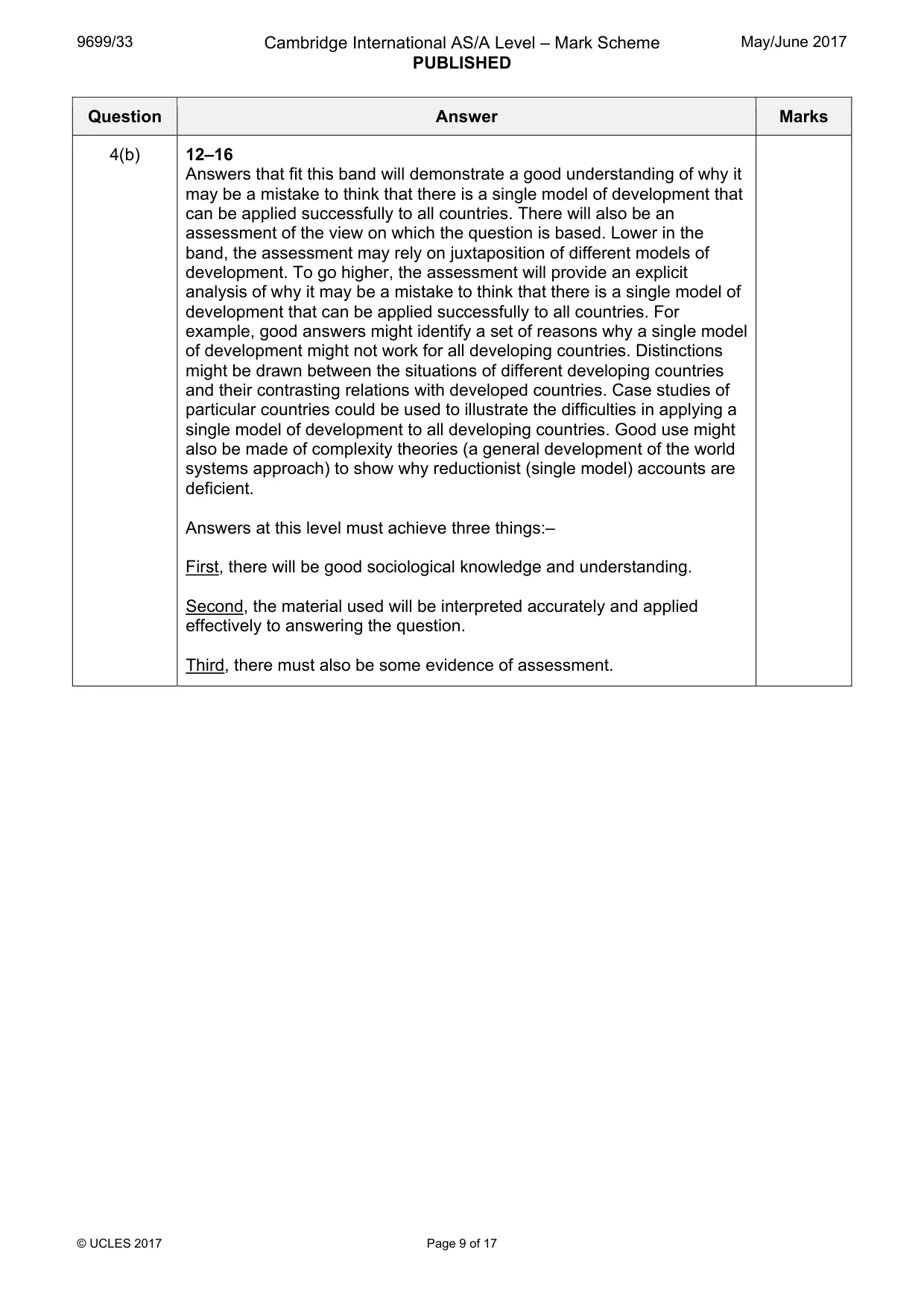
9699/33 Cambridge International AS/A Level – Mark Scheme PUBLISHED May/June 2017 © UCLES 2017 Page 9 of 17 Question Answer Marks 4(b) 12–16 Answers that fit this band will demonstrate a good understanding of why it may be a mistake to think that there is a single model of development that can be applied successfully to all countries. There will also be an assessment of the view on which the question is based. Lower in the band, the assessment may rely on juxtaposition of different models of development. To go higher, the assessment will provide an explicit analysis of why it may be a mistake to think that there is a single model of development that can be applied successfully to all countries. For example, good answers might identify a set of reasons why a single model of development might not work for all developing countries. Distinctions might be drawn between the situations of different developing countries and their contrasting relations with developed countries. Case studies of particular countries could be used to illustrate the difficulties in applying a single model of development to all developing countries. Good use might also be made of complexity theories (a general development of the world systems approach) to show why reductionist (single model) accounts are deficient. Answers at this level must achieve three things:– First, there will be good sociological knowledge and understanding. Second, the material used will be interpreted accurately and applied effectively to answering the question. Third, there must also be some evidence of assessment.
Mark scheme, page 10
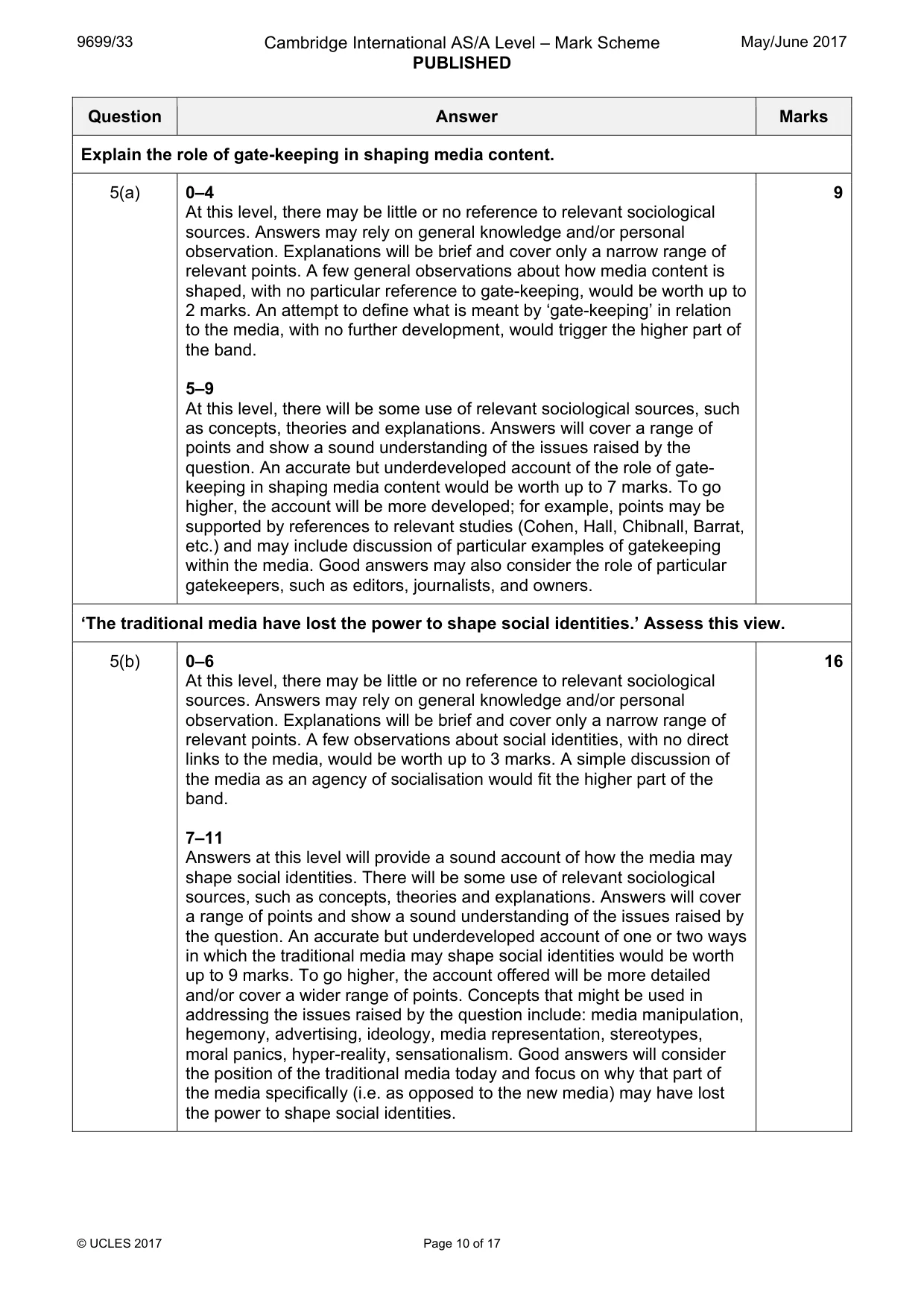
9699/33 Cambridge International AS/A Level – Mark Scheme PUBLISHED May/June 2017 © UCLES 2017 Page 10 of 17 Question Answer Marks Explain the role of gate-keeping in shaping media content. 5(a) 0–4 At this level, there may be little or no reference to relevant sociological sources. Answers may rely on general knowledge and/or personal observation. Explanations will be brief and cover only a narrow range of relevant points. A few general observations about how media content is shaped, with no particular reference to gate-keeping, would be worth up to 2 marks. An attempt to define what is meant by ‘gate-keeping’ in relation to the media, with no further development, would trigger the higher part of the band. 5–9 At this level, there will be some use of relevant sociological sources, such as concepts, theories and explanations. Answers will cover a range of points and show a sound understanding of the issues raised by the question. An accurate but underdeveloped account of the role of gate- keeping in shaping media content would be worth up to 7 marks. To go higher, the account will be more developed; for example, points may be supported by references to relevant studies (Cohen, Hall, Chibnall, Barrat, etc.) and may include discussion of particular examples of gatekeeping within the media. Good answers may also consider the role of particular gatekeepers, such as editors, journalists, and owners. 9 ‘The traditional media have lost the power to shape social identities.’ Assess this view. 5(b) 0–6 At this level, there may be little or no reference to relevant sociological sources. Answers may rely on general knowledge and/or personal observation. Explanations will be brief and cover only a narrow range of relevant points. A few observations about social identities, with no direct links to the media, would be worth up to 3 marks. A simple discussion of the media as an agency of socialisation would fit the higher part of the band. 7–11 Answers at this level will provide a sound account of how the media may shape social identities. There will be some use of relevant sociological sources, such as concepts, theories and explanations. Answers will cover a range of points and show a sound understanding of the issues raised by the question. An accurate but underdeveloped account of one or two ways in which the traditional media may shape social identities would be worth up to 9 marks. To go higher, the account offered will be more detailed and/or cover a wider range of points. Concepts that might be used in addressing the issues raised by the question include: media manipulation, hegemony, advertising, ideology, media representation, stereotypes, moral panics, hyper-reality, sensationalism. Good answers will consider the position of the traditional media today and focus on why that part of the media specifically (i.e. as opposed to the new media) may have lost the power to shape social identities. 16
Mark scheme, page 11
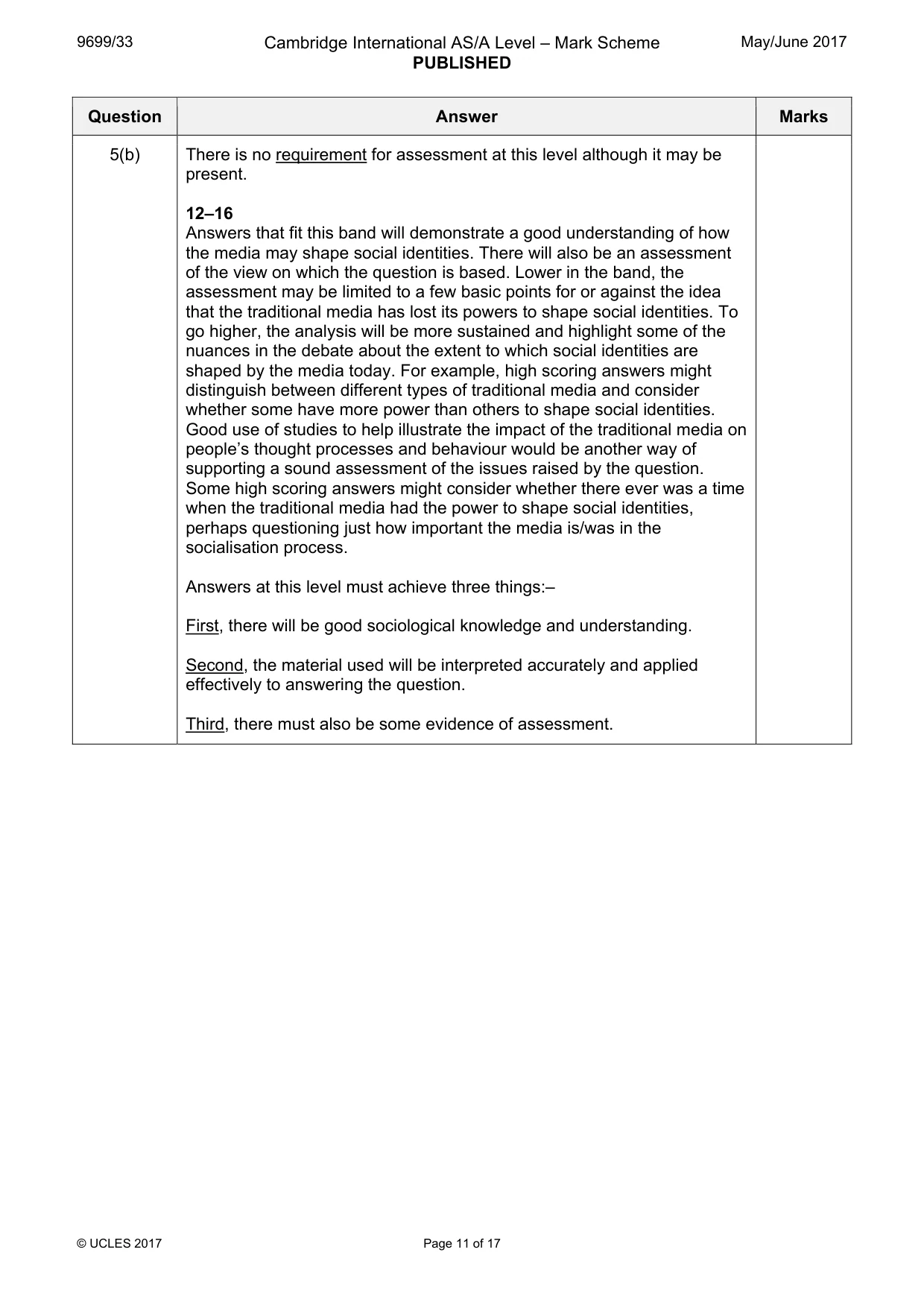
9699/33 Cambridge International AS/A Level – Mark Scheme PUBLISHED May/June 2017 © UCLES 2017 Page 11 of 17 Question Answer Marks 5(b) There is no requirement for assessment at this level although it may be present. 12–16 Answers that fit this band will demonstrate a good understanding of how the media may shape social identities. There will also be an assessment of the view on which the question is based. Lower in the band, the assessment may be limited to a few basic points for or against the idea that the traditional media has lost its powers to shape social identities. To go higher, the analysis will be more sustained and highlight some of the nuances in the debate about the extent to which social identities are shaped by the media today. For example, high scoring answers might distinguish between different types of traditional media and consider whether some have more power than others to shape social identities. Good use of studies to help illustrate the impact of the traditional media on people’s thought processes and behaviour would be another way of supporting a sound assessment of the issues raised by the question. Some high scoring answers might consider whether there ever was a time when the traditional media had the power to shape social identities, perhaps questioning just how important the media is/was in the socialisation process. Answers at this level must achieve three things:– First, there will be good sociological knowledge and understanding. Second, the material used will be interpreted accurately and applied effectively to answering the question. Third, there must also be some evidence of assessment.
Mark scheme, page 12
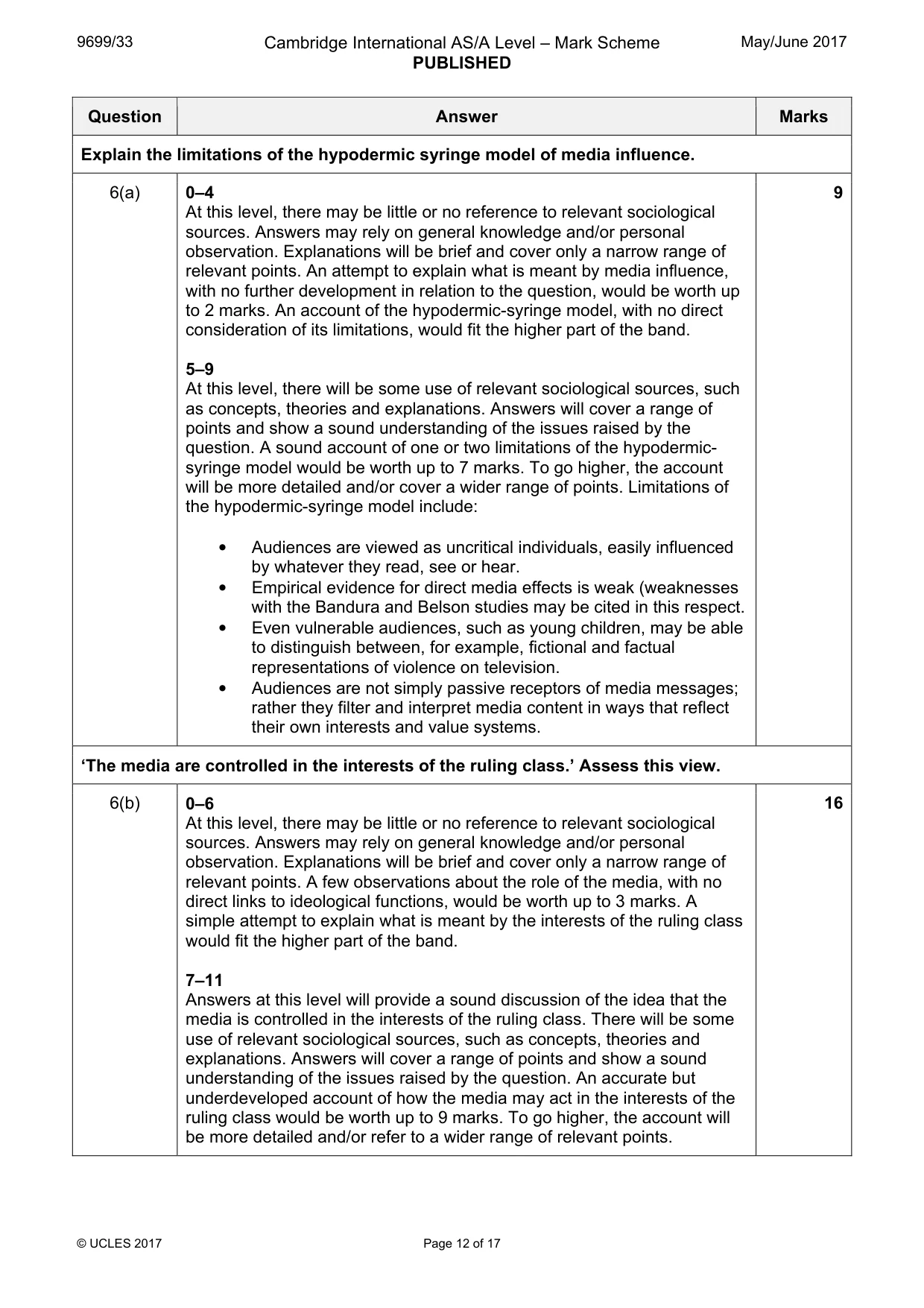
9699/33 Cambridge International AS/A Level – Mark Scheme PUBLISHED May/June 2017 © UCLES 2017 Page 12 of 17 Question Answer Marks Explain the limitations of the hypodermic syringe model of media influence. 6(a) 0–4 At this level, there may be little or no reference to relevant sociological sources. Answers may rely on general knowledge and/or personal observation. Explanations will be brief and cover only a narrow range of relevant points. An attempt to explain what is meant by media influence, with no further development in relation to the question, would be worth up to 2 marks. An account of the hypodermic-syringe model, with no direct consideration of its limitations, would fit the higher part of the band. 5–9 At this level, there will be some use of relevant sociological sources, such as concepts, theories and explanations. Answers will cover a range of points and show a sound understanding of the issues raised by the question. A sound account of one or two limitations of the hypodermic- syringe model would be worth up to 7 marks. To go higher, the account will be more detailed and/or cover a wider range of points. Limitations of the hypodermic-syringe model include: • Audiences are viewed as uncritical individuals, easily influenced by whatever they read, see or hear. • Empirical evidence for direct media effects is weak (weaknesses with the Bandura and Belson studies may be cited in this respect. • Even vulnerable audiences, such as young children, may be able to distinguish between, for example, fictional and factual representations of violence on television. • Audiences are not simply passive receptors of media messages; rather they filter and interpret media content in ways that reflect their own interests and value systems. 9 ‘The media are controlled in the interests of the ruling class.’ Assess this view. 6(b) 0–6 At this level, there may be little or no reference to relevant sociological sources. Answers may rely on general knowledge and/or personal observation. Explanations will be brief and cover only a narrow range of relevant points. A few observations about the role of the media, with no direct links to ideological functions, would be worth up to 3 marks. A simple attempt to explain what is meant by the interests of the ruling class would fit the higher part of the band. 7–11 Answers at this level will provide a sound discussion of the idea that the media is controlled in the interests of the ruling class. There will be some use of relevant sociological sources, such as concepts, theories and explanations. Answers will cover a range of points and show a sound understanding of the issues raised by the question. An accurate but underdeveloped account of how the media may act in the interests of the ruling class would be worth up to 9 marks. To go higher, the account will be more detailed and/or refer to a wider range of relevant points. 16
Mark scheme, page 13
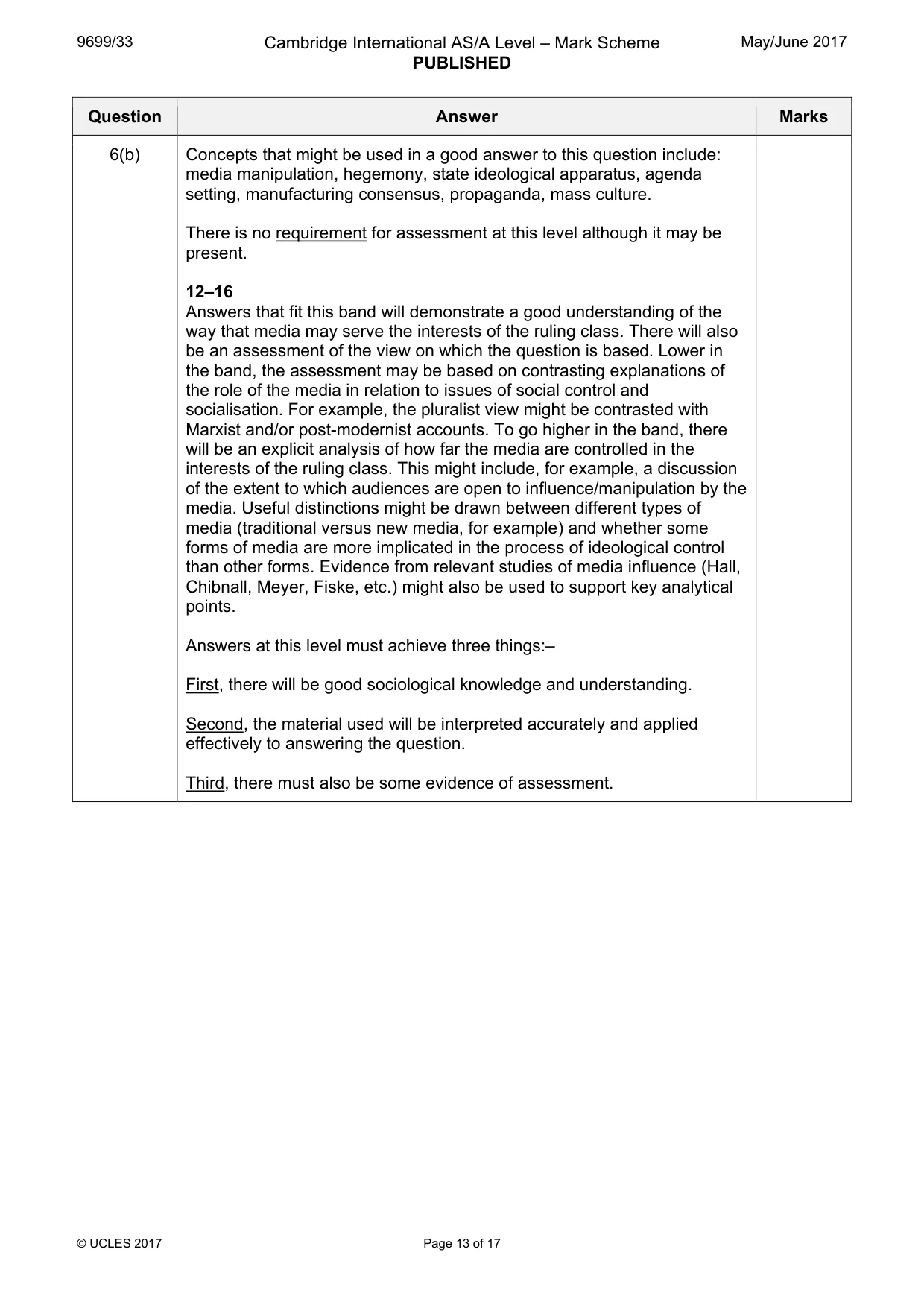
9699/33 Cambridge International AS/A Level – Mark Scheme PUBLISHED May/June 2017 © UCLES 2017 Page 13 of 17 Question Answer Marks 6(b) Concepts that might be used in a good answer to this question include: media manipulation, hegemony, state ideological apparatus, agenda setting, manufacturing consensus, propaganda, mass culture. There is no requirement for assessment at this level although it may be present. 12–16 Answers that fit this band will demonstrate a good understanding of the way that media may serve the interests of the ruling class. There will also be an assessment of the view on which the question is based. Lower in the band, the assessment may be based on contrasting explanations of the role of the media in relation to issues of social control and socialisation. For example, the pluralist view might be contrasted with Marxist and/or post-modernist accounts. To go higher in the band, there will be an explicit analysis of how far the media are controlled in the interests of the ruling class. This might include, for example, a discussion of the extent to which audiences are open to influence/manipulation by the media. Useful distinctions might be drawn between different types of media (traditional versus new media, for example) and whether some forms of media are more implicated in the process of ideological control than other forms. Evidence from relevant studies of media influence (Hall, Chibnall, Meyer, Fiske, etc.) might also be used to support key analytical points. Answers at this level must achieve three things:– First, there will be good sociological knowledge and understanding. Second, the material used will be interpreted accurately and applied effectively to answering the question. Third, there must also be some evidence of assessment.
Mark scheme, page 14
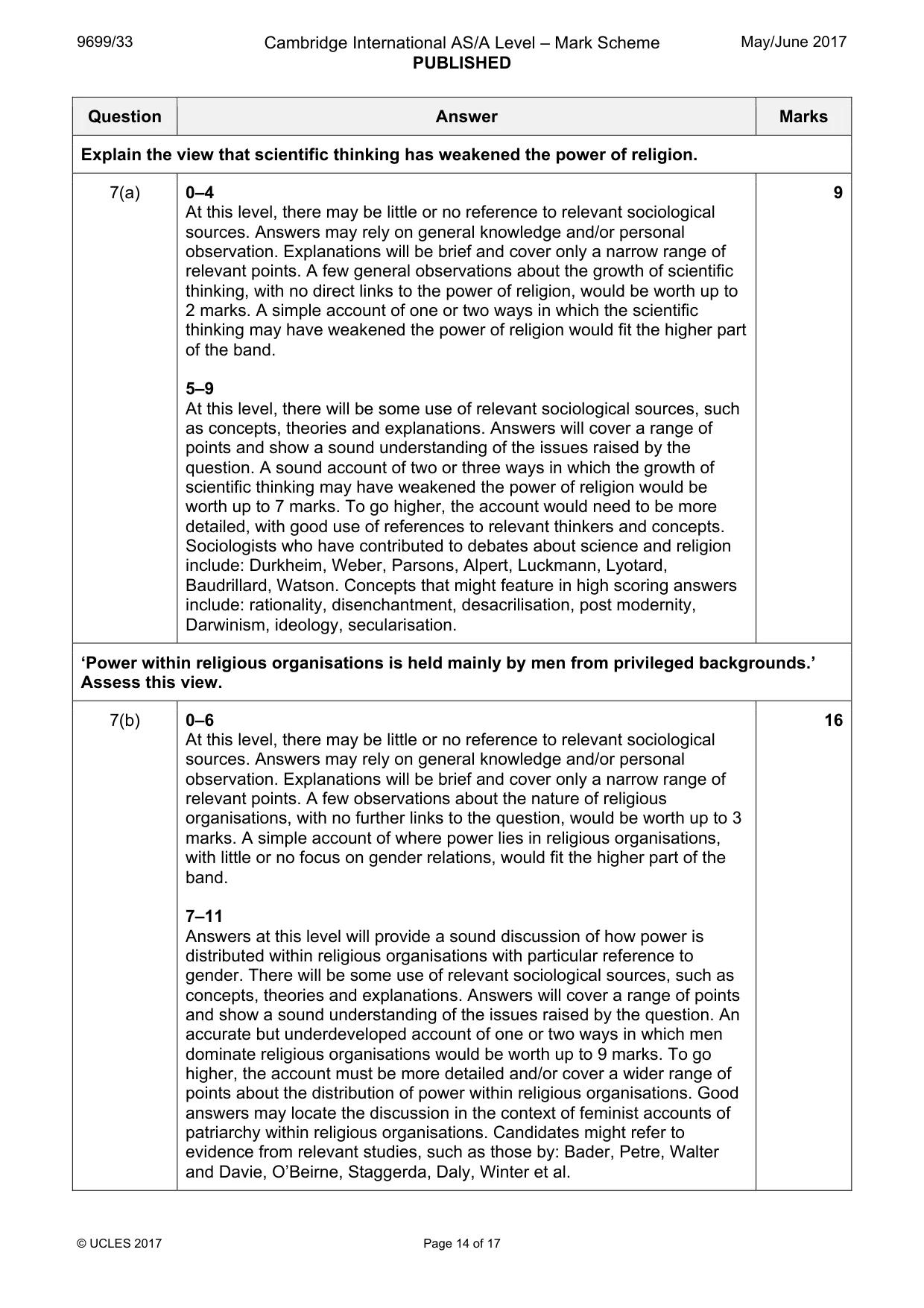
9699/33 Cambridge International AS/A Level – Mark Scheme PUBLISHED May/June 2017 © UCLES 2017 Page 14 of 17 Question Answer Marks Explain the view that scientific thinking has weakened the power of religion. 7(a) 0–4 At this level, there may be little or no reference to relevant sociological sources. Answers may rely on general knowledge and/or personal observation. Explanations will be brief and cover only a narrow range of relevant points. A few general observations about the growth of scientific thinking, with no direct links to the power of religion, would be worth up to 2 marks. A simple account of one or two ways in which the scientific thinking may have weakened the power of religion would fit the higher part of the band. 5–9 At this level, there will be some use of relevant sociological sources, such as concepts, theories and explanations. Answers will cover a range of points and show a sound understanding of the issues raised by the question. A sound account of two or three ways in which the growth of scientific thinking may have weakened the power of religion would be worth up to 7 marks. To go higher, the account would need to be more detailed, with good use of references to relevant thinkers and concepts. Sociologists who have contributed to debates about science and religion include: Durkheim, Weber, Parsons, Alpert, Luckmann, Lyotard, Baudrillard, Watson. Concepts that might feature in high scoring answers include: rationality, disenchantment, desacrilisation, post modernity, Darwinism, ideology, secularisation. 9 ‘Power within religious organisations is held mainly by men from privileged backgrounds.’ Assess this view. 7(b) 0–6 At this level, there may be little or no reference to relevant sociological sources. Answers may rely on general knowledge and/or personal observation. Explanations will be brief and cover only a narrow range of relevant points. A few observations about the nature of religious organisations, with no further links to the question, would be worth up to 3 marks. A simple account of where power lies in religious organisations, with little or no focus on gender relations, would fit the higher part of the band. 7–11 Answers at this level will provide a sound discussion of how power is distributed within religious organisations with particular reference to gender. There will be some use of relevant sociological sources, such as concepts, theories and explanations. Answers will cover a range of points and show a sound understanding of the issues raised by the question. An accurate but underdeveloped account of one or two ways in which men dominate religious organisations would be worth up to 9 marks. To go higher, the account must be more detailed and/or cover a wider range of points about the distribution of power within religious organisations. Good answers may locate the discussion in the context of feminist accounts of patriarchy within religious organisations. Candidates might refer to evidence from relevant studies, such as those by: Bader, Petre, Walter and Davie, O’Beirne, Staggerda, Daly, Winter et al. 16
Mark scheme, page 15
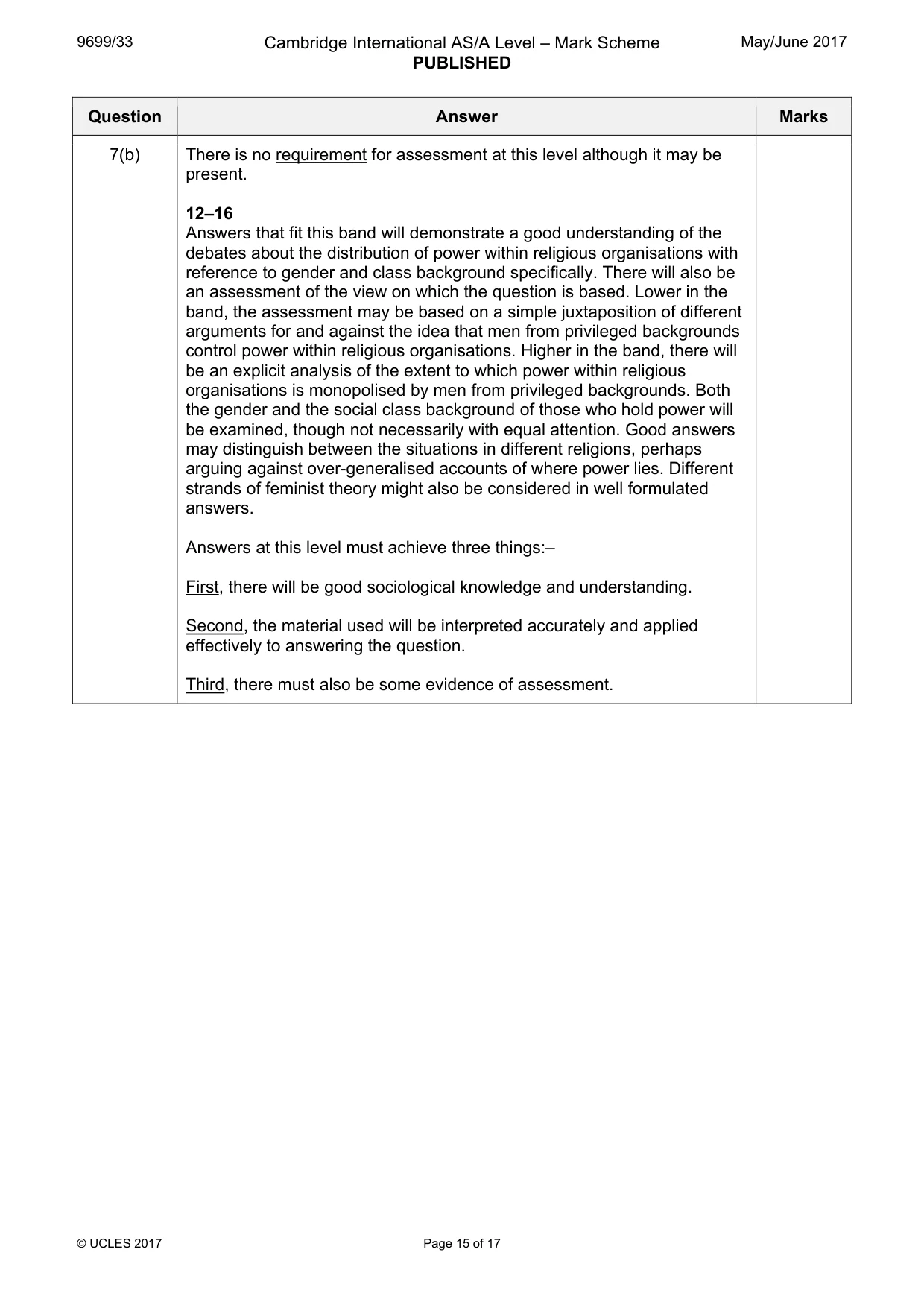
9699/33 Cambridge International AS/A Level – Mark Scheme PUBLISHED May/June 2017 © UCLES 2017 Page 15 of 17 Question Answer Marks 7(b) There is no requirement for assessment at this level although it may be present. 12–16 Answers that fit this band will demonstrate a good understanding of the debates about the distribution of power within religious organisations with reference to gender and class background specifically. There will also be an assessment of the view on which the question is based. Lower in the band, the assessment may be based on a simple juxtaposition of different arguments for and against the idea that men from privileged backgrounds control power within religious organisations. Higher in the band, there will be an explicit analysis of the extent to which power within religious organisations is monopolised by men from privileged backgrounds. Both the gender and the social class background of those who hold power will be examined, though not necessarily with equal attention. Good answers may distinguish between the situations in different religions, perhaps arguing against over-generalised accounts of where power lies. Different strands of feminist theory might also be considered in well formulated answers. Answers at this level must achieve three things:– First, there will be good sociological knowledge and understanding. Second, the material used will be interpreted accurately and applied effectively to answering the question. Third, there must also be some evidence of assessment.
Mark scheme, page 16
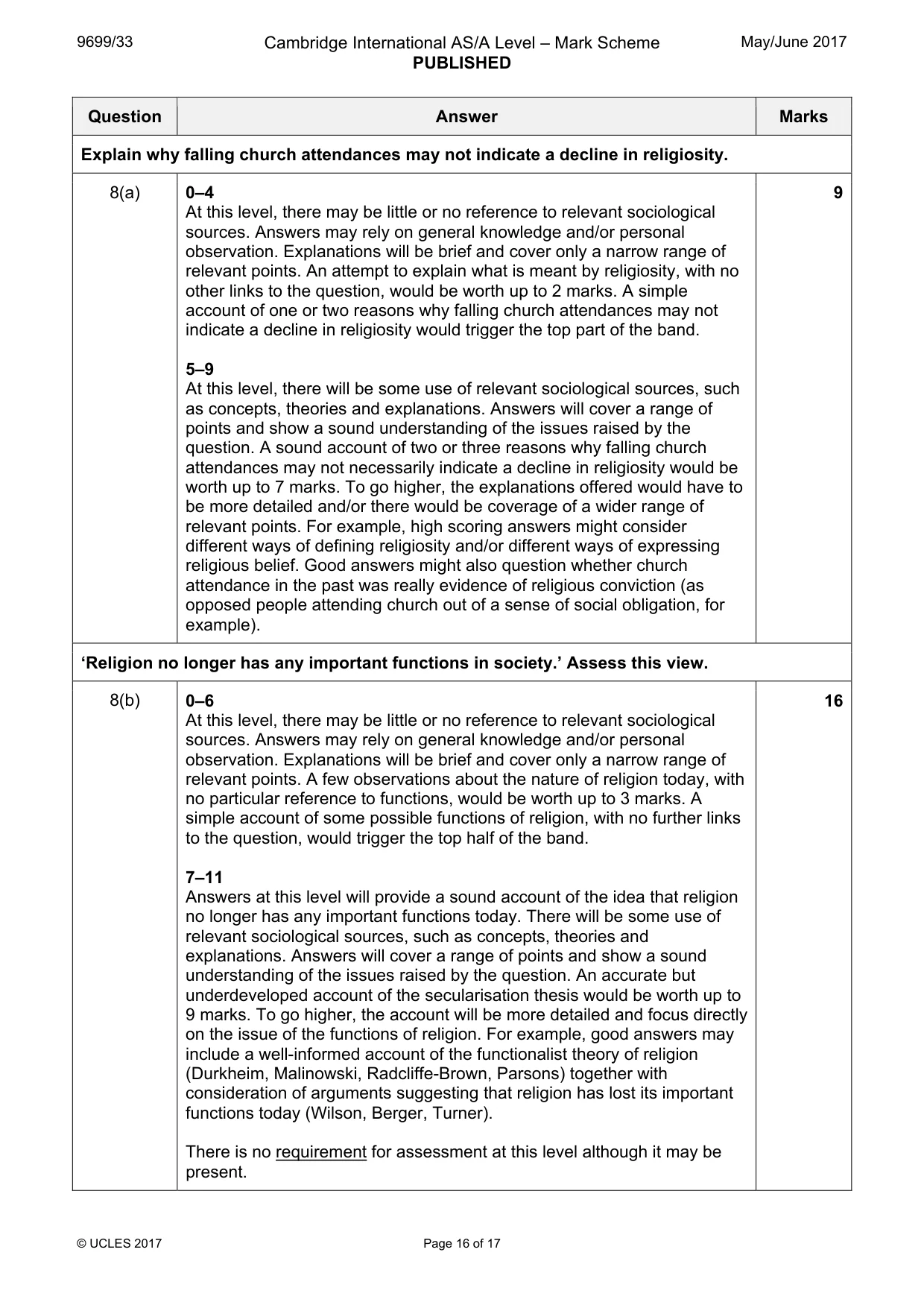
9699/33 Cambridge International AS/A Level – Mark Scheme PUBLISHED May/June 2017 © UCLES 2017 Page 16 of 17 Question Answer Marks Explain why falling church attendances may not indicate a decline in religiosity. 8(a) 0–4 At this level, there may be little or no reference to relevant sociological sources. Answers may rely on general knowledge and/or personal observation. Explanations will be brief and cover only a narrow range of relevant points. An attempt to explain what is meant by religiosity, with no other links to the question, would be worth up to 2 marks. A simple account of one or two reasons why falling church attendances may not indicate a decline in religiosity would trigger the top part of the band. 5–9 At this level, there will be some use of relevant sociological sources, such as concepts, theories and explanations. Answers will cover a range of points and show a sound understanding of the issues raised by the question. A sound account of two or three reasons why falling church attendances may not necessarily indicate a decline in religiosity would be worth up to 7 marks. To go higher, the explanations offered would have to be more detailed and/or there would be coverage of a wider range of relevant points. For example, high scoring answers might consider different ways of defining religiosity and/or different ways of expressing religious belief. Good answers might also question whether church attendance in the past was really evidence of religious conviction (as opposed people attending church out of a sense of social obligation, for example). 9 ‘Religion no longer has any important functions in society.’ Assess this view. 8(b) 0–6 At this level, there may be little or no reference to relevant sociological sources. Answers may rely on general knowledge and/or personal observation. Explanations will be brief and cover only a narrow range of relevant points. A few observations about the nature of religion today, with no particular reference to functions, would be worth up to 3 marks. A simple account of some possible functions of religion, with no further links to the question, would trigger the top half of the band. 7–11 Answers at this level will provide a sound account of the idea that religion no longer has any important functions today. There will be some use of relevant sociological sources, such as concepts, theories and explanations. Answers will cover a range of points and show a sound understanding of the issues raised by the question. An accurate but underdeveloped account of the secularisation thesis would be worth up to 9 marks. To go higher, the account will be more detailed and focus directly on the issue of the functions of religion. For example, good answers may include a well-informed account of the functionalist theory of religion (Durkheim, Malinowski, Radcliffe-Brown, Parsons) together with consideration of arguments suggesting that religion has lost its important functions today (Wilson, Berger, Turner). There is no requirement for assessment at this level although it may be present. 16
Mark scheme, page 17
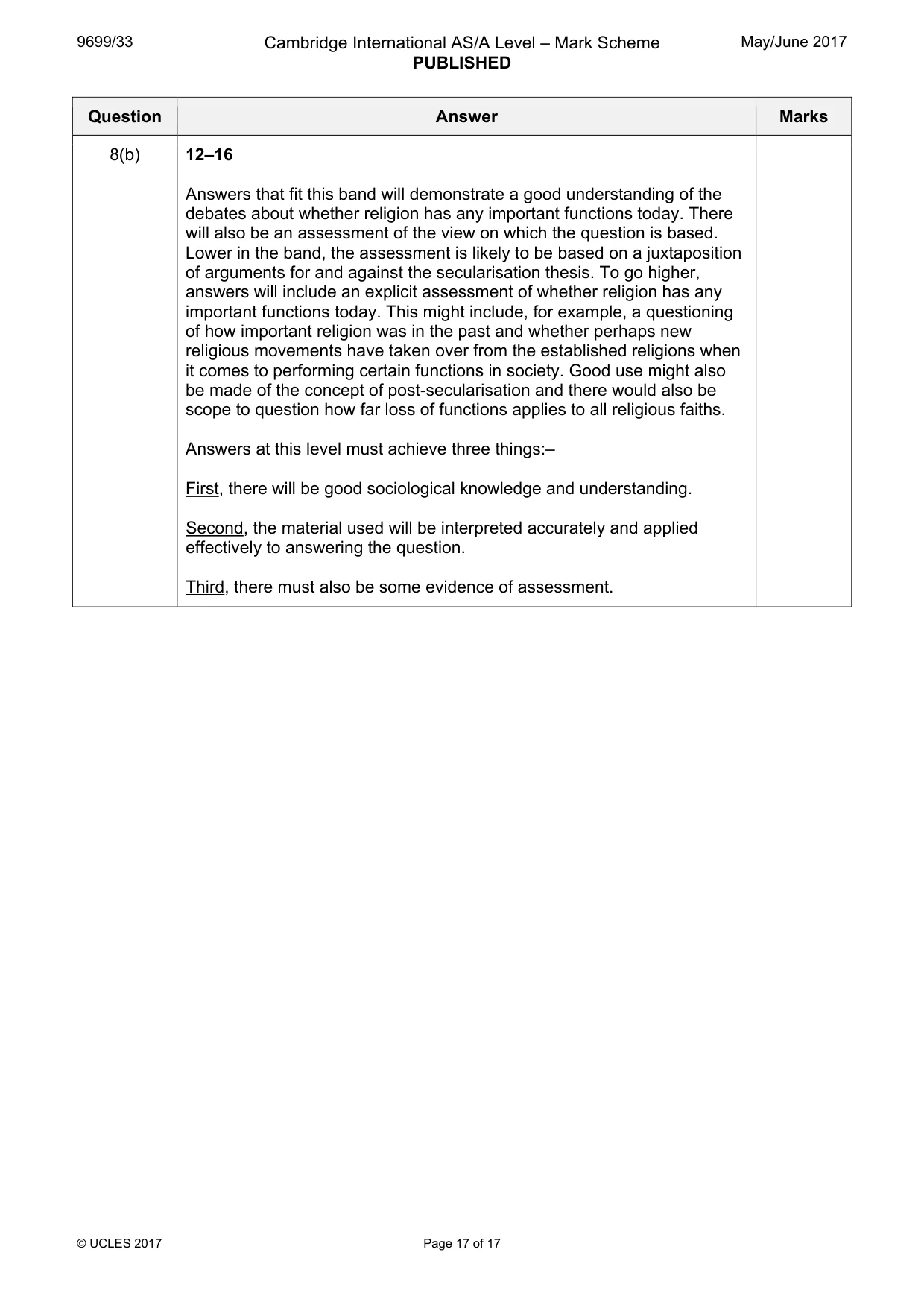
9699/33 Cambridge International AS/A Level – Mark Scheme PUBLISHED May/June 2017 © UCLES 2017 Page 17 of 17 Question Answer Marks 8(b) 12–16 Answers that fit this band will demonstrate a good understanding of the debates about whether religion has any important functions today. There will also be an assessment of the view on which the question is based. Lower in the band, the assessment is likely to be based on a juxtaposition of arguments for and against the secularisation thesis. To go higher, answers will include an explicit assessment of whether religion has any important functions today. This might include, for example, a questioning of how important religion was in the past and whether perhaps new religious movements have taken over from the established religions when it comes to performing certain functions in society. Good use might also be made of the concept of post-secularisation and there would also be scope to question how far loss of functions applies to all religious faiths. Answers at this level must achieve three things:– First, there will be good sociological knowledge and understanding. Second, the material used will be interpreted accurately and applied effectively to answering the question. Third, there must also be some evidence of assessment.
What you needed in this session
Cambridge’s own grade thresholds for 2017 May/June, Paper 3 · Variant 3. A higher threshold means an easier paper — the bar moves with how the cohort did.