Cambridge A Level Sociology 9699 — 2017 May/June Paper 3 · Variant 1
9699/31/M/J/17 · 75 marks · ≈84 min
The question paper and its mark scheme, free to read here and free to download. This is Cambridge’s own paper, exactly as it was sat.
Question paper4 pages
Mark scheme13 pages
Answers below. Sit the paper first if you are practising.
Paper as text
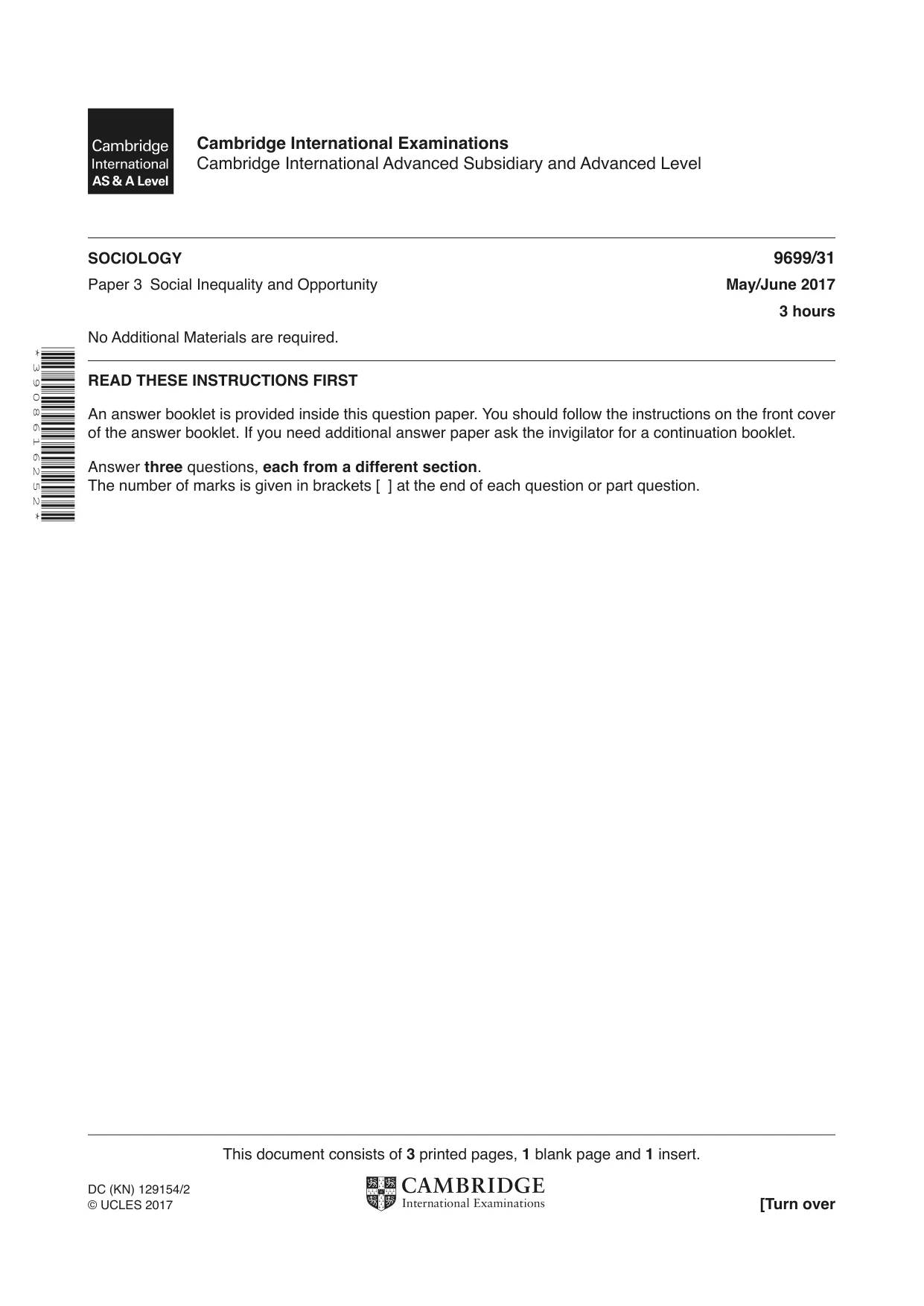
Question paper, page 1
This document consists of 3 printed pages, 1 blank page and 1 insert. DC (KN) 129154/2 © UCLES 2017 [Turn over Cambridge International Examinations Cambridge International Advanced Subsidiary and Advanced Level * 3 9 0 8 6 1 6 2 5 2 * SOCIOLOGY 9699/31 Paper 3 Social Inequality and Opportunity May/June 2017 3 hours No Additional Materials are required. READ THESE INSTRUCTIONS FIRST An answer booklet is provided inside this question paper. You should follow the instructions on the front cover of the answer booklet. If you need additional answer paper ask the invigilator for a continuation booklet. Answer three questions, each from a different section. The number of marks is given in brackets [ ] at the end of each question or part question.
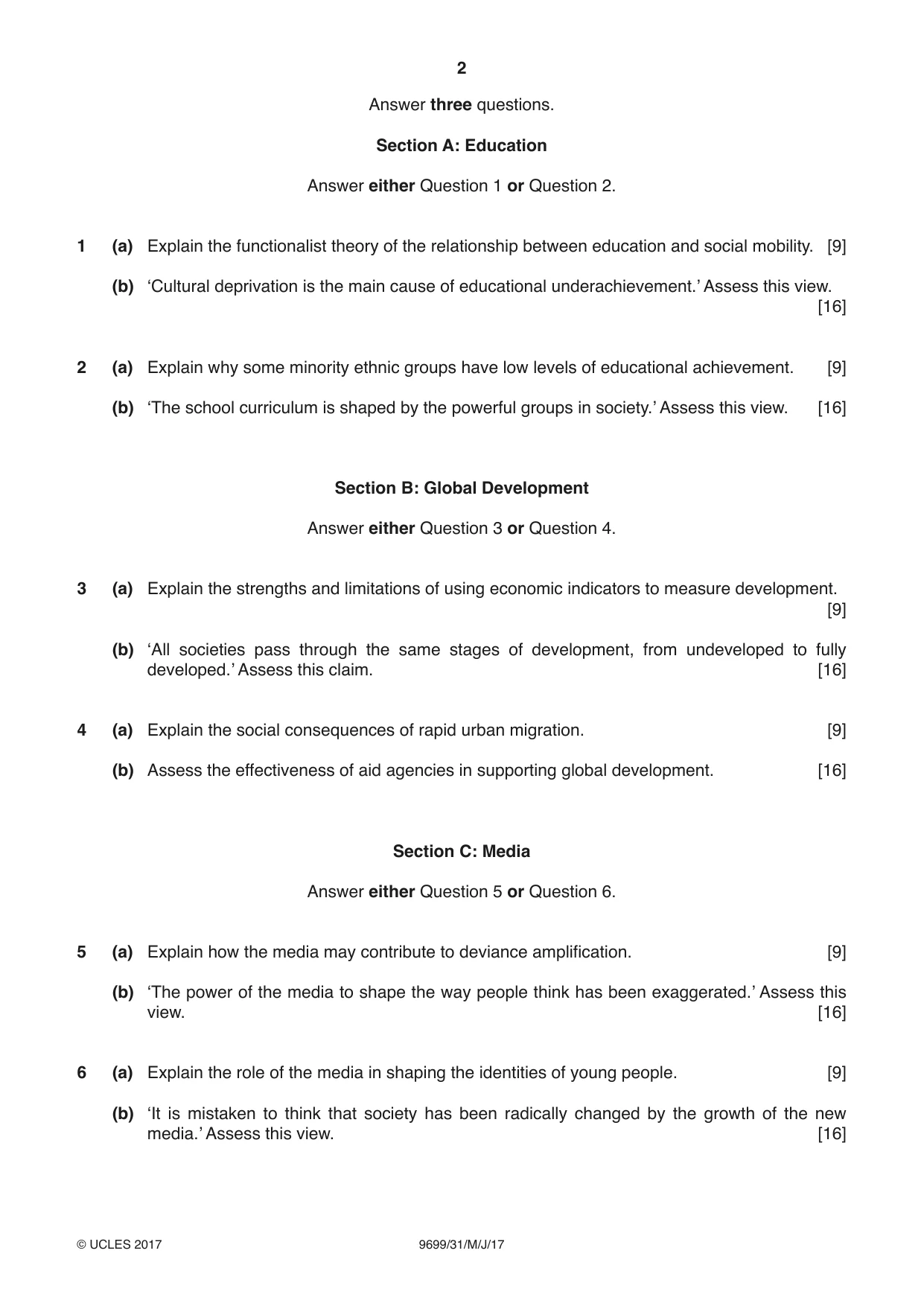
Question paper, page 2
2 9699/31/M/J/17 © UCLES 2017 Answer three questions. Section A: Education Answer either Question 1 or Question 2. 1 (a) Explain the functionalist theory of the relationship between education and social mobility. [9] (b) ‘Cultural deprivation is the main cause of educational underachievement.’ Assess this view. [16] 2 (a) Explain why some minority ethnic groups have low levels of educational achievement. [9] (b) ‘The school curriculum is shaped by the powerful groups in society.’ Assess this view. [16] Section B: Global Development Answer either Question 3 or Question 4. 3 (a) Explain the strengths and limitations of using economic indicators to measure development. [9] (b) ‘All societies pass through the same stages of development, from undeveloped to fully developed.’ Assess this claim. [16] 4 (a) Explain the social consequences of rapid urban migration. [9] (b) Assess the effectiveness of aid agencies in supporting global development. [16] Section C: Media Answer either Question 5 or Question 6. 5 (a) Explain how the media may contribute to deviance amplification. [9] (b) ‘The power of the media to shape the way people think has been exaggerated.’ Assess this view. [16] 6 (a) Explain the role of the media in shaping the identities of young people. [9] (b) ‘It is mistaken to think that society has been radically changed by the growth of the new media.’ Assess this view. [16]
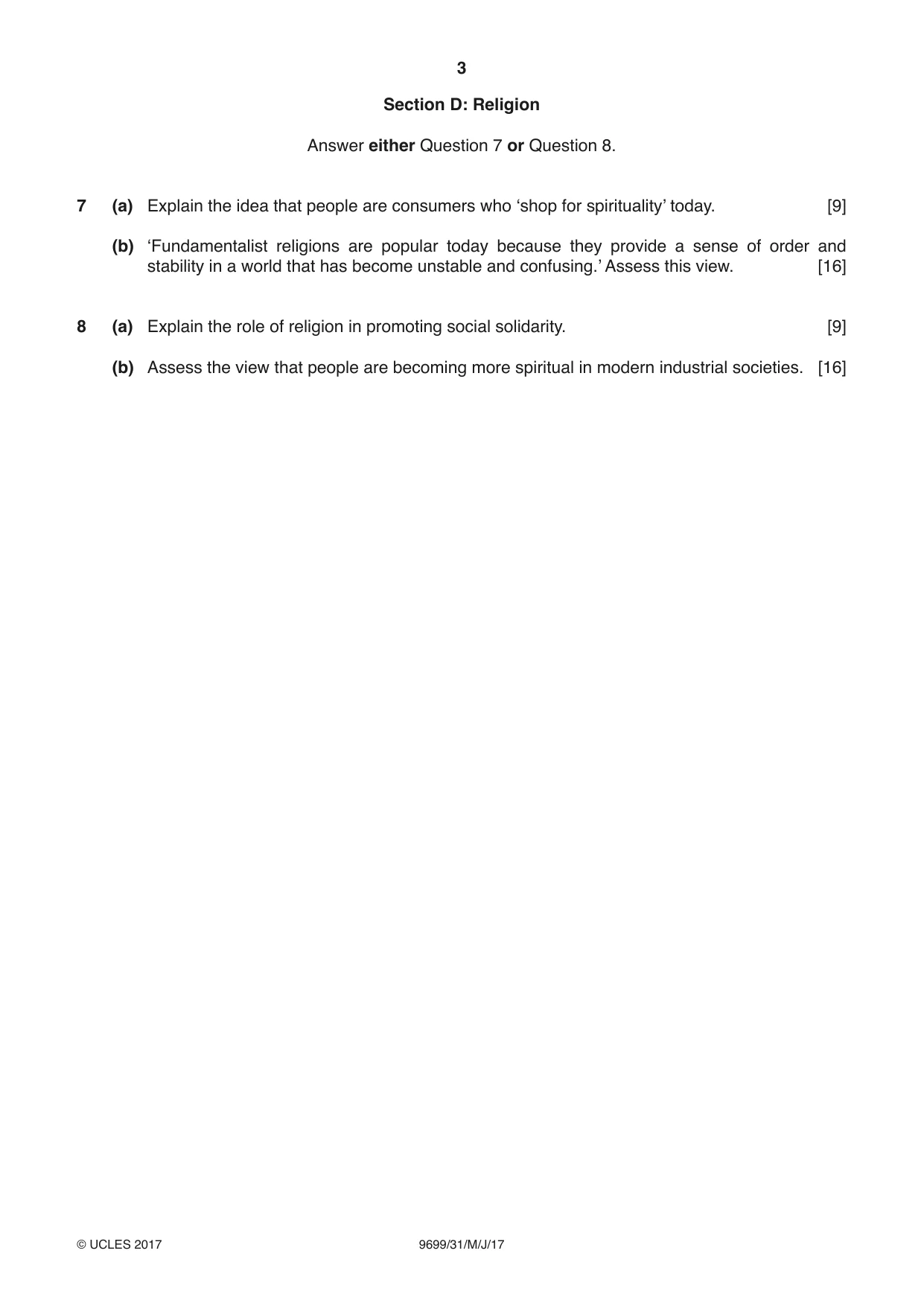
Question paper, page 3
3 9699/31/M/J/17 © UCLES 2017 Section D: Religion Answer either Question 7 or Question 8. 7 (a) Explain the idea that people are consumers who ‘shop for spirituality’ today. [9] (b) ‘Fundamentalist religions are popular today because they provide a sense of order and stability in a world that has become unstable and confusing.’ Assess this view. [16] 8 (a) Explain the role of religion in promoting social solidarity. [9] (b) Assess the view that people are becoming more spiritual in modern industrial societies. [16]
Question paper, page 4
4 9699/31/M/J/17 © UCLES 2017 Permission to reproduce items where third-party owned material protected by copyright is included has been sought and cleared where possible. Every reasonable effort has been made by the publisher (UCLES) to trace copyright holders, but if any items requiring clearance have unwittingly been included, the publisher will be pleased to make amends at the earliest possible opportunity. To avoid the issue of disclosure of answer-related information to candidates, all copyright acknowledgements are reproduced online in the Cambridge International Examinations Copyright Acknowledgements Booklet. This is produced for each series of examinations and is freely available to download at www.cie.org.uk after the live examination series. Cambridge International Examinations is part of the Cambridge Assessment Group. Cambridge Assessment is the brand name of University of Cambridge Local Examinations Syndicate (UCLES), which is itself a department of the University of Cambridge. BLANK PAGE
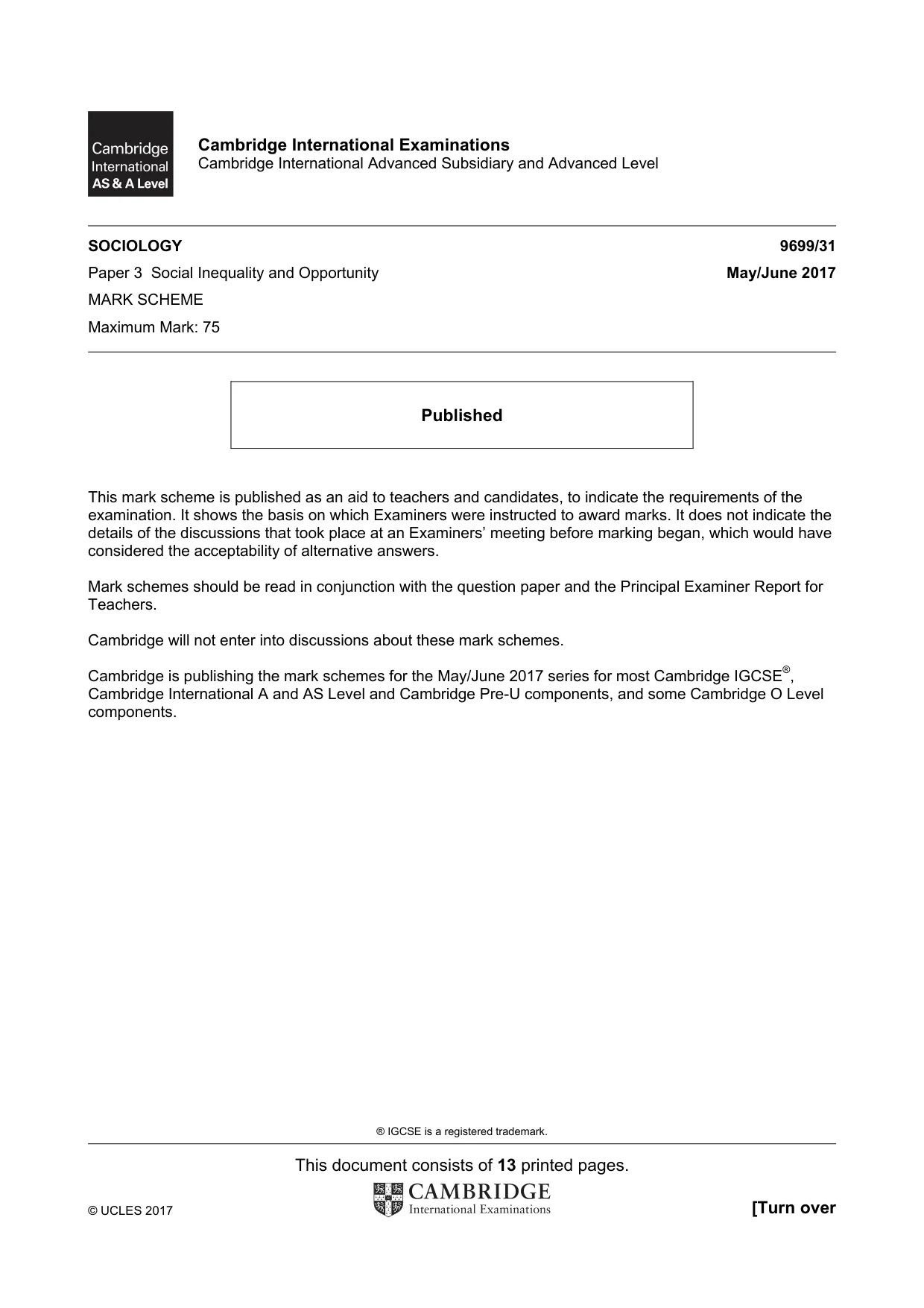
Mark scheme, page 1
® IGCSE is a registered trademark. This document consists of 13 printed pages. © UCLES 2017 [Turn over Cambridge International Examinations Cambridge International Advanced Subsidiary and Advanced Level SOCIOLOGY 9699/31 Paper 3 Social Inequality and Opportunity May/June 2017 MARK SCHEME Maximum Mark: 75 Published This mark scheme is published as an aid to teachers and candidates, to indicate the requirements of the examination. It shows the basis on which Examiners were instructed to award marks. It does not indicate the details of the discussions that took place at an Examiners’ meeting before marking began, which would have considered the acceptability of alternative answers. Mark schemes should be read in conjunction with the question paper and the Principal Examiner Report for Teachers. Cambridge will not enter into discussions about these mark schemes. Cambridge is publishing the mark schemes for the May/June 2017 series for most Cambridge IGCSE®, Cambridge International A and AS Level and Cambridge Pre-U components, and some Cambridge O Level components.
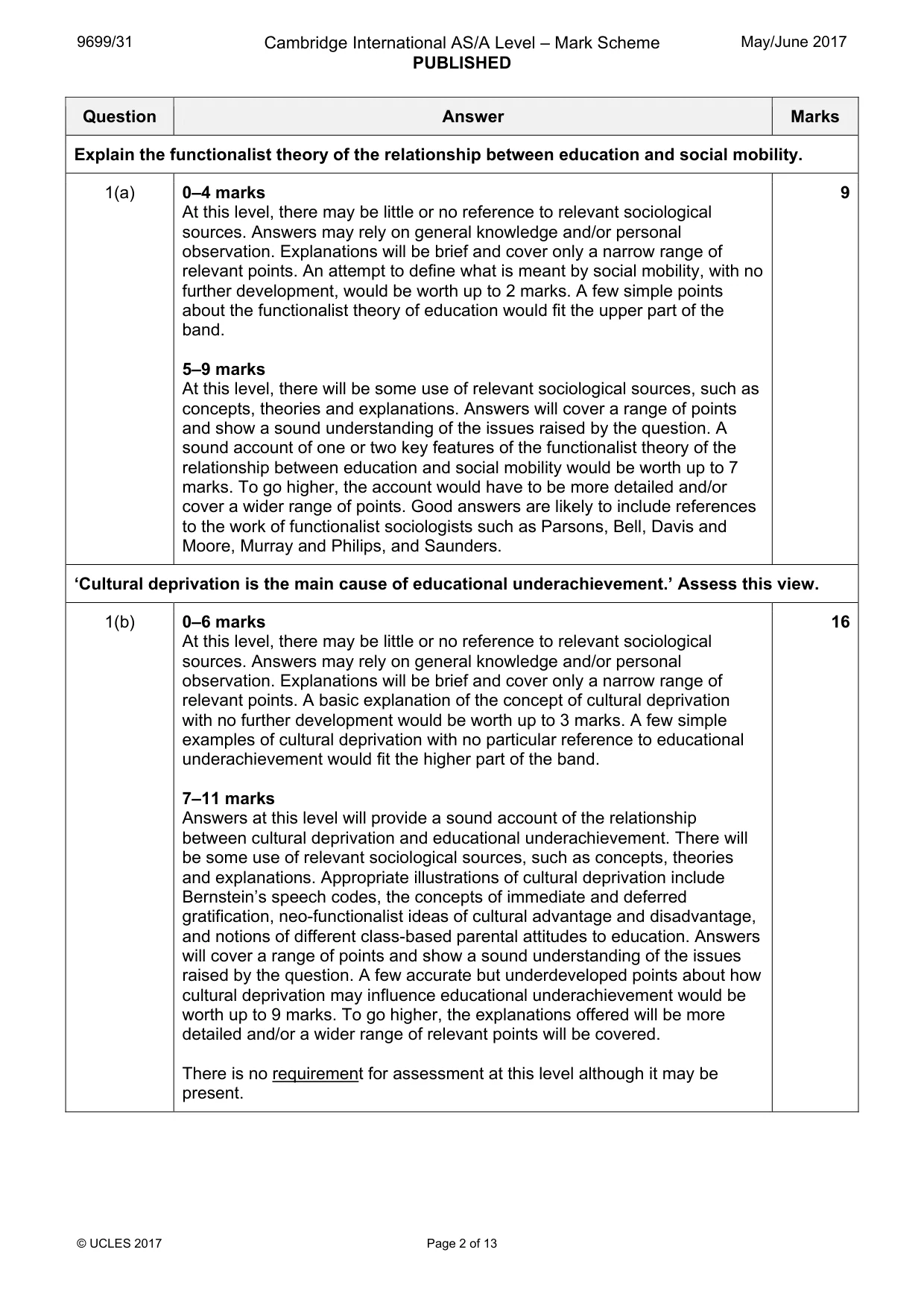
Mark scheme, page 2
9699/31 Cambridge International AS/A Level – Mark Scheme PUBLISHED May/June 2017 © UCLES 2017 Page 2 of 13 Question Answer Marks Explain the functionalist theory of the relationship between education and social mobility. 1(a) 0–4 marks At this level, there may be little or no reference to relevant sociological sources. Answers may rely on general knowledge and/or personal observation. Explanations will be brief and cover only a narrow range of relevant points. An attempt to define what is meant by social mobility, with no further development, would be worth up to 2 marks. A few simple points about the functionalist theory of education would fit the upper part of the band. 5–9 marks At this level, there will be some use of relevant sociological sources, such as concepts, theories and explanations. Answers will cover a range of points and show a sound understanding of the issues raised by the question. A sound account of one or two key features of the functionalist theory of the relationship between education and social mobility would be worth up to 7 marks. To go higher, the account would have to be more detailed and/or cover a wider range of points. Good answers are likely to include references to the work of functionalist sociologists such as Parsons, Bell, Davis and Moore, Murray and Philips, and Saunders. 9 ‘Cultural deprivation is the main cause of educational underachievement.’ Assess this view. 1(b) 0–6 marks At this level, there may be little or no reference to relevant sociological sources. Answers may rely on general knowledge and/or personal observation. Explanations will be brief and cover only a narrow range of relevant points. A basic explanation of the concept of cultural deprivation with no further development would be worth up to 3 marks. A few simple examples of cultural deprivation with no particular reference to educational underachievement would fit the higher part of the band. 7–11 marks Answers at this level will provide a sound account of the relationship between cultural deprivation and educational underachievement. There will be some use of relevant sociological sources, such as concepts, theories and explanations. Appropriate illustrations of cultural deprivation include Bernstein’s speech codes, the concepts of immediate and deferred gratification, neo-functionalist ideas of cultural advantage and disadvantage, and notions of different class-based parental attitudes to education. Answers will cover a range of points and show a sound understanding of the issues raised by the question. A few accurate but underdeveloped points about how cultural deprivation may influence educational underachievement would be worth up to 9 marks. To go higher, the explanations offered will be more detailed and/or a wider range of relevant points will be covered. There is no requirement for assessment at this level although it may be present. 16
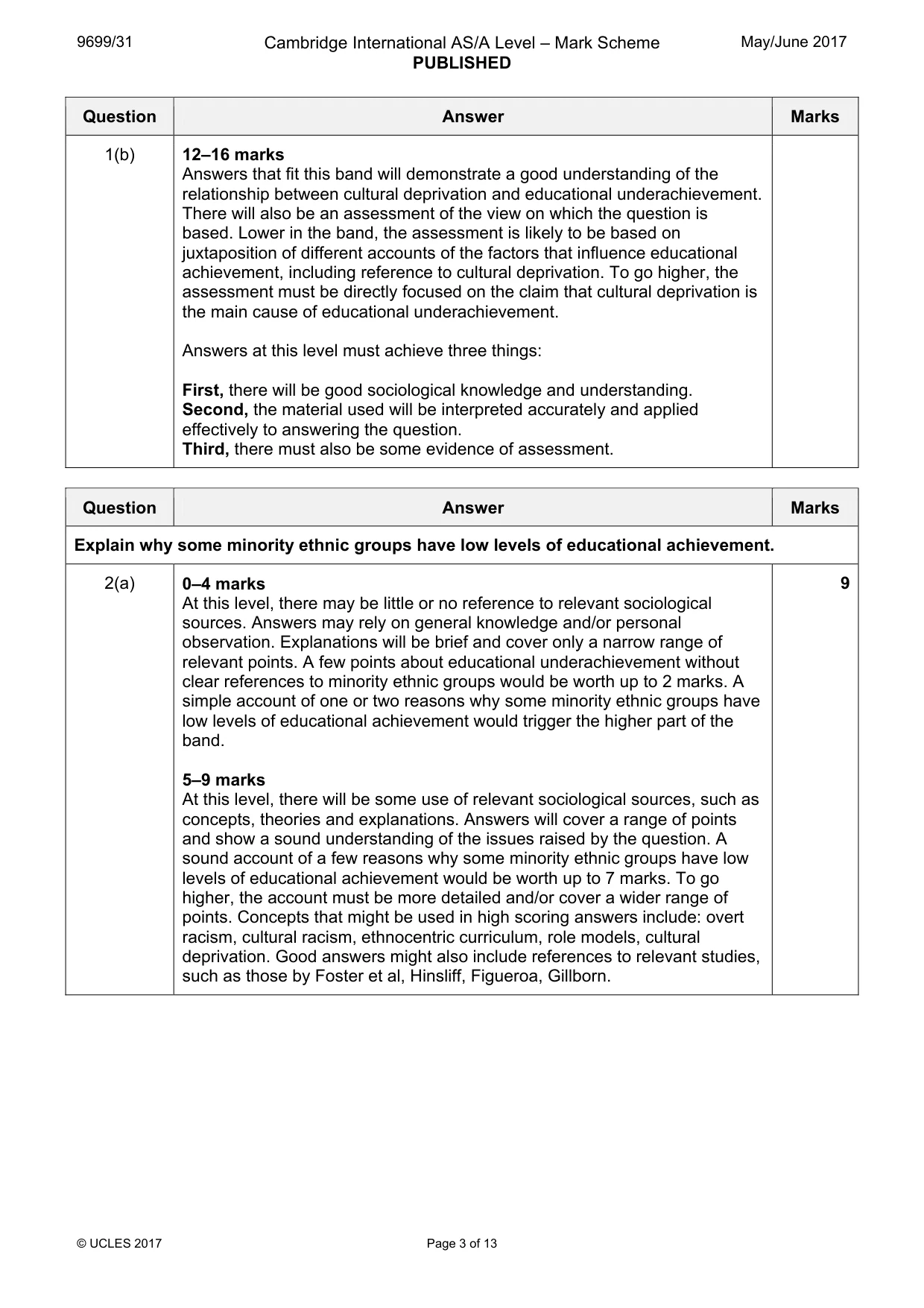
Mark scheme, page 3
9699/31 Cambridge International AS/A Level – Mark Scheme PUBLISHED May/June 2017 © UCLES 2017 Page 3 of 13 Question Answer Marks 1(b) 12–16 marks Answers that fit this band will demonstrate a good understanding of the relationship between cultural deprivation and educational underachievement. There will also be an assessment of the view on which the question is based. Lower in the band, the assessment is likely to be based on juxtaposition of different accounts of the factors that influence educational achievement, including reference to cultural deprivation. To go higher, the assessment must be directly focused on the claim that cultural deprivation is the main cause of educational underachievement. Answers at this level must achieve three things: First, there will be good sociological knowledge and understanding. Second, the material used will be interpreted accurately and applied effectively to answering the question. Third, there must also be some evidence of assessment. Question Answer Marks Explain why some minority ethnic groups have low levels of educational achievement. 2(a) 0–4 marks At this level, there may be little or no reference to relevant sociological sources. Answers may rely on general knowledge and/or personal observation. Explanations will be brief and cover only a narrow range of relevant points. A few points about educational underachievement without clear references to minority ethnic groups would be worth up to 2 marks. A simple account of one or two reasons why some minority ethnic groups have low levels of educational achievement would trigger the higher part of the band. 5–9 marks At this level, there will be some use of relevant sociological sources, such as concepts, theories and explanations. Answers will cover a range of points and show a sound understanding of the issues raised by the question. A sound account of a few reasons why some minority ethnic groups have low levels of educational achievement would be worth up to 7 marks. To go higher, the account must be more detailed and/or cover a wider range of points. Concepts that might be used in high scoring answers include: overt racism, cultural racism, ethnocentric curriculum, role models, cultural deprivation. Good answers might also include references to relevant studies, such as those by Foster et al, Hinsliff, Figueroa, Gillborn. 9
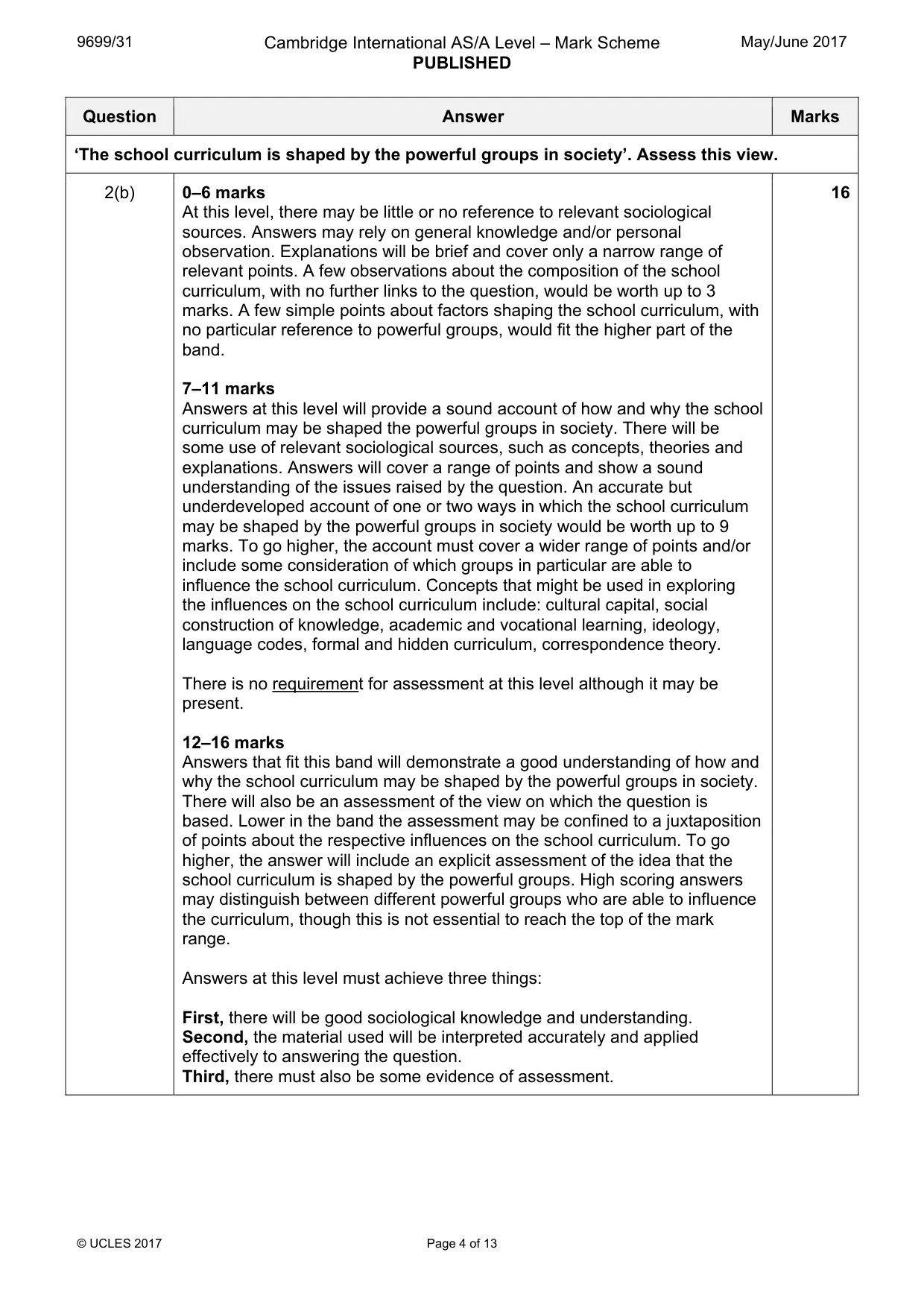
Mark scheme, page 4
9699/31 Cambridge International AS/A Level – Mark Scheme PUBLISHED May/June 2017 © UCLES 2017 Page 4 of 13 Question Answer Marks ‘The school curriculum is shaped by the powerful groups in society’. Assess this view. 2(b) 0–6 marks At this level, there may be little or no reference to relevant sociological sources. Answers may rely on general knowledge and/or personal observation. Explanations will be brief and cover only a narrow range of relevant points. A few observations about the composition of the school curriculum, with no further links to the question, would be worth up to 3 marks. A few simple points about factors shaping the school curriculum, with no particular reference to powerful groups, would fit the higher part of the band. 7–11 marks Answers at this level will provide a sound account of how and why the school curriculum may be shaped the powerful groups in society. There will be some use of relevant sociological sources, such as concepts, theories and explanations. Answers will cover a range of points and show a sound understanding of the issues raised by the question. An accurate but underdeveloped account of one or two ways in which the school curriculum may be shaped by the powerful groups in society would be worth up to 9 marks. To go higher, the account must cover a wider range of points and/or include some consideration of which groups in particular are able to influence the school curriculum. Concepts that might be used in exploring the influences on the school curriculum include: cultural capital, social construction of knowledge, academic and vocational learning, ideology, language codes, formal and hidden curriculum, correspondence theory. There is no requirement for assessment at this level although it may be present. 12–16 marks Answers that fit this band will demonstrate a good understanding of how and why the school curriculum may be shaped by the powerful groups in society. There will also be an assessment of the view on which the question is based. Lower in the band the assessment may be confined to a juxtaposition of points about the respective influences on the school curriculum. To go higher, the answer will include an explicit assessment of the idea that the school curriculum is shaped by the powerful groups. High scoring answers may distinguish between different powerful groups who are able to influence the curriculum, though this is not essential to reach the top of the mark range. Answers at this level must achieve three things: First, there will be good sociological knowledge and understanding. Second, the material used will be interpreted accurately and applied effectively to answering the question. Third, there must also be some evidence of assessment. 16
Mark scheme, page 5
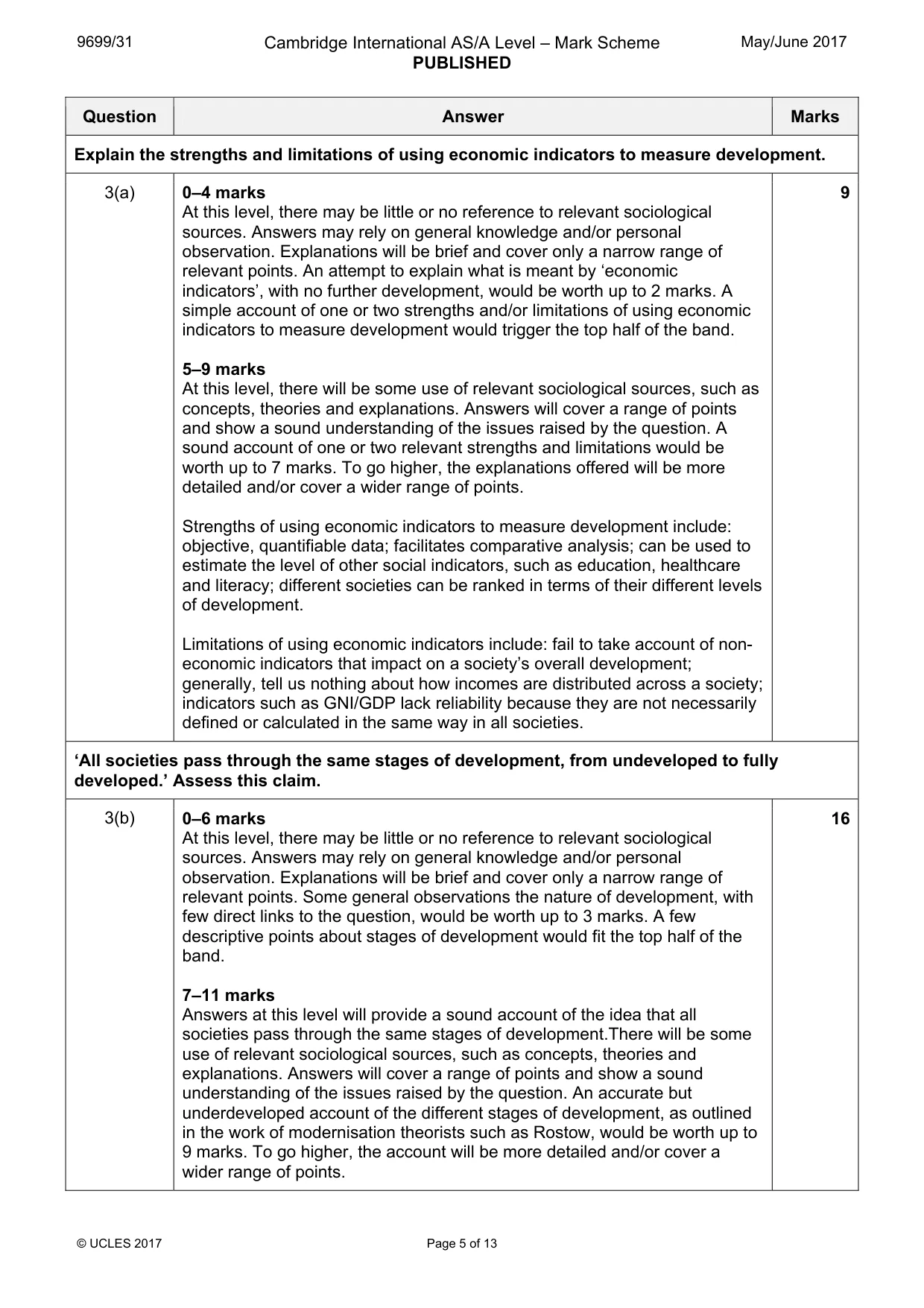
9699/31 Cambridge International AS/A Level – Mark Scheme PUBLISHED May/June 2017 © UCLES 2017 Page 5 of 13 Question Answer Marks Explain the strengths and limitations of using economic indicators to measure development. 3(a) 0–4 marks At this level, there may be little or no reference to relevant sociological sources. Answers may rely on general knowledge and/or personal observation. Explanations will be brief and cover only a narrow range of relevant points. An attempt to explain what is meant by ‘economic indicators’, with no further development, would be worth up to 2 marks. A simple account of one or two strengths and/or limitations of using economic indicators to measure development would trigger the top half of the band. 5–9 marks At this level, there will be some use of relevant sociological sources, such as concepts, theories and explanations. Answers will cover a range of points and show a sound understanding of the issues raised by the question. A sound account of one or two relevant strengths and limitations would be worth up to 7 marks. To go higher, the explanations offered will be more detailed and/or cover a wider range of points. Strengths of using economic indicators to measure development include: objective, quantifiable data; facilitates comparative analysis; can be used to estimate the level of other social indicators, such as education, healthcare and literacy; different societies can be ranked in terms of their different levels of development. Limitations of using economic indicators include: fail to take account of non- economic indicators that impact on a society’s overall development; generally, tell us nothing about how incomes are distributed across a society; indicators such as GNI/GDP lack reliability because they are not necessarily defined or calculated in the same way in all societies. 9 ‘All societies pass through the same stages of development, from undeveloped to fully developed.’ Assess this claim. 3(b) 0–6 marks At this level, there may be little or no reference to relevant sociological sources. Answers may rely on general knowledge and/or personal observation. Explanations will be brief and cover only a narrow range of relevant points. Some general observations the nature of development, with few direct links to the question, would be worth up to 3 marks. A few descriptive points about stages of development would fit the top half of the band. 7–11 marks Answers at this level will provide a sound account of the idea that all societies pass through the same stages of development.There will be some use of relevant sociological sources, such as concepts, theories and explanations. Answers will cover a range of points and show a sound understanding of the issues raised by the question. An accurate but underdeveloped account of the different stages of development, as outlined in the work of modernisation theorists such as Rostow, would be worth up to 9 marks. To go higher, the account will be more detailed and/or cover a wider range of points. 16
Mark scheme, page 6
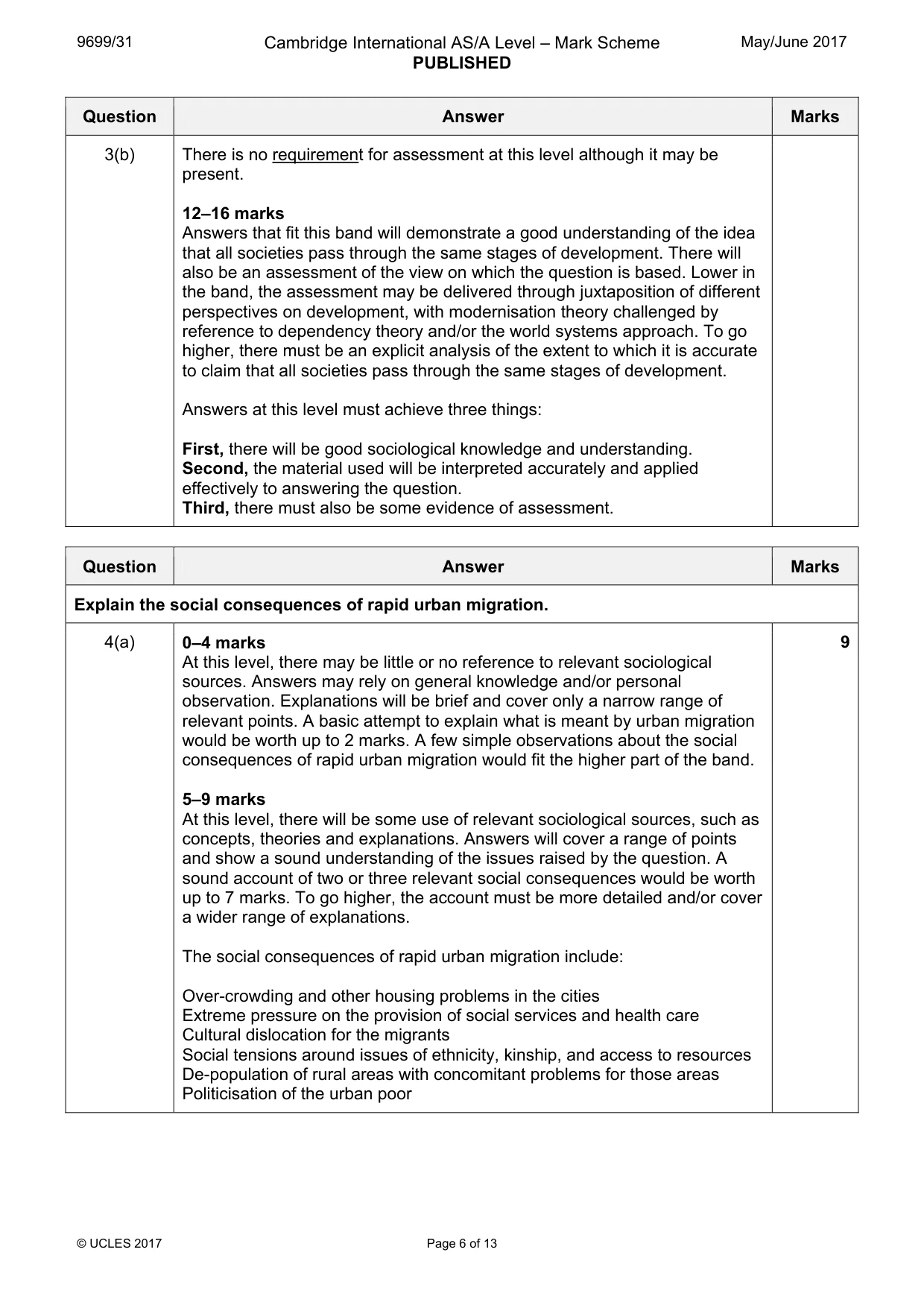
9699/31 Cambridge International AS/A Level – Mark Scheme PUBLISHED May/June 2017 © UCLES 2017 Page 6 of 13 Question Answer Marks 3(b) There is no requirement for assessment at this level although it may be present. 12–16 marks Answers that fit this band will demonstrate a good understanding of the idea that all societies pass through the same stages of development. There will also be an assessment of the view on which the question is based. Lower in the band, the assessment may be delivered through juxtaposition of different perspectives on development, with modernisation theory challenged by reference to dependency theory and/or the world systems approach. To go higher, there must be an explicit analysis of the extent to which it is accurate to claim that all societies pass through the same stages of development. Answers at this level must achieve three things: First, there will be good sociological knowledge and understanding. Second, the material used will be interpreted accurately and applied effectively to answering the question. Third, there must also be some evidence of assessment. Question Answer Marks Explain the social consequences of rapid urban migration. 4(a) 0–4 marks At this level, there may be little or no reference to relevant sociological sources. Answers may rely on general knowledge and/or personal observation. Explanations will be brief and cover only a narrow range of relevant points. A basic attempt to explain what is meant by urban migration would be worth up to 2 marks. A few simple observations about the social consequences of rapid urban migration would fit the higher part of the band. 5–9 marks At this level, there will be some use of relevant sociological sources, such as concepts, theories and explanations. Answers will cover a range of points and show a sound understanding of the issues raised by the question. A sound account of two or three relevant social consequences would be worth up to 7 marks. To go higher, the account must be more detailed and/or cover a wider range of explanations. The social consequences of rapid urban migration include: Over-crowding and other housing problems in the cities Extreme pressure on the provision of social services and health care Cultural dislocation for the migrants Social tensions around issues of ethnicity, kinship, and access to resources De-population of rural areas with concomitant problems for those areas Politicisation of the urban poor 9
Mark scheme, page 7
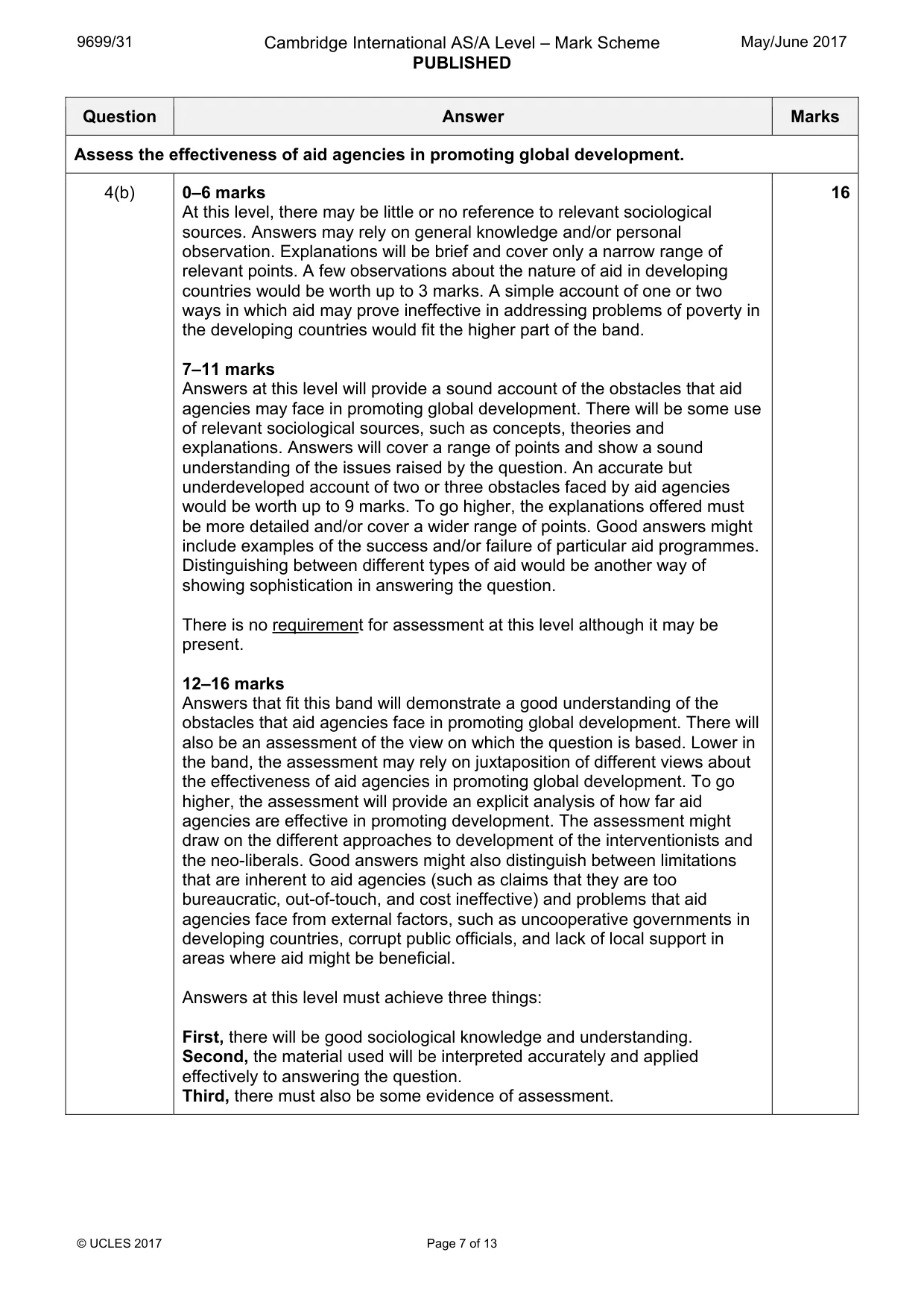
9699/31 Cambridge International AS/A Level – Mark Scheme PUBLISHED May/June 2017 © UCLES 2017 Page 7 of 13 Question Answer Marks Assess the effectiveness of aid agencies in promoting global development. 4(b) 0–6 marks At this level, there may be little or no reference to relevant sociological sources. Answers may rely on general knowledge and/or personal observation. Explanations will be brief and cover only a narrow range of relevant points. A few observations about the nature of aid in developing countries would be worth up to 3 marks. A simple account of one or two ways in which aid may prove ineffective in addressing problems of poverty in the developing countries would fit the higher part of the band. 7–11 marks Answers at this level will provide a sound account of the obstacles that aid agencies may face in promoting global development. There will be some use of relevant sociological sources, such as concepts, theories and explanations. Answers will cover a range of points and show a sound understanding of the issues raised by the question. An accurate but underdeveloped account of two or three obstacles faced by aid agencies would be worth up to 9 marks. To go higher, the explanations offered must be more detailed and/or cover a wider range of points. Good answers might include examples of the success and/or failure of particular aid programmes. Distinguishing between different types of aid would be another way of showing sophistication in answering the question. There is no requirement for assessment at this level although it may be present. 12–16 marks Answers that fit this band will demonstrate a good understanding of the obstacles that aid agencies face in promoting global development. There will also be an assessment of the view on which the question is based. Lower in the band, the assessment may rely on juxtaposition of different views about the effectiveness of aid agencies in promoting global development. To go higher, the assessment will provide an explicit analysis of how far aid agencies are effective in promoting development. The assessment might draw on the different approaches to development of the interventionists and the neo-liberals. Good answers might also distinguish between limitations that are inherent to aid agencies (such as claims that they are too bureaucratic, out-of-touch, and cost ineffective) and problems that aid agencies face from external factors, such as uncooperative governments in developing countries, corrupt public officials, and lack of local support in areas where aid might be beneficial. Answers at this level must achieve three things: First, there will be good sociological knowledge and understanding. Second, the material used will be interpreted accurately and applied effectively to answering the question. Third, there must also be some evidence of assessment. 16
Mark scheme, page 8
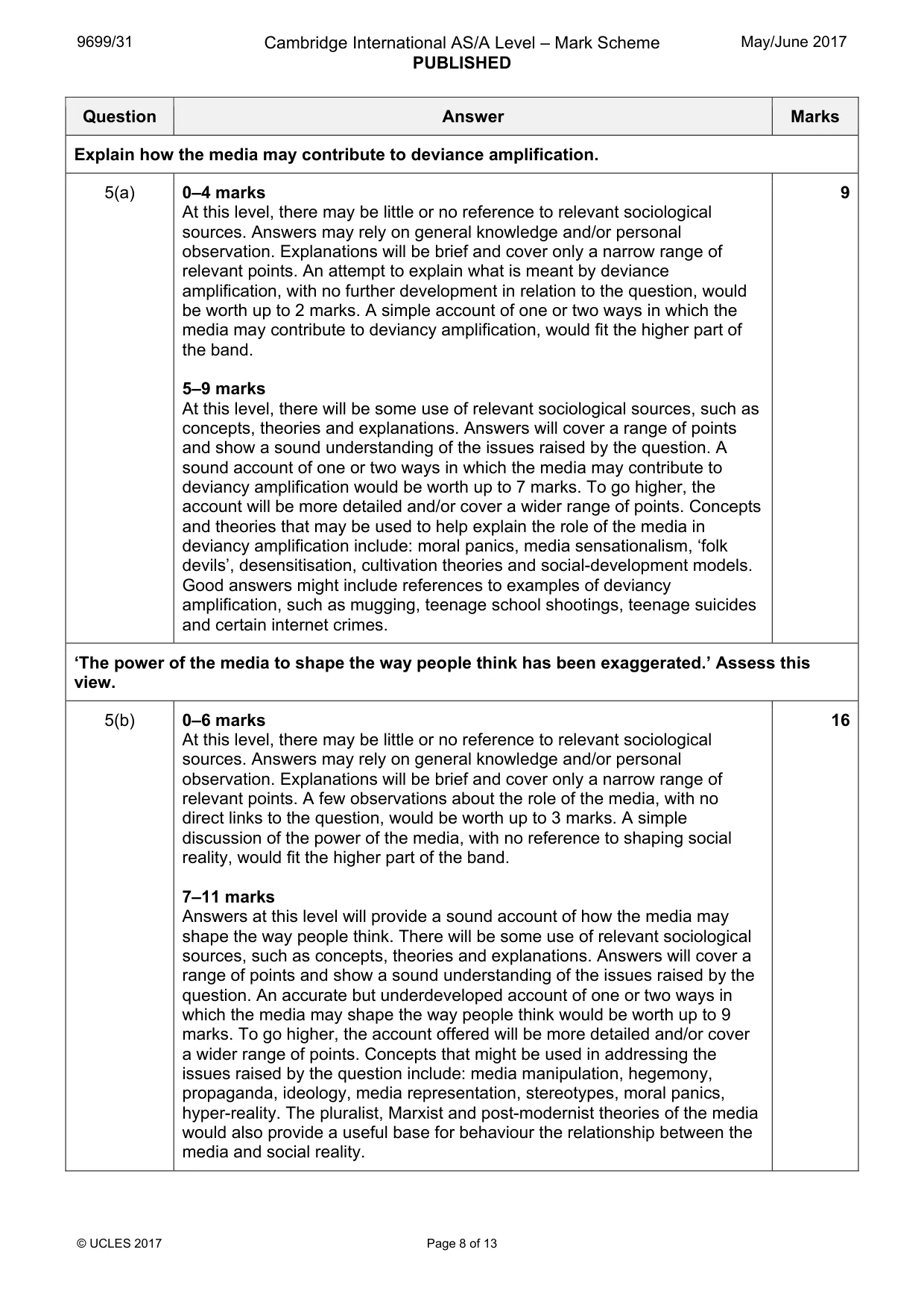
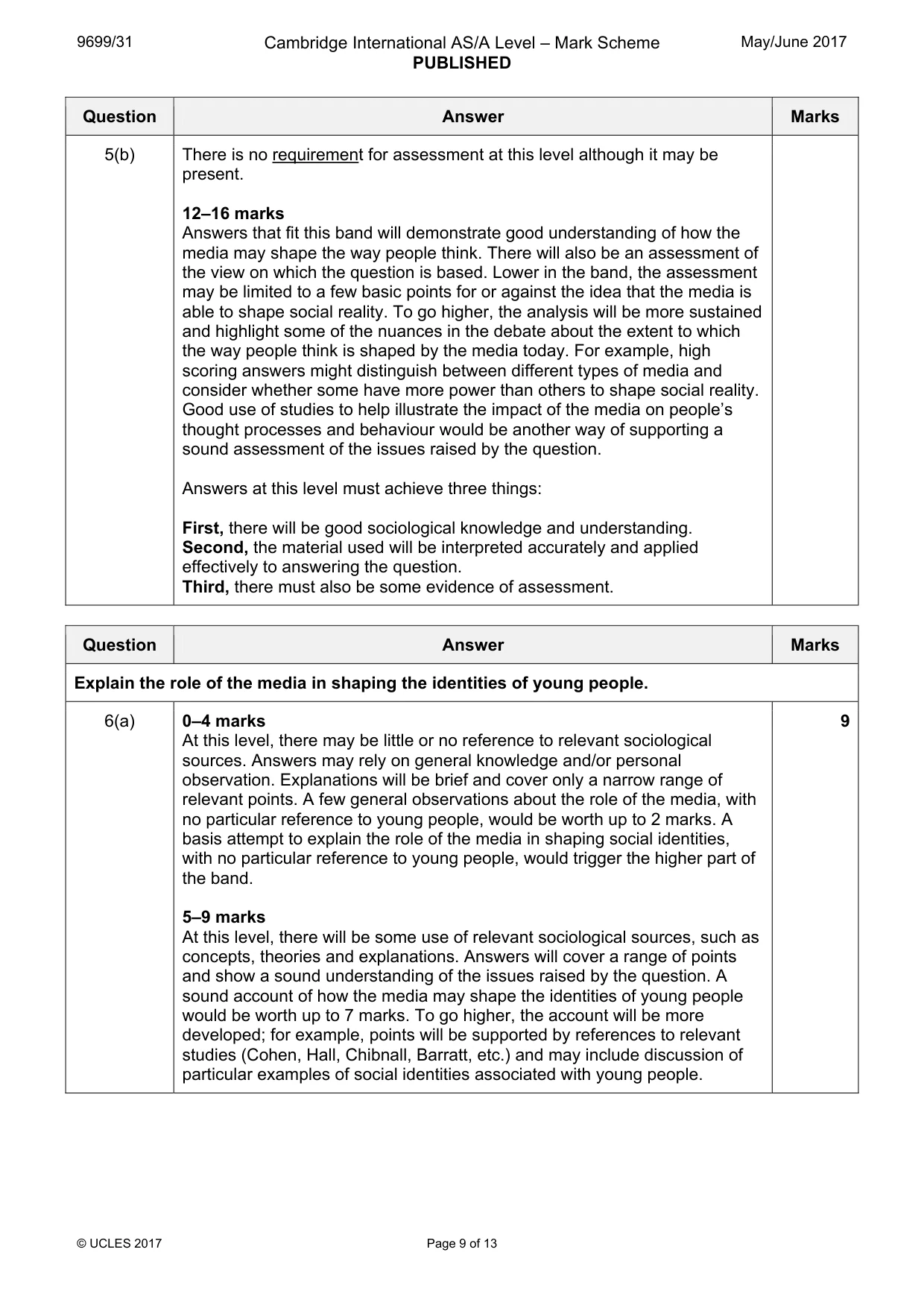
9699/31 Cambridge International AS/A Level – Mark Scheme PUBLISHED May/June 2017 © UCLES 2017 Page 8 of 13 Question Answer Marks Explain how the media may contribute to deviance amplification. 5(a) 0–4 marks At this level, there may be little or no reference to relevant sociological sources. Answers may rely on general knowledge and/or personal observation. Explanations will be brief and cover only a narrow range of relevant points. An attempt to explain what is meant by deviance amplification, with no further development in relation to the question, would be worth up to 2 marks. A simple account of one or two ways in which the media may contribute to deviancy amplification, would fit the higher part of the band. 5–9 marks At this level, there will be some use of relevant sociological sources, such as concepts, theories and explanations. Answers will cover a range of points and show a sound understanding of the issues raised by the question. A sound account of one or two ways in which the media may contribute to deviancy amplification would be worth up to 7 marks. To go higher, the account will be more detailed and/or cover a wider range of points. Concepts and theories that may be used to help explain the role of the media in deviancy amplification include: moral panics, media sensationalism, ‘folk devils’, desensitisation, cultivation theories and social-development models. Good answers might include references to examples of deviancy amplification, such as mugging, teenage school shootings, teenage suicides and certain internet crimes. 9 ‘The power of the media to shape the way people think has been exaggerated.’ Assess this view. 5(b) 0–6 marks At this level, there may be little or no reference to relevant sociological sources. Answers may rely on general knowledge and/or personal observation. Explanations will be brief and cover only a narrow range of relevant points. A few observations about the role of the media, with no direct links to the question, would be worth up to 3 marks. A simple discussion of the power of the media, with no reference to shaping social reality, would fit the higher part of the band. 7–11 marks Answers at this level will provide a sound account of how the media may shape the way people think. There will be some use of relevant sociological sources, such as concepts, theories and explanations. Answers will cover a range of points and show a sound understanding of the issues raised by the question. An accurate but underdeveloped account of one or two ways in which the media may shape the way people think would be worth up to 9 marks. To go higher, the account offered will be more detailed and/or cover a wider range of points. Concepts that might be used in addressing the issues raised by the question include: media manipulation, hegemony, propaganda, ideology, media representation, stereotypes, moral panics, hyper-reality. The pluralist, Marxist and post-modernist theories of the media would also provide a useful base for behaviour the relationship between the media and social reality. 16
Mark scheme, page 9
9699/31 Cambridge International AS/A Level – Mark Scheme PUBLISHED May/June 2017 © UCLES 2017 Page 9 of 13 Question Answer Marks 5(b) There is no requirement for assessment at this level although it may be present. 12–16 marks Answers that fit this band will demonstrate good understanding of how the media may shape the way people think. There will also be an assessment of the view on which the question is based. Lower in the band, the assessment may be limited to a few basic points for or against the idea that the media is able to shape social reality. To go higher, the analysis will be more sustained and highlight some of the nuances in the debate about the extent to which the way people think is shaped by the media today. For example, high scoring answers might distinguish between different types of media and consider whether some have more power than others to shape social reality. Good use of studies to help illustrate the impact of the media on people’s thought processes and behaviour would be another way of supporting a sound assessment of the issues raised by the question. Answers at this level must achieve three things: First, there will be good sociological knowledge and understanding. Second, the material used will be interpreted accurately and applied effectively to answering the question. Third, there must also be some evidence of assessment. Question Answer Marks Explain the role of the media in shaping the identities of young people. 6(a) 0–4 marks At this level, there may be little or no reference to relevant sociological sources. Answers may rely on general knowledge and/or personal observation. Explanations will be brief and cover only a narrow range of relevant points. A few general observations about the role of the media, with no particular reference to young people, would be worth up to 2 marks. A basis attempt to explain the role of the media in shaping social identities, with no particular reference to young people, would trigger the higher part of the band. 5–9 marks At this level, there will be some use of relevant sociological sources, such as concepts, theories and explanations. Answers will cover a range of points and show a sound understanding of the issues raised by the question. A sound account of how the media may shape the identities of young people would be worth up to 7 marks. To go higher, the account will be more developed; for example, points will be supported by references to relevant studies (Cohen, Hall, Chibnall, Barratt, etc.) and may include discussion of particular examples of social identities associated with young people. 9
Mark scheme, page 10
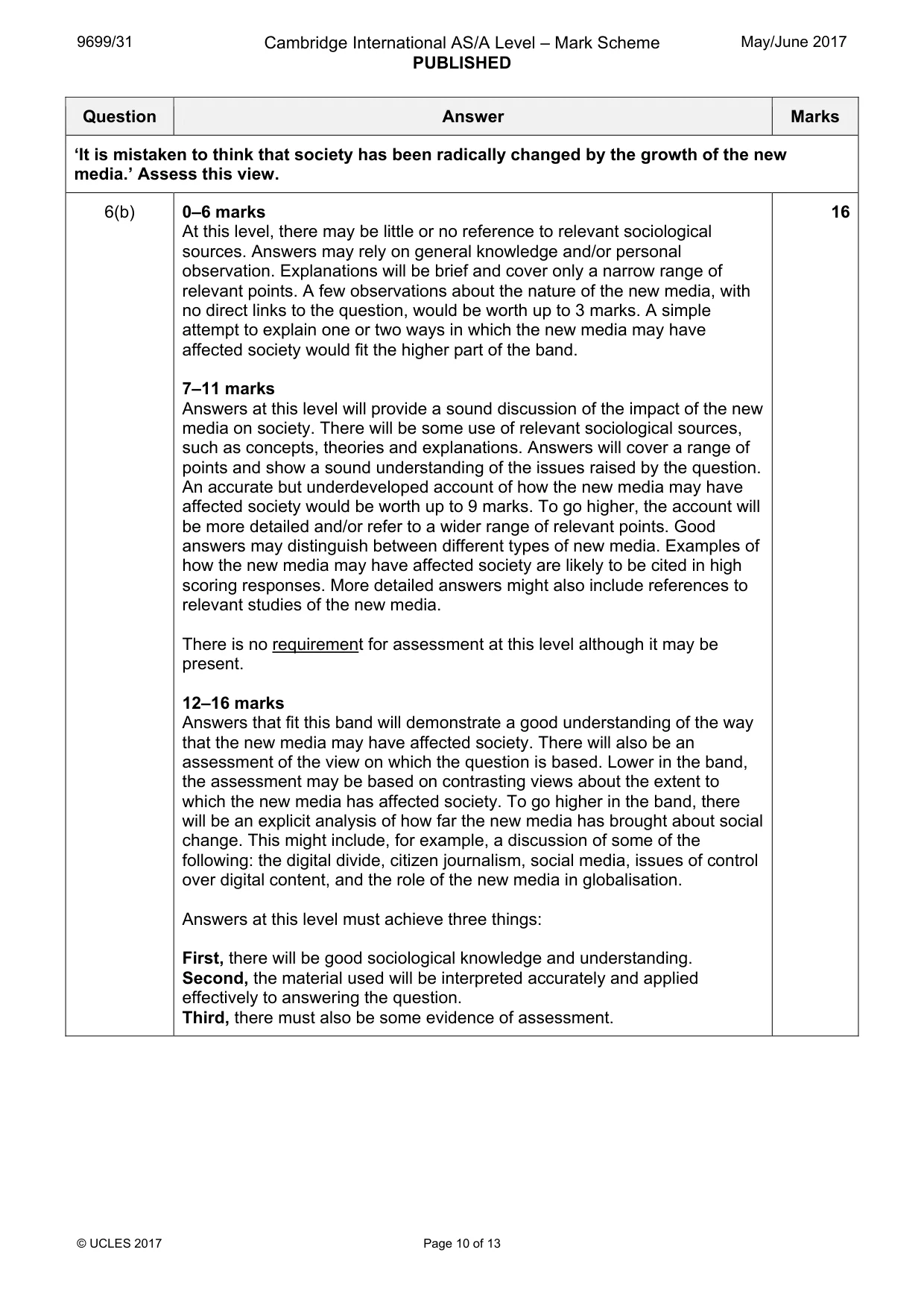
9699/31 Cambridge International AS/A Level – Mark Scheme PUBLISHED May/June 2017 © UCLES 2017 Page 10 of 13 Question Answer Marks ‘It is mistaken to think that society has been radically changed by the growth of the new media.’ Assess this view. 6(b) 0–6 marks At this level, there may be little or no reference to relevant sociological sources. Answers may rely on general knowledge and/or personal observation. Explanations will be brief and cover only a narrow range of relevant points. A few observations about the nature of the new media, with no direct links to the question, would be worth up to 3 marks. A simple attempt to explain one or two ways in which the new media may have affected society would fit the higher part of the band. 7–11 marks Answers at this level will provide a sound discussion of the impact of the new media on society. There will be some use of relevant sociological sources, such as concepts, theories and explanations. Answers will cover a range of points and show a sound understanding of the issues raised by the question. An accurate but underdeveloped account of how the new media may have affected society would be worth up to 9 marks. To go higher, the account will be more detailed and/or refer to a wider range of relevant points. Good answers may distinguish between different types of new media. Examples of how the new media may have affected society are likely to be cited in high scoring responses. More detailed answers might also include references to relevant studies of the new media. There is no requirement for assessment at this level although it may be present. 12–16 marks Answers that fit this band will demonstrate a good understanding of the way that the new media may have affected society. There will also be an assessment of the view on which the question is based. Lower in the band, the assessment may be based on contrasting views about the extent to which the new media has affected society. To go higher in the band, there will be an explicit analysis of how far the new media has brought about social change. This might include, for example, a discussion of some of the following: the digital divide, citizen journalism, social media, issues of control over digital content, and the role of the new media in globalisation. Answers at this level must achieve three things: First, there will be good sociological knowledge and understanding. Second, the material used will be interpreted accurately and applied effectively to answering the question. Third, there must also be some evidence of assessment. 16
Mark scheme, page 11
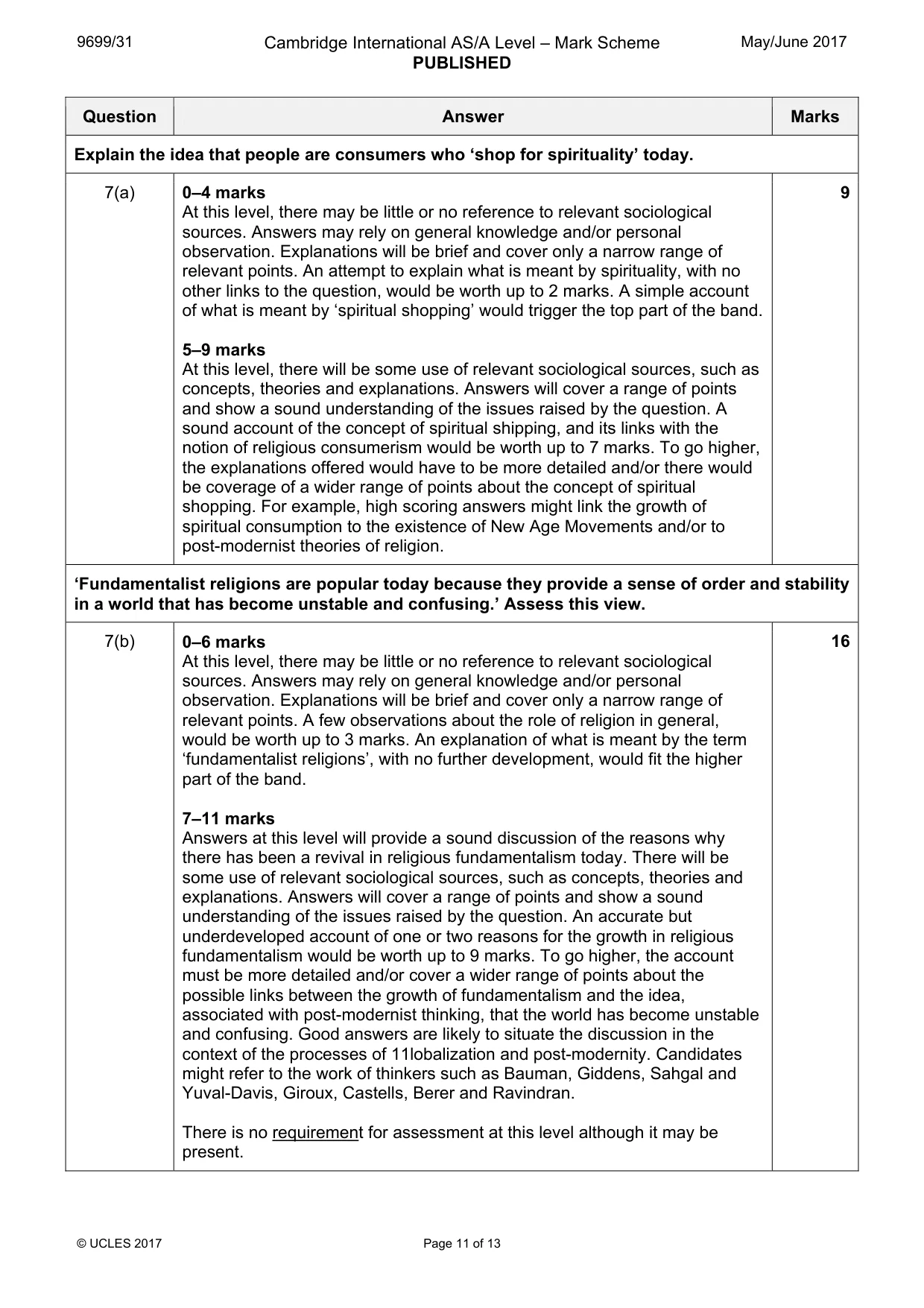
9699/31 Cambridge International AS/A Level – Mark Scheme PUBLISHED May/June 2017 © UCLES 2017 Page 11 of 13 Question Answer Marks Explain the idea that people are consumers who ‘shop for spirituality’ today. 7(a) 0–4 marks At this level, there may be little or no reference to relevant sociological sources. Answers may rely on general knowledge and/or personal observation. Explanations will be brief and cover only a narrow range of relevant points. An attempt to explain what is meant by spirituality, with no other links to the question, would be worth up to 2 marks. A simple account of what is meant by ‘spiritual shopping’ would trigger the top part of the band. 5–9 marks At this level, there will be some use of relevant sociological sources, such as concepts, theories and explanations. Answers will cover a range of points and show a sound understanding of the issues raised by the question. A sound account of the concept of spiritual shipping, and its links with the notion of religious consumerism would be worth up to 7 marks. To go higher, the explanations offered would have to be more detailed and/or there would be coverage of a wider range of points about the concept of spiritual shopping. For example, high scoring answers might link the growth of spiritual consumption to the existence of New Age Movements and/or to post-modernist theories of religion. 9 ‘Fundamentalist religions are popular today because they provide a sense of order and stability in a world that has become unstable and confusing.’ Assess this view. 7(b) 0–6 marks At this level, there may be little or no reference to relevant sociological sources. Answers may rely on general knowledge and/or personal observation. Explanations will be brief and cover only a narrow range of relevant points. A few observations about the role of religion in general, would be worth up to 3 marks. An explanation of what is meant by the term ‘fundamentalist religions’, with no further development, would fit the higher part of the band. 7–11 marks Answers at this level will provide a sound discussion of the reasons why there has been a revival in religious fundamentalism today. There will be some use of relevant sociological sources, such as concepts, theories and explanations. Answers will cover a range of points and show a sound understanding of the issues raised by the question. An accurate but underdeveloped account of one or two reasons for the growth in religious fundamentalism would be worth up to 9 marks. To go higher, the account must be more detailed and/or cover a wider range of points about the possible links between the growth of fundamentalism and the idea, associated with post-modernist thinking, that the world has become unstable and confusing. Good answers are likely to situate the discussion in the context of the processes of 11lobalization and post-modernity. Candidates might refer to the work of thinkers such as Bauman, Giddens, Sahgal and Yuval-Davis, Giroux, Castells, Berer and Ravindran. There is no requirement for assessment at this level although it may be present. 16
Mark scheme, page 12
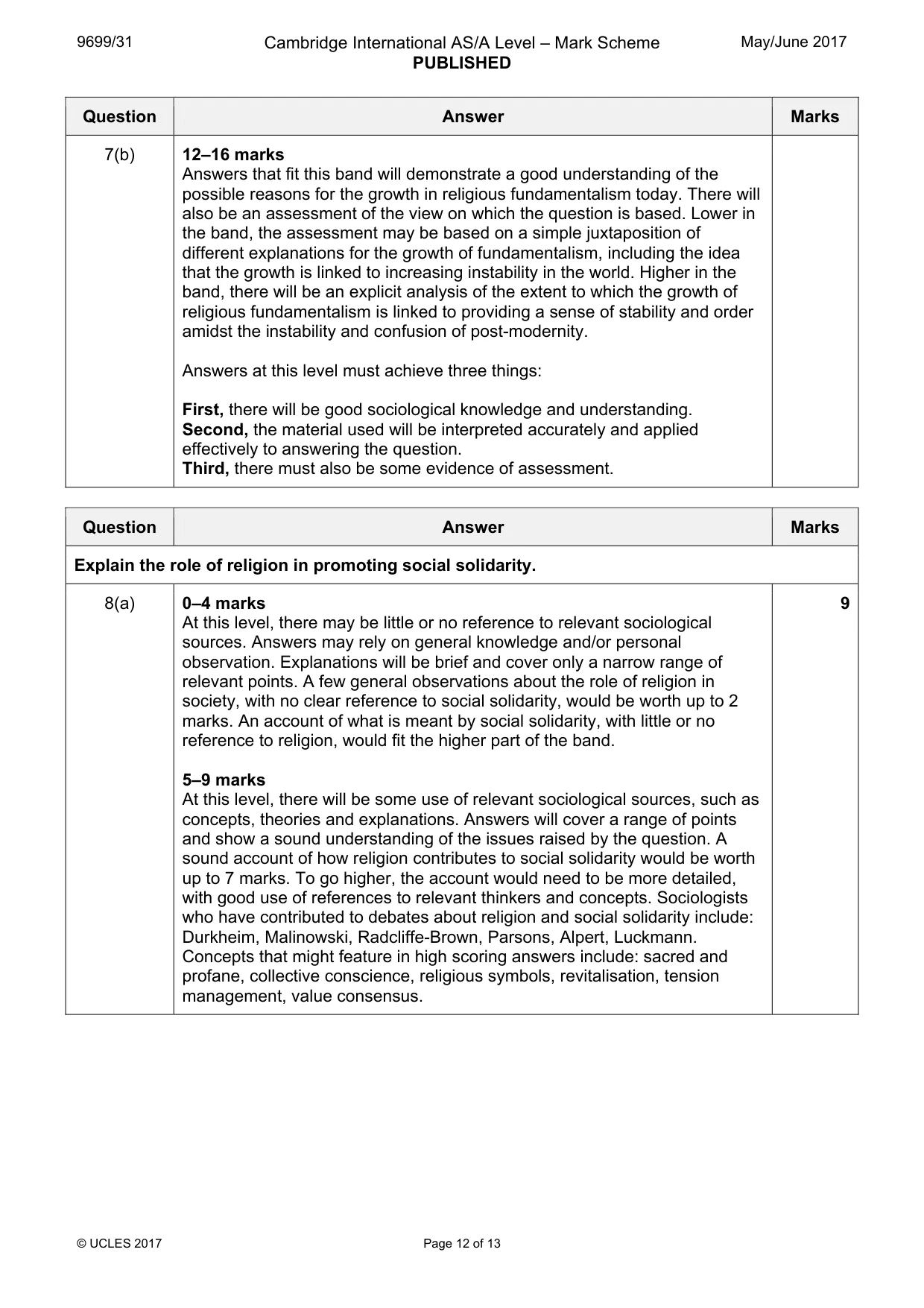
9699/31 Cambridge International AS/A Level – Mark Scheme PUBLISHED May/June 2017 © UCLES 2017 Page 12 of 13 Question Answer Marks 7(b) 12–16 marks Answers that fit this band will demonstrate a good understanding of the possible reasons for the growth in religious fundamentalism today. There will also be an assessment of the view on which the question is based. Lower in the band, the assessment may be based on a simple juxtaposition of different explanations for the growth of fundamentalism, including the idea that the growth is linked to increasing instability in the world. Higher in the band, there will be an explicit analysis of the extent to which the growth of religious fundamentalism is linked to providing a sense of stability and order amidst the instability and confusion of post-modernity. Answers at this level must achieve three things: First, there will be good sociological knowledge and understanding. Second, the material used will be interpreted accurately and applied effectively to answering the question. Third, there must also be some evidence of assessment. Question Answer Marks Explain the role of religion in promoting social solidarity. 8(a) 0–4 marks At this level, there may be little or no reference to relevant sociological sources. Answers may rely on general knowledge and/or personal observation. Explanations will be brief and cover only a narrow range of relevant points. A few general observations about the role of religion in society, with no clear reference to social solidarity, would be worth up to 2 marks. An account of what is meant by social solidarity, with little or no reference to religion, would fit the higher part of the band. 5–9 marks At this level, there will be some use of relevant sociological sources, such as concepts, theories and explanations. Answers will cover a range of points and show a sound understanding of the issues raised by the question. A sound account of how religion contributes to social solidarity would be worth up to 7 marks. To go higher, the account would need to be more detailed, with good use of references to relevant thinkers and concepts. Sociologists who have contributed to debates about religion and social solidarity include: Durkheim, Malinowski, Radcliffe-Brown, Parsons, Alpert, Luckmann. Concepts that might feature in high scoring answers include: sacred and profane, collective conscience, religious symbols, revitalisation, tension management, value consensus. 9
Mark scheme, page 13
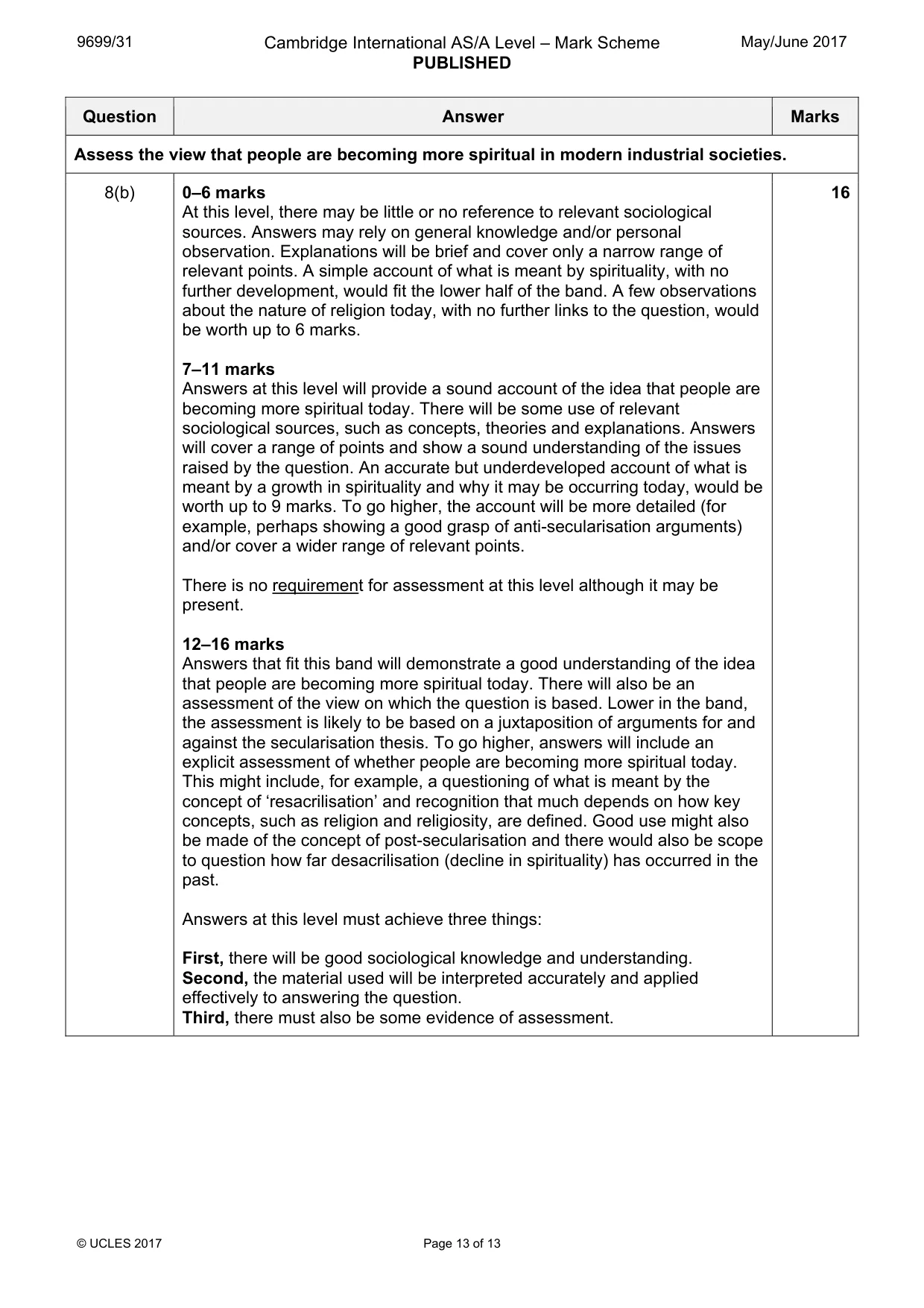
9699/31 Cambridge International AS/A Level – Mark Scheme PUBLISHED May/June 2017 © UCLES 2017 Page 13 of 13 Question Answer Marks Assess the view that people are becoming more spiritual in modern industrial societies. 8(b) 0–6 marks At this level, there may be little or no reference to relevant sociological sources. Answers may rely on general knowledge and/or personal observation. Explanations will be brief and cover only a narrow range of relevant points. A simple account of what is meant by spirituality, with no further development, would fit the lower half of the band. A few observations about the nature of religion today, with no further links to the question, would be worth up to 6 marks. 7–11 marks Answers at this level will provide a sound account of the idea that people are becoming more spiritual today. There will be some use of relevant sociological sources, such as concepts, theories and explanations. Answers will cover a range of points and show a sound understanding of the issues raised by the question. An accurate but underdeveloped account of what is meant by a growth in spirituality and why it may be occurring today, would be worth up to 9 marks. To go higher, the account will be more detailed (for example, perhaps showing a good grasp of anti-secularisation arguments) and/or cover a wider range of relevant points. There is no requirement for assessment at this level although it may be present. 12–16 marks Answers that fit this band will demonstrate a good understanding of the idea that people are becoming more spiritual today. There will also be an assessment of the view on which the question is based. Lower in the band, the assessment is likely to be based on a juxtaposition of arguments for and against the secularisation thesis. To go higher, answers will include an explicit assessment of whether people are becoming more spiritual today. This might include, for example, a questioning of what is meant by the concept of ‘resacrilisation’ and recognition that much depends on how key concepts, such as religion and religiosity, are defined. Good use might also be made of the concept of post-secularisation and there would also be scope to question how far desacrilisation (decline in spirituality) has occurred in the past. Answers at this level must achieve three things: First, there will be good sociological knowledge and understanding. Second, the material used will be interpreted accurately and applied effectively to answering the question. Third, there must also be some evidence of assessment. 16
What you needed in this session
Cambridge’s own grade thresholds for 2017 May/June, Paper 3 · Variant 1. A higher threshold means an easier paper — the bar moves with how the cohort did.