Cambridge A Level Psychology (from 2018) 9990 — 2020 May/June Paper 1 · Variant 3
9990/13/M/J/20
The question paper and its mark scheme, free to read here and free to download. This is Cambridge’s own paper, exactly as it was sat.
Question paper12 pages



Mark scheme9 pages
Answers below. Sit the paper first if you are practising.
Paper as text
Question paper, page 1
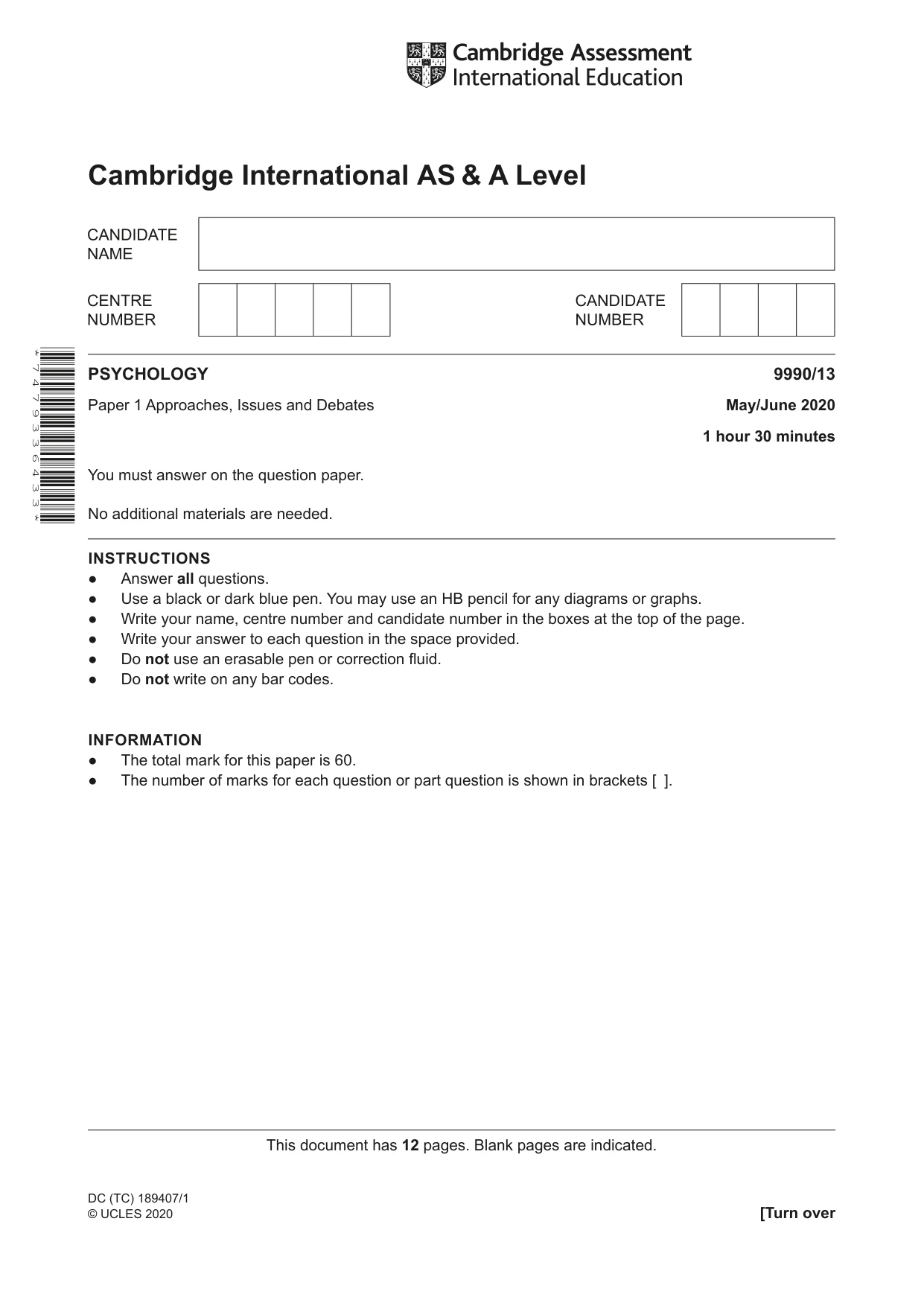
This document has 12 pages. Blank pages are indicated. DC (TC) 189407/1 © UCLES 2020 [Turn over * 7 4 7 9 3 3 6 4 3 3 * PSYCHOLOGY 9990/13 Paper 1 Approaches, Issues and Debates May/June 2020 1 hour 30 minutes You must answer on the question paper. No additional materials are needed. INSTRUCTIONS ● Answer all questions. ● Use a black or dark blue pen. You may use an HB pencil for any diagrams or graphs. ● Write your name, centre number and candidate number in the boxes at the top of the page. ● Write your answer to each question in the space provided. ● Do not use an erasable pen or correction fluid. ● Do not write on any bar codes. INFORMATION ● The total mark for this paper is 60. ● The number of marks for each question or part question is shown in brackets [ ]. Cambridge International AS & A Level
Question paper, page 2
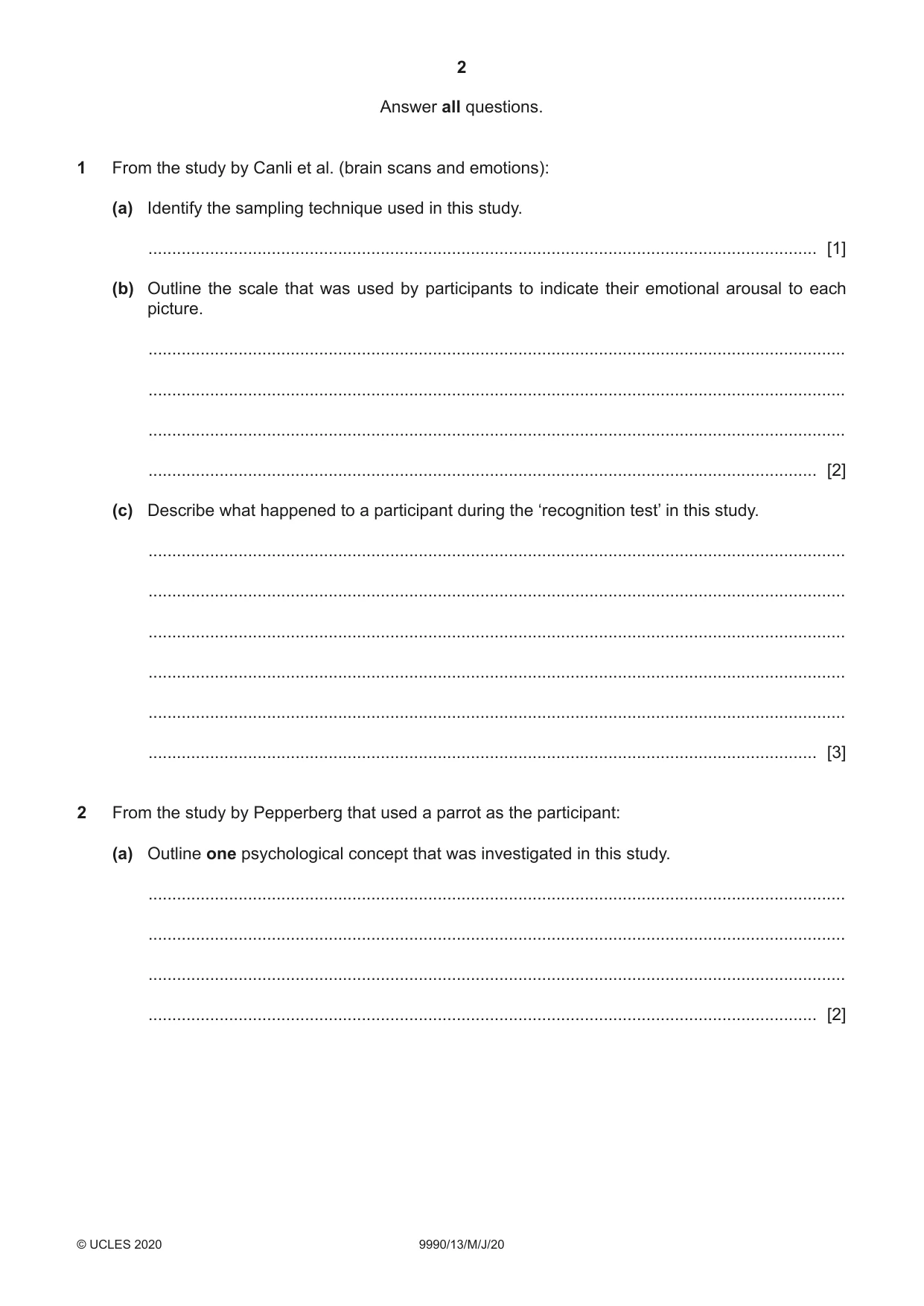
2 9990/13/M/J/20 © UCLES 2020 Answer all questions. 1 From the study by Canli et al. (brain scans and emotions): (a) Identify the sampling technique used in this study. … [1] (b) Outline the scale that was used by participants to indicate their emotional arousal to each picture. … … … … [2] (c) Describe what happened to a participant during the ‘recognition test’ in this study. … … … … … … [3] 2 From the study by Pepperberg that used a parrot as the participant: (a) Outline one psychological concept that was investigated in this study. … … … … [2]
Question paper, page 3
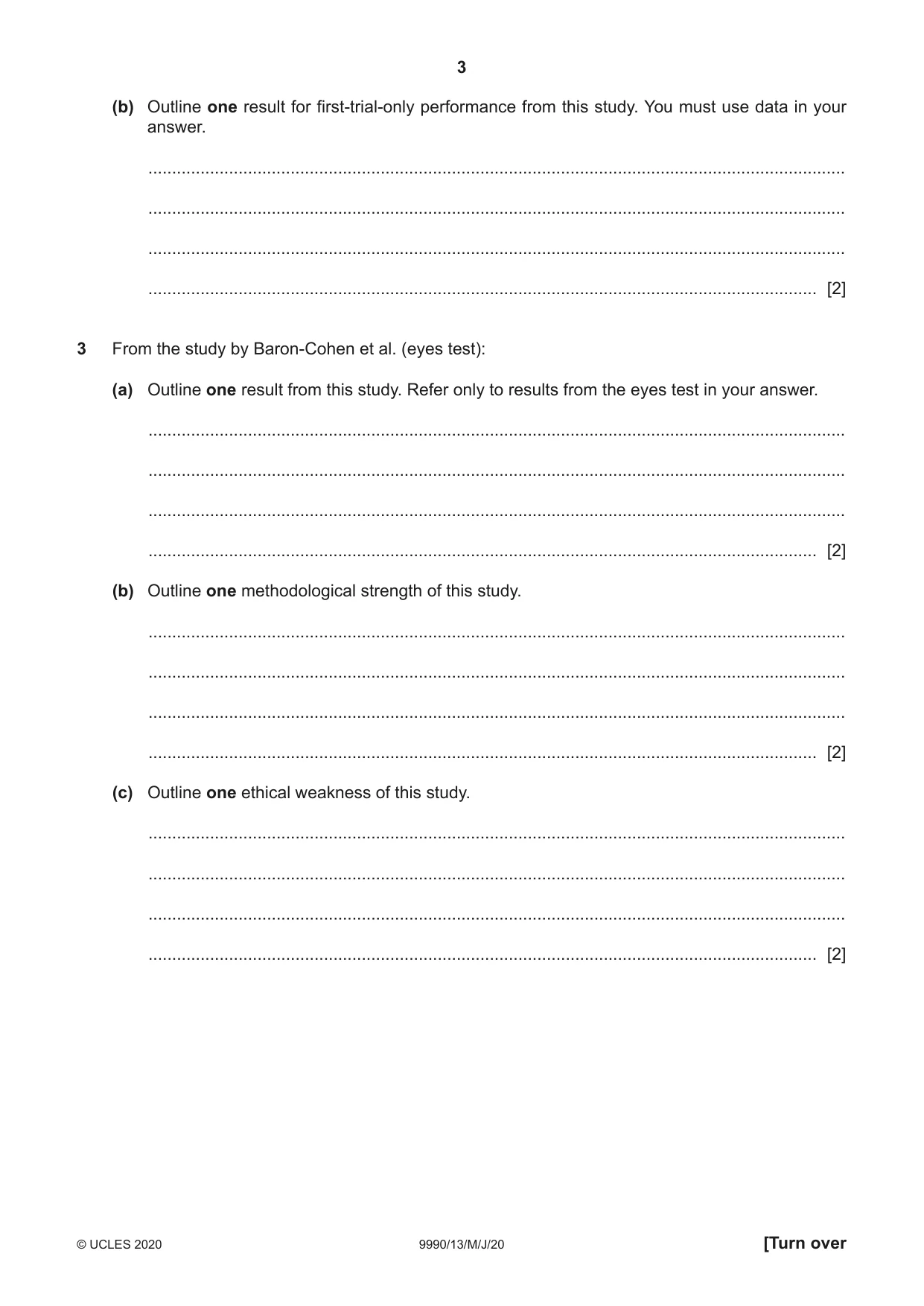
3 9990/13/M/J/20 © UCLES 2020 [Turn over (b) Outline one result for first-trial-only performance from this study. You must use data in your answer. … … … … [2] 3 From the study by Baron-Cohen et al. (eyes test): (a) Outline one result from this study. Refer only to results from the eyes test in your answer. … … … … [2] (b) Outline one methodological strength of this study. … … … … [2] (c) Outline one ethical weakness of this study. … … … … [2]
Question paper, page 4
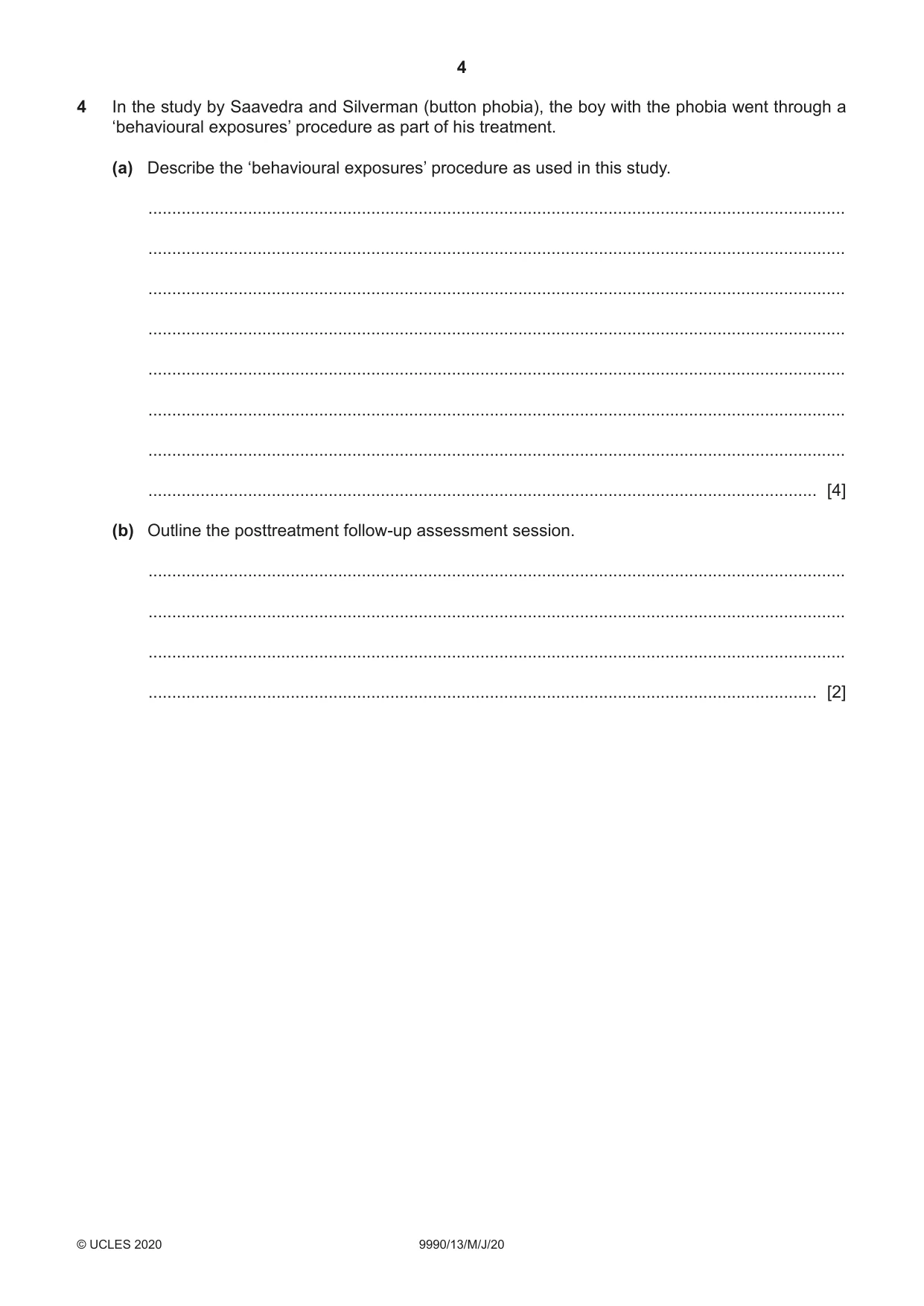
4 9990/13/M/J/20 © UCLES 2020 4 In the study by Saavedra and Silverman (button phobia), the boy with the phobia went through a ‘behavioural exposures’ procedure as part of his treatment. (a) Describe the ‘behavioural exposures’ procedure as used in this study. … … … … … … … … [4] (b) Outline the posttreatment follow-up assessment session. … … … … [2]
Question paper, page 5
5 9990/13/M/J/20 © UCLES 2020 [Turn over BLANK PAGE
Question paper, page 6
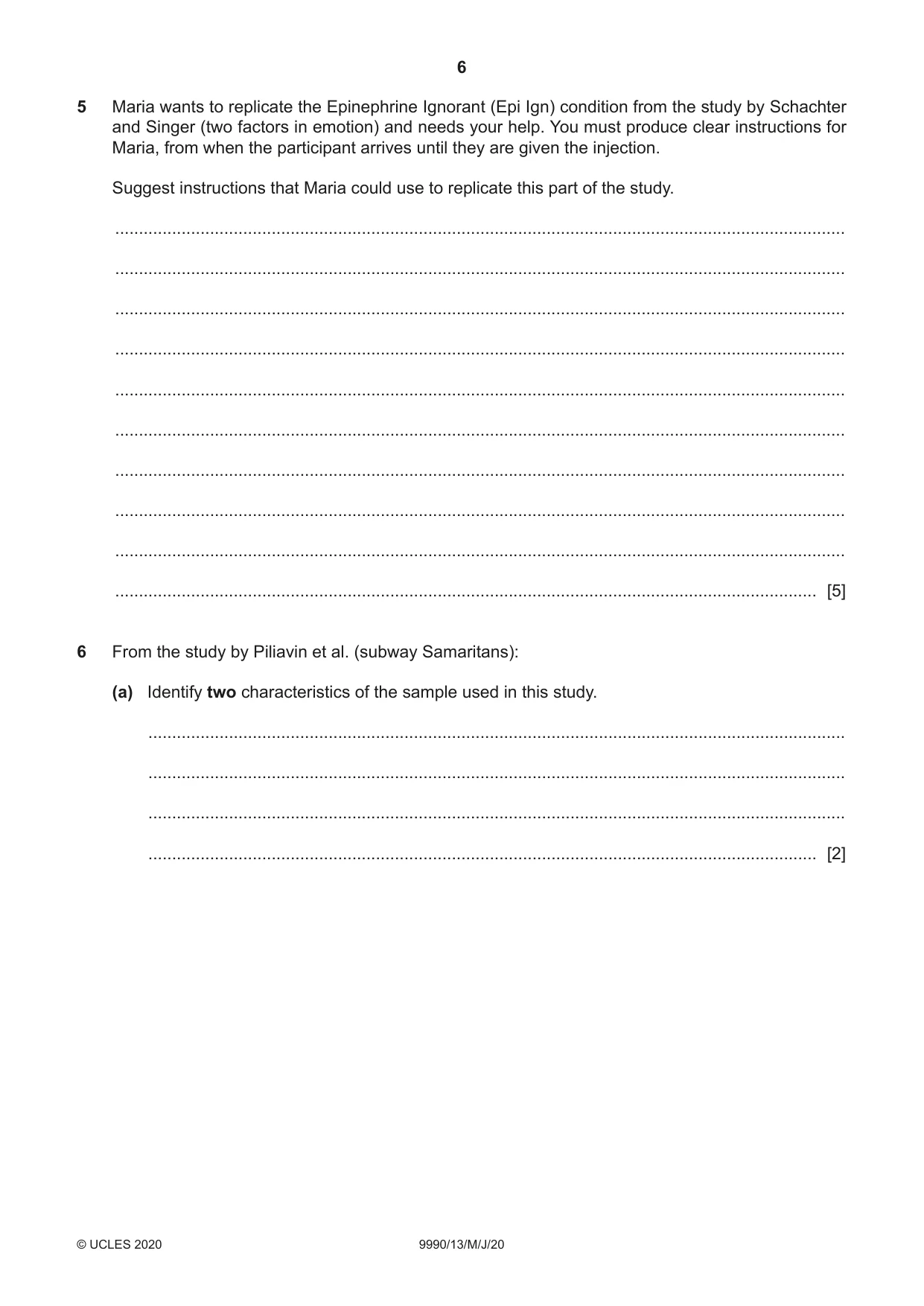
6 9990/13/M/J/20 © UCLES 2020 5 Maria wants to replicate the Epinephrine Ignorant (Epi Ign) condition from the study by Schachter and Singer (two factors in emotion) and needs your help. You must produce clear instructions for Maria, from when the participant arrives until they are given the injection. Suggest instructions that Maria could use to replicate this part of the study. … … … … … … … … … … [5] 6 From the study by Piliavin et al. (subway Samaritans): (a) Identify two characteristics of the sample used in this study. … … … … [2]
Question paper, page 7
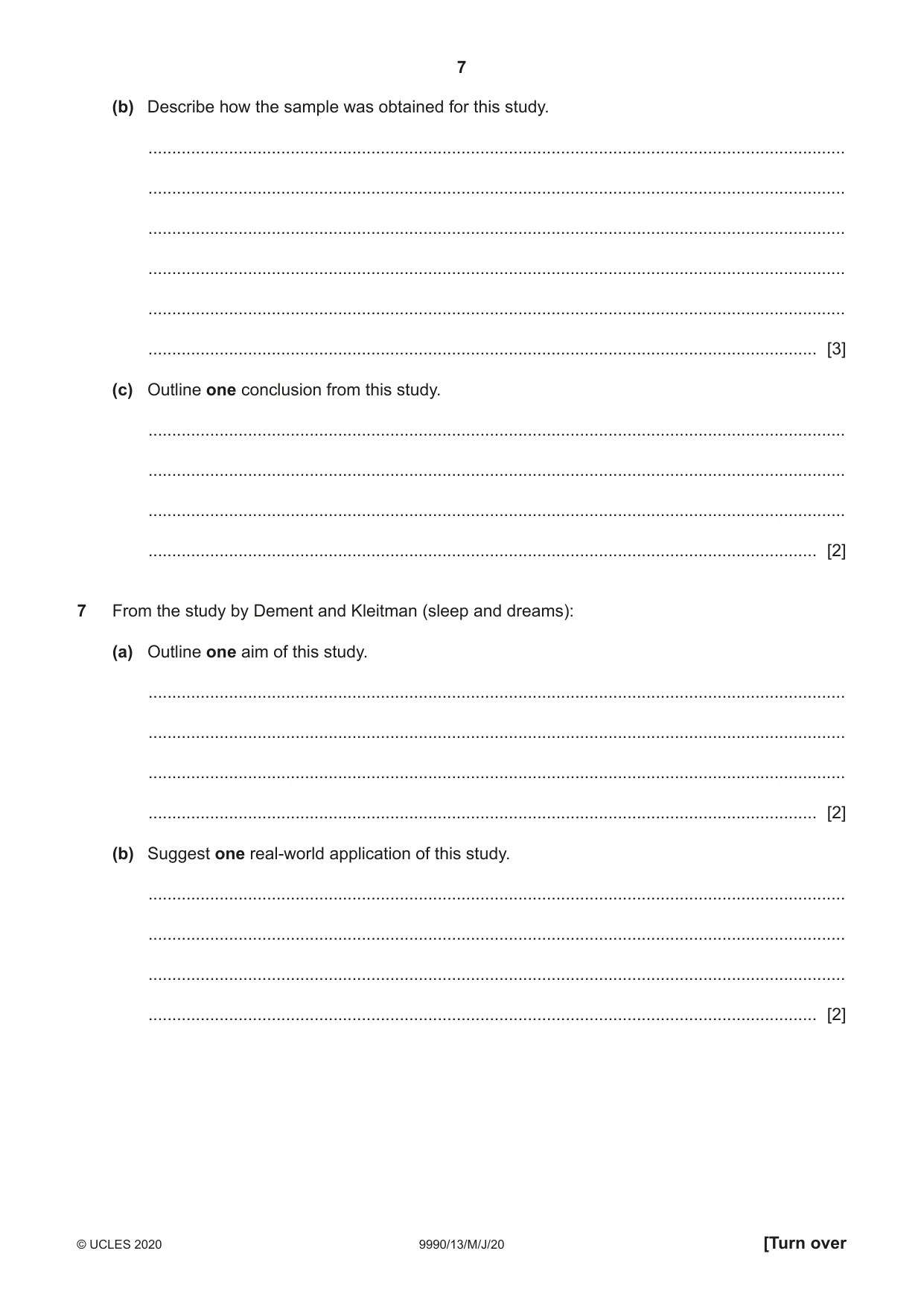
7 9990/13/M/J/20 © UCLES 2020 [Turn over (b) Describe how the sample was obtained for this study. … … … … … … [3] (c) Outline one conclusion from this study. … … … … [2] 7 From the study by Dement and Kleitman (sleep and dreams): (a) Outline one aim of this study. … … … … [2] (b) Suggest one real-world application of this study. … … … … [2]
Question paper, page 8
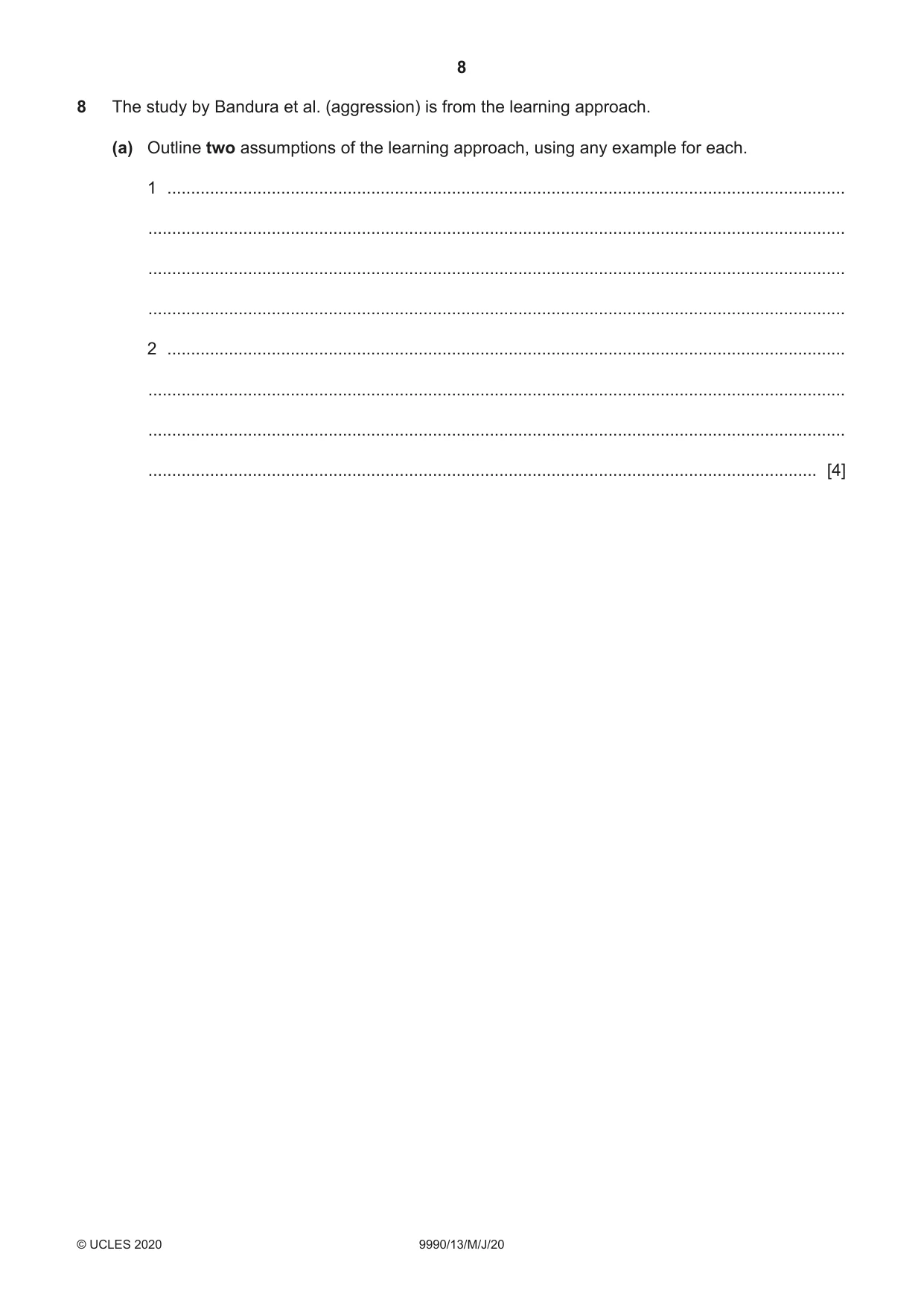
8 9990/13/M/J/20 © UCLES 2020 8 The study by Bandura et al. (aggression) is from the learning approach. (a) Outline two assumptions of the learning approach, using any example for each. 1 … … … … 2 … … … … [4]
Question paper, page 9
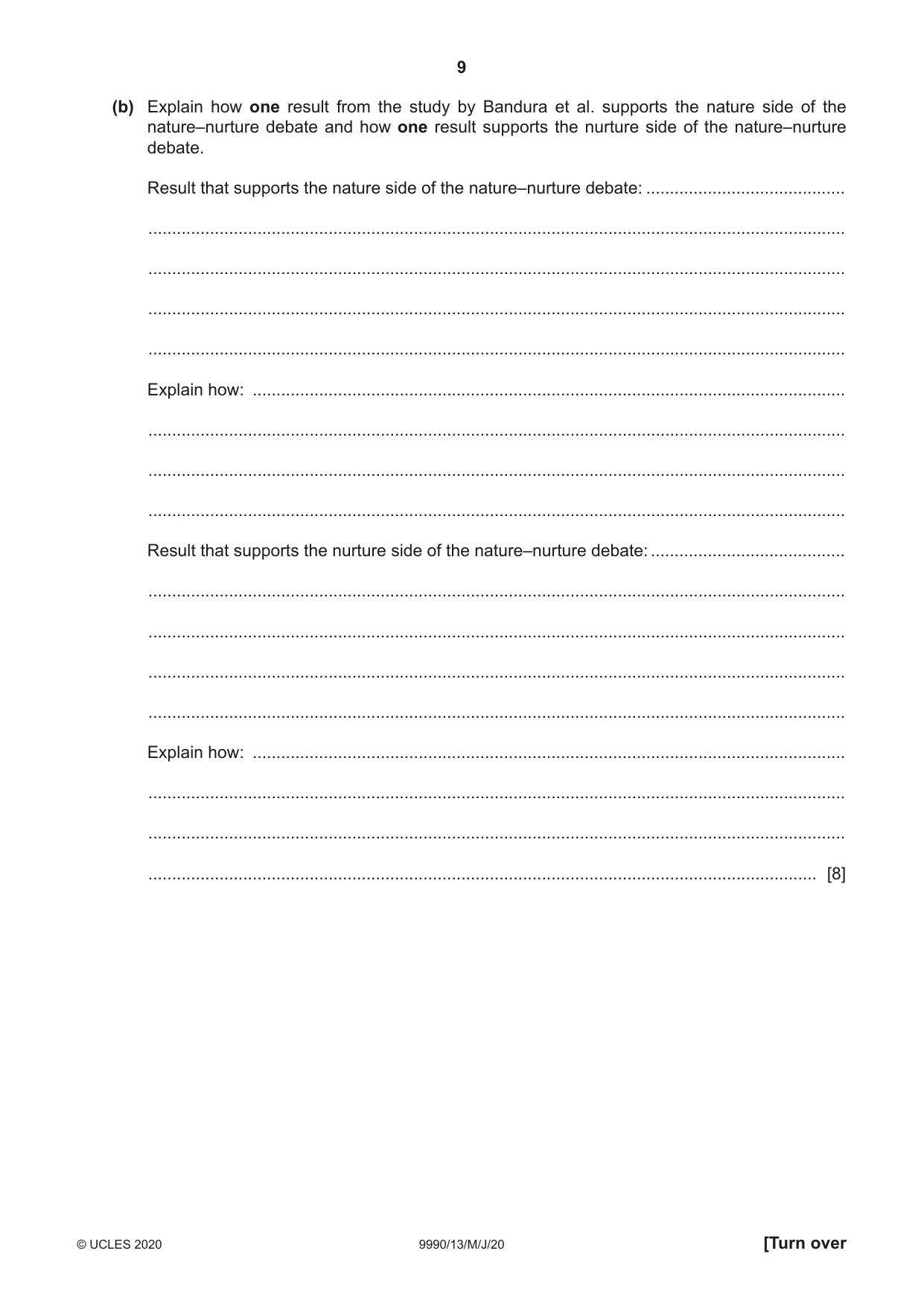
9 9990/13/M/J/20 © UCLES 2020 [Turn over (b) Explain how one result from the study by Bandura et al. supports the nature side of the nature–nurture debate and how one result supports the nurture side of the nature–nurture debate. Result that supports the nature side of the nature–nurture debate: … … … … … Explain how: … … … … Result that supports the nurture side of the nature–nurture debate: … … … … … Explain how: … … … … [8]
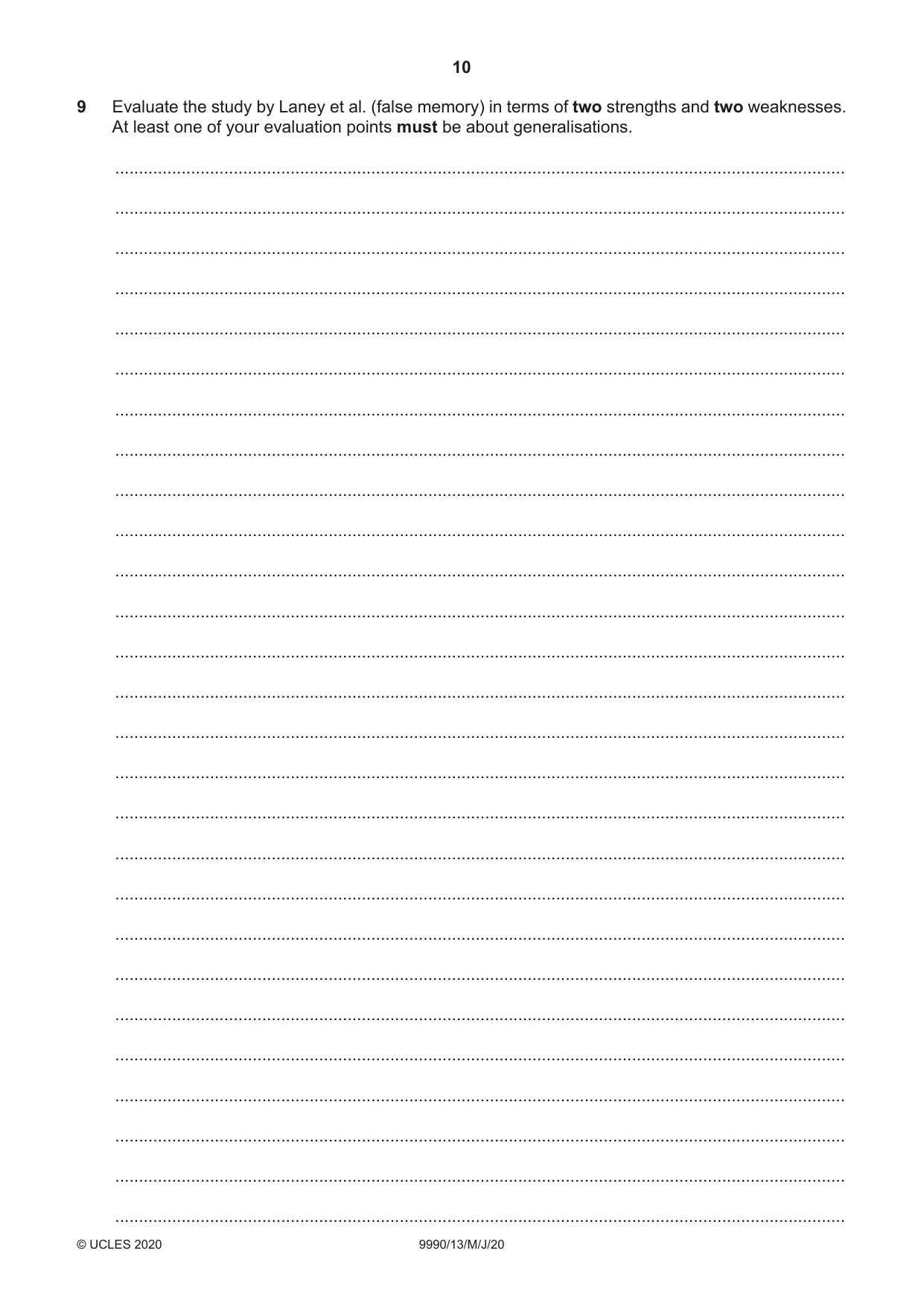
Question paper, page 10
10 9990/13/M/J/20 © UCLES 2020 9 Evaluate the study by Laney et al. (false memory) in terms of two strengths and two weaknesses. At least one of your evaluation points must be about generalisations. … … … … … … … … … … … … … … … … … … … … … … … … … … …
Question paper, page 11
11 9990/13/M/J/20 © UCLES 2020 … … … … … … … … … … … … … … … [10]
Question paper, page 12
12 9990/13/M/J/20 © UCLES 2020 Permission to reproduce items where third-party owned material protected by copyright is included has been sought and cleared where possible. Every reasonable effort has been made by the publisher (UCLES) to trace copyright holders, but if any items requiring clearance have unwittingly been included, the publisher will be pleased to make amends at the earliest possible opportunity. To avoid the issue of disclosure of answer-related information to candidates, all copyright acknowledgements are reproduced online in the Cambridge Assessment International Education Copyright Acknowledgements Booklet. This is produced for each series of examinations and is freely available to download at www.cambridgeinternational.org after the live examination series. Cambridge Assessment International Education is part of the Cambridge Assessment Group. Cambridge Assessment is the brand name of the University of Cambridge Local Examinations Syndicate (UCLES), which itself is a department of the University of Cambridge. BLANK PAGE
Mark scheme, page 1
This document consists of 9 printed pages. © UCLES 2020 [Turn over Cambridge International AS & A Level PSYCHOLOGY 9990/13 Paper 1 Approaches, issues and debates May/June 2020 MARK SCHEME Maximum Mark: 60 Published Students did not sit exam papers in the June 2020 series due to the Covid-19 global pandemic. This mark scheme is published to support teachers and students and should be read together with the question paper. It shows the requirements of the exam. The answer column of the mark scheme shows the proposed basis on which Examiners would award marks for this exam. Where appropriate, this column also provides the most likely acceptable alternative responses expected from students. Examiners usually review the mark scheme after they have seen student responses and update the mark scheme if appropriate. In the June series, Examiners were unable to consider the acceptability of alternative responses, as there were no student responses to consider. Mark schemes should usually be read together with the Principal Examiner Report for Teachers. However, because students did not sit exam papers, there is no Principal Examiner Report for Teachers for the June 2020 series. Cambridge International will not enter into discussions about these mark schemes. Cambridge International is publishing the mark schemes for the June 2020 series for most Cambridge IGCSE™ and Cambridge International A & AS Level components, and some Cambridge O Level components.
Mark scheme, page 2
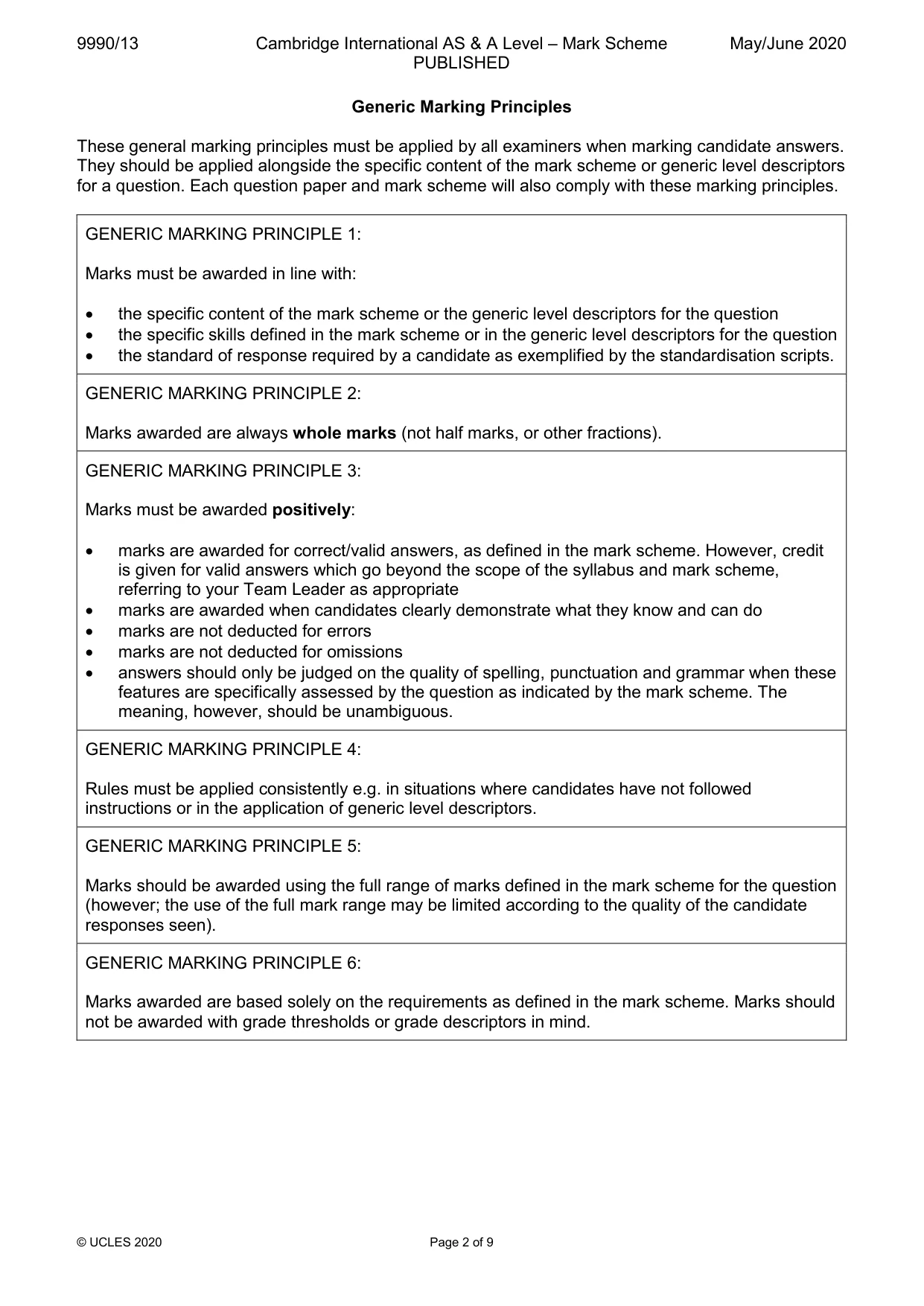
9990/13 Cambridge International AS & A Level – Mark Scheme PUBLISHED May/June 2020 © UCLES 2020 Page 2 of 9 Generic Marking Principles These general marking principles must be applied by all examiners when marking candidate answers. They should be applied alongside the specific content of the mark scheme or generic level descriptors for a question. Each question paper and mark scheme will also comply with these marking principles. GENERIC MARKING PRINCIPLE 1: Marks must be awarded in line with: • the specific content of the mark scheme or the generic level descriptors for the question • the specific skills defined in the mark scheme or in the generic level descriptors for the question • the standard of response required by a candidate as exemplified by the standardisation scripts. GENERIC MARKING PRINCIPLE 2: Marks awarded are always whole marks (not half marks, or other fractions). GENERIC MARKING PRINCIPLE 3: Marks must be awarded positively: • marks are awarded for correct/valid answers, as defined in the mark scheme. However, credit is given for valid answers which go beyond the scope of the syllabus and mark scheme, referring to your Team Leader as appropriate • marks are awarded when candidates clearly demonstrate what they know and can do • marks are not deducted for errors • marks are not deducted for omissions • answers should only be judged on the quality of spelling, punctuation and grammar when these features are specifically assessed by the question as indicated by the mark scheme. The meaning, however, should be unambiguous. GENERIC MARKING PRINCIPLE 4: Rules must be applied consistently e.g. in situations where candidates have not followed instructions or in the application of generic level descriptors. GENERIC MARKING PRINCIPLE 5: Marks should be awarded using the full range of marks defined in the mark scheme for the question (however; the use of the full mark range may be limited according to the quality of the candidate responses seen). GENERIC MARKING PRINCIPLE 6: Marks awarded are based solely on the requirements as defined in the mark scheme. Marks should not be awarded with grade thresholds or grade descriptors in mind.
Mark scheme, page 3
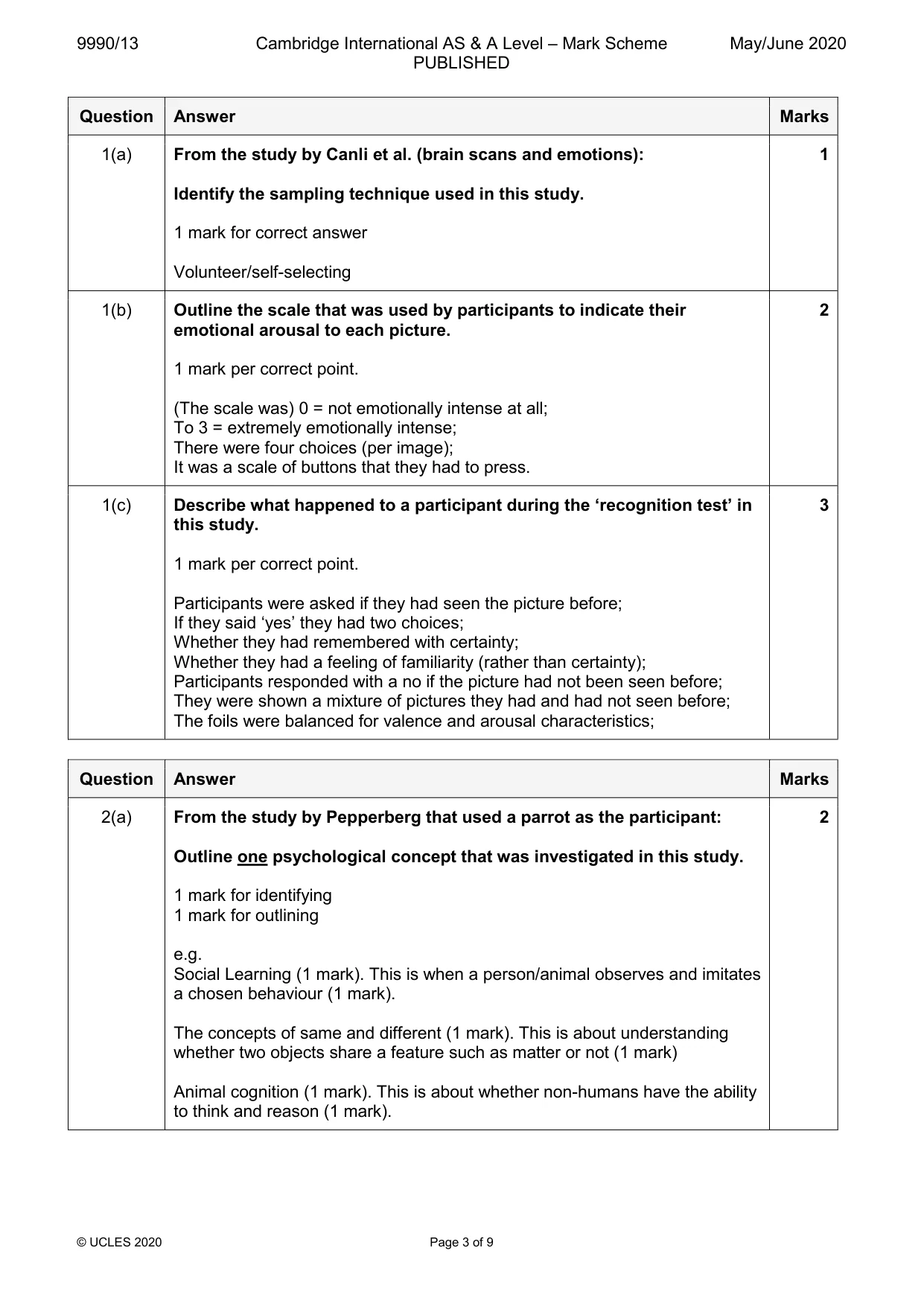
9990/13 Cambridge International AS & A Level – Mark Scheme PUBLISHED May/June 2020 © UCLES 2020 Page 3 of 9 Question Answer Marks 1(a) From the study by Canli et al. (brain scans and emotions): Identify the sampling technique used in this study. 1 mark for correct answer Volunteer/self-selecting 1 1(b) Outline the scale that was used by participants to indicate their emotional arousal to each picture. 1 mark per correct point. (The scale was) 0 = not emotionally intense at all; To 3 = extremely emotionally intense; There were four choices (per image); It was a scale of buttons that they had to press. 2 1(c) Describe what happened to a participant during the ‘recognition test’ in this study. 1 mark per correct point. Participants were asked if they had seen the picture before; If they said ‘yes’ they had two choices; Whether they had remembered with certainty; Whether they had a feeling of familiarity (rather than certainty); Participants responded with a no if the picture had not been seen before; They were shown a mixture of pictures they had and had not seen before; The foils were balanced for valence and arousal characteristics; 3 Question Answer Marks 2(a) From the study by Pepperberg that used a parrot as the participant: Outline one psychological concept that was investigated in this study. 1 mark for identifying 1 mark for outlining e.g. Social Learning (1 mark). This is when a person/animal observes and imitates a chosen behaviour (1 mark). The concepts of same and different (1 mark). This is about understanding whether two objects share a feature such as matter or not (1 mark) Animal cognition (1 mark). This is about whether non-humans have the ability to think and reason (1 mark). 2
Mark scheme, page 4
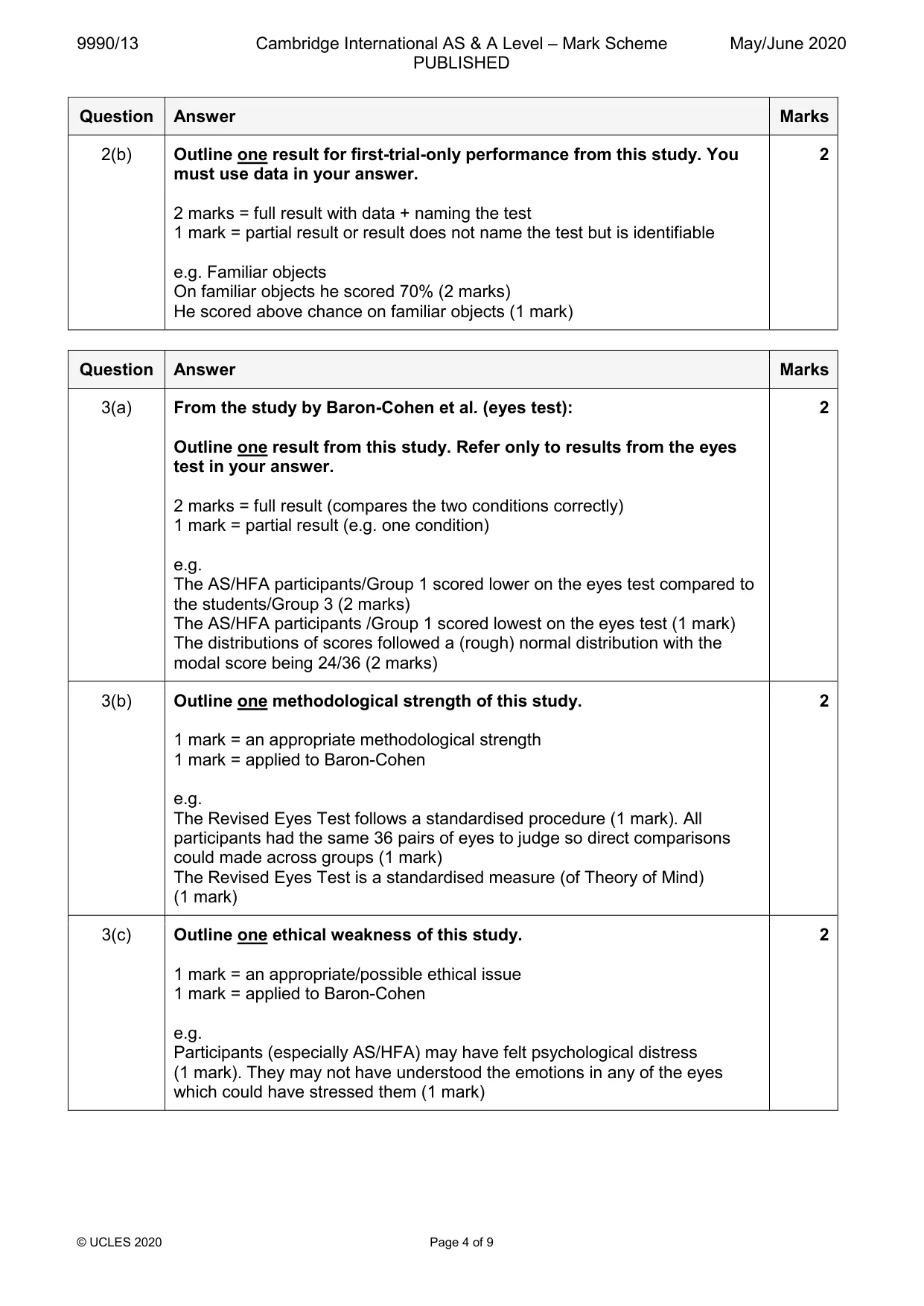
9990/13 Cambridge International AS & A Level – Mark Scheme PUBLISHED May/June 2020 © UCLES 2020 Page 4 of 9 Question Answer Marks 2(b) Outline one result for first-trial-only performance from this study. You must use data in your answer. 2 marks = full result with data + naming the test 1 mark = partial result or result does not name the test but is identifiable e.g. Familiar objects On familiar objects he scored 70% (2 marks) He scored above chance on familiar objects (1 mark) 2 Question Answer Marks 3(a) From the study by Baron-Cohen et al. (eyes test): Outline one result from this study. Refer only to results from the eyes test in your answer. 2 marks = full result (compares the two conditions correctly) 1 mark = partial result (e.g. one condition) e.g. The AS/HFA participants/Group 1 scored lower on the eyes test compared to the students/Group 3 (2 marks) The AS/HFA participants /Group 1 scored lowest on the eyes test (1 mark) The distributions of scores followed a (rough) normal distribution with the modal score being 24/36 (2 marks) 2 3(b) Outline one methodological strength of this study. 1 mark = an appropriate methodological strength 1 mark = applied to Baron-Cohen e.g. The Revised Eyes Test follows a standardised procedure (1 mark). All participants had the same 36 pairs of eyes to judge so direct comparisons could made across groups (1 mark) The Revised Eyes Test is a standardised measure (of Theory of Mind) (1 mark) 2 3(c) Outline one ethical weakness of this study. 1 mark = an appropriate/possible ethical issue 1 mark = applied to Baron-Cohen e.g. Participants (especially AS/HFA) may have felt psychological distress (1 mark). They may not have understood the emotions in any of the eyes which could have stressed them (1 mark) 2
Mark scheme, page 5
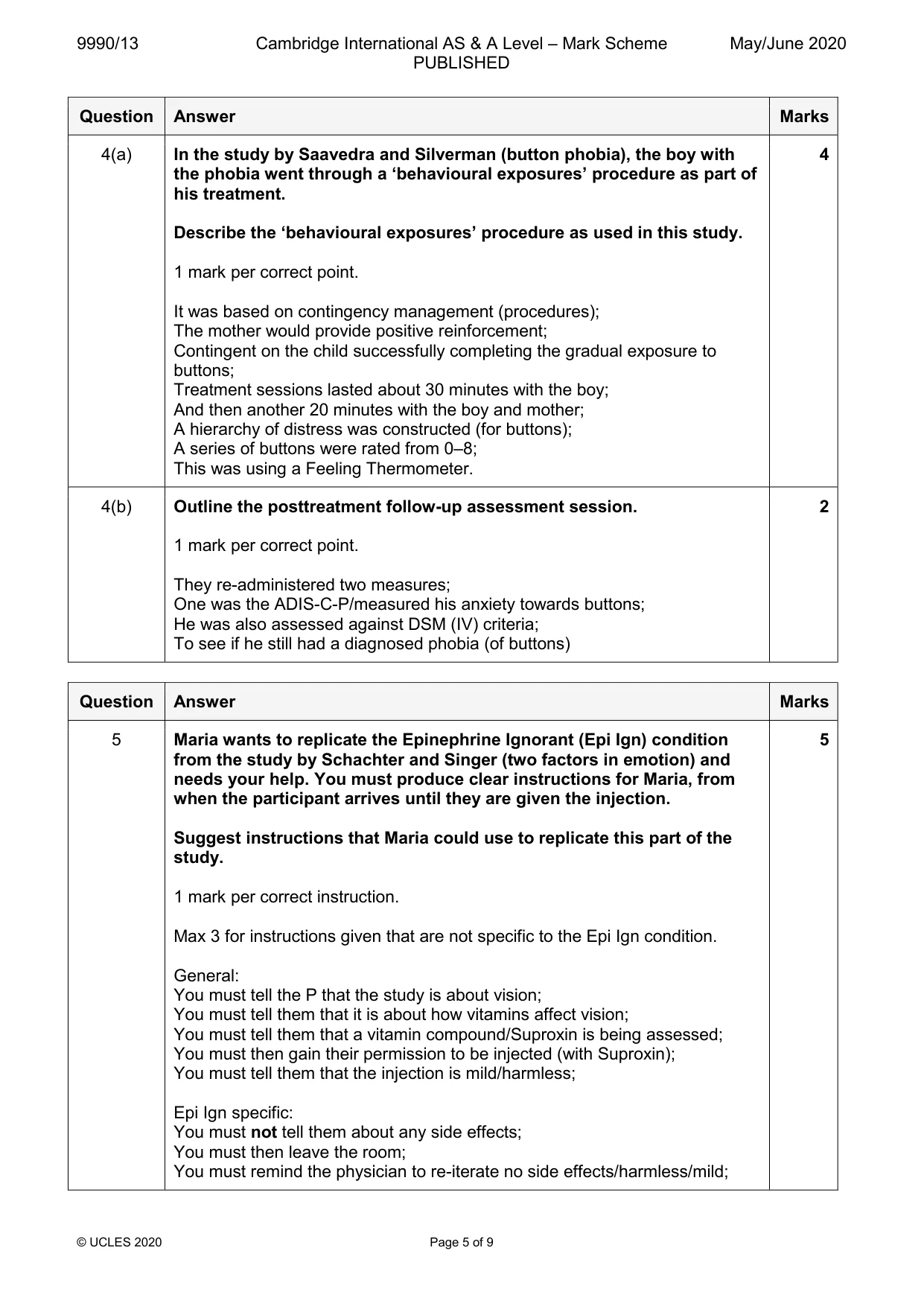
9990/13 Cambridge International AS & A Level – Mark Scheme PUBLISHED May/June 2020 © UCLES 2020 Page 5 of 9 Question Answer Marks 4(a) In the study by Saavedra and Silverman (button phobia), the boy with the phobia went through a ‘behavioural exposures’ procedure as part of his treatment. Describe the ‘behavioural exposures’ procedure as used in this study. 1 mark per correct point. It was based on contingency management (procedures); The mother would provide positive reinforcement; Contingent on the child successfully completing the gradual exposure to buttons; Treatment sessions lasted about 30 minutes with the boy; And then another 20 minutes with the boy and mother; A hierarchy of distress was constructed (for buttons); A series of buttons were rated from 0–8; This was using a Feeling Thermometer. 4 4(b) Outline the posttreatment follow-up assessment session. 1 mark per correct point. They re-administered two measures; One was the ADIS-C-P/measured his anxiety towards buttons; He was also assessed against DSM (IV) criteria; To see if he still had a diagnosed phobia (of buttons) 2 Question Answer Marks 5 Maria wants to replicate the Epinephrine Ignorant (Epi Ign) condition from the study by Schachter and Singer (two factors in emotion) and needs your help. You must produce clear instructions for Maria, from when the participant arrives until they are given the injection. Suggest instructions that Maria could use to replicate this part of the study. 1 mark per correct instruction. Max 3 for instructions given that are not specific to the Epi Ign condition. General: You must tell the P that the study is about vision; You must tell them that it is about how vitamins affect vision; You must tell them that a vitamin compound/Suproxin is being assessed; You must then gain their permission to be injected (with Suproxin); You must tell them that the injection is mild/harmless; Epi Ign specific: You must not tell them about any side effects; You must then leave the room; You must remind the physician to re-iterate no side effects/harmless/mild; 5
Mark scheme, page 6
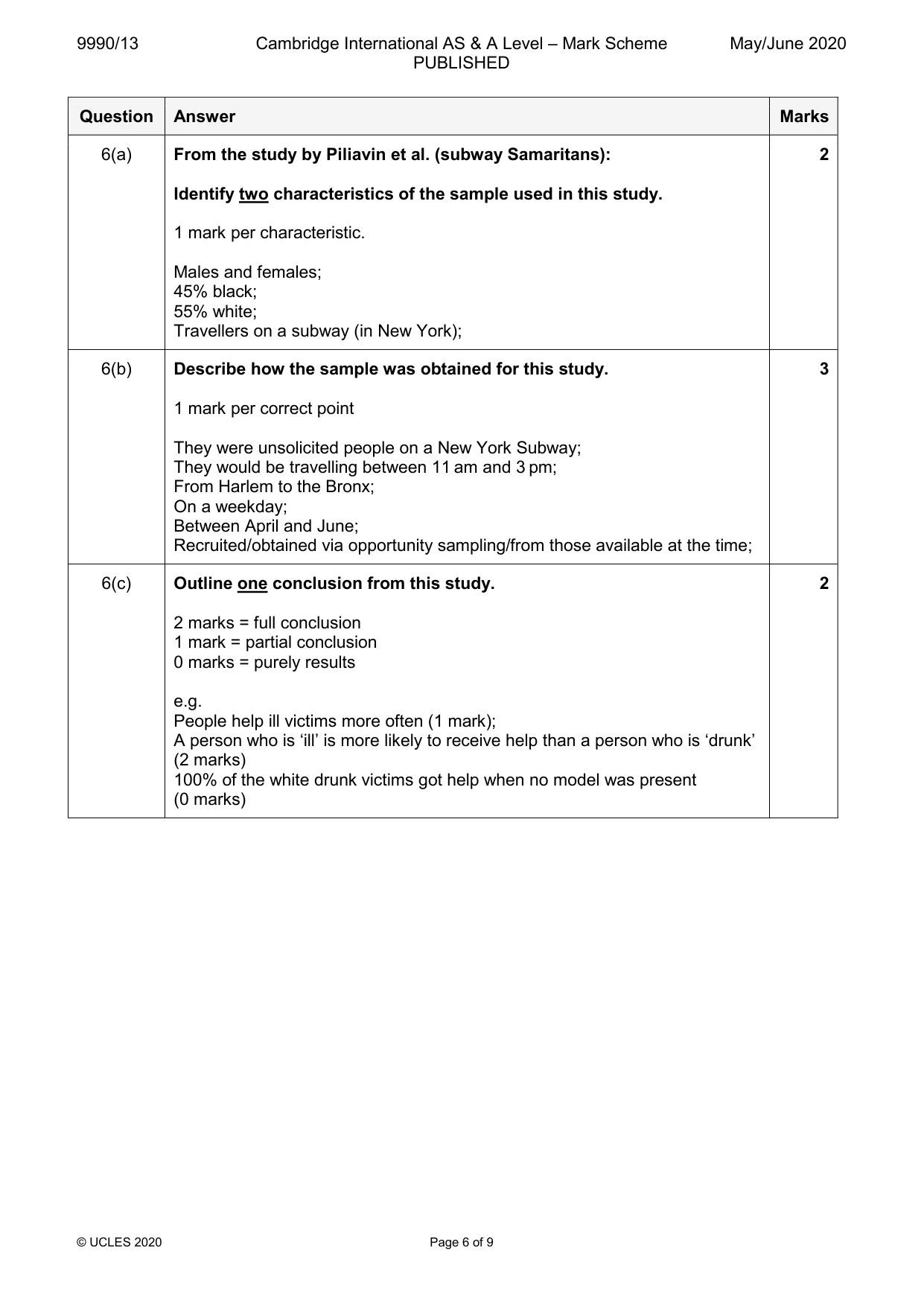
9990/13 Cambridge International AS & A Level – Mark Scheme PUBLISHED May/June 2020 © UCLES 2020 Page 6 of 9 Question Answer Marks 6(a) From the study by Piliavin et al. (subway Samaritans): Identify two characteristics of the sample used in this study. 1 mark per characteristic. Males and females; 45% black; 55% white; Travellers on a subway (in New York); 2 6(b) Describe how the sample was obtained for this study. 1 mark per correct point They were unsolicited people on a New York Subway; They would be travelling between 11 am and 3 pm; From Harlem to the Bronx; On a weekday; Between April and June; Recruited/obtained via opportunity sampling/from those available at the time; 3 6(c) Outline one conclusion from this study. 2 marks = full conclusion 1 mark = partial conclusion 0 marks = purely results e.g. People help ill victims more often (1 mark); A person who is ‘ill’ is more likely to receive help than a person who is ‘drunk’ (2 marks) 100% of the white drunk victims got help when no model was present (0 marks) 2
Mark scheme, page 7
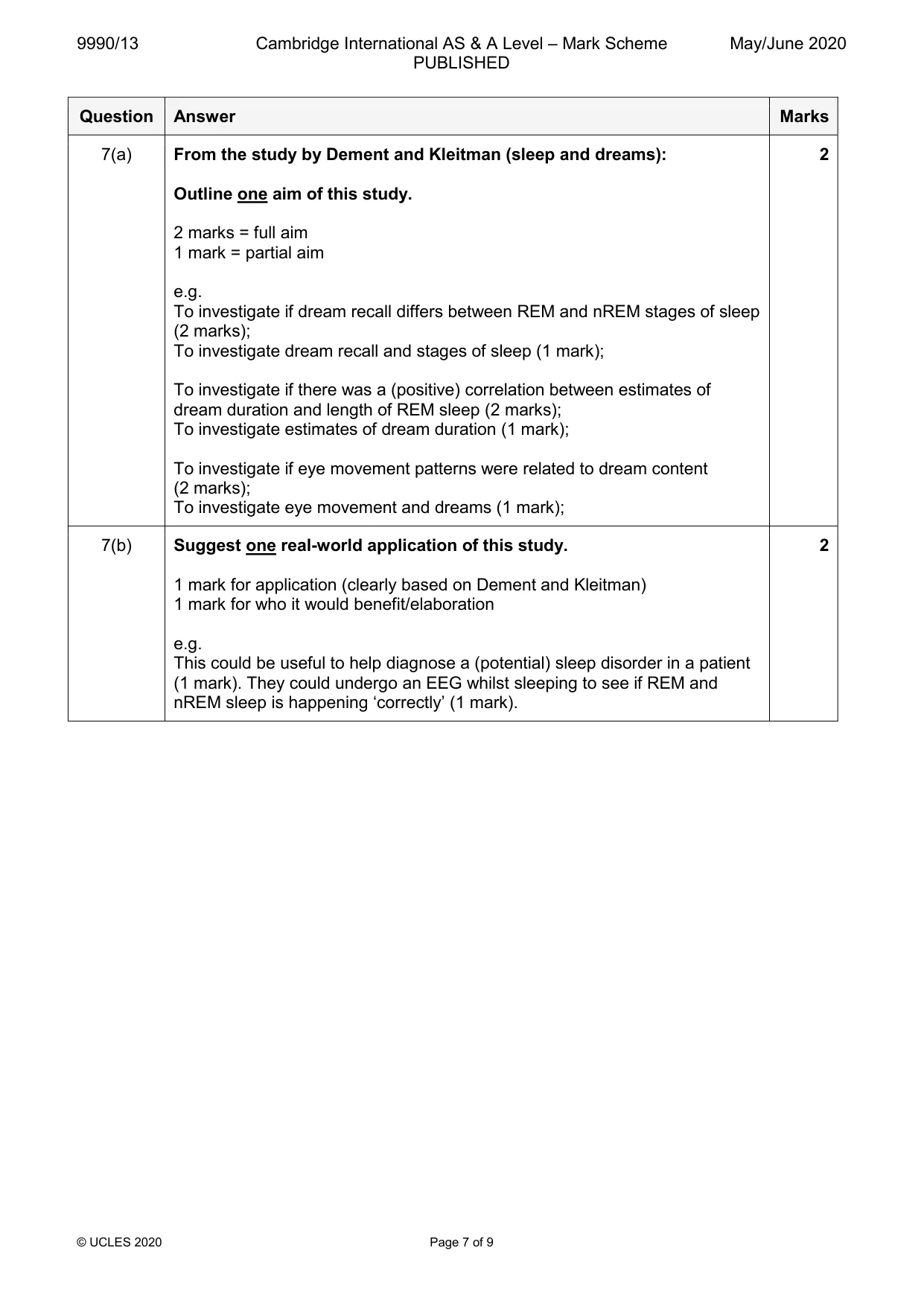
9990/13 Cambridge International AS & A Level – Mark Scheme PUBLISHED May/June 2020 © UCLES 2020 Page 7 of 9 Question Answer Marks 7(a) From the study by Dement and Kleitman (sleep and dreams): Outline one aim of this study. 2 marks = full aim 1 mark = partial aim e.g. To investigate if dream recall differs between REM and nREM stages of sleep (2 marks); To investigate dream recall and stages of sleep (1 mark); To investigate if there was a (positive) correlation between estimates of dream duration and length of REM sleep (2 marks); To investigate estimates of dream duration (1 mark); To investigate if eye movement patterns were related to dream content (2 marks); To investigate eye movement and dreams (1 mark); 2 7(b) Suggest one real-world application of this study. 1 mark for application (clearly based on Dement and Kleitman) 1 mark for who it would benefit/elaboration e.g. This could be useful to help diagnose a (potential) sleep disorder in a patient (1 mark). They could undergo an EEG whilst sleeping to see if REM and nREM sleep is happening ‘correctly’ (1 mark). 2
Mark scheme, page 8
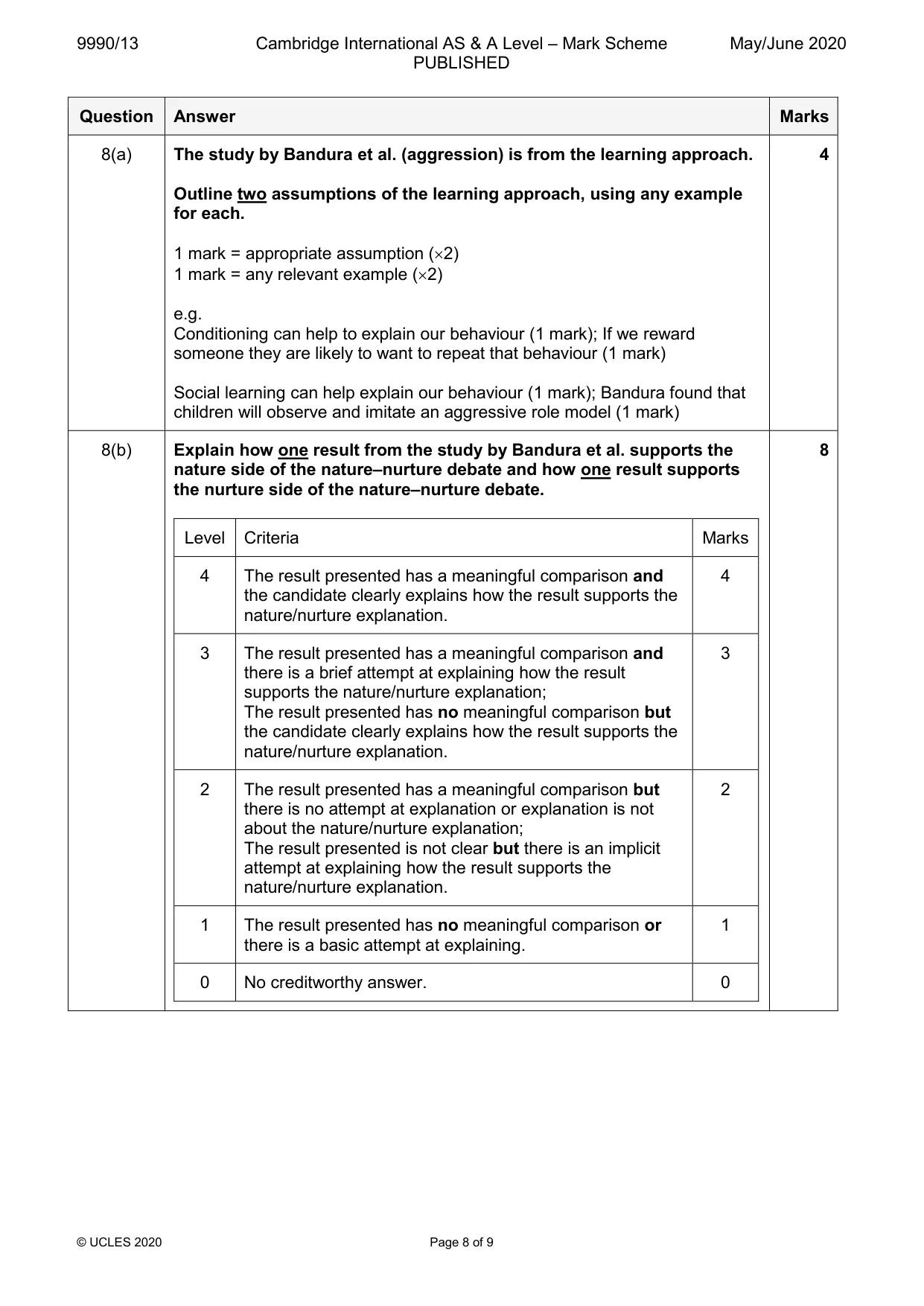
9990/13 Cambridge International AS & A Level – Mark Scheme PUBLISHED May/June 2020 © UCLES 2020 Page 8 of 9 Question Answer Marks 8(a) The study by Bandura et al. (aggression) is from the learning approach. Outline two assumptions of the learning approach, using any example for each. 1 mark = appropriate assumption (×2) 1 mark = any relevant example (×2) e.g. Conditioning can help to explain our behaviour (1 mark); If we reward someone they are likely to want to repeat that behaviour (1 mark) Social learning can help explain our behaviour (1 mark); Bandura found that children will observe and imitate an aggressive role model (1 mark) 4 8(b) Explain how one result from the study by Bandura et al. supports the nature side of the nature–nurture debate and how one result supports the nurture side of the nature–nurture debate. Level Criteria Marks 4 The result presented has a meaningful comparison and the candidate clearly explains how the result supports the nature/nurture explanation. 4 3 The result presented has a meaningful comparison and there is a brief attempt at explaining how the result supports the nature/nurture explanation; The result presented has no meaningful comparison but the candidate clearly explains how the result supports the nature/nurture explanation. 3 2 The result presented has a meaningful comparison but there is no attempt at explanation or explanation is not about the nature/nurture explanation; The result presented is not clear but there is an implicit attempt at explaining how the result supports the nature/nurture explanation. 2 1 The result presented has no meaningful comparison or there is a basic attempt at explaining. 1 0 No creditworthy answer. 0 8
Mark scheme, page 9
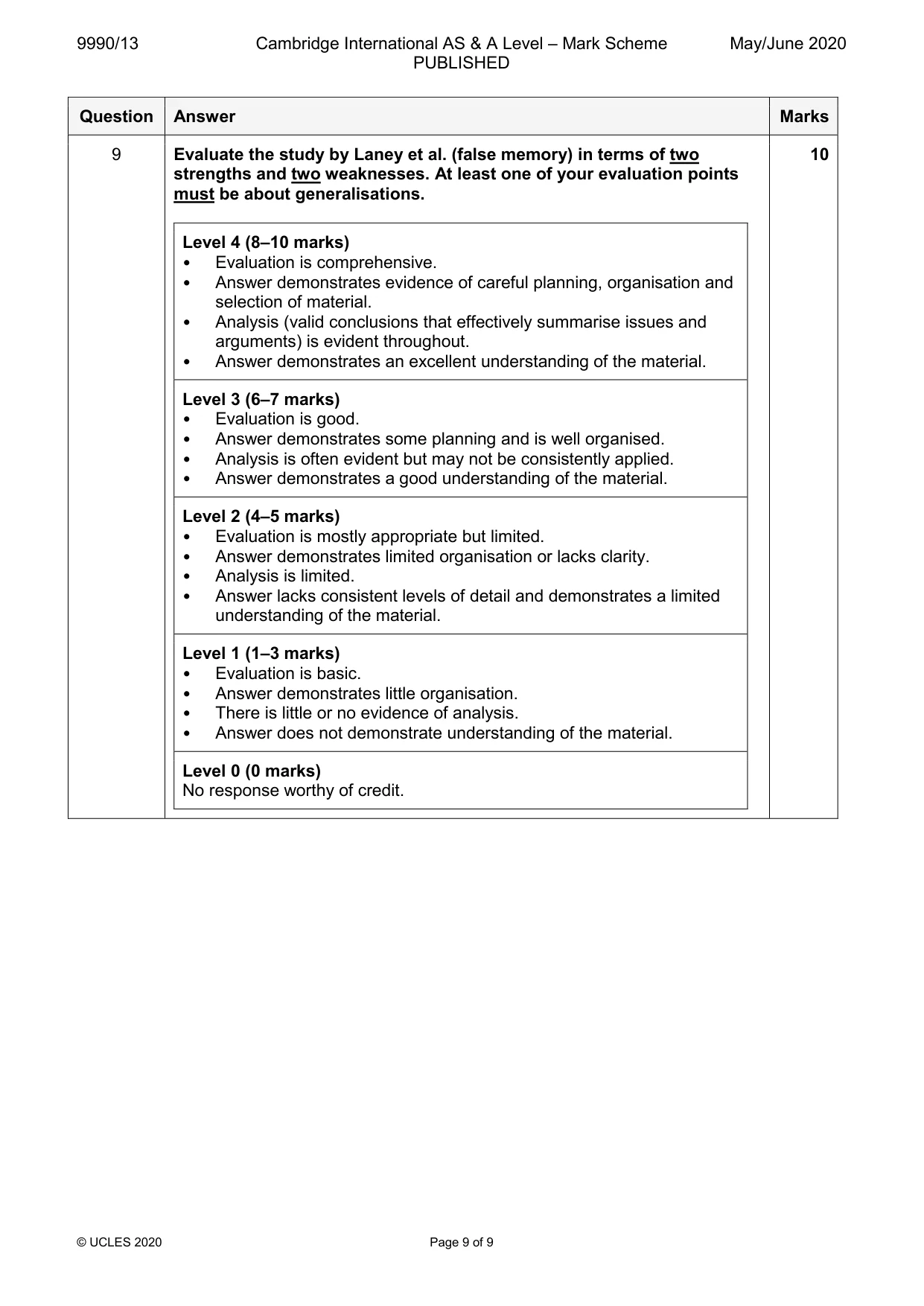
9990/13 Cambridge International AS & A Level – Mark Scheme PUBLISHED May/June 2020 © UCLES 2020 Page 9 of 9 Question Answer Marks 9 Evaluate the study by Laney et al. (false memory) in terms of two strengths and two weaknesses. At least one of your evaluation points must be about generalisations. Level 4 (8–10 marks) • Evaluation is comprehensive. • Answer demonstrates evidence of careful planning, organisation and selection of material. • Analysis (valid conclusions that effectively summarise issues and arguments) is evident throughout. • Answer demonstrates an excellent understanding of the material. Level 3 (6–7 marks) • Evaluation is good. • Answer demonstrates some planning and is well organised. • Analysis is often evident but may not be consistently applied. • Answer demonstrates a good understanding of the material. Level 2 (4–5 marks) • Evaluation is mostly appropriate but limited. • Answer demonstrates limited organisation or lacks clarity. • Analysis is limited. • Answer lacks consistent levels of detail and demonstrates a limited understanding of the material. Level 1 (1–3 marks) • Evaluation is basic. • Answer demonstrates little organisation. • There is little or no evidence of analysis. • Answer does not demonstrate understanding of the material. Level 0 (0 marks) No response worthy of credit. 10