Cambridge A Level Psychology (from 2018) 9990 — 2020 May/June Paper 1 · Variant 1
9990/11/M/J/20
The question paper and its mark scheme, free to read here and free to download. This is Cambridge’s own paper, exactly as it was sat.
Question paper12 pages



Mark scheme8 pages
Answers below. Sit the paper first if you are practising.
Paper as text
Question paper, page 1
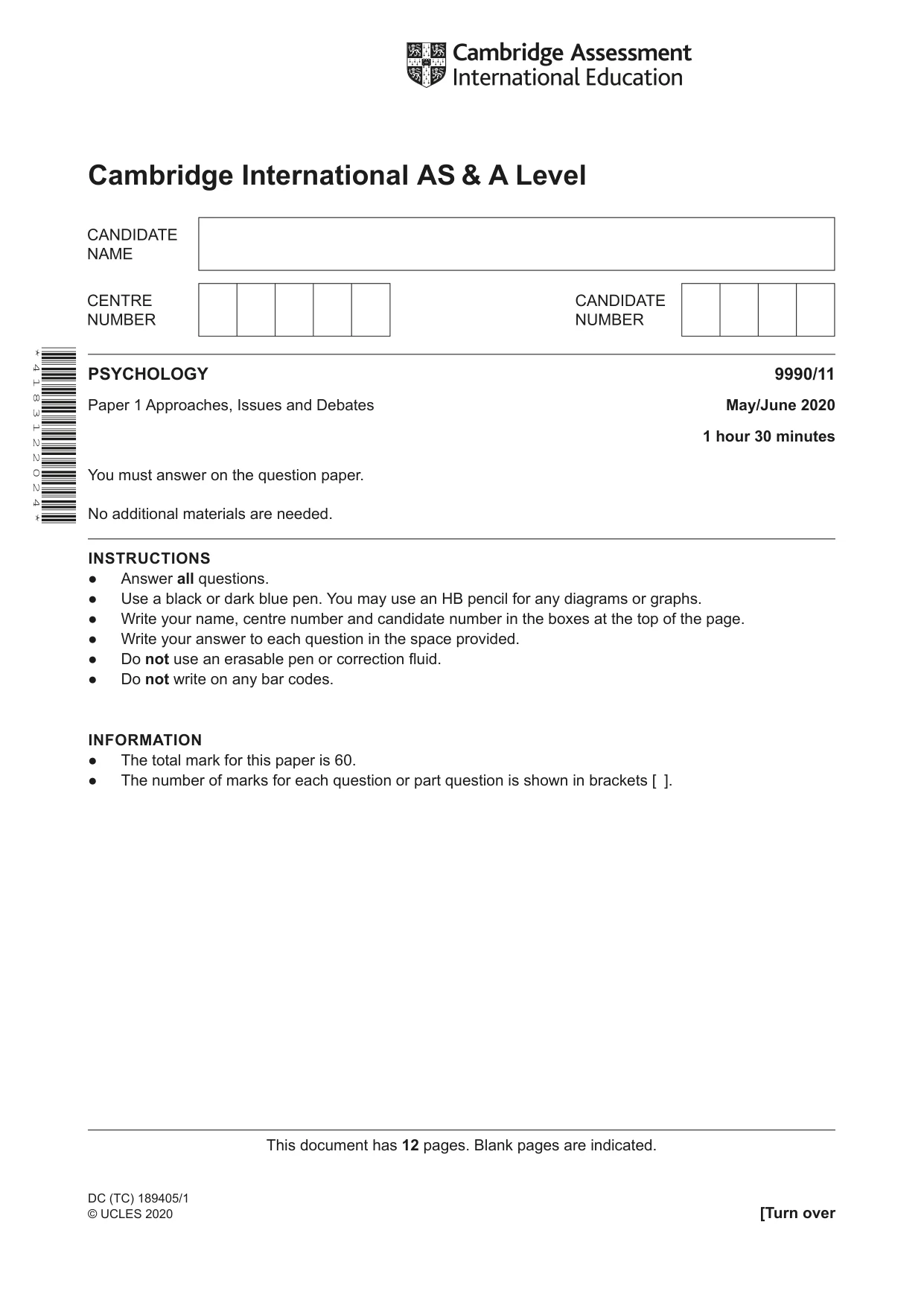
* 4 1 8 3 1 2 2 0 2 4 * This document has 12 pages. Blank pages are indicated. DC (TC) 189405/1 © UCLES 2020 [Turn over PSYCHOLOGY 9990/11 Paper 1 Approaches, Issues and Debates May/June 2020 1 hour 30 minutes You must answer on the question paper. No additional materials are needed. INSTRUCTIONS ● Answer all questions. ● Use a black or dark blue pen. You may use an HB pencil for any diagrams or graphs. ● Write your name, centre number and candidate number in the boxes at the top of the page. ● Write your answer to each question in the space provided. ● Do not use an erasable pen or correction fluid. ● Do not write on any bar codes. INFORMATION ● The total mark for this paper is 60. ● The number of marks for each question or part question is shown in brackets [ ]. Cambridge International AS & A Level
Question paper, page 2
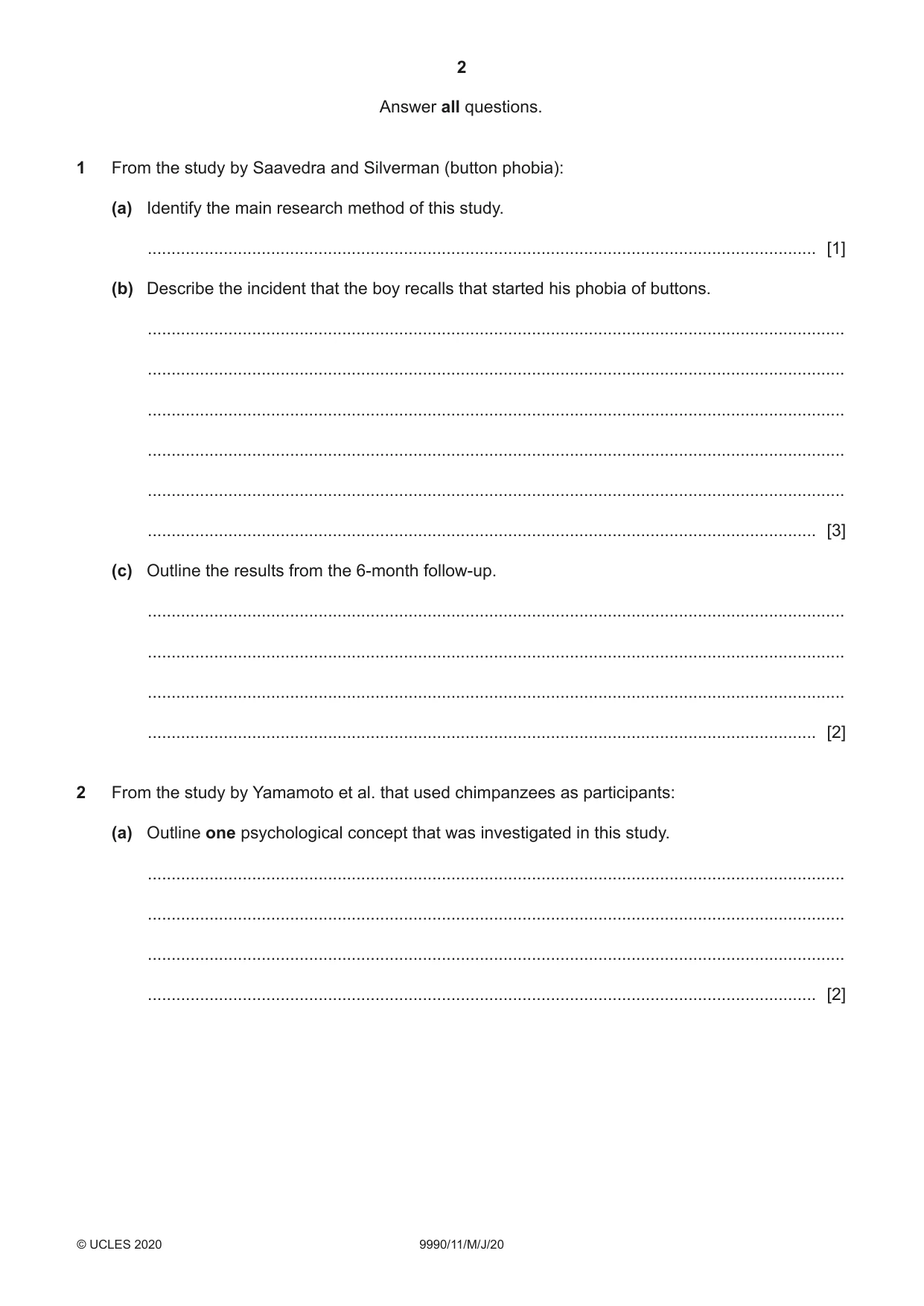
2 9990/11/M/J/20 © UCLES 2020 Answer all questions. 1 From the study by Saavedra and Silverman (button phobia): (a) Identify the main research method of this study. … [1] (b) Describe the incident that the boy recalls that started his phobia of buttons. … … … … … … [3] (c) Outline the results from the 6-month follow-up. … … … … [2] 2 From the study by Yamamoto et al. that used chimpanzees as participants: (a) Outline one psychological concept that was investigated in this study. … … … … [2]
Question paper, page 3
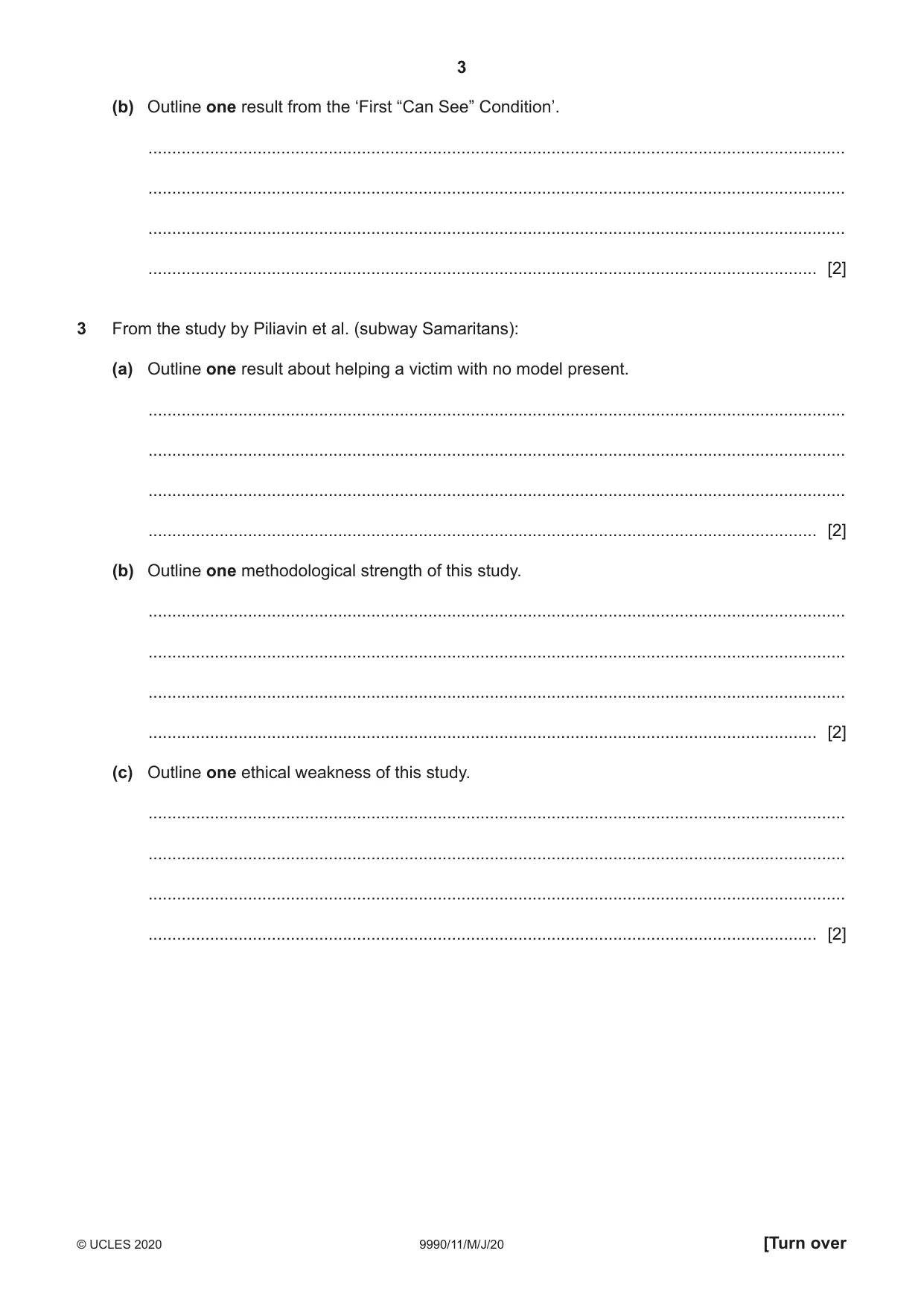
3 9990/11/M/J/20 © UCLES 2020 [Turn over (b) Outline one result from the ‘First “Can See” Condition’. … … … … [2] 3 From the study by Piliavin et al. (subway Samaritans): (a) Outline one result about helping a victim with no model present. … … … … [2] (b) Outline one methodological strength of this study. … … … … [2] (c) Outline one ethical weakness of this study. … … … … [2]
Question paper, page 4
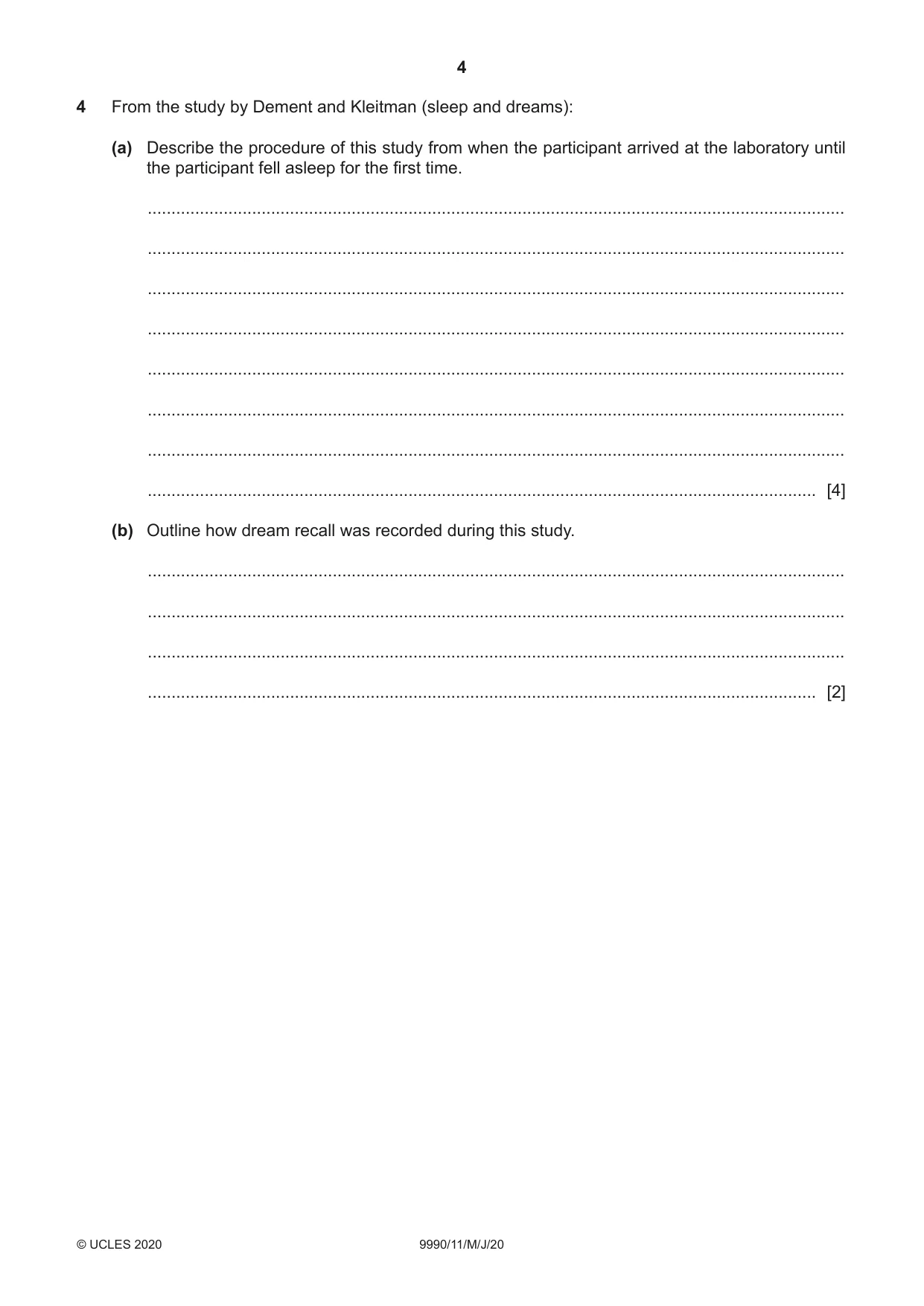
4 9990/11/M/J/20 © UCLES 2020 4 From the study by Dement and Kleitman (sleep and dreams): (a) Describe the procedure of this study from when the participant arrived at the laboratory until the participant fell asleep for the first time. … … … … … … … … [4] (b) Outline how dream recall was recorded during this study. … … … … [2]
Question paper, page 5
5 9990/11/M/J/20 © UCLES 2020 [Turn over BLANK PAGE
Question paper, page 6
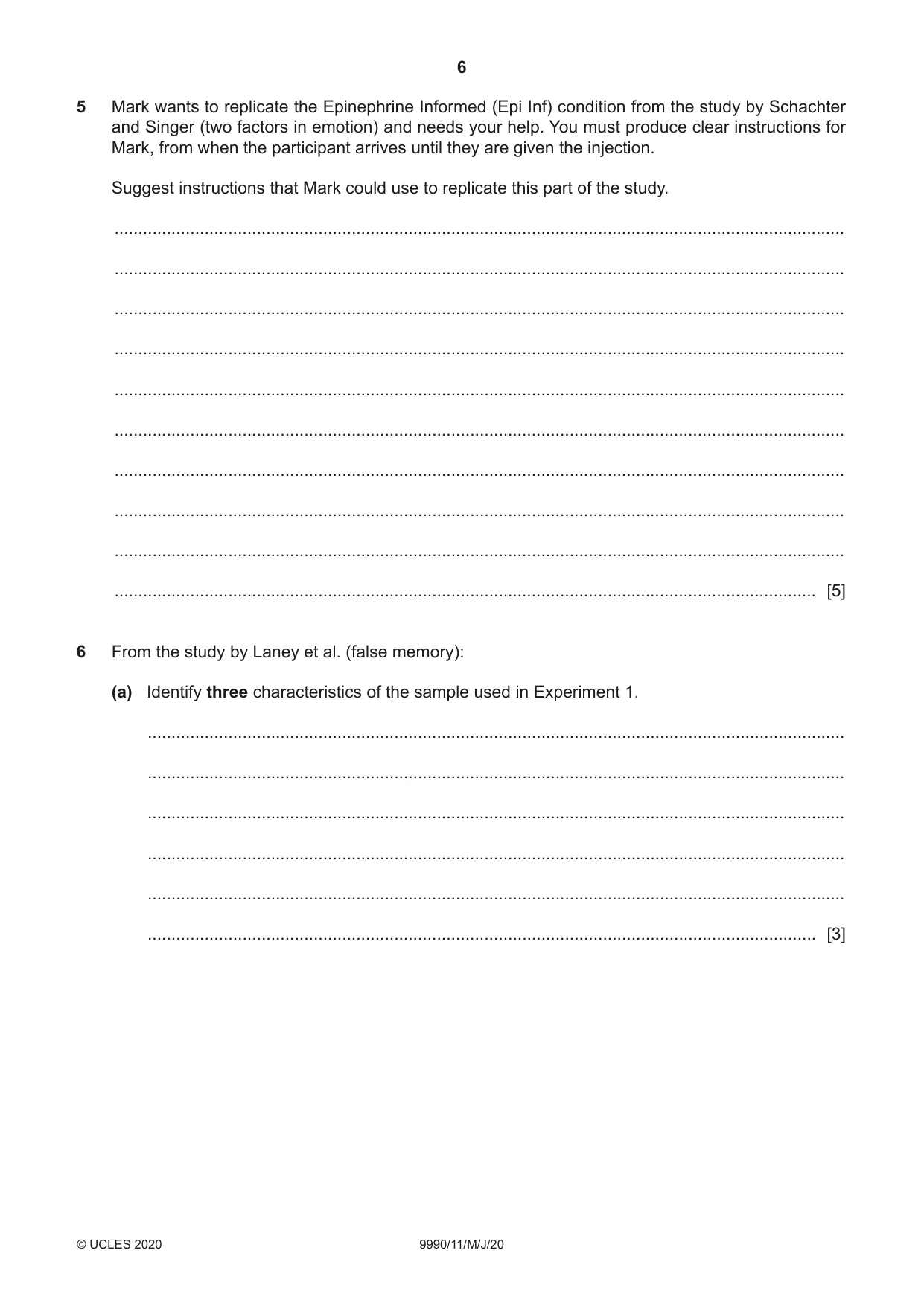
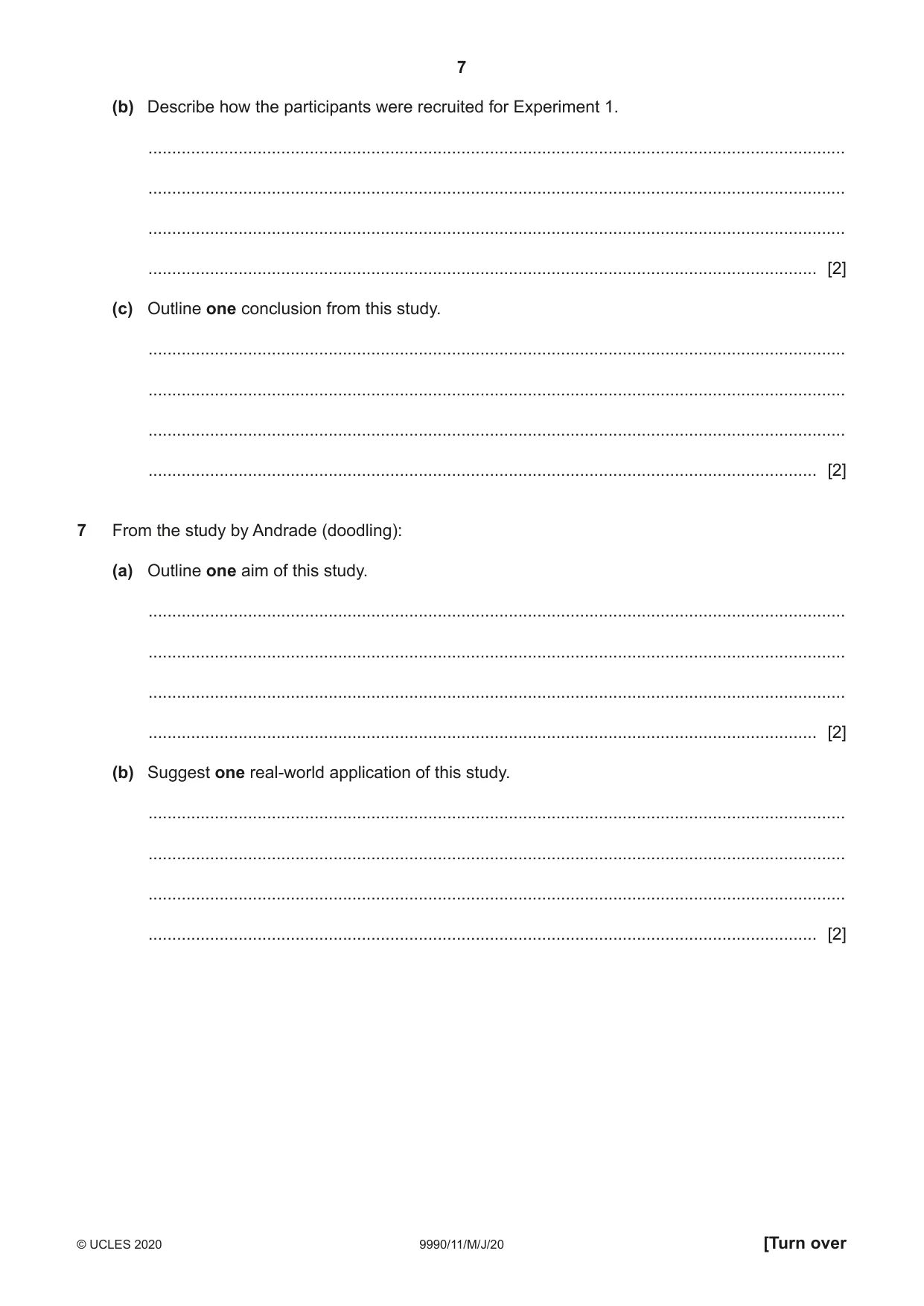
6 9990/11/M/J/20 © UCLES 2020 5 Mark wants to replicate the Epinephrine Informed (Epi Inf) condition from the study by Schachter and Singer (two factors in emotion) and needs your help. You must produce clear instructions for Mark, from when the participant arrives until they are given the injection. Suggest instructions that Mark could use to replicate this part of the study. … … … … … … … … … … [5] 6 From the study by Laney et al. (false memory): (a) Identify three characteristics of the sample used in Experiment 1. … … … … … … [3]
Question paper, page 7
7 9990/11/M/J/20 © UCLES 2020 [Turn over (b) Describe how the participants were recruited for Experiment 1. … … … … [2] (c) Outline one conclusion from this study. … … … … [2] 7 From the study by Andrade (doodling): (a) Outline one aim of this study. … … … … [2] (b) Suggest one real-world application of this study. … … … … [2]
Question paper, page 8
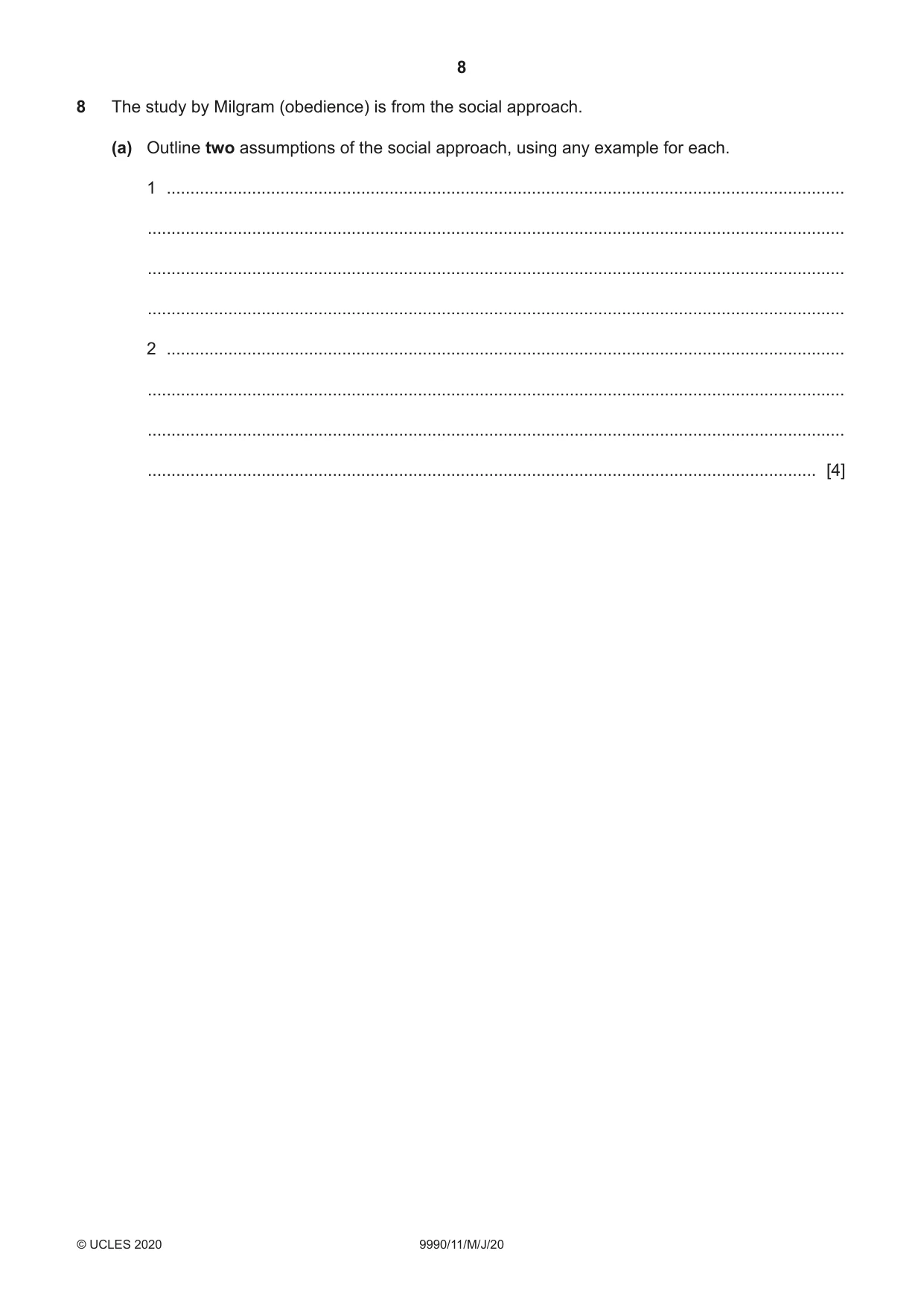
8 9990/11/M/J/20 © UCLES 2020 8 The study by Milgram (obedience) is from the social approach. (a) Outline two assumptions of the social approach, using any example for each. 1 … … … … 2 … … … … [4]
Question paper, page 9
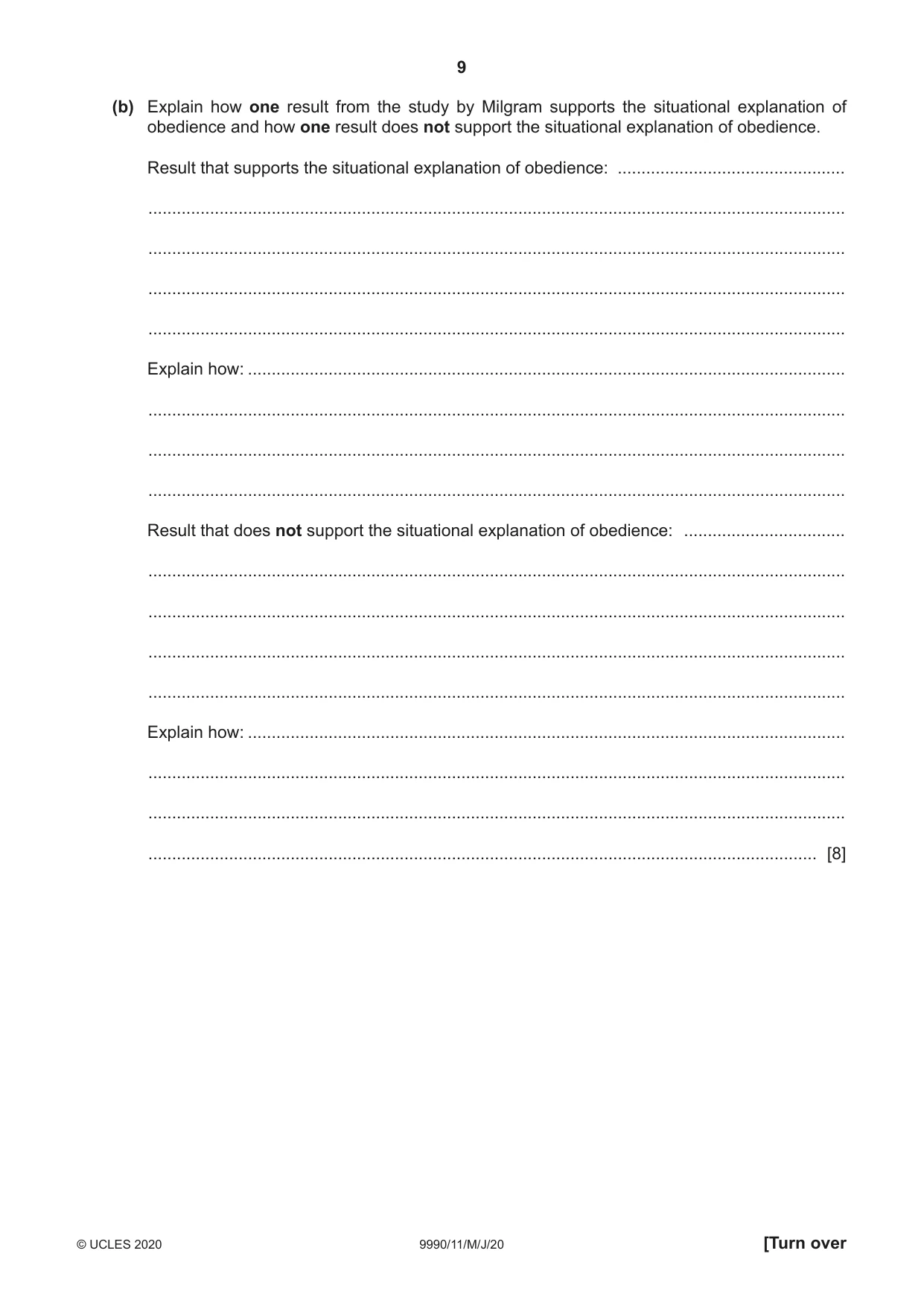
9 9990/11/M/J/20 © UCLES 2020 [Turn over (b) Explain how one result from the study by Milgram supports the situational explanation of obedience and how one result does not support the situational explanation of obedience. Result that supports the situational explanation of obedience: … … … … … Explain how: … … … … Result that does not support the situational explanation of obedience: … … … … … Explain how: … … … … [8]
Question paper, page 10
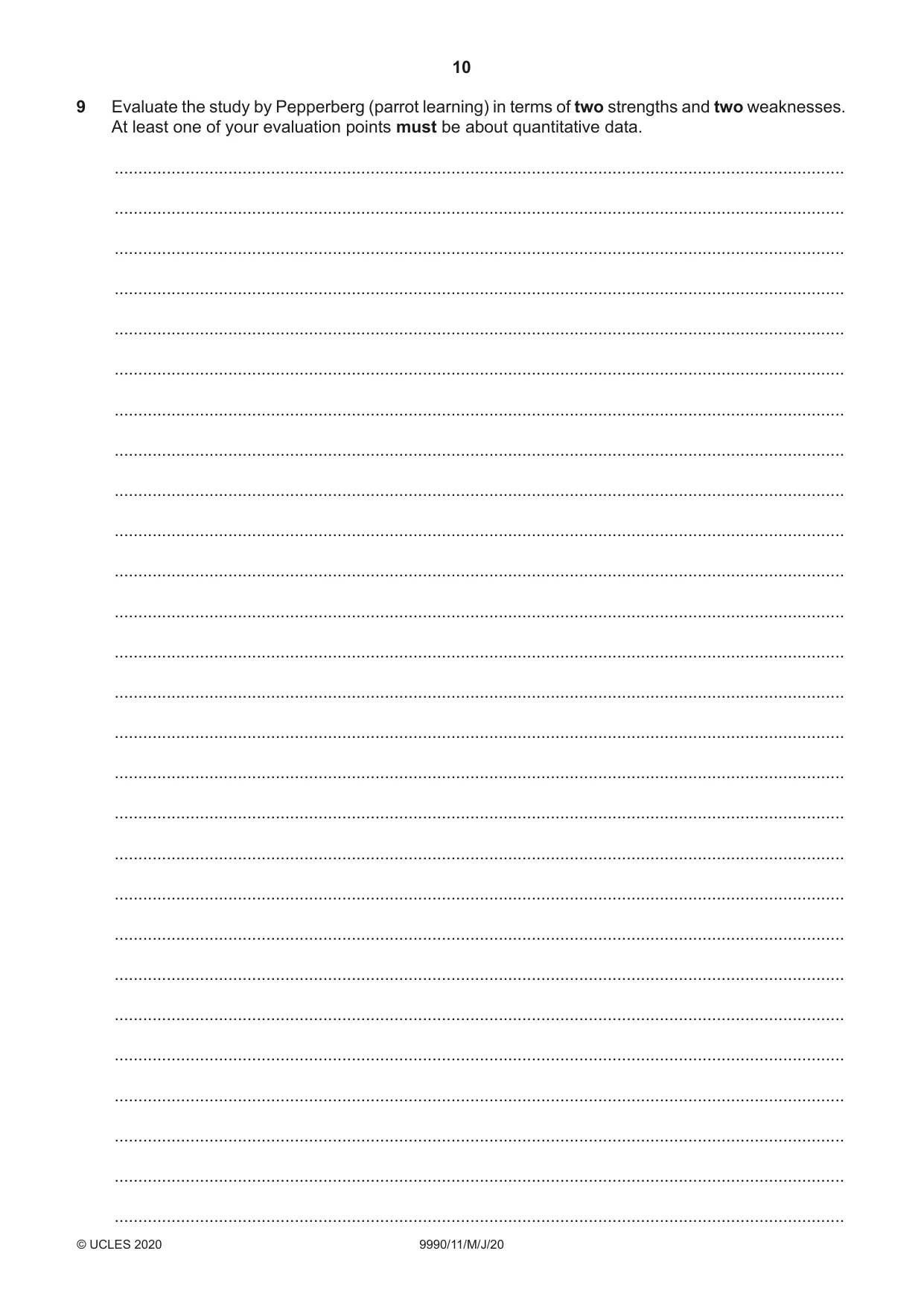
10 9990/11/M/J/20 © UCLES 2020 9 Evaluate the study by Pepperberg (parrot learning) in terms of two strengths and two weaknesses. At least one of your evaluation points must be about quantitative data. … … … … … … … … … … … … … … … … … … … … … … … … … … …
Question paper, page 11
11 9990/11/M/J/20 © UCLES 2020 … … … … … … … … … … … … … … … [10]
Question paper, page 12
12 9990/11/M/J/20 © UCLES 2020 BLANK PAGE Permission to reproduce items where third-party owned material protected by copyright is included has been sought and cleared where possible. Every reasonable effort has been made by the publisher (UCLES) to trace copyright holders, but if any items requiring clearance have unwittingly been included, the publisher will be pleased to make amends at the earliest possible opportunity. To avoid the issue of disclosure of answer-related information to candidates, all copyright acknowledgements are reproduced online in the Cambridge Assessment International Education Copyright Acknowledgements Booklet. This is produced for each series of examinations and is freely available to download at www.cambridgeinternational.org after the live examination series. Cambridge Assessment International Education is part of the Cambridge Assessment Group. Cambridge Assessment is the brand name of the University of Cambridge Local Examinations Syndicate (UCLES), which itself is a department of the University of Cambridge.
Mark scheme, page 1
This document consists of 8 printed pages. © UCLES 2020 [Turn over Cambridge International AS & A Level PSYCHOLOGY 9990/11 Paper 1 Approaches, issues and debates May/June 2020 MARK SCHEME Maximum Mark: 60 Published Students did not sit exam papers in the June 2020 series due to the Covid-19 global pandemic. This mark scheme is published to support teachers and students and should be read together with the question paper. It shows the requirements of the exam. The answer column of the mark scheme shows the proposed basis on which Examiners would award marks for this exam. Where appropriate, this column also provides the most likely acceptable alternative responses expected from students. Examiners usually review the mark scheme after they have seen student responses and update the mark scheme if appropriate. In the June series, Examiners were unable to consider the acceptability of alternative responses, as there were no student responses to consider. Mark schemes should usually be read together with the Principal Examiner Report for Teachers. However, because students did not sit exam papers, there is no Principal Examiner Report for Teachers for the June 2020 series. Cambridge International will not enter into discussions about these mark schemes. Cambridge International is publishing the mark schemes for the June 2020 series for most Cambridge IGCSE™ and Cambridge International A & AS Level components, and some Cambridge O Level components.
Mark scheme, page 2
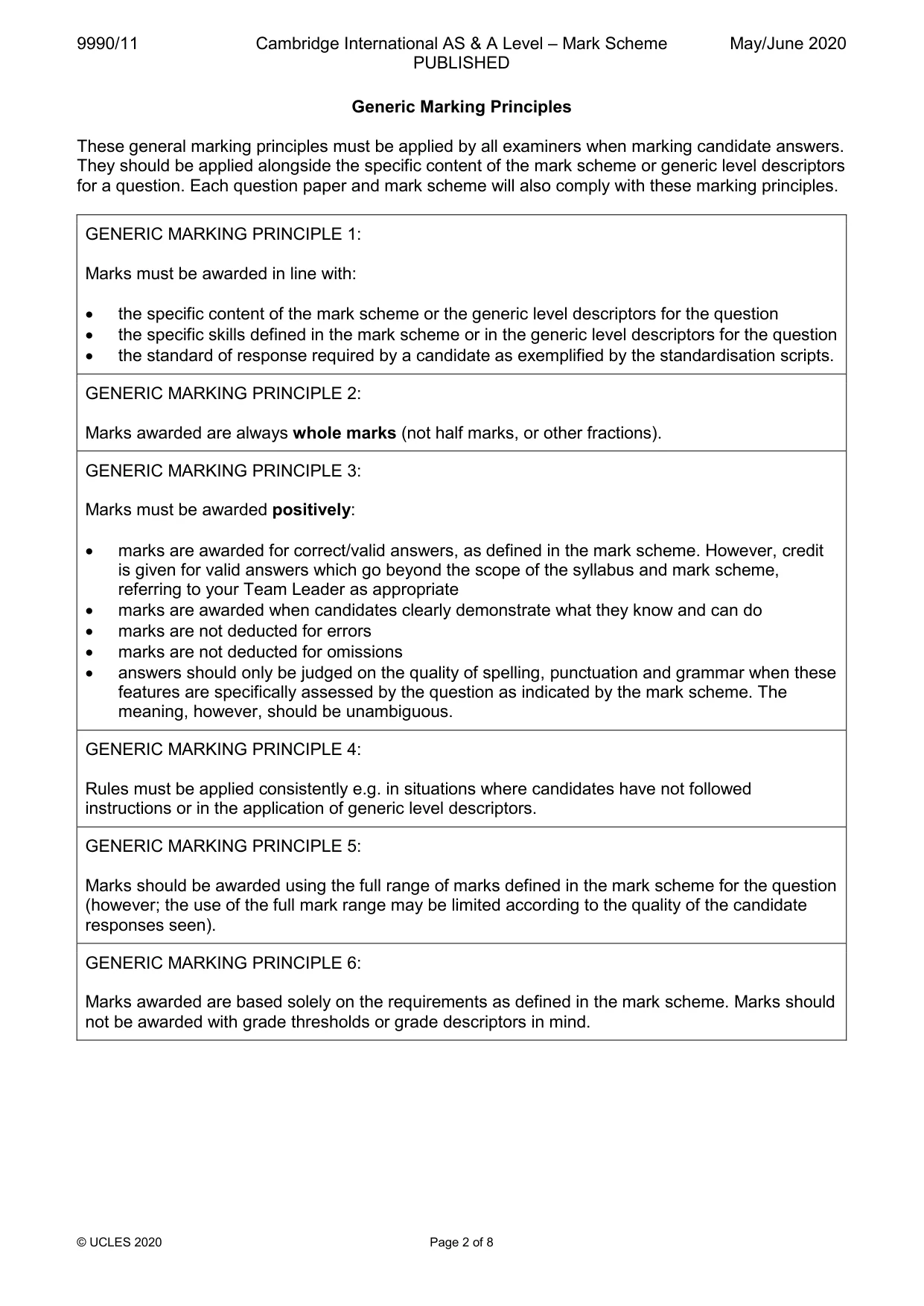
9990/11 Cambridge International AS & A Level – Mark Scheme PUBLISHED May/June 2020 © UCLES 2020 Page 2 of 8 Generic Marking Principles These general marking principles must be applied by all examiners when marking candidate answers. They should be applied alongside the specific content of the mark scheme or generic level descriptors for a question. Each question paper and mark scheme will also comply with these marking principles. GENERIC MARKING PRINCIPLE 1: Marks must be awarded in line with: • the specific content of the mark scheme or the generic level descriptors for the question • the specific skills defined in the mark scheme or in the generic level descriptors for the question • the standard of response required by a candidate as exemplified by the standardisation scripts. GENERIC MARKING PRINCIPLE 2: Marks awarded are always whole marks (not half marks, or other fractions). GENERIC MARKING PRINCIPLE 3: Marks must be awarded positively: • marks are awarded for correct/valid answers, as defined in the mark scheme. However, credit is given for valid answers which go beyond the scope of the syllabus and mark scheme, referring to your Team Leader as appropriate • marks are awarded when candidates clearly demonstrate what they know and can do • marks are not deducted for errors • marks are not deducted for omissions • answers should only be judged on the quality of spelling, punctuation and grammar when these features are specifically assessed by the question as indicated by the mark scheme. The meaning, however, should be unambiguous. GENERIC MARKING PRINCIPLE 4: Rules must be applied consistently e.g. in situations where candidates have not followed instructions or in the application of generic level descriptors. GENERIC MARKING PRINCIPLE 5: Marks should be awarded using the full range of marks defined in the mark scheme for the question (however; the use of the full mark range may be limited according to the quality of the candidate responses seen). GENERIC MARKING PRINCIPLE 6: Marks awarded are based solely on the requirements as defined in the mark scheme. Marks should not be awarded with grade thresholds or grade descriptors in mind.
Mark scheme, page 3
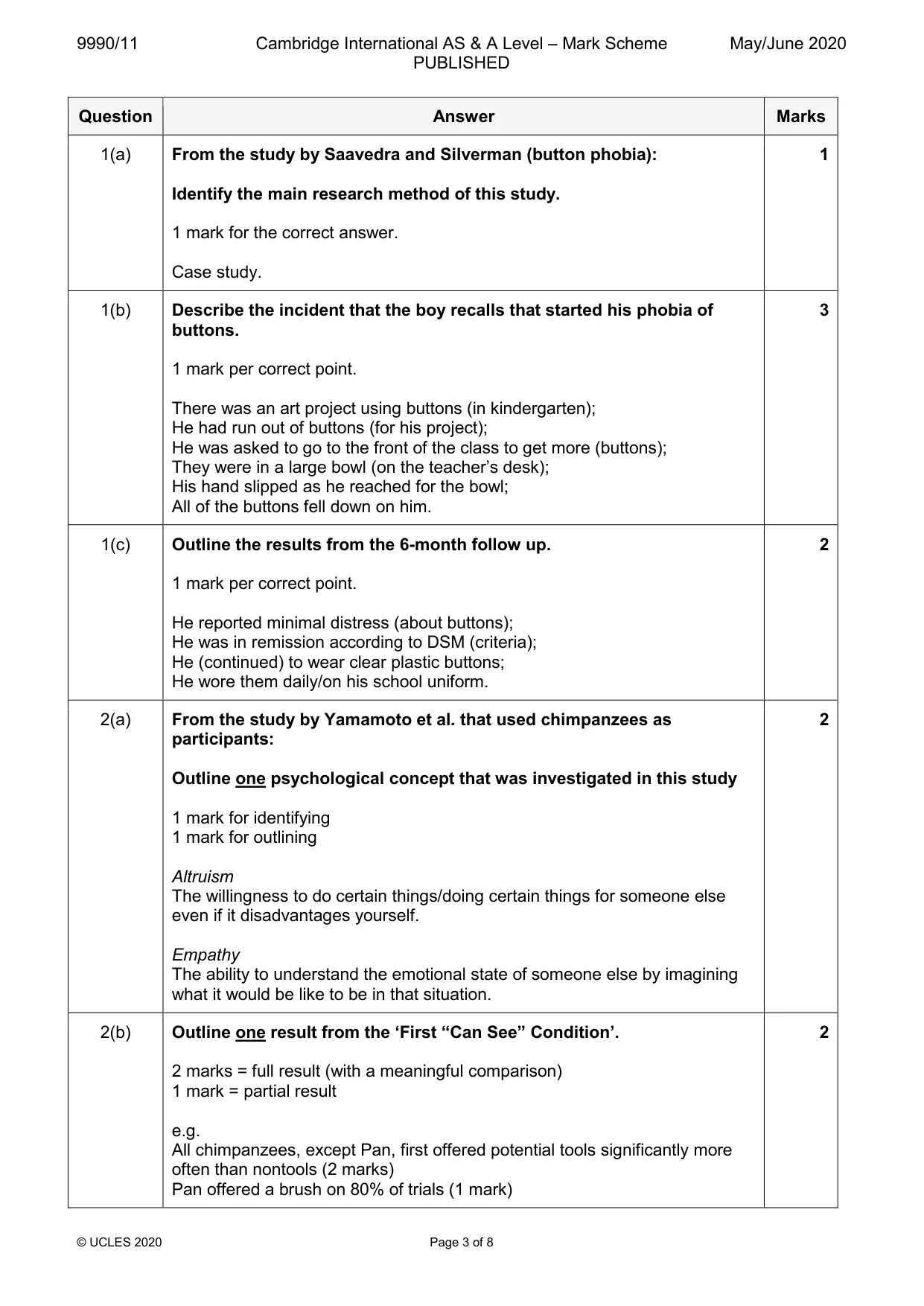
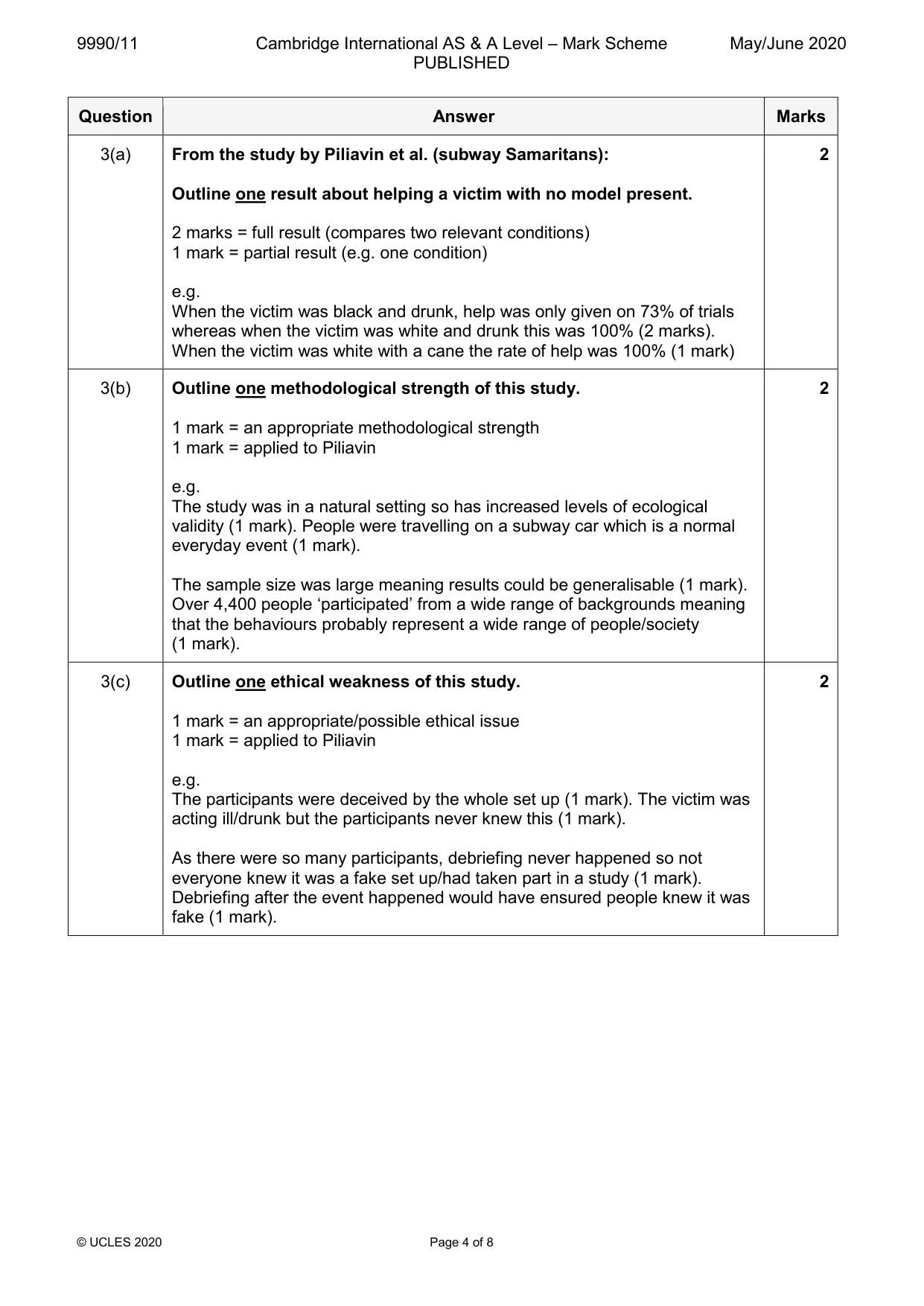
9990/11 Cambridge International AS & A Level – Mark Scheme PUBLISHED May/June 2020 © UCLES 2020 Page 3 of 8 Question Answer Marks 1(a) From the study by Saavedra and Silverman (button phobia): Identify the main research method of this study. 1 mark for the correct answer. Case study. 1 1(b) Describe the incident that the boy recalls that started his phobia of buttons. 1 mark per correct point. There was an art project using buttons (in kindergarten); He had run out of buttons (for his project); He was asked to go to the front of the class to get more (buttons); They were in a large bowl (on the teacher’s desk); His hand slipped as he reached for the bowl; All of the buttons fell down on him. 3 1(c) Outline the results from the 6-month follow up. 1 mark per correct point. He reported minimal distress (about buttons); He was in remission according to DSM (criteria); He (continued) to wear clear plastic buttons; He wore them daily/on his school uniform. 2 2(a) From the study by Yamamoto et al. that used chimpanzees as participants: Outline one psychological concept that was investigated in this study 1 mark for identifying 1 mark for outlining Altruism The willingness to do certain things/doing certain things for someone else even if it disadvantages yourself. Empathy The ability to understand the emotional state of someone else by imagining what it would be like to be in that situation. 2 2(b) Outline one result from the ‘First “Can See” Condition’. 2 marks = full result (with a meaningful comparison) 1 mark = partial result e.g. All chimpanzees, except Pan, first offered potential tools significantly more often than nontools (2 marks) Pan offered a brush on 80% of trials (1 mark) 2
Mark scheme, page 4
9990/11 Cambridge International AS & A Level – Mark Scheme PUBLISHED May/June 2020 © UCLES 2020 Page 4 of 8 Question Answer Marks 3(a) From the study by Piliavin et al. (subway Samaritans): Outline one result about helping a victim with no model present. 2 marks = full result (compares two relevant conditions) 1 mark = partial result (e.g. one condition) e.g. When the victim was black and drunk, help was only given on 73% of trials whereas when the victim was white and drunk this was 100% (2 marks). When the victim was white with a cane the rate of help was 100% (1 mark) 2 3(b) Outline one methodological strength of this study. 1 mark = an appropriate methodological strength 1 mark = applied to Piliavin e.g. The study was in a natural setting so has increased levels of ecological validity (1 mark). People were travelling on a subway car which is a normal everyday event (1 mark). The sample size was large meaning results could be generalisable (1 mark). Over 4,400 people ‘participated’ from a wide range of backgrounds meaning that the behaviours probably represent a wide range of people/society (1 mark). 2 3(c) Outline one ethical weakness of this study. 1 mark = an appropriate/possible ethical issue 1 mark = applied to Piliavin e.g. The participants were deceived by the whole set up (1 mark). The victim was acting ill/drunk but the participants never knew this (1 mark). As there were so many participants, debriefing never happened so not everyone knew it was a fake set up/had taken part in a study (1 mark). Debriefing after the event happened would have ensured people knew it was fake (1 mark). 2
Mark scheme, page 5
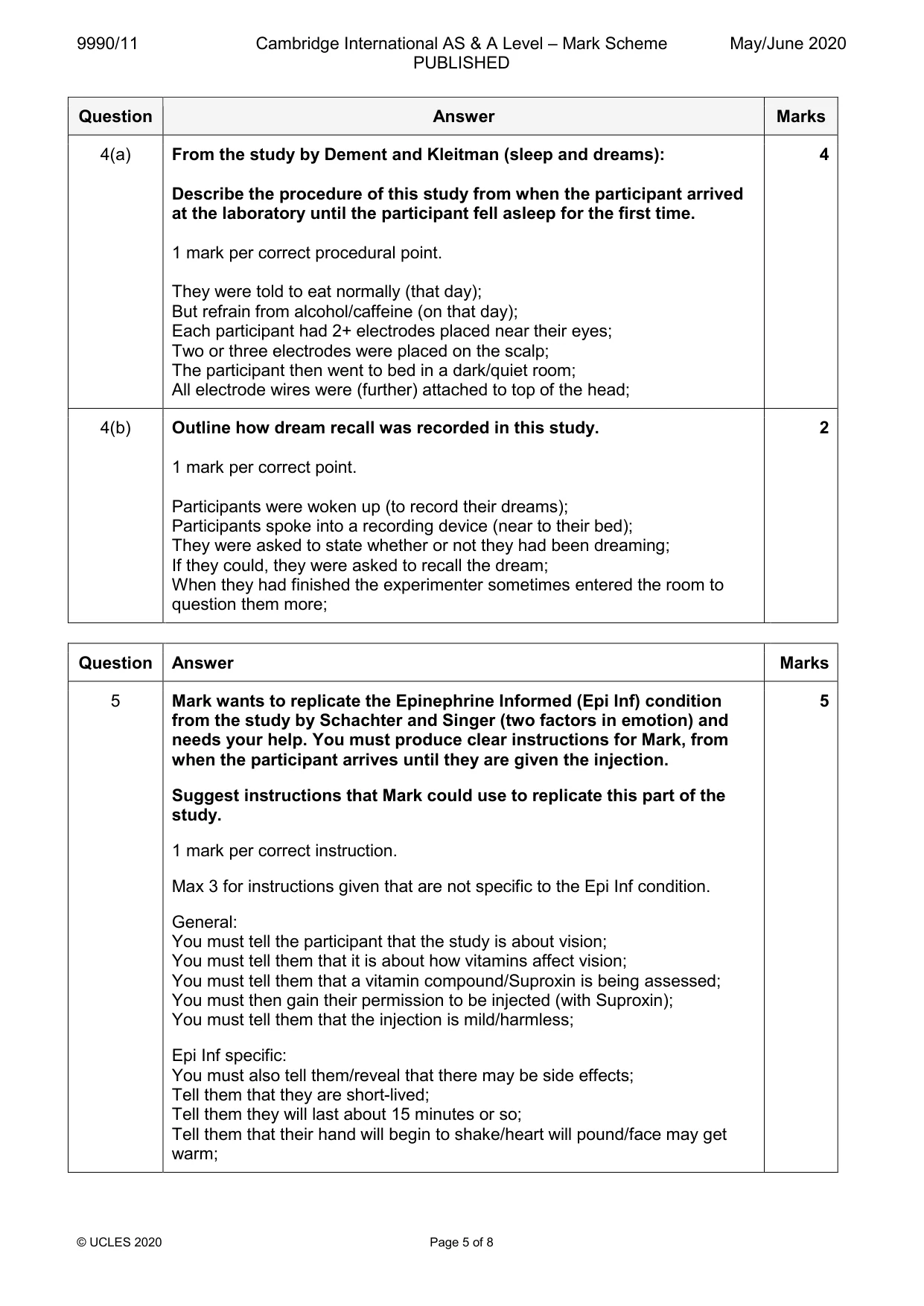
9990/11 Cambridge International AS & A Level – Mark Scheme PUBLISHED May/June 2020 © UCLES 2020 Page 5 of 8 Question Answer Marks 4(a) From the study by Dement and Kleitman (sleep and dreams): Describe the procedure of this study from when the participant arrived at the laboratory until the participant fell asleep for the first time. 1 mark per correct procedural point. They were told to eat normally (that day); But refrain from alcohol/caffeine (on that day); Each participant had 2+ electrodes placed near their eyes; Two or three electrodes were placed on the scalp; The participant then went to bed in a dark/quiet room; All electrode wires were (further) attached to top of the head; 4 4(b) Outline how dream recall was recorded in this study. 1 mark per correct point. Participants were woken up (to record their dreams); Participants spoke into a recording device (near to their bed); They were asked to state whether or not they had been dreaming; If they could, they were asked to recall the dream; When they had finished the experimenter sometimes entered the room to question them more; 2 Question Answer Marks 5 Mark wants to replicate the Epinephrine Informed (Epi Inf) condition from the study by Schachter and Singer (two factors in emotion) and needs your help. You must produce clear instructions for Mark, from when the participant arrives until they are given the injection. Suggest instructions that Mark could use to replicate this part of the study. 1 mark per correct instruction. Max 3 for instructions given that are not specific to the Epi Inf condition. General: You must tell the participant that the study is about vision; You must tell them that it is about how vitamins affect vision; You must tell them that a vitamin compound/Suproxin is being assessed; You must then gain their permission to be injected (with Suproxin); You must tell them that the injection is mild/harmless; Epi Inf specific: You must also tell them/reveal that there may be side effects; Tell them that they are short-lived; Tell them they will last about 15 minutes or so; Tell them that their hand will begin to shake/heart will pound/face may get warm; 5
Mark scheme, page 6
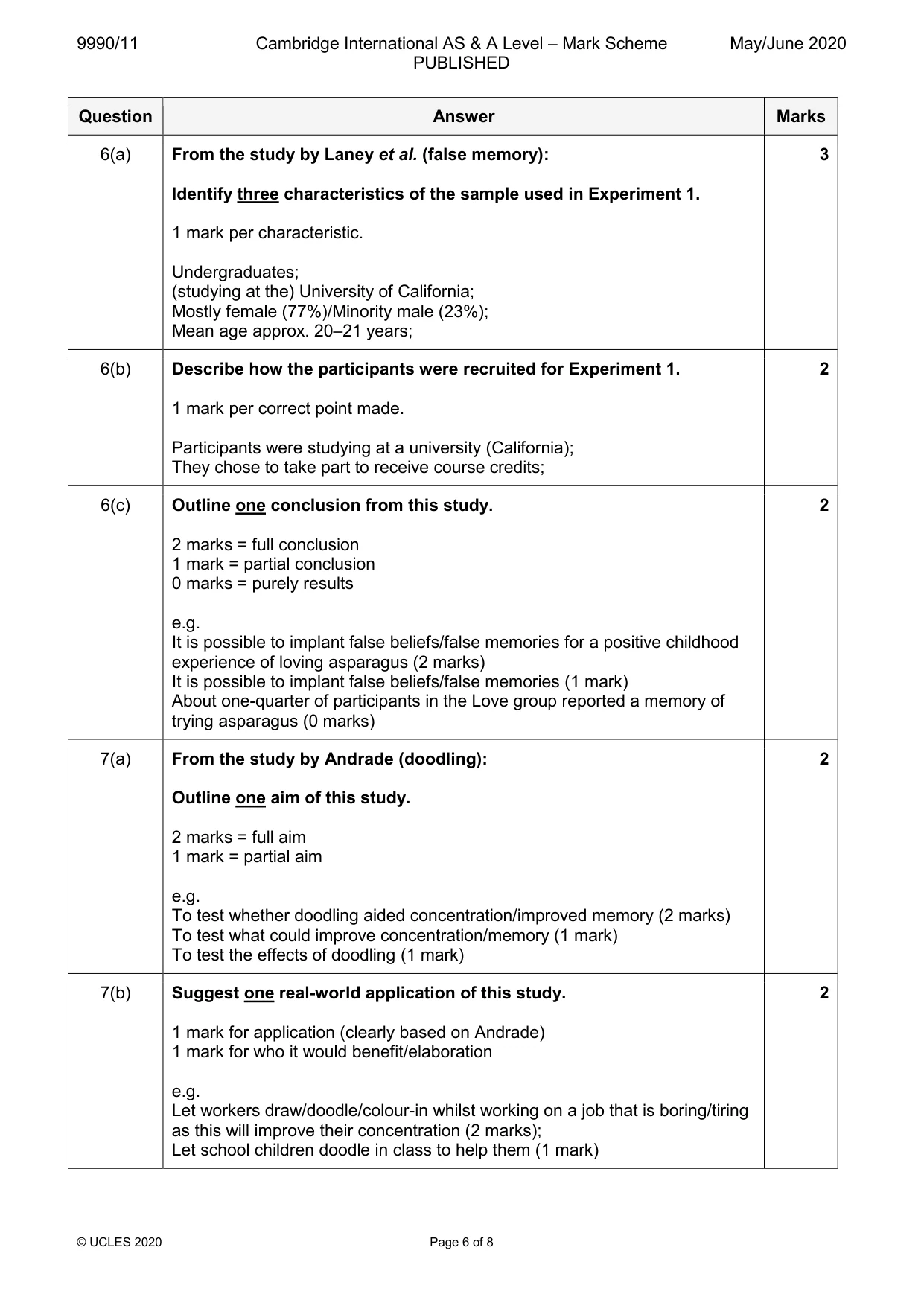
9990/11 Cambridge International AS & A Level – Mark Scheme PUBLISHED May/June 2020 © UCLES 2020 Page 6 of 8 Question Answer Marks 6(a) From the study by Laney et al. (false memory): Identify three characteristics of the sample used in Experiment 1. 1 mark per characteristic. Undergraduates; (studying at the) University of California; Mostly female (77%)/Minority male (23%); Mean age approx. 20–21 years; 3 6(b) Describe how the participants were recruited for Experiment 1. 1 mark per correct point made. Participants were studying at a university (California); They chose to take part to receive course credits; 2 6(c) Outline one conclusion from this study. 2 marks = full conclusion 1 mark = partial conclusion 0 marks = purely results e.g. It is possible to implant false beliefs/false memories for a positive childhood experience of loving asparagus (2 marks) It is possible to implant false beliefs/false memories (1 mark) About one-quarter of participants in the Love group reported a memory of trying asparagus (0 marks) 2 7(a) From the study by Andrade (doodling): Outline one aim of this study. 2 marks = full aim 1 mark = partial aim e.g. To test whether doodling aided concentration/improved memory (2 marks) To test what could improve concentration/memory (1 mark) To test the effects of doodling (1 mark) 2 7(b) Suggest one real-world application of this study. 1 mark for application (clearly based on Andrade) 1 mark for who it would benefit/elaboration e.g. Let workers draw/doodle/colour-in whilst working on a job that is boring/tiring as this will improve their concentration (2 marks); Let school children doodle in class to help them (1 mark) 2
Mark scheme, page 7
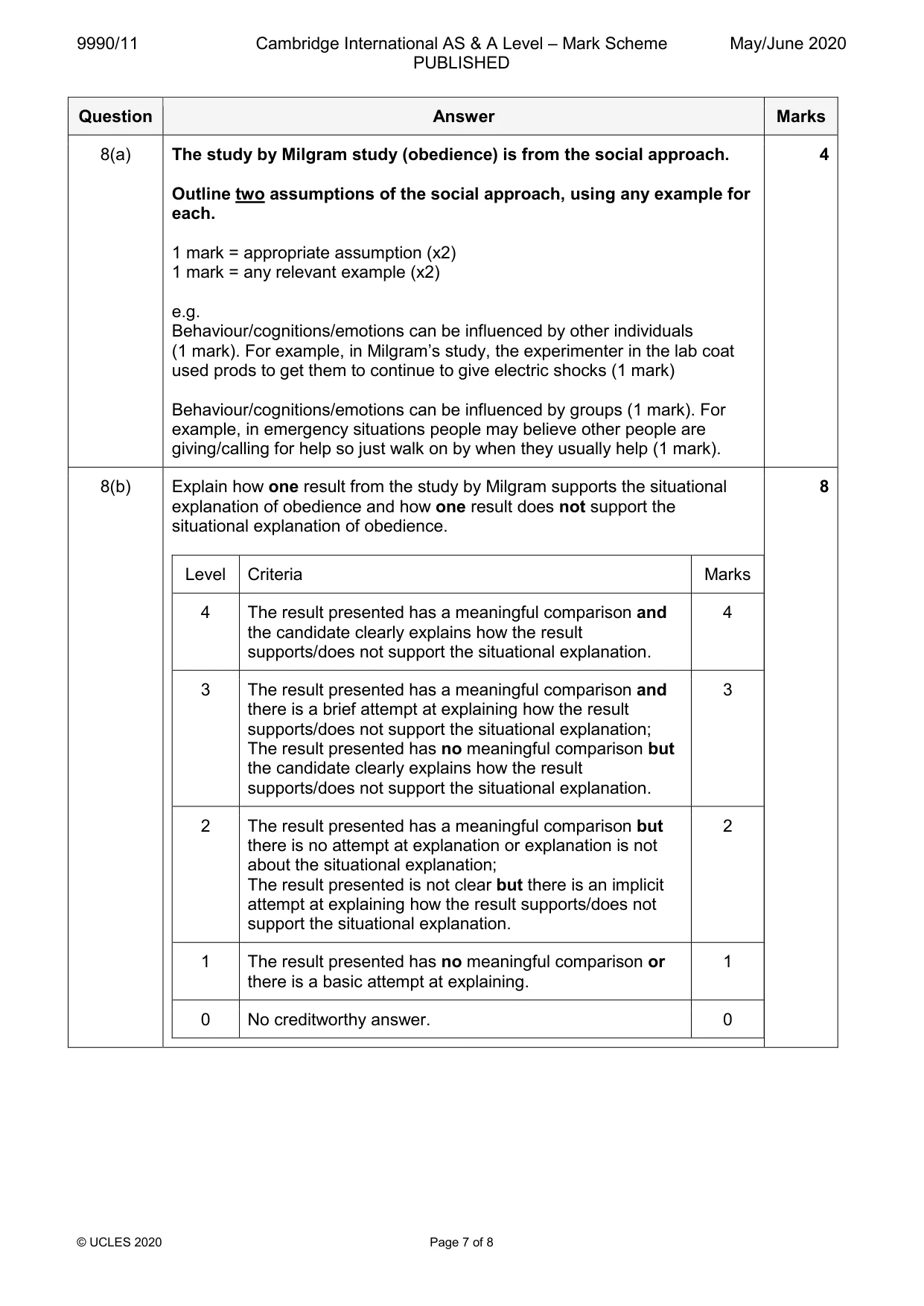
9990/11 Cambridge International AS & A Level – Mark Scheme PUBLISHED May/June 2020 © UCLES 2020 Page 7 of 8 Question Answer Marks 8(a) The study by Milgram study (obedience) is from the social approach. Outline two assumptions of the social approach, using any example for each. 1 mark = appropriate assumption (x2) 1 mark = any relevant example (x2) e.g. Behaviour/cognitions/emotions can be influenced by other individuals (1 mark). For example, in Milgram’s study, the experimenter in the lab coat used prods to get them to continue to give electric shocks (1 mark) Behaviour/cognitions/emotions can be influenced by groups (1 mark). For example, in emergency situations people may believe other people are giving/calling for help so just walk on by when they usually help (1 mark). 4 8(b) Explain how one result from the study by Milgram supports the situational explanation of obedience and how one result does not support the situational explanation of obedience. Level Criteria Marks 4 The result presented has a meaningful comparison and the candidate clearly explains how the result supports/does not support the situational explanation. 4 3 The result presented has a meaningful comparison and there is a brief attempt at explaining how the result supports/does not support the situational explanation; The result presented has no meaningful comparison but the candidate clearly explains how the result supports/does not support the situational explanation. 3 2 The result presented has a meaningful comparison but there is no attempt at explanation or explanation is not about the situational explanation; The result presented is not clear but there is an implicit attempt at explaining how the result supports/does not support the situational explanation. 2 1 The result presented has no meaningful comparison or there is a basic attempt at explaining. 1 0 No creditworthy answer. 0 8
Mark scheme, page 8
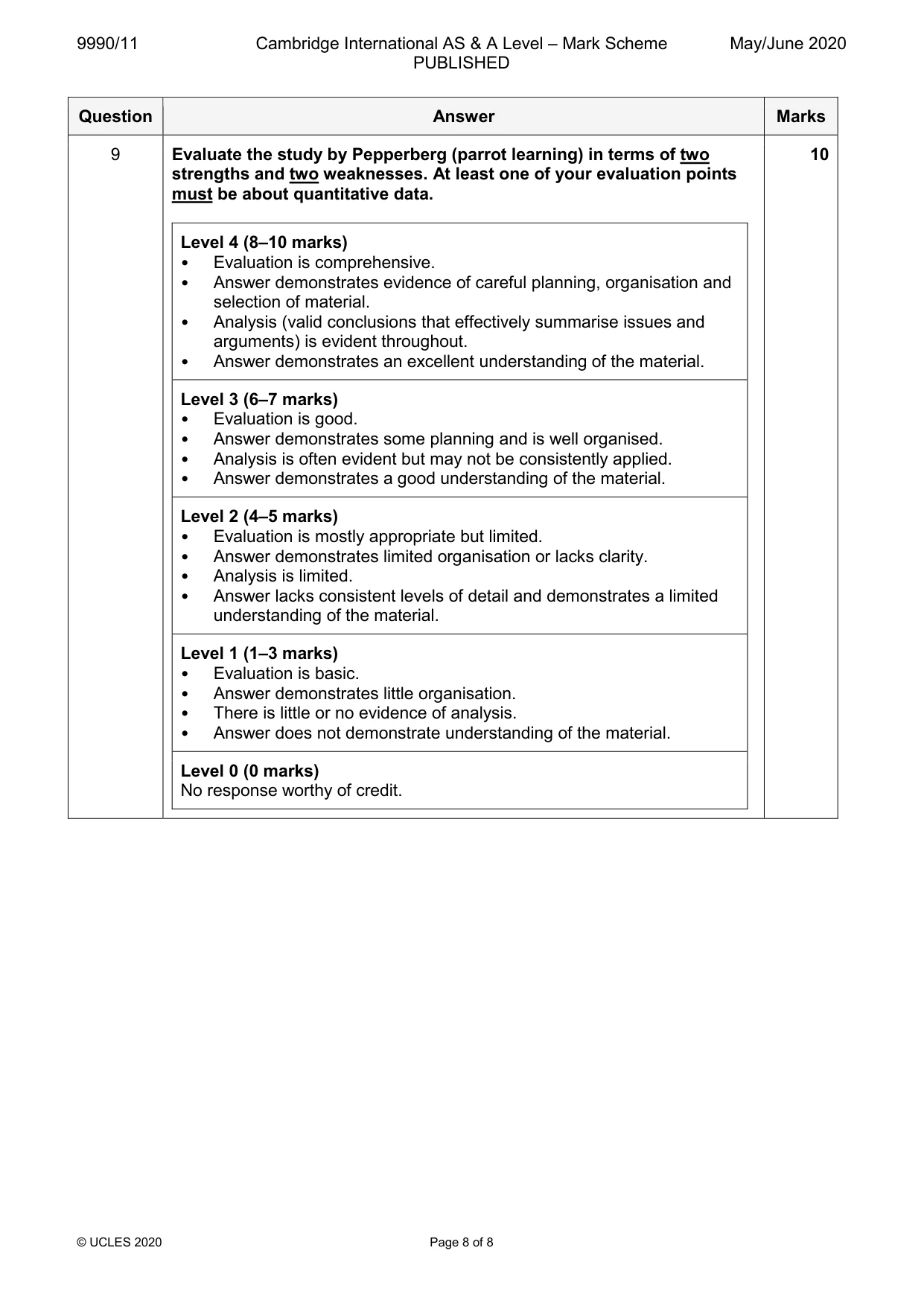
9990/11 Cambridge International AS & A Level – Mark Scheme PUBLISHED May/June 2020 © UCLES 2020 Page 8 of 8 Question Answer Marks 9 Evaluate the study by Pepperberg (parrot learning) in terms of two strengths and two weaknesses. At least one of your evaluation points must be about quantitative data. Level 4 (8–10 marks) • Evaluation is comprehensive. • Answer demonstrates evidence of careful planning, organisation and selection of material. • Analysis (valid conclusions that effectively summarise issues and arguments) is evident throughout. • Answer demonstrates an excellent understanding of the material. Level 3 (6–7 marks) • Evaluation is good. • Answer demonstrates some planning and is well organised. • Analysis is often evident but may not be consistently applied. • Answer demonstrates a good understanding of the material. Level 2 (4–5 marks) • Evaluation is mostly appropriate but limited. • Answer demonstrates limited organisation or lacks clarity. • Analysis is limited. • Answer lacks consistent levels of detail and demonstrates a limited understanding of the material. Level 1 (1–3 marks) • Evaluation is basic. • Answer demonstrates little organisation. • There is little or no evidence of analysis. • Answer does not demonstrate understanding of the material. Level 0 (0 marks) No response worthy of credit. 10