Cambridge A Level Psychology (from 2018) 9990 — 2019 Oct/Nov Paper 1 · Variant 3
9990/13/O/N/19 · 60 marks · ≈68 min
The question paper and its mark scheme, free to read here and free to download. This is Cambridge’s own paper, exactly as it was sat.
Question paper8 pages
Mark scheme11 pages
Answers below. Sit the paper first if you are practising.
Paper as text
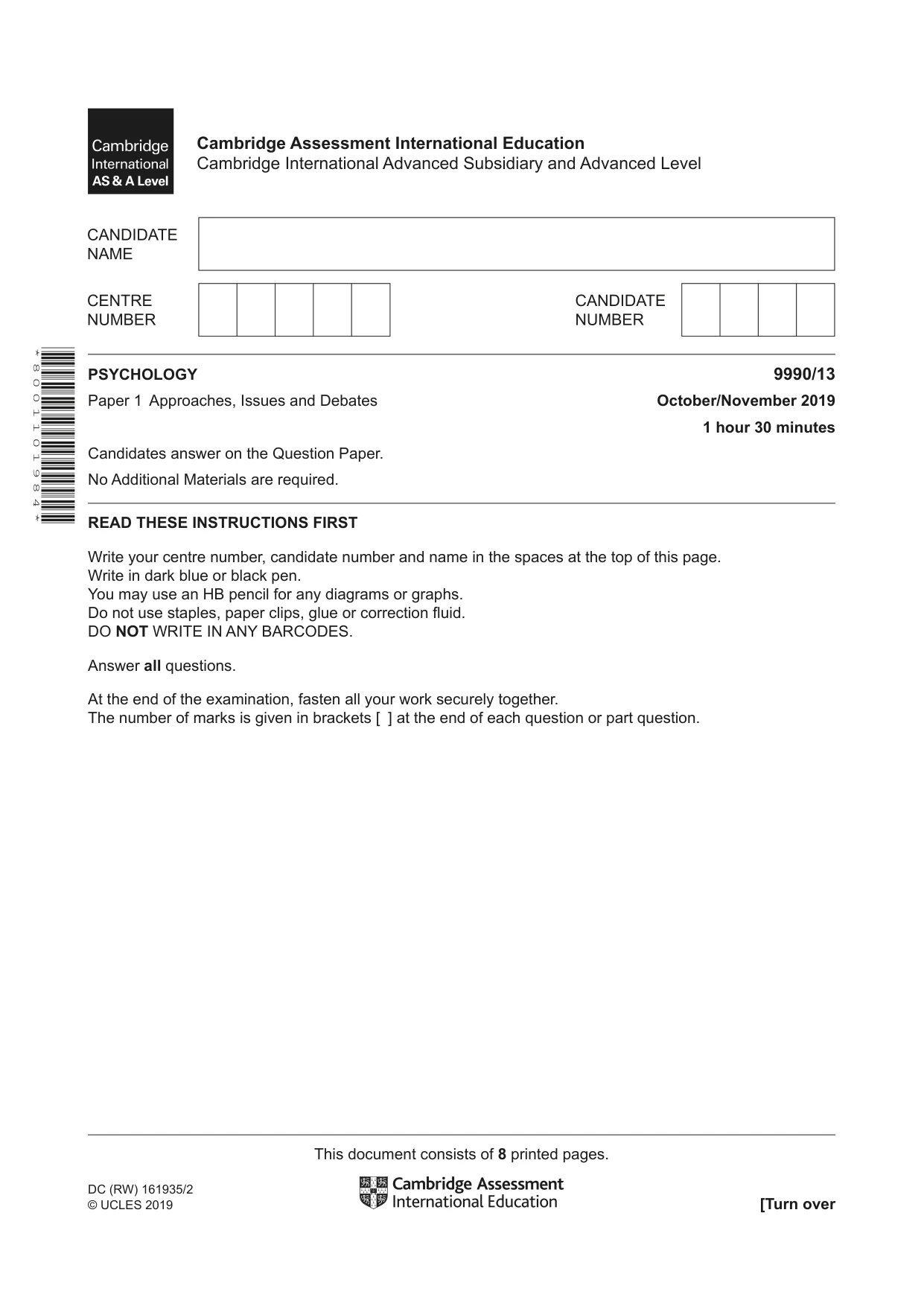
Question paper, page 1
This document consists of 8 printed pages. DC (RW) 161935/2 © UCLES 2019 [Turn over Cambridge Assessment International Education Cambridge International Advanced Subsidiary and Advanced Level * 8 0 0 1 1 0 1 9 8 4 * PSYCHOLOGY 9990/13 Paper 1 Approaches, Issues and Debates October/November 2019 1 hour 30 minutes Candidates answer on the Question Paper. No Additional Materials are required. READ THESE INSTRUCTIONS FIRST Write your centre number, candidate number and name in the spaces at the top of this page. Write in dark blue or black pen. You may use an HB pencil for any diagrams or graphs. Do not use staples, paper clips, glue or correction fluid. DO NOT WRITE IN ANY BARCODES. Answer all questions. At the end of the examination, fasten all your work securely together. The number of marks is given in brackets [ ] at the end of each question or part question.
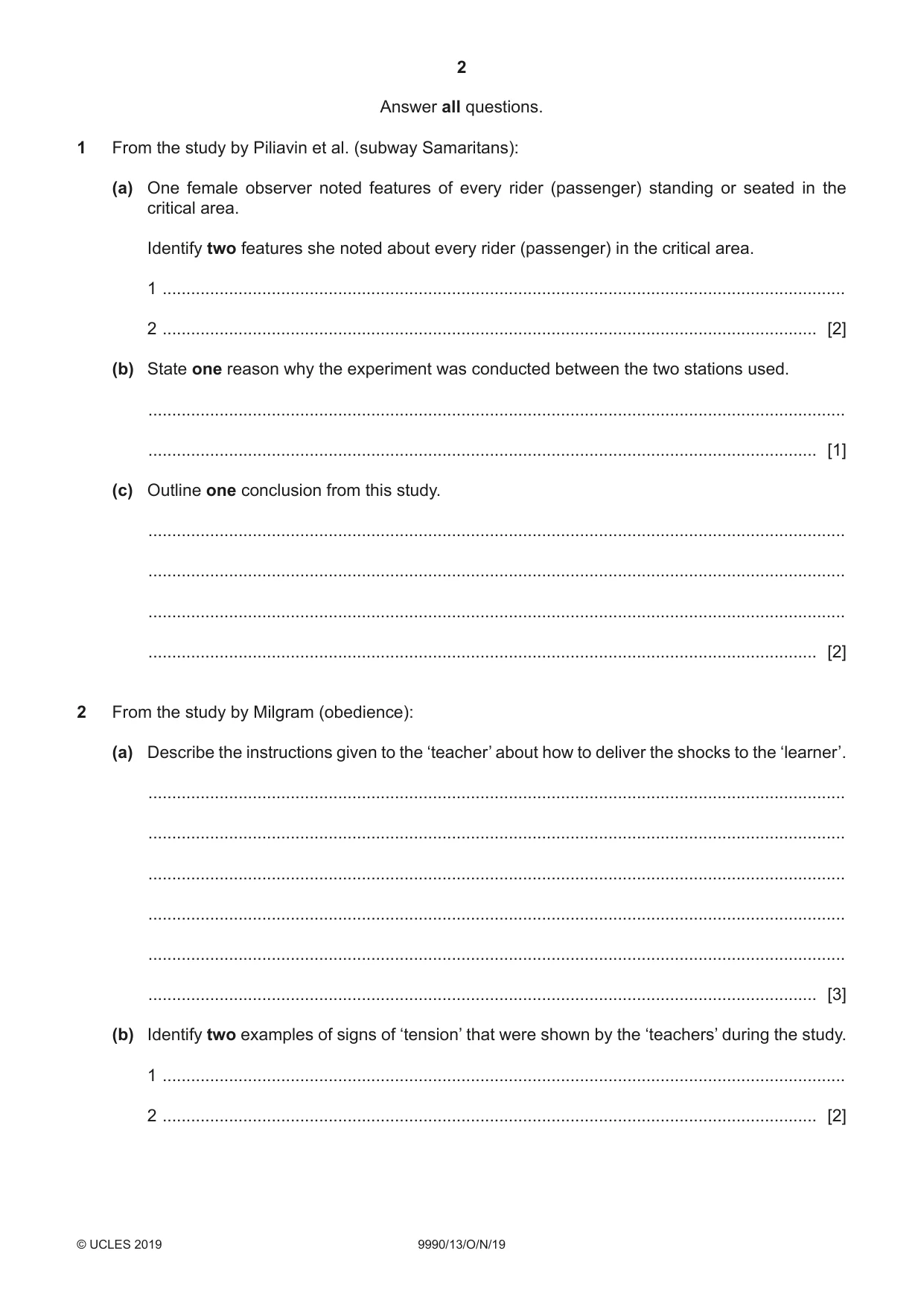
Question paper, page 2
2 9990/13/O/N/19 © UCLES 2019 Answer all questions. 1 From the study by Piliavin et al. (subway Samaritans): (a) One female observer noted features of every rider (passenger) standing or seated in the critical area. Identify two features she noted about every rider (passenger) in the critical area. 1 … 2 … [2] (b) State one reason why the experiment was conducted between the two stations used. … … [1] (c) Outline one conclusion from this study. … … … … [2] 2 From the study by Milgram (obedience): (a) Describe the instructions given to the ‘teacher’ about how to deliver the shocks to the ‘learner’. … … … … … … [3] (b) Identify two examples of signs of ‘tension’ that were shown by the ‘teachers’ during the study. 1 … 2 … [2]
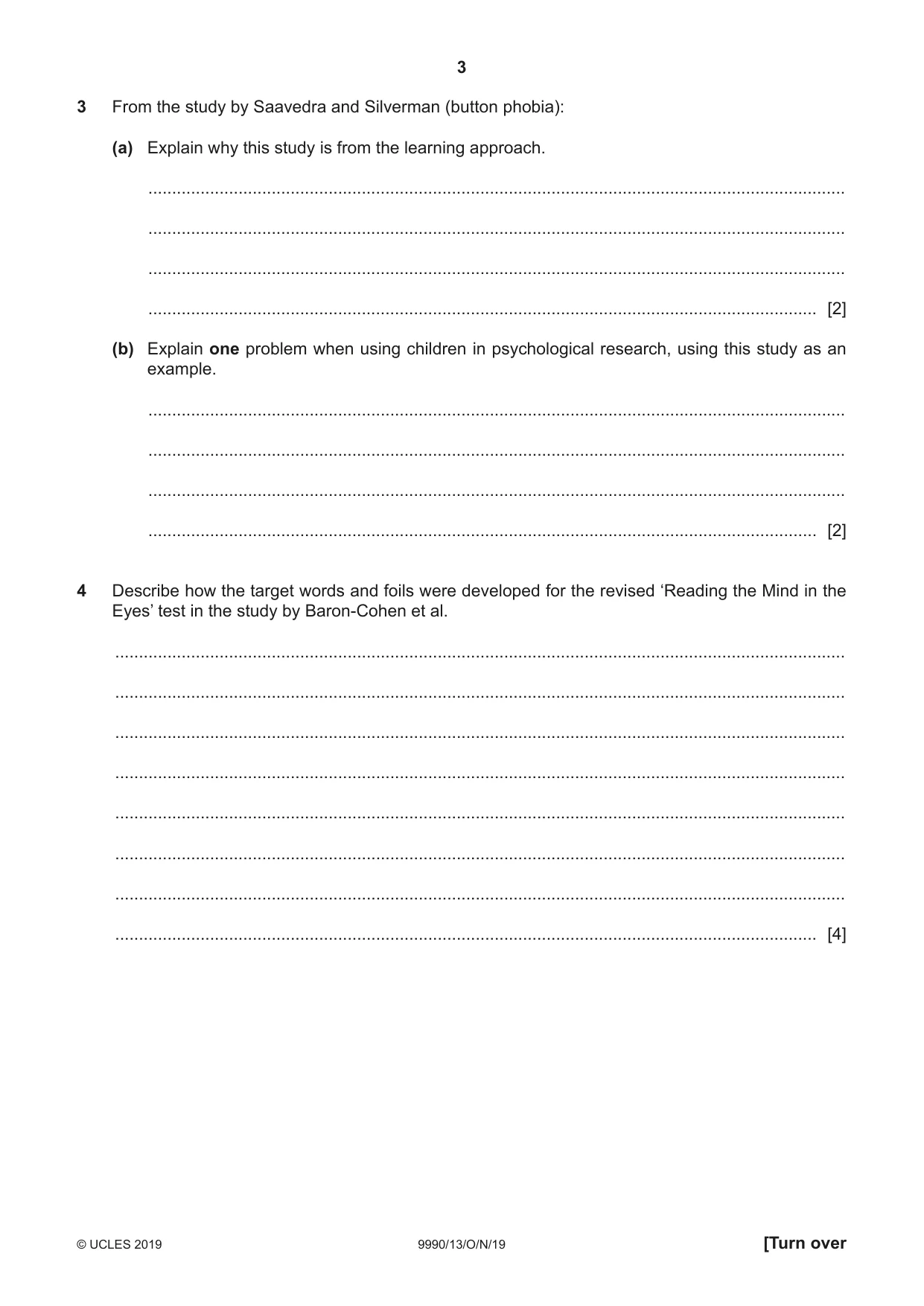
Question paper, page 3
3 9990/13/O/N/19 © UCLES 2019 [Turn over 3 From the study by Saavedra and Silverman (button phobia): (a) Explain why this study is from the learning approach. … … … … [2] (b) Explain one problem when using children in psychological research, using this study as an example. … … … … [2] 4 Describe how the target words and foils were developed for the revised ‘Reading the Mind in the Eyes’ test in the study by Baron-Cohen et al. … … … … … … … … [4]
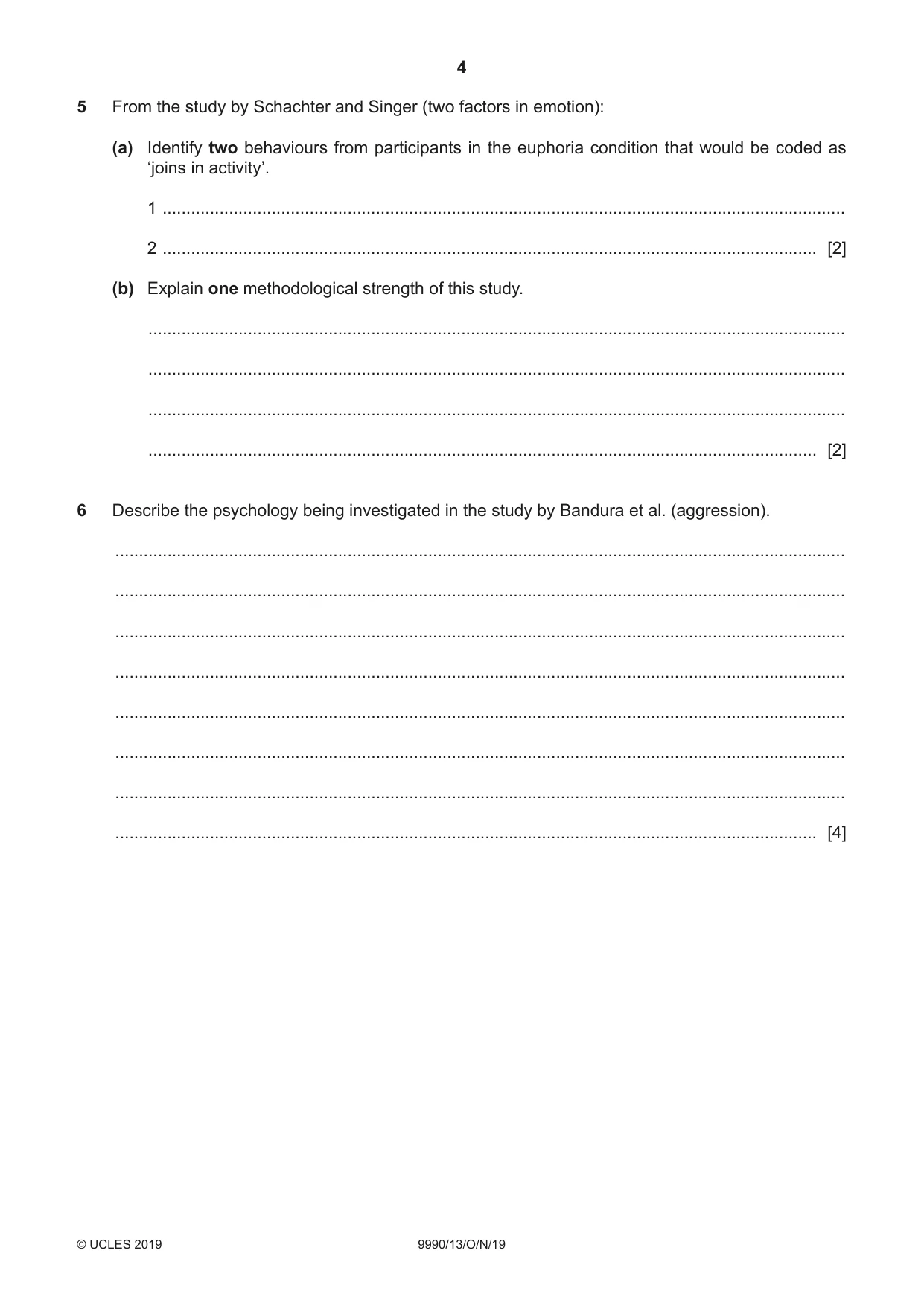
Question paper, page 4
4 9990/13/O/N/19 © UCLES 2019 5 From the study by Schachter and Singer (two factors in emotion): (a) Identify two behaviours from participants in the euphoria condition that would be coded as ‘joins in activity’. 1 … 2 … [2] (b) Explain one methodological strength of this study. … … … … [2] 6 Describe the psychology being investigated in the study by Bandura et al. (aggression). … … … … … … … … [4]
Question paper, page 5
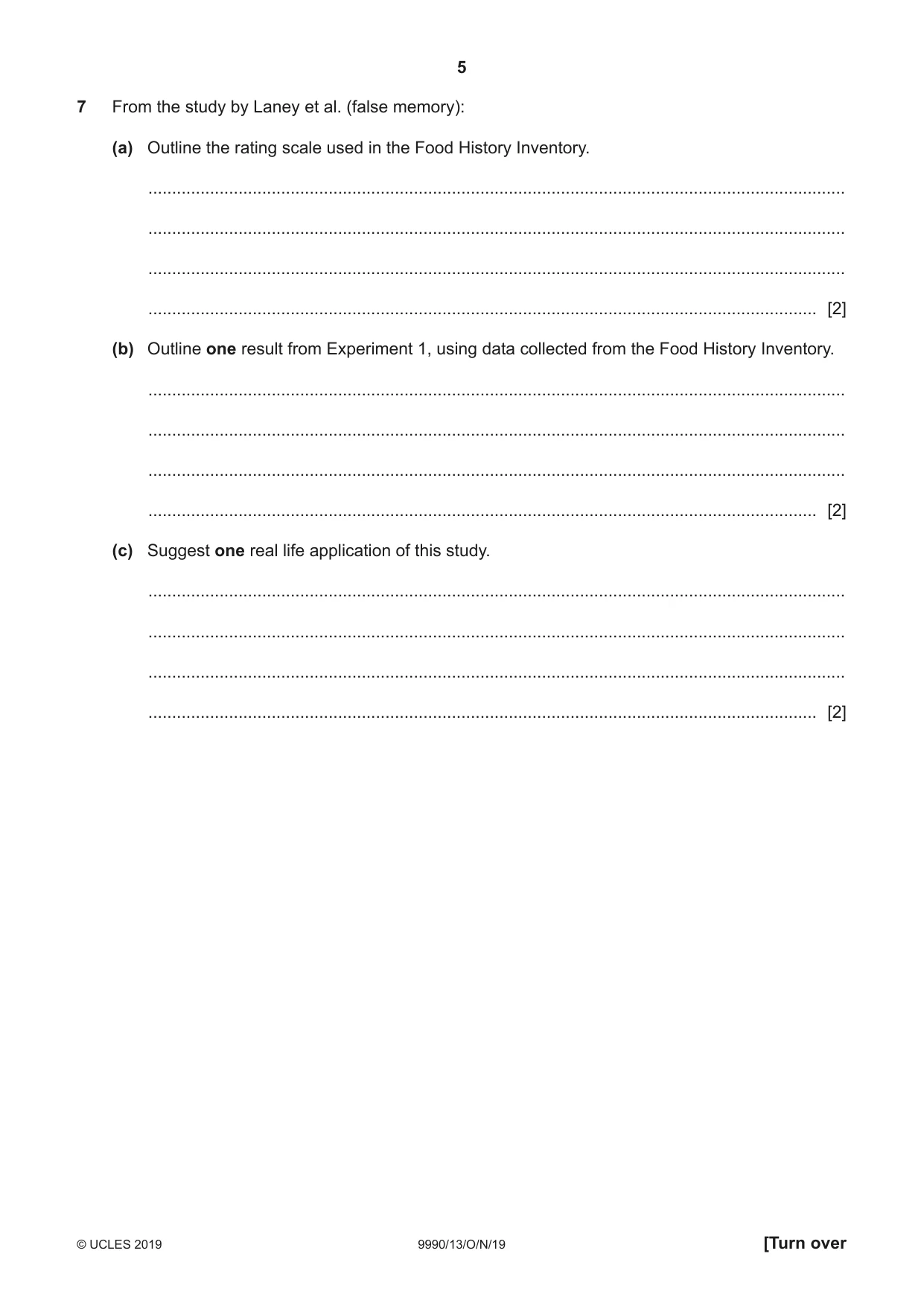
5 9990/13/O/N/19 © UCLES 2019 [Turn over 7 From the study by Laney et al. (false memory): (a) Outline the rating scale used in the Food History Inventory. … … … … [2] (b) Outline one result from Experiment 1, using data collected from the Food History Inventory. … … … … [2] (c) Suggest one real life application of this study. … … … … [2]
Question paper, page 6
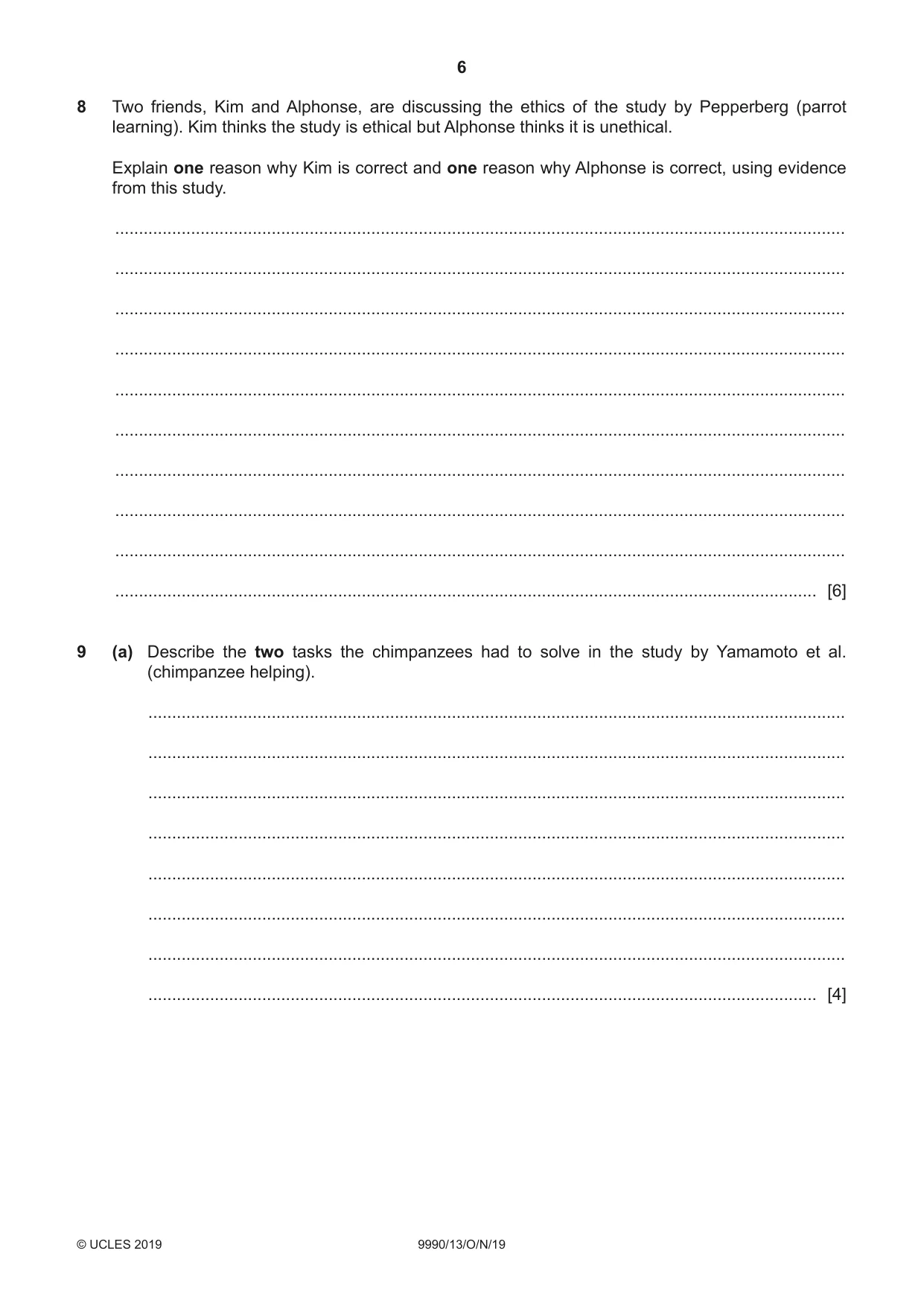
6 9990/13/O/N/19 © UCLES 2019 8 Two friends, Kim and Alphonse, are discussing the ethics of the study by Pepperberg (parrot learning). Kim thinks the study is ethical but Alphonse thinks it is unethical. Explain one reason why Kim is correct and one reason why Alphonse is correct, using evidence from this study. … … … … … … … … … … [6] 9 (a) Describe the two tasks the chimpanzees had to solve in the study by Yamamoto et al. (chimpanzee helping). … … … … … … … … [4]
Question paper, page 7
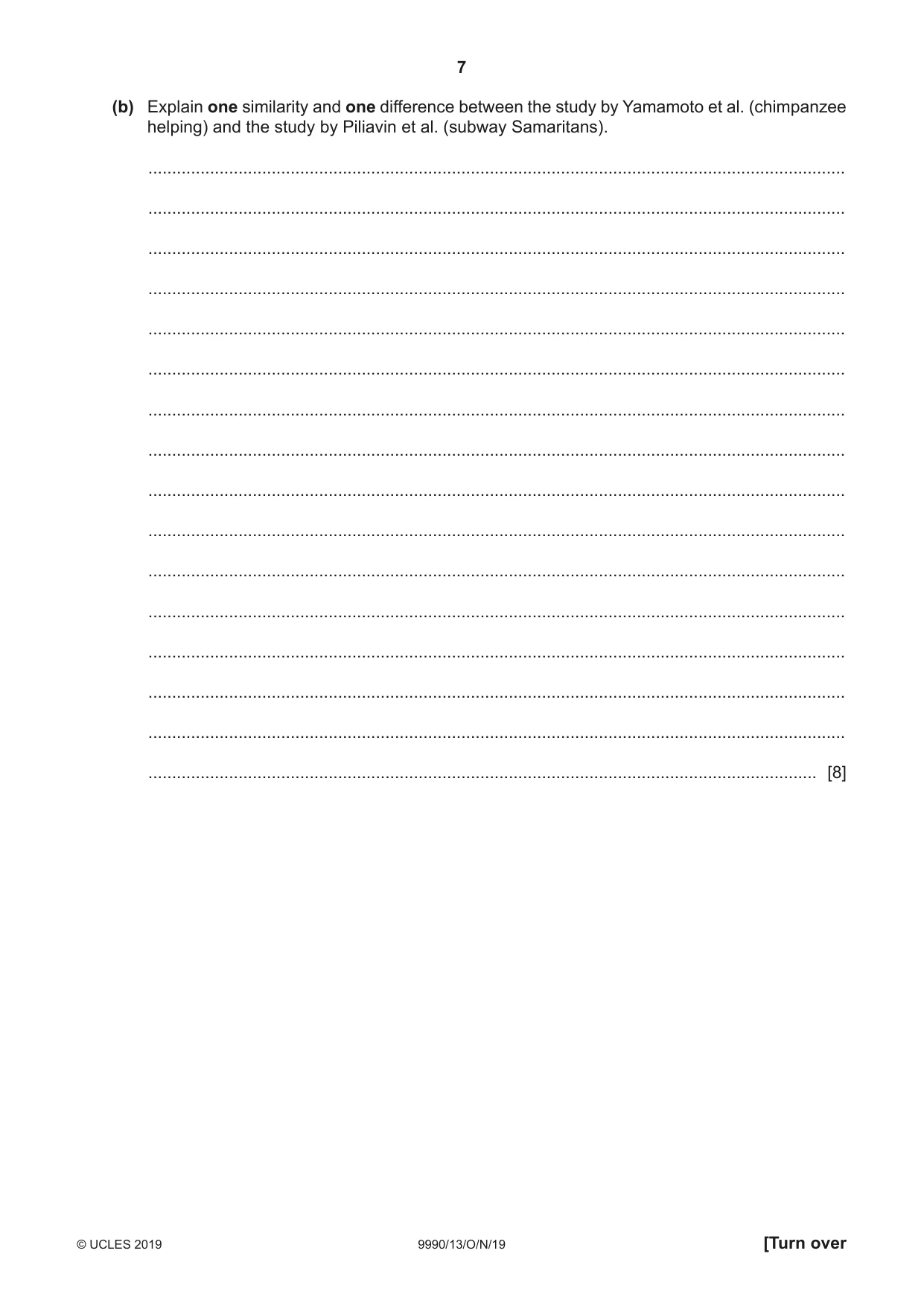
7 9990/13/O/N/19 © UCLES 2019 [Turn over (b) Explain one similarity and one difference between the study by Yamamoto et al. (chimpanzee helping) and the study by Piliavin et al. (subway Samaritans). … … … … … … … … … … … … … … … … [8]
Question paper, page 8
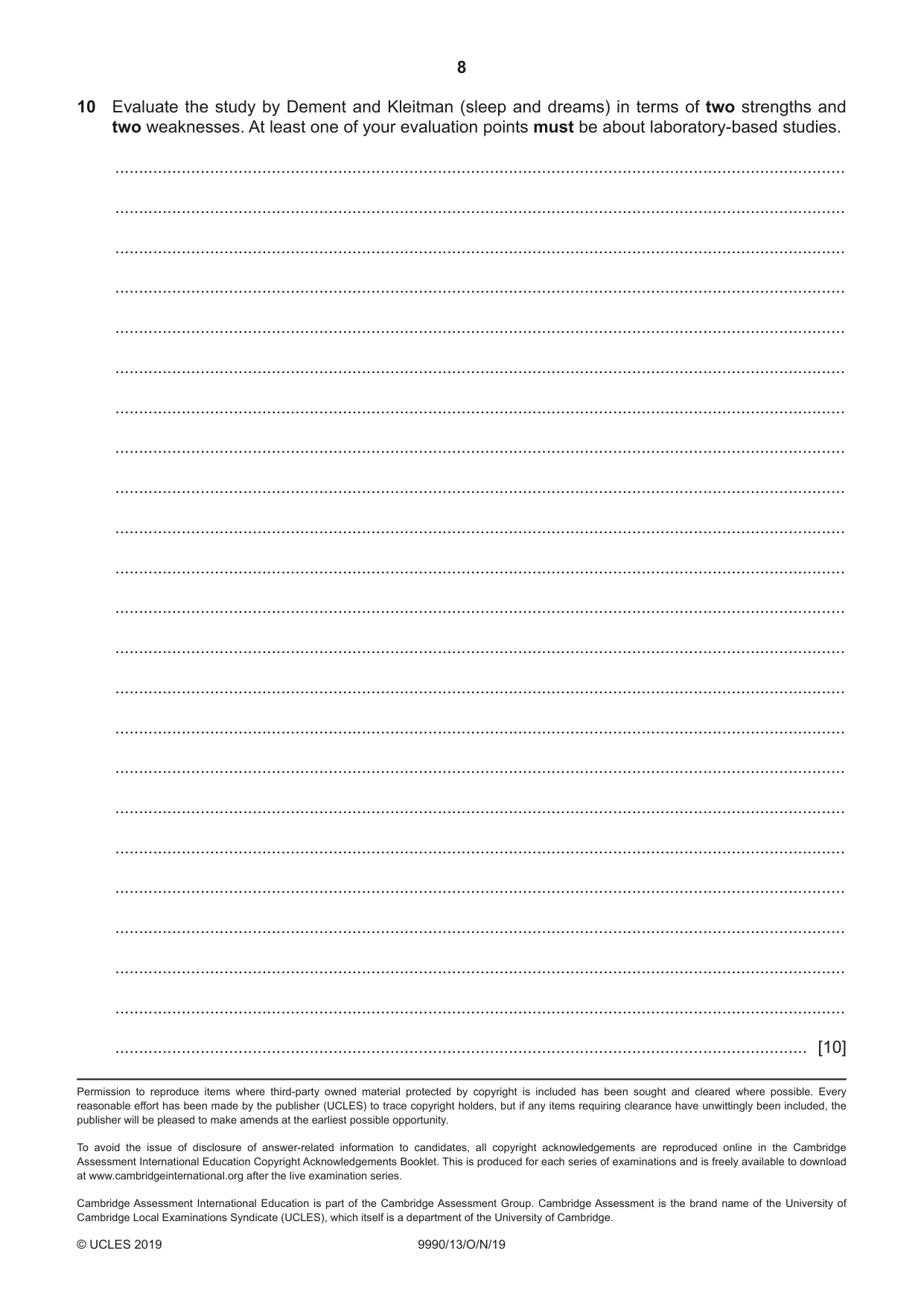
8 9990/13/O/N/19 © UCLES 2019 Permission to reproduce items where third-party owned material protected by copyright is included has been sought and cleared where possible. Every reasonable effort has been made by the publisher (UCLES) to trace copyright holders, but if any items requiring clearance have unwittingly been included, the publisher will be pleased to make amends at the earliest possible opportunity. To avoid the issue of disclosure of answer-related information to candidates, all copyright acknowledgements are reproduced online in the Cambridge Assessment International Education Copyright Acknowledgements Booklet. This is produced for each series of examinations and is freely available to download at www.cambridgeinternational.org after the live examination series. Cambridge Assessment International Education is part of the Cambridge Assessment Group. Cambridge Assessment is the brand name of the University of Cambridge Local Examinations Syndicate (UCLES), which itself is a department of the University of Cambridge. 10 Evaluate the study by Dement and Kleitman (sleep and dreams) in terms of two strengths and two weaknesses. At least one of your evaluation points must be about laboratory-based studies. … … … … … … … … … … … … … … … … … … … … … … … [10]
Mark scheme, page 1
This document consists of 11 printed pages. © UCLES 2019 [Turn over Cambridge Assessment International Education Cambridge International Advanced Subsidiary and Advanced Level PSYCHOLOGY 9990/13 Paper 1 Approaches, Issues and Debates October/November 2019 MARK SCHEME Maximum Mark: 60 Published This mark scheme is published as an aid to teachers and candidates, to indicate the requirements of the examination. It shows the basis on which Examiners were instructed to award marks. It does not indicate the details of the discussions that took place at an Examiners’ meeting before marking began, which would have considered the acceptability of alternative answers. Mark schemes should be read in conjunction with the question paper and the Principal Examiner Report for Teachers. Cambridge International will not enter into discussions about these mark schemes. Cambridge International is publishing the mark schemes for the October/November 2019 series for most Cambridge IGCSE™, Cambridge International A and AS Level components and some Cambridge O Level components.
Mark scheme, page 2
9990/13 Cambridge International AS/A Level – Mark Scheme PUBLISHED October/November 2019 © UCLES 2019 Page 2 of 11 Generic Marking Principles These general marking principles must be applied by all examiners when marking candidate answers. They should be applied alongside the specific content of the mark scheme or generic level descriptors for a question. Each question paper and mark scheme will also comply with these marking principles. GENERIC MARKING PRINCIPLE 1: Marks must be awarded in line with: • the specific content of the mark scheme or the generic level descriptors for the question • the specific skills defined in the mark scheme or in the generic level descriptors for the question • the standard of response required by a candidate as exemplified by the standardisation scripts. GENERIC MARKING PRINCIPLE 2: Marks awarded are always whole marks (not half marks, or other fractions). GENERIC MARKING PRINCIPLE 3: Marks must be awarded positively: • marks are awarded for correct/valid answers, as defined in the mark scheme. However, credit is given for valid answers which go beyond the scope of the syllabus and mark scheme, referring to your Team Leader as appropriate • marks are awarded when candidates clearly demonstrate what they know and can do • marks are not deducted for errors • marks are not deducted for omissions • answers should only be judged on the quality of spelling, punctuation and grammar when these features are specifically assessed by the question as indicated by the mark scheme. The meaning, however, should be unambiguous. GENERIC MARKING PRINCIPLE 4: Rules must be applied consistently e.g. in situations where candidates have not followed instructions or in the application of generic level descriptors. GENERIC MARKING PRINCIPLE 5: Marks should be awarded using the full range of marks defined in the mark scheme for the question (however; the use of the full mark range may be limited according to the quality of the candidate responses seen). GENERIC MARKING PRINCIPLE 6: Marks awarded are based solely on the requirements as defined in the mark scheme. Marks should not be awarded with grade thresholds or grade descriptors in mind.
Mark scheme, page 3
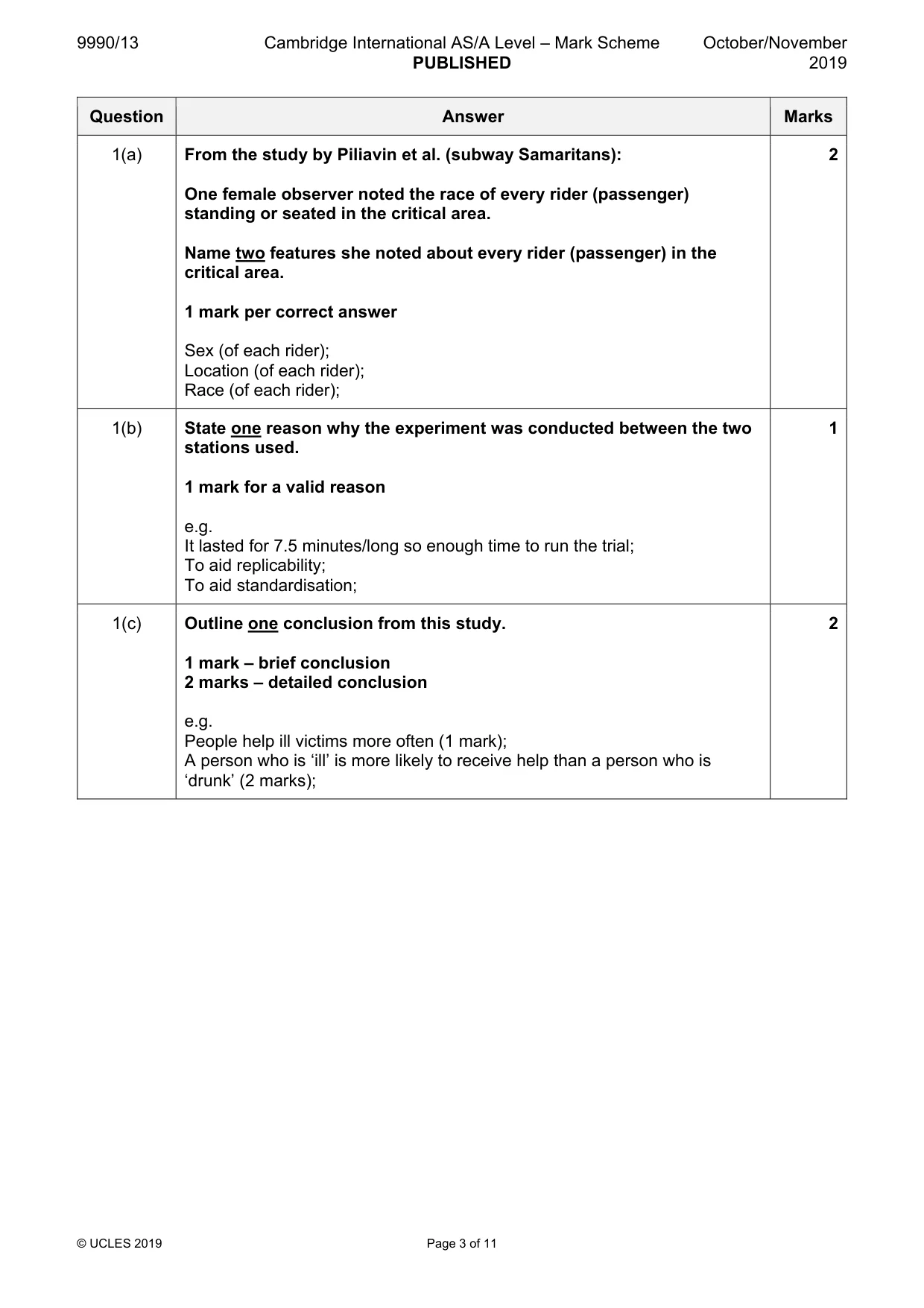
9990/13 Cambridge International AS/A Level – Mark Scheme PUBLISHED October/November 2019 © UCLES 2019 Page 3 of 11 Question Answer Marks 1(a) From the study by Piliavin et al. (subway Samaritans): One female observer noted the race of every rider (passenger) standing or seated in the critical area. Name two features she noted about every rider (passenger) in the critical area. 1 mark per correct answer Sex (of each rider); Location (of each rider); Race (of each rider); 2 1(b) State one reason why the experiment was conducted between the two stations used. 1 mark for a valid reason e.g. It lasted for 7.5 minutes/long so enough time to run the trial; To aid replicability; To aid standardisation; 1 1(c) Outline one conclusion from this study. 1 mark – brief conclusion 2 marks – detailed conclusion e.g. People help ill victims more often (1 mark); A person who is ‘ill’ is more likely to receive help than a person who is ‘drunk’ (2 marks); 2
Mark scheme, page 4
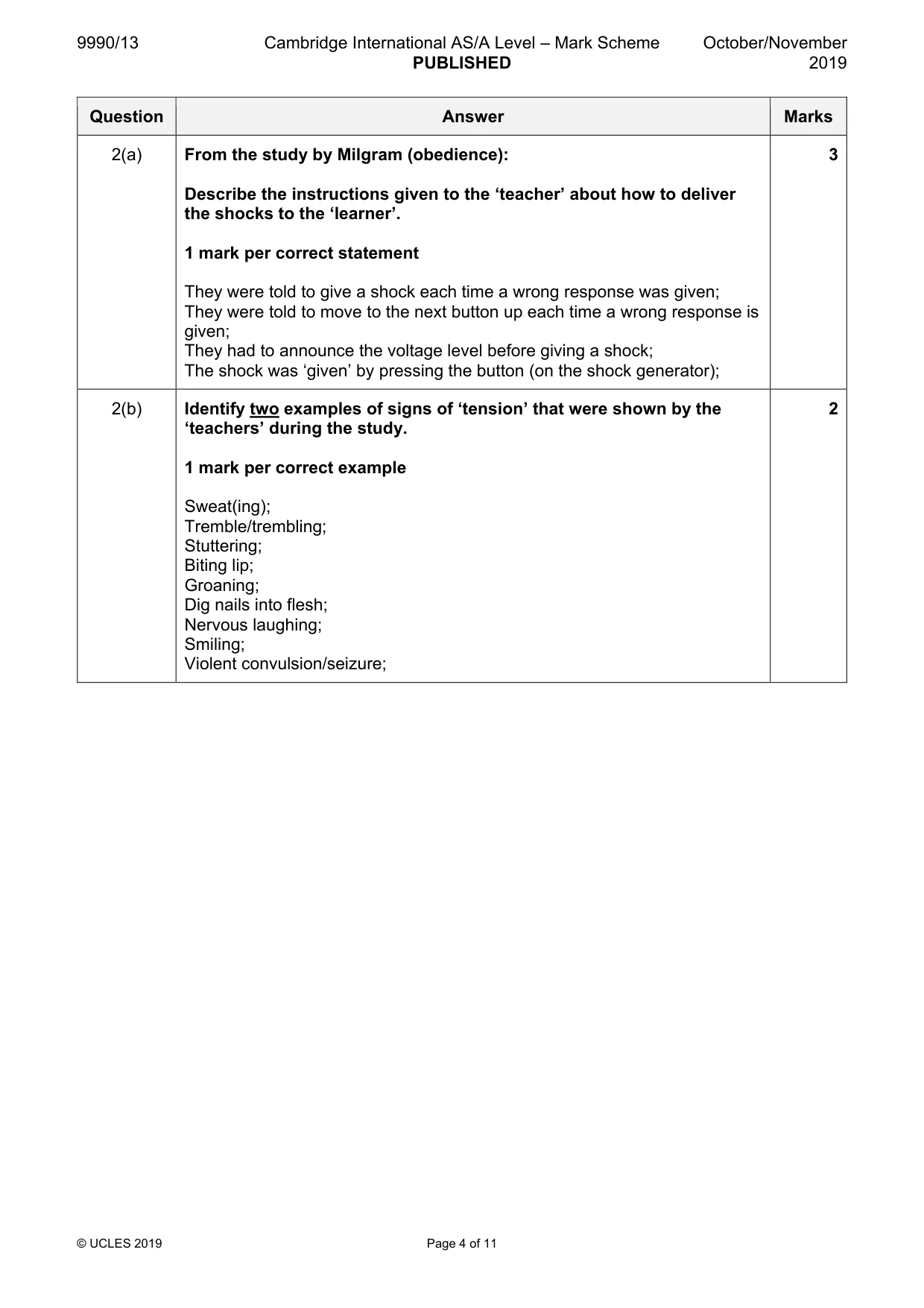
9990/13 Cambridge International AS/A Level – Mark Scheme PUBLISHED October/November 2019 © UCLES 2019 Page 4 of 11 Question Answer Marks 2(a) From the study by Milgram (obedience): Describe the instructions given to the ‘teacher’ about how to deliver the shocks to the ‘learner’. 1 mark per correct statement They were told to give a shock each time a wrong response was given; They were told to move to the next button up each time a wrong response is given; They had to announce the voltage level before giving a shock; The shock was ‘given’ by pressing the button (on the shock generator); 3 2(b) Identify two examples of signs of ‘tension’ that were shown by the ‘teachers’ during the study. 1 mark per correct example Sweat(ing); Tremble/trembling; Stuttering; Biting lip; Groaning; Dig nails into flesh; Nervous laughing; Smiling; Violent convulsion/seizure; 2
Mark scheme, page 5
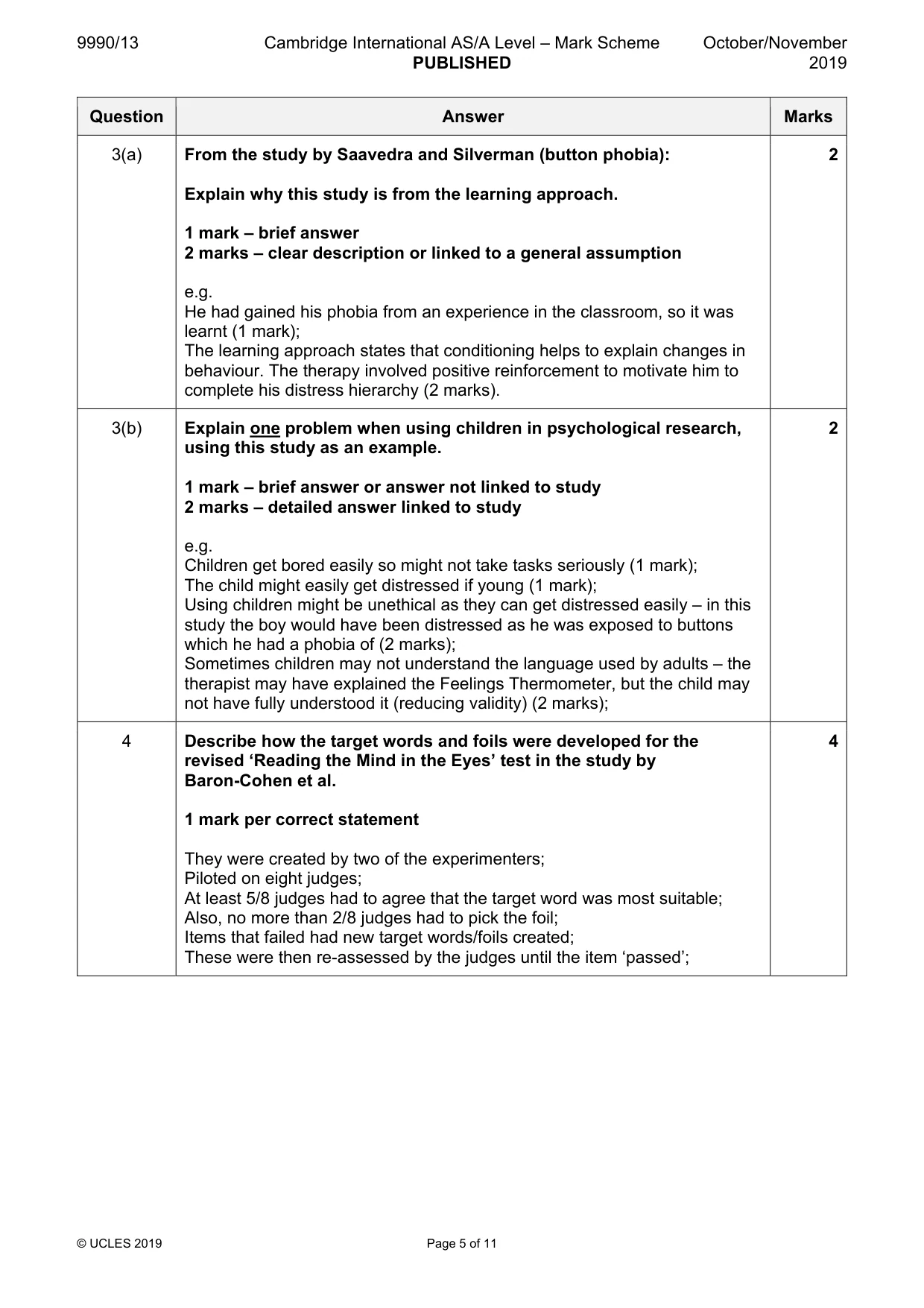
9990/13 Cambridge International AS/A Level – Mark Scheme PUBLISHED October/November 2019 © UCLES 2019 Page 5 of 11 Question Answer Marks 3(a) From the study by Saavedra and Silverman (button phobia): Explain why this study is from the learning approach. 1 mark – brief answer 2 marks – clear description or linked to a general assumption e.g. He had gained his phobia from an experience in the classroom, so it was learnt (1 mark); The learning approach states that conditioning helps to explain changes in behaviour. The therapy involved positive reinforcement to motivate him to complete his distress hierarchy (2 marks). 2 3(b) Explain one problem when using children in psychological research, using this study as an example. 1 mark – brief answer or answer not linked to study 2 marks – detailed answer linked to study e.g. Children get bored easily so might not take tasks seriously (1 mark); The child might easily get distressed if young (1 mark); Using children might be unethical as they can get distressed easily – in this study the boy would have been distressed as he was exposed to buttons which he had a phobia of (2 marks); Sometimes children may not understand the language used by adults – the therapist may have explained the Feelings Thermometer, but the child may not have fully understood it (reducing validity) (2 marks); 2 4 Describe how the target words and foils were developed for the revised ‘Reading the Mind in the Eyes’ test in the study by Baron-Cohen et al. 1 mark per correct statement They were created by two of the experimenters; Piloted on eight judges; At least 5/8 judges had to agree that the target word was most suitable; Also, no more than 2/8 judges had to pick the foil; Items that failed had new target words/foils created; These were then re-assessed by the judges until the item ‘passed’; 4
Mark scheme, page 6
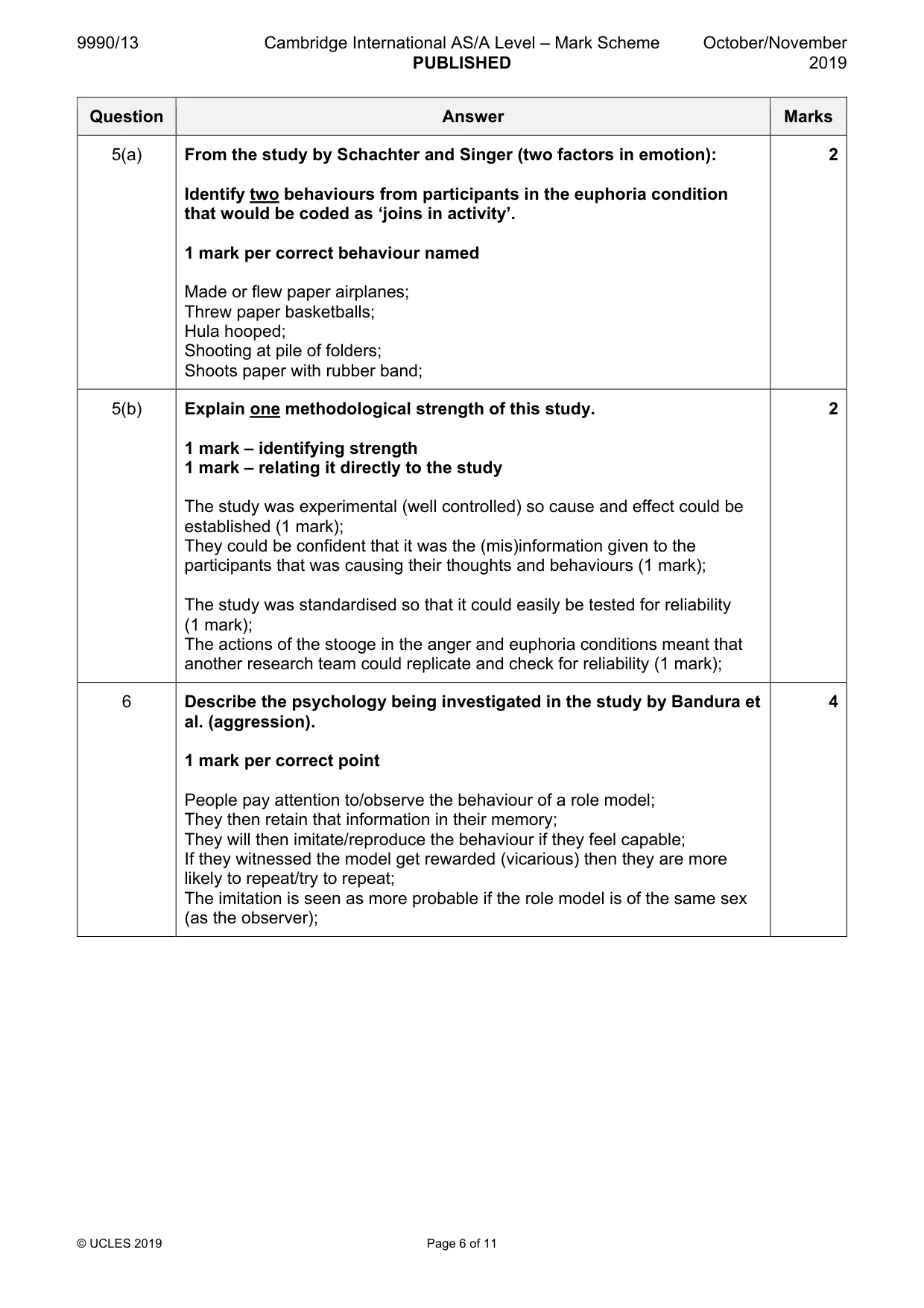
9990/13 Cambridge International AS/A Level – Mark Scheme PUBLISHED October/November 2019 © UCLES 2019 Page 6 of 11 Question Answer Marks 5(a) From the study by Schachter and Singer (two factors in emotion): Identify two behaviours from participants in the euphoria condition that would be coded as ‘joins in activity’. 1 mark per correct behaviour named Made or flew paper airplanes; Threw paper basketballs; Hula hooped; Shooting at pile of folders; Shoots paper with rubber band; 2 5(b) Explain one methodological strength of this study. 1 mark – identifying strength 1 mark – relating it directly to the study The study was experimental (well controlled) so cause and effect could be established (1 mark); They could be confident that it was the (mis)information given to the participants that was causing their thoughts and behaviours (1 mark); The study was standardised so that it could easily be tested for reliability (1 mark); The actions of the stooge in the anger and euphoria conditions meant that another research team could replicate and check for reliability (1 mark); 2 6 Describe the psychology being investigated in the study by Bandura et al. (aggression). 1 mark per correct point People pay attention to/observe the behaviour of a role model; They then retain that information in their memory; They will then imitate/reproduce the behaviour if they feel capable; If they witnessed the model get rewarded (vicarious) then they are more likely to repeat/try to repeat; The imitation is seen as more probable if the role model is of the same sex (as the observer); 4
Mark scheme, page 7
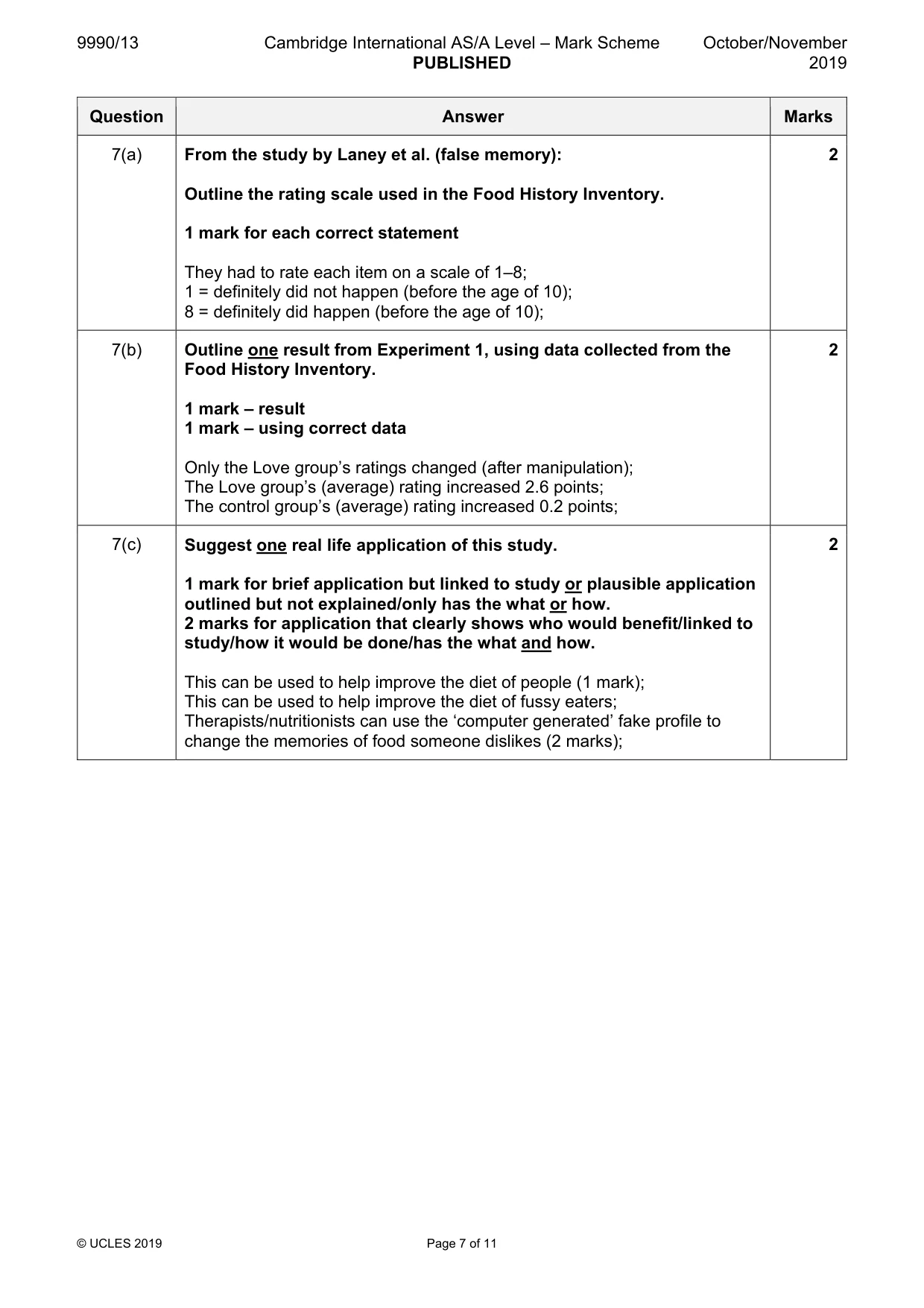
9990/13 Cambridge International AS/A Level – Mark Scheme PUBLISHED October/November 2019 © UCLES 2019 Page 7 of 11 Question Answer Marks 7(a) From the study by Laney et al. (false memory): Outline the rating scale used in the Food History Inventory. 1 mark for each correct statement They had to rate each item on a scale of 1–8; 1 = definitely did not happen (before the age of 10); 8 = definitely did happen (before the age of 10); 2 7(b) Outline one result from Experiment 1, using data collected from the Food History Inventory. 1 mark – result 1 mark – using correct data Only the Love group’s ratings changed (after manipulation); The Love group’s (average) rating increased 2.6 points; The control group’s (average) rating increased 0.2 points; 2 7(c) Suggest one real life application of this study. 1 mark for brief application but linked to study or plausible application outlined but not explained/only has the what or how. 2 marks for application that clearly shows who would benefit/linked to study/how it would be done/has the what and how. This can be used to help improve the diet of people (1 mark); This can be used to help improve the diet of fussy eaters; Therapists/nutritionists can use the ‘computer generated’ fake profile to change the memories of food someone dislikes (2 marks); 2
Mark scheme, page 8
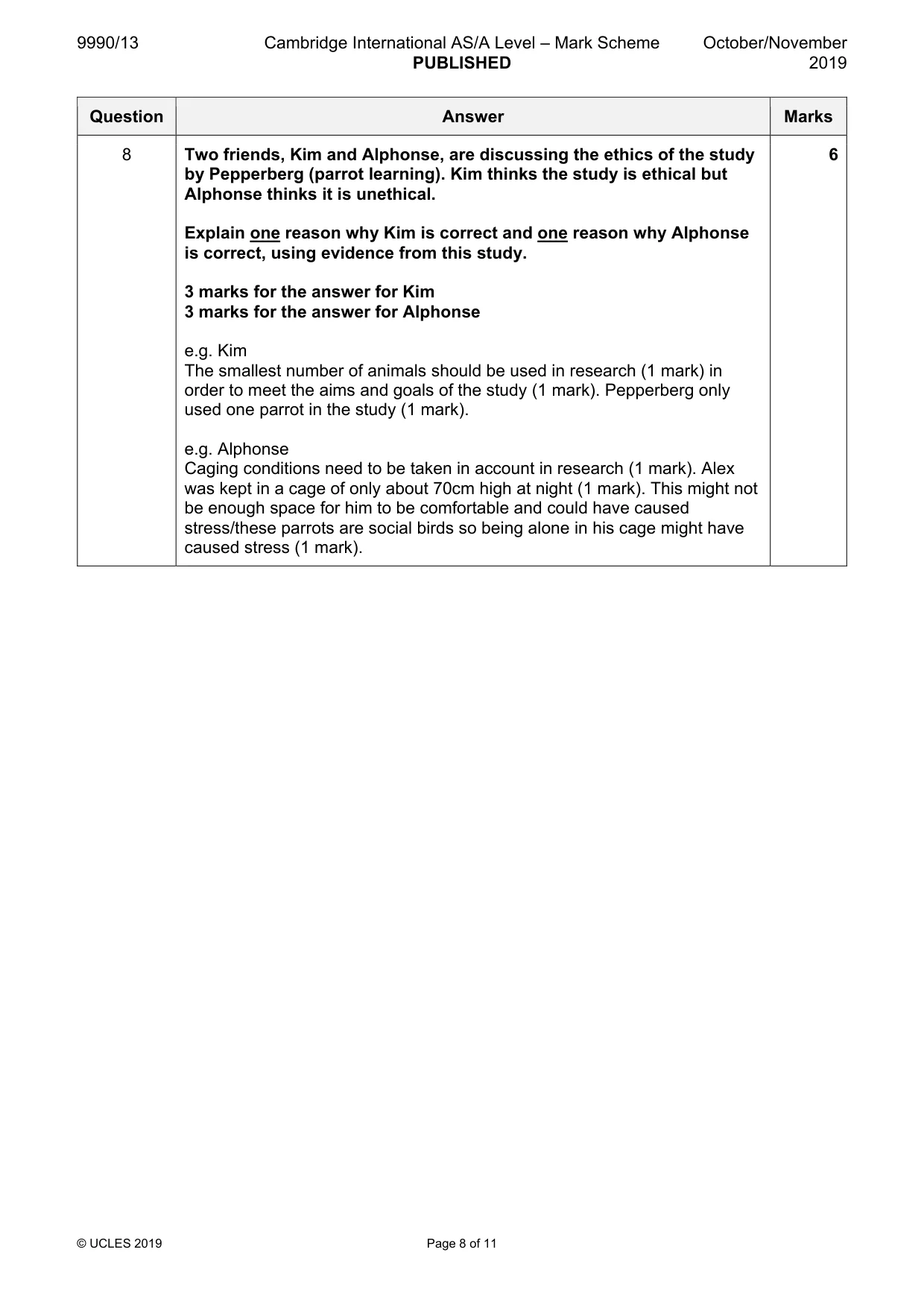
9990/13 Cambridge International AS/A Level – Mark Scheme PUBLISHED October/November 2019 © UCLES 2019 Page 8 of 11 Question Answer Marks 8 Two friends, Kim and Alphonse, are discussing the ethics of the study by Pepperberg (parrot learning). Kim thinks the study is ethical but Alphonse thinks it is unethical. Explain one reason why Kim is correct and one reason why Alphonse is correct, using evidence from this study. 3 marks for the answer for Kim 3 marks for the answer for Alphonse e.g. Kim The smallest number of animals should be used in research (1 mark) in order to meet the aims and goals of the study (1 mark). Pepperberg only used one parrot in the study (1 mark). e.g. Alphonse Caging conditions need to be taken in account in research (1 mark). Alex was kept in a cage of only about 70cm high at night (1 mark). This might not be enough space for him to be comfortable and could have caused stress/these parrots are social birds so being alone in his cage might have caused stress (1 mark). 6
Mark scheme, page 9
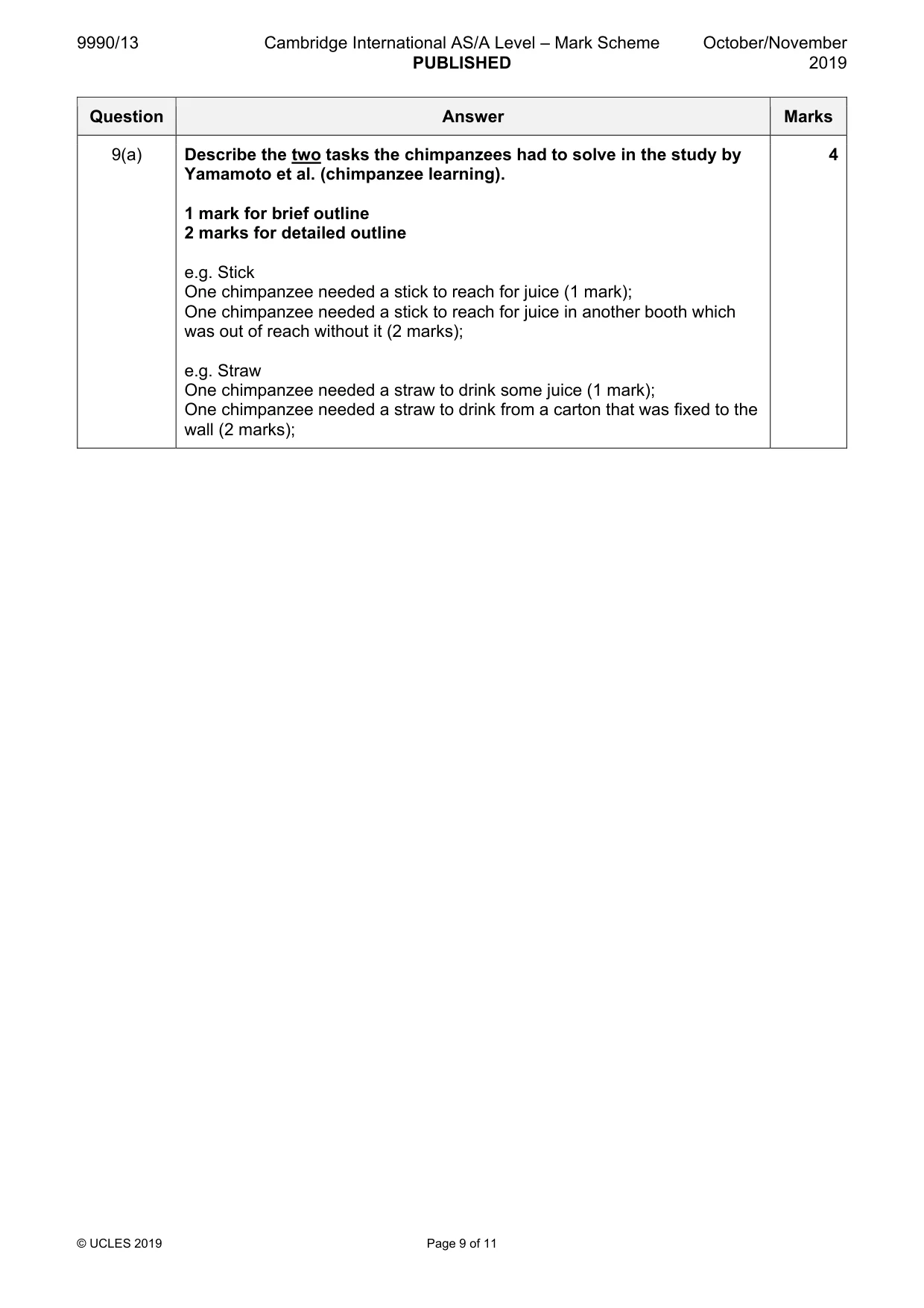
9990/13 Cambridge International AS/A Level – Mark Scheme PUBLISHED October/November 2019 © UCLES 2019 Page 9 of 11 Question Answer Marks 9(a) Describe the two tasks the chimpanzees had to solve in the study by Yamamoto et al. (chimpanzee learning). 1 mark for brief outline 2 marks for detailed outline e.g. Stick One chimpanzee needed a stick to reach for juice (1 mark); One chimpanzee needed a stick to reach for juice in another booth which was out of reach without it (2 marks); e.g. Straw One chimpanzee needed a straw to drink some juice (1 mark); One chimpanzee needed a straw to drink from a carton that was fixed to the wall (2 marks); 4
Mark scheme, page 10
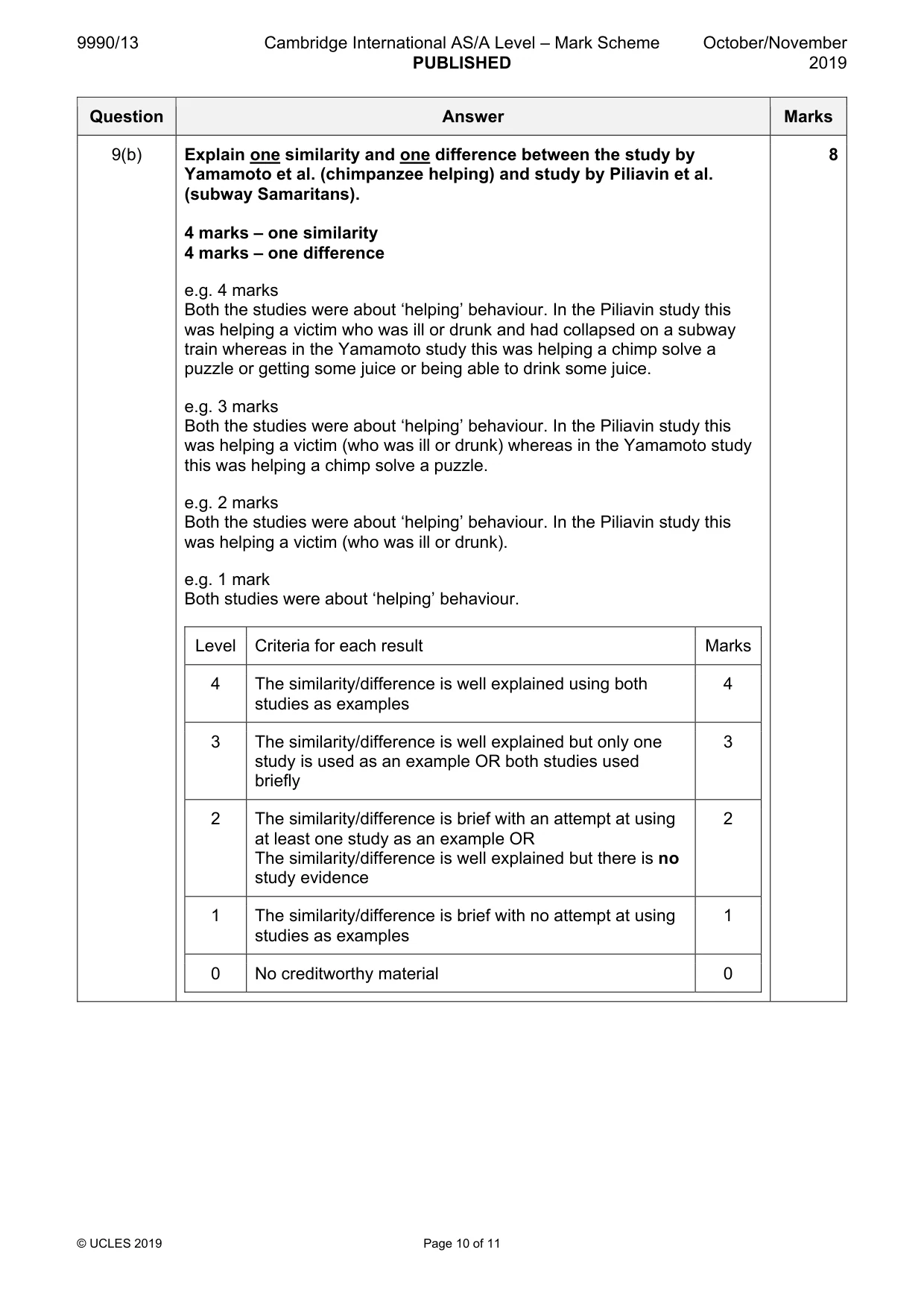
9990/13 Cambridge International AS/A Level – Mark Scheme PUBLISHED October/November 2019 © UCLES 2019 Page 10 of 11 Question Answer Marks 9(b) Explain one similarity and one difference between the study by Yamamoto et al. (chimpanzee helping) and study by Piliavin et al. (subway Samaritans). 4 marks – one similarity 4 marks – one difference e.g. 4 marks Both the studies were about ‘helping’ behaviour. In the Piliavin study this was helping a victim who was ill or drunk and had collapsed on a subway train whereas in the Yamamoto study this was helping a chimp solve a puzzle or getting some juice or being able to drink some juice. e.g. 3 marks Both the studies were about ‘helping’ behaviour. In the Piliavin study this was helping a victim (who was ill or drunk) whereas in the Yamamoto study this was helping a chimp solve a puzzle. e.g. 2 marks Both the studies were about ‘helping’ behaviour. In the Piliavin study this was helping a victim (who was ill or drunk). e.g. 1 mark Both studies were about ‘helping’ behaviour. Level Criteria for each result Marks 4 The similarity/difference is well explained using both studies as examples 4 3 The similarity/difference is well explained but only one study is used as an example OR both studies used briefly 3 2 The similarity/difference is brief with an attempt at using at least one study as an example OR The similarity/difference is well explained but there is no study evidence 2 1 The similarity/difference is brief with no attempt at using studies as examples 1 0 No creditworthy material 0 8
Mark scheme, page 11
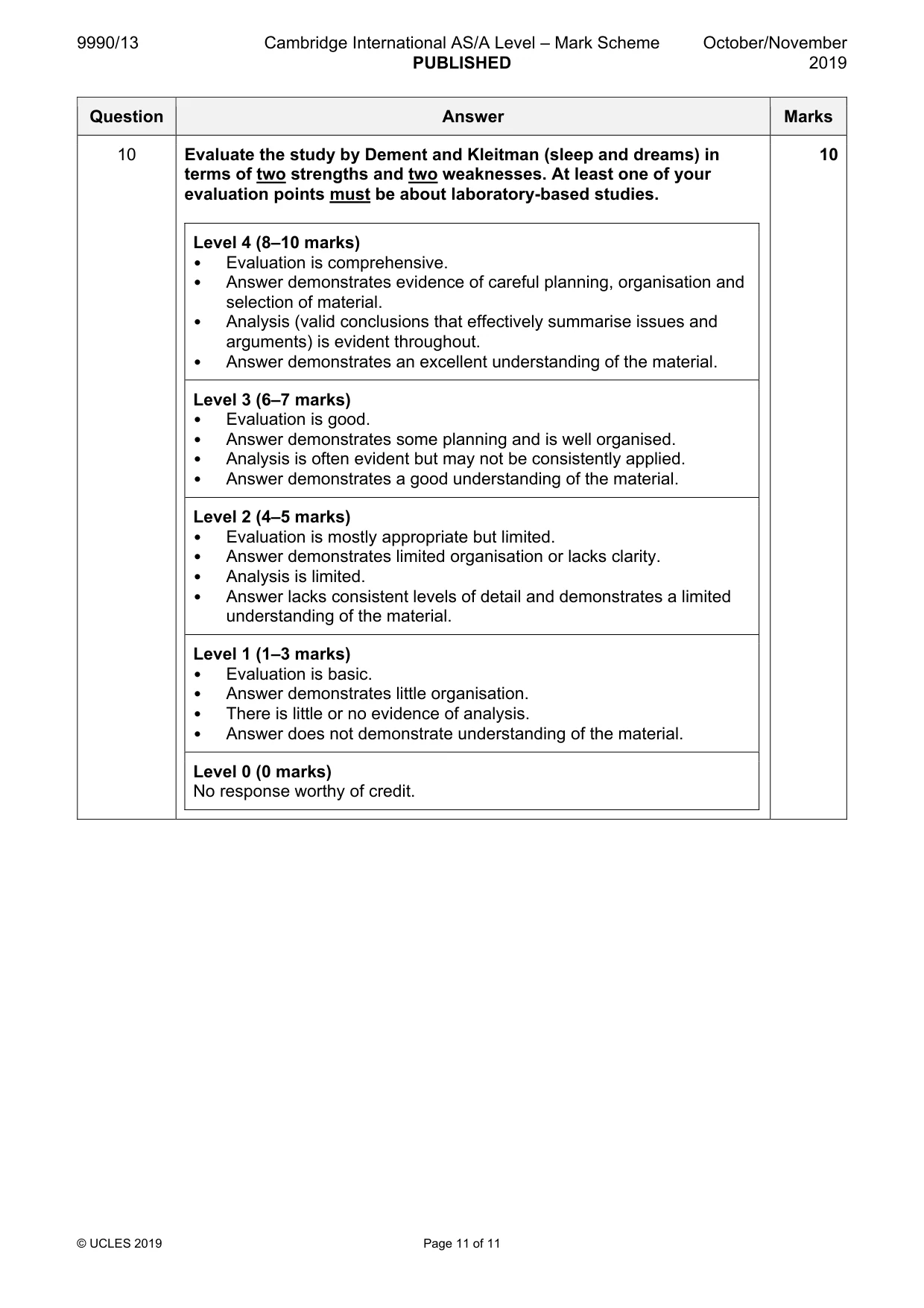
9990/13 Cambridge International AS/A Level – Mark Scheme PUBLISHED October/November 2019 © UCLES 2019 Page 11 of 11 Question Answer Marks 10 Evaluate the study by Dement and Kleitman (sleep and dreams) in terms of two strengths and two weaknesses. At least one of your evaluation points must be about laboratory-based studies. Level 4 (8–10 marks) • Evaluation is comprehensive. • Answer demonstrates evidence of careful planning, organisation and selection of material. • Analysis (valid conclusions that effectively summarise issues and arguments) is evident throughout. • Answer demonstrates an excellent understanding of the material. Level 3 (6–7 marks) • Evaluation is good. • Answer demonstrates some planning and is well organised. • Analysis is often evident but may not be consistently applied. • Answer demonstrates a good understanding of the material. Level 2 (4–5 marks) • Evaluation is mostly appropriate but limited. • Answer demonstrates limited organisation or lacks clarity. • Analysis is limited. • Answer lacks consistent levels of detail and demonstrates a limited understanding of the material. Level 1 (1–3 marks) • Evaluation is basic. • Answer demonstrates little organisation. • There is little or no evidence of analysis. • Answer does not demonstrate understanding of the material. Level 0 (0 marks) No response worthy of credit. 10
What you needed in this session
Cambridge’s own grade thresholds for 2019 Oct/Nov, Paper 1 · Variant 3. A higher threshold means an easier paper — the bar moves with how the cohort did.