Cambridge A Level Psychology (from 2018) 9990 — 2019 Oct/Nov Paper 1 · Variant 2
9990/12/O/N/19 · 60 marks · ≈68 min
The question paper and its mark scheme, free to read here and free to download. This is Cambridge’s own paper, exactly as it was sat.
Question paper8 pages
Mark scheme10 pages
Answers below. Sit the paper first if you are practising.
Paper as text
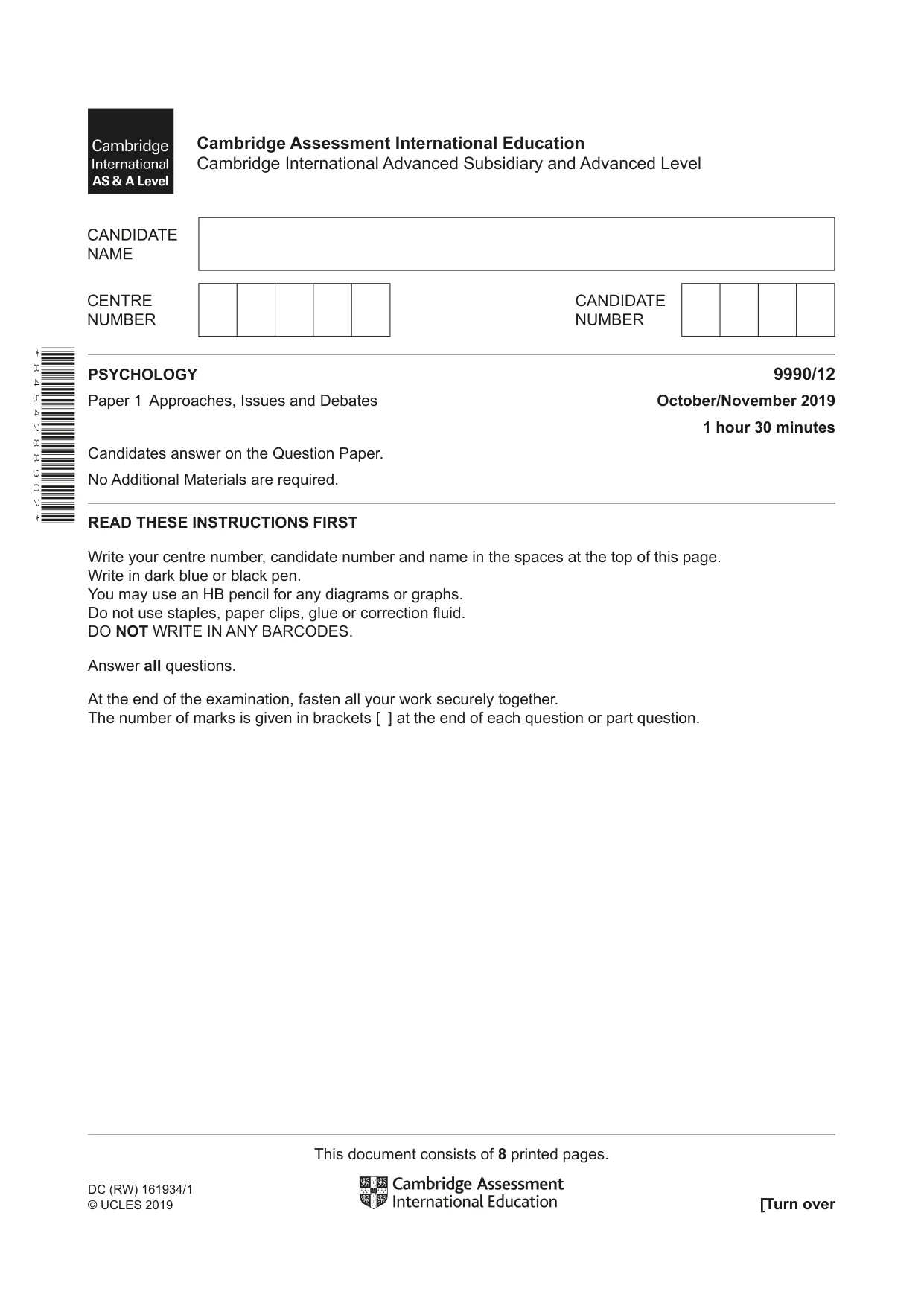
Question paper, page 1
This document consists of 8 printed pages. DC (RW) 161934/1 © UCLES 2019 [Turn over Cambridge Assessment International Education Cambridge International Advanced Subsidiary and Advanced Level * 8 4 5 4 2 8 8 9 0 2 * PSYCHOLOGY 9990/12 Paper 1 Approaches, Issues and Debates October/November 2019 1 hour 30 minutes Candidates answer on the Question Paper. No Additional Materials are required. READ THESE INSTRUCTIONS FIRST Write your centre number, candidate number and name in the spaces at the top of this page. Write in dark blue or black pen. You may use an HB pencil for any diagrams or graphs. Do not use staples, paper clips, glue or correction fluid. DO NOT WRITE IN ANY BARCODES. Answer all questions. At the end of the examination, fasten all your work securely together. The number of marks is given in brackets [ ] at the end of each question or part question.
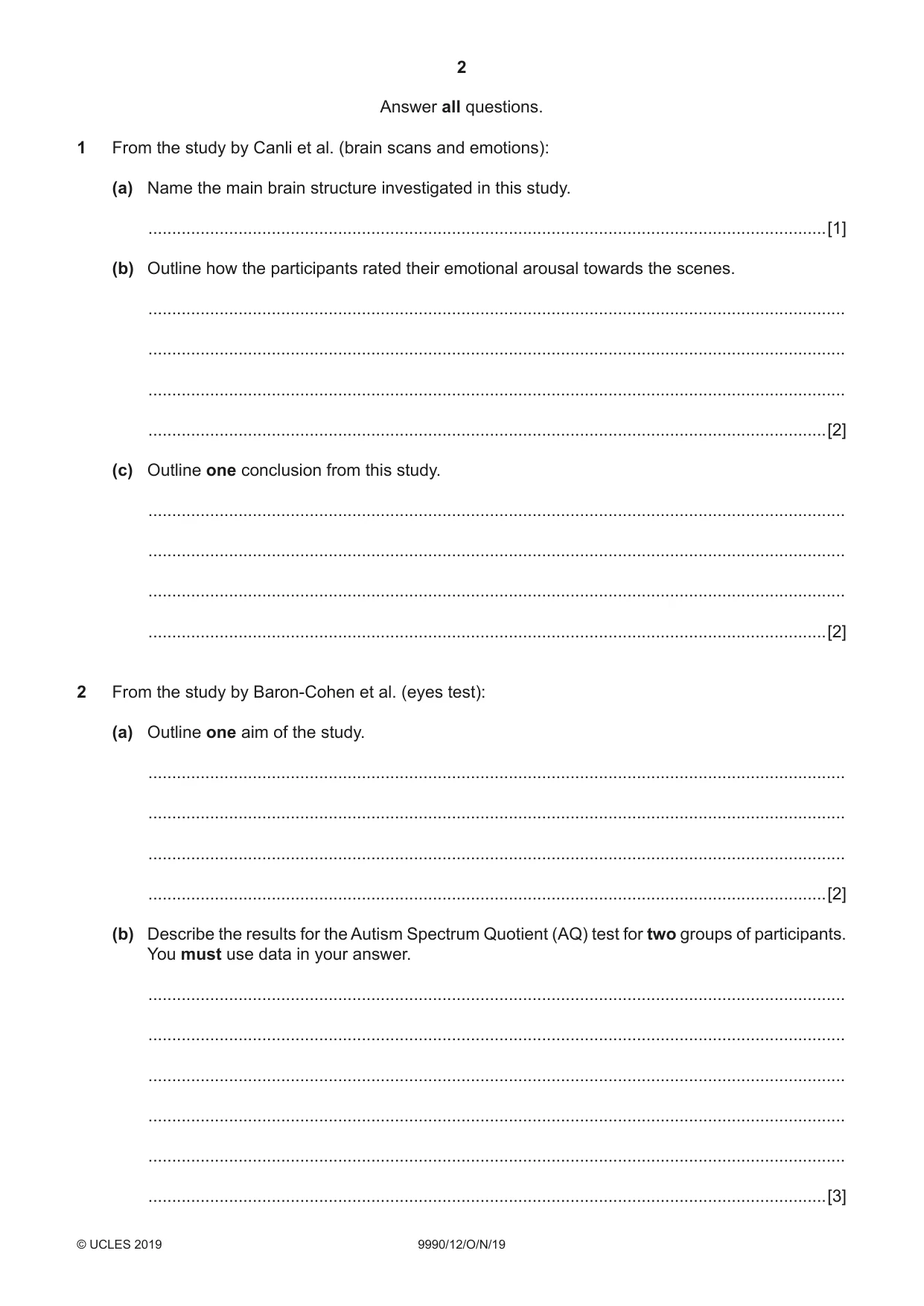
Question paper, page 2
2 9990/12/O/N/19 © UCLES 2019 Answer all questions. 1 From the study by Canli et al. (brain scans and emotions): (a) Name the main brain structure investigated in this study. …[1] (b) Outline how the participants rated their emotional arousal towards the scenes. … … … …[2] (c) Outline one conclusion from this study. … … … …[2] 2 From the study by Baron-Cohen et al. (eyes test): (a) Outline one aim of the study. … … … …[2] (b) Describe the results for the Autism Spectrum Quotient (AQ) test for two groups of participants. You must use data in your answer. … … … … … …[3]
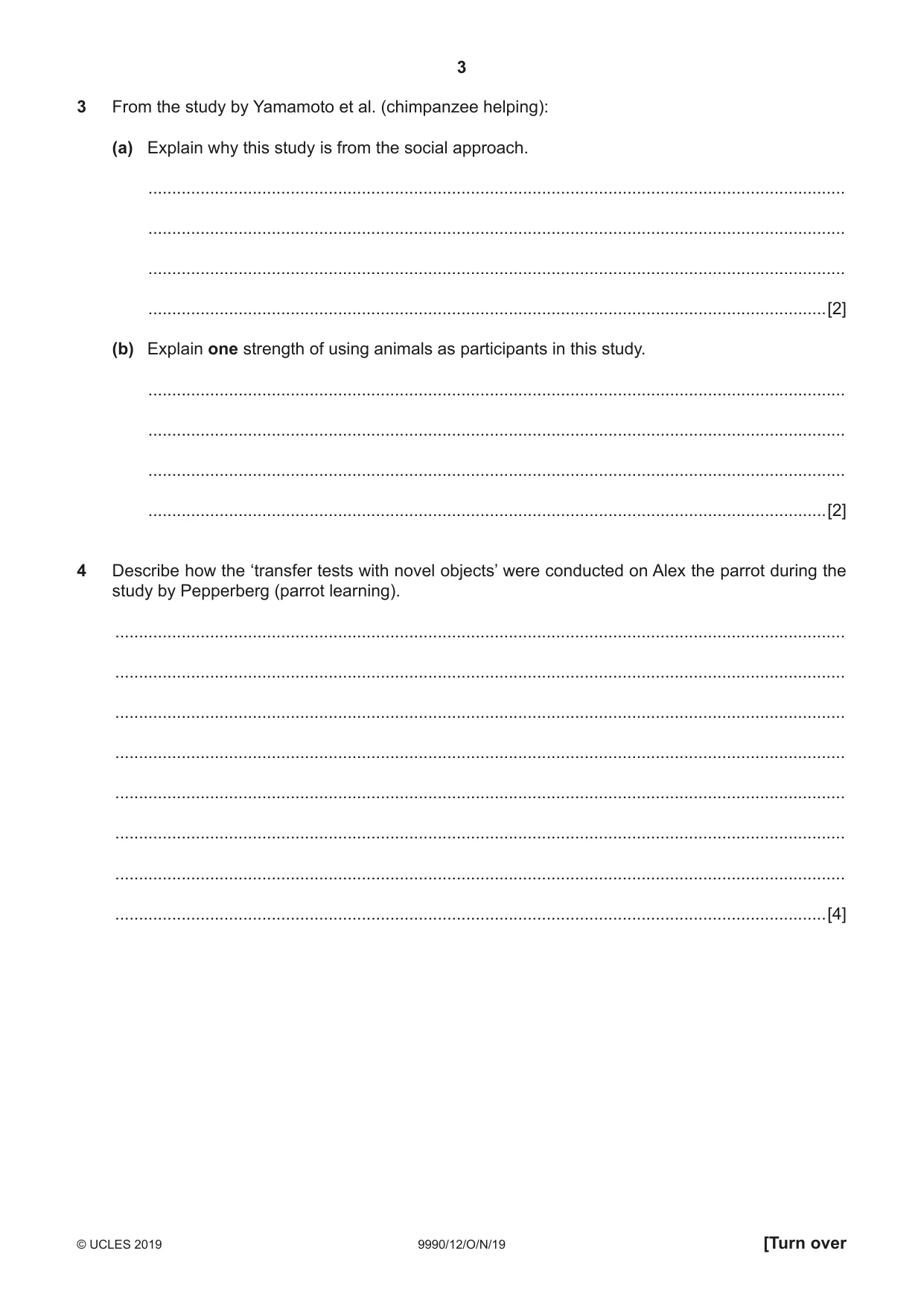
Question paper, page 3
3 9990/12/O/N/19 © UCLES 2019 [Turn over 3 From the study by Yamamoto et al. (chimpanzee helping): (a) Explain why this study is from the social approach. … … … …[2] (b) Explain one strength of using animals as participants in this study. … … … …[2] 4 Describe how the ‘transfer tests with novel objects’ were conducted on Alex the parrot during the study by Pepperberg (parrot learning). … … … … … … … …[4]
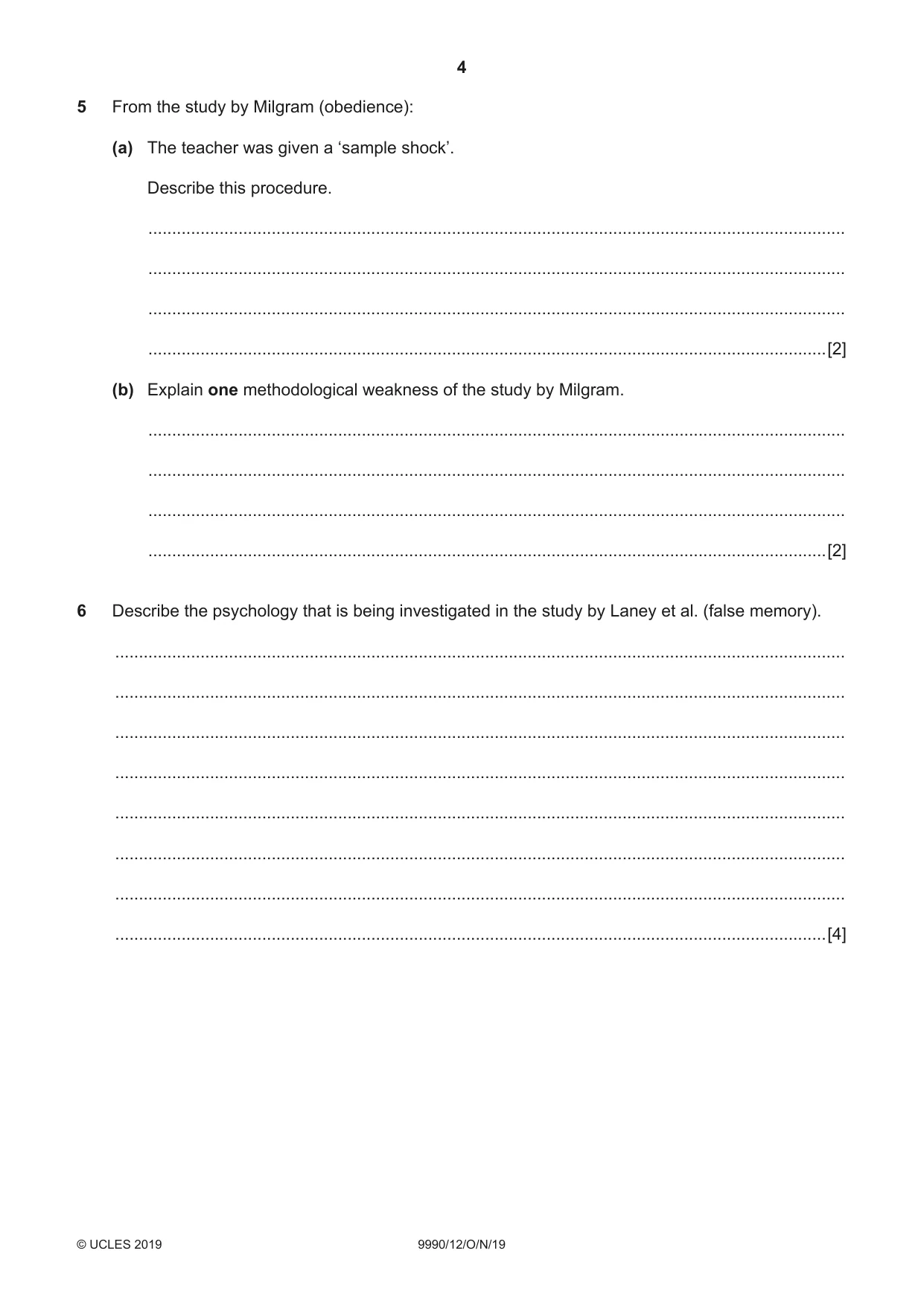
Question paper, page 4
4 9990/12/O/N/19 © UCLES 2019 5 From the study by Milgram (obedience): (a) The teacher was given a ‘sample shock’. Describe this procedure. … … … …[2] (b) Explain one methodological weakness of the study by Milgram. … … … …[2] 6 Describe the psychology that is being investigated in the study by Laney et al. (false memory). … … … … … … … …[4]
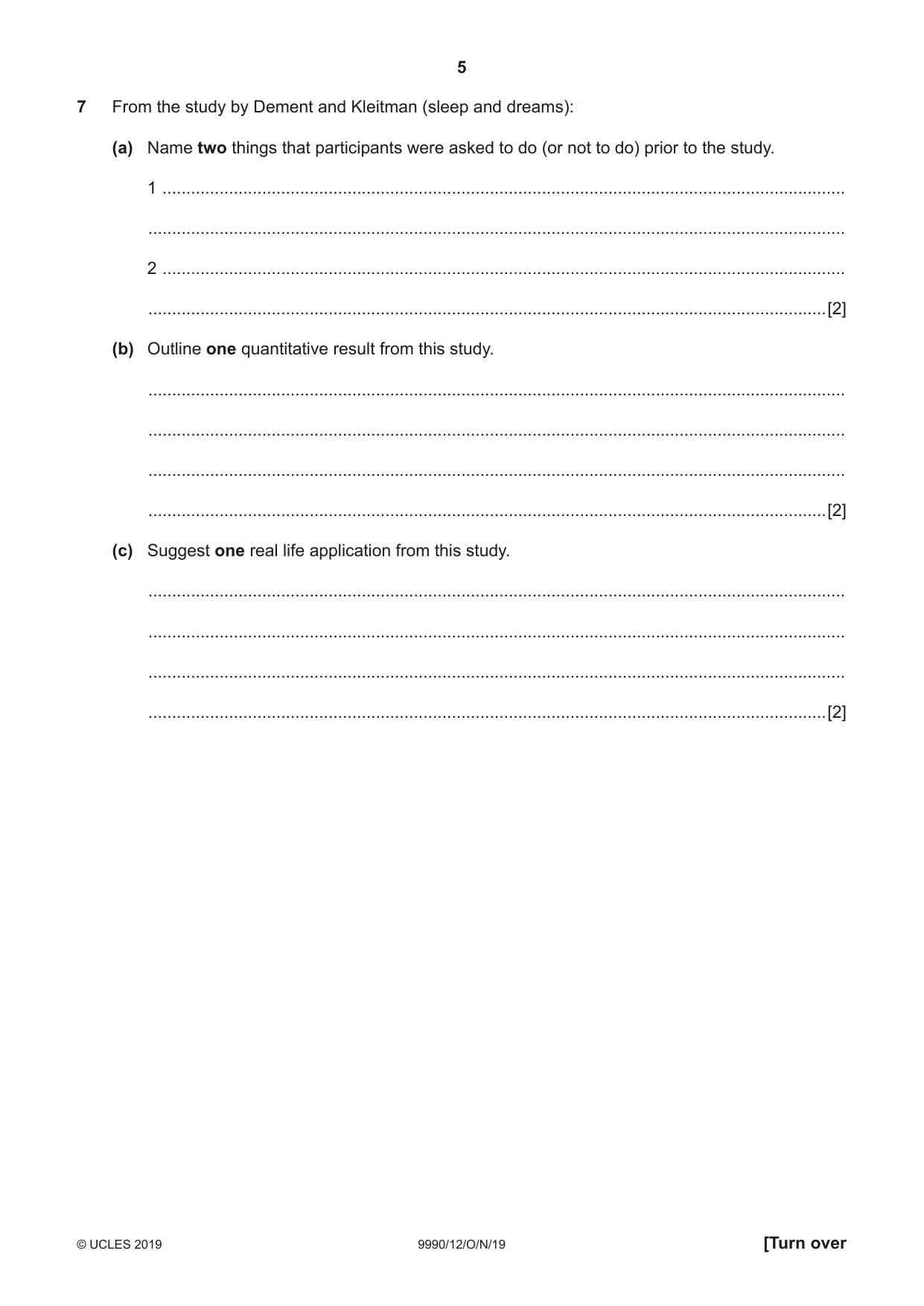
Question paper, page 5
5 9990/12/O/N/19 © UCLES 2019 [Turn over 7 From the study by Dement and Kleitman (sleep and dreams): (a) Name two things that participants were asked to do (or not to do) prior to the study. 1 … … 2 … …[2] (b) Outline one quantitative result from this study. … … … …[2] (c) Suggest one real life application from this study. … … … …[2]
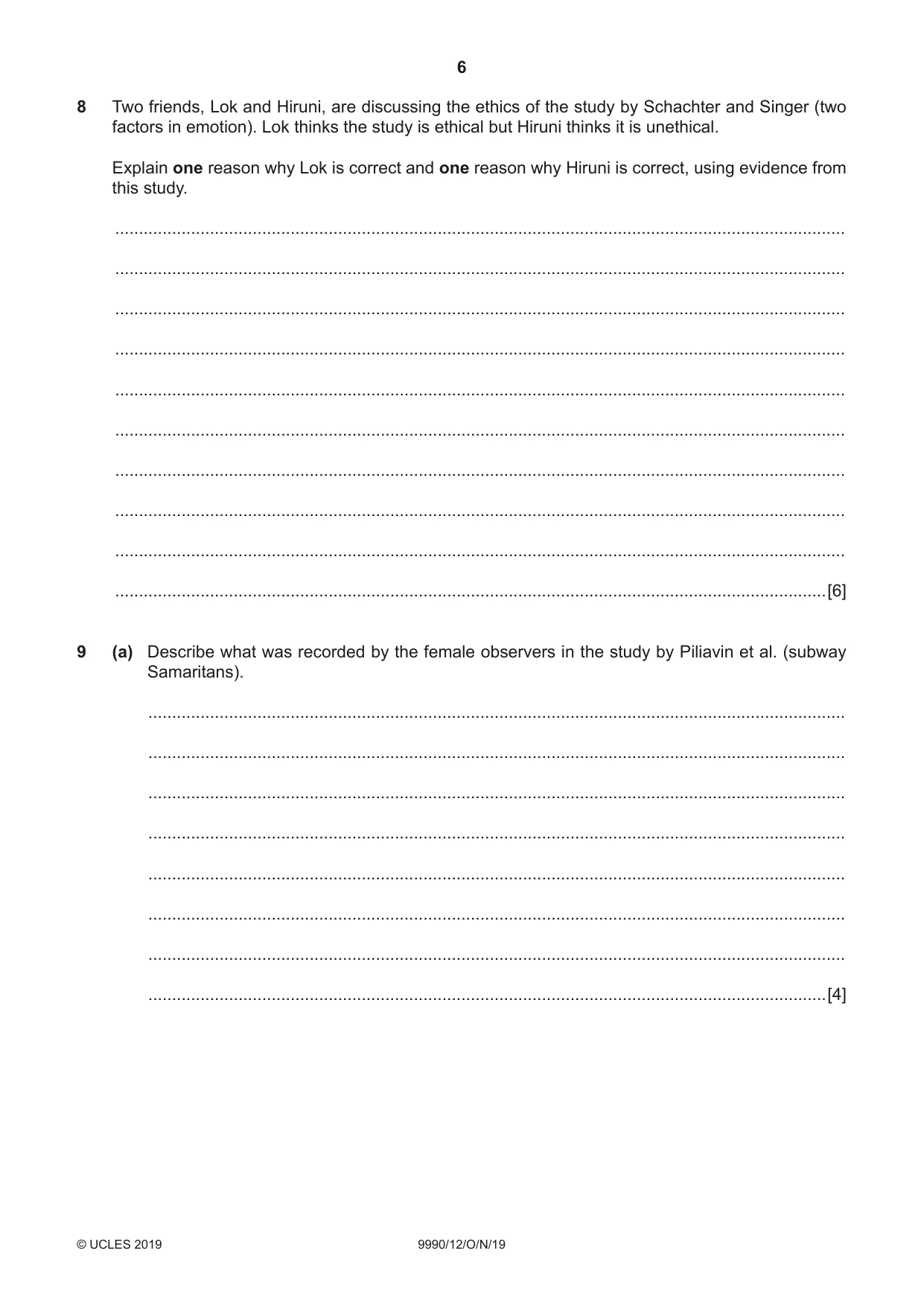
Question paper, page 6
6 9990/12/O/N/19 © UCLES 2019 8 Two friends, Lok and Hiruni, are discussing the ethics of the study by Schachter and Singer (two factors in emotion). Lok thinks the study is ethical but Hiruni thinks it is unethical. Explain one reason why Lok is correct and one reason why Hiruni is correct, using evidence from this study. … … … … … … … … … …[6] 9 (a) Describe what was recorded by the female observers in the study by Piliavin et al. (subway Samaritans). … … … … … … … …[4]
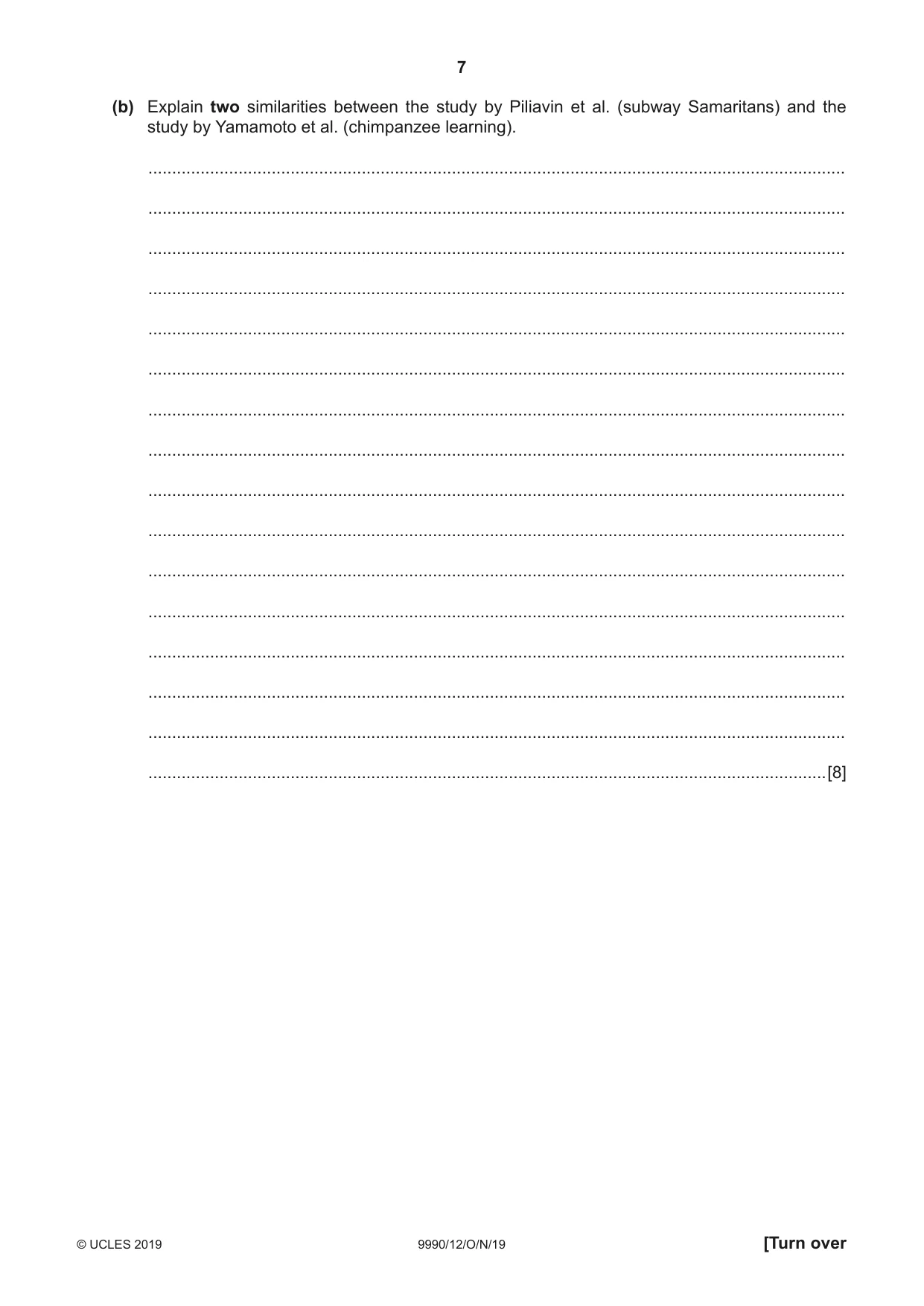
Question paper, page 7
7 9990/12/O/N/19 © UCLES 2019 [Turn over (b) Explain two similarities between the study by Piliavin et al. (subway Samaritans) and the study by Yamamoto et al. (chimpanzee learning). … … … … … … … … … … … … … … … …[8]
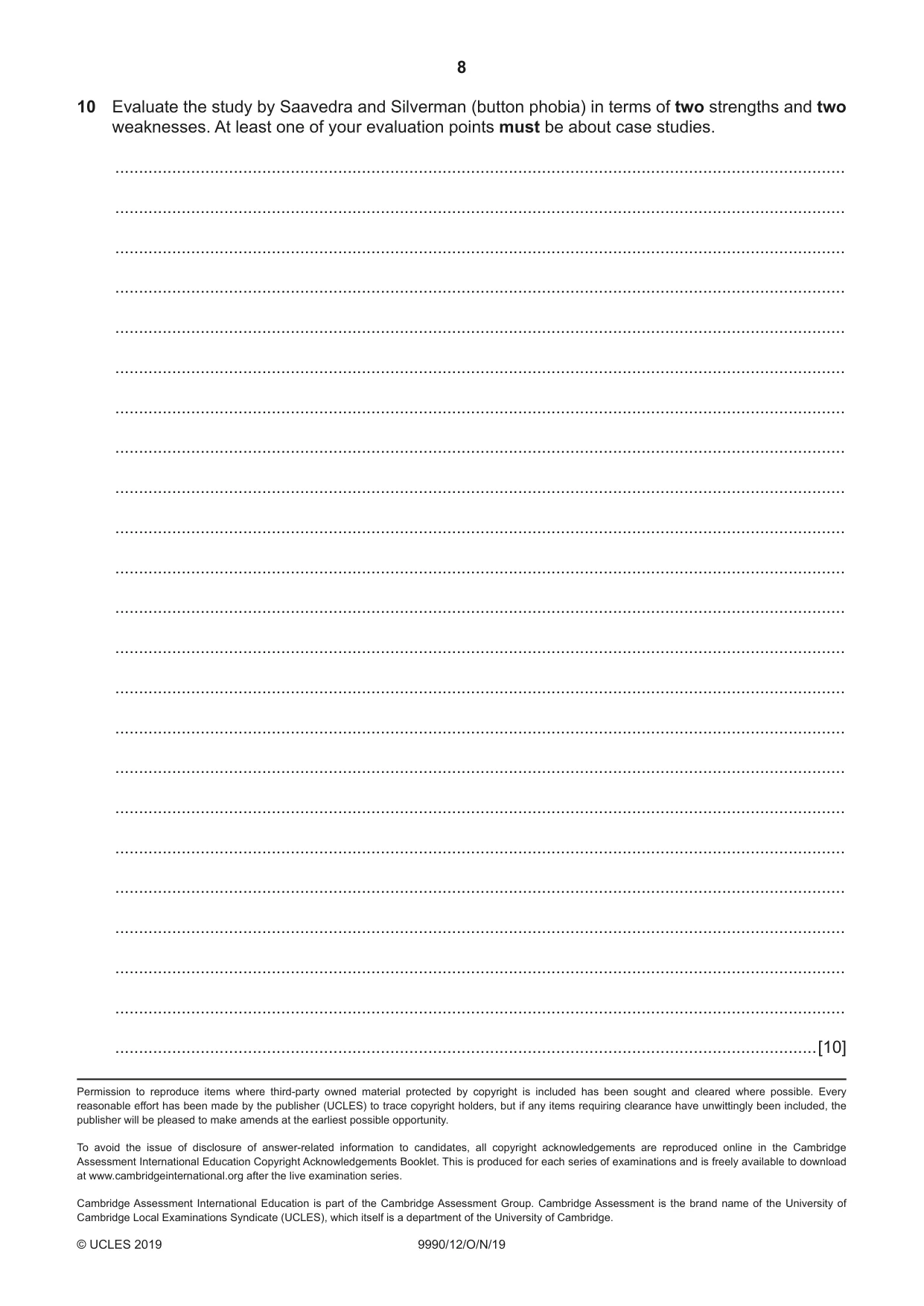
Question paper, page 8
8 9990/12/O/N/19 © UCLES 2019 Permission to reproduce items where third-party owned material protected by copyright is included has been sought and cleared where possible. Every reasonable effort has been made by the publisher (UCLES) to trace copyright holders, but if any items requiring clearance have unwittingly been included, the publisher will be pleased to make amends at the earliest possible opportunity. To avoid the issue of disclosure of answer-related information to candidates, all copyright acknowledgements are reproduced online in the Cambridge Assessment International Education Copyright Acknowledgements Booklet. This is produced for each series of examinations and is freely available to download at www.cambridgeinternational.org after the live examination series. Cambridge Assessment International Education is part of the Cambridge Assessment Group. Cambridge Assessment is the brand name of the University of Cambridge Local Examinations Syndicate (UCLES), which itself is a department of the University of Cambridge. 10 Evaluate the study by Saavedra and Silverman (button phobia) in terms of two strengths and two weaknesses. At least one of your evaluation points must be about case studies. … … … … … … … … … … … … … … … … … … … … … … …[10]
Mark scheme, page 1
This document consists of 10 printed pages. © UCLES 2019 [Turn over Cambridge Assessment International Education Cambridge International Advanced Subsidiary and Advanced Level PSYCHOLOGY 9990/12 Paper 1 Approaches, Issues and Debates October/November 2019 MARK SCHEME Maximum Mark: 60 Published This mark scheme is published as an aid to teachers and candidates, to indicate the requirements of the examination. It shows the basis on which Examiners were instructed to award marks. It does not indicate the details of the discussions that took place at an Examiners’ meeting before marking began, which would have considered the acceptability of alternative answers. Mark schemes should be read in conjunction with the question paper and the Principal Examiner Report for Teachers. Cambridge International will not enter into discussions about these mark schemes. Cambridge International is publishing the mark schemes for the October/November 2019 series for most Cambridge IGCSE™, Cambridge International A and AS Level components and some Cambridge O Level components.
Mark scheme, page 2
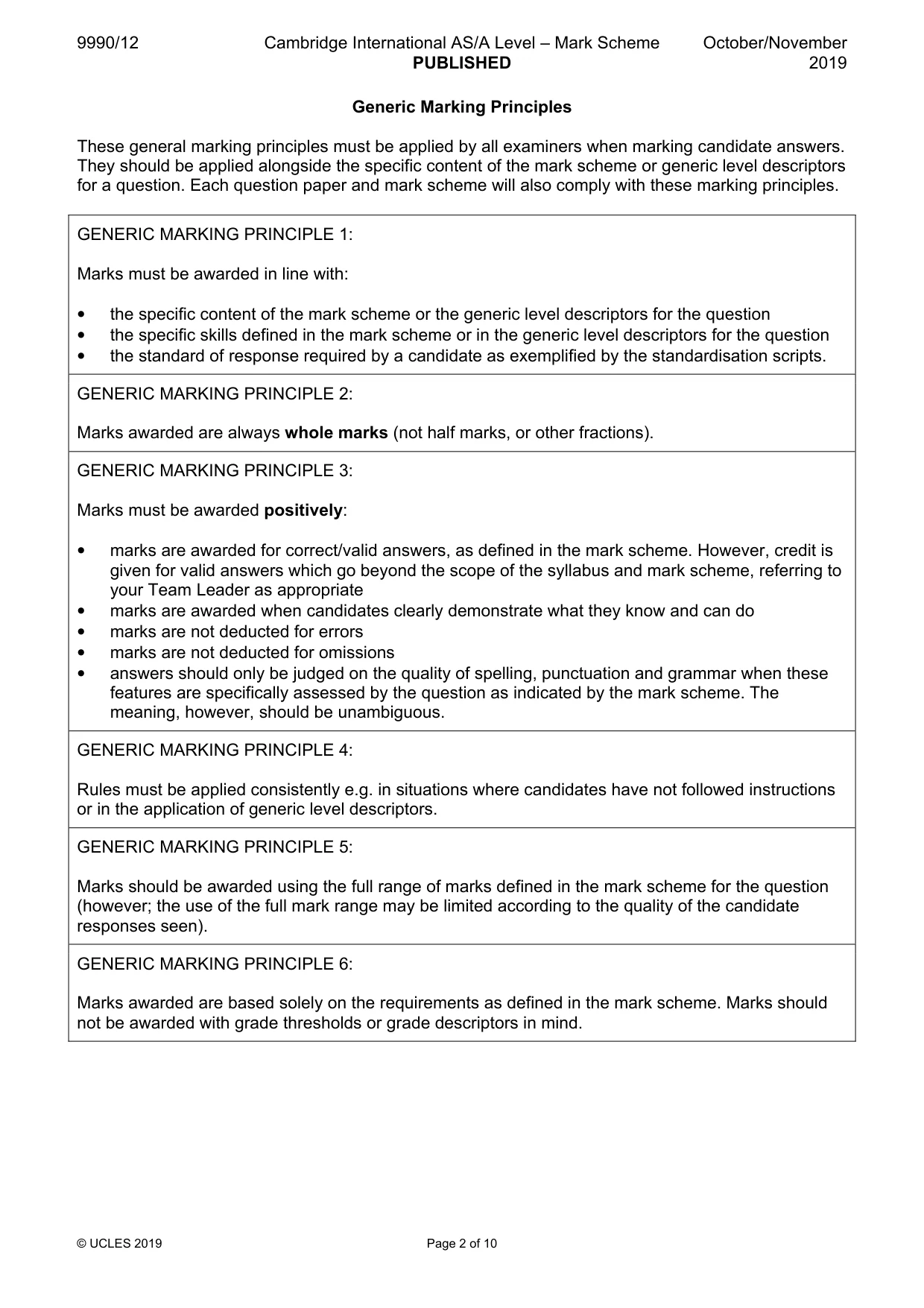
9990/12 Cambridge International AS/A Level – Mark Scheme PUBLISHED October/November 2019 © UCLES 2019 Page 2 of 10 Generic Marking Principles These general marking principles must be applied by all examiners when marking candidate answers. They should be applied alongside the specific content of the mark scheme or generic level descriptors for a question. Each question paper and mark scheme will also comply with these marking principles. GENERIC MARKING PRINCIPLE 1: Marks must be awarded in line with: • the specific content of the mark scheme or the generic level descriptors for the question • the specific skills defined in the mark scheme or in the generic level descriptors for the question • the standard of response required by a candidate as exemplified by the standardisation scripts. GENERIC MARKING PRINCIPLE 2: Marks awarded are always whole marks (not half marks, or other fractions). GENERIC MARKING PRINCIPLE 3: Marks must be awarded positively: • marks are awarded for correct/valid answers, as defined in the mark scheme. However, credit is given for valid answers which go beyond the scope of the syllabus and mark scheme, referring to your Team Leader as appropriate • marks are awarded when candidates clearly demonstrate what they know and can do • marks are not deducted for errors • marks are not deducted for omissions • answers should only be judged on the quality of spelling, punctuation and grammar when these features are specifically assessed by the question as indicated by the mark scheme. The meaning, however, should be unambiguous. GENERIC MARKING PRINCIPLE 4: Rules must be applied consistently e.g. in situations where candidates have not followed instructions or in the application of generic level descriptors. GENERIC MARKING PRINCIPLE 5: Marks should be awarded using the full range of marks defined in the mark scheme for the question (however; the use of the full mark range may be limited according to the quality of the candidate responses seen). GENERIC MARKING PRINCIPLE 6: Marks awarded are based solely on the requirements as defined in the mark scheme. Marks should not be awarded with grade thresholds or grade descriptors in mind.
Mark scheme, page 3
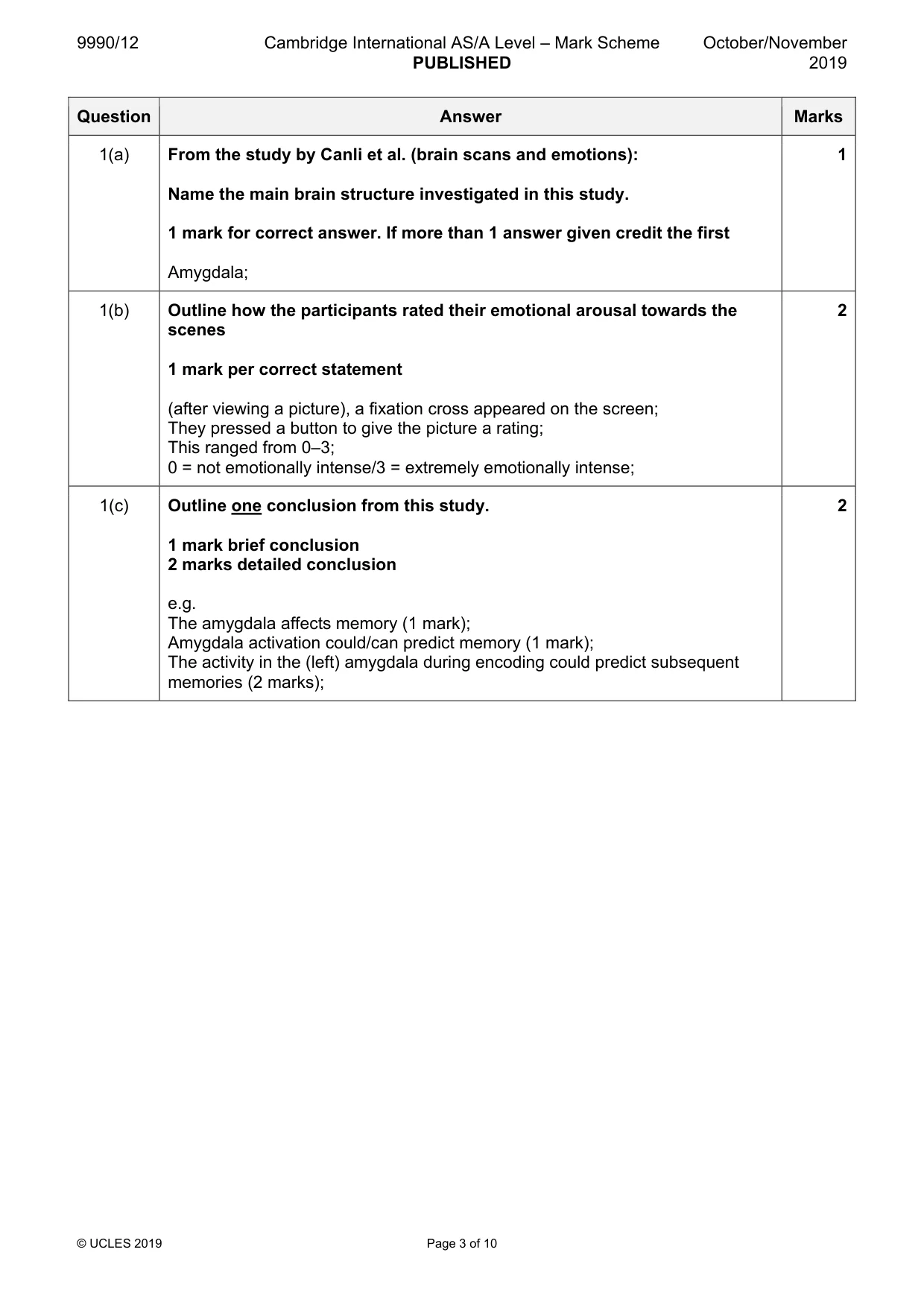
9990/12 Cambridge International AS/A Level – Mark Scheme PUBLISHED October/November 2019 © UCLES 2019 Page 3 of 10 Question Answer Marks 1(a) From the study by Canli et al. (brain scans and emotions): Name the main brain structure investigated in this study. 1 mark for correct answer. If more than 1 answer given credit the first Amygdala; 1 1(b) Outline how the participants rated their emotional arousal towards the scenes 1 mark per correct statement (after viewing a picture), a fixation cross appeared on the screen; They pressed a button to give the picture a rating; This ranged from 0–3; 0 = not emotionally intense/3 = extremely emotionally intense; 2 1(c) Outline one conclusion from this study. 1 mark brief conclusion 2 marks detailed conclusion e.g. The amygdala affects memory (1 mark); Amygdala activation could/can predict memory (1 mark); The activity in the (left) amygdala during encoding could predict subsequent memories (2 marks); 2
Mark scheme, page 4
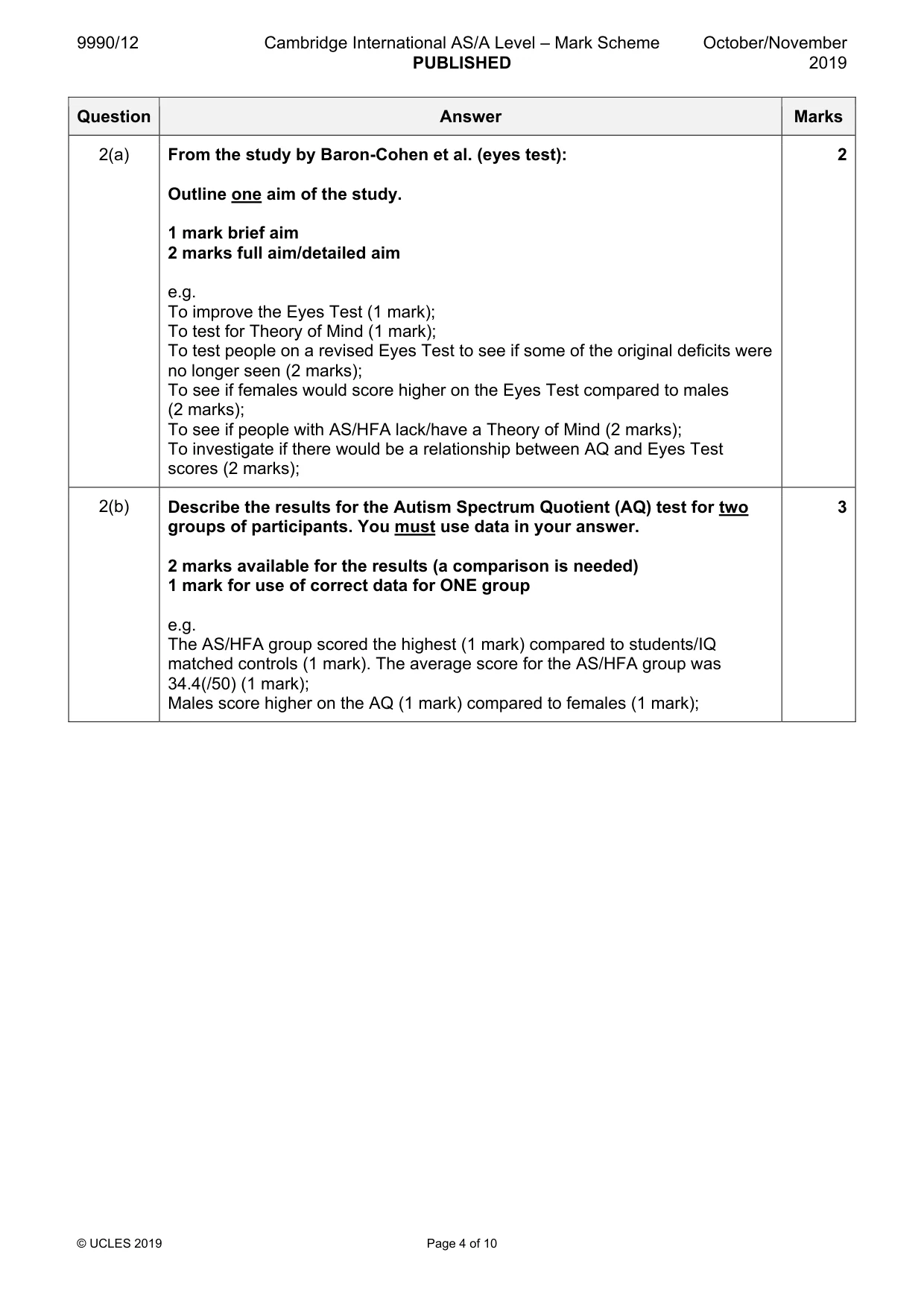
9990/12 Cambridge International AS/A Level – Mark Scheme PUBLISHED October/November 2019 © UCLES 2019 Page 4 of 10 Question Answer Marks 2(a) From the study by Baron-Cohen et al. (eyes test): Outline one aim of the study. 1 mark brief aim 2 marks full aim/detailed aim e.g. To improve the Eyes Test (1 mark); To test for Theory of Mind (1 mark); To test people on a revised Eyes Test to see if some of the original deficits were no longer seen (2 marks); To see if females would score higher on the Eyes Test compared to males (2 marks); To see if people with AS/HFA lack/have a Theory of Mind (2 marks); To investigate if there would be a relationship between AQ and Eyes Test scores (2 marks); 2 2(b) Describe the results for the Autism Spectrum Quotient (AQ) test for two groups of participants. You must use data in your answer. 2 marks available for the results (a comparison is needed) 1 mark for use of correct data for ONE group e.g. The AS/HFA group scored the highest (1 mark) compared to students/IQ matched controls (1 mark). The average score for the AS/HFA group was 34.4(/50) (1 mark); Males score higher on the AQ (1 mark) compared to females (1 mark); 3
Mark scheme, page 5
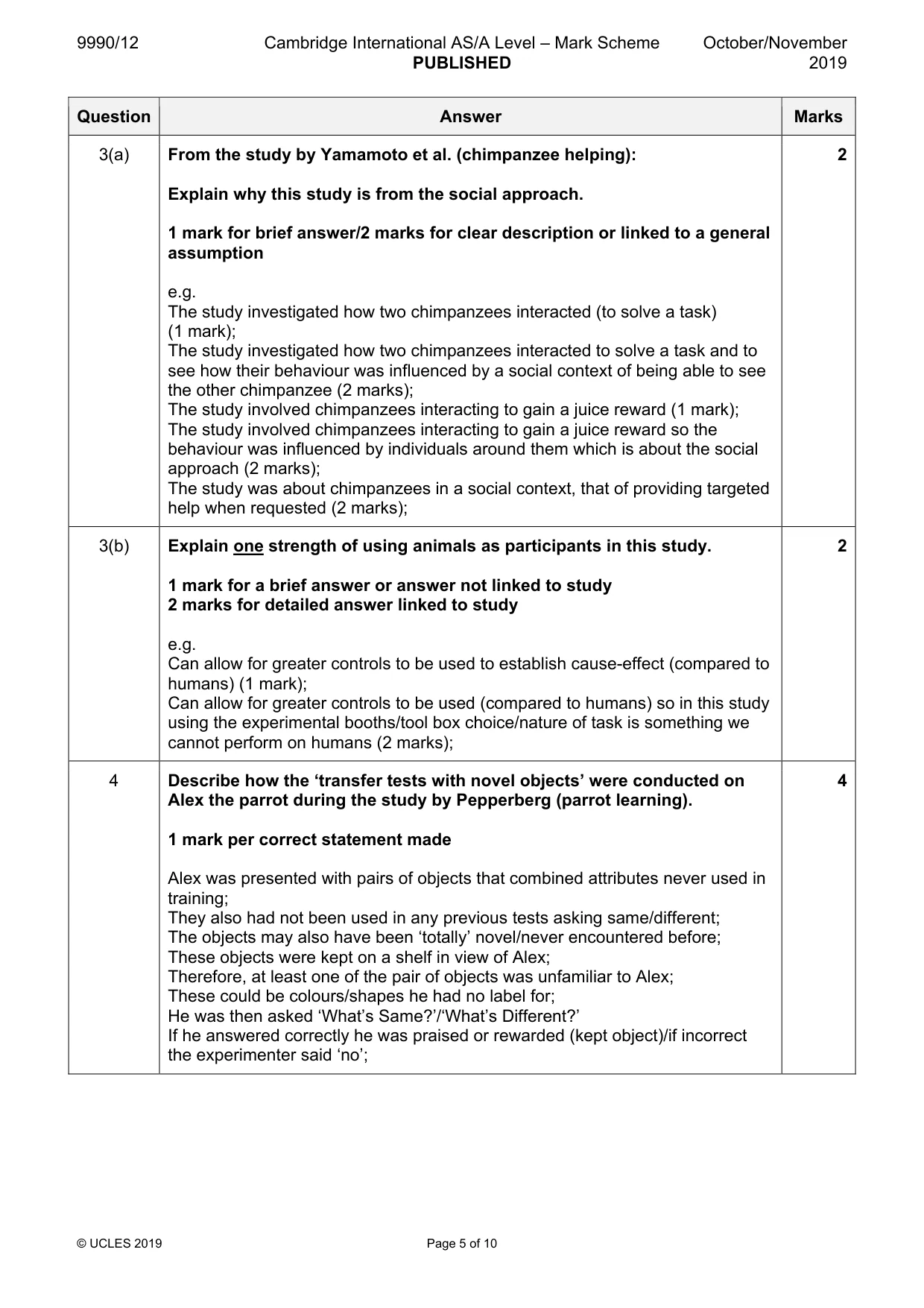
9990/12 Cambridge International AS/A Level – Mark Scheme PUBLISHED October/November 2019 © UCLES 2019 Page 5 of 10 Question Answer Marks 3(a) From the study by Yamamoto et al. (chimpanzee helping): Explain why this study is from the social approach. 1 mark for brief answer/2 marks for clear description or linked to a general assumption e.g. The study investigated how two chimpanzees interacted (to solve a task) (1 mark); The study investigated how two chimpanzees interacted to solve a task and to see how their behaviour was influenced by a social context of being able to see the other chimpanzee (2 marks); The study involved chimpanzees interacting to gain a juice reward (1 mark); The study involved chimpanzees interacting to gain a juice reward so the behaviour was influenced by individuals around them which is about the social approach (2 marks); The study was about chimpanzees in a social context, that of providing targeted help when requested (2 marks); 2 3(b) Explain one strength of using animals as participants in this study. 1 mark for a brief answer or answer not linked to study 2 marks for detailed answer linked to study e.g. Can allow for greater controls to be used to establish cause-effect (compared to humans) (1 mark); Can allow for greater controls to be used (compared to humans) so in this study using the experimental booths/tool box choice/nature of task is something we cannot perform on humans (2 marks); 2 4 Describe how the ‘transfer tests with novel objects’ were conducted on Alex the parrot during the study by Pepperberg (parrot learning). 1 mark per correct statement made Alex was presented with pairs of objects that combined attributes never used in training; They also had not been used in any previous tests asking same/different; The objects may also have been ‘totally’ novel/never encountered before; These objects were kept on a shelf in view of Alex; Therefore, at least one of the pair of objects was unfamiliar to Alex; These could be colours/shapes he had no label for; He was then asked ‘What’s Same?’/‘What’s Different?’ If he answered correctly he was praised or rewarded (kept object)/if incorrect the experimenter said ‘no’; 4
Mark scheme, page 6
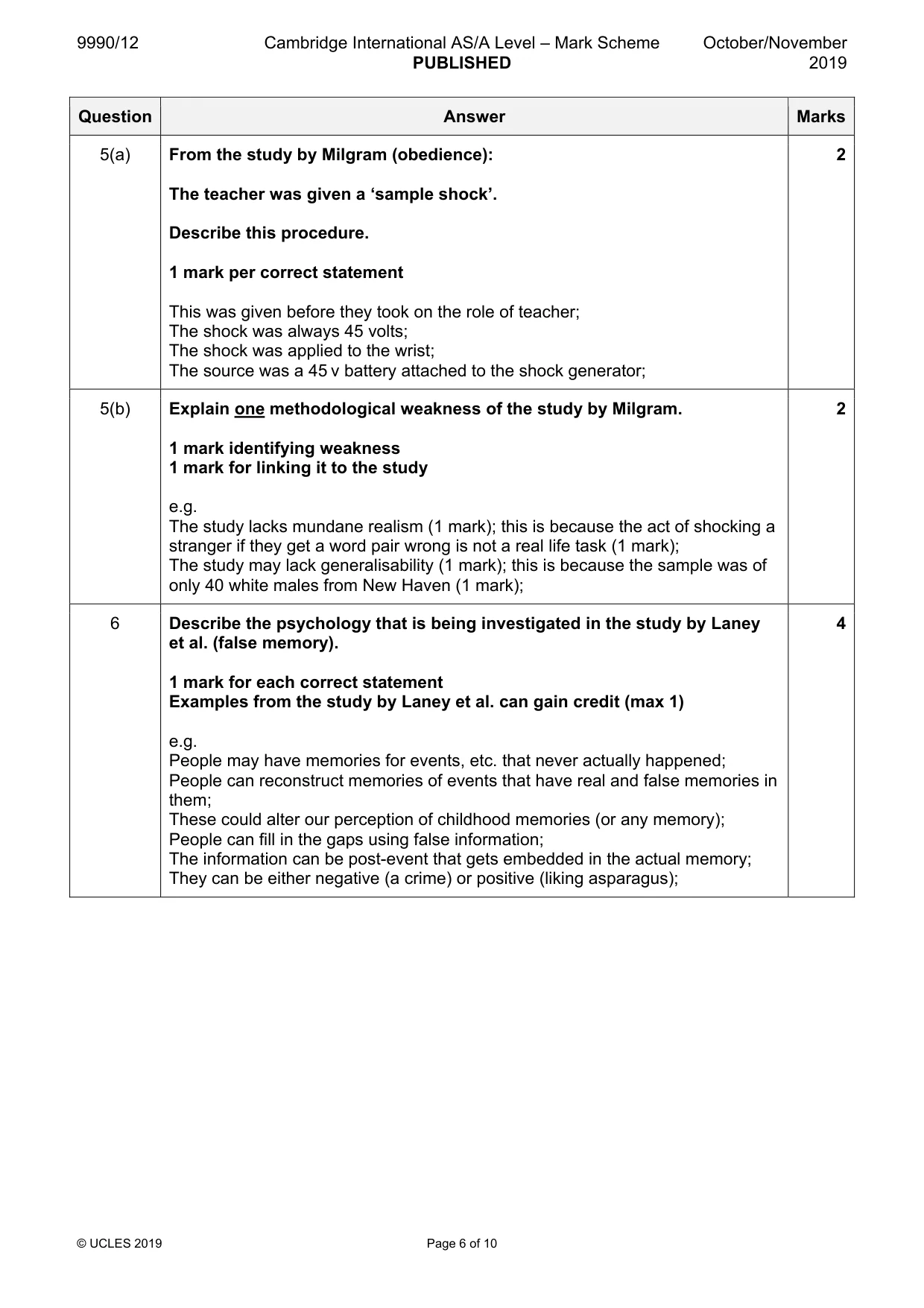
9990/12 Cambridge International AS/A Level – Mark Scheme PUBLISHED October/November 2019 © UCLES 2019 Page 6 of 10 Question Answer Marks 5(a) From the study by Milgram (obedience): The teacher was given a ‘sample shock’. Describe this procedure. 1 mark per correct statement This was given before they took on the role of teacher; The shock was always 45 volts; The shock was applied to the wrist; The source was a 45 v battery attached to the shock generator; 2 5(b) Explain one methodological weakness of the study by Milgram. 1 mark identifying weakness 1 mark for linking it to the study e.g. The study lacks mundane realism (1 mark); this is because the act of shocking a stranger if they get a word pair wrong is not a real life task (1 mark); The study may lack generalisability (1 mark); this is because the sample was of only 40 white males from New Haven (1 mark); 2 6 Describe the psychology that is being investigated in the study by Laney et al. (false memory). 1 mark for each correct statement Examples from the study by Laney et al. can gain credit (max 1) e.g. People may have memories for events, etc. that never actually happened; People can reconstruct memories of events that have real and false memories in them; These could alter our perception of childhood memories (or any memory); People can fill in the gaps using false information; The information can be post-event that gets embedded in the actual memory; They can be either negative (a crime) or positive (liking asparagus); 4
Mark scheme, page 7
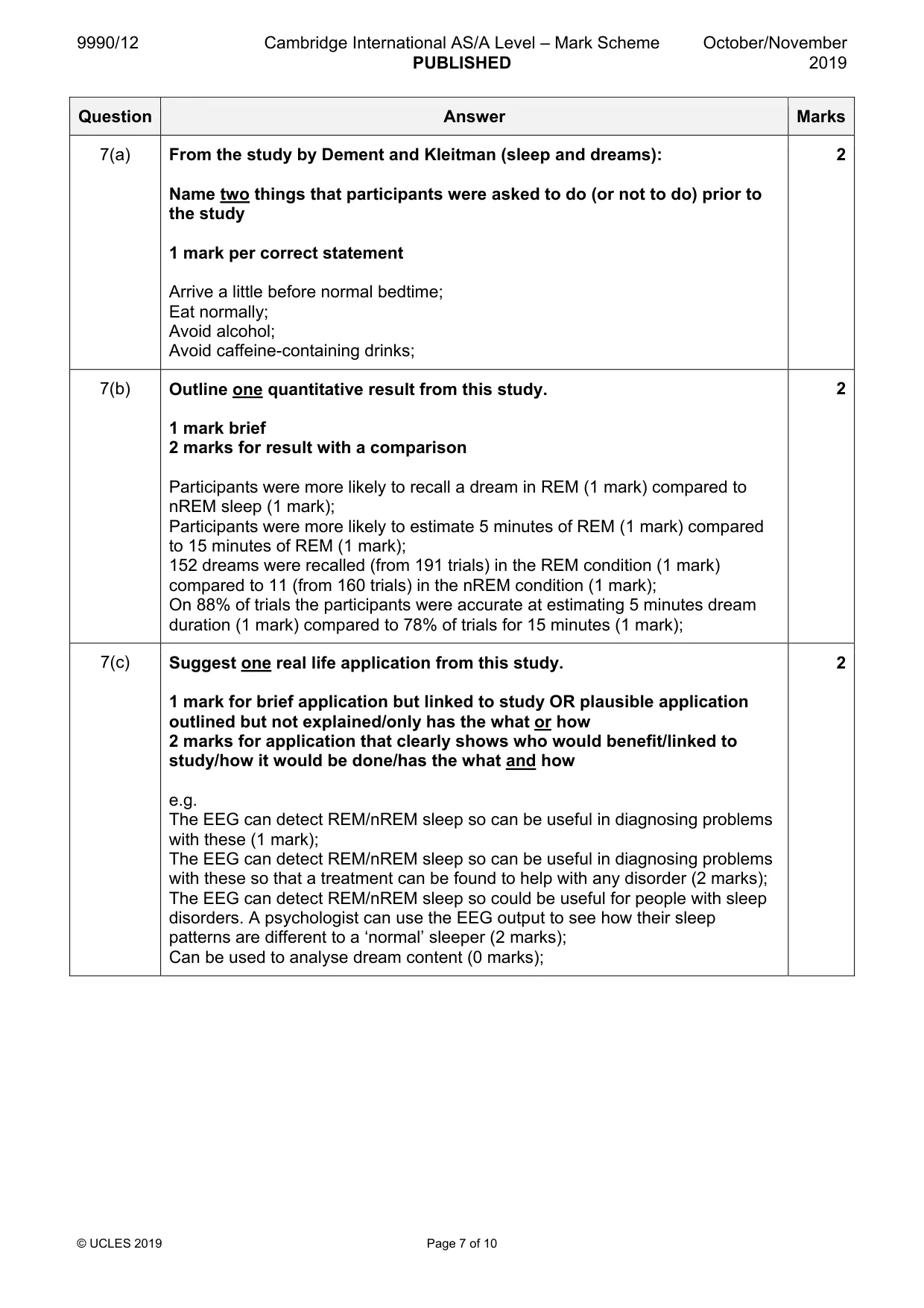
9990/12 Cambridge International AS/A Level – Mark Scheme PUBLISHED October/November 2019 © UCLES 2019 Page 7 of 10 Question Answer Marks 7(a) From the study by Dement and Kleitman (sleep and dreams): Name two things that participants were asked to do (or not to do) prior to the study 1 mark per correct statement Arrive a little before normal bedtime; Eat normally; Avoid alcohol; Avoid caffeine-containing drinks; 2 7(b) Outline one quantitative result from this study. 1 mark brief 2 marks for result with a comparison Participants were more likely to recall a dream in REM (1 mark) compared to nREM sleep (1 mark); Participants were more likely to estimate 5 minutes of REM (1 mark) compared to 15 minutes of REM (1 mark); 152 dreams were recalled (from 191 trials) in the REM condition (1 mark) compared to 11 (from 160 trials) in the nREM condition (1 mark); On 88% of trials the participants were accurate at estimating 5 minutes dream duration (1 mark) compared to 78% of trials for 15 minutes (1 mark); 2 7(c) Suggest one real life application from this study. 1 mark for brief application but linked to study OR plausible application outlined but not explained/only has the what or how 2 marks for application that clearly shows who would benefit/linked to study/how it would be done/has the what and how e.g. The EEG can detect REM/nREM sleep so can be useful in diagnosing problems with these (1 mark); The EEG can detect REM/nREM sleep so can be useful in diagnosing problems with these so that a treatment can be found to help with any disorder (2 marks); The EEG can detect REM/nREM sleep so could be useful for people with sleep disorders. A psychologist can use the EEG output to see how their sleep patterns are different to a ‘normal’ sleeper (2 marks); Can be used to analyse dream content (0 marks); 2
Mark scheme, page 8
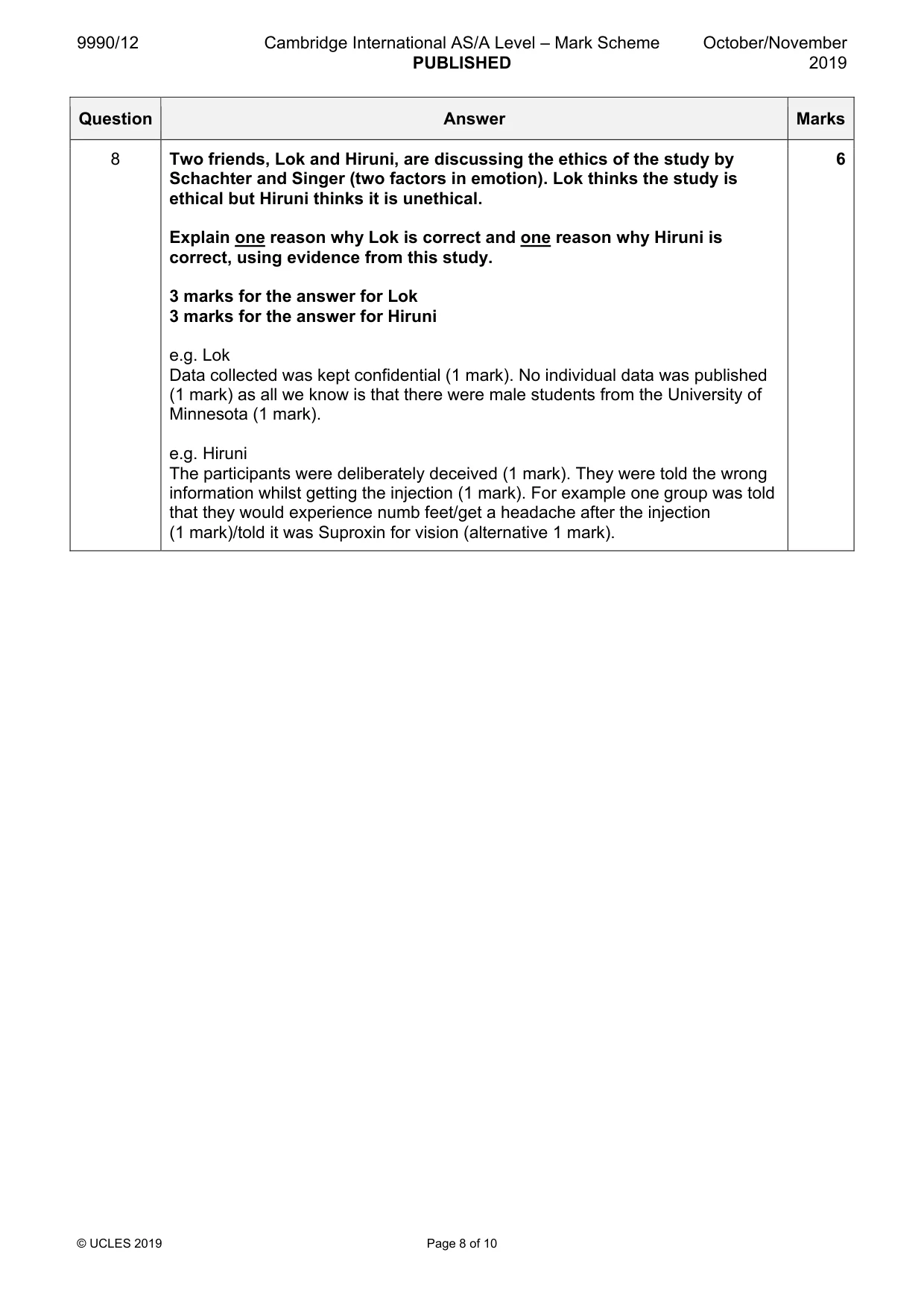
9990/12 Cambridge International AS/A Level – Mark Scheme PUBLISHED October/November 2019 © UCLES 2019 Page 8 of 10 Question Answer Marks 8 Two friends, Lok and Hiruni, are discussing the ethics of the study by Schachter and Singer (two factors in emotion). Lok thinks the study is ethical but Hiruni thinks it is unethical. Explain one reason why Lok is correct and one reason why Hiruni is correct, using evidence from this study. 3 marks for the answer for Lok 3 marks for the answer for Hiruni e.g. Lok Data collected was kept confidential (1 mark). No individual data was published (1 mark) as all we know is that there were male students from the University of Minnesota (1 mark). e.g. Hiruni The participants were deliberately deceived (1 mark). They were told the wrong information whilst getting the injection (1 mark). For example one group was told that they would experience numb feet/get a headache after the injection (1 mark)/told it was Suproxin for vision (alternative 1 mark). 6
Mark scheme, page 9
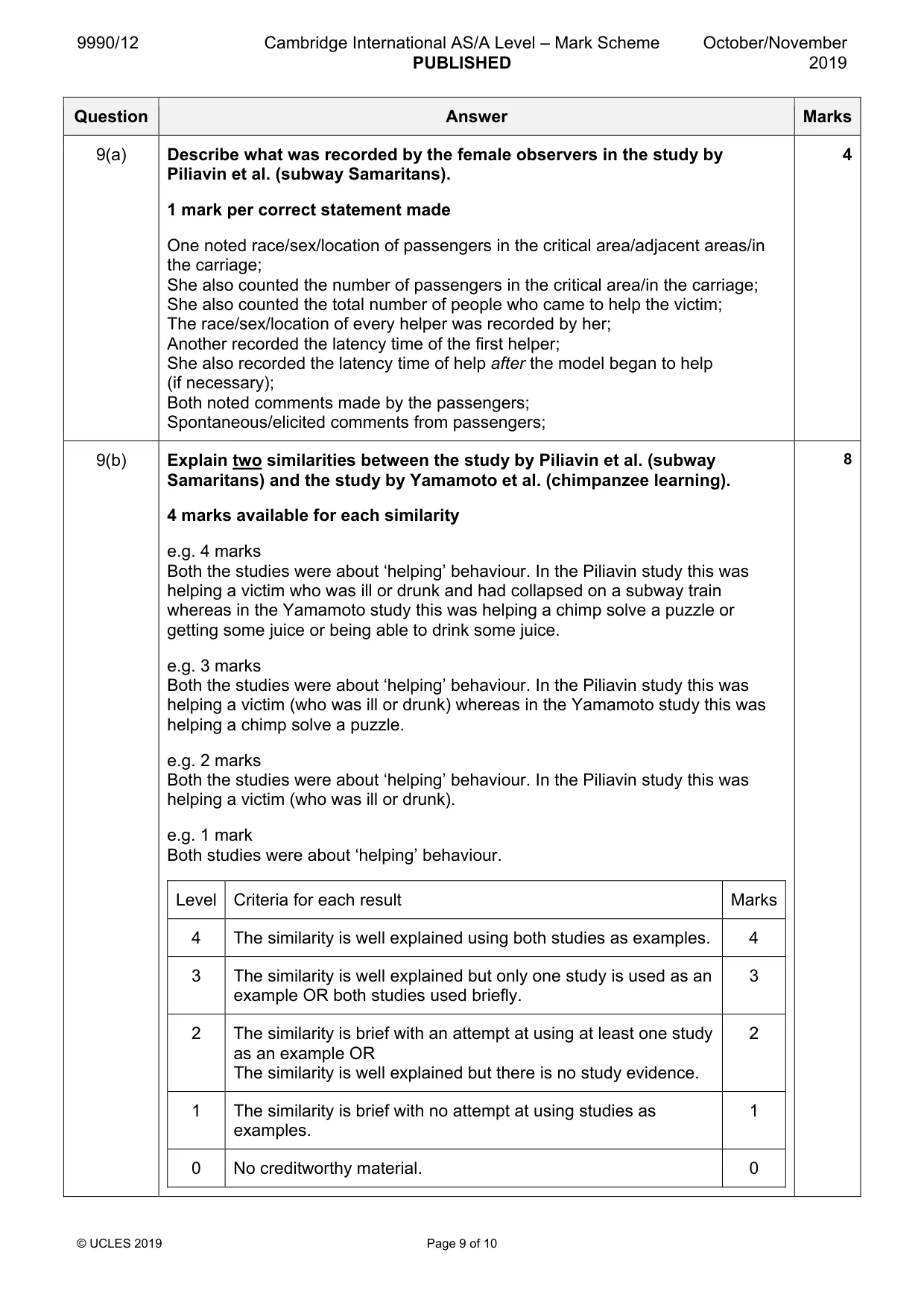
9990/12 Cambridge International AS/A Level – Mark Scheme PUBLISHED October/November 2019 © UCLES 2019 Page 9 of 10 Question Answer Marks 9(a) Describe what was recorded by the female observers in the study by Piliavin et al. (subway Samaritans). 1 mark per correct statement made One noted race/sex/location of passengers in the critical area/adjacent areas/in the carriage; She also counted the number of passengers in the critical area/in the carriage; She also counted the total number of people who came to help the victim; The race/sex/location of every helper was recorded by her; Another recorded the latency time of the first helper; She also recorded the latency time of help after the model began to help (if necessary); Both noted comments made by the passengers; Spontaneous/elicited comments from passengers; 4 9(b) Explain two similarities between the study by Piliavin et al. (subway Samaritans) and the study by Yamamoto et al. (chimpanzee learning). 4 marks available for each similarity e.g. 4 marks Both the studies were about ‘helping’ behaviour. In the Piliavin study this was helping a victim who was ill or drunk and had collapsed on a subway train whereas in the Yamamoto study this was helping a chimp solve a puzzle or getting some juice or being able to drink some juice. e.g. 3 marks Both the studies were about ‘helping’ behaviour. In the Piliavin study this was helping a victim (who was ill or drunk) whereas in the Yamamoto study this was helping a chimp solve a puzzle. e.g. 2 marks Both the studies were about ‘helping’ behaviour. In the Piliavin study this was helping a victim (who was ill or drunk). e.g. 1 mark Both studies were about ‘helping’ behaviour. Level Criteria for each result Marks 4 The similarity is well explained using both studies as examples. 4 3 The similarity is well explained but only one study is used as an example OR both studies used briefly. 3 2 The similarity is brief with an attempt at using at least one study as an example OR The similarity is well explained but there is no study evidence. 2 1 The similarity is brief with no attempt at using studies as examples. 1 0 No creditworthy material. 0 8
Mark scheme, page 10
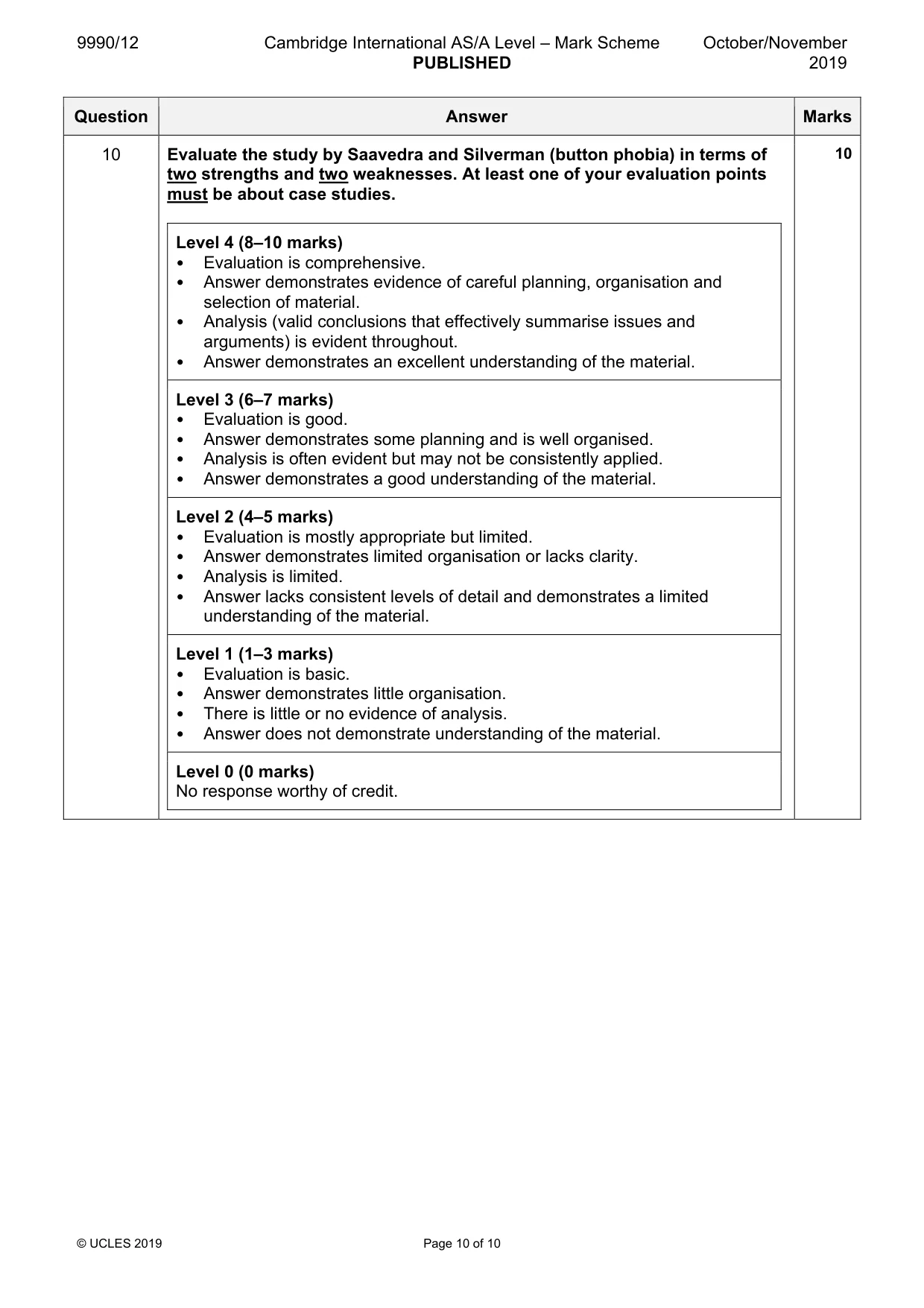
9990/12 Cambridge International AS/A Level – Mark Scheme PUBLISHED October/November 2019 © UCLES 2019 Page 10 of 10 Question Answer Marks 10 Evaluate the study by Saavedra and Silverman (button phobia) in terms of two strengths and two weaknesses. At least one of your evaluation points must be about case studies. Level 4 (8–10 marks) • Evaluation is comprehensive. • Answer demonstrates evidence of careful planning, organisation and selection of material. • Analysis (valid conclusions that effectively summarise issues and arguments) is evident throughout. • Answer demonstrates an excellent understanding of the material. Level 3 (6–7 marks) • Evaluation is good. • Answer demonstrates some planning and is well organised. • Analysis is often evident but may not be consistently applied. • Answer demonstrates a good understanding of the material. Level 2 (4–5 marks) • Evaluation is mostly appropriate but limited. • Answer demonstrates limited organisation or lacks clarity. • Analysis is limited. • Answer lacks consistent levels of detail and demonstrates a limited understanding of the material. Level 1 (1–3 marks) • Evaluation is basic. • Answer demonstrates little organisation. • There is little or no evidence of analysis. • Answer does not demonstrate understanding of the material. Level 0 (0 marks) No response worthy of credit. 10
What you needed in this session
Cambridge’s own grade thresholds for 2019 Oct/Nov, Paper 1 · Variant 2. A higher threshold means an easier paper — the bar moves with how the cohort did.