Cambridge A Level Psychology (from 2018) 9990 — 2024 Feb/March Paper 1 · Variant 2
9990/12/F/M/24 · 60 marks · 90 min
The question paper and its mark scheme, free to read here and free to download. This is Cambridge’s own paper, exactly as it was sat.
Question paper12 pages



Mark scheme19 pages
Answers below. Sit the paper first if you are practising.
Paper as text
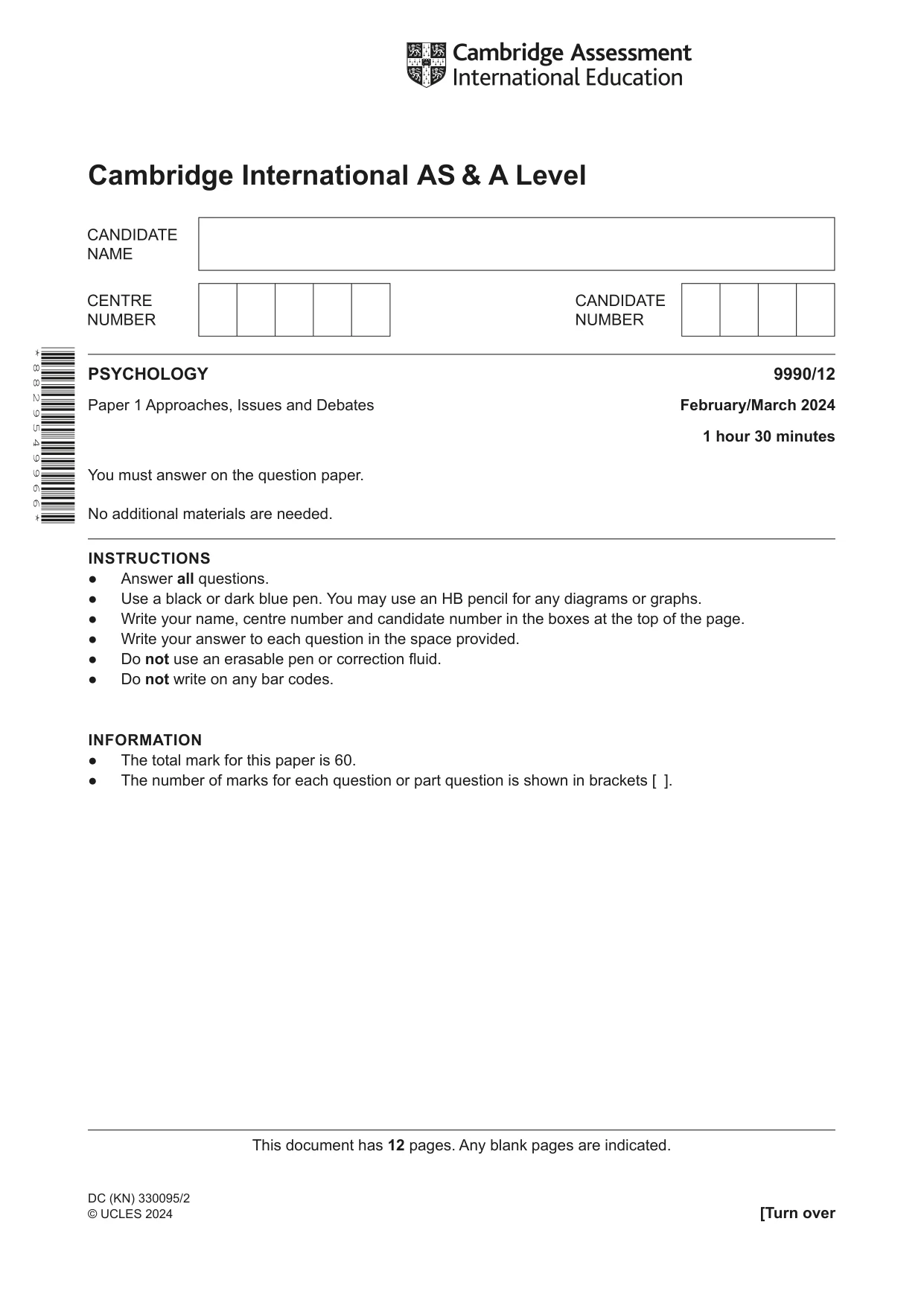
Question paper, page 1
This document has 12 pages. Any blank pages are indicated. [Turn over Cambridge International AS & A Level DC (KN) 330095/2 © UCLES 2024 * 8 8 2 9 5 4 9 9 6 6 * PSYCHOLOGY 9990/12 Paper 1 Approaches, Issues and Debates February/March 2024 1 hour 30 minutes You must answer on the question paper. No additional materials are needed. INSTRUCTIONS ● Answer all questions. ● Use a black or dark blue pen. You may use an HB pencil for any diagrams or graphs. ● Write your name, centre number and candidate number in the boxes at the top of the page. ● Write your answer to each question in the space provided. ● Do not use an erasable pen or correction fluid. ● Do not write on any bar codes. INFORMATION ● The total mark for this paper is 60. ● The number of marks for each question or part question is shown in brackets [ ].
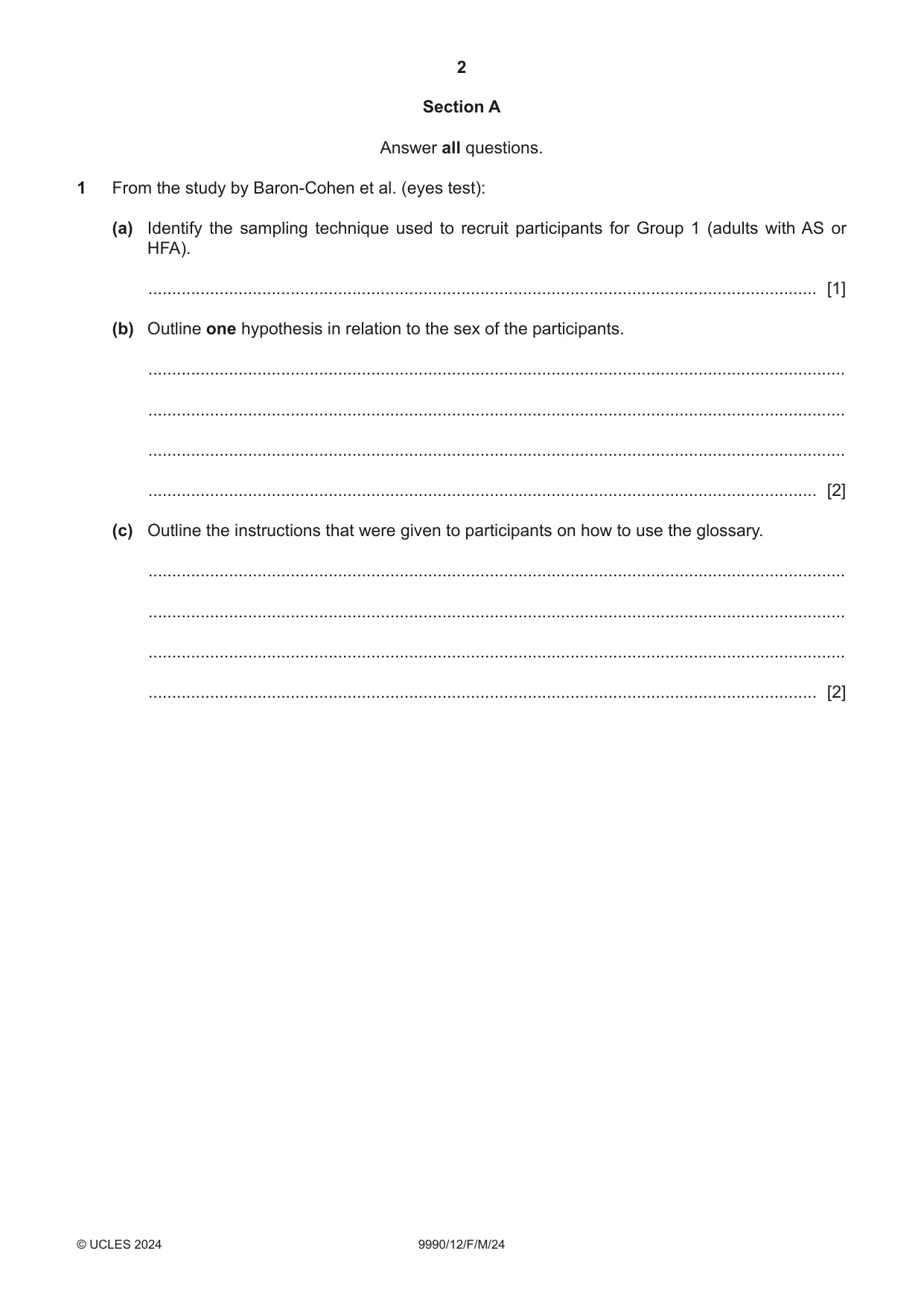
Question paper, page 2
2 9990/12/F/M/24 © UCLES 2024 Section A Answer all questions. 1 From the study by Baron-Cohen et al. (eyes test): (a) Identify the sampling technique used to recruit participants for Group 1 (adults with AS or HFA). … [1] (b) Outline one hypothesis in relation to the sex of the participants. … … … … [2] (c) Outline the instructions that were given to participants on how to use the glossary. … … … … [2]
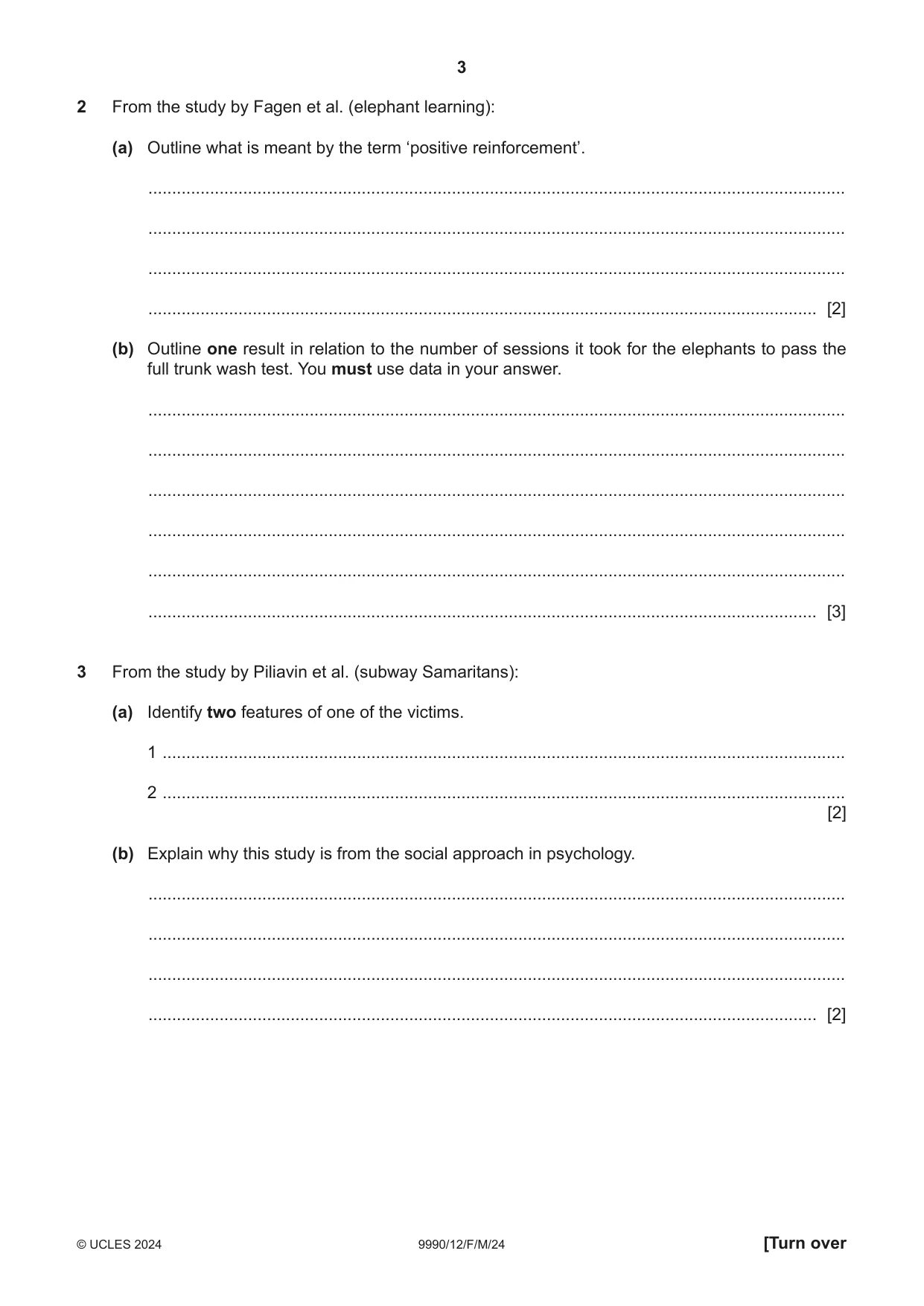
Question paper, page 3
3 9990/12/F/M/24 © UCLES 2024 [Turn over 2 From the study by Fagen et al. (elephant learning): (a) Outline what is meant by the term ‘positive reinforcement’. … … … … [2] (b) Outline one result in relation to the number of sessions it took for the elephants to pass the full trunk wash test. You must use data in your answer. … … … … … … [3] 3 From the study by Piliavin et al. (subway Samaritans): (a) Identify two features of one of the victims. 1 … 2 … [2] (b) Explain why this study is from the social approach in psychology. … … … … [2]
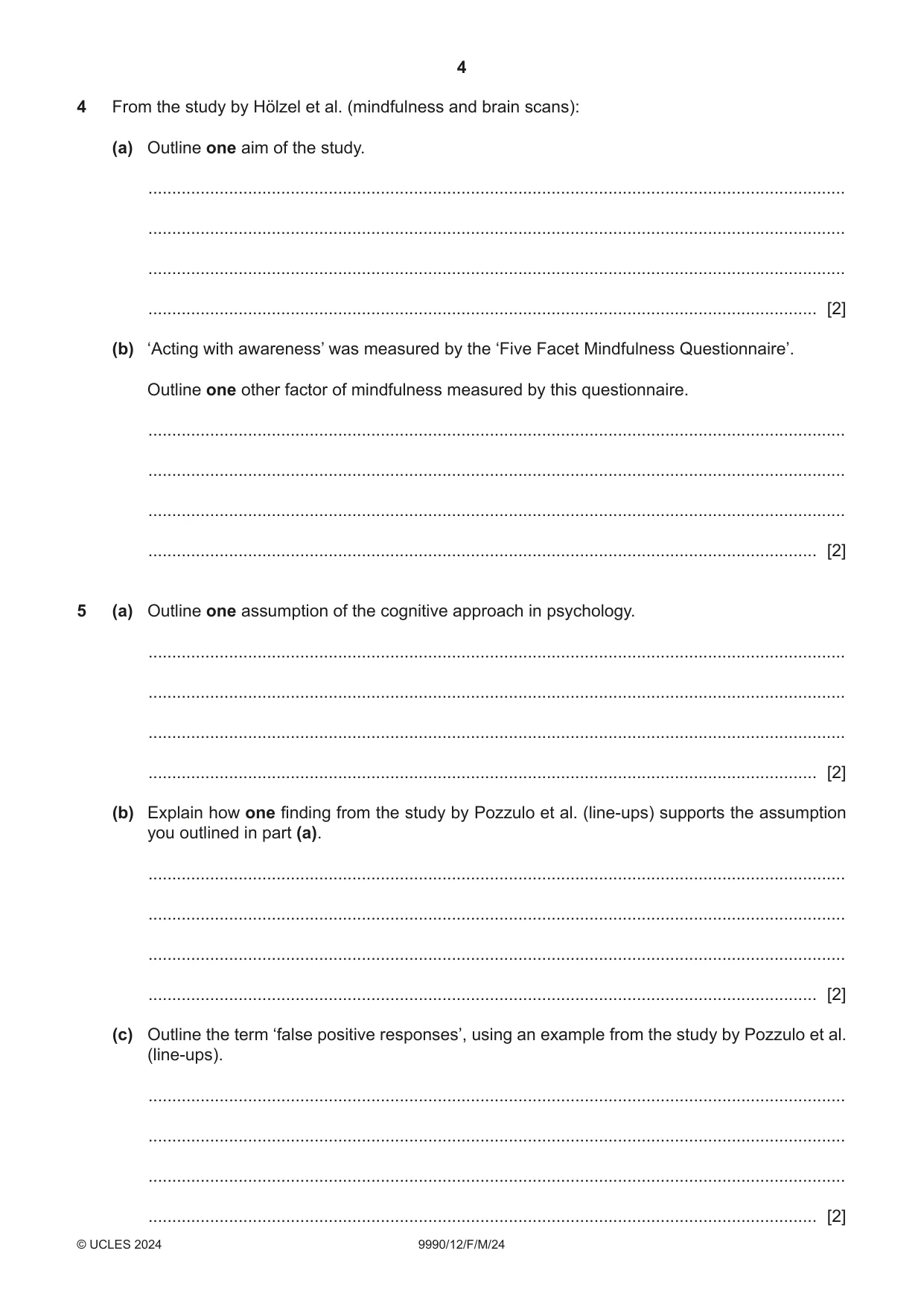
Question paper, page 4
4 9990/12/F/M/24 © UCLES 2024 4 From the study by Hölzel et al. (mindfulness and brain scans): (a) Outline one aim of the study. … … … … [2] (b) ‘Acting with awareness’ was measured by the ‘Five Facet Mindfulness Questionnaire’. Outline one other factor of mindfulness measured by this questionnaire. … … … … [2] 5 (a) Outline one assumption of the cognitive approach in psychology. … … … … [2] (b) Explain how one finding from the study by Pozzulo et al. (line-ups) supports the assumption you outlined in part (a). … … … … [2] (c) Outline the term ‘false positive responses’, using an example from the study by Pozzulo et al. (line-ups). … … … … [2]
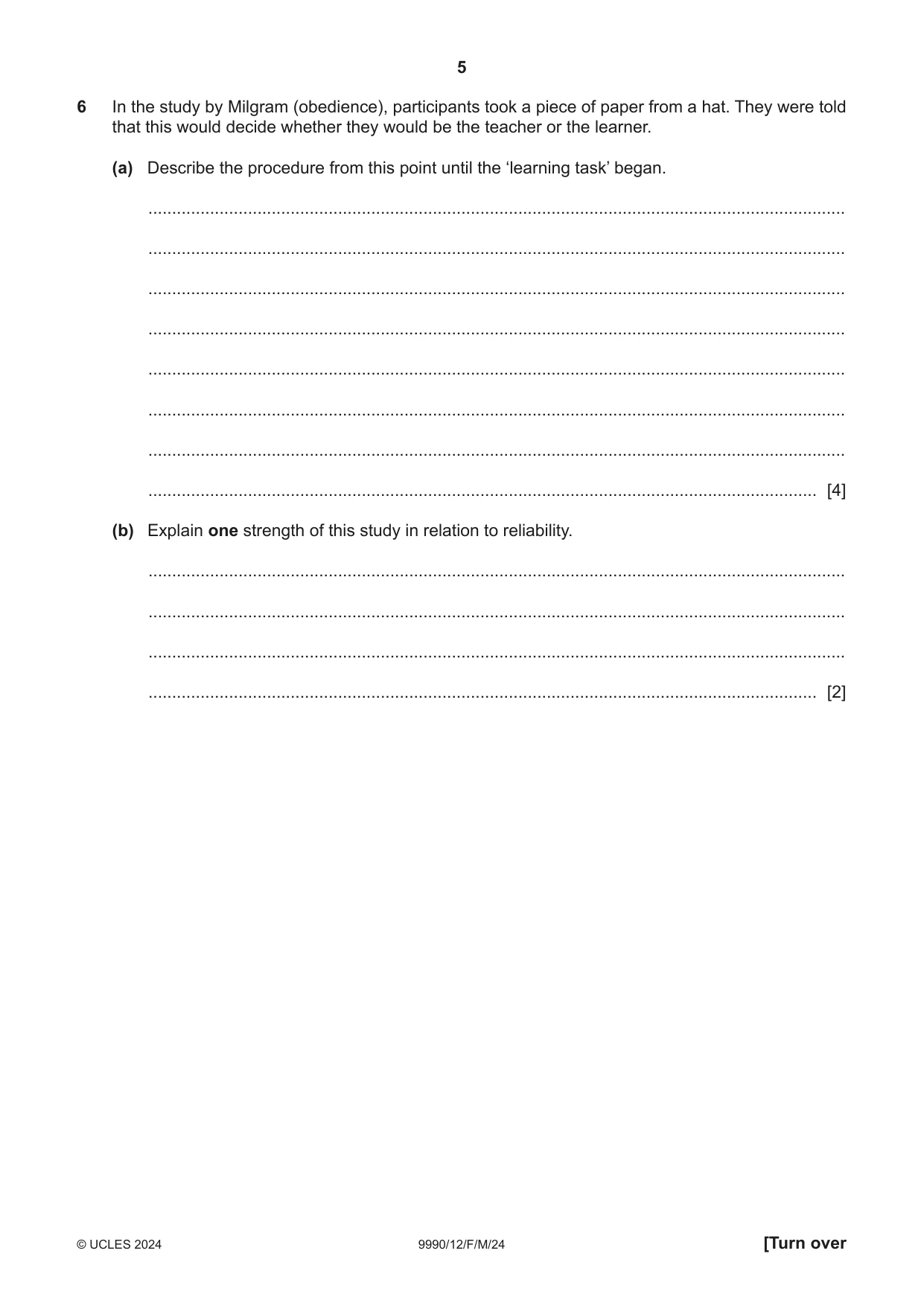
Question paper, page 5
5 9990/12/F/M/24 © UCLES 2024 [Turn over 6 In the study by Milgram (obedience), participants took a piece of paper from a hat. They were told that this would decide whether they would be the teacher or the learner. (a) Describe the procedure from this point until the ‘learning task’ began. … … … … … … … … [4] (b) Explain one strength of this study in relation to reliability. … … … … [2]
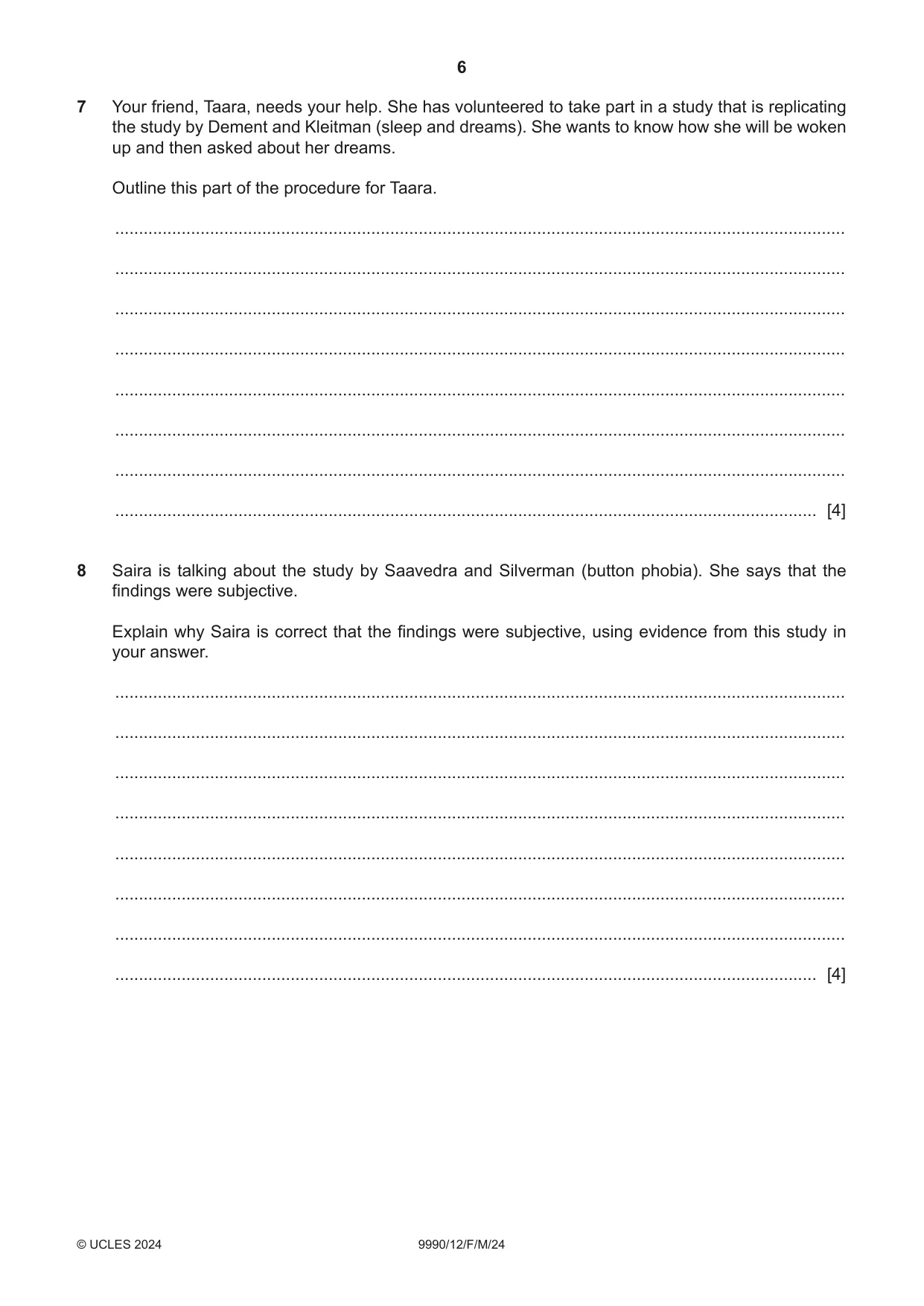
Question paper, page 6
6 9990/12/F/M/24 © UCLES 2024 7 Your friend, Taara, needs your help. She has volunteered to take part in a study that is replicating the study by Dement and Kleitman (sleep and dreams). She wants to know how she will be woken up and then asked about her dreams. Outline this part of the procedure for Taara. … … … … … … … … [4] 8 Saira is talking about the study by Saavedra and Silverman (button phobia). She says that the findings were subjective. Explain why Saira is correct that the findings were subjective, using evidence from this study in your answer. … … … … … … … … [4]
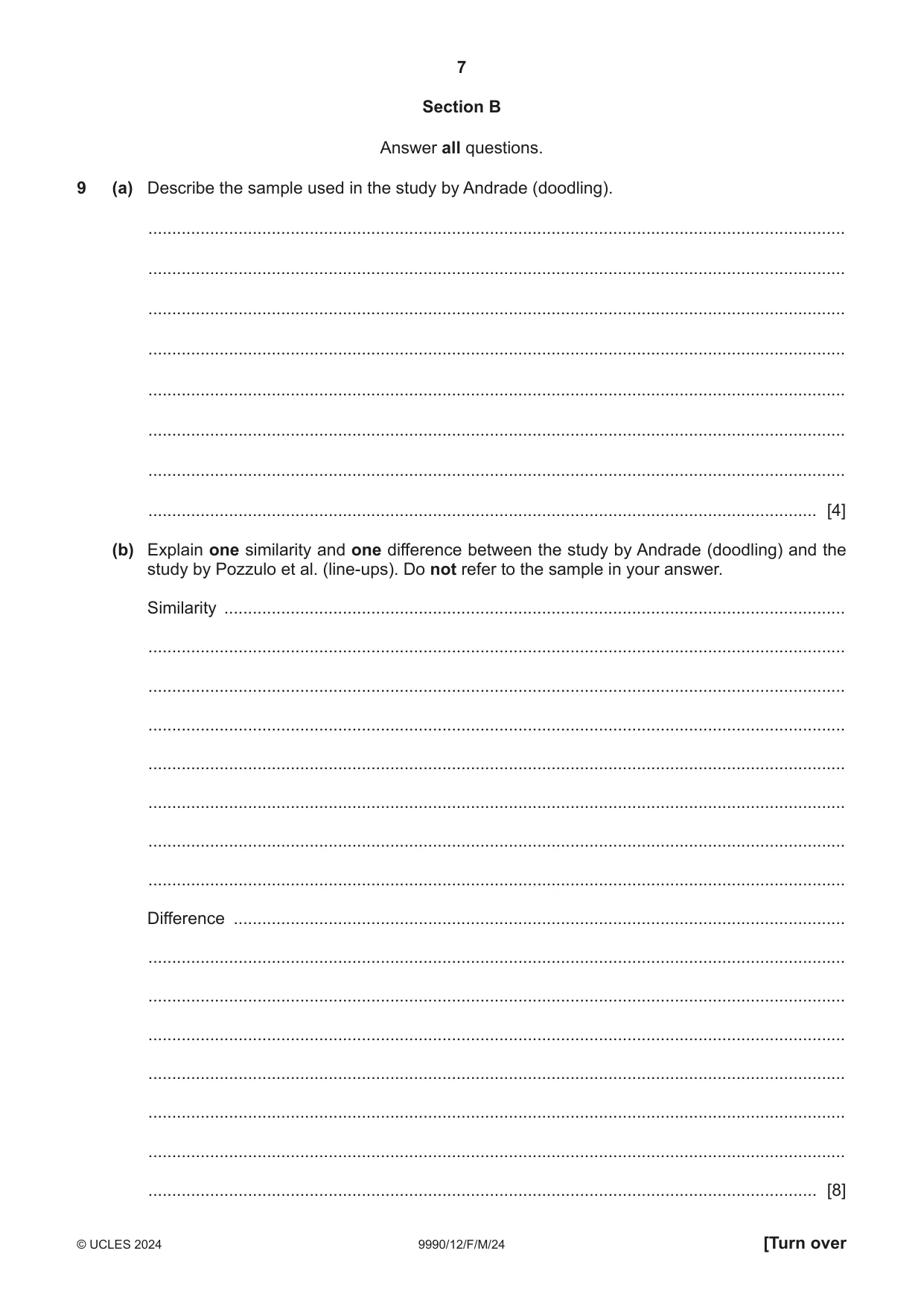
Question paper, page 7
7 9990/12/F/M/24 © UCLES 2024 [Turn over Section B Answer all questions. 9 (a) Describe the sample used in the study by Andrade (doodling). … … … … … … … … [4] (b) Explain one similarity and one difference between the study by Andrade (doodling) and the study by Pozzulo et al. (line-ups). Do not refer to the sample in your answer. Similarity … … … … … … … … Difference … … … … … … … … [8]
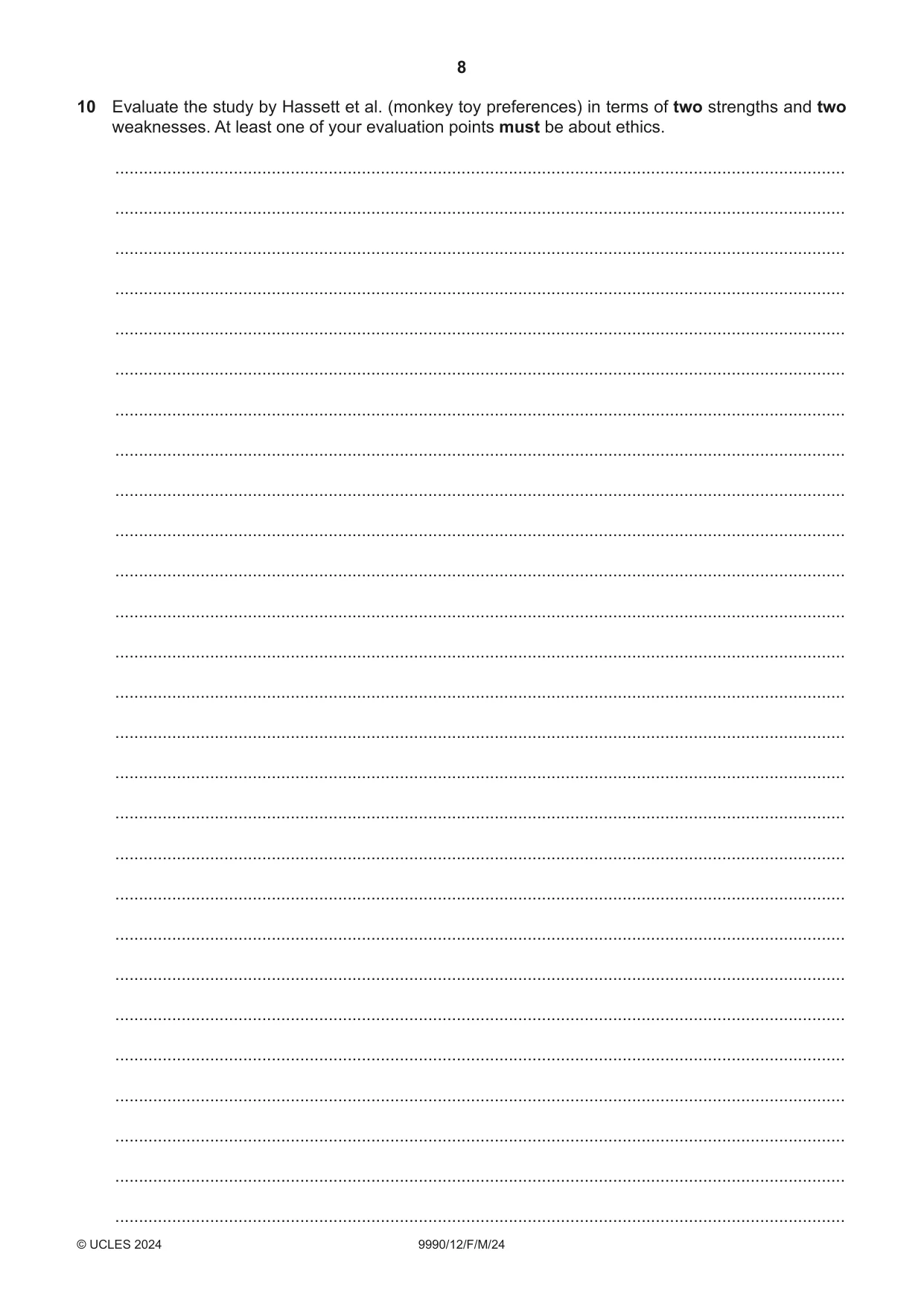
Question paper, page 8
8 9990/12/F/M/24 © UCLES 2024 10 Evaluate the study by Hassett et al. (monkey toy preferences) in terms of two strengths and two weaknesses. At least one of your evaluation points must be about ethics. … … … … … … … … … … … … … … … … … … … … … … … … … … …
Question paper, page 9
9 9990/12/F/M/24 © UCLES 2024 … … … … … … … … … … … … … … [10]
Question paper, page 10
10 9990/12/F/M/24 © UCLES 2024 BLANK PAGE
Question paper, page 11
11 9990/12/F/M/24 © UCLES 2024 BLANK PAGE
Question paper, page 12
12 9990/12/F/M/24 © UCLES 2024 Permission to reproduce items where third-party owned material protected by copyright is included has been sought and cleared where possible. Every reasonable effort has been made by the publisher (UCLES) to trace copyright holders, but if any items requiring clearance have unwittingly been included, the publisher will be pleased to make amends at the earliest possible opportunity. To avoid the issue of disclosure of answer-related information to candidates, all copyright acknowledgements are reproduced online in the Cambridge Assessment International Education Copyright Acknowledgements Booklet. This is produced for each series of examinations and is freely available to download at www.cambridgeinternational.org after the live examination series. Cambridge Assessment International Education is part of Cambridge Assessment. Cambridge Assessment is the brand name of the University of Cambridge Local Examinations Syndicate (UCLES), which is a department of the University of Cambridge. BLANK PAGE
Mark scheme, page 1
This document consists of 19 printed pages. © Cambridge University Press & Assessment 2024 [Turn over Cambridge International AS & A Level PSYCHOLOGY 9990/12 Paper 1 Approaches, Issues and Debates February/March 2024 MARK SCHEME Maximum Mark: 60 Published This mark scheme is published as an aid to teachers and candidates, to indicate the requirements of the examination. It shows the basis on which Examiners were instructed to award marks. It does not indicate the details of the discussions that took place at an Examiners’ meeting before marking began, which would have considered the acceptability of alternative answers. Mark schemes should be read in conjunction with the question paper and the Principal Examiner Report for Teachers. Cambridge International will not enter into discussions about these mark schemes. Cambridge International is publishing the mark schemes for the February/March 2024 series for most Cambridge IGCSE, Cambridge International A and AS Level components, and some Cambridge O Level components.
Mark scheme, page 2
9990/12 Cambridge International AS & A Level – Mark Scheme PUBLISHED February/March 2024 © Cambridge University Press & Assessment 2024 Page 2 of 19 Generic Marking Principles These general marking principles must be applied by all examiners when marking candidate answers. They should be applied alon gside the specific content of the mark scheme or generic level descriptions for a question. Each question paper and mark scheme will also comply with these marking principles. GENERIC MARKING PRINCIPLE 1: Marks must be awarded in line with: • the specific content of the mark scheme or the generic level descriptors for the question • the specific skills defined in the mark scheme or in the generic level descriptors for the question • the standard of response required by a candidate as exemplified by the standardisation scripts. GENERIC MARKING PRINCIPLE 2: Marks awarded are always whole marks (not half marks, or other fractions). GENERIC MARKING PRINCIPLE 3: Marks must be awarded positively: • marks are awarded for correct/valid answers, as defined in the mark scheme. However, credit is given for valid answers which go beyond the scope of the syllabus and mark scheme, referring to your Team Leader as appropriate • marks are awarded when candidates clearly demonstrate what they know and can do • marks are not deducted for errors • marks are not deducted for omissions • answers should only be judged on the quality of spelling, punctuation and grammar when these features are specifically assessed by the question as indicated by the mark scheme. The meaning, however, should be unambiguous. GENERIC MARKING PRINCIPLE 4: Rules must be applied consistently, e.g. in situations where candidates have not followed instructions or in the application of generic level descriptors.
Mark scheme, page 3
9990/12 Cambridge International AS & A Level – Mark Scheme PUBLISHED February/March 2024 © Cambridge University Press & Assessment 2024 Page 3 of 19 GENERIC MARKING PRINCIPLE 5: Marks should be awarded using the full range of marks defined in the mark scheme for the question (however; the use of the fu ll mark range may be limited according to the quality of the candidate responses seen). GENERIC MARKING PRINCIPLE 6: Marks awarded are based solely on the requirements as defined in the mark scheme. Marks should not be awarded with grade thresholds or grade descriptors in mind.
Mark scheme, page 4
9990/12 Cambridge International AS & A Level – Mark Scheme PUBLISHED February/March 2024 © Cambridge University Press & Assessment 2024 Page 4 of 19 Social Science-Specific Marking Principles (for point-based marking) 1 Components using point-based marking: • Point marking is often used to reward knowledge, understanding and application of skills. We give credit where the candidate’s answer shows relevant knowledge, understanding and application of skills in answering the question. We do not give credit where the answer shows confusion. From this it follows that we: a DO credit answers which are worded differently from the mark scheme if they clearly convey the same meaning (unless the mark scheme requires a specific term) b DO credit alternative answers/examples which are not written in the mark scheme if they are correct c DO credit answers where candidates give more than one correct answer in one prompt/numbered/scaffolded space where extended writing is required rather than list-type answers. For example, questions that require n reasons (e.g. State two reasons …). d DO NOT credit answers simply for using a ‘key term’ unless that is all that is required. (Check for evidence it is understood and not used wrongly.) e DO NOT credit answers which are obviously self-contradicting or trying to cover all possibilities f DO NOT give further credit for what is effectively repetition of a correct point already credited unless the language itself is being tested. This applies equally to ‘mirror statements’ (i.e. polluted/not polluted). g DO NOT require spellings to be correct, unless this is part of the test. However spellings of syllabus terms must allow for clear and unambiguous separation from other syllabus terms with which they may be confused (e.g. Corrasion/Corrosion) 2 Presentation of mark scheme: • Slashes (/) or the word ‘or’ separate alternative ways of making the same point. • Semi colons (;) bullet points (•) or figures in brackets (1) separate different points. • Content in the answer column in brackets is for examiner information/context to clarify the marking but is not required to earn the mark (except Accounting syllabuses where they indicate negative numbers). 3 Annotation: • For point marking, ticks can be used to indicate correct answers and crosses can be used to indicate wrong answers. There is no direct relationship between ticks and marks. Ticks have no defined meaning for levels of response marking. • For levels of response marking, the level awarded should be annotated on the script. • Other annotations will be used by examiners as agreed during standardisation, and the meaning will be understood by all examiners who marked that paper.
Mark scheme, page 5
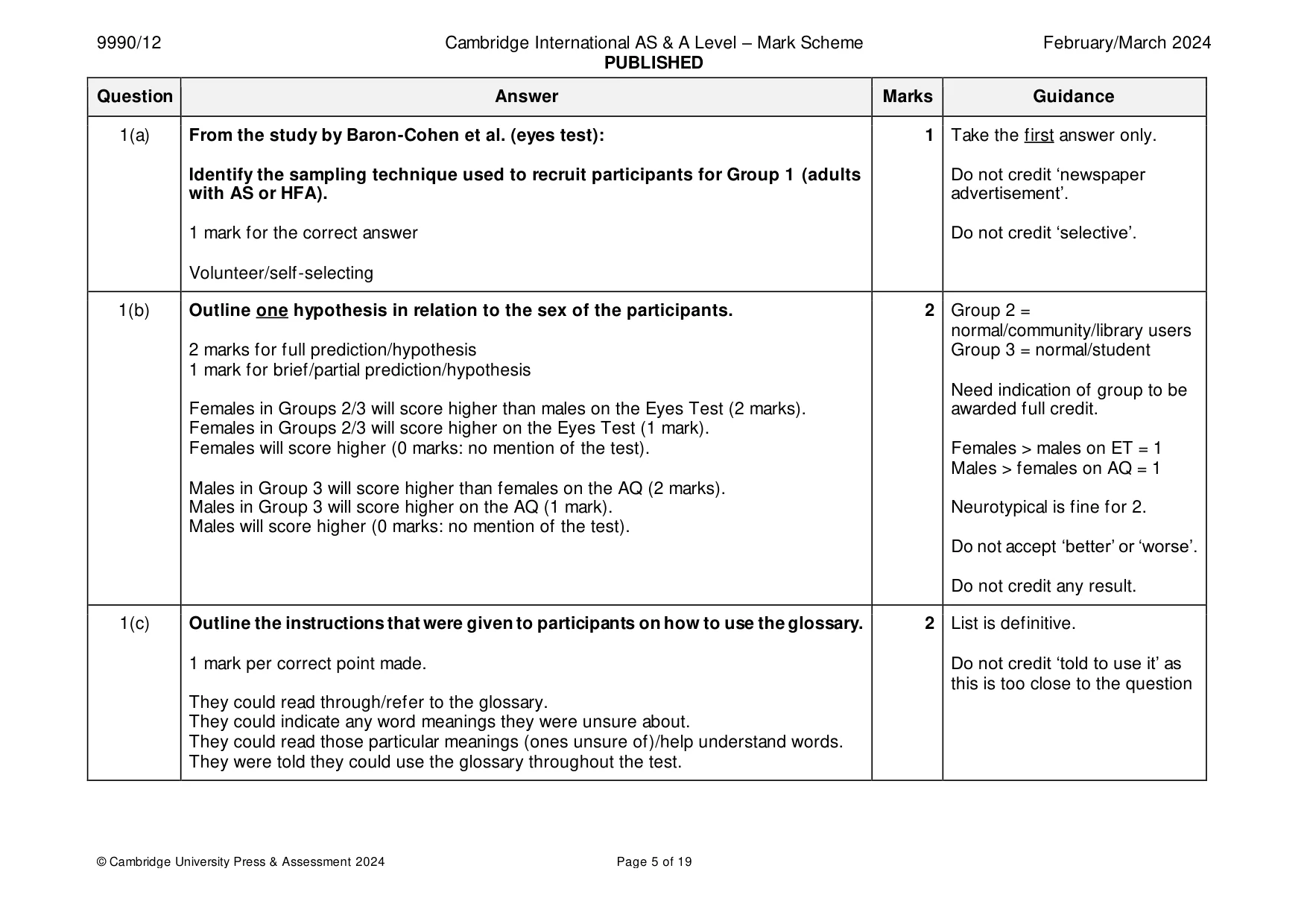
9990/12 Cambridge International AS & A Level – Mark Scheme PUBLISHED February/March 2024 © Cambridge University Press & Assessment 2024 Page 5 of 19 Question Answer Marks Guidance 1(a) From the study by Baron-Cohen et al. (eyes test): Identify the sampling technique used to recruit participants for Group 1 (adults with AS or HFA). 1 mark for the correct answer Volunteer/self-selecting 1 Take the first answer only. Do not credit ‘newspaper advertisement’. Do not credit ‘selective’. 1(b) Outline one hypothesis in relation to the sex of the participants. 2 marks for full prediction/hypothesis 1 mark for brief/partial prediction/hypothesis Females in Groups 2/3 will score higher than males on the Eyes Test (2 marks). Females in Groups 2/3 will score higher on the Eyes Test (1 mark). Females will score higher (0 marks: no mention of the test). Males in Group 3 will score higher than females on the AQ (2 marks). Males in Group 3 will score higher on the AQ (1 mark). Males will score higher (0 marks: no mention of the test). 2 Group 2 = normal/community/library users Group 3 = normal/student Need indication of group to be awarded full credit. Females > males on ET = 1 Males > females on AQ = 1 Neurotypical is fine for 2. Do not accept ‘better’ or ‘worse’. Do not credit any result. 1(c) Outline the instructions that were given to participants on how to use the glossary. 1 mark per correct point made. They could read through/refer to the glossary. They could indicate any word meanings they were unsure about. They could read those particular meanings (ones unsure of)/help understand words. They were told they could use the glossary throughout the test. 2 List is definitive. Do not credit ‘told to use it’ as this is too close to the question
Mark scheme, page 6
9990/12 Cambridge International AS & A Level – Mark Scheme PUBLISHED February/March 2024 © Cambridge University Press & Assessment 2024 Page 6 of 19 Question Answer Marks Guidance 2(a) From the study by Fagen et al. (elephant learning): Outline what is meant by the term ‘positive reinforcement’. 2 marks full definition 1 mark partial/brief definition 1 mark available for an example e.g. This is the addition of something nice/reward after a behaviour to increase the probability of repeating a behaviour (2 marks). It is giving a reward to someone/the elephants were given (chopped) bananas (1 mark: positive part of the definition). It is trying to help someone repeat a behaviour (1 mark: reinforcement part of the definition). 2 Credit can be given to an example from the study or an invented one.
Mark scheme, page 7
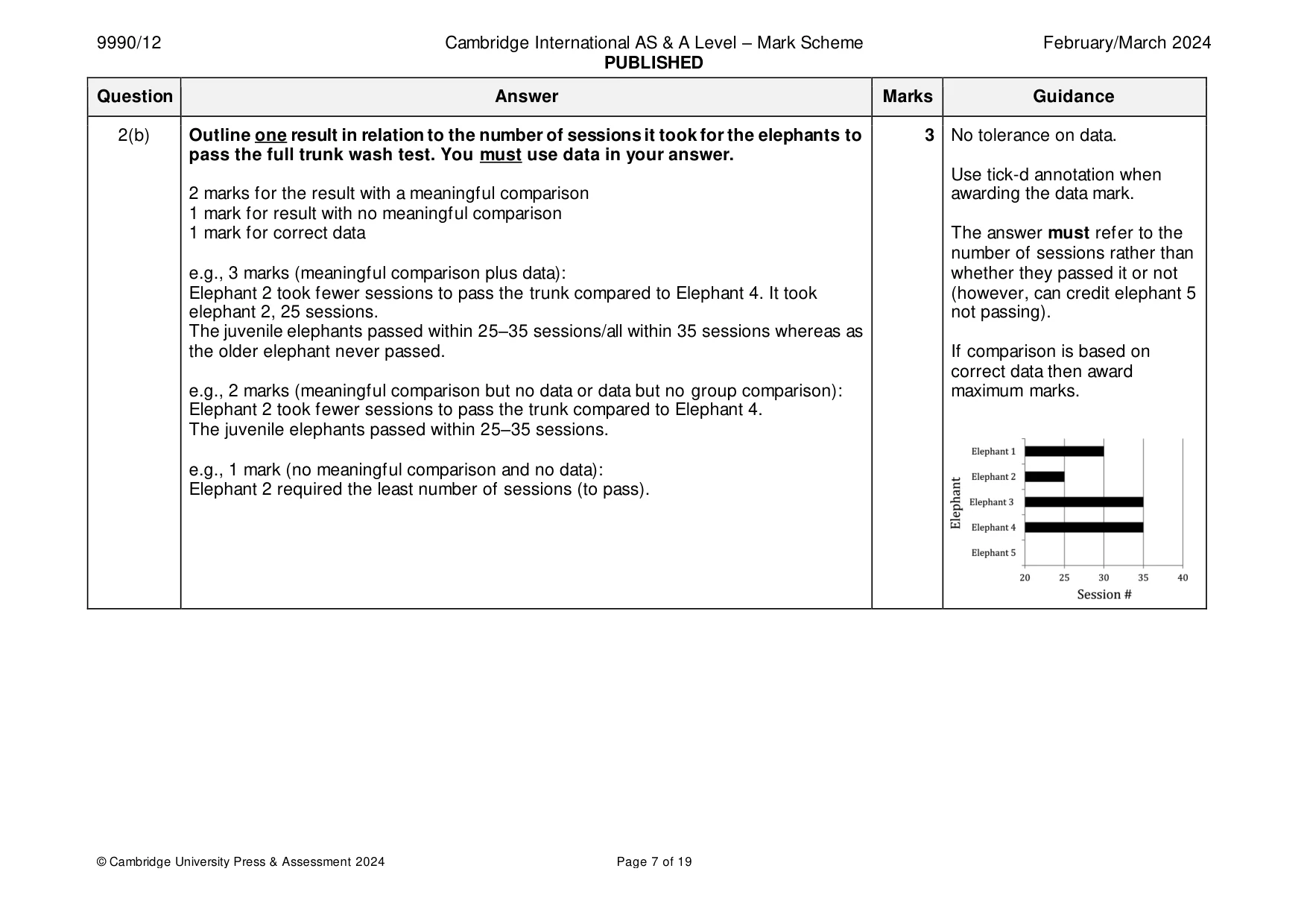
9990/12 Cambridge International AS & A Level – Mark Scheme PUBLISHED February/March 2024 © Cambridge University Press & Assessment 2024 Page 7 of 19 Question Answer Marks Guidance 2(b) Outline one result in relation to the number of sessions it took for the elephants to pass the full trunk wash test. You must use data in your answer. 2 marks for the result with a meaningful comparison 1 mark for result with no meaningful comparison 1 mark for correct data e.g., 3 marks (meaningful comparison plus data): Elephant 2 took fewer sessions to pass the trunk compared to Elephant 4. It took elephant 2, 25 sessions. The juvenile elephants passed within 25–35 sessions/all within 35 sessions whereas as the older elephant never passed. e.g., 2 marks (meaningful comparison but no data or data but no group comparison): Elephant 2 took fewer sessions to pass the trunk compared to Elephant 4. The juvenile elephants passed within 25–35 sessions. e.g., 1 mark (no meaningful comparison and no data): Elephant 2 required the least number of sessions (to pass). 3 No tolerance on data. Use tick-d annotation when awarding the data mark. The answer must refer to the number of sessions rather than whether they passed it or not (however, can credit elephant 5 not passing). If comparison is based on correct data then award maximum marks.
Mark scheme, page 8
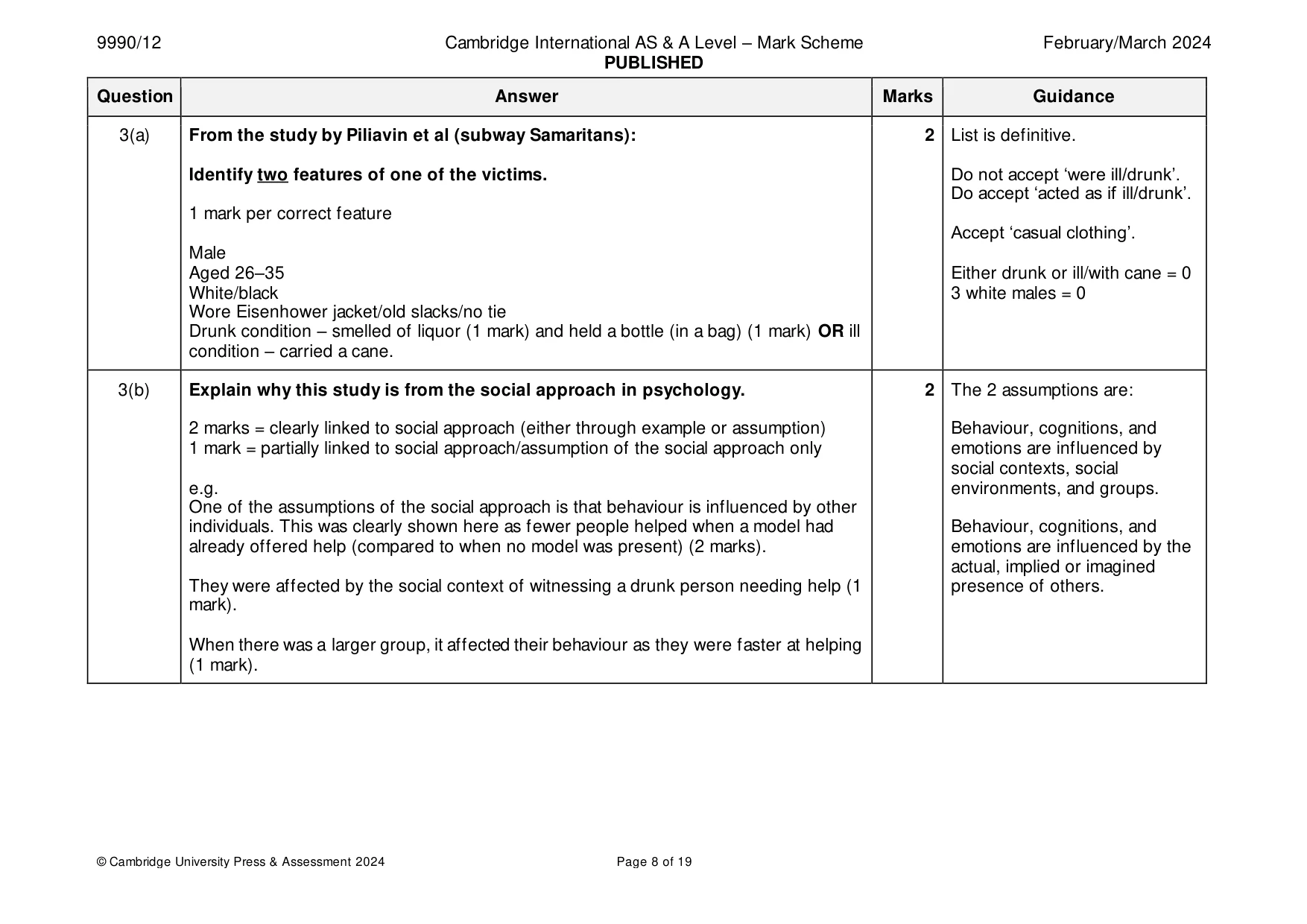
9990/12 Cambridge International AS & A Level – Mark Scheme PUBLISHED February/March 2024 © Cambridge University Press & Assessment 2024 Page 8 of 19 Question Answer Marks Guidance 3(a) From the study by Piliavin et al (subway Samaritans): Identify two features of one of the victims. 1 mark per correct feature Male Aged 26–35 White/black Wore Eisenhower jacket/old slacks/no tie Drunk condition – smelled of liquor (1 mark) and held a bottle (in a bag) (1 mark) OR ill condition – carried a cane. 2 List is definitive. Do not accept ‘were ill/drunk’. Do accept ‘acted as if ill/drunk’. Accept ‘casual clothing’. Either drunk or ill/with cane = 0 3 white males = 0 3(b) Explain why this study is from the social approach in psychology. 2 marks = clearly linked to social approach (either through example or assumption) 1 mark = partially linked to social approach/assumption of the social approach only e.g. One of the assumptions of the social approach is that behaviour is influenced by other individuals. This was clearly shown here as fewer people helped when a model had already offered help (compared to when no model was present) (2 marks). They were affected by the social context of witnessing a drunk person needing help (1 mark). When there was a larger group, it affected their behaviour as they were faster at helping (1 mark). 2 The 2 assumptions are: Behaviour, cognitions, and emotions are influenced by social contexts, social environments, and groups. Behaviour, cognitions, and emotions are influenced by the actual, implied or imagined presence of others.
Mark scheme, page 9
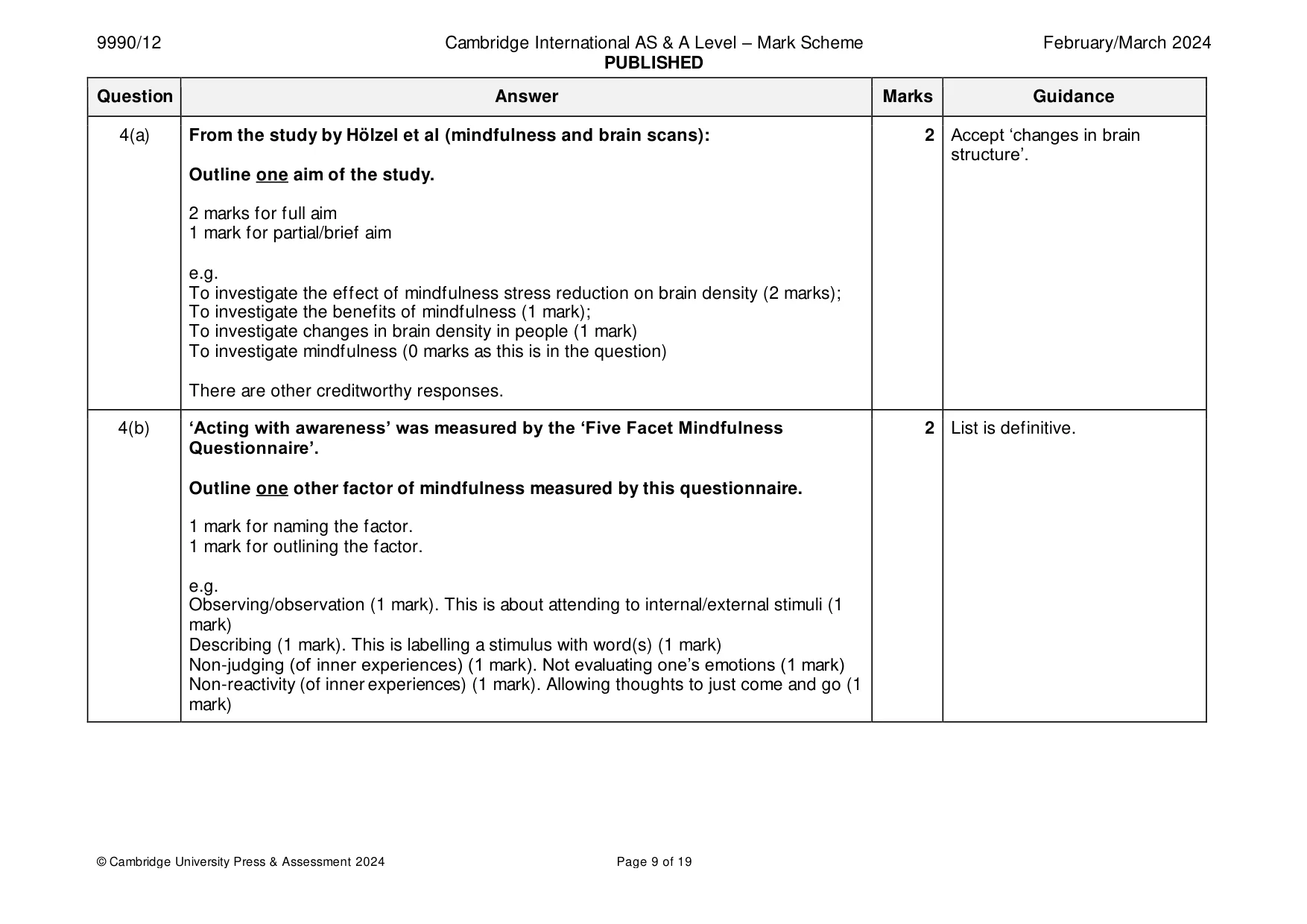
9990/12 Cambridge International AS & A Level – Mark Scheme PUBLISHED February/March 2024 © Cambridge University Press & Assessment 2024 Page 9 of 19 Question Answer Marks Guidance 4(a) From the study by Hölzel et al (mindfulness and brain scans): Outline one aim of the study. 2 marks for full aim 1 mark for partial/brief aim e.g. To investigate the effect of mindfulness stress reduction on brain density (2 marks); To investigate the benefits of mindfulness (1 mark); To investigate changes in brain density in people (1 mark) To investigate mindfulness (0 marks as this is in the question) There are other creditworthy responses. 2 Accept ‘changes in brain structure’. 4(b) ‘Acting with awareness’ was measured by the ‘Five Facet Mindfulness Questionnaire’. Outline one other factor of mindfulness measured by this questionnaire. 1 mark for naming the factor. 1 mark for outlining the factor. e.g. Observing/observation (1 mark). This is about attending to internal/external stimuli (1 mark) Describing (1 mark). This is labelling a stimulus with word(s) (1 mark) Non-judging (of inner experiences) (1 mark). Not evaluating one’s emotions (1 mark) Non-reactivity (of inner experiences) (1 mark). Allowing thoughts to just come and go (1 mark) 2 List is definitive.
Mark scheme, page 10
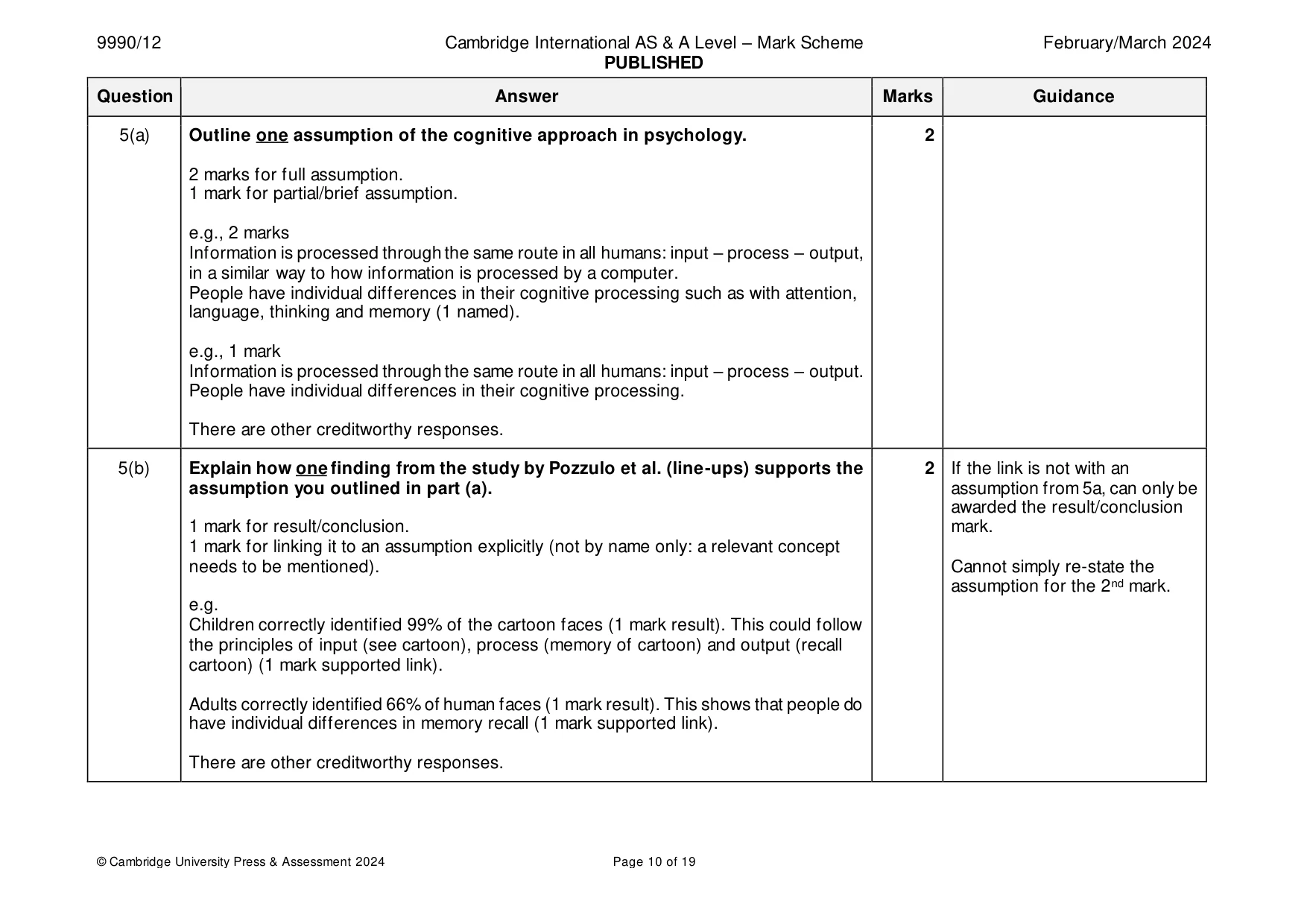
9990/12 Cambridge International AS & A Level – Mark Scheme PUBLISHED February/March 2024 © Cambridge University Press & Assessment 2024 Page 10 of 19 Question Answer Marks Guidance 5(a) Outline one assumption of the cognitive approach in psychology. 2 marks for full assumption. 1 mark for partial/brief assumption. e.g., 2 marks Information is processed through the same route in all humans: input – process – output, in a similar way to how information is processed by a computer. People have individual differences in their cognitive processing such as with attention, language, thinking and memory (1 named). e.g., 1 mark Information is processed through the same route in all humans: input – process – output. People have individual differences in their cognitive processing. There are other creditworthy responses. 2 5(b) Explain how one finding from the study by Pozzulo et al. (line-ups) supports the assumption you outlined in part (a). 1 mark for result/conclusion. 1 mark for linking it to an assumption explicitly (not by name only: a relevant concept needs to be mentioned). e.g. Children correctly identified 99% of the cartoon faces (1 mark result). This could follow the principles of input (see cartoon), process (memory of cartoon) and output (recall cartoon) (1 mark supported link). Adults correctly identified 66% of human faces (1 mark result). This shows that people do have individual differences in memory recall (1 mark supported link). There are other creditworthy responses. 2 If the link is not with an assumption from 5a, can only be awarded the result/conclusion mark. Cannot simply re-state the assumption for the 2nd mark.
Mark scheme, page 11
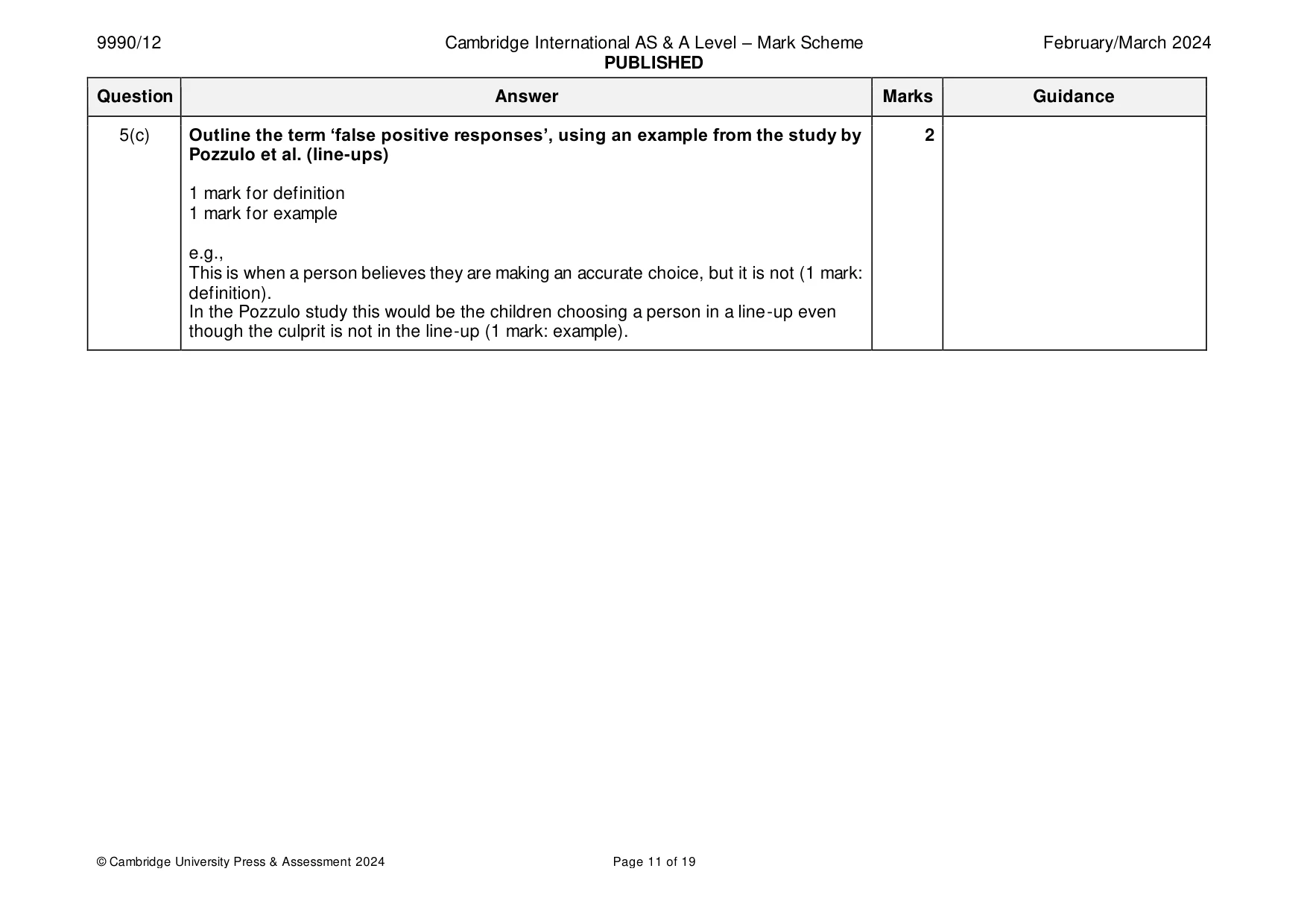
9990/12 Cambridge International AS & A Level – Mark Scheme PUBLISHED February/March 2024 © Cambridge University Press & Assessment 2024 Page 11 of 19 Question Answer Marks Guidance 5(c) Outline the term ‘false positive responses’, using an example from the study by Pozzulo et al. (line-ups) 1 mark for definition 1 mark for example e.g., This is when a person believes they are making an accurate choice, but it is not (1 mark: definition). In the Pozzulo study this would be the children choosing a person in a line-up even though the culprit is not in the line-up (1 mark: example). 2
Mark scheme, page 12
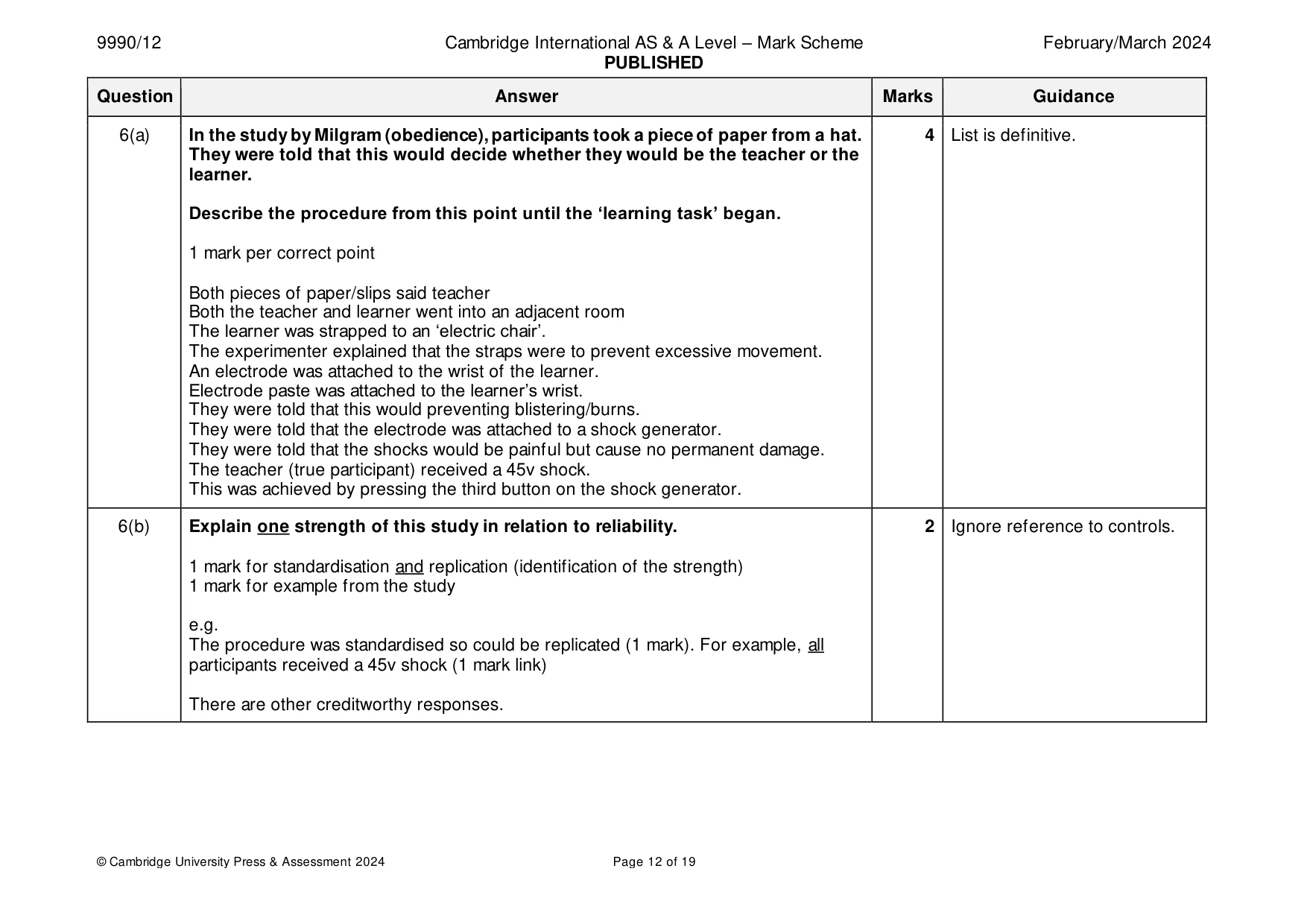
9990/12 Cambridge International AS & A Level – Mark Scheme PUBLISHED February/March 2024 © Cambridge University Press & Assessment 2024 Page 12 of 19 Question Answer Marks Guidance 6(a) In the study by Milgram (obedience), participants took a piece of paper from a hat. They were told that this would decide whether they would be the teacher or the learner. Describe the procedure from this point until the ‘learning task’ began. 1 mark per correct point Both pieces of paper/slips said teacher Both the teacher and learner went into an adjacent room The learner was strapped to an ‘electric chair’. The experimenter explained that the straps were to prevent excessive movement. An electrode was attached to the wrist of the learner. Electrode paste was attached to the learner’s wrist. They were told that this would preventing blistering/burns. They were told that the electrode was attached to a shock generator. They were told that the shocks would be painful but cause no permanent damage. The teacher (true participant) received a 45v shock. This was achieved by pressing the third button on the shock generator. 4 List is definitive. 6(b) Explain one strength of this study in relation to reliability. 1 mark for standardisation and replication (identification of the strength) 1 mark for example from the study e.g. The procedure was standardised so could be replicated (1 mark). For example, all participants received a 45v shock (1 mark link) There are other creditworthy responses. 2 Ignore reference to controls.
Mark scheme, page 13
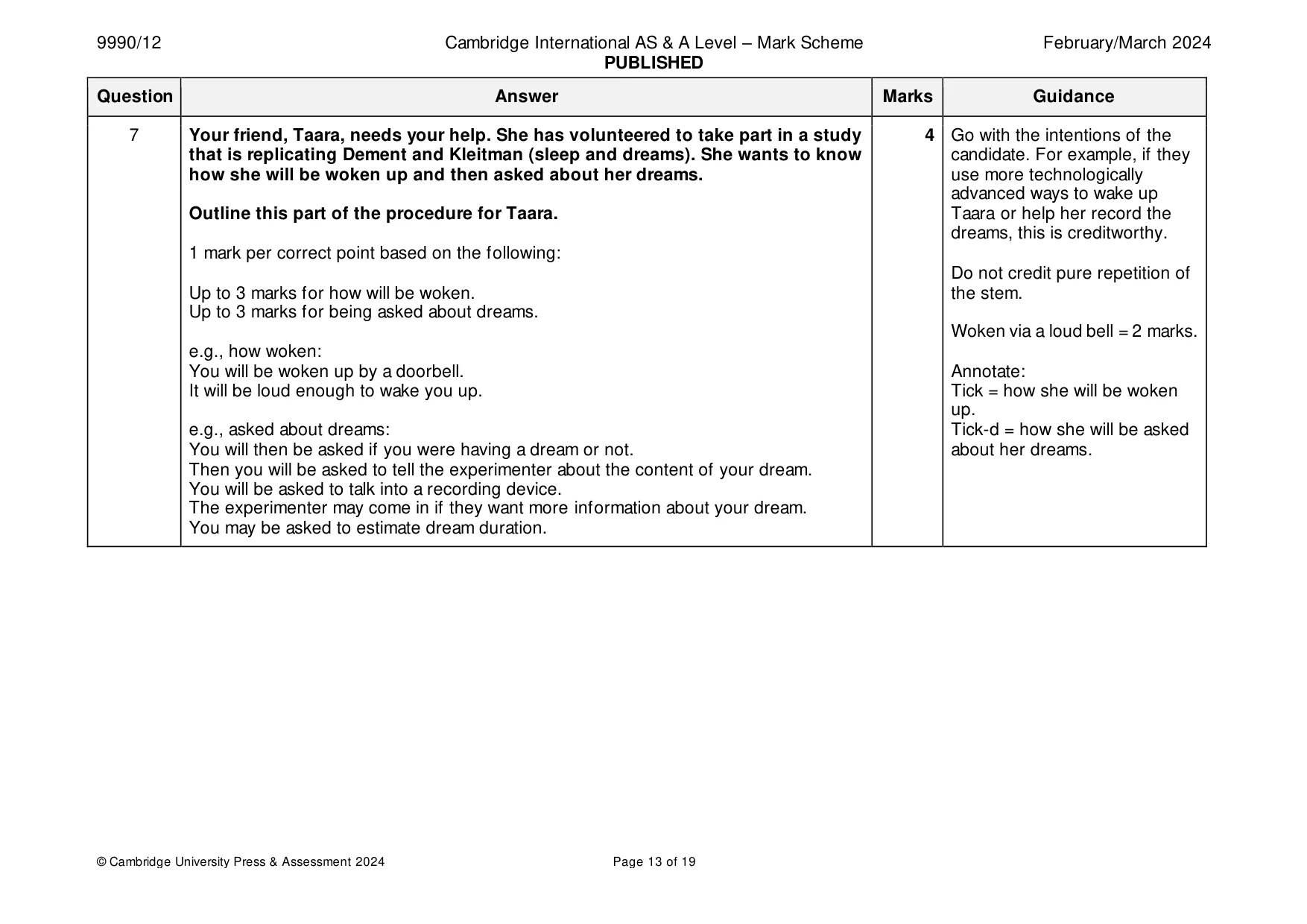
9990/12 Cambridge International AS & A Level – Mark Scheme PUBLISHED February/March 2024 © Cambridge University Press & Assessment 2024 Page 13 of 19 Question Answer Marks Guidance 7 Your friend, Taara, needs your help. She has volunteered to take part in a study that is replicating Dement and Kleitman (sleep and dreams). She wants to know how she will be woken up and then asked about her dreams. Outline this part of the procedure for Taara. 1 mark per correct point based on the following: Up to 3 marks for how will be woken. Up to 3 marks for being asked about dreams. e.g., how woken: You will be woken up by a doorbell. It will be loud enough to wake you up. e.g., asked about dreams: You will then be asked if you were having a dream or not. Then you will be asked to tell the experimenter about the content of your dream. You will be asked to talk into a recording device. The experimenter may come in if they want more information about your dream. You may be asked to estimate dream duration. 4 Go with the intentions of the candidate. For example, if they use more technologically advanced ways to wake up Taara or help her record the dreams, this is creditworthy. Do not credit pure repetition of the stem. Woken via a loud bell = 2 marks. Annotate: Tick = how she will be woken up. Tick-d = how she will be asked about her dreams.
Mark scheme, page 14
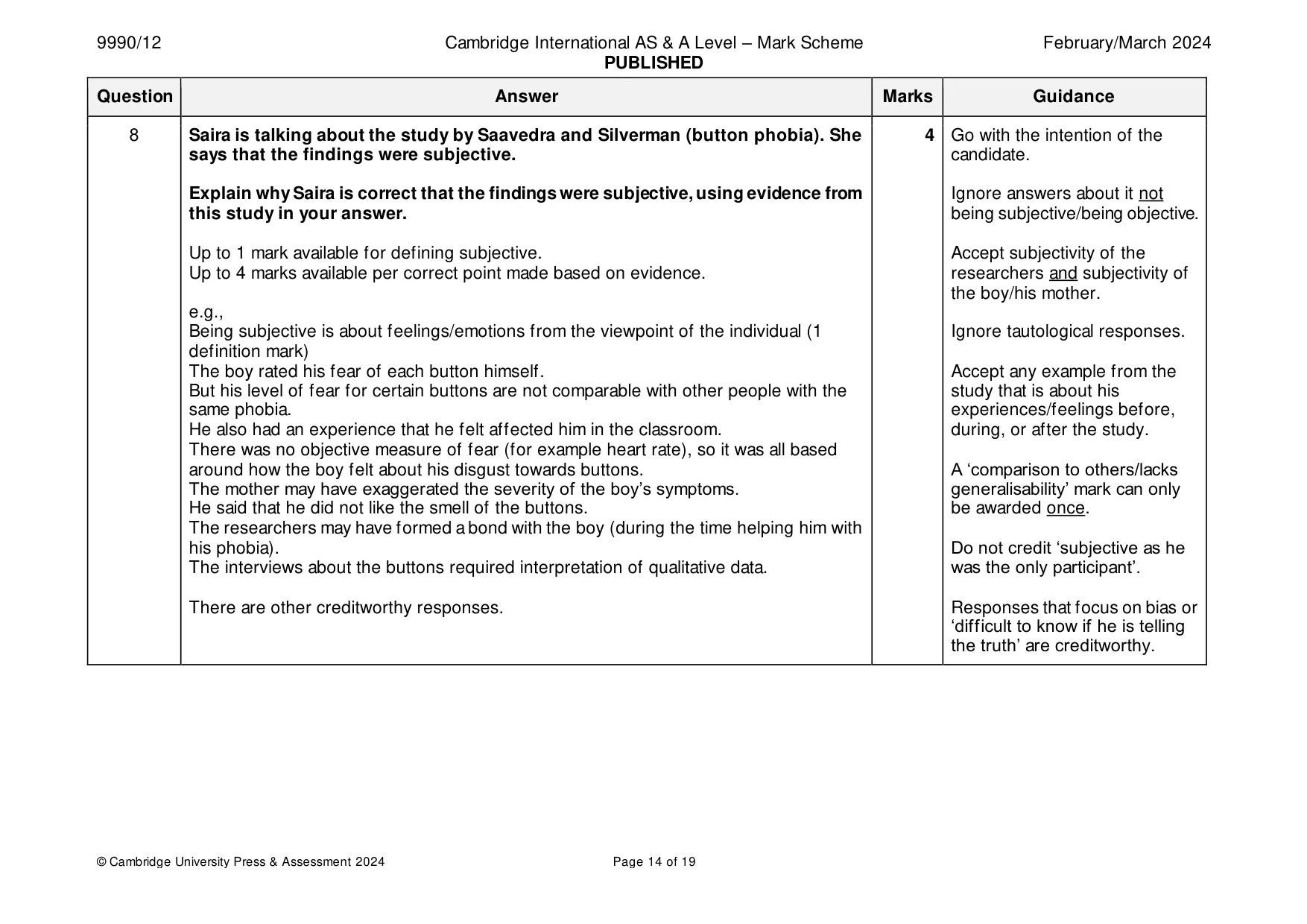
9990/12 Cambridge International AS & A Level – Mark Scheme PUBLISHED February/March 2024 © Cambridge University Press & Assessment 2024 Page 14 of 19 Question Answer Marks Guidance 8 Saira is talking about the study by Saavedra and Silverman (button phobia). She says that the findings were subjective. Explain why Saira is correct that the findings were subjective, using evidence from this study in your answer. Up to 1 mark available for defining subjective. Up to 4 marks available per correct point made based on evidence. e.g., Being subjective is about feelings/emotions from the viewpoint of the individual (1 definition mark) The boy rated his fear of each button himself. But his level of fear for certain buttons are not comparable with other people with the same phobia. He also had an experience that he felt affected him in the classroom. There was no objective measure of fear (for example heart rate), so it was all based around how the boy felt about his disgust towards buttons. The mother may have exaggerated the severity of the boy’s symptoms. He said that he did not like the smell of the buttons. The researchers may have formed a bond with the boy (during the time helping him with his phobia). The interviews about the buttons required interpretation of qualitative data. There are other creditworthy responses. 4 Go with the intention of the candidate. Ignore answers about it not being subjective/being objective. Accept subjectivity of the researchers and subjectivity of the boy/his mother. Ignore tautological responses. Accept any example from the study that is about his experiences/feelings before, during, or after the study. A ‘comparison to others/lacks generalisability’ mark can only be awarded once. Do not credit ‘subjective as he was the only participant’. Responses that focus on bias or ‘difficult to know if he is telling the truth’ are creditworthy.
Mark scheme, page 15
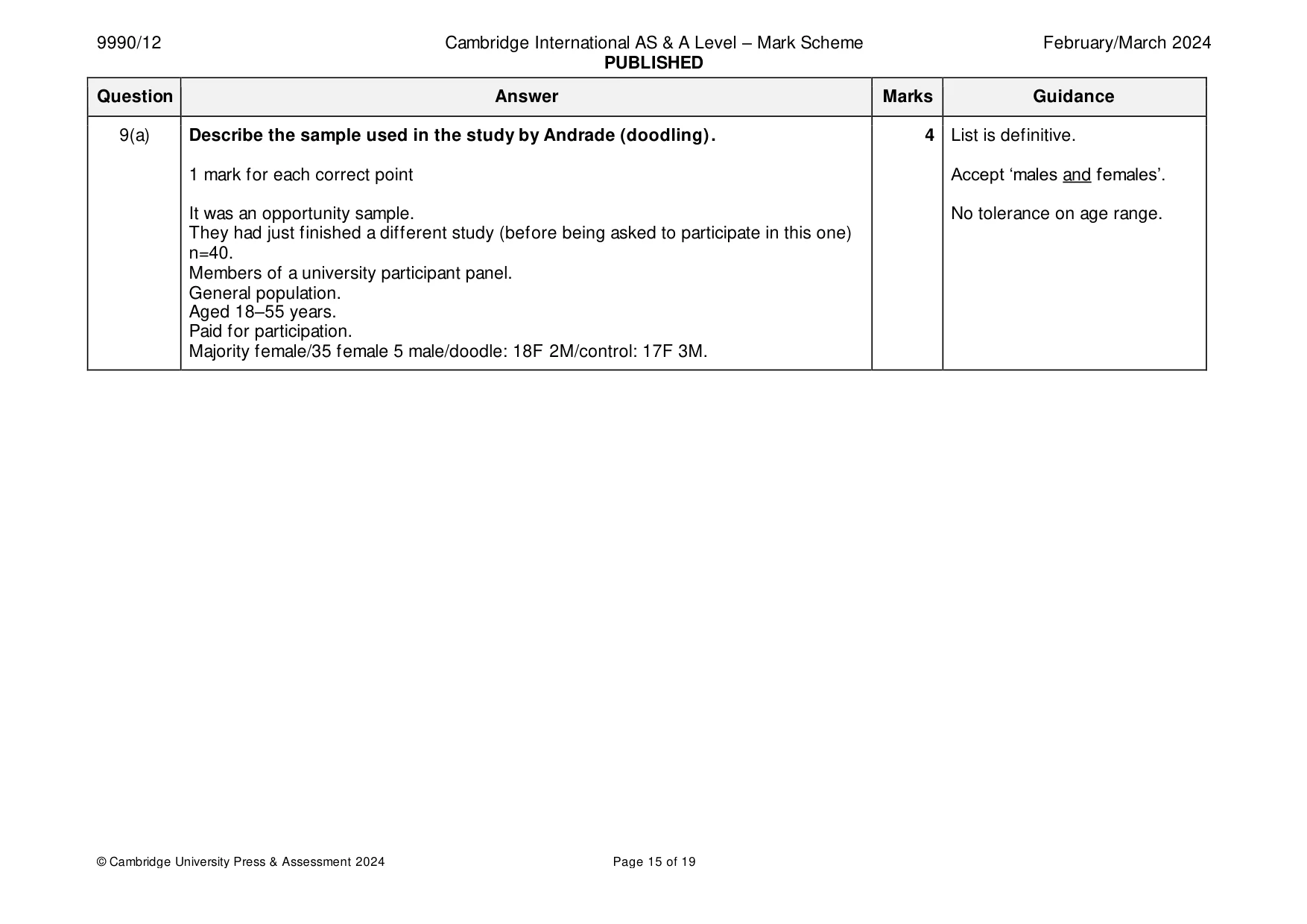
9990/12 Cambridge International AS & A Level – Mark Scheme PUBLISHED February/March 2024 © Cambridge University Press & Assessment 2024 Page 15 of 19 Question Answer Marks Guidance 9(a) Describe the sample used in the study by Andrade (doodling). 1 mark for each correct point It was an opportunity sample. They had just finished a different study (before being asked to participate in this one) n=40. Members of a university participant panel. General population. Aged 18–55 years. Paid for participation. Majority female/35 female 5 male/doodle: 18F 2M/control: 17F 3M. 4 List is definitive. Accept ‘males and females’. No tolerance on age range.
Mark scheme, page 16
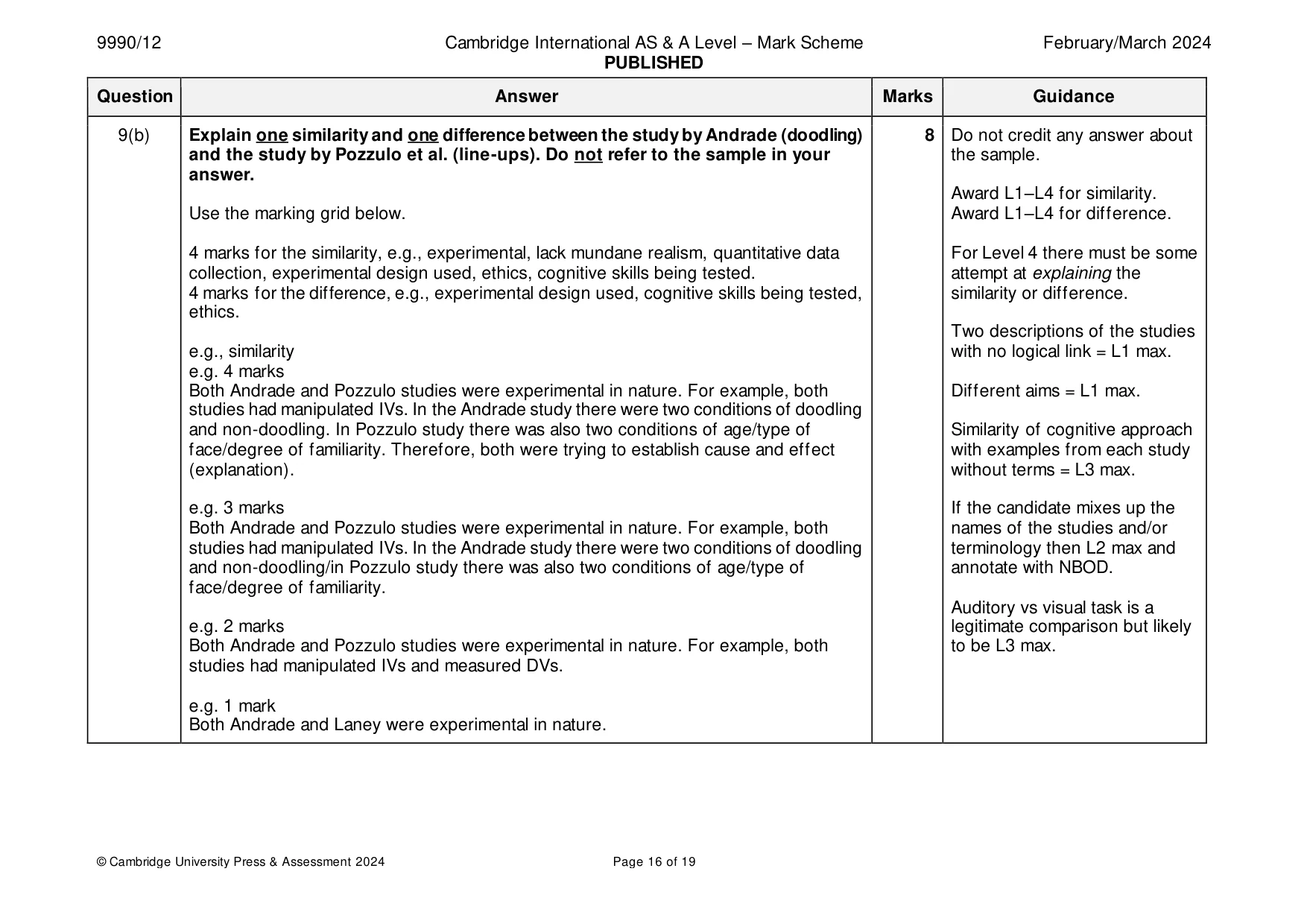
9990/12 Cambridge International AS & A Level – Mark Scheme PUBLISHED February/March 2024 © Cambridge University Press & Assessment 2024 Page 16 of 19 Question Answer Marks Guidance 9(b) Explain one similarity and one difference between the study by Andrade (doodling) and the study by Pozzulo et al. (line-ups). Do not refer to the sample in your answer. Use the marking grid below. 4 marks for the similarity, e.g., experimental, lack mundane realism, quantitative data collection, experimental design used, ethics, cognitive skills being tested. 4 marks for the difference, e.g., experimental design used, cognitive skills being tested, ethics. e.g., similarity e.g. 4 marks Both Andrade and Pozzulo studies were experimental in nature. For example, both studies had manipulated IVs. In the Andrade study there were two conditions of doodling and non-doodling. In Pozzulo study there was also two conditions of age/type of face/degree of familiarity. Therefore, both were trying to establish cause and effect (explanation). e.g. 3 marks Both Andrade and Pozzulo studies were experimental in nature. For example, both studies had manipulated IVs. In the Andrade study there were two conditions of doodling and non-doodling/in Pozzulo study there was also two conditions of age/type of face/degree of familiarity. e.g. 2 marks Both Andrade and Pozzulo studies were experimental in nature. For example, both studies had manipulated IVs and measured DVs. e.g. 1 mark Both Andrade and Laney were experimental in nature. 8 Do not credit any answer about the sample. Award L1–L4 for similarity. Award L1–L4 for difference. For Level 4 there must be some attempt at explaining the similarity or difference. Two descriptions of the studies with no logical link = L1 max. Different aims = L1 max. Similarity of cognitive approach with examples from each study without terms = L3 max. If the candidate mixes up the names of the studies and/or terminology then L2 max and annotate with NBOD. Auditory vs visual task is a legitimate comparison but likely to be L3 max.
Mark scheme, page 17
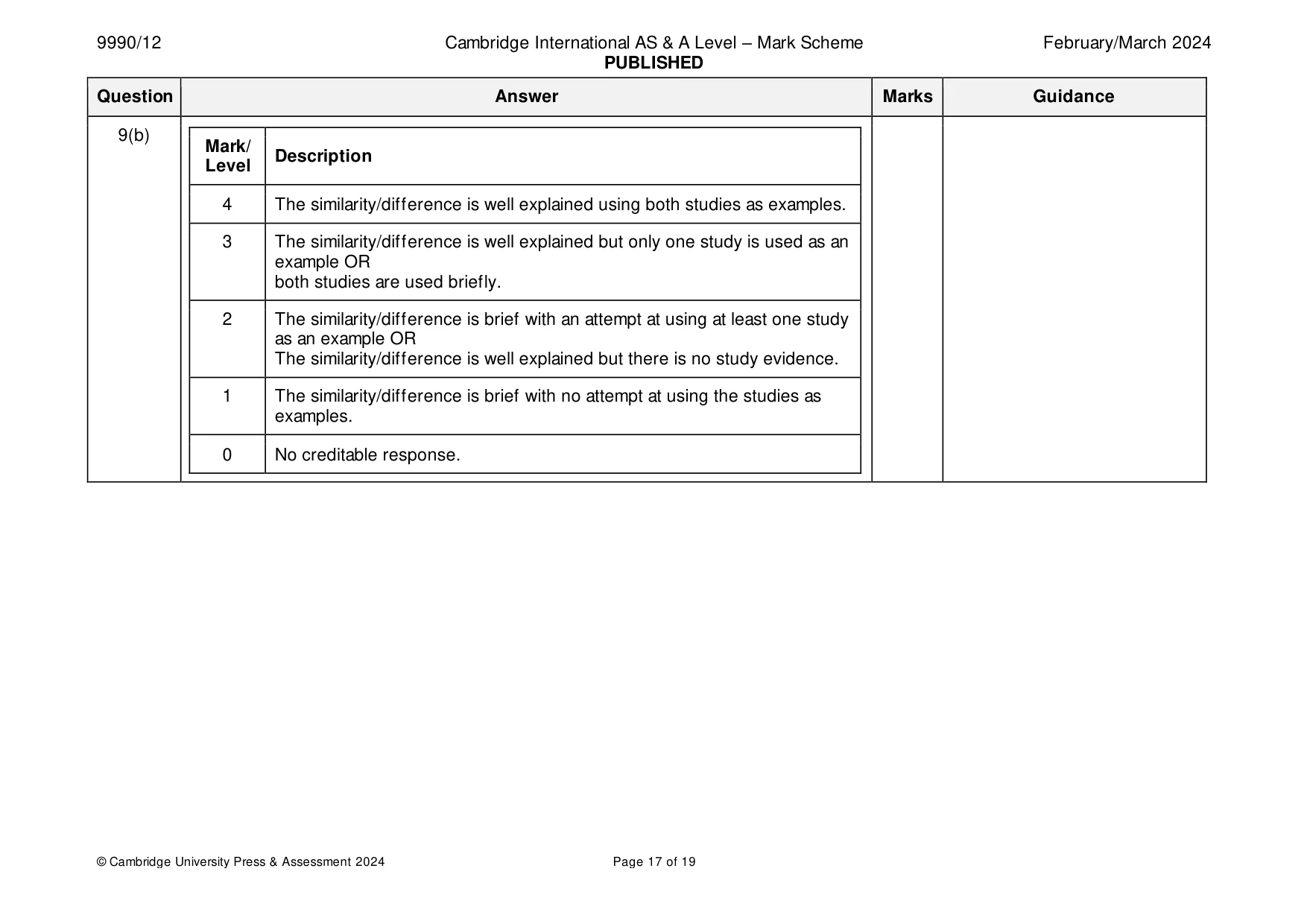
9990/12 Cambridge International AS & A Level – Mark Scheme PUBLISHED February/March 2024 © Cambridge University Press & Assessment 2024 Page 17 of 19 Question Answer Marks Guidance 9(b) Mark/ Level Description 4 The similarity/difference is well explained using both studies as examples. 3 The similarity/difference is well explained but only one study is used as an example OR both studies are used briefly. 2 The similarity/difference is brief with an attempt at using at least one study as an example OR The similarity/difference is well explained but there is no study evidence. 1 The similarity/difference is brief with no attempt at using the studies as examples. 0 No creditable response.
Mark scheme, page 18
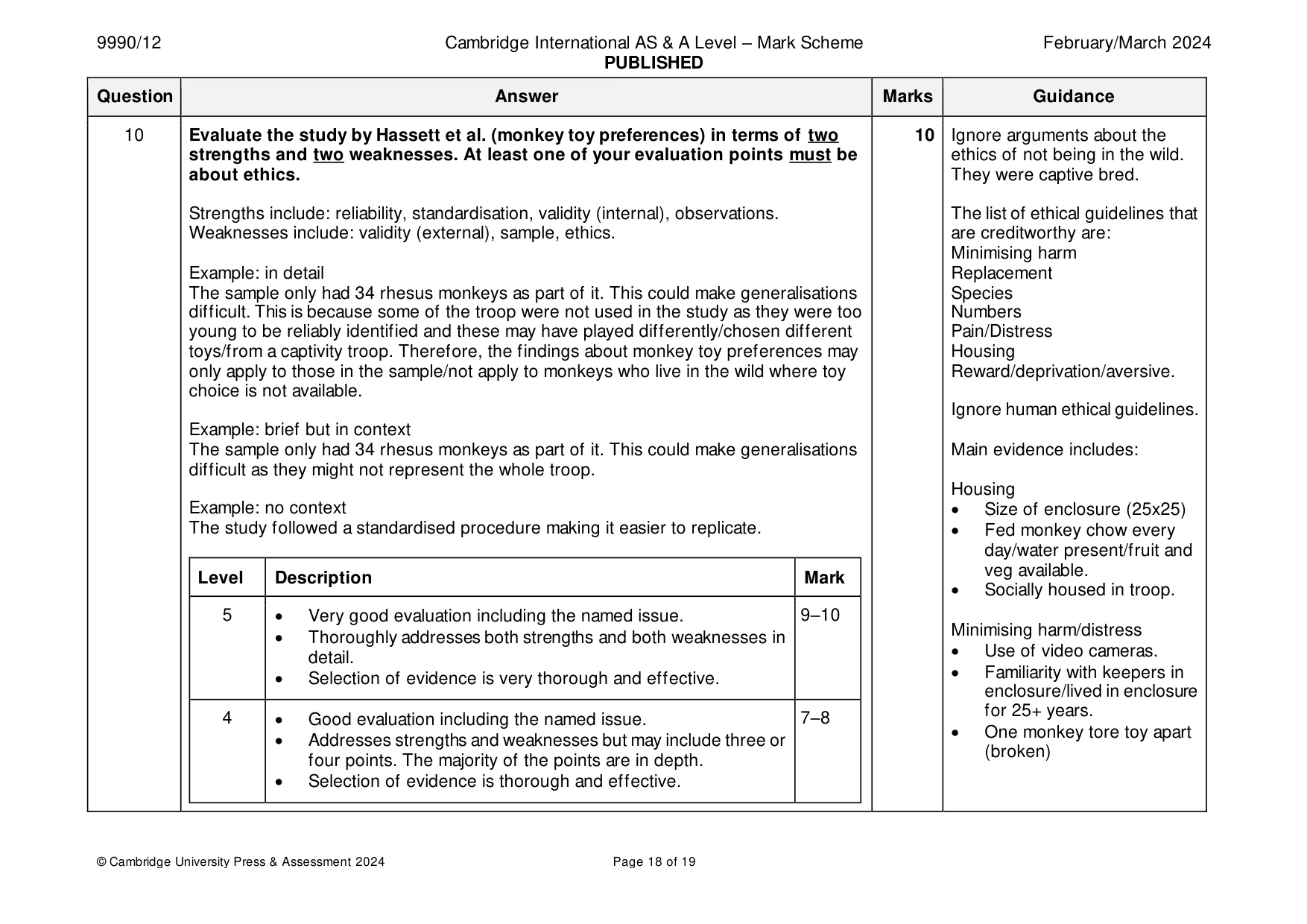
9990/12 Cambridge International AS & A Level – Mark Scheme PUBLISHED February/March 2024 © Cambridge University Press & Assessment 2024 Page 18 of 19 Question Answer Marks Guidance 10 Evaluate the study by Hassett et al. (monkey toy preferences) in terms of two strengths and two weaknesses. At least one of your evaluation points must be about ethics. Strengths include: reliability, standardisation, validity (internal), observations. Weaknesses include: validity (external), sample, ethics. Example: in detail The sample only had 34 rhesus monkeys as part of it. This could make generalisations difficult. This is because some of the troop were not used in the study as they were too young to be reliably identified and these may have played differently/chosen different toys/from a captivity troop. Therefore, the findings about monkey toy preferences may only apply to those in the sample/not apply to monkeys who live in the wild where toy choice is not available. Example: brief but in context The sample only had 34 rhesus monkeys as part of it. This could make generalisations difficult as they might not represent the whole troop. Example: no context The study followed a standardised procedure making it easier to replicate. Level Description Mark 5 • Very good evaluation including the named issue. • Thoroughly addresses both strengths and both weaknesses in detail. • Selection of evidence is very thorough and effective. 9–10 4 • Good evaluation including the named issue. • Addresses strengths and weaknesses but may include three or four points. The majority of the points are in depth. • Selection of evidence is thorough and effective. 7–8 10 Ignore arguments about the ethics of not being in the wild. They were captive bred. The list of ethical guidelines that are creditworthy are: Minimising harm Replacement Species Numbers Pain/Distress Housing Reward/deprivation/aversive. Ignore human ethical guidelines. Main evidence includes: Housing • Size of enclosure (25x25) • Fed monkey chow every day/water present/fruit and veg available. • Socially housed in troop. Minimising harm/distress • Use of video cameras. • Familiarity with keepers in enclosure/lived in enclosure for 25+ years. • One monkey tore toy apart (broken)
Mark scheme, page 19
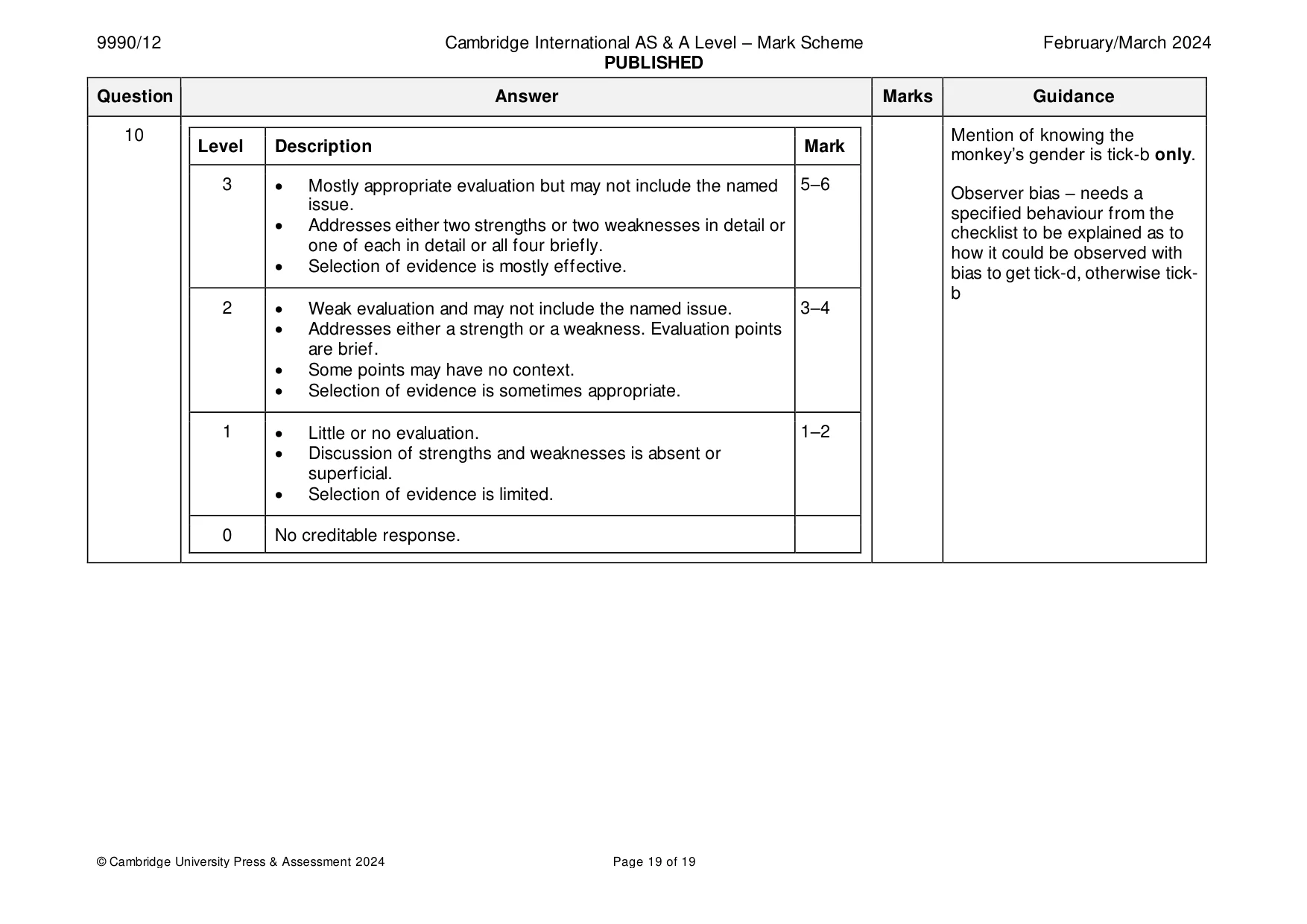
9990/12 Cambridge International AS & A Level – Mark Scheme PUBLISHED February/March 2024 © Cambridge University Press & Assessment 2024 Page 19 of 19 Question Answer Marks Guidance 10 Level Description Mark 3 • Mostly appropriate evaluation but may not include the named issue. • Addresses either two strengths or two weaknesses in detail or one of each in detail or all four briefly. • Selection of evidence is mostly effective. 5–6 2 • Weak evaluation and may not include the named issue. • Addresses either a strength or a weakness. Evaluation points are brief. • Some points may have no context. • Selection of evidence is sometimes appropriate. 3–4 1 • Little or no evaluation. • Discussion of strengths and weaknesses is absent or superficial. • Selection of evidence is limited. 1–2 0 No creditable response. Mention of knowing the monkey’s gender is tick-b only. Observer bias – needs a specified behaviour from the checklist to be explained as to how it could be observed with bias to get tick-d, otherwise tick- b
What you needed in this session
Cambridge’s own grade thresholds for 2024 Feb/March, Paper 1 · Variant 2. A higher threshold means an easier paper — the bar moves with how the cohort did.