Cambridge A Level Psychology (from 2018) 9990 — 2024 May/June Paper 1 · Variant 1
9990/11/M/J/24 · 60 marks · 90 min
The question paper and its mark scheme, free to read here and free to download. This is Cambridge’s own paper, exactly as it was sat.
Question paper12 pages



Mark scheme24 pages
Answers below. Sit the paper first if you are practising.
Paper as text
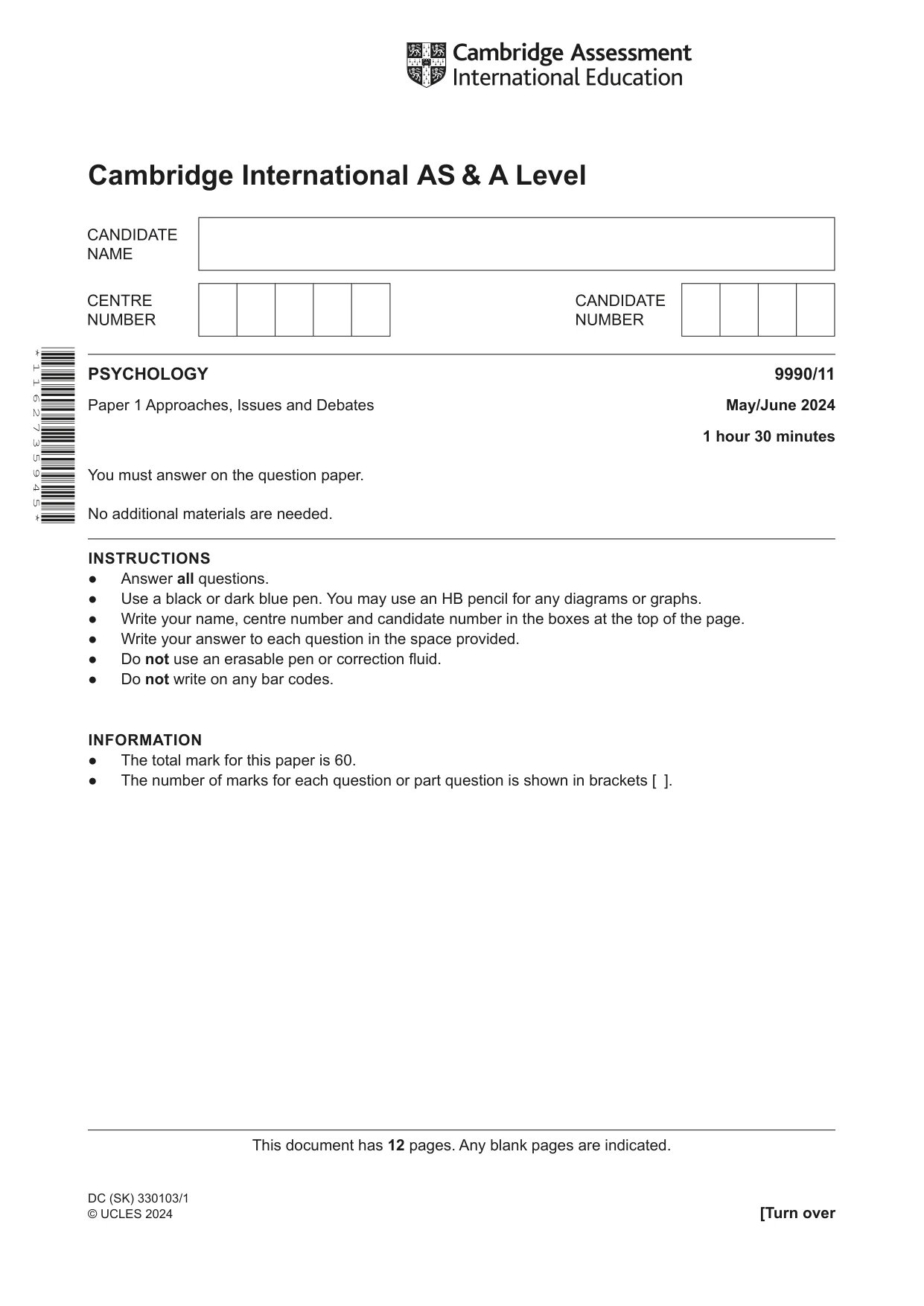
Question paper, page 1
This document has 12 pages. Any blank pages are indicated. [Turn over Cambridge International AS & A Level * 1 1 6 2 7 3 5 9 4 5 * DC (SK) 330103/1 © UCLES 2024 PSYCHOLOGY 9990/11 Paper 1 Approaches, Issues and Debates May/June 2024 1 hour 30 minutes You must answer on the question paper. No additional materials are needed. INSTRUCTIONS ● Answer all questions. ● Use a black or dark blue pen. You may use an HB pencil for any diagrams or graphs. ● Write your name, centre number and candidate number in the boxes at the top of the page. ● Write your answer to each question in the space provided. ● Do not use an erasable pen or correction fluid. ● Do not write on any bar codes. INFORMATION ● The total mark for this paper is 60. ● The number of marks for each question or part question is shown in brackets [ ].
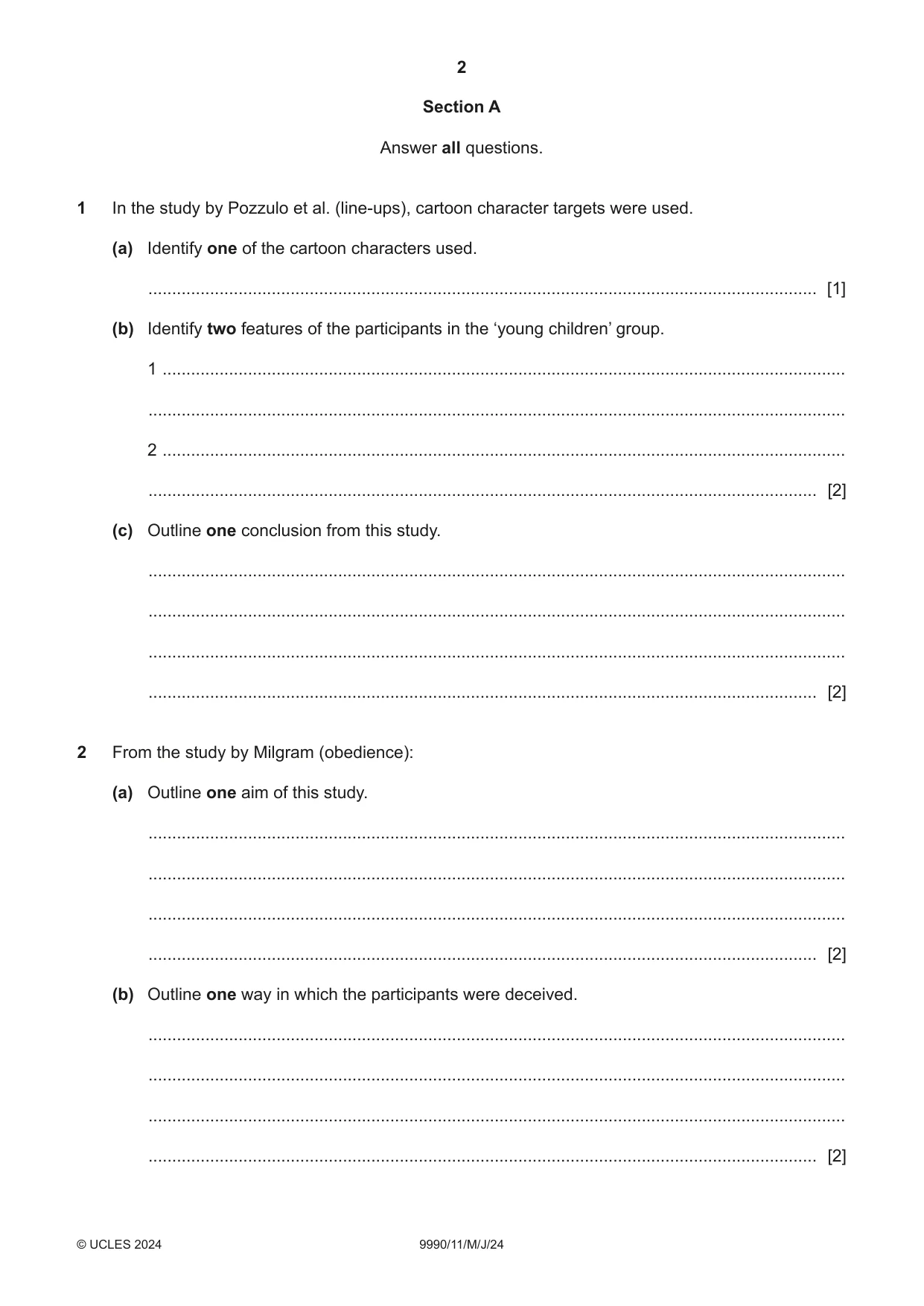
Question paper, page 2
2 9990/11/M/J/24 © UCLES 2024 Section A Answer all questions. 1 In the study by Pozzulo et al. (line-ups), cartoon character targets were used. (a) Identify one of the cartoon characters used. … [1] (b) Identify two features of the participants in the ‘young children’ group. 1 … … 2 … … [2] (c) Outline one conclusion from this study. … … … … [2] 2 From the study by Milgram (obedience): (a) Outline one aim of this study. … … … … [2] (b) Outline one way in which the participants were deceived. … … … … [2]
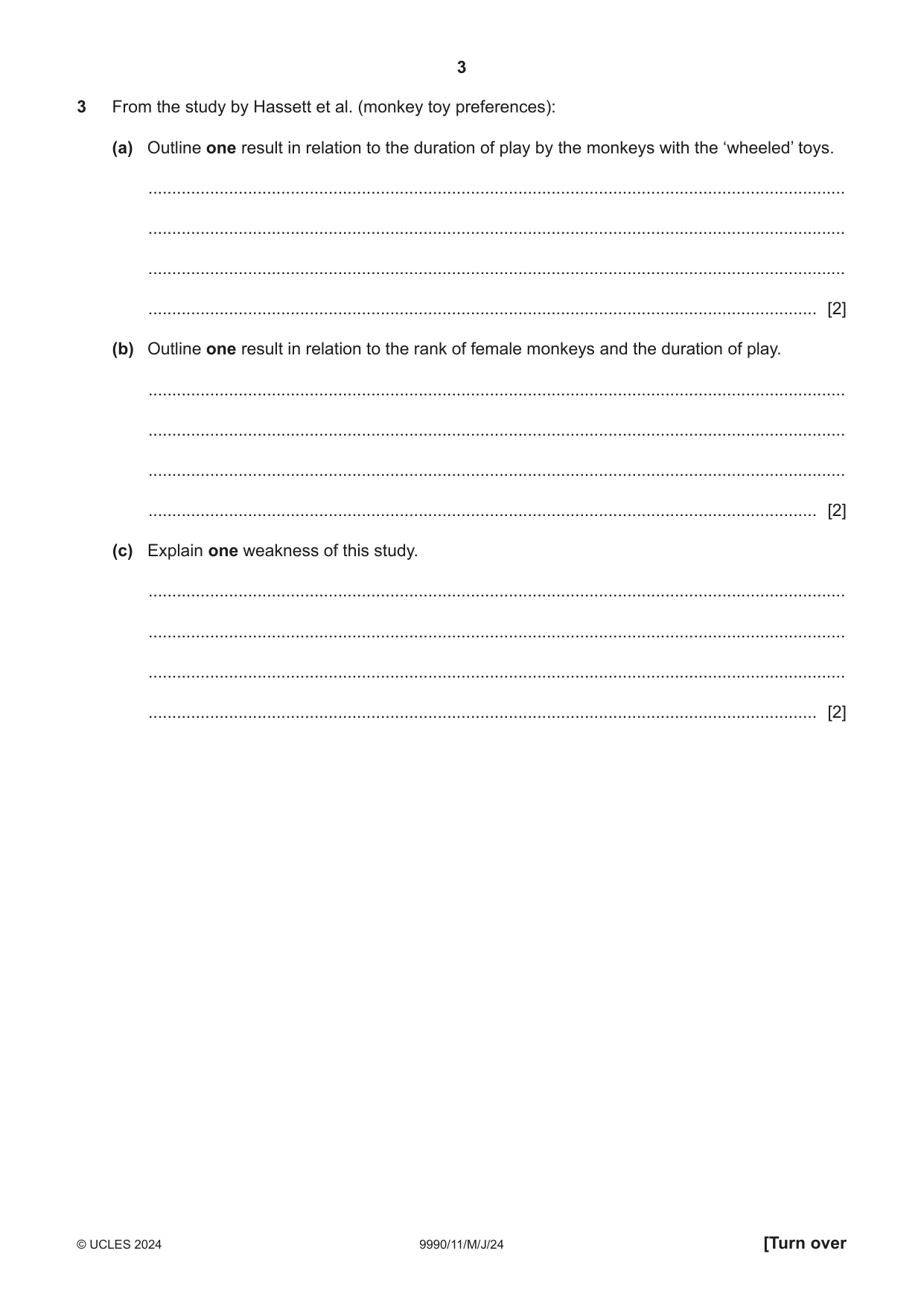
Question paper, page 3
3 9990/11/M/J/24 © UCLES 2024 [Turn over 3 From the study by Hassett et al. (monkey toy preferences): (a) Outline one result in relation to the duration of play by the monkeys with the ‘wheeled’ toys. … … … … [2] (b) Outline one result in relation to the rank of female monkeys and the duration of play. … … … … [2] (c) Explain one weakness of this study. … … … … [2]
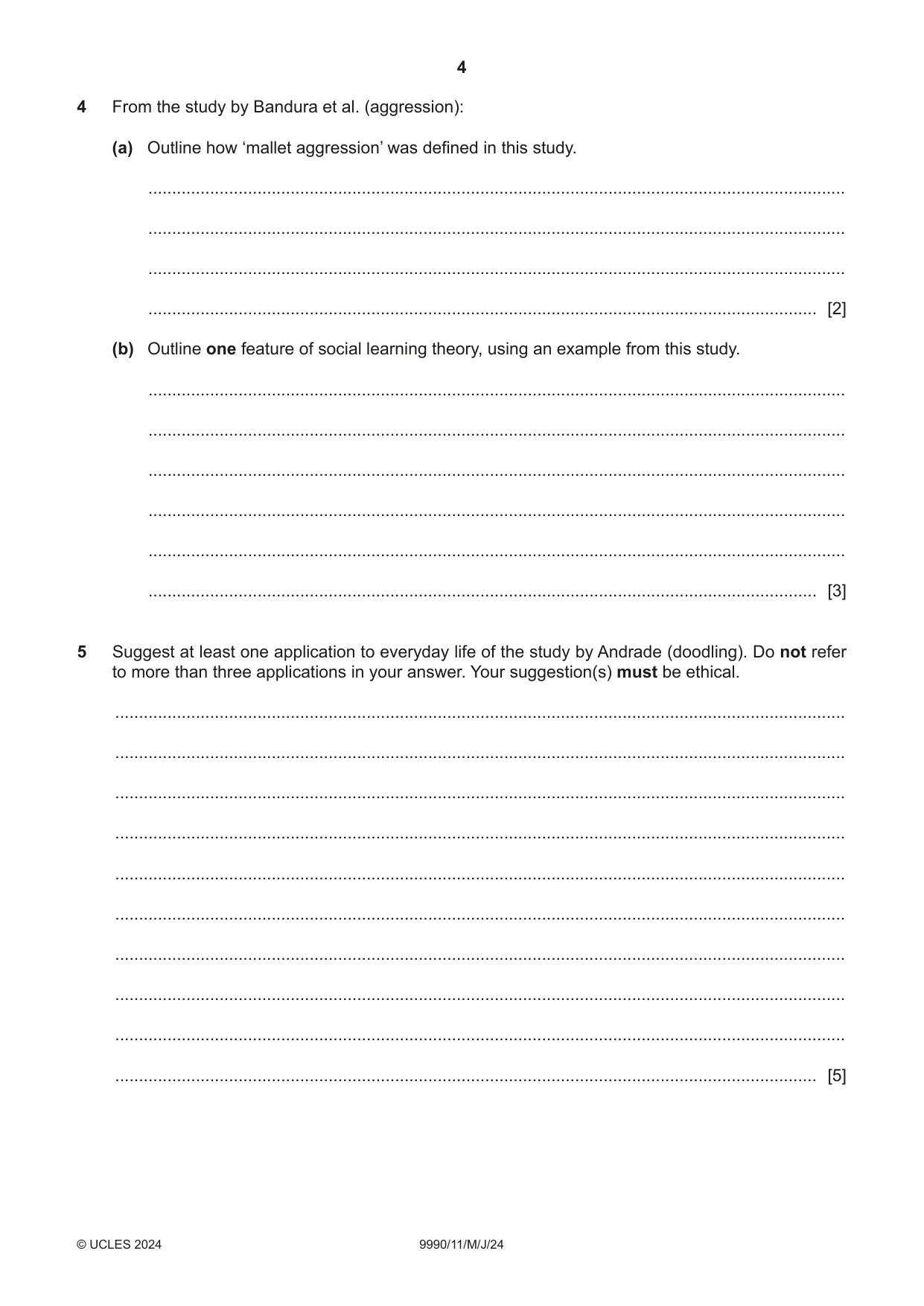
Question paper, page 4
4 9990/11/M/J/24 © UCLES 2024 4 From the study by Bandura et al. (aggression): (a) Outline how ‘mallet aggression’ was defined in this study. … … … … [2] (b) Outline one feature of social learning theory, using an example from this study. … … … … … … [3] 5 Suggest at least one application to everyday life of the study by Andrade (doodling). Do not refer to more than three applications in your answer. Your suggestion(s) must be ethical. … … … … … … … … … … [5]
Question paper, page 5
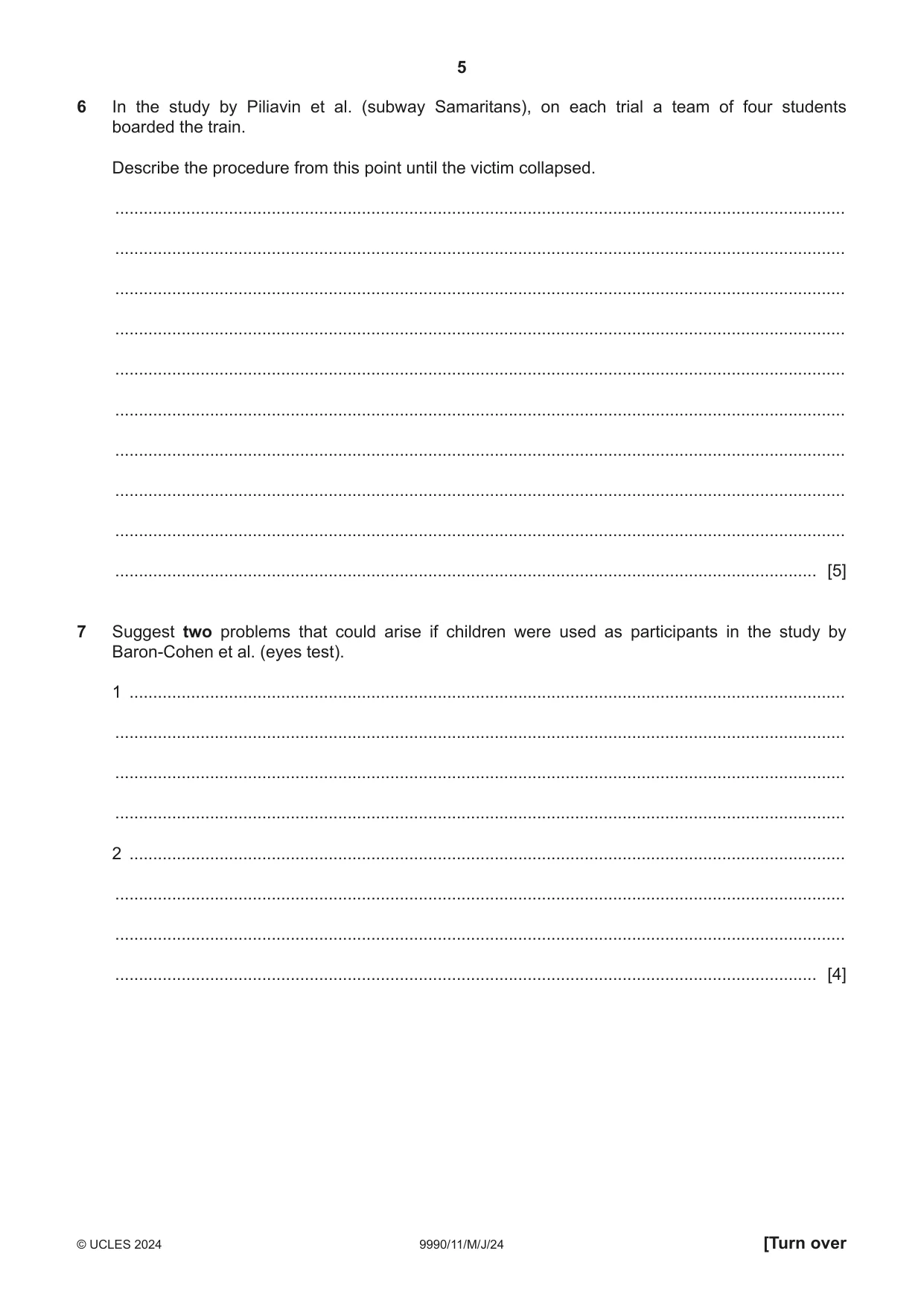
5 9990/11/M/J/24 © UCLES 2024 [Turn over 6 In the study by Piliavin et al. (subway Samaritans), on each trial a team of four students boarded the train. Describe the procedure from this point until the victim collapsed. … … … … … … … … … … [5] 7 Suggest two problems that could arise if children were used as participants in the study by Baron-Cohen et al. (eyes test). 1 … … … … 2 … … … … [4]
Question paper, page 6
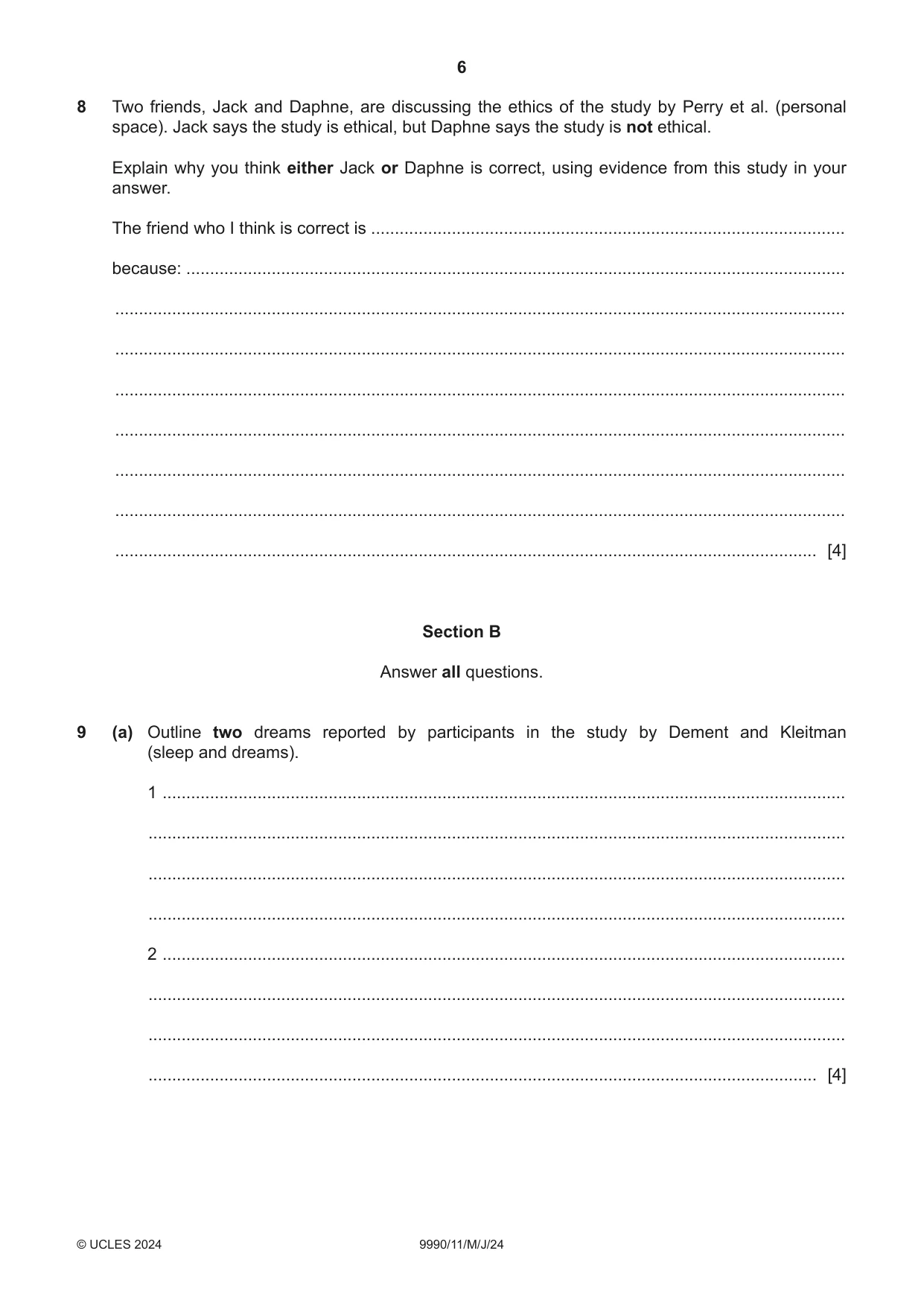
6 9990/11/M/J/24 © UCLES 2024 8 Two friends, Jack and Daphne, are discussing the ethics of the study by Perry et al. (personal space). Jack says the study is ethical, but Daphne says the study is not ethical. Explain why you think either Jack or Daphne is correct, using evidence from this study in your answer. The friend who I think is correct is … because: … … … … … … … … [4] Section B Answer all questions. 9 (a) Outline two dreams reported by participants in the study by Dement and Kleitman (sleep and dreams). 1 … … … … 2 … … … … [4]
Question paper, page 7
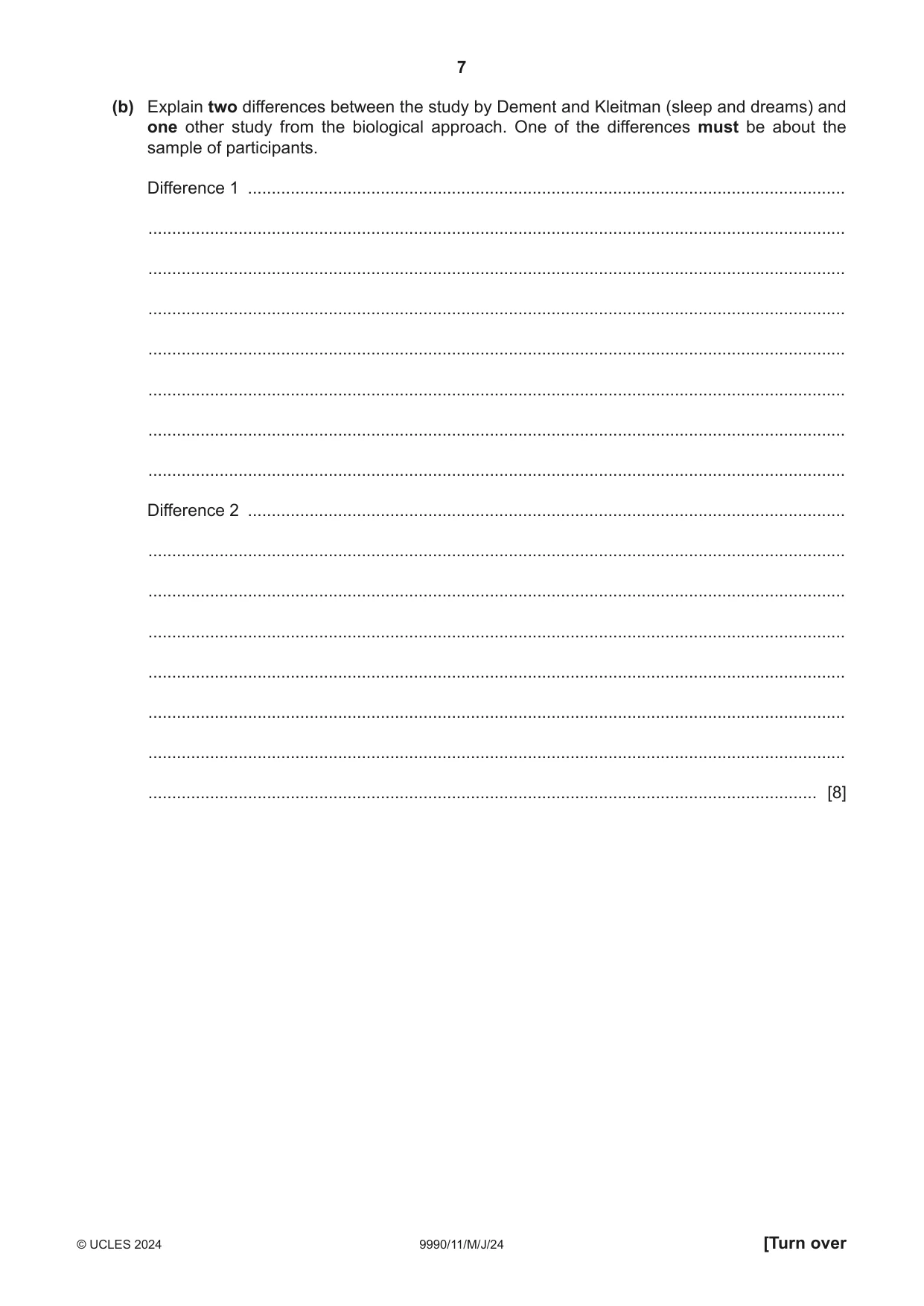
7 9990/11/M/J/24 © UCLES 2024 [Turn over (b) Explain two differences between the study by Dement and Kleitman (sleep and dreams) and one other study from the biological approach. One of the differences must be about the sample of participants. Difference 1 … … … … … … … … Difference 2 … … … … … … … … [8]
Question paper, page 8
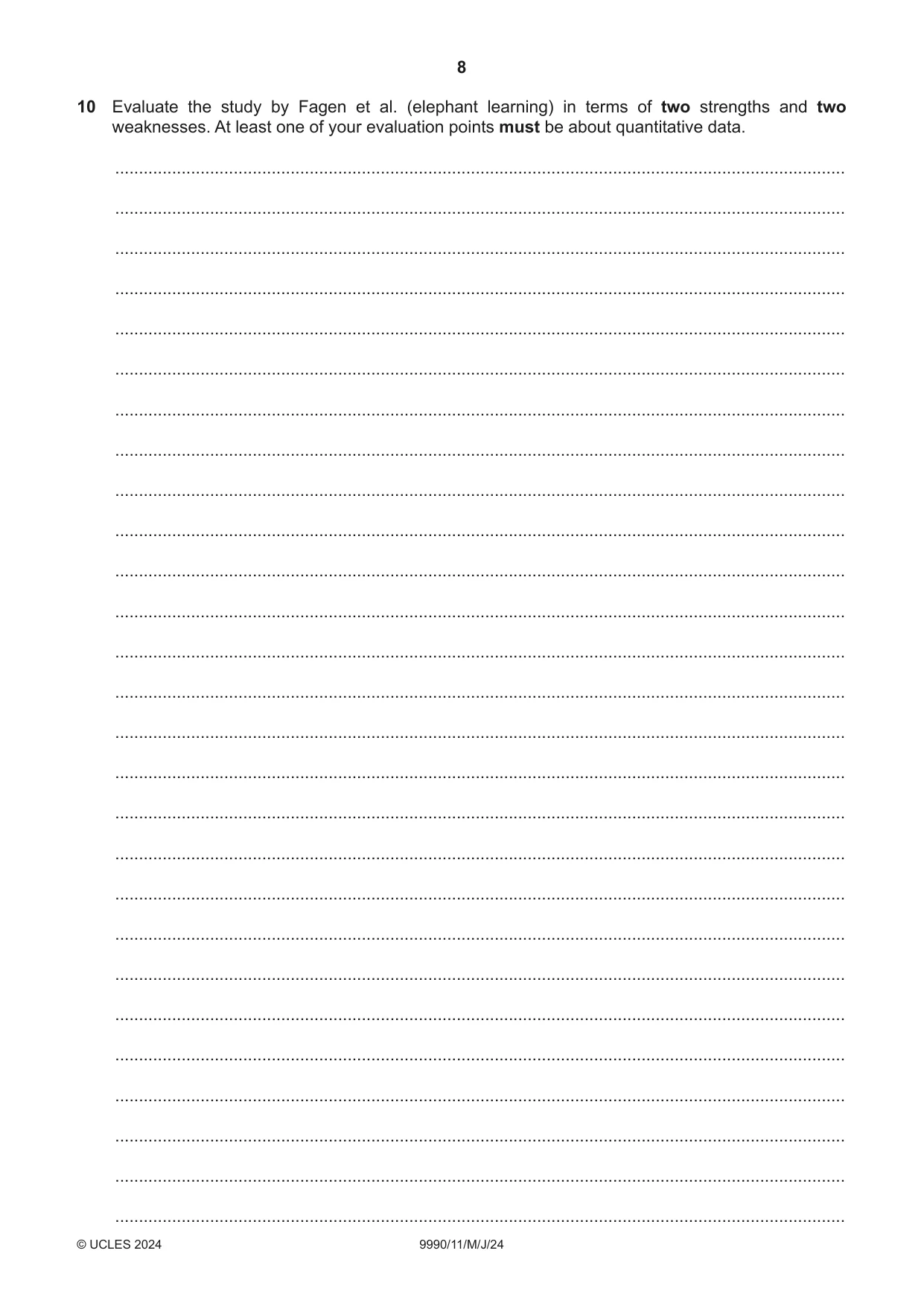
8 9990/11/M/J/24 © UCLES 2024 10 Evaluate the study by Fagen et al. (elephant learning) in terms of two strengths and two weaknesses. At least one of your evaluation points must be about quantitative data. … … … … … … … … … … … … … … … … … … … … … … … … … … …
Question paper, page 9
9 9990/11/M/J/24 © UCLES 2024 … … … … … … … … … … … … … … [10]
Question paper, page 10
10 9990/11/M/J/24 © UCLES 2024 BLANK PAGE
Question paper, page 11
11 9990/11/M/J/24 © UCLES 2024 BLANK PAGE
Question paper, page 12
12 9990/11/M/J/24 © UCLES 2024 Permission to reproduce items where third-party owned material protected by copyright is included has been sought and cleared where possible. Every reasonable effort has been made by the publisher (UCLES) to trace copyright holders, but if any items requiring clearance have unwittingly been included, the publisher will be pleased to make amends at the earliest possible opportunity. To avoid the issue of disclosure of answer-related information to candidates, all copyright acknowledgements are reproduced online in the Cambridge Assessment International Education Copyright Acknowledgements Booklet. This is produced for each series of examinations and is freely available to download at www.cambridgeinternational.org after the live examination series. Cambridge Assessment International Education is part of Cambridge Assessment. Cambridge Assessment is the brand name of the University of Cambridge Local Examinations Syndicate (UCLES), which is a department of the University of Cambridge. BLANK PAGE
Mark scheme, page 1
This document consists of 24 printed pages. © Cambridge University Press & Assessment 2024 [Turn over Cambridge International AS & A Level PSYCHOLOGY 9990/11 Paper 1 Approaches, Issues and Debates May/June 2024 MARK SCHEME Maximum Mark: 60 Published This mark scheme is published as an aid to teachers and candidates, to indicate the requirements of the examination. It shows the basis on which Examiners were instructed to award marks. It does not indicate the details of the discussions that took place at an Examiners’ meeting before marking began, which would have considered the acceptability of alternative answers. Mark schemes should be read in conjunction with the question paper and the Principal Examiner Report for Teachers. Cambridge International will not enter into discussions about these mark schemes. Cambridge International is publishing the mark schemes for the May/June 2024 series for most Cambridge IGCSE, Cambridge International A and AS Level and Cambridge Pre-U components, and some Cambridge O Level components.
Mark scheme, page 2
9990/11 Cambridge International AS & A Level – Mark Scheme PUBLISHED May/June 2024 © Cambridge University Press & Assessment 2024 Page 2 of 24 Generic Marking Principles These general marking principles must be applied by all examiners when marking candidate answers. They should be applied alongside the specific content of the mark scheme or generic level descriptions for a question. Each question paper and mark scheme will also comply with these marking principles. GENERIC MARKING PRINCIPLE 1: Marks must be awarded in line with: the specific content of the mark scheme or the generic level descriptors for the question the specific skills defined in the mark scheme or in the generic level descriptors for the question the standard of response required by a candidate as exemplified by the standardisation scripts. GENERIC MARKING PRINCIPLE 2: Marks awarded are always whole marks (not half marks, or other fractions). GENERIC MARKING PRINCIPLE 3: Marks must be awarded positively: marks are awarded for correct/valid answers, as defined in the mark scheme. However, credit is given for valid answers which go beyond the scope of the syllabus and mark scheme, referring to your Team Leader as appropriate marks are awarded when candidates clearly demonstrate what they know and can do marks are not deducted for errors marks are not deducted for omissions answers should only be judged on the quality of spelling, punctuation and grammar when these features are specifically assessed by the question as indicated by the mark scheme. The meaning, however, should be unambiguous. GENERIC MARKING PRINCIPLE 4: Rules must be applied consistently, e.g. in situations where candidates have not followed instructions or in the application of generic level descriptors.
Mark scheme, page 3
9990/11 Cambridge International AS & A Level – Mark Scheme PUBLISHED May/June 2024 © Cambridge University Press & Assessment 2024 Page 3 of 24 GENERIC MARKING PRINCIPLE 5: Marks should be awarded using the full range of marks defined in the mark scheme for the question (however; the use of the full mark range may be limited according to the quality of the candidate responses seen). GENERIC MARKING PRINCIPLE 6: Marks awarded are based solely on the requirements as defined in the mark scheme. Marks should not be awarded with grade thresholds or grade descriptors in mind.
Mark scheme, page 4
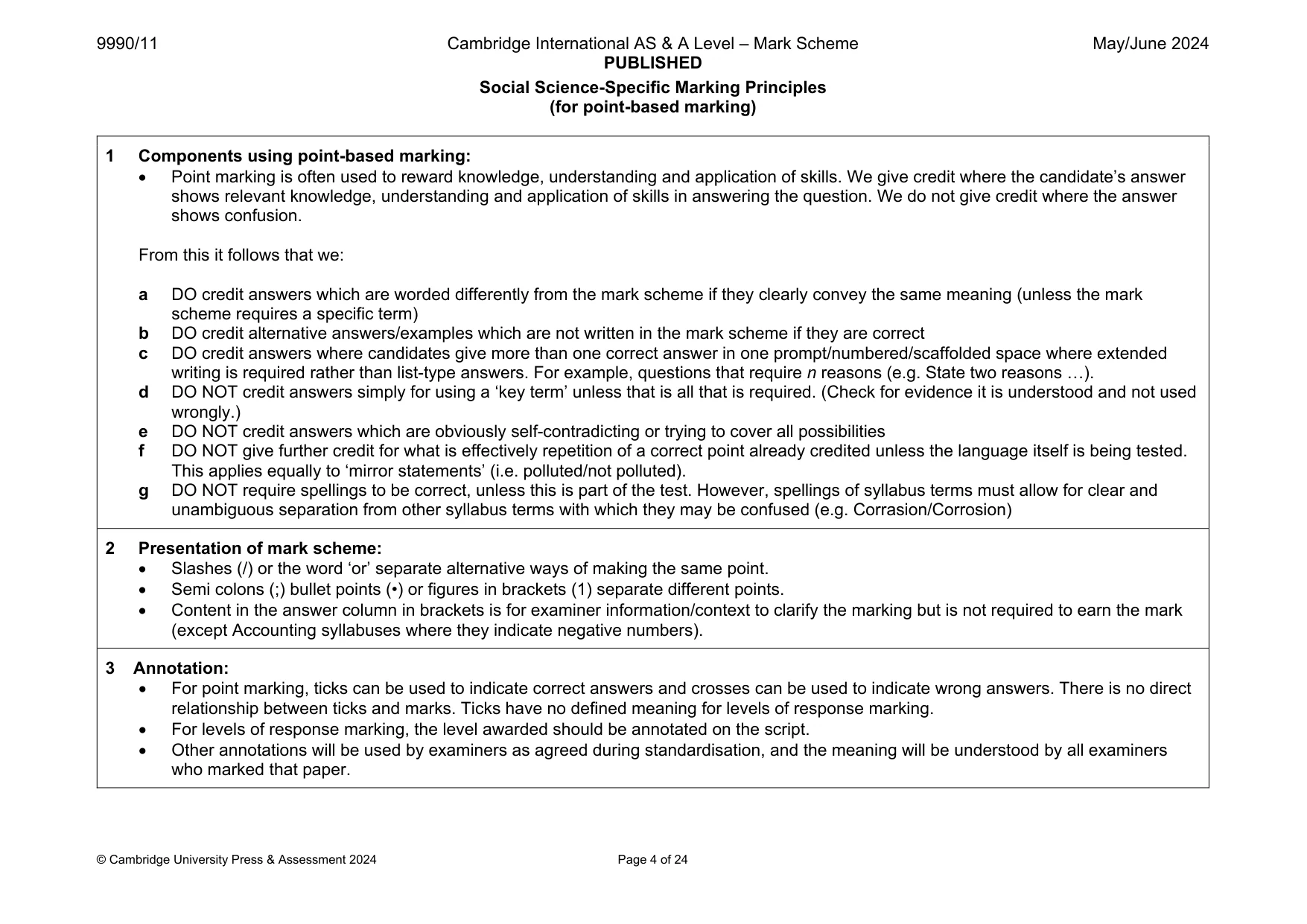
9990/11 Cambridge International AS & A Level – Mark Scheme PUBLISHED May/June 2024 © Cambridge University Press & Assessment 2024 Page 4 of 24 Social Science-Specific Marking Principles (for point-based marking) 1 Components using point-based marking: Point marking is often used to reward knowledge, understanding and application of skills. We give credit where the candidate’s answer shows relevant knowledge, understanding and application of skills in answering the question. We do not give credit where the answer shows confusion. From this it follows that we: a DO credit answers which are worded differently from the mark scheme if they clearly convey the same meaning (unless the mark scheme requires a specific term) b DO credit alternative answers/examples which are not written in the mark scheme if they are correct c DO credit answers where candidates give more than one correct answer in one prompt/numbered/scaffolded space where extended writing is required rather than list-type answers. For example, questions that require n reasons (e.g. State two reasons …). d DO NOT credit answers simply for using a ‘key term’ unless that is all that is required. (Check for evidence it is understood and not used wrongly.) e DO NOT credit answers which are obviously self-contradicting or trying to cover all possibilities f DO NOT give further credit for what is effectively repetition of a correct point already credited unless the language itself is being tested. This applies equally to ‘mirror statements’ (i.e. polluted/not polluted). g DO NOT require spellings to be correct, unless this is part of the test. However, spellings of syllabus terms must allow for clear and unambiguous separation from other syllabus terms with which they may be confused (e.g. Corrasion/Corrosion) 2 Presentation of mark scheme: Slashes (/) or the word ‘or’ separate alternative ways of making the same point. Semi colons (;) bullet points (•) or figures in brackets (1) separate different points. Content in the answer column in brackets is for examiner information/context to clarify the marking but is not required to earn the mark (except Accounting syllabuses where they indicate negative numbers). 3 Annotation: For point marking, ticks can be used to indicate correct answers and crosses can be used to indicate wrong answers. There is no direct relationship between ticks and marks. Ticks have no defined meaning for levels of response marking. For levels of response marking, the level awarded should be annotated on the script. Other annotations will be used by examiners as agreed during standardisation, and the meaning will be understood by all examiners who marked that paper.
Mark scheme, page 5
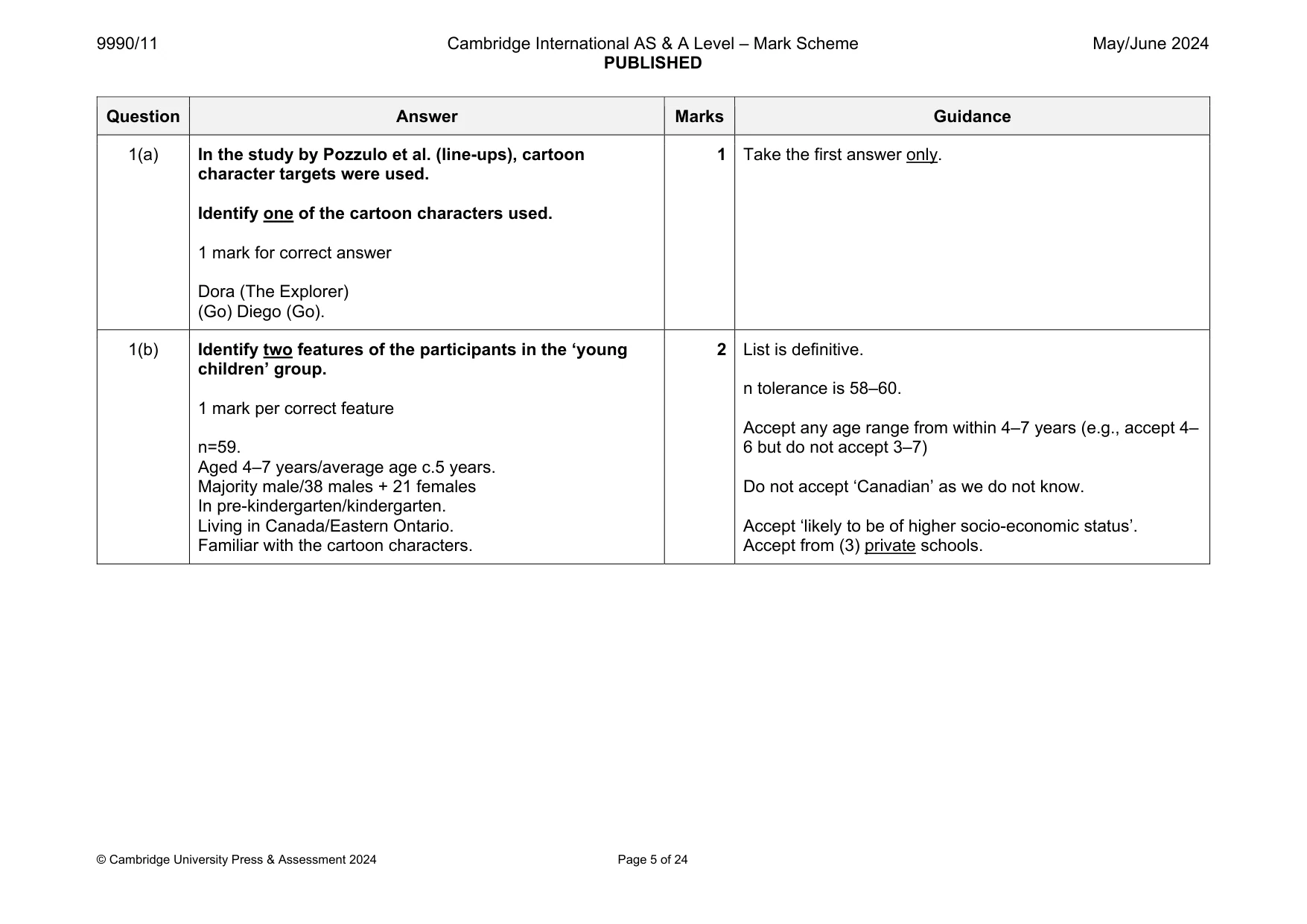
9990/11 Cambridge International AS & A Level – Mark Scheme PUBLISHED May/June 2024 © Cambridge University Press & Assessment 2024 Page 5 of 24 Question Answer Marks Guidance 1(a) In the study by Pozzulo et al. (line-ups), cartoon character targets were used. Identify one of the cartoon characters used. 1 mark for correct answer Dora (The Explorer) (Go) Diego (Go). 1 Take the first answer only. 1(b) Identify two features of the participants in the ‘young children’ group. 1 mark per correct feature n=59. Aged 4–7 years/average age c.5 years. Majority male/38 males + 21 females In pre-kindergarten/kindergarten. Living in Canada/Eastern Ontario. Familiar with the cartoon characters. 2 List is definitive. n tolerance is 58–60. Accept any age range from within 4–7 years (e.g., accept 4– 6 but do not accept 3–7) Do not accept ‘Canadian’ as we do not know. Accept ‘likely to be of higher socio-economic status’. Accept from (3) private schools.
Mark scheme, page 6
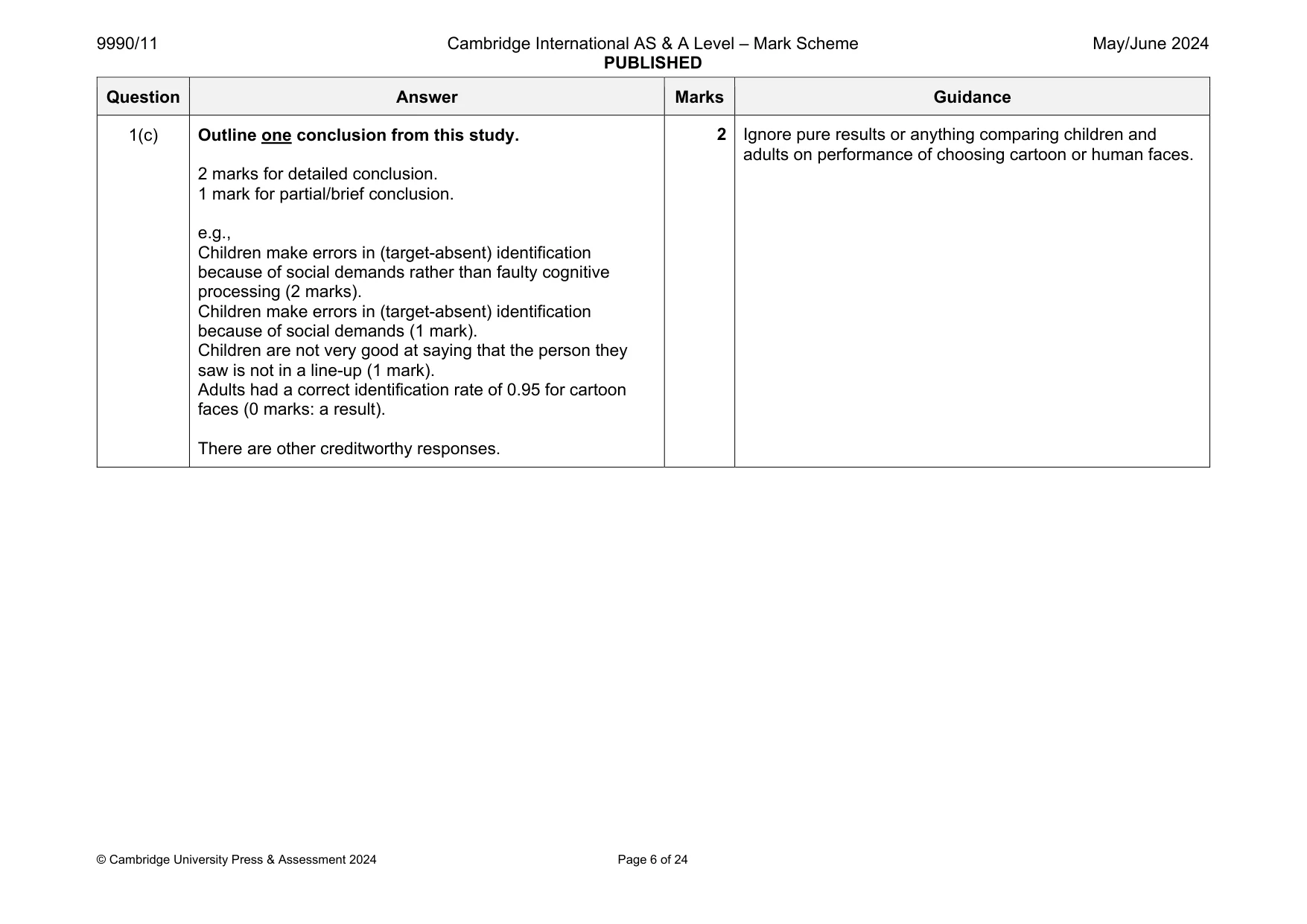
9990/11 Cambridge International AS & A Level – Mark Scheme PUBLISHED May/June 2024 © Cambridge University Press & Assessment 2024 Page 6 of 24 Question Answer Marks Guidance 1(c) Outline one conclusion from this study. 2 marks for detailed conclusion. 1 mark for partial/brief conclusion. e.g., Children make errors in (target-absent) identification because of social demands rather than faulty cognitive processing (2 marks). Children make errors in (target-absent) identification because of social demands (1 mark). Children are not very good at saying that the person they saw is not in a line-up (1 mark). Adults had a correct identification rate of 0.95 for cartoon faces (0 marks: a result). There are other creditworthy responses. 2 Ignore pure results or anything comparing children and adults on performance of choosing cartoon or human faces.
Mark scheme, page 7
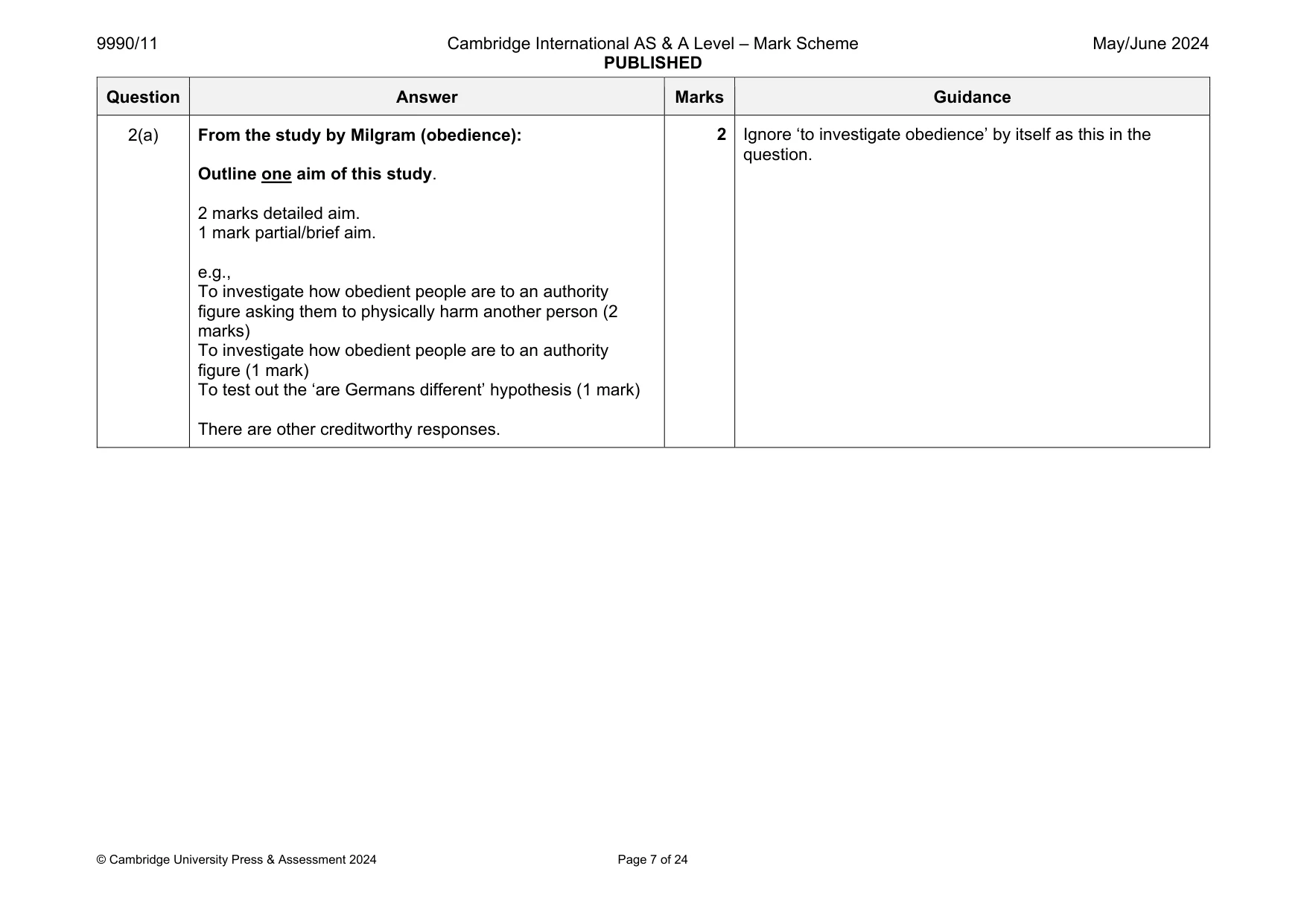
9990/11 Cambridge International AS & A Level – Mark Scheme PUBLISHED May/June 2024 © Cambridge University Press & Assessment 2024 Page 7 of 24 Question Answer Marks Guidance 2(a) From the study by Milgram (obedience): Outline one aim of this study. 2 marks detailed aim. 1 mark partial/brief aim. e.g., To investigate how obedient people are to an authority figure asking them to physically harm another person (2 marks) To investigate how obedient people are to an authority figure (1 mark) To test out the ‘are Germans different’ hypothesis (1 mark) There are other creditworthy responses. 2 Ignore ‘to investigate obedience’ by itself as this in the question.
Mark scheme, page 8
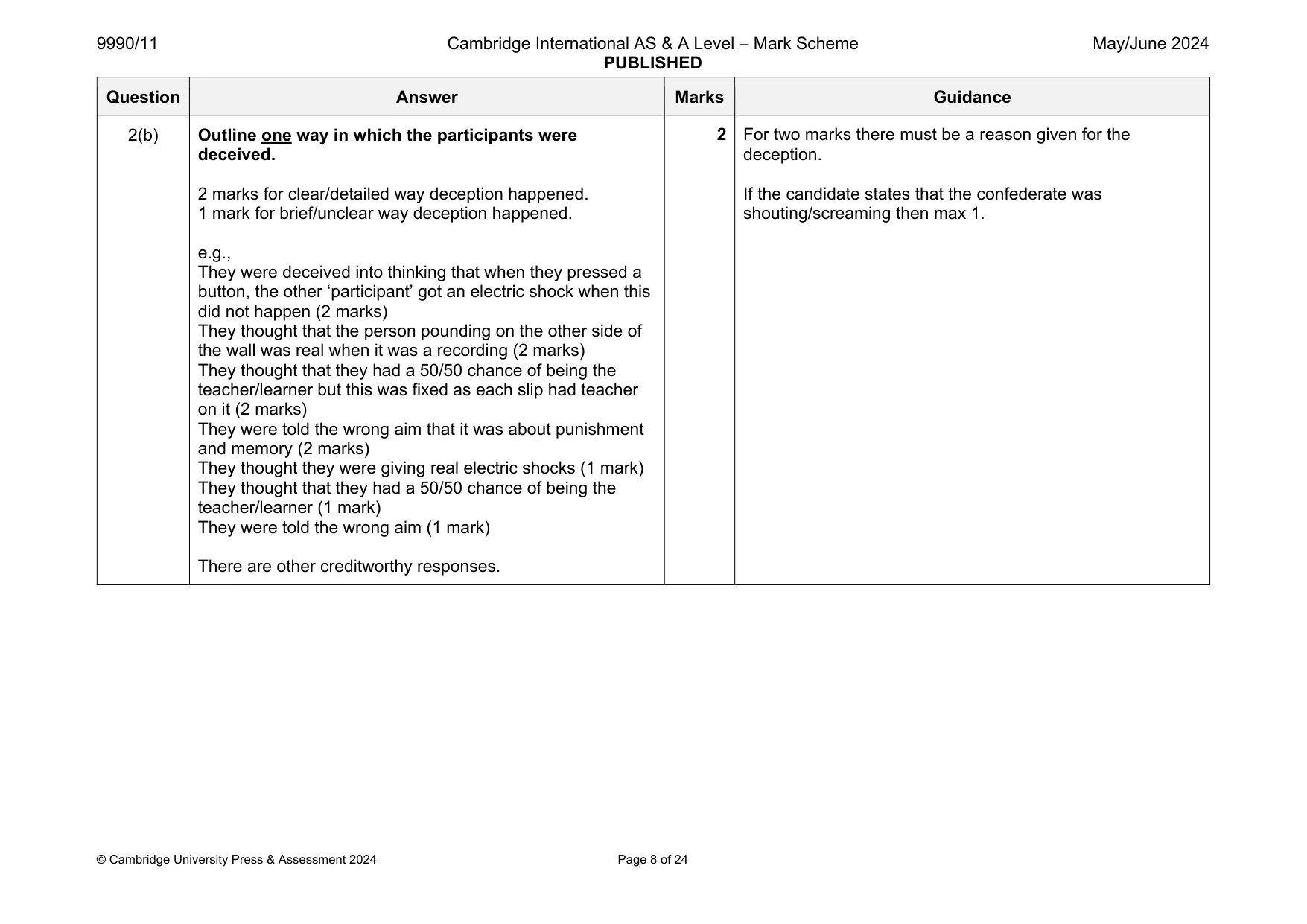
9990/11 Cambridge International AS & A Level – Mark Scheme PUBLISHED May/June 2024 © Cambridge University Press & Assessment 2024 Page 8 of 24 Question Answer Marks Guidance 2(b) Outline one way in which the participants were deceived. 2 marks for clear/detailed way deception happened. 1 mark for brief/unclear way deception happened. e.g., They were deceived into thinking that when they pressed a button, the other ‘participant’ got an electric shock when this did not happen (2 marks) They thought that the person pounding on the other side of the wall was real when it was a recording (2 marks) They thought that they had a 50/50 chance of being the teacher/learner but this was fixed as each slip had teacher on it (2 marks) They were told the wrong aim that it was about punishment and memory (2 marks) They thought they were giving real electric shocks (1 mark) They thought that they had a 50/50 chance of being the teacher/learner (1 mark) They were told the wrong aim (1 mark) There are other creditworthy responses. 2 For two marks there must be a reason given for the deception. If the candidate states that the confederate was shouting/screaming then max 1.
Mark scheme, page 9
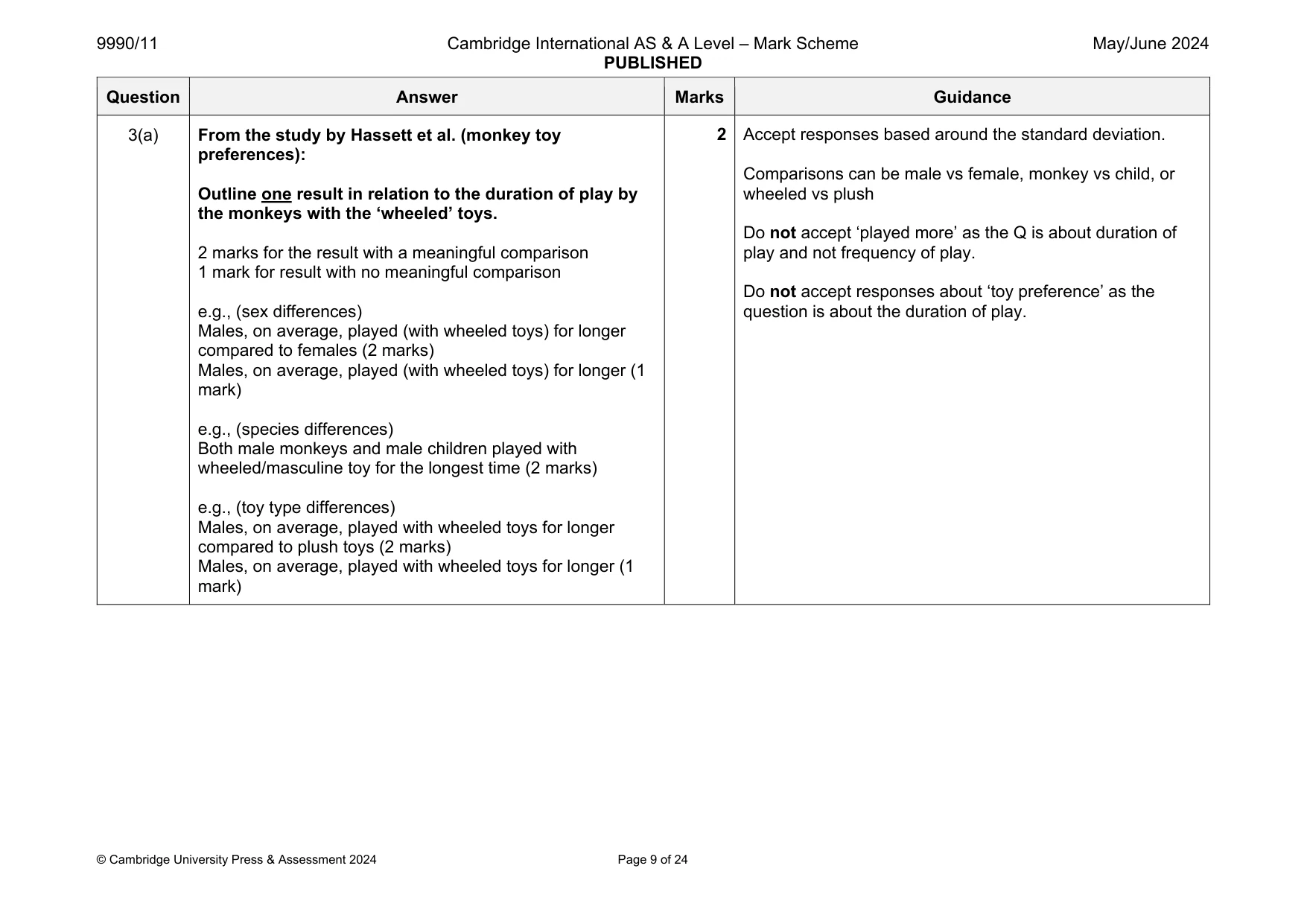
9990/11 Cambridge International AS & A Level – Mark Scheme PUBLISHED May/June 2024 © Cambridge University Press & Assessment 2024 Page 9 of 24 Question Answer Marks Guidance 3(a) From the study by Hassett et al. (monkey toy preferences): Outline one result in relation to the duration of play by the monkeys with the ‘wheeled’ toys. 2 marks for the result with a meaningful comparison 1 mark for result with no meaningful comparison e.g., (sex differences) Males, on average, played (with wheeled toys) for longer compared to females (2 marks) Males, on average, played (with wheeled toys) for longer (1 mark) e.g., (species differences) Both male monkeys and male children played with wheeled/masculine toy for the longest time (2 marks) e.g., (toy type differences) Males, on average, played with wheeled toys for longer compared to plush toys (2 marks) Males, on average, played with wheeled toys for longer (1 mark) 2 Accept responses based around the standard deviation. Comparisons can be male vs female, monkey vs child, or wheeled vs plush Do not accept ‘played more’ as the Q is about duration of play and not frequency of play. Do not accept responses about ‘toy preference’ as the question is about the duration of play.
Mark scheme, page 10
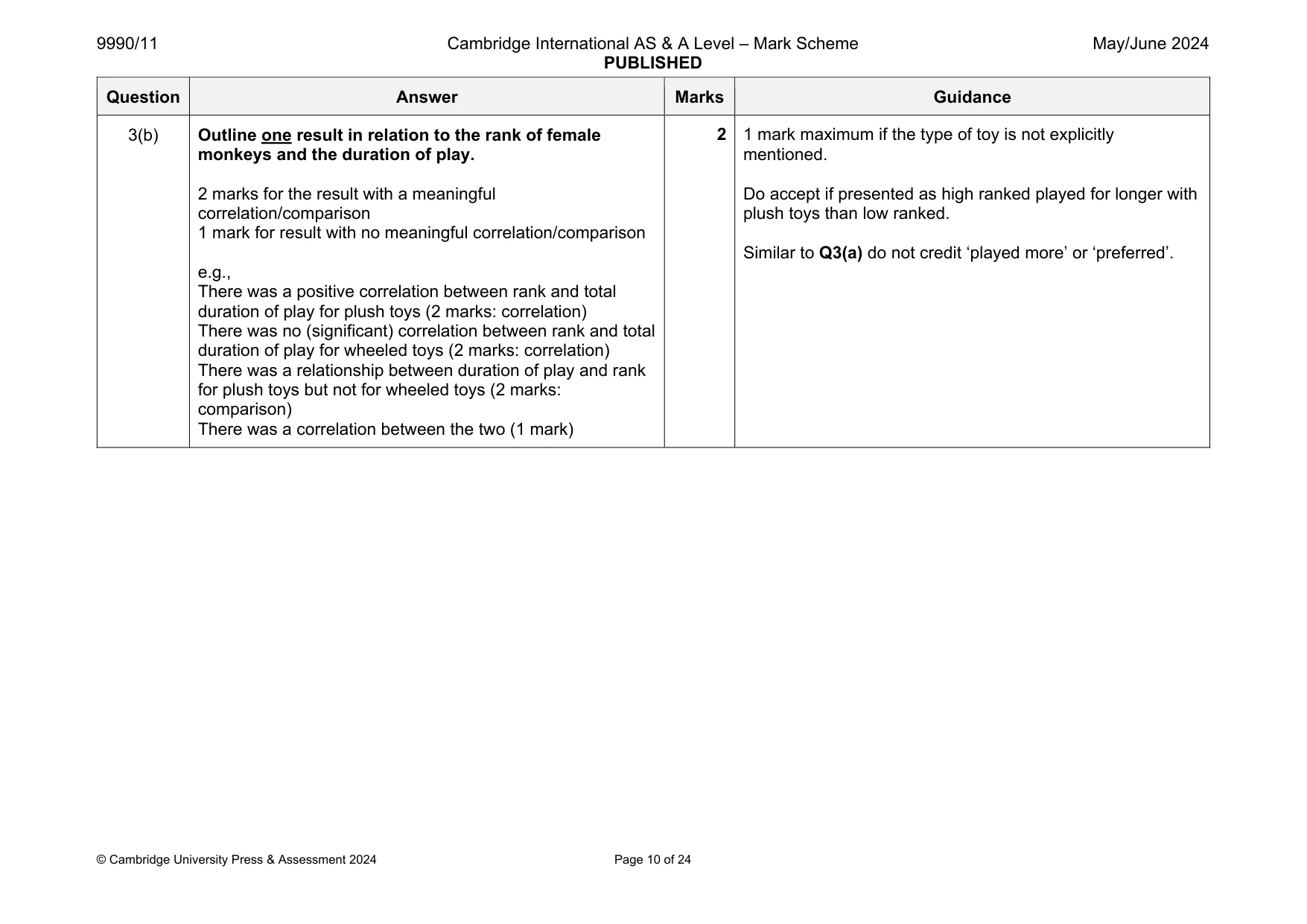
9990/11 Cambridge International AS & A Level – Mark Scheme PUBLISHED May/June 2024 © Cambridge University Press & Assessment 2024 Page 10 of 24 Question Answer Marks Guidance 3(b) Outline one result in relation to the rank of female monkeys and the duration of play. 2 marks for the result with a meaningful correlation/comparison 1 mark for result with no meaningful correlation/comparison e.g., There was a positive correlation between rank and total duration of play for plush toys (2 marks: correlation) There was no (significant) correlation between rank and total duration of play for wheeled toys (2 marks: correlation) There was a relationship between duration of play and rank for plush toys but not for wheeled toys (2 marks: comparison) There was a correlation between the two (1 mark) 2 1 mark maximum if the type of toy is not explicitly mentioned. Do accept if presented as high ranked played for longer with plush toys than low ranked. Similar to Q3(a) do not credit ‘played more’ or ‘preferred’.
Mark scheme, page 11
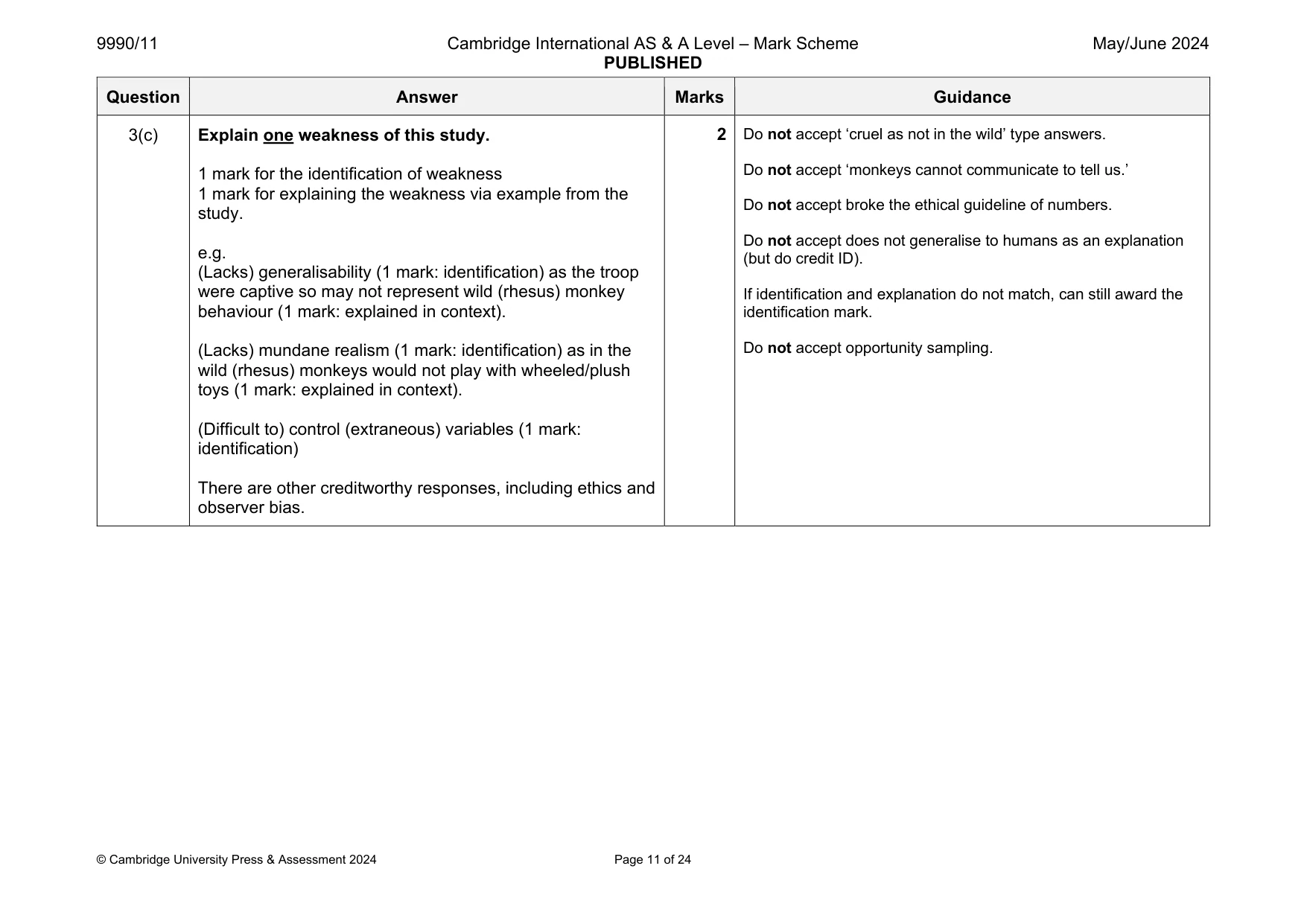
9990/11 Cambridge International AS & A Level – Mark Scheme PUBLISHED May/June 2024 © Cambridge University Press & Assessment 2024 Page 11 of 24 Question Answer Marks Guidance 3(c) Explain one weakness of this study. 1 mark for the identification of weakness 1 mark for explaining the weakness via example from the study. e.g. (Lacks) generalisability (1 mark: identification) as the troop were captive so may not represent wild (rhesus) monkey behaviour (1 mark: explained in context). (Lacks) mundane realism (1 mark: identification) as in the wild (rhesus) monkeys would not play with wheeled/plush toys (1 mark: explained in context). (Difficult to) control (extraneous) variables (1 mark: identification) There are other creditworthy responses, including ethics and observer bias. 2 Do not accept ‘cruel as not in the wild’ type answers. Do not accept ‘monkeys cannot communicate to tell us.’ Do not accept broke the ethical guideline of numbers. Do not accept does not generalise to humans as an explanation (but do credit ID). If identification and explanation do not match, can still award the identification mark. Do not accept opportunity sampling.
Mark scheme, page 12
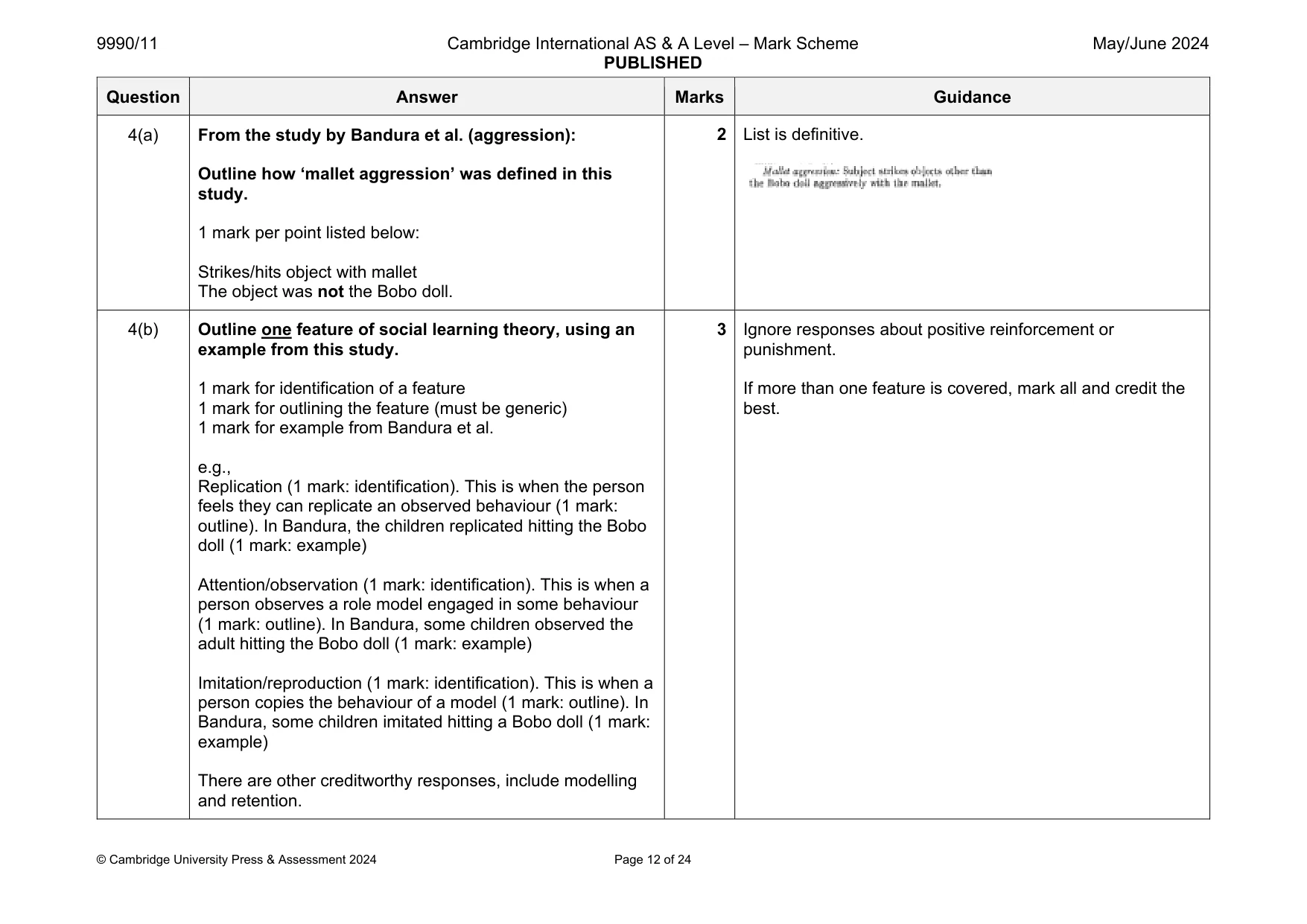
9990/11 Cambridge International AS & A Level – Mark Scheme PUBLISHED May/June 2024 © Cambridge University Press & Assessment 2024 Page 12 of 24 Question Answer Marks Guidance 4(a) From the study by Bandura et al. (aggression): Outline how ‘mallet aggression’ was defined in this study. 1 mark per point listed below: Strikes/hits object with mallet The object was not the Bobo doll. 2 List is definitive. 4(b) Outline one feature of social learning theory, using an example from this study. 1 mark for identification of a feature 1 mark for outlining the feature (must be generic) 1 mark for example from Bandura et al. e.g., Replication (1 mark: identification). This is when the person feels they can replicate an observed behaviour (1 mark: outline). In Bandura, the children replicated hitting the Bobo doll (1 mark: example) Attention/observation (1 mark: identification). This is when a person observes a role model engaged in some behaviour (1 mark: outline). In Bandura, some children observed the adult hitting the Bobo doll (1 mark: example) Imitation/reproduction (1 mark: identification). This is when a person copies the behaviour of a model (1 mark: outline). In Bandura, some children imitated hitting a Bobo doll (1 mark: example) There are other creditworthy responses, include modelling and retention. 3 Ignore responses about positive reinforcement or punishment. If more than one feature is covered, mark all and credit the best.
Mark scheme, page 13
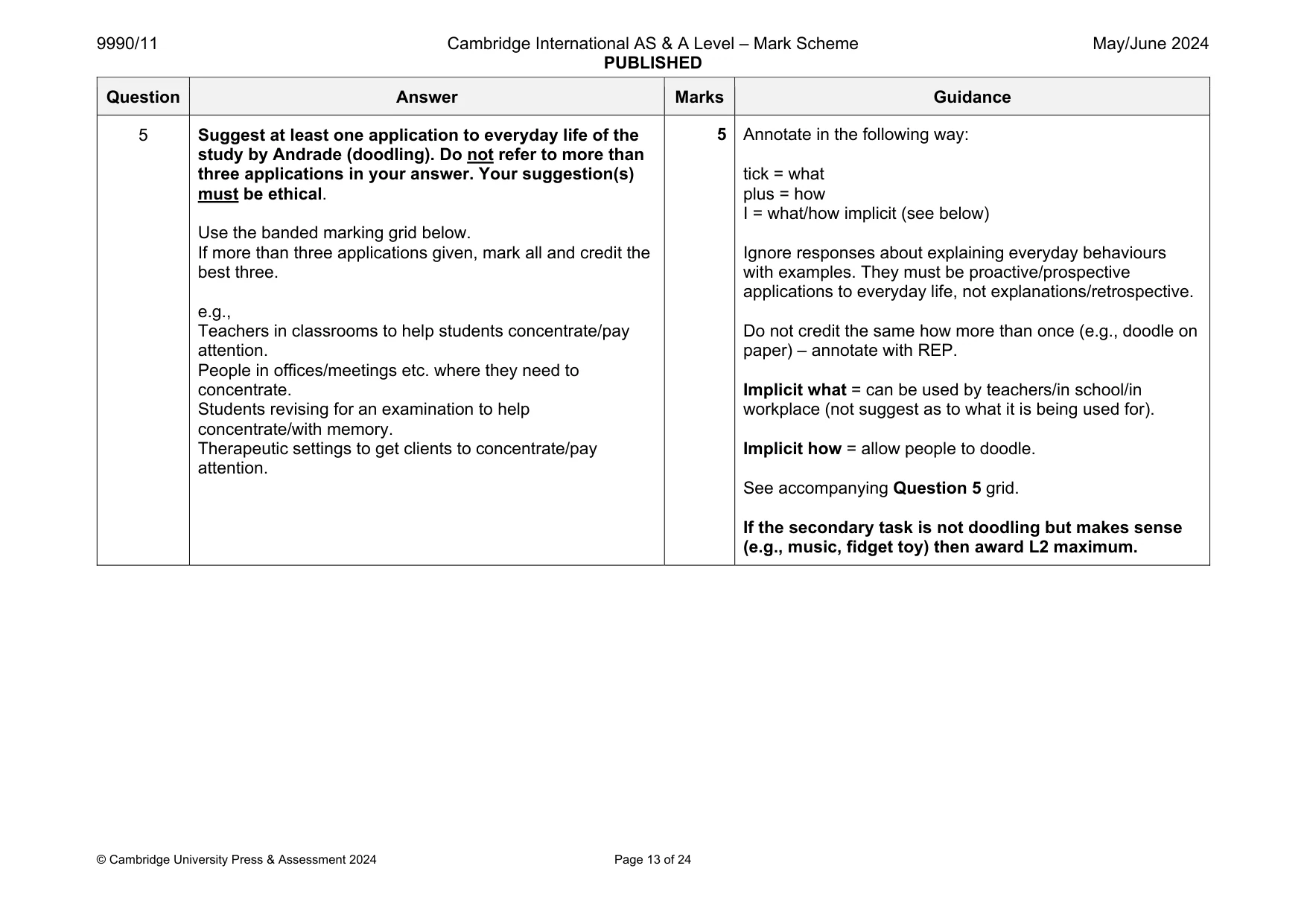
9990/11 Cambridge International AS & A Level – Mark Scheme PUBLISHED May/June 2024 © Cambridge University Press & Assessment 2024 Page 13 of 24 Question Answer Marks Guidance 5 Suggest at least one application to everyday life of the study by Andrade (doodling). Do not refer to more than three applications in your answer. Your suggestion(s) must be ethical. Use the banded marking grid below. If more than three applications given, mark all and credit the best three. e.g., Teachers in classrooms to help students concentrate/pay attention. People in offices/meetings etc. where they need to concentrate. Students revising for an examination to help concentrate/with memory. Therapeutic settings to get clients to concentrate/pay attention. 5 Annotate in the following way: tick = what plus = how I = what/how implicit (see below) Ignore responses about explaining everyday behaviours with examples. They must be proactive/prospective applications to everyday life, not explanations/retrospective. Do not credit the same how more than once (e.g., doodle on paper) – annotate with REP. Implicit what = can be used by teachers/in school/in workplace (not suggest as to what it is being used for). Implicit how = allow people to doodle. See accompanying Question 5 grid. If the secondary task is not doodling but makes sense (e.g., music, fidget toy) then award L2 maximum.
Mark scheme, page 14
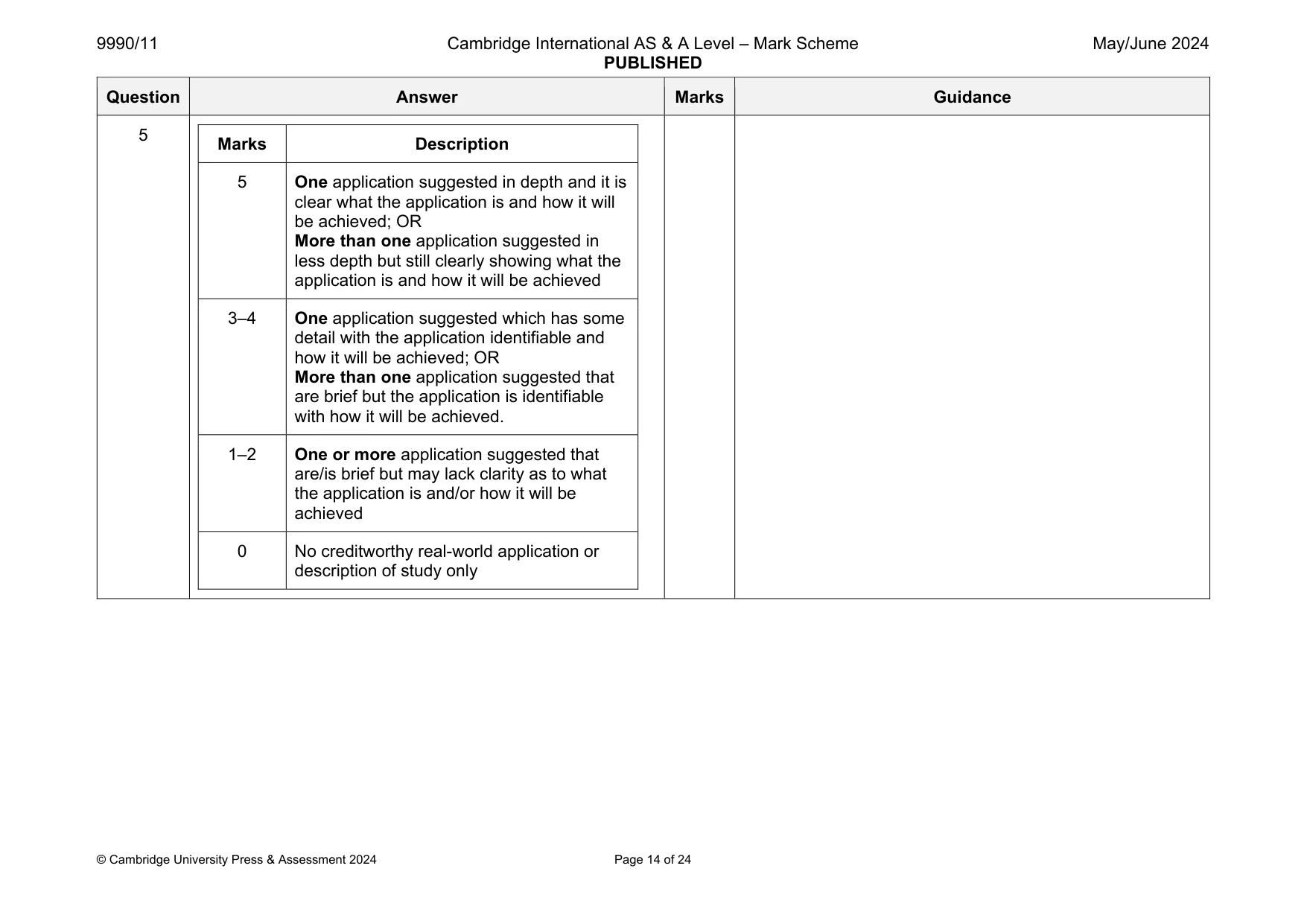
9990/11 Cambridge International AS & A Level – Mark Scheme PUBLISHED May/June 2024 © Cambridge University Press & Assessment 2024 Page 14 of 24 Question Answer Marks Guidance 5 Marks Description 5 One application suggested in depth and it is clear what the application is and how it will be achieved; OR More than one application suggested in less depth but still clearly showing what the application is and how it will be achieved 3–4 One application suggested which has some detail with the application identifiable and how it will be achieved; OR More than one application suggested that are brief but the application is identifiable with how it will be achieved. 1–2 One or more application suggested that are/is brief but may lack clarity as to what the application is and/or how it will be achieved 0 No creditworthy real-world application or description of study only
Mark scheme, page 15
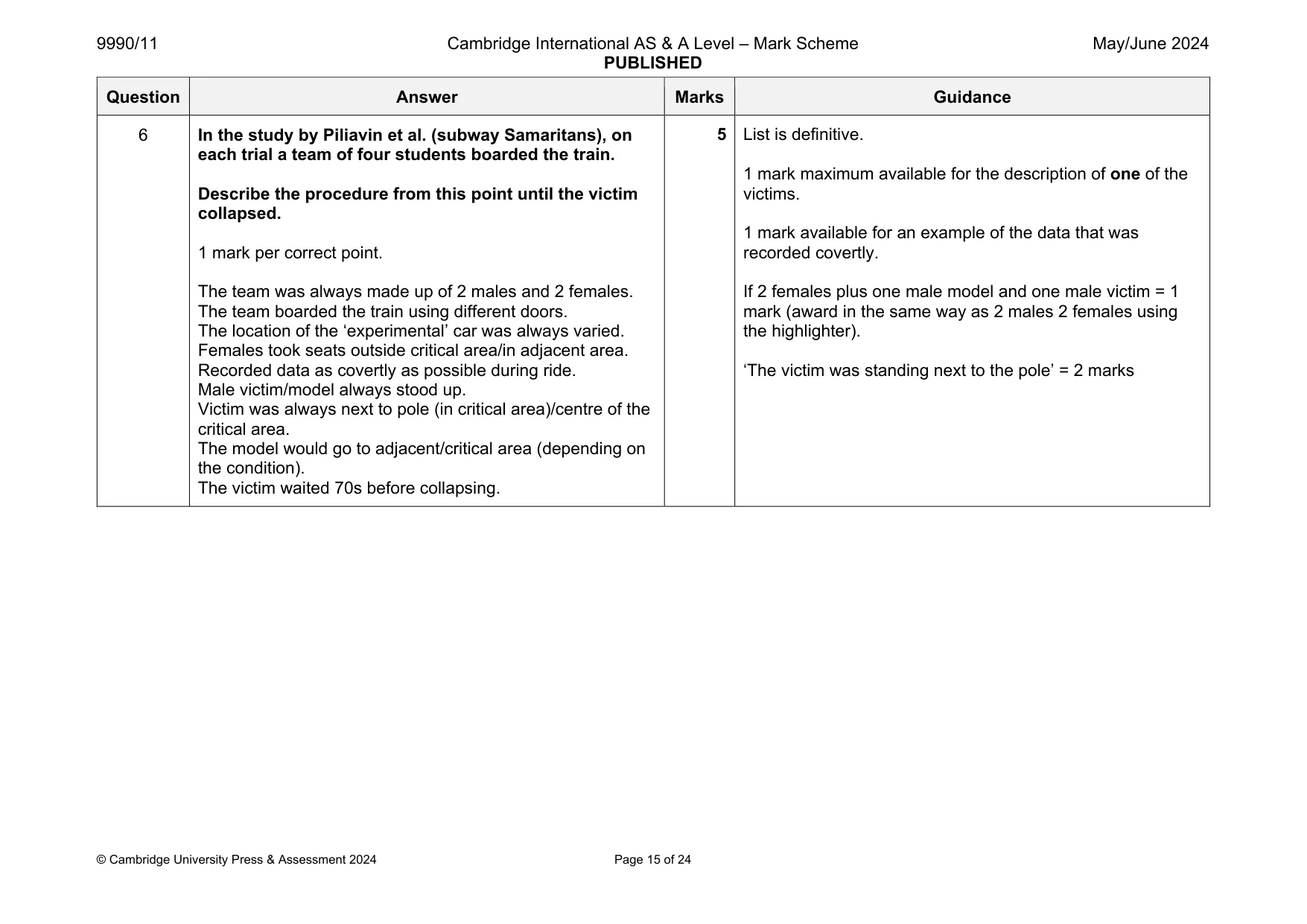
9990/11 Cambridge International AS & A Level – Mark Scheme PUBLISHED May/June 2024 © Cambridge University Press & Assessment 2024 Page 15 of 24 Question Answer Marks Guidance 6 In the study by Piliavin et al. (subway Samaritans), on each trial a team of four students boarded the train. Describe the procedure from this point until the victim collapsed. 1 mark per correct point. The team was always made up of 2 males and 2 females. The team boarded the train using different doors. The location of the ‘experimental’ car was always varied. Females took seats outside critical area/in adjacent area. Recorded data as covertly as possible during ride. Male victim/model always stood up. Victim was always next to pole (in critical area)/centre of the critical area. The model would go to adjacent/critical area (depending on the condition). The victim waited 70s before collapsing. 5 List is definitive. 1 mark maximum available for the description of one of the victims. 1 mark available for an example of the data that was recorded covertly. If 2 females plus one male model and one male victim = 1 mark (award in the same way as 2 males 2 females using the highlighter). ‘The victim was standing next to the pole’ = 2 marks
Mark scheme, page 16
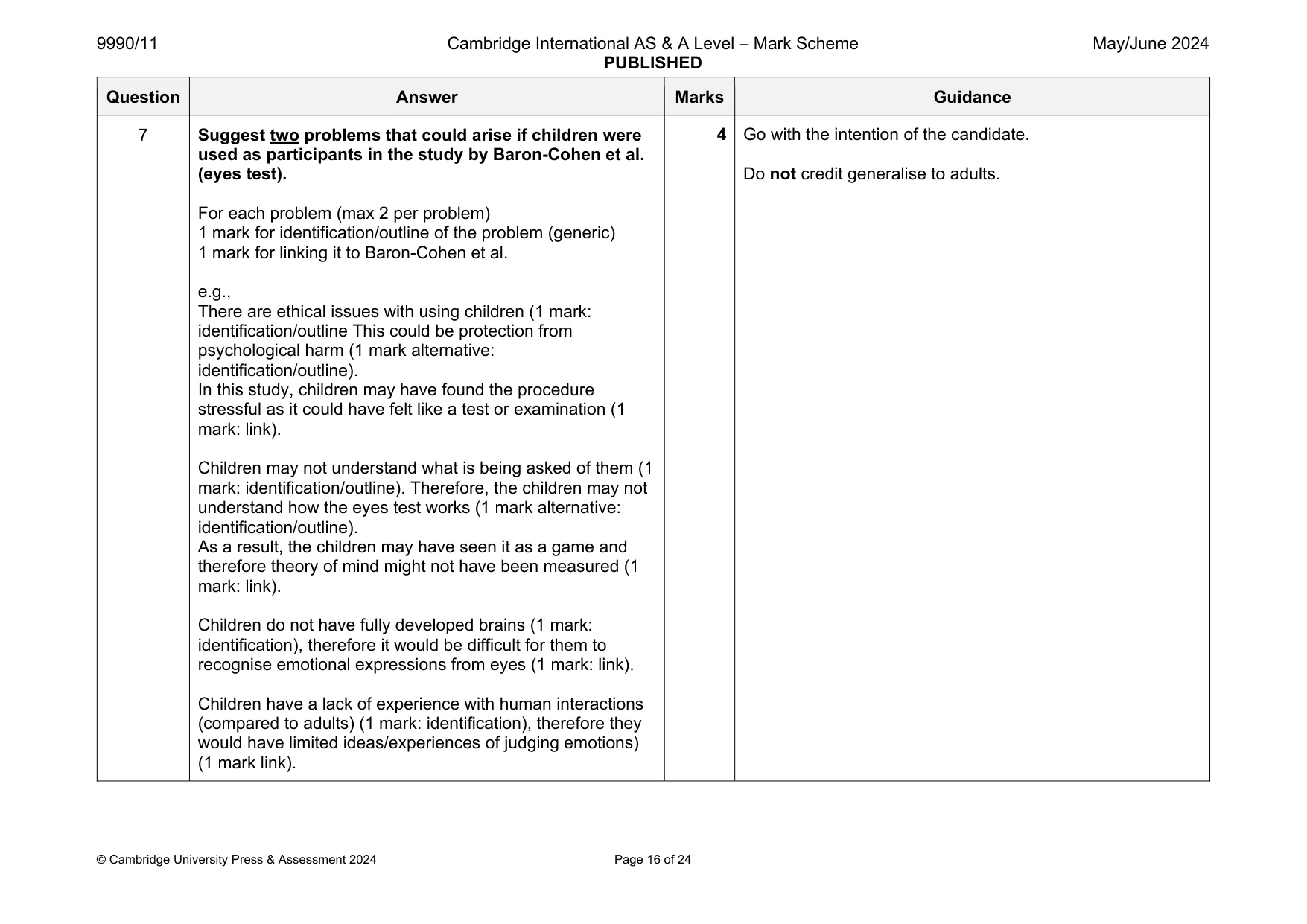
9990/11 Cambridge International AS & A Level – Mark Scheme PUBLISHED May/June 2024 © Cambridge University Press & Assessment 2024 Page 16 of 24 Question Answer Marks Guidance 7 Suggest two problems that could arise if children were used as participants in the study by Baron-Cohen et al. (eyes test). For each problem (max 2 per problem) 1 mark for identification/outline of the problem (generic) 1 mark for linking it to Baron-Cohen et al. e.g., There are ethical issues with using children (1 mark: identification/outline This could be protection from psychological harm (1 mark alternative: identification/outline). In this study, children may have found the procedure stressful as it could have felt like a test or examination (1 mark: link). Children may not understand what is being asked of them (1 mark: identification/outline). Therefore, the children may not understand how the eyes test works (1 mark alternative: identification/outline). As a result, the children may have seen it as a game and therefore theory of mind might not have been measured (1 mark: link). Children do not have fully developed brains (1 mark: identification), therefore it would be difficult for them to recognise emotional expressions from eyes (1 mark: link). Children have a lack of experience with human interactions (compared to adults) (1 mark: identification), therefore they would have limited ideas/experiences of judging emotions) (1 mark link). 4 Go with the intention of the candidate. Do not credit generalise to adults.
Mark scheme, page 17
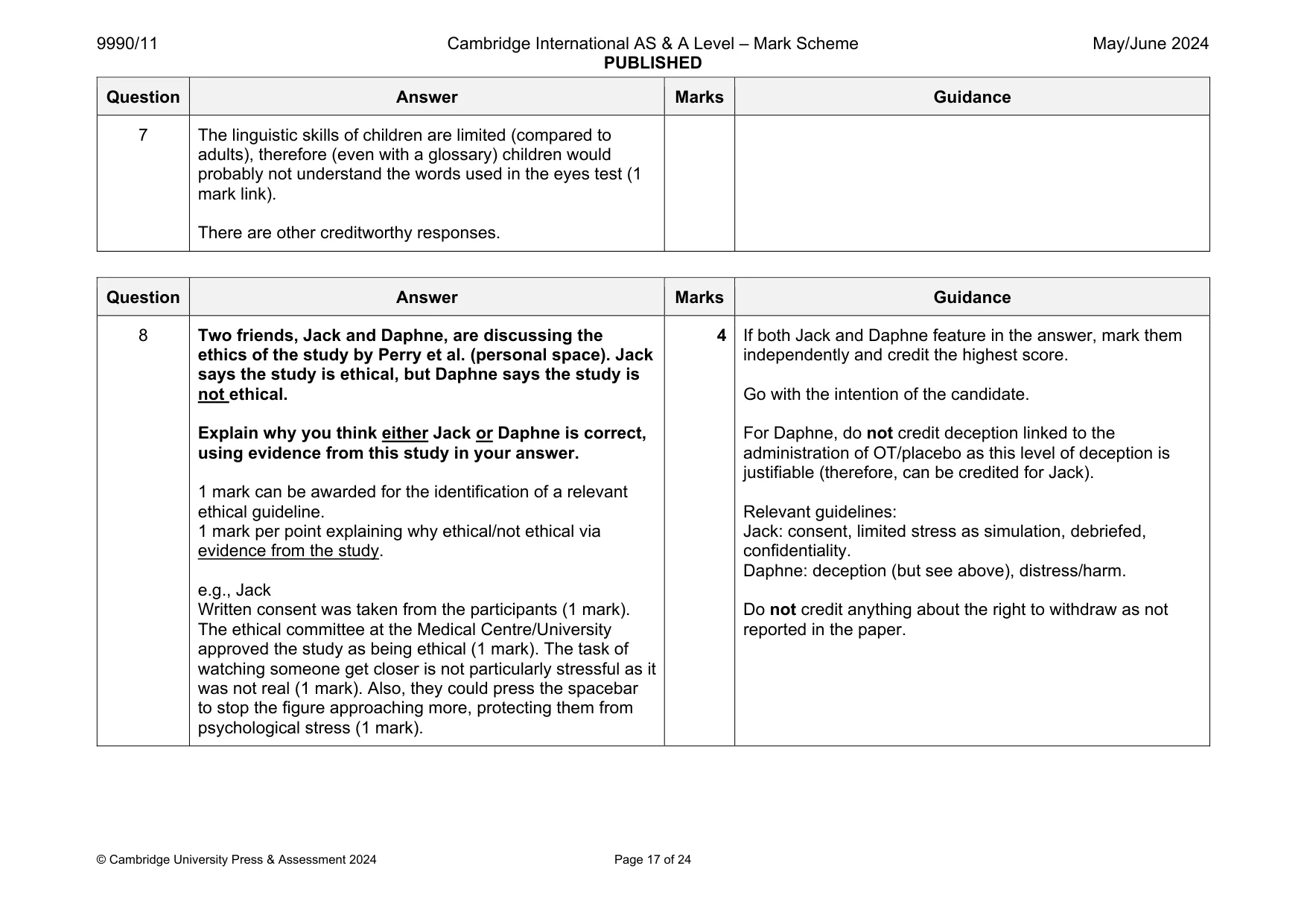
9990/11 Cambridge International AS & A Level – Mark Scheme PUBLISHED May/June 2024 © Cambridge University Press & Assessment 2024 Page 17 of 24 Question Answer Marks Guidance 7 The linguistic skills of children are limited (compared to adults), therefore (even with a glossary) children would probably not understand the words used in the eyes test (1 mark link). There are other creditworthy responses. Question Answer Marks Guidance 8 Two friends, Jack and Daphne, are discussing the ethics of the study by Perry et al. (personal space). Jack says the study is ethical, but Daphne says the study is not ethical. Explain why you think either Jack or Daphne is correct, using evidence from this study in your answer. 1 mark can be awarded for the identification of a relevant ethical guideline. 1 mark per point explaining why ethical/not ethical via evidence from the study. e.g., Jack Written consent was taken from the participants (1 mark). The ethical committee at the Medical Centre/University approved the study as being ethical (1 mark). The task of watching someone get closer is not particularly stressful as it was not real (1 mark). Also, they could press the spacebar to stop the figure approaching more, protecting them from psychological stress (1 mark). 4 If both Jack and Daphne feature in the answer, mark them independently and credit the highest score. Go with the intention of the candidate. For Daphne, do not credit deception linked to the administration of OT/placebo as this level of deception is justifiable (therefore, can be credited for Jack). Relevant guidelines: Jack: consent, limited stress as simulation, debriefed, confidentiality. Daphne: deception (but see above), distress/harm. Do not credit anything about the right to withdraw as not reported in the paper.
Mark scheme, page 18
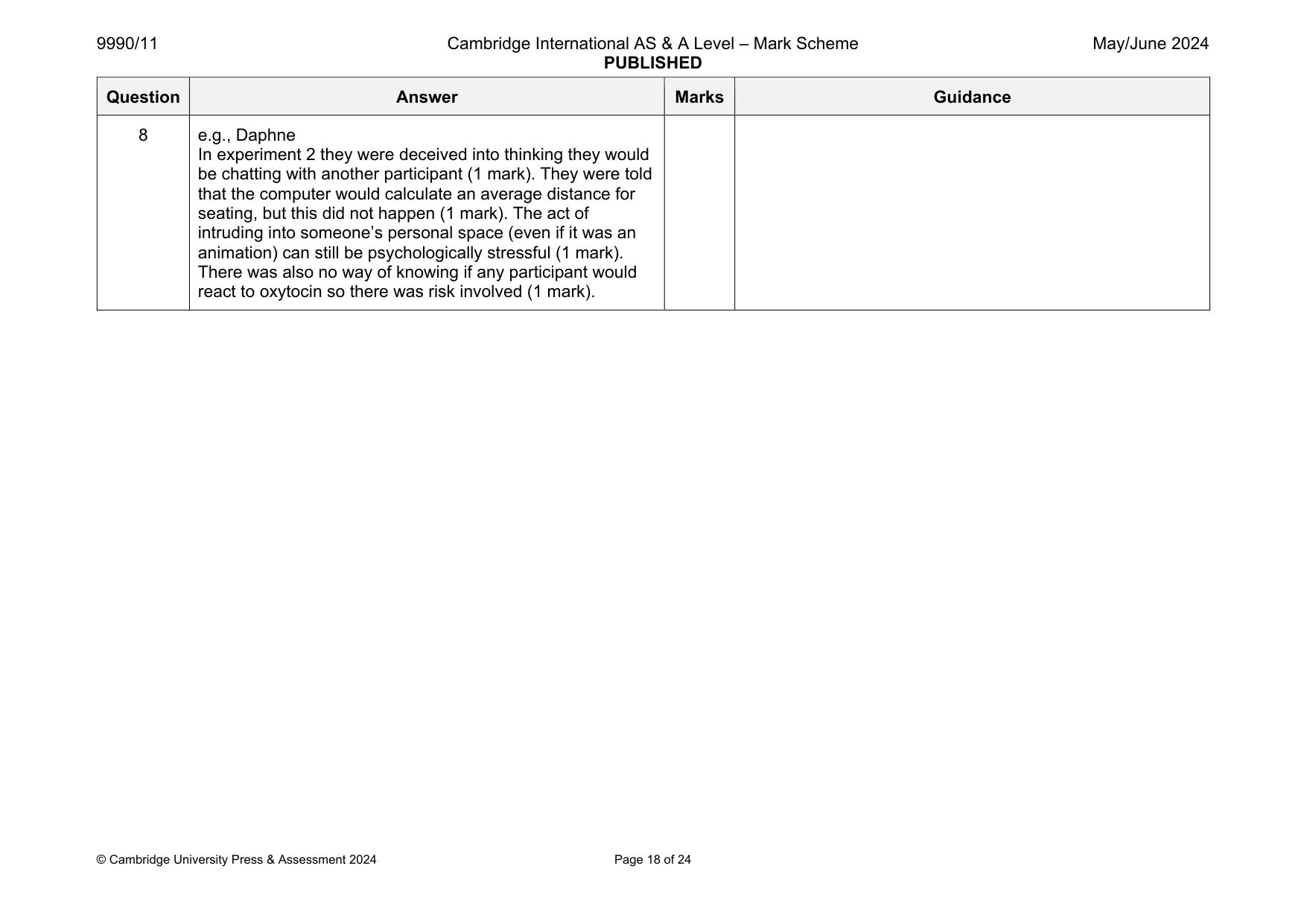
9990/11 Cambridge International AS & A Level – Mark Scheme PUBLISHED May/June 2024 © Cambridge University Press & Assessment 2024 Page 18 of 24 Question Answer Marks Guidance 8 e.g., Daphne In experiment 2 they were deceived into thinking they would be chatting with another participant (1 mark). They were told that the computer would calculate an average distance for seating, but this did not happen (1 mark). The act of intruding into someone’s personal space (even if it was an animation) can still be psychologically stressful (1 mark). There was also no way of knowing if any participant would react to oxytocin so there was risk involved (1 mark).
Mark scheme, page 19
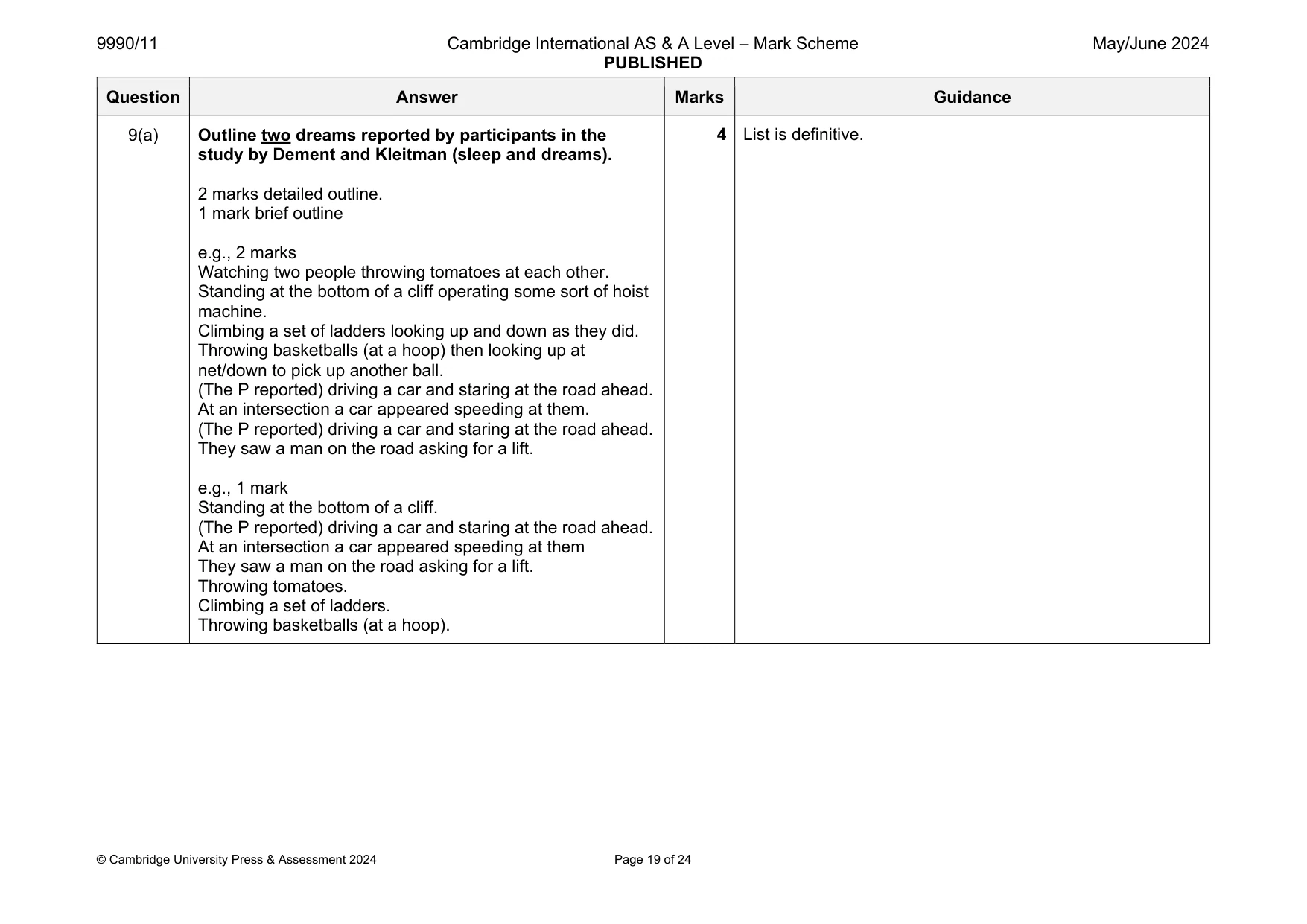
9990/11 Cambridge International AS & A Level – Mark Scheme PUBLISHED May/June 2024 © Cambridge University Press & Assessment 2024 Page 19 of 24 Question Answer Marks Guidance 9(a) Outline two dreams reported by participants in the study by Dement and Kleitman (sleep and dreams). 2 marks detailed outline. 1 mark brief outline e.g., 2 marks Watching two people throwing tomatoes at each other. Standing at the bottom of a cliff operating some sort of hoist machine. Climbing a set of ladders looking up and down as they did. Throwing basketballs (at a hoop) then looking up at net/down to pick up another ball. (The P reported) driving a car and staring at the road ahead. At an intersection a car appeared speeding at them. (The P reported) driving a car and staring at the road ahead. They saw a man on the road asking for a lift. e.g., 1 mark Standing at the bottom of a cliff. (The P reported) driving a car and staring at the road ahead. At an intersection a car appeared speeding at them They saw a man on the road asking for a lift. Throwing tomatoes. Climbing a set of ladders. Throwing basketballs (at a hoop). 4 List is definitive.
Mark scheme, page 20
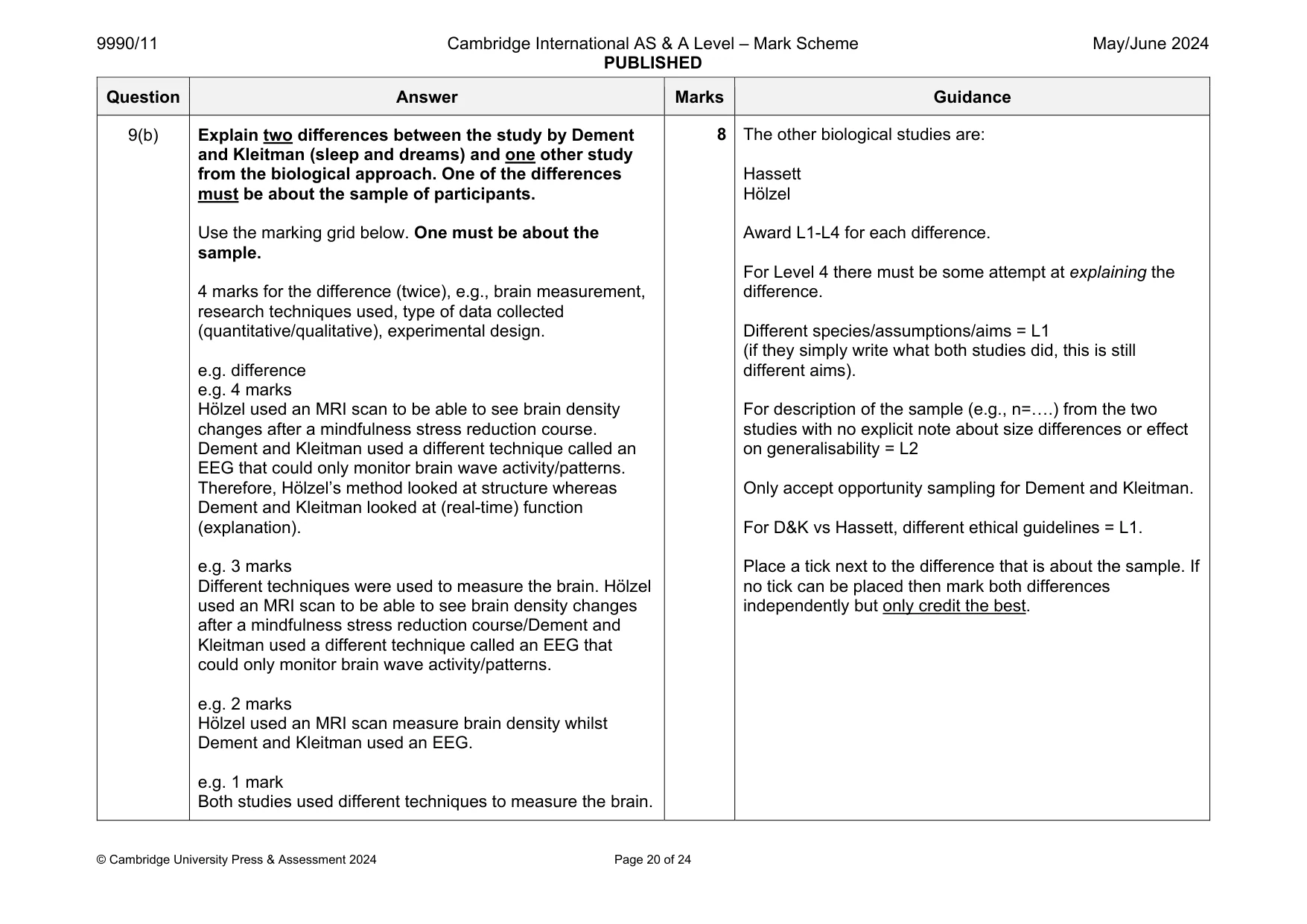
9990/11 Cambridge International AS & A Level – Mark Scheme PUBLISHED May/June 2024 © Cambridge University Press & Assessment 2024 Page 20 of 24 Question Answer Marks Guidance 9(b) Explain two differences between the study by Dement and Kleitman (sleep and dreams) and one other study from the biological approach. One of the differences must be about the sample of participants. Use the marking grid below. One must be about the sample. 4 marks for the difference (twice), e.g., brain measurement, research techniques used, type of data collected (quantitative/qualitative), experimental design. e.g. difference e.g. 4 marks Hölzel used an MRI scan to be able to see brain density changes after a mindfulness stress reduction course. Dement and Kleitman used a different technique called an EEG that could only monitor brain wave activity/patterns. Therefore, Hölzel’s method looked at structure whereas Dement and Kleitman looked at (real-time) function (explanation). e.g. 3 marks Different techniques were used to measure the brain. Hölzel used an MRI scan to be able to see brain density changes after a mindfulness stress reduction course/Dement and Kleitman used a different technique called an EEG that could only monitor brain wave activity/patterns. e.g. 2 marks Hölzel used an MRI scan measure brain density whilst Dement and Kleitman used an EEG. e.g. 1 mark Both studies used different techniques to measure the brain. 8 The other biological studies are: Hassett Hölzel Award L1-L4 for each difference. For Level 4 there must be some attempt at explaining the difference. Different species/assumptions/aims = L1 (if they simply write what both studies did, this is still different aims). For description of the sample (e.g., n=….) from the two studies with no explicit note about size differences or effect on generalisability = L2 Only accept opportunity sampling for Dement and Kleitman. For D&K vs Hassett, different ethical guidelines = L1. Place a tick next to the difference that is about the sample. If no tick can be placed then mark both differences independently but only credit the best.
Mark scheme, page 21
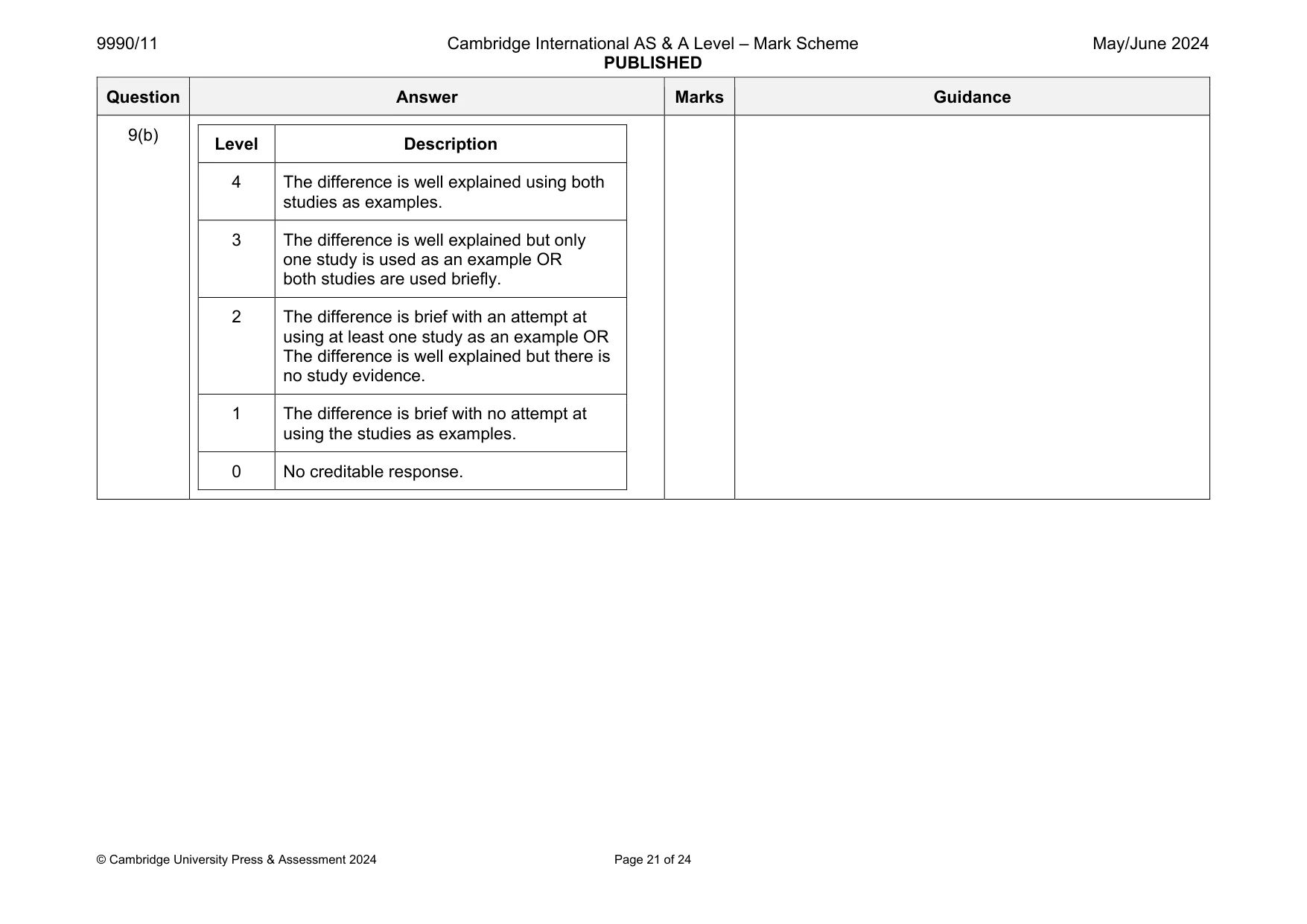
9990/11 Cambridge International AS & A Level – Mark Scheme PUBLISHED May/June 2024 © Cambridge University Press & Assessment 2024 Page 21 of 24 Question Answer Marks Guidance 9(b) Level Description 4 The difference is well explained using both studies as examples. 3 The difference is well explained but only one study is used as an example OR both studies are used briefly. 2 The difference is brief with an attempt at using at least one study as an example OR The difference is well explained but there is no study evidence. 1 The difference is brief with no attempt at using the studies as examples. 0 No creditable response.
Mark scheme, page 22
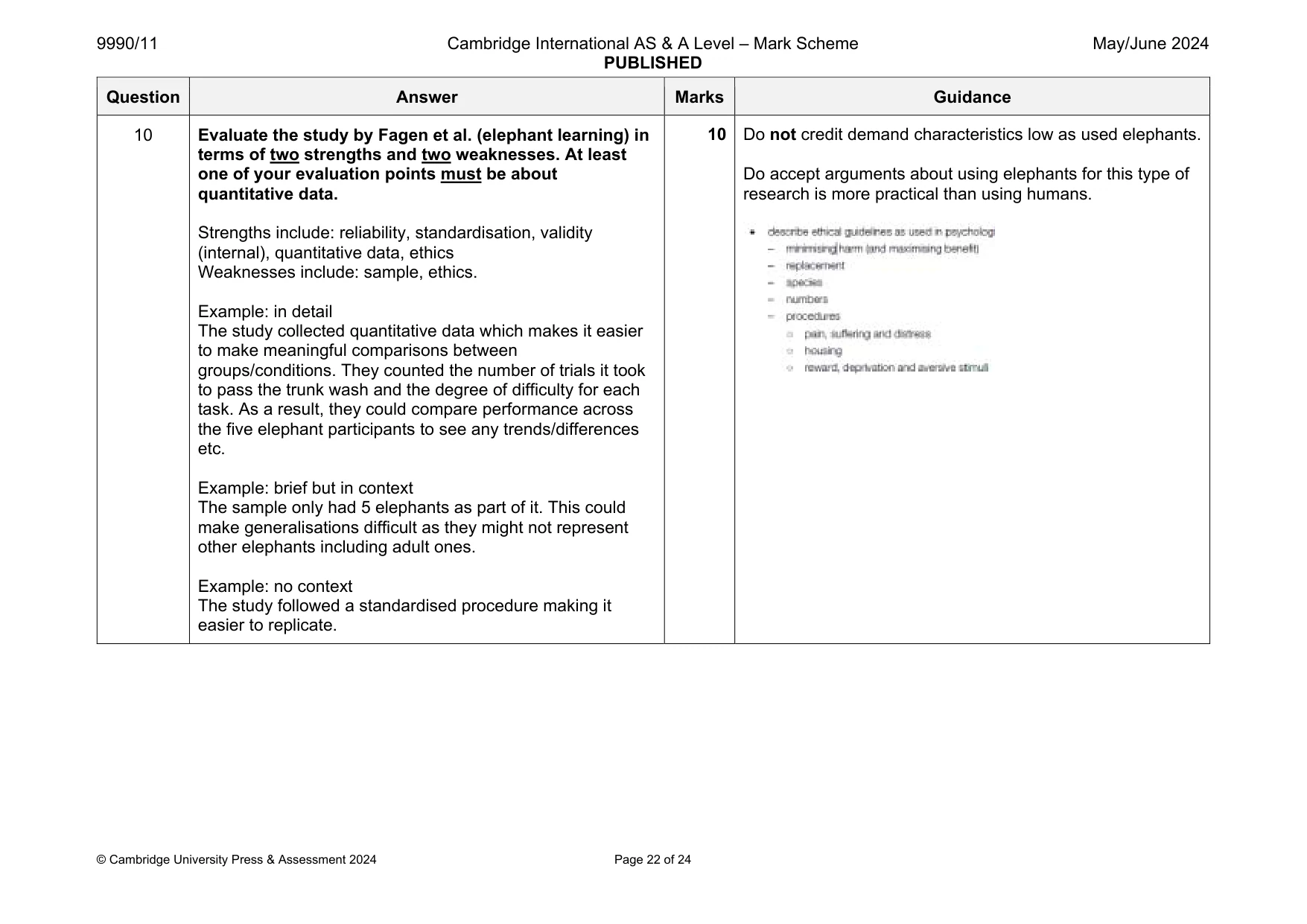
9990/11 Cambridge International AS & A Level – Mark Scheme PUBLISHED May/June 2024 © Cambridge University Press & Assessment 2024 Page 22 of 24 Question Answer Marks Guidance 10 Evaluate the study by Fagen et al. (elephant learning) in terms of two strengths and two weaknesses. At least one of your evaluation points must be about quantitative data. Strengths include: reliability, standardisation, validity (internal), quantitative data, ethics Weaknesses include: sample, ethics. Example: in detail The study collected quantitative data which makes it easier to make meaningful comparisons between groups/conditions. They counted the number of trials it took to pass the trunk wash and the degree of difficulty for each task. As a result, they could compare performance across the five elephant participants to see any trends/differences etc. Example: brief but in context The sample only had 5 elephants as part of it. This could make generalisations difficult as they might not represent other elephants including adult ones. Example: no context The study followed a standardised procedure making it easier to replicate. 10 Do not credit demand characteristics low as used elephants. Do accept arguments about using elephants for this type of research is more practical than using humans.
Mark scheme, page 23
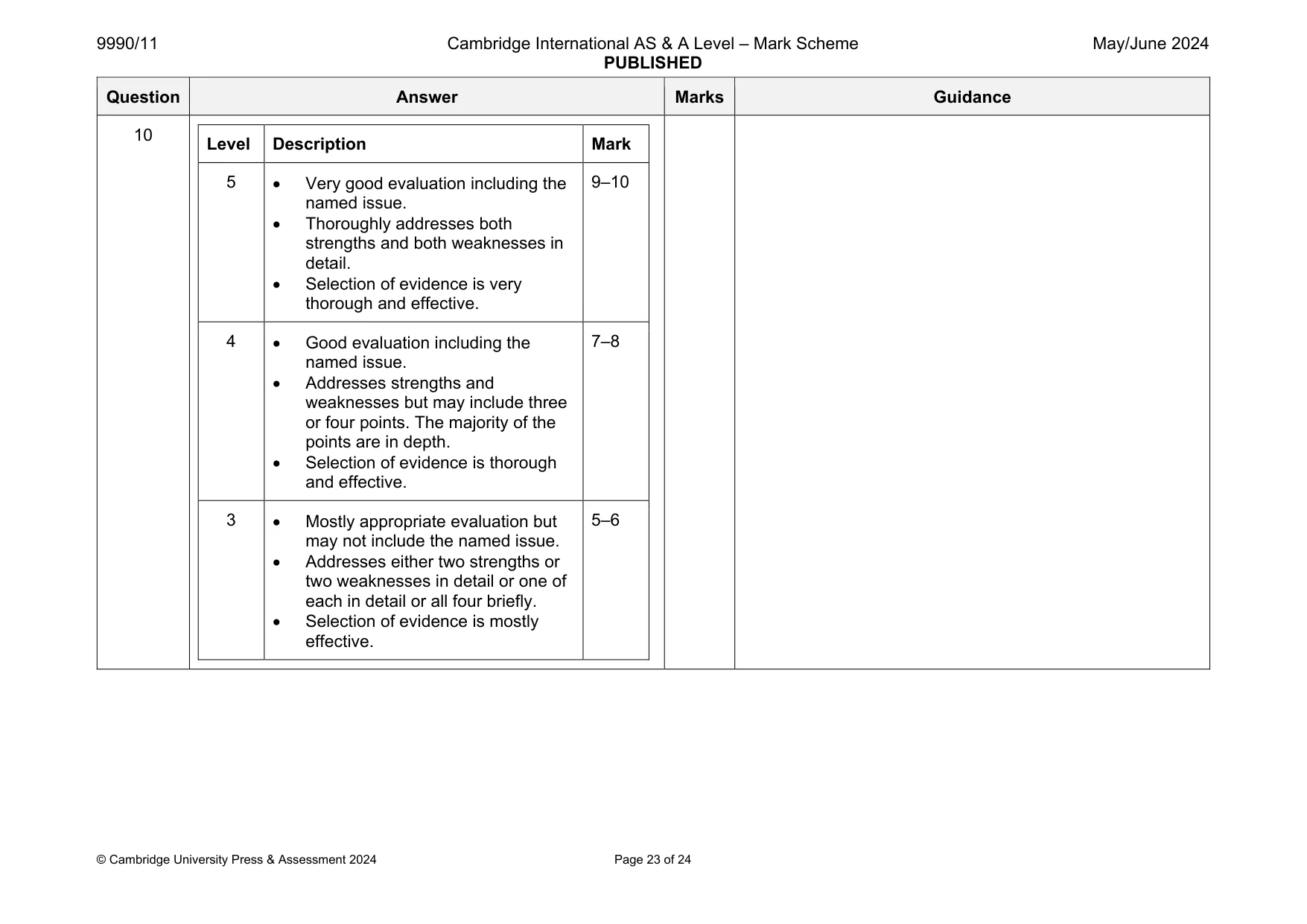
9990/11 Cambridge International AS & A Level – Mark Scheme PUBLISHED May/June 2024 © Cambridge University Press & Assessment 2024 Page 23 of 24 Question Answer Marks Guidance 10 Level Description Mark 5 Very good evaluation including the named issue. Thoroughly addresses both strengths and both weaknesses in detail. Selection of evidence is very thorough and effective. 9–10 4 Good evaluation including the named issue. Addresses strengths and weaknesses but may include three or four points. The majority of the points are in depth. Selection of evidence is thorough and effective. 7–8 3 Mostly appropriate evaluation but may not include the named issue. Addresses either two strengths or two weaknesses in detail or one of each in detail or all four briefly. Selection of evidence is mostly effective. 5–6
Mark scheme, page 24
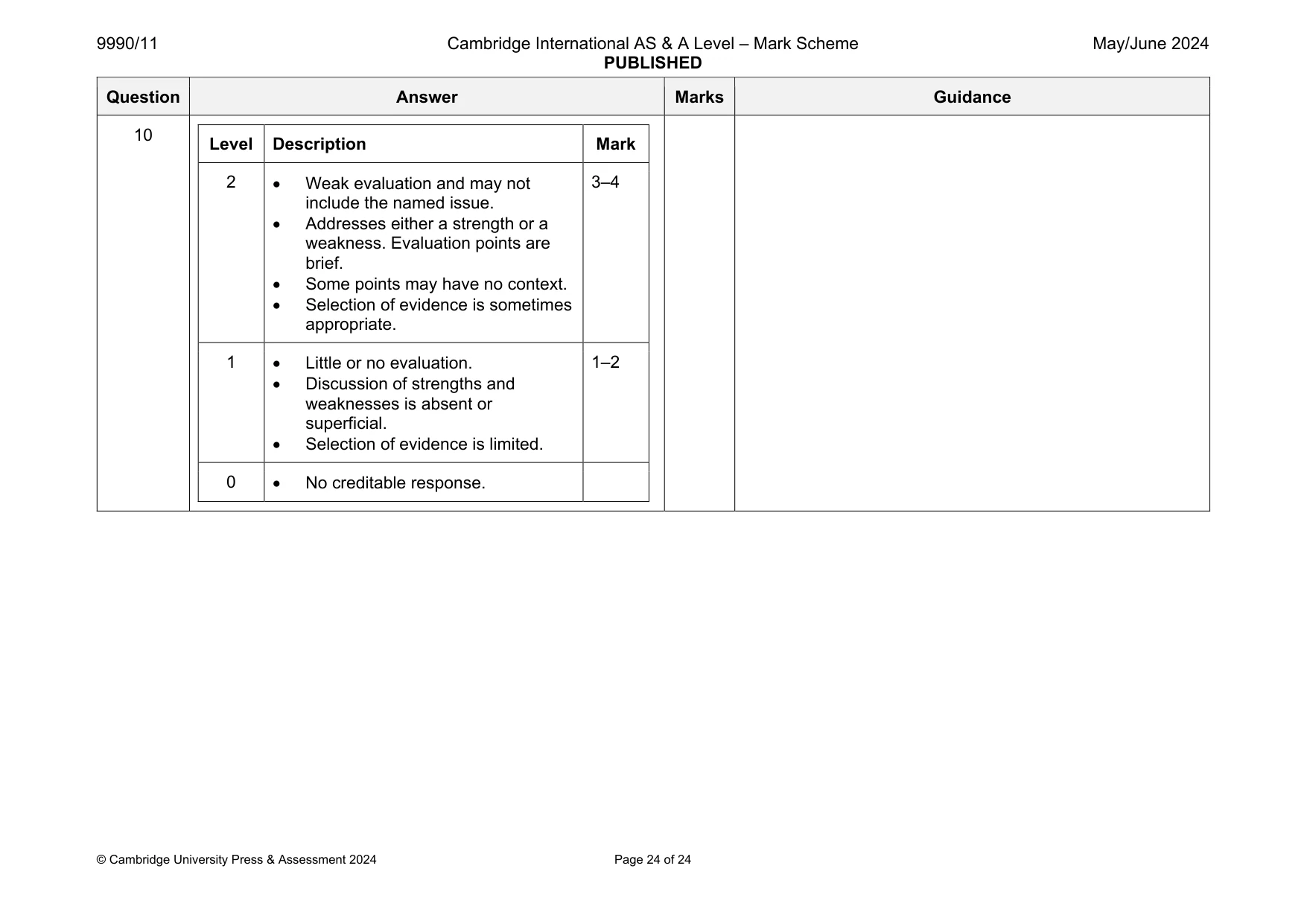
9990/11 Cambridge International AS & A Level – Mark Scheme PUBLISHED May/June 2024 © Cambridge University Press & Assessment 2024 Page 24 of 24 Question Answer Marks Guidance 10 Level Description Mark 2 Weak evaluation and may not include the named issue. Addresses either a strength or a weakness. Evaluation points are brief. Some points may have no context. Selection of evidence is sometimes appropriate. 3–4 1 Little or no evaluation. Discussion of strengths and weaknesses is absent or superficial. Selection of evidence is limited. 1–2 0 No creditable response.
What you needed in this session
Cambridge’s own grade thresholds for 2024 May/June, Paper 1 · Variant 1. A higher threshold means an easier paper — the bar moves with how the cohort did.