Cambridge A Level Psychology 9698 — 2015 Oct/Nov Paper 3 · Variant 3
9698/33/O/N/15 · 80 marks · ≈90 min
The question paper and its mark scheme, free to read here and free to download. This is Cambridge’s own paper, exactly as it was sat.
Question paper8 pages


Mark scheme24 pages
Answers below. Sit the paper first if you are practising.
Paper as text
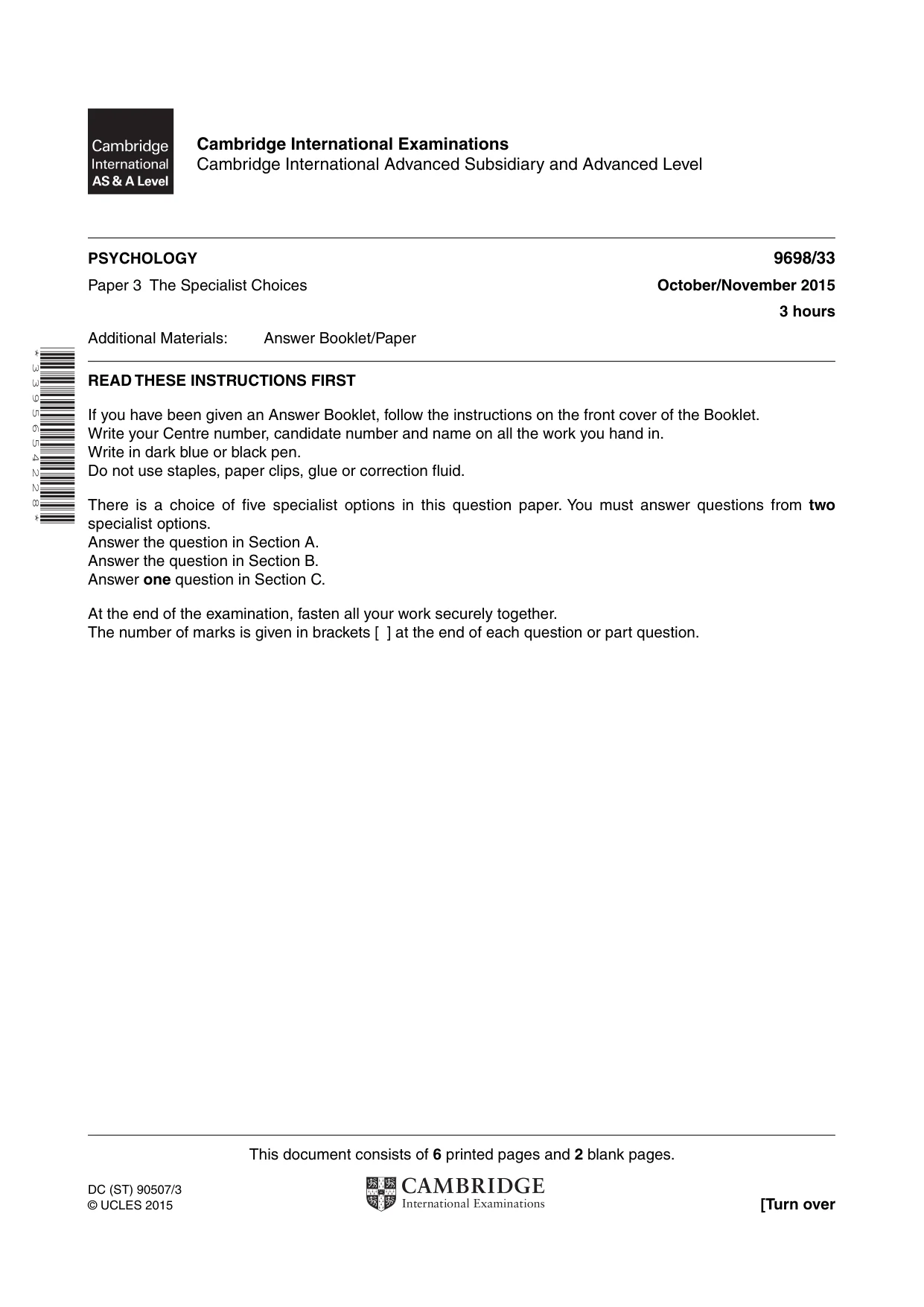
Question paper, page 1
This document consists of 6 printed pages and 2 blank pages. DC (ST) 90507/3 © UCLES 2015 [Turn over Cambridge International Examinations Cambridge International Advanced Subsidiary and Advanced Level * 3 3 9 5 6 5 4 2 2 8 * PSYCHOLOGY 9698/33 Paper 3 The Specialist Choices October/November 2015 3 hours Additional Materials: Answer Booklet/Paper READ THESE INSTRUCTIONS FIRST If you have been given an Answer Booklet, follow the instructions on the front cover of the Booklet. Write your Centre number, candidate number and name on all the work you hand in. Write in dark blue or black pen. Do not use staples, paper clips, glue or correction fluid. There is a choice of five specialist options in this question paper. You must answer questions from two specialist options. Answer the question in Section A. Answer the question in Section B. Answer one question in Section C. At the end of the examination, fasten all your work securely together. The number of marks is given in brackets [ ] at the end of each question or part question.
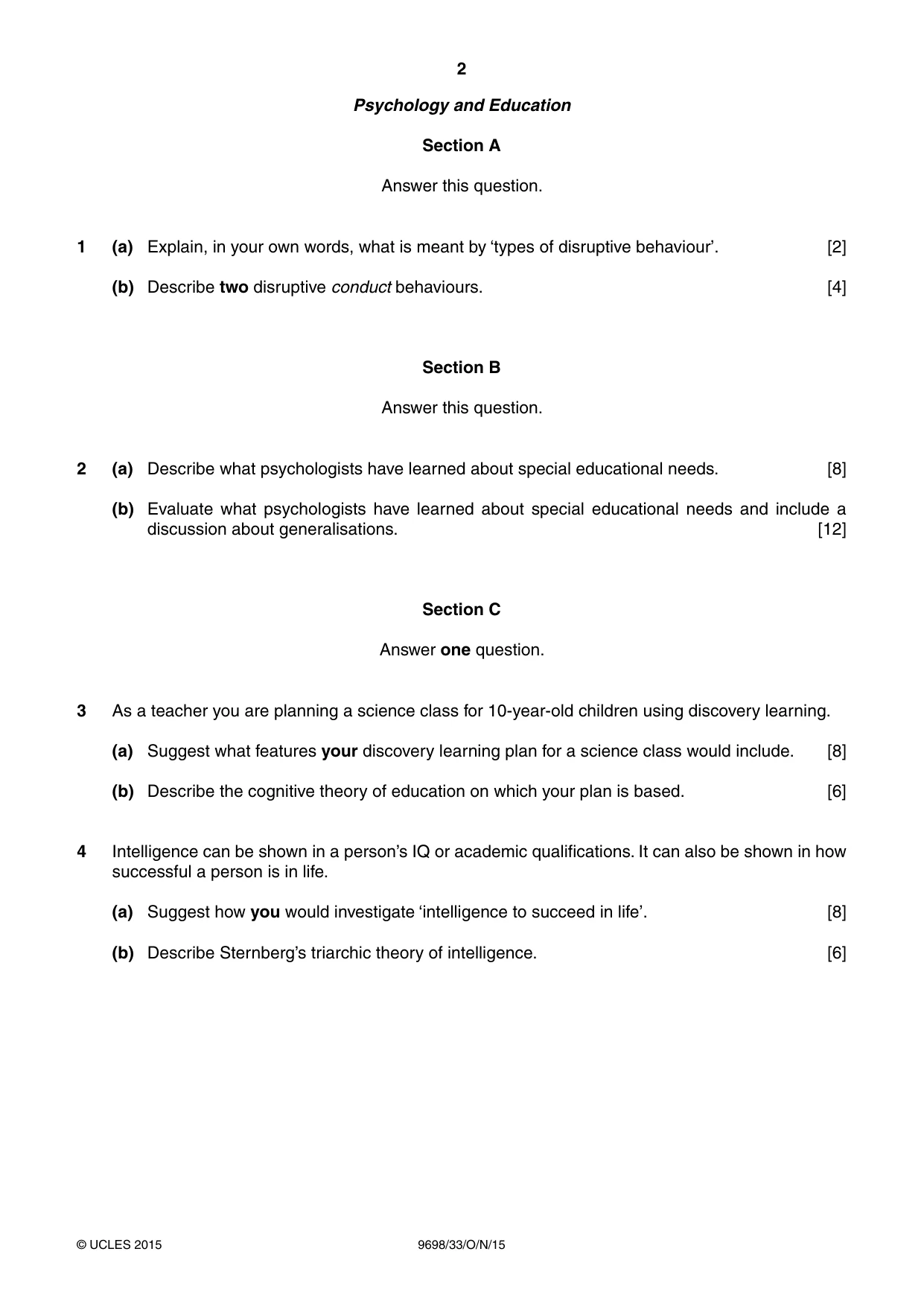
Question paper, page 2
2 9698/33/O/N/15 © UCLES 2015 Psychology and Education Section A Answer this question. 1 (a) Explain, in your own words, what is meant by ‘types of disruptive behaviour’. [2] (b) Describe two disruptive conduct behaviours. [4] Section B Answer this question. 2 (a) Describe what psychologists have learned about special educational needs. [8] (b) Evaluate what psychologists have learned about special educational needs and include a discussion about generalisations. [12] Section C Answer one question. 3 As a teacher you are planning a science class for 10-year-old children using discovery learning. (a) Suggest what features your discovery learning plan for a science class would include. [8] (b) Describe the cognitive theory of education on which your plan is based. [6] 4 Intelligence can be shown in a person’s IQ or academic qualifications. It can also be shown in how successful a person is in life. (a) Suggest how you would investigate ‘intelligence to succeed in life’. [8] (b) Describe Sternberg’s triarchic theory of intelligence. [6]
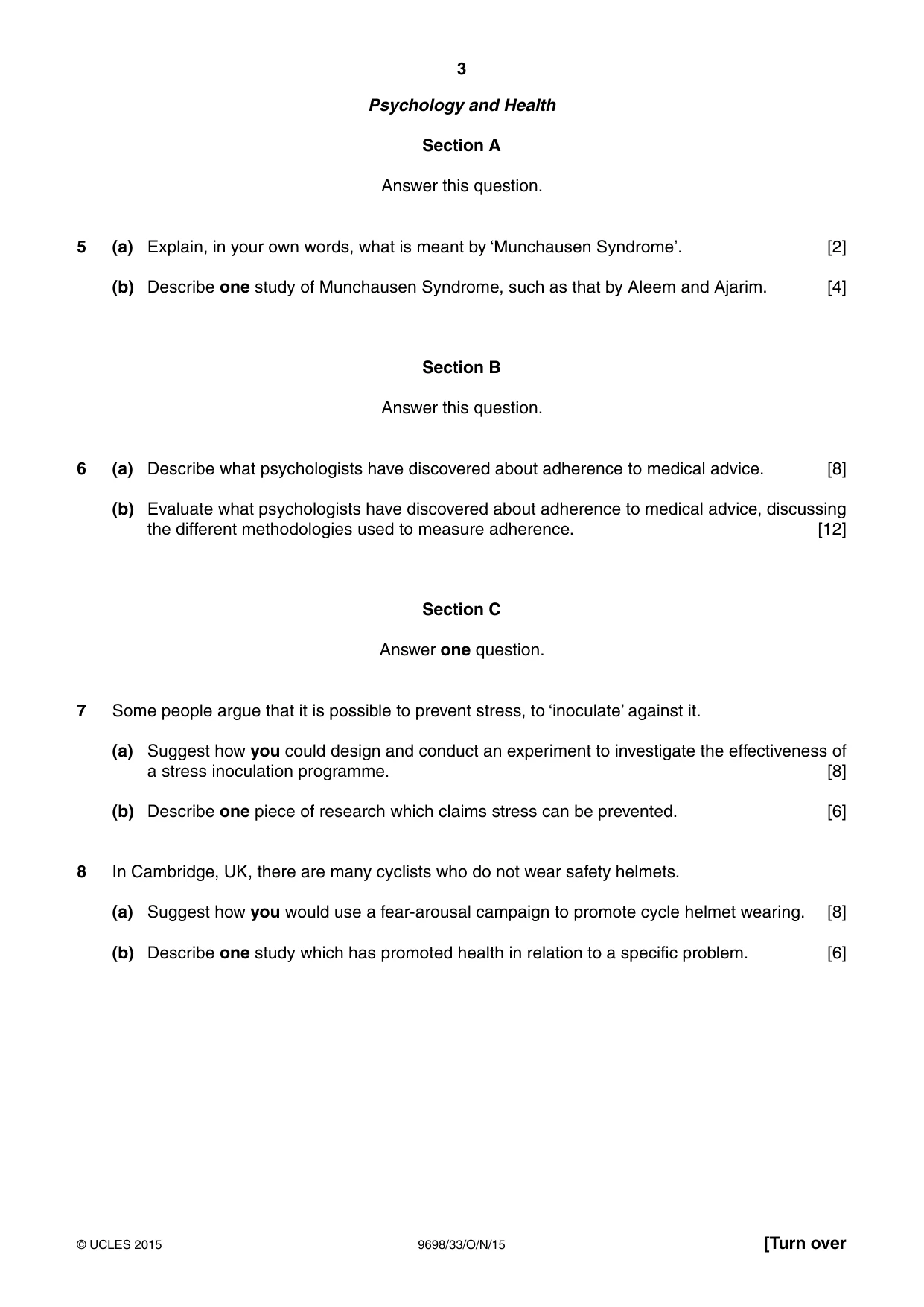
Question paper, page 3
3 9698/33/O/N/15 © UCLES 2015 [Turn over Psychology and Health Section A Answer this question. 5 (a) Explain, in your own words, what is meant by ‘Munchausen Syndrome’. [2] (b) Describe one study of Munchausen Syndrome, such as that by Aleem and Ajarim. [4] Section B Answer this question. 6 (a) Describe what psychologists have discovered about adherence to medical advice. [8] (b) Evaluate what psychologists have discovered about adherence to medical advice, discussing the different methodologies used to measure adherence. [12] Section C Answer one question. 7 Some people argue that it is possible to prevent stress, to ‘inoculate’ against it. (a) Suggest how you could design and conduct an experiment to investigate the effectiveness of a stress inoculation programme. [8] (b) Describe one piece of research which claims stress can be prevented. [6] 8 In Cambridge, UK, there are many cyclists who do not wear safety helmets. (a) Suggest how you would use a fear-arousal campaign to promote cycle helmet wearing. [8] (b) Describe one study which has promoted health in relation to a specific problem. [6]
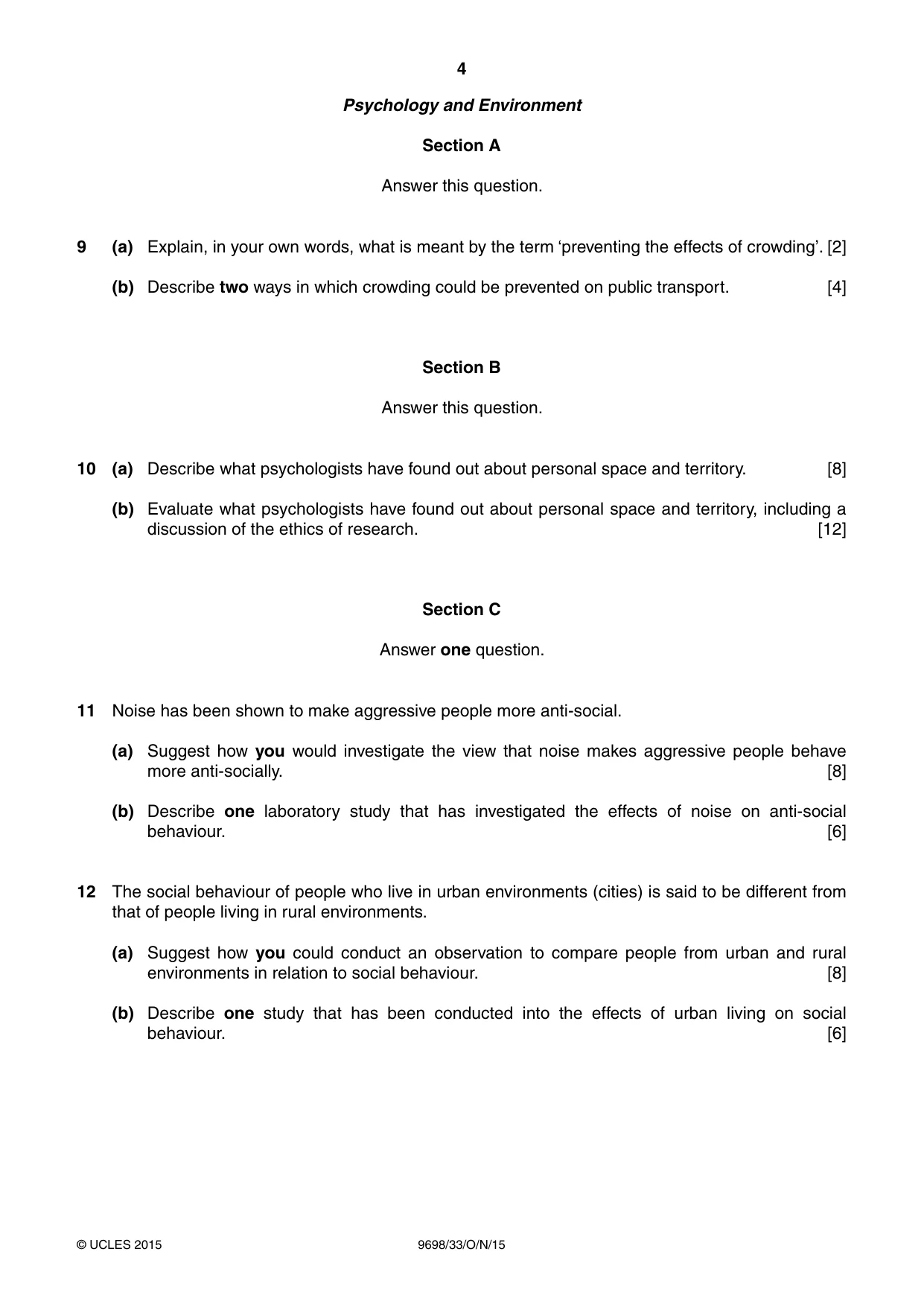
Question paper, page 4
4 9698/33/O/N/15 © UCLES 2015 Psychology and Environment Section A Answer this question. 9 (a) Explain, in your own words, what is meant by the term ‘preventing the effects of crowding’. [2] (b) Describe two ways in which crowding could be prevented on public transport. [4] Section B Answer this question. 10 (a) Describe what psychologists have found out about personal space and territory. [8] (b) Evaluate what psychologists have found out about personal space and territory, including a discussion of the ethics of research. [12] Section C Answer one question. 11 Noise has been shown to make aggressive people more anti-social. (a) Suggest how you would investigate the view that noise makes aggressive people behave more anti-socially. [8] (b) Describe one laboratory study that has investigated the effects of noise on anti-social behaviour. [6] 12 The social behaviour of people who live in urban environments (cities) is said to be different from that of people living in rural environments. (a) Suggest how you could conduct an observation to compare people from urban and rural environments in relation to social behaviour. [8] (b) Describe one study that has been conducted into the effects of urban living on social behaviour. [6]
Question paper, page 5
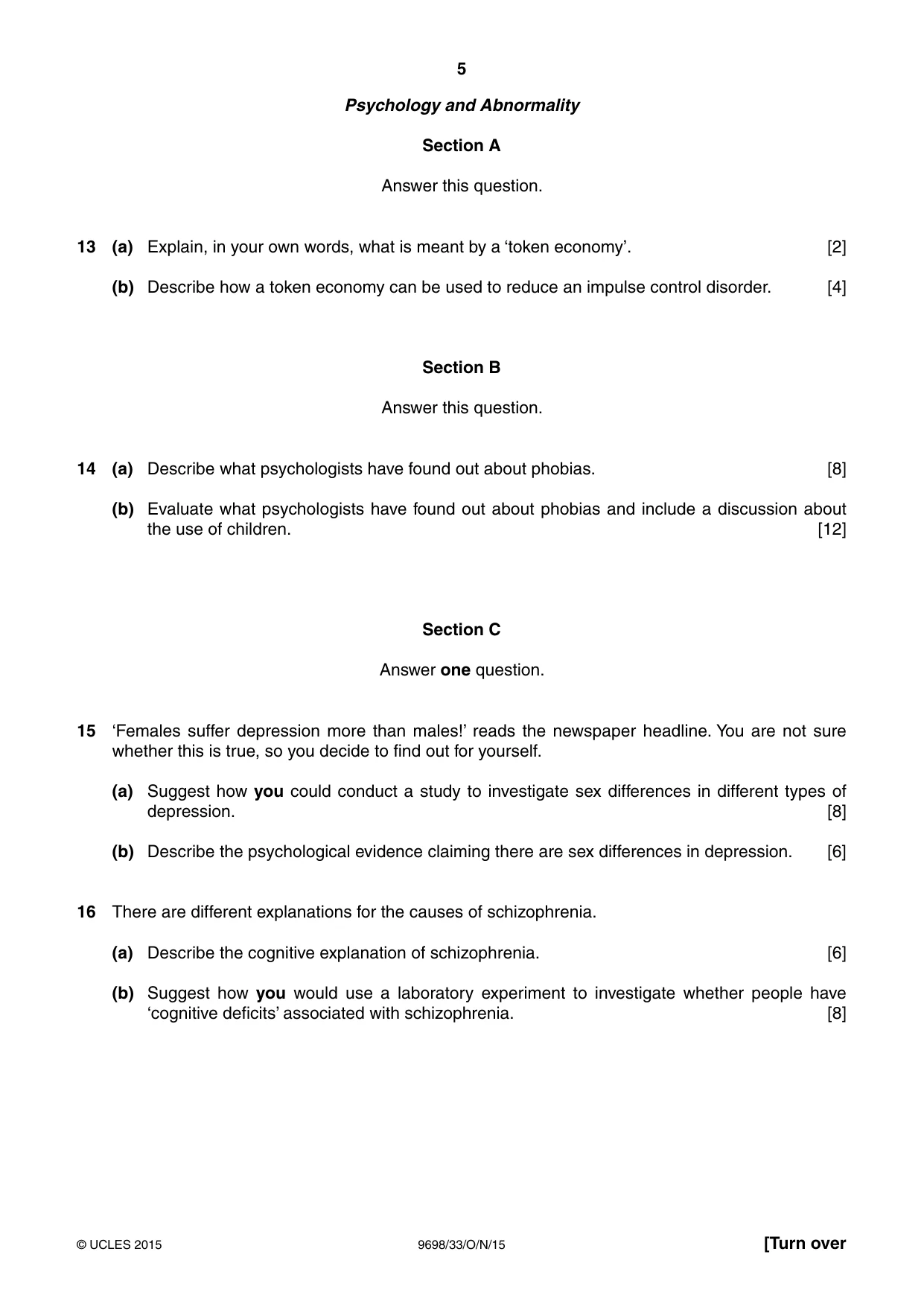
5 9698/33/O/N/15 © UCLES 2015 [Turn over Psychology and Abnormality Section A Answer this question. 13 (a) Explain, in your own words, what is meant by a ‘token economy’. [2] (b) Describe how a token economy can be used to reduce an impulse control disorder. [4] Section B Answer this question. 14 (a) Describe what psychologists have found out about phobias. [8] (b) Evaluate what psychologists have found out about phobias and include a discussion about the use of children. [12] Section C Answer one question. 15 ‘Females suffer depression more than males!’ reads the newspaper headline. You are not sure whether this is true, so you decide to find out for yourself. (a) Suggest how you could conduct a study to investigate sex differences in different types of depression. [8] (b) Describe the psychological evidence claiming there are sex differences in depression. [6] 16 There are different explanations for the causes of schizophrenia. (a) Describe the cognitive explanation of schizophrenia. [6] (b) Suggest how you would use a laboratory experiment to investigate whether people have ‘cognitive deficits’ associated with schizophrenia. [8]
Question paper, page 6
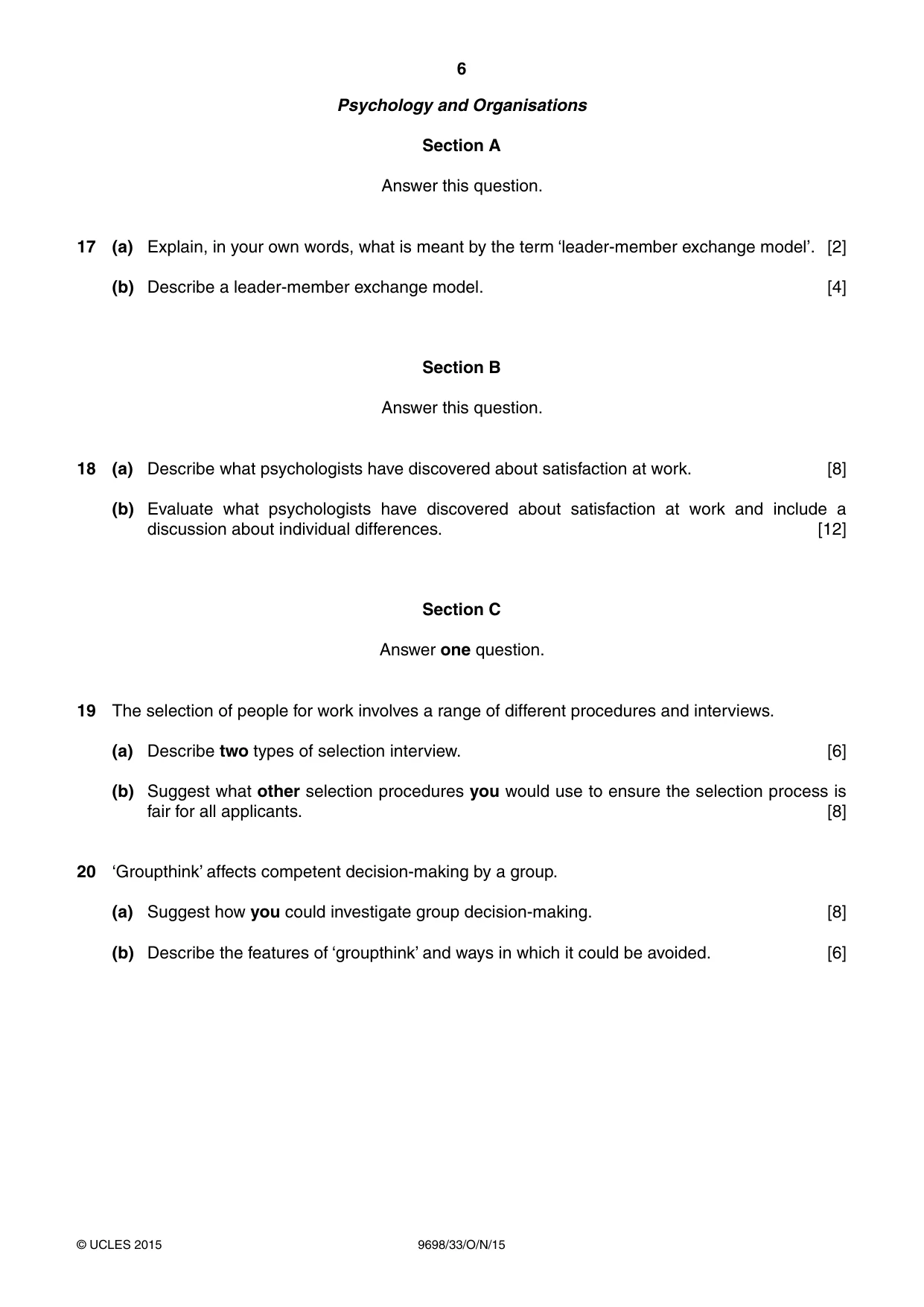
6 9698/33/O/N/15 © UCLES 2015 Psychology and Organisations Section A Answer this question. 17 (a) Explain, in your own words, what is meant by the term ‘leader-member exchange model’. [2] (b) Describe a leader-member exchange model. [4] Section B Answer this question. 18 (a) Describe what psychologists have discovered about satisfaction at work. [8] (b) Evaluate what psychologists have discovered about satisfaction at work and include a discussion about individual differences. [12] Section C Answer one question. 19 The selection of people for work involves a range of different procedures and interviews. (a) Describe two types of selection interview. [6] (b) Suggest what other selection procedures you would use to ensure the selection process is fair for all applicants. [8] 20 ‘Groupthink ’ affects competent decision-making by a group. (a) Suggest how you could investigate group decision-making. [8] (b) Describe the features of ‘groupthink’ and ways in which it could be avoided. [6]
Question paper, page 7
7 9698/33/O/N/15 © UCLES 2015 BLANK PAGE
Question paper, page 8
8 9698/33/O/N/15 © UCLES 2015 BLANK PAGE Permission to reproduce items where third-party owned material protected by copyright is included has been sought and cleared where possible. Every reasonable effort has been made by the publisher (UCLES) to trace copyright holders, but if any items requiring clearance have unwittingly been included, the publisher will be pleased to make amends at the earliest possible opportunity. To avoid the issue of disclosure of answer-related information to candidates, all copyright acknowledgements are reproduced online in the Cambridge International Examinations Copyright Acknowledgements Booklet. This is produced for each series of examinations and is freely available to download at www.cie.org.uk after the live examination series. Cambridge International Examinations is part of the Cambridge Assessment Group. Cambridge Assessment is the brand name of University of Cambridge Local Examinations Syndicate (UCLES), which is itself a department of the University of Cambridge.
Mark scheme, page 1
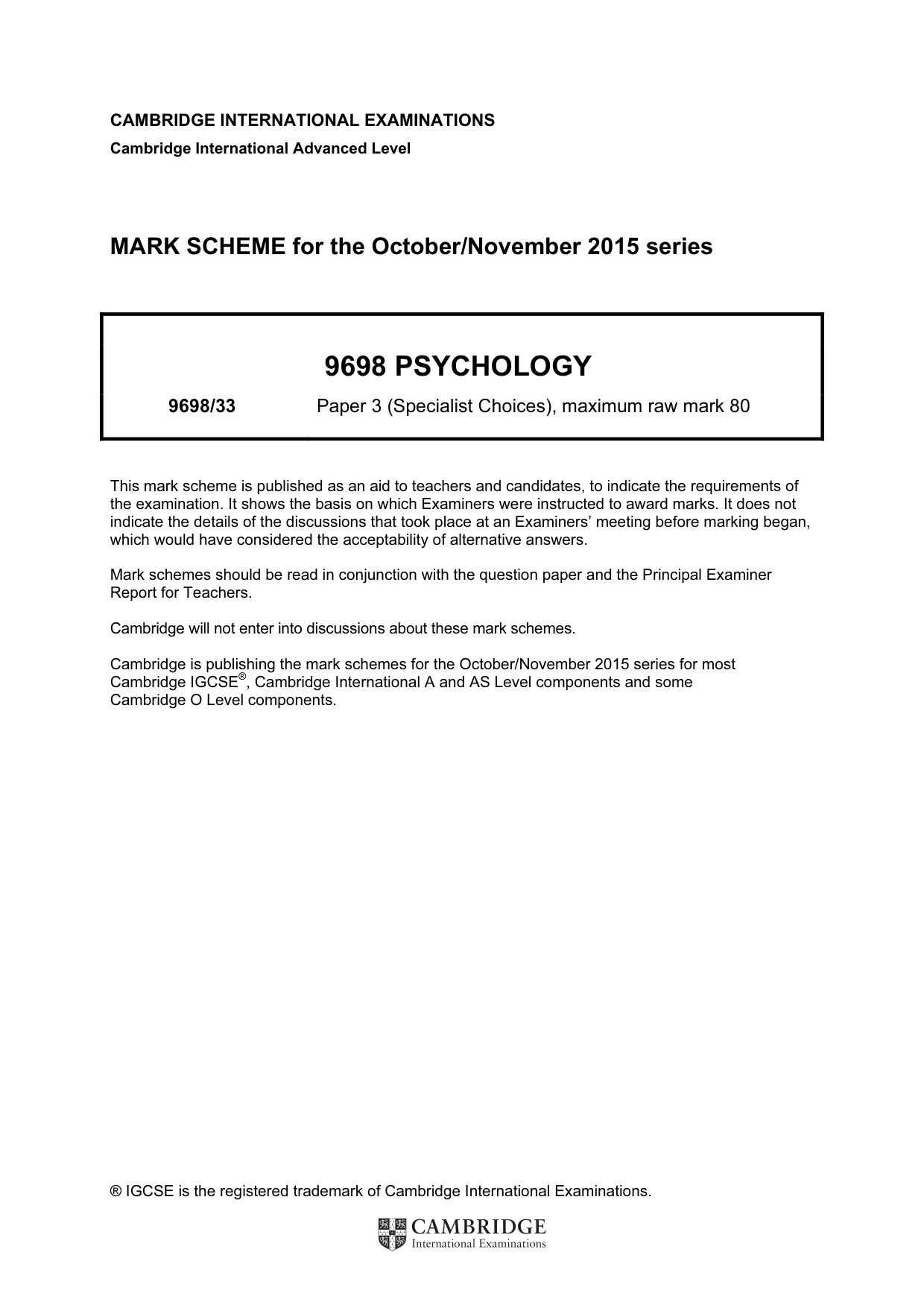
® IGCSE is the registered trademark of Cambridge International Examinations. CAMBRIDGE INTERNATIONAL EXAMINATIONS Cambridge International Advanced Level MARK SCHEME for the October/November 2015 series 9698 PSYCHOLOGY 9698/33 Paper 3 (Specialist Choices), maximum raw mark 80 This mark scheme is published as an aid to teachers and candidates, to indicate the requirements of the examination. It shows the basis on which Examiners were instructed to award marks. It does not indicate the details of the discussions that took place at an Examiners’ meeting before marking began, which would have considered the acceptability of alternative answers. Mark schemes should be read in conjunction with the question paper and the Principal Examiner Report for Teachers. Cambridge will not enter into discussions about these mark schemes. Cambridge is publishing the mark schemes for the October/November 2015 series for most Cambridge IGCSE®, Cambridge International A and AS Level components and some Cambridge O Level components.
Mark scheme, page 2
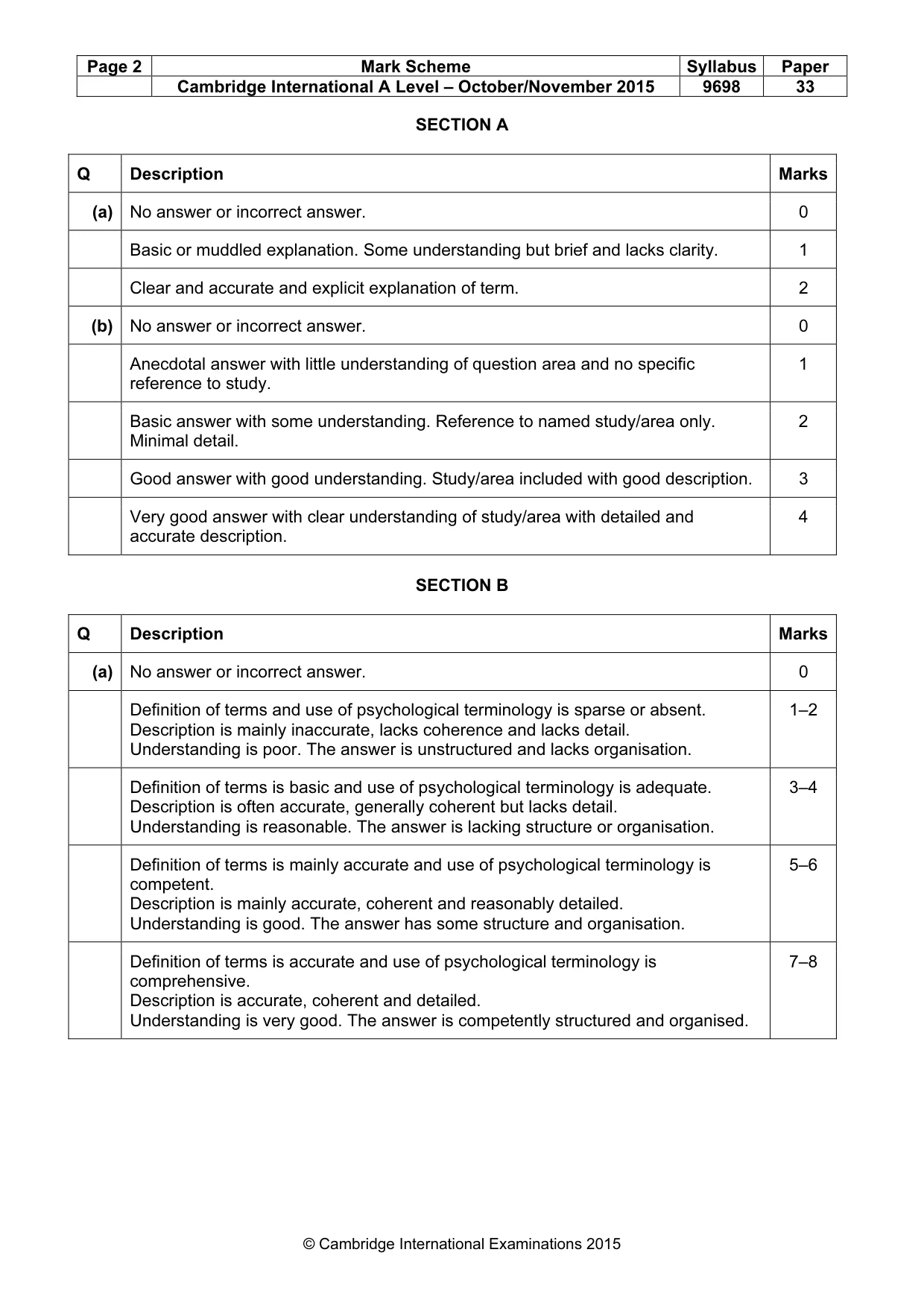
Page 2 Mark Scheme Syllabus Paper Cambridge International A Level – October/November 2015 9698 33 © Cambridge International Examinations 2015 SECTION A Q Description Marks (a) No answer or incorrect answer. 0 Basic or muddled explanation. Some understanding but brief and lacks clarity. 1 Clear and accurate and explicit explanation of term. 2 (b) No answer or incorrect answer. 0 Anecdotal answer with little understanding of question area and no specific reference to study. 1 Basic answer with some understanding. Reference to named study/area only. Minimal detail. 2 Good answer with good understanding. Study/area included with good description. 3 Very good answer with clear understanding of study/area with detailed and accurate description. 4 SECTION B Q Description Marks (a) No answer or incorrect answer. 0 Definition of terms and use of psychological terminology is sparse or absent. Description is mainly inaccurate, lacks coherence and lacks detail. Understanding is poor. The answer is unstructured and lacks organisation. 1–2 Definition of terms is basic and use of psychological terminology is adequate. Description is often accurate, generally coherent but lacks detail. Understanding is reasonable. The answer is lacking structure or organisation. 3–4 Definition of terms is mainly accurate and use of psychological terminology is competent. Description is mainly accurate, coherent and reasonably detailed. Understanding is good. The answer has some structure and organisation. 5–6 Definition of terms is accurate and use of psychological terminology is comprehensive. Description is accurate, coherent and detailed. Understanding is very good. The answer is competently structured and organised. 7–8
Mark scheme, page 3
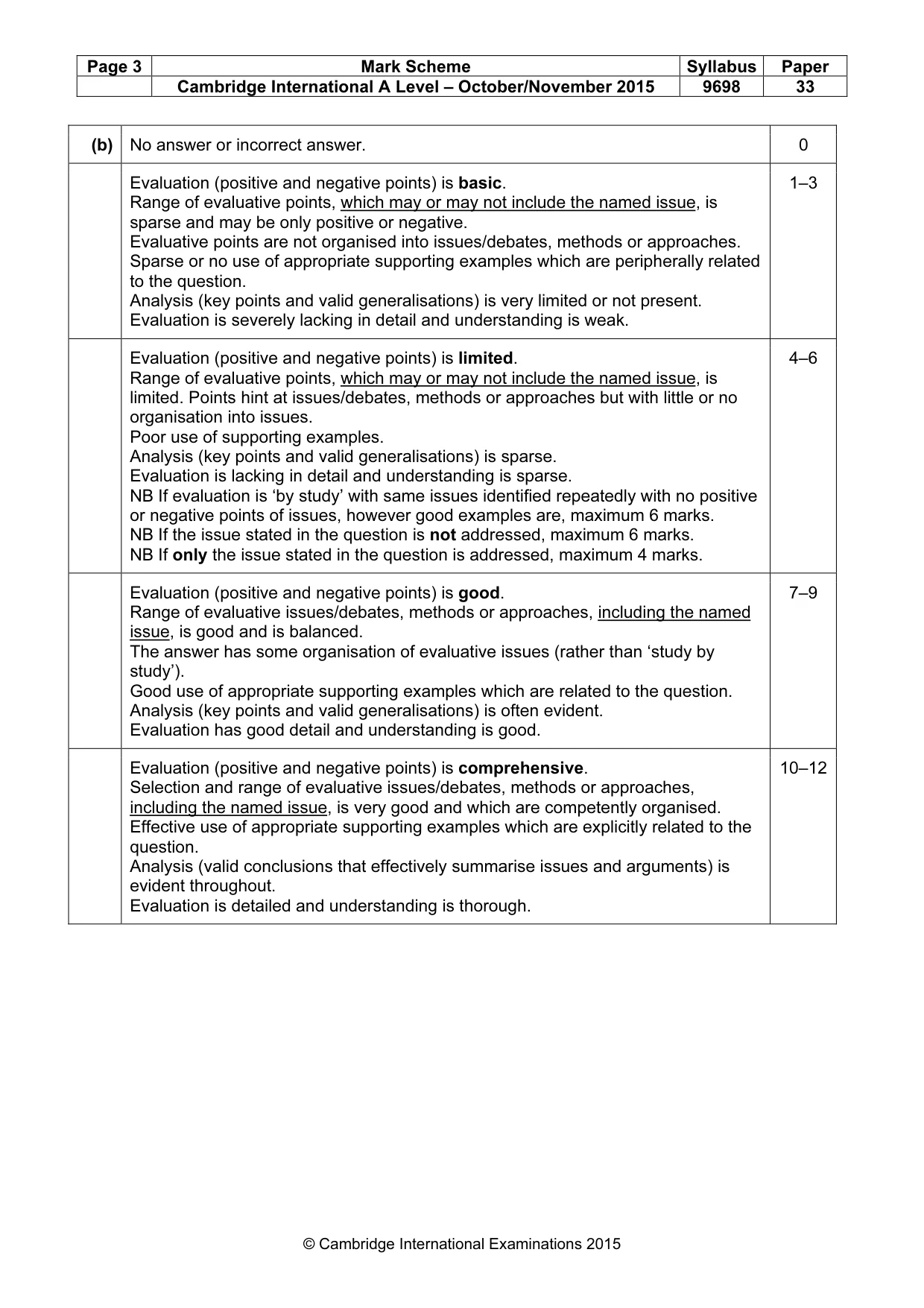
Page 3 Mark Scheme Syllabus Paper Cambridge International A Level – October/November 2015 9698 33 © Cambridge International Examinations 2015 (b) No answer or incorrect answer. 0 Evaluation (positive and negative points) is basic. Range of evaluative points, which may or may not include the named issue, is sparse and may be only positive or negative. Evaluative points are not organised into issues/debates, methods or approaches. Sparse or no use of appropriate supporting examples which are peripherally related to the question. Analysis (key points and valid generalisations) is very limited or not present. Evaluation is severely lacking in detail and understanding is weak. 1–3 Evaluation (positive and negative points) is limited. Range of evaluative points, which may or may not include the named issue, is limited. Points hint at issues/debates, methods or approaches but with little or no organisation into issues. Poor use of supporting examples. Analysis (key points and valid generalisations) is sparse. Evaluation is lacking in detail and understanding is sparse. NB If evaluation is ‘by study’ with same issues identified repeatedly with no positive or negative points of issues, however good examples are, maximum 6 marks. NB If the issue stated in the question is not addressed, maximum 6 marks. NB If only the issue stated in the question is addressed, maximum 4 marks. 4–6 Evaluation (positive and negative points) is good. Range of evaluative issues/debates, methods or approaches, including the named issue, is good and is balanced. The answer has some organisation of evaluative issues (rather than ‘study by study’). Good use of appropriate supporting examples which are related to the question. Analysis (key points and valid generalisations) is often evident. Evaluation has good detail and understanding is good. 7–9 Evaluation (positive and negative points) is comprehensive. Selection and range of evaluative issues/debates, methods or approaches, including the named issue, is very good and which are competently organised. Effective use of appropriate supporting examples which are explicitly related to the question. Analysis (valid conclusions that effectively summarise issues and arguments) is evident throughout. Evaluation is detailed and understanding is thorough. 10–12
Mark scheme, page 4
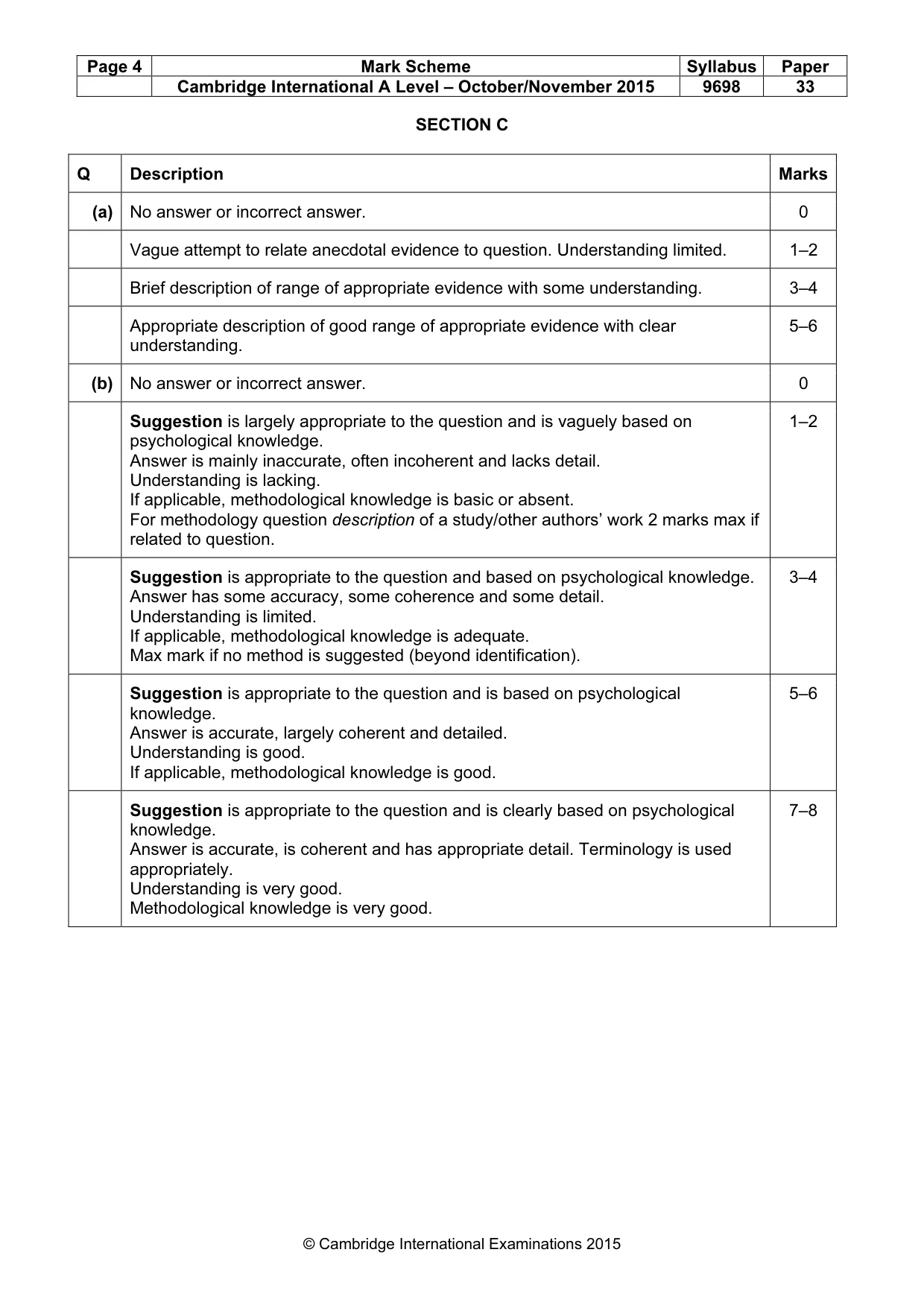
Page 4 Mark Scheme Syllabus Paper Cambridge International A Level – October/November 2015 9698 33 © Cambridge International Examinations 2015 SECTION C Q Description Marks (a) No answer or incorrect answer. 0 Vague attempt to relate anecdotal evidence to question. Understanding limited. 1–2 Brief description of range of appropriate evidence with some understanding. 3–4 Appropriate description of good range of appropriate evidence with clear understanding. 5–6 (b) No answer or incorrect answer. 0 Suggestion is largely appropriate to the question and is vaguely based on psychological knowledge. Answer is mainly inaccurate, often incoherent and lacks detail. Understanding is lacking. If applicable, methodological knowledge is basic or absent. For methodology question description of a study/other authors’ work 2 marks max if related to question. 1–2 Suggestion is appropriate to the question and based on psychological knowledge. Answer has some accuracy, some coherence and some detail. Understanding is limited. If applicable, methodological knowledge is adequate. Max mark if no method is suggested (beyond identification). 3–4 Suggestion is appropriate to the question and is based on psychological knowledge. Answer is accurate, largely coherent and detailed. Understanding is good. If applicable, methodological knowledge is good. 5–6 Suggestion is appropriate to the question and is clearly based on psychological knowledge. Answer is accurate, is coherent and has appropriate detail. Terminology is used appropriately. Understanding is very good. Methodological knowledge is very good. 7–8
Mark scheme, page 5
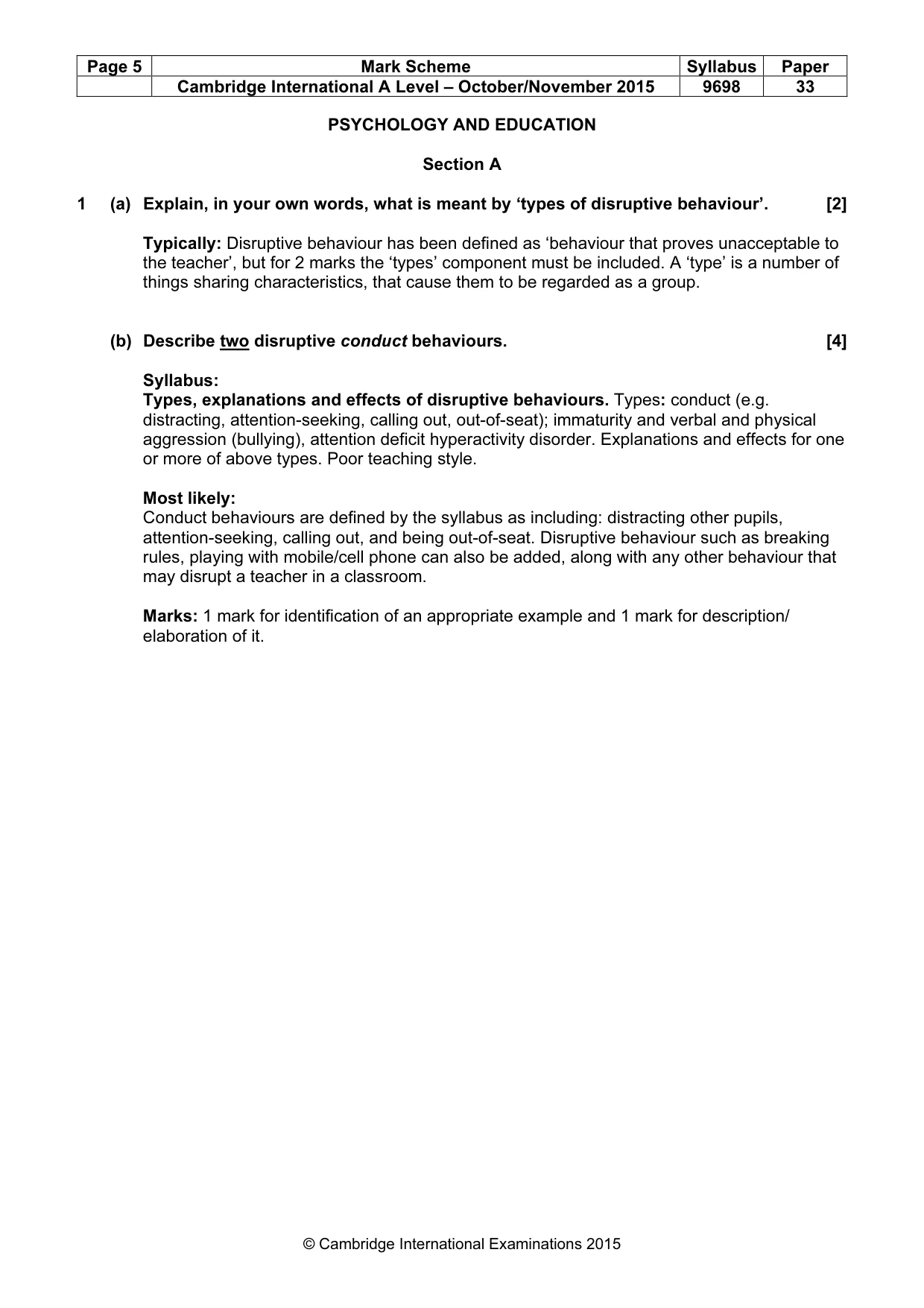
Page 5 Mark Scheme Syllabus Paper Cambridge International A Level – October/November 2015 9698 33 © Cambridge International Examinations 2015 PSYCHOLOGY AND EDUCATION Section A 1 (a) Explain, in your own words, what is meant by ‘types of disruptive behaviour’. [2] Typically: Disruptive behaviour has been defined as ‘behaviour that proves unacceptable to the teacher’, but for 2 marks the ‘types’ component must be included. A ‘type’ is a number of things sharing characteristics, that cause them to be regarded as a group. (b) Describe two disruptive conduct behaviours. [4] Syllabus: Types, explanations and effects of disruptive behaviours. Types: conduct (e.g. distracting, attention-seeking, calling out, out-of-seat); immaturity and verbal and physical aggression (bullying), attention deficit hyperactivity disorder. Explanations and effects for one or more of above types. Poor teaching style. Most likely: Conduct behaviours are defined by the syllabus as including: distracting other pupils, attention-seeking, calling out, and being out-of-seat. Disruptive behaviour such as breaking rules, playing with mobile/cell phone can also be added, along with any other behaviour that may disrupt a teacher in a classroom. Marks: 1 mark for identification of an appropriate example and 1 mark for description/ elaboration of it.
Mark scheme, page 6
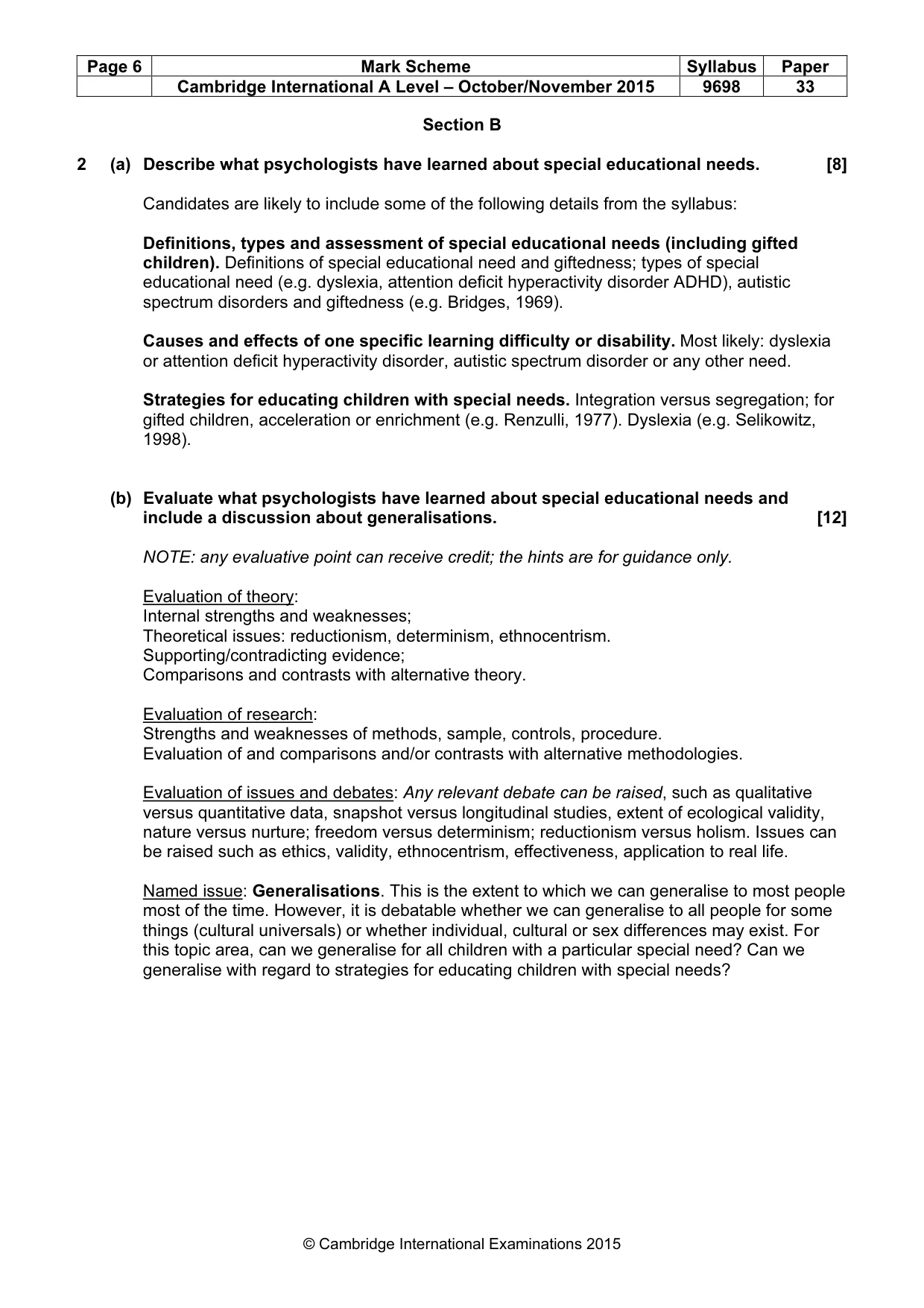
Page 6 Mark Scheme Syllabus Paper Cambridge International A Level – October/November 2015 9698 33 © Cambridge International Examinations 2015 Section B 2 (a) Describe what psychologists have learned about special educational needs. [8] Candidates are likely to include some of the following details from the syllabus: Definitions, types and assessment of special educational needs (including gifted children). Definitions of special educational need and giftedness; types of special educational need (e.g. dyslexia, attention deficit hyperactivity disorder ADHD), autistic spectrum disorders and giftedness (e.g. Bridges, 1969). Causes and effects of one specific learning difficulty or disability. Most likely: dyslexia or attention deficit hyperactivity disorder, autistic spectrum disorder or any other need. Strategies for educating children with special needs. Integration versus segregation; for gifted children, acceleration or enrichment (e.g. Renzulli, 1977). Dyslexia (e.g. Selikowitz, 1998). (b) Evaluate what psychologists have learned about special educational needs and include a discussion about generalisations. [12] NOTE: any evaluative point can receive credit; the hints are for guidance only. Evaluation of theory: Internal strengths and weaknesses; Theoretical issues: reductionism, determinism, ethnocentrism. Supporting/contradicting evidence; Comparisons and contrasts with alternative theory. Evaluation of research: Strengths and weaknesses of methods, sample, controls, procedure. Evaluation of and comparisons and/or contrasts with alternative methodologies. Evaluation of issues and debates: Any relevant debate can be raised, such as qualitative versus quantitative data, snapshot versus longitudinal studies, extent of ecological validity, nature versus nurture; freedom versus determinism; reductionism versus holism. Issues can be raised such as ethics, validity, ethnocentrism, effectiveness, application to real life. Named issue: Generalisations. This is the extent to which we can generalise to most people most of the time. However, it is debatable whether we can generalise to all people for some things (cultural universals) or whether individual, cultural or sex differences may exist. For this topic area, can we generalise for all children with a particular special need? Can we generalise with regard to strategies for educating children with special needs?
Mark scheme, page 7
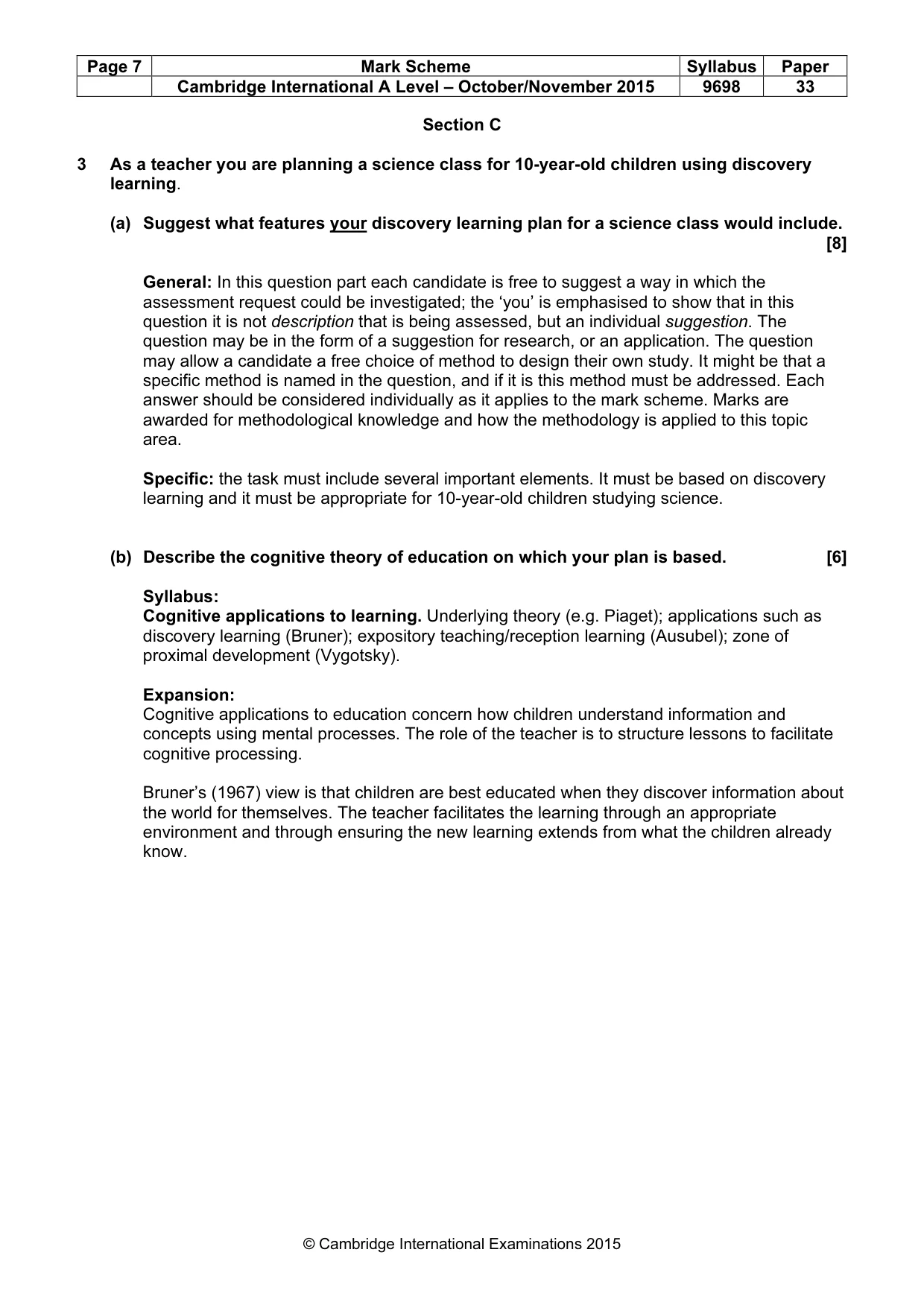
Page 7 Mark Scheme Syllabus Paper Cambridge International A Level – October/November 2015 9698 33 © Cambridge International Examinations 2015 Section C 3 As a teacher you are planning a science class for 10-year-old children using discovery learning. (a) Suggest what features your discovery learning plan for a science class would include. [8] General: In this question part each candidate is free to suggest a way in which the assessment request could be investigated; the ‘you’ is emphasised to show that in this question it is not description that is being assessed, but an individual suggestion. The question may be in the form of a suggestion for research, or an application. The question may allow a candidate a free choice of method to design their own study. It might be that a specific method is named in the question, and if it is this method must be addressed. Each answer should be considered individually as it applies to the mark scheme. Marks are awarded for methodological knowledge and how the methodology is applied to this topic area. Specific: the task must include several important elements. It must be based on discovery learning and it must be appropriate for 10-year-old children studying science. (b) Describe the cognitive theory of education on which your plan is based. [6] Syllabus: Cognitive applications to learning. Underlying theory (e.g. Piaget); applications such as discovery learning (Bruner); expository teaching/reception learning (Ausubel); zone of proximal development (Vygotsky). Expansion: Cognitive applications to education concern how children understand information and concepts using mental processes. The role of the teacher is to structure lessons to facilitate cognitive processing. Bruner’s (1967) view is that children are best educated when they discover information about the world for themselves. The teacher facilitates the learning through an appropriate environment and through ensuring the new learning extends from what the children already know.
Mark scheme, page 8
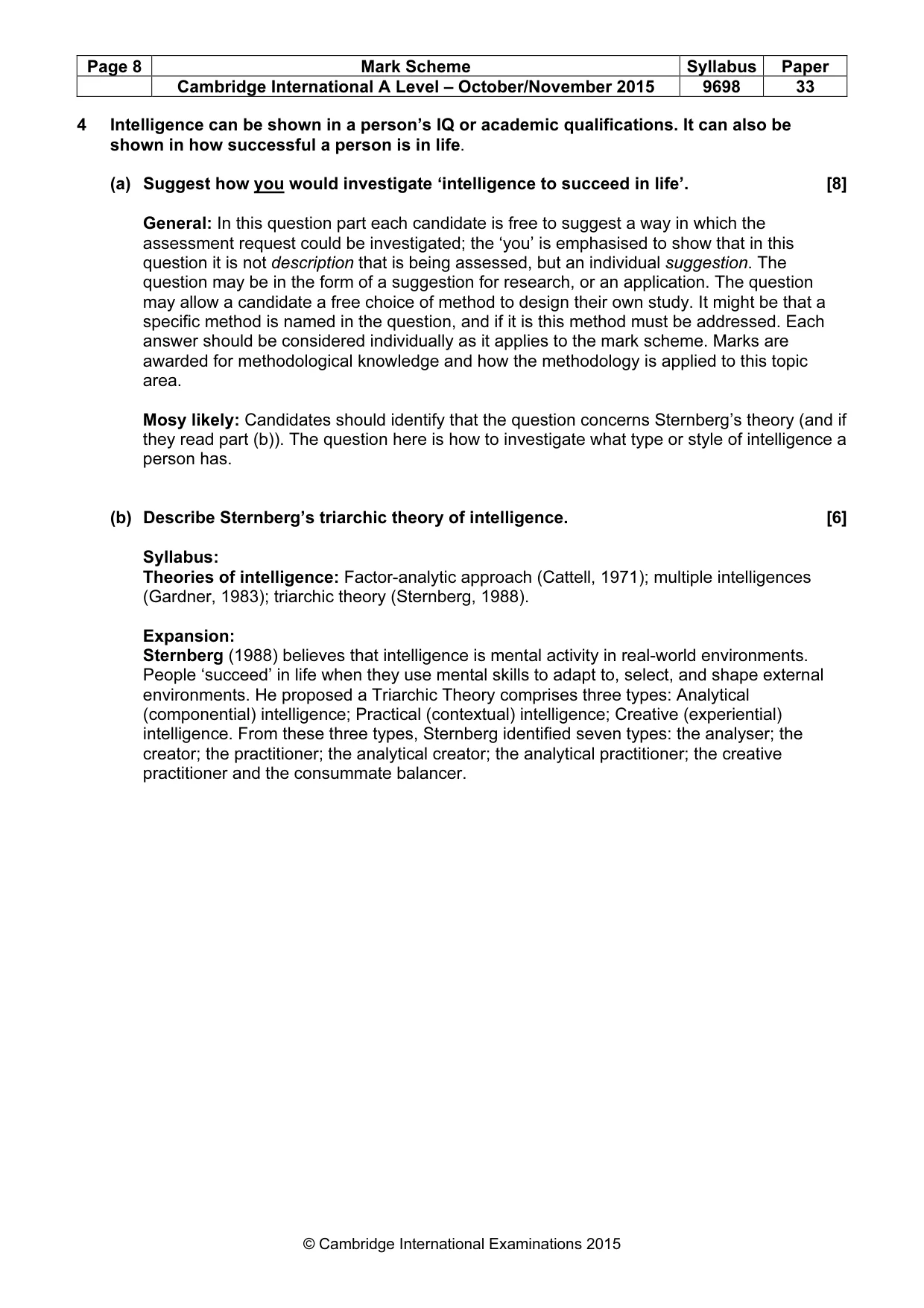
Page 8 Mark Scheme Syllabus Paper Cambridge International A Level – October/November 2015 9698 33 © Cambridge International Examinations 2015 4 Intelligence can be shown in a person’s IQ or academic qualifications. It can also be shown in how successful a person is in life. (a) Suggest how you would investigate ‘intelligence to succeed in life’. [8] General: In this question part each candidate is free to suggest a way in which the assessment request could be investigated; the ‘you’ is emphasised to show that in this question it is not description that is being assessed, but an individual suggestion. The question may be in the form of a suggestion for research, or an application. The question may allow a candidate a free choice of method to design their own study. It might be that a specific method is named in the question, and if it is this method must be addressed. Each answer should be considered individually as it applies to the mark scheme. Marks are awarded for methodological knowledge and how the methodology is applied to this topic area. Mosy likely: Candidates should identify that the question concerns Sternberg’s theory (and if they read part (b)). The question here is how to investigate what type or style of intelligence a person has. (b) Describe Sternberg’s triarchic theory of intelligence. [6] Syllabus: Theories of intelligence: Factor-analytic approach (Cattell, 1971); multiple intelligences (Gardner, 1983); triarchic theory (Sternberg, 1988). Expansion: Sternberg (1988) believes that intelligence is mental activity in real-world environments. People ‘succeed’ in life when they use mental skills to adapt to, select, and shape external environments. He proposed a Triarchic Theory comprises three types: Analytical (componential) intelligence; Practical (contextual) intelligence; Creative (experiential) intelligence. From these three types, Sternberg identified seven types: the analyser; the creator; the practitioner; the analytical creator; the analytical practitioner; the creative practitioner and the consummate balancer.
Mark scheme, page 9
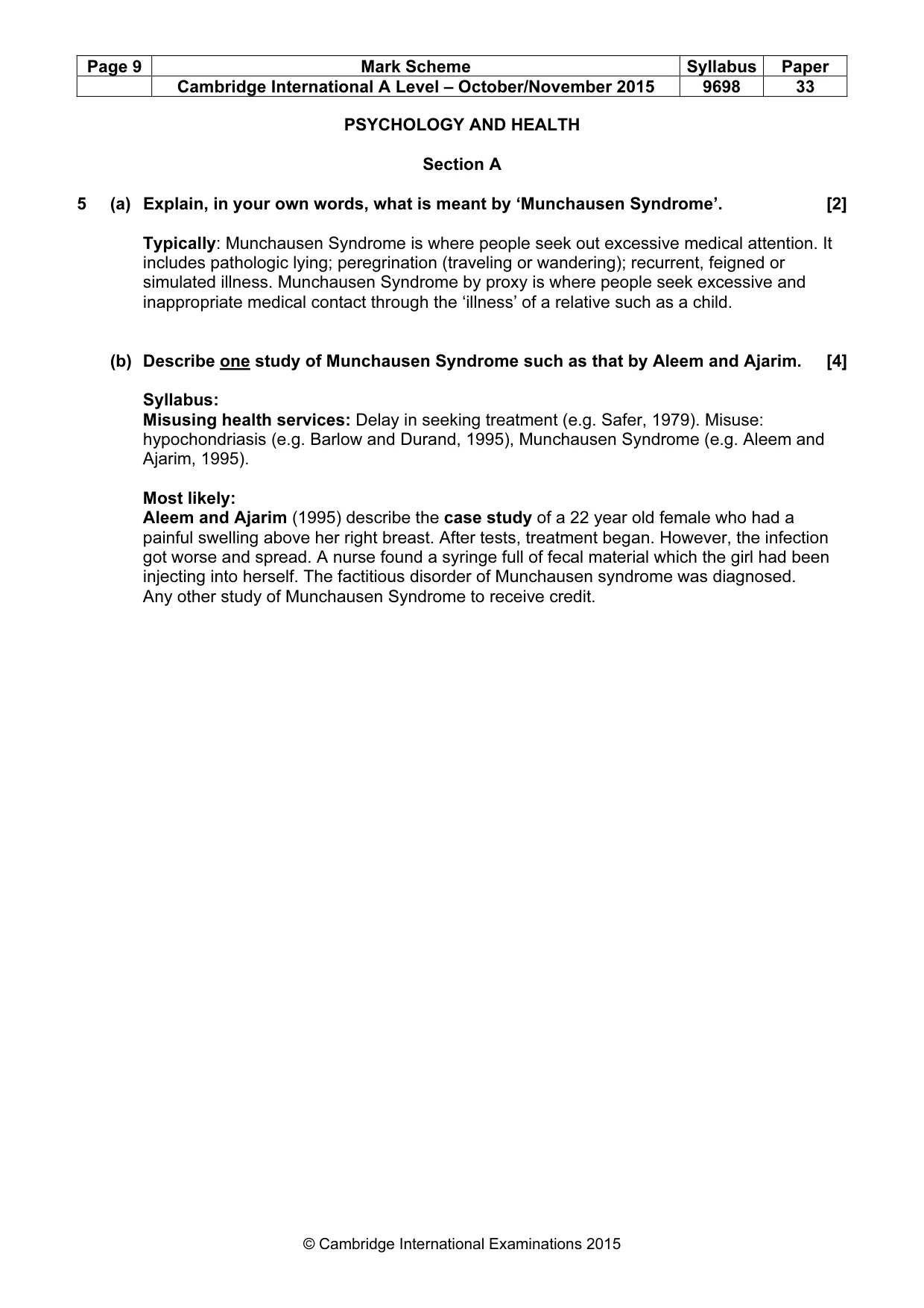
Page 9 Mark Scheme Syllabus Paper Cambridge International A Level – October/November 2015 9698 33 © Cambridge International Examinations 2015 PSYCHOLOGY AND HEALTH Section A 5 (a) Explain, in your own words, what is meant by ‘Munchausen Syndrome’. [2] Typically: Munchausen Syndrome is where people seek out excessive medical attention. It includes pathologic lying; peregrination (traveling or wandering); recurrent, feigned or simulated illness. Munchausen Syndrome by proxy is where people seek excessive and inappropriate medical contact through the ‘illness’ of a relative such as a child. (b) Describe one study of Munchausen Syndrome such as that by Aleem and Ajarim. [4] Syllabus: Misusing health services: Delay in seeking treatment (e.g. Safer, 1979). Misuse: hypochondriasis (e.g. Barlow and Durand, 1995), Munchausen Syndrome (e.g. Aleem and Ajarim, 1995). Most likely: Aleem and Ajarim (1995) describe the case study of a 22 year old female who had a painful swelling above her right breast. After tests, treatment began. However, the infection got worse and spread. A nurse found a syringe full of fecal material which the girl had been injecting into herself. The factitious disorder of Munchausen syndrome was diagnosed. Any other study of Munchausen Syndrome to receive credit.
Mark scheme, page 10
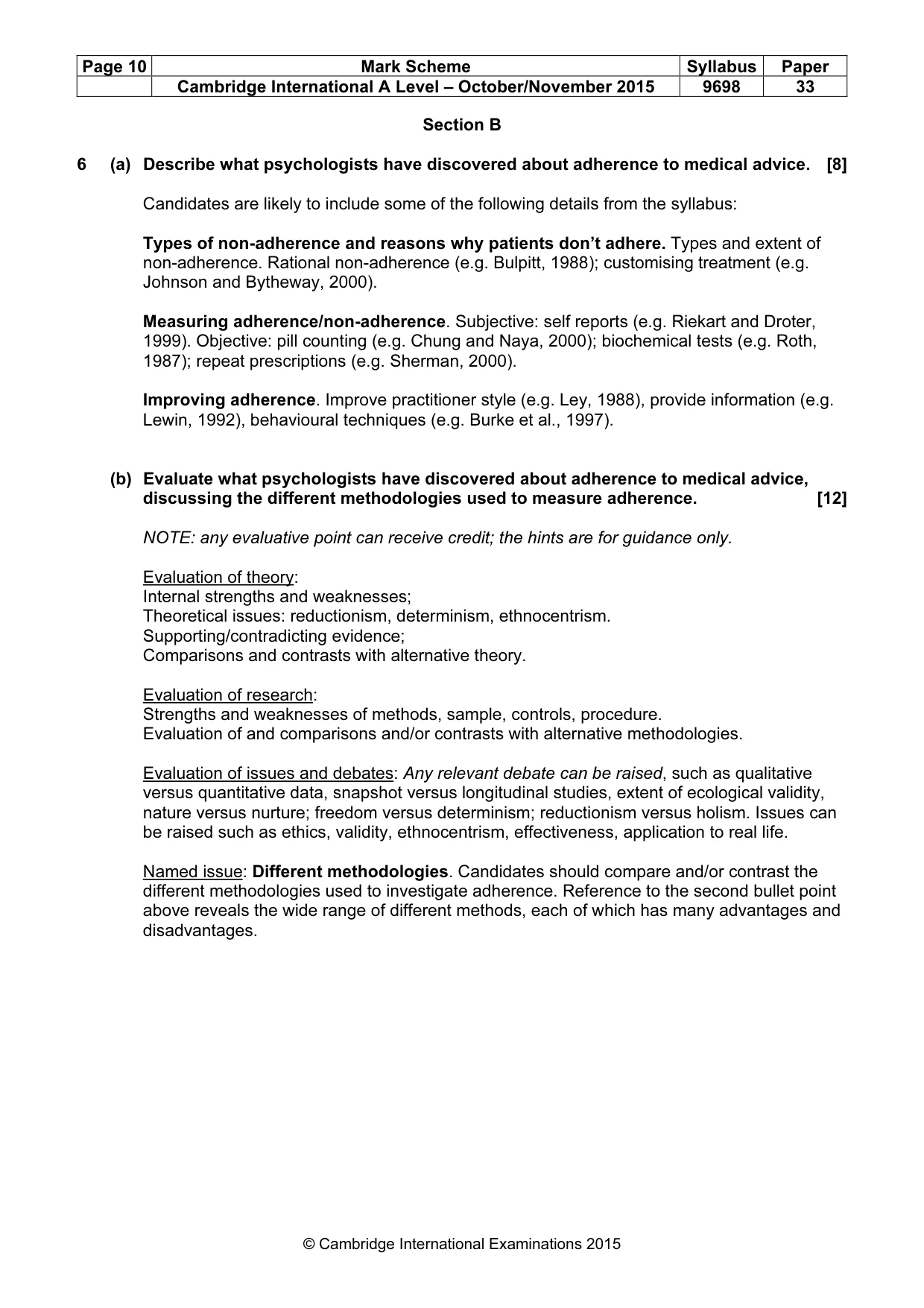
Page 10 Mark Scheme Syllabus Paper Cambridge International A Level – October/November 2015 9698 33 © Cambridge International Examinations 2015 Section B 6 (a) Describe what psychologists have discovered about adherence to medical advice. [8] Candidates are likely to include some of the following details from the syllabus: Types of non-adherence and reasons why patients don’t adhere. Types and extent of non-adherence. Rational non-adherence (e.g. Bulpitt, 1988); customising treatment (e.g. Johnson and Bytheway, 2000). Measuring adherence/non-adherence. Subjective: self reports (e.g. Riekart and Droter, 1999). Objective: pill counting (e.g. Chung and Naya, 2000); biochemical tests (e.g. Roth, 1987); repeat prescriptions (e.g. Sherman, 2000). Improving adherence. Improve practitioner style (e.g. Ley, 1988), provide information (e.g. Lewin, 1992), behavioural techniques (e.g. Burke et al., 1997). (b) Evaluate what psychologists have discovered about adherence to medical advice, discussing the different methodologies used to measure adherence. [12] NOTE: any evaluative point can receive credit; the hints are for guidance only. Evaluation of theory: Internal strengths and weaknesses; Theoretical issues: reductionism, determinism, ethnocentrism. Supporting/contradicting evidence; Comparisons and contrasts with alternative theory. Evaluation of research: Strengths and weaknesses of methods, sample, controls, procedure. Evaluation of and comparisons and/or contrasts with alternative methodologies. Evaluation of issues and debates: Any relevant debate can be raised, such as qualitative versus quantitative data, snapshot versus longitudinal studies, extent of ecological validity, nature versus nurture; freedom versus determinism; reductionism versus holism. Issues can be raised such as ethics, validity, ethnocentrism, effectiveness, application to real life. Named issue: Different methodologies. Candidates should compare and/or contrast the different methodologies used to investigate adherence. Reference to the second bullet point above reveals the wide range of different methods, each of which has many advantages and disadvantages.
Mark scheme, page 11
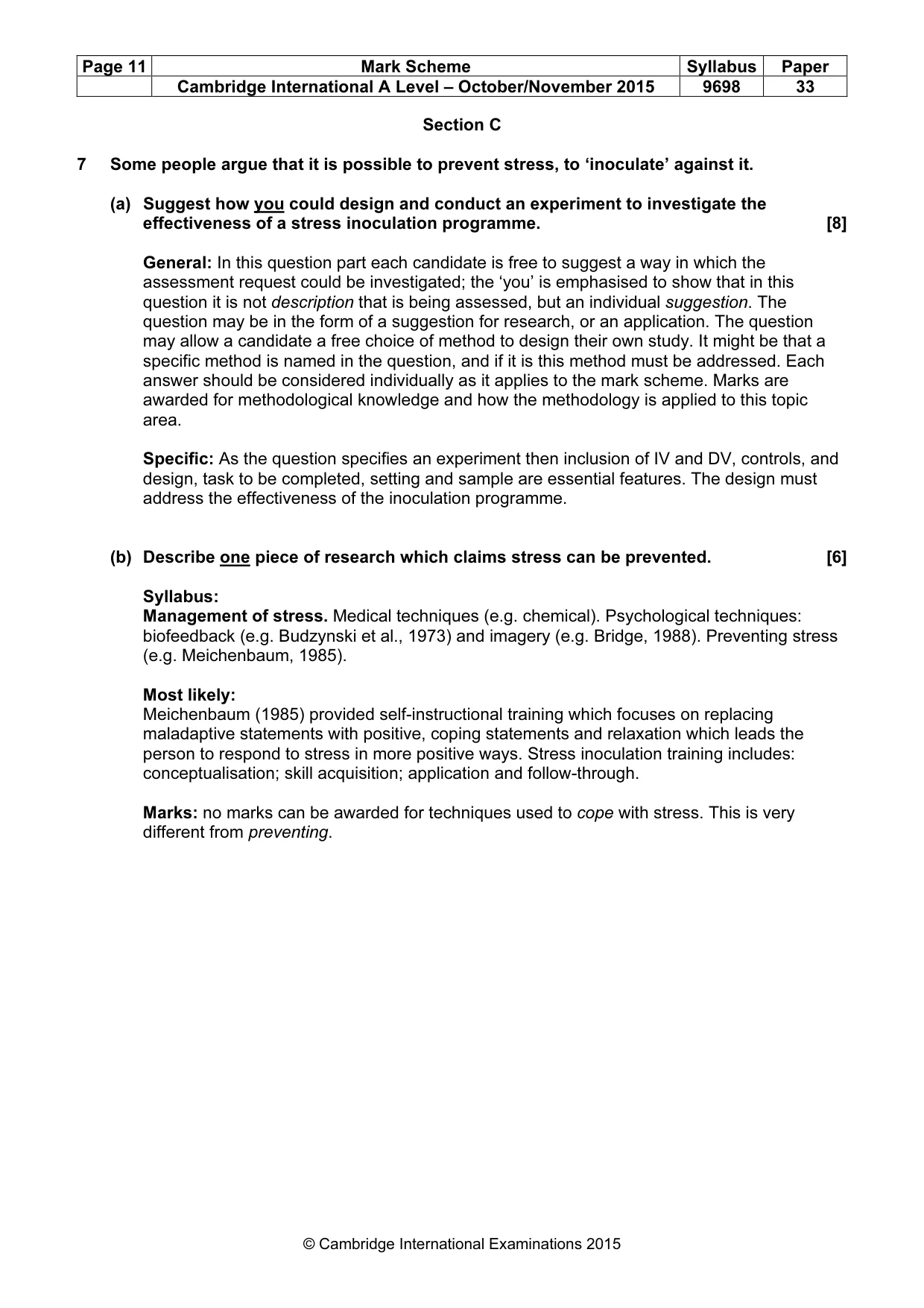
Page 11 Mark Scheme Syllabus Paper Cambridge International A Level – October/November 2015 9698 33 © Cambridge International Examinations 2015 Section C 7 Some people argue that it is possible to prevent stress, to ‘inoculate’ against it. (a) Suggest how you could design and conduct an experiment to investigate the effectiveness of a stress inoculation programme. [8] General: In this question part each candidate is free to suggest a way in which the assessment request could be investigated; the ‘you’ is emphasised to show that in this question it is not description that is being assessed, but an individual suggestion. The question may be in the form of a suggestion for research, or an application. The question may allow a candidate a free choice of method to design their own study. It might be that a specific method is named in the question, and if it is this method must be addressed. Each answer should be considered individually as it applies to the mark scheme. Marks are awarded for methodological knowledge and how the methodology is applied to this topic area. Specific: As the question specifies an experiment then inclusion of IV and DV, controls, and design, task to be completed, setting and sample are essential features. The design must address the effectiveness of the inoculation programme. (b) Describe one piece of research which claims stress can be prevented. [6] Syllabus: Management of stress. Medical techniques (e.g. chemical). Psychological techniques: biofeedback (e.g. Budzynski et al., 1973) and imagery (e.g. Bridge, 1988). Preventing stress (e.g. Meichenbaum, 1985). Most likely: Meichenbaum (1985) provided self-instructional training which focuses on replacing maladaptive statements with positive, coping statements and relaxation which leads the person to respond to stress in more positive ways. Stress inoculation training includes: conceptualisation; skill acquisition; application and follow-through. Marks: no marks can be awarded for techniques used to cope with stress. This is very different from preventing.
Mark scheme, page 12
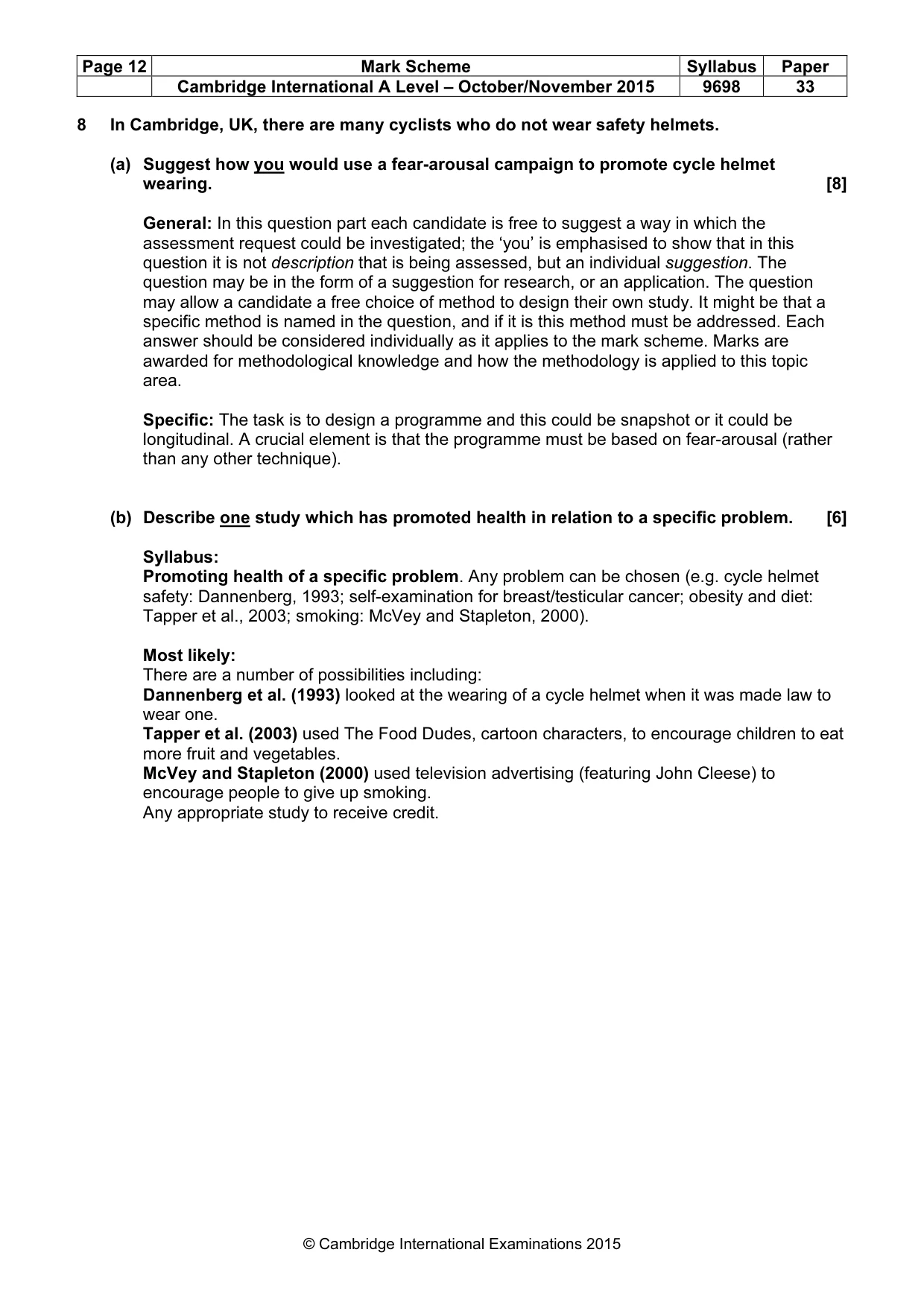
Page 12 Mark Scheme Syllabus Paper Cambridge International A Level – October/November 2015 9698 33 © Cambridge International Examinations 2015 8 In Cambridge, UK, there are many cyclists who do not wear safety helmets. (a) Suggest how you would use a fear-arousal campaign to promote cycle helmet wearing. [8] General: In this question part each candidate is free to suggest a way in which the assessment request could be investigated; the ‘you’ is emphasised to show that in this question it is not description that is being assessed, but an individual suggestion. The question may be in the form of a suggestion for research, or an application. The question may allow a candidate a free choice of method to design their own study. It might be that a specific method is named in the question, and if it is this method must be addressed. Each answer should be considered individually as it applies to the mark scheme. Marks are awarded for methodological knowledge and how the methodology is applied to this topic area. Specific: The task is to design a programme and this could be snapshot or it could be longitudinal. A crucial element is that the programme must be based on fear-arousal (rather than any other technique). (b) Describe one study which has promoted health in relation to a specific problem. [6] Syllabus: Promoting health of a specific problem. Any problem can be chosen (e.g. cycle helmet safety: Dannenberg, 1993; self-examination for breast/testicular cancer; obesity and diet: Tapper et al., 2003; smoking: McVey and Stapleton, 2000). Most likely: There are a number of possibilities including: Dannenberg et al. (1993) looked at the wearing of a cycle helmet when it was made law to wear one. Tapper et al. (2003) used The Food Dudes, cartoon characters, to encourage children to eat more fruit and vegetables. McVey and Stapleton (2000) used television advertising (featuring John Cleese) to encourage people to give up smoking. Any appropriate study to receive credit.
Mark scheme, page 13
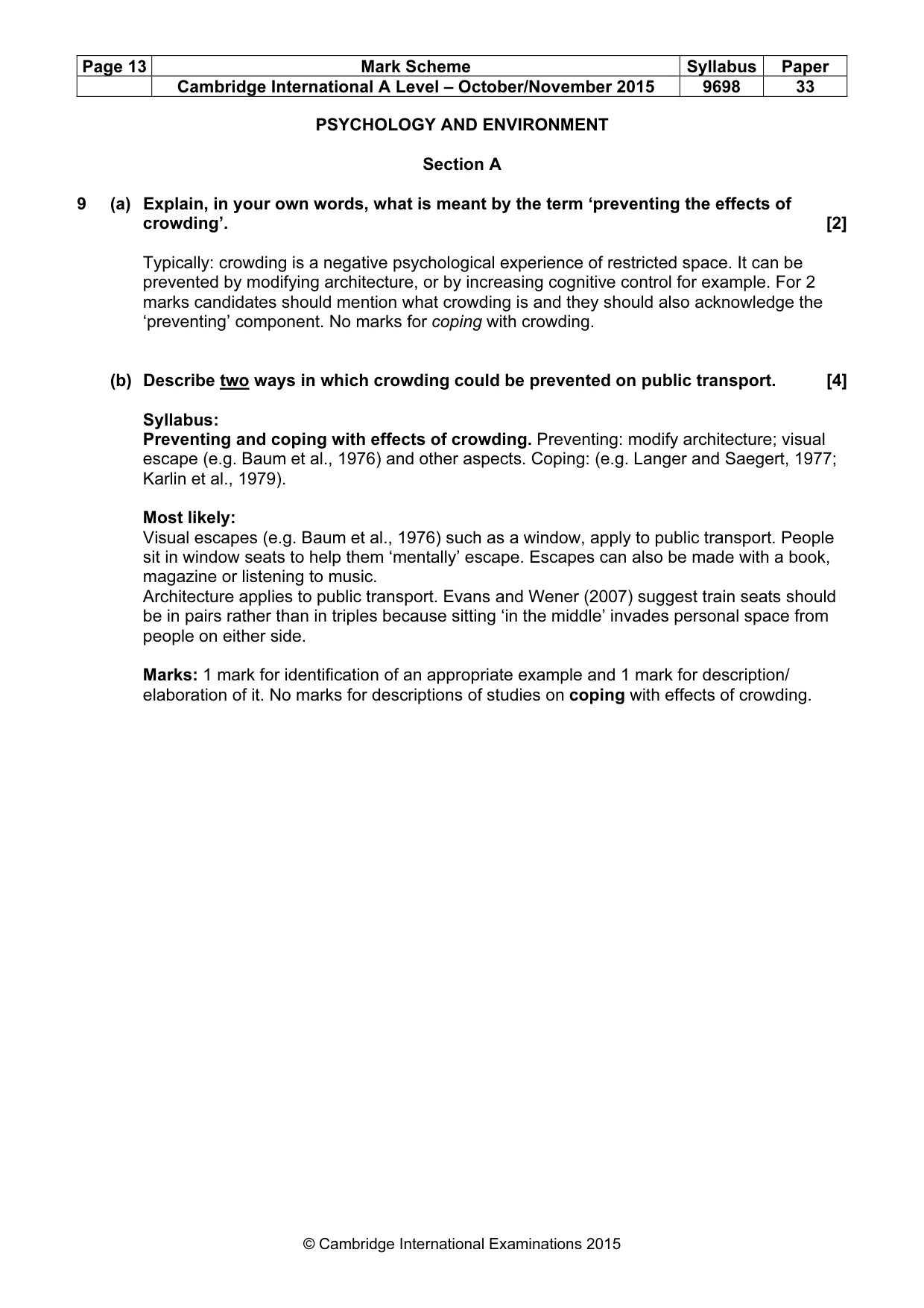
Page 13 Mark Scheme Syllabus Paper Cambridge International A Level – October/November 2015 9698 33 © Cambridge International Examinations 2015 PSYCHOLOGY AND ENVIRONMENT Section A 9 (a) Explain, in your own words, what is meant by the term ‘preventing the effects of crowding’. [2] Typically: crowding is a negative psychological experience of restricted space. It can be prevented by modifying architecture, or by increasing cognitive control for example. For 2 marks candidates should mention what crowding is and they should also acknowledge the ‘preventing’ component. No marks for coping with crowding. (b) Describe two ways in which crowding could be prevented on public transport. [4] Syllabus: Preventing and coping with effects of crowding. Preventing: modify architecture; visual escape (e.g. Baum et al., 1976) and other aspects. Coping: (e.g. Langer and Saegert, 1977; Karlin et al., 1979). Most likely: Visual escapes (e.g. Baum et al., 1976) such as a window, apply to public transport. People sit in window seats to help them ‘mentally’ escape. Escapes can also be made with a book, magazine or listening to music. Architecture applies to public transport. Evans and Wener (2007) suggest train seats should be in pairs rather than in triples because sitting ‘in the middle’ invades personal space from people on either side. Marks: 1 mark for identification of an appropriate example and 1 mark for description/ elaboration of it. No marks for descriptions of studies on coping with effects of crowding.
Mark scheme, page 14
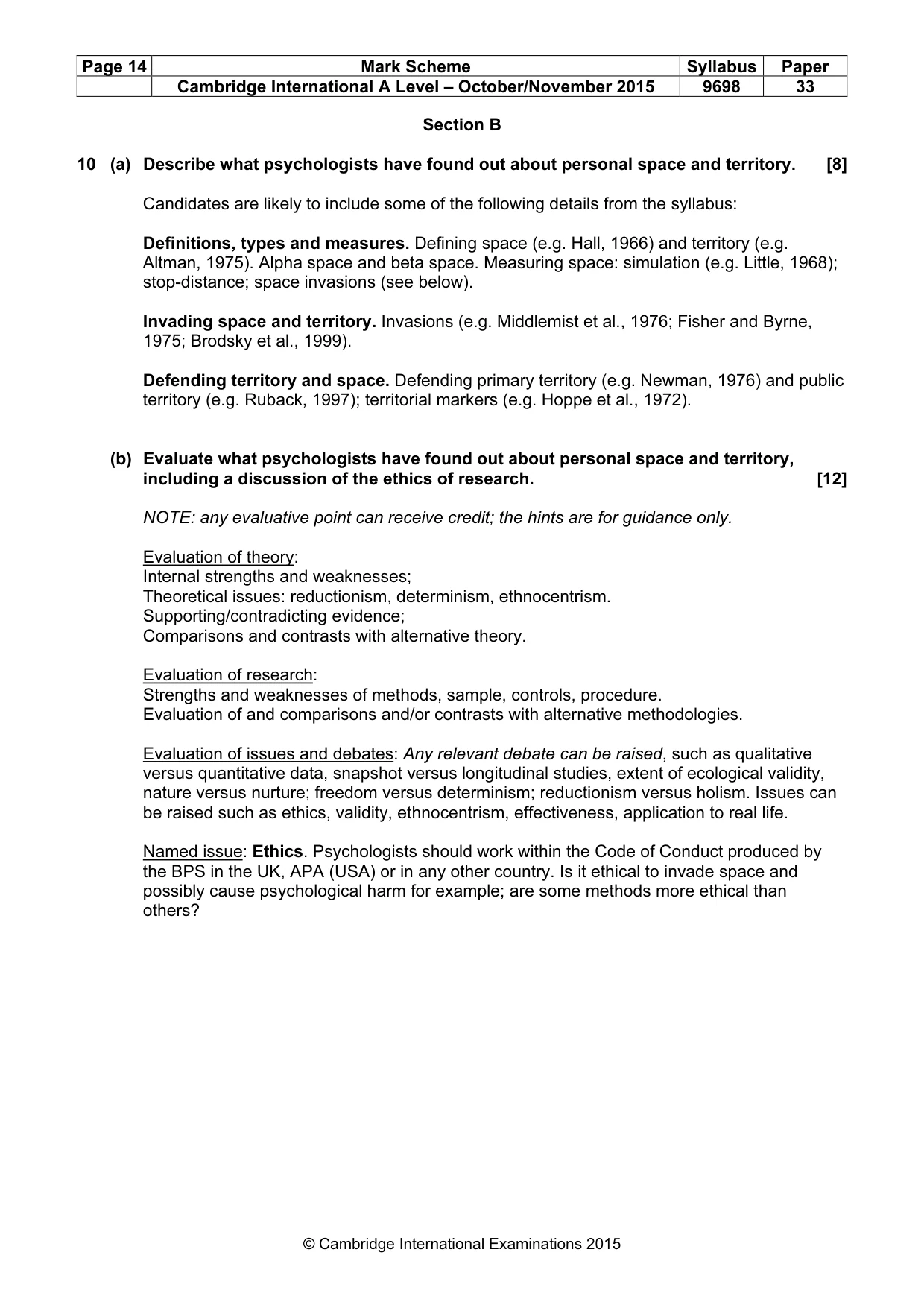
Page 14 Mark Scheme Syllabus Paper Cambridge International A Level – October/November 2015 9698 33 © Cambridge International Examinations 2015 Section B 10 (a) Describe what psychologists have found out about personal space and territory. [8] Candidates are likely to include some of the following details from the syllabus: Definitions, types and measures. Defining space (e.g. Hall, 1966) and territory (e.g. Altman, 1975). Alpha space and beta space. Measuring space: simulation (e.g. Little, 1968); stop-distance; space invasions (see below). Invading space and territory. Invasions (e.g. Middlemist et al., 1976; Fisher and Byrne, 1975; Brodsky et al., 1999). Defending territory and space. Defending primary territory (e.g. Newman, 1976) and public territory (e.g. Ruback, 1997); territorial markers (e.g. Hoppe et al., 1972). (b) Evaluate what psychologists have found out about personal space and territory, including a discussion of the ethics of research. [12] NOTE: any evaluative point can receive credit; the hints are for guidance only. Evaluation of theory: Internal strengths and weaknesses; Theoretical issues: reductionism, determinism, ethnocentrism. Supporting/contradicting evidence; Comparisons and contrasts with alternative theory. Evaluation of research: Strengths and weaknesses of methods, sample, controls, procedure. Evaluation of and comparisons and/or contrasts with alternative methodologies. Evaluation of issues and debates: Any relevant debate can be raised, such as qualitative versus quantitative data, snapshot versus longitudinal studies, extent of ecological validity, nature versus nurture; freedom versus determinism; reductionism versus holism. Issues can be raised such as ethics, validity, ethnocentrism, effectiveness, application to real life. Named issue: Ethics. Psychologists should work within the Code of Conduct produced by the BPS in the UK, APA (USA) or in any other country. Is it ethical to invade space and possibly cause psychological harm for example; are some methods more ethical than others?
Mark scheme, page 15
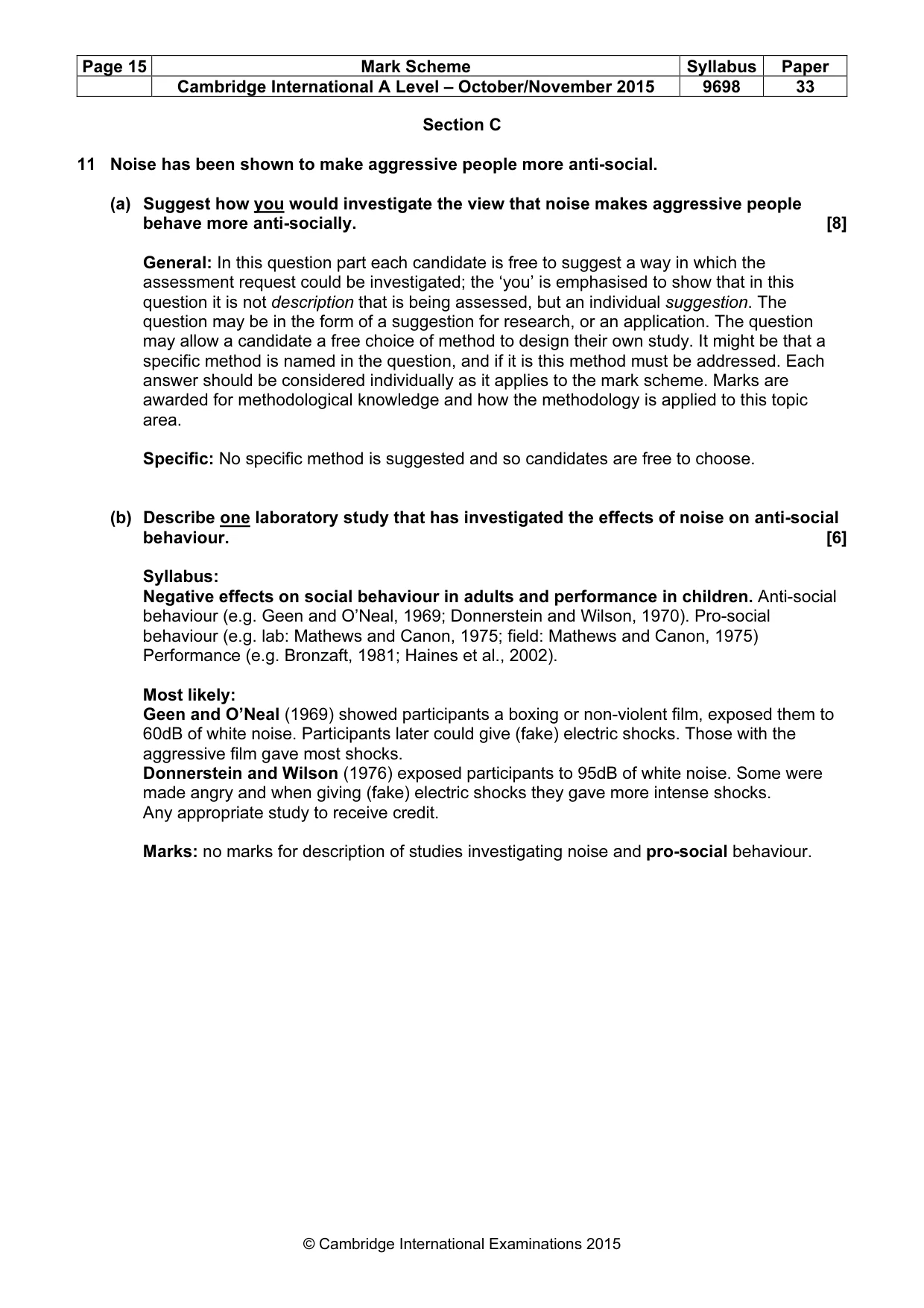
Page 15 Mark Scheme Syllabus Paper Cambridge International A Level – October/November 2015 9698 33 © Cambridge International Examinations 2015 Section C 11 Noise has been shown to make aggressive people more anti-social. (a) Suggest how you would investigate the view that noise makes aggressive people behave more anti-socially. [8] General: In this question part each candidate is free to suggest a way in which the assessment request could be investigated; the ‘you’ is emphasised to show that in this question it is not description that is being assessed, but an individual suggestion. The question may be in the form of a suggestion for research, or an application. The question may allow a candidate a free choice of method to design their own study. It might be that a specific method is named in the question, and if it is this method must be addressed. Each answer should be considered individually as it applies to the mark scheme. Marks are awarded for methodological knowledge and how the methodology is applied to this topic area. Specific: No specific method is suggested and so candidates are free to choose. (b) Describe one laboratory study that has investigated the effects of noise on anti-social behaviour. [6] Syllabus: Negative effects on social behaviour in adults and performance in children. Anti-social behaviour (e.g. Geen and O’Neal, 1969; Donnerstein and Wilson, 1970). Pro-social behaviour (e.g. lab: Mathews and Canon, 1975; field: Mathews and Canon, 1975) Performance (e.g. Bronzaft, 1981; Haines et al., 2002). Most likely: Geen and O’Neal (1969) showed participants a boxing or non-violent film, exposed them to 60dB of white noise. Participants later could give (fake) electric shocks. Those with the aggressive film gave most shocks. Donnerstein and Wilson (1976) exposed participants to 95dB of white noise. Some were made angry and when giving (fake) electric shocks they gave more intense shocks. Any appropriate study to receive credit. Marks: no marks for description of studies investigating noise and pro-social behaviour.
Mark scheme, page 16
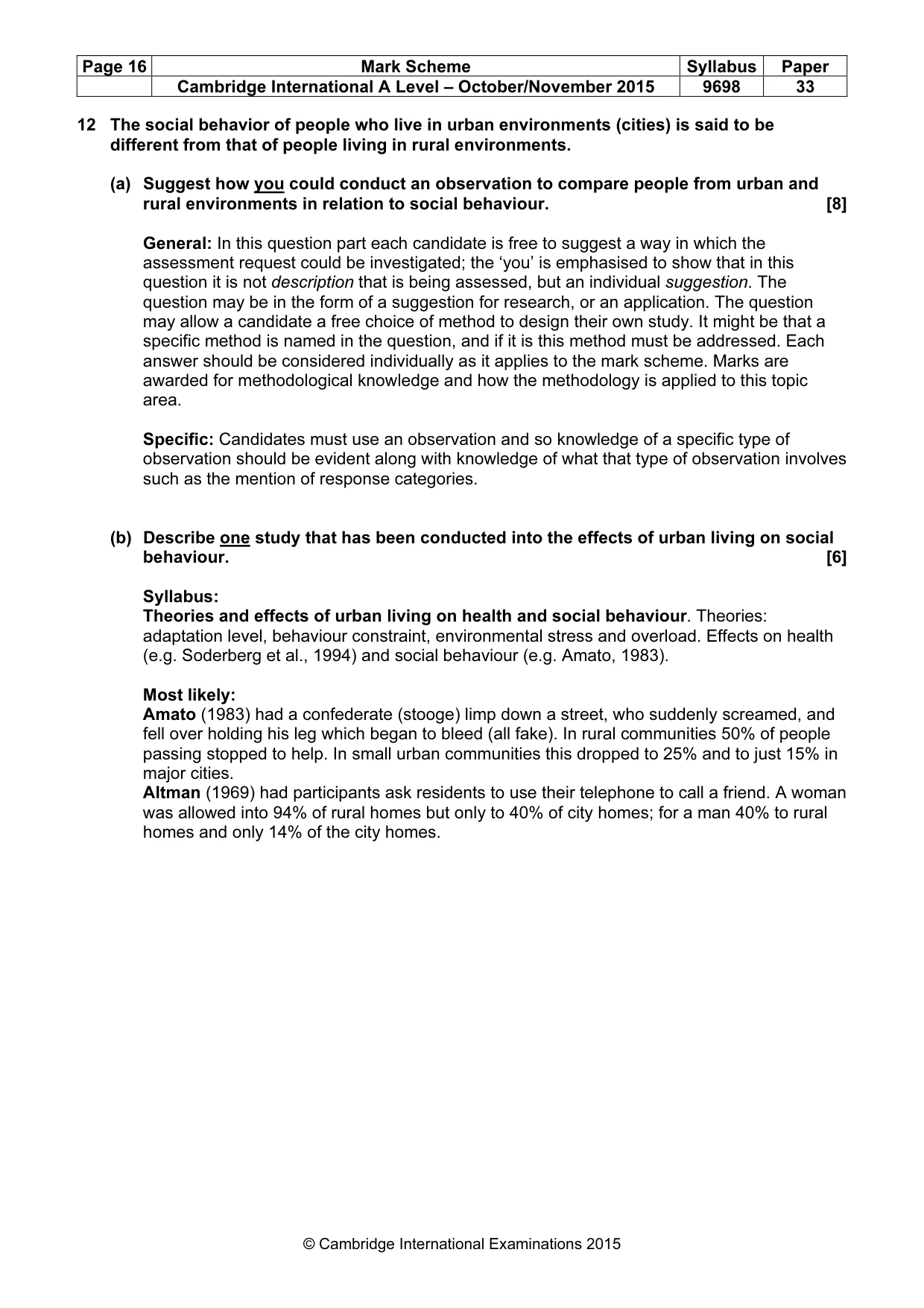
Page 16 Mark Scheme Syllabus Paper Cambridge International A Level – October/November 2015 9698 33 © Cambridge International Examinations 2015 12 The social behavior of people who live in urban environments (cities) is said to be different from that of people living in rural environments. (a) Suggest how you could conduct an observation to compare people from urban and rural environments in relation to social behaviour. [8] General: In this question part each candidate is free to suggest a way in which the assessment request could be investigated; the ‘you’ is emphasised to show that in this question it is not description that is being assessed, but an individual suggestion. The question may be in the form of a suggestion for research, or an application. The question may allow a candidate a free choice of method to design their own study. It might be that a specific method is named in the question, and if it is this method must be addressed. Each answer should be considered individually as it applies to the mark scheme. Marks are awarded for methodological knowledge and how the methodology is applied to this topic area. Specific: Candidates must use an observation and so knowledge of a specific type of observation should be evident along with knowledge of what that type of observation involves such as the mention of response categories. (b) Describe one study that has been conducted into the effects of urban living on social behaviour. [6] Syllabus: Theories and effects of urban living on health and social behaviour. Theories: adaptation level, behaviour constraint, environmental stress and overload. Effects on health (e.g. Soderberg et al., 1994) and social behaviour (e.g. Amato, 1983). Most likely: Amato (1983) had a confederate (stooge) limp down a street, who suddenly screamed, and fell over holding his leg which began to bleed (all fake). In rural communities 50% of people passing stopped to help. In small urban communities this dropped to 25% and to just 15% in major cities. Altman (1969) had participants ask residents to use their telephone to call a friend. A woman was allowed into 94% of rural homes but only to 40% of city homes; for a man 40% to rural homes and only 14% of the city homes.
Mark scheme, page 17
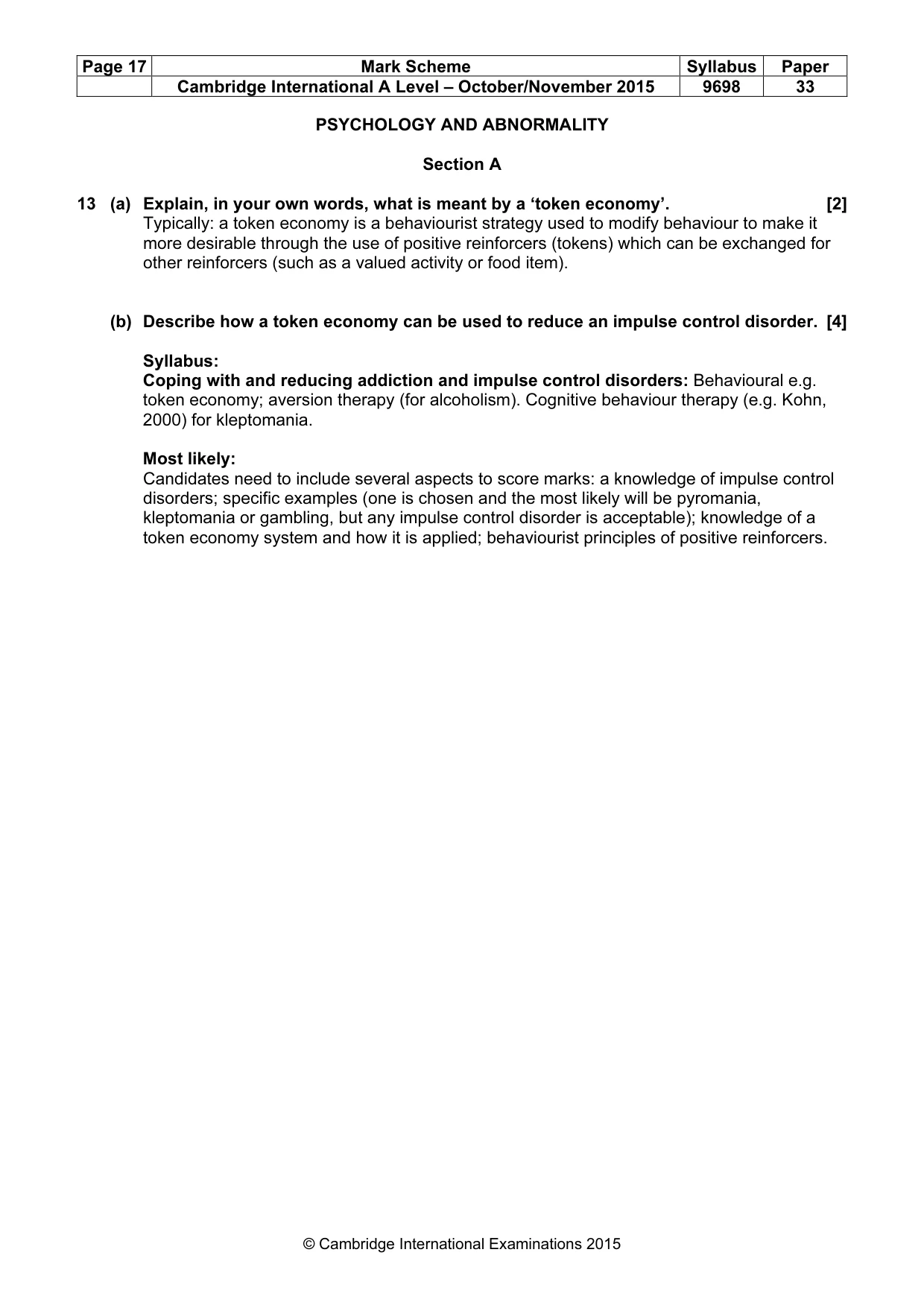
Page 17 Mark Scheme Syllabus Paper Cambridge International A Level – October/November 2015 9698 33 © Cambridge International Examinations 2015 PSYCHOLOGY AND ABNORMALITY Section A 13 (a) Explain, in your own words, what is meant by a ‘token economy’. [2] Typically: a token economy is a behaviourist strategy used to modify behaviour to make it more desirable through the use of positive reinforcers (tokens) which can be exchanged for other reinforcers (such as a valued activity or food item). (b) Describe how a token economy can be used to reduce an impulse control disorder. [4] Syllabus: Coping with and reducing addiction and impulse control disorders: Behavioural e.g. token economy; aversion therapy (for alcoholism). Cognitive behaviour therapy (e.g. Kohn, 2000) for kleptomania. Most likely: Candidates need to include several aspects to score marks: a knowledge of impulse control disorders; specific examples (one is chosen and the most likely will be pyromania, kleptomania or gambling, but any impulse control disorder is acceptable); knowledge of a token economy system and how it is applied; behaviourist principles of positive reinforcers.
Mark scheme, page 18
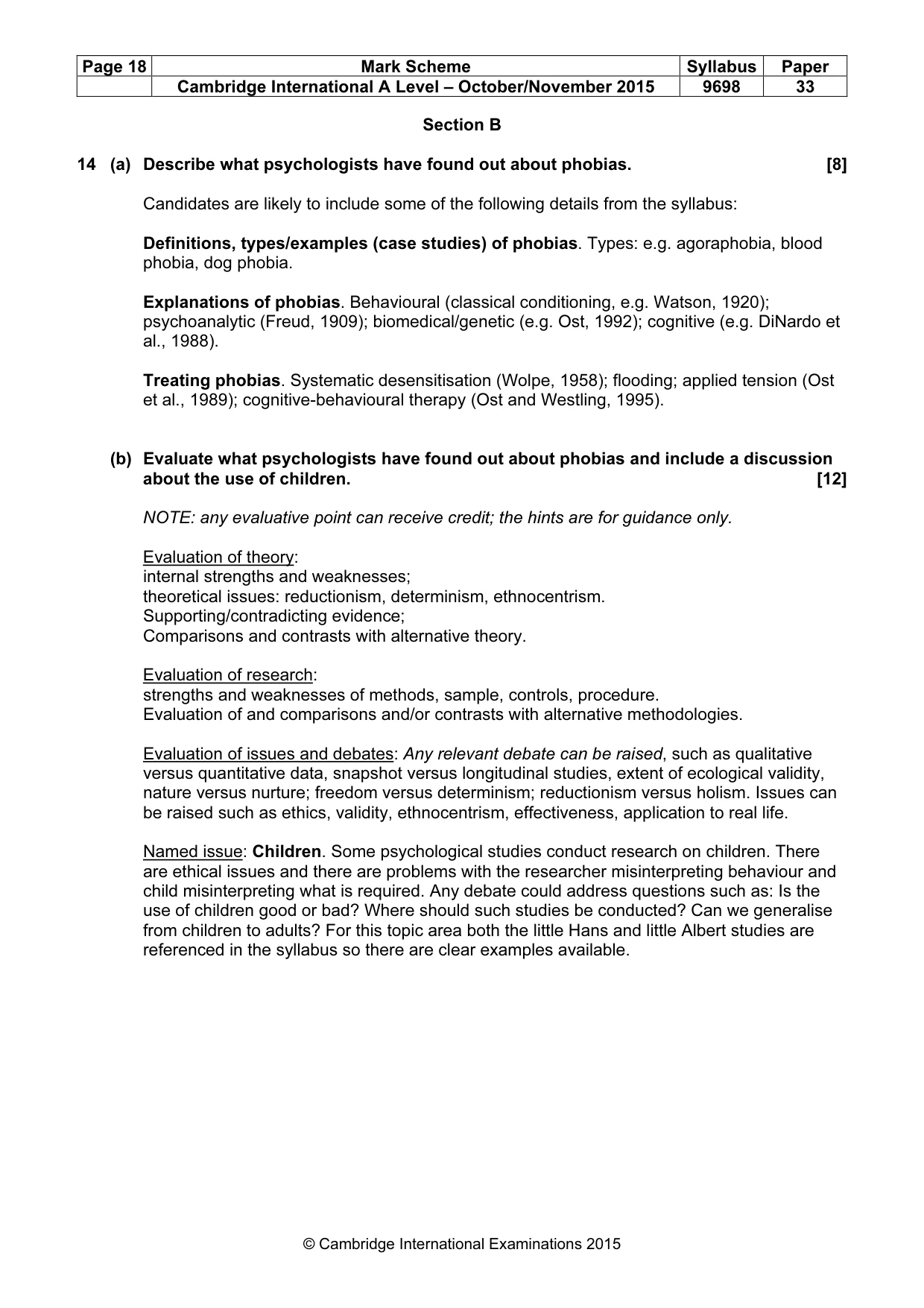
Page 18 Mark Scheme Syllabus Paper Cambridge International A Level – October/November 2015 9698 33 © Cambridge International Examinations 2015 Section B 14 (a) Describe what psychologists have found out about phobias. [8] Candidates are likely to include some of the following details from the syllabus: Definitions, types/examples (case studies) of phobias. Types: e.g. agoraphobia, blood phobia, dog phobia. Explanations of phobias. Behavioural (classical conditioning, e.g. Watson, 1920); psychoanalytic (Freud, 1909); biomedical/genetic (e.g. Ost, 1992); cognitive (e.g. DiNardo et al., 1988). Treating phobias. Systematic desensitisation (Wolpe, 1958); flooding; applied tension (Ost et al., 1989); cognitive-behavioural therapy (Ost and Westling, 1995). (b) Evaluate what psychologists have found out about phobias and include a discussion about the use of children. [12] NOTE: any evaluative point can receive credit; the hints are for guidance only. Evaluation of theory: internal strengths and weaknesses; theoretical issues: reductionism, determinism, ethnocentrism. Supporting/contradicting evidence; Comparisons and contrasts with alternative theory. Evaluation of research: strengths and weaknesses of methods, sample, controls, procedure. Evaluation of and comparisons and/or contrasts with alternative methodologies. Evaluation of issues and debates: Any relevant debate can be raised, such as qualitative versus quantitative data, snapshot versus longitudinal studies, extent of ecological validity, nature versus nurture; freedom versus determinism; reductionism versus holism. Issues can be raised such as ethics, validity, ethnocentrism, effectiveness, application to real life. Named issue: Children. Some psychological studies conduct research on children. There are ethical issues and there are problems with the researcher misinterpreting behaviour and child misinterpreting what is required. Any debate could address questions such as: Is the use of children good or bad? Where should such studies be conducted? Can we generalise from children to adults? For this topic area both the little Hans and little Albert studies are referenced in the syllabus so there are clear examples available.
Mark scheme, page 19
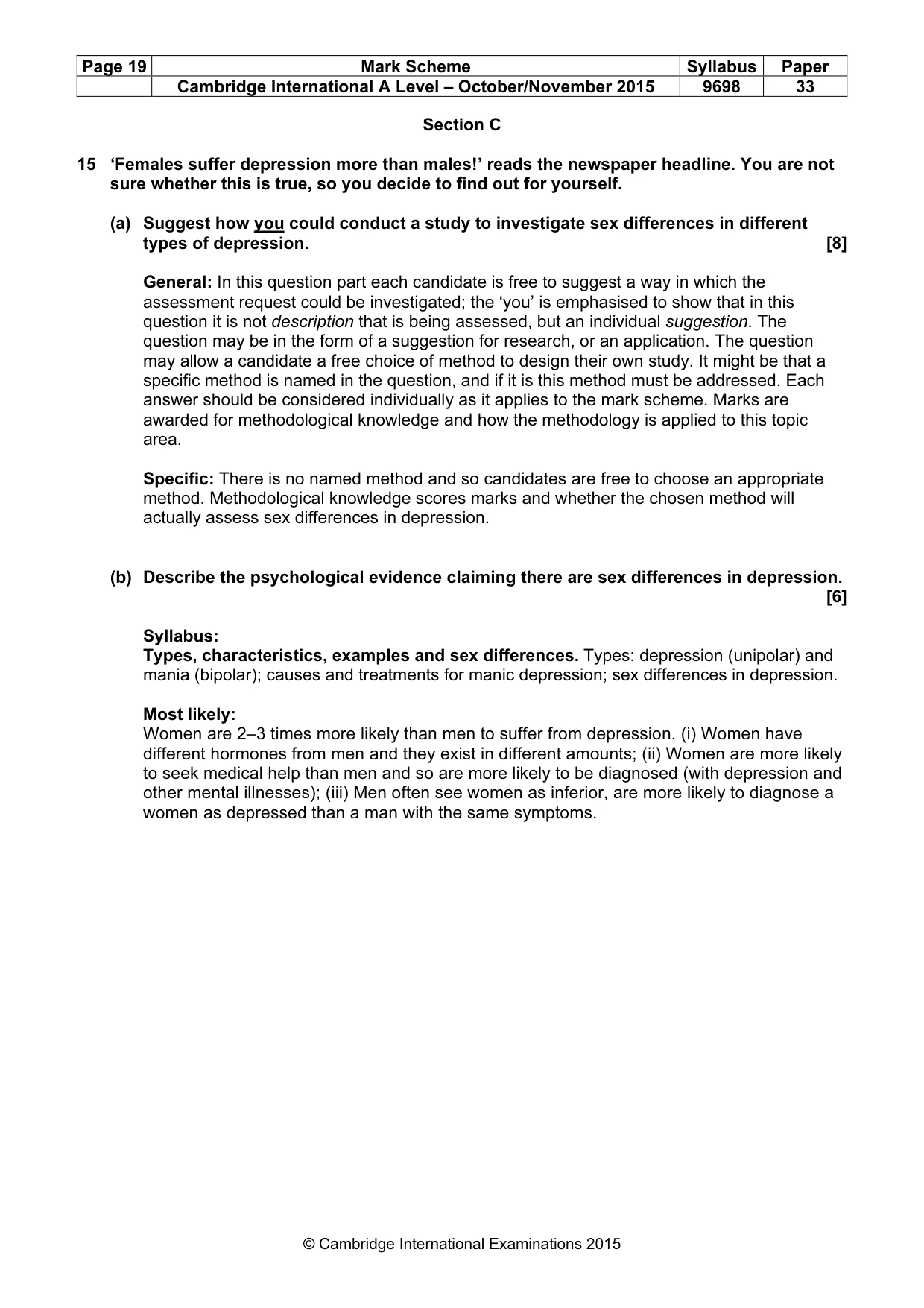
Page 19 Mark Scheme Syllabus Paper Cambridge International A Level – October/November 2015 9698 33 © Cambridge International Examinations 2015 Section C 15 ‘Females suffer depression more than males!’ reads the newspaper headline. You are not sure whether this is true, so you decide to find out for yourself. (a) Suggest how you could conduct a study to investigate sex differences in different types of depression. [8] General: In this question part each candidate is free to suggest a way in which the assessment request could be investigated; the ‘you’ is emphasised to show that in this question it is not description that is being assessed, but an individual suggestion. The question may be in the form of a suggestion for research, or an application. The question may allow a candidate a free choice of method to design their own study. It might be that a specific method is named in the question, and if it is this method must be addressed. Each answer should be considered individually as it applies to the mark scheme. Marks are awarded for methodological knowledge and how the methodology is applied to this topic area. Specific: There is no named method and so candidates are free to choose an appropriate method. Methodological knowledge scores marks and whether the chosen method will actually assess sex differences in depression. (b) Describe the psychological evidence claiming there are sex differences in depression. [6] Syllabus: Types, characteristics, examples and sex differences. Types: depression (unipolar) and mania (bipolar); causes and treatments for manic depression; sex differences in depression. Most likely: Women are 2–3 times more likely than men to suffer from depression. (i) Women have different hormones from men and they exist in different amounts; (ii) Women are more likely to seek medical help than men and so are more likely to be diagnosed (with depression and other mental illnesses); (iii) Men often see women as inferior, are more likely to diagnose a women as depressed than a man with the same symptoms.
Mark scheme, page 20
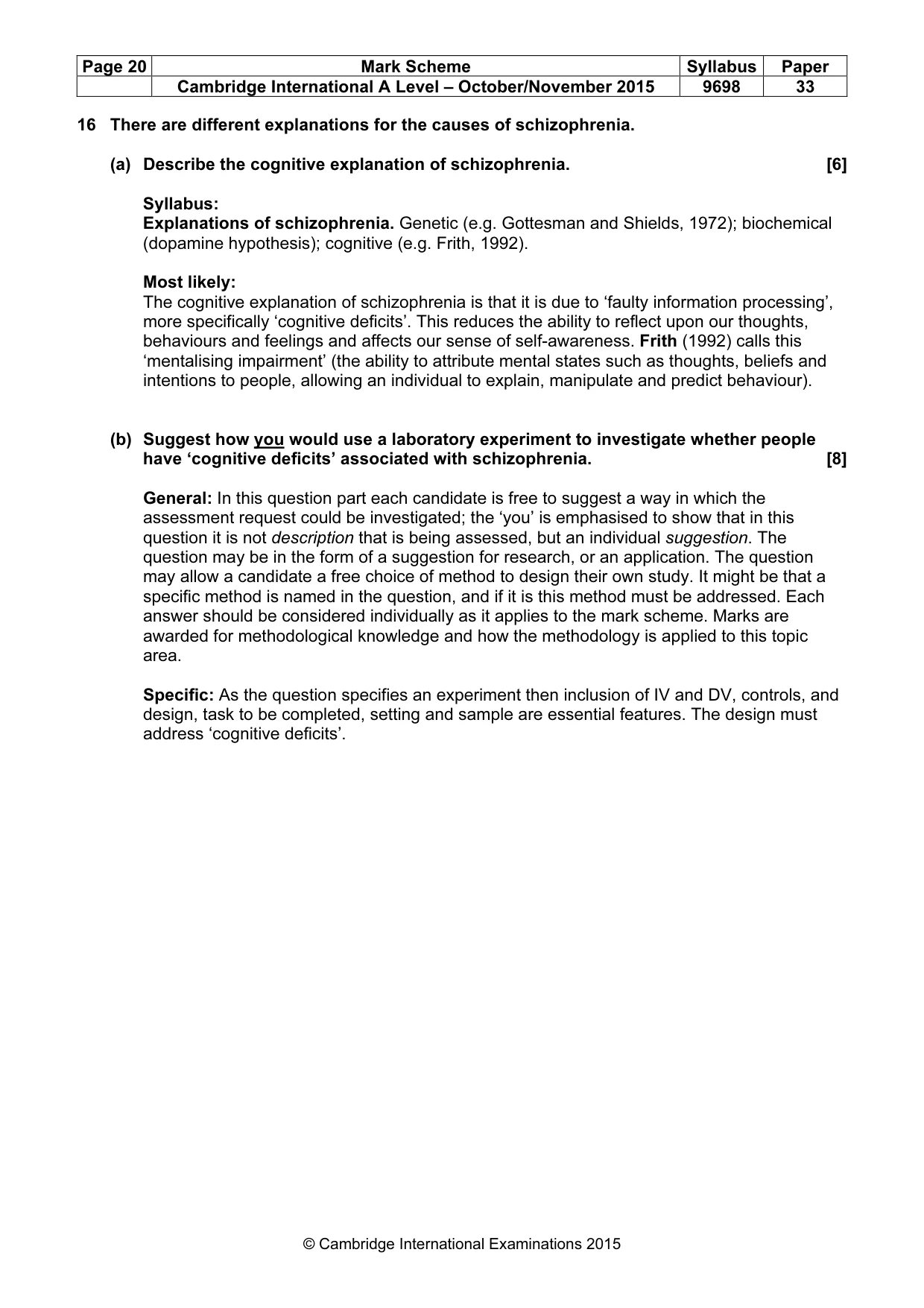
Page 20 Mark Scheme Syllabus Paper Cambridge International A Level – October/November 2015 9698 33 © Cambridge International Examinations 2015 16 There are different explanations for the causes of schizophrenia. (a) Describe the cognitive explanation of schizophrenia. [6] Syllabus: Explanations of schizophrenia. Genetic (e.g. Gottesman and Shields, 1972); biochemical (dopamine hypothesis); cognitive (e.g. Frith, 1992). Most likely: The cognitive explanation of schizophrenia is that it is due to ‘faulty information processing’, more specifically ‘cognitive deficits’. This reduces the ability to reflect upon our thoughts, behaviours and feelings and affects our sense of self-awareness. Frith (1992) calls this ‘mentalising impairment’ (the ability to attribute mental states such as thoughts, beliefs and intentions to people, allowing an individual to explain, manipulate and predict behaviour). (b) Suggest how you would use a laboratory experiment to investigate whether people have ‘cognitive deficits’ associated with schizophrenia. [8] General: In this question part each candidate is free to suggest a way in which the assessment request could be investigated; the ‘you’ is emphasised to show that in this question it is not description that is being assessed, but an individual suggestion. The question may be in the form of a suggestion for research, or an application. The question may allow a candidate a free choice of method to design their own study. It might be that a specific method is named in the question, and if it is this method must be addressed. Each answer should be considered individually as it applies to the mark scheme. Marks are awarded for methodological knowledge and how the methodology is applied to this topic area. Specific: As the question specifies an experiment then inclusion of IV and DV, controls, and design, task to be completed, setting and sample are essential features. The design must address ‘cognitive deficits’.
Mark scheme, page 21
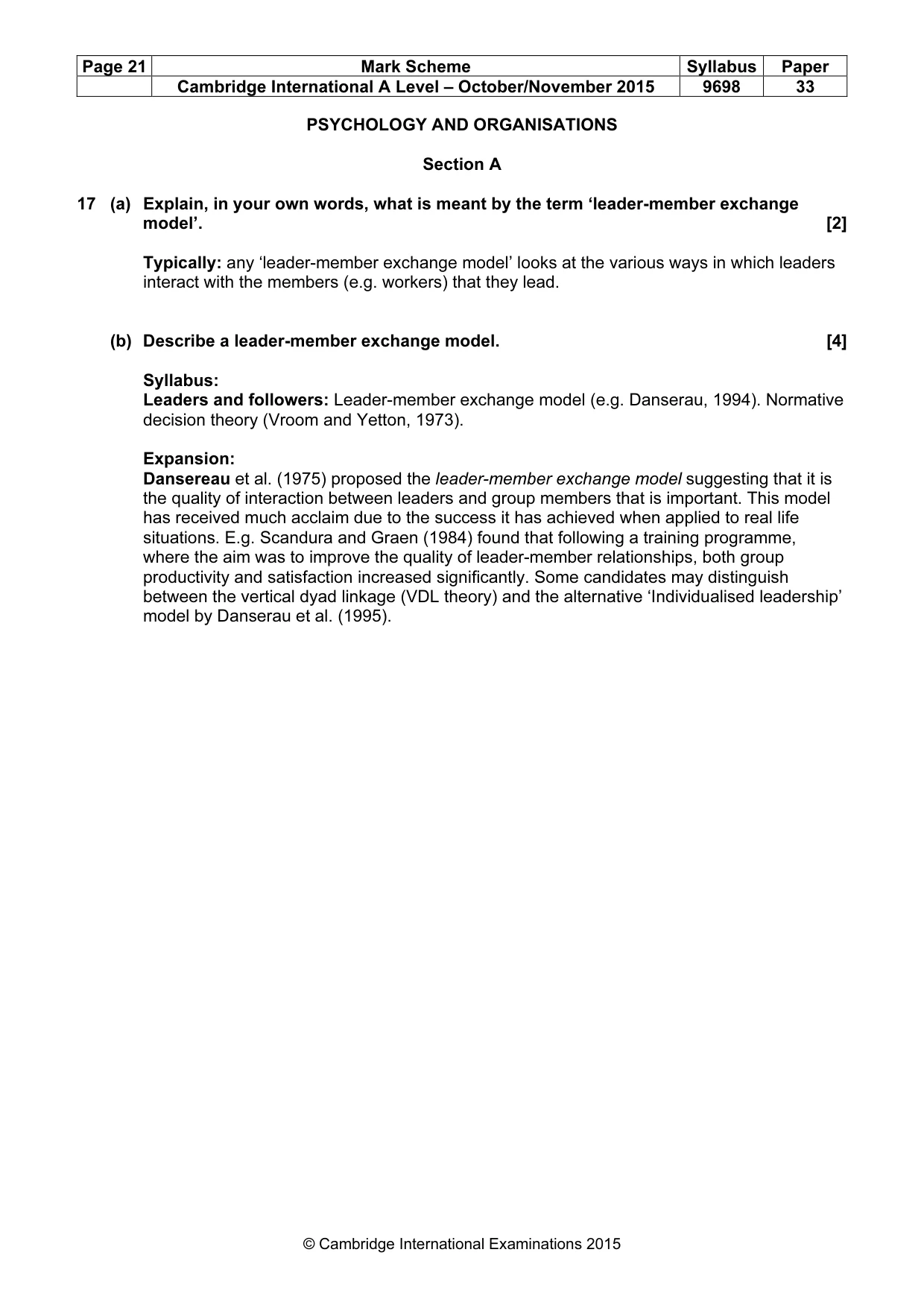
Page 21 Mark Scheme Syllabus Paper Cambridge International A Level – October/November 2015 9698 33 © Cambridge International Examinations 2015 PSYCHOLOGY AND ORGANISATIONS Section A 17 (a) Explain, in your own words, what is meant by the term ‘leader-member exchange model’. [2] Typically: any ‘leader-member exchange model’ looks at the various ways in which leaders interact with the members (e.g. workers) that they lead. (b) Describe a leader-member exchange model. [4] Syllabus: Leaders and followers: Leader-member exchange model (e.g. Danserau, 1994). Normative decision theory (Vroom and Yetton, 1973). Expansion: Dansereau et al. (1975) proposed the leader-member exchange model suggesting that it is the quality of interaction between leaders and group members that is important. This model has received much acclaim due to the success it has achieved when applied to real life situations. E.g. Scandura and Graen (1984) found that following a training programme, where the aim was to improve the quality of leader-member relationships, both group productivity and satisfaction increased significantly. Some candidates may distinguish between the vertical dyad linkage (VDL theory) and the alternative ‘Individualised leadership’ model by Danserau et al. (1995).
Mark scheme, page 22
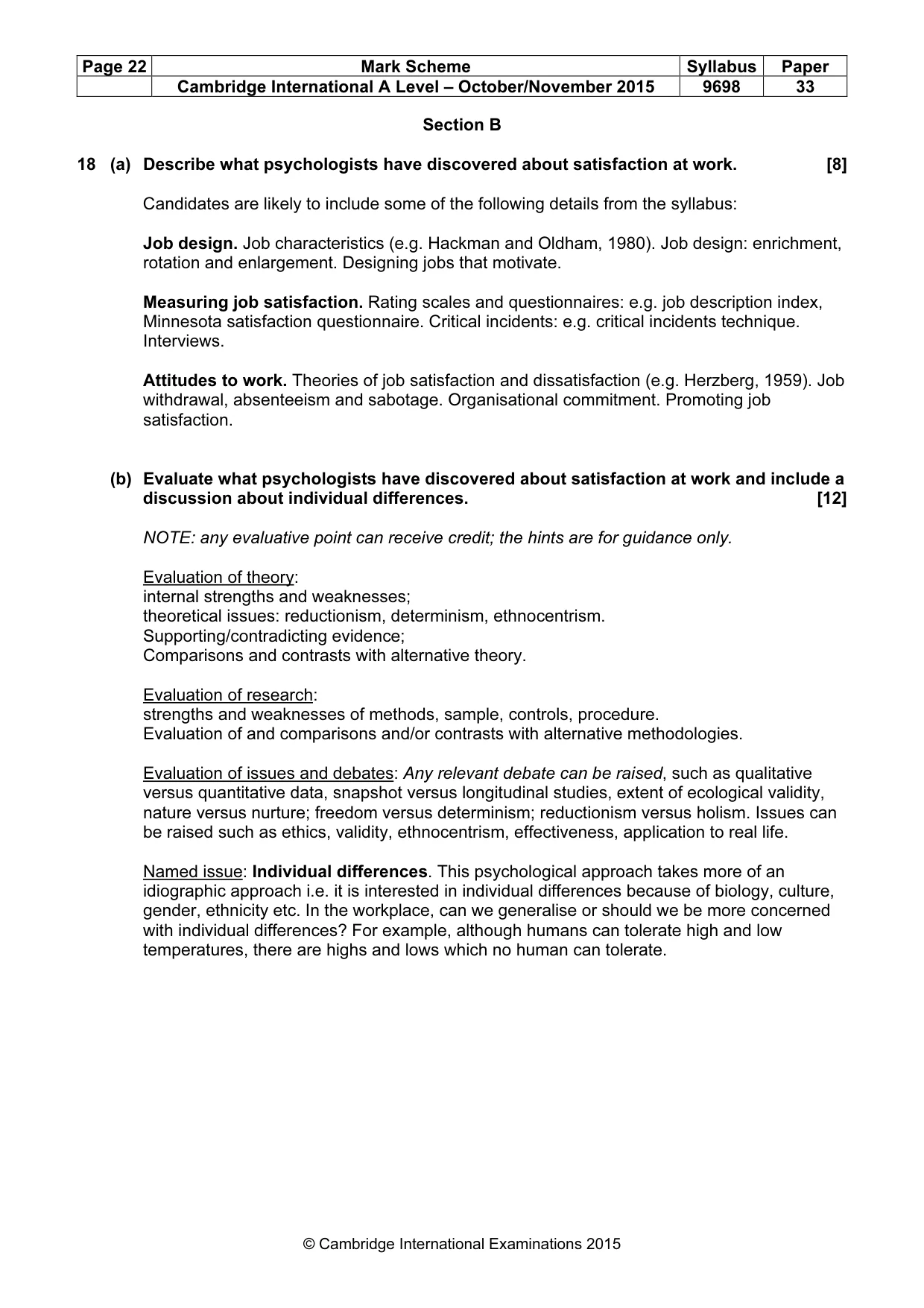
Page 22 Mark Scheme Syllabus Paper Cambridge International A Level – October/November 2015 9698 33 © Cambridge International Examinations 2015 Section B 18 (a) Describe what psychologists have discovered about satisfaction at work. [8] Candidates are likely to include some of the following details from the syllabus: Job design. Job characteristics (e.g. Hackman and Oldham, 1980). Job design: enrichment, rotation and enlargement. Designing jobs that motivate. Measuring job satisfaction. Rating scales and questionnaires: e.g. job description index, Minnesota satisfaction questionnaire. Critical incidents: e.g. critical incidents technique. Interviews. Attitudes to work. Theories of job satisfaction and dissatisfaction (e.g. Herzberg, 1959). Job withdrawal, absenteeism and sabotage. Organisational commitment. Promoting job satisfaction. (b) Evaluate what psychologists have discovered about satisfaction at work and include a discussion about individual differences. [12] NOTE: any evaluative point can receive credit; the hints are for guidance only. Evaluation of theory: internal strengths and weaknesses; theoretical issues: reductionism, determinism, ethnocentrism. Supporting/contradicting evidence; Comparisons and contrasts with alternative theory. Evaluation of research: strengths and weaknesses of methods, sample, controls, procedure. Evaluation of and comparisons and/or contrasts with alternative methodologies. Evaluation of issues and debates: Any relevant debate can be raised, such as qualitative versus quantitative data, snapshot versus longitudinal studies, extent of ecological validity, nature versus nurture; freedom versus determinism; reductionism versus holism. Issues can be raised such as ethics, validity, ethnocentrism, effectiveness, application to real life. Named issue: Individual differences. This psychological approach takes more of an idiographic approach i.e. it is interested in individual differences because of biology, culture, gender, ethnicity etc. In the workplace, can we generalise or should we be more concerned with individual differences? For example, although humans can tolerate high and low temperatures, there are highs and lows which no human can tolerate.
Mark scheme, page 23
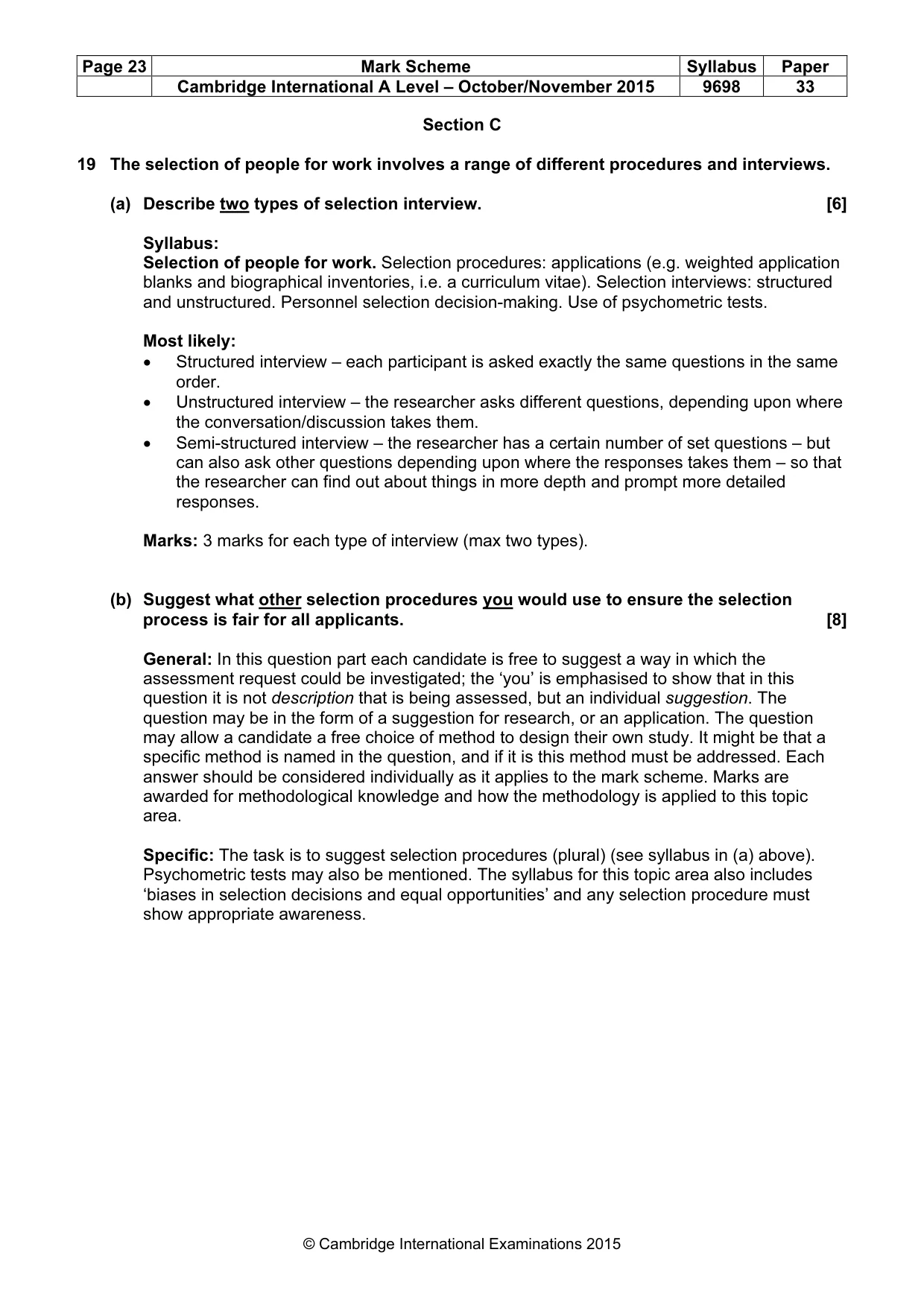
Page 23 Mark Scheme Syllabus Paper Cambridge International A Level – October/November 2015 9698 33 © Cambridge International Examinations 2015 Section C 19 The selection of people for work involves a range of different procedures and interviews. (a) Describe two types of selection interview. [6] Syllabus: Selection of people for work. Selection procedures: applications (e.g. weighted application blanks and biographical inventories, i.e. a curriculum vitae). Selection interviews: structured and unstructured. Personnel selection decision-making. Use of psychometric tests. Most likely: • Structured interview – each participant is asked exactly the same questions in the same order. • Unstructured interview – the researcher asks different questions, depending upon where the conversation/discussion takes them. • Semi-structured interview – the researcher has a certain number of set questions – but can also ask other questions depending upon where the responses takes them – so that the researcher can find out about things in more depth and prompt more detailed responses. Marks: 3 marks for each type of interview (max two types). (b) Suggest what other selection procedures you would use to ensure the selection process is fair for all applicants. [8] General: In this question part each candidate is free to suggest a way in which the assessment request could be investigated; the ‘you’ is emphasised to show that in this question it is not description that is being assessed, but an individual suggestion. The question may be in the form of a suggestion for research, or an application. The question may allow a candidate a free choice of method to design their own study. It might be that a specific method is named in the question, and if it is this method must be addressed. Each answer should be considered individually as it applies to the mark scheme. Marks are awarded for methodological knowledge and how the methodology is applied to this topic area. Specific: The task is to suggest selection procedures (plural) (see syllabus in (a) above). Psychometric tests may also be mentioned. The syllabus for this topic area also includes ‘biases in selection decisions and equal opportunities’ and any selection procedure must show appropriate awareness.
Mark scheme, page 24
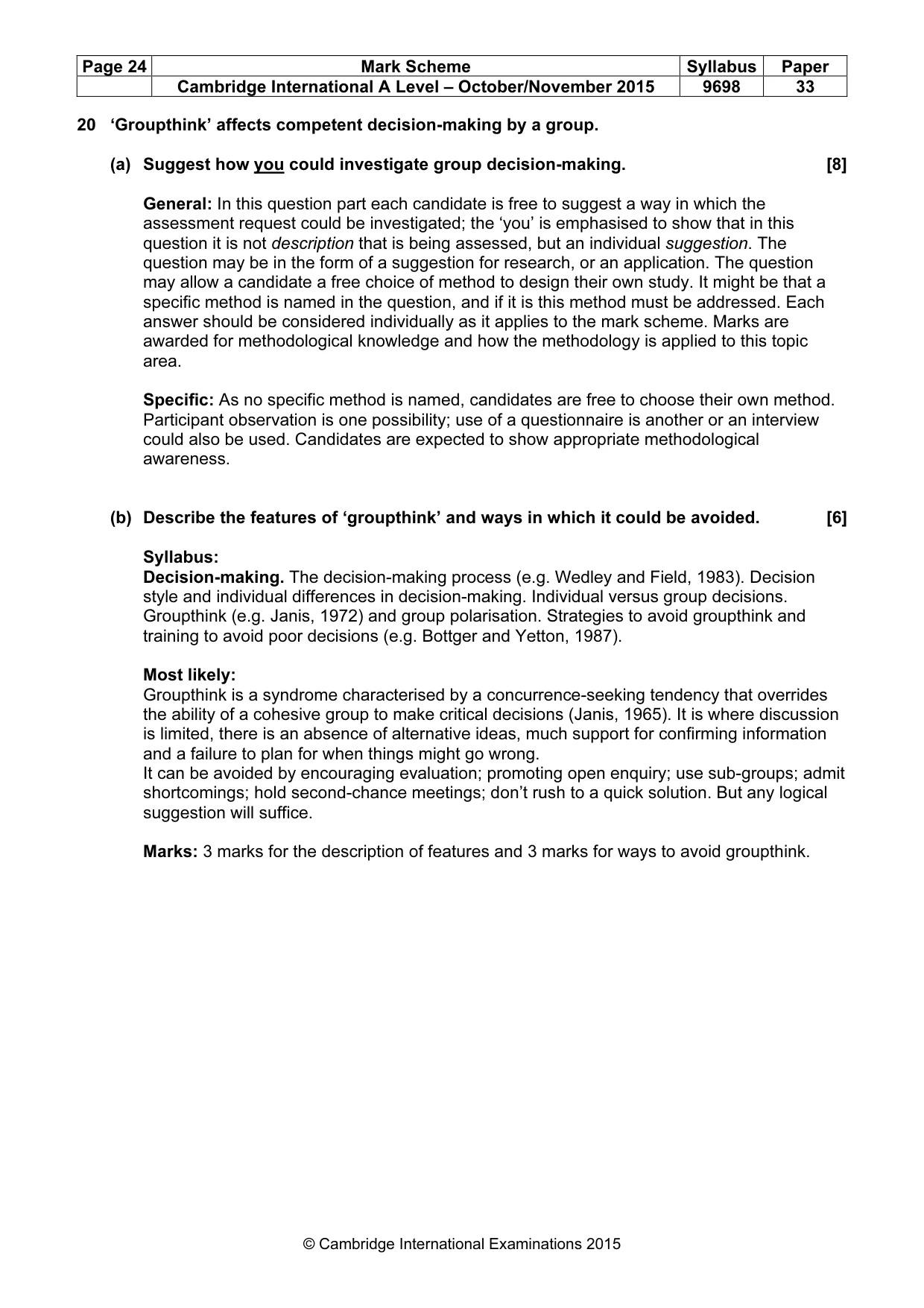
Page 24 Mark Scheme Syllabus Paper Cambridge International A Level – October/November 2015 9698 33 © Cambridge International Examinations 2015 20 ‘Groupthink’ affects competent decision-making by a group. (a) Suggest how you could investigate group decision-making. [8] General: In this question part each candidate is free to suggest a way in which the assessment request could be investigated; the ‘you’ is emphasised to show that in this question it is not description that is being assessed, but an individual suggestion. The question may be in the form of a suggestion for research, or an application. The question may allow a candidate a free choice of method to design their own study. It might be that a specific method is named in the question, and if it is this method must be addressed. Each answer should be considered individually as it applies to the mark scheme. Marks are awarded for methodological knowledge and how the methodology is applied to this topic area. Specific: As no specific method is named, candidates are free to choose their own method. Participant observation is one possibility; use of a questionnaire is another or an interview could also be used. Candidates are expected to show appropriate methodological awareness. (b) Describe the features of ‘groupthink’ and ways in which it could be avoided. [6] Syllabus: Decision-making. The decision-making process (e.g. Wedley and Field, 1983). Decision style and individual differences in decision-making. Individual versus group decisions. Groupthink (e.g. Janis, 1972) and group polarisation. Strategies to avoid groupthink and training to avoid poor decisions (e.g. Bottger and Yetton, 1987). Most likely: Groupthink is a syndrome characterised by a concurrence-seeking tendency that overrides the ability of a cohesive group to make critical decisions (Janis, 1965). It is where discussion is limited, there is an absence of alternative ideas, much support for confirming information and a failure to plan for when things might go wrong. It can be avoided by encouraging evaluation; promoting open enquiry; use sub-groups; admit shortcomings; hold second-chance meetings; don’t rush to a quick solution. But any logical suggestion will suffice. Marks: 3 marks for the description of features and 3 marks for ways to avoid groupthink.
What you needed in this session
Cambridge’s own grade thresholds for 2015 Oct/Nov, Paper 3 · Variant 3. A higher threshold means an easier paper — the bar moves with how the cohort did.