Cambridge A Level Portuguese (A Level only) 9718 — 2019 May/June Paper 2 · Variant 1
9718/21/M/J/19 · 70 marks · ≈79 min
The question paper and its mark scheme, free to read here and free to download. This is Cambridge’s own paper, exactly as it was sat.
Question paper12 pages



Mark scheme14 pages
Answers below. Sit the paper first if you are practising.
Paper as text
Question paper, page 1
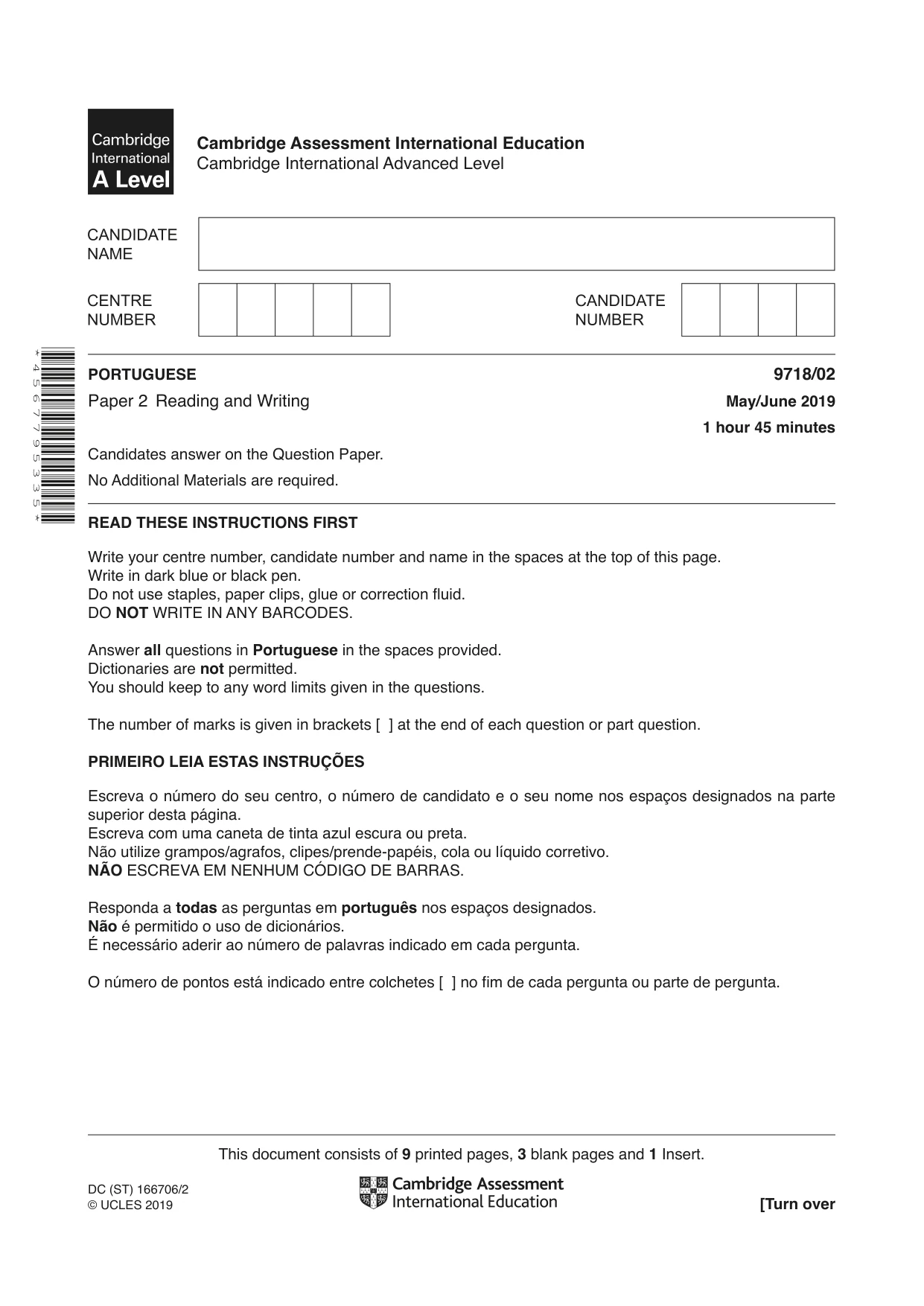
This document consists of 9 printed pages, 3 blank pages and 1 Insert. DC (ST) 166706/2 © UCLES 2019 [Turn over * 4 5 6 7 7 9 5 3 3 5 * PORTUGUESE 9718/02 Paper 2 Reading and Writing May/June 2019 1 hour 45 minutes Candidates answer on the Question Paper. No Additional Materials are required. READ THESE INSTRUCTIONS FIRST Write your centre number, candidate number and name in the spaces at the top of this page. Write in dark blue or black pen. Do not use staples, paper clips, glue or correction fluid. DO NOT WRITE IN ANY BARCODES. Answer all questions in Portuguese in the spaces provided. Dictionaries are not permitted. You should keep to any word limits given in the questions. The number of marks is given in brackets [ ] at the end of each question or part question. PRIMEIRO LEIA ESTAS INSTRUÇÕES Escreva o número do seu centro, o número de candidato e o seu nome nos espaços designados na parte superior desta página. Escreva com uma caneta de tinta azul escura ou preta. Não utilize grampos/agrafos, clipes/prende-papéis, cola ou líquido corretivo. NÃO ESCREVA EM NENHUM CÓDIGO DE BARRAS. Responda a todas as perguntas em português nos espaços designados. Não é permitido o uso de dicionários. É necessário aderir ao número de palavras indicado em cada pergunta. O número de pontos está indicado entre colchetes [ ] no fim de cada pergunta ou parte de pergunta. Cambridge Assessment International Education Cambridge International Advanced Level
Question paper, page 2
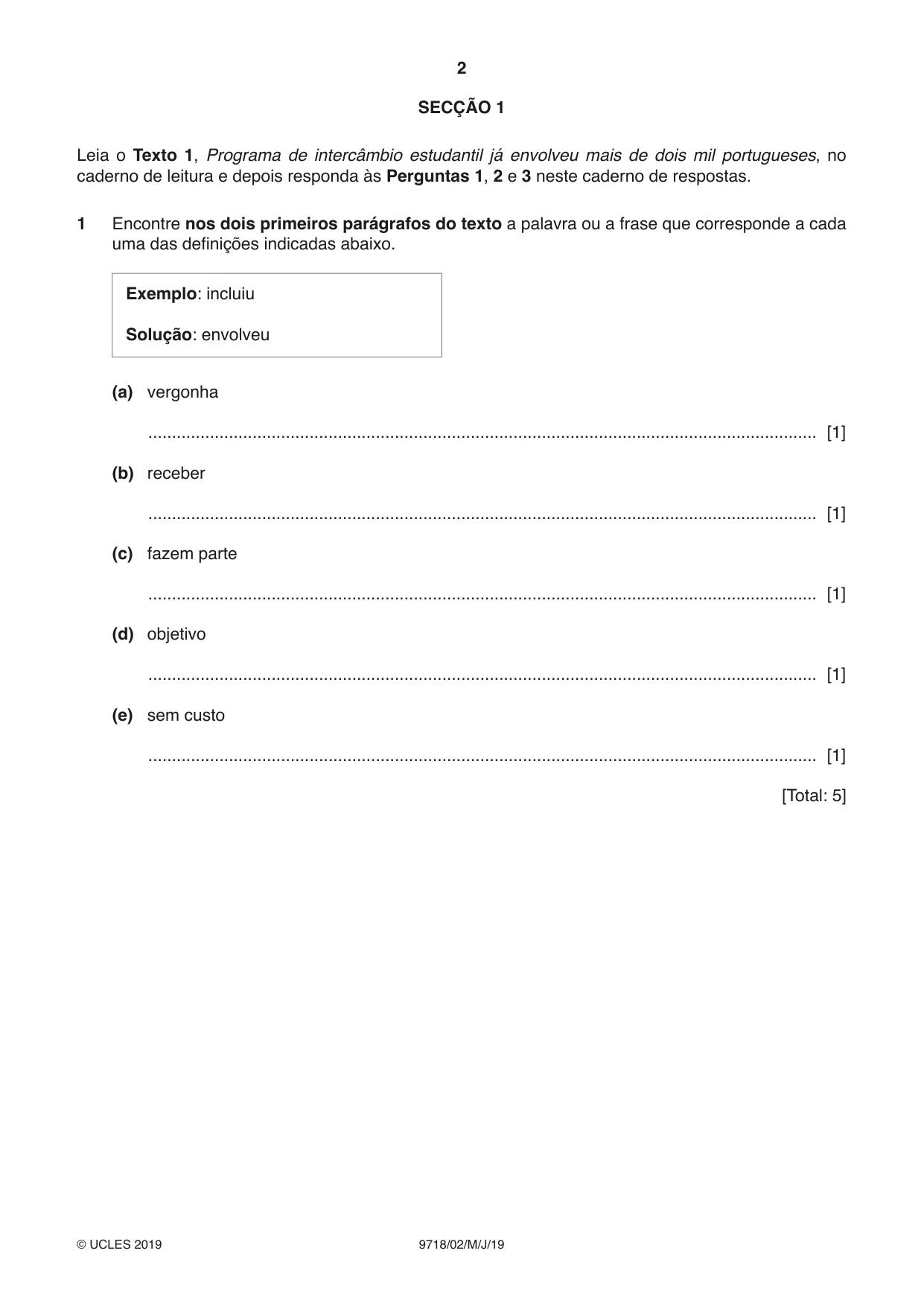
2 9718/02/M/J/19 © UCLES 2019 SECÇÃO 1 Leia o Texto 1, Programa de intercâmbio estudantil já envolveu mais de dois mil portugueses, no caderno de leitura e depois responda às Perguntas 1, 2 e 3 neste caderno de respostas. 1 Encontre nos dois primeiros parágrafos do texto a palavra ou a frase que corresponde a cada uma das definições indicadas abaixo. Exemplo: incluiu Solução: envolveu (a) vergonha … [1] (b) receber … [1] (c) fazem parte … [1] (d) objetivo … [1] (e) sem custo … [1] [Total: 5]
Question paper, page 3
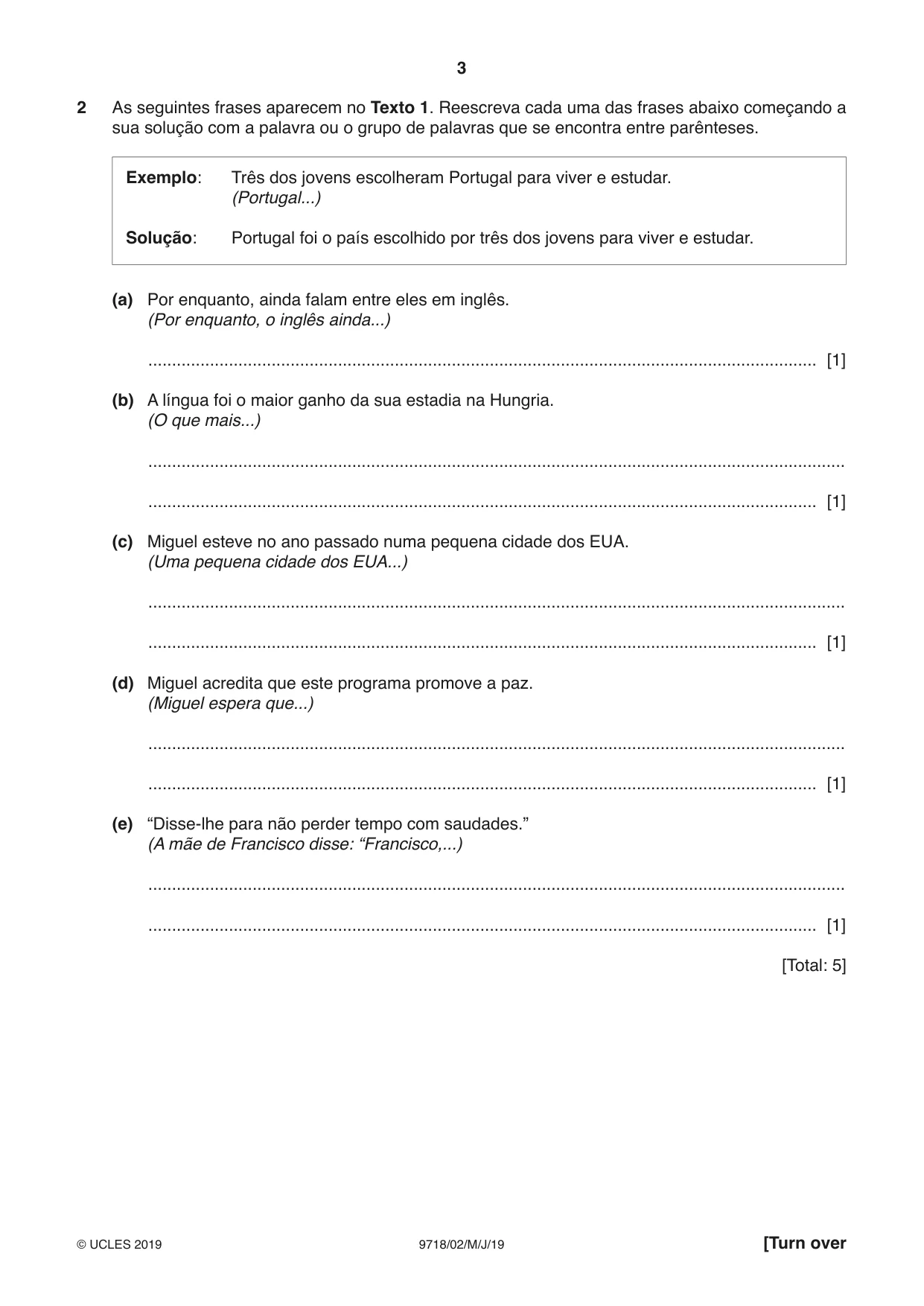
3 9718/02/M/J/19 © UCLES 2019 [Turn over 2 As seguintes frases aparecem no Texto 1. Reescreva cada uma das frases abaixo começando a sua solução com a palavra ou o grupo de palavras que se encontra entre parênteses. Exemplo: Três dos jovens escolheram Portugal para viver e estudar. (Portugal...) Solução: Portugal foi o país escolhido por três dos jovens para viver e estudar. (a) Por enquanto, ainda falam entre eles em inglês. (Por enquanto, o inglês ainda...) … [1] (b) A língua foi o maior ganho da sua estadia na Hungria. (O que mais...) … … [1] (c) Miguel esteve no ano passado numa pequena cidade dos EUA. (Uma pequena cidade dos EUA...) … … [1] (d) Miguel acredita que este programa promove a paz. (Miguel espera que...) … … [1] (e) “Disse-lhe para não perder tempo com saudades.” (A mãe de Francisco disse: “Francisco,...) … … [1] [Total: 5]
Question paper, page 4
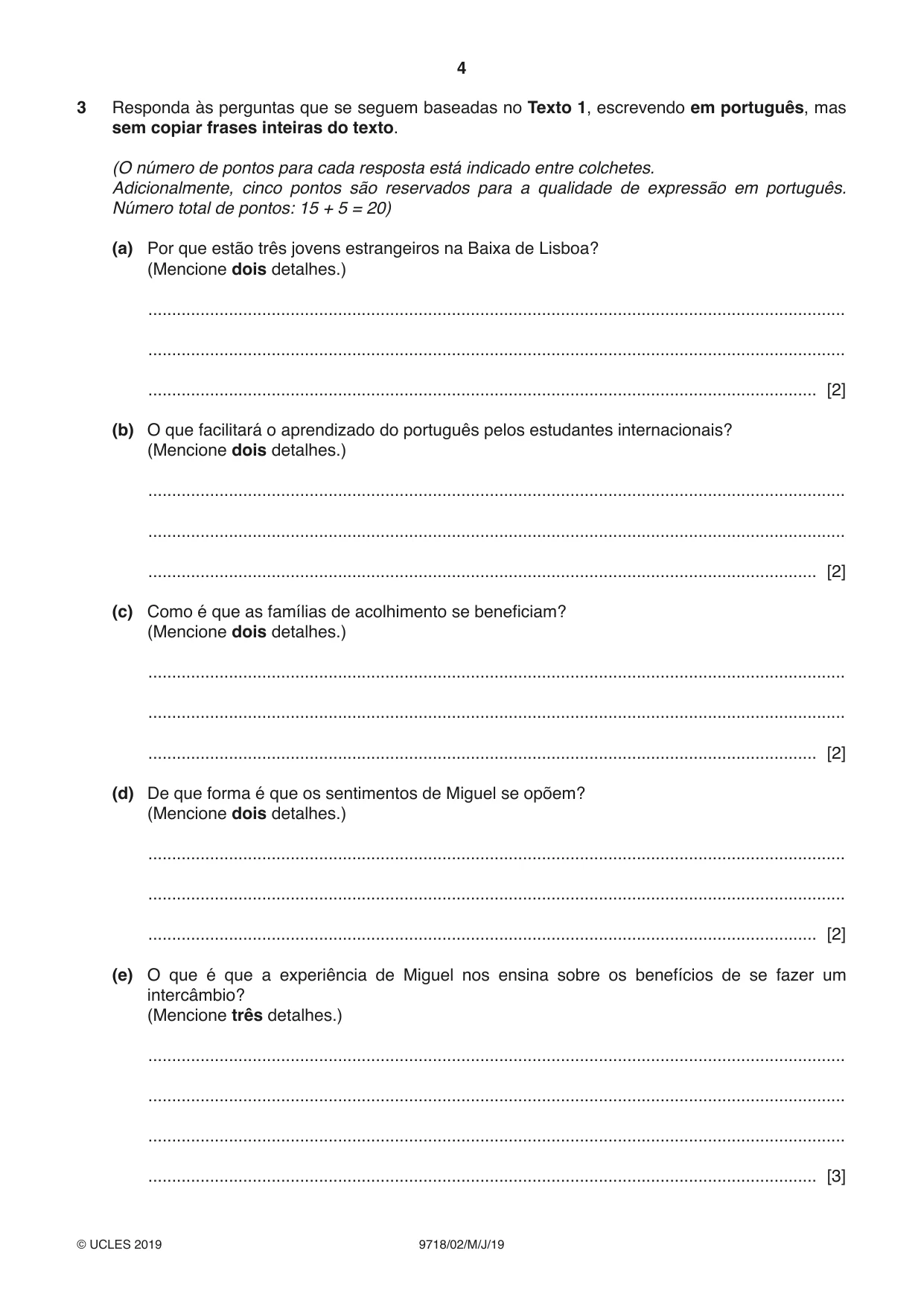
4 9718/02/M/J/19 © UCLES 2019 3 Responda às perguntas que se seguem baseadas no Texto 1, escrevendo em português, mas sem copiar frases inteiras do texto. (O número de pontos para cada resposta está indicado entre colchetes. Adicionalmente, cinco pontos são reservados para a qualidade de expressão em português. Número total de pontos: 15 + 5 = 20) (a) Por que estão três jovens estrangeiros na Baixa de Lisboa? (Mencione dois detalhes.) … … … [2] (b) O que facilitará o aprendizado do português pelos estudantes internacionais? (Mencione dois detalhes.) … … … [2] (c) Como é que as famílias de acolhimento se beneficiam? (Mencione dois detalhes.) … … … [2] (d) De que forma é que os sentimentos de Miguel se opõem? (Mencione dois detalhes.) … … … [2] (e) O que é que a experiência de Miguel nos ensina sobre os benefícios de se fazer um intercâmbio? (Mencione três detalhes.) … … … … [3]
Question paper, page 5
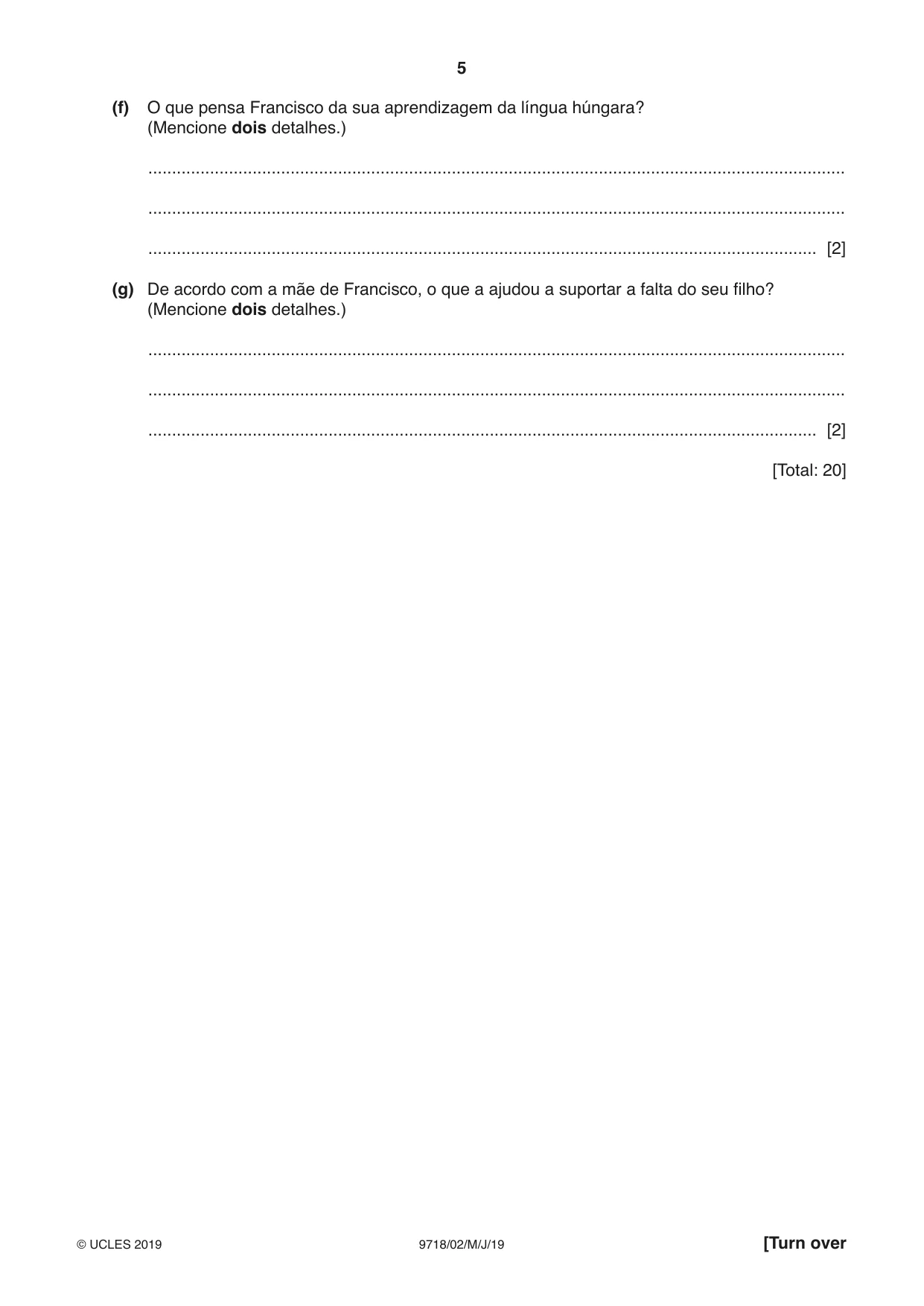
5 9718/02/M/J/19 © UCLES 2019 [Turn over (f) O que pensa Francisco da sua aprendizagem da língua húngara? (Mencione dois detalhes.) … … … [2] (g) De acordo com a mãe de Francisco, o que a ajudou a suportar a falta do seu filho? (Mencione dois detalhes.) … … … [2] [Total: 20]
Question paper, page 6
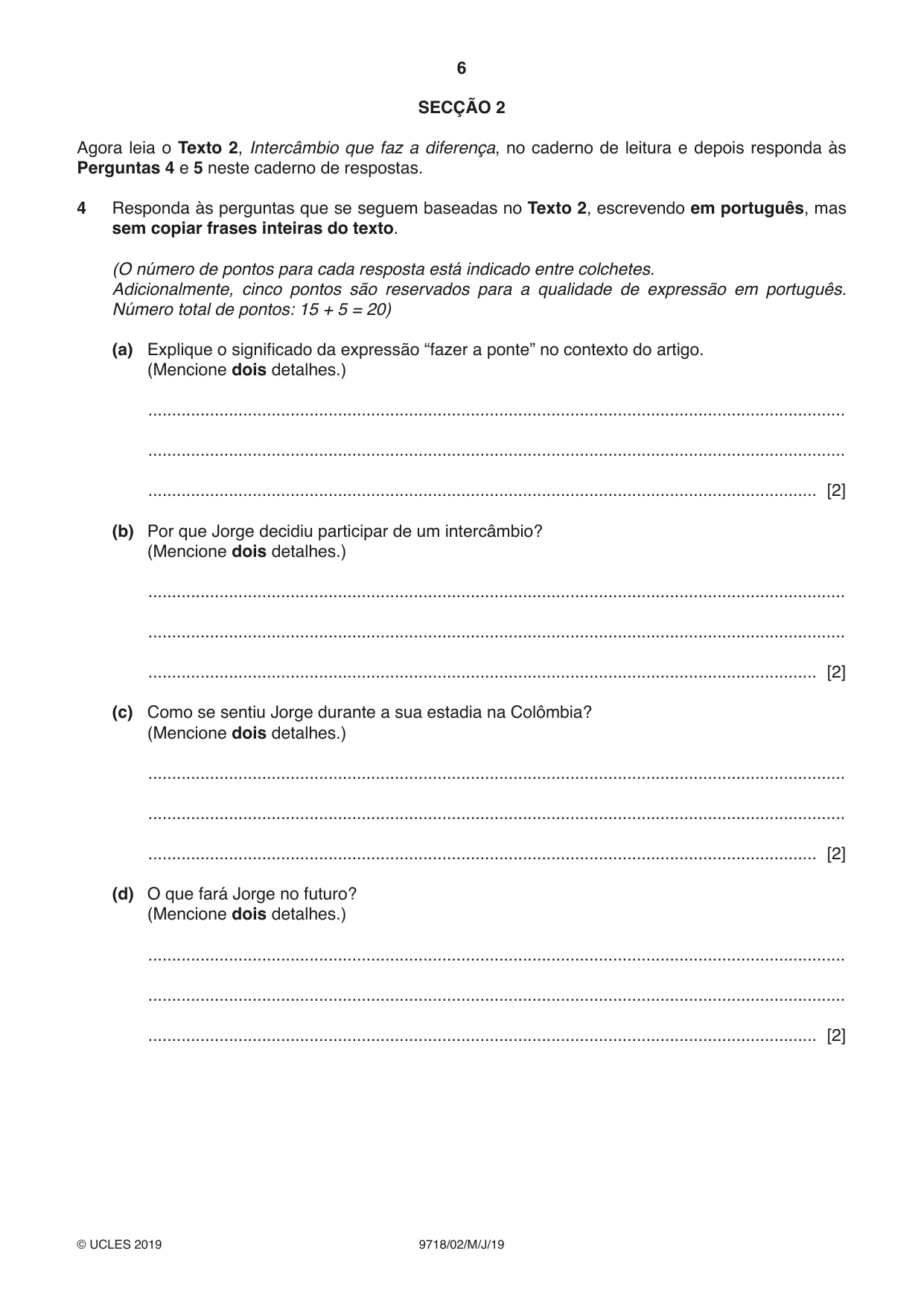
6 9718/02/M/J/19 © UCLES 2019 SECÇÃO 2 Agora leia o Texto 2, Intercâmbio que faz a diferença, no caderno de leitura e depois responda às Perguntas 4 e 5 neste caderno de respostas. 4 Responda às perguntas que se seguem baseadas no Texto 2, escrevendo em português, mas sem copiar frases inteiras do texto. (O número de pontos para cada resposta está indicado entre colchetes. Adicionalmente, cinco pontos são reservados para a qualidade de expressão em português. Número total de pontos: 15 + 5 = 20) (a) Explique o significado da expressão “fazer a ponte” no contexto do artigo. (Mencione dois detalhes.) … … … [2] (b) Por que Jorge decidiu participar de um intercâmbio? (Mencione dois detalhes.) … … … [2] (c) Como se sentiu Jorge durante a sua estadia na Colômbia? (Mencione dois detalhes.) … … … [2] (d) O que fará Jorge no futuro? (Mencione dois detalhes.) … … … [2]
Question paper, page 7
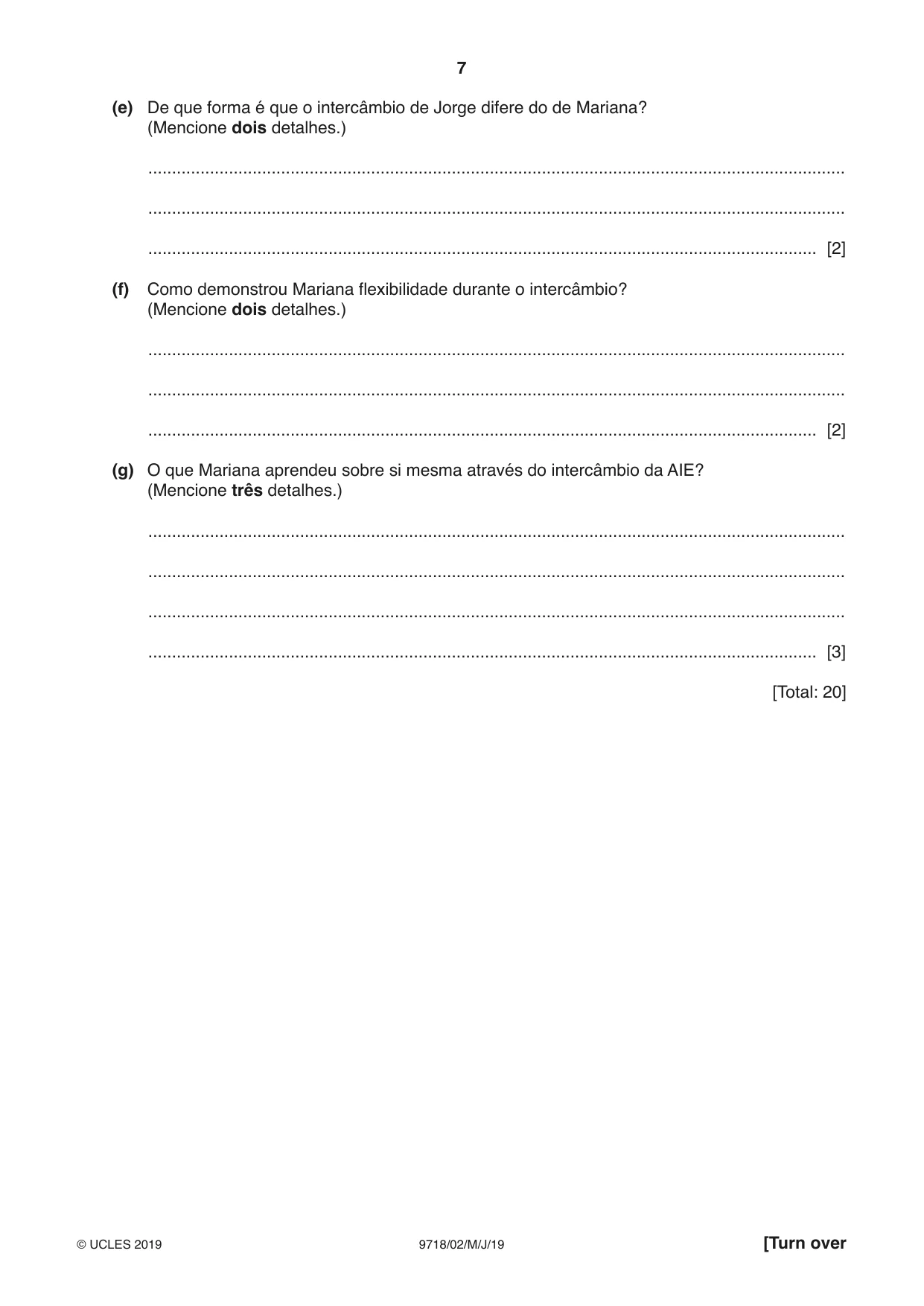
7 9718/02/M/J/19 © UCLES 2019 [Turn over (e) De que forma é que o intercâmbio de Jorge difere do de Mariana? (Mencione dois detalhes.) … … … [2] (f) Como demonstrou Mariana flexibilidade durante o intercâmbio? (Mencione dois detalhes.) … … … [2] (g) O que Mariana aprendeu sobre si mesma através do intercâmbio da AIE? (Mencione três detalhes.) … … … … [3] [Total: 20]
Question paper, page 8
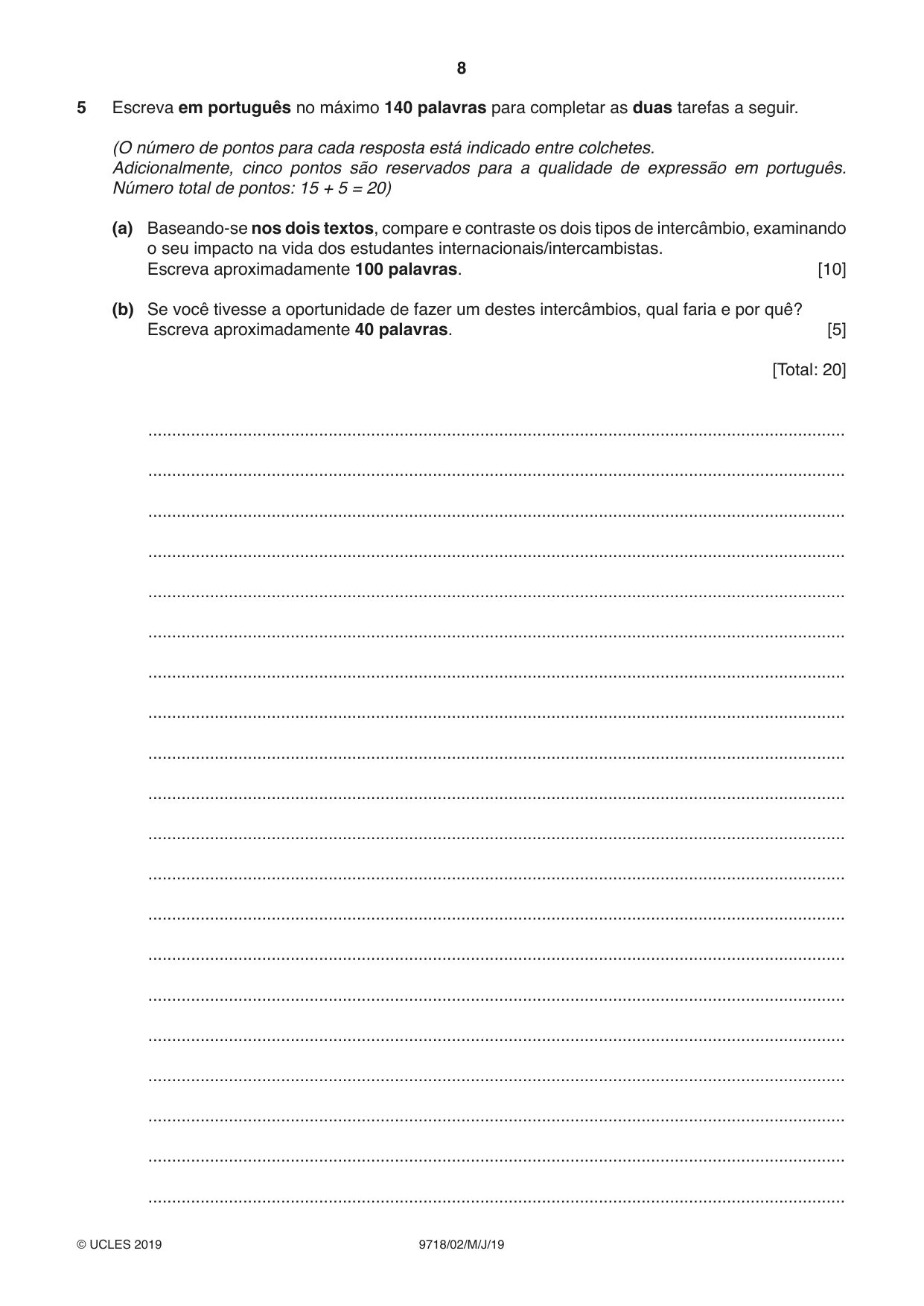
8 9718/02/M/J/19 © UCLES 2019 5 Escreva em português no máximo 140 palavras para completar as duas tarefas a seguir. (O número de pontos para cada resposta está indicado entre colchetes. Adicionalmente, cinco pontos são reservados para a qualidade de expressão em português. Número total de pontos: 15 + 5 = 20) (a) Baseando-se nos dois textos, compare e contraste os dois tipos de intercâmbio, examinando o seu impacto na vida dos estudantes internacionais/intercambistas. Escreva aproximadamente 100 palavras. [10] (b) Se você tivesse a oportunidade de fazer um destes intercâmbios, qual faria e por quê? Escreva aproximadamente 40 palavras. [5] [Total: 20] … … … … … … … … … … … … … … … … … … … …
Question paper, page 9
9 9718/02/M/J/19 © UCLES 2019 … … … … … … … … … … … … … … … … … … … … … … … … …
Question paper, page 10
10 9718/02/M/J/19 © UCLES 2019 BLANK PAGE
Question paper, page 11
11 9718/02/M/J/19 © UCLES 2019 BLANK PAGE
Question paper, page 12
12 9718/02/M/J/19 © UCLES 2019 Permission to reproduce items where third-party owned material protected by copyright is included has been sought and cleared where possible. Every reasonable effort has been made by the publisher (UCLES) to trace copyright holders, but if any items requiring clearance have unwittingly been included, the publisher will be pleased to make amends at the earliest possible opportunity. To avoid the issue of disclosure of answer-related information to candidates, all copyright acknowledgements are reproduced online in the Cambridge Assessment International Education Copyright Acknowledgements Booklet. This is produced for each series of examinations and is freely available to download at www.cambridgeinternational.org after the live examination series. Cambridge Assessment International Education is part of the Cambridge Assessment Group. Cambridge Assessment is the brand name of the University of Cambridge Local Examinations Syndicate (UCLES), which itself is a department of the University of Cambridge. BLANK PAGE
Mark scheme, page 1
This document consists of 14 printed pages. © UCLES 2019 [Turn over Cambridge Assessment International Education Cambridge International Advanced Level PORTUGUESE 9718/02 Paper 2 Reading and Writing May/June 2019 MARK SCHEME Maximum Mark: 70 Published This mark scheme is published as an aid to teachers and candidates, to indicate the requirements of the examination. It shows the basis on which Examiners were instructed to award marks. It does not indicate the details of the discussions that took place at an Examiners’ meeting before marking began, which would have considered the acceptability of alternative answers. Mark schemes should be read in conjunction with the question paper and the Principal Examiner Report for Teachers. Cambridge International will not enter into discussions about these mark schemes. Cambridge International is publishing the mark schemes for the May/June 2019 series for most Cambridge IGCSE™, Cambridge International A and AS Level and Cambridge Pre-U components, and some Cambridge O Level components.
Mark scheme, page 2
9718/02 Cambridge International A Level – Mark Scheme PUBLISHED May/June 2019 © UCLES 2019 Page 2 of 14 Generic Marking Principles These general marking principles must be applied by all examiners when marking candidate answers. They should be applied alongside the specific content of the mark scheme or generic level descriptors for a question. Each question paper and mark scheme will also comply with these marking principles. GENERIC MARKING PRINCIPLE 1: Marks must be awarded in line with: • the specific content of the mark scheme or the generic level descriptors for the question • the specific skills defined in the mark scheme or in the generic level descriptors for the question • the standard of response required by a candidate as exemplified by the standardisation scripts. GENERIC MARKING PRINCIPLE 2: Marks awarded are always whole marks (not half marks, or other fractions). GENERIC MARKING PRINCIPLE 3: Marks must be awarded positively: • marks are awarded for correct/valid answers, as defined in the mark scheme. However, credit is given for valid answers which go beyond the scope of the syllabus and mark scheme, referring to your Team Leader as appropriate • marks are awarded when candidates clearly demonstrate what they know and can do • marks are not deducted for errors • marks are not deducted for omissions • answers should only be judged on the quality of spelling, punctuation and grammar when these features are specifically assessed by the question as indicated by the mark scheme. The meaning, however, should be unambiguous. GENERIC MARKING PRINCIPLE 4: Rules must be applied consistently e.g. in situations where candidates have not followed instructions or in the application of generic level descriptors.
Mark scheme, page 3
9718/02 Cambridge International A Level – Mark Scheme PUBLISHED May/June 2019 © UCLES 2019 Page 3 of 14 GENERIC MARKING PRINCIPLE 5: Marks should be awarded using the full range of marks defined in the mark scheme for the question (however; the use of the full mark range may be limited according to the quality of the candidate responses seen). GENERIC MARKING PRINCIPLE 6: Marks awarded are based solely on the requirements as defined in the mark scheme. Marks should not be awarded with grade thresholds or grade descriptors in mind.
Mark scheme, page 4
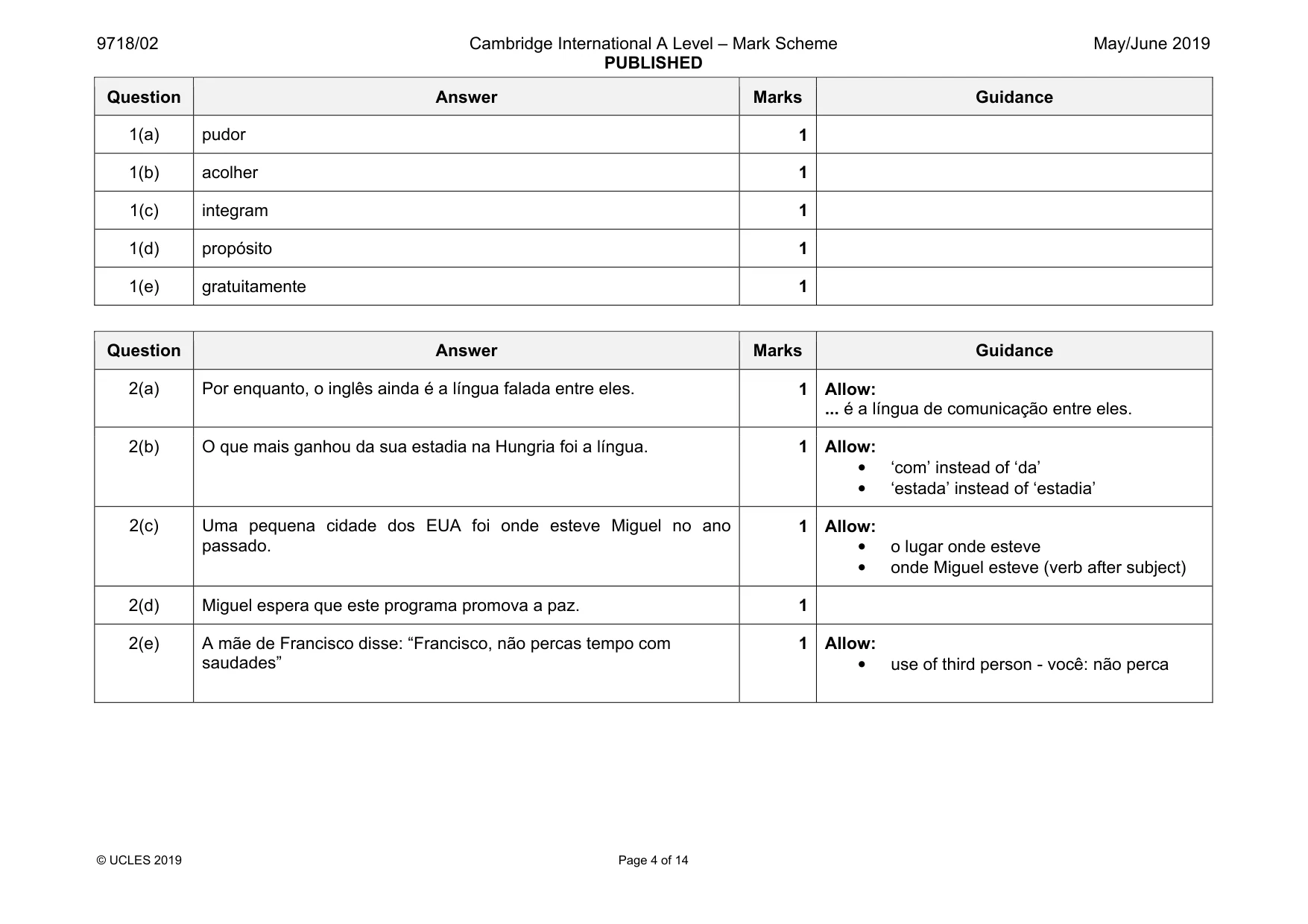
9718/02 Cambridge International A Level – Mark Scheme PUBLISHED May/June 2019 © UCLES 2019 Page 4 of 14 Question Answer Marks Guidance 1(a) pudor 1 1(b) acolher 1 1(c) integram 1 1(d) propósito 1 1(e) gratuitamente 1 Question Answer Marks Guidance 2(a) Por enquanto, o inglês ainda é a língua falada entre eles. 1 Allow: ... é a língua de comunicação entre eles. 2(b) O que mais ganhou da sua estadia na Hungria foi a língua. 1 Allow: • ‘com’ instead of ‘da’ • ‘estada’ instead of ‘estadia’ 2(c) Uma pequena cidade dos EUA foi onde esteve Miguel no ano passado. 1 Allow: • o lugar onde esteve • onde Miguel esteve (verb after subject) 2(d) Miguel espera que este programa promova a paz. 1 2(e) A mãe de Francisco disse: “Francisco, não percas tempo com saudades” 1 Allow: • use of third person - você: não perca
Mark scheme, page 5
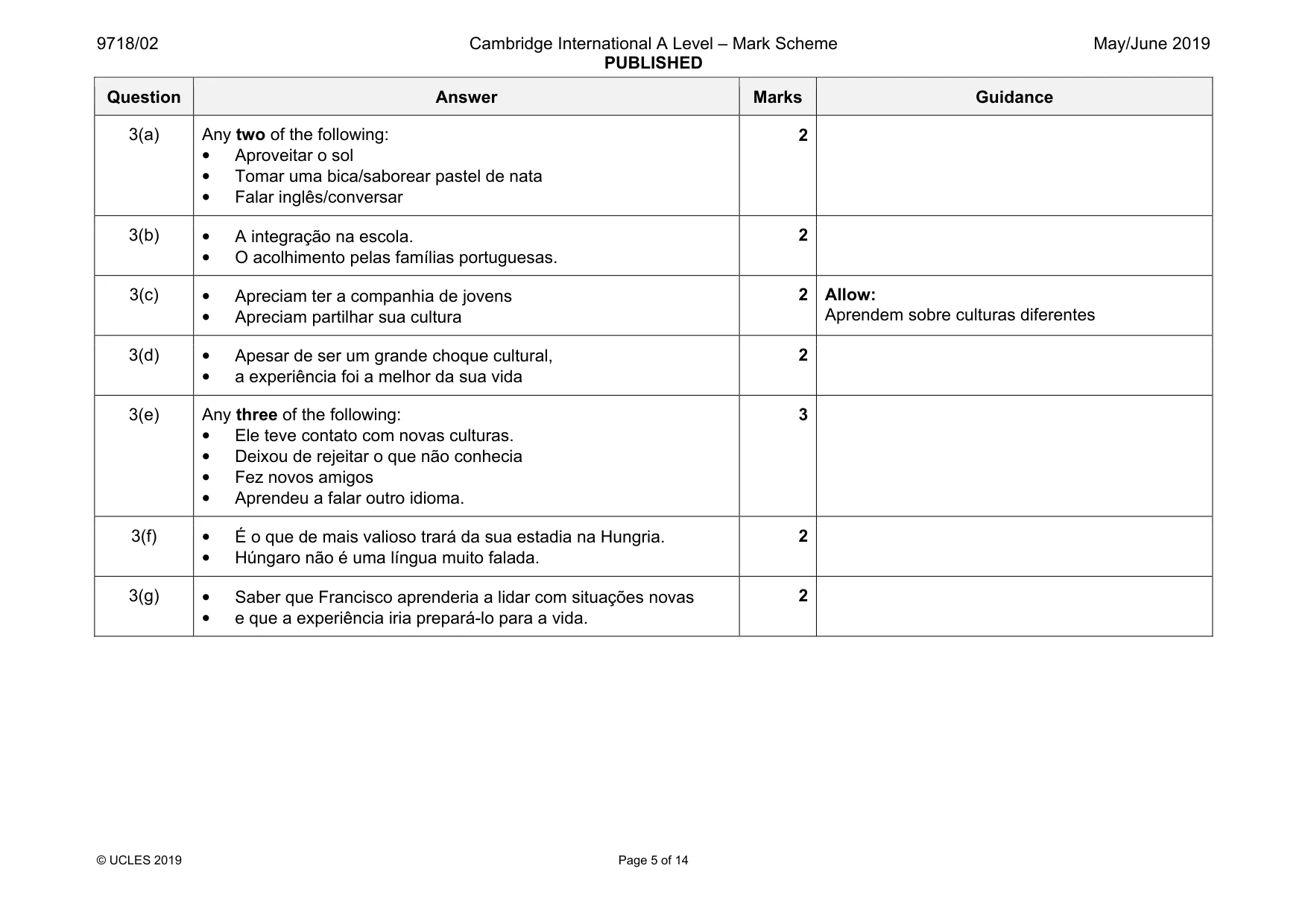
9718/02 Cambridge International A Level – Mark Scheme PUBLISHED May/June 2019 © UCLES 2019 Page 5 of 14 Question Answer Marks Guidance 3(a) Any two of the following: • Aproveitar o sol • Tomar uma bica/saborear pastel de nata • Falar inglês/conversar 2 3(b) • A integração na escola. • O acolhimento pelas famílias portuguesas. 2 3(c) • Apreciam ter a companhia de jovens • Apreciam partilhar sua cultura 2 Allow: Aprendem sobre culturas diferentes 3(d) • Apesar de ser um grande choque cultural, • a experiência foi a melhor da sua vida 2 3(e) Any three of the following: • Ele teve contato com novas culturas. • Deixou de rejeitar o que não conhecia • Fez novos amigos • Aprendeu a falar outro idioma. 3 3(f) • É o que de mais valioso trará da sua estadia na Hungria. • Húngaro não é uma língua muito falada. 2 3(g) • Saber que Francisco aprenderia a lidar com situações novas • e que a experiência iria prepará-lo para a vida. 2
Mark scheme, page 6
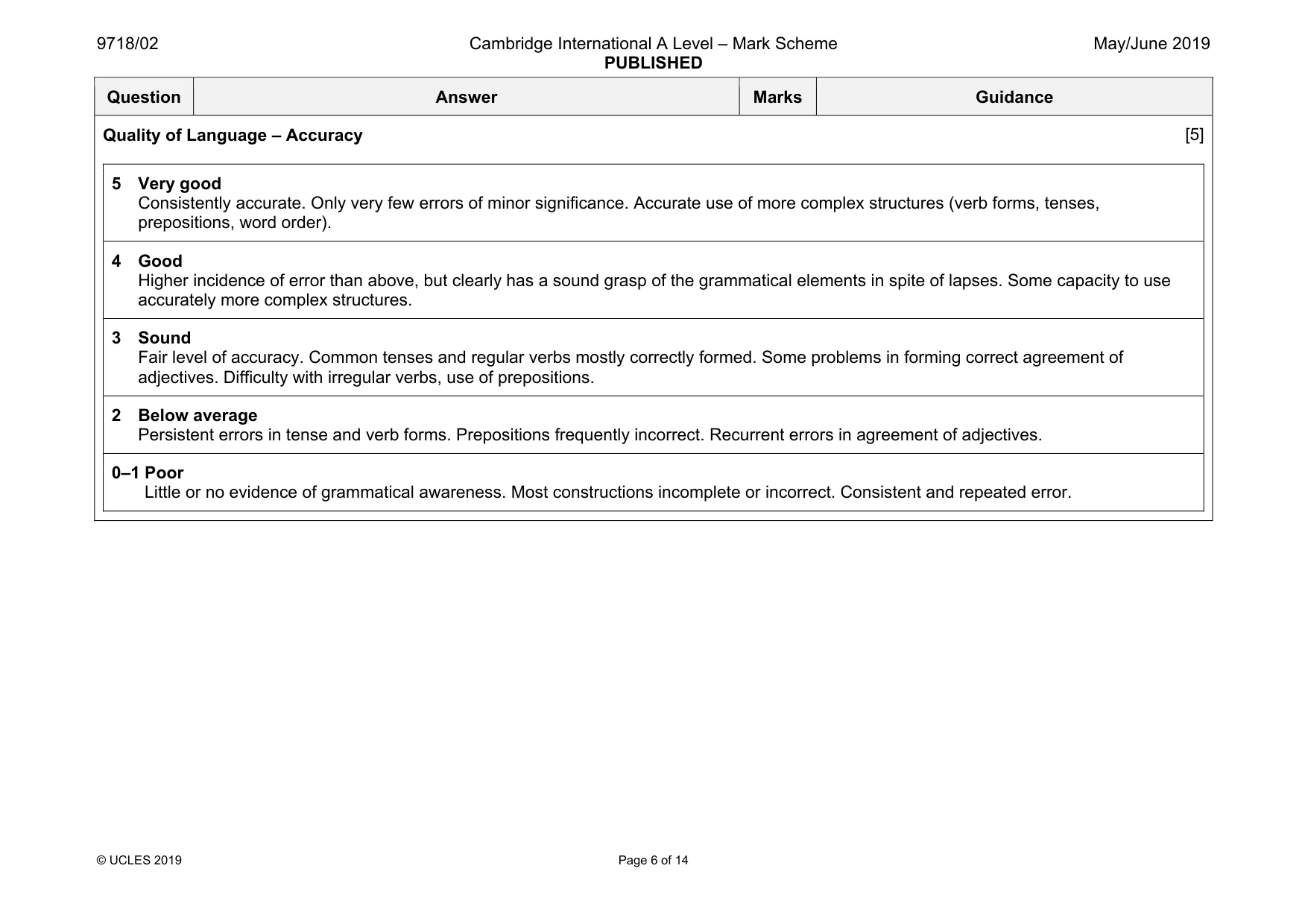
9718/02 Cambridge International A Level – Mark Scheme PUBLISHED May/June 2019 © UCLES 2019 Page 6 of 14 Question Answer Marks Guidance Quality of Language – Accuracy [5] 5 Very good Consistently accurate. Only very few errors of minor significance. Accurate use of more complex structures (verb forms, tenses, prepositions, word order). 4 Good Higher incidence of error than above, but clearly has a sound grasp of the grammatical elements in spite of lapses. Some capacity to use accurately more complex structures. 3 Sound Fair level of accuracy. Common tenses and regular verbs mostly correctly formed. Some problems in forming correct agreement of adjectives. Difficulty with irregular verbs, use of prepositions. 2 Below average Persistent errors in tense and verb forms. Prepositions frequently incorrect. Recurrent errors in agreement of adjectives. 0–1 Poor Little or no evidence of grammatical awareness. Most constructions incomplete or incorrect. Consistent and repeated error.
Mark scheme, page 7
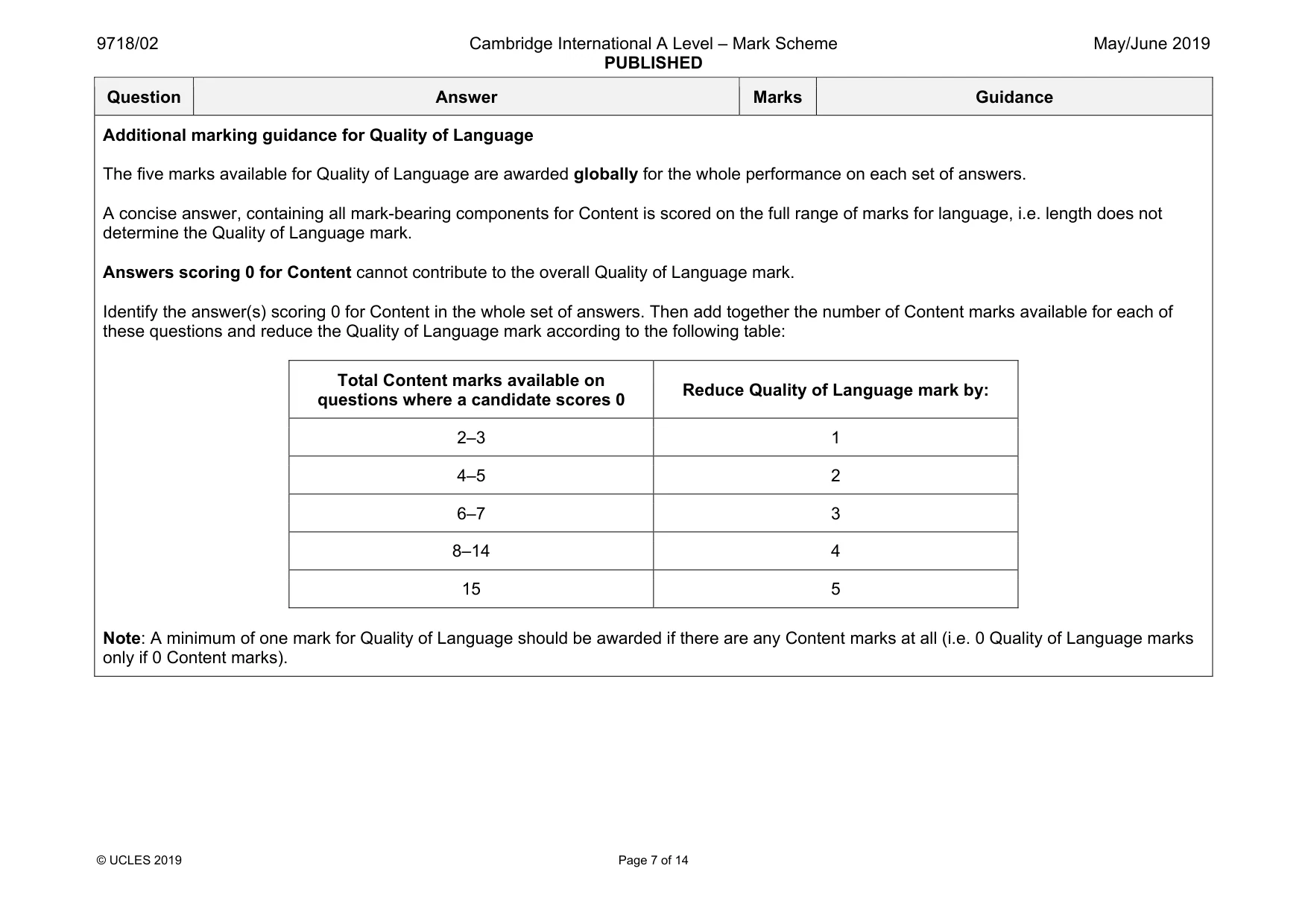
9718/02 Cambridge International A Level – Mark Scheme PUBLISHED May/June 2019 © UCLES 2019 Page 7 of 14 Question Answer Marks Guidance Additional marking guidance for Quality of Language The five marks available for Quality of Language are awarded globally for the whole performance on each set of answers. A concise answer, containing all mark-bearing components for Content is scored on the full range of marks for language, i.e. length does not determine the Quality of Language mark. Answers scoring 0 for Content cannot contribute to the overall Quality of Language mark. Identify the answer(s) scoring 0 for Content in the whole set of answers. Then add together the number of Content marks available for each of these questions and reduce the Quality of Language mark according to the following table: Total Content marks available on questions where a candidate scores 0 Reduce Quality of Language mark by: 2–3 1 4–5 2 6–7 3 8–14 4 15 5 Note: A minimum of one mark for Quality of Language should be awarded if there are any Content marks at all (i.e. 0 Quality of Language marks only if 0 Content marks).
Mark scheme, page 8
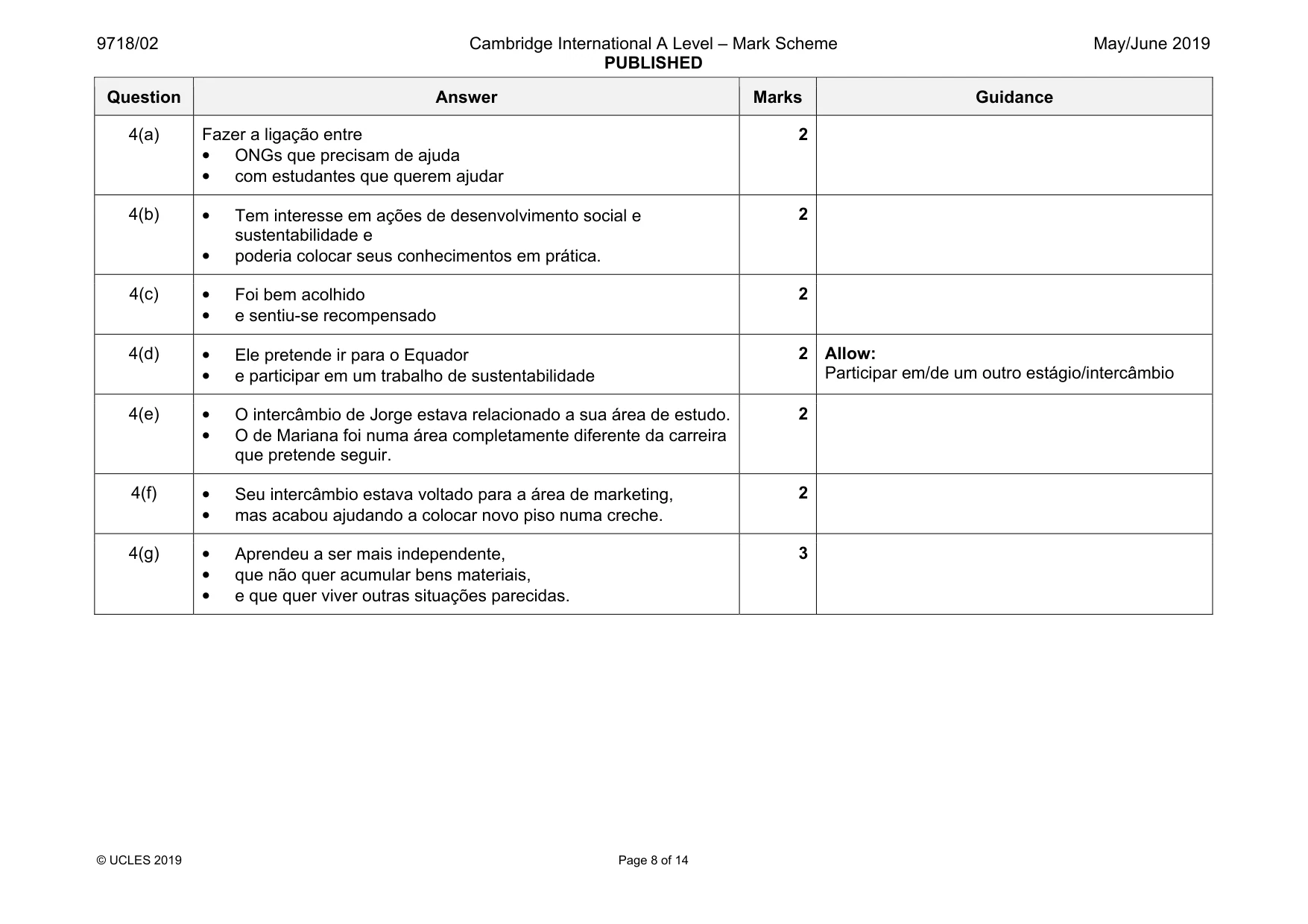
9718/02 Cambridge International A Level – Mark Scheme PUBLISHED May/June 2019 © UCLES 2019 Page 8 of 14 Question Answer Marks Guidance 4(a) Fazer a ligação entre • ONGs que precisam de ajuda • com estudantes que querem ajudar 2 4(b) • Tem interesse em ações de desenvolvimento social e sustentabilidade e • poderia colocar seus conhecimentos em prática. 2 4(c) • Foi bem acolhido • e sentiu-se recompensado 2 4(d) • Ele pretende ir para o Equador • e participar em um trabalho de sustentabilidade 2 Allow: Participar em/de um outro estágio/intercâmbio 4(e) • O intercâmbio de Jorge estava relacionado a sua área de estudo. • O de Mariana foi numa área completamente diferente da carreira que pretende seguir. 2 4(f) • Seu intercâmbio estava voltado para a área de marketing, • mas acabou ajudando a colocar novo piso numa creche. 2 4(g) • Aprendeu a ser mais independente, • que não quer acumular bens materiais, • e que quer viver outras situações parecidas. 3
Mark scheme, page 9
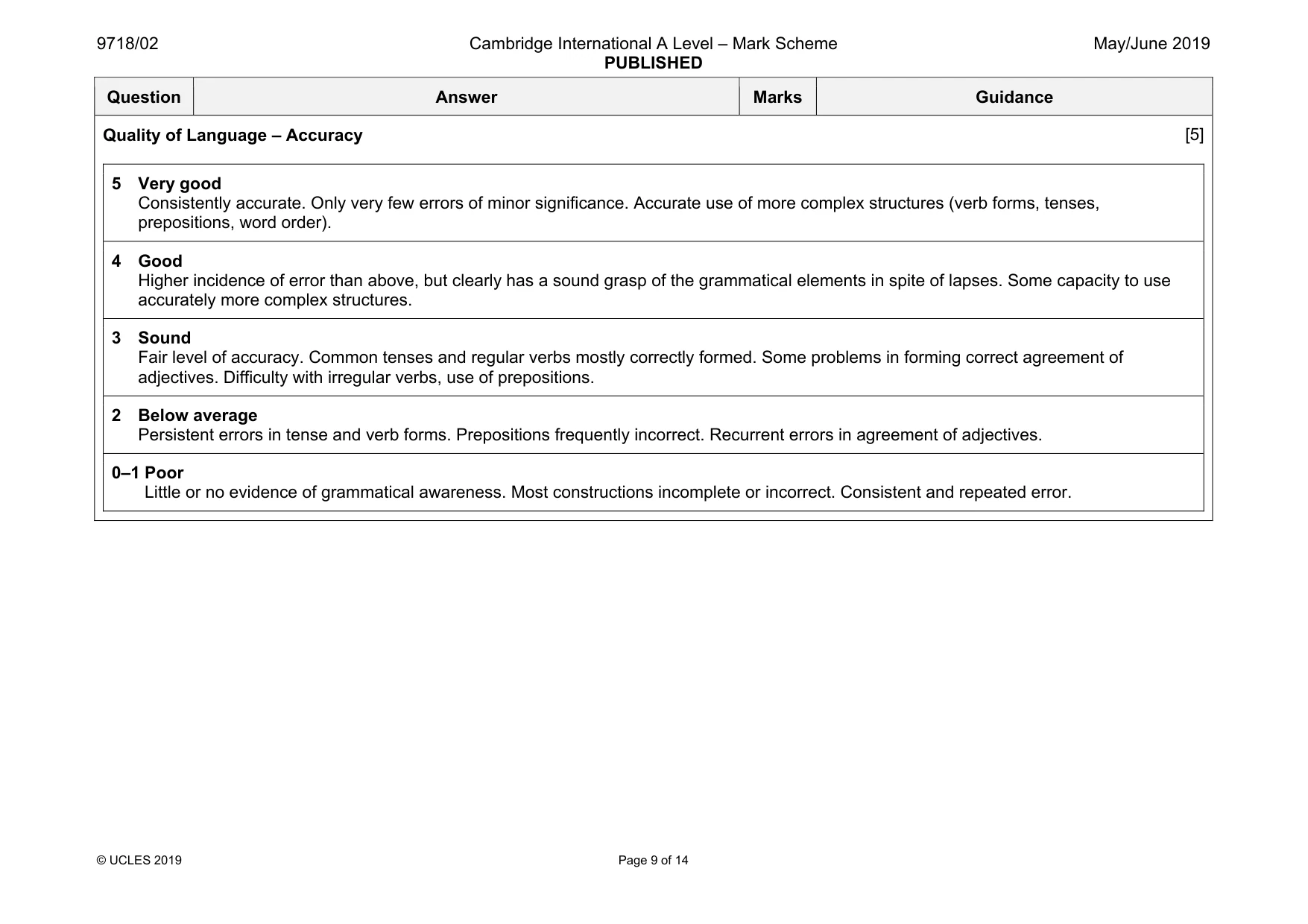
9718/02 Cambridge International A Level – Mark Scheme PUBLISHED May/June 2019 © UCLES 2019 Page 9 of 14 Question Answer Marks Guidance Quality of Language – Accuracy [5] 5 Very good Consistently accurate. Only very few errors of minor significance. Accurate use of more complex structures (verb forms, tenses, prepositions, word order). 4 Good Higher incidence of error than above, but clearly has a sound grasp of the grammatical elements in spite of lapses. Some capacity to use accurately more complex structures. 3 Sound Fair level of accuracy. Common tenses and regular verbs mostly correctly formed. Some problems in forming correct agreement of adjectives. Difficulty with irregular verbs, use of prepositions. 2 Below average Persistent errors in tense and verb forms. Prepositions frequently incorrect. Recurrent errors in agreement of adjectives. 0–1 Poor Little or no evidence of grammatical awareness. Most constructions incomplete or incorrect. Consistent and repeated error.
Mark scheme, page 10
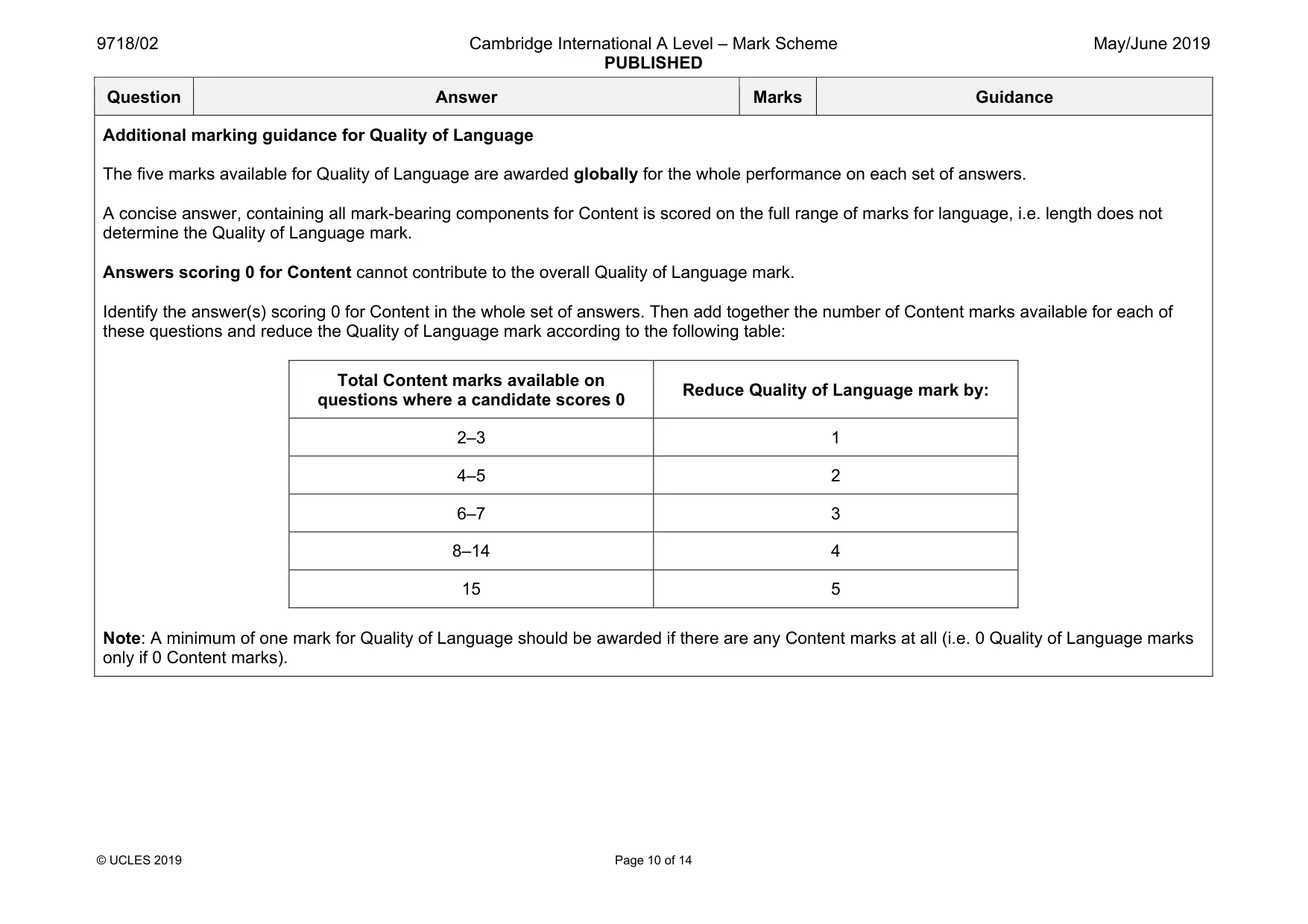
9718/02 Cambridge International A Level – Mark Scheme PUBLISHED May/June 2019 © UCLES 2019 Page 10 of 14 Question Answer Marks Guidance Additional marking guidance for Quality of Language The five marks available for Quality of Language are awarded globally for the whole performance on each set of answers. A concise answer, containing all mark-bearing components for Content is scored on the full range of marks for language, i.e. length does not determine the Quality of Language mark. Answers scoring 0 for Content cannot contribute to the overall Quality of Language mark. Identify the answer(s) scoring 0 for Content in the whole set of answers. Then add together the number of Content marks available for each of these questions and reduce the Quality of Language mark according to the following table: Total Content marks available on questions where a candidate scores 0 Reduce Quality of Language mark by: 2–3 1 4–5 2 6–7 3 8–14 4 15 5 Note: A minimum of one mark for Quality of Language should be awarded if there are any Content marks at all (i.e. 0 Quality of Language marks only if 0 Content marks).
Mark scheme, page 11
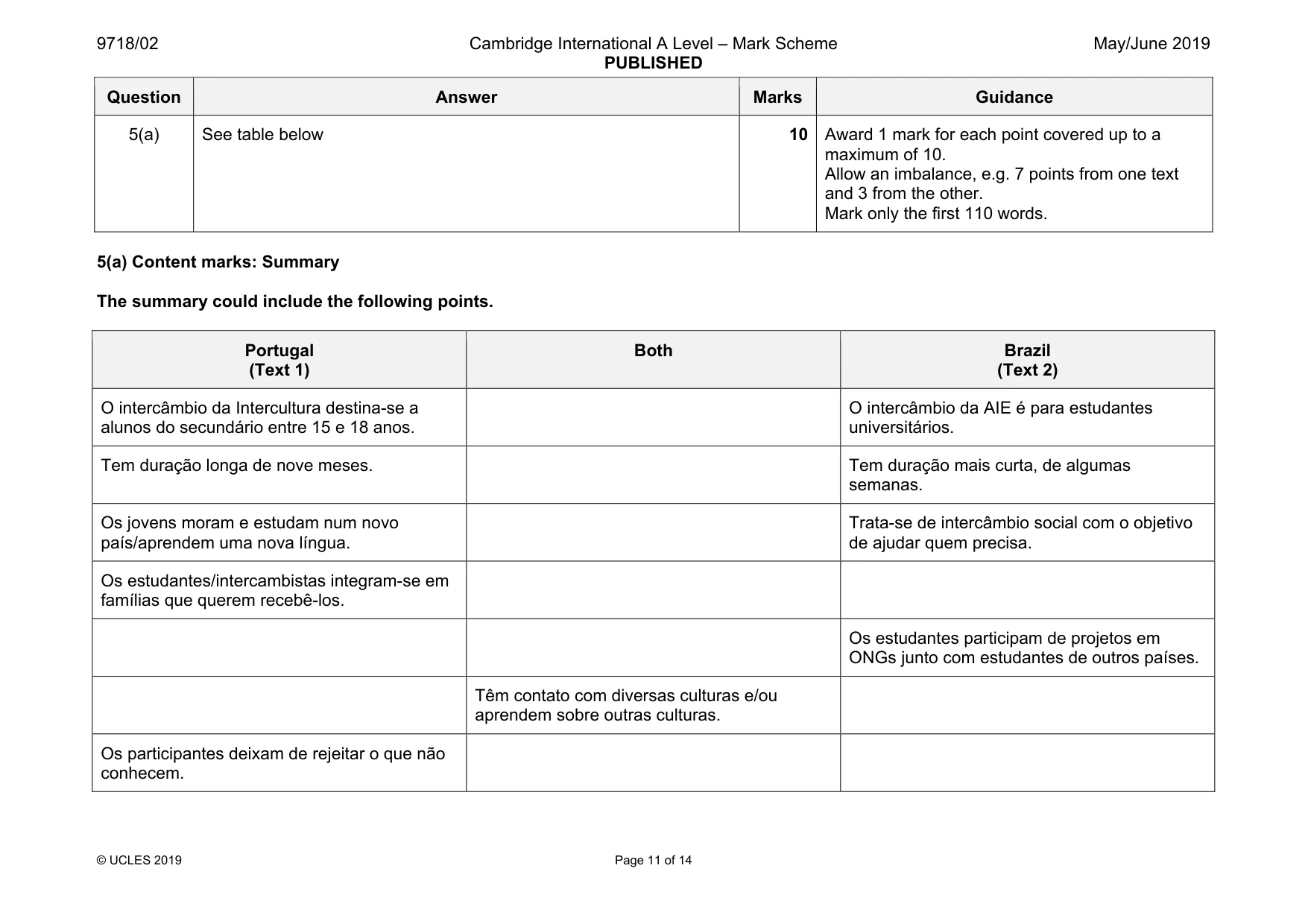
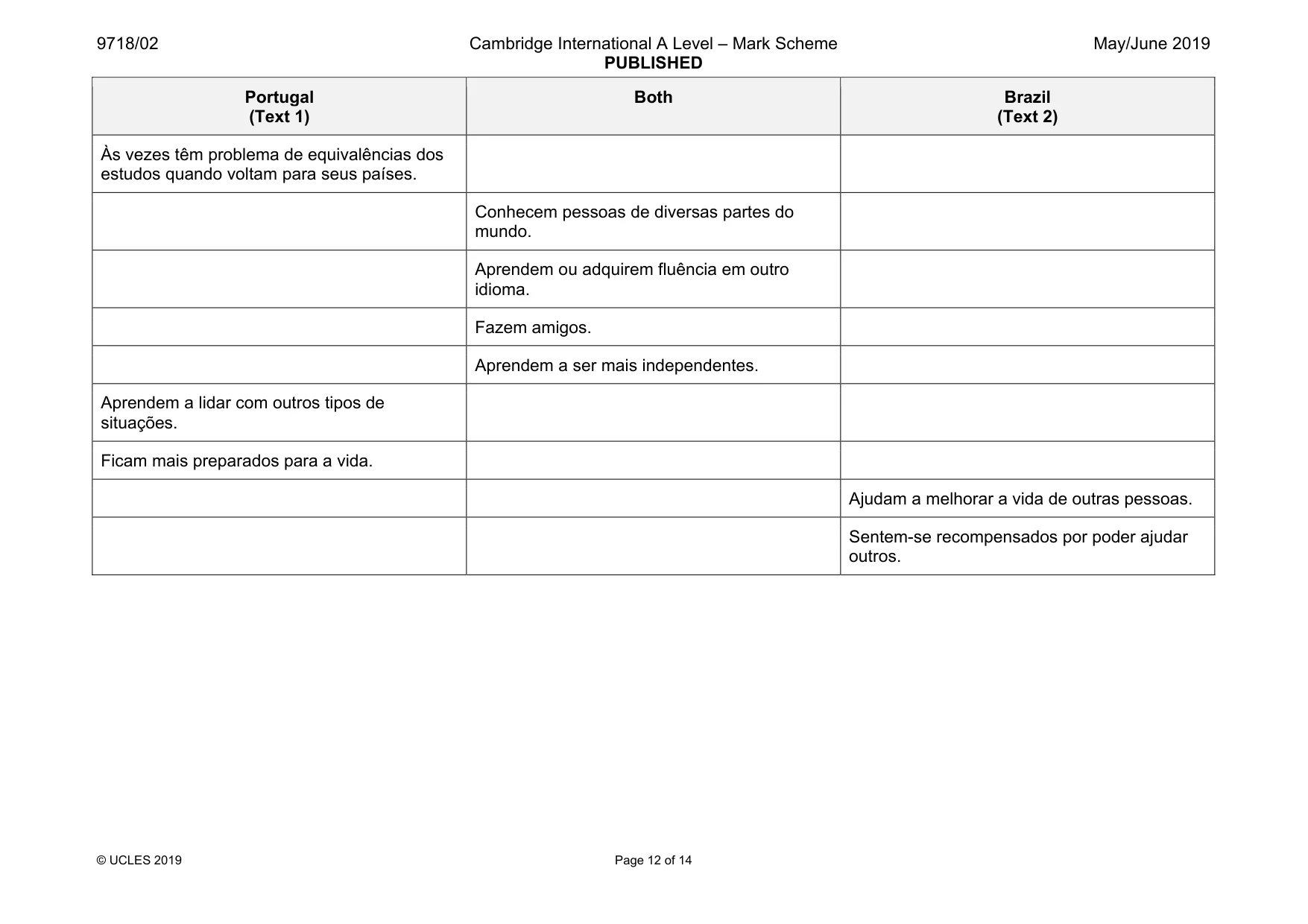
9718/02 Cambridge International A Level – Mark Scheme PUBLISHED May/June 2019 © UCLES 2019 Page 11 of 14 Question Answer Marks Guidance 5(a) See table below 10 Award 1 mark for each point covered up to a maximum of 10. Allow an imbalance, e.g. 7 points from one text and 3 from the other. Mark only the first 110 words. 5(a) Content marks: Summary The summary could include the following points. Portugal (Text 1) Both Brazil (Text 2) O intercâmbio da Intercultura destina-se a alunos do secundário entre 15 e 18 anos. O intercâmbio da AIE é para estudantes universitários. Tem duração longa de nove meses. Tem duração mais curta, de algumas semanas. Os jovens moram e estudam num novo país/aprendem uma nova língua. Trata-se de intercâmbio social com o objetivo de ajudar quem precisa. Os estudantes/intercambistas integram-se em famílias que querem recebê-los. Os estudantes participam de projetos em ONGs junto com estudantes de outros países. Têm contato com diversas culturas e/ou aprendem sobre outras culturas. Os participantes deixam de rejeitar o que não conhecem.
Mark scheme, page 12
9718/02 Cambridge International A Level – Mark Scheme PUBLISHED May/June 2019 © UCLES 2019 Page 12 of 14 Portugal (Text 1) Both Brazil (Text 2) Às vezes têm problema de equivalências dos estudos quando voltam para seus países. Conhecem pessoas de diversas partes do mundo. Aprendem ou adquirem fluência em outro idioma. Fazem amigos. Aprendem a ser mais independentes. Aprendem a lidar com outros tipos de situações. Ficam mais preparados para a vida. Ajudam a melhorar a vida de outras pessoas. Sentem-se recompensados por poder ajudar outros.
Mark scheme, page 13
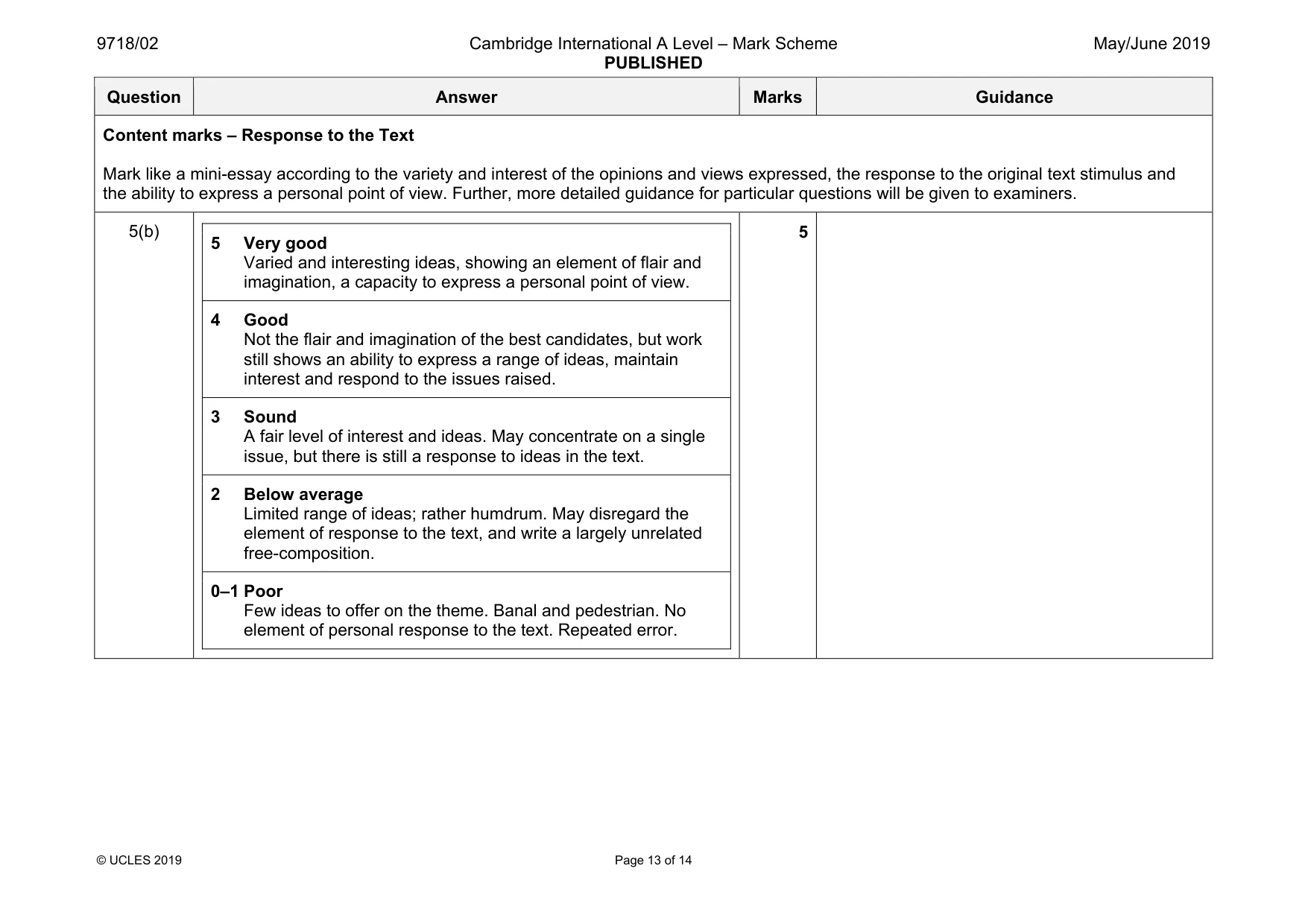
9718/02 Cambridge International A Level – Mark Scheme PUBLISHED May/June 2019 © UCLES 2019 Page 13 of 14 Question Answer Marks Guidance Content marks – Response to the Text Mark like a mini-essay according to the variety and interest of the opinions and views expressed, the response to the original text stimulus and the ability to express a personal point of view. Further, more detailed guidance for particular questions will be given to examiners. 5(b) 5 Very good Varied and interesting ideas, showing an element of flair and imagination, a capacity to express a personal point of view. 4 Good Not the flair and imagination of the best candidates, but work still shows an ability to express a range of ideas, maintain interest and respond to the issues raised. 3 Sound A fair level of interest and ideas. May concentrate on a single issue, but there is still a response to ideas in the text. 2 Below average Limited range of ideas; rather humdrum. May disregard the element of response to the text, and write a largely unrelated free-composition. 0–1 Poor Few ideas to offer on the theme. Banal and pedestrian. No element of personal response to the text. Repeated error. 5
Mark scheme, page 14
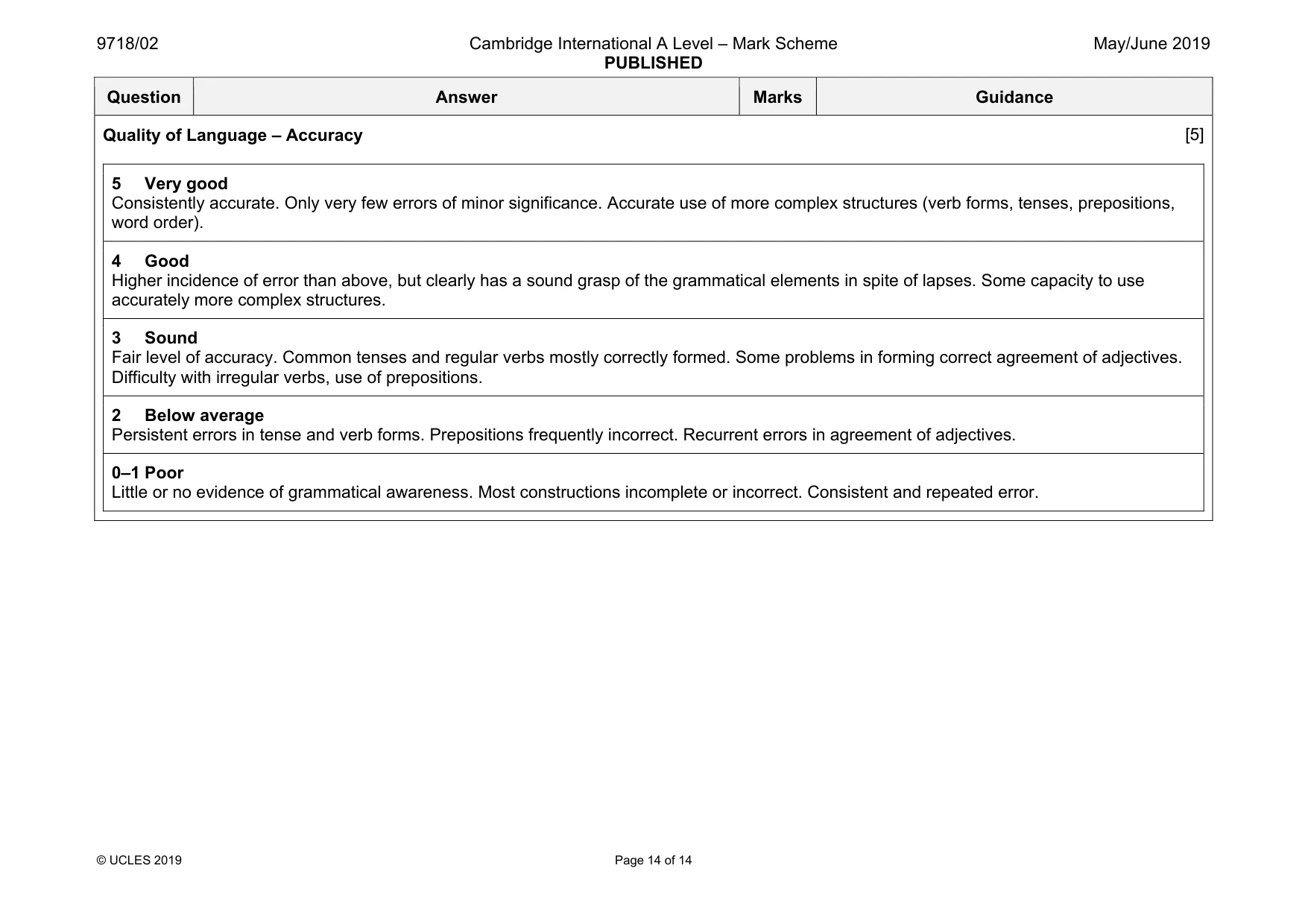
9718/02 Cambridge International A Level – Mark Scheme PUBLISHED May/June 2019 © UCLES 2019 Page 14 of 14 Question Answer Marks Guidance Quality of Language – Accuracy [5] 5 Very good Consistently accurate. Only very few errors of minor significance. Accurate use of more complex structures (verb forms, tenses, prepositions, word order). 4 Good Higher incidence of error than above, but clearly has a sound grasp of the grammatical elements in spite of lapses. Some capacity to use accurately more complex structures. 3 Sound Fair level of accuracy. Common tenses and regular verbs mostly correctly formed. Some problems in forming correct agreement of adjectives. Difficulty with irregular verbs, use of prepositions. 2 Below average Persistent errors in tense and verb forms. Prepositions frequently incorrect. Recurrent errors in agreement of adjectives. 0–1 Poor Little or no evidence of grammatical awareness. Most constructions incomplete or incorrect. Consistent and repeated error.
What you needed in this session
Cambridge’s own grade thresholds for 2019 May/June, Paper 2 · Variant 1. A higher threshold means an easier paper — the bar moves with how the cohort did.