Cambridge A Level Physical Education 9396 — 2019 Oct/Nov Paper 3 · Variant 3
9396/33/O/N/19 · 3 questions · 90 marks · ≈101 min
The question paper and its mark scheme, free to read here and free to download. This is Cambridge’s own paper, exactly as it was sat.
Question paper4 pages
Mark scheme10 pages
Answers below. Sit the paper first if you are practising.


Questions as text
Q1 · A gymnast performing a floor routine relies heavily on the lactic acid system for ATP…
1 (a) A gymnast performing a floor routine relies heavily on the lactic acid system for ATP resynthesis. (i) Describe the lactic acid system. [5] (ii) Once the floor routine is completed, the gymnast begins the recovery process. Explain the processes that occur during the first few minutes of recovery. [4] (b) Periodisation of training involves splitting the training year into blocks of time. Explain, using sporting examples, the following terms: • macrocycle • mesocycle • microcycle. [3] (c) Flexibility and balance are important components of fitness that will impact on the effective performance of a range of motor skills. (i) Define the term balance and, using practical examples, identify the two dimensions of balance. [3] (ii) Describe a recognised test to evaluate balance. [3] (iii) Describe the types of training used to develop flexibility. [6] (iv) Describe the physiological adaptations to flexibility training that will enhance sporting performance. [3] (d) Caffeine is an ergogenic aid that is used by many athletes. Explain, using a sporting example, how caffeine enhances performance. [3] [Total: 30]
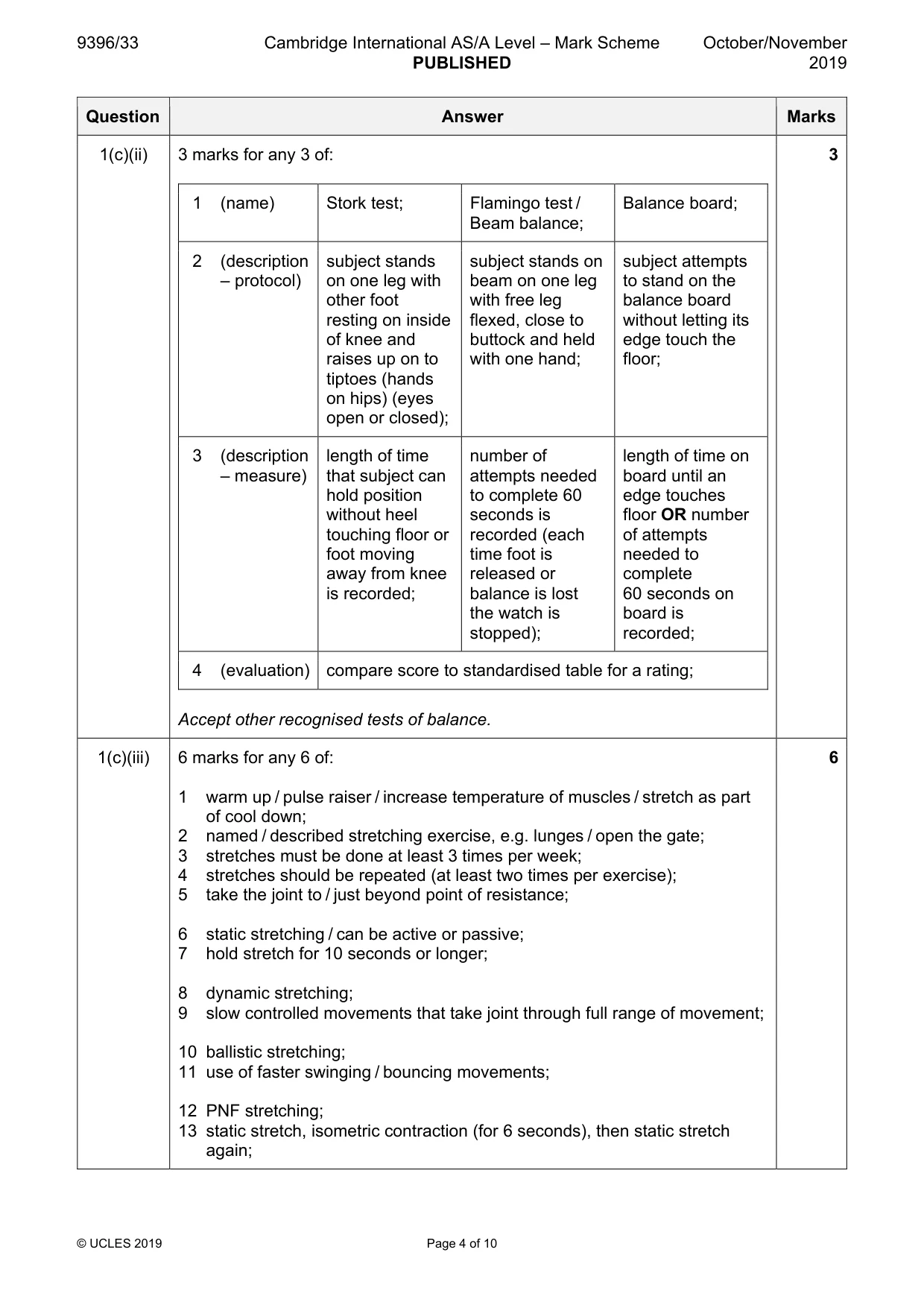
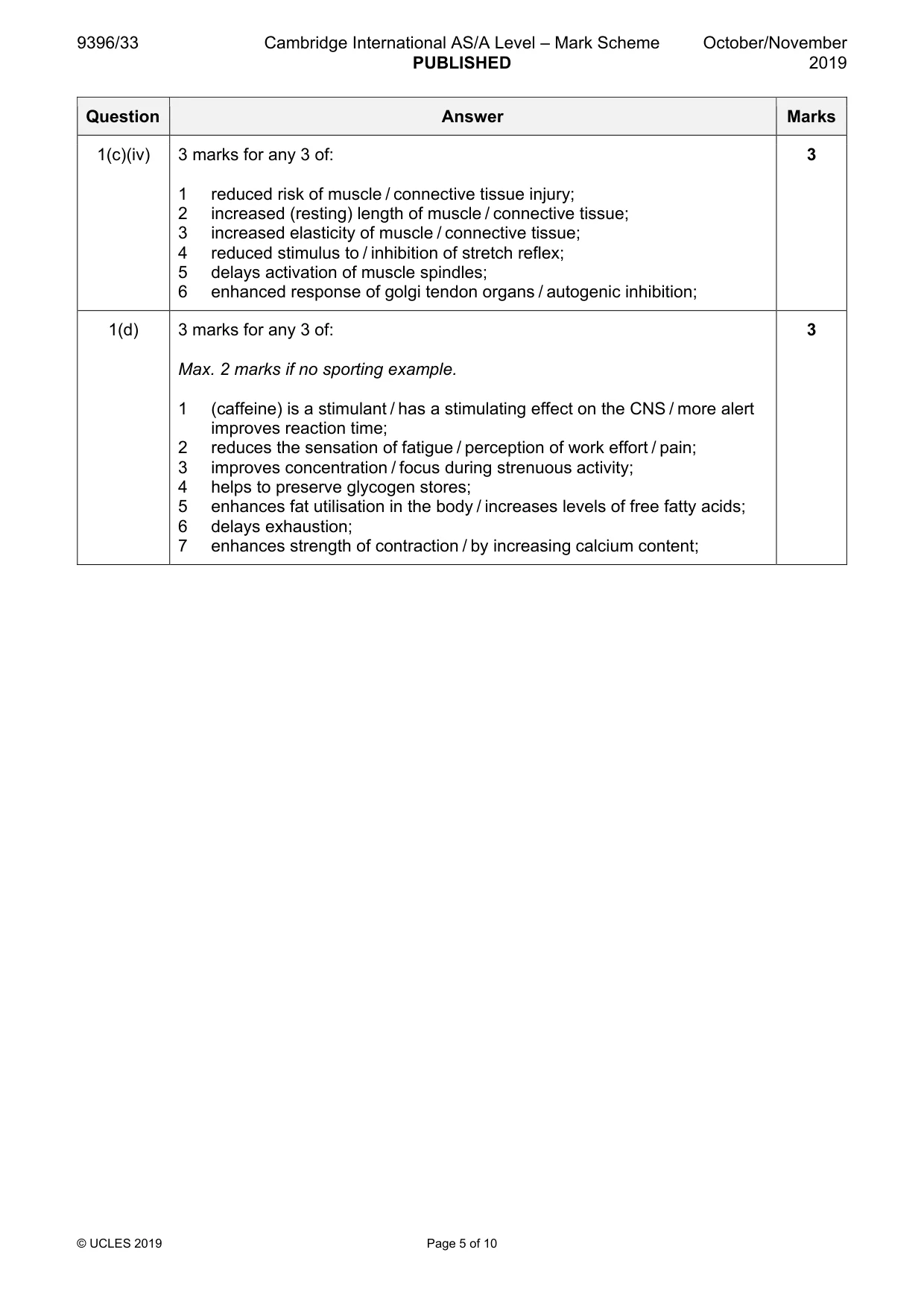
Mark scheme: Question Answer Marks 1(a)(i) 5 marks for any 5 of: 5 1 anaerobic / absence of oxygen; 2 (breakdown of) carbohydrate / glycogen / glucose / glycolysis; 3 « to pyruvic acid / pyruvate; 4 « to lactic acid / lactate; 5 occurs in sarcoplasm; 6 2 ATP (net) produced (per molecule of glucose); 7 (enzymes) GP / GPP / glycogen phosphorylase / PFK / phosphofructokinase / LDH / lactate dehydrogenase; 1(a)(ii) 4 marks for any 4 of: 4 1 alactacid / alactic debt / fast component of EPOC; 2 replenishment of ATP stores / PC stores / muscle phosphagen stores; 3 uses the aerobic system; 4 circulatory / respiratory rates remain elevated; 5 (replenishment of PC stores / alactacid debt) takes 2–3 minutes for full recovery / 30 seconds for 50% recovery / uses up to 4 litres of oxygen; 6 replenishment of myoglobin with oxygen / restoration of oxy-myoglobin link; 7 (replenishment of myoglobin with oxygen) takes 1–2 minutes / uses 0.5 litres of oxygen / happens first or very quickly; 8 lactacid debt / slow component of EPOC (starts but takes up to an hour to complete); 9 removal of lactic acid; 1(b) 3 marks for: 3 Must use a sporting example for each term. 1 (macrocycle) for example, the training period between now and the Olympic Games / World Championships; 2 (mesocycle) for example, an 8-week training programme to improve speed; 3 (microcycle) for example, a weekly plan that involves strength work, flexibility exercises and running technique sessions; 1(c)(i) 3 marks for: 3 1 (definition) the ability to maintain equilibrium / centre of mass over base of support; 2 static AND an example, e.g. headstand; 3 dynamic AND an example, e.g. rugby player evading a tackle; 1(c)(ii) 3 marks for any 3 of: 3 1 (name) Stork test; Flamingo test / Balance board; Beam balance; 2 (description subject stands subject stands on subject attempts – protocol) on one leg with beam on one leg to stand on the other foot with free leg balance board resting on inside flexed, close to without letting its of knee and buttock and held edge touch the raises up on to with one hand; floor; tiptoes (hands on hips) (eyes open or closed); 3 (description length of time number of length of time on – measure) that subject can attempts needed board until an hold position to complete 60 edge touches without heel seconds is floor OR number touching floor or recorded (each of attempts foot moving time foot is needed to away from knee released or complete is recorded; balance is lost 60 seconds on the watch is board is stopped); recorded; 4 (evaluation) compare score to standardised table for a rating; Accept other recognised tests of balance. 1(c)(iii) 6 marks for any 6 of: 6 1 warm up / pulse raiser / increase temperature of muscles / stretch as part of cool down; 2 named / described stretching exercise, e.g. lunges / open the gate; 3 stretches must be done at least 3 times per week; 4 stretches should be repeated (at least two times per exercise); 5 take the joint to / just beyond point of resistance; 6 static stretching / can be active or passive; 7 hold stretch for 10 seconds or longer; 8 dynamic stretching; 9 slow controlled movements that take joint through full range of movement; 10 ballistic stretching; 11 use of faster swinging / bouncing movements; 12 PNF stretching; 13 static stretch, isometric contraction (for 6 seconds), then static stretch again; 1(c)(iv) 3 marks for any 3 of: 3 1 reduced risk of muscle / connective tissue injury; 2 increased (resting) length of muscle / connective tissue; 3 increased elasticity of muscle / connective tissue; 4 reduced stimulus to / inhibition of stretch reflex; 5 delays activation of muscle spindles; 6 enhanced response of golgi tendon organs / autogenic inhibition; 1(d) 3 marks for any 3 of: 3 Max. 2 marks if no sporting example. 1 (caffeine) is a stimulant / has a stimulating effect on the CNS / more alert improves reaction time; 2 reduces the sensation of fatigue / perception of work effort / pain; 3 improves concentration / focus during strenuous activity; 4 helps to preserve glycogen stores; 5 enhances fat utilisation in the body / increases levels of free fatty acids; 6 delays exhaustion; 7 enhances strength of contraction / by increasing calcium content;
Q2 · A talented young sports performer shows a positive attitude towards fitness training
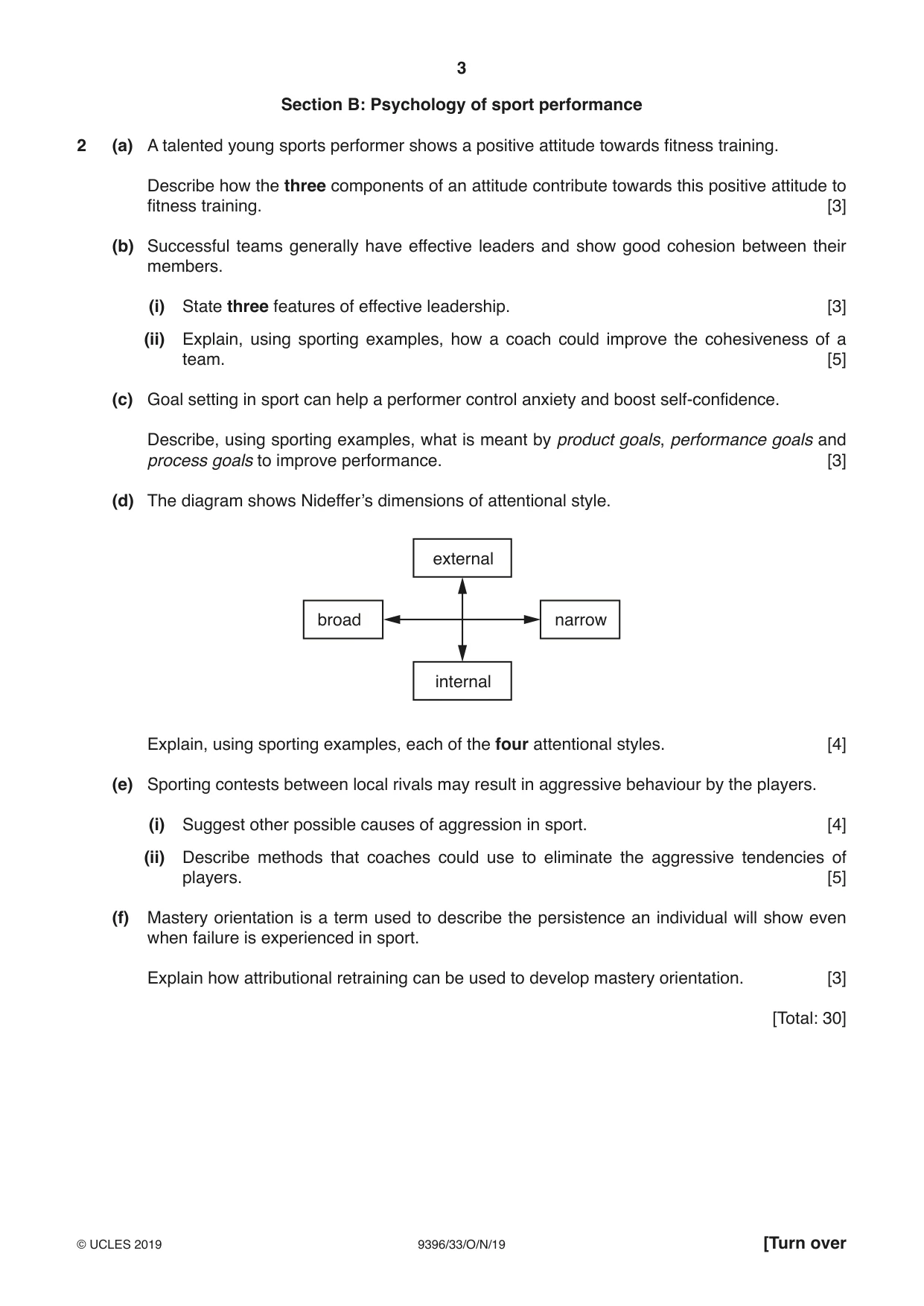
2 (a) A talented young sports performer shows a positive attitude towards fitness training. Describe how the three components of an attitude contribute towards this positive attitude to fitness training. [3] (b) Successful teams generally have effective leaders and show good cohesion between their members. (i) State three features of effective leadership. [3] (ii) Explain, using sporting examples, how a coach could improve the cohesiveness of a team. [5] (c) Goal setting in sport can help a performer control anxiety and boost self-confidence. Describe, using sporting examples, what is meant by product goals, performance goals and process goals to improve performance. [3] (d) The diagram shows Nideffer’s dimensions of attentional style. external broad narrow internal Explain, using sporting examples, each of the four attentional styles. [4] (e) Sporting contests between local rivals may result in aggressive behaviour by the players. (i) Suggest other possible causes of aggression in sport. [4] (ii) Describe methods that coaches could use to eliminate the aggressive tendencies of players. [5] (f) Mastery orientation is a term used to describe the persistence an individual will show even when failure is experienced in sport. Explain how attributional retraining can be used to develop mastery orientation. [3] [Total: 30] Section C: Olympic Games: a global perspective
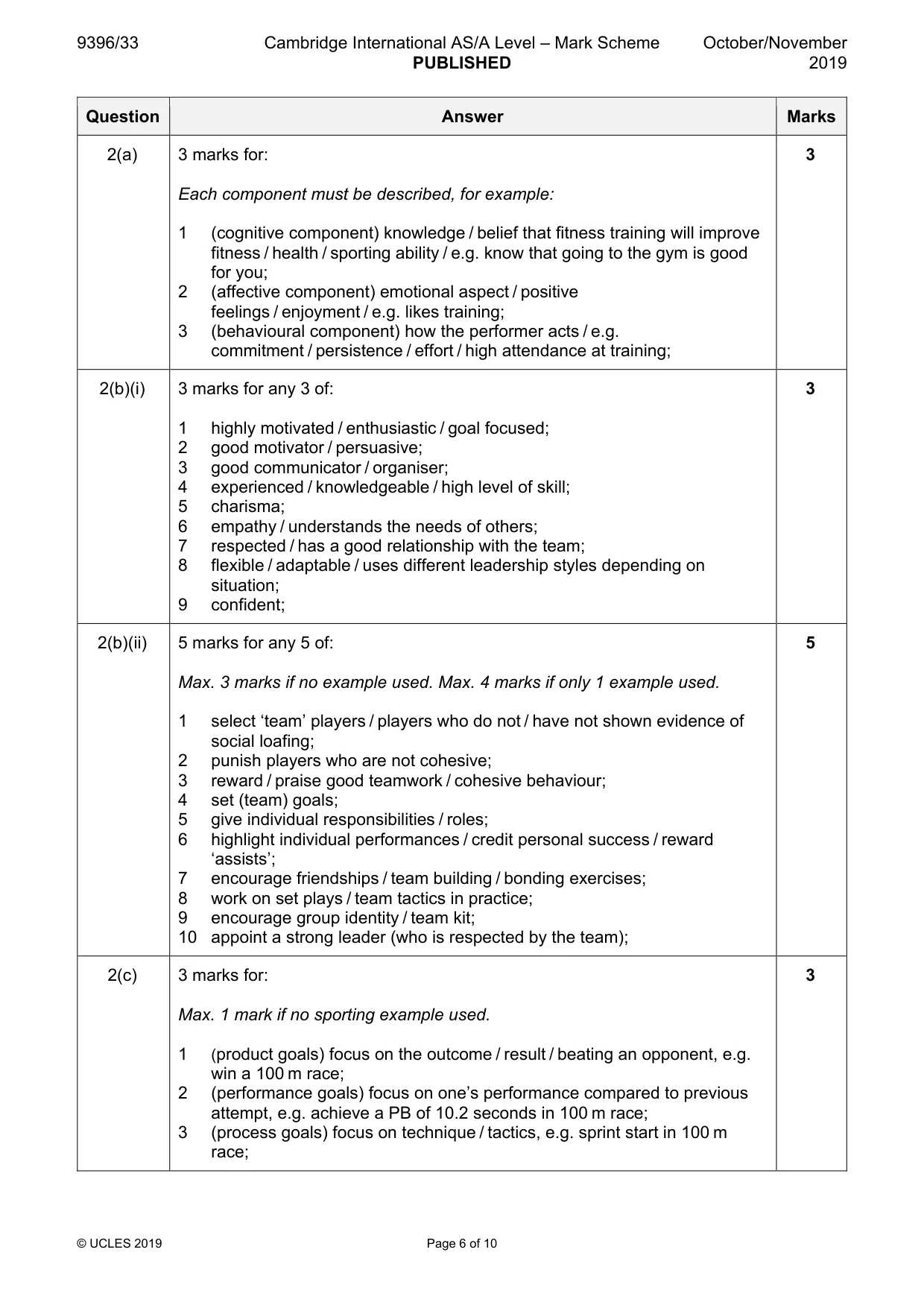
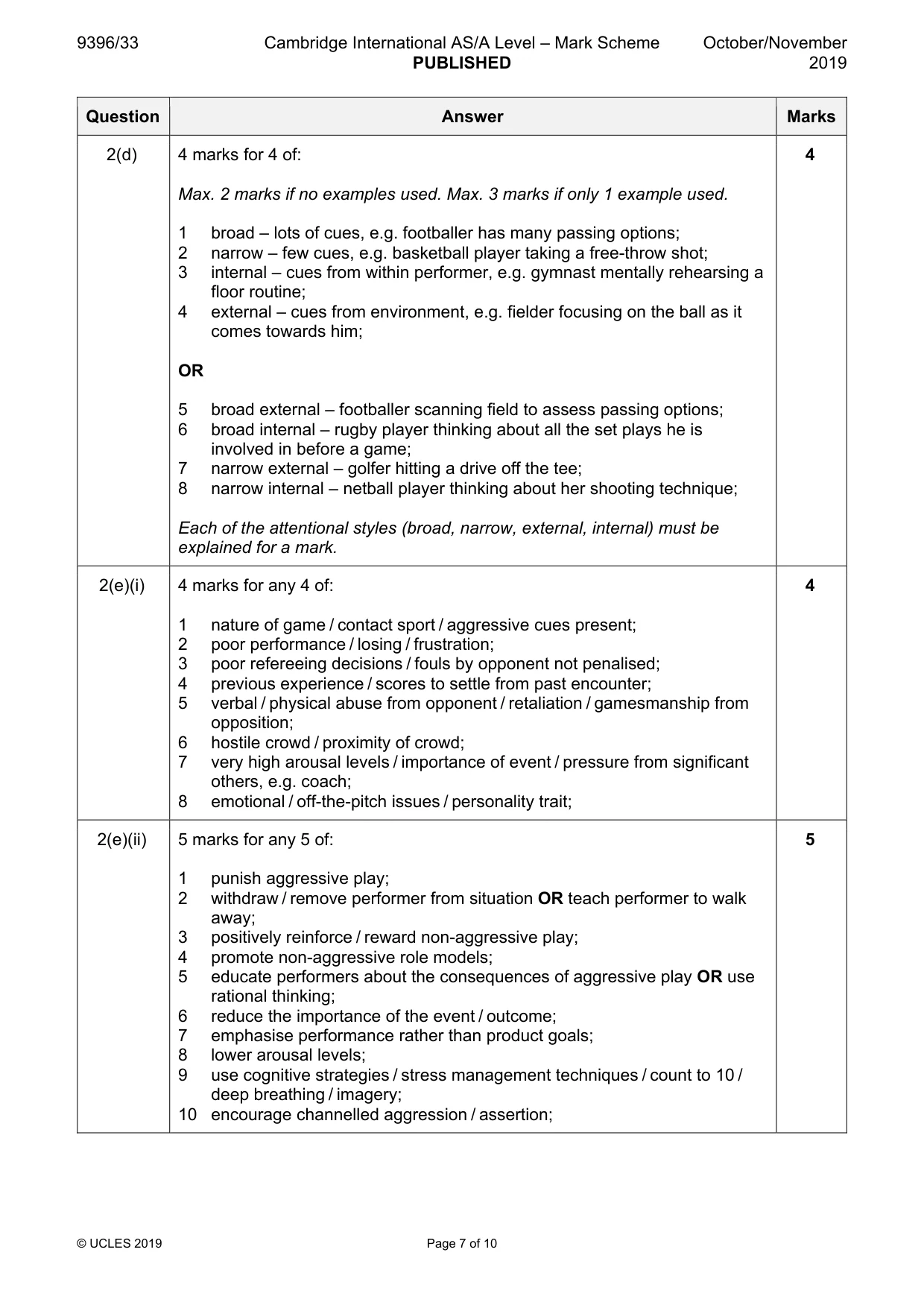
Mark scheme: 2(a) 3 marks for: 3 Each component must be described, for example: 1 (cognitive component) knowledge / belief that fitness training will improve fitness / health / sporting ability / e.g. know that going to the gym is good for you; 2 (affective component) emotional aspect / positive feelings / enjoyment / e.g. likes training; 3 (behavioural component) how the performer acts / e.g. commitment / persistence / effort / high attendance at training; 2(b)(i) 3 marks for any 3 of: 3 1 highly motivated / enthusiastic / goal focused; 2 good motivator / persuasive; 3 good communicator / organiser; 4 experienced / knowledgeable / high level of skill; 5 charisma; 6 empathy / understands the needs of others; 7 respected / has a good relationship with the team; 8 flexible / adaptable / uses different leadership styles depending on situation; 9 confident; 2(b)(ii) 5 marks for any 5 of: 5 Max. 3 marks if no example used. Max. 4 marks if only 1 example used. 1 select ‘team’ players / players who do not / have not shown evidence of social loafing; 2 punish players who are not cohesive; 3 reward / praise good teamwork / cohesive behaviour; 4 set (team) goals; 5 give individual responsibilities / roles; 6 highlight individual performances / credit personal success / reward ‘assists’; 7 encourage friendships / team building / bonding exercises; 8 work on set plays / team tactics in practice; 9 encourage group identity / team kit; 10 appoint a strong leader (who is respected by the team); 2(c) 3 marks for: 3 Max. 1 mark if no sporting example used. 1 (product goals) focus on the outcome / result / beating an opponent, e.g. win a 100 m race; 2 (performance goals) focus on one’s performance compared to previous attempt, e.g. achieve a PB of 10.2 seconds in 100 m race; 3 (process goals) focus on technique / tactics, e.g. sprint start in 100 m race; 2(d) 4 marks for 4 of: 4 Max. 2 marks if no examples used. Max. 3 marks if only 1 example used. 1 broad – lots of cues, e.g. footballer has many passing options; 2 narrow – few cues, e.g. basketball player taking a free-throw shot; 3 internal – cues from within performer, e.g. gymnast mentally rehearsing a floor routine; 4 external – cues from environment, e.g. fielder focusing on the ball as it comes towards him; OR 5 broad external – footballer scanning field to assess passing options; 6 broad internal – rugby player thinking about all the set plays he is involved in before a game; 7 narrow external – golfer hitting a drive off the tee; 8 narrow internal – netball player thinking about her shooting technique; Each of the attentional styles (broad, narrow, external, internal) must be explained for a mark. 2(e)(i) 4 marks for any 4 of: 4 1 nature of game / contact sport / aggressive cues present; 2 poor performance / losing / frustration; 3 poor refereeing decisions / fouls by opponent not penalised; 4 previous experience / scores to settle from past encounter; 5 verbal / physical abuse from opponent / retaliation / gamesmanship from opposition; 6 hostile crowd / proximity of crowd; 7 very high arousal levels / importance of event / pressure from significant others, e.g. coach; 8 emotional / off-the-pitch issues / personality trait; 2(e)(ii) 5 marks for any 5 of: 5 1 punish aggressive play; 2 withdraw / remove performer from situation OR teach performer to walk away; 3 positively reinforce / reward non-aggressive play; 4 promote non-aggressive role models; 5 educate performers about the consequences of aggressive play OR use rational thinking; 6 reduce the importance of the event / outcome; 7 emphasise performance rather than product goals; 8 lower arousal levels; 9 use cognitive strategies / stress management techniques / count to 10 / deep breathing / imagery; 10 encourage channelled aggression / assertion; 2(f) 3 marks for any 3 of: 3 1 attribute failure to internal factors (that are controllable) / lack of effort; 2 attribute failure to unstable factors / luck / task difficulty; 3 attribute failure to controllable factors / poor coaching / tactics; 4 attribute success to internal / stable factors / ability;
Q3 · One of the ideals of the Olympic Games is to promote fair play, which can be adopted in…
3 (a) One of the ideals of the Olympic Games is to promote fair play, which can be adopted in other aspects of life. Describe ways that an Olympic competitor could conform to fair-play ideals. [3] (b) The Ancient Olympic Games were seen as a blueprint for the modern era. Outline four characteristics that are shared by both the Ancient and Modern Olympic Games. [4] (c) There have been numerous examples of political interventions and manipulations in the Olympic Games, such as boycotts by countries in protest at the actions of other countries. Describe four examples, other than boycotts, of when the Olympic Games have been used as a platform for political confrontation. [4] (d) The issue of ‘broken time’ payments came to prominence in the 1928 Olympic Games and was associated with the sport of association football. Explain what is meant by ‘broken time’ payments and the impact of these on the amateur ideal of Olympism. [5] (e) Describe the benefits to athletes of competing at the Olympic Games. [3] (f) Explain why the men’s 100-metre final in the 1988 Olympic Games in Seoul has been called ‘the dirtiest race in history’. [4] (g) Critically evaluate the view that a ban on doping in the Olympic Games should be lifted. [7] [Total: 30]
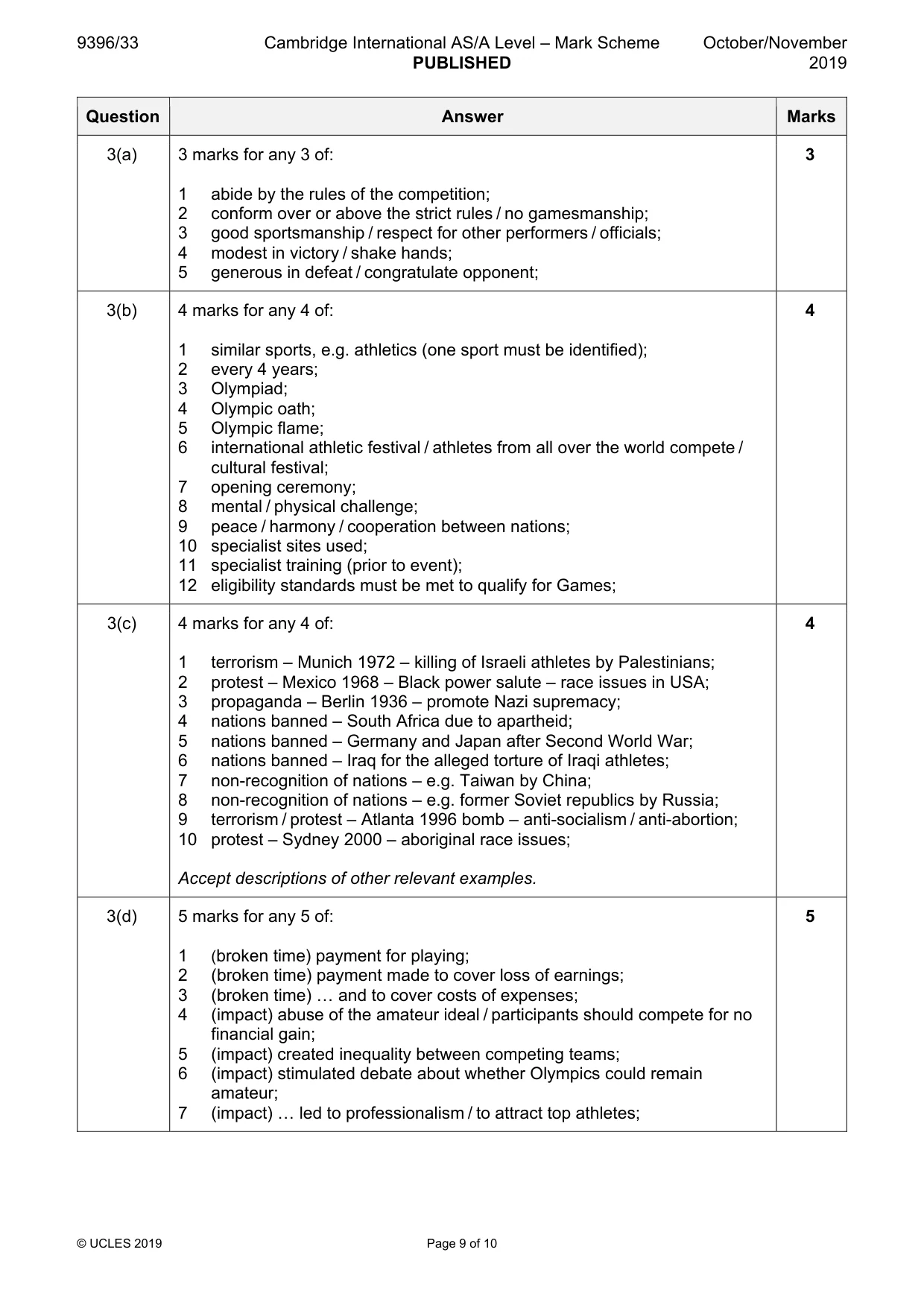
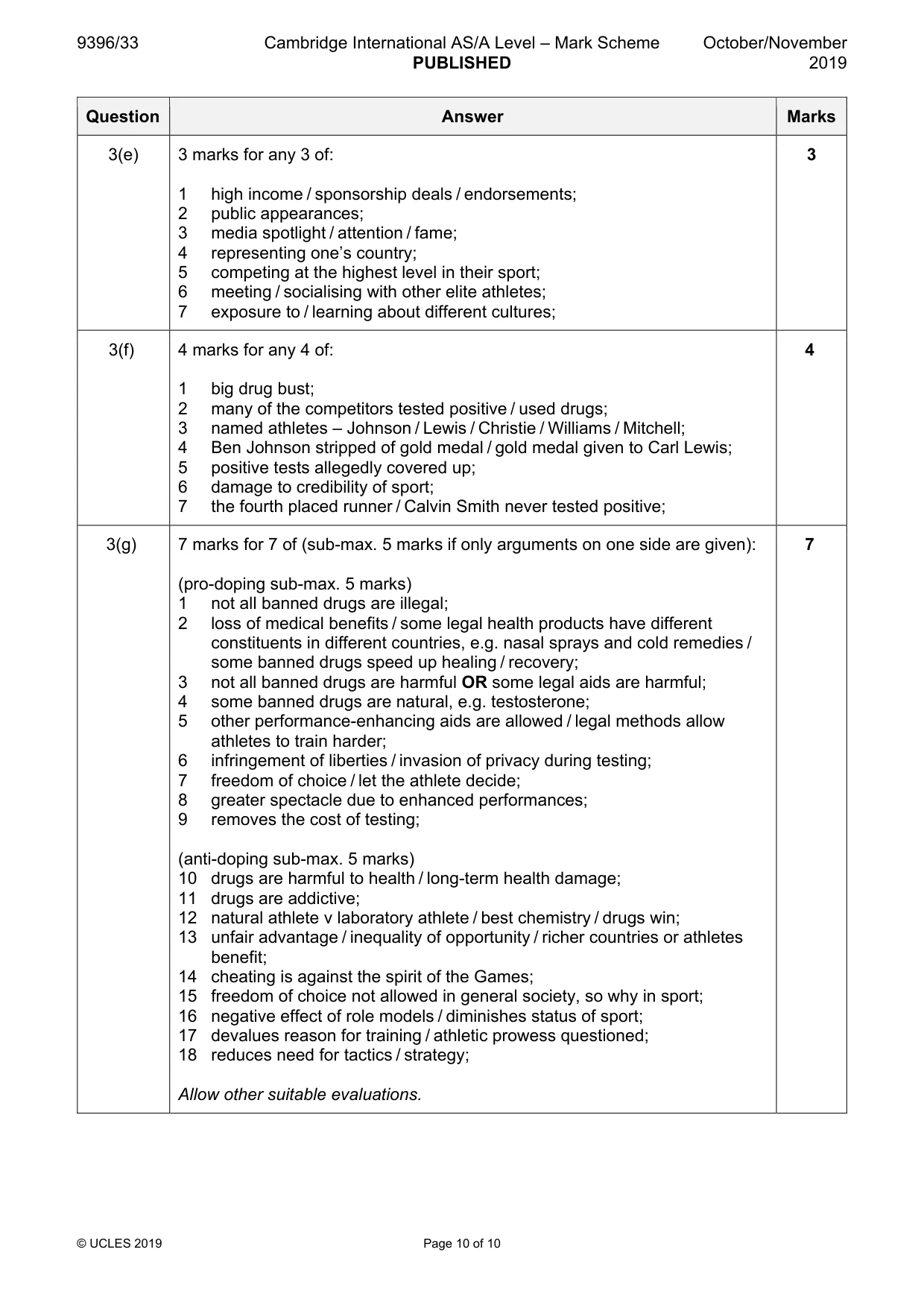
Mark scheme: 3(a) 3 marks for any 3 of: 3 1 abide by the rules of the competition; 2 conform over or above the strict rules / no gamesmanship; 3 good sportsmanship / respect for other performers / officials; 4 modest in victory / shake hands; 5 generous in defeat / congratulate opponent; 3(b) 4 marks for any 4 of: 4 1 similar sports, e.g. athletics (one sport must be identified); 2 every 4 years; 3 Olympiad; 4 Olympic oath; 5 Olympic flame; 6 international athletic festival / athletes from all over the world compete / cultural festival; 7 opening ceremony; 8 mental / physical challenge; 9 peace / harmony / cooperation between nations; 10 specialist sites used; 11 specialist training (prior to event); 12 eligibility standards must be met to qualify for Games; 3(c) 4 marks for any 4 of: 4 1 terrorism – Munich 1972 – killing of Israeli athletes by Palestinians; 2 protest – Mexico 1968 – Black power salute – race issues in USA; 3 propaganda – Berlin 1936 – promote Nazi supremacy; 4 nations banned – South Africa due to apartheid; 5 nations banned – Germany and Japan after Second World War; 6 nations banned – Iraq for the alleged torture of Iraqi athletes; 7 non-recognition of nations – e.g. Taiwan by China; 8 non-recognition of nations – e.g. former Soviet republics by Russia; 9 terrorism / protest – Atlanta 1996 bomb – anti-socialism / anti-abortion; 10 protest – Sydney 2000 – aboriginal race issues; Accept descriptions of other relevant examples. 3(d) 5 marks for any 5 of: 5 1 (broken time) payment for playing; 2 (broken time) payment made to cover loss of earnings; 3 (broken time) « and to cover costs of expenses; 4 (impact) abuse of the amateur ideal / participants should compete for no financial gain; 5 (impact) created inequality between competing teams; 6 (impact) stimulated debate about whether Olympics could remain amateur; 7 (impact) « led to professionalism / to attract top athletes; 3(e) 3 marks for any 3 of: 3 1 high income / sponsorship deals / endorsements; 2 public appearances; 3 media spotlight / attention / fame; 4 representing one’s country; 5 competing at the highest level in their sport; 6 meeting / socialising with other elite athletes; 7 exposure to / learning about different cultures; 3(f) 4 marks for any 4 of: 4 1 big drug bust; 2 many of the competitors tested positive / used drugs; 3 named athletes – Johnson / Lewis / Christie / Williams / Mitchell; 4 Ben Johnson stripped of gold medal / gold medal given to Carl Lewis; 5 positive tests allegedly covered up; 6 damage to credibility of sport; 7 the fourth placed runner / Calvin Smith never tested positive; 3(g) 7 marks for 7 of (sub-max. 5 marks if only arguments on one side are given): 7 (pro-doping sub-max. 5 marks) 1 not all banned drugs are illegal; 2 loss of medical benefits / some legal health products have different constituents in different countries, e.g. nasal sprays and cold remedies / some banned drugs speed up healing / recovery; 3 not all banned drugs are harmful OR some legal aids are harmful; 4 some banned drugs are natural, e.g. testosterone; 5 other performance-enhancing aids are allowed / legal methods allow athletes to train harder; 6 infringement of liberties / invasion of privacy during testing; 7 freedom of choice / let the athlete decide; 8 greater spectacle due to enhanced performances; 9 removes the cost of testing; (anti-doping sub-max. 5 marks) 10 drugs are harmful to health / long-term health damage; 11 drugs are addictive; 12 natural athlete v laboratory athlete / best chemistry / drugs win; 13 unfair advantage / inequality of opportunity / richer countries or athletes benefit; 14 cheating is against the spirit of the Games; 15 freedom of choice not allowed in general society, so why in sport; 16 negative effect of role models / diminishes status of sport; 17 devalues reason for training / athletic prowess questioned; 18 reduces need for tactics / strategy; Allow other suitable evaluations.
What you needed in this session
Cambridge’s own grade thresholds for 2019 Oct/Nov, Paper 3 · Variant 3. A higher threshold means an easier paper — the bar moves with how the cohort did.