Cambridge A Level Physical Education 9396 — 2017 Oct/Nov Paper 3 · Variant 3
9396/33/O/N/17 · 3 questions · 90 marks · ≈101 min
The question paper and its mark scheme, free to read here and free to download. This is Cambridge’s own paper, exactly as it was sat.
Question paper4 pages
Mark scheme9 pages
Answers below. Sit the paper first if you are practising.
Questions as text
Q1 · Describe the roles of the Krebs cycle and the electron transport (transfer) chain of the…
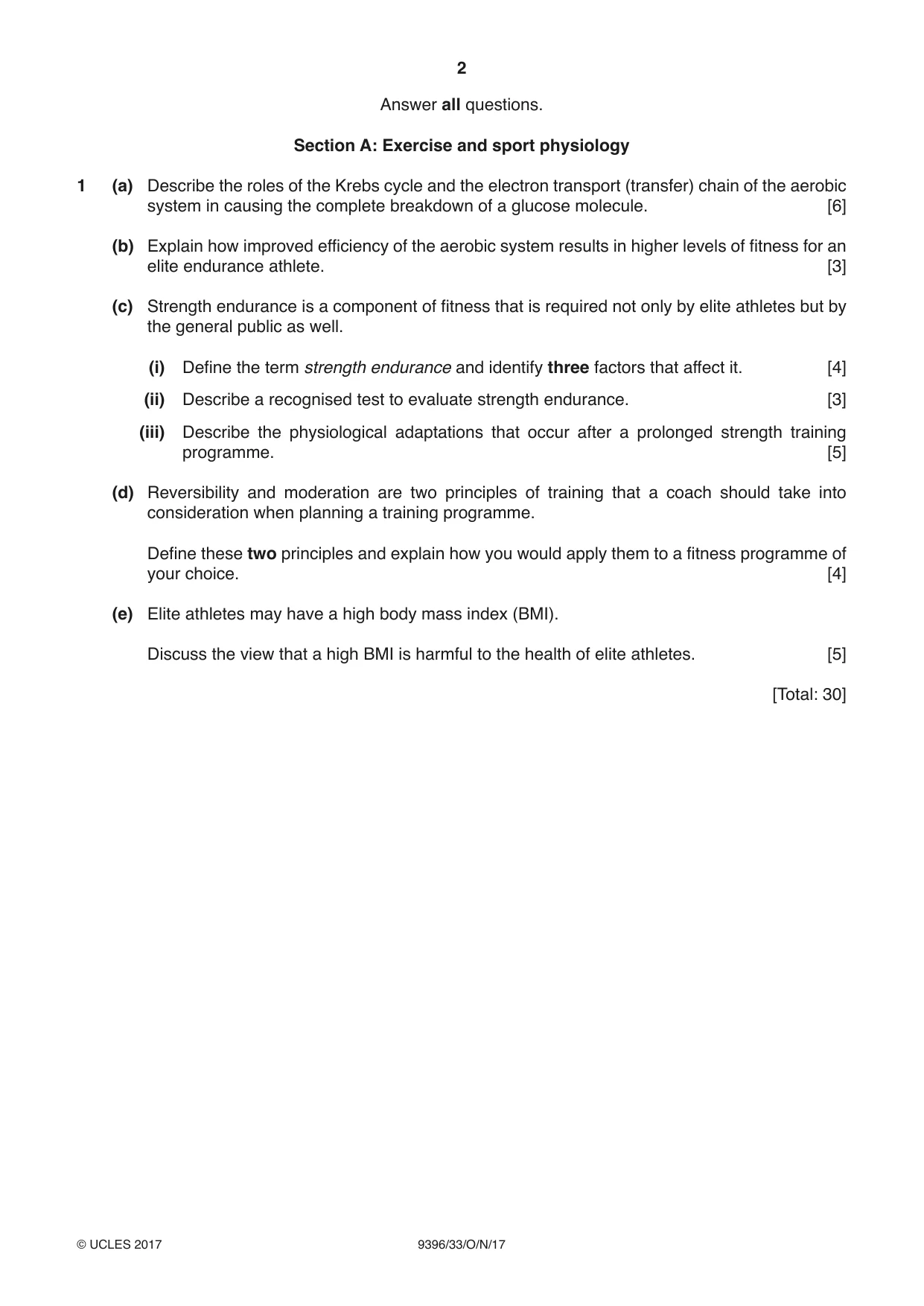
1 (a) Describe the roles of the Krebs cycle and the electron transport (transfer) chain of the aerobic system in causing the complete breakdown of a glucose molecule. [6] (b) Explain how improved efficiency of the aerobic system results in higher levels of fitness for an elite endurance athlete. [3] (c) Strength endurance is a component of fitness that is required not only by elite athletes but by the general public as well. (i) Define the term strength endurance and identify three factors that affect it. [4] (ii) Describe a recognised test to evaluate strength endurance. [3] (iii) Describe the physiological adaptations that occur after a prolonged strength training programme. [5] (d) Reversibility and moderation are two principles of training that a coach should take into consideration when planning a training programme. Define these two principles and explain how you would apply them to a fitness programme of your choice. [4] (e) Elite athletes may have a high body mass index (BMI). Discuss the view that a high BMI is harmful to the health of elite athletes. [5] [Total: 30]
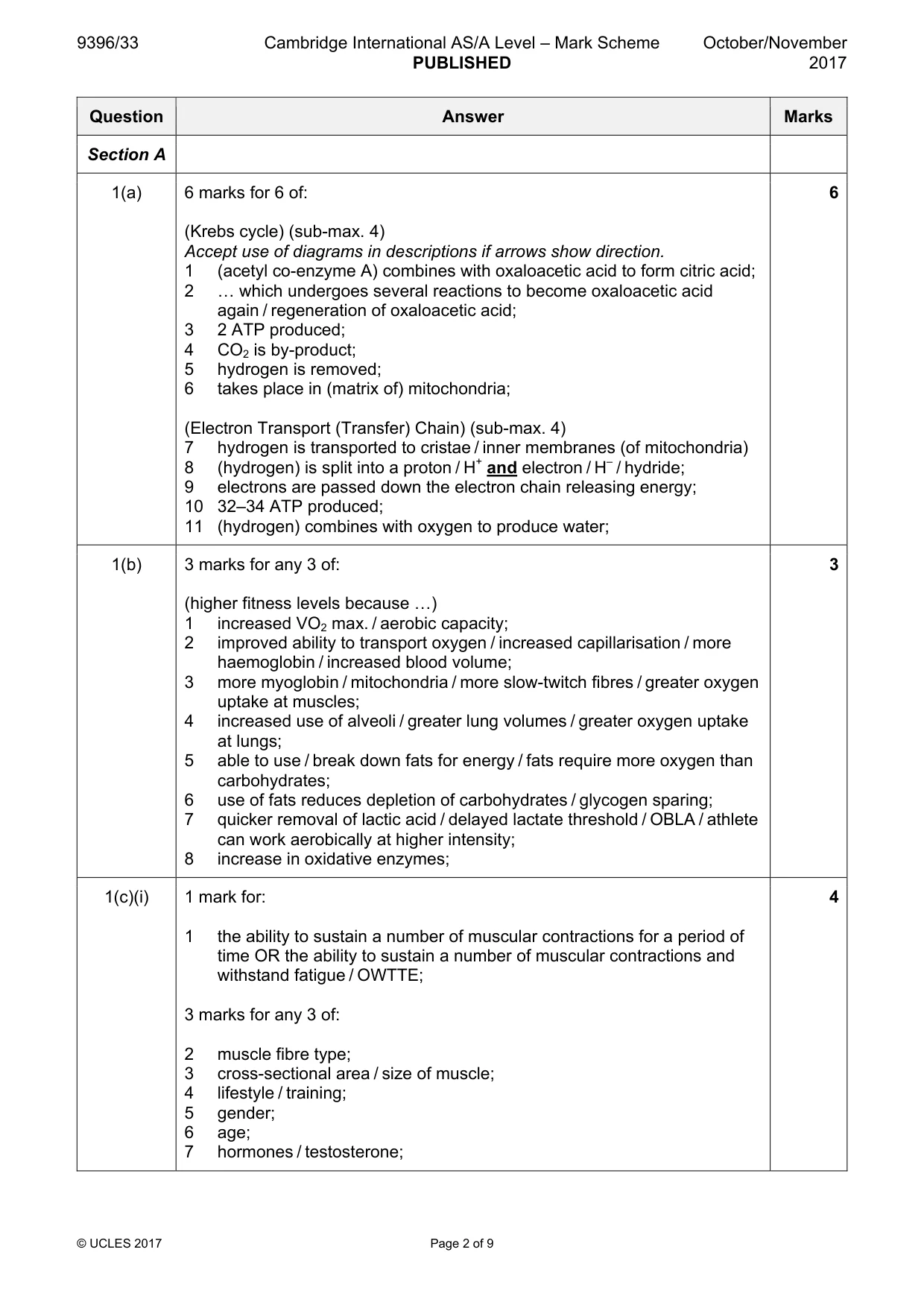
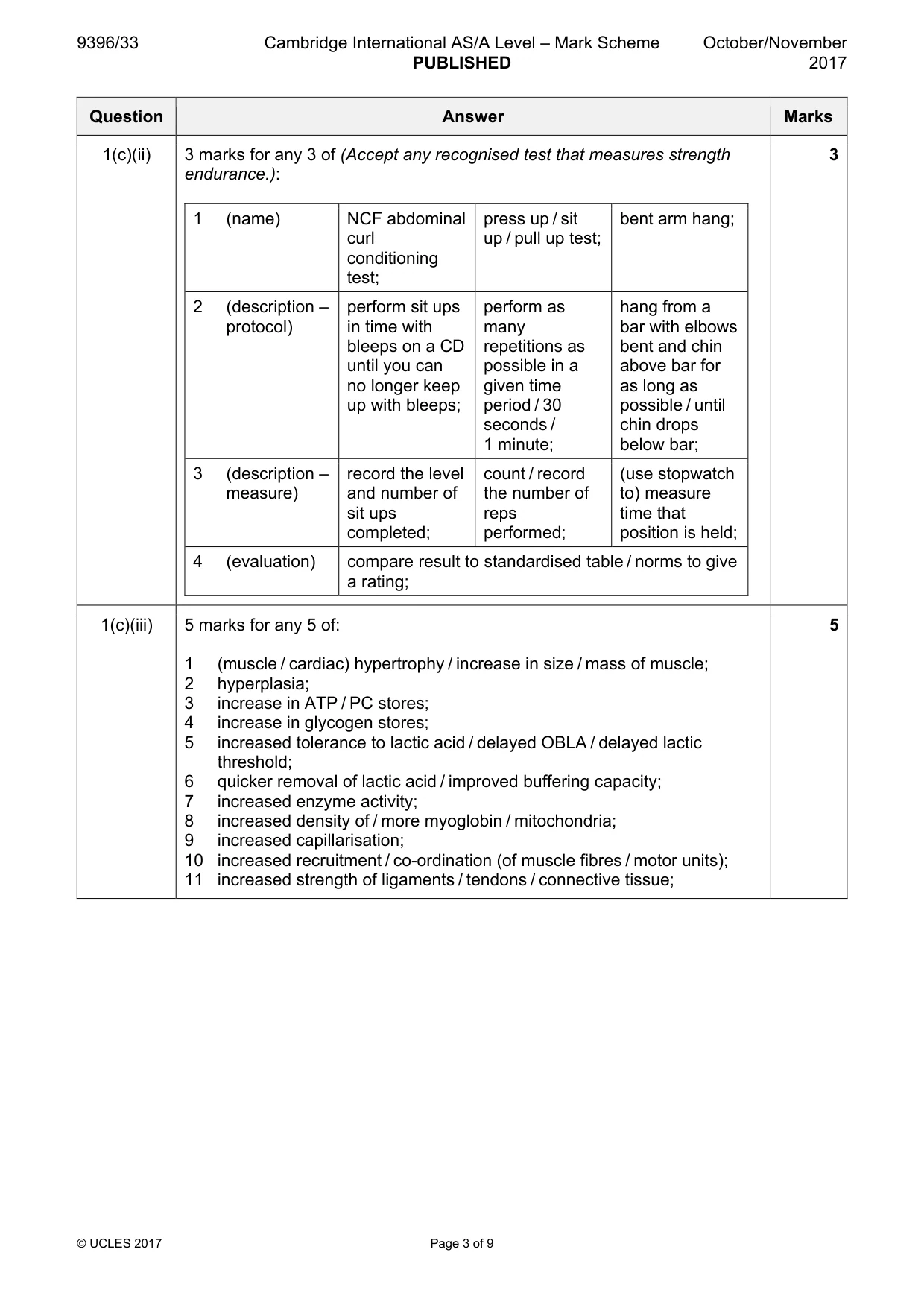
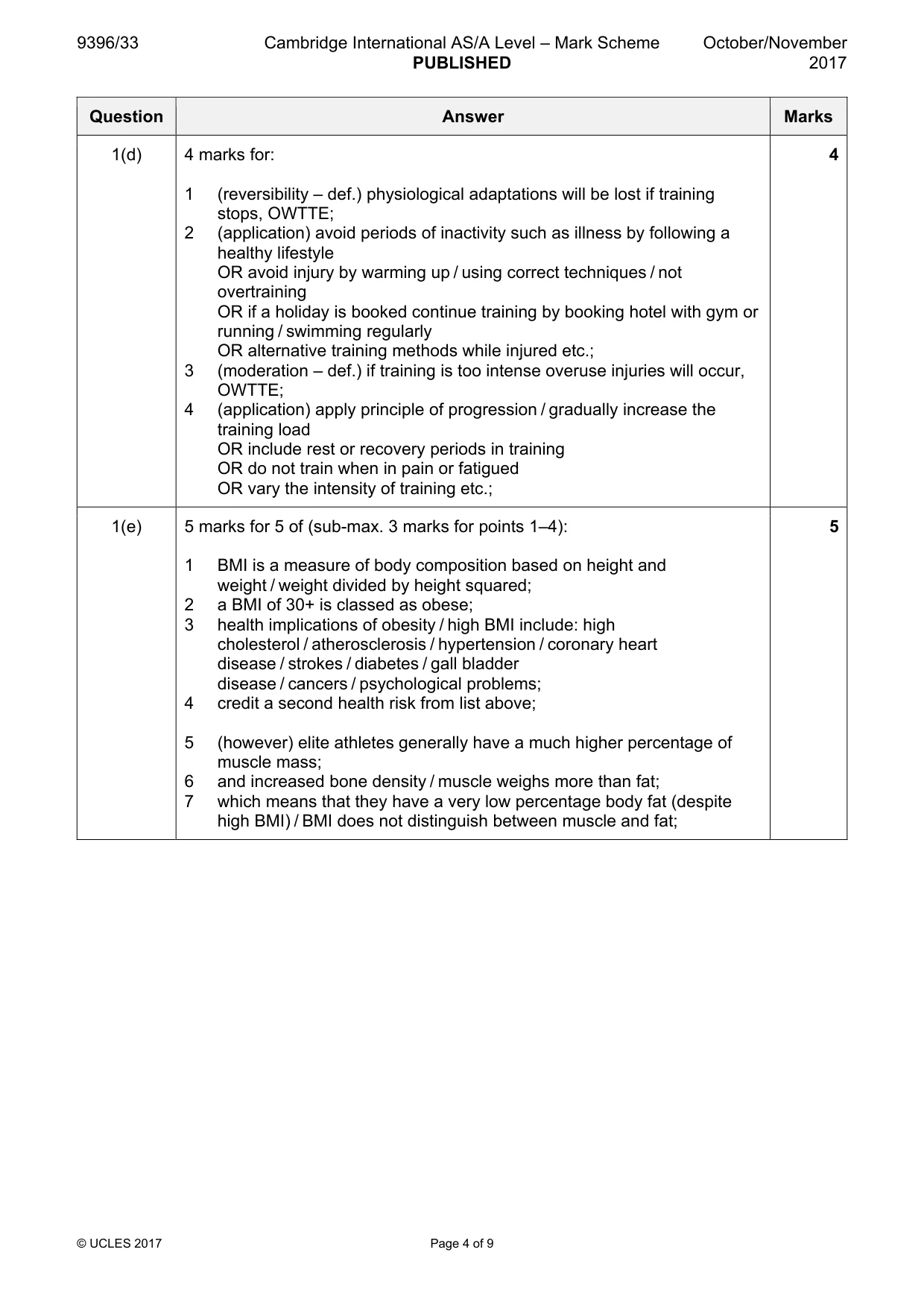
Mark scheme: Question Answer Marks Section A 1(a) 6 marks for 6 of: 6 (Krebs cycle) (sub-max. 4) Accept use of diagrams in descriptions if arrows show direction. 1 (acetyl co-enzyme A) combines with oxaloacetic acid to form citric acid; 2 « which undergoes several reactions to become oxaloacetic acid again / regeneration of oxaloacetic acid; 3 2 ATP produced; 4 CO2 is by-product; 5 hydrogen is removed; 6 takes place in (matrix of) mitochondria; (Electron Transport (Transfer) Chain) (sub-max. 4) 7 hydrogen is transported to cristae / inner membranes (of mitochondria) 8 (hydrogen) is split into a proton / H+ and electron / H– / hydride; 9 electrons are passed down the electron chain releasing energy; 10 32–34 ATP produced; 11 (hydrogen) combines with oxygen to produce water; 1(b) 3 marks for any 3 of: 3 (higher fitness levels because «) 1 increased VO2 max. / aerobic capacity; 2 improved ability to transport oxygen / increased capillarisation / more haemoglobin / increased blood volume; 3 more myoglobin / mitochondria / more slow-twitch fibres / greater oxygen uptake at muscles; 4 increased use of alveoli / greater lung volumes / greater oxygen uptake at lungs; 5 able to use / break down fats for energy / fats require more oxygen than carbohydrates; 6 use of fats reduces depletion of carbohydrates / glycogen sparing; 7 quicker removal of lactic acid / delayed lactate threshold / OBLA / athlete can work aerobically at higher intensity; 8 increase in oxidative enzymes; 1(c)(i) 1 mark for: 4 1 the ability to sustain a number of muscular contractions for a period of time OR the ability to sustain a number of muscular contractions and withstand fatigue / OWTTE; 3 marks for any 3 of: 2 muscle fibre type; 3 cross-sectional area / size of muscle; 4 lifestyle / training; 5 gender; 6 age; 7 hormones / testosterone; 1(c)(ii) 3 marks for any 3 of (Accept any recognised test that measures strength 3 endurance.): 1 (name) NCF abdominal press up / sit bent arm hang; curl up / pull up test; conditioning test; 2 (description – perform sit ups perform as hang from a protocol) in time with many bar with elbows bleeps on a CD repetitions as bent and chin until you can possible in a above bar for no longer keep given time as long as up with bleeps; period / 30 possible / until seconds / chin drops 1 minute; below bar; 3 (description – record the level count / record (use stopwatch measure) and number of the number of to) measure sit ups reps time that completed; performed; position is held; 4 (evaluation) compare result to standardised table / norms to give a rating; 1(c)(iii) 5 marks for any 5 of: 5 1 (muscle / cardiac) hypertrophy / increase in size / mass of muscle; 2 hyperplasia; 3 increase in ATP / PC stores; 4 increase in glycogen stores; 5 increased tolerance to lactic acid / delayed OBLA / delayed lactic threshold; 6 quicker removal of lactic acid / improved buffering capacity; 7 increased enzyme activity; 8 increased density of / more myoglobin / mitochondria; 9 increased capillarisation; 10 increased recruitment / co-ordination (of muscle fibres / motor units); 11 increased strength of ligaments / tendons / connective tissue; 1(d) 4 marks for: 4 1 (reversibility – def.) physiological adaptations will be lost if training stops, OWTTE; 2 (application) avoid periods of inactivity such as illness by following a healthy lifestyle OR avoid injury by warming up / using correct techniques / not overtraining OR if a holiday is booked continue training by booking hotel with gym or running / swimming regularly OR alternative training methods while injured etc.; 3 (moderation – def.) if training is too intense overuse injuries will occur, OWTTE; 4 (application) apply principle of progression / gradually increase the training load OR include rest or recovery periods in training OR do not train when in pain or fatigued OR vary the intensity of training etc.; 1(e) 5 marks for 5 of (sub-max. 3 marks for points 1–4): 5 1 BMI is a measure of body composition based on height and weight / weight divided by height squared; 2 a BMI of 30+ is classed as obese; 3 health implications of obesity / high BMI include: high cholesterol / atherosclerosis / hypertension / coronary heart disease / strokes / diabetes / gall bladder disease / cancers / psychological problems; 4 credit a second health risk from list above; 5 (however) elite athletes generally have a much higher percentage of muscle mass; 6 and increased bone density / muscle weighs more than fat; 7 which means that they have a very low percentage body fat (despite high BMI) / BMI does not distinguish between muscle and fat;
Q2 · There are different theories of personality
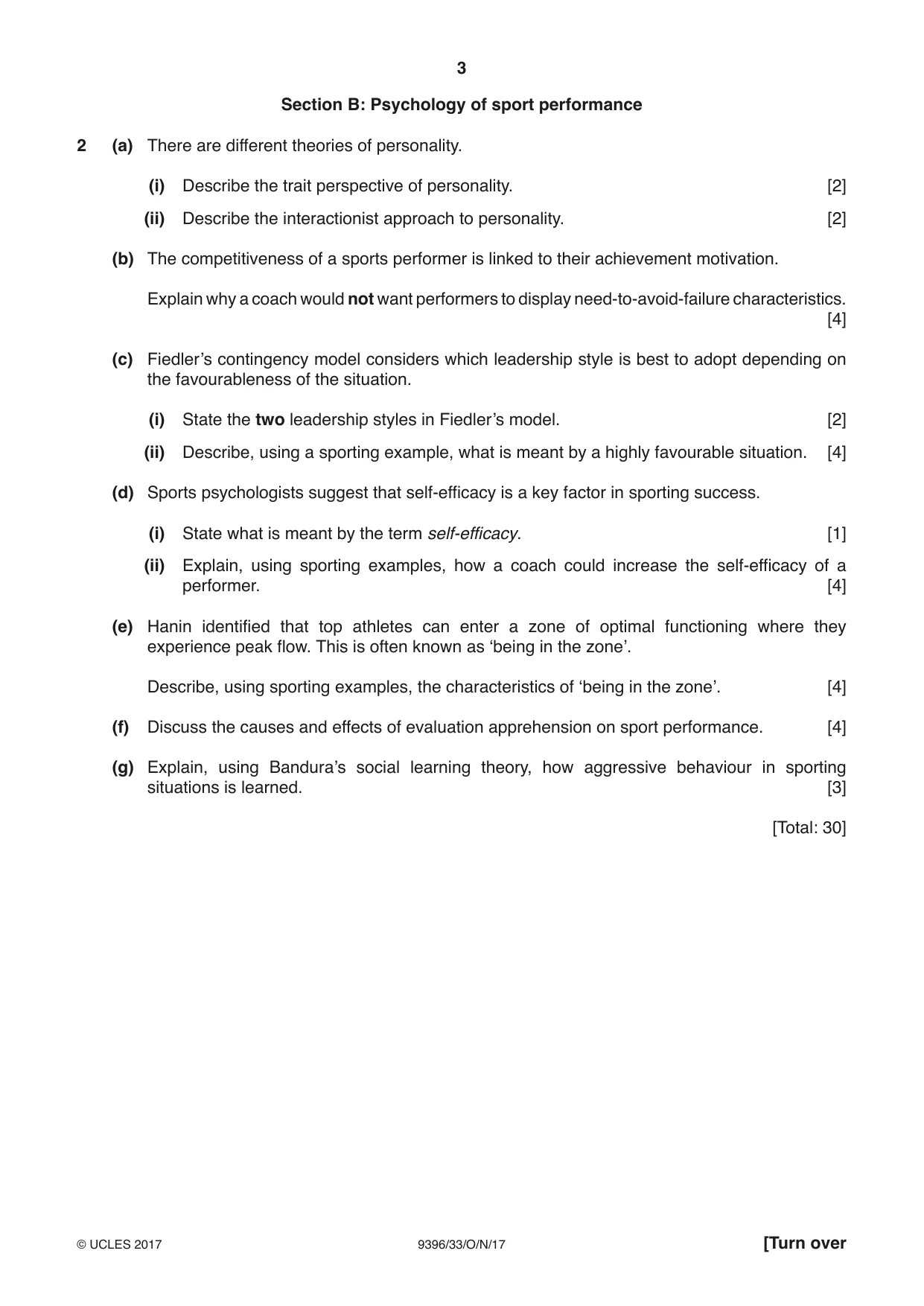
2 (a) There are different theories of personality. (i) Describe the trait perspective of personality. [2] (ii) Describe the interactionist approach to personality. [2] (b) The competitiveness of a sports performer is linked to their achievement motivation. Explain why a coach would not want performers to display need-to-avoid-failure characteristics. [4] (c) Fiedler’s contingency model considers which leadership style is best to adopt depending on the favourableness of the situation. (i) State the two leadership styles in Fiedler’s model. [2] (ii) Describe, using a sporting example, what is meant by a highly favourable situation. [4] (d) Sports psychologists suggest that self-efficacy is a key factor in sporting success. (i) State what is meant by the term self-efficacy. [1] (ii) Explain, using sporting examples, how a coach could increase the self-efficacy of a performer. [4] (e) Hanin identified that top athletes can enter a zone of optimal functioning where they experience peak flow. This is often known as ‘being in the zone’. Describe, using sporting examples, the characteristics of ‘being in the zone’. [4] (f) Discuss the causes and effects of evaluation apprehension on sport performance. [4] (g) Explain, using Bandura’s social learning theory, how aggressive behaviour in sporting situations is learned. [3] [Total: 30] Section C: Olympic Games: a global perspective
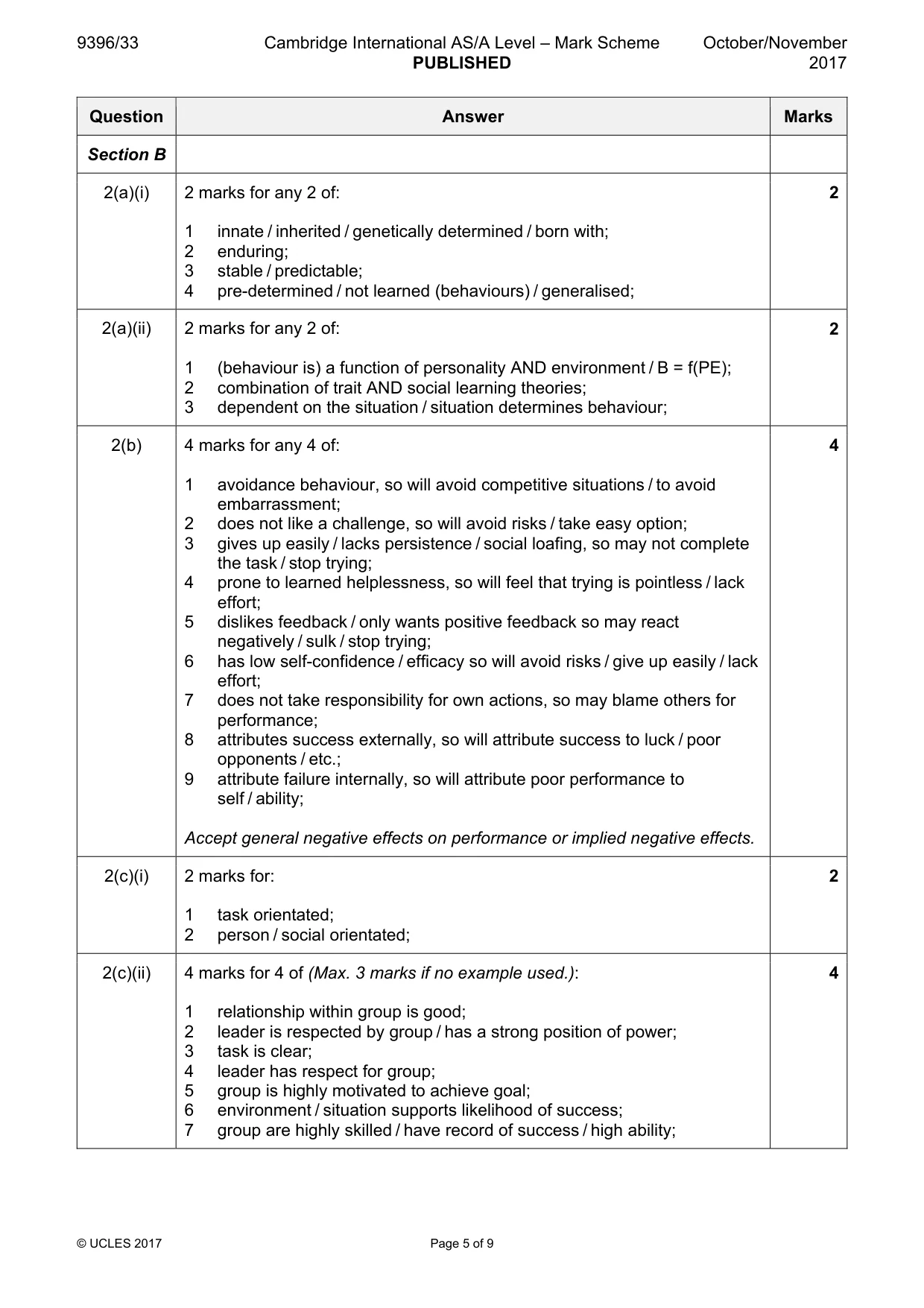
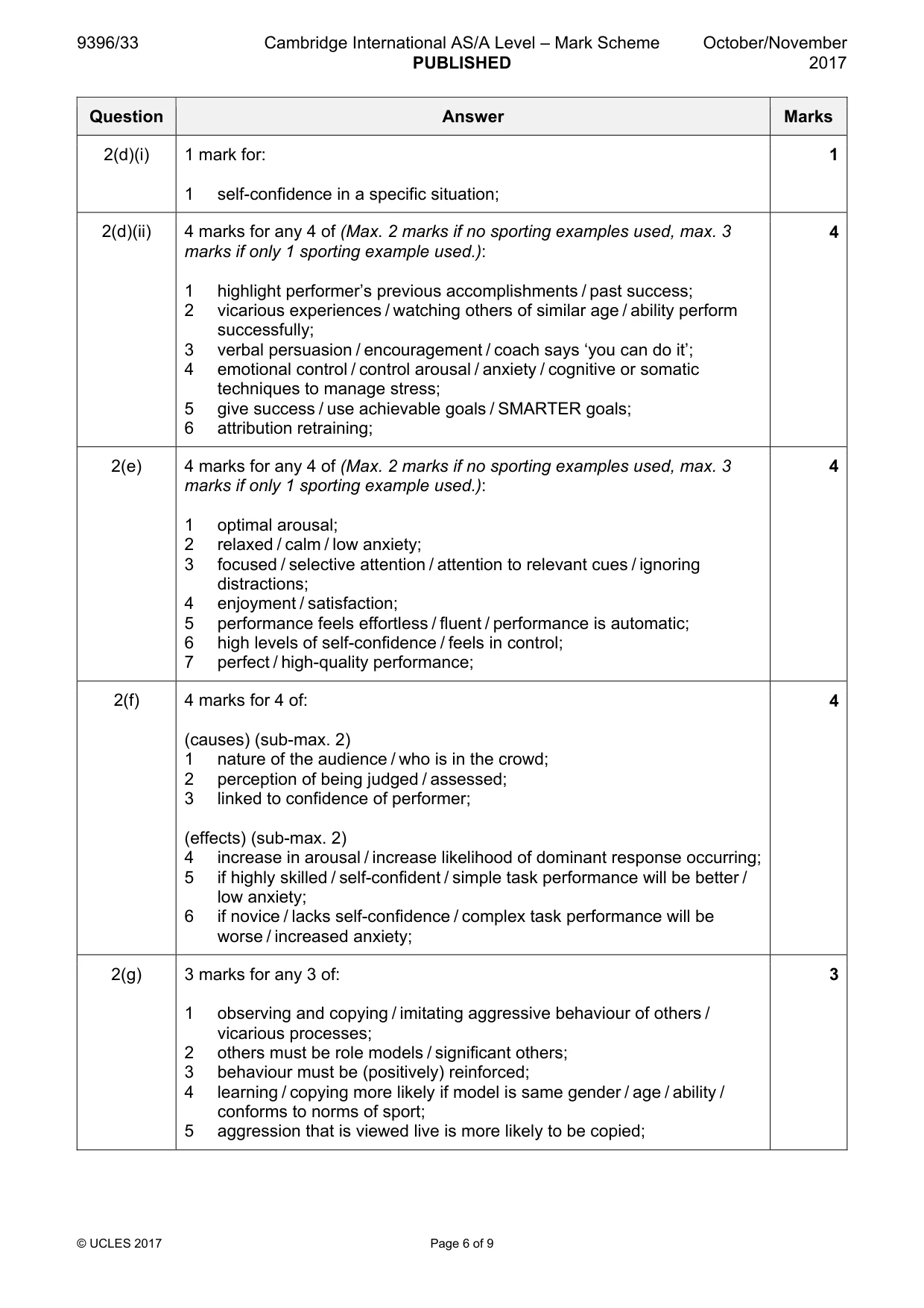
Mark scheme: 2(a)(i) 2 marks for any 2 of: 2 1 innate / inherited / genetically determined / born with; 2 enduring; 3 stable / predictable; 4 pre-determined / not learned (behaviours) / generalised; 2(a)(ii) 2 marks for any 2 of: 2 1 (behaviour is) a function of personality AND environment / B = f(PE); 2 combination of trait AND social learning theories; 3 dependent on the situation / situation determines behaviour; 2(b) 4 marks for any 4 of: 4 1 avoidance behaviour, so will avoid competitive situations / to avoid embarrassment; 2 does not like a challenge, so will avoid risks / take easy option; 3 gives up easily / lacks persistence / social loafing, so may not complete the task / stop trying; 4 prone to learned helplessness, so will feel that trying is pointless / lack effort; 5 dislikes feedback / only wants positive feedback so may react negatively / sulk / stop trying; 6 has low self-confidence / efficacy so will avoid risks / give up easily / lack effort; 7 does not take responsibility for own actions, so may blame others for performance; 8 attributes success externally, so will attribute success to luck / poor opponents / etc.; 9 attribute failure internally, so will attribute poor performance to self / ability; Accept general negative effects on performance or implied negative effects. 2(c)(i) 2 marks for: 2 1 task orientated; 2 person / social orientated; 2(c)(ii) 4 marks for 4 of (Max. 3 marks if no example used.): 4 1 relationship within group is good; 2 leader is respected by group / has a strong position of power; 3 task is clear; 4 leader has respect for group; 5 group is highly motivated to achieve goal; 6 environment / situation supports likelihood of success; 7 group are highly skilled / have record of success / high ability; 2(d)(i) 1 mark for: 1 1 self-confidence in a specific situation; 2(d)(ii) 4 marks for any 4 of (Max. 2 marks if no sporting examples used, max. 3 4 marks if only 1 sporting example used.): 1 highlight performer’s previous accomplishments / past success; 2 vicarious experiences / watching others of similar age / ability perform successfully; 3 verbal persuasion / encouragement / coach says ‘you can do it’; 4 emotional control / control arousal / anxiety / cognitive or somatic techniques to manage stress; 5 give success / use achievable goals / SMARTER goals; 6 attribution retraining; 2(e) 4 marks for any 4 of (Max. 2 marks if no sporting examples used, max. 3 4 marks if only 1 sporting example used.): 1 optimal arousal; 2 relaxed / calm / low anxiety; 3 focused / selective attention / attention to relevant cues / ignoring distractions; 4 enjoyment / satisfaction; 5 performance feels effortless / fluent / performance is automatic; 6 high levels of self-confidence / feels in control; 7 perfect / high-quality performance; 2(f) 4 marks for 4 of: 4 (causes) (sub-max. 2) 1 nature of the audience / who is in the crowd; 2 perception of being judged / assessed; 3 linked to confidence of performer; (effects) (sub-max. 2) 4 increase in arousal / increase likelihood of dominant response occurring; 5 if highly skilled / self-confident / simple task performance will be better / low anxiety; 6 if novice / lacks self-confidence / complex task performance will be worse / increased anxiety; 2(g) 3 marks for any 3 of: 3 1 observing and copying / imitating aggressive behaviour of others / vicarious processes; 2 others must be role models / significant others; 3 behaviour must be (positively) reinforced; 4 learning / copying more likely if model is same gender / age / ability / conforms to norms of sport; 5 aggression that is viewed live is more likely to be copied;
Q3 · Identify three sources of funding that are available to cover the costs of hosting the…
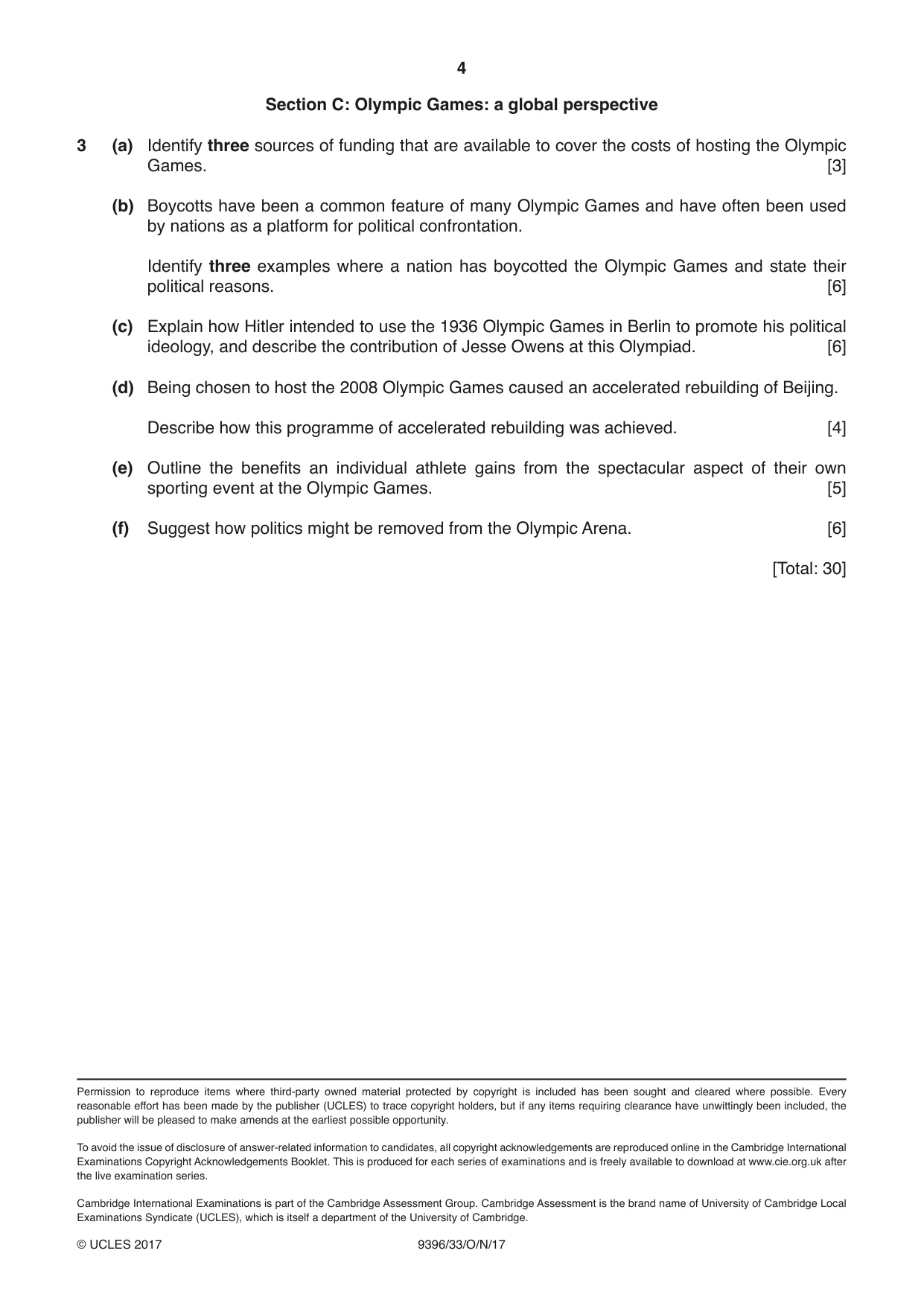
3 (a) Identify three sources of funding that are available to cover the costs of hosting the Olympic Games. [3] (b) Boycotts have been a common feature of many Olympic Games and have often been used by nations as a platform for political confrontation. Identify three examples where a nation has boycotted the Olympic Games and state their political reasons. [6] (c) Explain how Hitler intended to use the 1936 Olympic Games in Berlin to promote his political ideology, and describe the contribution of Jesse Owens at this Olympiad. [6] (d) Being chosen to host the 2008 Olympic Games caused an accelerated rebuilding of Beijing. Describe how this programme of accelerated rebuilding was achieved. [4] (e) Outline the benefits an individual athlete gains from the spectacular aspect of their own sporting event at the Olympic Games. [5] (f) Suggest how politics might be removed from the Olympic Arena. [6] [Total: 30]
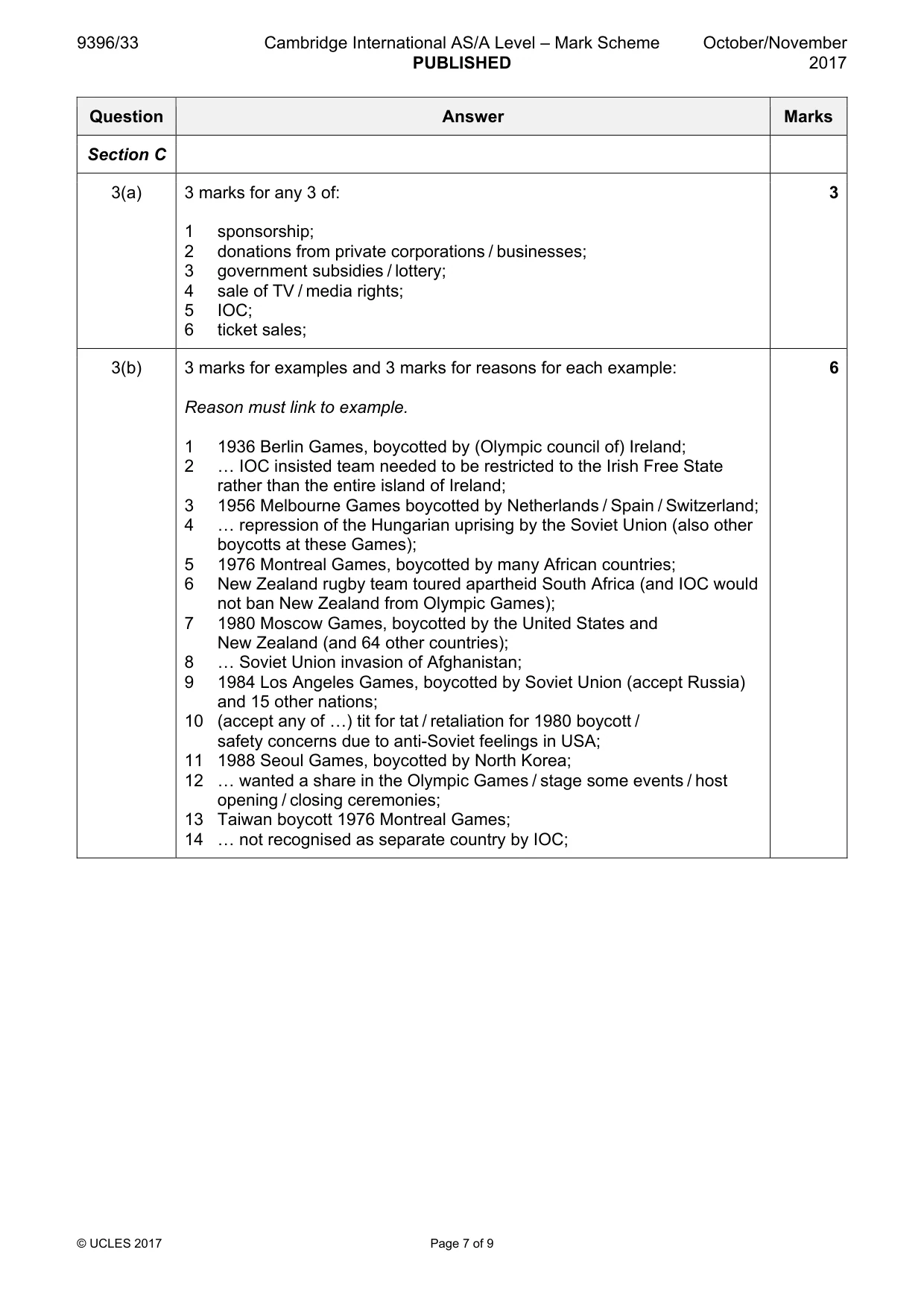
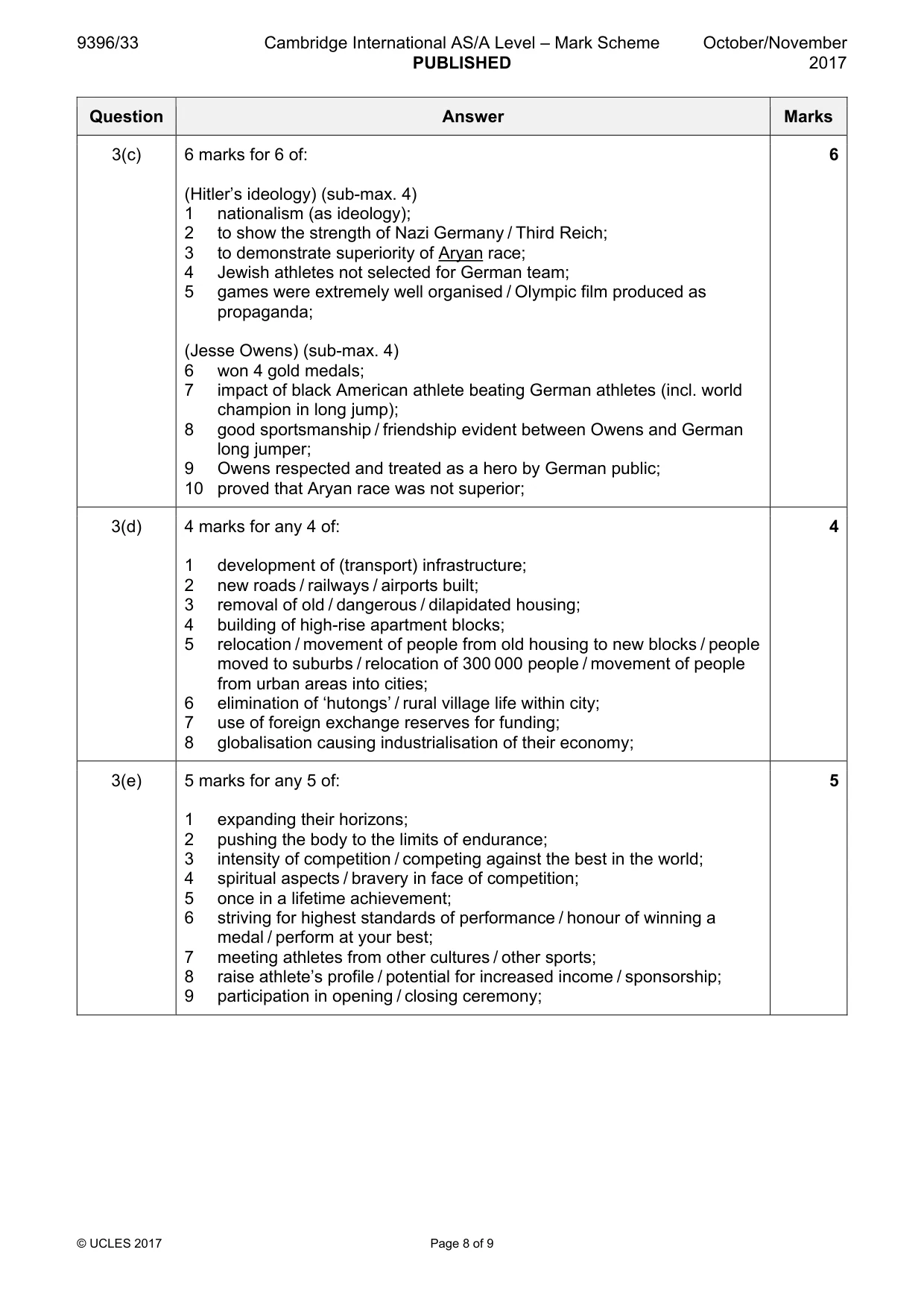
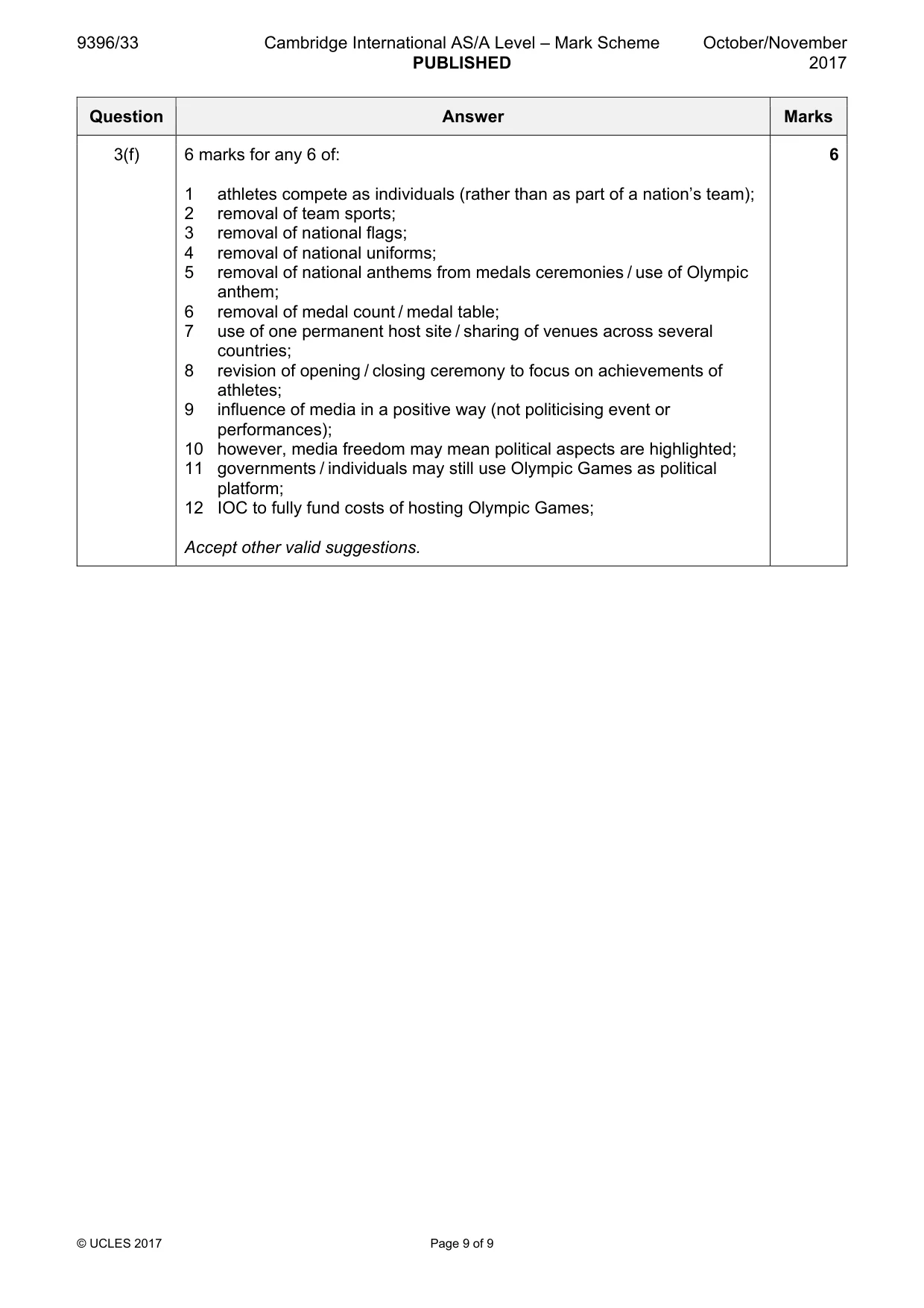
Mark scheme: 3(a) 3 marks for any 3 of: 3 1 sponsorship; 2 donations from private corporations / businesses; 3 government subsidies / lottery; 4 sale of TV / media rights; 5 IOC; 6 ticket sales; 3(b) 3 marks for examples and 3 marks for reasons for each example: 6 Reason must link to example. 1 1936 Berlin Games, boycotted by (Olympic council of) Ireland; 2 « IOC insisted team needed to be restricted to the Irish Free State rather than the entire island of Ireland; 3 1956 Melbourne Games boycotted by Netherlands / Spain / Switzerland; 4 « repression of the Hungarian uprising by the Soviet Union (also other boycotts at these Games); 5 1976 Montreal Games, boycotted by many African countries; 6 New Zealand rugby team toured apartheid South Africa (and IOC would not ban New Zealand from Olympic Games); 7 1980 Moscow Games, boycotted by the United States and New Zealand (and 64 other countries); 8 « Soviet Union invasion of Afghanistan; 9 1984 Los Angeles Games, boycotted by Soviet Union (accept Russia) and 15 other nations; 10 (accept any of «) tit for tat / retaliation for 1980 boycott / safety concerns due to anti-Soviet feelings in USA; 11 1988 Seoul Games, boycotted by North Korea; 12 « wanted a share in the Olympic Games / stage some events / host opening / closing ceremonies; 13 Taiwan boycott 1976 Montreal Games; 14 « not recognised as separate country by IOC; 3(c) 6 marks for 6 of: 6 (Hitler’s ideology) (sub-max. 4) 1 nationalism (as ideology); 2 to show the strength of Nazi Germany / Third Reich; 3 to demonstrate superiority of Aryan race; 4 Jewish athletes not selected for German team; 5 games were extremely well organised / Olympic film produced as propaganda; (Jesse Owens) (sub-max. 4) 6 won 4 gold medals; 7 impact of black American athlete beating German athletes (incl. world champion in long jump); 8 good sportsmanship / friendship evident between Owens and German long jumper; 9 Owens respected and treated as a hero by German public; 10 proved that Aryan race was not superior; 3(d) 4 marks for any 4 of: 4 1 development of (transport) infrastructure; 2 new roads / railways / airports built; 3 removal of old / dangerous / dilapidated housing; 4 building of high-rise apartment blocks; 5 relocation / movement of people from old housing to new blocks / people moved to suburbs / relocation of 300 000 people / movement of people from urban areas into cities; 6 elimination of ‘hutongs’ / rural village life within city; 7 use of foreign exchange reserves for funding; 8 globalisation causing industrialisation of their economy; 3(e) 5 marks for any 5 of: 5 1 expanding their horizons; 2 pushing the body to the limits of endurance; 3 intensity of competition / competing against the best in the world; 4 spiritual aspects / bravery in face of competition; 5 once in a lifetime achievement; 6 striving for highest standards of performance / honour of winning a medal / perform at your best; 7 meeting athletes from other cultures / other sports; 8 raise athlete’s profile / potential for increased income / sponsorship; 9 participation in opening / closing ceremony; 3(f) 6 marks for any 6 of: 6 1 athletes compete as individuals (rather than as part of a nation’s team); 2 removal of team sports; 3 removal of national flags; 4 removal of national uniforms; 5 removal of national anthems from medals ceremonies / use of Olympic anthem; 6 removal of medal count / medal table; 7 use of one permanent host site / sharing of venues across several countries; 8 revision of opening / closing ceremony to focus on achievements of athletes; 9 influence of media in a positive way (not politicising event or performances); 10 however, media freedom may mean political aspects are highlighted; 11 governments / individuals may still use Olympic Games as political platform; 12 IOC to fully fund costs of hosting Olympic Games; Accept other valid suggestions.
What you needed in this session
Cambridge’s own grade thresholds for 2017 Oct/Nov, Paper 3 · Variant 3. A higher threshold means an easier paper — the bar moves with how the cohort did.