Cambridge A Level Physical Education 9396 — 2016 Oct/Nov Paper 3 · Variant 3
9396/33/O/N/16 · 90 marks · ≈101 min
The question paper and its mark scheme, free to read here and free to download. This is Cambridge’s own paper, exactly as it was sat.
Question paper4 pages
Mark scheme8 pages
Answers below. Sit the paper first if you are practising.
Paper as text
Question paper, page 1
This document consists of 4 printed pages and 1 insert. DC (ST/FD) 126174 © UCLES 2016 [Turn over Cambridge International Examinations Cambridge International Advanced Subsidiary and Advanced Level * 4 0 0 8 2 7 6 1 0 0 * PHYSICAL EDUCATION 9396/33 Paper 3 October/November 2016 2 hours 30 minutes No Additional Materials are required. READ THESE INSTRUCTIONS FIRST An answer booklet is provided inside this question paper. You should follow the instructions on the front cover of the answer booklet. If you need additional answer paper ask the invigilator for a continuation booklet. Answer all questions. Electronic calculators may be used. You may lose marks if you do not show your working or if you do not use appropriate units. The number of marks is given in brackets [ ] at the end of each question or part question.
Question paper, page 2
2 9396/33/O/N/16 © UCLES 2016 Answer all questions. Section A: Exercise and sport physiology 1 (a) Explain the role of ATP, including its breakdown and re-synthesis, in producing muscle contractions to enable human movement. [6] (b) The 1500 m race in athletics involves the performer using all three energy systems at different times during the race. (i) Explain, using the 1500 m race, when and why each of the energy systems would be used by an elite performer. [6] (ii) After the race, a significant amount of lactic acid will be present in the working muscles. Outline the processes that occur in the body in the removal of this lactic acid. [4] (c) Define the term body composition and outline guidelines for its improvement. [4] (d) Speed is a vital fitness component for most elite sports performers. (i) Identify and describe a recognised test to evaluate speed. [2] (ii) Plyometric training programmes can be used to improve explosive strength and power, which impacts on speed. Explain the principles behind plyometrics training. [4] (e) Critically evaluate the use of creatine supplements as an ergogenic aid to performance. [4] [Total: 30] Section B: Psychology of sport performance 2 (a) The trait theory of personality suggests that individuals have either Type A or Type B characteristics. Identify two characteristics of a Type A personality. [2] (b) Prejudice is a prejudgement of a person, group, or situation, usually based on inadequate information. State an example of prejudice in a sporting situation and identify the origins and influences that may have contributed to this prejudice. [4] (c) Successful sports teams generally work together very well as a unit. Steiner’s model of group performance can be expressed as shown. Actual productivity = Potential productivity – Losses due to faulty processes Using examples from a team sport of your choice, explain Steiner’s model and describe the possible causes of faulty processes. [5]
Question paper, page 3
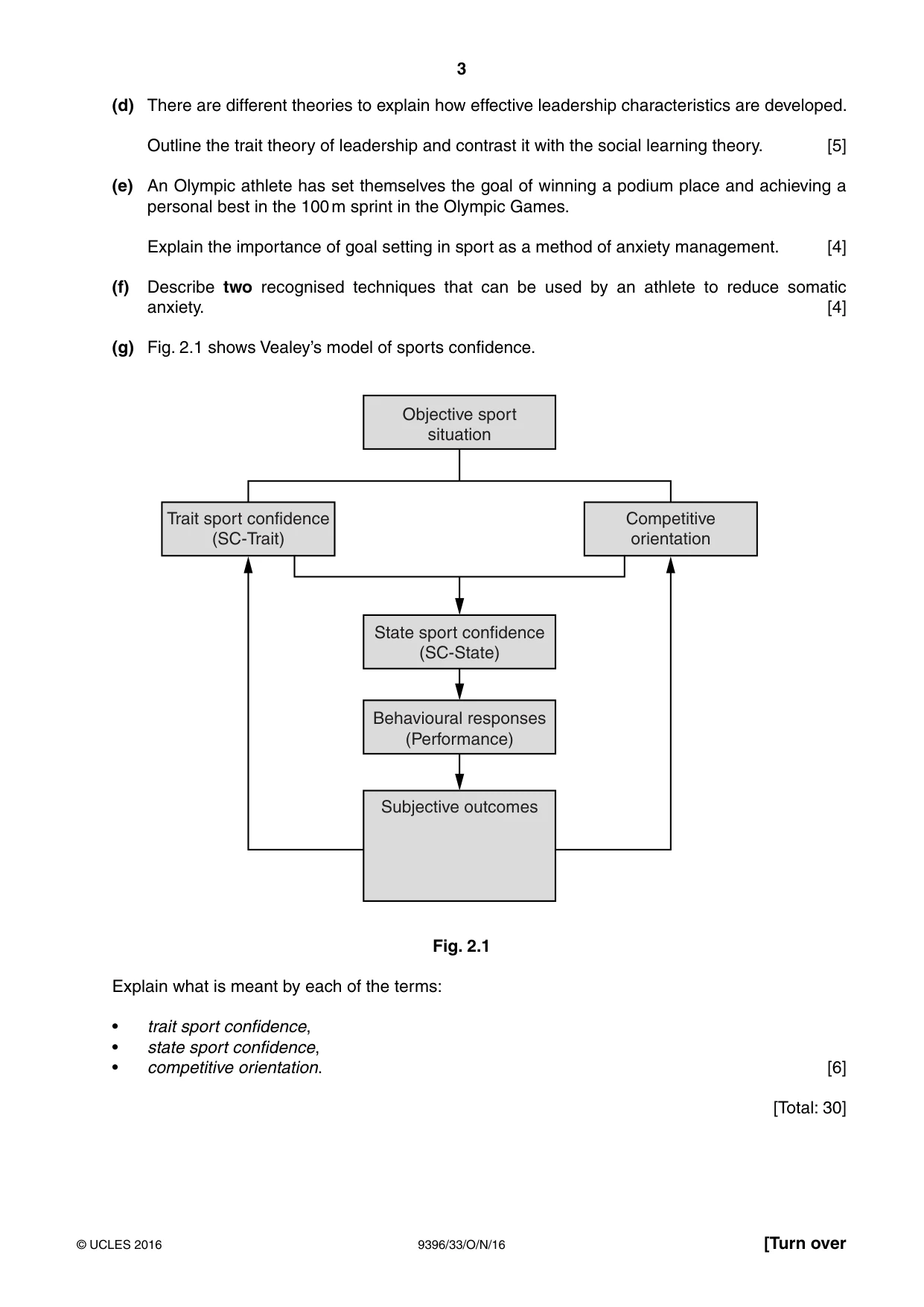
3 9396/33/O/N/16 © UCLES 2016 [Turn over (d) There are different theories to explain how effective leadership characteristics are developed. Outline the trait theory of leadership and contrast it with the social learning theory. [5] (e) An Olympic athlete has set themselves the goal of winning a podium place and achieving a personal best in the 100 m sprint in the Olympic Games. Explain the importance of goal setting in sport as a method of anxiety management. [4] (f) Describe two recognised techniques that can be used by an athlete to reduce somatic anxiety. [4] (g) Fig. 2.1 shows Vealey’s model of sports confidence. Objective sport situation State sport confidence (SC-State) Behavioural responses (Performance) Subjective outcomes Trait sport confidence (SC-Trait) Competitive orientation Fig. 2.1 Explain what is meant by each of the terms: • trait sport confidence, • state sport confidence, • competitive orientation. [6] [Total: 30]
Question paper, page 4
4 9396/33/O/N/16 © UCLES 2016 Section C: Olympic Games: a global perspective 3 (a) The Ancient Olympic Games are seen as a blueprint for the modern era. Many aspects of their format were incorporated into the modern era and the philosophy behind the Games was believed to act as a social force. (i) Identify four athletic events that were a part of the Ancient Olympic Games. [4] (ii) Describe the philosophy and values behind the Olympic Games. [4] (b) When the Modern Olympic Games began in 1896, the concept of amateurism significantly influenced participation in the Games. Explain the transition from amateurism to professionalism during the Modern Olympic Games. [5] (c) No women were allowed to compete in the first Modern Olympic Games in 1896. Discuss the changing role of women in the Olympic Games from 1896 to today. [4] (d) The modern Olympic oath was written by Pierre de Coubertin. It has been modified over time to reflect the changing nature of sports competition and to address dysfunctional aspects of behaviour. (i) Explain, using at least one practical example from the Olympic Games, what is meant by dysfunctional aspects of behaviour. [3] (ii) Describe how dysfunctional aspects of behaviour could be prevented from occurring at the Olympic Games. [4] (e) The Ancient Olympic Games were held at the same site in Olympia every four years, whereas the Modern Olympic Games rotate from city to city based on bids to host the Games. Give reasons why it was decided to rotate the Games from city to city and consider the benefits that would arise from having a permanent site for the Olympic Games. [6] [Total: 30] Permission to reproduce items where third-party owned material protected by copyright is included has been sought and cleared where possible. Every reasonable effort has been made by the publisher (UCLES) to trace copyright holders, but if any items requiring clearance have unwittingly been included, the publisher will be pleased to make amends at the earliest possible opportunity. To avoid the issue of disclosure of answer-related information to candidates, all copyright acknowledgements are reproduced online in the Cambridge International Examinations Copyright Acknowledgements Booklet. This is produced for each series of examinations and is freely available to download at www.cie.org.uk after the live examination series. Cambridge International Examinations is part of the Cambridge Assessment Group. Cambridge Assessment is the brand name of University of Cambridge Local Examinations Syndicate (UCLES), which is itself a department of the University of Cambridge.
Mark scheme, page 1
® IGCSE is the registered trademark of Cambridge International Examinations. This document consists of 8 printed pages. © UCLES 2016 [Turn over Cambridge International Examinations Cambridge International Advanced Subsidiary and Advanced Level PHYSICAL EDUCATION 9396/33 Paper 3 October/November 2016 MARK SCHEME Maximum Mark: 90 Published This mark scheme is published as an aid to teachers and candidates, to indicate the requirements of the examination. It shows the basis on which Examiners were instructed to award marks. It does not indicate the details of the discussions that took place at an Examiners’ meeting before marking began, which would have considered the acceptability of alternative answers. Mark schemes should be read in conjunction with the question paper and the Principal Examiner Report for Teachers. Cambridge will not enter into discussions about these mark schemes. Cambridge is publishing the mark schemes for the October/November 2016 series for most Cambridge IGCSE®, Cambridge International A and AS Level components and some Cambridge O Level components.
Mark scheme, page 2
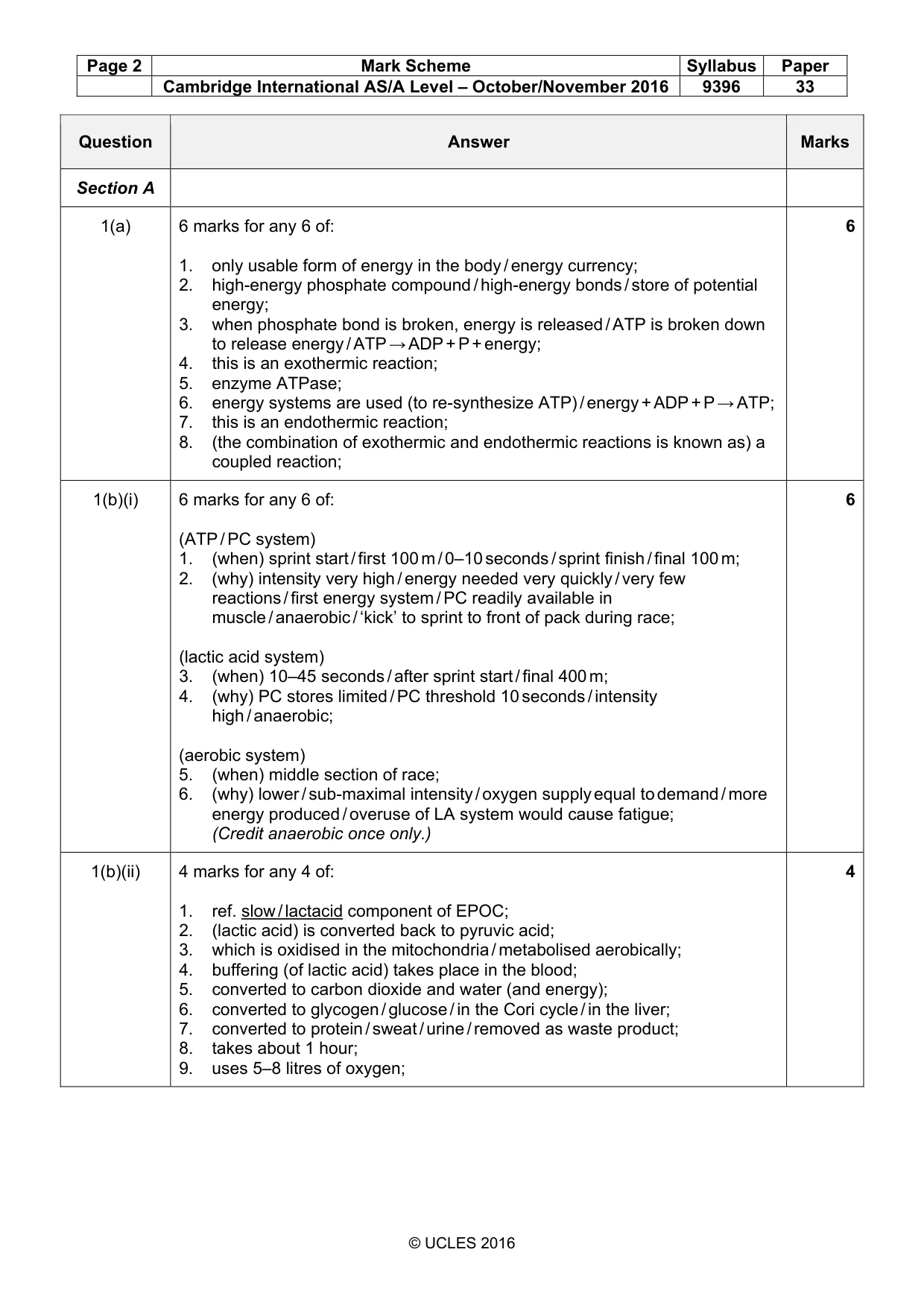
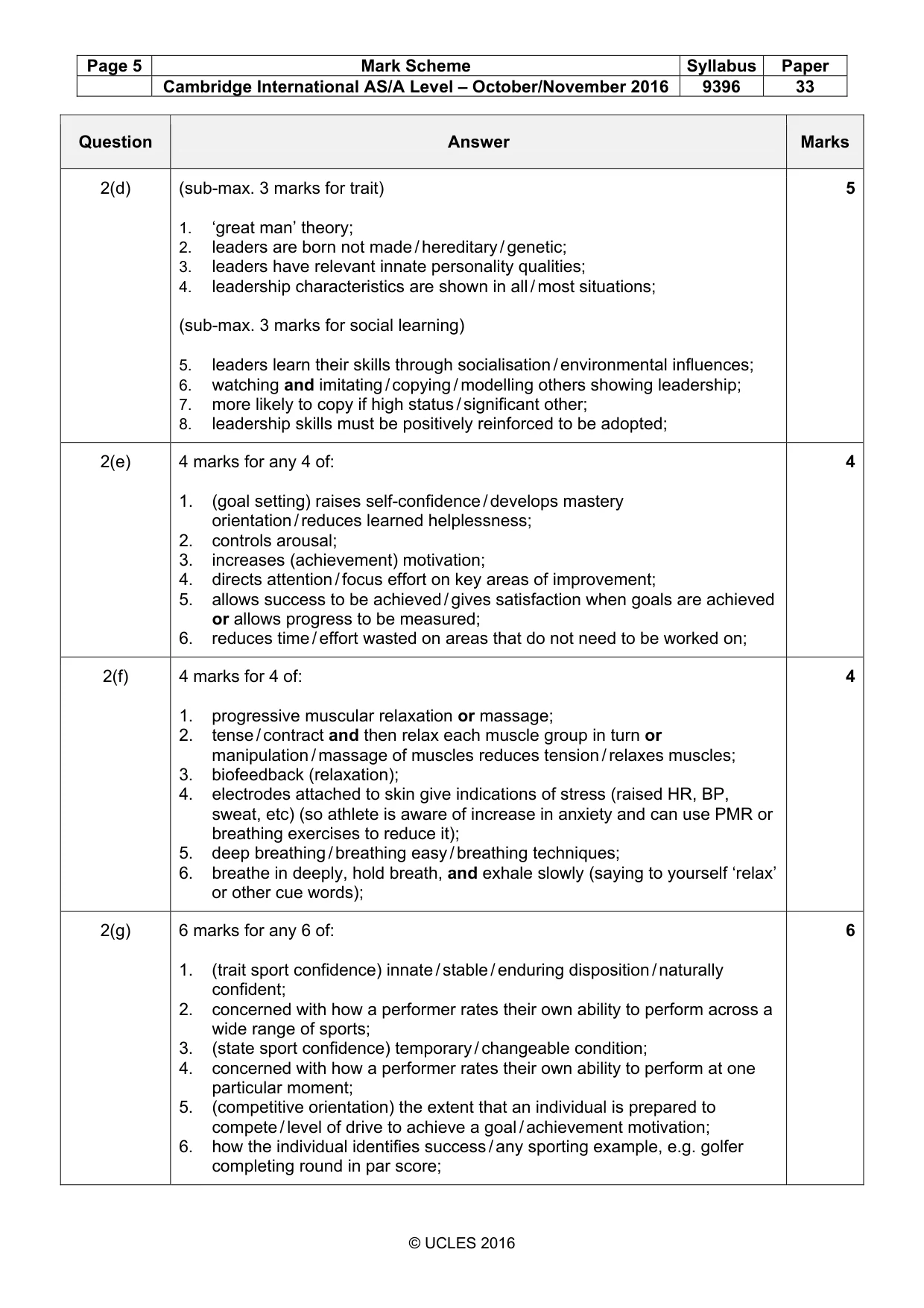
Page 2 Mark Scheme Syllabus Paper Cambridge International AS/A Level – October/November 2016 9396 33 © UCLES 2016 Question Answer Marks Section A 1(a) 6 marks for any 6 of: 1. only usable form of energy in the body / energy currency; 2. high-energy phosphate compound / high-energy bonds / store of potential energy; 3. when phosphate bond is broken, energy is released / ATP is broken down to release energy / ATP → ADP + P + energy; 4. this is an exothermic reaction; 5. enzyme ATPase; 6. energy systems are used (to re-synthesize ATP) / energy + ADP + P → ATP; 7. this is an endothermic reaction; 8. (the combination of exothermic and endothermic reactions is known as) a coupled reaction; 6 1(b)(i) 6 marks for any 6 of: (ATP / PC system) 1. (when) sprint start / first 100 m / 0–10 seconds / sprint finish / final 100 m; 2. (why) intensity very high / energy needed very quickly / very few reactions / first energy system / PC readily available in muscle / anaerobic / ‘kick’ to sprint to front of pack during race; (lactic acid system) 3. (when) 10–45 seconds / after sprint start / final 400 m; 4. (why) PC stores limited / PC threshold 10 seconds / intensity high / anaerobic; (aerobic system) 5. (when) middle section of race; 6. (why) lower / sub-maximal intensity / oxygen supply equal to demand / more energy produced / overuse of LA system would cause fatigue; (Credit anaerobic once only.) 6 1(b)(ii) 4 marks for any 4 of: 1. ref. slow / lactacid component of EPOC; 2. (lactic acid) is converted back to pyruvic acid; 3. which is oxidised in the mitochondria / metabolised aerobically; 4. buffering (of lactic acid) takes place in the blood; 5. converted to carbon dioxide and water (and energy); 6. converted to glycogen / glucose / in the Cori cycle / in the liver; 7. converted to protein / sweat / urine / removed as waste product; 8. takes about 1 hour; 9. uses 5–8 litres of oxygen; 4
Mark scheme, page 3
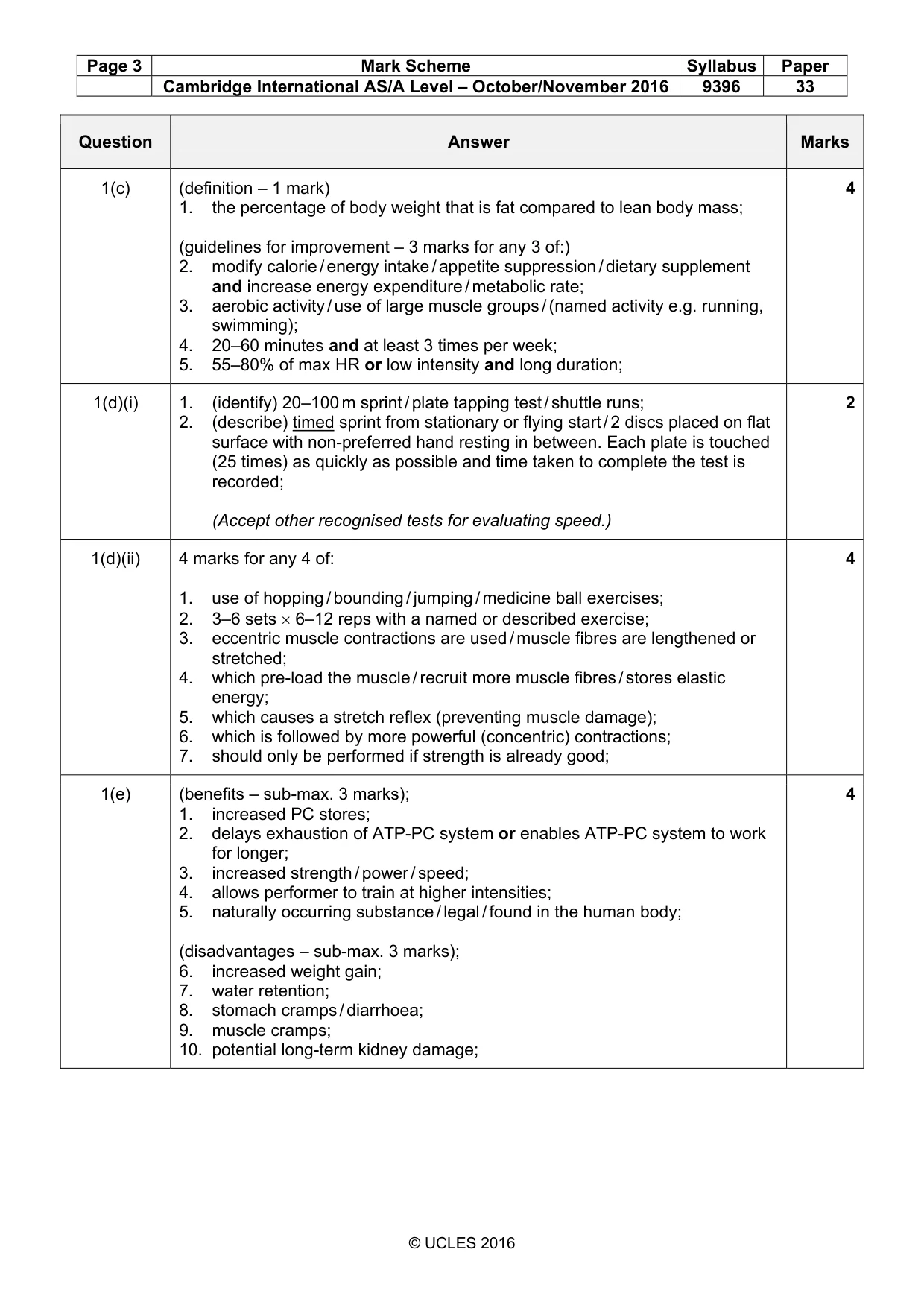
Page 3 Mark Scheme Syllabus Paper Cambridge International AS/A Level – October/November 2016 9396 33 © UCLES 2016 Question Answer Marks 1(c) (definition – 1 mark) 1. the percentage of body weight that is fat compared to lean body mass; (guidelines for improvement – 3 marks for any 3 of:) 2. modify calorie / energy intake / appetite suppression / dietary supplement and increase energy expenditure / metabolic rate; 3. aerobic activity / use of large muscle groups / (named activity e.g. running, swimming); 4. 20–60 minutes and at least 3 times per week; 5. 55–80% of max HR or low intensity and long duration; 4 1(d)(i) 1. (identify) 20–100 m sprint / plate tapping test / shuttle runs; 2. (describe) timed sprint from stationary or flying start / 2 discs placed on flat surface with non-preferred hand resting in between. Each plate is touched (25 times) as quickly as possible and time taken to complete the test is recorded; (Accept other recognised tests for evaluating speed.) 2 1(d)(ii) 4 marks for any 4 of: 1. use of hopping / bounding / jumping / medicine ball exercises; 2. 3–6 sets × 6–12 reps with a named or described exercise; 3. eccentric muscle contractions are used / muscle fibres are lengthened or stretched; 4. which pre-load the muscle / recruit more muscle fibres / stores elastic energy; 5. which causes a stretch reflex (preventing muscle damage); 6. which is followed by more powerful (concentric) contractions; 7. should only be performed if strength is already good; 4 1(e) (benefits – sub-max. 3 marks); 1. increased PC stores; 2. delays exhaustion of ATP-PC system or enables ATP-PC system to work for longer; 3. increased strength / power / speed; 4. allows performer to train at higher intensities; 5. naturally occurring substance / legal / found in the human body; (disadvantages – sub-max. 3 marks); 6. increased weight gain; 7. water retention; 8. stomach cramps / diarrhoea; 9. muscle cramps; 10. potential long-term kidney damage; 4
Mark scheme, page 4
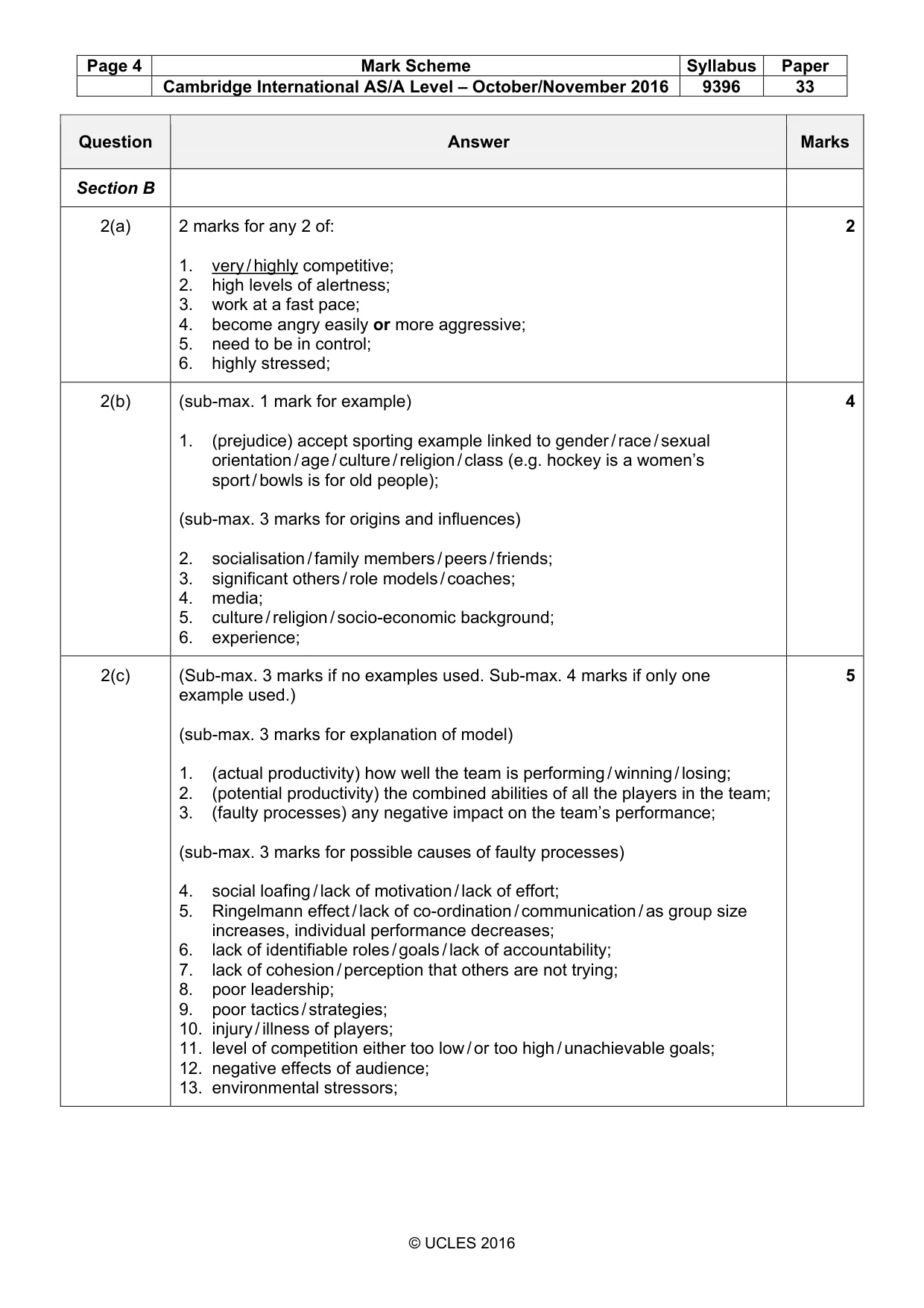
Page 4 Mark Scheme Syllabus Paper Cambridge International AS/A Level – October/November 2016 9396 33 © UCLES 2016 Question Answer Marks Section B 2(a) 2 marks for any 2 of: 1. very / highly competitive; 2. high levels of alertness; 3. work at a fast pace; 4. become angry easily or more aggressive; 5. need to be in control; 6. highly stressed; 2 2(b) (sub-max. 1 mark for example) 1. (prejudice) accept sporting example linked to gender / race / sexual orientation / age / culture / religion / class (e.g. hockey is a women’s sport / bowls is for old people); (sub-max. 3 marks for origins and influences) 2. socialisation / family members / peers / friends; 3. significant others / role models / coaches; 4. media; 5. culture / religion / socio-economic background; 6. experience; 4 2(c) (Sub-max. 3 marks if no examples used. Sub-max. 4 marks if only one example used.) (sub-max. 3 marks for explanation of model) 1. (actual productivity) how well the team is performing / winning / losing; 2. (potential productivity) the combined abilities of all the players in the team; 3. (faulty processes) any negative impact on the team’s performance; (sub-max. 3 marks for possible causes of faulty processes) 4. social loafing / lack of motivation / lack of effort; 5. Ringelmann effect / lack of co-ordination / communication / as group size increases, individual performance decreases; 6. lack of identifiable roles / goals / lack of accountability; 7. lack of cohesion / perception that others are not trying; 8. poor leadership; 9. poor tactics / strategies; 10. injury / illness of players; 11. level of competition either too low / or too high / unachievable goals; 12. negative effects of audience; 13. environmental stressors; 5
Mark scheme, page 5
Page 5 Mark Scheme Syllabus Paper Cambridge International AS/A Level – October/November 2016 9396 33 © UCLES 2016 Question Answer Marks 2(d) (sub-max. 3 marks for trait) 1. ‘great man’ theory; 2. leaders are born not made / hereditary / genetic; 3. leaders have relevant innate personality qualities; 4. leadership characteristics are shown in all / most situations; (sub-max. 3 marks for social learning) 5. leaders learn their skills through socialisation / environmental influences; 6. watching and imitating / copying / modelling others showing leadership; 7. more likely to copy if high status / significant other; 8. leadership skills must be positively reinforced to be adopted; 5 2(e) 4 marks for any 4 of: 1. (goal setting) raises self-confidence / develops mastery orientation / reduces learned helplessness; 2. controls arousal; 3. increases (achievement) motivation; 4. directs attention / focus effort on key areas of improvement; 5. allows success to be achieved / gives satisfaction when goals are achieved or allows progress to be measured; 6. reduces time / effort wasted on areas that do not need to be worked on; 4 2(f) 4 marks for 4 of: 1. progressive muscular relaxation or massage; 2. tense / contract and then relax each muscle group in turn or manipulation / massage of muscles reduces tension / relaxes muscles; 3. biofeedback (relaxation); 4. electrodes attached to skin give indications of stress (raised HR, BP, sweat, etc) (so athlete is aware of increase in anxiety and can use PMR or breathing exercises to reduce it); 5. deep breathing / breathing easy / breathing techniques; 6. breathe in deeply, hold breath, and exhale slowly (saying to yourself ‘relax’ or other cue words); 4 2(g) 6 marks for any 6 of: 1. (trait sport confidence) innate / stable / enduring disposition / naturally confident; 2. concerned with how a performer rates their own ability to perform across a wide range of sports; 3. (state sport confidence) temporary / changeable condition; 4. concerned with how a performer rates their own ability to perform at one particular moment; 5. (competitive orientation) the extent that an individual is prepared to compete / level of drive to achieve a goal / achievement motivation; 6. how the individual identifies success / any sporting example, e.g. golfer completing round in par score; 6
Mark scheme, page 6
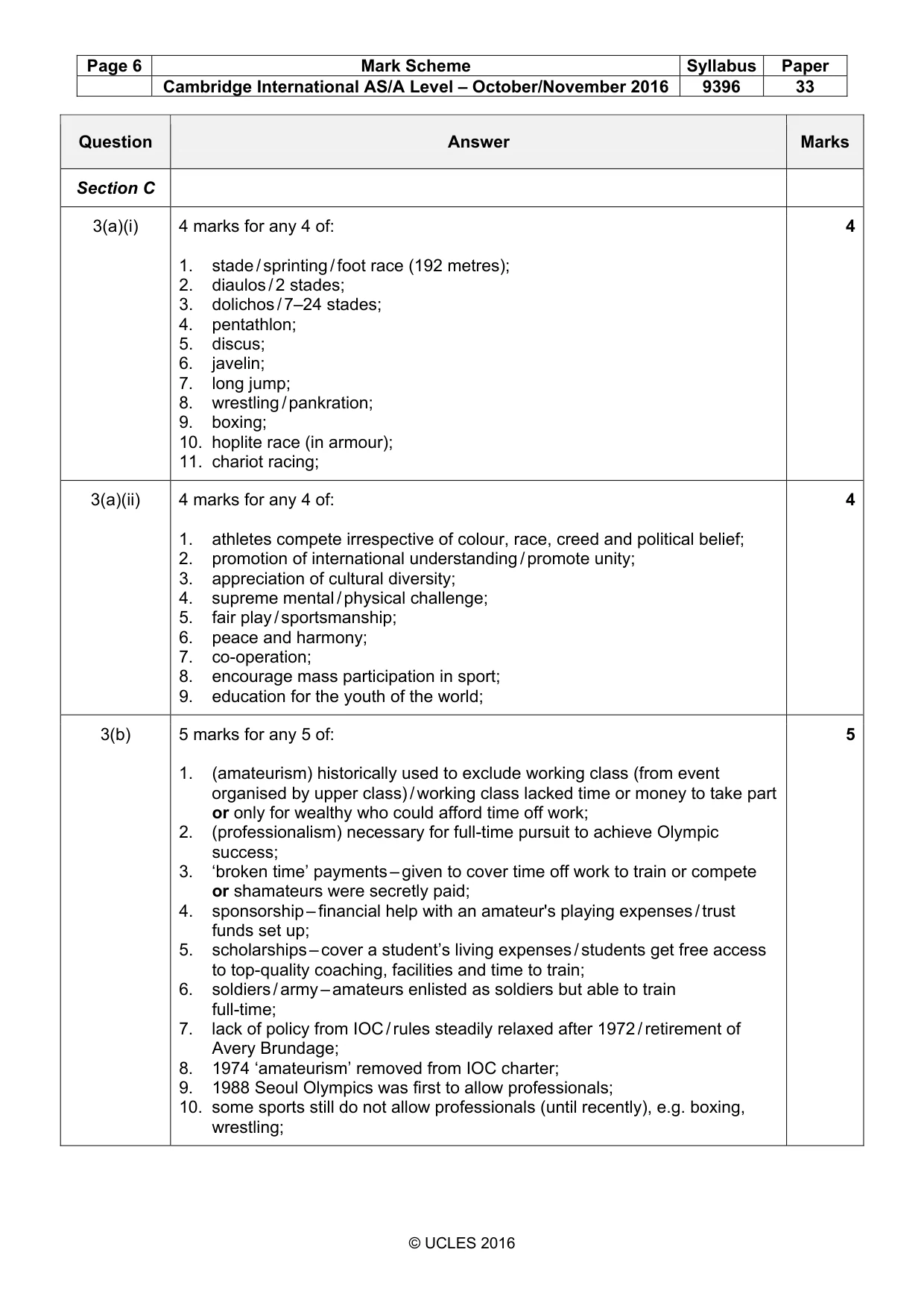
Page 6 Mark Scheme Syllabus Paper Cambridge International AS/A Level – October/November 2016 9396 33 © UCLES 2016 Question Answer Marks Section C 3(a)(i) 4 marks for any 4 of: 1. stade / sprinting / foot race (192 metres); 2. diaulos / 2 stades; 3. dolichos / 7–24 stades; 4. pentathlon; 5. discus; 6. javelin; 7. long jump; 8. wrestling / pankration; 9. boxing; 10. hoplite race (in armour); 11. chariot racing; 4 3(a)(ii) 4 marks for any 4 of: 1. athletes compete irrespective of colour, race, creed and political belief; 2. promotion of international understanding / promote unity; 3. appreciation of cultural diversity; 4. supreme mental / physical challenge; 5. fair play / sportsmanship; 6. peace and harmony; 7. co-operation; 8. encourage mass participation in sport; 9. education for the youth of the world; 4 3(b) 5 marks for any 5 of: 1. (amateurism) historically used to exclude working class (from event organised by upper class) / working class lacked time or money to take part or only for wealthy who could afford time off work; 2. (professionalism) necessary for full-time pursuit to achieve Olympic success; 3. ‘broken time’ payments – given to cover time off work to train or compete or shamateurs were secretly paid; 4. sponsorship – financial help with an amateur's playing expenses / trust funds set up; 5. scholarships – cover a student’s living expenses / students get free access to top-quality coaching, facilities and time to train; 6. soldiers / army – amateurs enlisted as soldiers but able to train full-time; 7. lack of policy from IOC / rules steadily relaxed after 1972 / retirement of Avery Brundage; 8. 1974 ‘amateurism’ removed from IOC charter; 9. 1988 Seoul Olympics was first to allow professionals; 10. some sports still do not allow professionals (until recently), e.g. boxing, wrestling; 5
Mark scheme, page 7
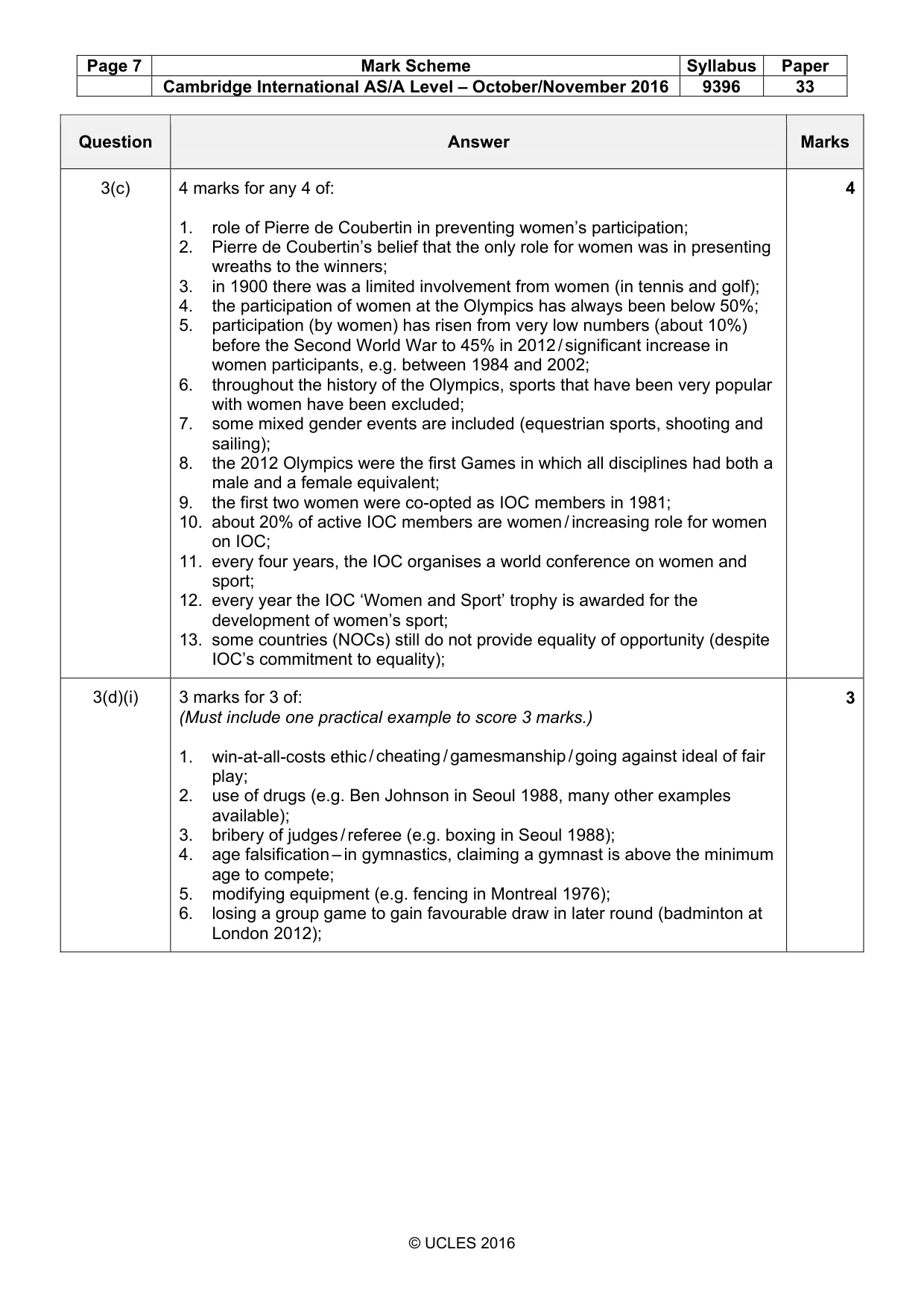
Page 7 Mark Scheme Syllabus Paper Cambridge International AS/A Level – October/November 2016 9396 33 © UCLES 2016 Question Answer Marks 3(c) 4 marks for any 4 of: 1. role of Pierre de Coubertin in preventing women’s participation; 2. Pierre de Coubertin’s belief that the only role for women was in presenting wreaths to the winners; 3. in 1900 there was a limited involvement from women (in tennis and golf); 4. the participation of women at the Olympics has always been below 50%; 5. participation (by women) has risen from very low numbers (about 10%) before the Second World War to 45% in 2012 / significant increase in women participants, e.g. between 1984 and 2002; 6. throughout the history of the Olympics, sports that have been very popular with women have been excluded; 7. some mixed gender events are included (equestrian sports, shooting and sailing); 8. the 2012 Olympics were the first Games in which all disciplines had both a male and a female equivalent; 9. the first two women were co-opted as IOC members in 1981; 10. about 20% of active IOC members are women / increasing role for women on IOC; 11. every four years, the IOC organises a world conference on women and sport; 12. every year the IOC ‘Women and Sport’ trophy is awarded for the development of women’s sport; 13. some countries (NOCs) still do not provide equality of opportunity (despite IOC’s commitment to equality); 4 3(d)(i) 3 marks for 3 of: (Must include one practical example to score 3 marks.) 1. win-at-all-costs ethic / cheating / gamesmanship / going against ideal of fair play; 2. use of drugs (e.g. Ben Johnson in Seoul 1988, many other examples available); 3. bribery of judges / referee (e.g. boxing in Seoul 1988); 4. age falsification – in gymnastics, claiming a gymnast is above the minimum age to compete; 5. modifying equipment (e.g. fencing in Montreal 1976); 6. losing a group game to gain favourable draw in later round (badminton at London 2012); 3
Mark scheme, page 8
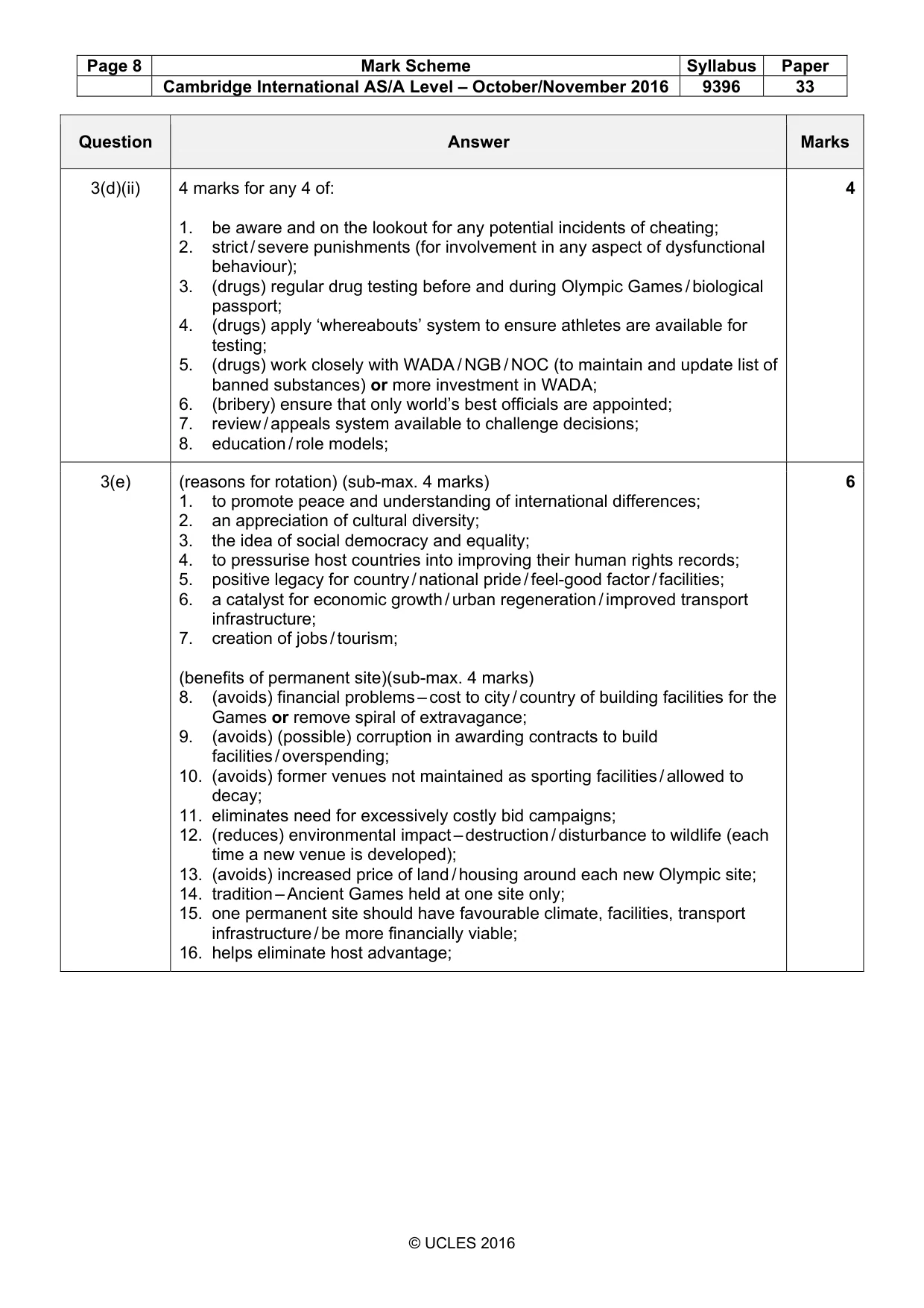
Page 8 Mark Scheme Syllabus Paper Cambridge International AS/A Level – October/November 2016 9396 33 © UCLES 2016 Question Answer Marks 3(d)(ii) 4 marks for any 4 of: 1. be aware and on the lookout for any potential incidents of cheating; 2. strict / severe punishments (for involvement in any aspect of dysfunctional behaviour); 3. (drugs) regular drug testing before and during Olympic Games / biological passport; 4. (drugs) apply ‘whereabouts’ system to ensure athletes are available for testing; 5. (drugs) work closely with WADA / NGB / NOC (to maintain and update list of banned substances) or more investment in WADA; 6. (bribery) ensure that only world’s best officials are appointed; 7. review / appeals system available to challenge decisions; 8. education / role models; 4 3(e) (reasons for rotation) (sub-max. 4 marks) 1. to promote peace and understanding of international differences; 2. an appreciation of cultural diversity; 3. the idea of social democracy and equality; 4. to pressurise host countries into improving their human rights records; 5. positive legacy for country / national pride / feel-good factor / facilities; 6. a catalyst for economic growth / urban regeneration / improved transport infrastructure; 7. creation of jobs / tourism; (benefits of permanent site)(sub-max. 4 marks) 8. (avoids) financial problems – cost to city / country of building facilities for the Games or remove spiral of extravagance; 9. (avoids) (possible) corruption in awarding contracts to build facilities / overspending; 10. (avoids) former venues not maintained as sporting facilities / allowed to decay; 11. eliminates need for excessively costly bid campaigns; 12. (reduces) environmental impact – destruction / disturbance to wildlife (each time a new venue is developed); 13. (avoids) increased price of land / housing around each new Olympic site; 14. tradition – Ancient Games held at one site only; 15. one permanent site should have favourable climate, facilities, transport infrastructure / be more financially viable; 16. helps eliminate host advantage; 6
What you needed in this session
Cambridge’s own grade thresholds for 2016 Oct/Nov, Paper 3 · Variant 3. A higher threshold means an easier paper — the bar moves with how the cohort did.