Cambridge A Level Physical Education 9396 — 2015 Oct/Nov Paper 3 · Variant 3
9396/33/O/N/15 · 90 marks · ≈101 min
The question paper and its mark scheme, free to read here and free to download. This is Cambridge’s own paper, exactly as it was sat.
Question paper4 pages
Mark scheme9 pages
Answers below. Sit the paper first if you are practising.
Paper as text
Question paper, page 1
This document consists of 4 printed pages and 1 insert. DC (LK/JG) 105830 © UCLES 2015 [Turn over Cambridge International Examinations Cambridge International Advanced Subsidiary and Advanced Level * 1 0 0 5 2 3 0 1 0 5 * PHYSICAL EDUCATION 9396/33 Paper 3 October/November 2015 2 hours 30 minutes No Additional Materials are required. READ THESE INSTRUCTIONS FIRST An answer booklet is provided inside this question paper. You should follow the instructions on the front cover of the answer booklet. If you need additional answer paper ask the invigilator for a continuation booklet. Answer all questions. Electronic calculators may be used. You may lose marks if you do not show your working or if you do not use appropriate units. The number of marks is given in brackets [ ] at the end of each question or part question.
Question paper, page 2
2 9396/33/O/N/15 © UCLES 2015 Answer all questions. Section A: Exercise and Sport Physiology 1 (a) Energy is fundamental to performance in sport. (i) Define each of the following terms and give the units that they are expressed in: • energy • work • power. [6] (ii) Explain, using the ATP/PC system, the principles of a coupled reaction. [4] (b) Balance, co-ordination, agility and reaction time are important fitness components that will enable sports performers to achieve success in their chosen activity. Give a definition and a method of evaluating two of the above components. [4] (c) An elite marathon runner is preparing to compete in the Olympic Games next year. (i) Use the principles of training to design a continuous training programme that will enable the athlete to reach peak performance for the Games. [6] (ii) Explain the benefits of periodisation in planning this continuous training programme. [6] (iii) Outline the constituents and timings of the recommended pre-competition and post- competition meals for a marathon runner. [4] [Total: 30]
Question paper, page 3
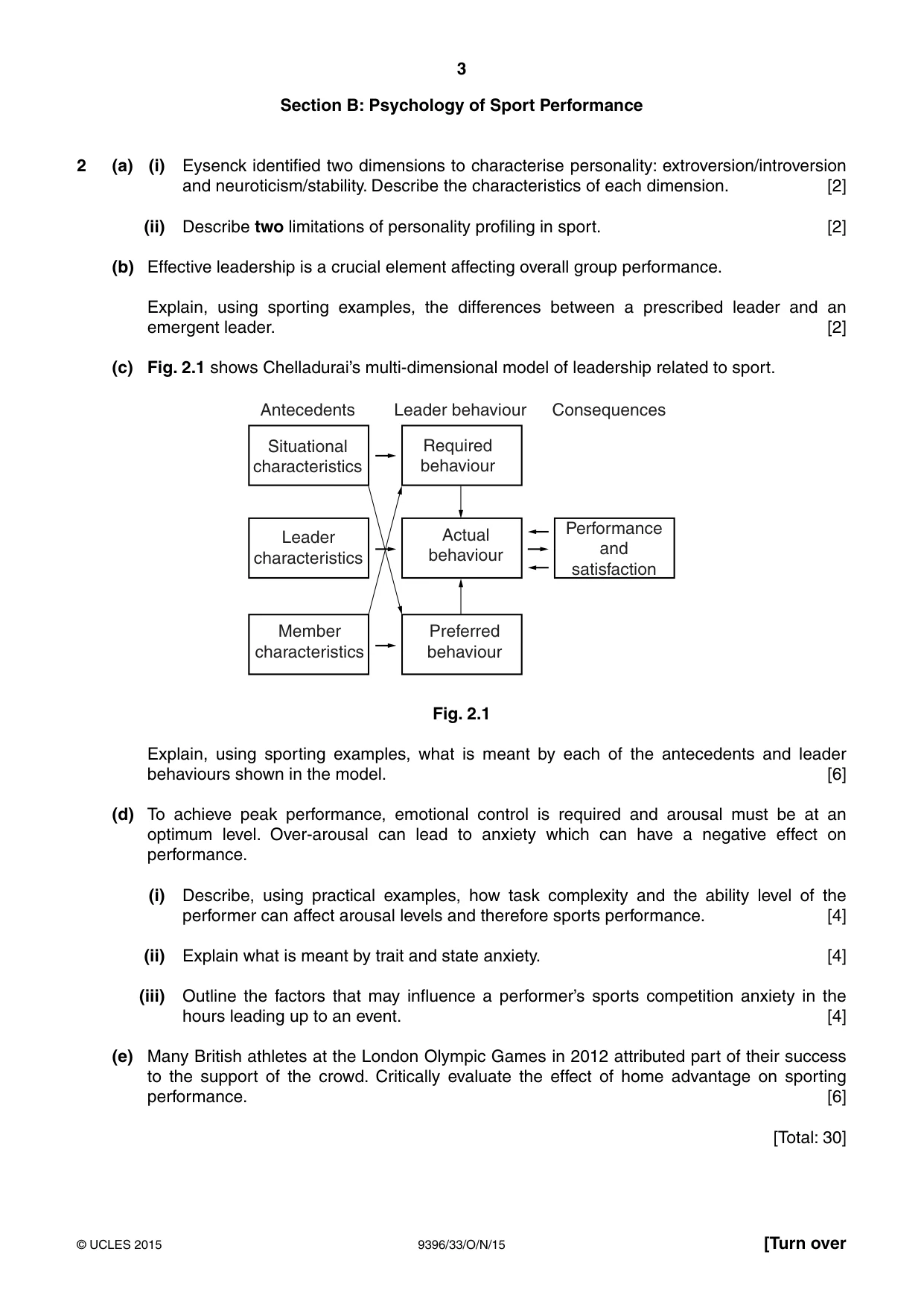
3 9396/33/O/N/15 © UCLES 2015 [Turn over Section B: Psychology of Sport Performance 2 (a) (i) Eysenck identified two dimensions to characterise personality: extroversion/introversion and neuroticism/stability. Describe the characteristics of each dimension. [2] (ii) Describe two limitations of personality profiling in sport. [2] (b) Effective leadership is a crucial element affecting overall group performance. Explain, using sporting examples, the differences between a prescribed leader and an emergent leader. [2] (c) Fig. 2.1 shows Chelladurai’s multi-dimensional model of leadership related to sport. Situational characteristics Antecedents Consequences Leader behaviour Required behaviour Actual behaviour Preferred behaviour Performance and satisfaction Leader characteristics Member characteristics Fig. 2.1 Explain, using sporting examples, what is meant by each of the antecedents and leader behaviours shown in the model. [6] (d) To achieve peak performance, emotional control is required and arousal must be at an optimum level. Over-arousal can lead to anxiety which can have a negative effect on performance. (i) Describe, using practical examples, how task complexity and the ability level of the performer can affect arousal levels and therefore sports performance. [4] (ii) Explain what is meant by trait and state anxiety. [4] (iii) Outline the factors that may influence a performer’s sports competition anxiety in the hours leading up to an event. [4] (e) Many British athletes at the London Olympic Games in 2012 attributed part of their success to the support of the crowd. Critically evaluate the effect of home advantage on sporting performance. [6] [Total: 30]
Question paper, page 4
4 9396/33/O/N/15 © UCLES 2015 Permission to reproduce items where third-party owned material protected by copyright is included has been sought and cleared where possible. Every reasonable effort has been made by the publisher (UCLES) to trace copyright holders, but if any items requiring clearance have unwittingly been included, the publisher will be pleased to make amends at the earliest possible opportunity. To avoid the issue of disclosure of answer-related information to candidates, all copyright acknowledgements are reproduced online in the Cambridge International Examinations Copyright Acknowledgements Booklet. This is produced for each series of examinations and is freely available to download at www.cie.org.uk after the live examination series. Cambridge International Examinations is part of the Cambridge Assessment Group. Cambridge Assessment is the brand name of University of Cambridge Local Examinations Syndicate (UCLES), which is itself a department of the University of Cambridge. Section C: Olympic Games: A Global Perspective 3 (a) The Olympic Games is an athletics festival that is seen to act as a social force. One of the key values of the Games is the concept of a supreme mental and physical challenge. What is meant by the concept of a supreme mental and physical challenge? [4] (b) After the 1976 Montreal Games, the IOC accepted the need for commercialisation to enable the Olympic Games to take place. (i) Outline the various sources of funding that are available to a host nation to cover the costs of hosting the Olympics. [3] (ii) Describe the possible financial costs to an athlete of competing in the Olympic Games. [3] (iii) Evaluate the potential impact to people living in an area that has been awarded the honour of hosting the Olympic Games. [4] (c) The United States of America and the People’s Republic of China have dominated the medal table at the most recent Olympic Games. Compare the methods used in these two countries of nurturing talent in the pursuit of global excellence. [6] (d) Baron Pierre de Coubertin established the modern Olympic Games and believed strongly in the 19th century ideal of amateurism, which remained in place at the Games until the late 20th century. Explain how the traditional definition of amateurism was believed to exclude working class athletes from participation in the Olympic Games in the first half of the 20th century. [5] (e) Discuss the suggestion that reform of the Olympic Games by the IOC should include the dropping of ‘wealth sports’ from the programme of activities. [5] [Total: 30]
Mark scheme, page 1
® IGCSE is the registered trademark of Cambridge International Examinations. CAMBRIDGE INTERNATIONAL EXAMINATIONS Cambridge International Advanced Level MARK SCHEME for the October/November 2015 series 9396 PHYSICAL EDUCATION 9396/33 Paper 3, maximum raw mark 90 This mark scheme is published as an aid to teachers and candidates, to indicate the requirements of the examination. It shows the basis on which Examiners were instructed to award marks. It does not indicate the details of the discussions that took place at an Examiners’ meeting before marking began, which would have considered the acceptability of alternative answers. Mark schemes should be read in conjunction with the question paper and the Principal Examiner Report for Teachers. Cambridge will not enter into discussions about these mark schemes. Cambridge is publishing the mark schemes for the October/November 2015 series for most Cambridge IGCSE®, Cambridge International A and AS Level components and some Cambridge O Level components.
Mark scheme, page 2
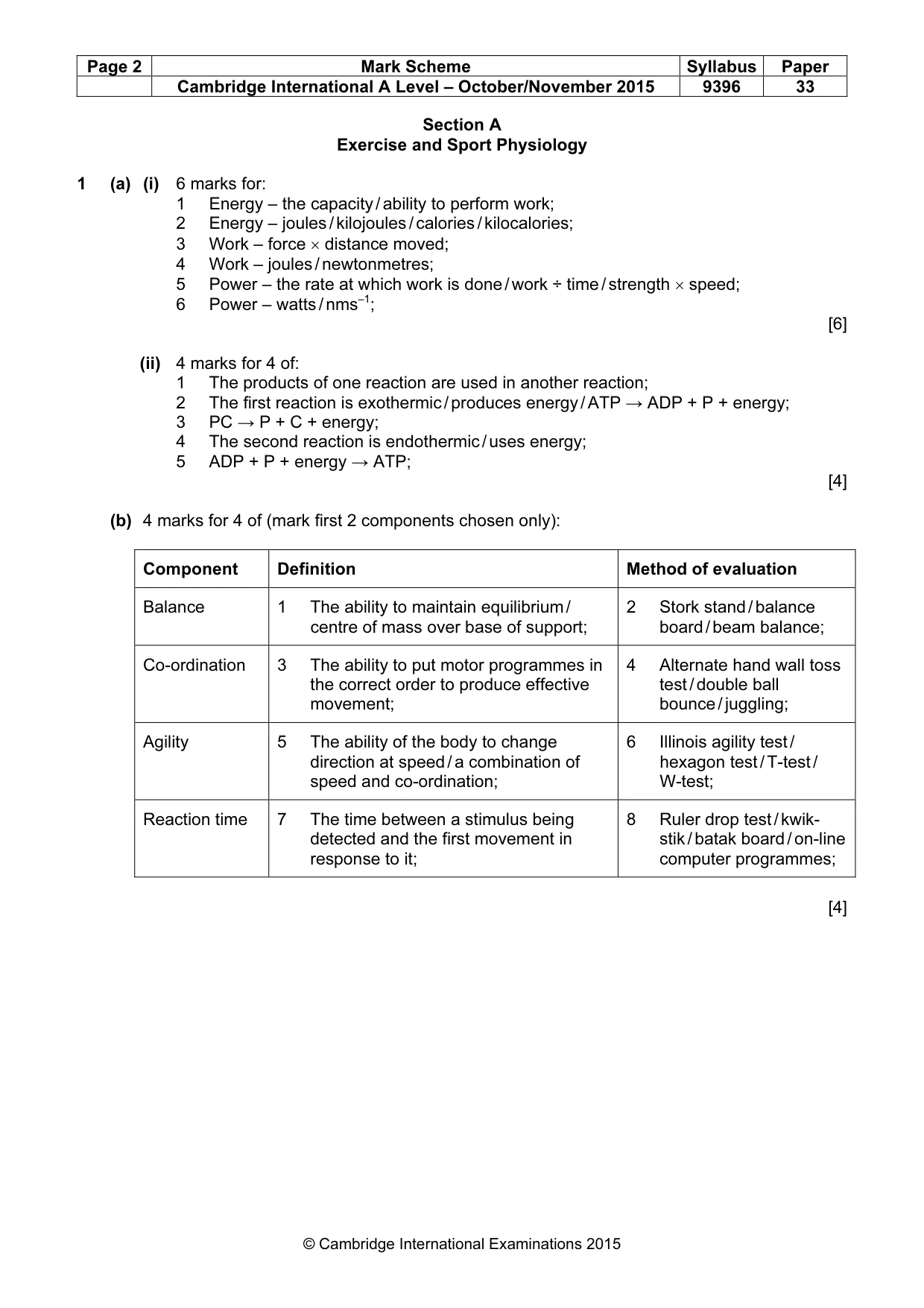
Page 2 Mark Scheme Syllabus Paper Cambridge International A Level – October/November 2015 9396 33 © Cambridge International Examinations 2015 Section A Exercise and Sport Physiology 1 (a) (i) 6 marks for: 1 Energy – the capacity / ability to perform work; 2 Energy – joules / kilojoules / calories / kilocalories; 3 Work – force × distance moved; 4 Work – joules / newtonmetres; 5 Power – the rate at which work is done / work ÷ time / strength × speed; 6 Power – watts / nms–1; [6] (ii) 4 marks for 4 of: 1 The products of one reaction are used in another reaction; 2 The first reaction is exothermic / produces energy / ATP → ADP + P + energy; 3 PC → P + C + energy; 4 The second reaction is endothermic / uses energy; 5 ADP + P + energy → ATP; [4] (b) 4 marks for 4 of (mark first 2 components chosen only): Component Definition Method of evaluation Balance 1 The ability to maintain equilibrium / centre of mass over base of support; 2 Stork stand / balance board / beam balance; Co-ordination 3 The ability to put motor programmes in the correct order to produce effective movement; 4 Alternate hand wall toss test / double ball bounce / juggling; Agility 5 The ability of the body to change direction at speed / a combination of speed and co-ordination; 6 Illinois agility test / hexagon test / T-test / W-test; Reaction time 7 The time between a stimulus being detected and the first movement in response to it; 8 Ruler drop test / kwik- stik / batak board / on-line computer programmes; [4]
Mark scheme, page 3
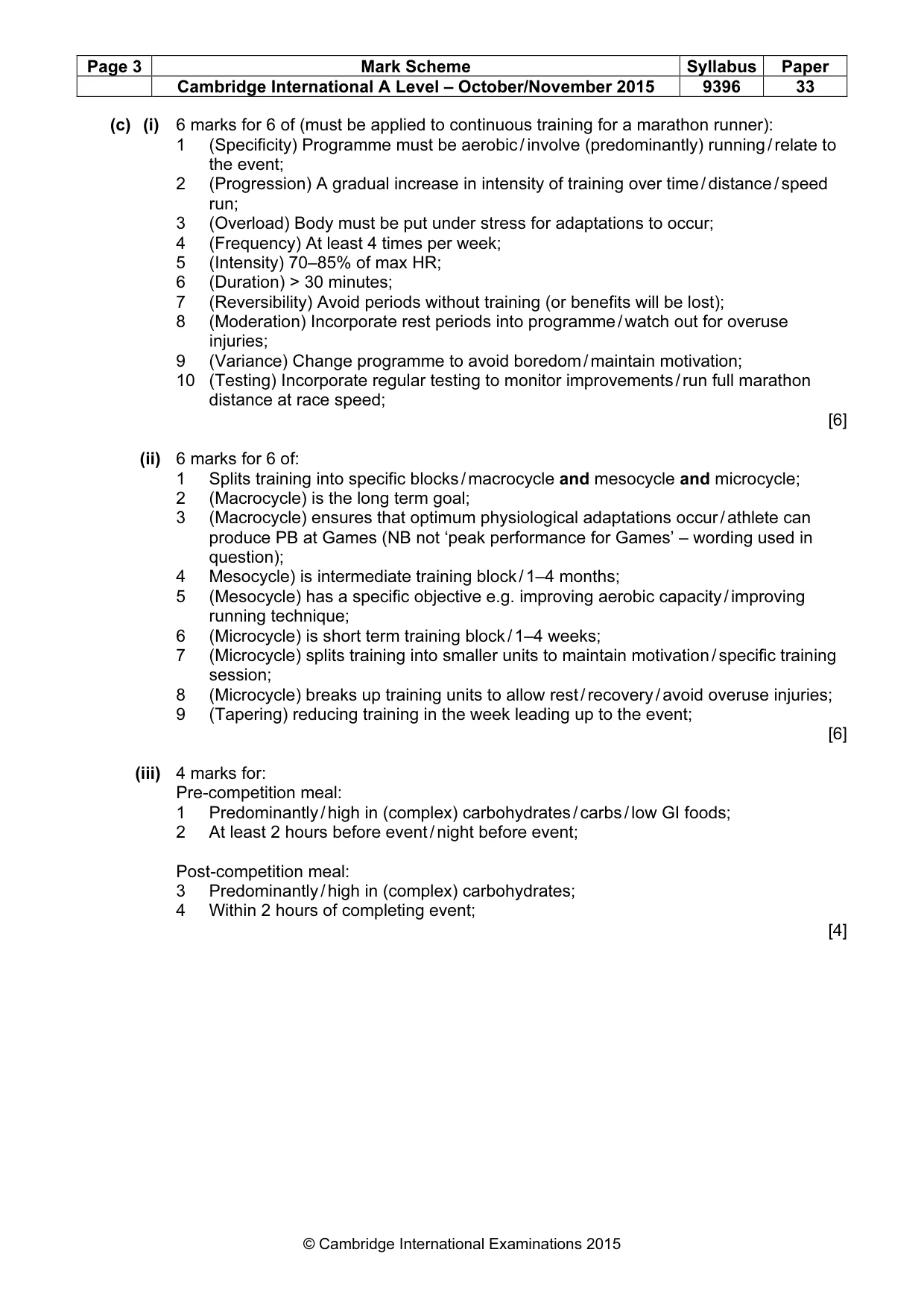
Page 3 Mark Scheme Syllabus Paper Cambridge International A Level – October/November 2015 9396 33 © Cambridge International Examinations 2015 (c) (i) 6 marks for 6 of (must be applied to continuous training for a marathon runner): 1 (Specificity) Programme must be aerobic / involve (predominantly) running / relate to the event; 2 (Progression) A gradual increase in intensity of training over time / distance / speed run; 3 (Overload) Body must be put under stress for adaptations to occur; 4 (Frequency) At least 4 times per week; 5 (Intensity) 70–85% of max HR; 6 (Duration) > 30 minutes; 7 (Reversibility) Avoid periods without training (or benefits will be lost); 8 (Moderation) Incorporate rest periods into programme / watch out for overuse injuries; 9 (Variance) Change programme to avoid boredom / maintain motivation; 10 (Testing) Incorporate regular testing to monitor improvements / run full marathon distance at race speed; [6] (ii) 6 marks for 6 of: 1 Splits training into specific blocks / macrocycle and mesocycle and microcycle; 2 (Macrocycle) is the long term goal; 3 (Macrocycle) ensures that optimum physiological adaptations occur / athlete can produce PB at Games (NB not ‘peak performance for Games’ – wording used in question); 4 Mesocycle) is intermediate training block / 1–4 months; 5 (Mesocycle) has a specific objective e.g. improving aerobic capacity / improving running technique; 6 (Microcycle) is short term training block / 1–4 weeks; 7 (Microcycle) splits training into smaller units to maintain motivation / specific training session; 8 (Microcycle) breaks up training units to allow rest / recovery / avoid overuse injuries; 9 (Tapering) reducing training in the week leading up to the event; [6] (iii) 4 marks for: Pre-competition meal: 1 Predominantly / high in (complex) carbohydrates / carbs / low GI foods; 2 At least 2 hours before event / night before event; Post-competition meal: 3 Predominantly / high in (complex) carbohydrates; 4 Within 2 hours of completing event; [4]
Mark scheme, page 4
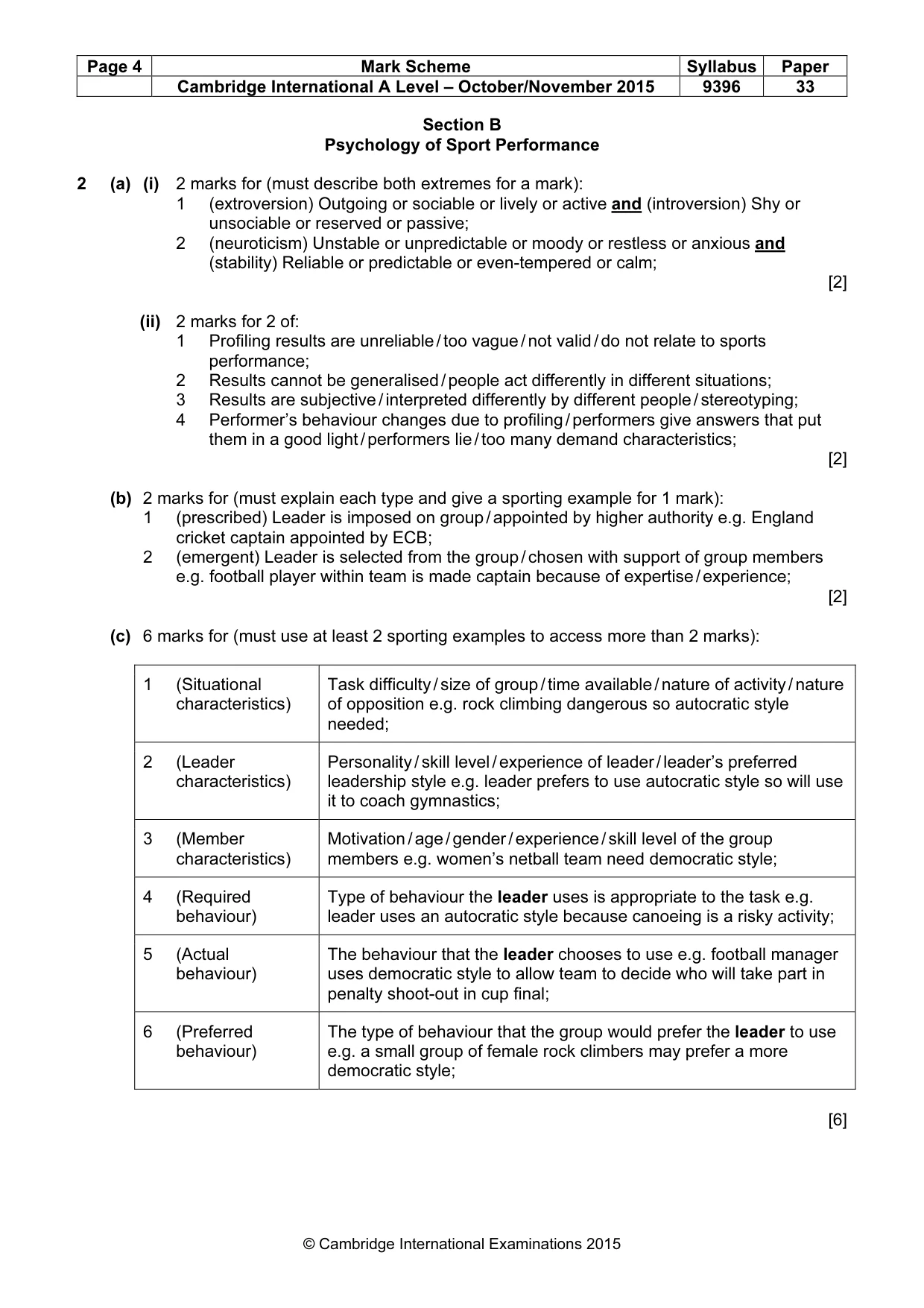
Page 4 Mark Scheme Syllabus Paper Cambridge International A Level – October/November 2015 9396 33 © Cambridge International Examinations 2015 Section B Psychology of Sport Performance 2 (a) (i) 2 marks for (must describe both extremes for a mark): 1 (extroversion) Outgoing or sociable or lively or active and (introversion) Shy or unsociable or reserved or passive; 2 (neuroticism) Unstable or unpredictable or moody or restless or anxious and (stability) Reliable or predictable or even-tempered or calm; [2] (ii) 2 marks for 2 of: 1 Profiling results are unreliable / too vague / not valid / do not relate to sports performance; 2 Results cannot be generalised / people act differently in different situations; 3 Results are subjective / interpreted differently by different people / stereotyping; 4 Performer’s behaviour changes due to profiling / performers give answers that put them in a good light / performers lie / too many demand characteristics; [2] (b) 2 marks for (must explain each type and give a sporting example for 1 mark): 1 (prescribed) Leader is imposed on group / appointed by higher authority e.g. England cricket captain appointed by ECB; 2 (emergent) Leader is selected from the group / chosen with support of group members e.g. football player within team is made captain because of expertise / experience; [2] (c) 6 marks for (must use at least 2 sporting examples to access more than 2 marks): 1 (Situational characteristics) Task difficulty / size of group / time available / nature of activity / nature of opposition e.g. rock climbing dangerous so autocratic style needed; 2 (Leader characteristics) Personality / skill level / experience of leader / leader’s preferred leadership style e.g. leader prefers to use autocratic style so will use it to coach gymnastics; 3 (Member characteristics) Motivation / age / gender / experience / skill level of the group members e.g. women’s netball team need democratic style; 4 (Required behaviour) Type of behaviour the leader uses is appropriate to the task e.g. leader uses an autocratic style because canoeing is a risky activity; 5 (Actual behaviour) The behaviour that the leader chooses to use e.g. football manager uses democratic style to allow team to decide who will take part in penalty shoot-out in cup final; 6 (Preferred behaviour) The type of behaviour that the group would prefer the leader to use e.g. a small group of female rock climbers may prefer a more democratic style; [6]
Mark scheme, page 5
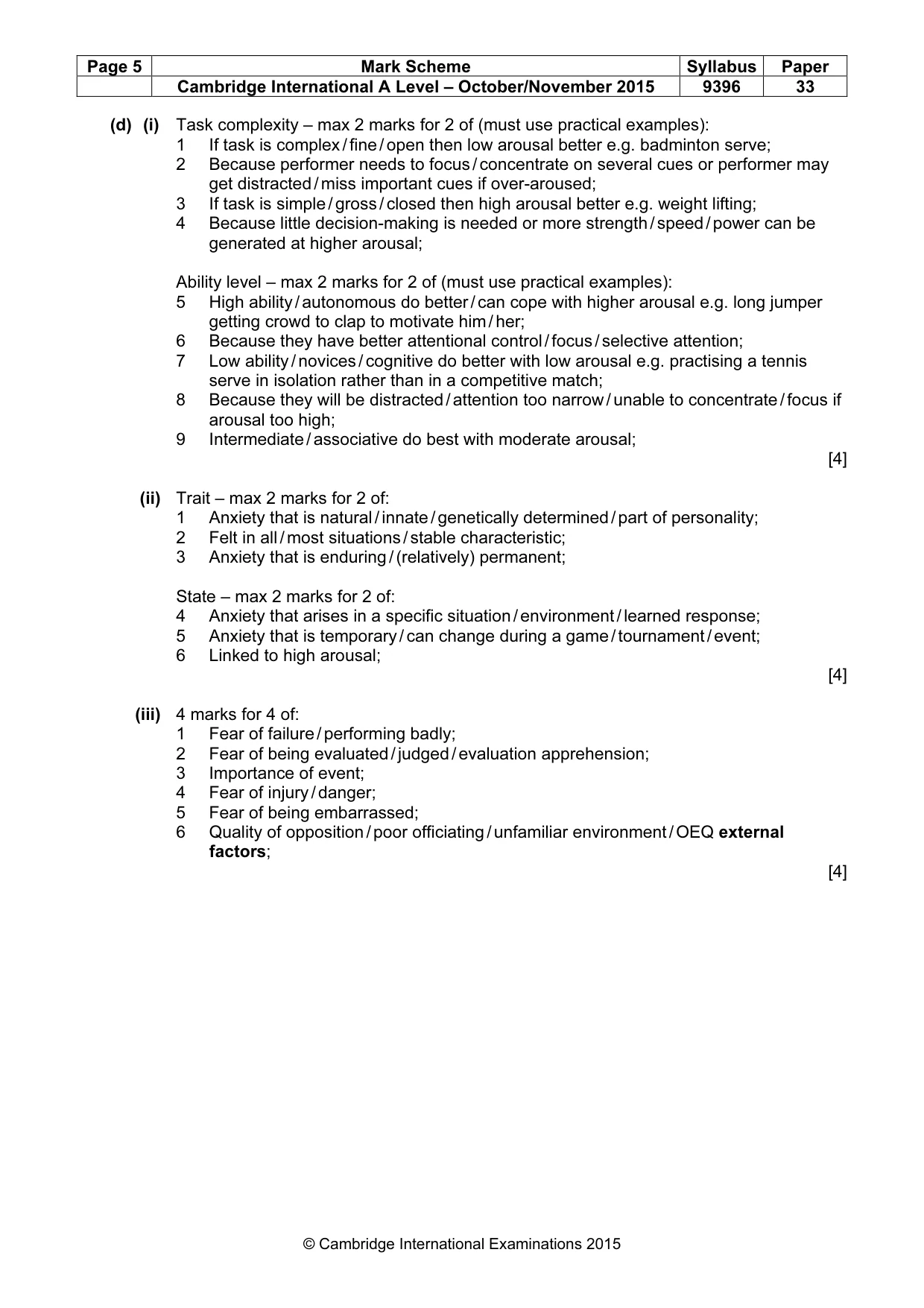
Page 5 Mark Scheme Syllabus Paper Cambridge International A Level – October/November 2015 9396 33 © Cambridge International Examinations 2015 (d) (i) Task complexity – max 2 marks for 2 of (must use practical examples): 1 If task is complex / fine / open then low arousal better e.g. badminton serve; 2 Because performer needs to focus / concentrate on several cues or performer may get distracted / miss important cues if over-aroused; 3 If task is simple / gross / closed then high arousal better e.g. weight lifting; 4 Because little decision-making is needed or more strength / speed / power can be generated at higher arousal; Ability level – max 2 marks for 2 of (must use practical examples): 5 High ability / autonomous do better / can cope with higher arousal e.g. long jumper getting crowd to clap to motivate him / her; 6 Because they have better attentional control / focus / selective attention; 7 Low ability / novices / cognitive do better with low arousal e.g. practising a tennis serve in isolation rather than in a competitive match; 8 Because they will be distracted / attention too narrow / unable to concentrate / focus if arousal too high; 9 Intermediate / associative do best with moderate arousal; [4] (ii) Trait – max 2 marks for 2 of: 1 Anxiety that is natural / innate / genetically determined / part of personality; 2 Felt in all / most situations / stable characteristic; 3 Anxiety that is enduring / (relatively) permanent; State – max 2 marks for 2 of: 4 Anxiety that arises in a specific situation / environment / learned response; 5 Anxiety that is temporary / can change during a game / tournament / event; 6 Linked to high arousal; [4] (iii) 4 marks for 4 of: 1 Fear of failure / performing badly; 2 Fear of being evaluated / judged / evaluation apprehension; 3 Importance of event; 4 Fear of injury / danger; 5 Fear of being embarrassed; 6 Quality of opposition / poor officiating / unfamiliar environment / OEQ external factors; [4]
Mark scheme, page 6
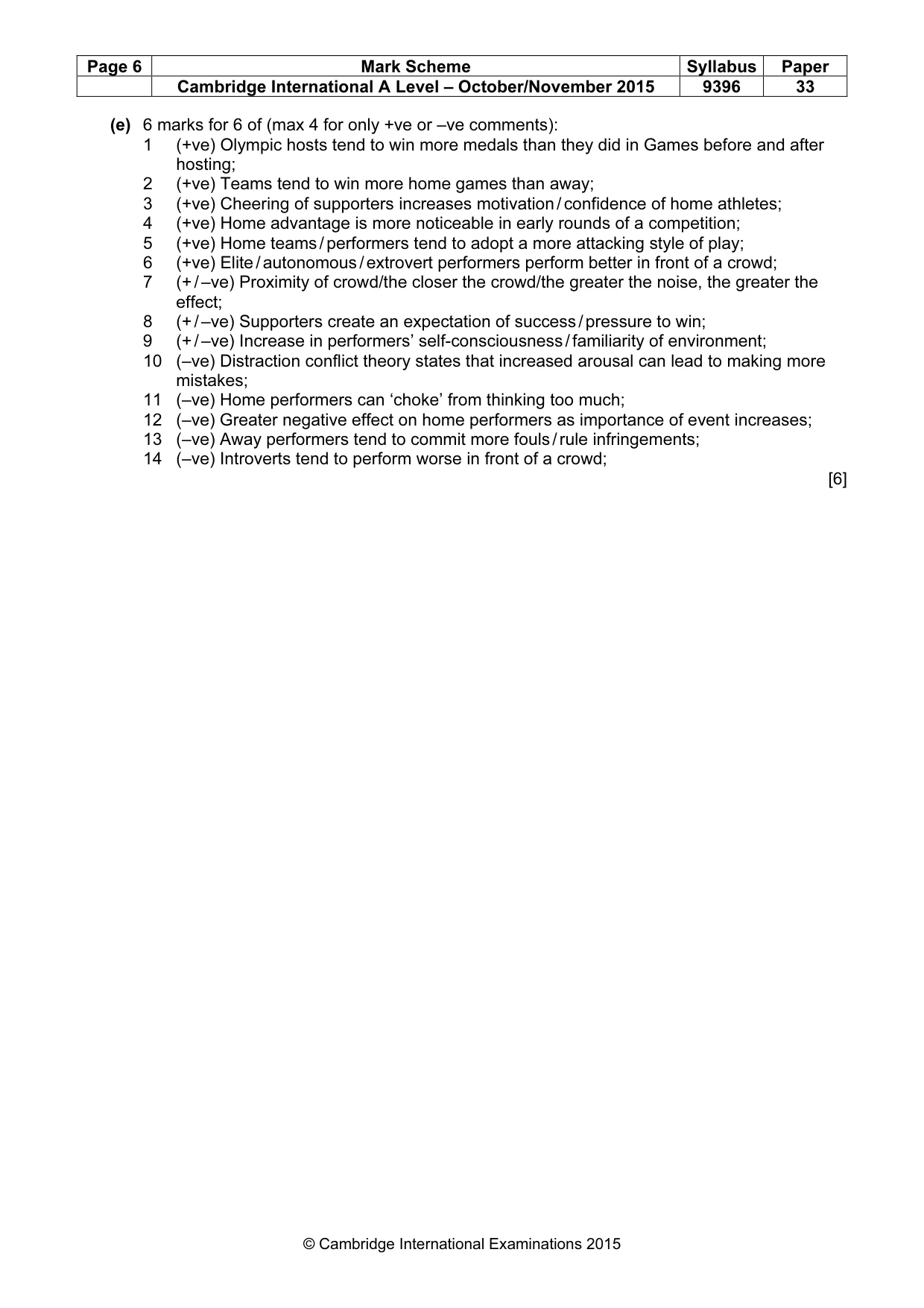
Page 6 Mark Scheme Syllabus Paper Cambridge International A Level – October/November 2015 9396 33 © Cambridge International Examinations 2015 (e) 6 marks for 6 of (max 4 for only +ve or –ve comments): 1 (+ve) Olympic hosts tend to win more medals than they did in Games before and after hosting; 2 (+ve) Teams tend to win more home games than away; 3 (+ve) Cheering of supporters increases motivation / confidence of home athletes; 4 (+ve) Home advantage is more noticeable in early rounds of a competition; 5 (+ve) Home teams / performers tend to adopt a more attacking style of play; 6 (+ve) Elite / autonomous / extrovert performers perform better in front of a crowd; 7 (+ / –ve) Proximity of crowd/the closer the crowd/the greater the noise, the greater the effect; 8 (+ / –ve) Supporters create an expectation of success / pressure to win; 9 (+ / –ve) Increase in performers’ self-consciousness / familiarity of environment; 10 (–ve) Distraction conflict theory states that increased arousal can lead to making more mistakes; 11 (–ve) Home performers can ‘choke’ from thinking too much; 12 (–ve) Greater negative effect on home performers as importance of event increases; 13 (–ve) Away performers tend to commit more fouls / rule infringements; 14 (–ve) Introverts tend to perform worse in front of a crowd; [6]
Mark scheme, page 7
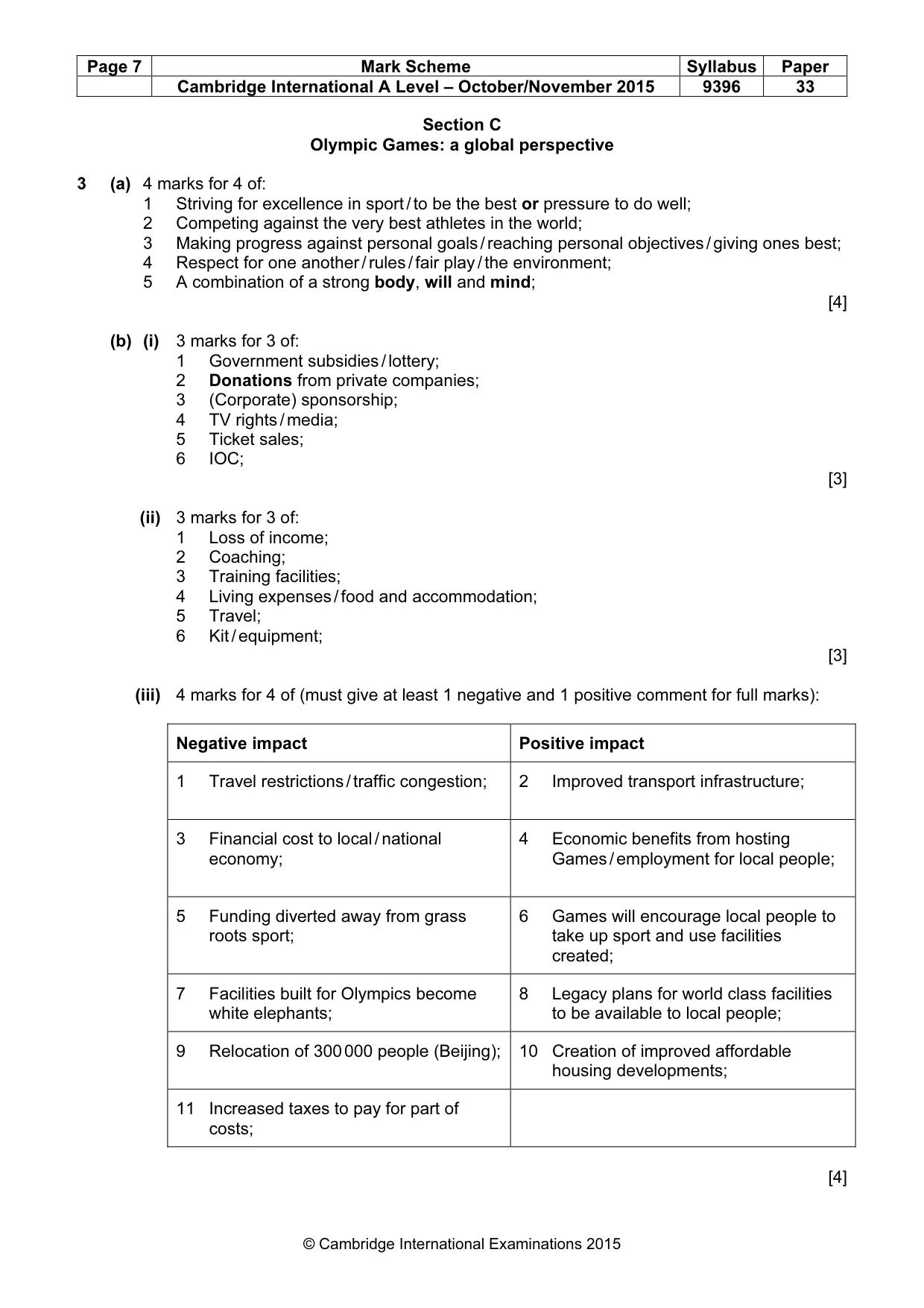
Page 7 Mark Scheme Syllabus Paper Cambridge International A Level – October/November 2015 9396 33 © Cambridge International Examinations 2015 Section C Olympic Games: a global perspective 3 (a) 4 marks for 4 of: 1 Striving for excellence in sport / to be the best or pressure to do well; 2 Competing against the very best athletes in the world; 3 Making progress against personal goals / reaching personal objectives / giving ones best; 4 Respect for one another / rules / fair play / the environment; 5 A combination of a strong body, will and mind; [4] (b) (i) 3 marks for 3 of: 1 Government subsidies / lottery; 2 Donations from private companies; 3 (Corporate) sponsorship; 4 TV rights / media; 5 Ticket sales; 6 IOC; [3] (ii) 3 marks for 3 of: 1 Loss of income; 2 Coaching; 3 Training facilities; 4 Living expenses / food and accommodation; 5 Travel; 6 Kit / equipment; [3] (iii) 4 marks for 4 of (must give at least 1 negative and 1 positive comment for full marks): Negative impact Positive impact 1 Travel restrictions / traffic congestion; 2 Improved transport infrastructure; 3 Financial cost to local / national economy; 4 Economic benefits from hosting Games / employment for local people; 5 Funding diverted away from grass roots sport; 6 Games will encourage local people to take up sport and use facilities created; 7 Facilities built for Olympics become white elephants; 8 Legacy plans for world class facilities to be available to local people; 9 Relocation of 300 000 people (Beijing); 10 Creation of improved affordable housing developments; 11 Increased taxes to pay for part of costs; [4]
Mark scheme, page 8
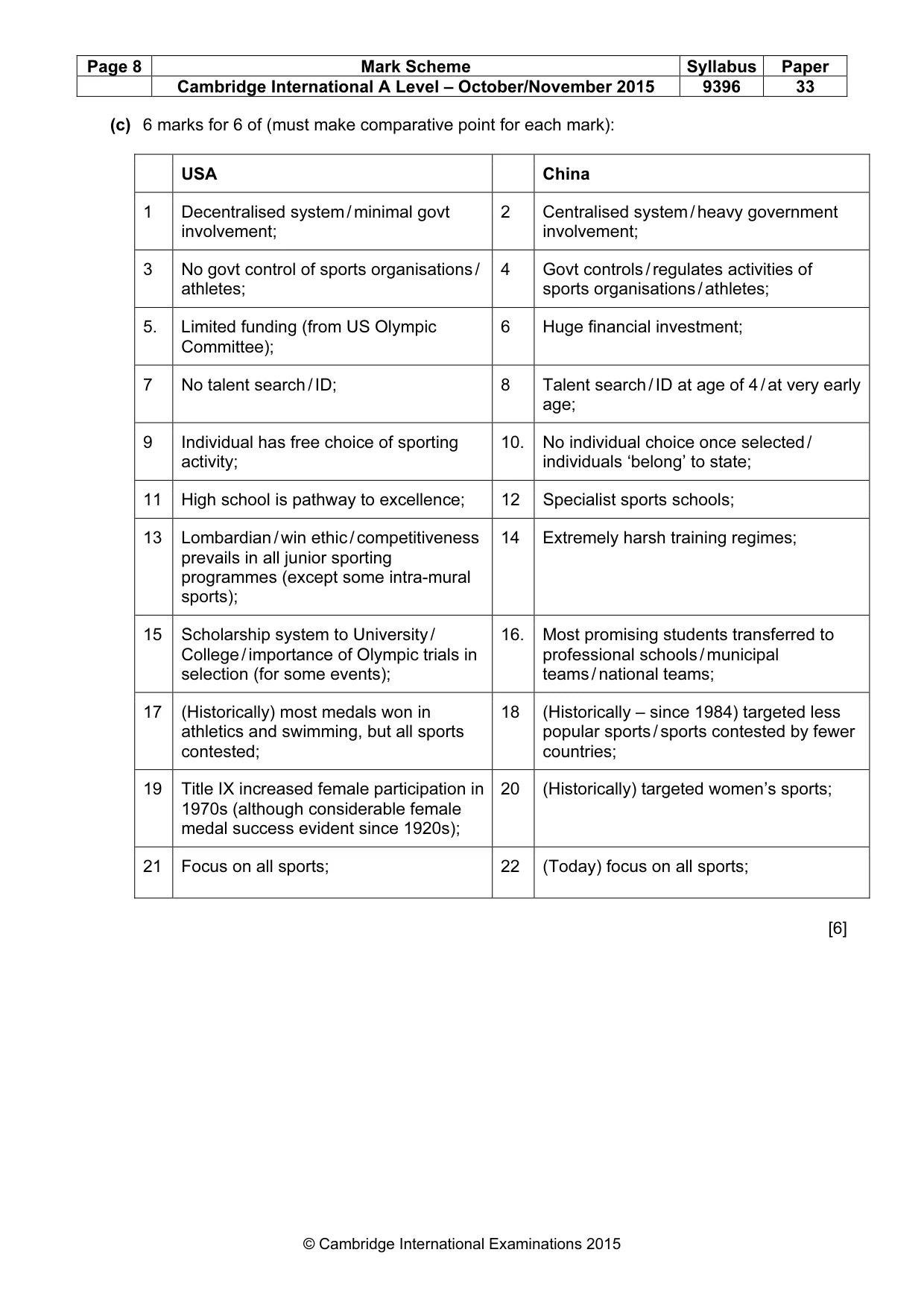
Page 8 Mark Scheme Syllabus Paper Cambridge International A Level – October/November 2015 9396 33 © Cambridge International Examinations 2015 (c) 6 marks for 6 of (must make comparative point for each mark): USA China 1 Decentralised system / minimal govt involvement; 2 Centralised system / heavy government involvement; 3 No govt control of sports organisations / athletes; 4 Govt controls / regulates activities of sports organisations / athletes; 5. Limited funding (from US Olympic Committee); 6 Huge financial investment; 7 No talent search / ID; 8 Talent search / ID at age of 4 / at very early age; 9 Individual has free choice of sporting activity; 10. No individual choice once selected / individuals ‘belong’ to state; 11 High school is pathway to excellence; 12 Specialist sports schools; 13 Lombardian / win ethic / competitiveness prevails in all junior sporting programmes (except some intra-mural sports); 14 Extremely harsh training regimes; 15 Scholarship system to University / College / importance of Olympic trials in selection (for some events); 16. Most promising students transferred to professional schools / municipal teams / national teams; 17 (Historically) most medals won in athletics and swimming, but all sports contested; 18 (Historically – since 1984) targeted less popular sports / sports contested by fewer countries; 19 Title IX increased female participation in 1970s (although considerable female medal success evident since 1920s); 20 (Historically) targeted women’s sports; 21 Focus on all sports; 22 (Today) focus on all sports; [6]
Mark scheme, page 9
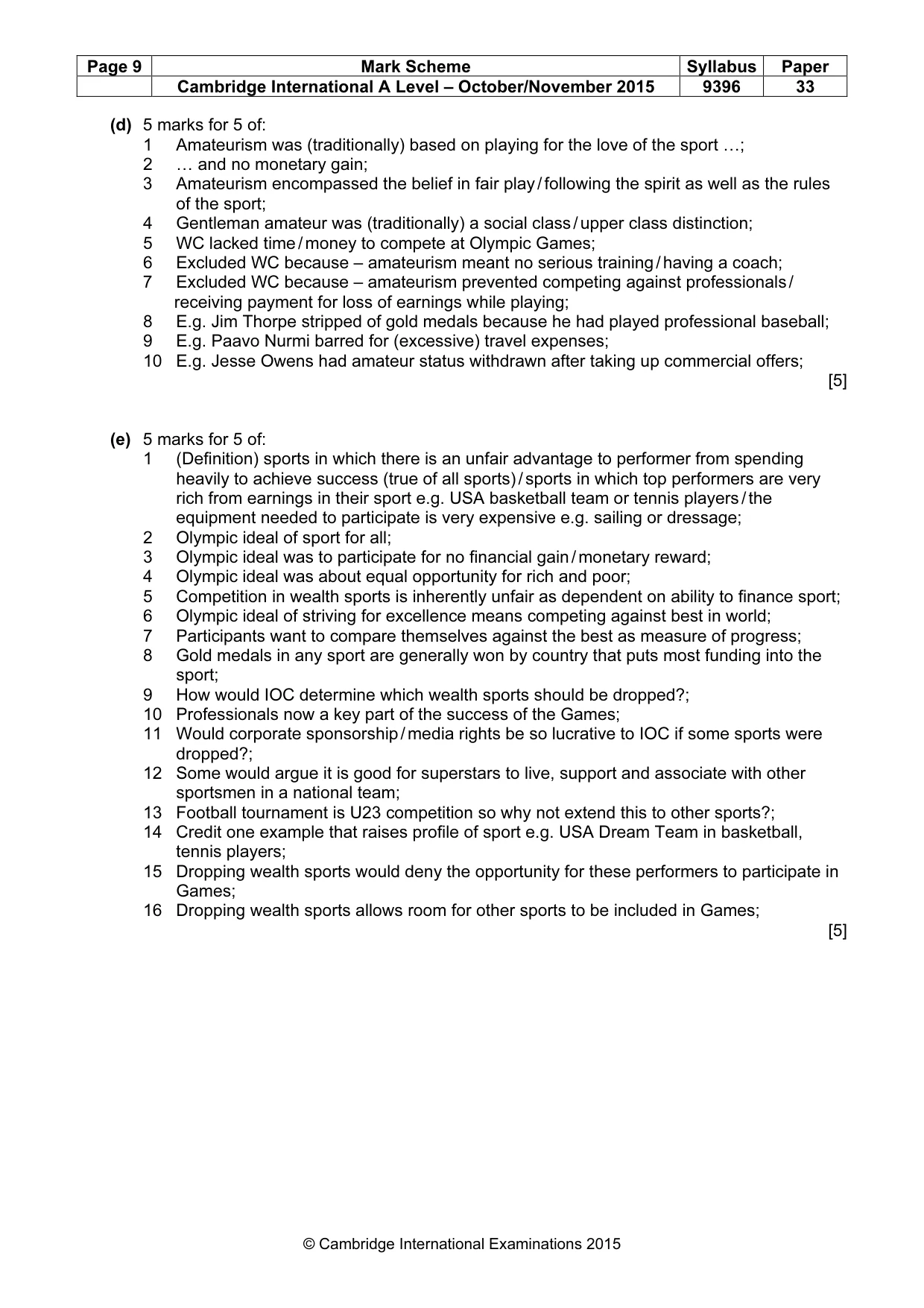
Page 9 Mark Scheme Syllabus Paper Cambridge International A Level – October/November 2015 9396 33 © Cambridge International Examinations 2015 (d) 5 marks for 5 of: 1 Amateurism was (traditionally) based on playing for the love of the sport …; 2 … and no monetary gain; 3 Amateurism encompassed the belief in fair play / following the spirit as well as the rules of the sport; 4 Gentleman amateur was (traditionally) a social class / upper class distinction; 5 WC lacked time / money to compete at Olympic Games; 6 Excluded WC because – amateurism meant no serious training / having a coach; 7 Excluded WC because – amateurism prevented competing against professionals / receiving payment for loss of earnings while playing; 8 E.g. Jim Thorpe stripped of gold medals because he had played professional baseball; 9 E.g. Paavo Nurmi barred for (excessive) travel expenses; 10 E.g. Jesse Owens had amateur status withdrawn after taking up commercial offers; [5] (e) 5 marks for 5 of: 1 (Definition) sports in which there is an unfair advantage to performer from spending heavily to achieve success (true of all sports) / sports in which top performers are very rich from earnings in their sport e.g. USA basketball team or tennis players / the equipment needed to participate is very expensive e.g. sailing or dressage; 2 Olympic ideal of sport for all; 3 Olympic ideal was to participate for no financial gain / monetary reward; 4 Olympic ideal was about equal opportunity for rich and poor; 5 Competition in wealth sports is inherently unfair as dependent on ability to finance sport; 6 Olympic ideal of striving for excellence means competing against best in world; 7 Participants want to compare themselves against the best as measure of progress; 8 Gold medals in any sport are generally won by country that puts most funding into the sport; 9 How would IOC determine which wealth sports should be dropped?; 10 Professionals now a key part of the success of the Games; 11 Would corporate sponsorship / media rights be so lucrative to IOC if some sports were dropped?; 12 Some would argue it is good for superstars to live, support and associate with other sportsmen in a national team; 13 Football tournament is U23 competition so why not extend this to other sports?; 14 Credit one example that raises profile of sport e.g. USA Dream Team in basketball, tennis players; 15 Dropping wealth sports would deny the opportunity for these performers to participate in Games; 16 Dropping wealth sports allows room for other sports to be included in Games; [5]
What you needed in this session
Cambridge’s own grade thresholds for 2015 Oct/Nov, Paper 3 · Variant 3. A higher threshold means an easier paper — the bar moves with how the cohort did.