Cambridge A Level Physical Education 9396 — 2014 Oct/Nov Paper 3 · Variant 3
9396/33/O/N/14 · 90 marks · ≈101 min
The question paper and its mark scheme, free to read here and free to download. This is Cambridge’s own paper, exactly as it was sat.
Question paper4 pages
Mark scheme10 pages
Answers below. Sit the paper first if you are practising.
Paper as text
Question paper, page 1
This document consists of 4 printed pages. DC (LK/JG) 98840 © UCLES 2014 [Turn over Cambridge International Examinations Cambridge International Advanced Subsidiary and Advanced Level * 4 5 4 3 5 8 0 6 2 5 * PHYSICAL EDUCATION 9396/33 Paper 3 October/November 2014 2 hours 30 minutes Additional Materials: Answer Booklet/Paper READ THESE INSTRUCTIONS FIRST If you have been given an Answer Booklet, follow the instructions on the front cover of the Booklet. Write your Centre number, candidate number and name on all the work you hand in. Write in dark blue or black pen. You may use an HB pencil for any diagrams or graphs. Do not use staples, paper clips, glue or correction fluid. DO NOT WRITE IN ANY BARCODES. Answer all questions. At the end of the examination, fasten all your work securely together. The number of marks is given in brackets [ ] at the end of each question or part question.
Question paper, page 2
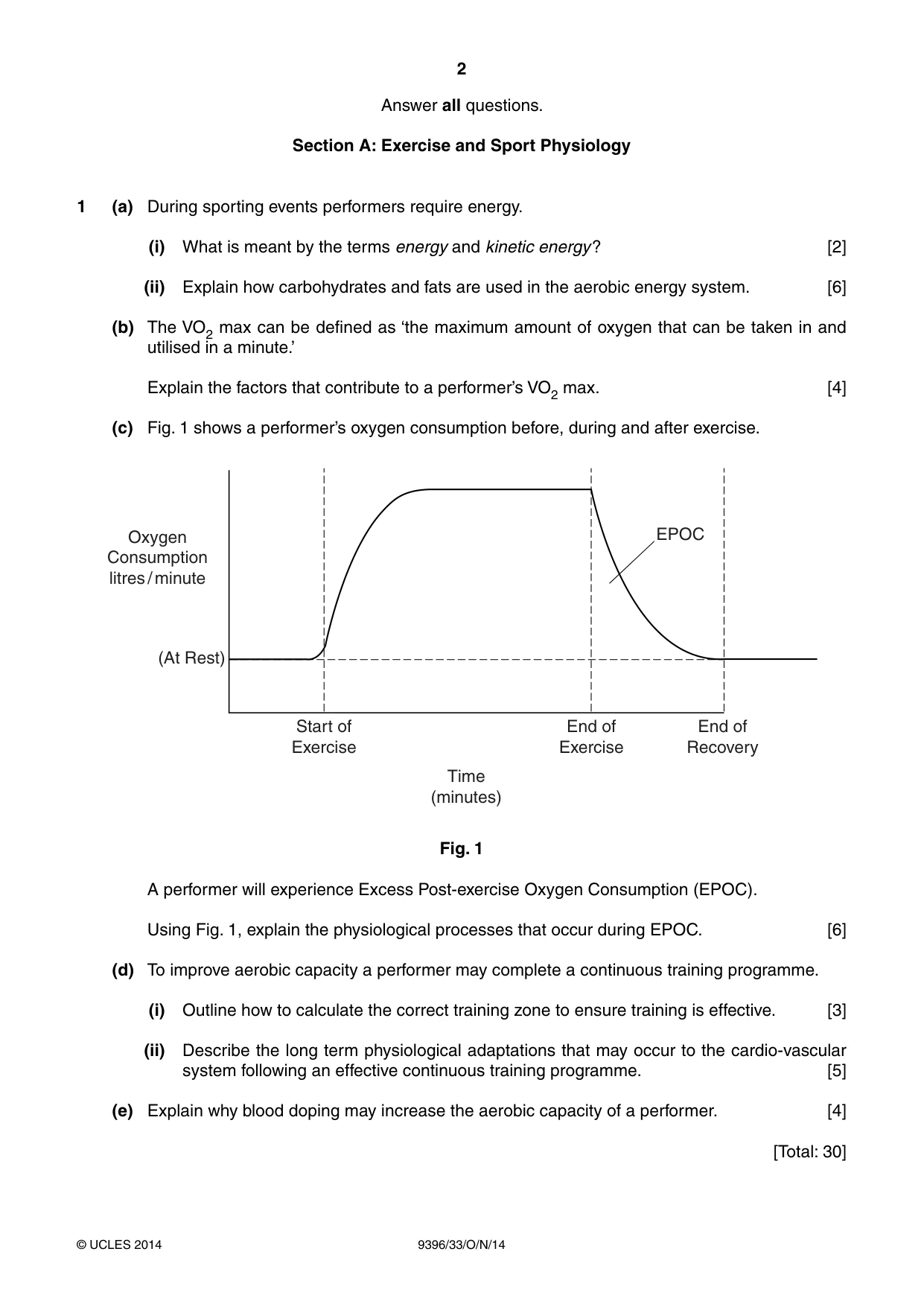
2 9396/33/O/N/14 © UCLES 2014 Answer all questions. Section A: Exercise and Sport Physiology 1 (a) During sporting events performers require energy. (i) What is meant by the terms energy and kinetic energy? [2] (ii) Explain how carbohydrates and fats are used in the aerobic energy system. [6] (b) The VO2 max can be defined as ‘the maximum amount of oxygen that can be taken in and utilised in a minute.’ Explain the factors that contribute to a performer’s VO2 max. [4] (c) Fig. 1 shows a performer’s oxygen consumption before, during and after exercise. EPOC Oxygen Consumption litres / minute (At Rest) Start of Exercise Time (minutes) End of Exercise End of Recovery Fig. 1 A performer will experience Excess Post-exercise Oxygen Consumption (EPOC). Using Fig. 1, explain the physiological processes that occur during EPOC. [6] (d) To improve aerobic capacity a performer may complete a continuous training programme. (i) Outline how to calculate the correct training zone to ensure training is effective. [3] (ii) Describe the long term physiological adaptations that may occur to the cardio-vascular system following an effective continuous training programme. [5] (e) Explain why blood doping may increase the aerobic capacity of a performer. [4] [Total: 30]
Question paper, page 3
3 9396/33/O/N/14 © UCLES 2014 [Turn over Section B: Psychology of Sport Performance 2 (a) Successful performers and teams display a positive attitude. (i) Using a practical example, identify and describe the components of an attitude. [3] (ii) Explain how a coach could change a negative attitude of a team using persuasive communication. [3] (b) Elite performers aim to control arousal levels to optimise performance. Using a practical example, describe the characteristics of the peak flow experience. [3] (c) Name and describe one cognitive stress management technique. [3] (d) The positive effect of an audience on performance is known as social facilitation. (i) Suggest reasons why home-field advantage often helps the performance of a team. [4] (ii) Outline strategies a coach could use to overcome the effects of social inhibition. [5] (e) Successful teams have high levels of cohesion. (i) Explain the term cohesive group and suggest reasons for its importance for team success. [4] (ii) Suggest strategies a coach could use to develop a cohesive team. [5] [Total: 30]
Question paper, page 4
4 9396/33/O/N/14 © UCLES 2014 Section C: Olympic Games: a Global Perspective 3 (a) The Olympic Games began as an ancient festival in Greece and have become a global spectacle in the modern era. (i) What are the similarities and differences between the modern Olympic Games and the ancient Olympic Games? [6] (ii) Discuss the impact to a city, such as London, of hosting the Olympic Games. [5] (iii) Outline the role of the International Olympic Committee and suggest some of the problems this organisation has encountered. [6] (b) The modern Olympic Games were established as an amateur competition. (i) What is meant by the traditional definition of amateurism? [3] (ii) How has commercialisation positively influenced the Olympic Games? [6] (c) The Paralympic Games have continued to expand with London 2012 attracting record audiences. Explain why the Paralympic Games were established. [4] [Total: 30] Permission to reproduce items where third-party owned material protected by copyright is included has been sought and cleared where possible. Every reasonable effort has been made by the publisher (UCLES) to trace copyright holders, but if any items requiring clearance have unwittingly been included, the publisher will be pleased to make amends at the earliest possible opportunity. Cambridge International Examinations is part of the Cambridge Assessment Group. Cambridge Assessment is the brand name of University of Cambridge Local Examinations Syndicate (UCLES), which is itself a department of the University of Cambridge.
Mark scheme, page 1
® IGCSE is the registered trademark of Cambridge International Examinations. CAMBRIDGE INTERNATIONAL EXAMINATIONS Cambridge International Advanced Level MARK SCHEME for the October/November 2014 series 9396 PHYSICAL EDUCATION 9396/33 Paper 3, maximum raw mark 90 This mark scheme is published as an aid to teachers and candidates, to indicate the requirements of the examination. It shows the basis on which Examiners were instructed to award marks. It does not indicate the details of the discussions that took place at an Examiners’ meeting before marking began, which would have considered the acceptability of alternative answers. Mark schemes should be read in conjunction with the question paper and the Principal Examiner Report for Teachers. Cambridge will not enter into discussions about these mark schemes. Cambridge is publishing the mark schemes for the October/November 2014 series for most Cambridge IGCSE®, Cambridge International A and AS Level components and some Cambridge O Level components.
Mark scheme, page 2
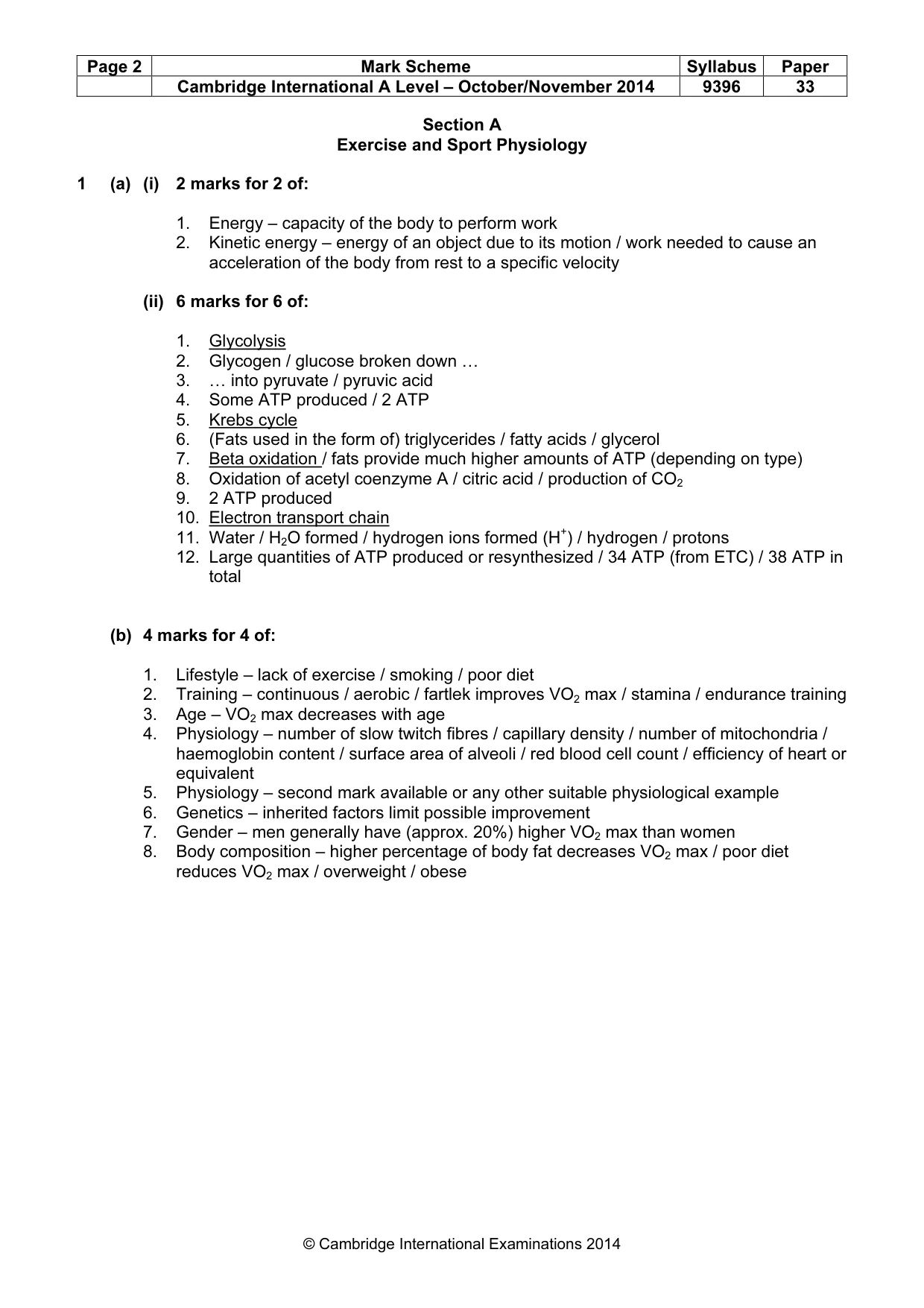
Page 2 Mark Scheme Syllabus Paper Cambridge International A Level – October/November 2014 9396 33 © Cambridge International Examinations 2014 Section A Exercise and Sport Physiology 1 (a) (i) 2 marks for 2 of: 1. Energy – capacity of the body to perform work 2. Kinetic energy – energy of an object due to its motion / work needed to cause an acceleration of the body from rest to a specific velocity (ii) 6 marks for 6 of: 1. Glycolysis 2. Glycogen / glucose broken down … 3. … into pyruvate / pyruvic acid 4. Some ATP produced / 2 ATP 5. Krebs cycle 6. (Fats used in the form of) triglycerides / fatty acids / glycerol 7. Beta oxidation / fats provide much higher amounts of ATP (depending on type) 8. Oxidation of acetyl coenzyme A / citric acid / production of CO2 9. 2 ATP produced 10. Electron transport chain 11. Water / H2O formed / hydrogen ions formed (H+) / hydrogen / protons 12. Large quantities of ATP produced or resynthesized / 34 ATP (from ETC) / 38 ATP in total (b) 4 marks for 4 of: 1. Lifestyle – lack of exercise / smoking / poor diet 2. Training – continuous / aerobic / fartlek improves VO2 max / stamina / endurance training 3. Age – VO2 max decreases with age 4. Physiology – number of slow twitch fibres / capillary density / number of mitochondria / haemoglobin content / surface area of alveoli / red blood cell count / efficiency of heart or equivalent 5. Physiology – second mark available or any other suitable physiological example 6. Genetics – inherited factors limit possible improvement 7. Gender – men generally have (approx. 20%) higher VO2 max than women 8. Body composition – higher percentage of body fat decreases VO2 max / poor diet reduces VO2 max / overweight / obese
Mark scheme, page 3
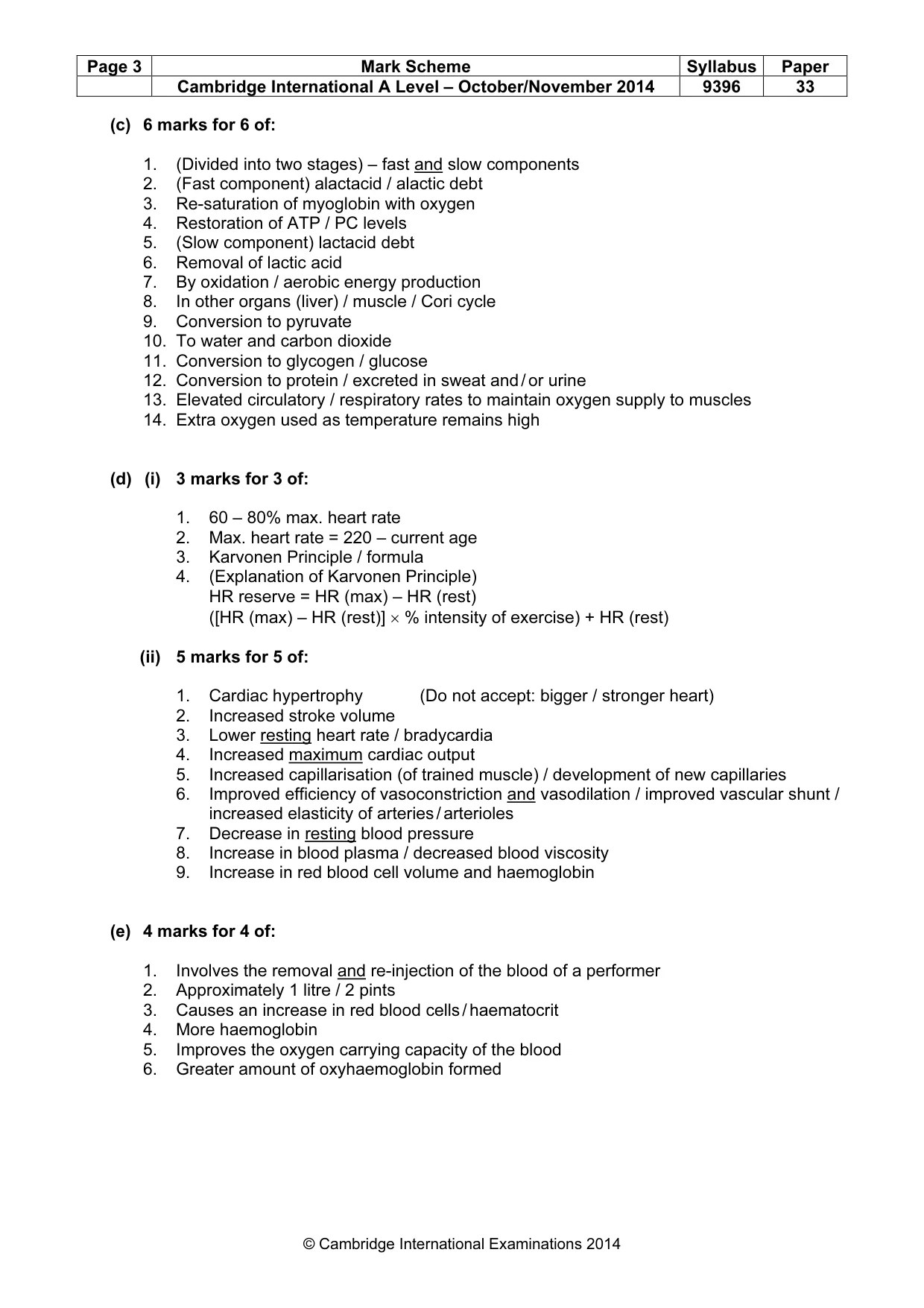
Page 3 Mark Scheme Syllabus Paper Cambridge International A Level – October/November 2014 9396 33 © Cambridge International Examinations 2014 (c) 6 marks for 6 of: 1. (Divided into two stages) – fast and slow components 2. (Fast component) alactacid / alactic debt 3. Re-saturation of myoglobin with oxygen 4. Restoration of ATP / PC levels 5. (Slow component) lactacid debt 6. Removal of lactic acid 7. By oxidation / aerobic energy production 8. In other organs (liver) / muscle / Cori cycle 9. Conversion to pyruvate 10. To water and carbon dioxide 11. Conversion to glycogen / glucose 12. Conversion to protein / excreted in sweat and / or urine 13. Elevated circulatory / respiratory rates to maintain oxygen supply to muscles 14. Extra oxygen used as temperature remains high (d) (i) 3 marks for 3 of: 1. 60 – 80% max. heart rate 2. Max. heart rate = 220 – current age 3. Karvonen Principle / formula 4. (Explanation of Karvonen Principle) HR reserve = HR (max) – HR (rest) ([HR (max) – HR (rest)] × % intensity of exercise) + HR (rest) (ii) 5 marks for 5 of: 1. Cardiac hypertrophy (Do not accept: bigger / stronger heart) 2. Increased stroke volume 3. Lower resting heart rate / bradycardia 4. Increased maximum cardiac output 5. Increased capillarisation (of trained muscle) / development of new capillaries 6. Improved efficiency of vasoconstriction and vasodilation / improved vascular shunt / increased elasticity of arteries / arterioles 7. Decrease in resting blood pressure 8. Increase in blood plasma / decreased blood viscosity 9. Increase in red blood cell volume and haemoglobin (e) 4 marks for 4 of: 1. Involves the removal and re-injection of the blood of a performer 2. Approximately 1 litre / 2 pints 3. Causes an increase in red blood cells / haematocrit 4. More haemoglobin 5. Improves the oxygen carrying capacity of the blood 6. Greater amount of oxyhaemoglobin formed
Mark scheme, page 4
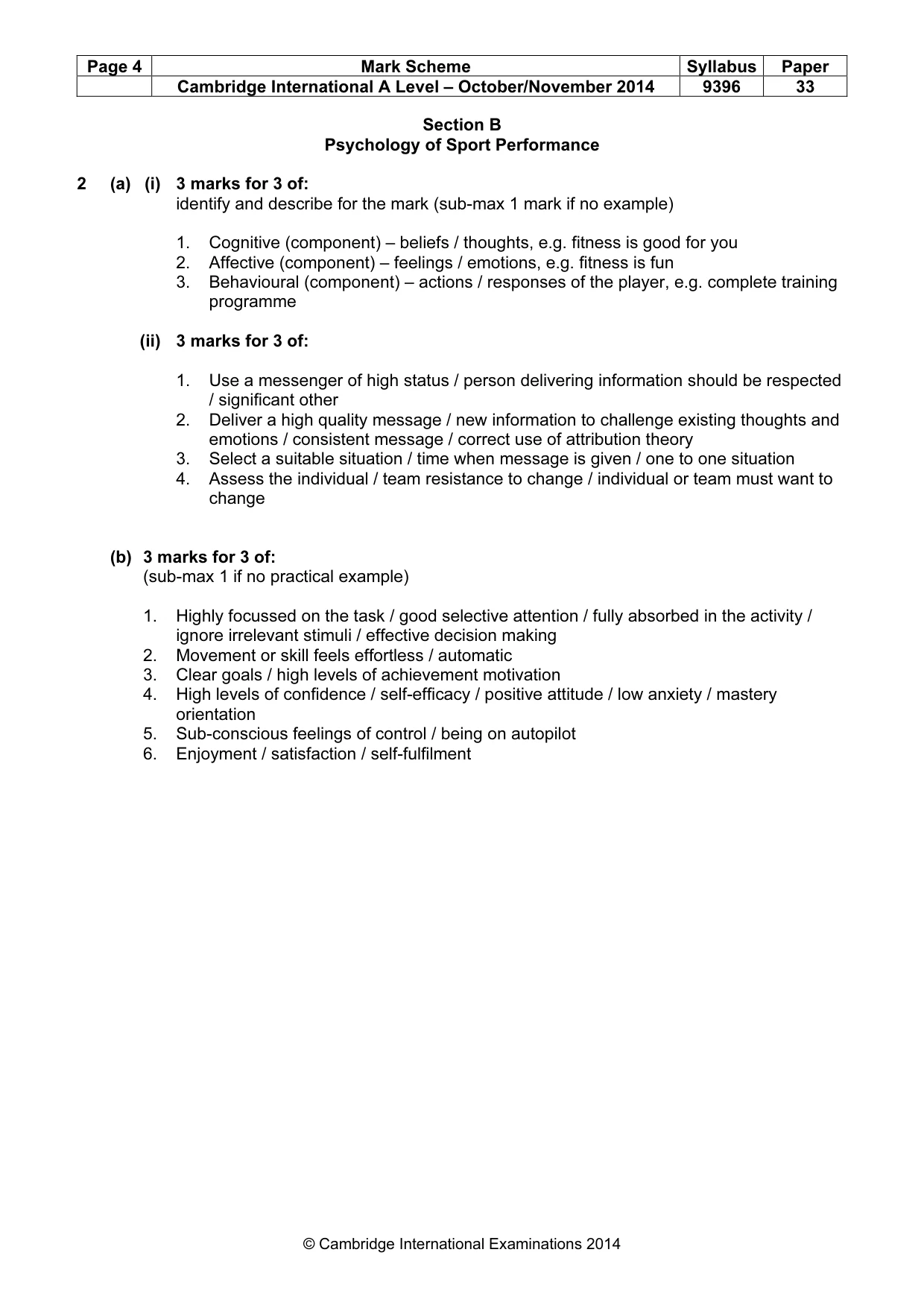
Page 4 Mark Scheme Syllabus Paper Cambridge International A Level – October/November 2014 9396 33 © Cambridge International Examinations 2014 Section B Psychology of Sport Performance 2 (a) (i) 3 marks for 3 of: identify and describe for the mark (sub-max 1 mark if no example) 1. Cognitive (component) – beliefs / thoughts, e.g. fitness is good for you 2. Affective (component) – feelings / emotions, e.g. fitness is fun 3. Behavioural (component) – actions / responses of the player, e.g. complete training programme (ii) 3 marks for 3 of: 1. Use a messenger of high status / person delivering information should be respected / significant other 2. Deliver a high quality message / new information to challenge existing thoughts and emotions / consistent message / correct use of attribution theory 3. Select a suitable situation / time when message is given / one to one situation 4. Assess the individual / team resistance to change / individual or team must want to change (b) 3 marks for 3 of: (sub-max 1 if no practical example) 1. Highly focussed on the task / good selective attention / fully absorbed in the activity / ignore irrelevant stimuli / effective decision making 2. Movement or skill feels effortless / automatic 3. Clear goals / high levels of achievement motivation 4. High levels of confidence / self-efficacy / positive attitude / low anxiety / mastery orientation 5. Sub-conscious feelings of control / being on autopilot 6. Enjoyment / satisfaction / self-fulfilment
Mark scheme, page 5
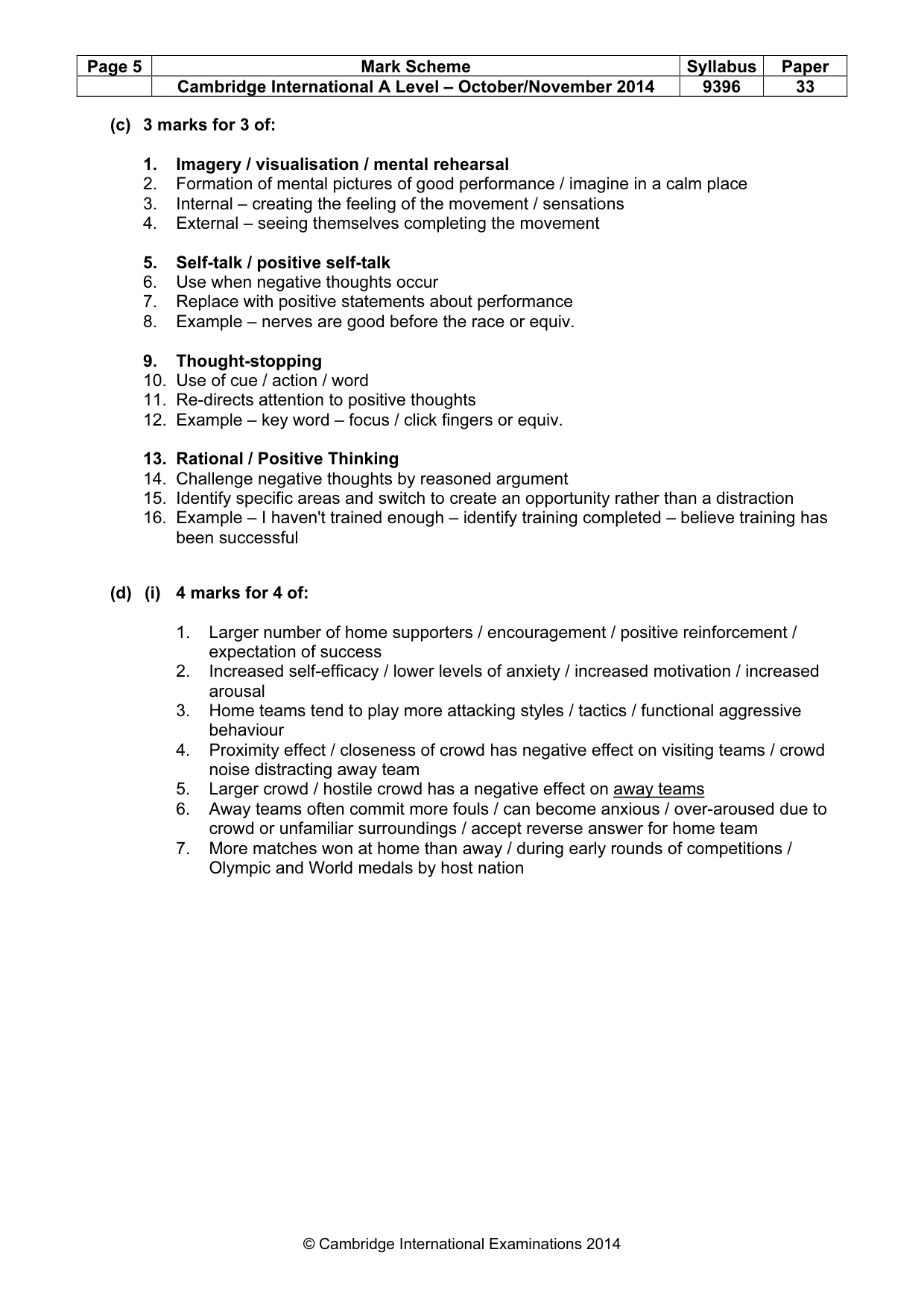
Page 5 Mark Scheme Syllabus Paper Cambridge International A Level – October/November 2014 9396 33 © Cambridge International Examinations 2014 (c) 3 marks for 3 of: 1. Imagery / visualisation / mental rehearsal 2. Formation of mental pictures of good performance / imagine in a calm place 3. Internal – creating the feeling of the movement / sensations 4. External – seeing themselves completing the movement 5. Self-talk / positive self-talk 6. Use when negative thoughts occur 7. Replace with positive statements about performance 8. Example – nerves are good before the race or equiv. 9. Thought-stopping 10. Use of cue / action / word 11. Re-directs attention to positive thoughts 12. Example – key word – focus / click fingers or equiv. 13. Rational / Positive Thinking 14. Challenge negative thoughts by reasoned argument 15. Identify specific areas and switch to create an opportunity rather than a distraction 16. Example – I haven't trained enough – identify training completed – believe training has been successful (d) (i) 4 marks for 4 of: 1. Larger number of home supporters / encouragement / positive reinforcement / expectation of success 2. Increased self-efficacy / lower levels of anxiety / increased motivation / increased arousal 3. Home teams tend to play more attacking styles / tactics / functional aggressive behaviour 4. Proximity effect / closeness of crowd has negative effect on visiting teams / crowd noise distracting away team 5. Larger crowd / hostile crowd has a negative effect on away teams 6. Away teams often commit more fouls / can become anxious / over-aroused due to crowd or unfamiliar surroundings / accept reverse answer for home team 7. More matches won at home than away / during early rounds of competitions / Olympic and World medals by host nation
Mark scheme, page 6
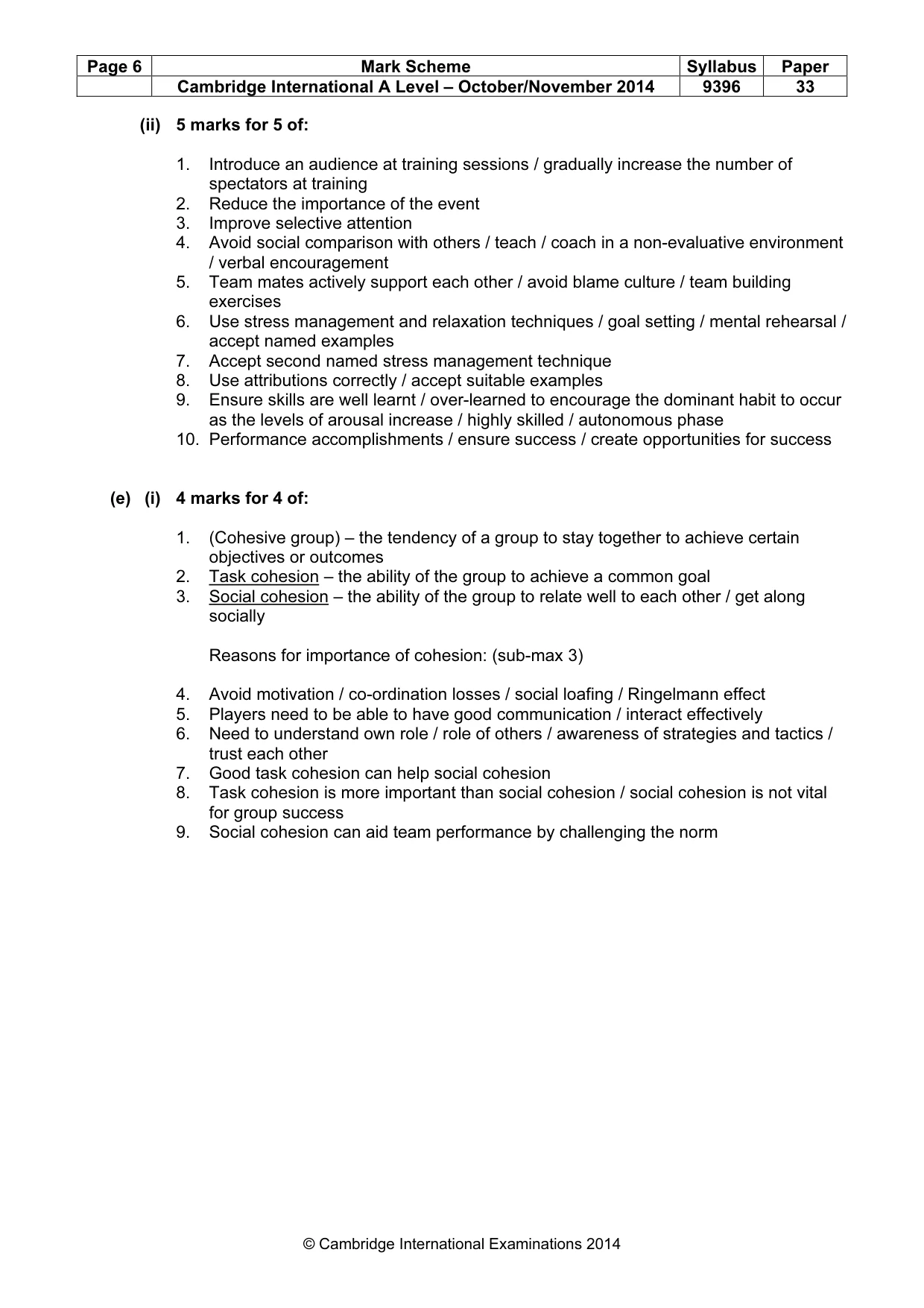
Page 6 Mark Scheme Syllabus Paper Cambridge International A Level – October/November 2014 9396 33 © Cambridge International Examinations 2014 (ii) 5 marks for 5 of: 1. Introduce an audience at training sessions / gradually increase the number of spectators at training 2. Reduce the importance of the event 3. Improve selective attention 4. Avoid social comparison with others / teach / coach in a non-evaluative environment / verbal encouragement 5. Team mates actively support each other / avoid blame culture / team building exercises 6. Use stress management and relaxation techniques / goal setting / mental rehearsal / accept named examples 7. Accept second named stress management technique 8. Use attributions correctly / accept suitable examples 9. Ensure skills are well learnt / over-learned to encourage the dominant habit to occur as the levels of arousal increase / highly skilled / autonomous phase 10. Performance accomplishments / ensure success / create opportunities for success (e) (i) 4 marks for 4 of: 1. (Cohesive group) – the tendency of a group to stay together to achieve certain objectives or outcomes 2. Task cohesion – the ability of the group to achieve a common goal 3. Social cohesion – the ability of the group to relate well to each other / get along socially Reasons for importance of cohesion: (sub-max 3) 4. Avoid motivation / co-ordination losses / social loafing / Ringelmann effect 5. Players need to be able to have good communication / interact effectively 6. Need to understand own role / role of others / awareness of strategies and tactics / trust each other 7. Good task cohesion can help social cohesion 8. Task cohesion is more important than social cohesion / social cohesion is not vital for group success 9. Social cohesion can aid team performance by challenging the norm
Mark scheme, page 7
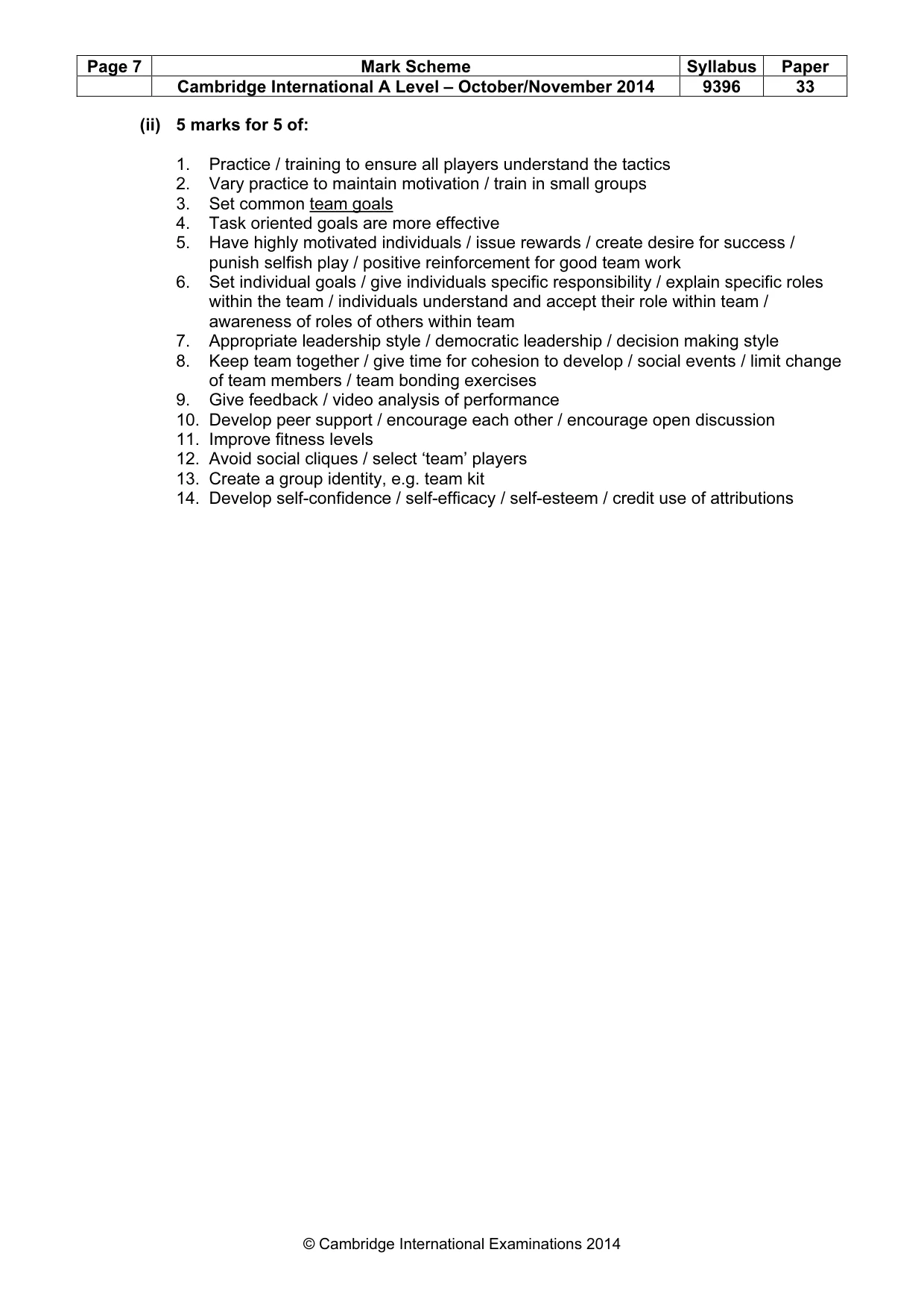
Page 7 Mark Scheme Syllabus Paper Cambridge International A Level – October/November 2014 9396 33 © Cambridge International Examinations 2014 (ii) 5 marks for 5 of: 1. Practice / training to ensure all players understand the tactics 2. Vary practice to maintain motivation / train in small groups 3. Set common team goals 4. Task oriented goals are more effective 5. Have highly motivated individuals / issue rewards / create desire for success / punish selfish play / positive reinforcement for good team work 6. Set individual goals / give individuals specific responsibility / explain specific roles within the team / individuals understand and accept their role within team / awareness of roles of others within team 7. Appropriate leadership style / democratic leadership / decision making style 8. Keep team together / give time for cohesion to develop / social events / limit change of team members / team bonding exercises 9. Give feedback / video analysis of performance 10. Develop peer support / encourage each other / encourage open discussion 11. Improve fitness levels 12. Avoid social cliques / select ‘team’ players 13. Create a group identity, e.g. team kit 14. Develop self-confidence / self-efficacy / self-esteem / credit use of attributions
Mark scheme, page 8
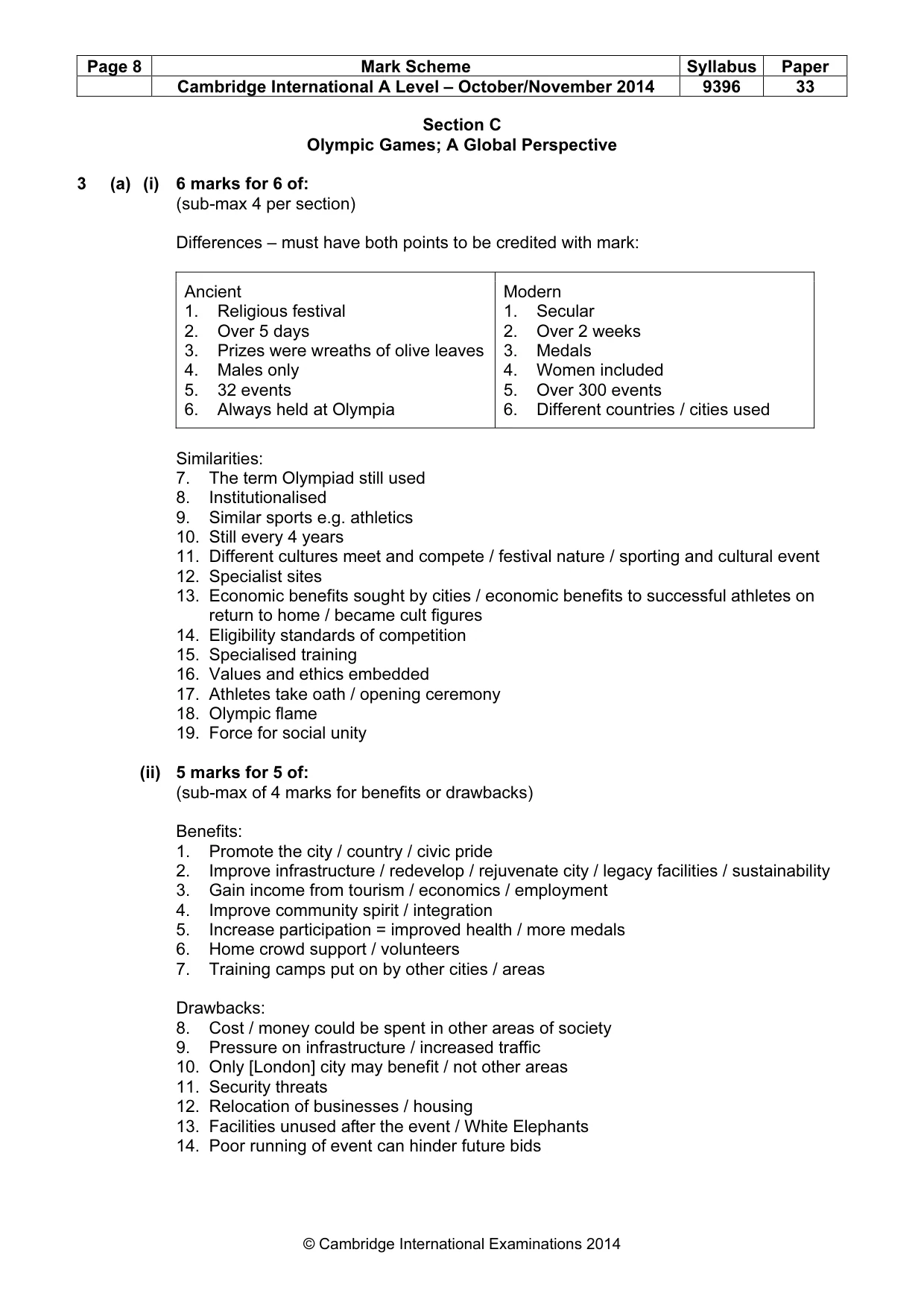
Page 8 Mark Scheme Syllabus Paper Cambridge International A Level – October/November 2014 9396 33 © Cambridge International Examinations 2014 Section C Olympic Games; A Global Perspective 3 (a) (i) 6 marks for 6 of: (sub-max 4 per section) Differences – must have both points to be credited with mark: Ancient 1. Religious festival 2. Over 5 days 3. Prizes were wreaths of olive leaves 4. Males only 5. 32 events 6. Always held at Olympia Modern 1. Secular 2. Over 2 weeks 3. Medals 4. Women included 5. Over 300 events 6. Different countries / cities used Similarities: 7. The term Olympiad still used 8. Institutionalised 9. Similar sports e.g. athletics 10. Still every 4 years 11. Different cultures meet and compete / festival nature / sporting and cultural event 12. Specialist sites 13. Economic benefits sought by cities / economic benefits to successful athletes on return to home / became cult figures 14. Eligibility standards of competition 15. Specialised training 16. Values and ethics embedded 17. Athletes take oath / opening ceremony 18. Olympic flame 19. Force for social unity (ii) 5 marks for 5 of: (sub-max of 4 marks for benefits or drawbacks) Benefits: 1. Promote the city / country / civic pride 2. Improve infrastructure / redevelop / rejuvenate city / legacy facilities / sustainability 3. Gain income from tourism / economics / employment 4. Improve community spirit / integration 5. Increase participation = improved health / more medals 6. Home crowd support / volunteers 7. Training camps put on by other cities / areas Drawbacks: 8. Cost / money could be spent in other areas of society 9. Pressure on infrastructure / increased traffic 10. Only [London] city may benefit / not other areas 11. Security threats 12. Relocation of businesses / housing 13. Facilities unused after the event / White Elephants 14. Poor running of event can hinder future bids
Mark scheme, page 9
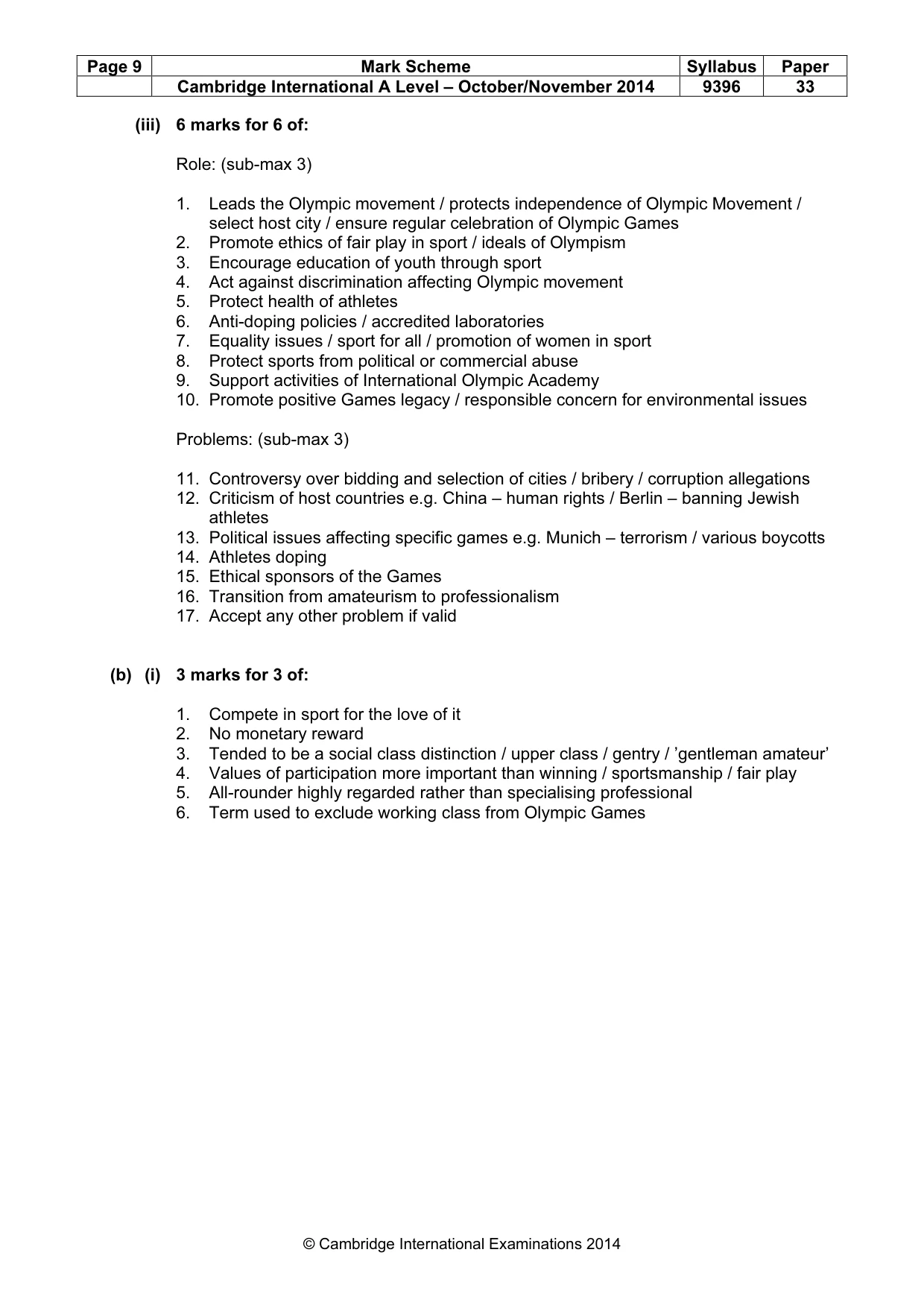
Page 9 Mark Scheme Syllabus Paper Cambridge International A Level – October/November 2014 9396 33 © Cambridge International Examinations 2014 (iii) 6 marks for 6 of: Role: (sub-max 3) 1. Leads the Olympic movement / protects independence of Olympic Movement / select host city / ensure regular celebration of Olympic Games 2. Promote ethics of fair play in sport / ideals of Olympism 3. Encourage education of youth through sport 4. Act against discrimination affecting Olympic movement 5. Protect health of athletes 6. Anti-doping policies / accredited laboratories 7. Equality issues / sport for all / promotion of women in sport 8. Protect sports from political or commercial abuse 9. Support activities of International Olympic Academy 10. Promote positive Games legacy / responsible concern for environmental issues Problems: (sub-max 3) 11. Controversy over bidding and selection of cities / bribery / corruption allegations 12. Criticism of host countries e.g. China – human rights / Berlin – banning Jewish athletes 13. Political issues affecting specific games e.g. Munich – terrorism / various boycotts 14. Athletes doping 15. Ethical sponsors of the Games 16. Transition from amateurism to professionalism 17. Accept any other problem if valid (b) (i) 3 marks for 3 of: 1. Compete in sport for the love of it 2. No monetary reward 3. Tended to be a social class distinction / upper class / gentry / ’gentleman amateur’ 4. Values of participation more important than winning / sportsmanship / fair play 5. All-rounder highly regarded rather than specialising professional 6. Term used to exclude working class from Olympic Games
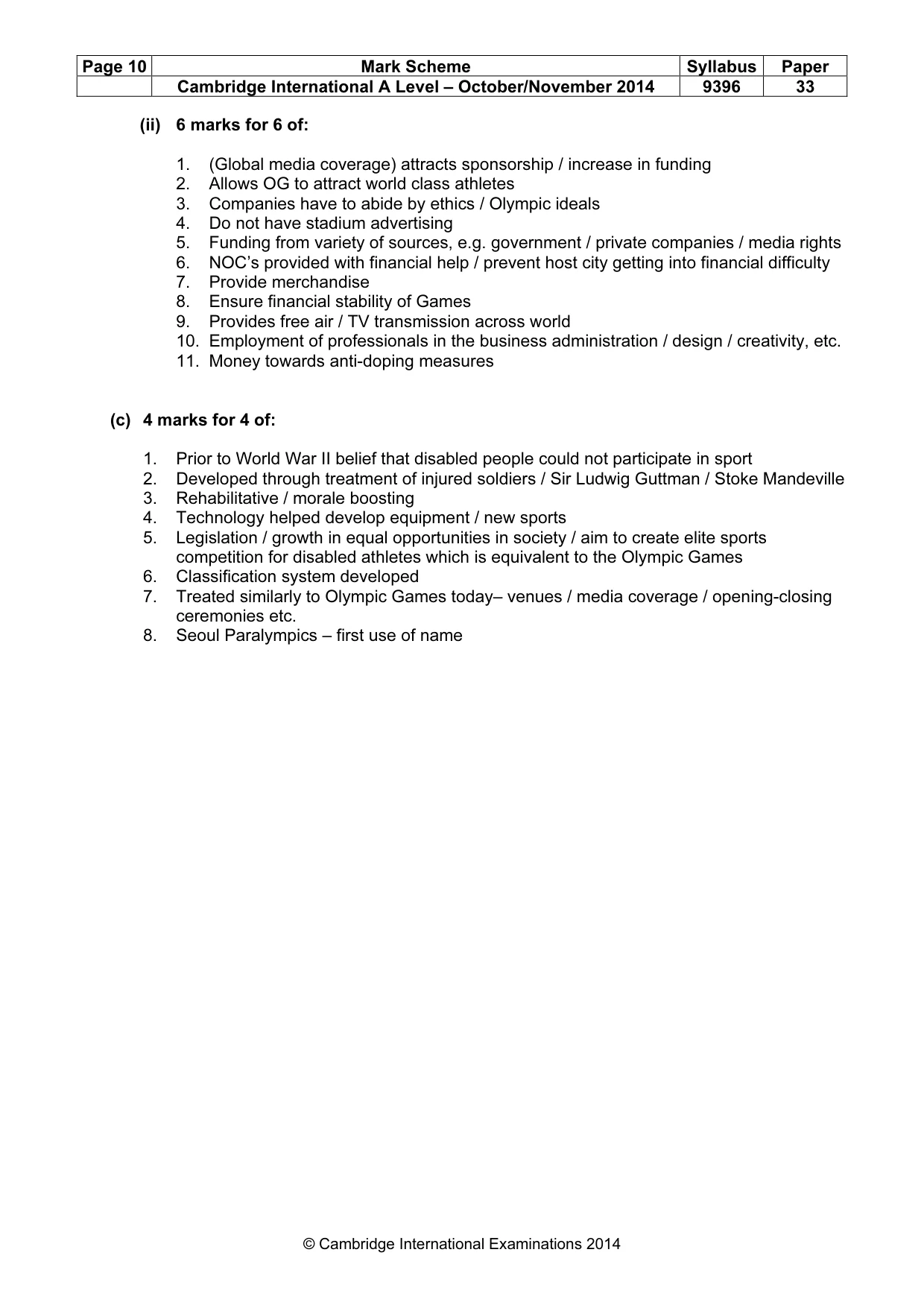
Mark scheme, page 10
Page 10 Mark Scheme Syllabus Paper Cambridge International A Level – October/November 2014 9396 33 © Cambridge International Examinations 2014 (ii) 6 marks for 6 of: 1. (Global media coverage) attracts sponsorship / increase in funding 2. Allows OG to attract world class athletes 3. Companies have to abide by ethics / Olympic ideals 4. Do not have stadium advertising 5. Funding from variety of sources, e.g. government / private companies / media rights 6. NOC’s provided with financial help / prevent host city getting into financial difficulty 7. Provide merchandise 8. Ensure financial stability of Games 9. Provides free air / TV transmission across world 10. Employment of professionals in the business administration / design / creativity, etc. 11. Money towards anti-doping measures (c) 4 marks for 4 of: 1. Prior to World War II belief that disabled people could not participate in sport 2. Developed through treatment of injured soldiers / Sir Ludwig Guttman / Stoke Mandeville 3. Rehabilitative / morale boosting 4. Technology helped develop equipment / new sports 5. Legislation / growth in equal opportunities in society / aim to create elite sports competition for disabled athletes which is equivalent to the Olympic Games 6. Classification system developed 7. Treated similarly to Olympic Games today– venues / media coverage / opening-closing ceremonies etc. 8. Seoul Paralympics – first use of name
What you needed in this session
Cambridge’s own grade thresholds for 2014 Oct/Nov, Paper 3 · Variant 3. A higher threshold means an easier paper — the bar moves with how the cohort did.