Cambridge A Level Physical Education 9396 — 2012 Oct/Nov Paper 3 · Variant 3
9396/33/O/N/12 · 90 marks · ≈101 min
The question paper and its mark scheme, free to read here and free to download. This is Cambridge’s own paper, exactly as it was sat.
Question paper4 pages
Mark scheme8 pages
Answers below. Sit the paper first if you are practising.
Paper as text
Question paper, page 1
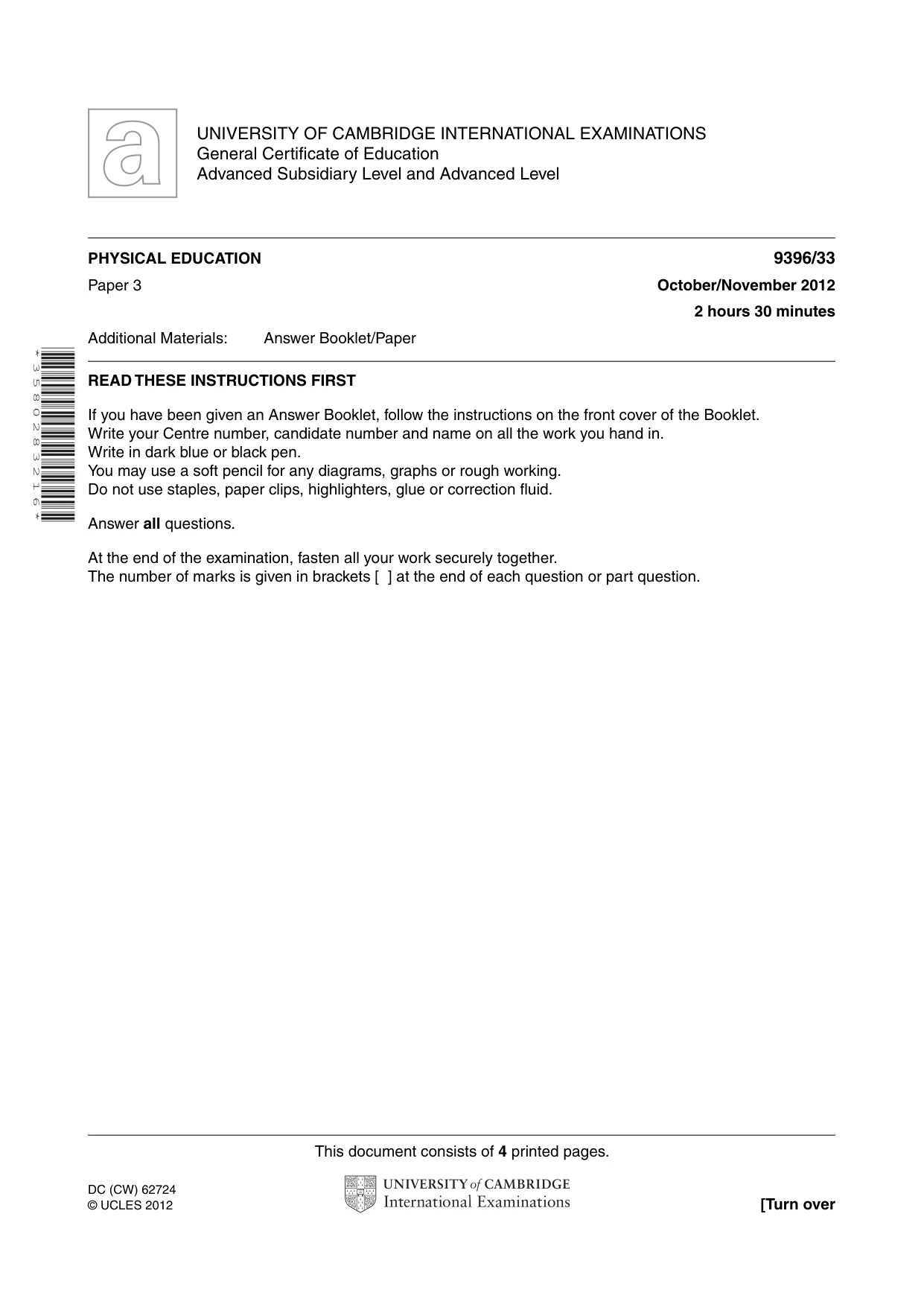
This document consists of 4 printed pages. DC (CW) 62724 © UCLES 2012 [Turn over UNIVERSITY OF CAMBRIDGE INTERNATIONAL EXAMINATIONS General Certificate of Education Advanced Subsidiary Level and Advanced Level * 3 5 8 0 2 8 3 2 1 6 * PHYSICAL EDUCATION 9396/33 Paper 3 October/November 2012 2 hours 30 minutes Additional Materials: Answer Booklet/Paper READ THESE INSTRUCTIONS FIRST If you have been given an Answer Booklet, follow the instructions on the front cover of the Booklet. Write your Centre number, candidate number and name on all the work you hand in. Write in dark blue or black pen. You may use a soft pencil for any diagrams, graphs or rough working. Do not use staples, paper clips, highlighters, glue or correction fluid. Answer all questions. At the end of the examination, fasten all your work securely together. The number of marks is given in brackets [ ] at the end of each question or part question.
Question paper, page 2
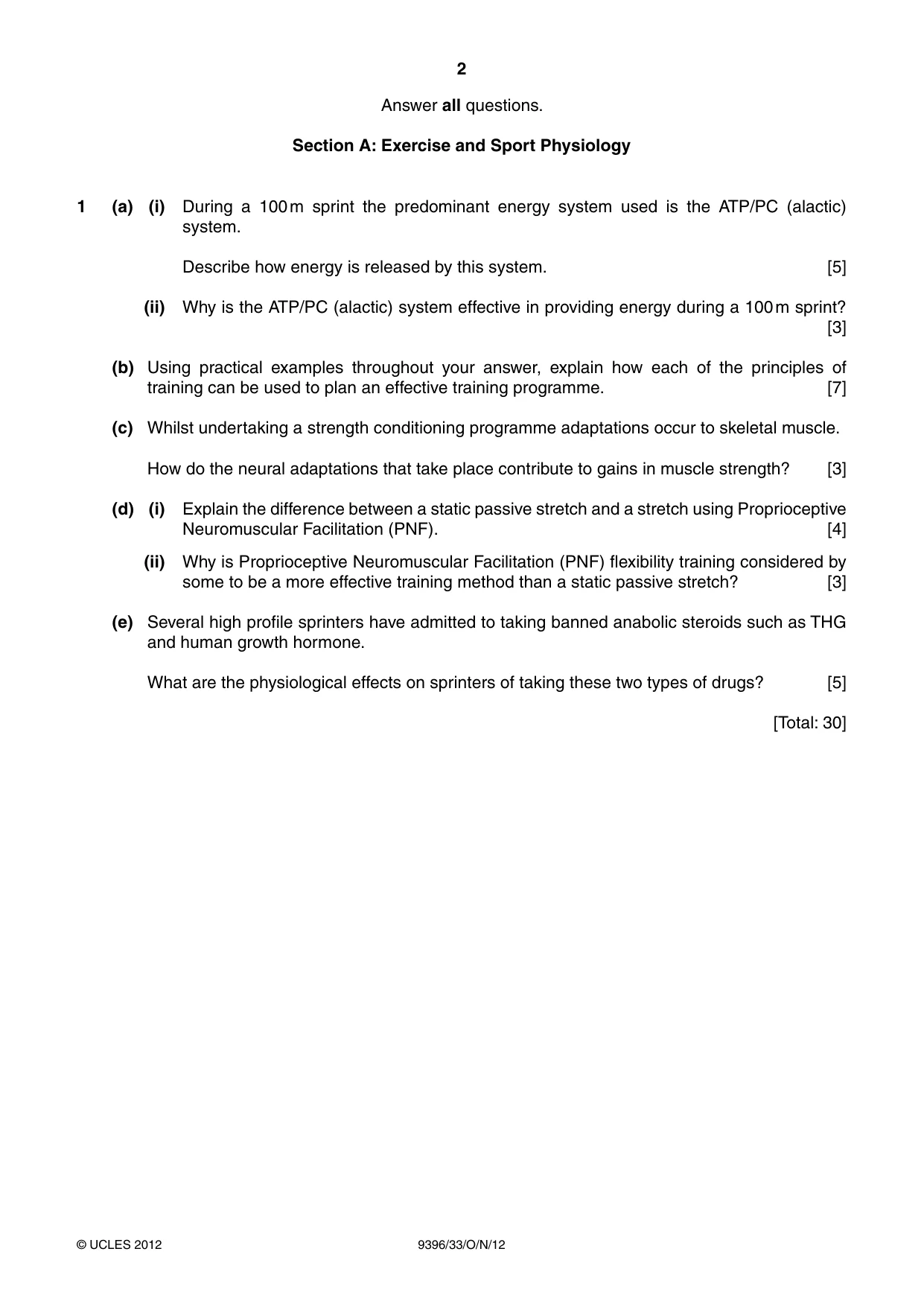
2 9396/33/O/N/12 © UCLES 2012 Answer all questions. Section A: Exercise and Sport Physiology 1 (a) (i) During a 100 m sprint the predominant energy system used is the ATP/PC (alactic) system. Describe how energy is released by this system. [5] (ii) Why is the ATP/PC (alactic) system effective in providing energy during a 100 m sprint? [3] (b) Using practical examples throughout your answer, explain how each of the principles of training can be used to plan an effective training programme. [7] (c) Whilst undertaking a strength conditioning programme adaptations occur to skeletal muscle. How do the neural adaptations that take place contribute to gains in muscle strength? [3] (d) (i) Explain the difference between a static passive stretch and a stretch using Proprioceptive Neuromuscular Facilitation (PNF). [4] (ii) Why is Proprioceptive Neuromuscular Facilitation (PNF) flexibility training considered by some to be a more effective training method than a static passive stretch? [3] (e) Several high profile sprinters have admitted to taking banned anabolic steroids such as THG and human growth hormone. What are the physiological effects on sprinters of taking these two types of drugs? [5] [Total: 30]
Question paper, page 3
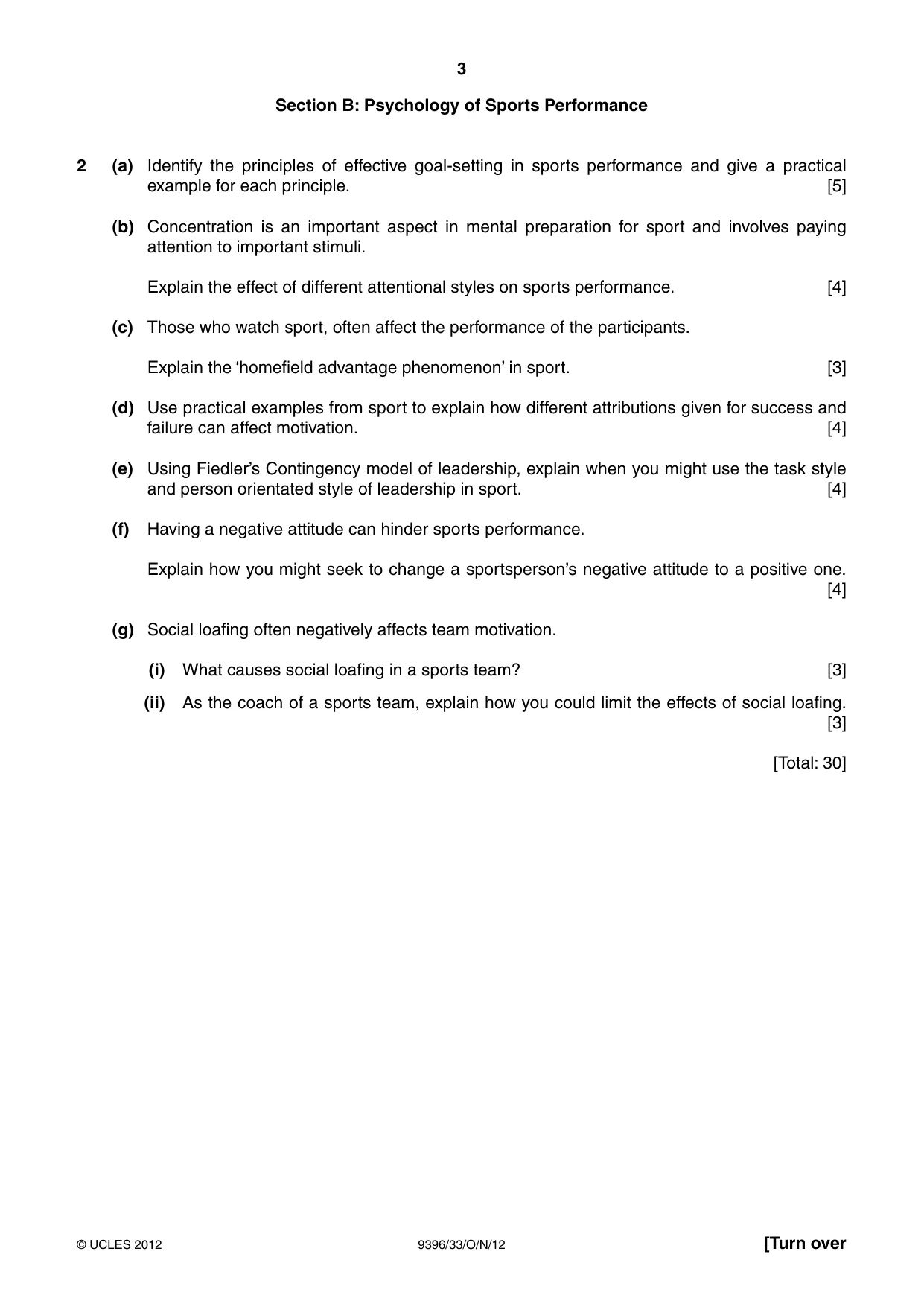
3 9396/33/O/N/12 © UCLES 2012 [Turn over Section B: Psychology of Sports Performance 2 (a) Identify the principles of effective goal-setting in sports performance and give a practical example for each principle. [5] (b) Concentration is an important aspect in mental preparation for sport and involves paying attention to important stimuli. Explain the effect of different attentional styles on sports performance. [4] (c) Those who watch sport, often affect the performance of the participants. Explain the ‘homefield advantage phenomenon’ in sport. [3] (d) Use practical examples from sport to explain how different attributions given for success and failure can affect motivation. [4] (e) Using Fiedler’s Contingency model of leadership, explain when you might use the task style and person orientated style of leadership in sport. [4] (f) Having a negative attitude can hinder sports performance. Explain how you might seek to change a sportsperson’s negative attitude to a positive one. [4] (g) Social loafing often negatively affects team motivation. (i) What causes social loafing in a sports team? [3] (ii) As the coach of a sports team, explain how you could limit the effects of social loafing. [3] [Total: 30]
Question paper, page 4
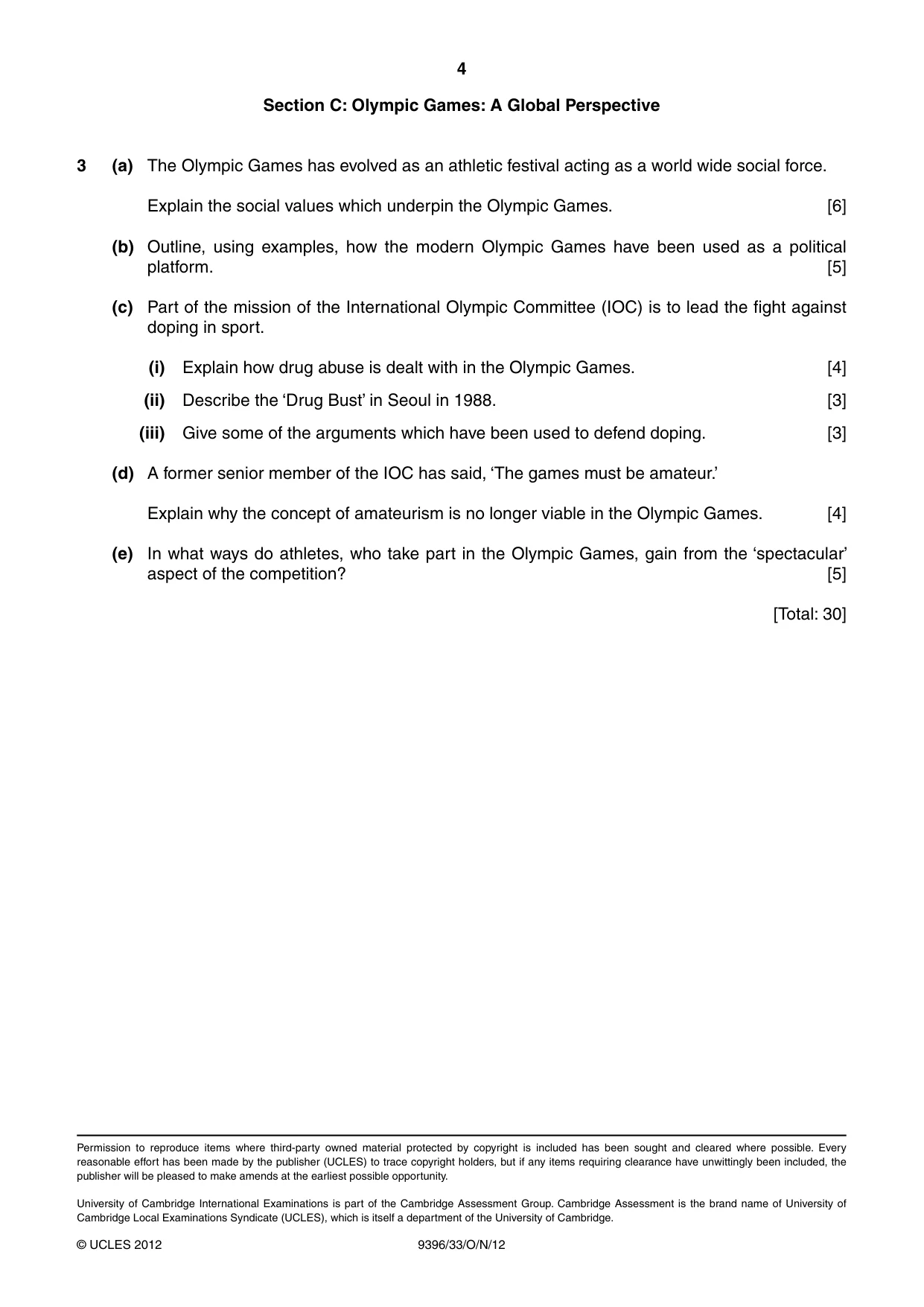
4 9396/33/O/N/12 © UCLES 2012 Section C: Olympic Games: A Global Perspective 3 (a) The Olympic Games has evolved as an athletic festival acting as a world wide social force. Explain the social values which underpin the Olympic Games. [6] (b) Outline, using examples, how the modern Olympic Games have been used as a political platform. [5] (c) Part of the mission of the International Olympic Committee (IOC) is to lead the fight against doping in sport. (i) Explain how drug abuse is dealt with in the Olympic Games. [4] (ii) Describe the ‘Drug Bust’ in Seoul in 1988. [3] (iii) Give some of the arguments which have been used to defend doping. [3] (d) A former senior member of the IOC has said, ‘The games must be amateur.’ Explain why the concept of amateurism is no longer viable in the Olympic Games. [4] (e) In what ways do athletes, who take part in the Olympic Games, gain from the ‘spectacular’ aspect of the competition? [5] [Total: 30] Permission to reproduce items where third-party owned material protected by copyright is included has been sought and cleared where possible. Every reasonable effort has been made by the publisher (UCLES) to trace copyright holders, but if any items requiring clearance have unwittingly been included, the publisher will be pleased to make amends at the earliest possible opportunity. University of Cambridge International Examinations is part of the Cambridge Assessment Group. Cambridge Assessment is the brand name of University of Cambridge Local Examinations Syndicate (UCLES), which is itself a department of the University of Cambridge.
Mark scheme, page 1
CAMBRIDGE INTERNATIONAL EXAMINATIONS GCE Advanced Level MARK SCHEME for the October/November 2012 series 9396 PHYSICAL EDUCATION 9396/33 Paper 3 (Theory), maximum raw mark 90 This mark scheme is published as an aid to teachers and candidates, to indicate the requirements of the examination. It shows the basis on which Examiners were instructed to award marks. It does not indicate the details of the discussions that took place at an Examiners’ meeting before marking began, which would have considered the acceptability of alternative answers. Mark schemes should be read in conjunction with the question paper and the Principal Examiner Report for Teachers. Cambridge will not enter into discussions about these mark schemes. Cambridge is publishing the mark schemes for the October/November 2012 series for most IGCSE, GCE Advanced Level and Advanced Subsidiary Level components and some Ordinary Level components.
Mark scheme, page 2
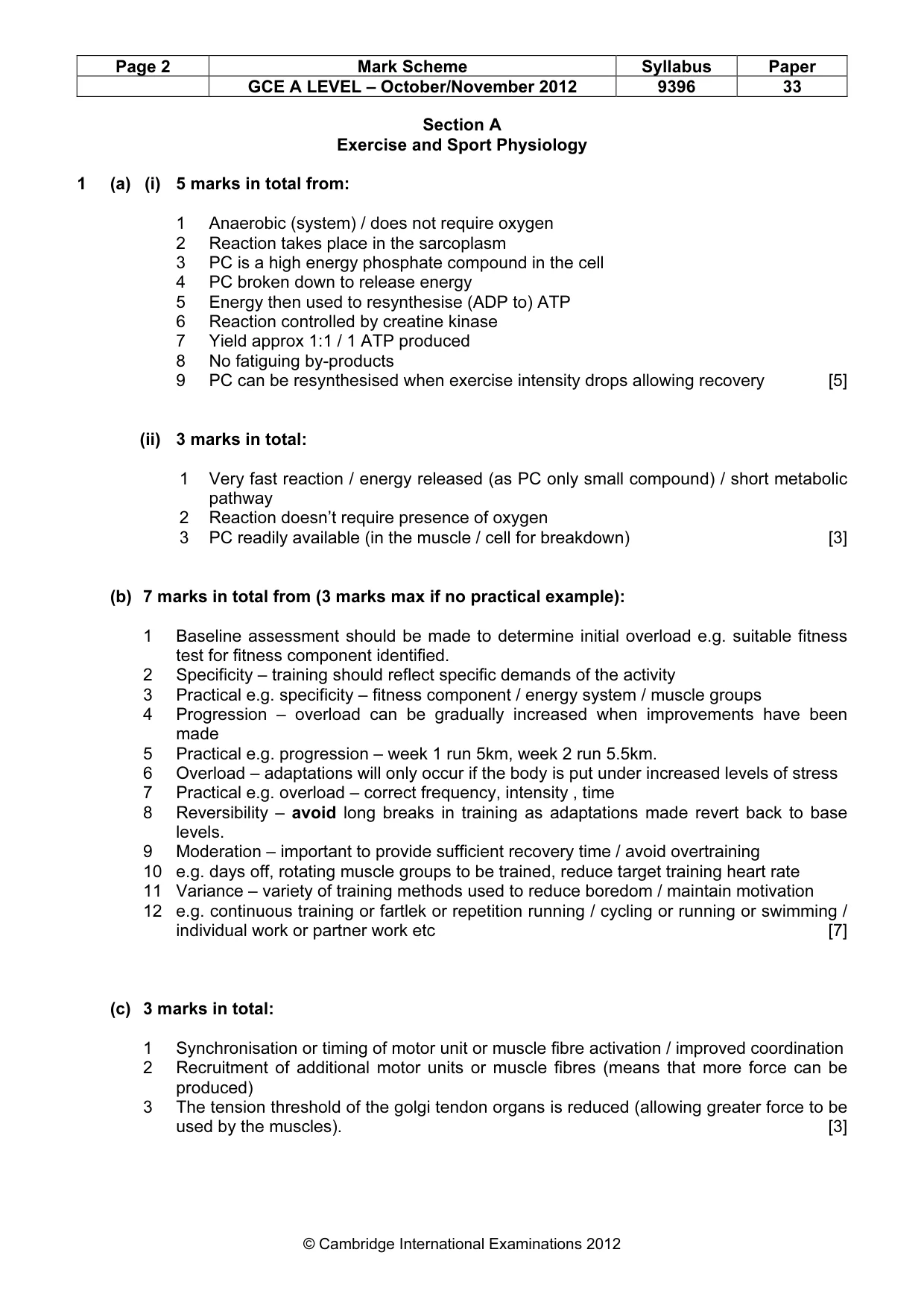
Page 2 Mark Scheme Syllabus Paper GCE A LEVEL – October/November 2012 9396 33 © Cambridge International Examinations 2012 Section A Exercise and Sport Physiology 1 (a) (i) 5 marks in total from: 1 Anaerobic (system) / does not require oxygen 2 Reaction takes place in the sarcoplasm 3 PC is a high energy phosphate compound in the cell 4 PC broken down to release energy 5 Energy then used to resynthesise (ADP to) ATP 6 Reaction controlled by creatine kinase 7 Yield approx 1:1 / 1 ATP produced 8 No fatiguing by-products 9 PC can be resynthesised when exercise intensity drops allowing recovery [5] (ii) 3 marks in total: 1 Very fast reaction / energy released (as PC only small compound) / short metabolic pathway 2 Reaction doesn’t require presence of oxygen 3 PC readily available (in the muscle / cell for breakdown) [3] (b) 7 marks in total from (3 marks max if no practical example): 1 Baseline assessment should be made to determine initial overload e.g. suitable fitness test for fitness component identified. 2 Specificity – training should reflect specific demands of the activity 3 Practical e.g. specificity – fitness component / energy system / muscle groups 4 Progression – overload can be gradually increased when improvements have been made 5 Practical e.g. progression – week 1 run 5km, week 2 run 5.5km. 6 Overload – adaptations will only occur if the body is put under increased levels of stress 7 Practical e.g. overload – correct frequency, intensity , time 8 Reversibility – avoid long breaks in training as adaptations made revert back to base levels. 9 Moderation – important to provide sufficient recovery time / avoid overtraining 10 e.g. days off, rotating muscle groups to be trained, reduce target training heart rate 11 Variance – variety of training methods used to reduce boredom / maintain motivation 12 e.g. continuous training or fartlek or repetition running / cycling or running or swimming / individual work or partner work etc [7] (c) 3 marks in total: 1 Synchronisation or timing of motor unit or muscle fibre activation / improved coordination 2 Recruitment of additional motor units or muscle fibres (means that more force can be produced) 3 The tension threshold of the golgi tendon organs is reduced (allowing greater force to be used by the muscles). [3]
Mark scheme, page 3
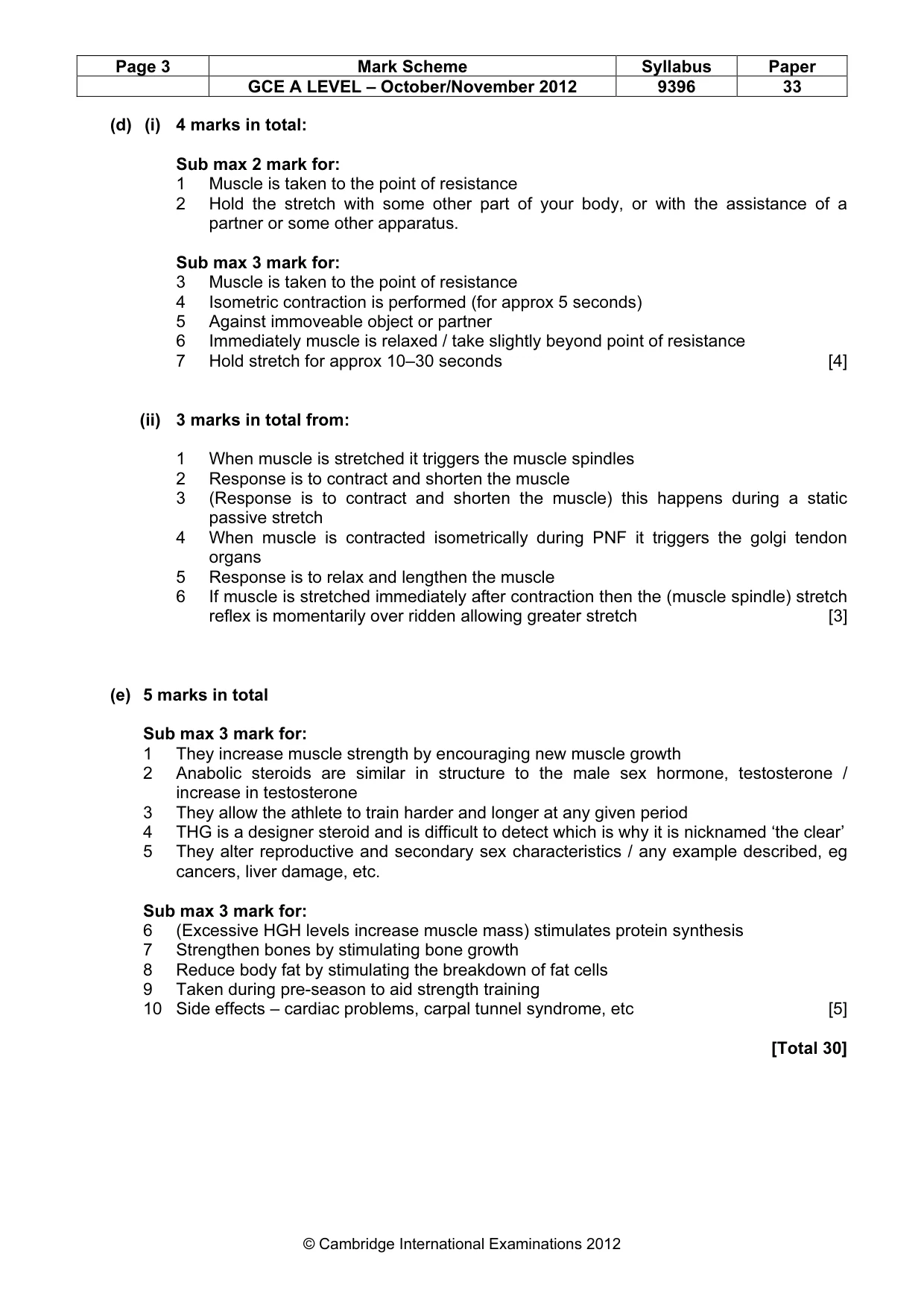
Page 3 Mark Scheme Syllabus Paper GCE A LEVEL – October/November 2012 9396 33 © Cambridge International Examinations 2012 (d) (i) 4 marks in total: Sub max 2 mark for: 1 Muscle is taken to the point of resistance 2 Hold the stretch with some other part of your body, or with the assistance of a partner or some other apparatus. Sub max 3 mark for: 3 Muscle is taken to the point of resistance 4 Isometric contraction is performed (for approx 5 seconds) 5 Against immoveable object or partner 6 Immediately muscle is relaxed / take slightly beyond point of resistance 7 Hold stretch for approx 10–30 seconds [4] (ii) 3 marks in total from: 1 When muscle is stretched it triggers the muscle spindles 2 Response is to contract and shorten the muscle 3 (Response is to contract and shorten the muscle) this happens during a static passive stretch 4 When muscle is contracted isometrically during PNF it triggers the golgi tendon organs 5 Response is to relax and lengthen the muscle 6 If muscle is stretched immediately after contraction then the (muscle spindle) stretch reflex is momentarily over ridden allowing greater stretch [3] (e) 5 marks in total Sub max 3 mark for: 1 They increase muscle strength by encouraging new muscle growth 2 Anabolic steroids are similar in structure to the male sex hormone, testosterone / increase in testosterone 3 They allow the athlete to train harder and longer at any given period 4 THG is a designer steroid and is difficult to detect which is why it is nicknamed ‘the clear’ 5 They alter reproductive and secondary sex characteristics / any example described, eg cancers, liver damage, etc. Sub max 3 mark for: 6 (Excessive HGH levels increase muscle mass) stimulates protein synthesis 7 Strengthen bones by stimulating bone growth 8 Reduce body fat by stimulating the breakdown of fat cells 9 Taken during pre-season to aid strength training 10 Side effects – cardiac problems, carpal tunnel syndrome, etc [5] [Total 30]
Mark scheme, page 4
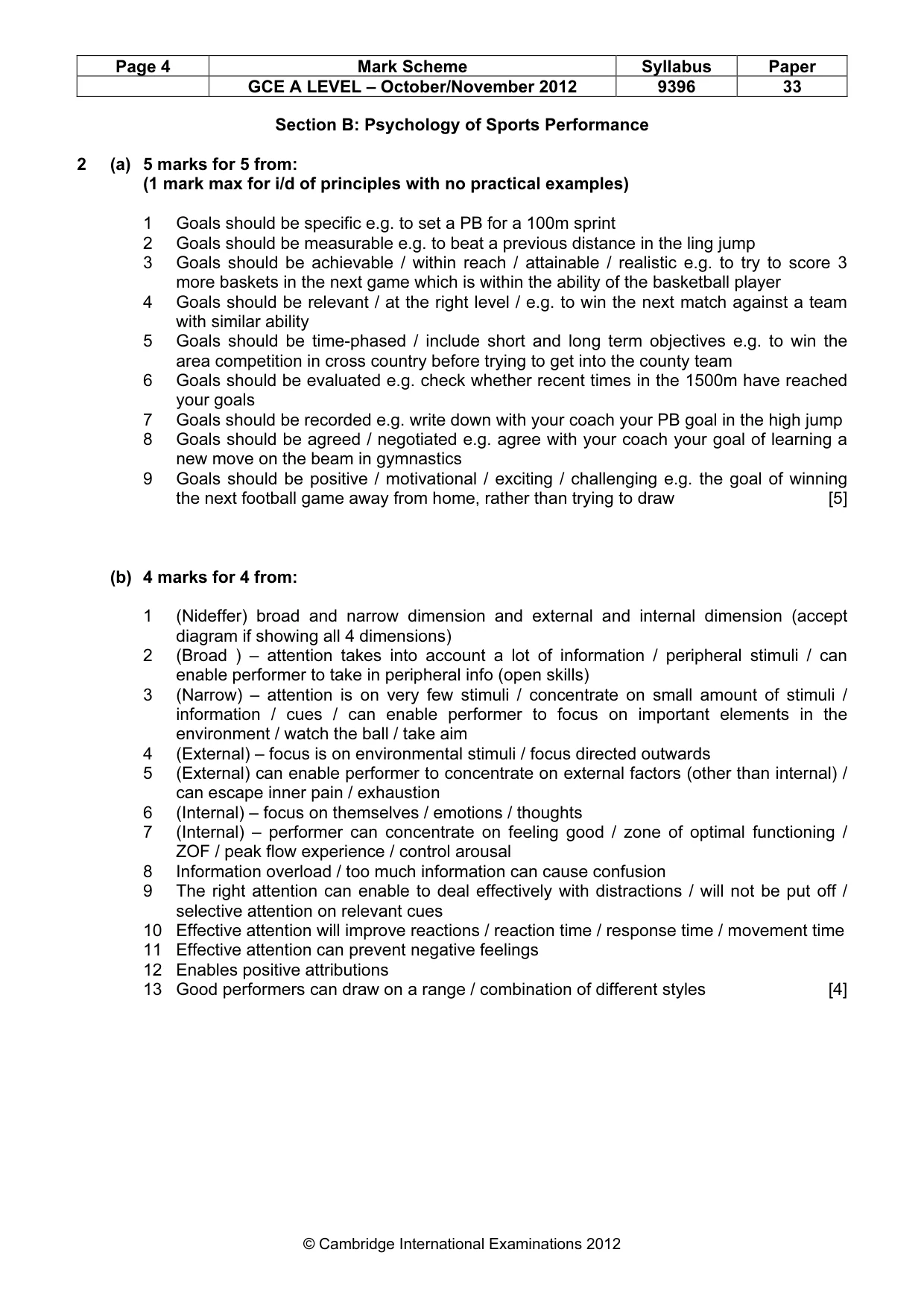
Page 4 Mark Scheme Syllabus Paper GCE A LEVEL – October/November 2012 9396 33 © Cambridge International Examinations 2012 Section B: Psychology of Sports Performance 2 (a) 5 marks for 5 from: (1 mark max for i/d of principles with no practical examples) 1 Goals should be specific e.g. to set a PB for a 100m sprint 2 Goals should be measurable e.g. to beat a previous distance in the ling jump 3 Goals should be achievable / within reach / attainable / realistic e.g. to try to score 3 more baskets in the next game which is within the ability of the basketball player 4 Goals should be relevant / at the right level / e.g. to win the next match against a team with similar ability 5 Goals should be time-phased / include short and long term objectives e.g. to win the area competition in cross country before trying to get into the county team 6 Goals should be evaluated e.g. check whether recent times in the 1500m have reached your goals 7 Goals should be recorded e.g. write down with your coach your PB goal in the high jump 8 Goals should be agreed / negotiated e.g. agree with your coach your goal of learning a new move on the beam in gymnastics 9 Goals should be positive / motivational / exciting / challenging e.g. the goal of winning the next football game away from home, rather than trying to draw [5] (b) 4 marks for 4 from: 1 (Nideffer) broad and narrow dimension and external and internal dimension (accept diagram if showing all 4 dimensions) 2 (Broad ) – attention takes into account a lot of information / peripheral stimuli / can enable performer to take in peripheral info (open skills) 3 (Narrow) – attention is on very few stimuli / concentrate on small amount of stimuli / information / cues / can enable performer to focus on important elements in the environment / watch the ball / take aim 4 (External) – focus is on environmental stimuli / focus directed outwards 5 (External) can enable performer to concentrate on external factors (other than internal) / can escape inner pain / exhaustion 6 (Internal) – focus on themselves / emotions / thoughts 7 (Internal) – performer can concentrate on feeling good / zone of optimal functioning / ZOF / peak flow experience / control arousal 8 Information overload / too much information can cause confusion 9 The right attention can enable to deal effectively with distractions / will not be put off / selective attention on relevant cues 10 Effective attention will improve reactions / reaction time / response time / movement time 11 Effective attention can prevent negative feelings 12 Enables positive attributions 13 Good performers can draw on a range / combination of different styles [4]
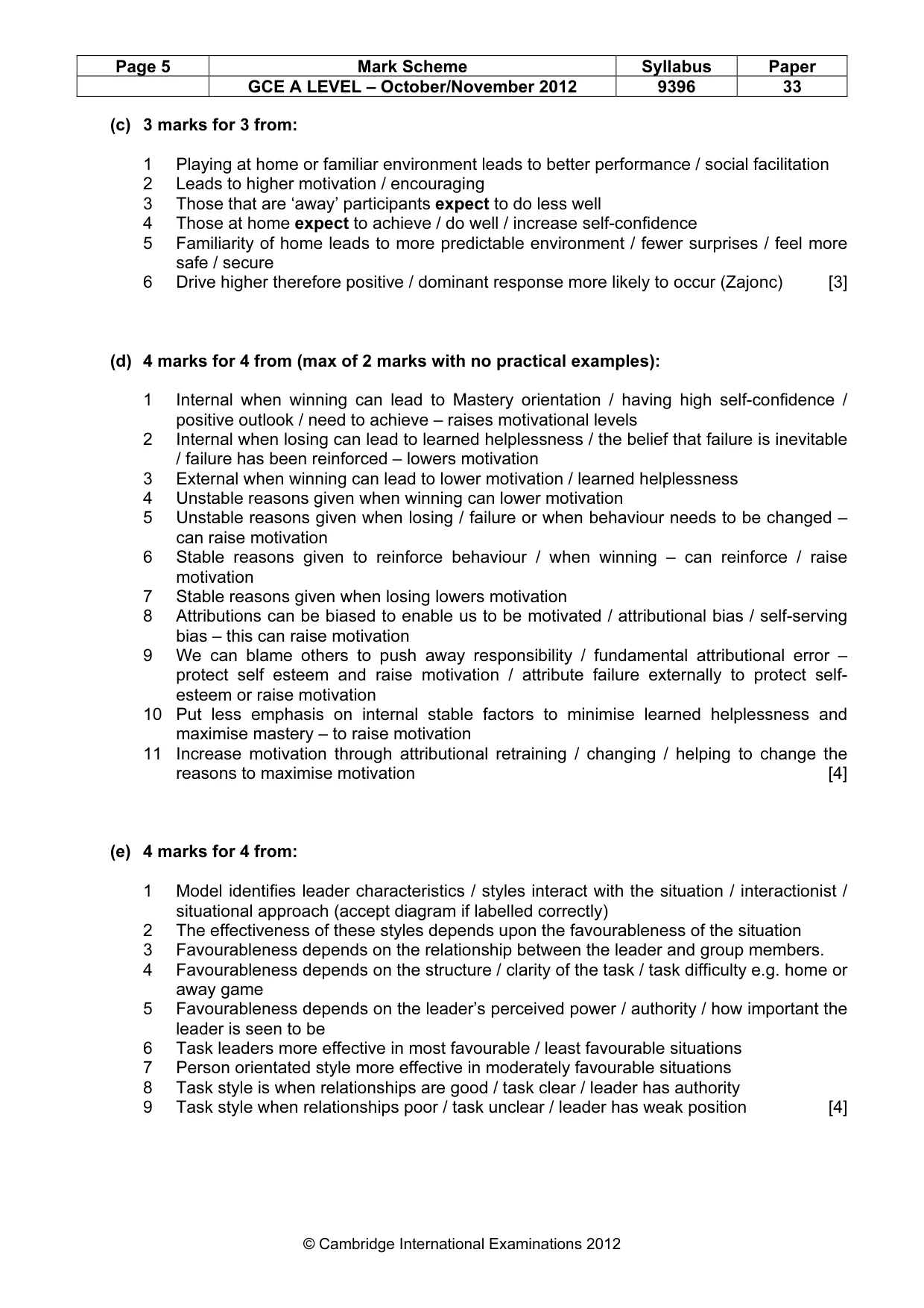
Mark scheme, page 5
Page 5 Mark Scheme Syllabus Paper GCE A LEVEL – October/November 2012 9396 33 © Cambridge International Examinations 2012 (c) 3 marks for 3 from: 1 Playing at home or familiar environment leads to better performance / social facilitation 2 Leads to higher motivation / encouraging 3 Those that are ‘away’ participants expect to do less well 4 Those at home expect to achieve / do well / increase self-confidence 5 Familiarity of home leads to more predictable environment / fewer surprises / feel more safe / secure 6 Drive higher therefore positive / dominant response more likely to occur (Zajonc) [3] (d) 4 marks for 4 from (max of 2 marks with no practical examples): 1 Internal when winning can lead to Mastery orientation / having high self-confidence / positive outlook / need to achieve – raises motivational levels 2 Internal when losing can lead to learned helplessness / the belief that failure is inevitable / failure has been reinforced – lowers motivation 3 External when winning can lead to lower motivation / learned helplessness 4 Unstable reasons given when winning can lower motivation 5 Unstable reasons given when losing / failure or when behaviour needs to be changed – can raise motivation 6 Stable reasons given to reinforce behaviour / when winning – can reinforce / raise motivation 7 Stable reasons given when losing lowers motivation 8 Attributions can be biased to enable us to be motivated / attributional bias / self-serving bias – this can raise motivation 9 We can blame others to push away responsibility / fundamental attributional error – protect self esteem and raise motivation / attribute failure externally to protect self- esteem or raise motivation 10 Put less emphasis on internal stable factors to minimise learned helplessness and maximise mastery – to raise motivation 11 Increase motivation through attributional retraining / changing / helping to change the reasons to maximise motivation [4] (e) 4 marks for 4 from: 1 Model identifies leader characteristics / styles interact with the situation / interactionist / situational approach (accept diagram if labelled correctly) 2 The effectiveness of these styles depends upon the favourableness of the situation 3 Favourableness depends on the relationship between the leader and group members. 4 Favourableness depends on the structure / clarity of the task / task difficulty e.g. home or away game 5 Favourableness depends on the leader’s perceived power / authority / how important the leader is seen to be 6 Task leaders more effective in most favourable / least favourable situations 7 Person orientated style more effective in moderately favourable situations 8 Task style is when relationships are good / task clear / leader has authority 9 Task style when relationships poor / task unclear / leader has weak position [4]
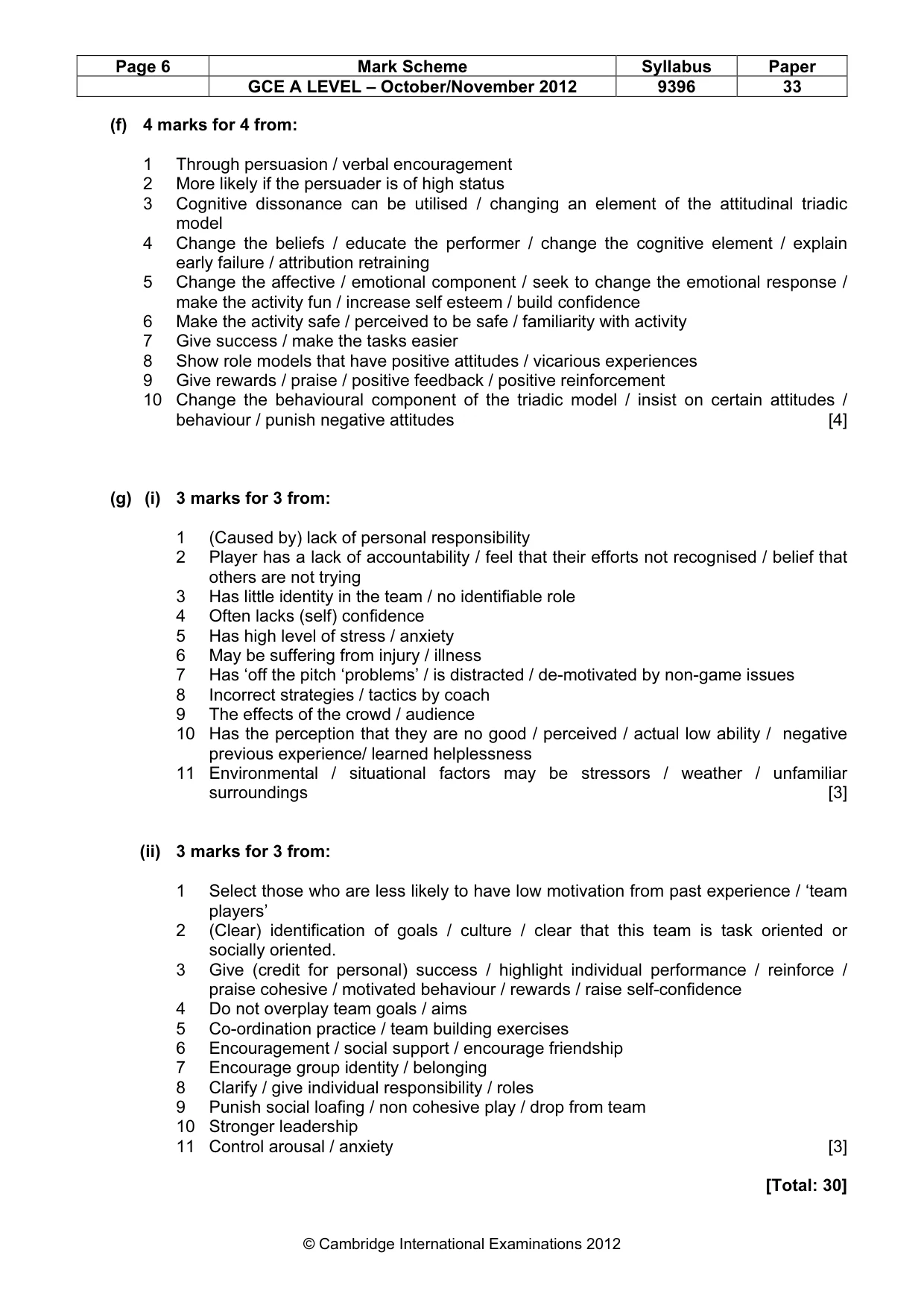
Mark scheme, page 6
Page 6 Mark Scheme Syllabus Paper GCE A LEVEL – October/November 2012 9396 33 © Cambridge International Examinations 2012 (f) 4 marks for 4 from: 1 Through persuasion / verbal encouragement 2 More likely if the persuader is of high status 3 Cognitive dissonance can be utilised / changing an element of the attitudinal triadic model 4 Change the beliefs / educate the performer / change the cognitive element / explain early failure / attribution retraining 5 Change the affective / emotional component / seek to change the emotional response / make the activity fun / increase self esteem / build confidence 6 Make the activity safe / perceived to be safe / familiarity with activity 7 Give success / make the tasks easier 8 Show role models that have positive attitudes / vicarious experiences 9 Give rewards / praise / positive feedback / positive reinforcement 10 Change the behavioural component of the triadic model / insist on certain attitudes / behaviour / punish negative attitudes [4] (g) (i) 3 marks for 3 from: 1 (Caused by) lack of personal responsibility 2 Player has a lack of accountability / feel that their efforts not recognised / belief that others are not trying 3 Has little identity in the team / no identifiable role 4 Often lacks (self) confidence 5 Has high level of stress / anxiety 6 May be suffering from injury / illness 7 Has ‘off the pitch ‘problems’ / is distracted / de-motivated by non-game issues 8 Incorrect strategies / tactics by coach 9 The effects of the crowd / audience 10 Has the perception that they are no good / perceived / actual low ability / negative previous experience/ learned helplessness 11 Environmental / situational factors may be stressors / weather / unfamiliar surroundings [3] (ii) 3 marks for 3 from: 1 Select those who are less likely to have low motivation from past experience / ‘team players’ 2 (Clear) identification of goals / culture / clear that this team is task oriented or socially oriented. 3 Give (credit for personal) success / highlight individual performance / reinforce / praise cohesive / motivated behaviour / rewards / raise self-confidence 4 Do not overplay team goals / aims 5 Co-ordination practice / team building exercises 6 Encouragement / social support / encourage friendship 7 Encourage group identity / belonging 8 Clarify / give individual responsibility / roles 9 Punish social loafing / non cohesive play / drop from team 10 Stronger leadership 11 Control arousal / anxiety [3] [Total: 30]
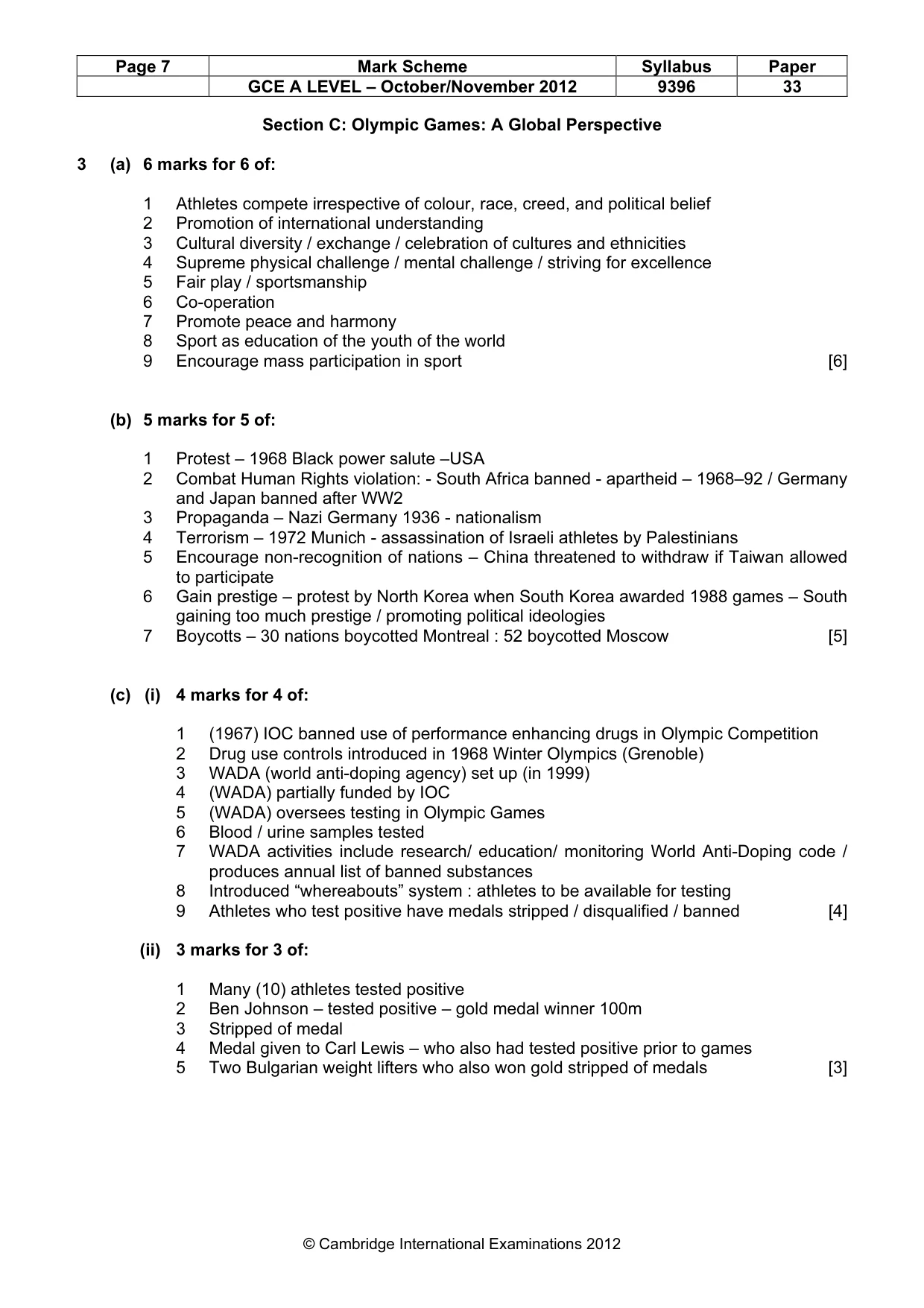
Mark scheme, page 7
Page 7 Mark Scheme Syllabus Paper GCE A LEVEL – October/November 2012 9396 33 © Cambridge International Examinations 2012 Section C: Olympic Games: A Global Perspective 3 (a) 6 marks for 6 of: 1 Athletes compete irrespective of colour, race, creed, and political belief 2 Promotion of international understanding 3 Cultural diversity / exchange / celebration of cultures and ethnicities 4 Supreme physical challenge / mental challenge / striving for excellence 5 Fair play / sportsmanship 6 Co-operation 7 Promote peace and harmony 8 Sport as education of the youth of the world 9 Encourage mass participation in sport [6] (b) 5 marks for 5 of: 1 Protest – 1968 Black power salute –USA 2 Combat Human Rights violation: - South Africa banned - apartheid – 1968–92 / Germany and Japan banned after WW2 3 Propaganda – Nazi Germany 1936 - nationalism 4 Terrorism – 1972 Munich - assassination of Israeli athletes by Palestinians 5 Encourage non-recognition of nations – China threatened to withdraw if Taiwan allowed to participate 6 Gain prestige – protest by North Korea when South Korea awarded 1988 games – South gaining too much prestige / promoting political ideologies 7 Boycotts – 30 nations boycotted Montreal : 52 boycotted Moscow [5] (c) (i) 4 marks for 4 of: 1 (1967) IOC banned use of performance enhancing drugs in Olympic Competition 2 Drug use controls introduced in 1968 Winter Olympics (Grenoble) 3 WADA (world anti-doping agency) set up (in 1999) 4 (WADA) partially funded by IOC 5 (WADA) oversees testing in Olympic Games 6 Blood / urine samples tested 7 WADA activities include research/ education/ monitoring World Anti-Doping code / produces annual list of banned substances 8 Introduced “whereabouts” system : athletes to be available for testing 9 Athletes who test positive have medals stripped / disqualified / banned [4] (ii) 3 marks for 3 of: 1 Many (10) athletes tested positive 2 Ben Johnson – tested positive – gold medal winner 100m 3 Stripped of medal 4 Medal given to Carl Lewis – who also had tested positive prior to games 5 Two Bulgarian weight lifters who also won gold stripped of medals [3]
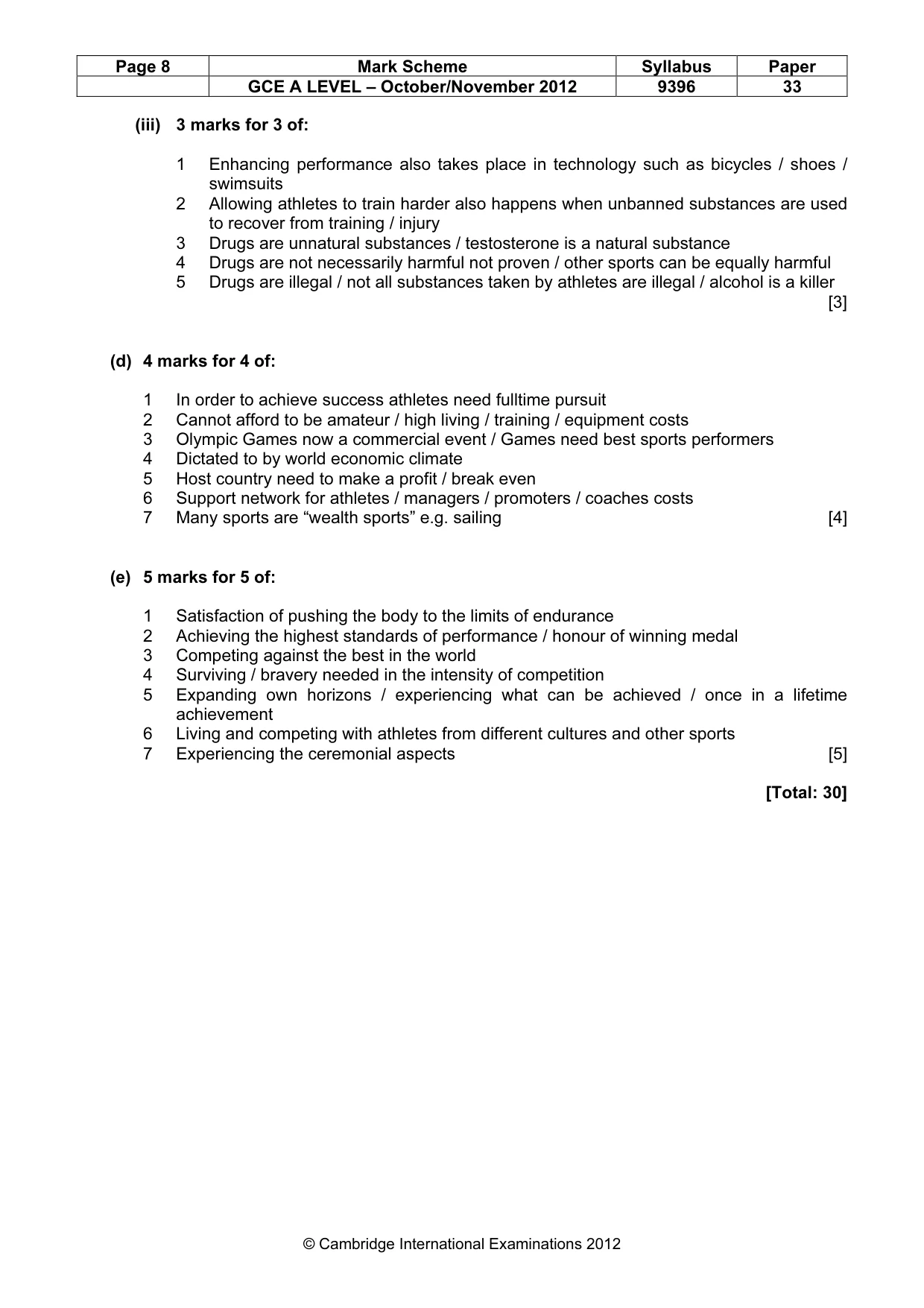
Mark scheme, page 8
Page 8 Mark Scheme Syllabus Paper GCE A LEVEL – October/November 2012 9396 33 © Cambridge International Examinations 2012 (iii) 3 marks for 3 of: 1 Enhancing performance also takes place in technology such as bicycles / shoes / swimsuits 2 Allowing athletes to train harder also happens when unbanned substances are used to recover from training / injury 3 Drugs are unnatural substances / testosterone is a natural substance 4 Drugs are not necessarily harmful not proven / other sports can be equally harmful 5 Drugs are illegal / not all substances taken by athletes are illegal / alcohol is a killer [3] (d) 4 marks for 4 of: 1 In order to achieve success athletes need fulltime pursuit 2 Cannot afford to be amateur / high living / training / equipment costs 3 Olympic Games now a commercial event / Games need best sports performers 4 Dictated to by world economic climate 5 Host country need to make a profit / break even 6 Support network for athletes / managers / promoters / coaches costs 7 Many sports are “wealth sports” e.g. sailing [4] (e) 5 marks for 5 of: 1 Satisfaction of pushing the body to the limits of endurance 2 Achieving the highest standards of performance / honour of winning medal 3 Competing against the best in the world 4 Surviving / bravery needed in the intensity of competition 5 Expanding own horizons / experiencing what can be achieved / once in a lifetime achievement 6 Living and competing with athletes from different cultures and other sports 7 Experiencing the ceremonial aspects [5] [Total: 30]
What you needed in this session
Cambridge’s own grade thresholds for 2012 Oct/Nov, Paper 3 · Variant 3. A higher threshold means an easier paper — the bar moves with how the cohort did.