Cambridge A Level Physical Education 9396 — 2012 Oct/Nov Paper 1 · Variant 3
9396/13/O/N/12 · 90 marks · ≈101 min
The question paper and its mark scheme, free to read here and free to download. This is Cambridge’s own paper, exactly as it was sat.
Question paper4 pages
Mark scheme9 pages
Answers below. Sit the paper first if you are practising.
Paper as text
Question paper, page 1
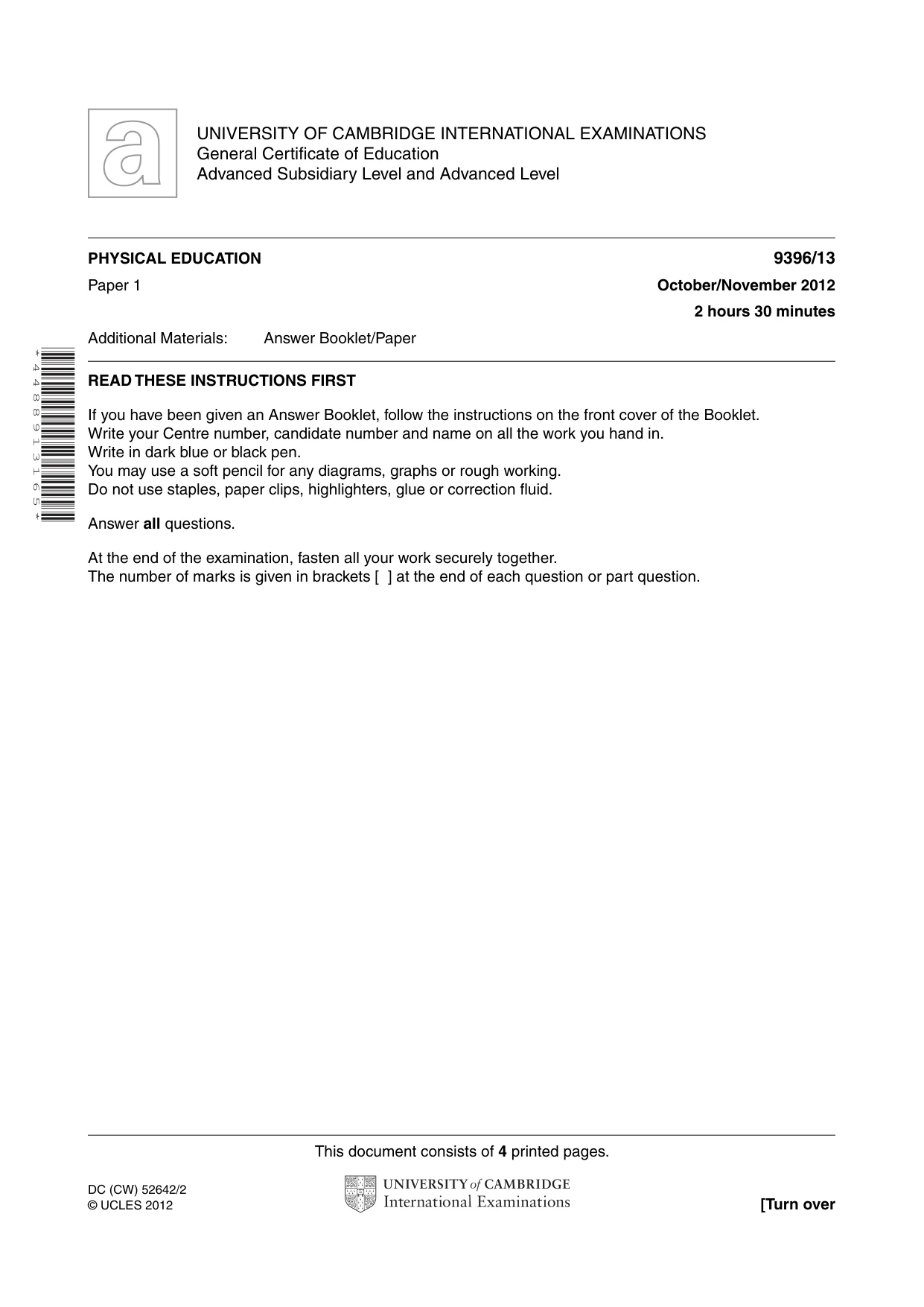
This document consists of 4 printed pages. DC (CW) 52642/2 © UCLES 2012 [Turn over UNIVERSITY OF CAMBRIDGE INTERNATIONAL EXAMINATIONS General Certificate of Education Advanced Subsidiary Level and Advanced Level * 4 4 8 8 9 1 3 1 6 5 * PHYSICAL EDUCATION 9396/13 Paper 1 October/November 2012 2 hours 30 minutes Additional Materials: Answer Booklet/Paper READ THESE INSTRUCTIONS FIRST If you have been given an Answer Booklet, follow the instructions on the front cover of the Booklet. Write your Centre number, candidate number and name on all the work you hand in. Write in dark blue or black pen. You may use a soft pencil for any diagrams, graphs or rough working. Do not use staples, paper clips, highlighters, glue or correction fluid. Answer all questions. At the end of the examination, fasten all your work securely together. The number of marks is given in brackets [ ] at the end of each question or part question.
Question paper, page 2
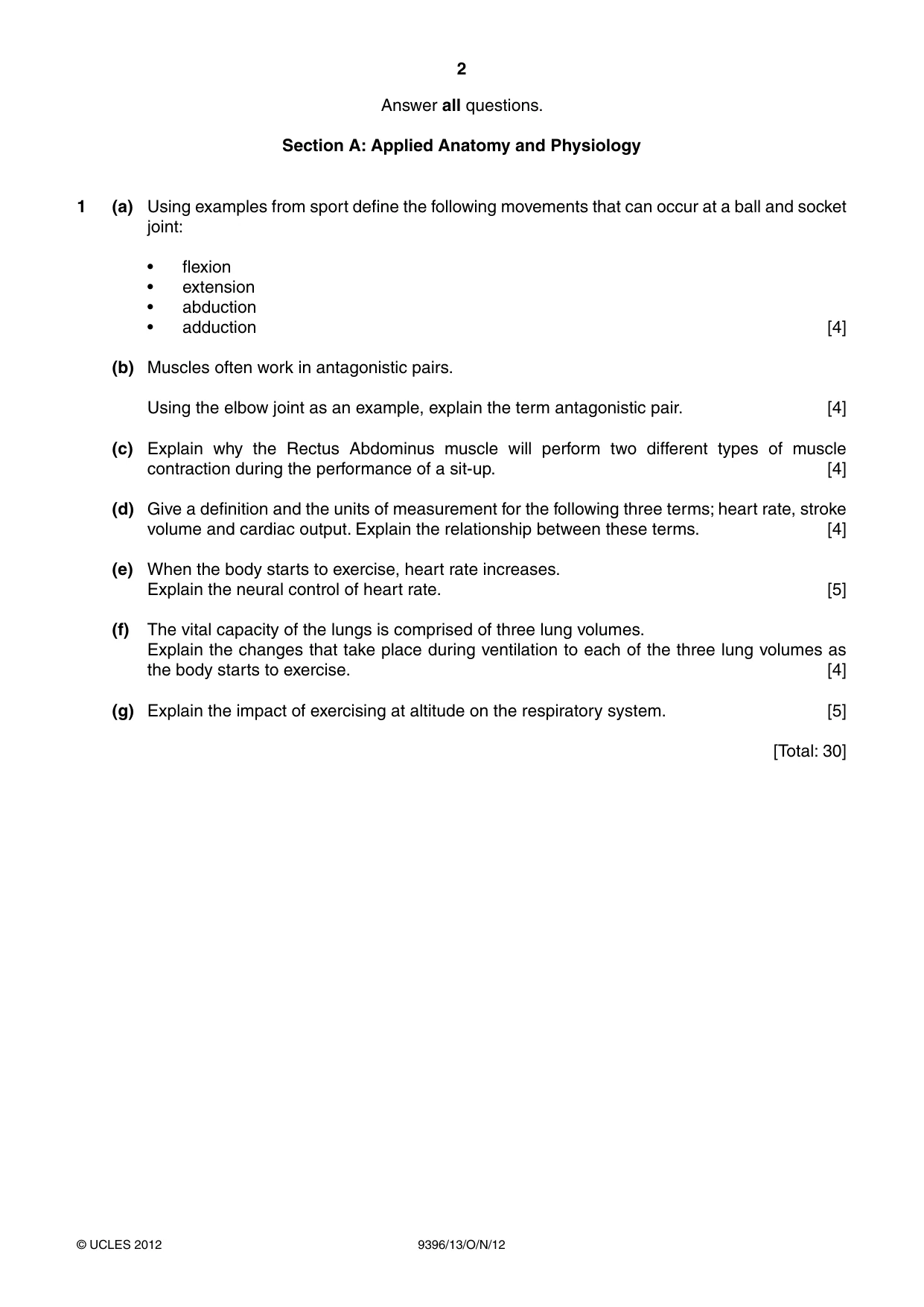
2 9396/13/O/N/12 © UCLES 2012 Answer all questions. Section A: Applied Anatomy and Physiology 1 (a) Using examples from sport define the following movements that can occur at a ball and socket joint: • flexion • extension • abduction • adduction [4] (b) Muscles often work in antagonistic pairs. Using the elbow joint as an example, explain the term antagonistic pair. [4] (c) Explain why the Rectus Abdominus muscle will perform two different types of muscle contraction during the performance of a sit-up. [4] (d) Give a definition and the units of measurement for the following three terms; heart rate, stroke volume and cardiac output. Explain the relationship between these terms. [4] (e) When the body starts to exercise, heart rate increases. Explain the neural control of heart rate. [5] (f) The vital capacity of the lungs is comprised of three lung volumes. Explain the changes that take place during ventilation to each of the three lung volumes as the body starts to exercise. [4] (g) Explain the impact of exercising at altitude on the respiratory system. [5] [Total: 30]
Question paper, page 3
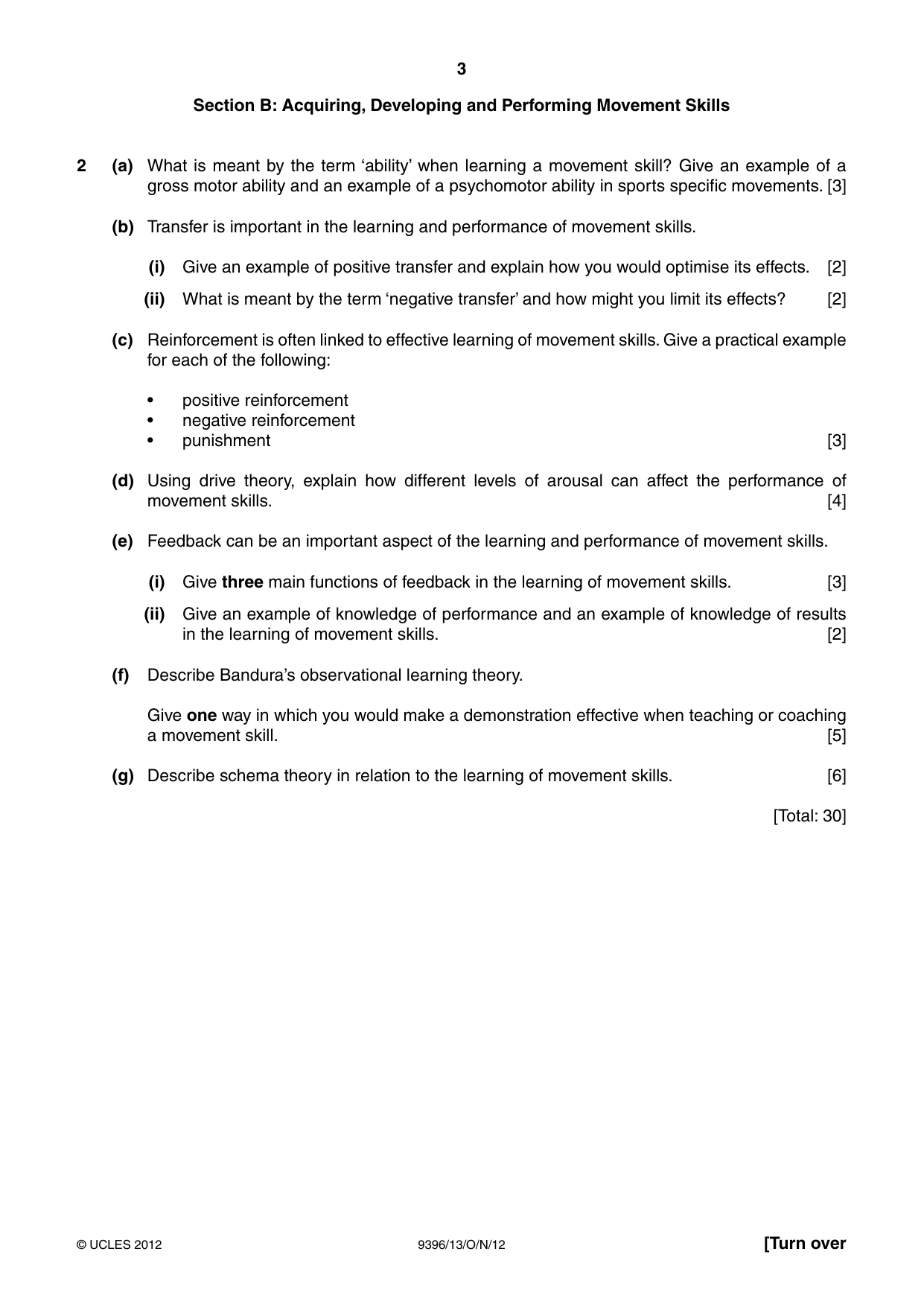
3 9396/13/O/N/12 © UCLES 2012 [Turn over Section B: Acquiring, Developing and Performing Movement Skills 2 (a) What is meant by the term ‘ability’ when learning a movement skill? Give an example of a gross motor ability and an example of a psychomotor ability in sports specific movements. [3] (b) Transfer is important in the learning and performance of movement skills. (i) Give an example of positive transfer and explain how you would optimise its effects. [2] (ii) What is meant by the term ‘negative transfer’ and how might you limit its effects? [2] (c) Reinforcement is often linked to effective learning of movement skills. Give a practical example for each of the following: • positive reinforcement • negative reinforcement • punishment [3] (d) Using drive theory, explain how different levels of arousal can affect the performance of movement skills. [4] (e) Feedback can be an important aspect of the learning and performance of movement skills. (i) Give three main functions of feedback in the learning of movement skills. [3] (ii) Give an example of knowledge of performance and an example of knowledge of results in the learning of movement skills. [2] (f) Describe Bandura’s observational learning theory. Give one way in which you would make a demonstration effective when teaching or coaching a movement skill. [5] (g) Describe schema theory in relation to the learning of movement skills. [6] [Total: 30]
Question paper, page 4
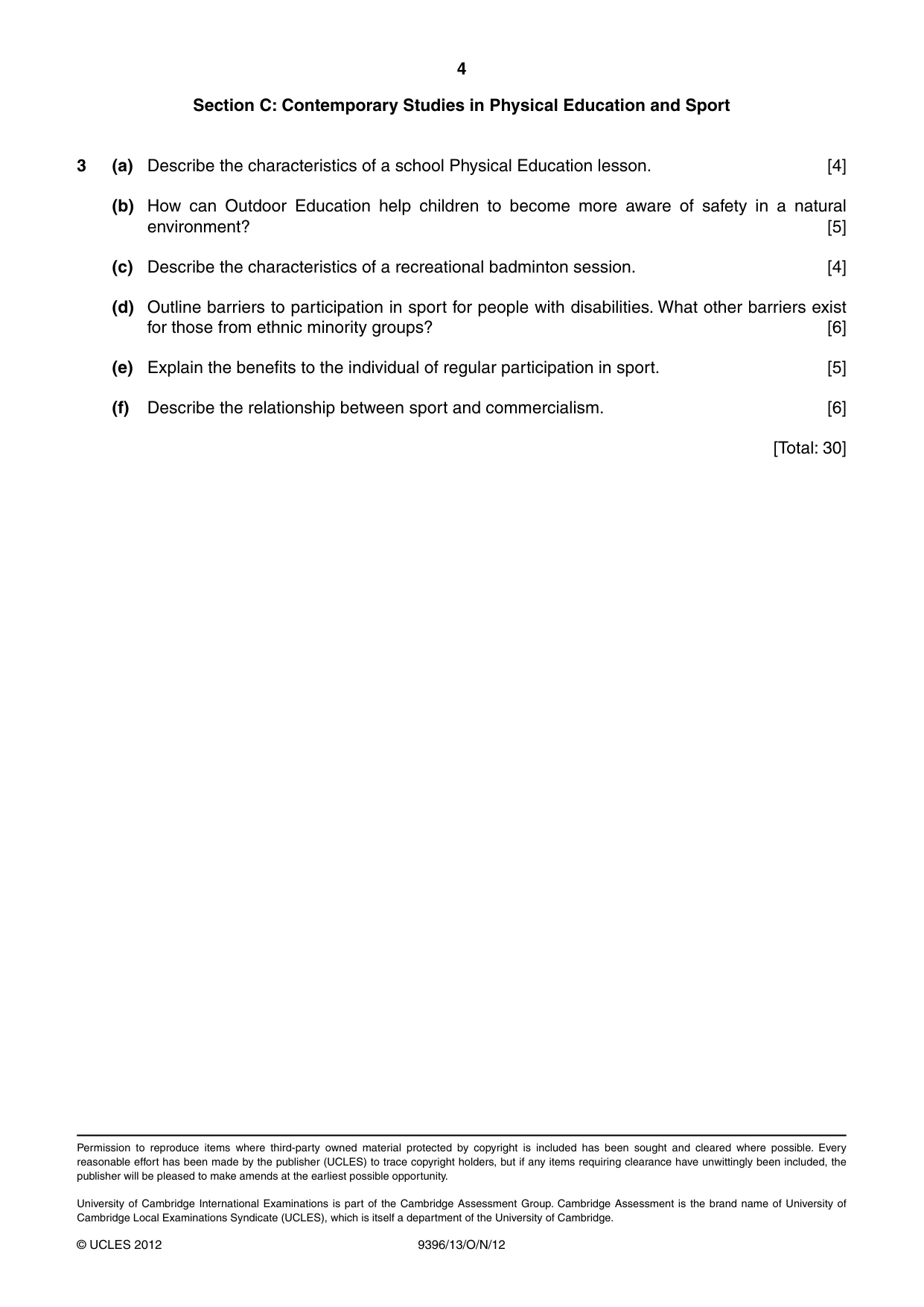
4 9396/13/O/N/12 © UCLES 2012 Section C: Contemporary Studies in Physical Education and Sport 3 (a) Describe the characteristics of a school Physical Education lesson. [4] (b) How can Outdoor Education help children to become more aware of safety in a natural environment? [5] (c) Describe the characteristics of a recreational badminton session. [4] (d) Outline barriers to participation in sport for people with disabilities. What other barriers exist for those from ethnic minority groups? [6] (e) Explain the benefits to the individual of regular participation in sport. [5] (f) Describe the relationship between sport and commercialism. [6] [Total: 30] Permission to reproduce items where third-party owned material protected by copyright is included has been sought and cleared where possible. Every reasonable effort has been made by the publisher (UCLES) to trace copyright holders, but if any items requiring clearance have unwittingly been included, the publisher will be pleased to make amends at the earliest possible opportunity. University of Cambridge International Examinations is part of the Cambridge Assessment Group. Cambridge Assessment is the brand name of University of Cambridge Local Examinations Syndicate (UCLES), which is itself a department of the University of Cambridge.
Mark scheme, page 1
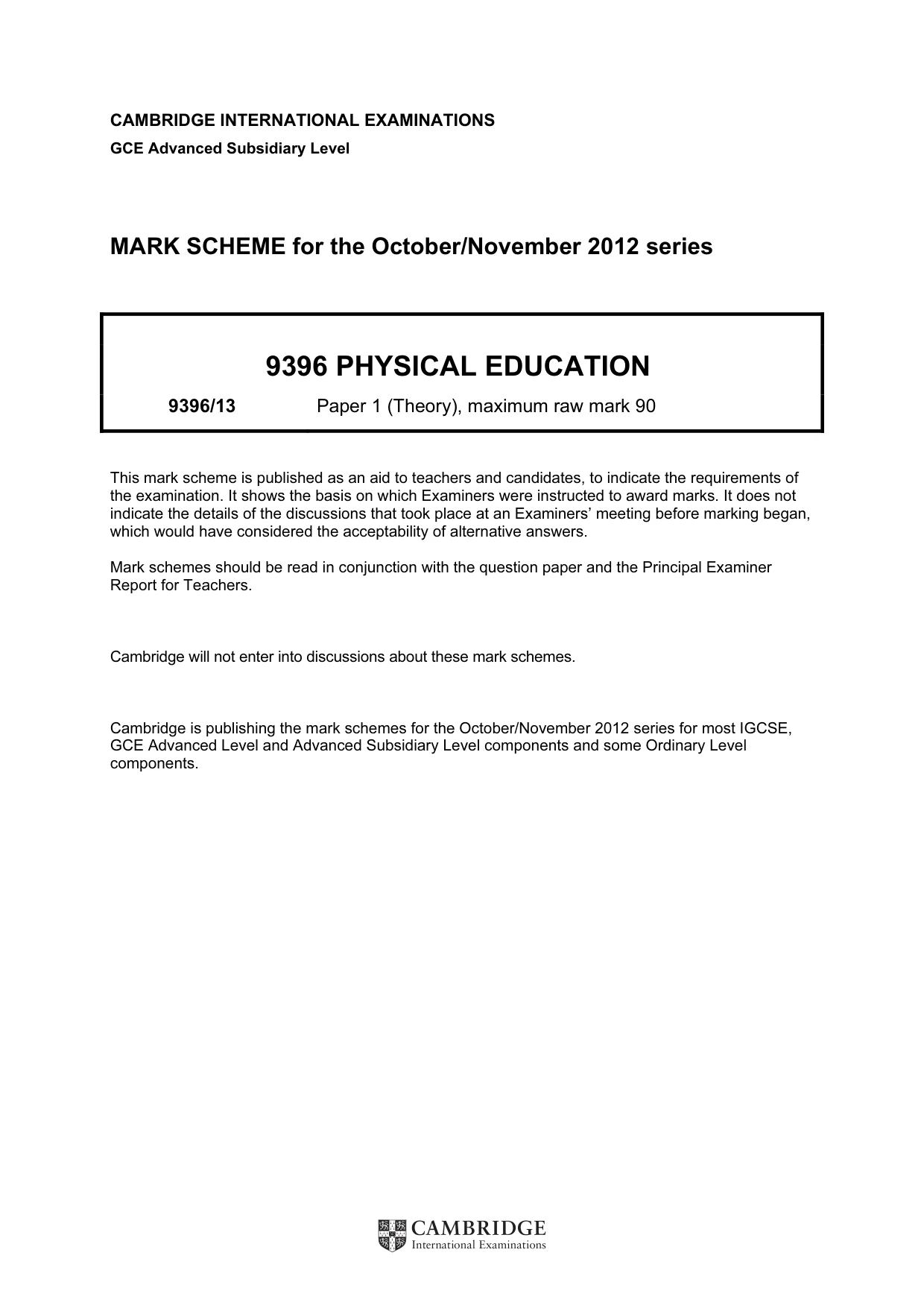
CAMBRIDGE INTERNATIONAL EXAMINATIONS GCE Advanced Subsidiary Level MARK SCHEME for the October/November 2012 series 9396 PHYSICAL EDUCATION 9396/13 Paper 1 (Theory), maximum raw mark 90 This mark scheme is published as an aid to teachers and candidates, to indicate the requirements of the examination. It shows the basis on which Examiners were instructed to award marks. It does not indicate the details of the discussions that took place at an Examiners’ meeting before marking began, which would have considered the acceptability of alternative answers. Mark schemes should be read in conjunction with the question paper and the Principal Examiner Report for Teachers. Cambridge will not enter into discussions about these mark schemes. Cambridge is publishing the mark schemes for the October/November 2012 series for most IGCSE, GCE Advanced Level and Advanced Subsidiary Level components and some Ordinary Level components.
Mark scheme, page 2
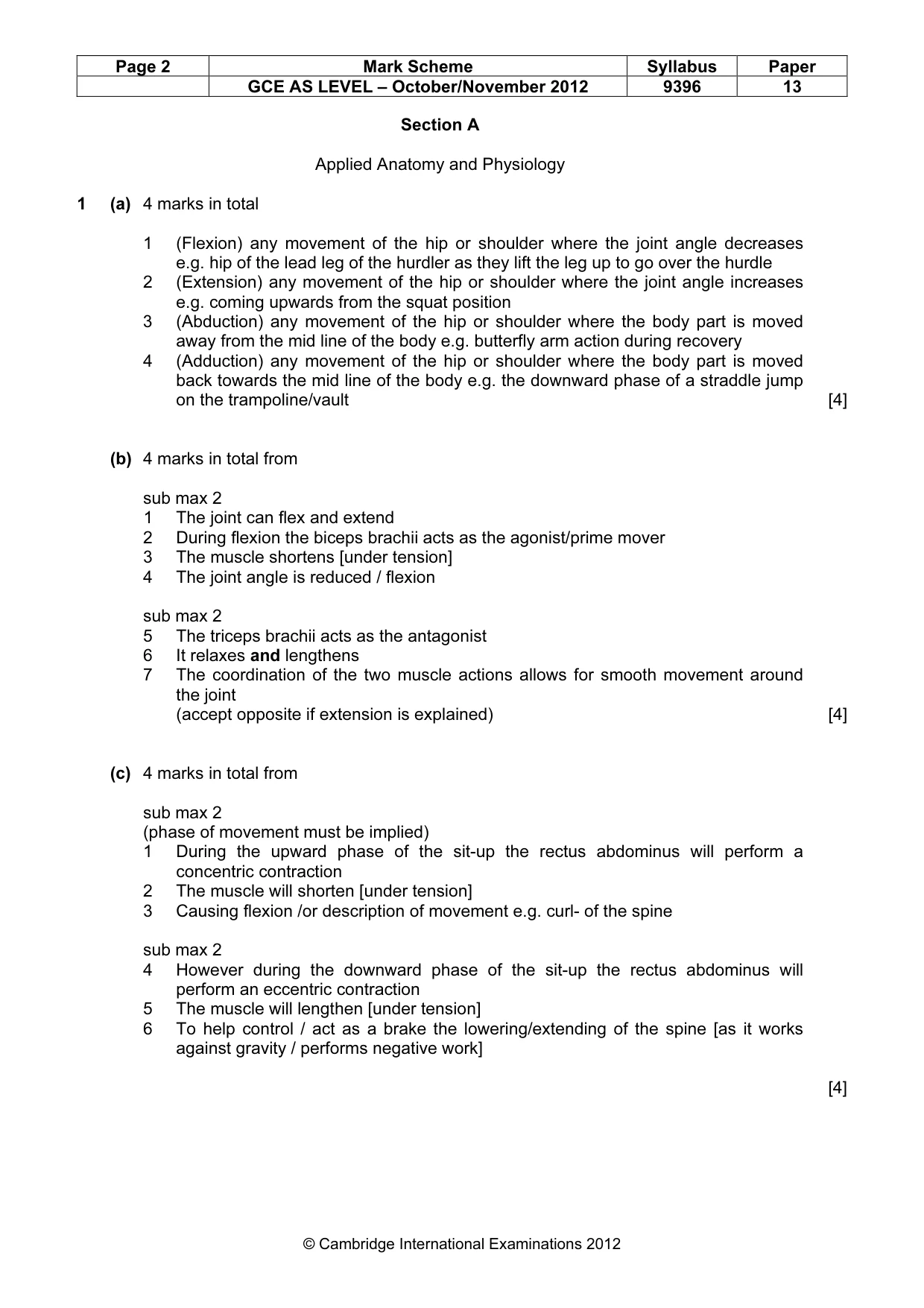
Page 2 Mark Scheme Syllabus Paper GCE AS LEVEL – October/November 2012 9396 13 © Cambridge International Examinations 2012 Section A Applied Anatomy and Physiology 1 (a) 4 marks in total 1 (Flexion) any movement of the hip or shoulder where the joint angle decreases e.g. hip of the lead leg of the hurdler as they lift the leg up to go over the hurdle 2 (Extension) any movement of the hip or shoulder where the joint angle increases e.g. coming upwards from the squat position 3 (Abduction) any movement of the hip or shoulder where the body part is moved away from the mid line of the body e.g. butterfly arm action during recovery 4 (Adduction) any movement of the hip or shoulder where the body part is moved back towards the mid line of the body e.g. the downward phase of a straddle jump on the trampoline/vault [4] (b) 4 marks in total from sub max 2 1 The joint can flex and extend 2 During flexion the biceps brachii acts as the agonist/prime mover 3 The muscle shortens [under tension] 4 The joint angle is reduced / flexion sub max 2 5 The triceps brachii acts as the antagonist 6 It relaxes and lengthens 7 The coordination of the two muscle actions allows for smooth movement around the joint (accept opposite if extension is explained) [4] (c) 4 marks in total from sub max 2 (phase of movement must be implied) 1 During the upward phase of the sit-up the rectus abdominus will perform a concentric contraction 2 The muscle will shorten [under tension] 3 Causing flexion /or description of movement e.g. curl- of the spine sub max 2 4 However during the downward phase of the sit-up the rectus abdominus will perform an eccentric contraction 5 The muscle will lengthen [under tension] 6 To help control / act as a brake the lowering/extending of the spine [as it works against gravity / performs negative work] [4]
Mark scheme, page 3
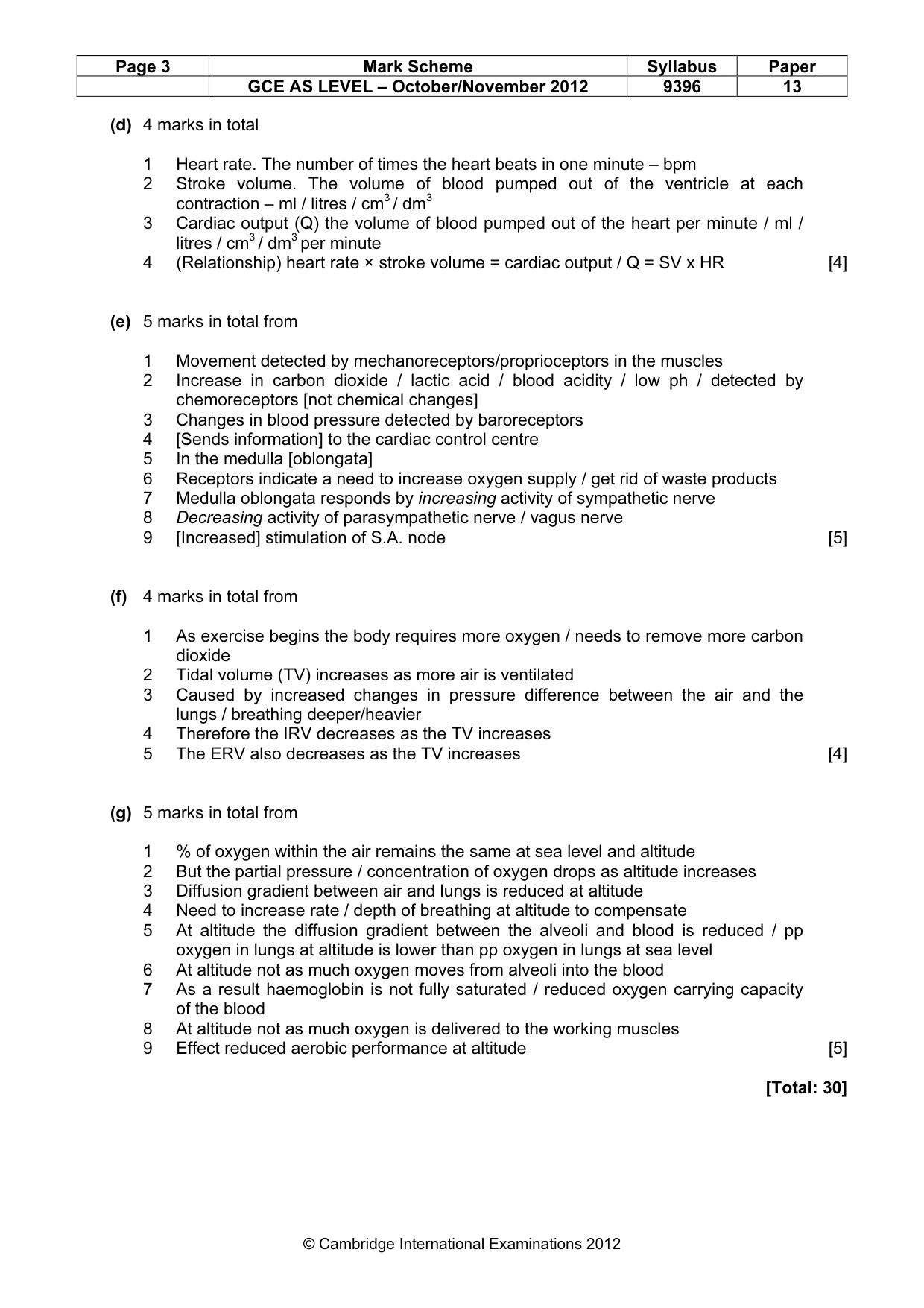
Page 3 Mark Scheme Syllabus Paper GCE AS LEVEL – October/November 2012 9396 13 © Cambridge International Examinations 2012 (d) 4 marks in total 1 Heart rate. The number of times the heart beats in one minute – bpm 2 Stroke volume. The volume of blood pumped out of the ventricle at each contraction – ml / litres / cm3 / dm3 3 Cardiac output (Q) the volume of blood pumped out of the heart per minute / ml / litres / cm3 / dm3 per minute 4 (Relationship) heart rate × stroke volume = cardiac output / Q = SV x HR [4] (e) 5 marks in total from 1 Movement detected by mechanoreceptors/proprioceptors in the muscles 2 Increase in carbon dioxide / lactic acid / blood acidity / low ph / detected by chemoreceptors [not chemical changes] 3 Changes in blood pressure detected by baroreceptors 4 [Sends information] to the cardiac control centre 5 In the medulla [oblongata] 6 Receptors indicate a need to increase oxygen supply / get rid of waste products 7 Medulla oblongata responds by increasing activity of sympathetic nerve 8 Decreasing activity of parasympathetic nerve / vagus nerve 9 [Increased] stimulation of S.A. node [5] (f) 4 marks in total from 1 As exercise begins the body requires more oxygen / needs to remove more carbon dioxide 2 Tidal volume (TV) increases as more air is ventilated 3 Caused by increased changes in pressure difference between the air and the lungs / breathing deeper/heavier 4 Therefore the IRV decreases as the TV increases 5 The ERV also decreases as the TV increases [4] (g) 5 marks in total from 1 % of oxygen within the air remains the same at sea level and altitude 2 But the partial pressure / concentration of oxygen drops as altitude increases 3 Diffusion gradient between air and lungs is reduced at altitude 4 Need to increase rate / depth of breathing at altitude to compensate 5 At altitude the diffusion gradient between the alveoli and blood is reduced / pp oxygen in lungs at altitude is lower than pp oxygen in lungs at sea level 6 At altitude not as much oxygen moves from alveoli into the blood 7 As a result haemoglobin is not fully saturated / reduced oxygen carrying capacity of the blood 8 At altitude not as much oxygen is delivered to the working muscles 9 Effect reduced aerobic performance at altitude [5] [Total: 30]
Mark scheme, page 4
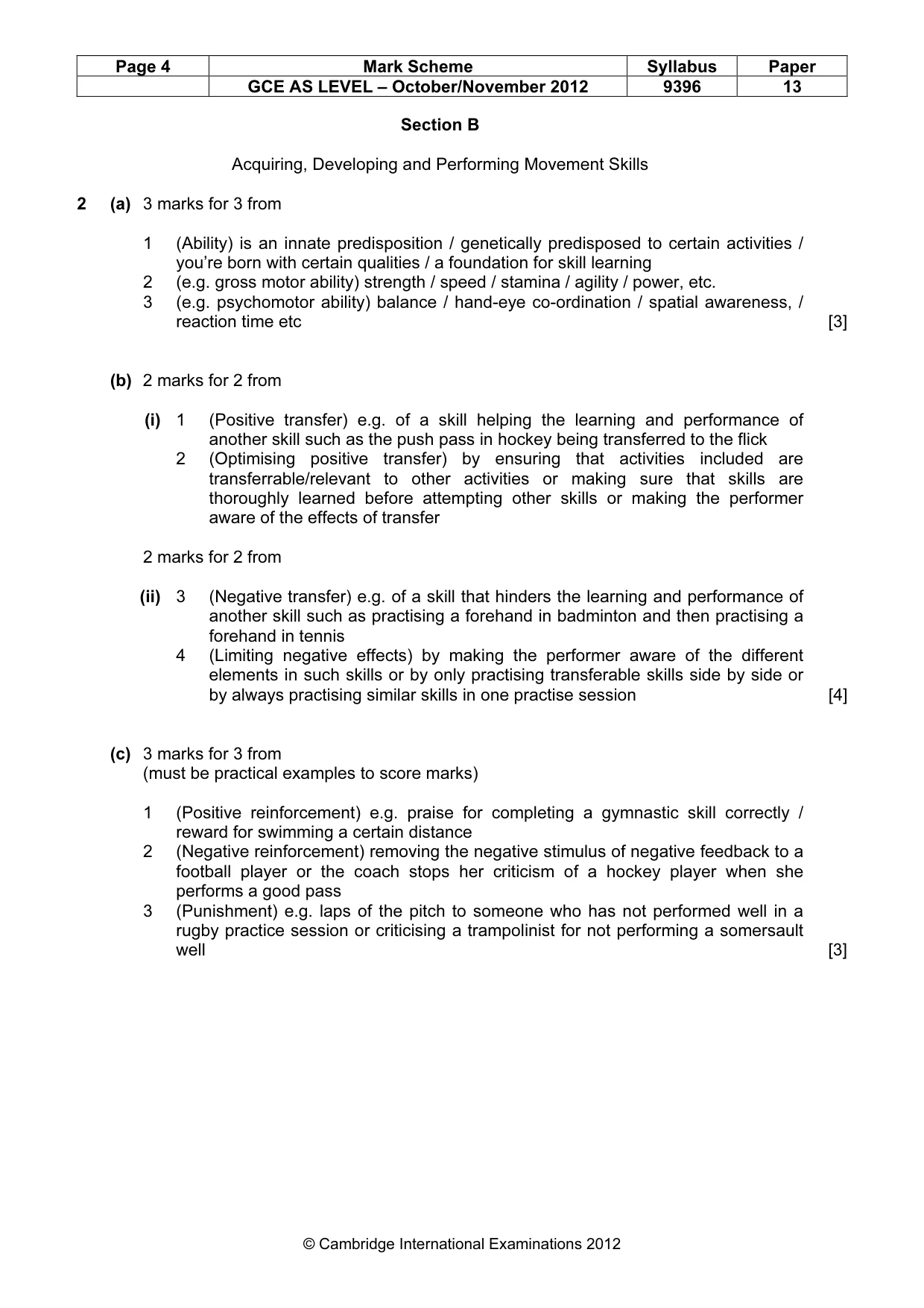
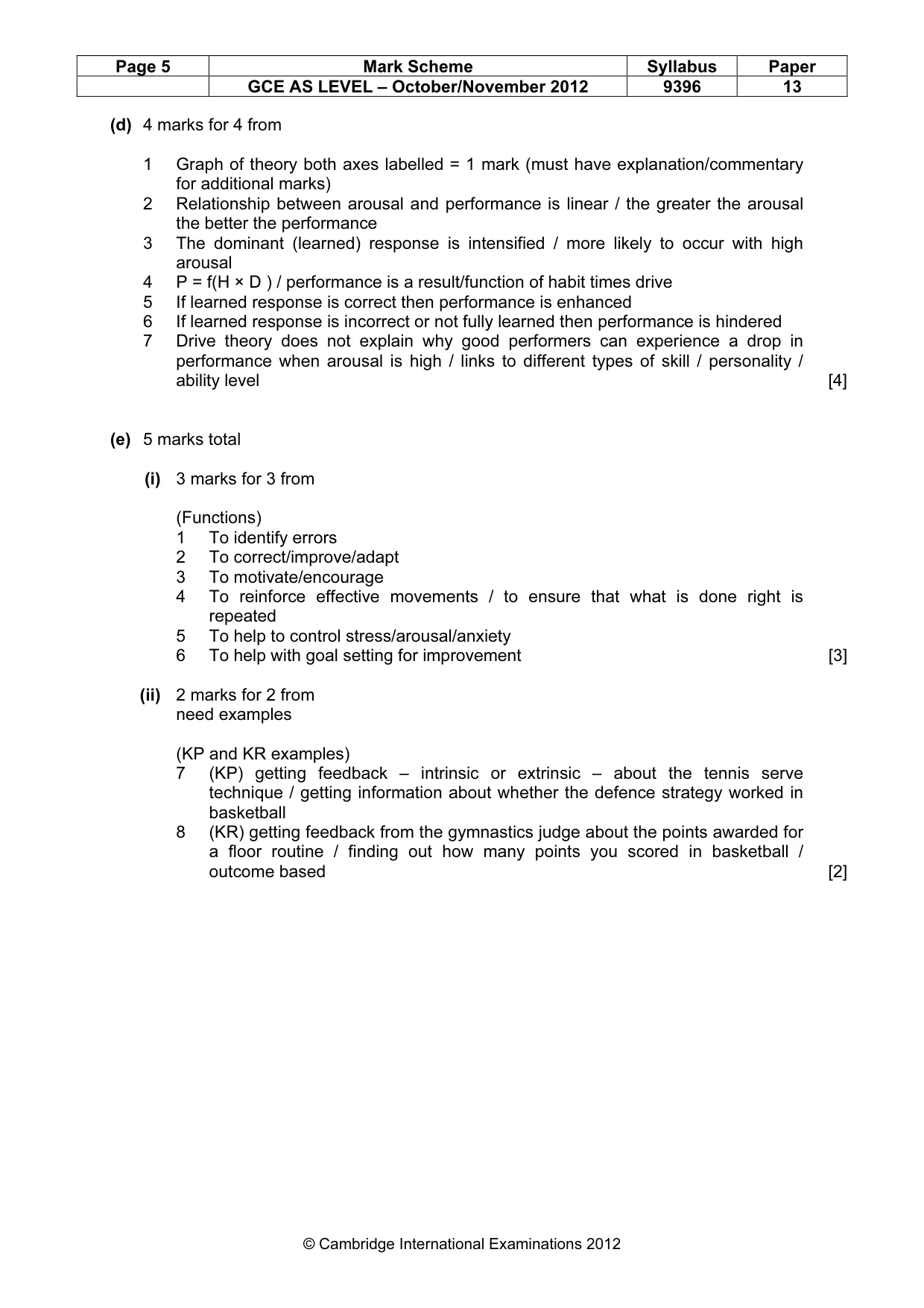
Page 4 Mark Scheme Syllabus Paper GCE AS LEVEL – October/November 2012 9396 13 © Cambridge International Examinations 2012 Section B Acquiring, Developing and Performing Movement Skills 2 (a) 3 marks for 3 from 1 (Ability) is an innate predisposition / genetically predisposed to certain activities / you’re born with certain qualities / a foundation for skill learning 2 (e.g. gross motor ability) strength / speed / stamina / agility / power, etc. 3 (e.g. psychomotor ability) balance / hand-eye co-ordination / spatial awareness, / reaction time etc [3] (b) 2 marks for 2 from (i) 1 (Positive transfer) e.g. of a skill helping the learning and performance of another skill such as the push pass in hockey being transferred to the flick 2 (Optimising positive transfer) by ensuring that activities included are transferrable/relevant to other activities or making sure that skills are thoroughly learned before attempting other skills or making the performer aware of the effects of transfer 2 marks for 2 from (ii) 3 (Negative transfer) e.g. of a skill that hinders the learning and performance of another skill such as practising a forehand in badminton and then practising a forehand in tennis 4 (Limiting negative effects) by making the performer aware of the different elements in such skills or by only practising transferable skills side by side or by always practising similar skills in one practise session [4] (c) 3 marks for 3 from (must be practical examples to score marks) 1 (Positive reinforcement) e.g. praise for completing a gymnastic skill correctly / reward for swimming a certain distance 2 (Negative reinforcement) removing the negative stimulus of negative feedback to a football player or the coach stops her criticism of a hockey player when she performs a good pass 3 (Punishment) e.g. laps of the pitch to someone who has not performed well in a rugby practice session or criticising a trampolinist for not performing a somersault well [3]
Mark scheme, page 5
Page 5 Mark Scheme Syllabus Paper GCE AS LEVEL – October/November 2012 9396 13 © Cambridge International Examinations 2012 (d) 4 marks for 4 from 1 Graph of theory both axes labelled = 1 mark (must have explanation/commentary for additional marks) 2 Relationship between arousal and performance is linear / the greater the arousal the better the performance 3 The dominant (learned) response is intensified / more likely to occur with high arousal 4 P = f(H × D ) / performance is a result/function of habit times drive 5 If learned response is correct then performance is enhanced 6 If learned response is incorrect or not fully learned then performance is hindered 7 Drive theory does not explain why good performers can experience a drop in performance when arousal is high / links to different types of skill / personality / ability level [4] (e) 5 marks total (i) 3 marks for 3 from (Functions) 1 To identify errors 2 To correct/improve/adapt 3 To motivate/encourage 4 To reinforce effective movements / to ensure that what is done right is repeated 5 To help to control stress/arousal/anxiety 6 To help with goal setting for improvement [3] (ii) 2 marks for 2 from need examples (KP and KR examples) 7 (KP) getting feedback – intrinsic or extrinsic – about the tennis serve technique / getting information about whether the defence strategy worked in basketball 8 (KR) getting feedback from the gymnastics judge about the points awarded for a floor routine / finding out how many points you scored in basketball / outcome based [2]
Mark scheme, page 6
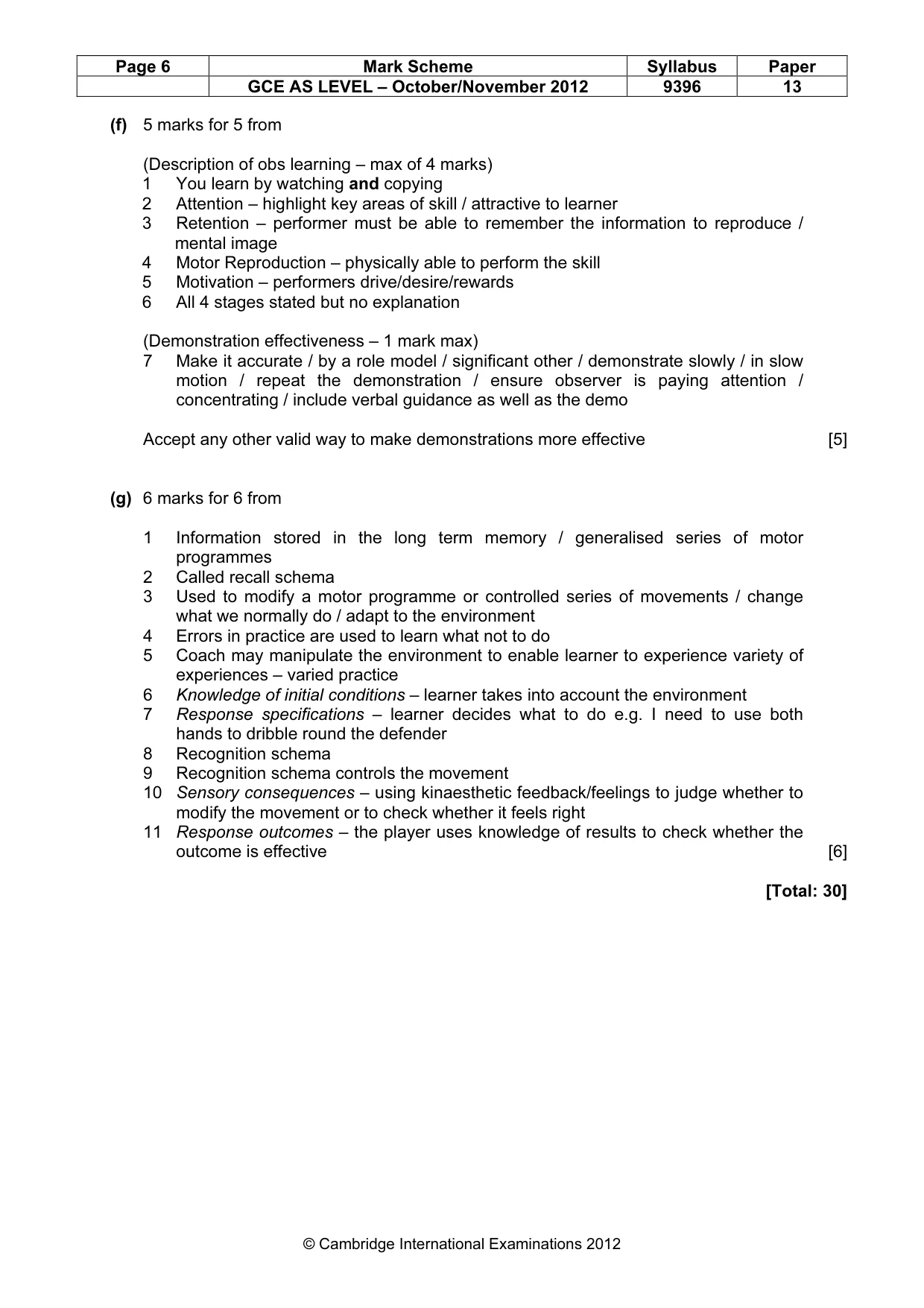
Page 6 Mark Scheme Syllabus Paper GCE AS LEVEL – October/November 2012 9396 13 © Cambridge International Examinations 2012 (f) 5 marks for 5 from (Description of obs learning – max of 4 marks) 1 You learn by watching and copying 2 Attention – highlight key areas of skill / attractive to learner 3 Retention – performer must be able to remember the information to reproduce / mental image 4 Motor Reproduction – physically able to perform the skill 5 Motivation – performers drive/desire/rewards 6 All 4 stages stated but no explanation (Demonstration effectiveness – 1 mark max) 7 Make it accurate / by a role model / significant other / demonstrate slowly / in slow motion / repeat the demonstration / ensure observer is paying attention / concentrating / include verbal guidance as well as the demo Accept any other valid way to make demonstrations more effective [5] (g) 6 marks for 6 from 1 Information stored in the long term memory / generalised series of motor programmes 2 Called recall schema 3 Used to modify a motor programme or controlled series of movements / change what we normally do / adapt to the environment 4 Errors in practice are used to learn what not to do 5 Coach may manipulate the environment to enable learner to experience variety of experiences – varied practice 6 Knowledge of initial conditions – learner takes into account the environment 7 Response specifications – learner decides what to do e.g. I need to use both hands to dribble round the defender 8 Recognition schema 9 Recognition schema controls the movement 10 Sensory consequences – using kinaesthetic feedback/feelings to judge whether to modify the movement or to check whether it feels right 11 Response outcomes – the player uses knowledge of results to check whether the outcome is effective [6] [Total: 30]
Mark scheme, page 7
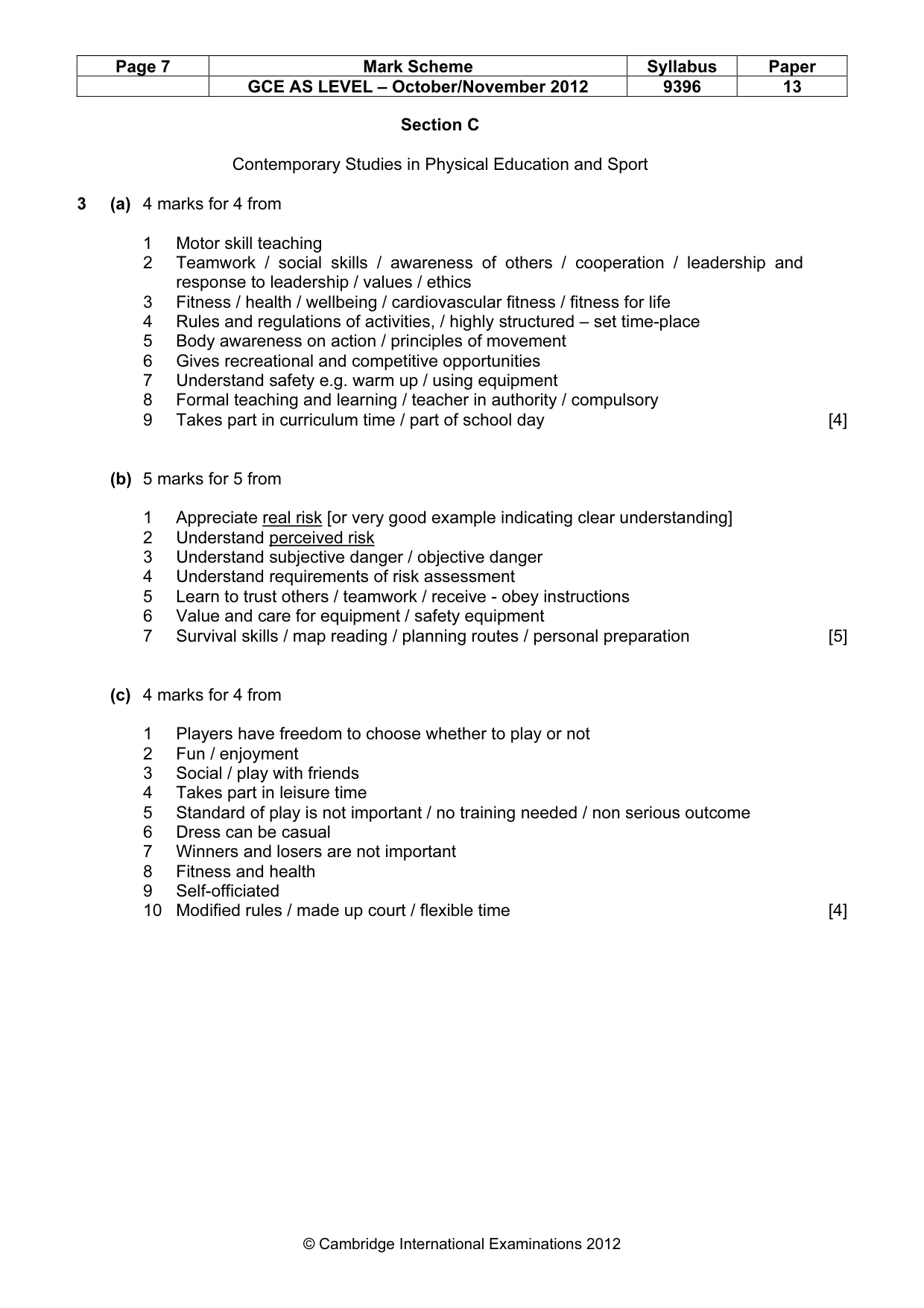
Page 7 Mark Scheme Syllabus Paper GCE AS LEVEL – October/November 2012 9396 13 © Cambridge International Examinations 2012 Section C Contemporary Studies in Physical Education and Sport 3 (a) 4 marks for 4 from 1 Motor skill teaching 2 Teamwork / social skills / awareness of others / cooperation / leadership and response to leadership / values / ethics 3 Fitness / health / wellbeing / cardiovascular fitness / fitness for life 4 Rules and regulations of activities, / highly structured – set time-place 5 Body awareness on action / principles of movement 6 Gives recreational and competitive opportunities 7 Understand safety e.g. warm up / using equipment 8 Formal teaching and learning / teacher in authority / compulsory 9 Takes part in curriculum time / part of school day [4] (b) 5 marks for 5 from 1 Appreciate real risk [or very good example indicating clear understanding] 2 Understand perceived risk 3 Understand subjective danger / objective danger 4 Understand requirements of risk assessment 5 Learn to trust others / teamwork / receive - obey instructions 6 Value and care for equipment / safety equipment 7 Survival skills / map reading / planning routes / personal preparation [5] (c) 4 marks for 4 from 1 Players have freedom to choose whether to play or not 2 Fun / enjoyment 3 Social / play with friends 4 Takes part in leisure time 5 Standard of play is not important / no training needed / non serious outcome 6 Dress can be casual 7 Winners and losers are not important 8 Fitness and health 9 Self-officiated 10 Modified rules / made up court / flexible time [4]
Mark scheme, page 8
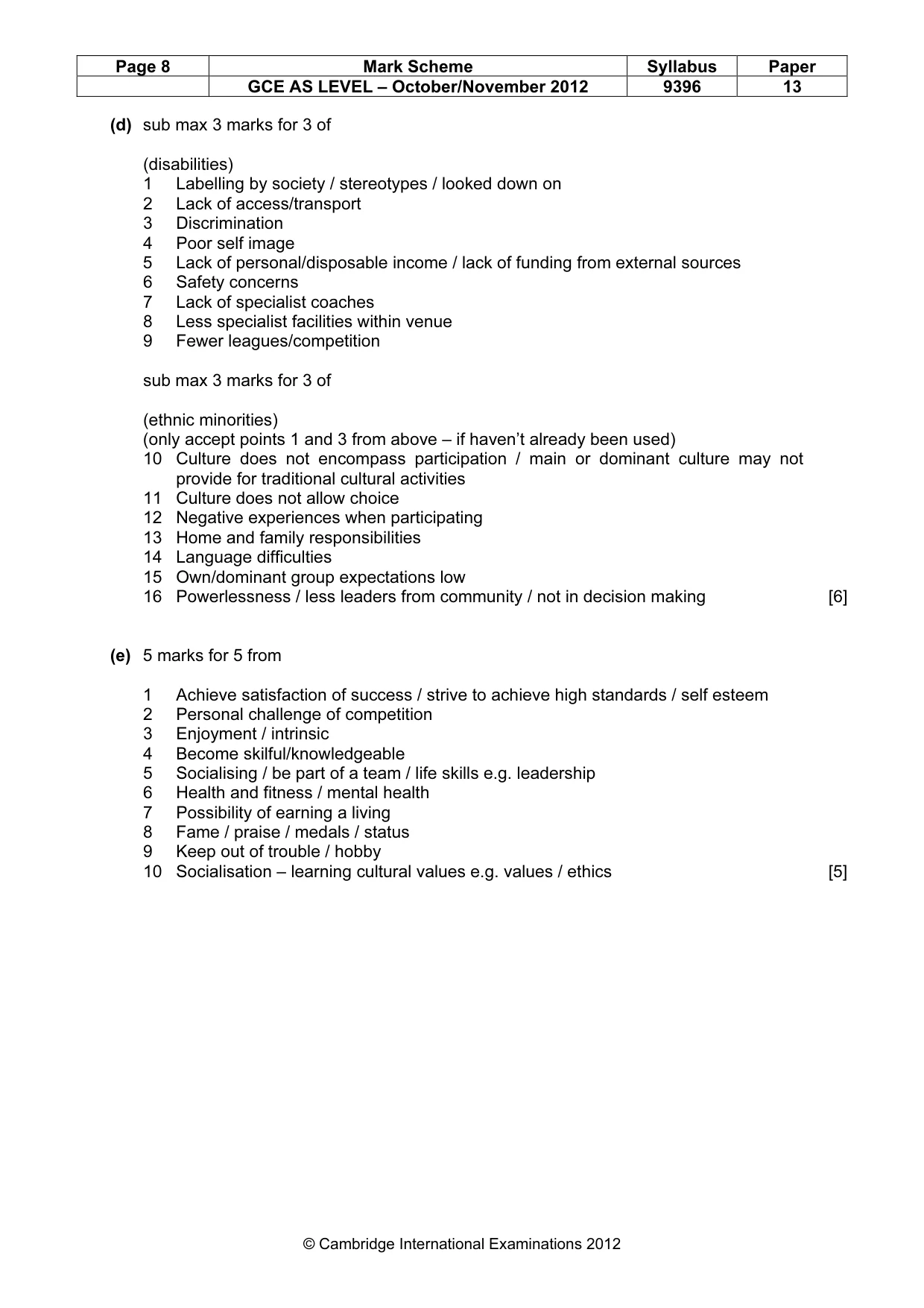
Page 8 Mark Scheme Syllabus Paper GCE AS LEVEL – October/November 2012 9396 13 © Cambridge International Examinations 2012 (d) sub max 3 marks for 3 of (disabilities) 1 Labelling by society / stereotypes / looked down on 2 Lack of access/transport 3 Discrimination 4 Poor self image 5 Lack of personal/disposable income / lack of funding from external sources 6 Safety concerns 7 Lack of specialist coaches 8 Less specialist facilities within venue 9 Fewer leagues/competition sub max 3 marks for 3 of (ethnic minorities) (only accept points 1 and 3 from above – if haven’t already been used) 10 Culture does not encompass participation / main or dominant culture may not provide for traditional cultural activities 11 Culture does not allow choice 12 Negative experiences when participating 13 Home and family responsibilities 14 Language difficulties 15 Own/dominant group expectations low 16 Powerlessness / less leaders from community / not in decision making [6] (e) 5 marks for 5 from 1 Achieve satisfaction of success / strive to achieve high standards / self esteem 2 Personal challenge of competition 3 Enjoyment / intrinsic 4 Become skilful/knowledgeable 5 Socialising / be part of a team / life skills e.g. leadership 6 Health and fitness / mental health 7 Possibility of earning a living 8 Fame / praise / medals / status 9 Keep out of trouble / hobby 10 Socialisation – learning cultural values e.g. values / ethics [5]
Mark scheme, page 9
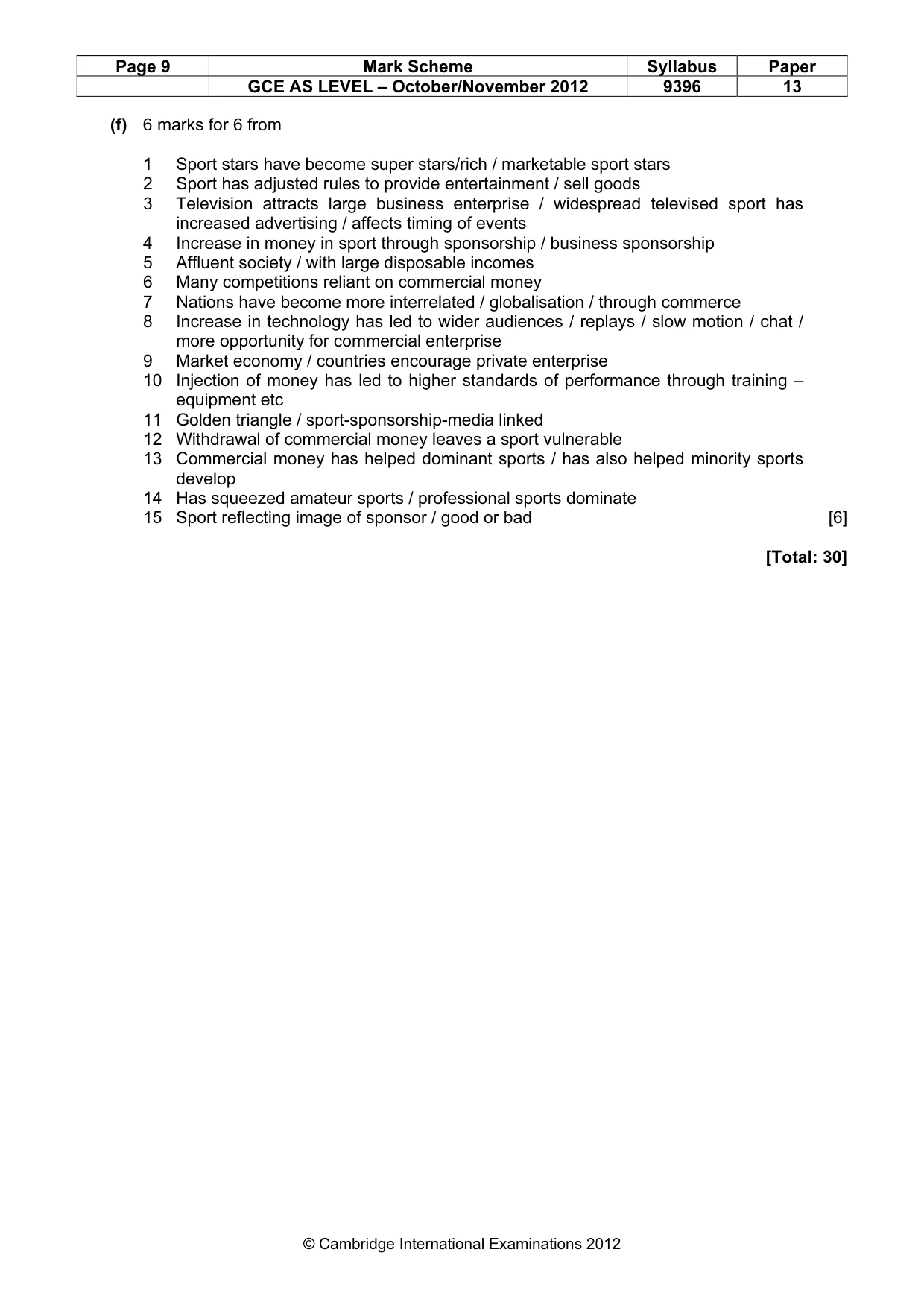
Page 9 Mark Scheme Syllabus Paper GCE AS LEVEL – October/November 2012 9396 13 © Cambridge International Examinations 2012 (f) 6 marks for 6 from 1 Sport stars have become super stars/rich / marketable sport stars 2 Sport has adjusted rules to provide entertainment / sell goods 3 Television attracts large business enterprise / widespread televised sport has increased advertising / affects timing of events 4 Increase in money in sport through sponsorship / business sponsorship 5 Affluent society / with large disposable incomes 6 Many competitions reliant on commercial money 7 Nations have become more interrelated / globalisation / through commerce 8 Increase in technology has led to wider audiences / replays / slow motion / chat / more opportunity for commercial enterprise 9 Market economy / countries encourage private enterprise 10 Injection of money has led to higher standards of performance through training – equipment etc 11 Golden triangle / sport-sponsorship-media linked 12 Withdrawal of commercial money leaves a sport vulnerable 13 Commercial money has helped dominant sports / has also helped minority sports develop 14 Has squeezed amateur sports / professional sports dominate 15 Sport reflecting image of sponsor / good or bad [6] [Total: 30]
What you needed in this session
Cambridge’s own grade thresholds for 2012 Oct/Nov, Paper 1 · Variant 3. A higher threshold means an easier paper — the bar moves with how the cohort did.