Cambridge A Level Physical Education 9396 — 2012 Oct/Nov Paper 1 · Variant 1
9396/11/O/N/12 · 90 marks · ≈101 min
The question paper and its mark scheme, free to read here and free to download. This is Cambridge’s own paper, exactly as it was sat.
Question paper4 pages

Mark scheme10 pages
Answers below. Sit the paper first if you are practising.
Paper as text
Question paper, page 1
This document consists of 4 printed pages. DC (CW/SW) 52639/1 © UCLES 2012 [Turn over UNIVERSITY OF CAMBRIDGE INTERNATIONAL EXAMINATIONS General Certificate of Education Advanced Subsidiary Level and Advanced Level * 1 8 1 8 3 0 2 8 5 6 * PHYSICAL EDUCATION 9396/11 Paper 1 October/November 2012 2 hours 30 minutes Additional Materials: Answer Booklet/Paper READ THESE INSTRUCTIONS FIRST If you have been given an Answer Booklet, follow the instructions on the front cover of the Booklet. Write your Centre number, candidate number and name on all the work you hand in. Write in dark blue or black pen. You may use a soft pencil for any diagrams, graphs or rough working. Do not use staples, paper clips, highlighters, glue or correction fluid. Answer all questions. At the end of the examination, fasten all your work securely together. The number of marks is given in brackets [ ] at the end of each question or part question.
Question paper, page 2
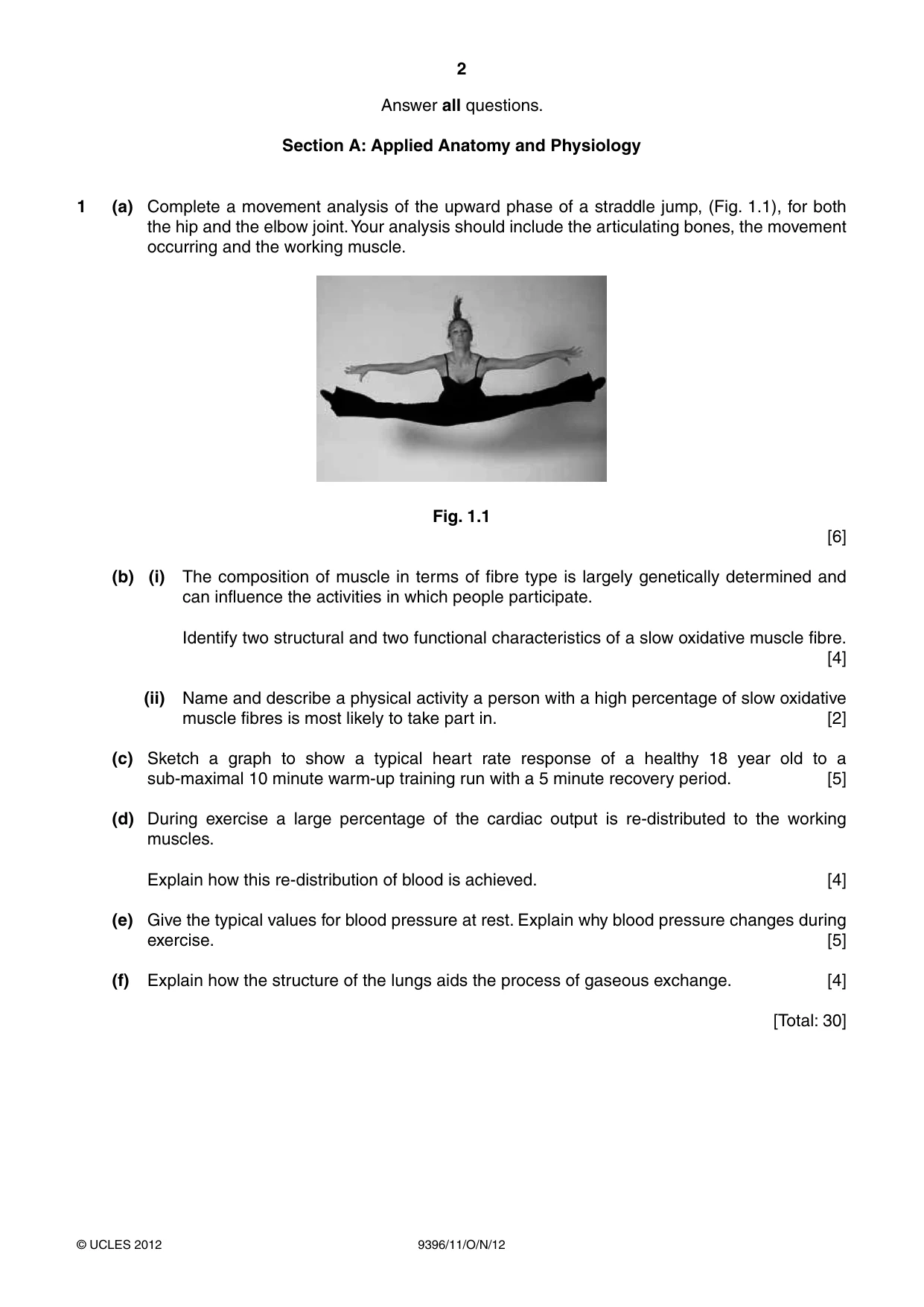
2 9396/11/O/N/12 © UCLES 2012 Answer all questions. Section A: Applied Anatomy and Physiology 1 (a) Complete a movement analysis of the upward phase of a straddle jump, (Fig. 1.1), for both the hip and the elbow joint. Your analysis should include the articulating bones, the movement occurring and the working muscle. Fig. 1.1 [6] (b) (i) The composition of muscle in terms of fibre type is largely genetically determined and can influence the activities in which people participate. Identify two structural and two functional characteristics of a slow oxidative muscle fibre. [4] (ii) Name and describe a physical activity a person with a high percentage of slow oxidative muscle fibres is most likely to take part in. [2] (c) Sketch a graph to show a typical heart rate response of a healthy 18 year old to a sub-maximal 10 minute warm-up training run with a 5 minute recovery period. [5] (d) During exercise a large percentage of the cardiac output is re-distributed to the working muscles. Explain how this re-distribution of blood is achieved. [4] (e) Give the typical values for blood pressure at rest. Explain why blood pressure changes during exercise. [5] (f) Explain how the structure of the lungs aids the process of gaseous exchange. [4] [Total: 30]
Question paper, page 3
3 9396/11/O/N/12 © UCLES 2012 [Turn over Section B: Acquiring, Developing and Performing Movement Skills 2 (a) Identify three characteristics of skilful performance in sport and for each characteristic give a practical example. [3] (b) Different levels of arousal can affect the performance of movement skills. Using the inverted U theory, explain how the different levels of arousal can affect the performance of a movement skill. [4] (c) Explain how the psychological refractory period can affect reaction time when performing a movement skill. [3] (d) Using a practical example for each, describe extrinsic and intrinsic motivation in the learning of movement skills. [4] (e) Using practical examples explain what is meant by proactive, retroactive and bilateral transfer in the learning of movement skills. [5] (f) Give an example of a motor programme related to the learning and performance of movement skills. Explain how motor programmes are formed. [5] (g) Explain the cognitive theory of learning movement skills. [6] [Total: 30]
Question paper, page 4
4 9396/11/O/N/12 © UCLES 2012 Section C: Contemporary Studies in Physical Education and Sport 3 (a) The concepts ‘Physical Education’ and ‘Sport’ are complex. (i) Describe two similarities and two differences between Physical Education and Sport. [4] (ii) How can a teacher of Physical Education introduce the elements of sport to pupils in a Physical Education curriculum lesson? [4] (b) Rock climbing is an example of an outdoor activity. Explain why Outdoor Education should be included in the school curriculum. [4] (c) There is a view that sport is no longer in the hands of the players or spectators but in the hands of global television corporations. (i) Explain some of the effects of media on sporting events. [6] (ii) Explain how sport sponsorship is closely linked to the media. [6] (d) More men take part in regular physical activity than women. Suggest ways in which more women can be encouraged to take part in physical activity. [6] [Total: 30] Permission to reproduce items where third-party owned material protected by copyright is included has been sought and cleared where possible. Every reasonable effort has been made by the publisher (UCLES) to trace copyright holders, but if any items requiring clearance have unwittingly been included, the publisher will be pleased to make amends at the earliest possible opportunity. University of Cambridge International Examinations is part of the Cambridge Assessment Group. Cambridge Assessment is the brand name of University of Cambridge Local Examinations Syndicate (UCLES), which is itself a department of the University of Cambridge.
Mark scheme, page 1
CAMBRIDGE INTERNATIONAL EXAMINATIONS GCE Advanced Subsidiary Level MARK SCHEME for the October/November 2012 series 9396 PHYSICAL EDUCATION 9396/11 Paper 1 (Theory), maximum raw mark 90 This mark scheme is published as an aid to teachers and candidates, to indicate the requirements of the examination. It shows the basis on which Examiners were instructed to award marks. It does not indicate the details of the discussions that took place at an Examiners’ meeting before marking began, which would have considered the acceptability of alternative answers. Mark schemes should be read in conjunction with the question paper and the Principal Examiner Report for Teachers. Cambridge will not enter into discussions about these mark schemes. Cambridge is publishing the mark schemes for the October/November 2012 series for most IGCSE, GCE Advanced Level and Advanced Subsidiary Level components and some Ordinary Level components.
Mark scheme, page 2
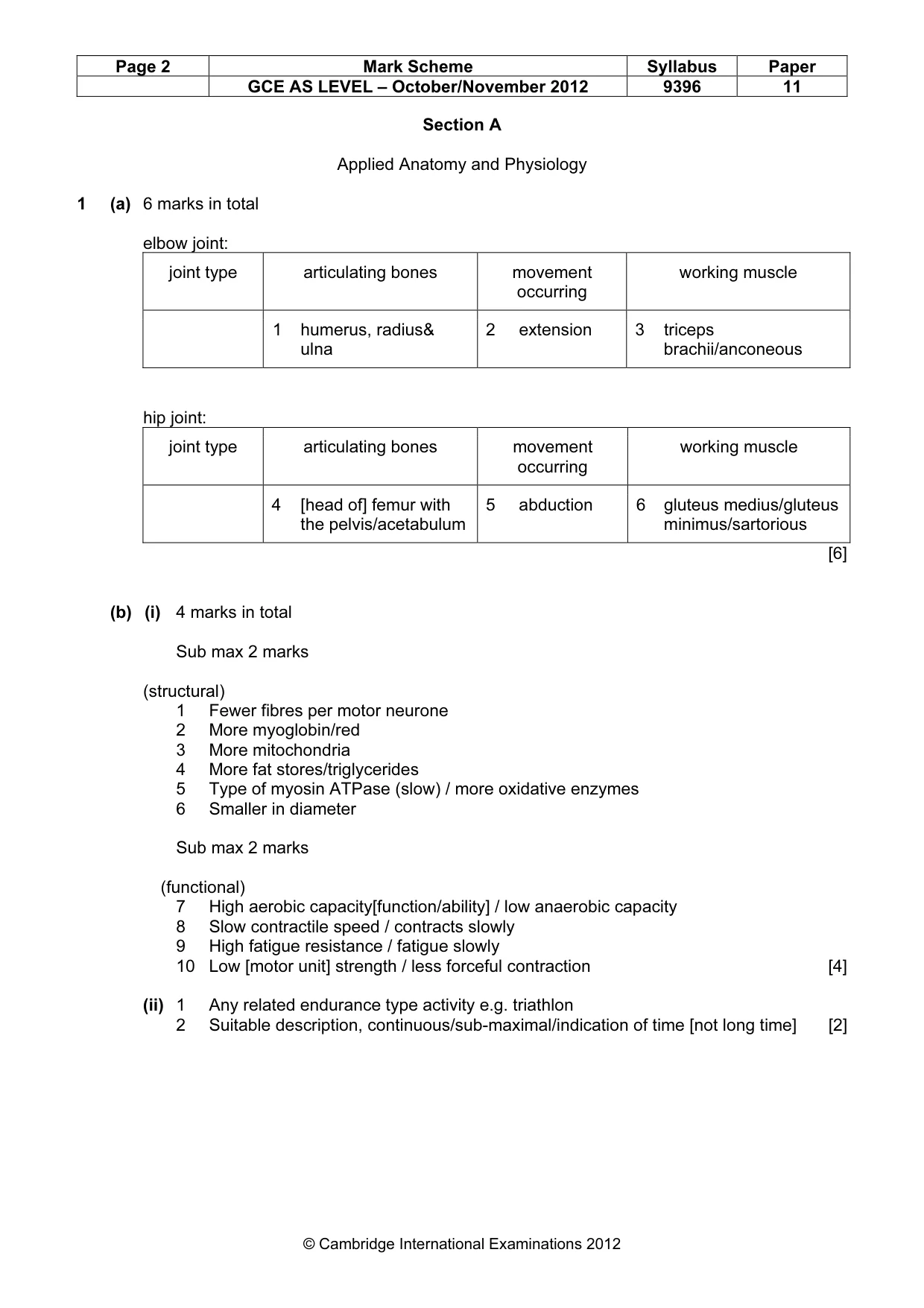
Page 2 Mark Scheme Syllabus Paper GCE AS LEVEL – October/November 2012 9396 11 © Cambridge International Examinations 2012 Section A Applied Anatomy and Physiology 1 (a) 6 marks in total elbow joint: joint type articulating bones movement occurring working muscle 1 humerus, radius& ulna 2 extension 3 triceps brachii/anconeous hip joint: joint type articulating bones movement occurring working muscle 4 [head of] femur with the pelvis/acetabulum 5 abduction 6 gluteus medius/gluteus minimus/sartorious [6] (b) (i) 4 marks in total Sub max 2 marks (structural) 1 Fewer fibres per motor neurone 2 More myoglobin/red 3 More mitochondria 4 More fat stores/triglycerides 5 Type of myosin ATPase (slow) / more oxidative enzymes 6 Smaller in diameter Sub max 2 marks (functional) 7 High aerobic capacity[function/ability] / low anaerobic capacity 8 Slow contractile speed / contracts slowly 9 High fatigue resistance / fatigue slowly 10 Low [motor unit] strength / less forceful contraction [4] (ii) 1 Any related endurance type activity e.g. triathlon 2 Suitable description, continuous/sub-maximal/indication of time [not long time] [2]
Mark scheme, page 3
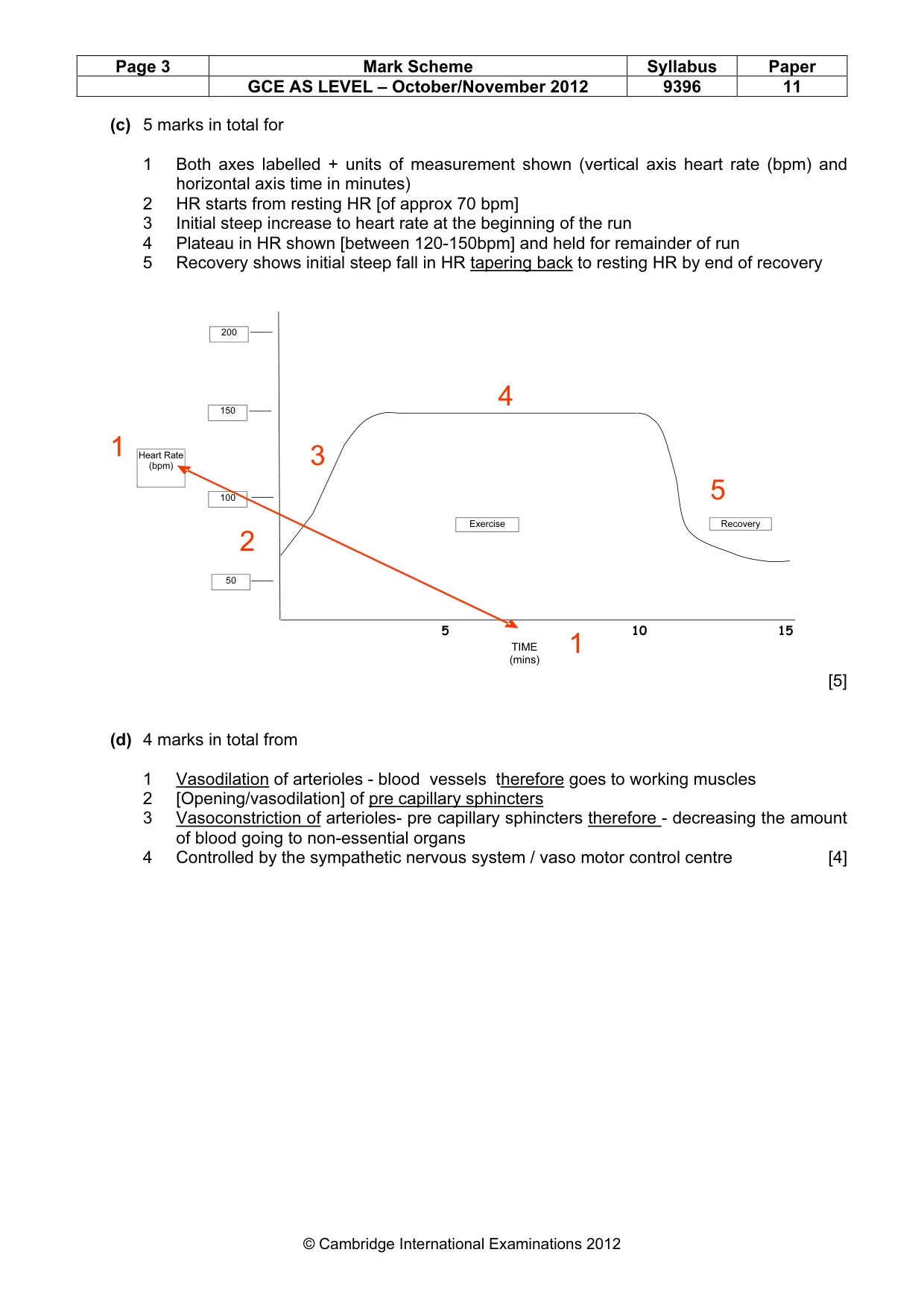
Page 3 Mark Scheme Syllabus Paper GCE AS LEVEL – October/November 2012 9396 11 © Cambridge International Examinations 2012 (c) 5 marks in total for 1 Both axes labelled + units of measurement shown (vertical axis heart rate (bpm) and horizontal axis time in minutes) 2 HR starts from resting HR [of approx 70 bpm] 3 Initial steep increase to heart rate at the beginning of the run 4 Plateau in HR shown [between 120-150bpm] and held for remainder of run 5 Recovery shows initial steep fall in HR tapering back to resting HR by end of recovery [5] (d) 4 marks in total from 1 Vasodilation of arterioles - blood vessels therefore goes to working muscles 2 [Opening/vasodilation] of pre capillary sphincters 3 Vasoconstriction of arterioles- pre capillary sphincters therefore - decreasing the amount of blood going to non-essential organs 4 Controlled by the sympathetic nervous system / vaso motor control centre [4] 200 Recovery Heart Rate (bpm) TIME (mins) 10 5 Exercise 15 1 1 2 3 4 5 150 100 50
Mark scheme, page 4
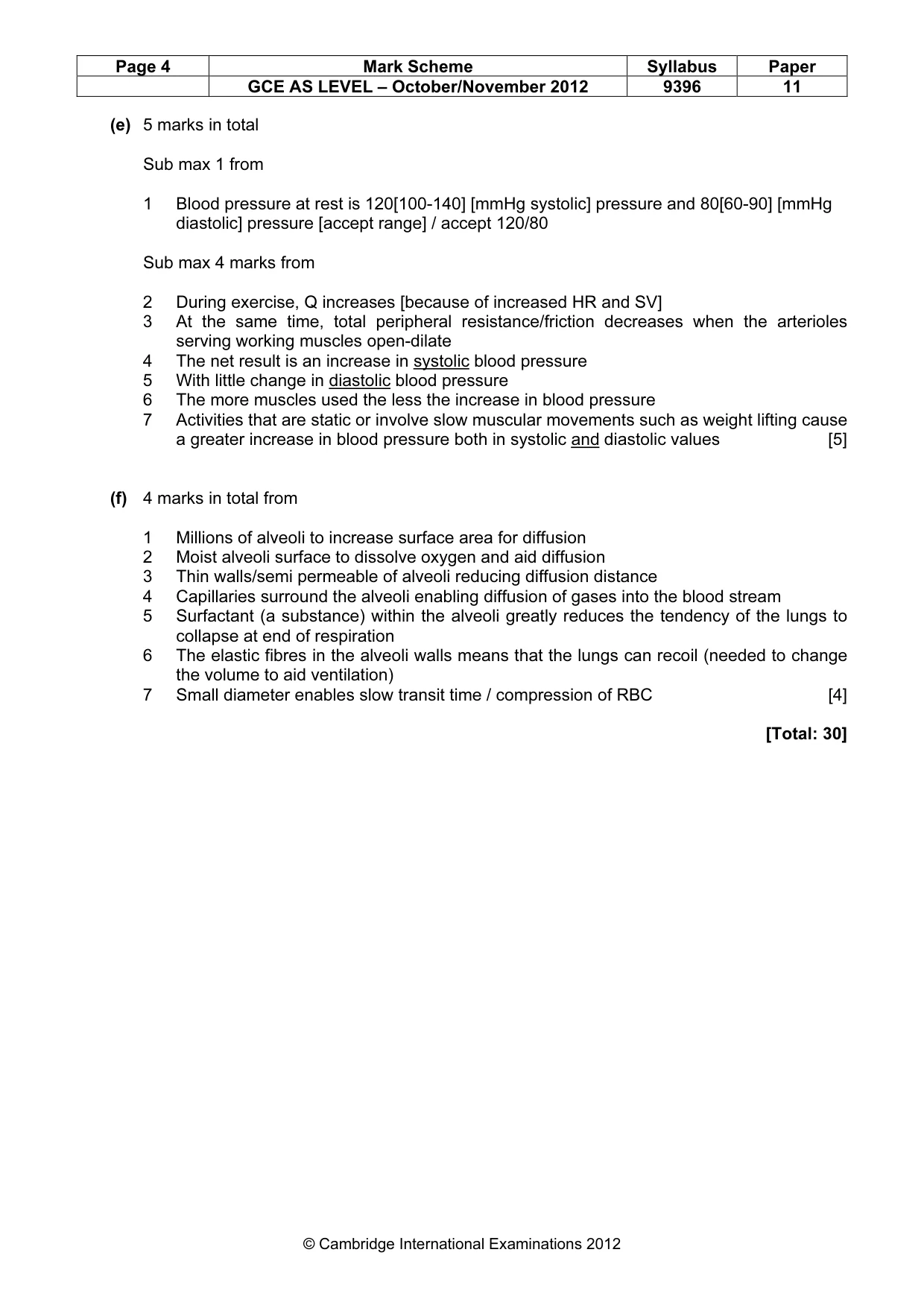
Page 4 Mark Scheme Syllabus Paper GCE AS LEVEL – October/November 2012 9396 11 © Cambridge International Examinations 2012 (e) 5 marks in total Sub max 1 from 1 Blood pressure at rest is 120[100-140] [mmHg systolic] pressure and 80[60-90] [mmHg diastolic] pressure [accept range] / accept 120/80 Sub max 4 marks from 2 During exercise, Q increases [because of increased HR and SV] 3 At the same time, total peripheral resistance/friction decreases when the arterioles serving working muscles open-dilate 4 The net result is an increase in systolic blood pressure 5 With little change in diastolic blood pressure 6 The more muscles used the less the increase in blood pressure 7 Activities that are static or involve slow muscular movements such as weight lifting cause a greater increase in blood pressure both in systolic and diastolic values [5] (f) 4 marks in total from 1 Millions of alveoli to increase surface area for diffusion 2 Moist alveoli surface to dissolve oxygen and aid diffusion 3 Thin walls/semi permeable of alveoli reducing diffusion distance 4 Capillaries surround the alveoli enabling diffusion of gases into the blood stream 5 Surfactant (a substance) within the alveoli greatly reduces the tendency of the lungs to collapse at end of respiration 6 The elastic fibres in the alveoli walls means that the lungs can recoil (needed to change the volume to aid ventilation) 7 Small diameter enables slow transit time / compression of RBC [4] [Total: 30]
Mark scheme, page 5
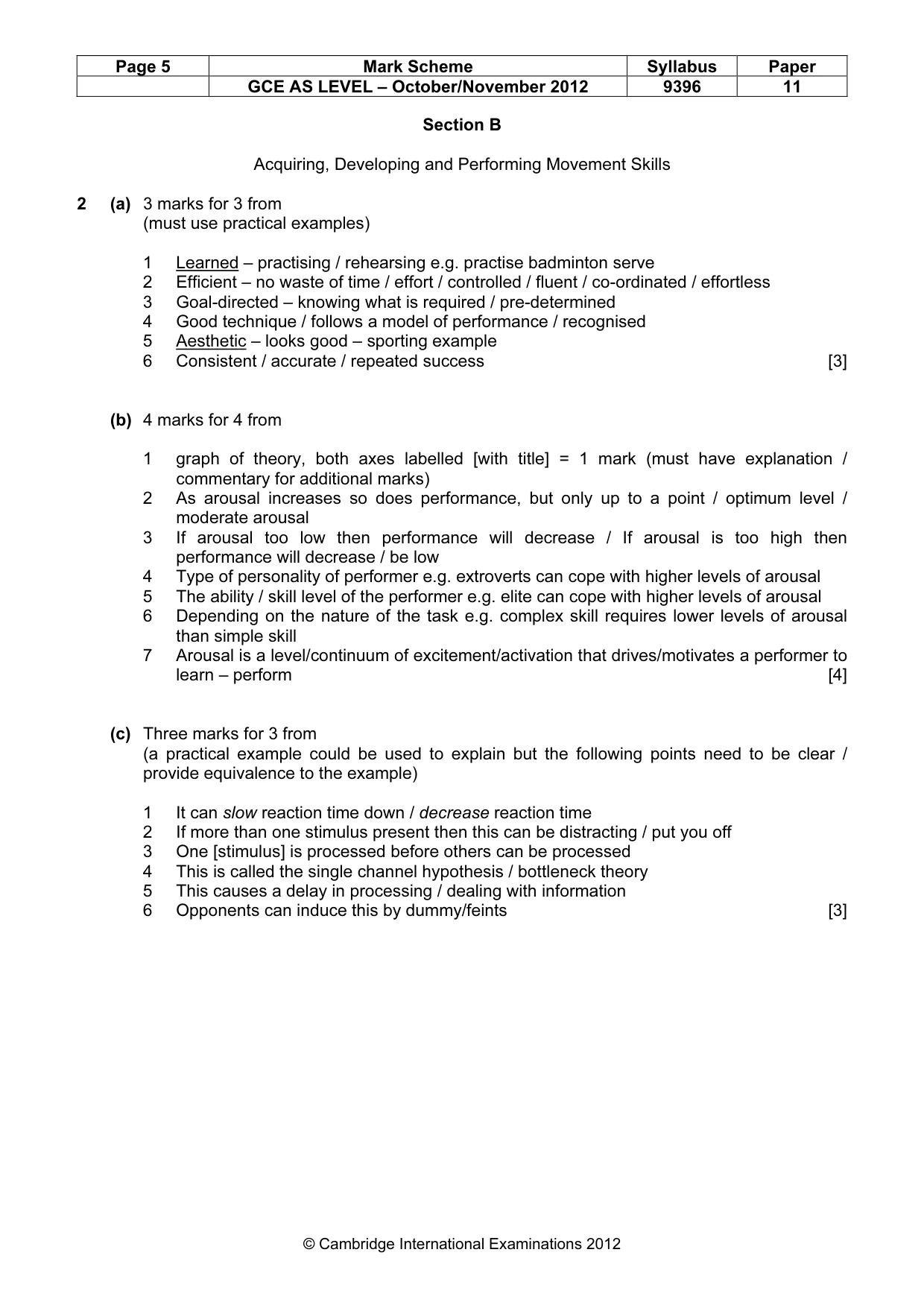
Page 5 Mark Scheme Syllabus Paper GCE AS LEVEL – October/November 2012 9396 11 © Cambridge International Examinations 2012 Section B Acquiring, Developing and Performing Movement Skills 2 (a) 3 marks for 3 from (must use practical examples) 1 Learned – practising / rehearsing e.g. practise badminton serve 2 Efficient – no waste of time / effort / controlled / fluent / co-ordinated / effortless 3 Goal-directed – knowing what is required / pre-determined 4 Good technique / follows a model of performance / recognised 5 Aesthetic – looks good – sporting example 6 Consistent / accurate / repeated success [3] (b) 4 marks for 4 from 1 graph of theory, both axes labelled [with title] = 1 mark (must have explanation / commentary for additional marks) 2 As arousal increases so does performance, but only up to a point / optimum level / moderate arousal 3 If arousal too low then performance will decrease / If arousal is too high then performance will decrease / be low 4 Type of personality of performer e.g. extroverts can cope with higher levels of arousal 5 The ability / skill level of the performer e.g. elite can cope with higher levels of arousal 6 Depending on the nature of the task e.g. complex skill requires lower levels of arousal than simple skill 7 Arousal is a level/continuum of excitement/activation that drives/motivates a performer to learn – perform [4] (c) Three marks for 3 from (a practical example could be used to explain but the following points need to be clear / provide equivalence to the example) 1 It can slow reaction time down / decrease reaction time 2 If more than one stimulus present then this can be distracting / put you off 3 One [stimulus] is processed before others can be processed 4 This is called the single channel hypothesis / bottleneck theory 5 This causes a delay in processing / dealing with information 6 Opponents can induce this by dummy/feints [3]
Mark scheme, page 6
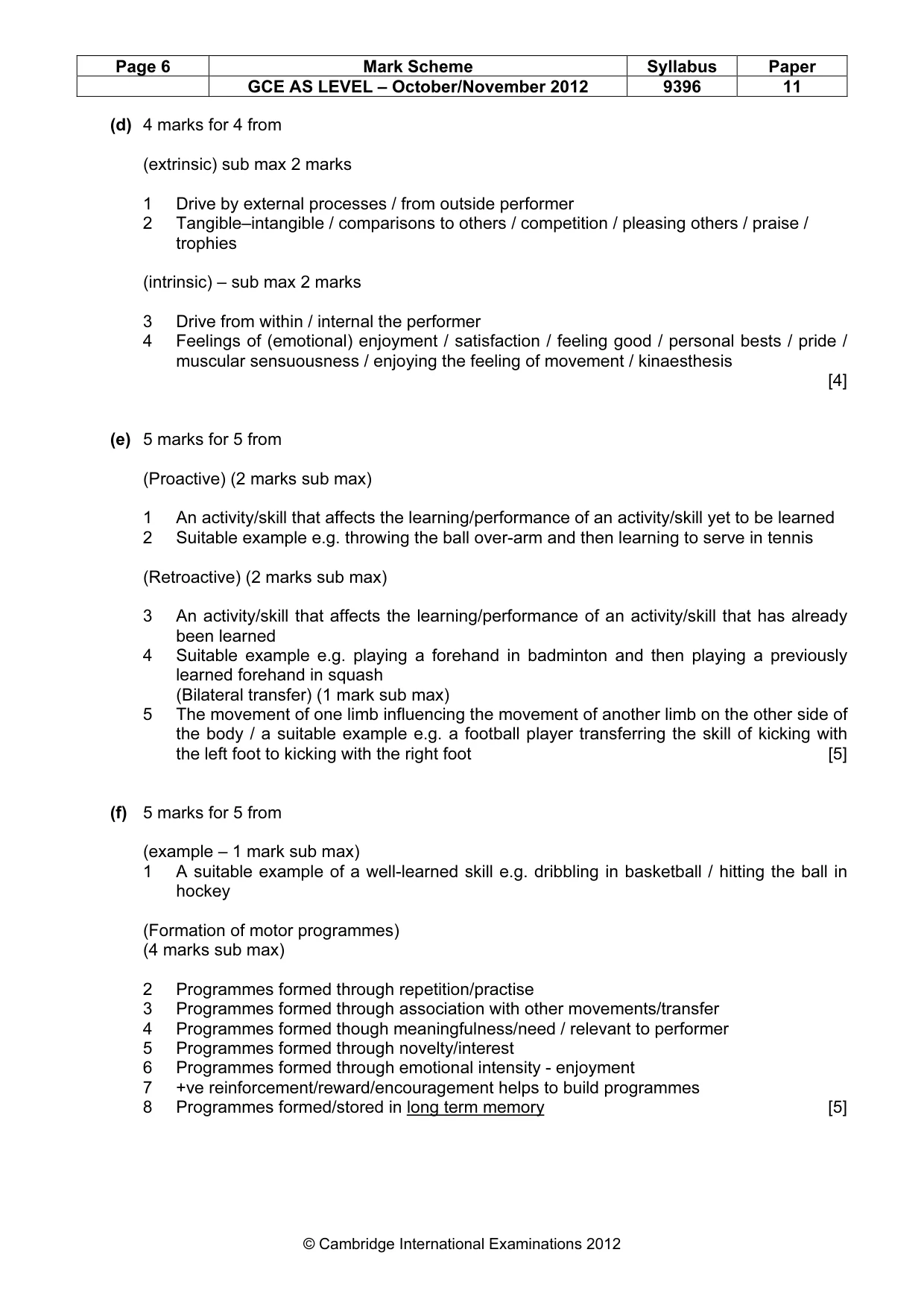
Page 6 Mark Scheme Syllabus Paper GCE AS LEVEL – October/November 2012 9396 11 © Cambridge International Examinations 2012 (d) 4 marks for 4 from (extrinsic) sub max 2 marks 1 Drive by external processes / from outside performer 2 Tangible–intangible / comparisons to others / competition / pleasing others / praise / trophies (intrinsic) – sub max 2 marks 3 Drive from within / internal the performer 4 Feelings of (emotional) enjoyment / satisfaction / feeling good / personal bests / pride / muscular sensuousness / enjoying the feeling of movement / kinaesthesis [4] (e) 5 marks for 5 from (Proactive) (2 marks sub max) 1 An activity/skill that affects the learning/performance of an activity/skill yet to be learned 2 Suitable example e.g. throwing the ball over-arm and then learning to serve in tennis (Retroactive) (2 marks sub max) 3 An activity/skill that affects the learning/performance of an activity/skill that has already been learned 4 Suitable example e.g. playing a forehand in badminton and then playing a previously learned forehand in squash (Bilateral transfer) (1 mark sub max) 5 The movement of one limb influencing the movement of another limb on the other side of the body / a suitable example e.g. a football player transferring the skill of kicking with the left foot to kicking with the right foot [5] (f) 5 marks for 5 from (example – 1 mark sub max) 1 A suitable example of a well-learned skill e.g. dribbling in basketball / hitting the ball in hockey (Formation of motor programmes) (4 marks sub max) 2 Programmes formed through repetition/practise 3 Programmes formed through association with other movements/transfer 4 Programmes formed though meaningfulness/need / relevant to performer 5 Programmes formed through novelty/interest 6 Programmes formed through emotional intensity - enjoyment 7 +ve reinforcement/reward/encouragement helps to build programmes 8 Programmes formed/stored in long term memory [5]
Mark scheme, page 7
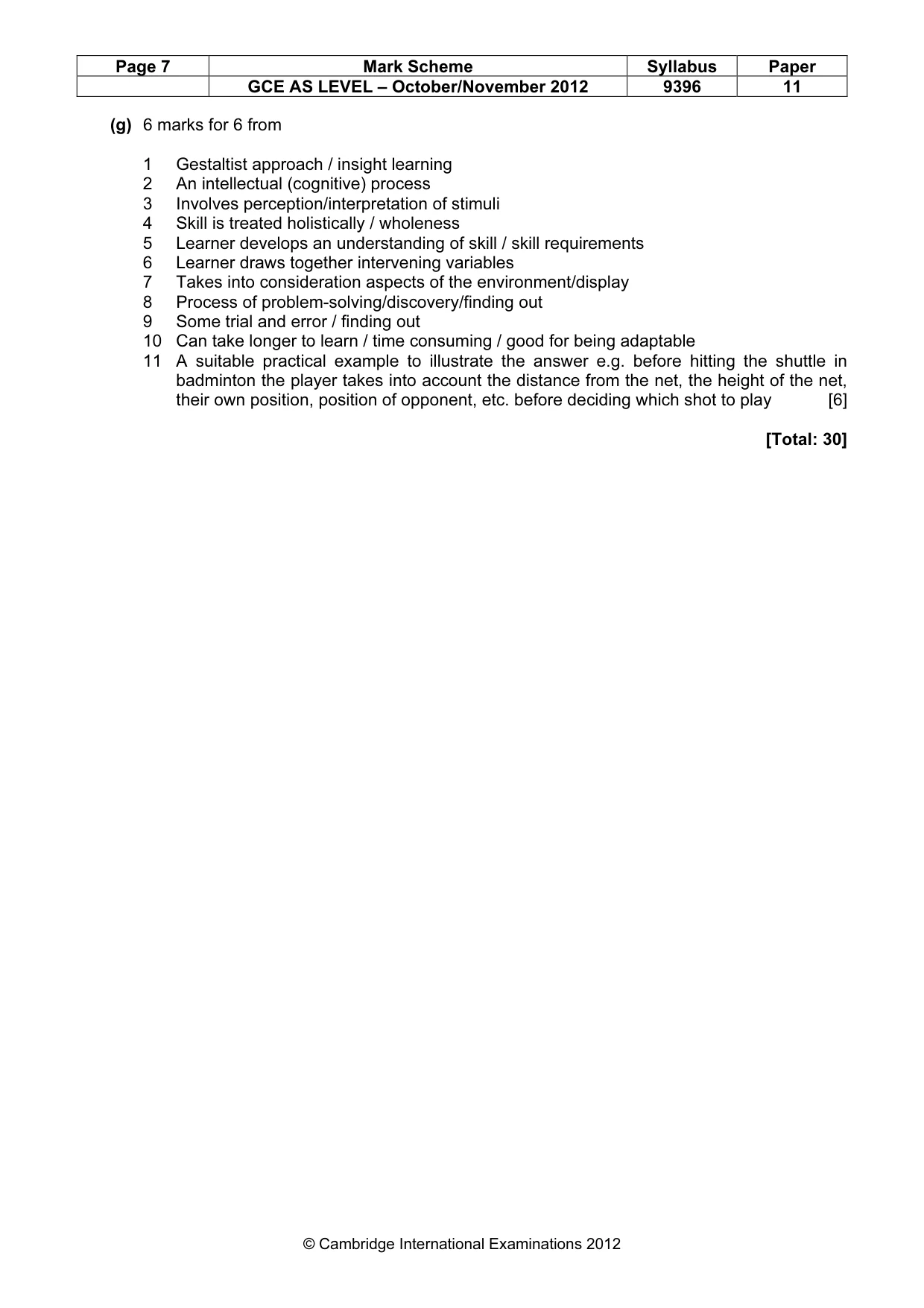
Page 7 Mark Scheme Syllabus Paper GCE AS LEVEL – October/November 2012 9396 11 © Cambridge International Examinations 2012 (g) 6 marks for 6 from 1 Gestaltist approach / insight learning 2 An intellectual (cognitive) process 3 Involves perception/interpretation of stimuli 4 Skill is treated holistically / wholeness 5 Learner develops an understanding of skill / skill requirements 6 Learner draws together intervening variables 7 Takes into consideration aspects of the environment/display 8 Process of problem-solving/discovery/finding out 9 Some trial and error / finding out 10 Can take longer to learn / time consuming / good for being adaptable 11 A suitable practical example to illustrate the answer e.g. before hitting the shuttle in badminton the player takes into account the distance from the net, the height of the net, their own position, position of opponent, etc. before deciding which shot to play [6] [Total: 30]
Mark scheme, page 8
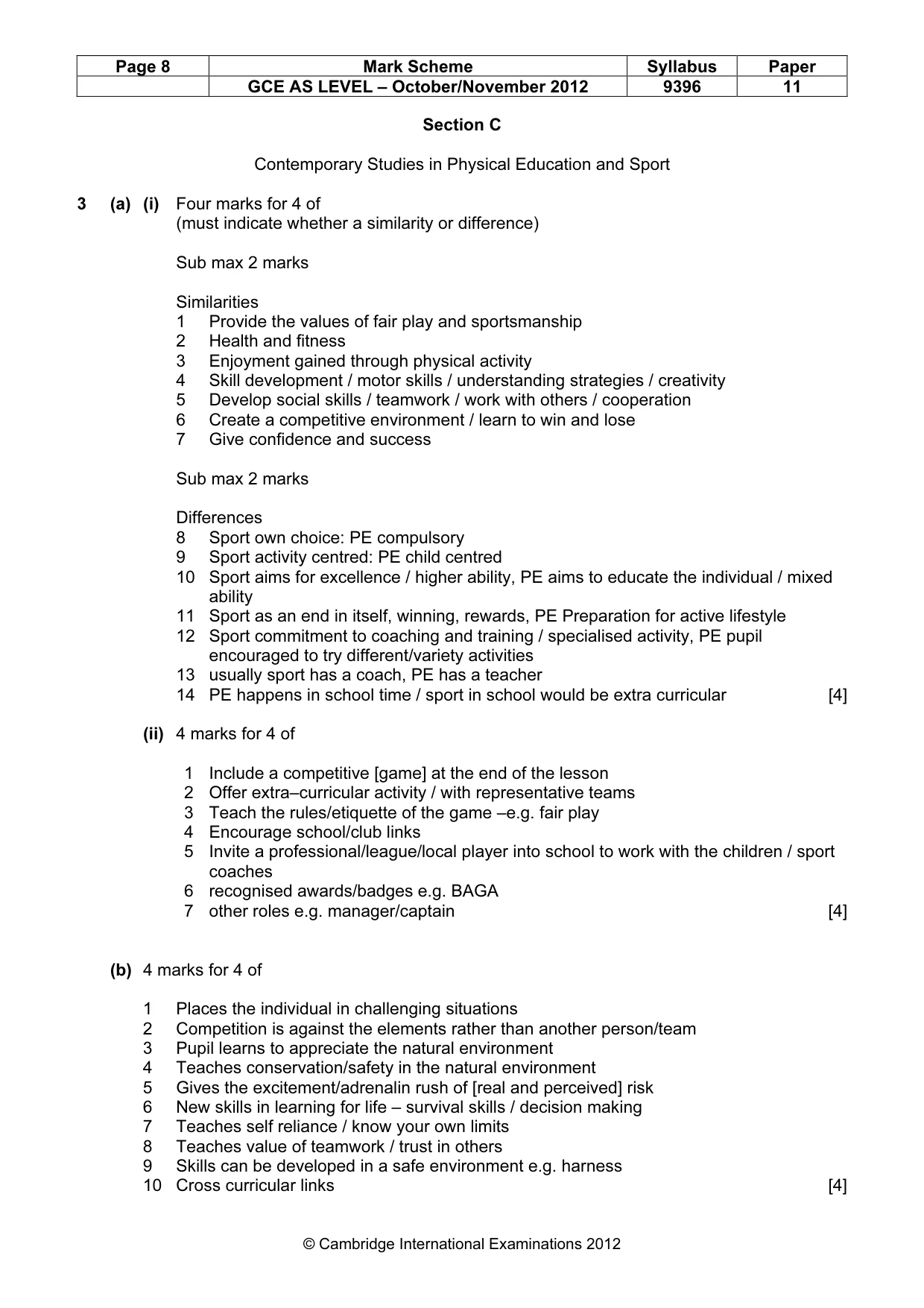
Page 8 Mark Scheme Syllabus Paper GCE AS LEVEL – October/November 2012 9396 11 © Cambridge International Examinations 2012 Section C Contemporary Studies in Physical Education and Sport 3 (a) (i) Four marks for 4 of (must indicate whether a similarity or difference) Sub max 2 marks Similarities 1 Provide the values of fair play and sportsmanship 2 Health and fitness 3 Enjoyment gained through physical activity 4 Skill development / motor skills / understanding strategies / creativity 5 Develop social skills / teamwork / work with others / cooperation 6 Create a competitive environment / learn to win and lose 7 Give confidence and success Sub max 2 marks Differences 8 Sport own choice: PE compulsory 9 Sport activity centred: PE child centred 10 Sport aims for excellence / higher ability, PE aims to educate the individual / mixed ability 11 Sport as an end in itself, winning, rewards, PE Preparation for active lifestyle 12 Sport commitment to coaching and training / specialised activity, PE pupil encouraged to try different/variety activities 13 usually sport has a coach, PE has a teacher 14 PE happens in school time / sport in school would be extra curricular [4] (ii) 4 marks for 4 of 1 Include a competitive [game] at the end of the lesson 2 Offer extra–curricular activity / with representative teams 3 Teach the rules/etiquette of the game –e.g. fair play 4 Encourage school/club links 5 Invite a professional/league/local player into school to work with the children / sport coaches 6 recognised awards/badges e.g. BAGA 7 other roles e.g. manager/captain [4] (b) 4 marks for 4 of 1 Places the individual in challenging situations 2 Competition is against the elements rather than another person/team 3 Pupil learns to appreciate the natural environment 4 Teaches conservation/safety in the natural environment 5 Gives the excitement/adrenalin rush of [real and perceived] risk 6 New skills in learning for life – survival skills / decision making 7 Teaches self reliance / know your own limits 8 Teaches value of teamwork / trust in others 9 Skills can be developed in a safe environment e.g. harness 10 Cross curricular links [4]
Mark scheme, page 9
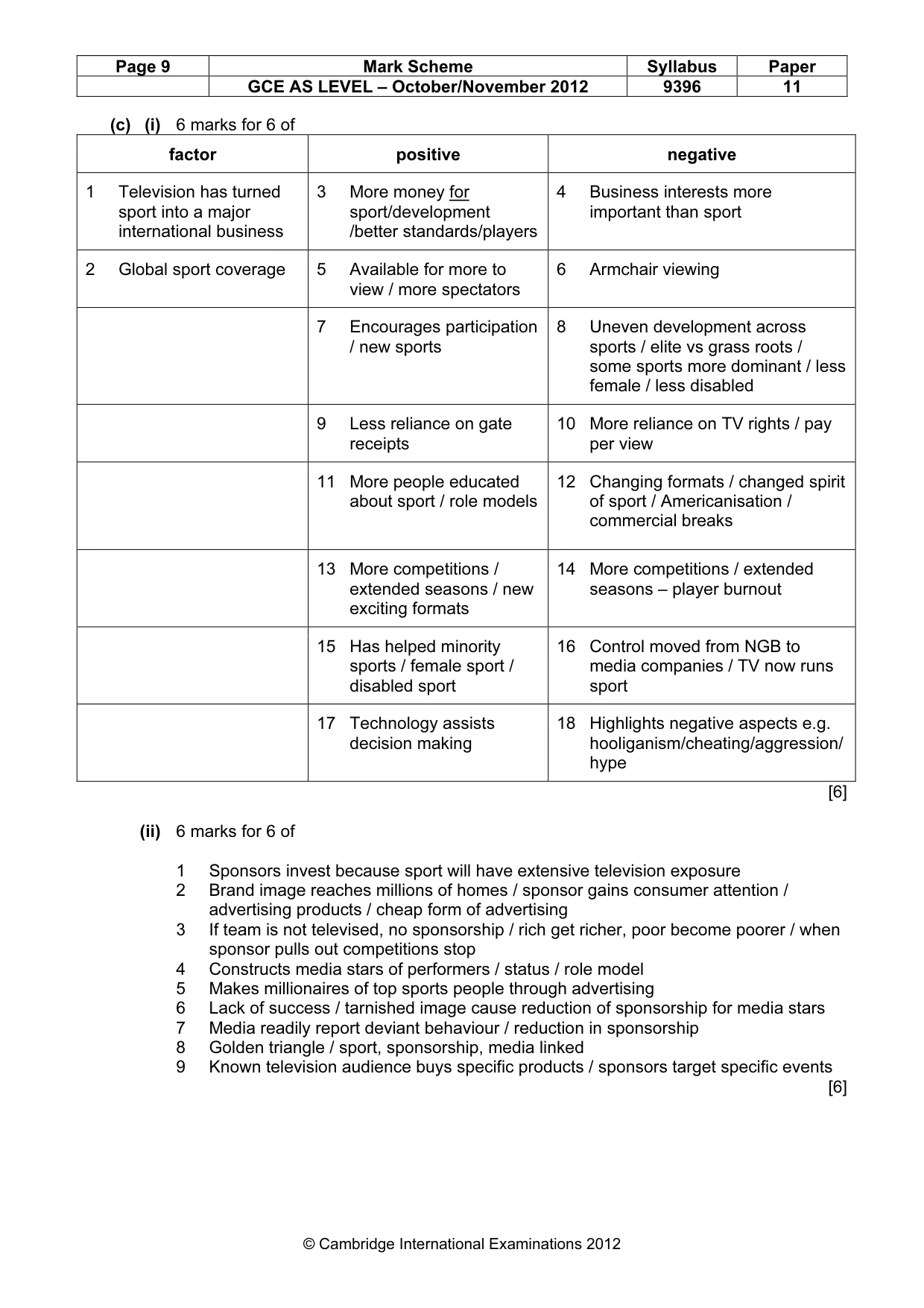
Page 9 Mark Scheme Syllabus Paper GCE AS LEVEL – October/November 2012 9396 11 © Cambridge International Examinations 2012 (c) (i) 6 marks for 6 of factor positive negative 1 Television has turned sport into a major international business 3 More money for sport/development /better standards/players 4 Business interests more important than sport 2 Global sport coverage 5 Available for more to view / more spectators 6 Armchair viewing 7 Encourages participation / new sports 8 Uneven development across sports / elite vs grass roots / some sports more dominant / less female / less disabled 9 Less reliance on gate receipts 10 More reliance on TV rights / pay per view 11 More people educated about sport / role models 12 Changing formats / changed spirit of sport / Americanisation / commercial breaks 13 More competitions / extended seasons / new exciting formats 14 More competitions / extended seasons – player burnout 15 Has helped minority sports / female sport / disabled sport 16 Control moved from NGB to media companies / TV now runs sport 17 Technology assists decision making 18 Highlights negative aspects e.g. hooliganism/cheating/aggression/ hype [6] (ii) 6 marks for 6 of 1 Sponsors invest because sport will have extensive television exposure 2 Brand image reaches millions of homes / sponsor gains consumer attention / advertising products / cheap form of advertising 3 If team is not televised, no sponsorship / rich get richer, poor become poorer / when sponsor pulls out competitions stop 4 Constructs media stars of performers / status / role model 5 Makes millionaires of top sports people through advertising 6 Lack of success / tarnished image cause reduction of sponsorship for media stars 7 Media readily report deviant behaviour / reduction in sponsorship 8 Golden triangle / sport, sponsorship, media linked 9 Known television audience buys specific products / sponsors target specific events [6]
Mark scheme, page 10
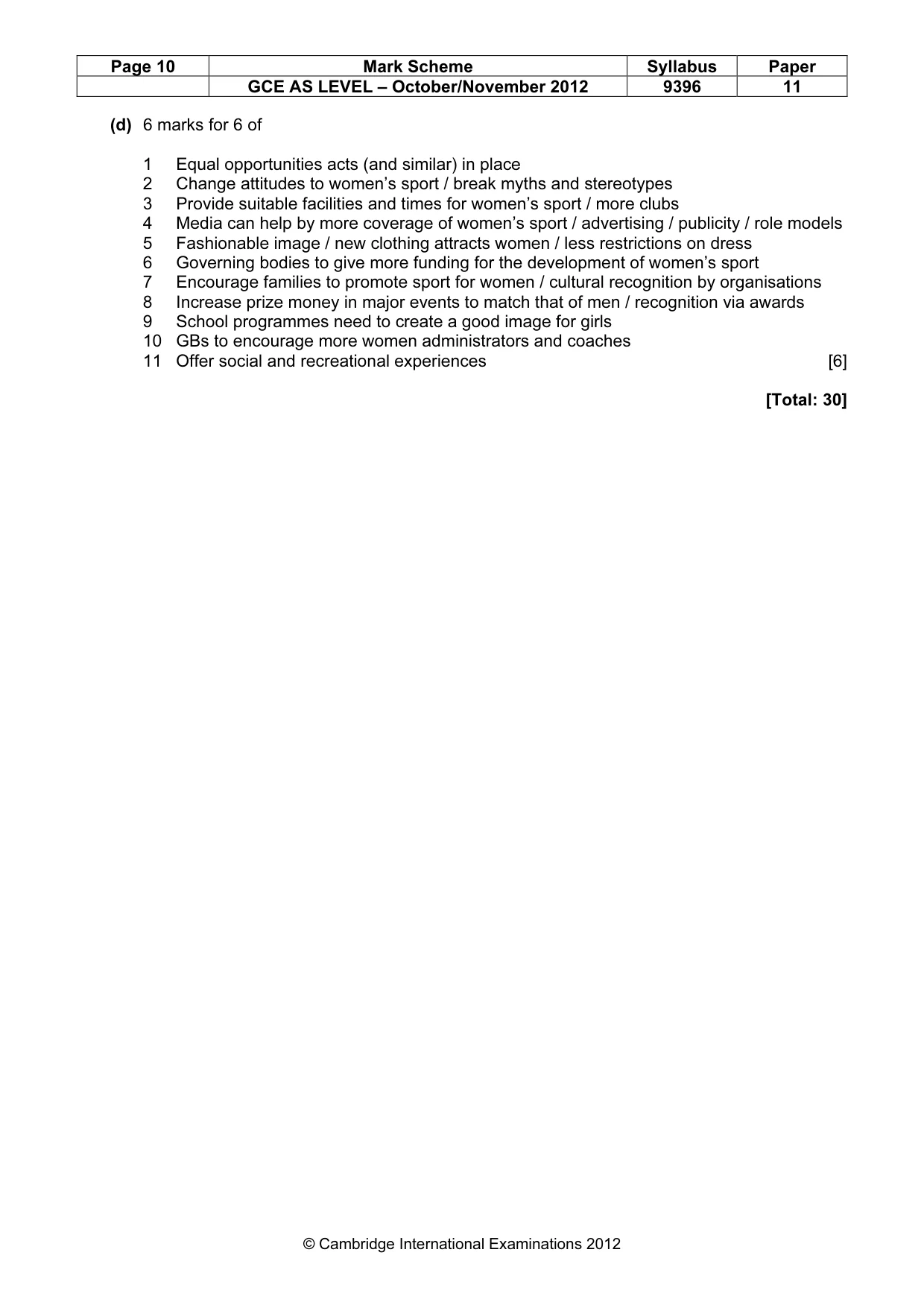
Page 10 Mark Scheme Syllabus Paper GCE AS LEVEL – October/November 2012 9396 11 © Cambridge International Examinations 2012 (d) 6 marks for 6 of 1 Equal opportunities acts (and similar) in place 2 Change attitudes to women’s sport / break myths and stereotypes 3 Provide suitable facilities and times for women’s sport / more clubs 4 Media can help by more coverage of women’s sport / advertising / publicity / role models 5 Fashionable image / new clothing attracts women / less restrictions on dress 6 Governing bodies to give more funding for the development of women’s sport 7 Encourage families to promote sport for women / cultural recognition by organisations 8 Increase prize money in major events to match that of men / recognition via awards 9 School programmes need to create a good image for girls 10 GBs to encourage more women administrators and coaches 11 Offer social and recreational experiences [6] [Total: 30]
What you needed in this session
Cambridge’s own grade thresholds for 2012 Oct/Nov, Paper 1 · Variant 1. A higher threshold means an easier paper — the bar moves with how the cohort did.