Cambridge A Level Music 9703 — 2019 May/June Paper 1 · Variant 1
9703/11/M/J/19 · 100 marks · ≈113 min
The question paper and its mark scheme, free to read here and free to download. This is Cambridge’s own paper, exactly as it was sat.
Question paper4 pages


Mark scheme6 pages
Answers below. Sit the paper first if you are practising.
Paper as text
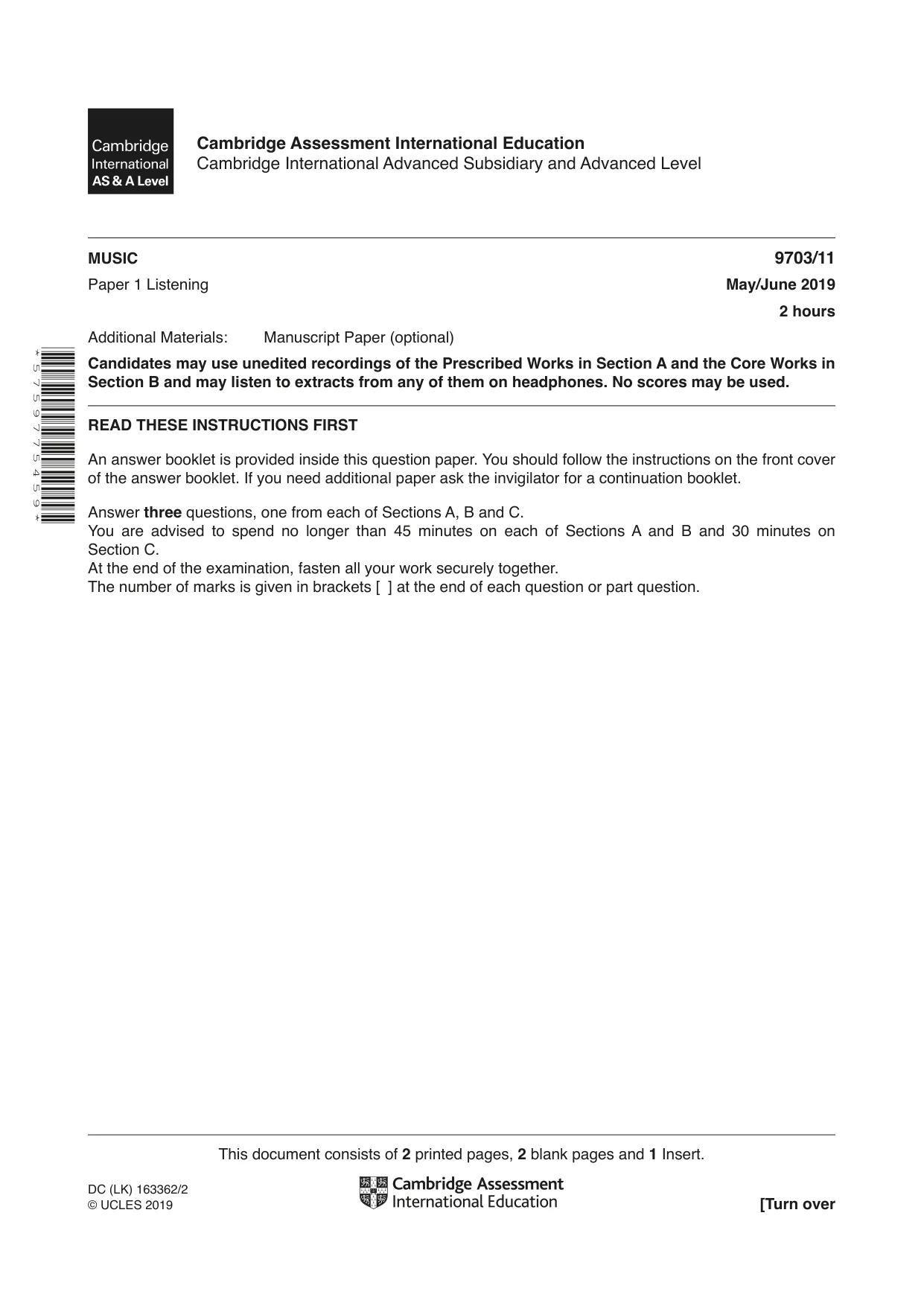
Question paper, page 1
This document consists of 2 printed pages, 2 blank pages and 1 Insert. DC (LK) 163362/2 © UCLES 2019 [Turn over Cambridge Assessment International Education Cambridge International Advanced Subsidiary and Advanced Level * 5 7 5 9 7 7 5 4 5 9 * MUSIC 9703/11 Paper 1 Listening May/June 2019 2 hours Additional Materials: Manuscript Paper (optional) Candidates may use unedited recordings of the Prescribed Works in Section A and the Core Works in Section B and may listen to extracts from any of them on headphones. No scores may be used. READ THESE INSTRUCTIONS FIRST An answer booklet is provided inside this question paper. You should follow the instructions on the front cover of the answer booklet. If you need additional paper ask the invigilator for a continuation booklet. Answer three questions, one from each of Sections A, B and C. You are advised to spend no longer than 45 minutes on each of Sections A and B and 30 minutes on Section C. At the end of the examination, fasten all your work securely together. The number of marks is given in brackets [ ] at the end of each question or part question.
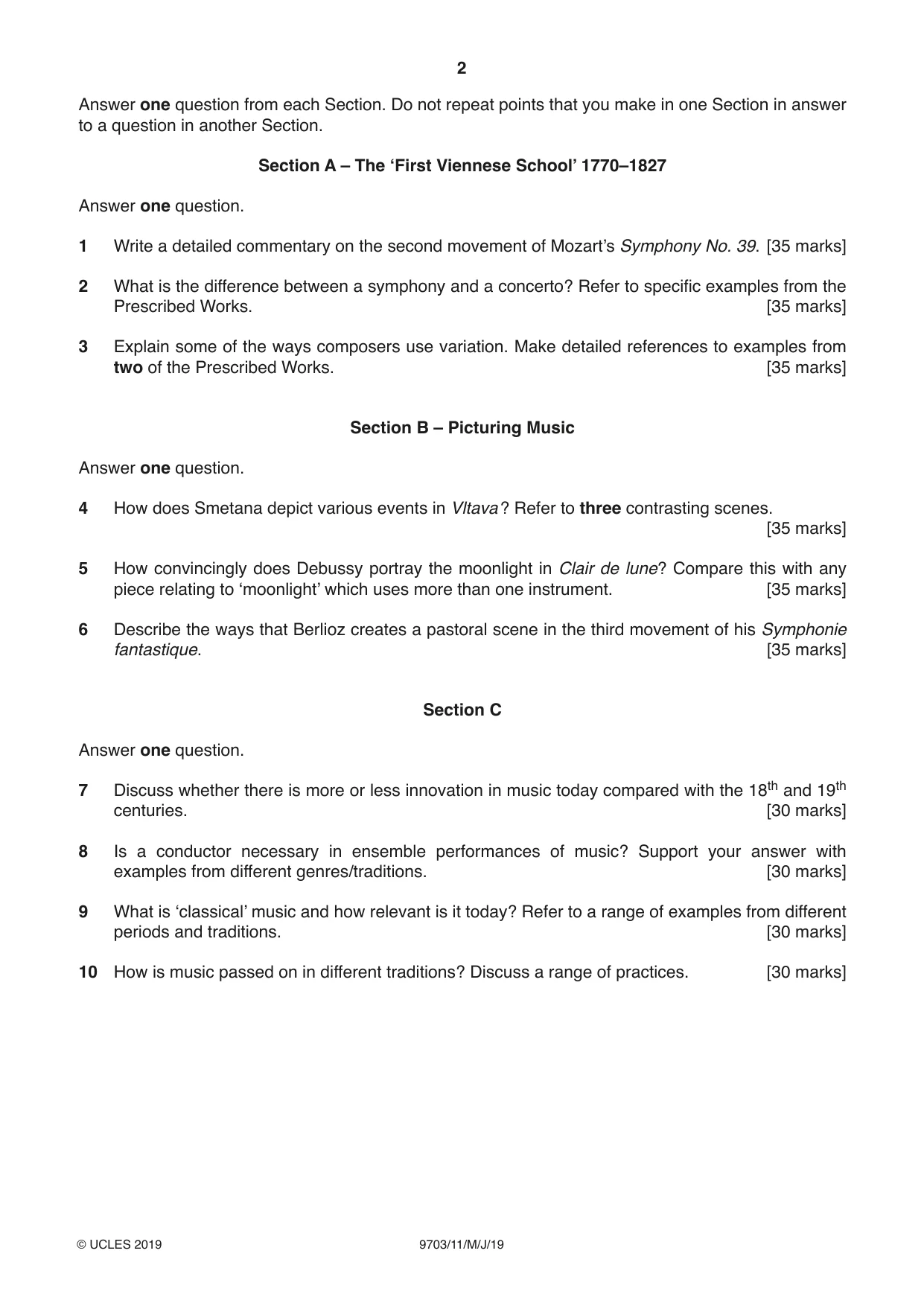
Question paper, page 2
2 9703/11/M/J/19 © UCLES 2019 Answer one question from each Section. Do not repeat points that you make in one Section in answer to a question in another Section. Section A – The ‘First Viennese School’ 1770–1827 Answer one question. 1 Write a detailed commentary on the second movement of Mozart’s Symphony No. 39. [35 marks] 2 What is the difference between a symphony and a concerto? Refer to specific examples from the Prescribed Works. [35 marks] 3 Explain some of the ways composers use variation. Make detailed references to examples from two of the Prescribed Works. [35 marks] Section B – Picturing Music Answer one question. 4 How does Smetana depict various events in Vltava ? Refer to three contrasting scenes. [35 marks] 5 How convincingly does Debussy portray the moonlight in Clair de lune? Compare this with any piece relating to ‘moonlight’ which uses more than one instrument. [35 marks] 6 Describe the ways that Berlioz creates a pastoral scene in the third movement of his Symphonie fantastique. [35 marks] Section C Answer one question. 7 Discuss whether there is more or less innovation in music today compared with the 18th and 19th centuries. [30 marks] 8 Is a conductor necessary in ensemble performances of music? Support your answer with examples from different genres/traditions. [30 marks] 9 What is ‘classical’ music and how relevant is it today? Refer to a range of examples from different periods and traditions. [30 marks] 10 How is music passed on in different traditions? Discuss a range of practices. [30 marks]
Question paper, page 3
3 9703/11/M/J/19 © UCLES 2019 BLANK PAGE
Question paper, page 4
4 9703/11/M/J/19 © UCLES 2019 Permission to reproduce items where third-party owned material protected by copyright is included has been sought and cleared where possible. Every reasonable effort has been made by the publisher (UCLES) to trace copyright holders, but if any items requiring clearance have unwittingly been included, the publisher will be pleased to make amends at the earliest possible opportunity. To avoid the issue of disclosure of answer-related information to candidates, all copyright acknowledgements are reproduced online in the Cambridge Assessment International Education Copyright Acknowledgements Booklet. This is produced for each series of examinations and is freely available to download at www.cambridgeinternational.org after the live examination series. Cambridge Assessment International Education is part of the Cambridge Assessment Group. Cambridge Assessment is the brand name of the University of Cambridge Local Examinations Syndicate (UCLES), which itself is a department of the University of Cambridge. BLANK PAGE
Mark scheme, page 1
This document consists of 6 printed pages. © UCLES 2019 [Turn over Cambridge Assessment International Education Cambridge International Advanced Level MUSIC 9703/11 Paper 1 Listening May/June 2019 MARK SCHEME Maximum Mark: 1000 Published This mark scheme is published as an aid to teachers and candidates, to indicate the requirements of the examination. It shows the basis on which Examiners were instructed to award marks. It does not indicate the details of the discussions that took place at an Examiners’ meeting before marking began, which would have considered the acceptability of alternative answers. Mark schemes should be read in conjunction with the question paper and the Principal Examiner Report for Teachers. Cambridge International will not enter into discussions about these mark schemes. Cambridge International is publishing the mark schemes for the May/June 2019 series for most Cambridge IGCSE™, Cambridge International A and AS Level and Cambridge Pre-U components, and some Cambridge O Level components.
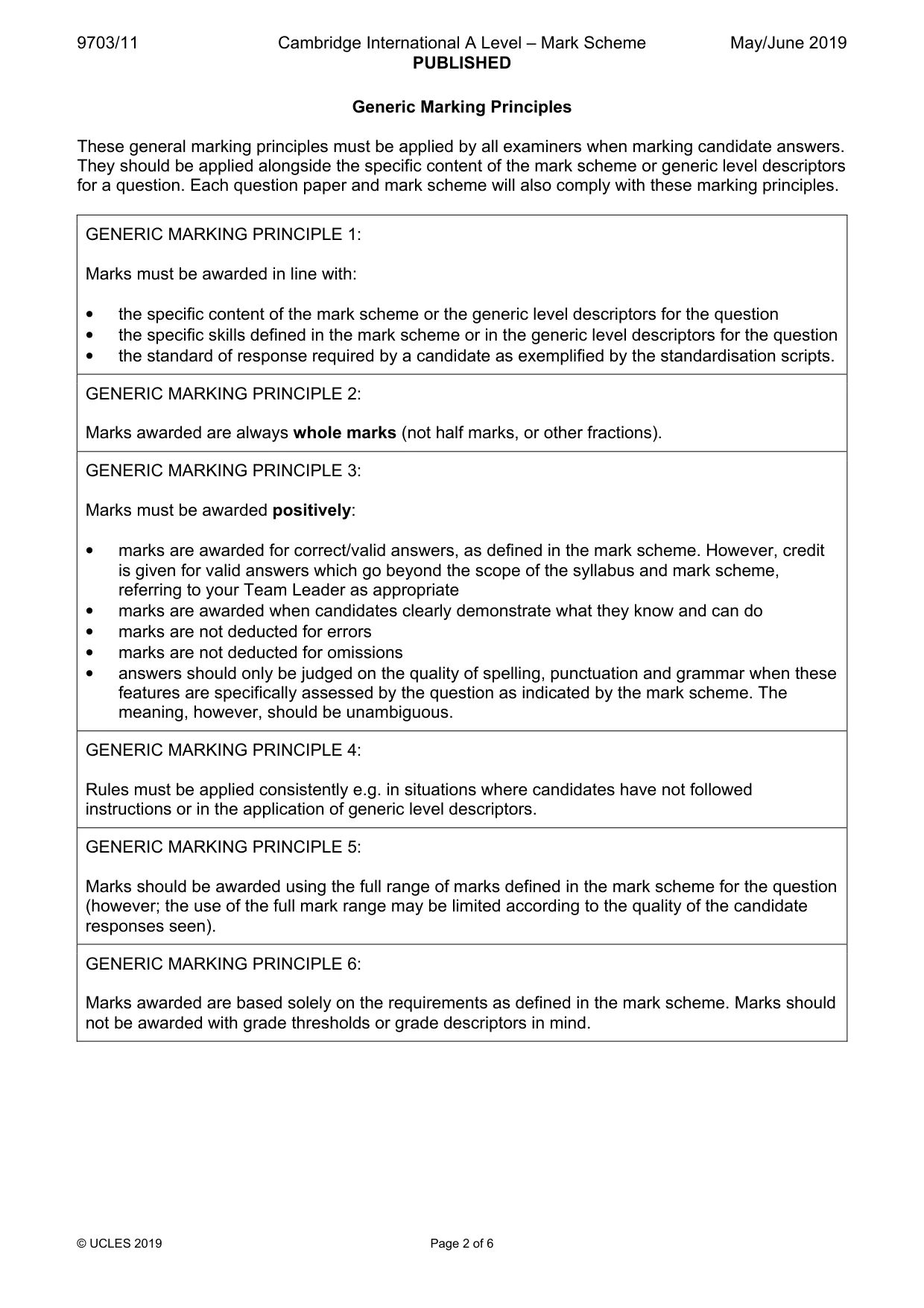
Mark scheme, page 2
9703/11 Cambridge International A Level – Mark Scheme PUBLISHED May/June 2019 © UCLES 2019 Page 2 of 6 Generic Marking Principles These general marking principles must be applied by all examiners when marking candidate answers. They should be applied alongside the specific content of the mark scheme or generic level descriptors for a question. Each question paper and mark scheme will also comply with these marking principles. GENERIC MARKING PRINCIPLE 1: Marks must be awarded in line with: • the specific content of the mark scheme or the generic level descriptors for the question • the specific skills defined in the mark scheme or in the generic level descriptors for the question • the standard of response required by a candidate as exemplified by the standardisation scripts. GENERIC MARKING PRINCIPLE 2: Marks awarded are always whole marks (not half marks, or other fractions). GENERIC MARKING PRINCIPLE 3: Marks must be awarded positively: • marks are awarded for correct/valid answers, as defined in the mark scheme. However, credit is given for valid answers which go beyond the scope of the syllabus and mark scheme, referring to your Team Leader as appropriate • marks are awarded when candidates clearly demonstrate what they know and can do • marks are not deducted for errors • marks are not deducted for omissions • answers should only be judged on the quality of spelling, punctuation and grammar when these features are specifically assessed by the question as indicated by the mark scheme. The meaning, however, should be unambiguous. GENERIC MARKING PRINCIPLE 4: Rules must be applied consistently e.g. in situations where candidates have not followed instructions or in the application of generic level descriptors. GENERIC MARKING PRINCIPLE 5: Marks should be awarded using the full range of marks defined in the mark scheme for the question (however; the use of the full mark range may be limited according to the quality of the candidate responses seen). GENERIC MARKING PRINCIPLE 6: Marks awarded are based solely on the requirements as defined in the mark scheme. Marks should not be awarded with grade thresholds or grade descriptors in mind.
Mark scheme, page 3
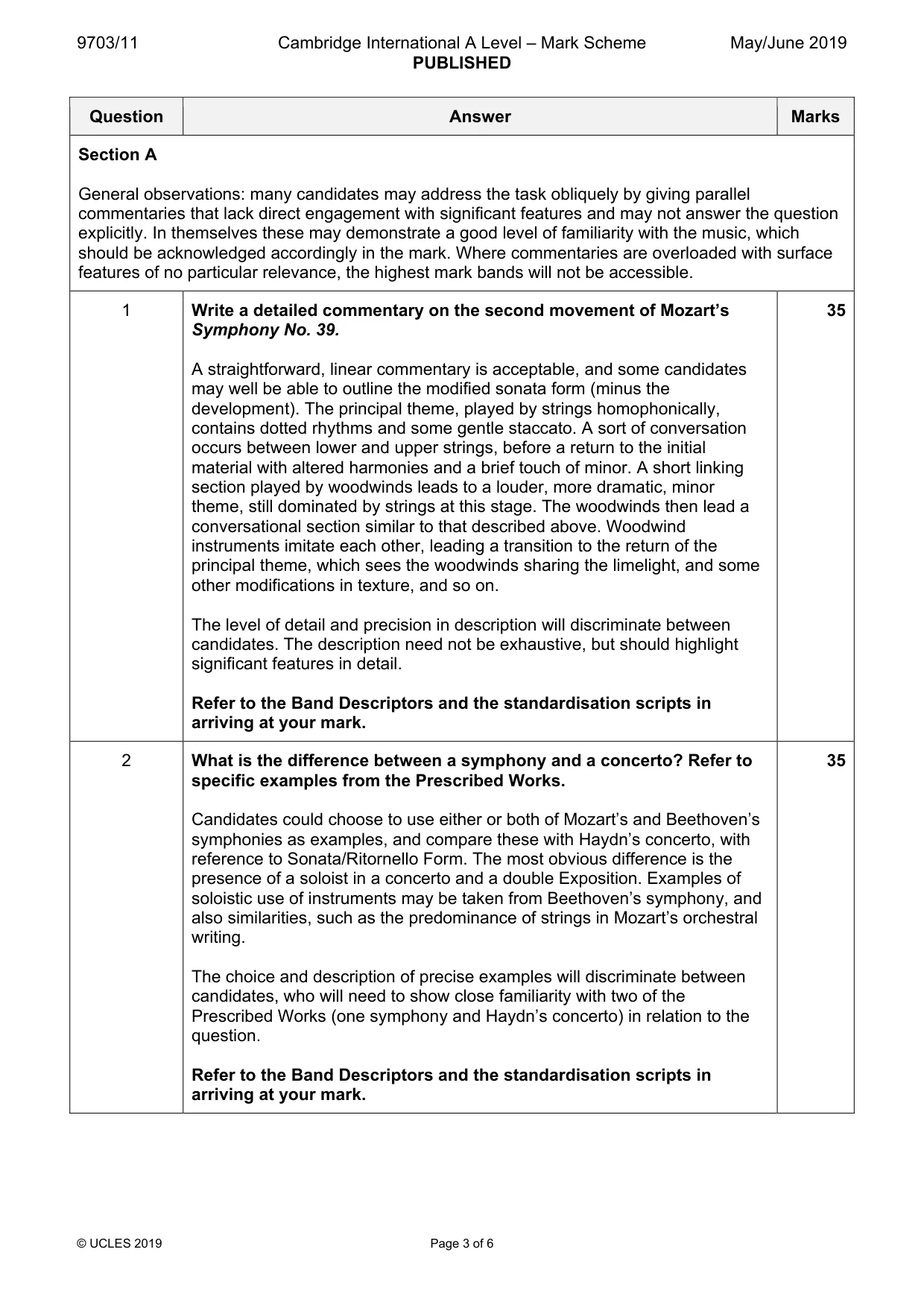
9703/11 Cambridge International A Level – Mark Scheme PUBLISHED May/June 2019 © UCLES 2019 Page 3 of 6 Question Answer Marks Section A General observations: many candidates may address the task obliquely by giving parallel commentaries that lack direct engagement with significant features and may not answer the question explicitly. In themselves these may demonstrate a good level of familiarity with the music, which should be acknowledged accordingly in the mark. Where commentaries are overloaded with surface features of no particular relevance, the highest mark bands will not be accessible. 1 Write a detailed commentary on the second movement of Mozart’s Symphony No. 39. A straightforward, linear commentary is acceptable, and some candidates may well be able to outline the modified sonata form (minus the development). The principal theme, played by strings homophonically, contains dotted rhythms and some gentle staccato. A sort of conversation occurs between lower and upper strings, before a return to the initial material with altered harmonies and a brief touch of minor. A short linking section played by woodwinds leads to a louder, more dramatic, minor theme, still dominated by strings at this stage. The woodwinds then lead a conversational section similar to that described above. Woodwind instruments imitate each other, leading a transition to the return of the principal theme, which sees the woodwinds sharing the limelight, and some other modifications in texture, and so on. The level of detail and precision in description will discriminate between candidates. The description need not be exhaustive, but should highlight significant features in detail. Refer to the Band Descriptors and the standardisation scripts in arriving at your mark. 35 2 What is the difference between a symphony and a concerto? Refer to specific examples from the Prescribed Works. Candidates could choose to use either or both of Mozart’s and Beethoven’s symphonies as examples, and compare these with Haydn’s concerto, with reference to Sonata/Ritornello Form. The most obvious difference is the presence of a soloist in a concerto and a double Exposition. Examples of soloistic use of instruments may be taken from Beethoven’s symphony, and also similarities, such as the predominance of strings in Mozart’s orchestral writing. The choice and description of precise examples will discriminate between candidates, who will need to show close familiarity with two of the Prescribed Works (one symphony and Haydn’s concerto) in relation to the question. Refer to the Band Descriptors and the standardisation scripts in arriving at your mark. 35
Mark scheme, page 4
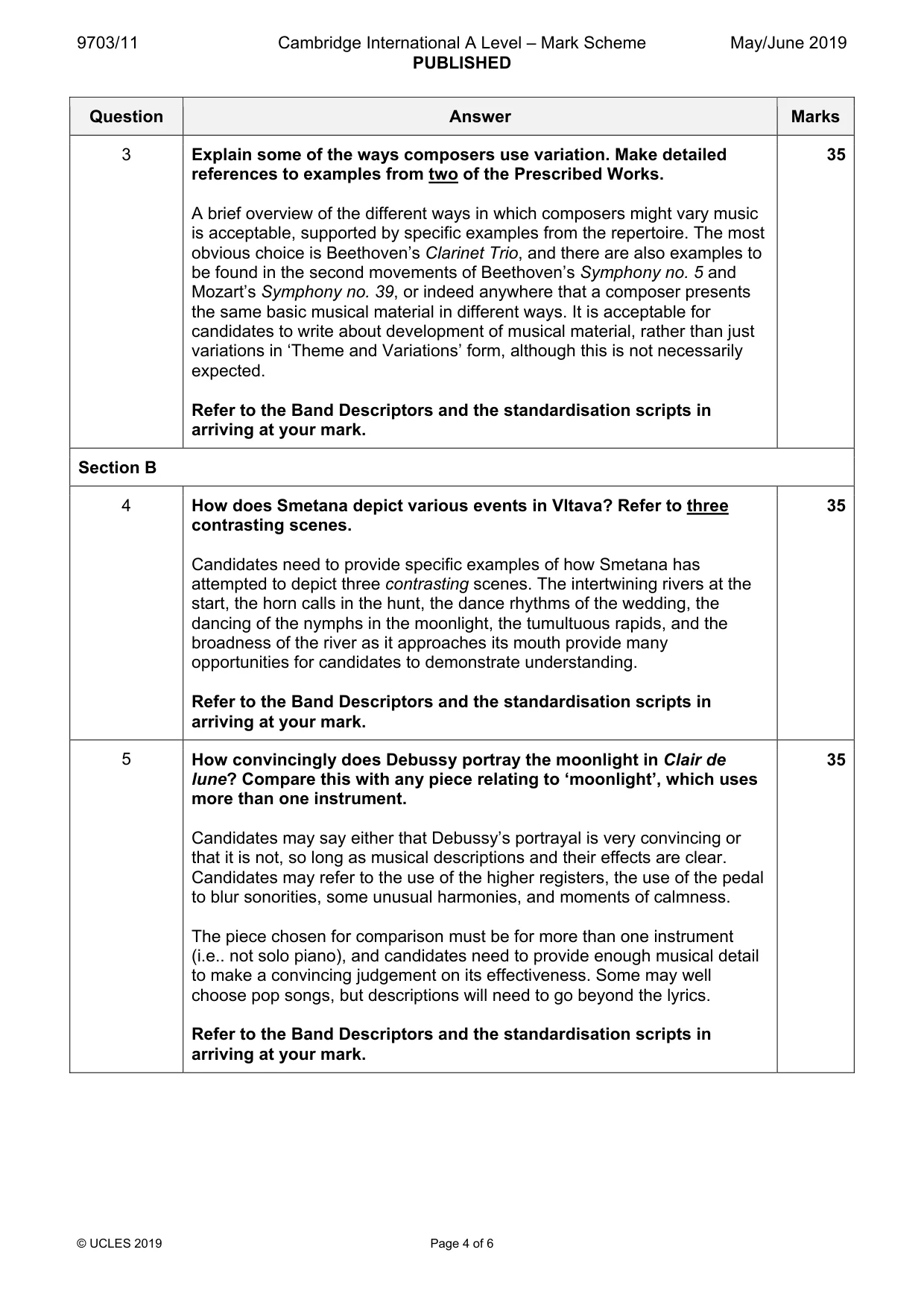
9703/11 Cambridge International A Level – Mark Scheme PUBLISHED May/June 2019 © UCLES 2019 Page 4 of 6 Question Answer Marks 3 Explain some of the ways composers use variation. Make detailed references to examples from two of the Prescribed Works. A brief overview of the different ways in which composers might vary music is acceptable, supported by specific examples from the repertoire. The most obvious choice is Beethoven’s Clarinet Trio, and there are also examples to be found in the second movements of Beethoven’s Symphony no. 5 and Mozart’s Symphony no. 39, or indeed anywhere that a composer presents the same basic musical material in different ways. It is acceptable for candidates to write about development of musical material, rather than just variations in ‘Theme and Variations’ form, although this is not necessarily expected. Refer to the Band Descriptors and the standardisation scripts in arriving at your mark. 35 Section B 4 How does Smetana depict various events in Vltava? Refer to three contrasting scenes. Candidates need to provide specific examples of how Smetana has attempted to depict three contrasting scenes. The intertwining rivers at the start, the horn calls in the hunt, the dance rhythms of the wedding, the dancing of the nymphs in the moonlight, the tumultuous rapids, and the broadness of the river as it approaches its mouth provide many opportunities for candidates to demonstrate understanding. Refer to the Band Descriptors and the standardisation scripts in arriving at your mark. 35 5 How convincingly does Debussy portray the moonlight in Clair de lune? Compare this with any piece relating to ‘moonlight’, which uses more than one instrument. Candidates may say either that Debussy’s portrayal is very convincing or that it is not, so long as musical descriptions and their effects are clear. Candidates may refer to the use of the higher registers, the use of the pedal to blur sonorities, some unusual harmonies, and moments of calmness. The piece chosen for comparison must be for more than one instrument (i.e.. not solo piano), and candidates need to provide enough musical detail to make a convincing judgement on its effectiveness. Some may well choose pop songs, but descriptions will need to go beyond the lyrics. Refer to the Band Descriptors and the standardisation scripts in arriving at your mark. 35
Mark scheme, page 5
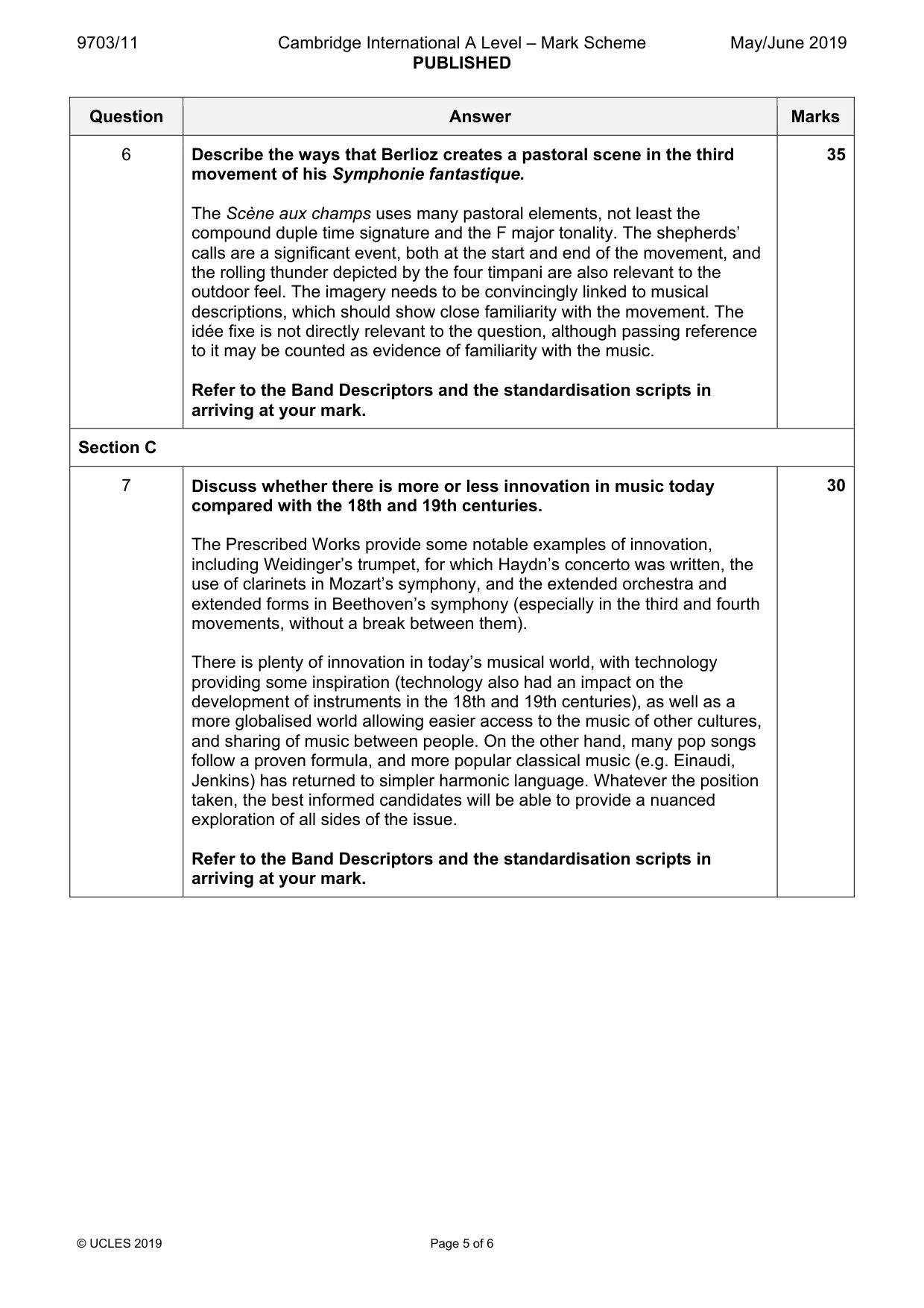
9703/11 Cambridge International A Level – Mark Scheme PUBLISHED May/June 2019 © UCLES 2019 Page 5 of 6 Question Answer Marks 6 Describe the ways that Berlioz creates a pastoral scene in the third movement of his Symphonie fantastique. The Scène aux champs uses many pastoral elements, not least the compound duple time signature and the F major tonality. The shepherds’ calls are a significant event, both at the start and end of the movement, and the rolling thunder depicted by the four timpani are also relevant to the outdoor feel. The imagery needs to be convincingly linked to musical descriptions, which should show close familiarity with the movement. The idée fixe is not directly relevant to the question, although passing reference to it may be counted as evidence of familiarity with the music. Refer to the Band Descriptors and the standardisation scripts in arriving at your mark. 35 Section C 7 Discuss whether there is more or less innovation in music today compared with the 18th and 19th centuries. The Prescribed Works provide some notable examples of innovation, including Weidinger’s trumpet, for which Haydn’s concerto was written, the use of clarinets in Mozart’s symphony, and the extended orchestra and extended forms in Beethoven’s symphony (especially in the third and fourth movements, without a break between them). There is plenty of innovation in today’s musical world, with technology providing some inspiration (technology also had an impact on the development of instruments in the 18th and 19th centuries), as well as a more globalised world allowing easier access to the music of other cultures, and sharing of music between people. On the other hand, many pop songs follow a proven formula, and more popular classical music (e.g. Einaudi, Jenkins) has returned to simpler harmonic language. Whatever the position taken, the best informed candidates will be able to provide a nuanced exploration of all sides of the issue. Refer to the Band Descriptors and the standardisation scripts in arriving at your mark. 30
Mark scheme, page 6
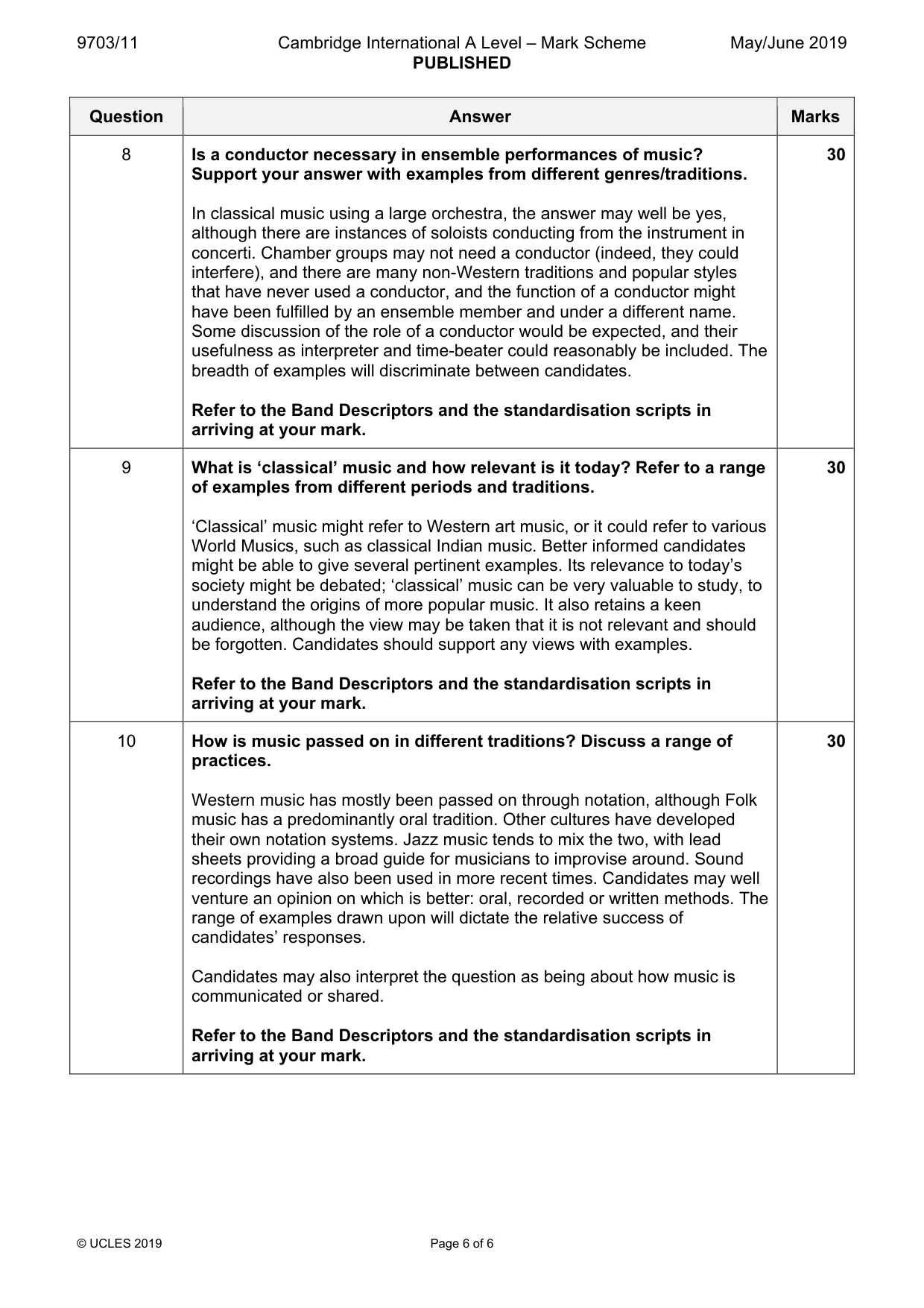
9703/11 Cambridge International A Level – Mark Scheme PUBLISHED May/June 2019 © UCLES 2019 Page 6 of 6 Question Answer Marks 8 Is a conductor necessary in ensemble performances of music? Support your answer with examples from different genres/traditions. In classical music using a large orchestra, the answer may well be yes, although there are instances of soloists conducting from the instrument in concerti. Chamber groups may not need a conductor (indeed, they could interfere), and there are many non-Western traditions and popular styles that have never used a conductor, and the function of a conductor might have been fulfilled by an ensemble member and under a different name. Some discussion of the role of a conductor would be expected, and their usefulness as interpreter and time-beater could reasonably be included. The breadth of examples will discriminate between candidates. Refer to the Band Descriptors and the standardisation scripts in arriving at your mark. 30 9 What is ‘classical’ music and how relevant is it today? Refer to a range of examples from different periods and traditions. ‘Classical’ music might refer to Western art music, or it could refer to various World Musics, such as classical Indian music. Better informed candidates might be able to give several pertinent examples. Its relevance to today’s society might be debated; ‘classical’ music can be very valuable to study, to understand the origins of more popular music. It also retains a keen audience, although the view may be taken that it is not relevant and should be forgotten. Candidates should support any views with examples. Refer to the Band Descriptors and the standardisation scripts in arriving at your mark. 30 10 How is music passed on in different traditions? Discuss a range of practices. Western music has mostly been passed on through notation, although Folk music has a predominantly oral tradition. Other cultures have developed their own notation systems. Jazz music tends to mix the two, with lead sheets providing a broad guide for musicians to improvise around. Sound recordings have also been used in more recent times. Candidates may well venture an opinion on which is better: oral, recorded or written methods. The range of examples drawn upon will dictate the relative success of candidates’ responses. Candidates may also interpret the question as being about how music is communicated or shared. Refer to the Band Descriptors and the standardisation scripts in arriving at your mark. 30
What you needed in this session
Cambridge’s own grade thresholds for 2019 May/June, Paper 1 · Variant 1. A higher threshold means an easier paper — the bar moves with how the cohort did.