Cambridge A Level Music 9703 — 2019 May/June Paper 1 · Variant 2
9703/12/M/J/19 · 100 marks · ≈113 min
The question paper and its mark scheme, free to read here and free to download. This is Cambridge’s own paper, exactly as it was sat.
Question paper4 pages


Mark scheme6 pages
Answers below. Sit the paper first if you are practising.
Paper as text
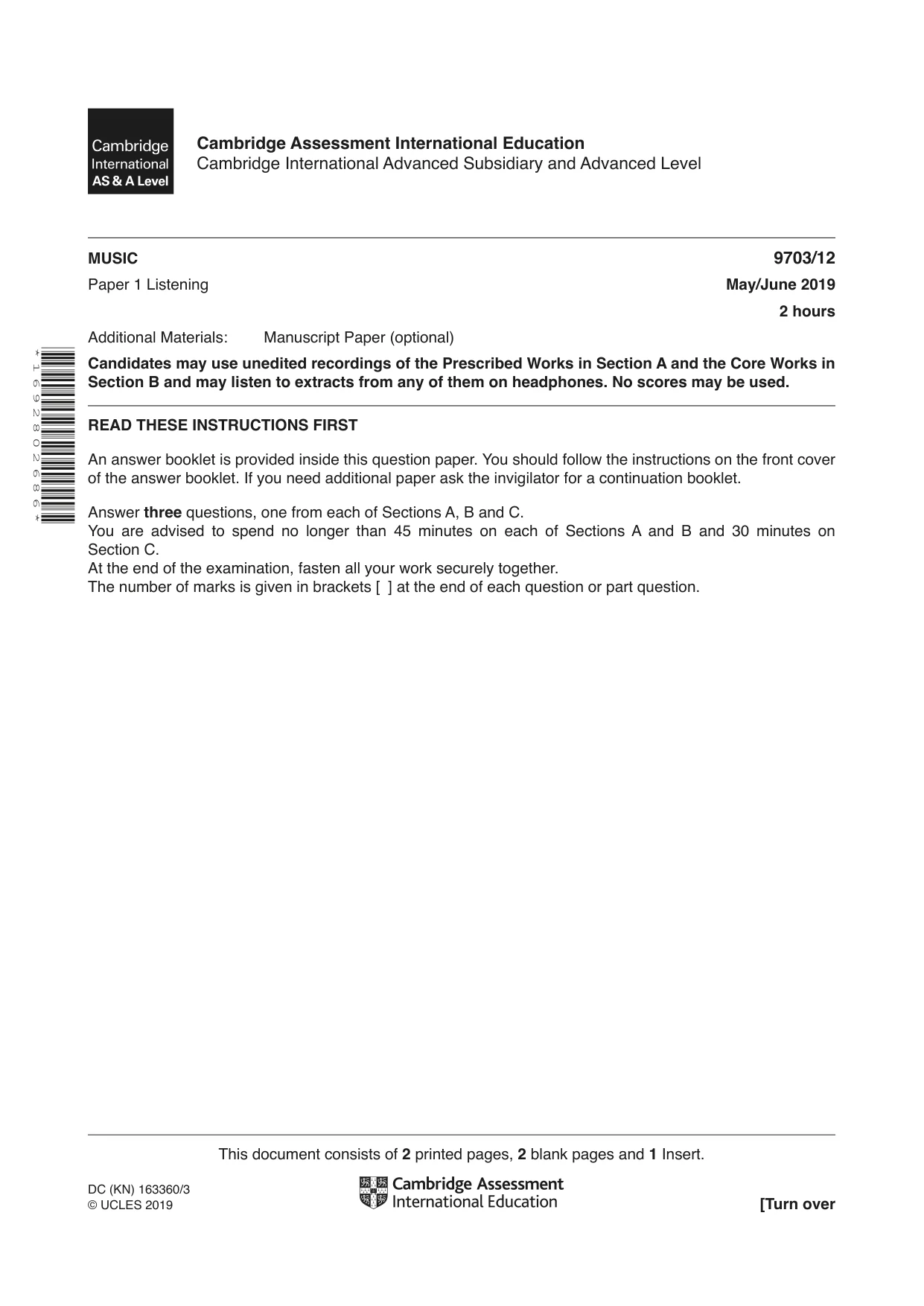
Question paper, page 1
This document consists of 2 printed pages, 2 blank pages and 1 Insert. DC (KN) 163360/3 © UCLES 2019 [Turn over Cambridge Assessment International Education Cambridge International Advanced Subsidiary and Advanced Level * 1 6 9 2 8 0 2 6 8 6 * MUSIC 9703/12 Paper 1 Listening May/June 2019 2 hours Additional Materials: Manuscript Paper (optional) Candidates may use unedited recordings of the Prescribed Works in Section A and the Core Works in Section B and may listen to extracts from any of them on headphones. No scores may be used. READ THESE INSTRUCTIONS FIRST An answer booklet is provided inside this question paper. You should follow the instructions on the front cover of the answer booklet. If you need additional paper ask the invigilator for a continuation booklet. Answer three questions, one from each of Sections A, B and C. You are advised to spend no longer than 45 minutes on each of Sections A and B and 30 minutes on Section C. At the end of the examination, fasten all your work securely together. The number of marks is given in brackets [ ] at the end of each question or part question.
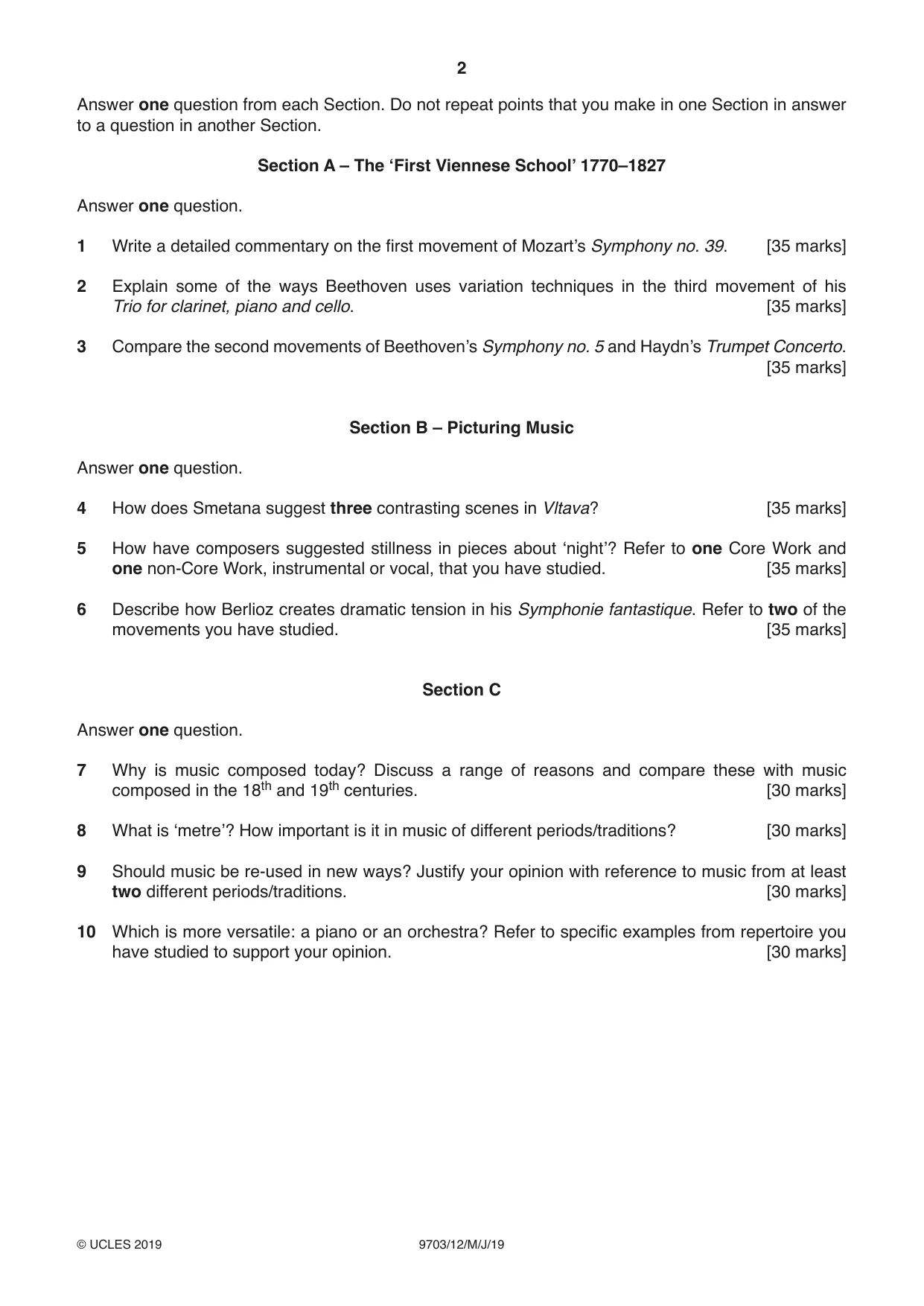
Question paper, page 2
2 9703/12/M/J/19 © UCLES 2019 Answer one question from each Section. Do not repeat points that you make in one Section in answer to a question in another Section. Section A – The ‘First Viennese School’ 1770–1827 Answer one question. 1 Write a detailed commentary on the first movement of Mozart’s Symphony no. 39. [35 marks] 2 Explain some of the ways Beethoven uses variation techniques in the third movement of his Trio for clarinet, piano and cello. [35 marks] 3 Compare the second movements of Beethoven’s Symphony no. 5 and Haydn’s Trumpet Concerto. [35 marks] Section B – Picturing Music Answer one question. 4 How does Smetana suggest three contrasting scenes in Vltava? [35 marks] 5 How have composers suggested stillness in pieces about ‘night’? Refer to one Core Work and one non-Core Work, instrumental or vocal, that you have studied. [35 marks] 6 Describe how Berlioz creates dramatic tension in his Symphonie fantastique. Refer to two of the movements you have studied. [35 marks] Section C Answer one question. 7 Why is music composed today? Discuss a range of reasons and compare these with music composed in the 18th and 19th centuries. [30 marks] 8 What is ‘metre’? How important is it in music of different periods/traditions? [30 marks] 9 Should music be re-used in new ways? Justify your opinion with reference to music from at least two different periods/traditions. [30 marks] 10 Which is more versatile: a piano or an orchestra? Refer to specific examples from repertoire you have studied to support your opinion. [30 marks]
Question paper, page 3
3 9703/12/M/J/19 © UCLES 2019 BLANK PAGE
Question paper, page 4
4 9703/12/M/J/19 © UCLES 2019 BLANK PAGE Permission to reproduce items where third-party owned material protected by copyright is included has been sought and cleared where possible. Every reasonable effort has been made by the publisher (UCLES) to trace copyright holders, but if any items requiring clearance have unwittingly been included, the publisher will be pleased to make amends at the earliest possible opportunity. To avoid the issue of disclosure of answer-related information to candidates, all copyright acknowledgements are reproduced online in the Cambridge Assessment International Education Copyright Acknowledgements Booklet. This is produced for each series of examinations and is freely available to download at www.cambridgeinternational.org after the live examination series. Cambridge Assessment International Education is part of the Cambridge Assessment Group. Cambridge Assessment is the brand name of the University of Cambridge Local Examinations Syndicate (UCLES), which itself is a department of the University of Cambridge.
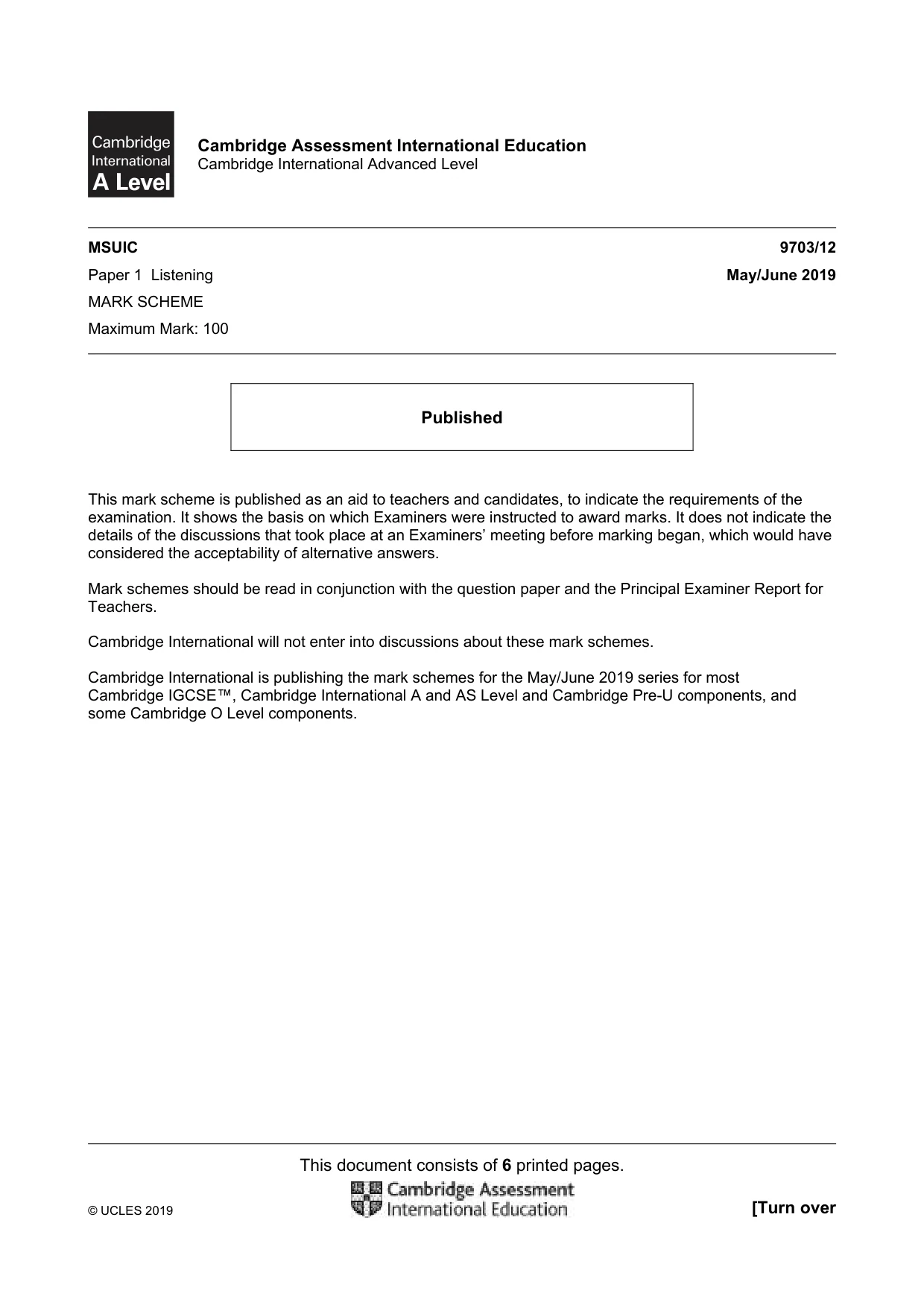
Mark scheme, page 1
This document consists of 6 printed pages. © UCLES 2019 [Turn over Cambridge Assessment International Education Cambridge International Advanced Level MSUIC 9703/12 Paper 1 Listening May/June 2019 MARK SCHEME Maximum Mark: 100 Published This mark scheme is published as an aid to teachers and candidates, to indicate the requirements of the examination. It shows the basis on which Examiners were instructed to award marks. It does not indicate the details of the discussions that took place at an Examiners’ meeting before marking began, which would have considered the acceptability of alternative answers. Mark schemes should be read in conjunction with the question paper and the Principal Examiner Report for Teachers. Cambridge International will not enter into discussions about these mark schemes. Cambridge International is publishing the mark schemes for the May/June 2019 series for most Cambridge IGCSE™, Cambridge International A and AS Level and Cambridge Pre-U components, and some Cambridge O Level components.
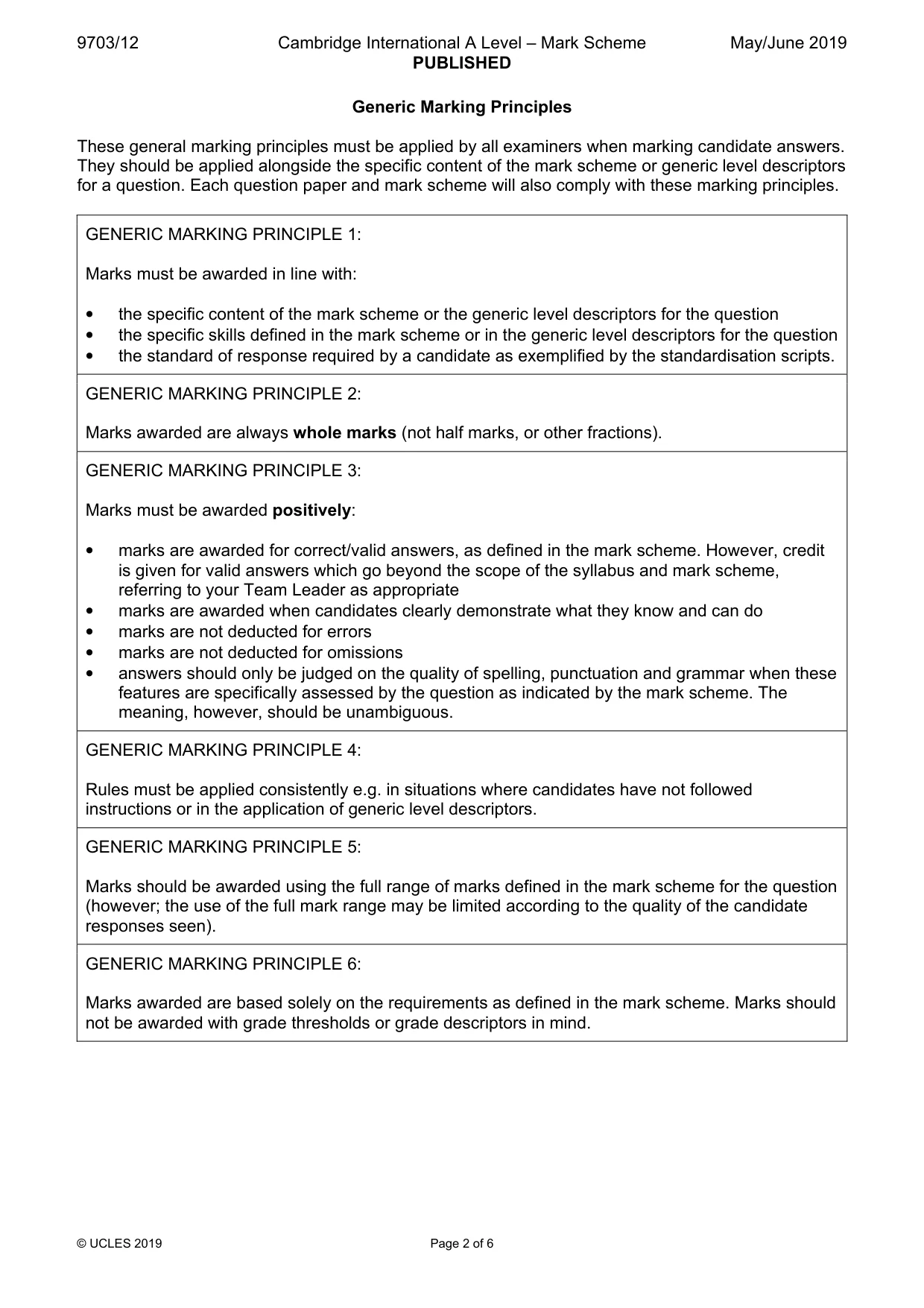
Mark scheme, page 2
9703/12 Cambridge International A Level – Mark Scheme PUBLISHED May/June 2019 © UCLES 2019 Page 2 of 6 Generic Marking Principles These general marking principles must be applied by all examiners when marking candidate answers. They should be applied alongside the specific content of the mark scheme or generic level descriptors for a question. Each question paper and mark scheme will also comply with these marking principles. GENERIC MARKING PRINCIPLE 1: Marks must be awarded in line with: • the specific content of the mark scheme or the generic level descriptors for the question • the specific skills defined in the mark scheme or in the generic level descriptors for the question • the standard of response required by a candidate as exemplified by the standardisation scripts. GENERIC MARKING PRINCIPLE 2: Marks awarded are always whole marks (not half marks, or other fractions). GENERIC MARKING PRINCIPLE 3: Marks must be awarded positively: • marks are awarded for correct/valid answers, as defined in the mark scheme. However, credit is given for valid answers which go beyond the scope of the syllabus and mark scheme, referring to your Team Leader as appropriate • marks are awarded when candidates clearly demonstrate what they know and can do • marks are not deducted for errors • marks are not deducted for omissions • answers should only be judged on the quality of spelling, punctuation and grammar when these features are specifically assessed by the question as indicated by the mark scheme. The meaning, however, should be unambiguous. GENERIC MARKING PRINCIPLE 4: Rules must be applied consistently e.g. in situations where candidates have not followed instructions or in the application of generic level descriptors. GENERIC MARKING PRINCIPLE 5: Marks should be awarded using the full range of marks defined in the mark scheme for the question (however; the use of the full mark range may be limited according to the quality of the candidate responses seen). GENERIC MARKING PRINCIPLE 6: Marks awarded are based solely on the requirements as defined in the mark scheme. Marks should not be awarded with grade thresholds or grade descriptors in mind.
Mark scheme, page 3
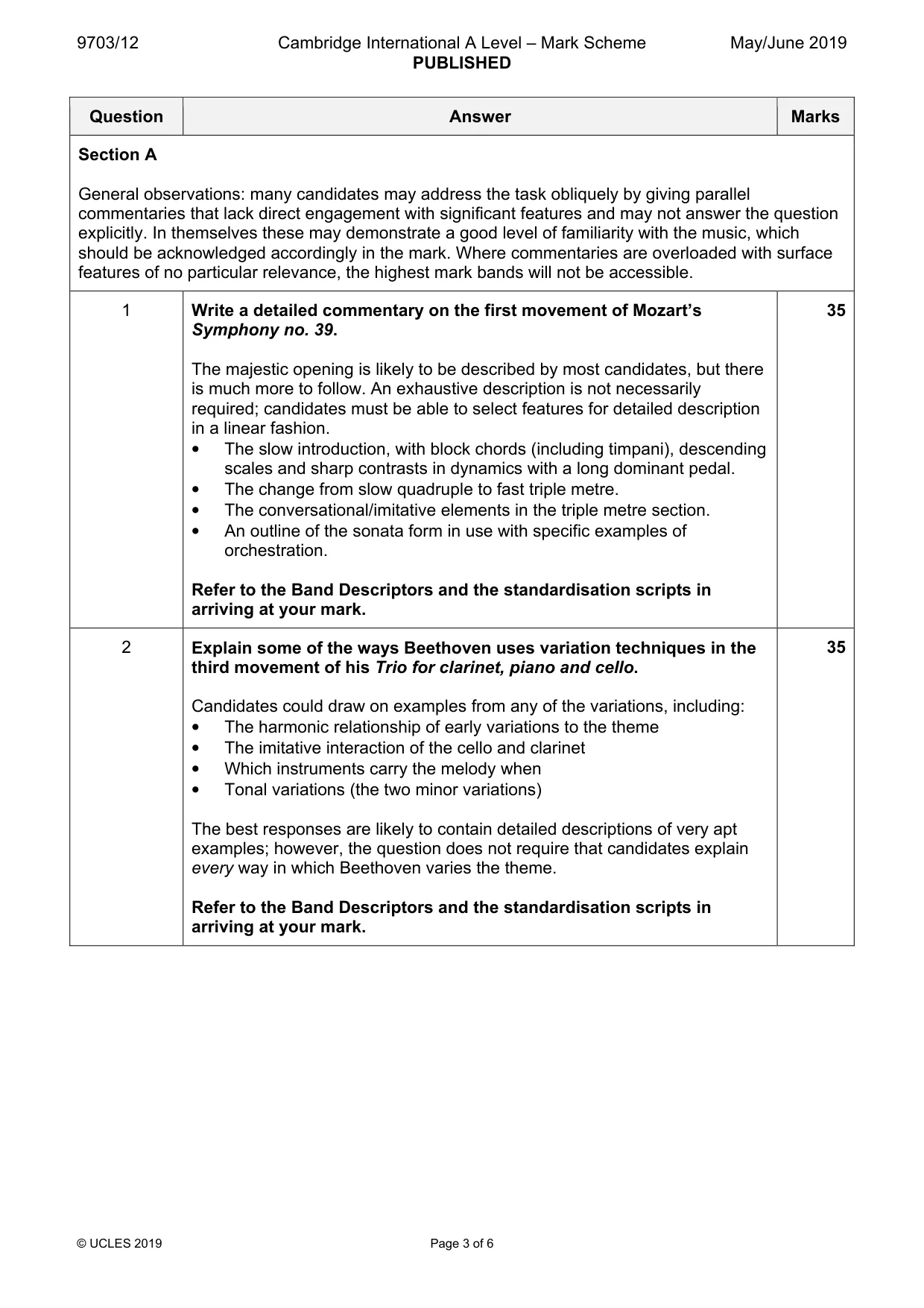
9703/12 Cambridge International A Level – Mark Scheme PUBLISHED May/June 2019 © UCLES 2019 Page 3 of 6 Question Answer Marks Section A General observations: many candidates may address the task obliquely by giving parallel commentaries that lack direct engagement with significant features and may not answer the question explicitly. In themselves these may demonstrate a good level of familiarity with the music, which should be acknowledged accordingly in the mark. Where commentaries are overloaded with surface features of no particular relevance, the highest mark bands will not be accessible. 1 Write a detailed commentary on the first movement of Mozart’s Symphony no. 39. The majestic opening is likely to be described by most candidates, but there is much more to follow. An exhaustive description is not necessarily required; candidates must be able to select features for detailed description in a linear fashion. • The slow introduction, with block chords (including timpani), descending scales and sharp contrasts in dynamics with a long dominant pedal. • The change from slow quadruple to fast triple metre. • The conversational/imitative elements in the triple metre section. • An outline of the sonata form in use with specific examples of orchestration. Refer to the Band Descriptors and the standardisation scripts in arriving at your mark. 35 2 Explain some of the ways Beethoven uses variation techniques in the third movement of his Trio for clarinet, piano and cello. Candidates could draw on examples from any of the variations, including: • The harmonic relationship of early variations to the theme • The imitative interaction of the cello and clarinet • Which instruments carry the melody when • Tonal variations (the two minor variations) The best responses are likely to contain detailed descriptions of very apt examples; however, the question does not require that candidates explain every way in which Beethoven varies the theme. Refer to the Band Descriptors and the standardisation scripts in arriving at your mark. 35
Mark scheme, page 4
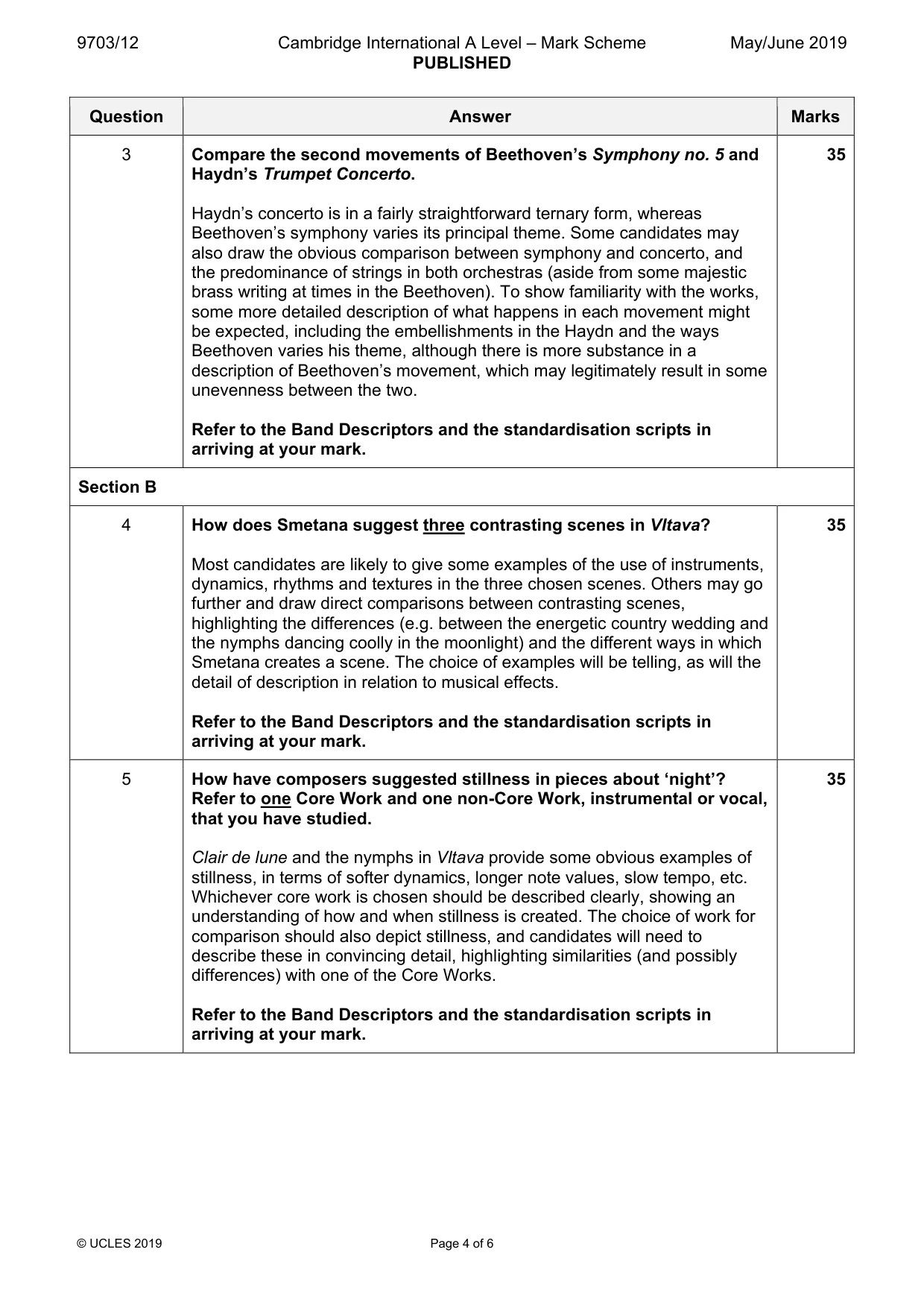
9703/12 Cambridge International A Level – Mark Scheme PUBLISHED May/June 2019 © UCLES 2019 Page 4 of 6 Question Answer Marks 3 Compare the second movements of Beethoven’s Symphony no. 5 and Haydn’s Trumpet Concerto. Haydn’s concerto is in a fairly straightforward ternary form, whereas Beethoven’s symphony varies its principal theme. Some candidates may also draw the obvious comparison between symphony and concerto, and the predominance of strings in both orchestras (aside from some majestic brass writing at times in the Beethoven). To show familiarity with the works, some more detailed description of what happens in each movement might be expected, including the embellishments in the Haydn and the ways Beethoven varies his theme, although there is more substance in a description of Beethoven’s movement, which may legitimately result in some unevenness between the two. Refer to the Band Descriptors and the standardisation scripts in arriving at your mark. 35 Section B 4 How does Smetana suggest three contrasting scenes in Vltava? Most candidates are likely to give some examples of the use of instruments, dynamics, rhythms and textures in the three chosen scenes. Others may go further and draw direct comparisons between contrasting scenes, highlighting the differences (e.g. between the energetic country wedding and the nymphs dancing coolly in the moonlight) and the different ways in which Smetana creates a scene. The choice of examples will be telling, as will the detail of description in relation to musical effects. Refer to the Band Descriptors and the standardisation scripts in arriving at your mark. 35 5 How have composers suggested stillness in pieces about ‘night’? Refer to one Core Work and one non-Core Work, instrumental or vocal, that you have studied. Clair de lune and the nymphs in Vltava provide some obvious examples of stillness, in terms of softer dynamics, longer note values, slow tempo, etc. Whichever core work is chosen should be described clearly, showing an understanding of how and when stillness is created. The choice of work for comparison should also depict stillness, and candidates will need to describe these in convincing detail, highlighting similarities (and possibly differences) with one of the Core Works. Refer to the Band Descriptors and the standardisation scripts in arriving at your mark. 35
Mark scheme, page 5
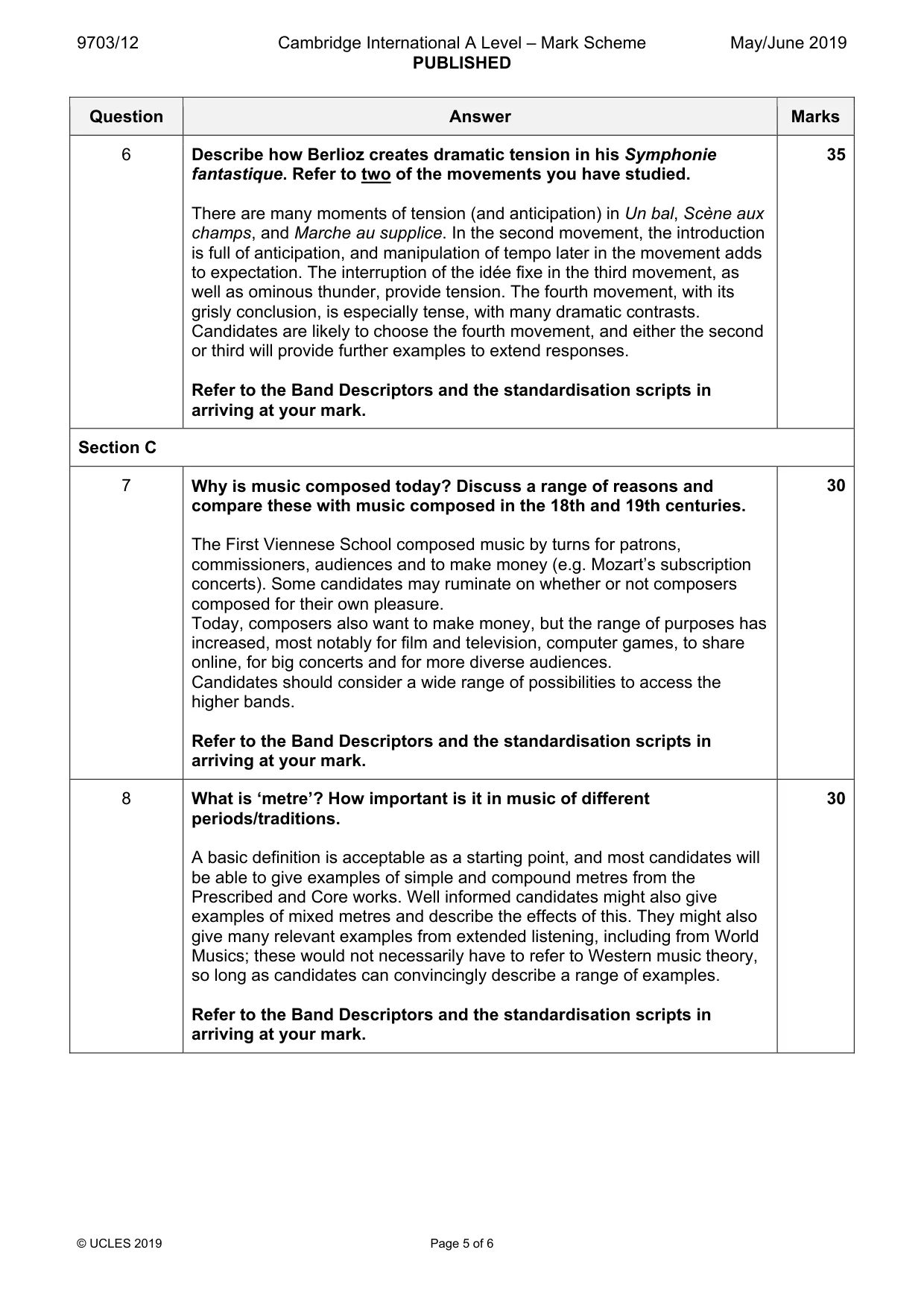
9703/12 Cambridge International A Level – Mark Scheme PUBLISHED May/June 2019 © UCLES 2019 Page 5 of 6 Question Answer Marks 6 Describe how Berlioz creates dramatic tension in his Symphonie fantastique. Refer to two of the movements you have studied. There are many moments of tension (and anticipation) in Un bal, Scène aux champs, and Marche au supplice. In the second movement, the introduction is full of anticipation, and manipulation of tempo later in the movement adds to expectation. The interruption of the idée fixe in the third movement, as well as ominous thunder, provide tension. The fourth movement, with its grisly conclusion, is especially tense, with many dramatic contrasts. Candidates are likely to choose the fourth movement, and either the second or third will provide further examples to extend responses. Refer to the Band Descriptors and the standardisation scripts in arriving at your mark. 35 Section C 7 Why is music composed today? Discuss a range of reasons and compare these with music composed in the 18th and 19th centuries. The First Viennese School composed music by turns for patrons, commissioners, audiences and to make money (e.g. Mozart’s subscription concerts). Some candidates may ruminate on whether or not composers composed for their own pleasure. Today, composers also want to make money, but the range of purposes has increased, most notably for film and television, computer games, to share online, for big concerts and for more diverse audiences. Candidates should consider a wide range of possibilities to access the higher bands. Refer to the Band Descriptors and the standardisation scripts in arriving at your mark. 30 8 What is ‘metre’? How important is it in music of different periods/traditions. A basic definition is acceptable as a starting point, and most candidates will be able to give examples of simple and compound metres from the Prescribed and Core works. Well informed candidates might also give examples of mixed metres and describe the effects of this. They might also give many relevant examples from extended listening, including from World Musics; these would not necessarily have to refer to Western music theory, so long as candidates can convincingly describe a range of examples. Refer to the Band Descriptors and the standardisation scripts in arriving at your mark. 30
Mark scheme, page 6
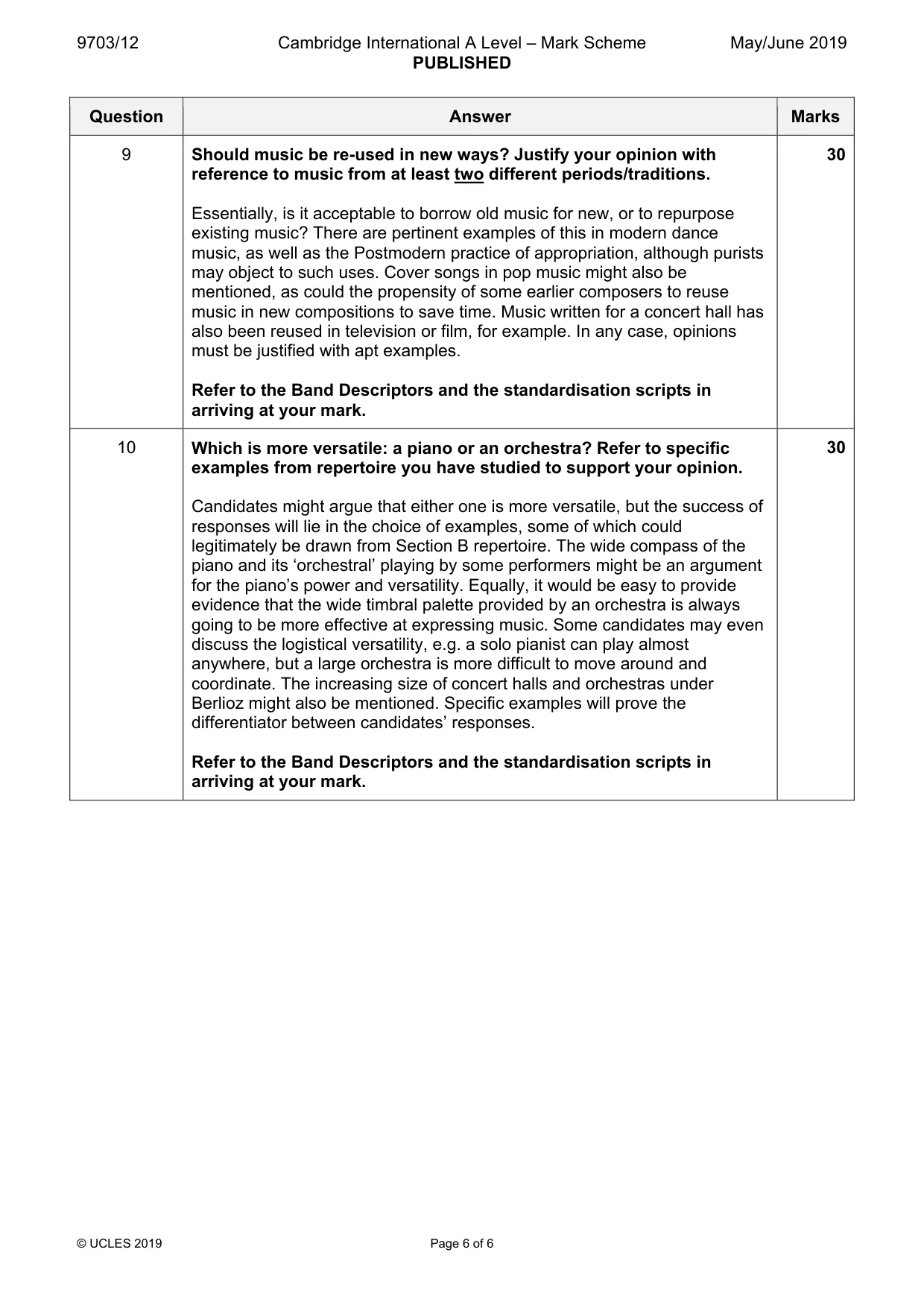
9703/12 Cambridge International A Level – Mark Scheme PUBLISHED May/June 2019 © UCLES 2019 Page 6 of 6 Question Answer Marks 9 Should music be re-used in new ways? Justify your opinion with reference to music from at least two different periods/traditions. Essentially, is it acceptable to borrow old music for new, or to repurpose existing music? There are pertinent examples of this in modern dance music, as well as the Postmodern practice of appropriation, although purists may object to such uses. Cover songs in pop music might also be mentioned, as could the propensity of some earlier composers to reuse music in new compositions to save time. Music written for a concert hall has also been reused in television or film, for example. In any case, opinions must be justified with apt examples. Refer to the Band Descriptors and the standardisation scripts in arriving at your mark. 30 10 Which is more versatile: a piano or an orchestra? Refer to specific examples from repertoire you have studied to support your opinion. Candidates might argue that either one is more versatile, but the success of responses will lie in the choice of examples, some of which could legitimately be drawn from Section B repertoire. The wide compass of the piano and its ‘orchestral’ playing by some performers might be an argument for the piano’s power and versatility. Equally, it would be easy to provide evidence that the wide timbral palette provided by an orchestra is always going to be more effective at expressing music. Some candidates may even discuss the logistical versatility, e.g. a solo pianist can play almost anywhere, but a large orchestra is more difficult to move around and coordinate. The increasing size of concert halls and orchestras under Berlioz might also be mentioned. Specific examples will prove the differentiator between candidates’ responses. Refer to the Band Descriptors and the standardisation scripts in arriving at your mark. 30
What you needed in this session
Cambridge’s own grade thresholds for 2019 May/June, Paper 1 · Variant 2. A higher threshold means an easier paper — the bar moves with how the cohort did.