Cambridge A Level Music 9703 — 2014 Oct/Nov Paper 1 · Variant 1
9703/11/O/N/14 · 100 marks · ≈113 min
The question paper and its mark scheme, free to read here and free to download. This is Cambridge’s own paper, exactly as it was sat.
Question paper2 pages
Mark scheme5 pages
Answers below. Sit the paper first if you are practising.
Paper as text
Question paper, page 1
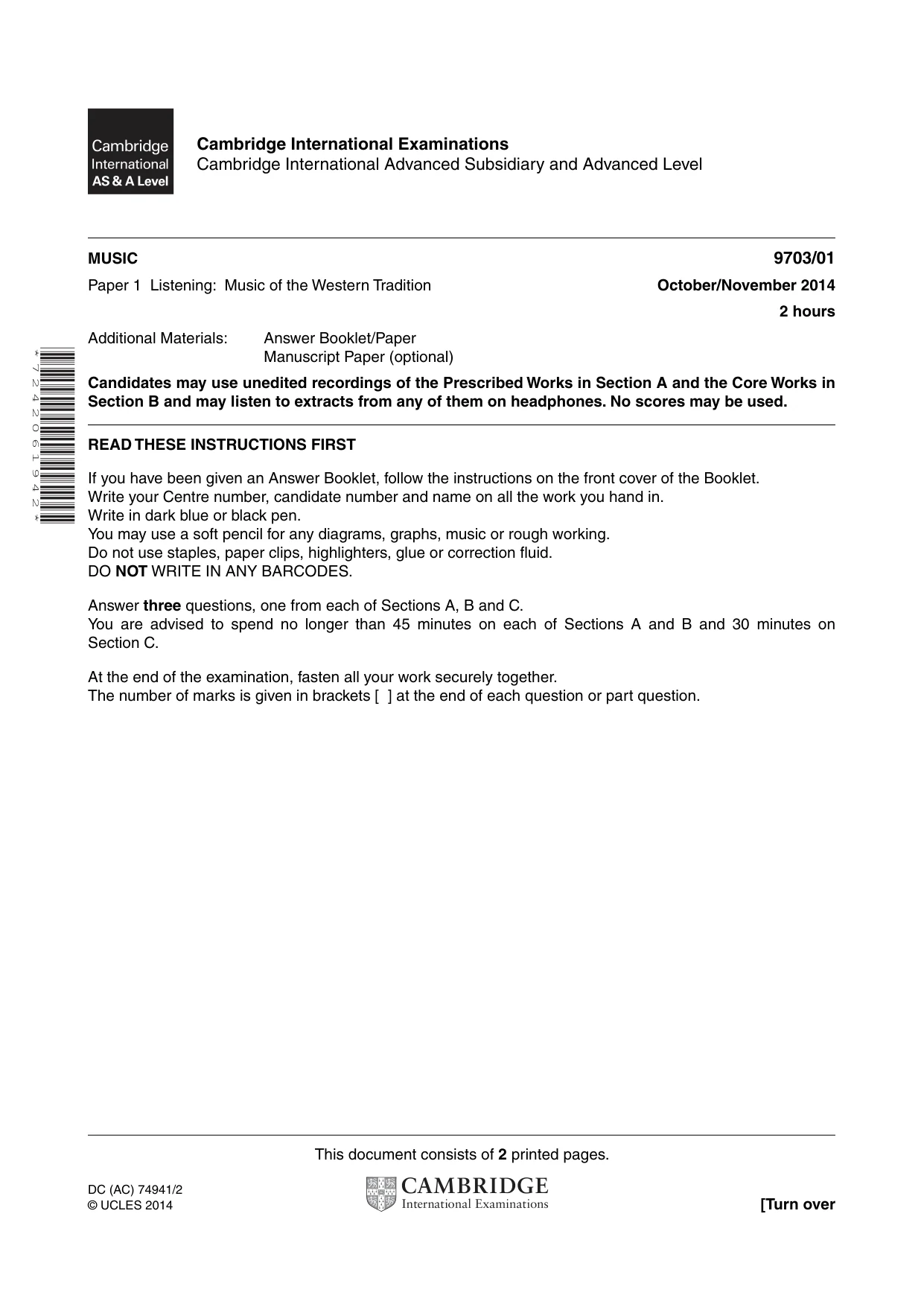
This document consists of 2 printed pages. DC (AC) 74941/2 © UCLES 2014 [Turn over Cambridge International Examinations Cambridge International Advanced Subsidiary and Advanced Level * 7 2 4 2 0 6 1 9 4 2 * MUSIC 9703/01 Paper 1 Listening: Music of the Western Tradition October/November 2014 2 hours Additional Materials: Answer Booklet/Paper Manuscript Paper (optional) Candidates may use unedited recordings of the Prescribed Works in Section A and the Core Works in Section B and may listen to extracts from any of them on headphones. No scores may be used. READ THESE INSTRUCTIONS FIRST If you have been given an Answer Booklet, follow the instructions on the front cover of the Booklet. Write your Centre number, candidate number and name on all the work you hand in. Write in dark blue or black pen. You may use a soft pencil for any diagrams, graphs, music or rough working. Do not use staples, paper clips, highlighters, glue or correction fluid. DO NOT WRITE IN ANY BARCODES. Answer three questions, one from each of Sections A, B and C. You are advised to spend no longer than 45 minutes on each of Sections A and B and 30 minutes on Section C. At the end of the examination, fasten all your work securely together. The number of marks is given in brackets [ ] at the end of each question or part question.
Question paper, page 2
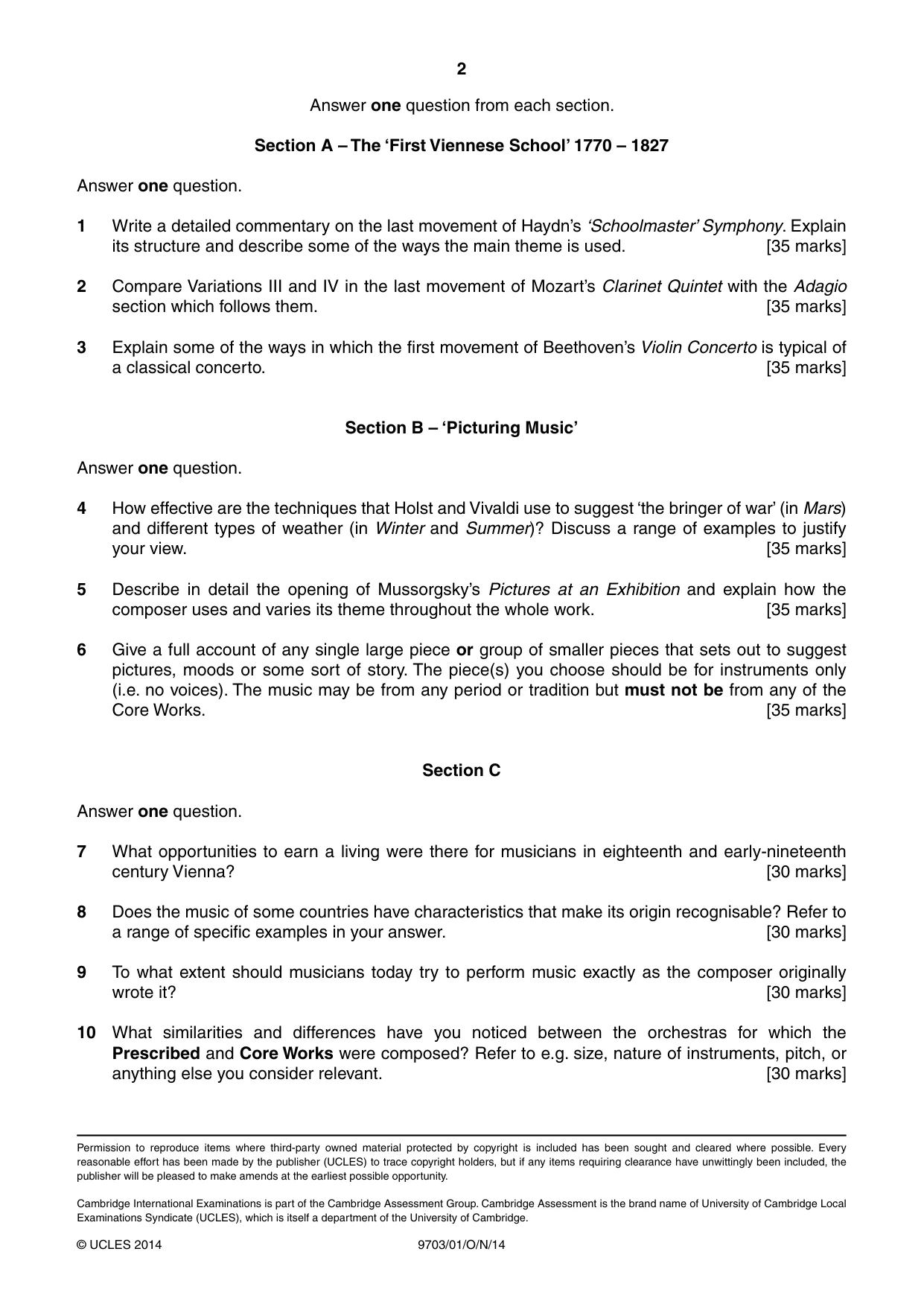
2 9703/01/O/N/14 © UCLES 2014 Permission to reproduce items where third-party owned material protected by copyright is included has been sought and cleared where possible. Every reasonable effort has been made by the publisher (UCLES) to trace copyright holders, but if any items requiring clearance have unwittingly been included, the publisher will be pleased to make amends at the earliest possible opportunity. Cambridge International Examinations is part of the Cambridge Assessment Group. Cambridge Assessment is the brand name of University of Cambridge Local Examinations Syndicate (UCLES), which is itself a department of the University of Cambridge. Answer one question from each section. Section A – The ‘First Viennese School’ 1770 – 1827 Answer one question. 1 Write a detailed commentary on the last movement of Haydn’s ‘Schoolmaster’ Symphony. Explain its structure and describe some of the ways the main theme is used. [35 marks] 2 Compare Variations III and IV in the last movement of Mozart’s Clarinet Quintet with the Adagio section which follows them. [35 marks] 3 Explain some of the ways in which the first movement of Beethoven’s Violin Concerto is typical of a classical concerto. [35 marks] Section B – ‘Picturing Music’ Answer one question. 4 How effective are the techniques that Holst and Vivaldi use to suggest ‘the bringer of war’ (in Mars) and different types of weather (in Winter and Summer)? Discuss a range of examples to justify your view. [35 marks] 5 Describe in detail the opening of Mussorgsky’s Pictures at an Exhibition and explain how the composer uses and varies its theme throughout the whole work. [35 marks] 6 Give a full account of any single large piece or group of smaller pieces that sets out to suggest pictures, moods or some sort of story. The piece(s) you choose should be for instruments only (i.e. no voices). The music may be from any period or tradition but must not be from any of the Core Works. [35 marks] Section C Answer one question. 7 What opportunities to earn a living were there for musicians in eighteenth and early-nineteenth century Vienna? [30 marks] 8 Does the music of some countries have characteristics that make its origin recognisable? Refer to a range of specific examples in your answer. [30 marks] 9 To what extent should musicians today try to perform music exactly as the composer originally wrote it? [30 marks] 10 What similarities and differences have you noticed between the orchestras for which the Prescribed and Core Works were composed? Refer to e.g. size, nature of instruments, pitch, or anything else you consider relevant. [30 marks]
Mark scheme, page 1
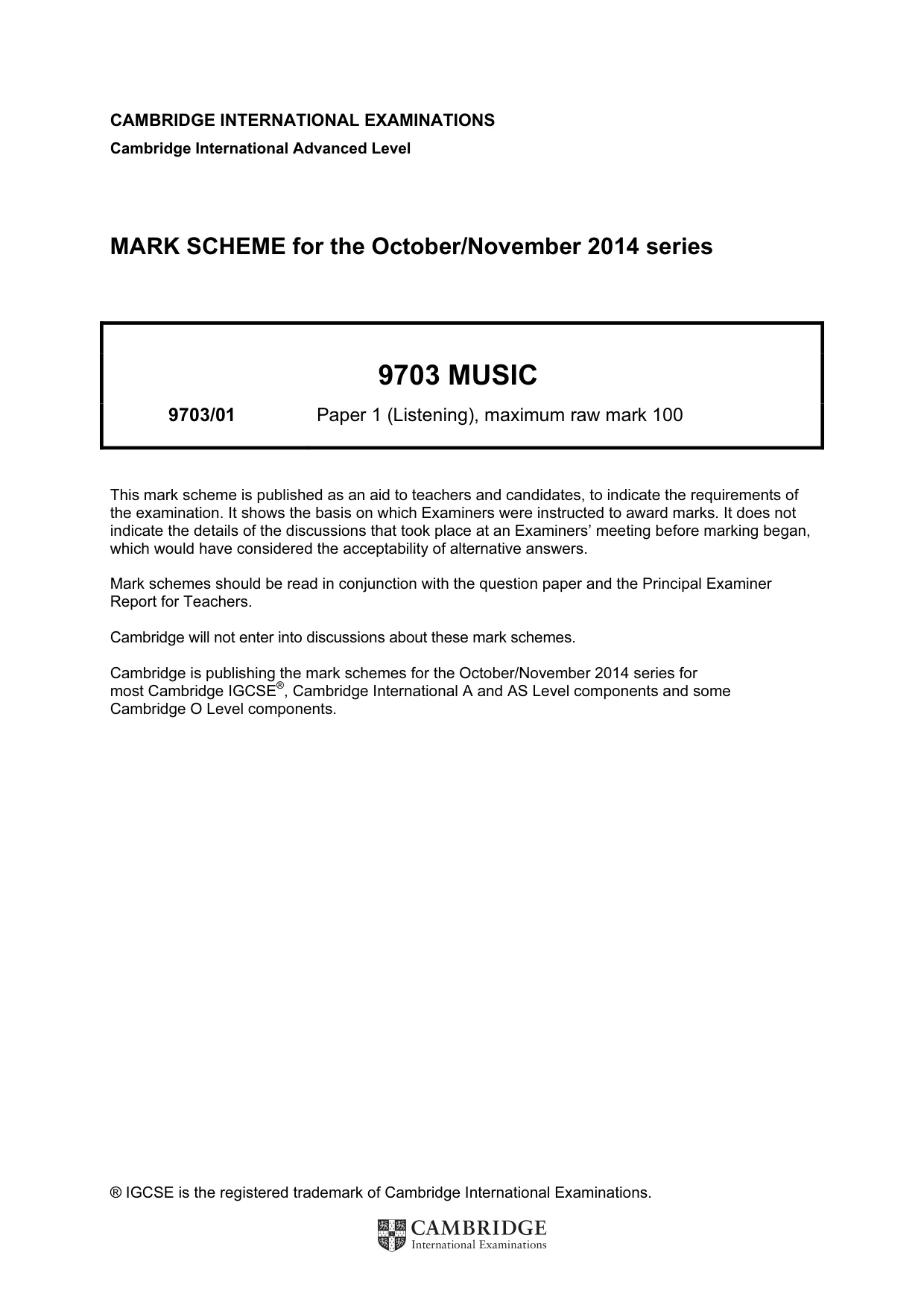
® IGCSE is the registered trademark of Cambridge International Examinations. CAMBRIDGE INTERNATIONAL EXAMINATIONS Cambridge International Advanced Level MARK SCHEME for the October/November 2014 series 9703 MUSIC 9703/01 Paper 1 (Listening), maximum raw mark 100 This mark scheme is published as an aid to teachers and candidates, to indicate the requirements of the examination. It shows the basis on which Examiners were instructed to award marks. It does not indicate the details of the discussions that took place at an Examiners’ meeting before marking began, which would have considered the acceptability of alternative answers. Mark schemes should be read in conjunction with the question paper and the Principal Examiner Report for Teachers. Cambridge will not enter into discussions about these mark schemes. Cambridge is publishing the mark schemes for the October/November 2014 series for most Cambridge IGCSE®, Cambridge International A and AS Level components and some Cambridge O Level components.
Mark scheme, page 2
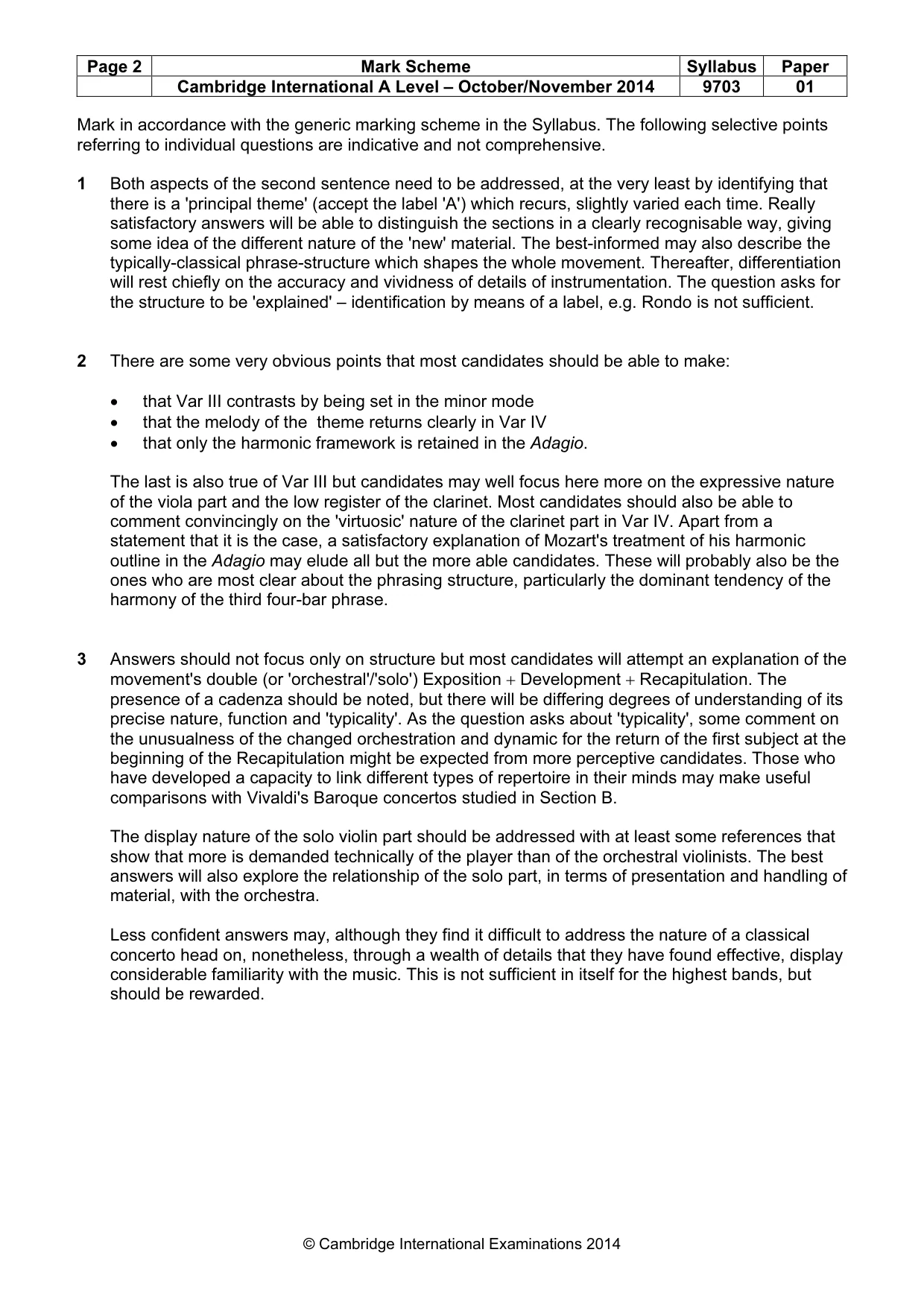
Page 2 Mark Scheme Syllabus Paper Cambridge International A Level – October/November 2014 9703 01 © Cambridge International Examinations 2014 Mark in accordance with the generic marking scheme in the Syllabus. The following selective points referring to individual questions are indicative and not comprehensive. 1 Both aspects of the second sentence need to be addressed, at the very least by identifying that there is a 'principal theme' (accept the label 'A') which recurs, slightly varied each time. Really satisfactory answers will be able to distinguish the sections in a clearly recognisable way, giving some idea of the different nature of the 'new' material. The best-informed may also describe the typically-classical phrase-structure which shapes the whole movement. Thereafter, differentiation will rest chiefly on the accuracy and vividness of details of instrumentation. The question asks for the structure to be 'explained' – identification by means of a label, e.g. Rondo is not sufficient. 2 There are some very obvious points that most candidates should be able to make: • that Var III contrasts by being set in the minor mode • that the melody of the theme returns clearly in Var IV • that only the harmonic framework is retained in the Adagio. The last is also true of Var III but candidates may well focus here more on the expressive nature of the viola part and the low register of the clarinet. Most candidates should also be able to comment convincingly on the 'virtuosic' nature of the clarinet part in Var IV. Apart from a statement that it is the case, a satisfactory explanation of Mozart's treatment of his harmonic outline in the Adagio may elude all but the more able candidates. These will probably also be the ones who are most clear about the phrasing structure, particularly the dominant tendency of the harmony of the third four-bar phrase. 3 Answers should not focus only on structure but most candidates will attempt an explanation of the movement's double (or 'orchestral'/'solo') Exposition + Development + Recapitulation. The presence of a cadenza should be noted, but there will be differing degrees of understanding of its precise nature, function and 'typicality'. As the question asks about 'typicality', some comment on the unusualness of the changed orchestration and dynamic for the return of the first subject at the beginning of the Recapitulation might be expected from more perceptive candidates. Those who have developed a capacity to link different types of repertoire in their minds may make useful comparisons with Vivaldi's Baroque concertos studied in Section B. The display nature of the solo violin part should be addressed with at least some references that show that more is demanded technically of the player than of the orchestral violinists. The best answers will also explore the relationship of the solo part, in terms of presentation and handling of material, with the orchestra. Less confident answers may, although they find it difficult to address the nature of a classical concerto head on, nonetheless, through a wealth of details that they have found effective, display considerable familiarity with the music. This is not sufficient in itself for the highest bands, but should be rewarded.
Mark scheme, page 3
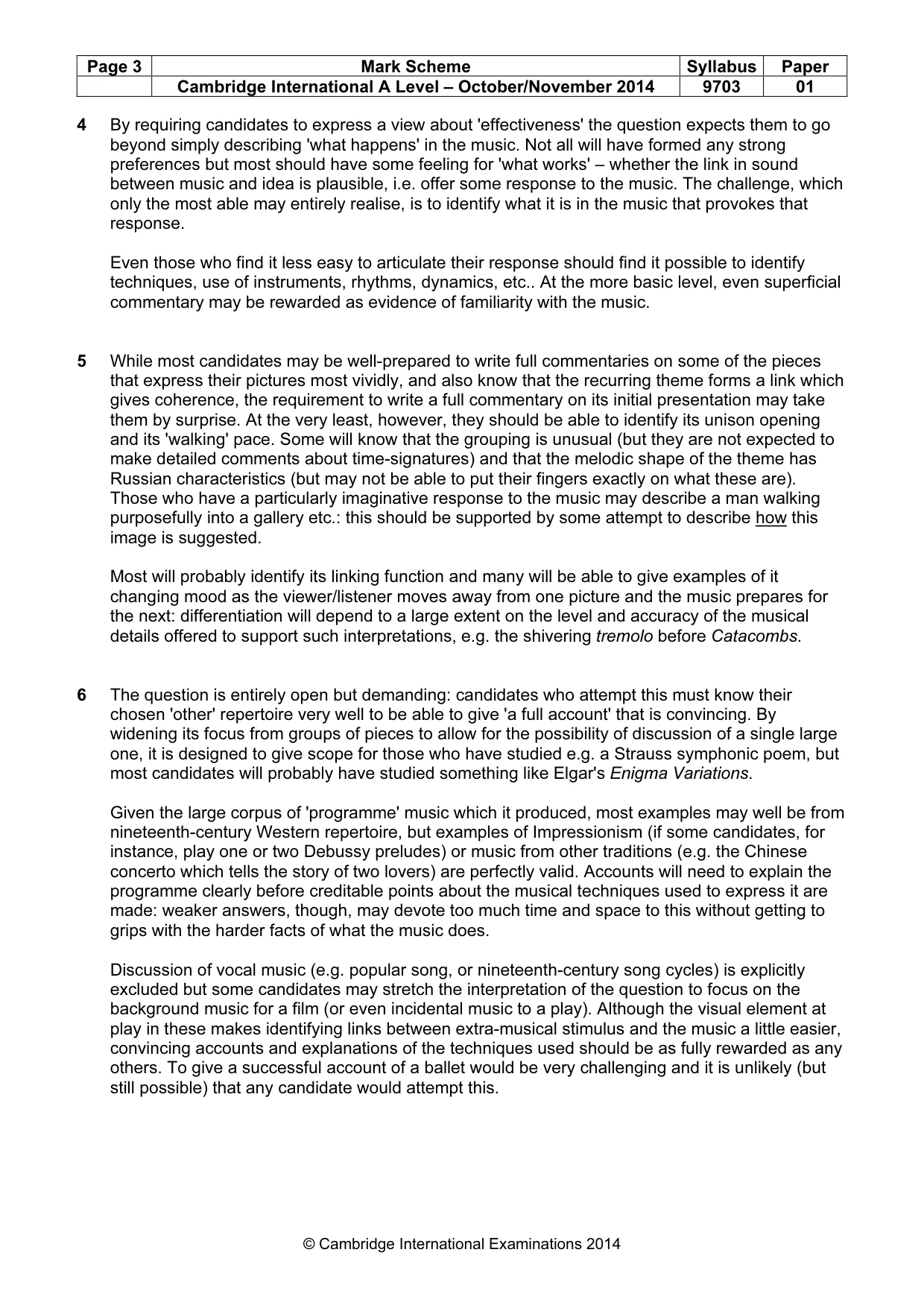
Page 3 Mark Scheme Syllabus Paper Cambridge International A Level – October/November 2014 9703 01 © Cambridge International Examinations 2014 4 By requiring candidates to express a view about 'effectiveness' the question expects them to go beyond simply describing 'what happens' in the music. Not all will have formed any strong preferences but most should have some feeling for 'what works' – whether the link in sound between music and idea is plausible, i.e. offer some response to the music. The challenge, which only the most able may entirely realise, is to identify what it is in the music that provokes that response. Even those who find it less easy to articulate their response should find it possible to identify techniques, use of instruments, rhythms, dynamics, etc.. At the more basic level, even superficial commentary may be rewarded as evidence of familiarity with the music. 5 While most candidates may be well-prepared to write full commentaries on some of the pieces that express their pictures most vividly, and also know that the recurring theme forms a link which gives coherence, the requirement to write a full commentary on its initial presentation may take them by surprise. At the very least, however, they should be able to identify its unison opening and its 'walking' pace. Some will know that the grouping is unusual (but they are not expected to make detailed comments about time-signatures) and that the melodic shape of the theme has Russian characteristics (but may not be able to put their fingers exactly on what these are). Those who have a particularly imaginative response to the music may describe a man walking purposefully into a gallery etc.: this should be supported by some attempt to describe how this image is suggested. Most will probably identify its linking function and many will be able to give examples of it changing mood as the viewer/listener moves away from one picture and the music prepares for the next: differentiation will depend to a large extent on the level and accuracy of the musical details offered to support such interpretations, e.g. the shivering tremolo before Catacombs. 6 The question is entirely open but demanding: candidates who attempt this must know their chosen 'other' repertoire very well to be able to give 'a full account' that is convincing. By widening its focus from groups of pieces to allow for the possibility of discussion of a single large one, it is designed to give scope for those who have studied e.g. a Strauss symphonic poem, but most candidates will probably have studied something like Elgar's Enigma Variations. Given the large corpus of 'programme' music which it produced, most examples may well be from nineteenth-century Western repertoire, but examples of Impressionism (if some candidates, for instance, play one or two Debussy preludes) or music from other traditions (e.g. the Chinese concerto which tells the story of two lovers) are perfectly valid. Accounts will need to explain the programme clearly before creditable points about the musical techniques used to express it are made: weaker answers, though, may devote too much time and space to this without getting to grips with the harder facts of what the music does. Discussion of vocal music (e.g. popular song, or nineteenth-century song cycles) is explicitly excluded but some candidates may stretch the interpretation of the question to focus on the background music for a film (or even incidental music to a play). Although the visual element at play in these makes identifying links between extra-musical stimulus and the music a little easier, convincing accounts and explanations of the techniques used should be as fully rewarded as any others. To give a successful account of a ballet would be very challenging and it is unlikely (but still possible) that any candidate would attempt this.
Mark scheme, page 4
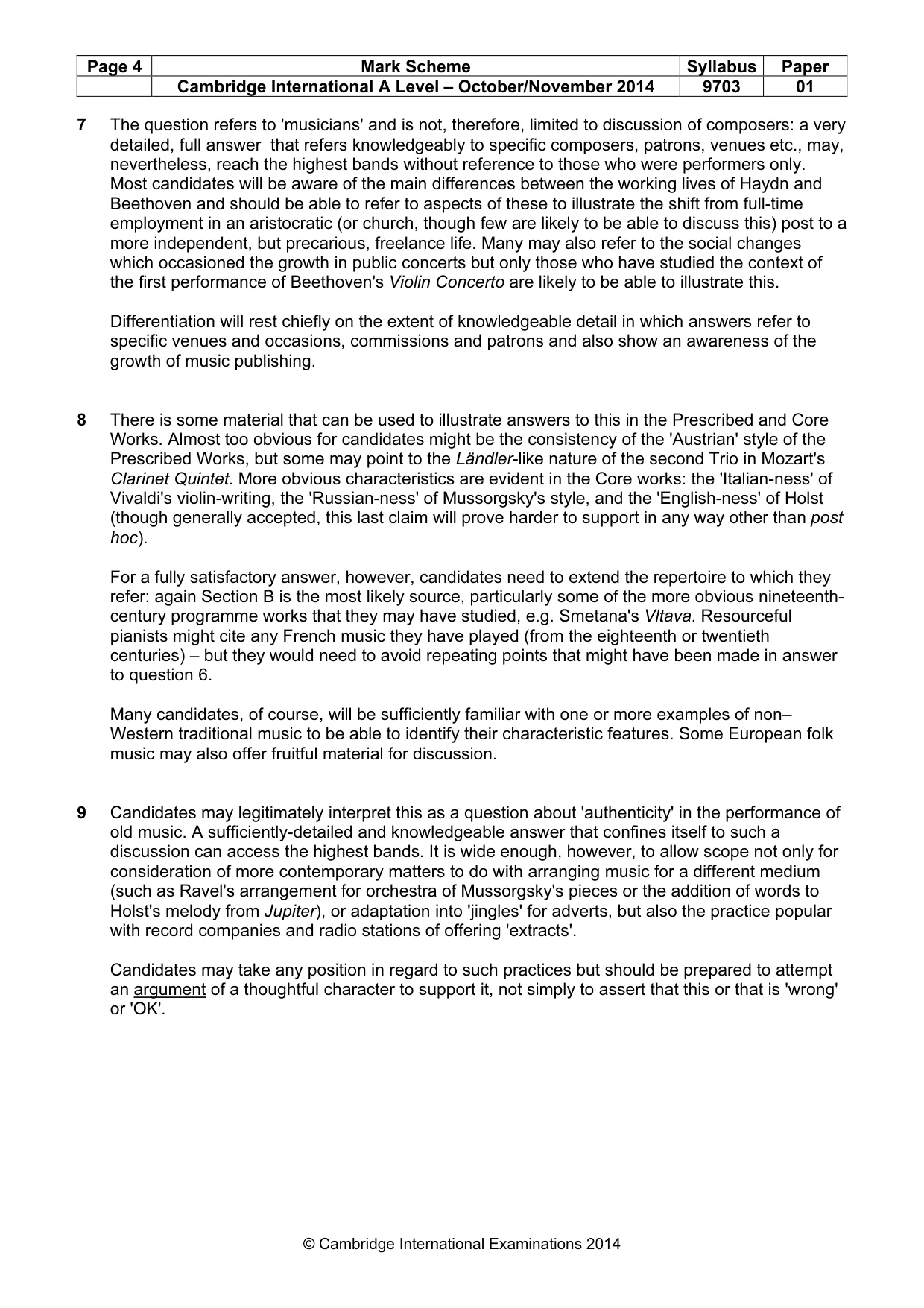
Page 4 Mark Scheme Syllabus Paper Cambridge International A Level – October/November 2014 9703 01 © Cambridge International Examinations 2014 7 The question refers to 'musicians' and is not, therefore, limited to discussion of composers: a very detailed, full answer that refers knowledgeably to specific composers, patrons, venues etc., may, nevertheless, reach the highest bands without reference to those who were performers only. Most candidates will be aware of the main differences between the working lives of Haydn and Beethoven and should be able to refer to aspects of these to illustrate the shift from full-time employment in an aristocratic (or church, though few are likely to be able to discuss this) post to a more independent, but precarious, freelance life. Many may also refer to the social changes which occasioned the growth in public concerts but only those who have studied the context of the first performance of Beethoven's Violin Concerto are likely to be able to illustrate this. Differentiation will rest chiefly on the extent of knowledgeable detail in which answers refer to specific venues and occasions, commissions and patrons and also show an awareness of the growth of music publishing. 8 There is some material that can be used to illustrate answers to this in the Prescribed and Core Works. Almost too obvious for candidates might be the consistency of the 'Austrian' style of the Prescribed Works, but some may point to the Ländler-like nature of the second Trio in Mozart's Clarinet Quintet. More obvious characteristics are evident in the Core works: the 'Italian-ness' of Vivaldi's violin-writing, the 'Russian-ness' of Mussorgsky's style, and the 'English-ness' of Holst (though generally accepted, this last claim will prove harder to support in any way other than post hoc). For a fully satisfactory answer, however, candidates need to extend the repertoire to which they refer: again Section B is the most likely source, particularly some of the more obvious nineteenth- century programme works that they may have studied, e.g. Smetana's Vltava. Resourceful pianists might cite any French music they have played (from the eighteenth or twentieth centuries) – but they would need to avoid repeating points that might have been made in answer to question 6. Many candidates, of course, will be sufficiently familiar with one or more examples of non– Western traditional music to be able to identify their characteristic features. Some European folk music may also offer fruitful material for discussion. 9 Candidates may legitimately interpret this as a question about 'authenticity' in the performance of old music. A sufficiently-detailed and knowledgeable answer that confines itself to such a discussion can access the highest bands. It is wide enough, however, to allow scope not only for consideration of more contemporary matters to do with arranging music for a different medium (such as Ravel's arrangement for orchestra of Mussorgsky's pieces or the addition of words to Holst's melody from Jupiter), or adaptation into 'jingles' for adverts, but also the practice popular with record companies and radio stations of offering 'extracts'. Candidates may take any position in regard to such practices but should be prepared to attempt an argument of a thoughtful character to support it, not simply to assert that this or that is 'wrong' or 'OK'.
Mark scheme, page 5
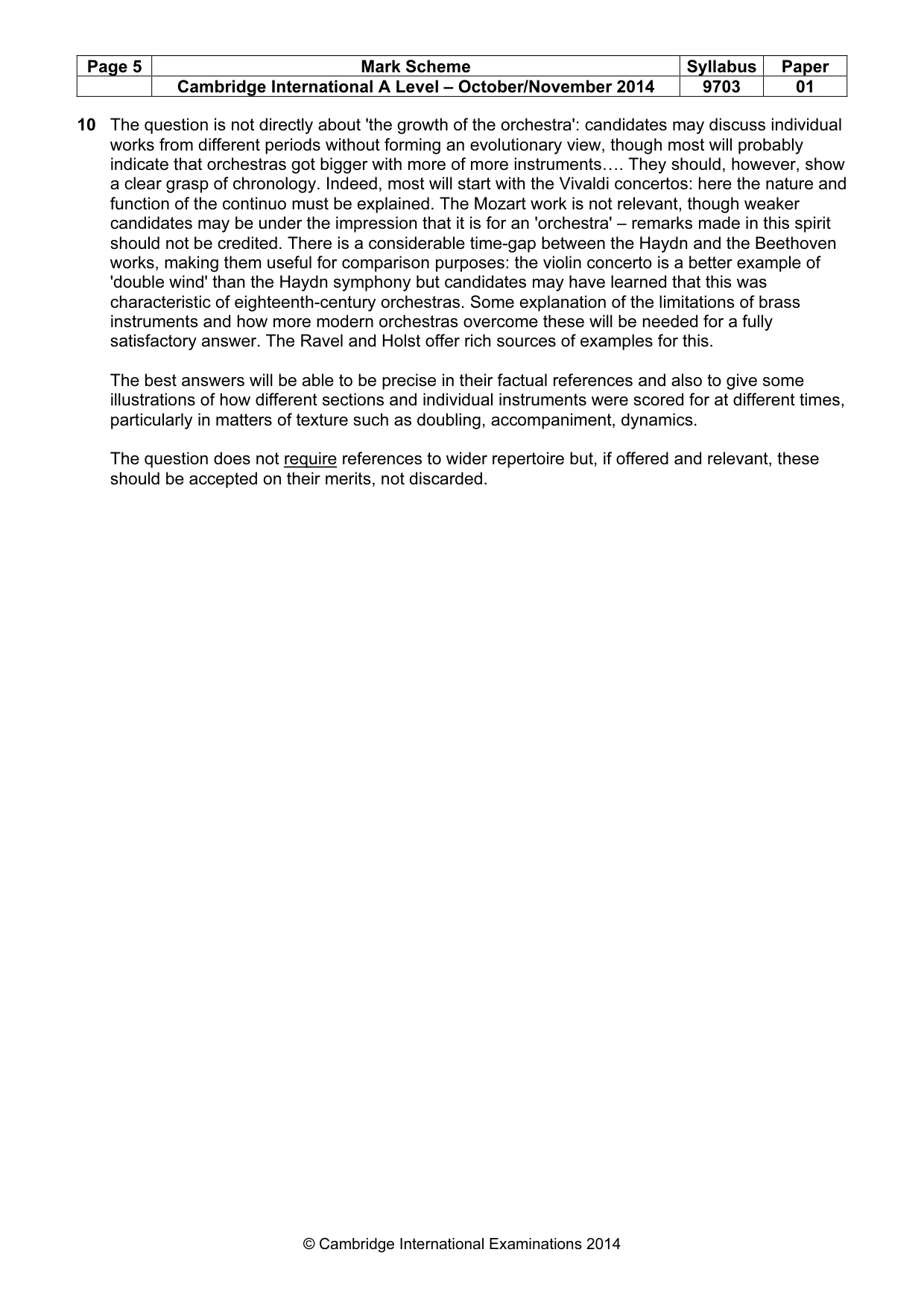
Page 5 Mark Scheme Syllabus Paper Cambridge International A Level – October/November 2014 9703 01 © Cambridge International Examinations 2014 10 The question is not directly about 'the growth of the orchestra': candidates may discuss individual works from different periods without forming an evolutionary view, though most will probably indicate that orchestras got bigger with more of more instruments…. They should, however, show a clear grasp of chronology. Indeed, most will start with the Vivaldi concertos: here the nature and function of the continuo must be explained. The Mozart work is not relevant, though weaker candidates may be under the impression that it is for an 'orchestra' – remarks made in this spirit should not be credited. There is a considerable time-gap between the Haydn and the Beethoven works, making them useful for comparison purposes: the violin concerto is a better example of 'double wind' than the Haydn symphony but candidates may have learned that this was characteristic of eighteenth-century orchestras. Some explanation of the limitations of brass instruments and how more modern orchestras overcome these will be needed for a fully satisfactory answer. The Ravel and Holst offer rich sources of examples for this. The best answers will be able to be precise in their factual references and also to give some illustrations of how different sections and individual instruments were scored for at different times, particularly in matters of texture such as doubling, accompaniment, dynamics. The question does not require references to wider repertoire but, if offered and relevant, these should be accepted on their merits, not discarded.
What you needed in this session
Cambridge’s own grade thresholds for 2014 Oct/Nov, Paper 1 · Variant 1. A higher threshold means an easier paper — the bar moves with how the cohort did.