Cambridge A Level Music 9703 — 2017 Oct/Nov Paper 1 · Variant 1
9703/11/O/N/17 · 100 marks · ≈113 min
The question paper and its mark scheme, free to read here and free to download. This is Cambridge’s own paper, exactly as it was sat.
Question paper4 pages


Mark scheme7 pages
Answers below. Sit the paper first if you are practising.
Paper as text
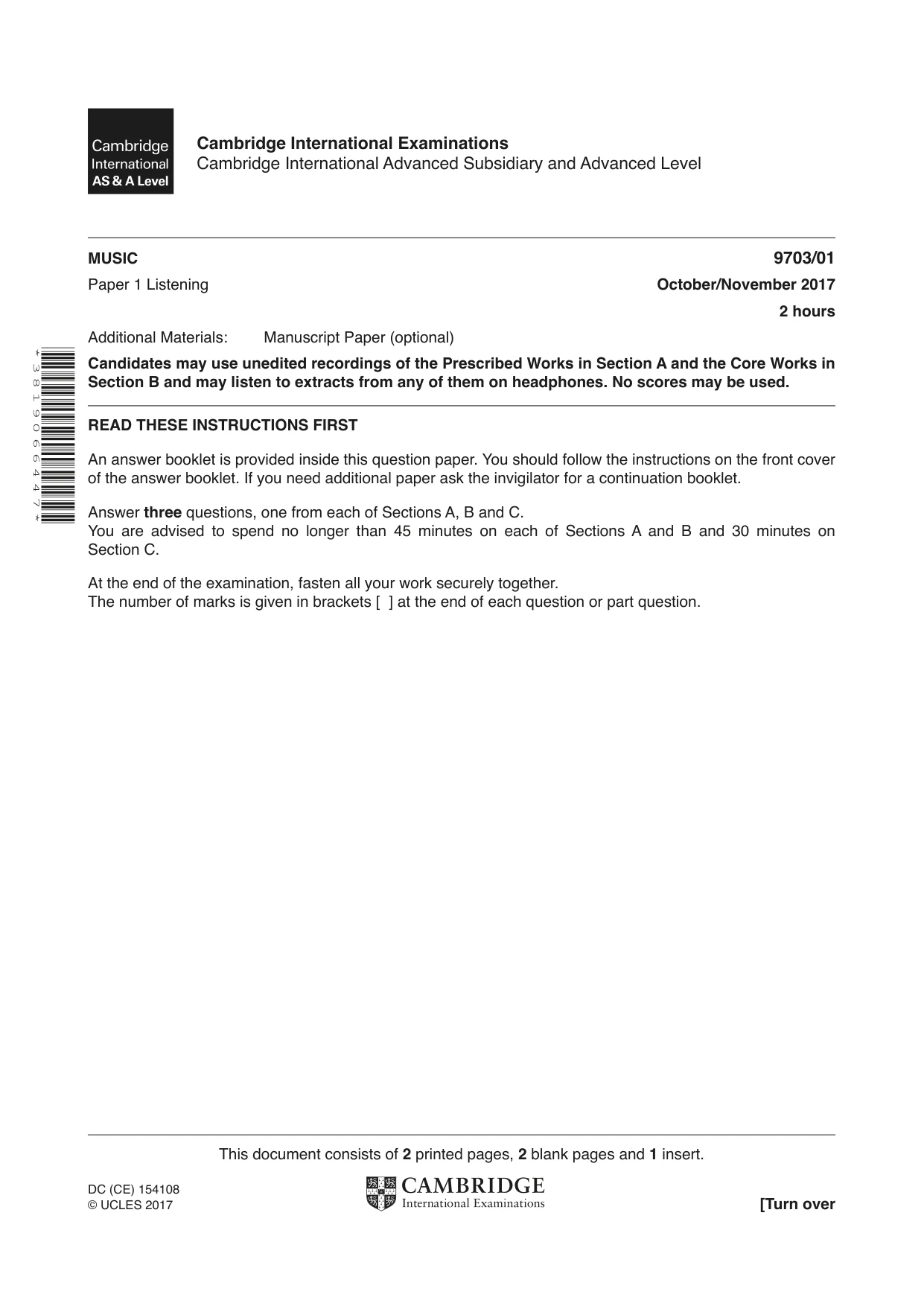
Question paper, page 1
This document consists of 2 printed pages, 2 blank pages and 1 insert. DC (CE) 154108 © UCLES 2017 [Turn over Cambridge International Examinations Cambridge International Advanced Subsidiary and Advanced Level * 3 8 1 9 0 6 6 4 4 7 * MUSIC 9703/01 Paper 1 Listening October/November 2017 2 hours Additional Materials: Manuscript Paper (optional) Candidates may use unedited recordings of the Prescribed Works in Section A and the Core Works in Section B and may listen to extracts from any of them on headphones. No scores may be used. READ THESE INSTRUCTIONS FIRST An answer booklet is provided inside this question paper. You should follow the instructions on the front cover of the answer booklet. If you need additional paper ask the invigilator for a continuation booklet. Answer three questions, one from each of Sections A, B and C. You are advised to spend no longer than 45 minutes on each of Sections A and B and 30 minutes on Section C. At the end of the examination, fasten all your work securely together. The number of marks is given in brackets [ ] at the end of each question or part question.
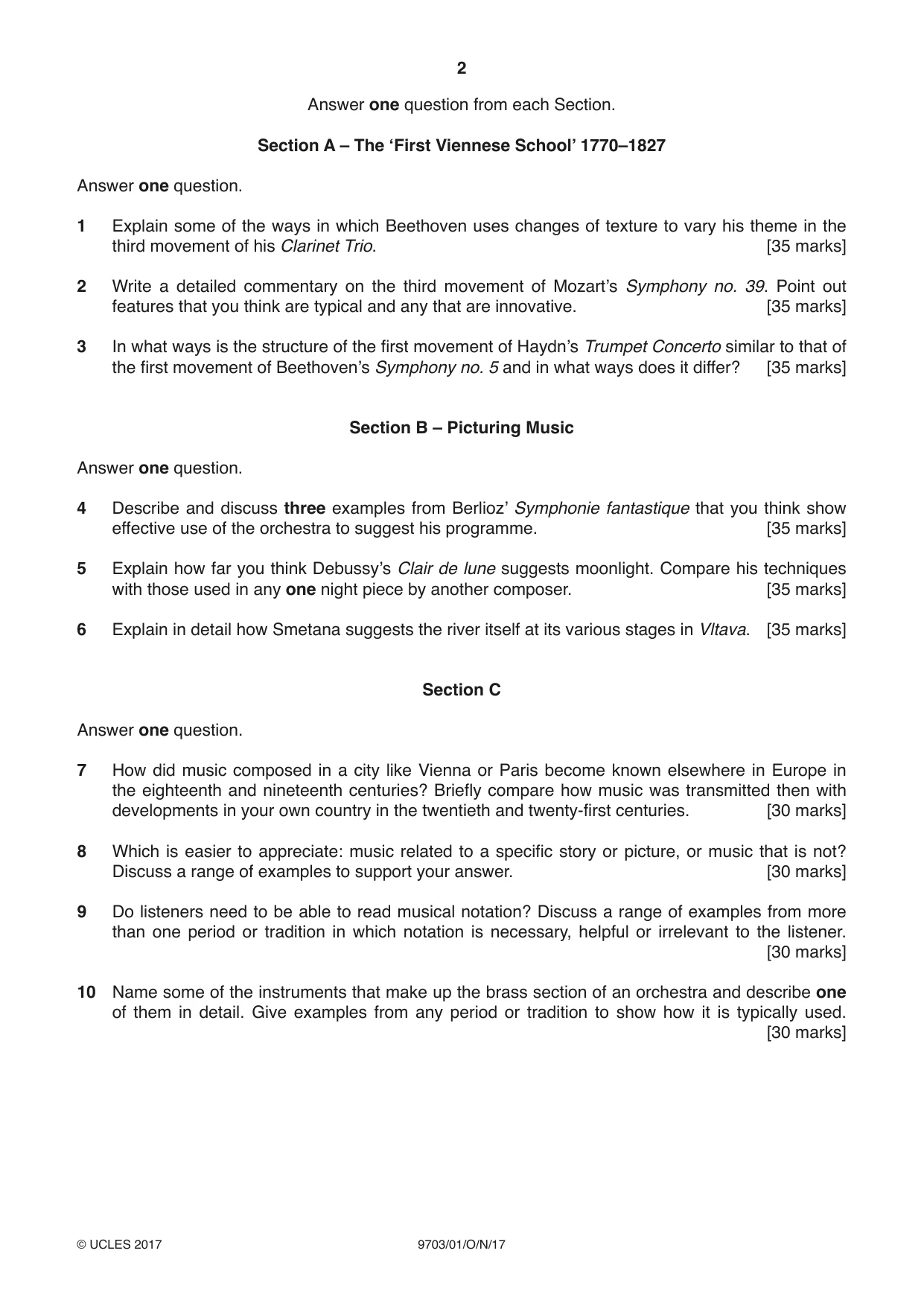
Question paper, page 2
2 9703/01/O/N/17 © UCLES 2017 Answer one question from each Section. Section A – The ‘First Viennese School’ 1770–1827 Answer one question. 1 Explain some of the ways in which Beethoven uses changes of texture to vary his theme in the third movement of his Clarinet Trio. [35 marks] 2 Write a detailed commentary on the third movement of Mozart’s Symphony no. 39. Point out features that you think are typical and any that are innovative. [35 marks] 3 In what ways is the structure of the first movement of Haydn’s Trumpet Concerto similar to that of the first movement of Beethoven’s Symphony no. 5 and in what ways does it differ? [35 marks] Section B – Picturing Music Answer one question. 4 Describe and discuss three examples from Berlioz’ Symphonie fantastique that you think show effective use of the orchestra to suggest his programme. [35 marks] 5 Explain how far you think Debussy’s Clair de lune suggests moonlight. Compare his techniques with those used in any one night piece by another composer. [35 marks] 6 Explain in detail how Smetana suggests the river itself at its various stages in Vltava. [35 marks] Section C Answer one question. 7 How did music composed in a city like Vienna or Paris become known elsewhere in Europe in the eighteenth and nineteenth centuries? Briefly compare how music was transmitted then with developments in your own country in the twentieth and twenty-first centuries. [30 marks] 8 Which is easier to appreciate: music related to a specific story or picture, or music that is not? Discuss a range of examples to support your answer. [30 marks] 9 Do listeners need to be able to read musical notation? Discuss a range of examples from more than one period or tradition in which notation is necessary, helpful or irrelevant to the listener. [30 marks] 10 Name some of the instruments that make up the brass section of an orchestra and describe one of them in detail. Give examples from any period or tradition to show how it is typically used. [30 marks]
Question paper, page 3
3 9703/01/O/N/17 © UCLES 2017 BLANK PAGE
Question paper, page 4
4 9703/01/O/N/17 © UCLES 2017 Permission to reproduce items where third-party owned material protected by copyright is included has been sought and cleared where possible. Every reasonable effort has been made by the publisher (UCLES) to trace copyright holders, but if any items requiring clearance have unwittingly been included, the publisher will be pleased to make amends at the earliest possible opportunity. To avoid the issue of disclosure of answer-related information to candidates, all copyright acknowledgements are reproduced online in the Cambridge International Examinations Copyright Acknowledgements Booklet. This is produced for each series of examinations and is freely available to download at www.cie.org.uk after the live examination series. Cambridge International Examinations is part of the Cambridge Assessment Group. Cambridge Assessment is the brand name of University of Cambridge Local Examinations Syndicate (UCLES), which is itself a department of the University of Cambridge. BLANK PAGE
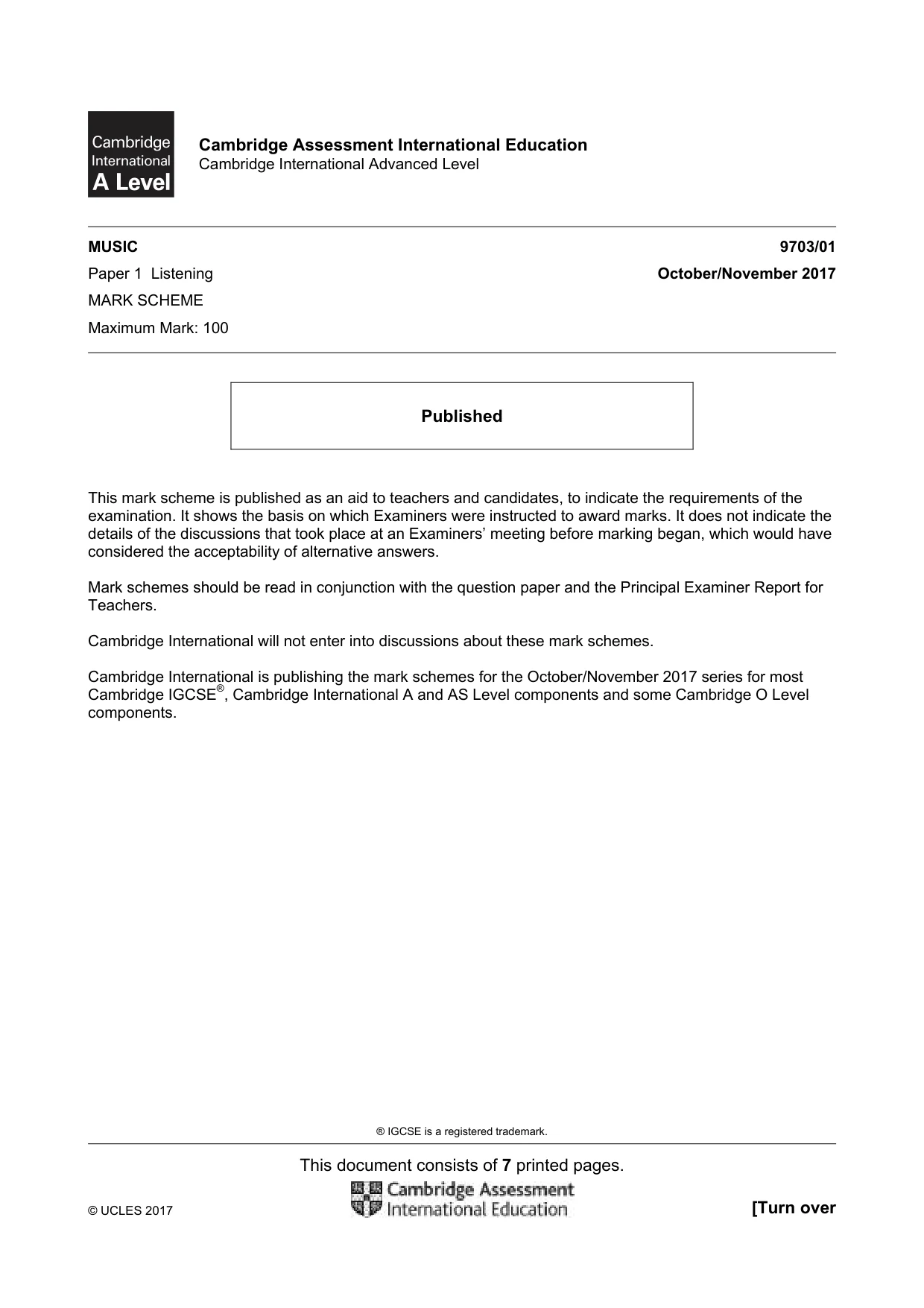
Mark scheme, page 1
® IGCSE is a registered trademark. This document consists of 7 printed pages. © UCLES 2017 [Turn over Cambridge Assessment International Education Cambridge International Advanced Level MUSIC 9703/01 Paper 1 Listening October/November 2017 MARK SCHEME Maximum Mark: 100 Published This mark scheme is published as an aid to teachers and candidates, to indicate the requirements of the examination. It shows the basis on which Examiners were instructed to award marks. It does not indicate the details of the discussions that took place at an Examiners’ meeting before marking began, which would have considered the acceptability of alternative answers. Mark schemes should be read in conjunction with the question paper and the Principal Examiner Report for Teachers. Cambridge International will not enter into discussions about these mark schemes. Cambridge International is publishing the mark schemes for the October/November 2017 series for most Cambridge IGCSE®, Cambridge International A and AS Level components and some Cambridge O Level components.
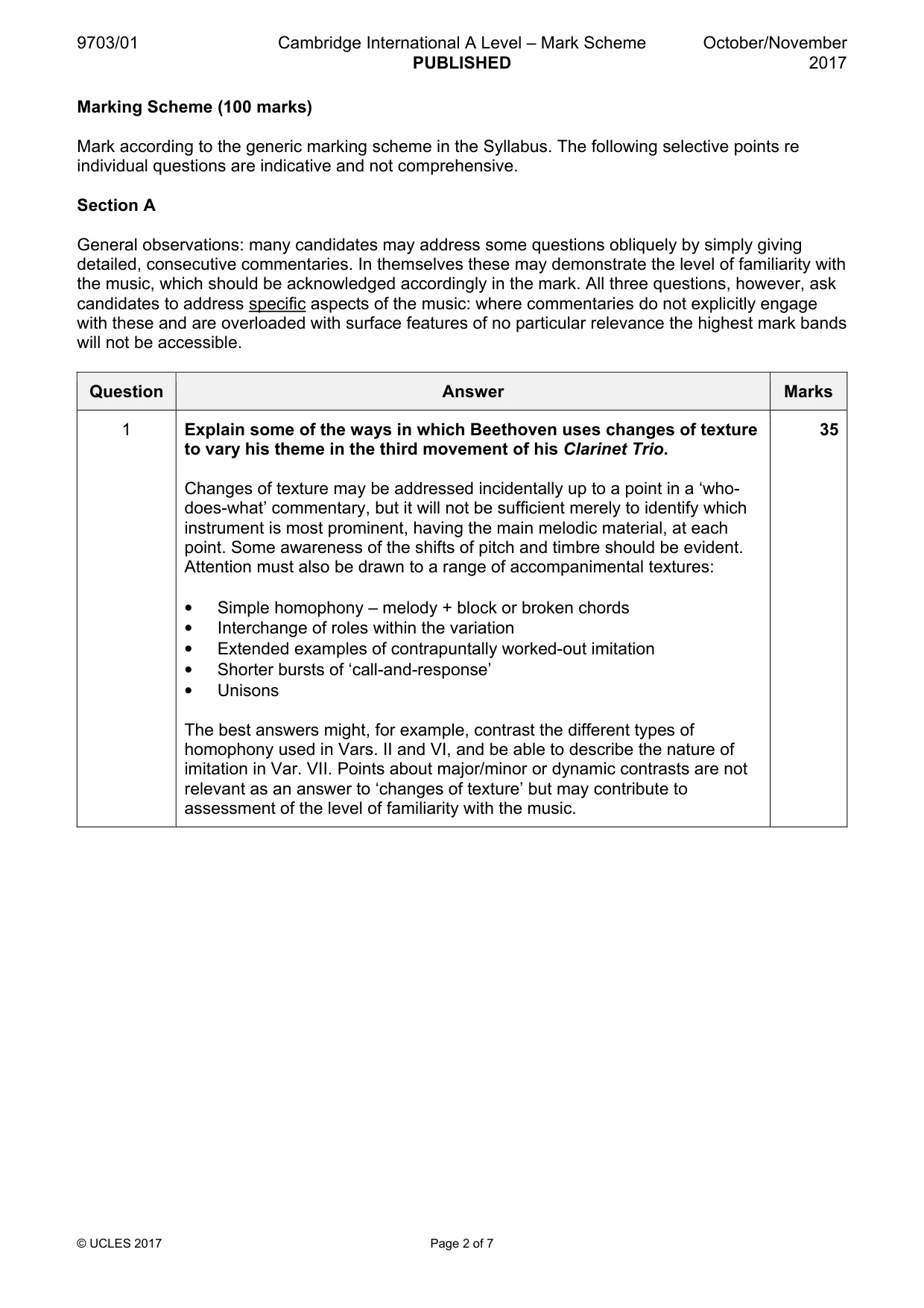
Mark scheme, page 2
9703/01 Cambridge International A Level – Mark Scheme PUBLISHED October/November 2017 © UCLES 2017 Page 2 of 7 Marking Scheme (100 marks) Mark according to the generic marking scheme in the Syllabus. The following selective points re individual questions are indicative and not comprehensive. Section A General observations: many candidates may address some questions obliquely by simply giving detailed, consecutive commentaries. In themselves these may demonstrate the level of familiarity with the music, which should be acknowledged accordingly in the mark. All three questions, however, ask candidates to address specific aspects of the music: where commentaries do not explicitly engage with these and are overloaded with surface features of no particular relevance the highest mark bands will not be accessible. Question Answer Marks 1 Explain some of the ways in which Beethoven uses changes of texture to vary his theme in the third movement of his Clarinet Trio. Changes of texture may be addressed incidentally up to a point in a ‘who- does-what’ commentary, but it will not be sufficient merely to identify which instrument is most prominent, having the main melodic material, at each point. Some awareness of the shifts of pitch and timbre should be evident. Attention must also be drawn to a range of accompanimental textures: • Simple homophony – melody + block or broken chords • Interchange of roles within the variation • Extended examples of contrapuntally worked-out imitation • Shorter bursts of ‘call-and-response’ • Unisons The best answers might, for example, contrast the different types of homophony used in Vars. II and VI, and be able to describe the nature of imitation in Var. VII. Points about major/minor or dynamic contrasts are not relevant as an answer to ‘changes of texture’ but may contribute to assessment of the level of familiarity with the music. 35
Mark scheme, page 3
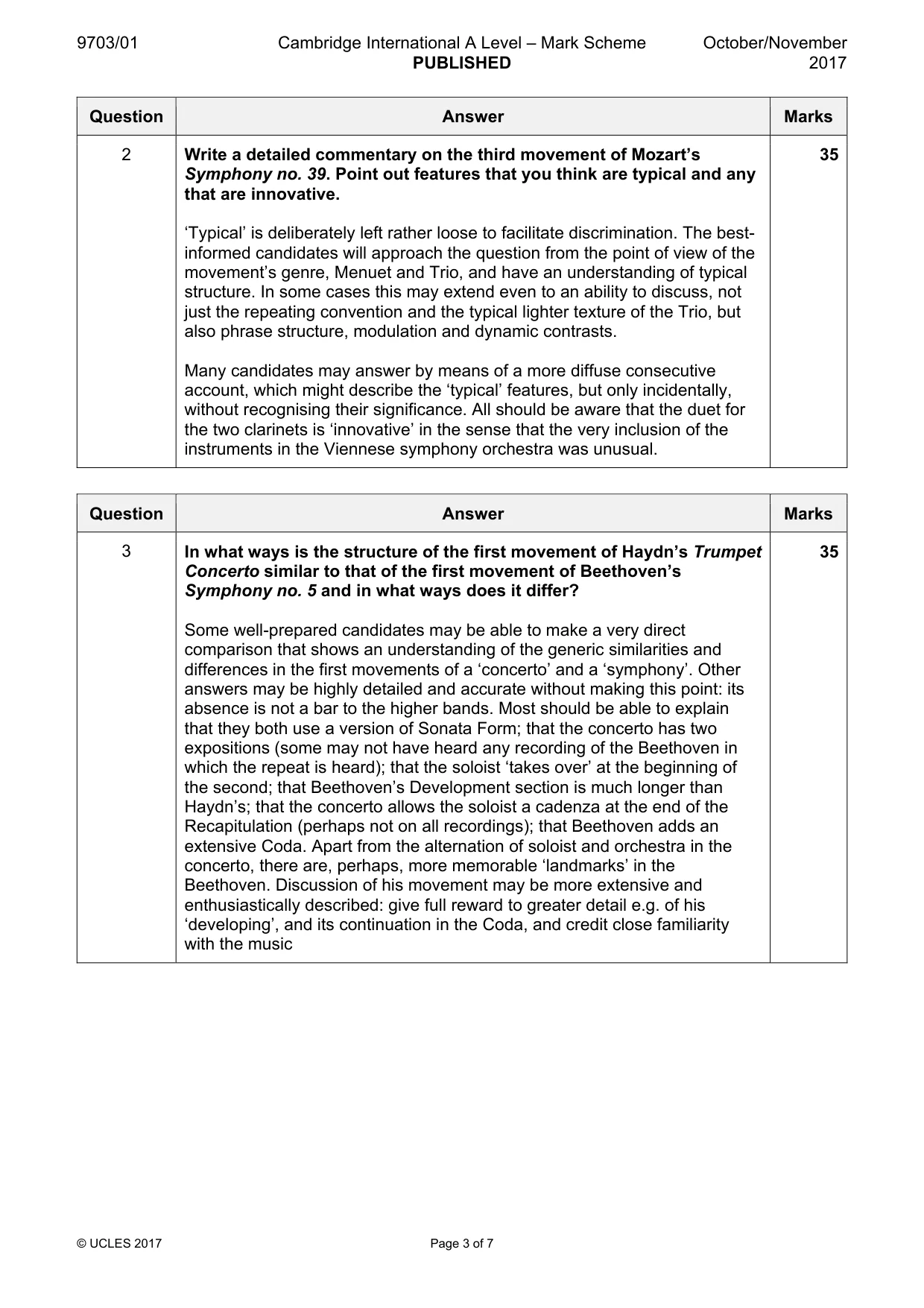
9703/01 Cambridge International A Level – Mark Scheme PUBLISHED October/November 2017 © UCLES 2017 Page 3 of 7 Question Answer Marks 2 Write a detailed commentary on the third movement of Mozart’s Symphony no. 39. Point out features that you think are typical and any that are innovative. ‘Typical’ is deliberately left rather loose to facilitate discrimination. The best- informed candidates will approach the question from the point of view of the movement’s genre, Menuet and Trio, and have an understanding of typical structure. In some cases this may extend even to an ability to discuss, not just the repeating convention and the typical lighter texture of the Trio, but also phrase structure, modulation and dynamic contrasts. Many candidates may answer by means of a more diffuse consecutive account, which might describe the ‘typical’ features, but only incidentally, without recognising their significance. All should be aware that the duet for the two clarinets is ‘innovative’ in the sense that the very inclusion of the instruments in the Viennese symphony orchestra was unusual. 35 Question Answer Marks 3 In what ways is the structure of the first movement of Haydn’s Trumpet Concerto similar to that of the first movement of Beethoven’s Symphony no. 5 and in what ways does it differ? Some well-prepared candidates may be able to make a very direct comparison that shows an understanding of the generic similarities and differences in the first movements of a ‘concerto’ and a ‘symphony’. Other answers may be highly detailed and accurate without making this point: its absence is not a bar to the higher bands. Most should be able to explain that they both use a version of Sonata Form; that the concerto has two expositions (some may not have heard any recording of the Beethoven in which the repeat is heard); that the soloist ‘takes over’ at the beginning of the second; that Beethoven’s Development section is much longer than Haydn’s; that the concerto allows the soloist a cadenza at the end of the Recapitulation (perhaps not on all recordings); that Beethoven adds an extensive Coda. Apart from the alternation of soloist and orchestra in the concerto, there are, perhaps, more memorable ‘landmarks’ in the Beethoven. Discussion of his movement may be more extensive and enthusiastically described: give full reward to greater detail e.g. of his ‘developing’, and its continuation in the Coda, and credit close familiarity with the music 35
Mark scheme, page 4
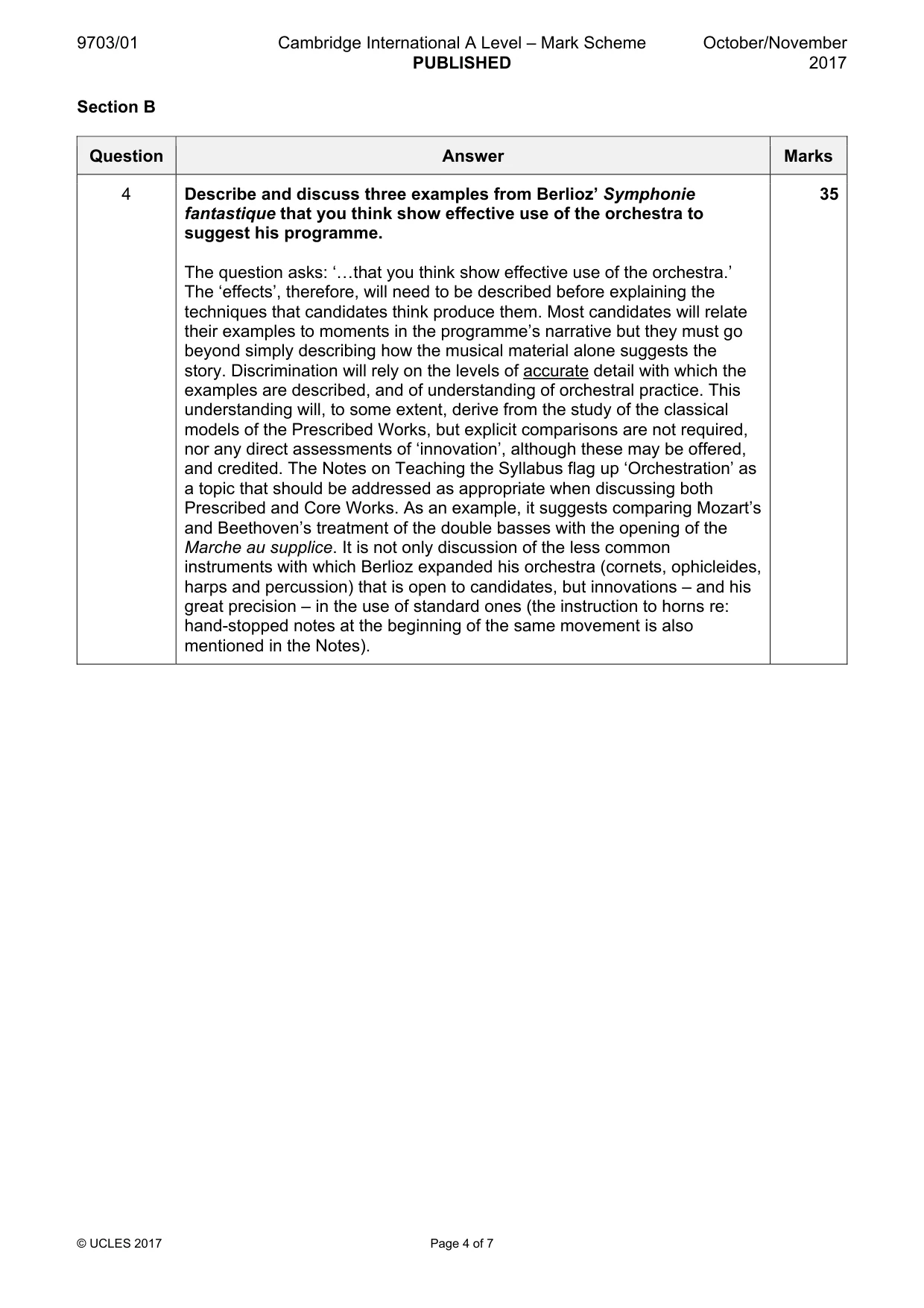
9703/01 Cambridge International A Level – Mark Scheme PUBLISHED October/November 2017 © UCLES 2017 Page 4 of 7 Section B Question Answer Marks 4 Describe and discuss three examples from Berlioz’ Symphonie fantastique that you think show effective use of the orchestra to suggest his programme. The question asks: ‘«that you think show effective use of the orchestra.’ The ‘effects’, therefore, will need to be described before explaining the techniques that candidates think produce them. Most candidates will relate their examples to moments in the programme’s narrative but they must go beyond simply describing how the musical material alone suggests the story. Discrimination will rely on the levels of accurate detail with which the examples are described, and of understanding of orchestral practice. This understanding will, to some extent, derive from the study of the classical models of the Prescribed Works, but explicit comparisons are not required, nor any direct assessments of ‘innovation’, although these may be offered, and credited. The Notes on Teaching the Syllabus flag up ‘Orchestration’ as a topic that should be addressed as appropriate when discussing both Prescribed and Core Works. As an example, it suggests comparing Mozart’s and Beethoven’s treatment of the double basses with the opening of the Marche au supplice. It is not only discussion of the less common instruments with which Berlioz expanded his orchestra (cornets, ophicleides, harps and percussion) that is open to candidates, but innovations – and his great precision – in the use of standard ones (the instruction to horns re: hand-stopped notes at the beginning of the same movement is also mentioned in the Notes). 35
Mark scheme, page 5
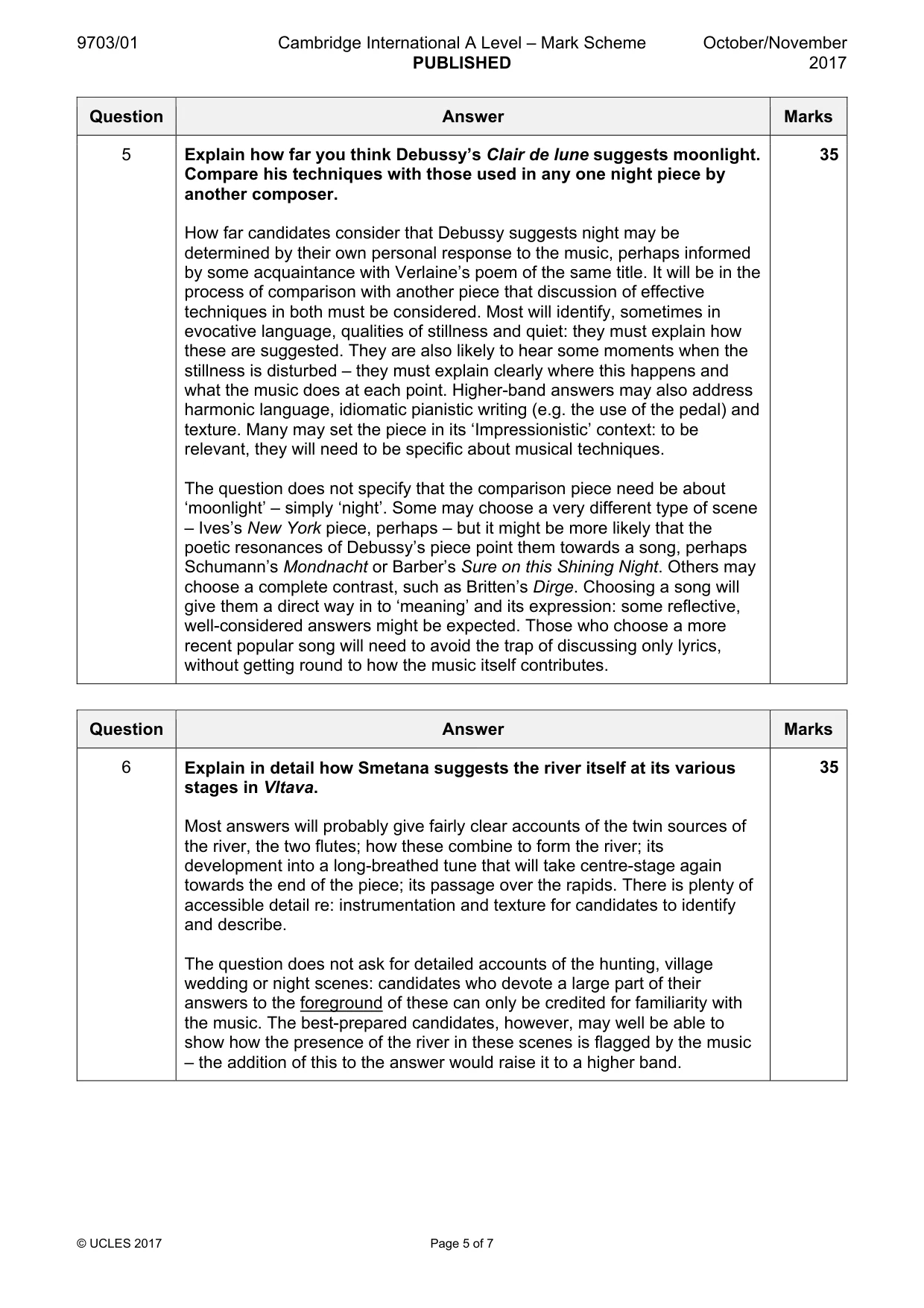
9703/01 Cambridge International A Level – Mark Scheme PUBLISHED October/November 2017 © UCLES 2017 Page 5 of 7 Question Answer Marks 5 Explain how far you think Debussy’s Clair de lune suggests moonlight. Compare his techniques with those used in any one night piece by another composer. How far candidates consider that Debussy suggests night may be determined by their own personal response to the music, perhaps informed by some acquaintance with Verlaine’s poem of the same title. It will be in the process of comparison with another piece that discussion of effective techniques in both must be considered. Most will identify, sometimes in evocative language, qualities of stillness and quiet: they must explain how these are suggested. They are also likely to hear some moments when the stillness is disturbed – they must explain clearly where this happens and what the music does at each point. Higher-band answers may also address harmonic language, idiomatic pianistic writing (e.g. the use of the pedal) and texture. Many may set the piece in its ‘Impressionistic’ context: to be relevant, they will need to be specific about musical techniques. The question does not specify that the comparison piece need be about ‘moonlight’ – simply ‘night’. Some may choose a very different type of scene – Ives’s New York piece, perhaps – but it might be more likely that the poetic resonances of Debussy’s piece point them towards a song, perhaps Schumann’s Mondnacht or Barber’s Sure on this Shining Night. Others may choose a complete contrast, such as Britten’s Dirge. Choosing a song will give them a direct way in to ‘meaning’ and its expression: some reflective, well-considered answers might be expected. Those who choose a more recent popular song will need to avoid the trap of discussing only lyrics, without getting round to how the music itself contributes. 35 Question Answer Marks 6 Explain in detail how Smetana suggests the river itself at its various stages in Vltava. Most answers will probably give fairly clear accounts of the twin sources of the river, the two flutes; how these combine to form the river; its development into a long-breathed tune that will take centre-stage again towards the end of the piece; its passage over the rapids. There is plenty of accessible detail re: instrumentation and texture for candidates to identify and describe. The question does not ask for detailed accounts of the hunting, village wedding or night scenes: candidates who devote a large part of their answers to the foreground of these can only be credited for familiarity with the music. The best-prepared candidates, however, may well be able to show how the presence of the river in these scenes is flagged by the music – the addition of this to the answer would raise it to a higher band. 35
Mark scheme, page 6
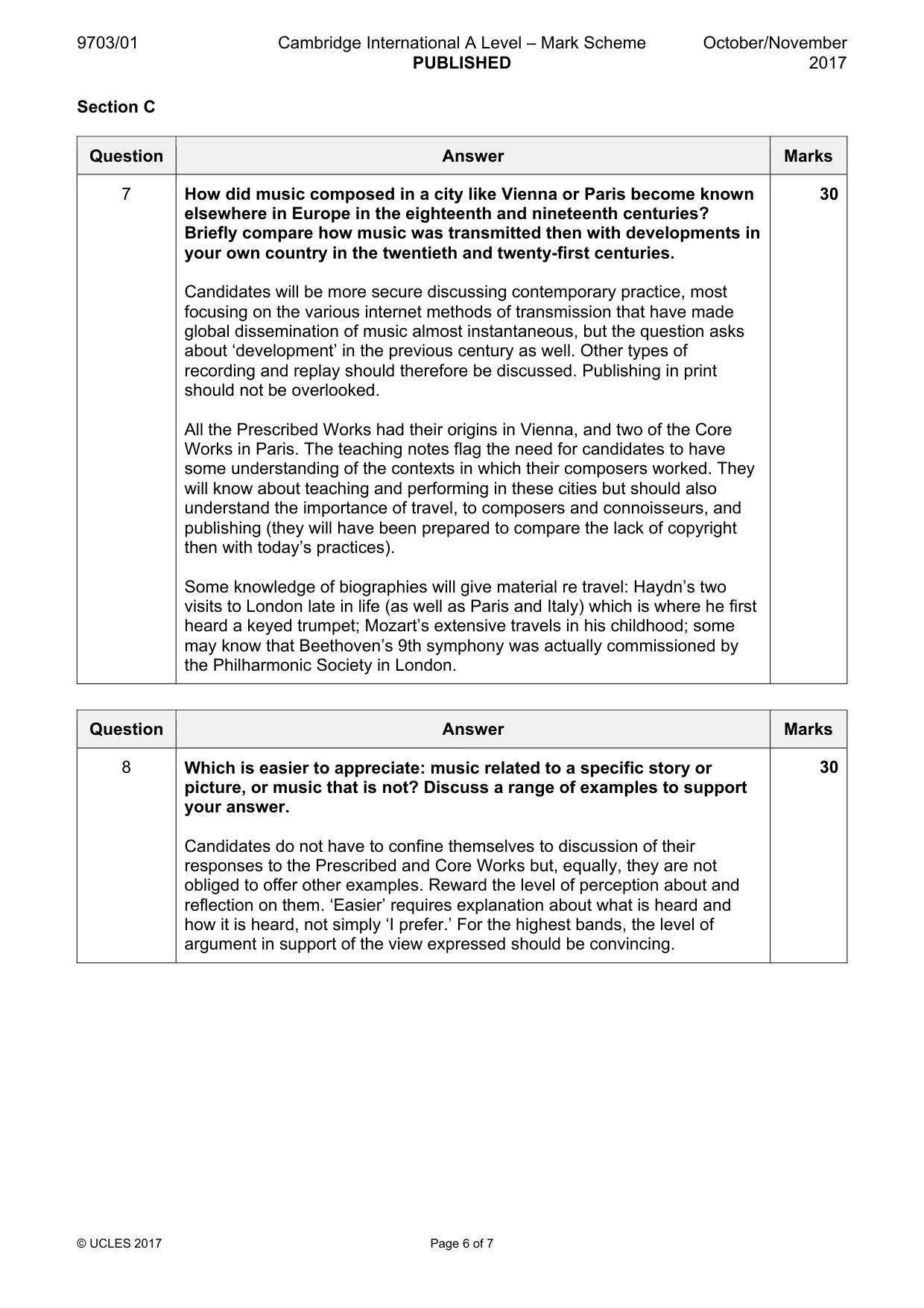
9703/01 Cambridge International A Level – Mark Scheme PUBLISHED October/November 2017 © UCLES 2017 Page 6 of 7 Section C Question Answer Marks 7 How did music composed in a city like Vienna or Paris become known elsewhere in Europe in the eighteenth and nineteenth centuries? Briefly compare how music was transmitted then with developments in your own country in the twentieth and twenty-first centuries. Candidates will be more secure discussing contemporary practice, most focusing on the various internet methods of transmission that have made global dissemination of music almost instantaneous, but the question asks about ‘development’ in the previous century as well. Other types of recording and replay should therefore be discussed. Publishing in print should not be overlooked. All the Prescribed Works had their origins in Vienna, and two of the Core Works in Paris. The teaching notes flag the need for candidates to have some understanding of the contexts in which their composers worked. They will know about teaching and performing in these cities but should also understand the importance of travel, to composers and connoisseurs, and publishing (they will have been prepared to compare the lack of copyright then with today’s practices). Some knowledge of biographies will give material re travel: Haydn’s two visits to London late in life (as well as Paris and Italy) which is where he first heard a keyed trumpet; Mozart’s extensive travels in his childhood; some may know that Beethoven’s 9th symphony was actually commissioned by the Philharmonic Society in London. 30 Question Answer Marks 8 Which is easier to appreciate: music related to a specific story or picture, or music that is not? Discuss a range of examples to support your answer. Candidates do not have to confine themselves to discussion of their responses to the Prescribed and Core Works but, equally, they are not obliged to offer other examples. Reward the level of perception about and reflection on them. ‘Easier’ requires explanation about what is heard and how it is heard, not simply ‘I prefer.’ For the highest bands, the level of argument in support of the view expressed should be convincing. 30
Mark scheme, page 7
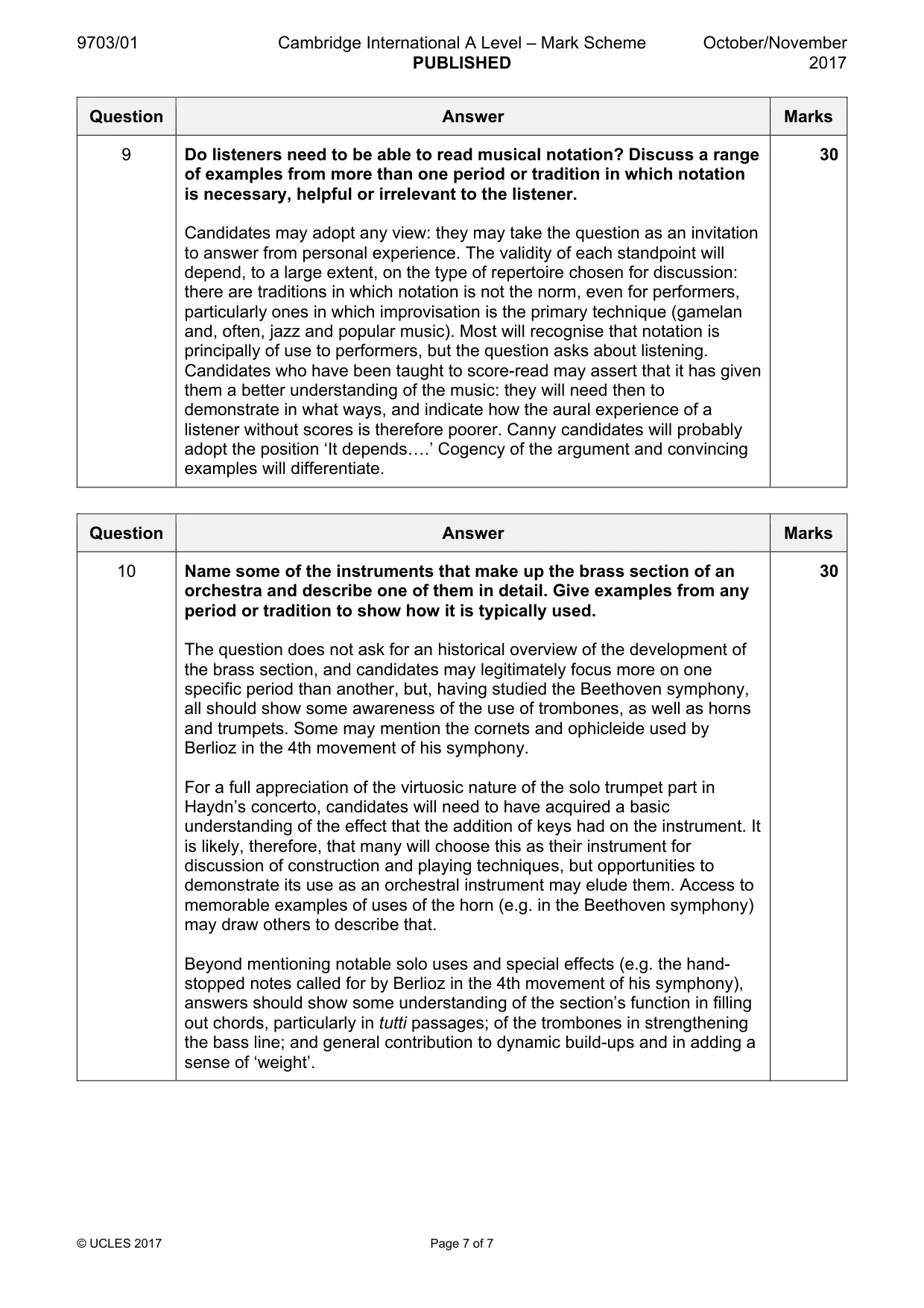
9703/01 Cambridge International A Level – Mark Scheme PUBLISHED October/November 2017 © UCLES 2017 Page 7 of 7 Question Answer Marks 9 Do listeners need to be able to read musical notation? Discuss a range of examples from more than one period or tradition in which notation is necessary, helpful or irrelevant to the listener. Candidates may adopt any view: they may take the question as an invitation to answer from personal experience. The validity of each standpoint will depend, to a large extent, on the type of repertoire chosen for discussion: there are traditions in which notation is not the norm, even for performers, particularly ones in which improvisation is the primary technique (gamelan and, often, jazz and popular music). Most will recognise that notation is principally of use to performers, but the question asks about listening. Candidates who have been taught to score-read may assert that it has given them a better understanding of the music: they will need then to demonstrate in what ways, and indicate how the aural experience of a listener without scores is therefore poorer. Canny candidates will probably adopt the position ‘It depends«.’ Cogency of the argument and convincing examples will differentiate. 30 Question Answer Marks 10 Name some of the instruments that make up the brass section of an orchestra and describe one of them in detail. Give examples from any period or tradition to show how it is typically used. The question does not ask for an historical overview of the development of the brass section, and candidates may legitimately focus more on one specific period than another, but, having studied the Beethoven symphony, all should show some awareness of the use of trombones, as well as horns and trumpets. Some may mention the cornets and ophicleide used by Berlioz in the 4th movement of his symphony. For a full appreciation of the virtuosic nature of the solo trumpet part in Haydn’s concerto, candidates will need to have acquired a basic understanding of the effect that the addition of keys had on the instrument. It is likely, therefore, that many will choose this as their instrument for discussion of construction and playing techniques, but opportunities to demonstrate its use as an orchestral instrument may elude them. Access to memorable examples of uses of the horn (e.g. in the Beethoven symphony) may draw others to describe that. Beyond mentioning notable solo uses and special effects (e.g. the hand- stopped notes called for by Berlioz in the 4th movement of his symphony), answers should show some understanding of the section’s function in filling out chords, particularly in tutti passages; of the trombones in strengthening the bass line; and general contribution to dynamic build-ups and in adding a sense of ‘weight’. 30
What you needed in this session
Cambridge’s own grade thresholds for 2017 Oct/Nov, Paper 1 · Variant 1. A higher threshold means an easier paper — the bar moves with how the cohort did.