Cambridge A Level Mathematics 9709 — 2015 May/June Paper 4 · Variant 3
9709/43/M/J/15 · 2 questions · 50 marks · ≈56 min
The question paper and its mark scheme, free to read here and free to download. This is Cambridge’s own paper, exactly as it was sat.
Question paper4 pages
Mark scheme8 pages
Answers below. Sit the paper first if you are practising.
Questions as text
Q1 · A block is pulled along a horizontal floor by a horizontal rope
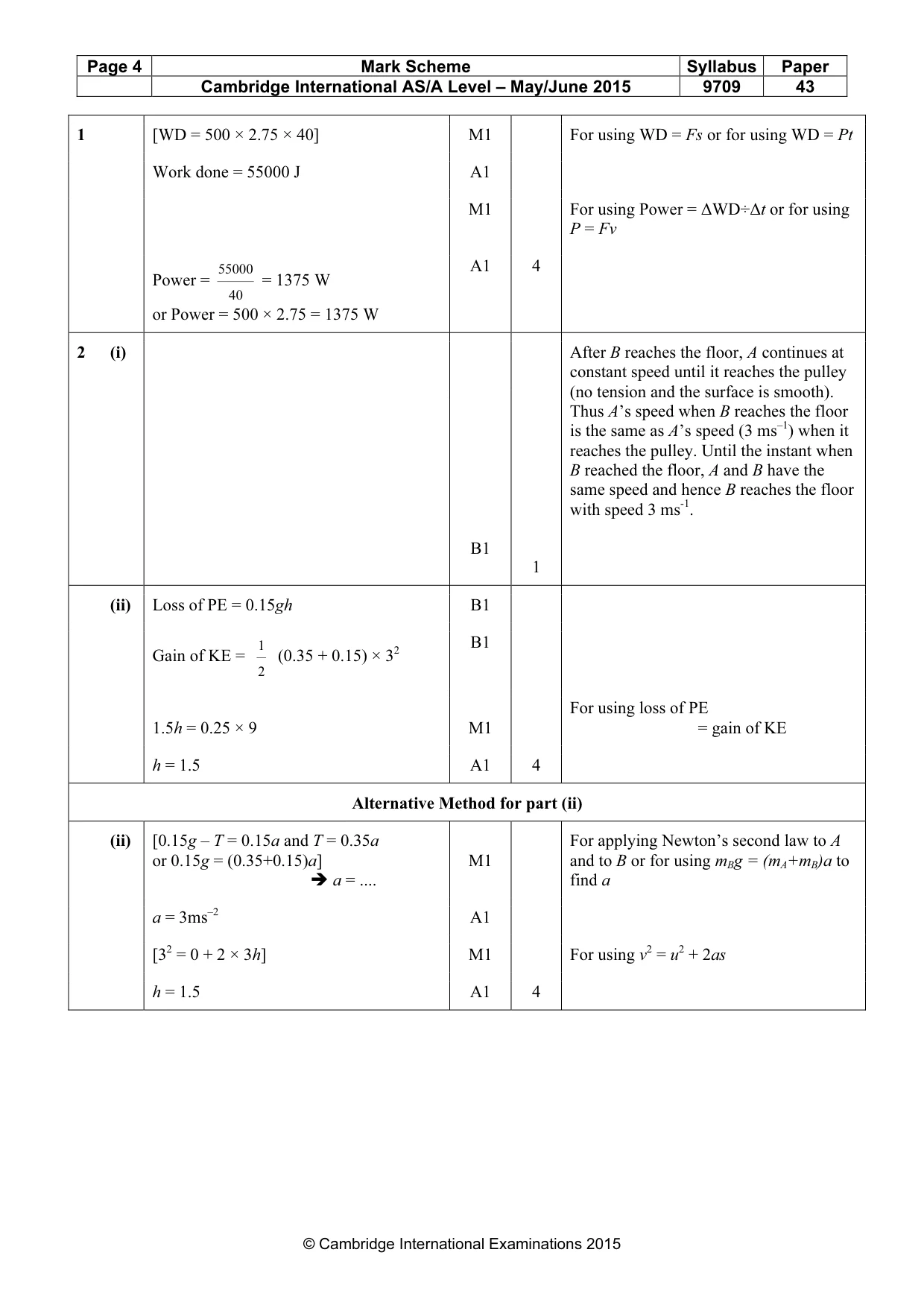
1 A block is pulled along a horizontal floor by a horizontal rope. The tension in the rope is 500 N and the block moves at a constant speed of 2.75 m s−1. Find the work done by the tension in 40 s and find the power applied by the tension. [4]
Mark scheme: 1 2
Q2 · 0.35 kg A 0.15 kg B h m Particles A and B, of masses 0.35 kg and 0.15 kg respectively…
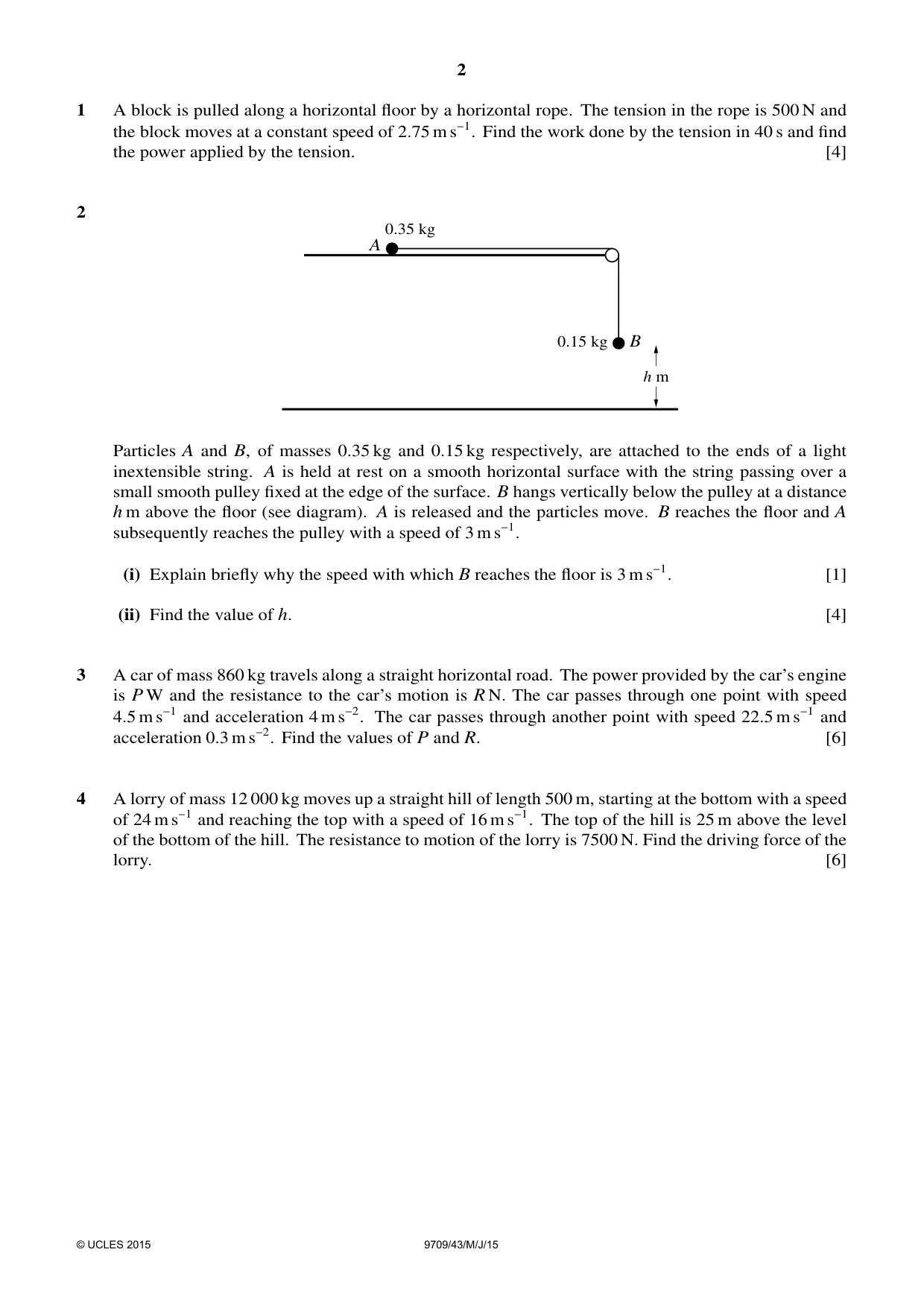
2 0.35 kg A 0.15 kg B h m Particles A and B, of masses 0.35 kg and 0.15 kg respectively, are attached to the ends of a light inextensible string. A is held at rest on a smooth horizontal surface with the string passing over a small smooth pulley fixed at the edge of the surface. B hangs vertically below the pulley at a distance h m above the floor (see diagram). A is released and the particles move. B reaches the floor and A subsequently reaches the pulley with a speed of 3 m s−1. (i) Explain briefly why the speed with which B reaches the floor is 3 m s−1. [1] (ii) Find the value of h. [4]
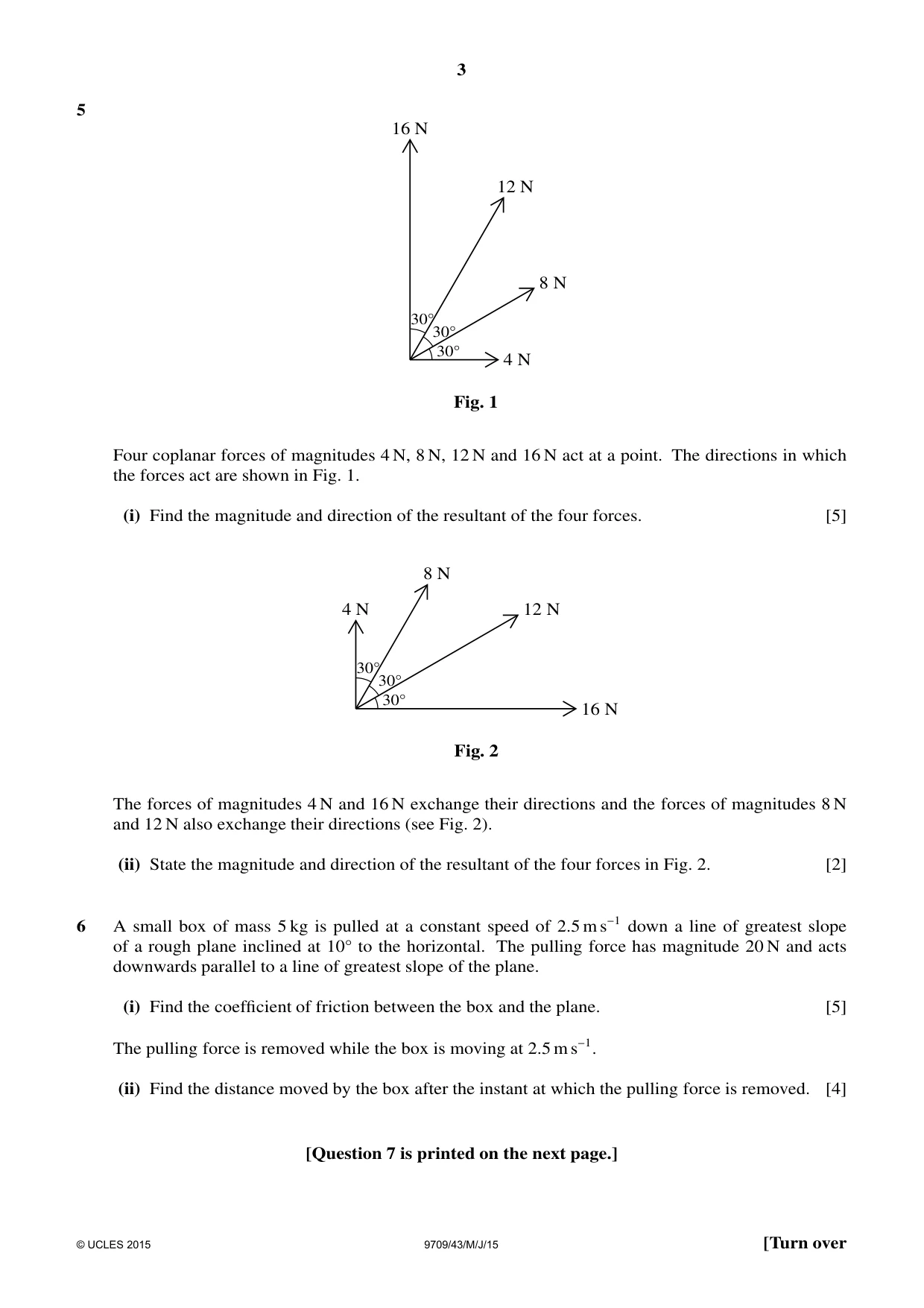
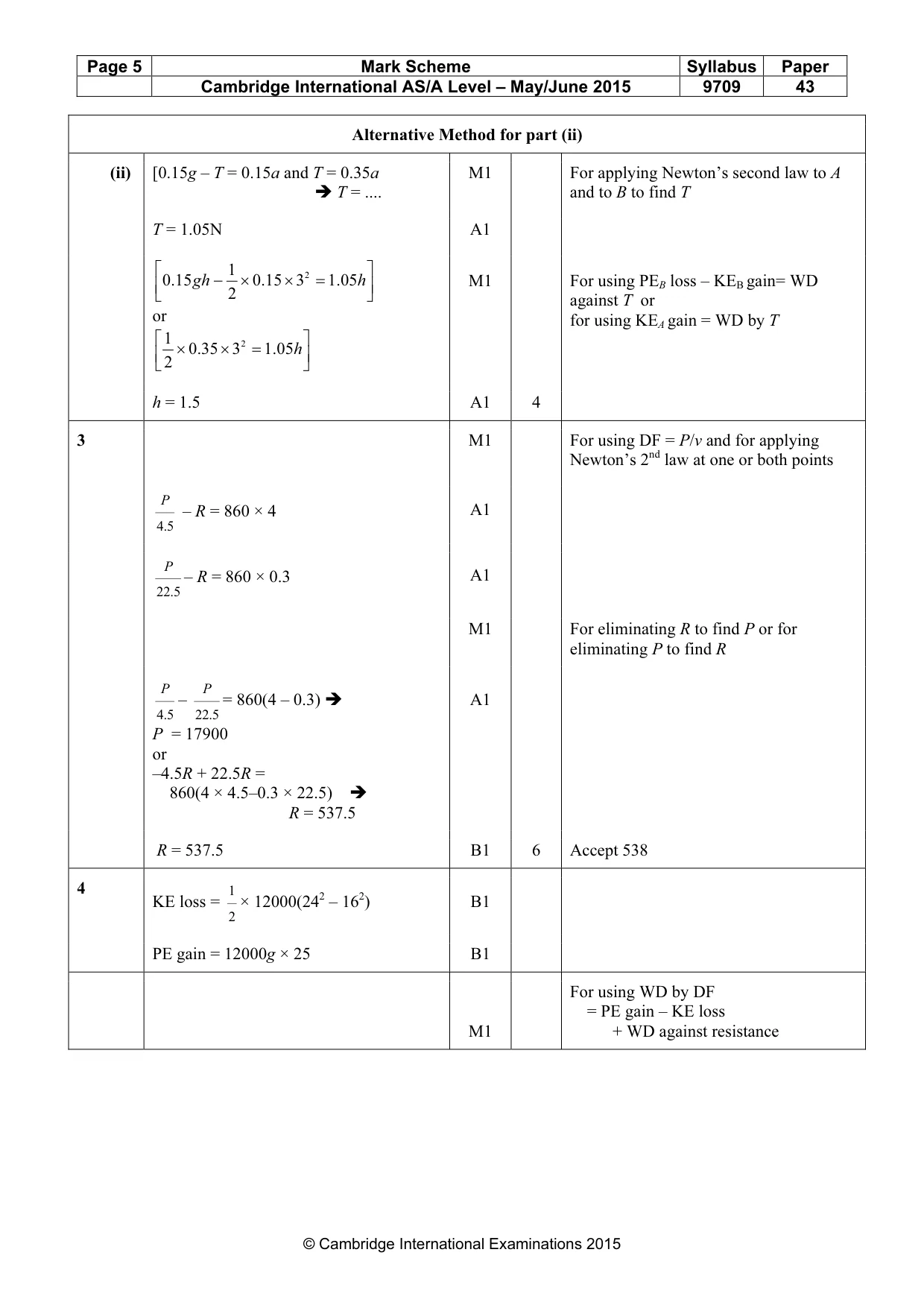
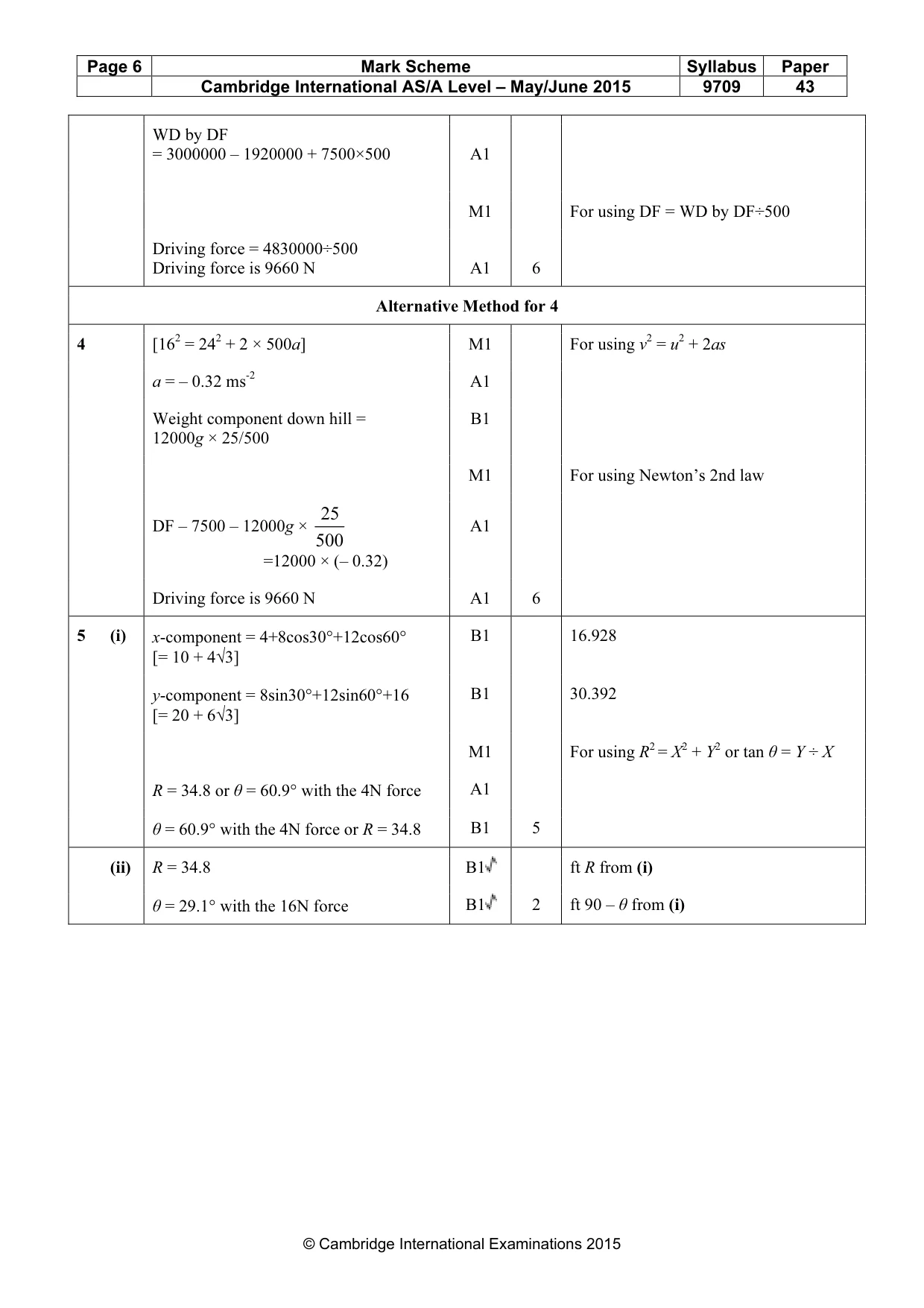
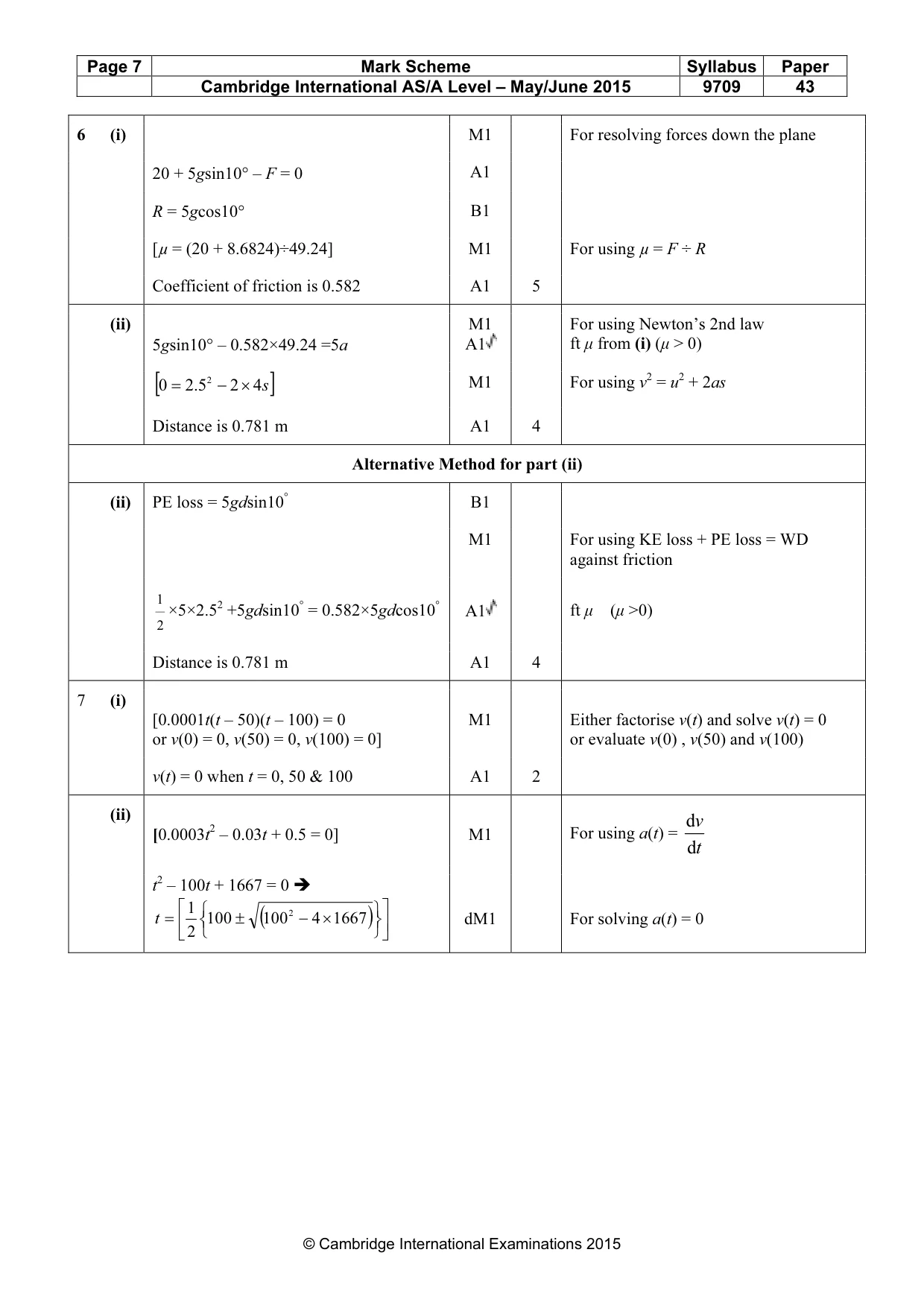
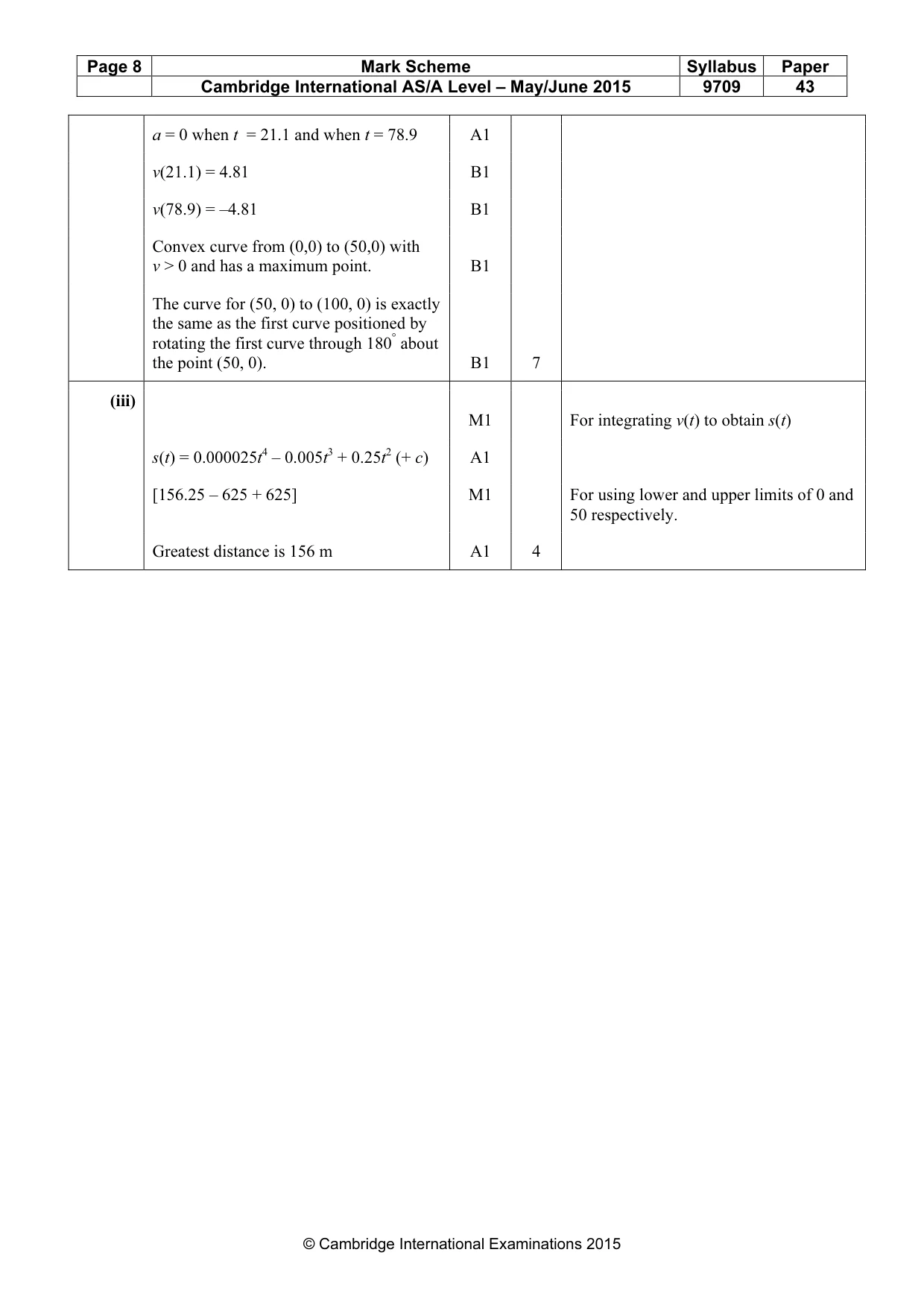
Mark scheme: .0 35 3 .1 05 h 2 h = 1.5 A1 4 3 M1 For using DF = P/v and for applying Newton’s 2nd law at one or both points P – R = 860 × 4 A1 4.5 P – R = 860 × 0.3 A1 22.5 M1 For eliminating R to find P or for eliminating P to find R P P – = 860(4 – 0.3) A1 4.5 22.5 P = 17900 or –4.5R + 22.5R = 860(4 × 4.5–0.3 × 22.5) R = 537.5 R = 537.5 B1 6 Accept 538 4 1 KE loss = × 12000(242 – 162) B1 2 PE gain = 12000g × 25 B1 For using WD by DF = PE gain – KE loss M1 + WD against resistance WD by DF = 3000000 – 1920000 + 7500×500 A1 M1 For using DF = WD by DF÷500 Driving force = 4830000÷500 Driving force is 9660 N A1 6 Alternative Method for 4 4 [162 = 242 + 2 × 500a] M1 For using v2 = u2 + 2as a = – 0.32 ms-2 A1 Weight component down hill = B1 12000g × 25/500 M1 For using Newton’s 2nd law 25 DF – 7500 – 12000g × A1 500 =12000 × (– 0.32) Driving force is 9660 N A1 6 5 (i) x-component = 4+8cos30°+12cos60° B1 16.928 [= 10 + 4√3] y-component = 8sin30°+12sin60°+16 B1 30.392 [= 20 + 6√3] M1 For using R2 = X2 + Y2 or tan θ = Y ÷ X R = 34.8 or θ = 60.9° with the 4N force A1 θ = 60.9° with the 4N force or R = 34.8 B1 5 (ii) R = 34.8 B1 ft R from (i) θ = 29.1° with the 16N force B1 2 ft 90 – θ from (i) 6 (i) M1 For resolving forces down the plane
What was in this paper
The subtopics covered by these 2 questions, and how many questions each got. Open one in a new tab to see every Cambridge question on it.
What you needed in this session
Cambridge’s own grade thresholds for 2015 May/June, Paper 4 · Variant 3. A higher threshold means an easier paper — the bar moves with how the cohort did.