Cambridge A Level Law 9084 — 2022 Oct/Nov Paper 3 · Variant 1
9084/31/O/N/22 · 75 marks · ≈84 min
The question paper and its mark scheme, free to read here and free to download. This is Cambridge’s own paper, exactly as it was sat.
Question paper4 pages

Mark scheme11 pages
Answers below. Sit the paper first if you are practising.
Paper as text
Question paper, page 1
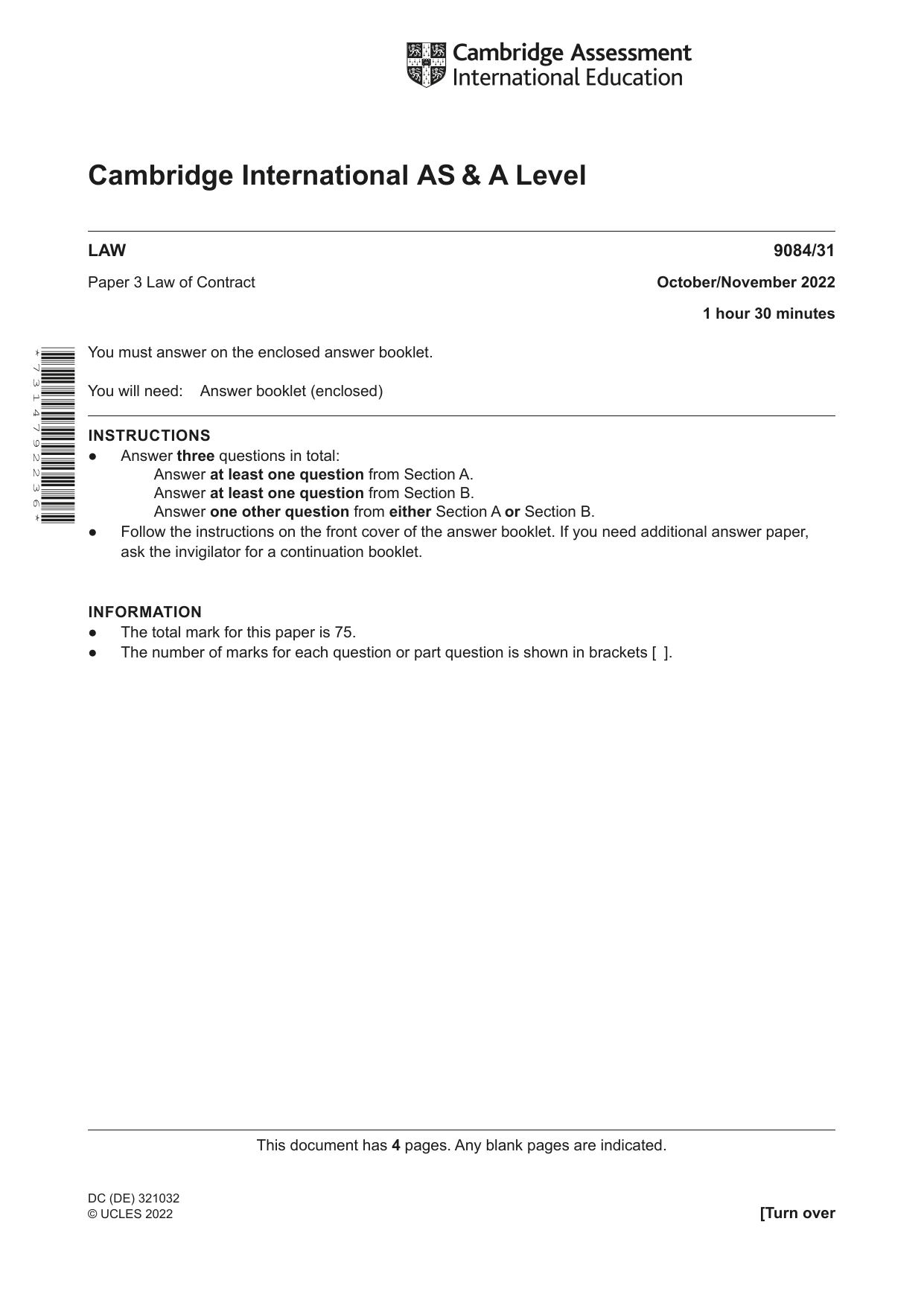
This document has 4 pages. Any blank pages are indicated. [Turn over DC (DE) 321032 © UCLES 2022 * 7 3 1 4 7 9 2 2 3 6 * Cambridge International AS & A Level LAW 9084/31 Paper 3 Law of Contract October/November 2022 1 hour 30 minutes You must answer on the enclosed answer booklet. You will need: Answer booklet (enclosed) INSTRUCTIONS ● Answer three questions in total: Answer at least one question from Section A. Answer at least one question from Section B. Answer one other question from either Section A or Section B. ● Follow the instructions on the front cover of the answer booklet. If you need additional answer paper, ask the invigilator for a continuation booklet. INFORMATION ● The total mark for this paper is 75. ● The number of marks for each question or part question is shown in brackets [ ].
Question paper, page 2
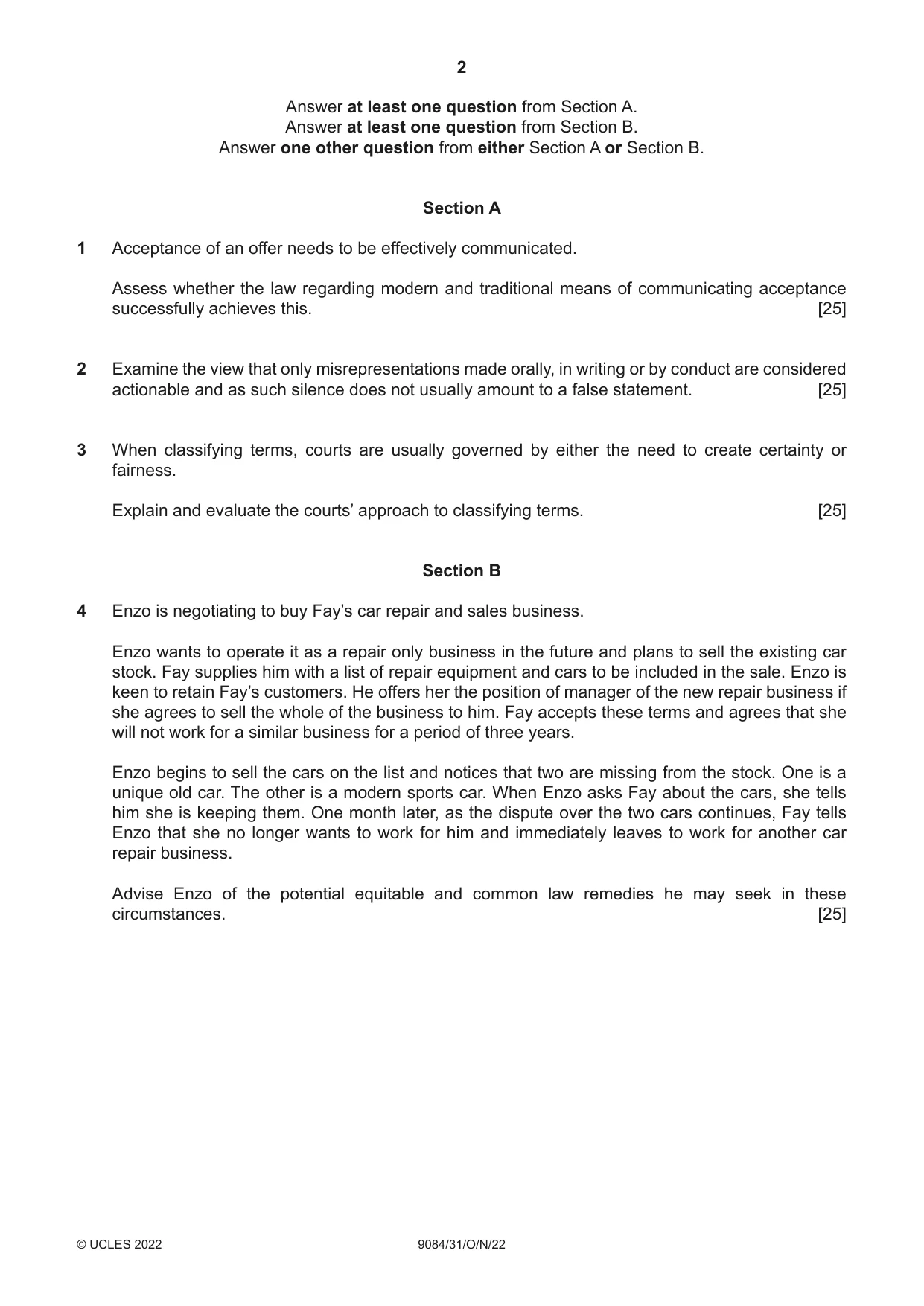
2 9084/31/O/N/22 © UCLES 2022 Answer at least one question from Section A. Answer at least one question from Section B. Answer one other question from either Section A or Section B. Section A 1 Acceptance of an offer needs to be effectively communicated. Assess whether the law regarding modern and traditional means of communicating acceptance successfully achieves this. [25] 2 Examine the view that only misrepresentations made orally, in writing or by conduct are considered actionable and as such silence does not usually amount to a false statement. [25] 3 When classifying terms, courts are usually governed by either the need to create certainty or fairness. Explain and evaluate the courts’ approach to classifying terms. [25] Section B 4 Enzo is negotiating to buy Fay’s car repair and sales business. Enzo wants to operate it as a repair only business in the future and plans to sell the existing car stock. Fay supplies him with a list of repair equipment and cars to be included in the sale. Enzo is keen to retain Fay’s customers. He offers her the position of manager of the new repair business if she agrees to sell the whole of the business to him. Fay accepts these terms and agrees that she will not work for a similar business for a period of three years. Enzo begins to sell the cars on the list and notices that two are missing from the stock. One is a unique old car. The other is a modern sports car. When Enzo asks Fay about the cars, she tells him she is keeping them. One month later, as the dispute over the two cars continues, Fay tells Enzo that she no longer wants to work for him and immediately leaves to work for another car repair business. Advise Enzo of the potential equitable and common law remedies he may seek in these circumstances. [25]
Question paper, page 3
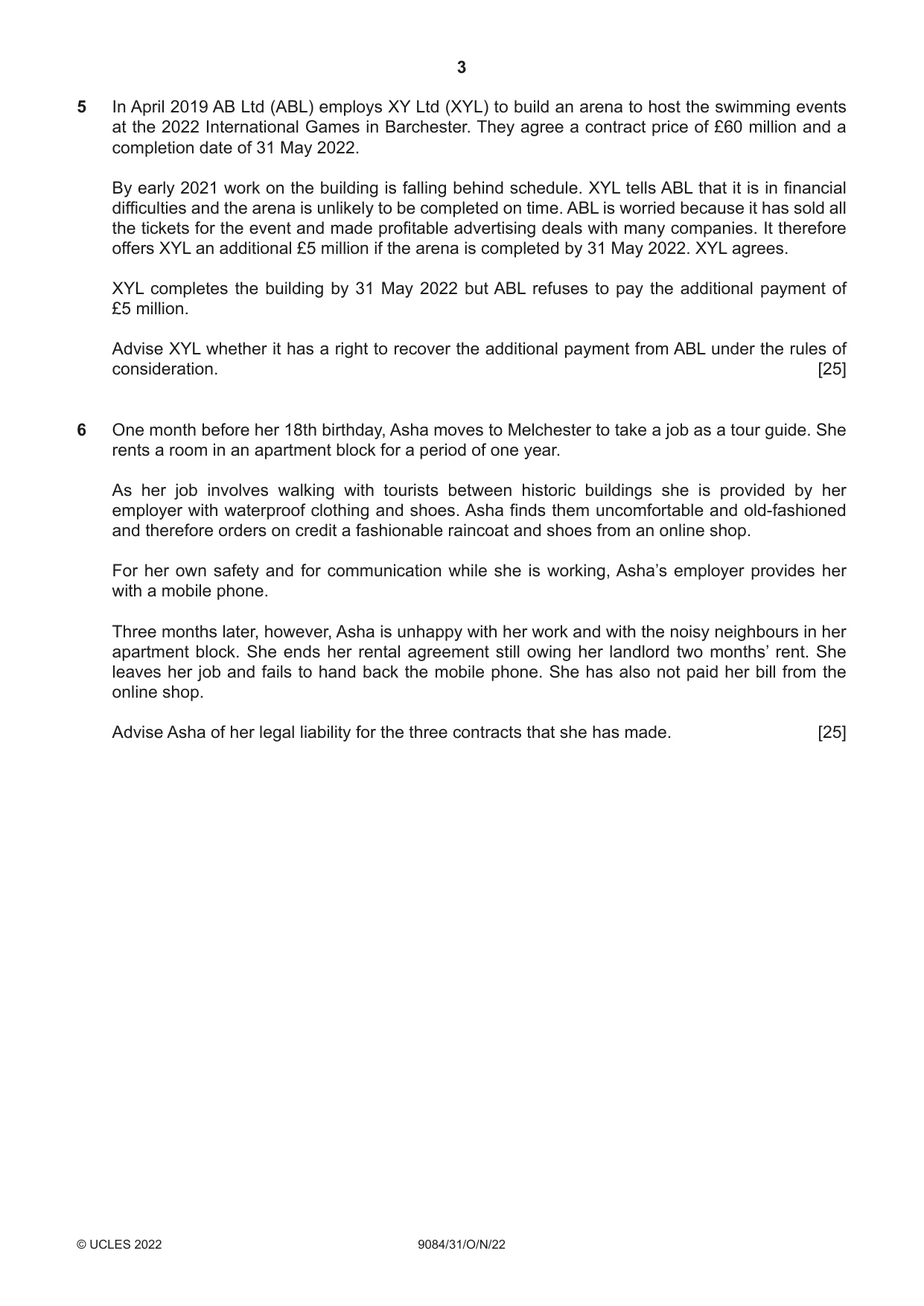
3 9084/31/O/N/22 © UCLES 2022 5 In April 2019 AB Ltd (ABL) employs XY Ltd (XYL) to build an arena to host the swimming events at the 2022 International Games in Barchester. They agree a contract price of £60 million and a completion date of 31 May 2022. By early 2021 work on the building is falling behind schedule. XYL tells ABL that it is in financial difficulties and the arena is unlikely to be completed on time. ABL is worried because it has sold all the tickets for the event and made profitable advertising deals with many companies. It therefore offers XYL an additional £5 million if the arena is completed by 31 May 2022. XYL agrees. XYL completes the building by 31 May 2022 but ABL refuses to pay the additional payment of £5 million. Advise XYL whether it has a right to recover the additional payment from ABL under the rules of consideration. [25] 6 One month before her 18th birthday, Asha moves to Melchester to take a job as a tour guide. She rents a room in an apartment block for a period of one year. As her job involves walking with tourists between historic buildings she is provided by her employer with waterproof clothing and shoes. Asha finds them uncomfortable and old-fashioned and therefore orders on credit a fashionable raincoat and shoes from an online shop. For her own safety and for communication while she is working, Asha’s employer provides her with a mobile phone. Three months later, however, Asha is unhappy with her work and with the noisy neighbours in her apartment block. She ends her rental agreement still owing her landlord two months’ rent. She leaves her job and fails to hand back the mobile phone. She has also not paid her bill from the online shop. Advise Asha of her legal liability for the three contracts that she has made. [25]
Question paper, page 4
4 9084/31/O/N/22 © UCLES 2022 Permission to reproduce items where third-party owned material protected by copyright is included has been sought and cleared where possible. Every reasonable effort has been made by the publisher (UCLES) to trace copyright holders, but if any items requiring clearance have unwittingly been included, the publisher will be pleased to make amends at the earliest possible opportunity. To avoid the issue of disclosure of answer-related information to candidates, all copyright acknowledgements are reproduced online in the Cambridge Assessment International Education Copyright Acknowledgements Booklet. This is produced for each series of examinations and is freely available to download at www.cambridgeinternational.org after the live examination series. Cambridge Assessment International Education is part of Cambridge Assessment. Cambridge Assessment is the brand name of the University of Cambridge Local Examinations Syndicate (UCLES), which is a department of the University of Cambridge. BLANK PAGE
Mark scheme, page 1
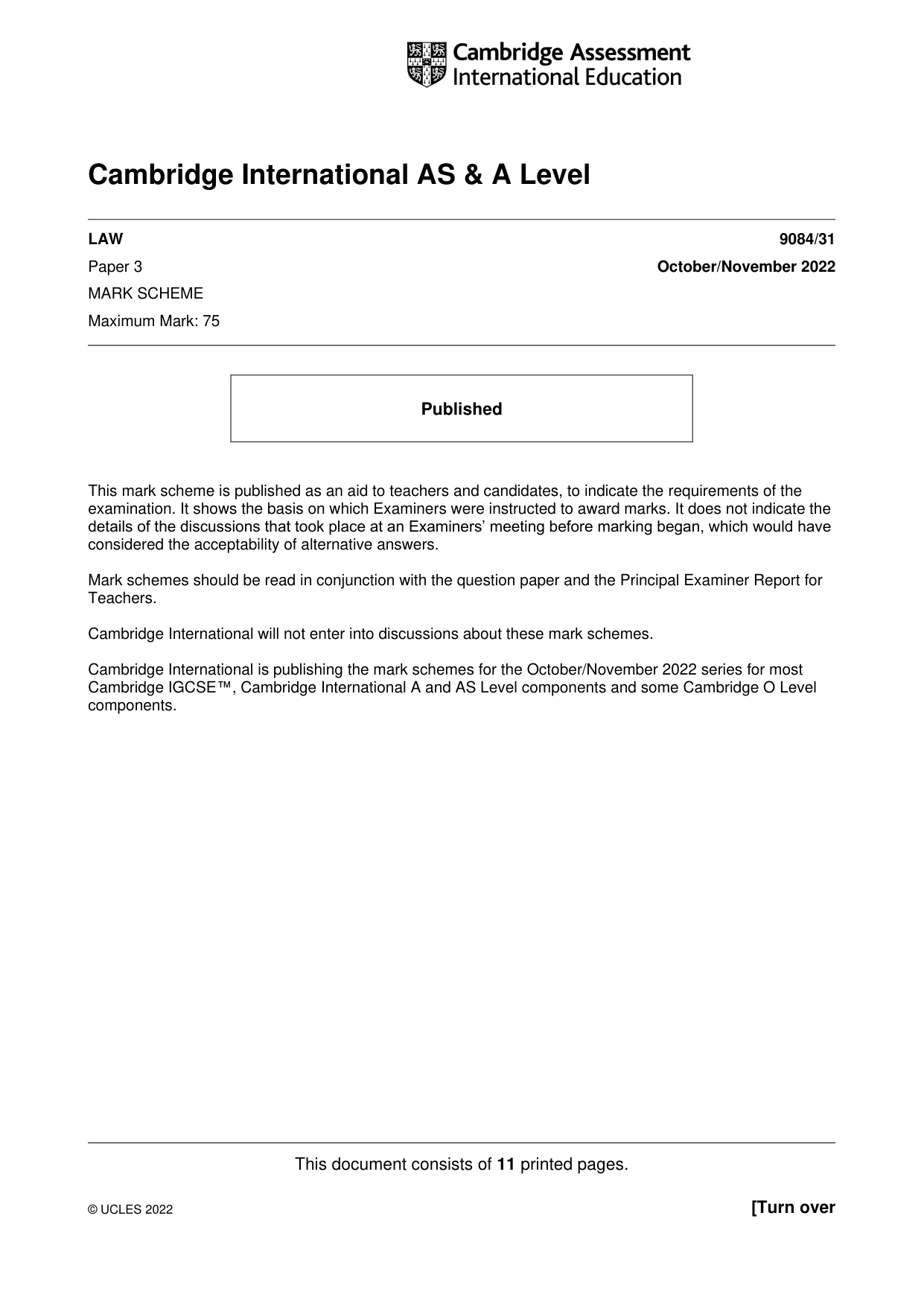
This document consists of 11 printed pages. © UCLES 2022 [Turn over Cambridge International AS & A Level LAW 9084/31 Paper 3 October/November 2022 MARK SCHEME Maximum Mark: 75 Published This mark scheme is published as an aid to teachers and candidates, to indicate the requirements of the examination. It shows the basis on which Examiners were instructed to award marks. It does not indicate the details of the discussions that took place at an Examiners’ meeting before marking began, which would have considered the acceptability of alternative answers. Mark schemes should be read in conjunction with the question paper and the Principal Examiner Report for Teachers. Cambridge International will not enter into discussions about these mark schemes. Cambridge International is publishing the mark schemes for the October/November 2022 series for most Cambridge IGCSE™, Cambridge International A and AS Level components and some Cambridge O Level components.
Mark scheme, page 2
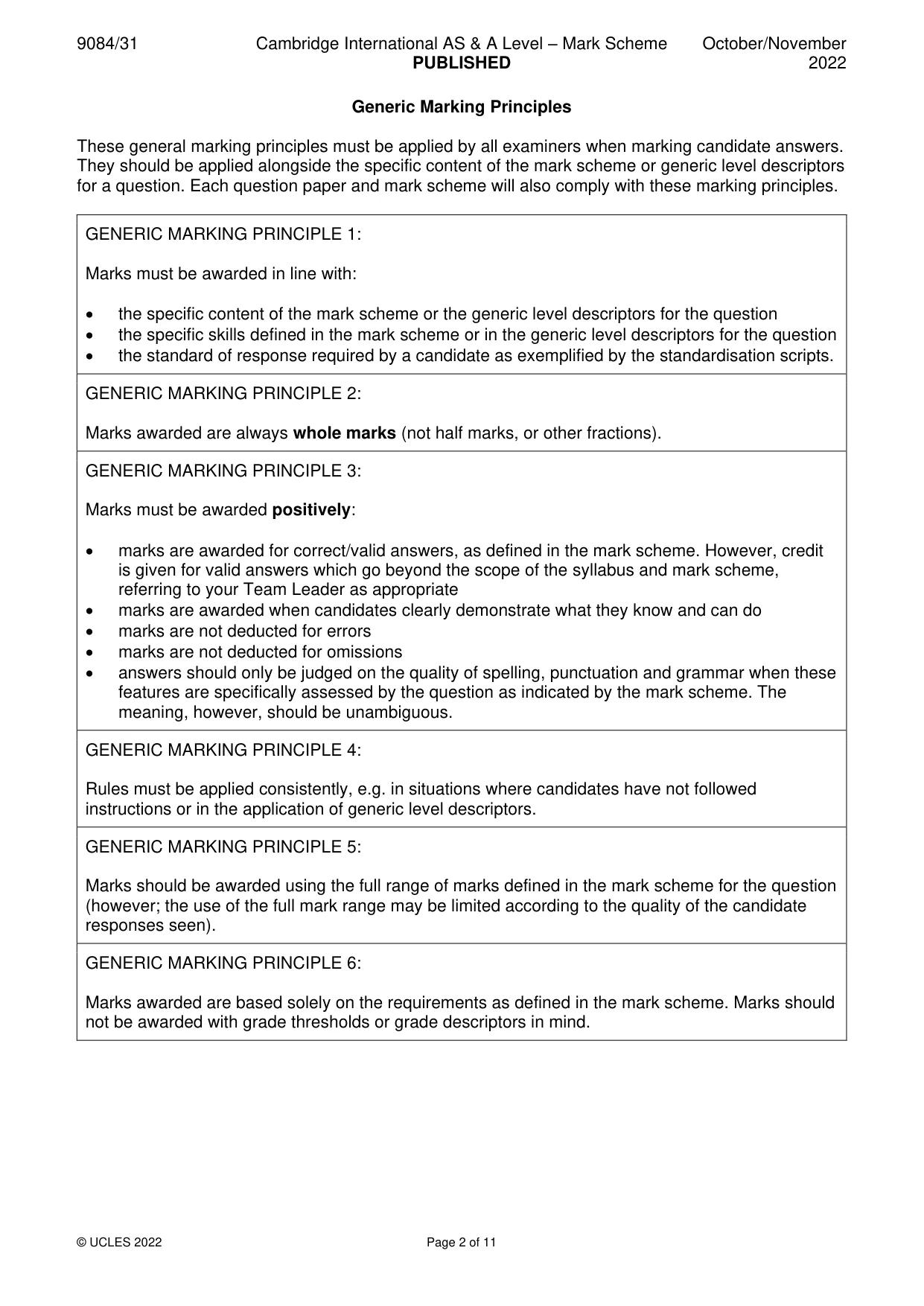
9084/31 Cambridge International AS & A Level – Mark Scheme PUBLISHED October/November 2022 © UCLES 2022 Page 2 of 11 Generic Marking Principles These general marking principles must be applied by all examiners when marking candidate answers. They should be applied alongside the specific content of the mark scheme or generic level descriptors for a question. Each question paper and mark scheme will also comply with these marking principles. GENERIC MARKING PRINCIPLE 1: Marks must be awarded in line with: • the specific content of the mark scheme or the generic level descriptors for the question • the specific skills defined in the mark scheme or in the generic level descriptors for the question • the standard of response required by a candidate as exemplified by the standardisation scripts. GENERIC MARKING PRINCIPLE 2: Marks awarded are always whole marks (not half marks, or other fractions). GENERIC MARKING PRINCIPLE 3: Marks must be awarded positively: • marks are awarded for correct/valid answers, as defined in the mark scheme. However, credit is given for valid answers which go beyond the scope of the syllabus and mark scheme, referring to your Team Leader as appropriate • marks are awarded when candidates clearly demonstrate what they know and can do • marks are not deducted for errors • marks are not deducted for omissions • answers should only be judged on the quality of spelling, punctuation and grammar when these features are specifically assessed by the question as indicated by the mark scheme. The meaning, however, should be unambiguous. GENERIC MARKING PRINCIPLE 4: Rules must be applied consistently, e.g. in situations where candidates have not followed instructions or in the application of generic level descriptors. GENERIC MARKING PRINCIPLE 5: Marks should be awarded using the full range of marks defined in the mark scheme for the question (however; the use of the full mark range may be limited according to the quality of the candidate responses seen). GENERIC MARKING PRINCIPLE 6: Marks awarded are based solely on the requirements as defined in the mark scheme. Marks should not be awarded with grade thresholds or grade descriptors in mind.
Mark scheme, page 3
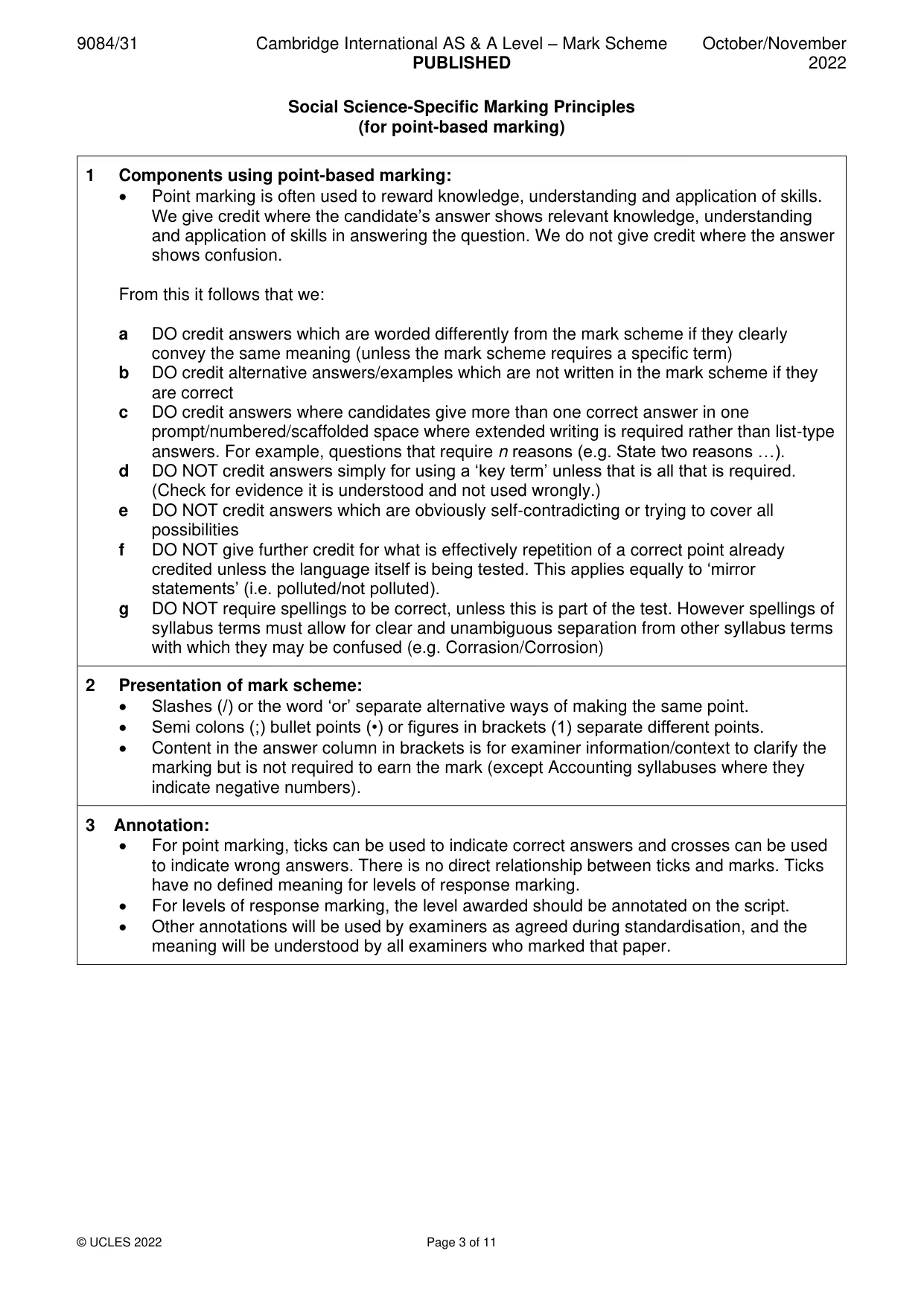
9084/31 Cambridge International AS & A Level – Mark Scheme PUBLISHED October/November 2022 © UCLES 2022 Page 3 of 11 Social Science-Specific Marking Principles (for point-based marking) 1 Components using point-based marking: • Point marking is often used to reward knowledge, understanding and application of skills. We give credit where the candidate’s answer shows relevant knowledge, understanding and application of skills in answering the question. We do not give credit where the answer shows confusion. From this it follows that we: a DO credit answers which are worded differently from the mark scheme if they clearly convey the same meaning (unless the mark scheme requires a specific term) b DO credit alternative answers/examples which are not written in the mark scheme if they are correct c DO credit answers where candidates give more than one correct answer in one prompt/numbered/scaffolded space where extended writing is required rather than list-type answers. For example, questions that require n reasons (e.g. State two reasons …). d DO NOT credit answers simply for using a ‘key term’ unless that is all that is required. (Check for evidence it is understood and not used wrongly.) e DO NOT credit answers which are obviously self-contradicting or trying to cover all possibilities f DO NOT give further credit for what is effectively repetition of a correct point already credited unless the language itself is being tested. This applies equally to ‘mirror statements’ (i.e. polluted/not polluted). g DO NOT require spellings to be correct, unless this is part of the test. However spellings of syllabus terms must allow for clear and unambiguous separation from other syllabus terms with which they may be confused (e.g. Corrasion/Corrosion) 2 Presentation of mark scheme: • Slashes (/) or the word ‘or’ separate alternative ways of making the same point. • Semi colons (;) bullet points (•) or figures in brackets (1) separate different points. • Content in the answer column in brackets is for examiner information/context to clarify the marking but is not required to earn the mark (except Accounting syllabuses where they indicate negative numbers). 3 Annotation: • For point marking, ticks can be used to indicate correct answers and crosses can be used to indicate wrong answers. There is no direct relationship between ticks and marks. Ticks have no defined meaning for levels of response marking. • For levels of response marking, the level awarded should be annotated on the script. • Other annotations will be used by examiners as agreed during standardisation, and the meaning will be understood by all examiners who marked that paper.
Mark scheme, page 4
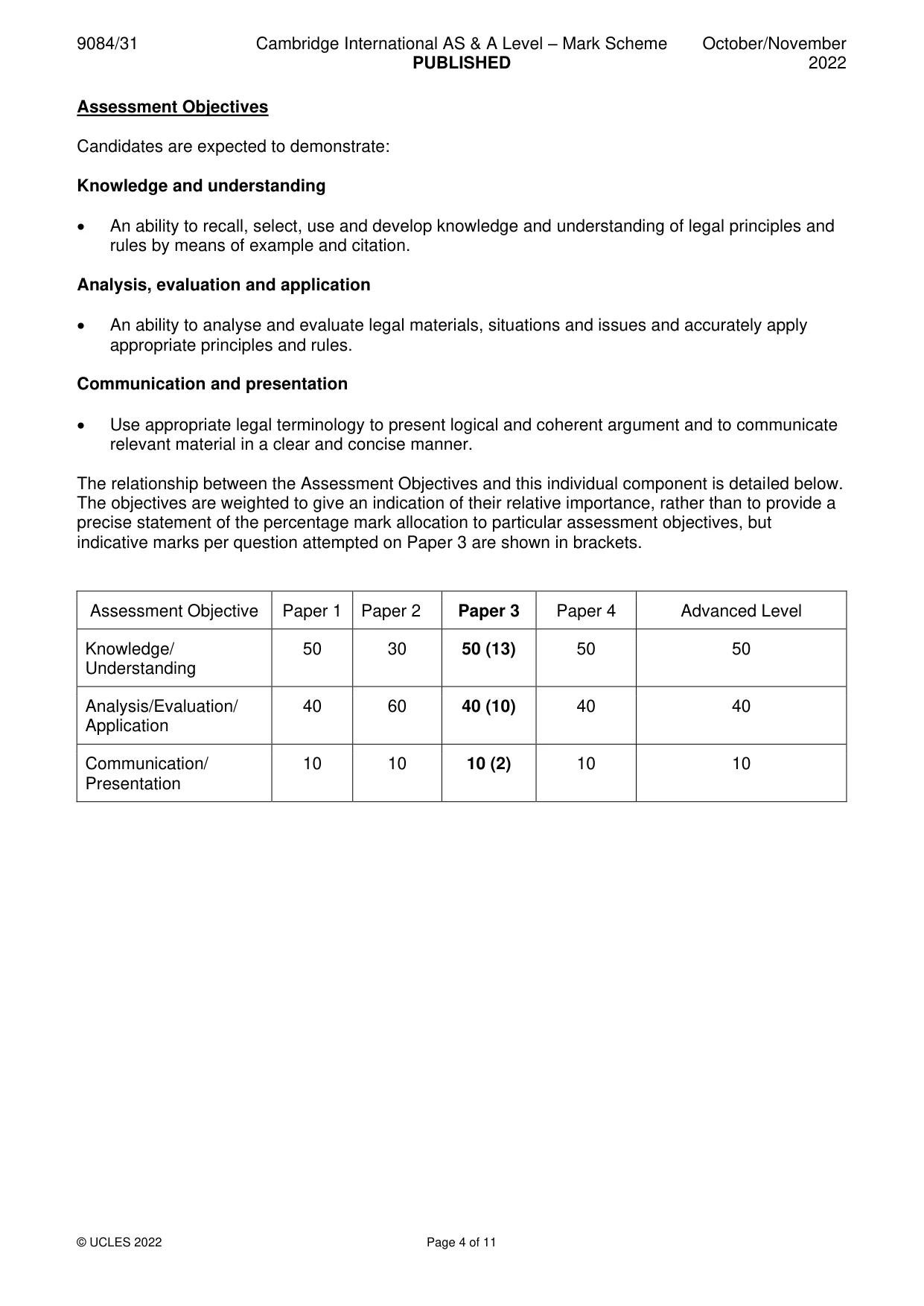
9084/31 Cambridge International AS & A Level – Mark Scheme PUBLISHED October/November 2022 © UCLES 2022 Page 4 of 11 Assessment Objectives Candidates are expected to demonstrate: Knowledge and understanding • An ability to recall, select, use and develop knowledge and understanding of legal principles and rules by means of example and citation. Analysis, evaluation and application • An ability to analyse and evaluate legal materials, situations and issues and accurately apply appropriate principles and rules. Communication and presentation • Use appropriate legal terminology to present logical and coherent argument and to communicate relevant material in a clear and concise manner. The relationship between the Assessment Objectives and this individual component is detailed below. The objectives are weighted to give an indication of their relative importance, rather than to provide a precise statement of the percentage mark allocation to particular assessment objectives, but indicative marks per question attempted on Paper 3 are shown in brackets. Assessment Objective Paper 1 Paper 2 Paper 3 Paper 4 Advanced Level Knowledge/ Understanding 50 30 50 (13) 50 50 Analysis/Evaluation/ Application 40 60 40 (10) 40 40 Communication/ Presentation 10 10 10 (2) 10 10
Mark scheme, page 5
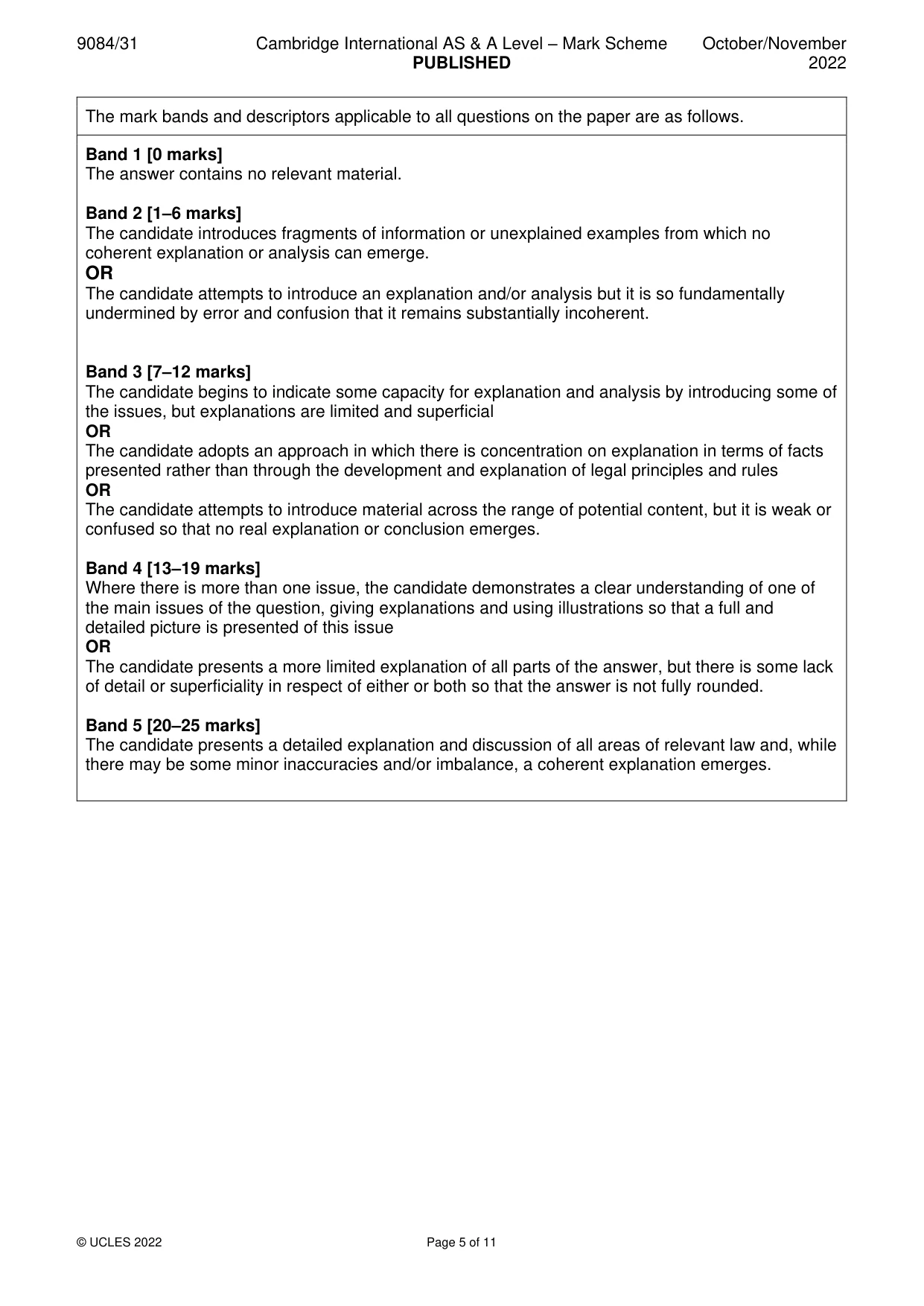
9084/31 Cambridge International AS & A Level – Mark Scheme PUBLISHED October/November 2022 © UCLES 2022 Page 5 of 11 The mark bands and descriptors applicable to all questions on the paper are as follows. Band 1 [0 marks] The answer contains no relevant material. Band 2 [1–6 marks] The candidate introduces fragments of information or unexplained examples from which no coherent explanation or analysis can emerge. OR The candidate attempts to introduce an explanation and/or analysis but it is so fundamentally undermined by error and confusion that it remains substantially incoherent. Band 3 [7–12 marks] The candidate begins to indicate some capacity for explanation and analysis by introducing some of the issues, but explanations are limited and superficial OR The candidate adopts an approach in which there is concentration on explanation in terms of facts presented rather than through the development and explanation of legal principles and rules OR The candidate attempts to introduce material across the range of potential content, but it is weak or confused so that no real explanation or conclusion emerges. Band 4 [13–19 marks] Where there is more than one issue, the candidate demonstrates a clear understanding of one of the main issues of the question, giving explanations and using illustrations so that a full and detailed picture is presented of this issue OR The candidate presents a more limited explanation of all parts of the answer, but there is some lack of detail or superficiality in respect of either or both so that the answer is not fully rounded. Band 5 [20–25 marks] The candidate presents a detailed explanation and discussion of all areas of relevant law and, while there may be some minor inaccuracies and/or imbalance, a coherent explanation emerges.
Mark scheme, page 6
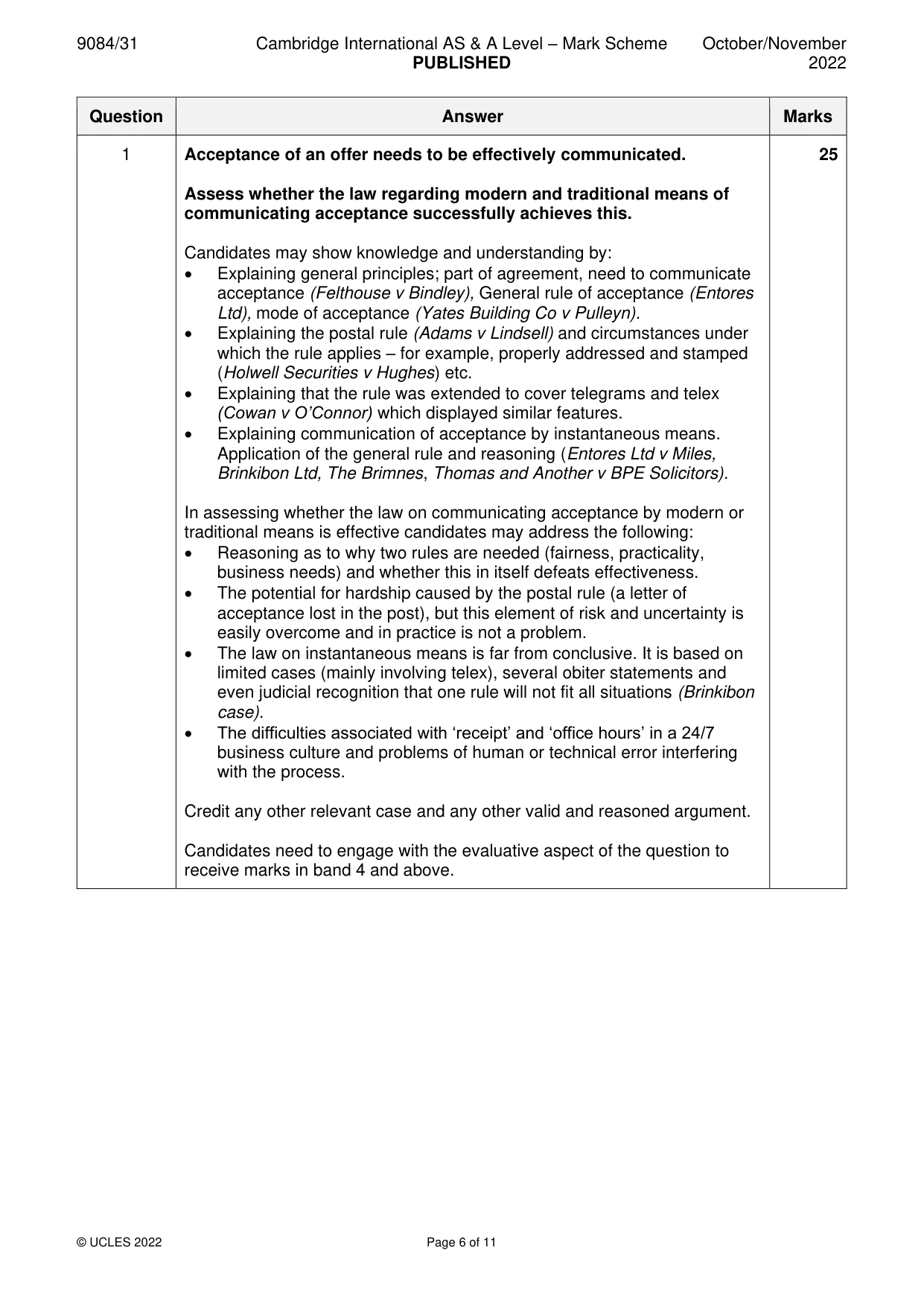
9084/31 Cambridge International AS & A Level – Mark Scheme PUBLISHED October/November 2022 © UCLES 2022 Page 6 of 11 Question Answer Marks 1 Acceptance of an offer needs to be effectively communicated. Assess whether the law regarding modern and traditional means of communicating acceptance successfully achieves this. Candidates may show knowledge and understanding by: • Explaining general principles; part of agreement, need to communicate acceptance (Felthouse v Bindley), General rule of acceptance (Entores Ltd), mode of acceptance (Yates Building Co v Pulleyn). • Explaining the postal rule (Adams v Lindsell) and circumstances under which the rule applies – for example, properly addressed and stamped (Holwell Securities v Hughes) etc. • Explaining that the rule was extended to cover telegrams and telex (Cowan v O’Connor) which displayed similar features. • Explaining communication of acceptance by instantaneous means. Application of the general rule and reasoning (Entores Ltd v Miles, Brinkibon Ltd, The Brimnes, Thomas and Another v BPE Solicitors). In assessing whether the law on communicating acceptance by modern or traditional means is effective candidates may address the following: • Reasoning as to why two rules are needed (fairness, practicality, business needs) and whether this in itself defeats effectiveness. • The potential for hardship caused by the postal rule (a letter of acceptance lost in the post), but this element of risk and uncertainty is easily overcome and in practice is not a problem. • The law on instantaneous means is far from conclusive. It is based on limited cases (mainly involving telex), several obiter statements and even judicial recognition that one rule will not fit all situations (Brinkibon case). • The difficulties associated with ‘receipt’ and ‘office hours’ in a 24/7 business culture and problems of human or technical error interfering with the process. Credit any other relevant case and any other valid and reasoned argument. Candidates need to engage with the evaluative aspect of the question to receive marks in band 4 and above. 25
Mark scheme, page 7
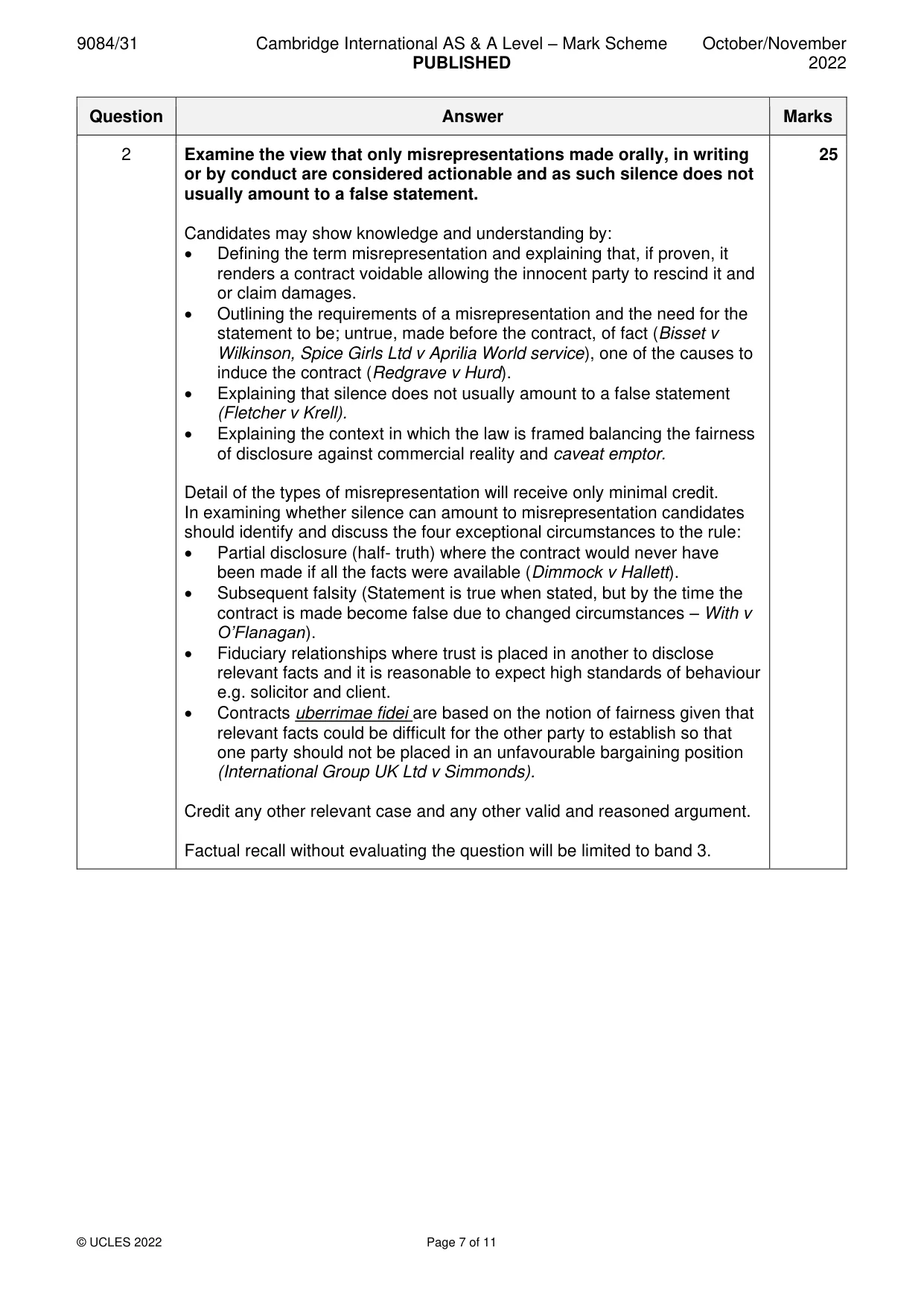
9084/31 Cambridge International AS & A Level – Mark Scheme PUBLISHED October/November 2022 © UCLES 2022 Page 7 of 11 Question Answer Marks 2 Examine the view that only misrepresentations made orally, in writing or by conduct are considered actionable and as such silence does not usually amount to a false statement. Candidates may show knowledge and understanding by: • Defining the term misrepresentation and explaining that, if proven, it renders a contract voidable allowing the innocent party to rescind it and or claim damages. • Outlining the requirements of a misrepresentation and the need for the statement to be; untrue, made before the contract, of fact (Bisset v Wilkinson, Spice Girls Ltd v Aprilia World service), one of the causes to induce the contract (Redgrave v Hurd). • Explaining that silence does not usually amount to a false statement (Fletcher v Krell). • Explaining the context in which the law is framed balancing the fairness of disclosure against commercial reality and caveat emptor. Detail of the types of misrepresentation will receive only minimal credit. In examining whether silence can amount to misrepresentation candidates should identify and discuss the four exceptional circumstances to the rule: • Partial disclosure (half- truth) where the contract would never have been made if all the facts were available (Dimmock v Hallett). • Subsequent falsity (Statement is true when stated, but by the time the contract is made become false due to changed circumstances – With v O’Flanagan). • Fiduciary relationships where trust is placed in another to disclose relevant facts and it is reasonable to expect high standards of behaviour e.g. solicitor and client. • Contracts uberrimae fidei are based on the notion of fairness given that relevant facts could be difficult for the other party to establish so that one party should not be placed in an unfavourable bargaining position (International Group UK Ltd v Simmonds). Credit any other relevant case and any other valid and reasoned argument. Factual recall without evaluating the question will be limited to band 3. 25
Mark scheme, page 8
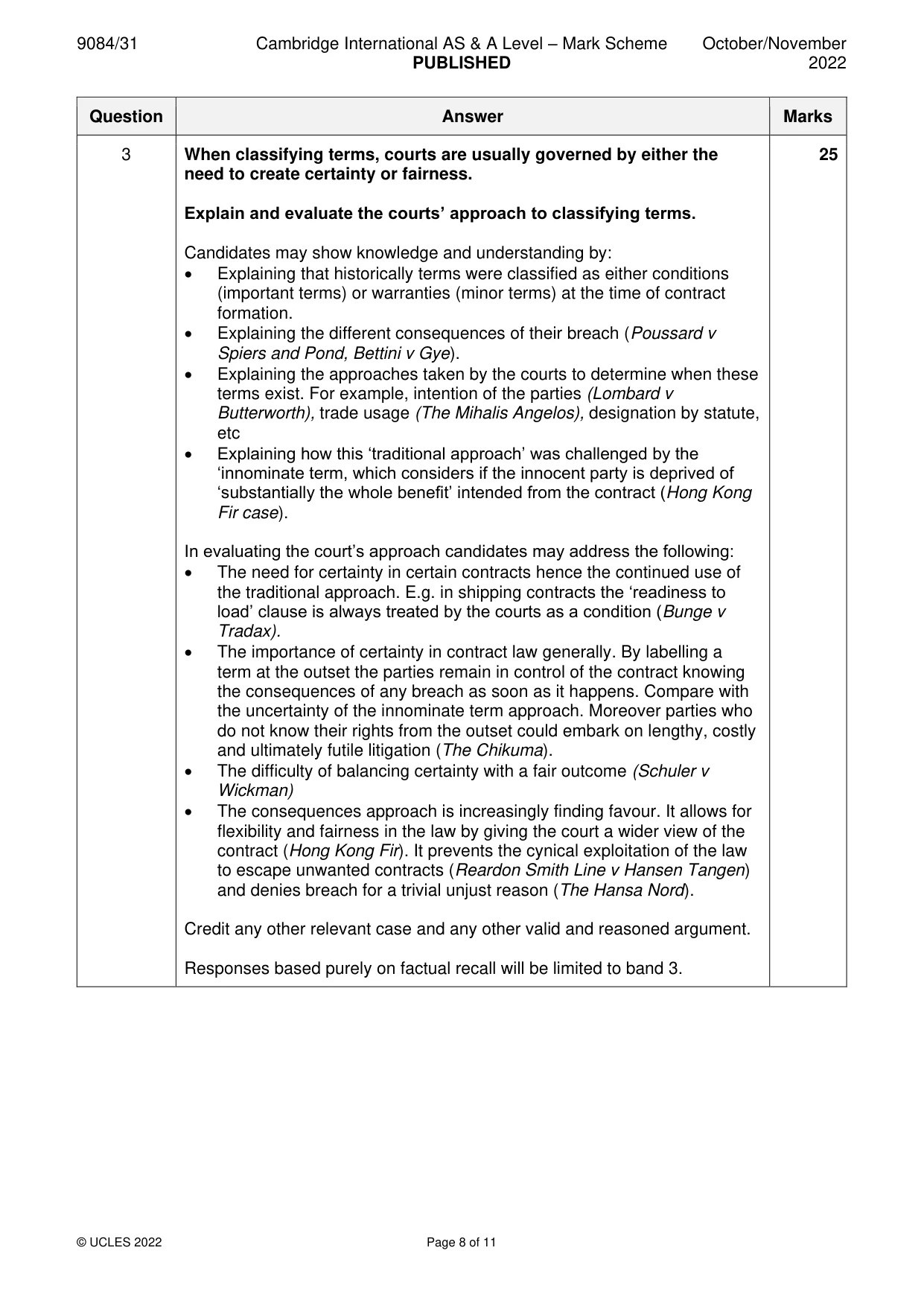
9084/31 Cambridge International AS & A Level – Mark Scheme PUBLISHED October/November 2022 © UCLES 2022 Page 8 of 11 Question Answer Marks 3 When classifying terms, courts are usually governed by either the need to create certainty or fairness. Explain and evaluate the courts’ approach to classifying terms. Candidates may show knowledge and understanding by: • Explaining that historically terms were classified as either conditions (important terms) or warranties (minor terms) at the time of contract formation. • Explaining the different consequences of their breach (Poussard v Spiers and Pond, Bettini v Gye). • Explaining the approaches taken by the courts to determine when these terms exist. For example, intention of the parties (Lombard v Butterworth), trade usage (The Mihalis Angelos), designation by statute, etc • Explaining how this ‘traditional approach’ was challenged by the ‘innominate term, which considers if the innocent party is deprived of ‘substantially the whole benefit’ intended from the contract (Hong Kong Fir case). In evaluating the court’s approach candidates may address the following: • The need for certainty in certain contracts hence the continued use of the traditional approach. E.g. in shipping contracts the ‘readiness to load’ clause is always treated by the courts as a condition (Bunge v Tradax). • The importance of certainty in contract law generally. By labelling a term at the outset the parties remain in control of the contract knowing the consequences of any breach as soon as it happens. Compare with the uncertainty of the innominate term approach. Moreover parties who do not know their rights from the outset could embark on lengthy, costly and ultimately futile litigation (The Chikuma). • The difficulty of balancing certainty with a fair outcome (Schuler v Wickman) • The consequences approach is increasingly finding favour. It allows for flexibility and fairness in the law by giving the court a wider view of the contract (Hong Kong Fir). It prevents the cynical exploitation of the law to escape unwanted contracts (Reardon Smith Line v Hansen Tangen) and denies breach for a trivial unjust reason (The Hansa Nord). Credit any other relevant case and any other valid and reasoned argument. Responses based purely on factual recall will be limited to band 3. 25
Mark scheme, page 9
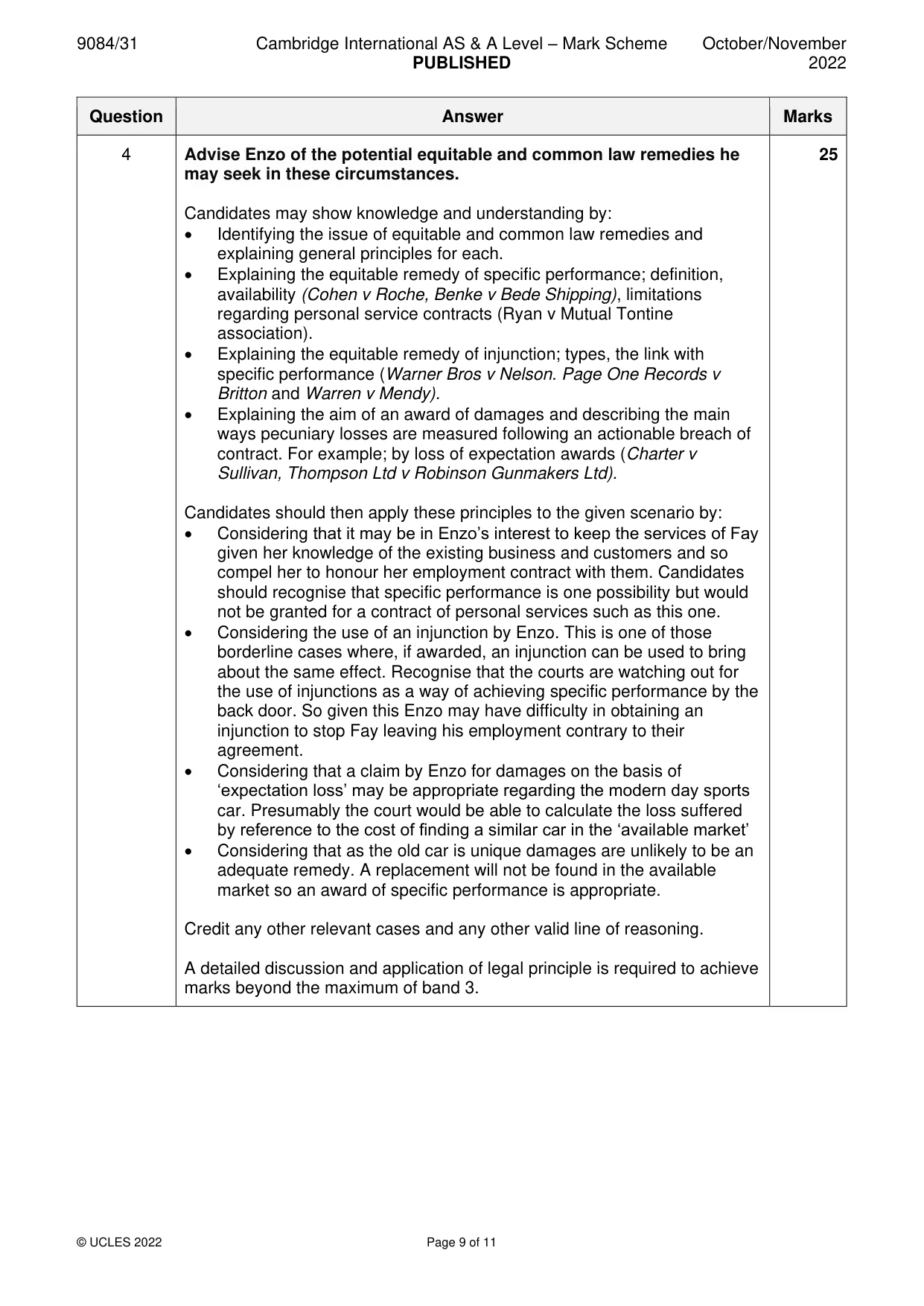
9084/31 Cambridge International AS & A Level – Mark Scheme PUBLISHED October/November 2022 © UCLES 2022 Page 9 of 11 Question Answer Marks 4 Advise Enzo of the potential equitable and common law remedies he may seek in these circumstances. Candidates may show knowledge and understanding by: • Identifying the issue of equitable and common law remedies and explaining general principles for each. • Explaining the equitable remedy of specific performance; definition, availability (Cohen v Roche, Benke v Bede Shipping), limitations regarding personal service contracts (Ryan v Mutual Tontine association). • Explaining the equitable remedy of injunction; types, the link with specific performance (Warner Bros v Nelson. Page One Records v Britton and Warren v Mendy). • Explaining the aim of an award of damages and describing the main ways pecuniary losses are measured following an actionable breach of contract. For example; by loss of expectation awards (Charter v Sullivan, Thompson Ltd v Robinson Gunmakers Ltd). Candidates should then apply these principles to the given scenario by: • Considering that it may be in Enzo’s interest to keep the services of Fay given her knowledge of the existing business and customers and so compel her to honour her employment contract with them. Candidates should recognise that specific performance is one possibility but would not be granted for a contract of personal services such as this one. • Considering the use of an injunction by Enzo. This is one of those borderline cases where, if awarded, an injunction can be used to bring about the same effect. Recognise that the courts are watching out for the use of injunctions as a way of achieving specific performance by the back door. So given this Enzo may have difficulty in obtaining an injunction to stop Fay leaving his employment contrary to their agreement. • Considering that a claim by Enzo for damages on the basis of ‘expectation loss’ may be appropriate regarding the modern day sports car. Presumably the court would be able to calculate the loss suffered by reference to the cost of finding a similar car in the ‘available market’ • Considering that as the old car is unique damages are unlikely to be an adequate remedy. A replacement will not be found in the available market so an award of specific performance is appropriate. Credit any other relevant cases and any other valid line of reasoning. A detailed discussion and application of legal principle is required to achieve marks beyond the maximum of band 3. 25
Mark scheme, page 10
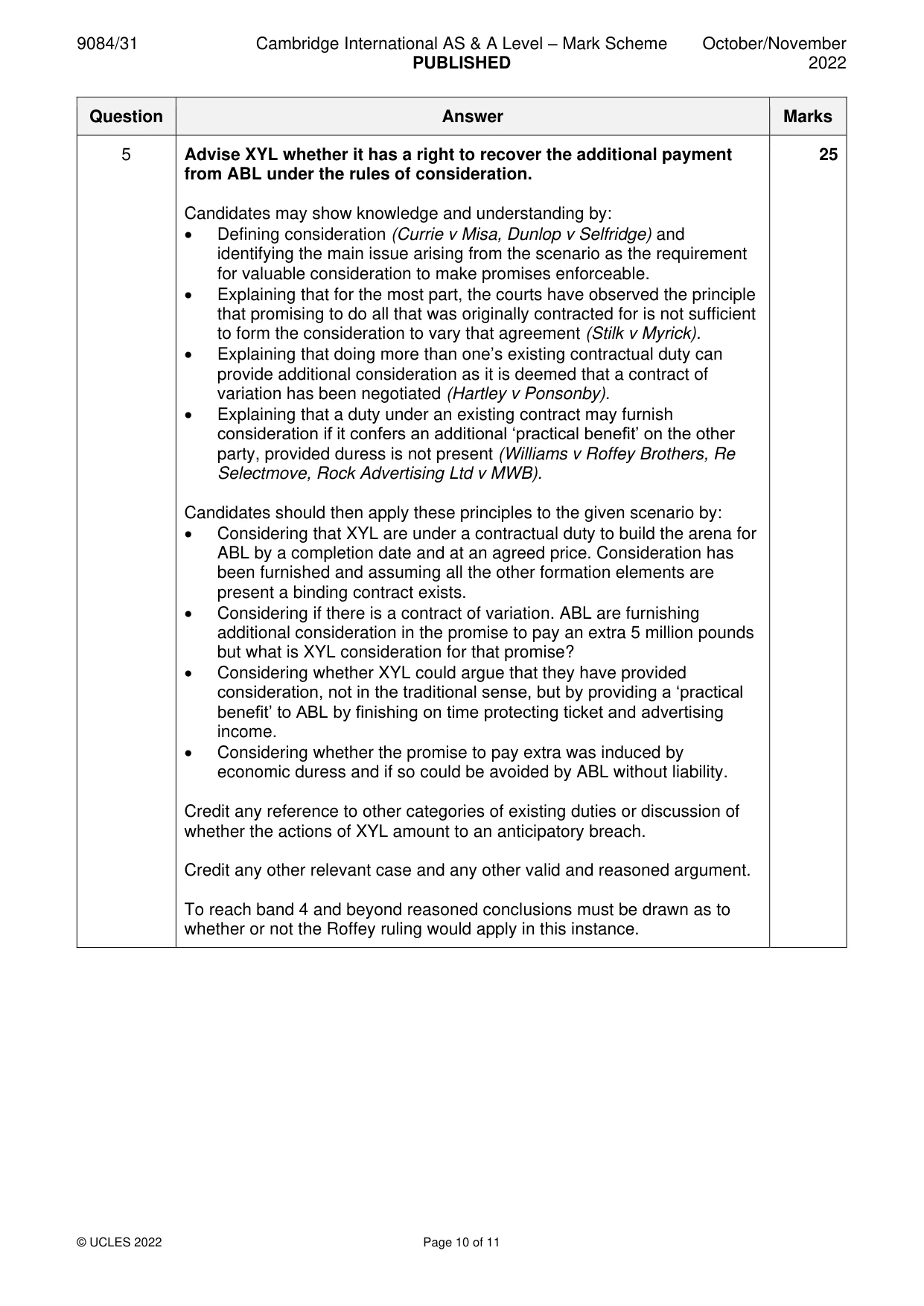
9084/31 Cambridge International AS & A Level – Mark Scheme PUBLISHED October/November 2022 © UCLES 2022 Page 10 of 11 Question Answer Marks 5 Advise XYL whether it has a right to recover the additional payment from ABL under the rules of consideration. Candidates may show knowledge and understanding by: • Defining consideration (Currie v Misa, Dunlop v Selfridge) and identifying the main issue arising from the scenario as the requirement for valuable consideration to make promises enforceable. • Explaining that for the most part, the courts have observed the principle that promising to do all that was originally contracted for is not sufficient to form the consideration to vary that agreement (Stilk v Myrick). • Explaining that doing more than one’s existing contractual duty can provide additional consideration as it is deemed that a contract of variation has been negotiated (Hartley v Ponsonby). • Explaining that a duty under an existing contract may furnish consideration if it confers an additional ‘practical benefit’ on the other party, provided duress is not present (Williams v Roffey Brothers, Re Selectmove, Rock Advertising Ltd v MWB). Candidates should then apply these principles to the given scenario by: • Considering that XYL are under a contractual duty to build the arena for ABL by a completion date and at an agreed price. Consideration has been furnished and assuming all the other formation elements are present a binding contract exists. • Considering if there is a contract of variation. ABL are furnishing additional consideration in the promise to pay an extra 5 million pounds but what is XYL consideration for that promise? • Considering whether XYL could argue that they have provided consideration, not in the traditional sense, but by providing a ‘practical benefit’ to ABL by finishing on time protecting ticket and advertising income. • Considering whether the promise to pay extra was induced by economic duress and if so could be avoided by ABL without liability. Credit any reference to other categories of existing duties or discussion of whether the actions of XYL amount to an anticipatory breach. Credit any other relevant case and any other valid and reasoned argument. To reach band 4 and beyond reasoned conclusions must be drawn as to whether or not the Roffey ruling would apply in this instance. 25
Mark scheme, page 11
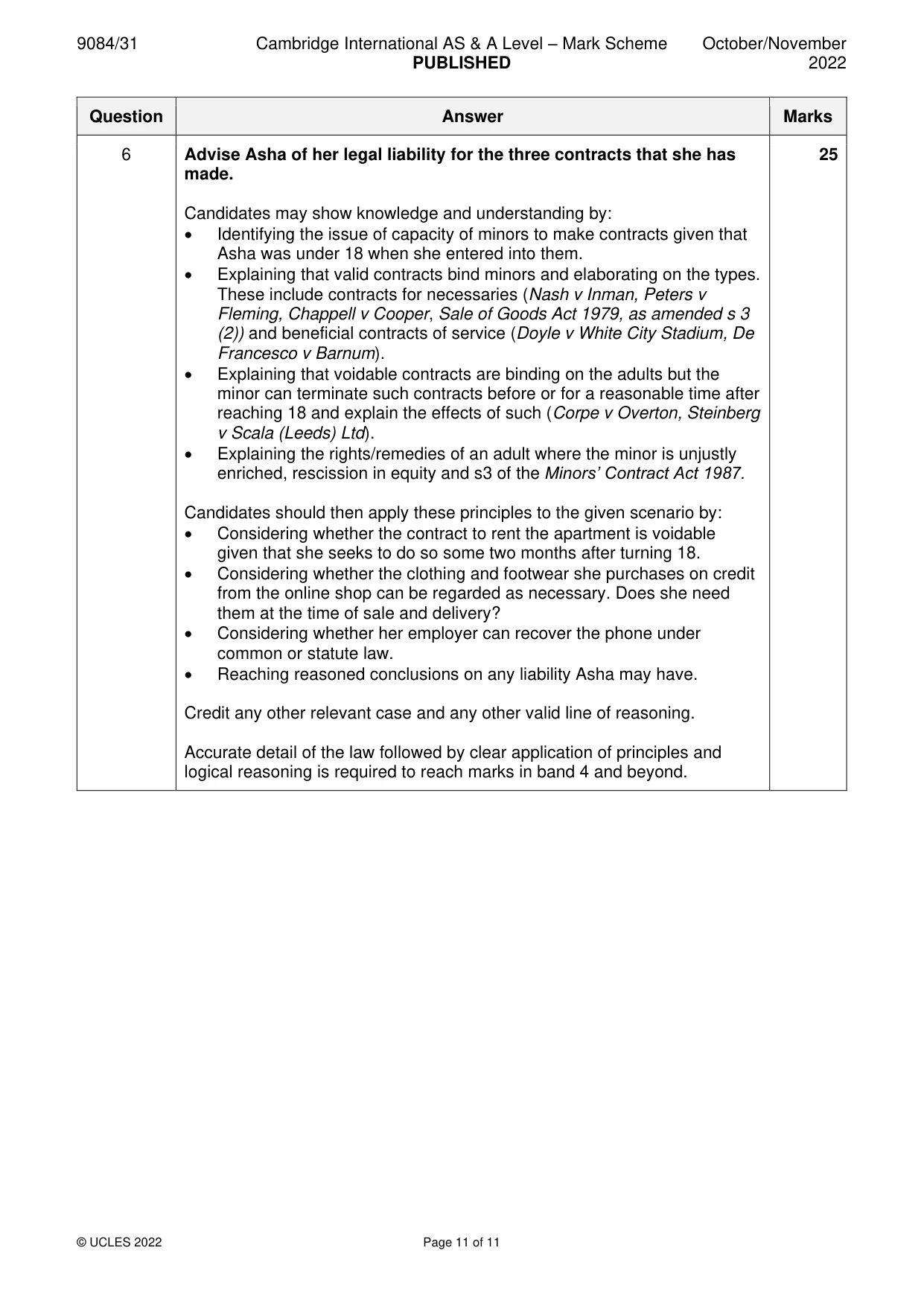
9084/31 Cambridge International AS & A Level – Mark Scheme PUBLISHED October/November 2022 © UCLES 2022 Page 11 of 11 Question Answer Marks 6 Advise Asha of her legal liability for the three contracts that she has made. Candidates may show knowledge and understanding by: • Identifying the issue of capacity of minors to make contracts given that Asha was under 18 when she entered into them. • Explaining that valid contracts bind minors and elaborating on the types. These include contracts for necessaries (Nash v Inman, Peters v Fleming, Chappell v Cooper, Sale of Goods Act 1979, as amended s 3 (2)) and beneficial contracts of service (Doyle v White City Stadium, De Francesco v Barnum). • Explaining that voidable contracts are binding on the adults but the minor can terminate such contracts before or for a reasonable time after reaching 18 and explain the effects of such (Corpe v Overton, Steinberg v Scala (Leeds) Ltd). • Explaining the rights/remedies of an adult where the minor is unjustly enriched, rescission in equity and s3 of the Minors’ Contract Act 1987. Candidates should then apply these principles to the given scenario by: • Considering whether the contract to rent the apartment is voidable given that she seeks to do so some two months after turning 18. • Considering whether the clothing and footwear she purchases on credit from the online shop can be regarded as necessary. Does she need them at the time of sale and delivery? • Considering whether her employer can recover the phone under common or statute law. • Reaching reasoned conclusions on any liability Asha may have. Credit any other relevant case and any other valid line of reasoning. Accurate detail of the law followed by clear application of principles and logical reasoning is required to reach marks in band 4 and beyond. 25
What you needed in this session
Cambridge’s own grade thresholds for 2022 Oct/Nov, Paper 3 · Variant 1. A higher threshold means an easier paper — the bar moves with how the cohort did.