Cambridge A Level Law 9084 — 2019 Oct/Nov Paper 3 · Variant 2
9084/32/O/N/19 · 75 marks · ≈84 min
The question paper and its mark scheme, free to read here and free to download. This is Cambridge’s own paper, exactly as it was sat.
Question paper4 pages

Mark scheme10 pages
Answers below. Sit the paper first if you are practising.
Paper as text
Question paper, page 1
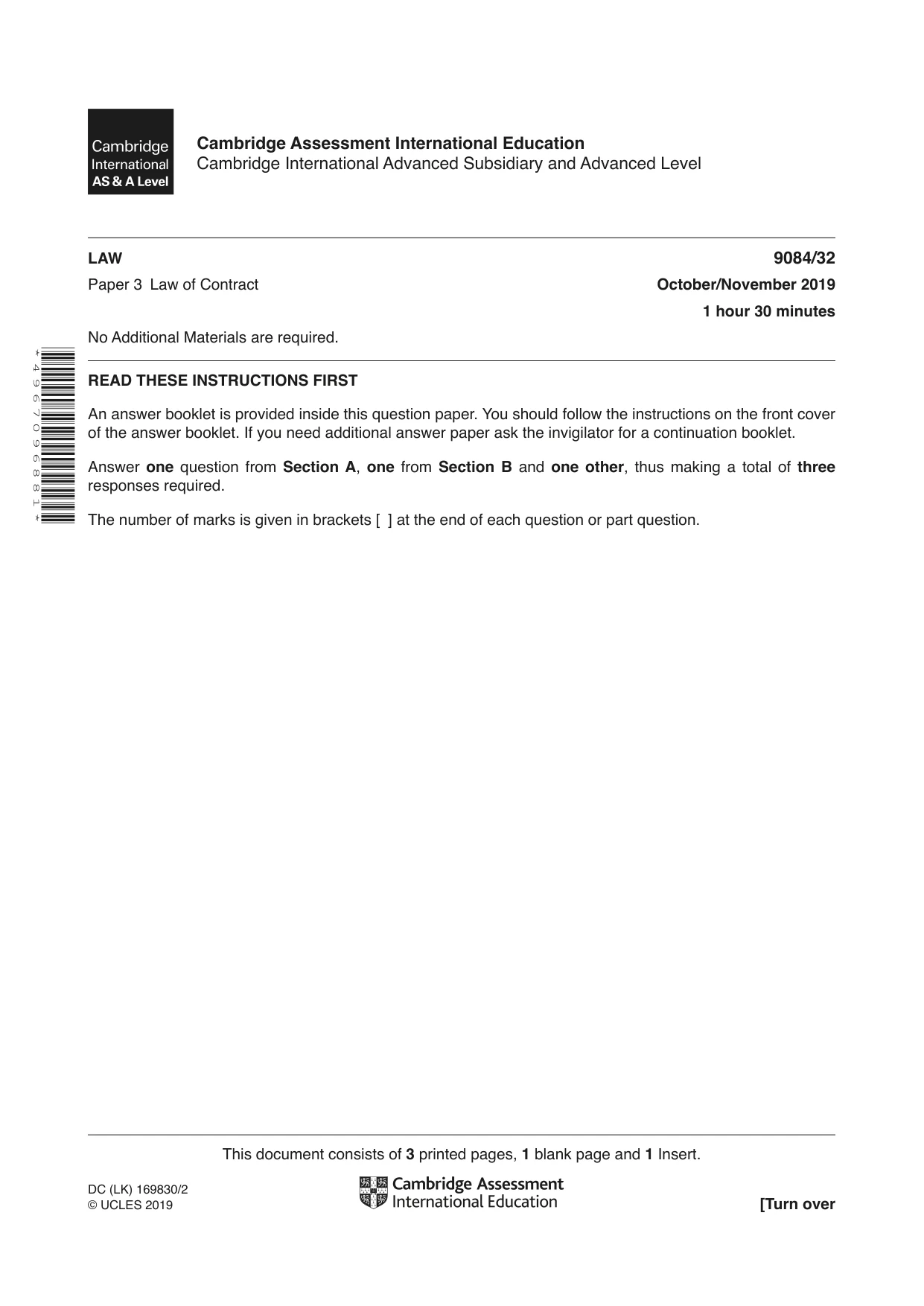
This document consists of 3 printed pages, 1 blank page and 1 Insert. DC (LK) 169830/2 © UCLES 2019 [Turn over Cambridge Assessment International Education Cambridge International Advanced Subsidiary and Advanced Level * 4 9 6 7 0 9 6 8 8 1 * LAW 9084/32 Paper 3 Law of Contract October/November 2019 1 hour 30 minutes No Additional Materials are required. READ THESE INSTRUCTIONS FIRST An answer booklet is provided inside this question paper. You should follow the instructions on the front cover of the answer booklet. If you need additional answer paper ask the invigilator for a continuation booklet. Answer one question from Section A, one from Section B and one other, thus making a total of three responses required. The number of marks is given in brackets [ ] at the end of each question or part question.
Question paper, page 2
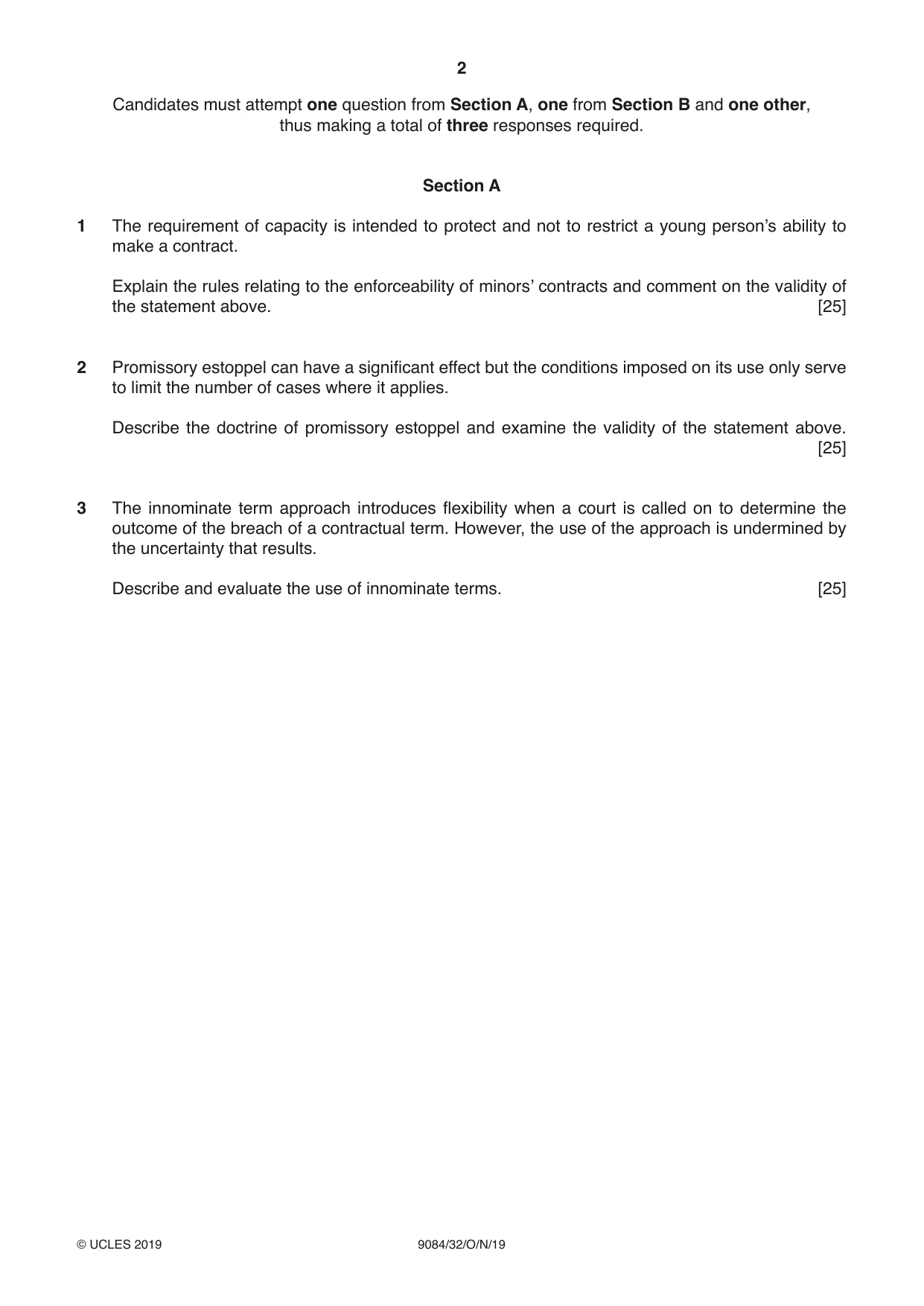
2 9084/32/O/N/19 © UCLES 2019 Candidates must attempt one question from Section A, one from Section B and one other, thus making a total of three responses required. Section A 1 The requirement of capacity is intended to protect and not to restrict a young person’s ability to make a contract. Explain the rules relating to the enforceability of minors’ contracts and comment on the validity of the statement above. [25] 2 Promissory estoppel can have a significant effect but the conditions imposed on its use only serve to limit the number of cases where it applies. Describe the doctrine of promissory estoppel and examine the validity of the statement above. [25] 3 The innominate term approach introduces flexibility when a court is called on to determine the outcome of the breach of a contractual term. However, the use of the approach is undermined by the uncertainty that results. Describe and evaluate the use of innominate terms. [25]
Question paper, page 3
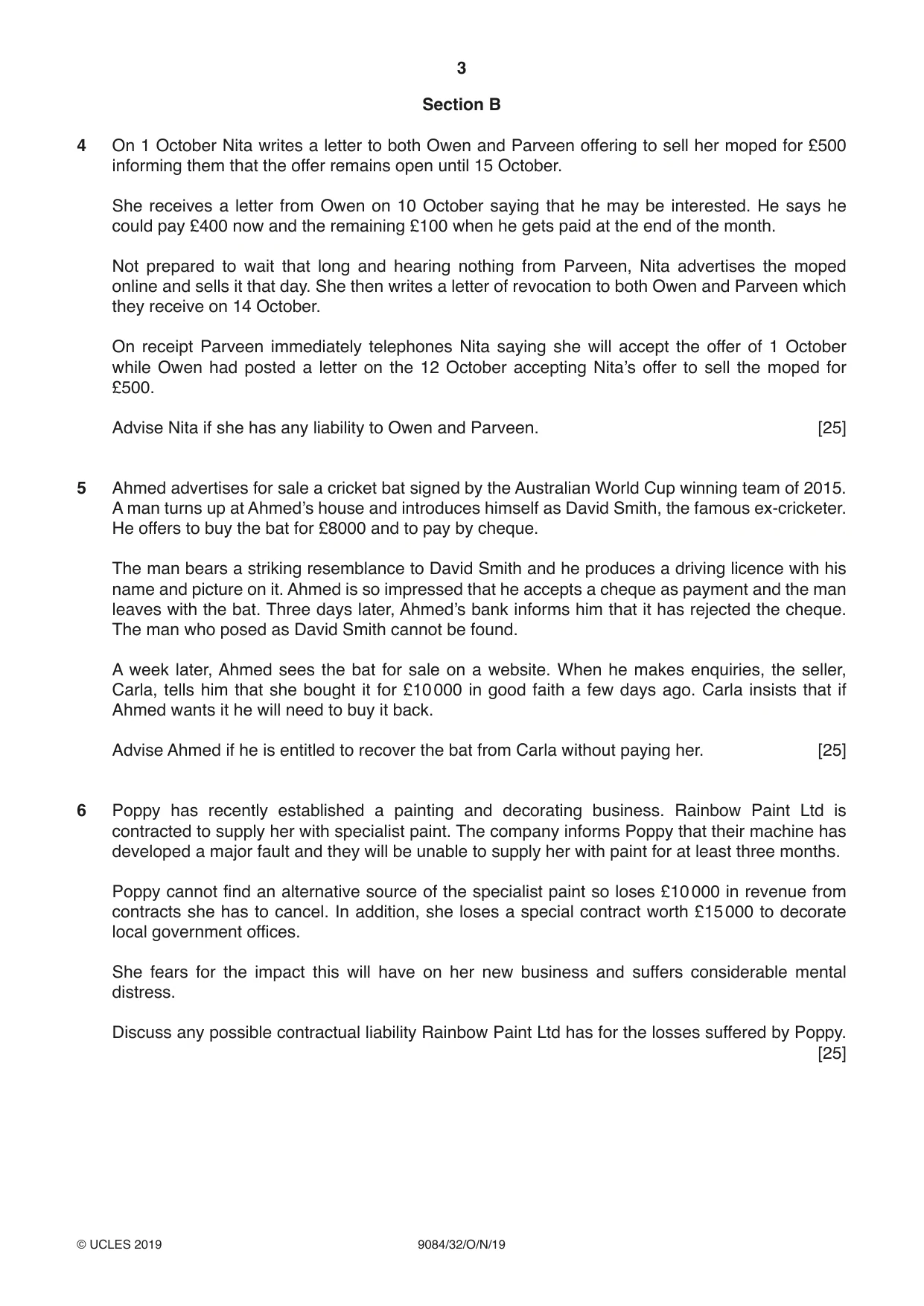
3 9084/32/O/N/19 © UCLES 2019 Section B 4 On 1 October Nita writes a letter to both Owen and Parveen offering to sell her moped for £500 informing them that the offer remains open until 15 October. She receives a letter from Owen on 10 October saying that he may be interested. He says he could pay £400 now and the remaining £100 when he gets paid at the end of the month. Not prepared to wait that long and hearing nothing from Parveen, Nita advertises the moped online and sells it that day. She then writes a letter of revocation to both Owen and Parveen which they receive on 14 October. On receipt Parveen immediately telephones Nita saying she will accept the offer of 1 October while Owen had posted a letter on the 12 October accepting Nita’s offer to sell the moped for £500. Advise Nita if she has any liability to Owen and Parveen. [25] 5 Ahmed advertises for sale a cricket bat signed by the Australian World Cup winning team of 2015. A man turns up at Ahmed’s house and introduces himself as David Smith, the famous ex-cricketer. He offers to buy the bat for £8000 and to pay by cheque. The man bears a striking resemblance to David Smith and he produces a driving licence with his name and picture on it. Ahmed is so impressed that he accepts a cheque as payment and the man leaves with the bat. Three days later, Ahmed’s bank informs him that it has rejected the cheque. The man who posed as David Smith cannot be found. A week later, Ahmed sees the bat for sale on a website. When he makes enquiries, the seller, Carla, tells him that she bought it for £10 000 in good faith a few days ago. Carla insists that if Ahmed wants it he will need to buy it back. Advise Ahmed if he is entitled to recover the bat from Carla without paying her. [25] 6 Poppy has recently established a painting and decorating business. Rainbow Paint Ltd is contracted to supply her with specialist paint. The company informs Poppy that their machine has developed a major fault and they will be unable to supply her with paint for at least three months. Poppy cannot find an alternative source of the specialist paint so loses £10 000 in revenue from contracts she has to cancel. In addition, she loses a special contract worth £15 000 to decorate local government offices. She fears for the impact this will have on her new business and suffers considerable mental distress. Discuss any possible contractual liability Rainbow Paint Ltd has for the losses suffered by Poppy. [25]
Question paper, page 4
4 9084/32/O/N/19 © UCLES 2019 Permission to reproduce items where third-party owned material protected by copyright is included has been sought and cleared where possible. Every reasonable effort has been made by the publisher (UCLES) to trace copyright holders, but if any items requiring clearance have unwittingly been included, the publisher will be pleased to make amends at the earliest possible opportunity. To avoid the issue of disclosure of answer-related information to candidates, all copyright acknowledgements are reproduced online in the Cambridge Assessment International Education Copyright Acknowledgements Booklet. This is produced for each series of examinations and is freely available to download at www.cambridgeinternational.org after the live examination series. Cambridge Assessment International Education is part of the Cambridge Assessment Group. Cambridge Assessment is the brand name of the University of Cambridge Local Examinations Syndicate (UCLES), which itself is a department of the University of Cambridge. BLANK PAGE
Mark scheme, page 1
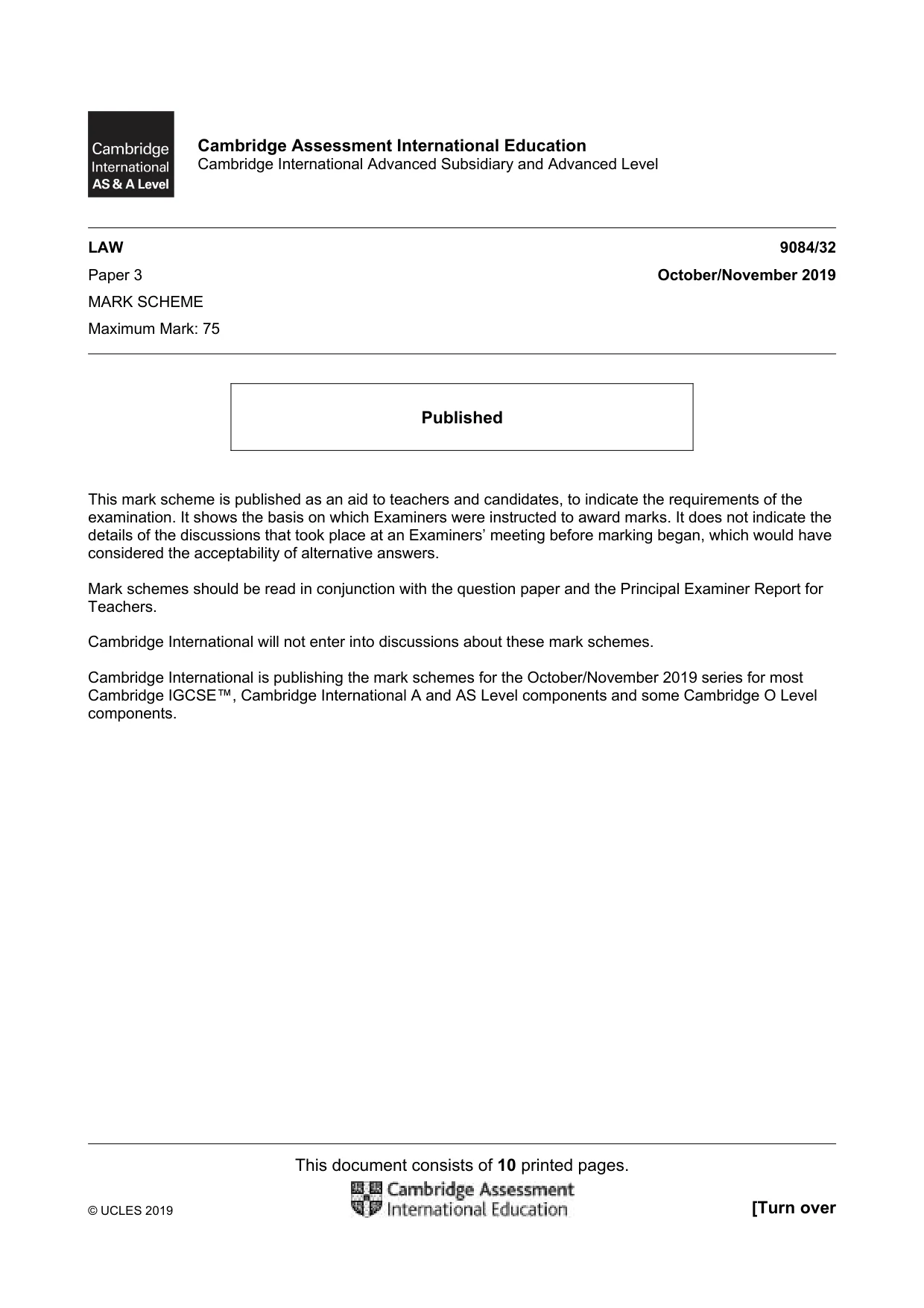
This document consists of 10 printed pages. © UCLES 2019 [Turn over Cambridge Assessment International Education Cambridge International Advanced Subsidiary and Advanced Level LAW 9084/32 Paper 3 October/November 2019 MARK SCHEME Maximum Mark: 75 Published This mark scheme is published as an aid to teachers and candidates, to indicate the requirements of the examination. It shows the basis on which Examiners were instructed to award marks. It does not indicate the details of the discussions that took place at an Examiners’ meeting before marking began, which would have considered the acceptability of alternative answers. Mark schemes should be read in conjunction with the question paper and the Principal Examiner Report for Teachers. Cambridge International will not enter into discussions about these mark schemes. Cambridge International is publishing the mark schemes for the October/November 2019 series for most Cambridge IGCSE™, Cambridge International A and AS Level components and some Cambridge O Level components.
Mark scheme, page 2
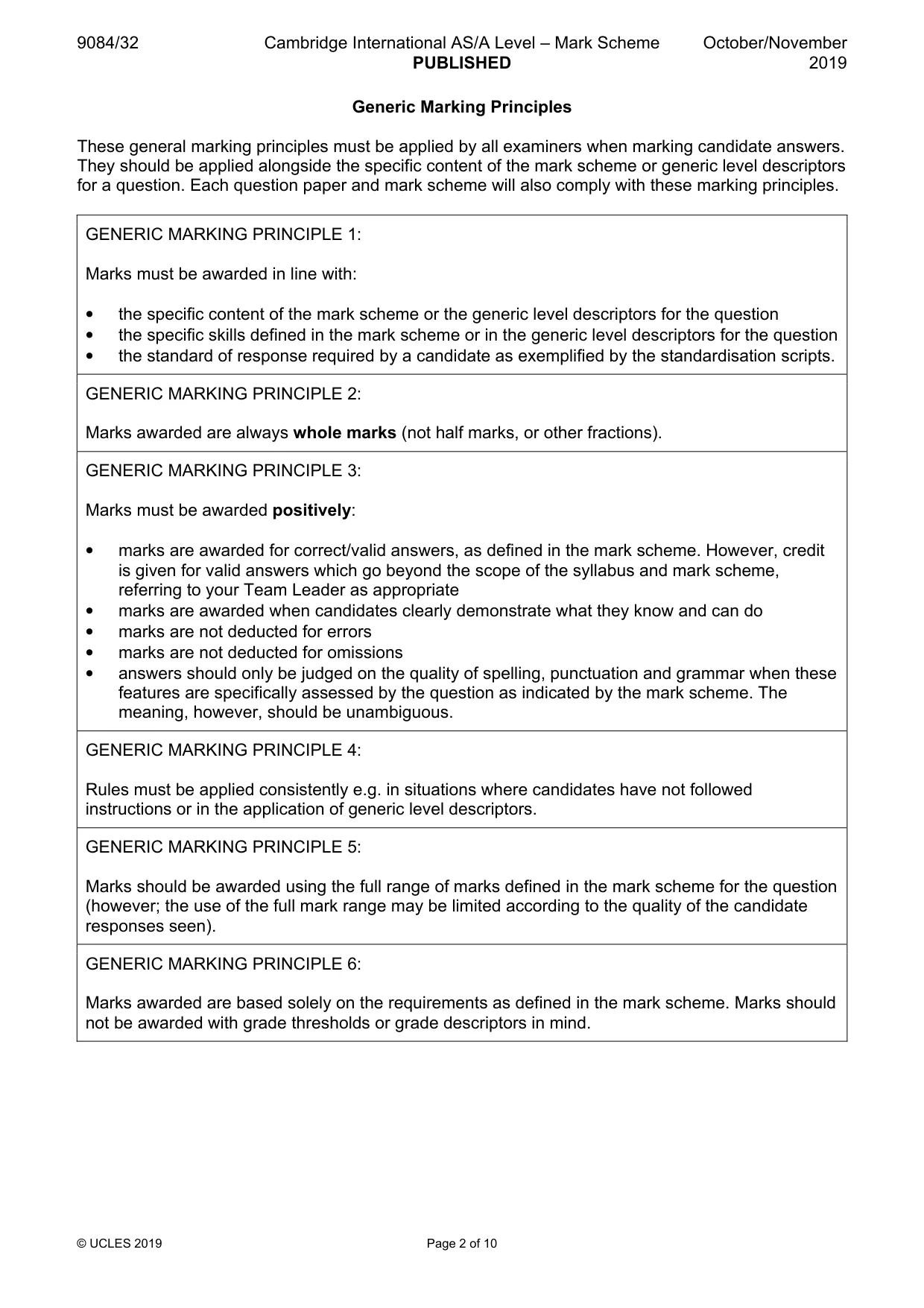
9084/32 Cambridge International AS/A Level – Mark Scheme PUBLISHED October/November 2019 © UCLES 2019 Page 2 of 10 Generic Marking Principles These general marking principles must be applied by all examiners when marking candidate answers. They should be applied alongside the specific content of the mark scheme or generic level descriptors for a question. Each question paper and mark scheme will also comply with these marking principles. GENERIC MARKING PRINCIPLE 1: Marks must be awarded in line with: • the specific content of the mark scheme or the generic level descriptors for the question • the specific skills defined in the mark scheme or in the generic level descriptors for the question • the standard of response required by a candidate as exemplified by the standardisation scripts. GENERIC MARKING PRINCIPLE 2: Marks awarded are always whole marks (not half marks, or other fractions). GENERIC MARKING PRINCIPLE 3: Marks must be awarded positively: • marks are awarded for correct/valid answers, as defined in the mark scheme. However, credit is given for valid answers which go beyond the scope of the syllabus and mark scheme, referring to your Team Leader as appropriate • marks are awarded when candidates clearly demonstrate what they know and can do • marks are not deducted for errors • marks are not deducted for omissions • answers should only be judged on the quality of spelling, punctuation and grammar when these features are specifically assessed by the question as indicated by the mark scheme. The meaning, however, should be unambiguous. GENERIC MARKING PRINCIPLE 4: Rules must be applied consistently e.g. in situations where candidates have not followed instructions or in the application of generic level descriptors. GENERIC MARKING PRINCIPLE 5: Marks should be awarded using the full range of marks defined in the mark scheme for the question (however; the use of the full mark range may be limited according to the quality of the candidate responses seen). GENERIC MARKING PRINCIPLE 6: Marks awarded are based solely on the requirements as defined in the mark scheme. Marks should not be awarded with grade thresholds or grade descriptors in mind.
Mark scheme, page 3
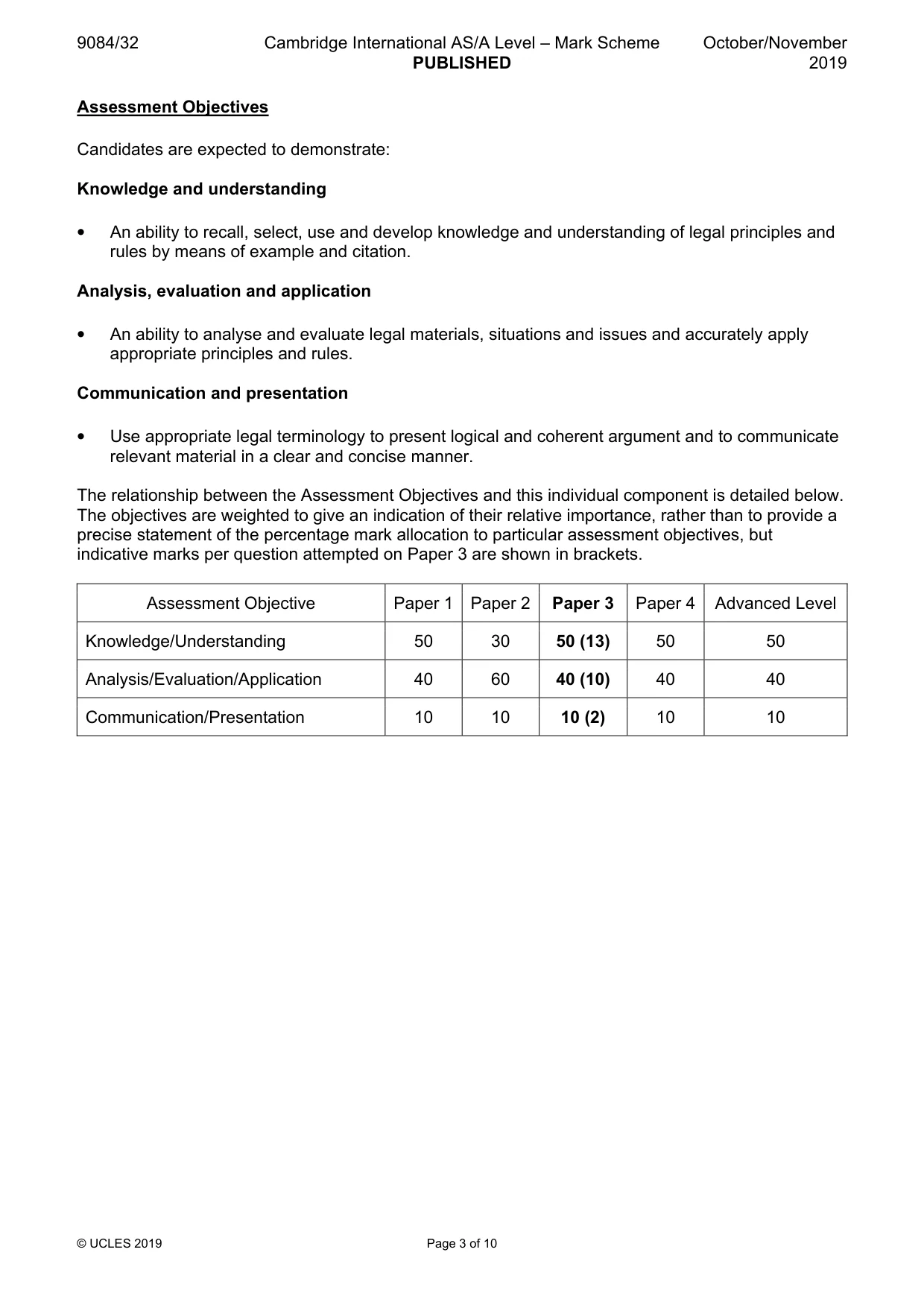
9084/32 Cambridge International AS/A Level – Mark Scheme PUBLISHED October/November 2019 © UCLES 2019 Page 3 of 10 Assessment Objectives Candidates are expected to demonstrate: Knowledge and understanding • An ability to recall, select, use and develop knowledge and understanding of legal principles and rules by means of example and citation. Analysis, evaluation and application • An ability to analyse and evaluate legal materials, situations and issues and accurately apply appropriate principles and rules. Communication and presentation • Use appropriate legal terminology to present logical and coherent argument and to communicate relevant material in a clear and concise manner. The relationship between the Assessment Objectives and this individual component is detailed below. The objectives are weighted to give an indication of their relative importance, rather than to provide a precise statement of the percentage mark allocation to particular assessment objectives, but indicative marks per question attempted on Paper 3 are shown in brackets. Assessment Objective Paper 1 Paper 2 Paper 3 Paper 4 Advanced Level Knowledge/Understanding 50 30 50 (13) 50 50 Analysis/Evaluation/Application 40 60 40 (10) 40 40 Communication/Presentation 10 10 10 (2) 10 10
Mark scheme, page 4
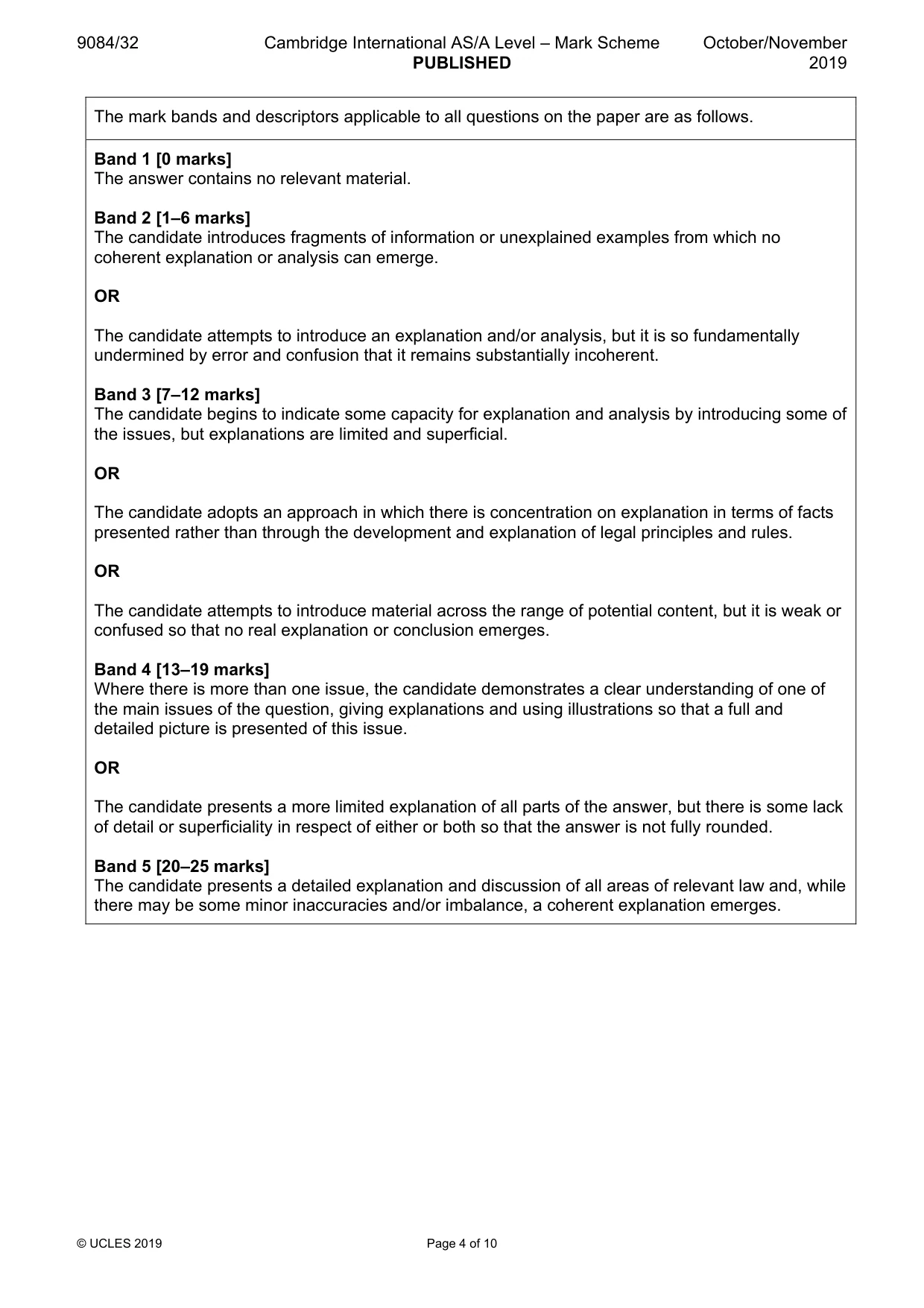
9084/32 Cambridge International AS/A Level – Mark Scheme PUBLISHED October/November 2019 © UCLES 2019 Page 4 of 10 The mark bands and descriptors applicable to all questions on the paper are as follows. Band 1 [0 marks] The answer contains no relevant material. Band 2 [1–6 marks] The candidate introduces fragments of information or unexplained examples from which no coherent explanation or analysis can emerge. OR The candidate attempts to introduce an explanation and/or analysis, but it is so fundamentally undermined by error and confusion that it remains substantially incoherent. Band 3 [7–12 marks] The candidate begins to indicate some capacity for explanation and analysis by introducing some of the issues, but explanations are limited and superficial. OR The candidate adopts an approach in which there is concentration on explanation in terms of facts presented rather than through the development and explanation of legal principles and rules. OR The candidate attempts to introduce material across the range of potential content, but it is weak or confused so that no real explanation or conclusion emerges. Band 4 [13–19 marks] Where there is more than one issue, the candidate demonstrates a clear understanding of one of the main issues of the question, giving explanations and using illustrations so that a full and detailed picture is presented of this issue. OR The candidate presents a more limited explanation of all parts of the answer, but there is some lack of detail or superficiality in respect of either or both so that the answer is not fully rounded. Band 5 [20–25 marks] The candidate presents a detailed explanation and discussion of all areas of relevant law and, while there may be some minor inaccuracies and/or imbalance, a coherent explanation emerges.
Mark scheme, page 5
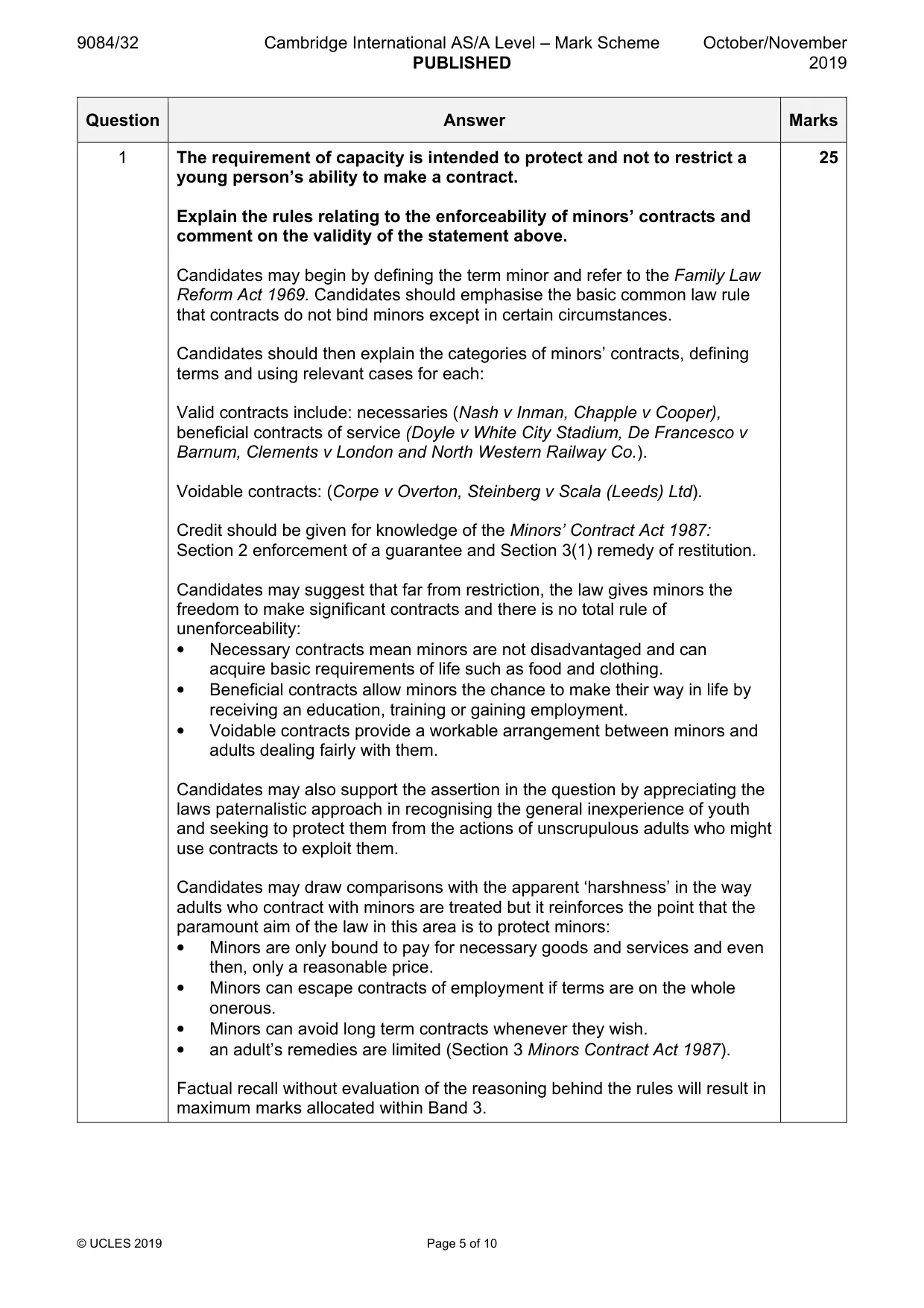
9084/32 Cambridge International AS/A Level – Mark Scheme PUBLISHED October/November 2019 © UCLES 2019 Page 5 of 10 Question Answer Marks 1 The requirement of capacity is intended to protect and not to restrict a young person’s ability to make a contract. Explain the rules relating to the enforceability of minors’ contracts and comment on the validity of the statement above. Candidates may begin by defining the term minor and refer to the Family Law Reform Act 1969. Candidates should emphasise the basic common law rule that contracts do not bind minors except in certain circumstances. Candidates should then explain the categories of minors’ contracts, defining terms and using relevant cases for each: Valid contracts include: necessaries (Nash v Inman, Chapple v Cooper), beneficial contracts of service (Doyle v White City Stadium, De Francesco v Barnum, Clements v London and North Western Railway Co.). Voidable contracts: (Corpe v Overton, Steinberg v Scala (Leeds) Ltd). Credit should be given for knowledge of the Minors’ Contract Act 1987: Section 2 enforcement of a guarantee and Section 3(1) remedy of restitution. Candidates may suggest that far from restriction, the law gives minors the freedom to make significant contracts and there is no total rule of unenforceability: • Necessary contracts mean minors are not disadvantaged and can acquire basic requirements of life such as food and clothing. • Beneficial contracts allow minors the chance to make their way in life by receiving an education, training or gaining employment. • Voidable contracts provide a workable arrangement between minors and adults dealing fairly with them. Candidates may also support the assertion in the question by appreciating the laws paternalistic approach in recognising the general inexperience of youth and seeking to protect them from the actions of unscrupulous adults who might use contracts to exploit them. Candidates may draw comparisons with the apparent ‘harshness’ in the way adults who contract with minors are treated but it reinforces the point that the paramount aim of the law in this area is to protect minors: • Minors are only bound to pay for necessary goods and services and even then, only a reasonable price. • Minors can escape contracts of employment if terms are on the whole onerous. • Minors can avoid long term contracts whenever they wish. • an adult’s remedies are limited (Section 3 Minors Contract Act 1987). Factual recall without evaluation of the reasoning behind the rules will result in maximum marks allocated within Band 3. 25
Mark scheme, page 6
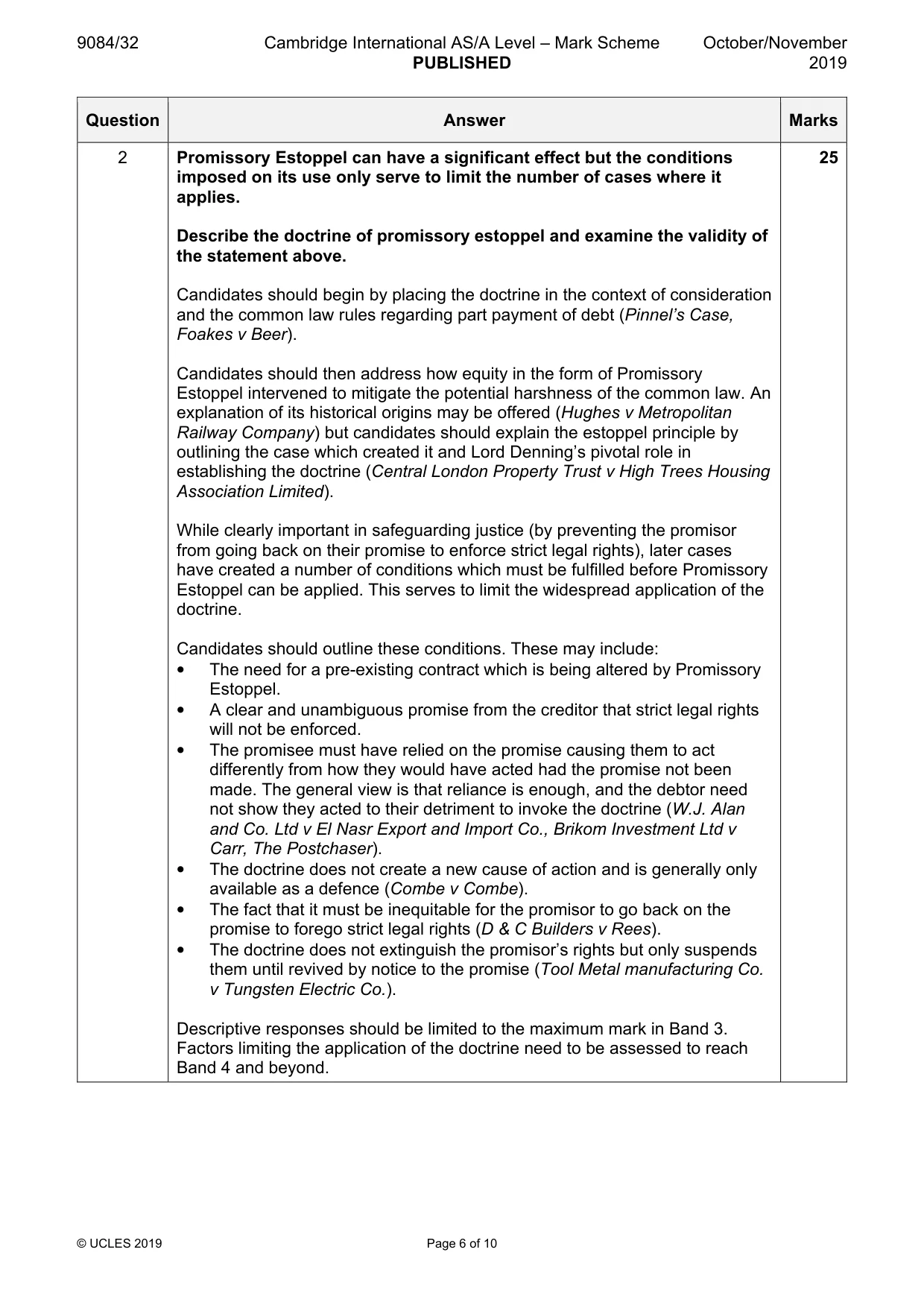
9084/32 Cambridge International AS/A Level – Mark Scheme PUBLISHED October/November 2019 © UCLES 2019 Page 6 of 10 Question Answer Marks 2 Promissory Estoppel can have a significant effect but the conditions imposed on its use only serve to limit the number of cases where it applies. Describe the doctrine of promissory estoppel and examine the validity of the statement above. Candidates should begin by placing the doctrine in the context of consideration and the common law rules regarding part payment of debt (Pinnel’s Case, Foakes v Beer). Candidates should then address how equity in the form of Promissory Estoppel intervened to mitigate the potential harshness of the common law. An explanation of its historical origins may be offered (Hughes v Metropolitan Railway Company) but candidates should explain the estoppel principle by outlining the case which created it and Lord Denning’s pivotal role in establishing the doctrine (Central London Property Trust v High Trees Housing Association Limited). While clearly important in safeguarding justice (by preventing the promisor from going back on their promise to enforce strict legal rights), later cases have created a number of conditions which must be fulfilled before Promissory Estoppel can be applied. This serves to limit the widespread application of the doctrine. Candidates should outline these conditions. These may include: • The need for a pre-existing contract which is being altered by Promissory Estoppel. • A clear and unambiguous promise from the creditor that strict legal rights will not be enforced. • The promisee must have relied on the promise causing them to act differently from how they would have acted had the promise not been made. The general view is that reliance is enough, and the debtor need not show they acted to their detriment to invoke the doctrine (W.J. Alan and Co. Ltd v El Nasr Export and Import Co., Brikom Investment Ltd v Carr, The Postchaser). • The doctrine does not create a new cause of action and is generally only available as a defence (Combe v Combe). • The fact that it must be inequitable for the promisor to go back on the promise to forego strict legal rights (D & C Builders v Rees). • The doctrine does not extinguish the promisor’s rights but only suspends them until revived by notice to the promise (Tool Metal manufacturing Co. v Tungsten Electric Co.). Descriptive responses should be limited to the maximum mark in Band 3. Factors limiting the application of the doctrine need to be assessed to reach Band 4 and beyond. 25
Mark scheme, page 7
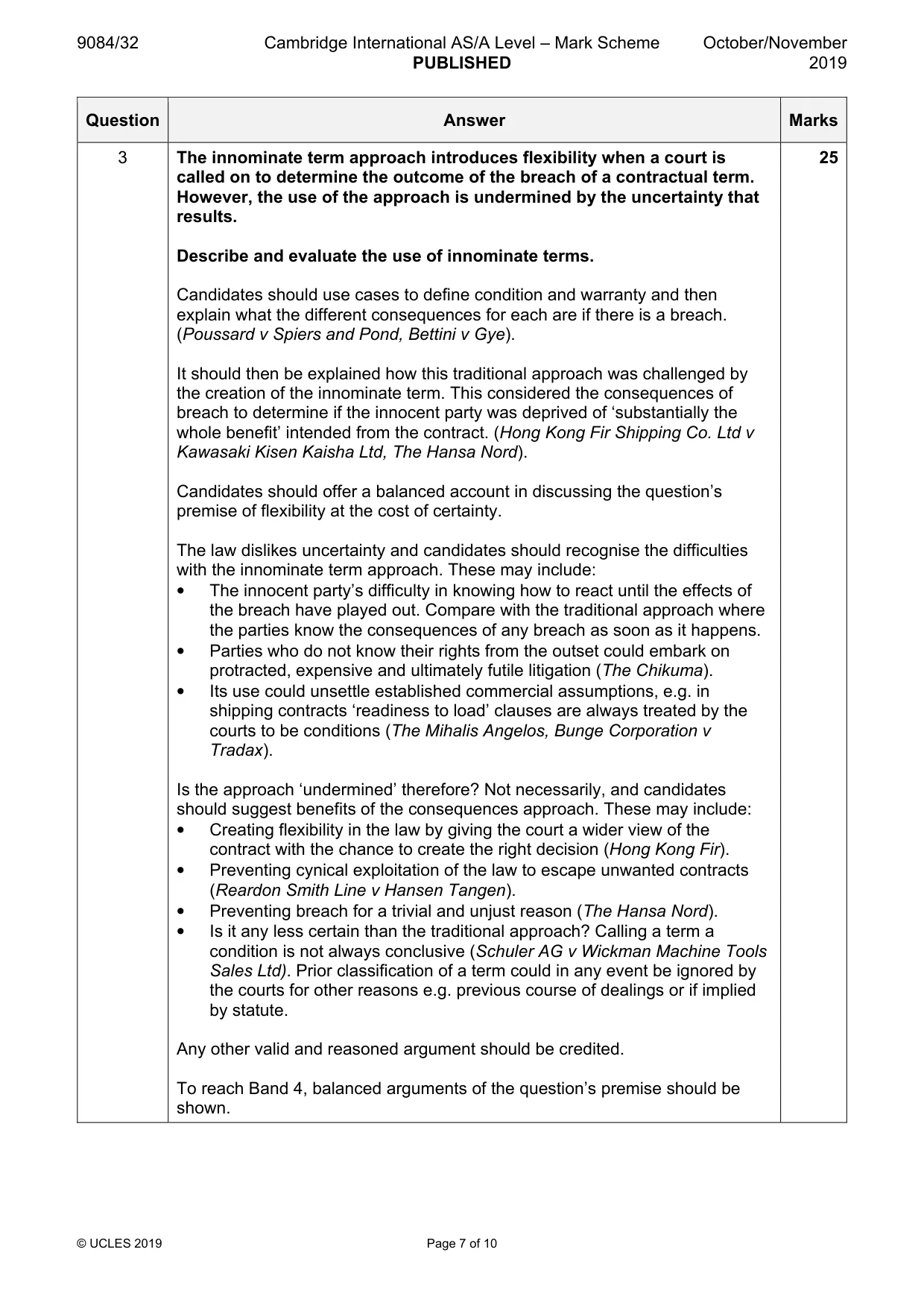
9084/32 Cambridge International AS/A Level – Mark Scheme PUBLISHED October/November 2019 © UCLES 2019 Page 7 of 10 Question Answer Marks 3 The innominate term approach introduces flexibility when a court is called on to determine the outcome of the breach of a contractual term. However, the use of the approach is undermined by the uncertainty that results. Describe and evaluate the use of innominate terms. Candidates should use cases to define condition and warranty and then explain what the different consequences for each are if there is a breach. (Poussard v Spiers and Pond, Bettini v Gye). It should then be explained how this traditional approach was challenged by the creation of the innominate term. This considered the consequences of breach to determine if the innocent party was deprived of ‘substantially the whole benefit’ intended from the contract. (Hong Kong Fir Shipping Co. Ltd v Kawasaki Kisen Kaisha Ltd, The Hansa Nord). Candidates should offer a balanced account in discussing the question’s premise of flexibility at the cost of certainty. The law dislikes uncertainty and candidates should recognise the difficulties with the innominate term approach. These may include: • The innocent party’s difficulty in knowing how to react until the effects of the breach have played out. Compare with the traditional approach where the parties know the consequences of any breach as soon as it happens. • Parties who do not know their rights from the outset could embark on protracted, expensive and ultimately futile litigation (The Chikuma). • Its use could unsettle established commercial assumptions, e.g. in shipping contracts ‘readiness to load’ clauses are always treated by the courts to be conditions (The Mihalis Angelos, Bunge Corporation v Tradax). Is the approach ‘undermined’ therefore? Not necessarily, and candidates should suggest benefits of the consequences approach. These may include: • Creating flexibility in the law by giving the court a wider view of the contract with the chance to create the right decision (Hong Kong Fir). • Preventing cynical exploitation of the law to escape unwanted contracts (Reardon Smith Line v Hansen Tangen). • Preventing breach for a trivial and unjust reason (The Hansa Nord). • Is it any less certain than the traditional approach? Calling a term a condition is not always conclusive (Schuler AG v Wickman Machine Tools Sales Ltd). Prior classification of a term could in any event be ignored by the courts for other reasons e.g. previous course of dealings or if implied by statute. Any other valid and reasoned argument should be credited. To reach Band 4, balanced arguments of the question’s premise should be shown. 25
Mark scheme, page 8
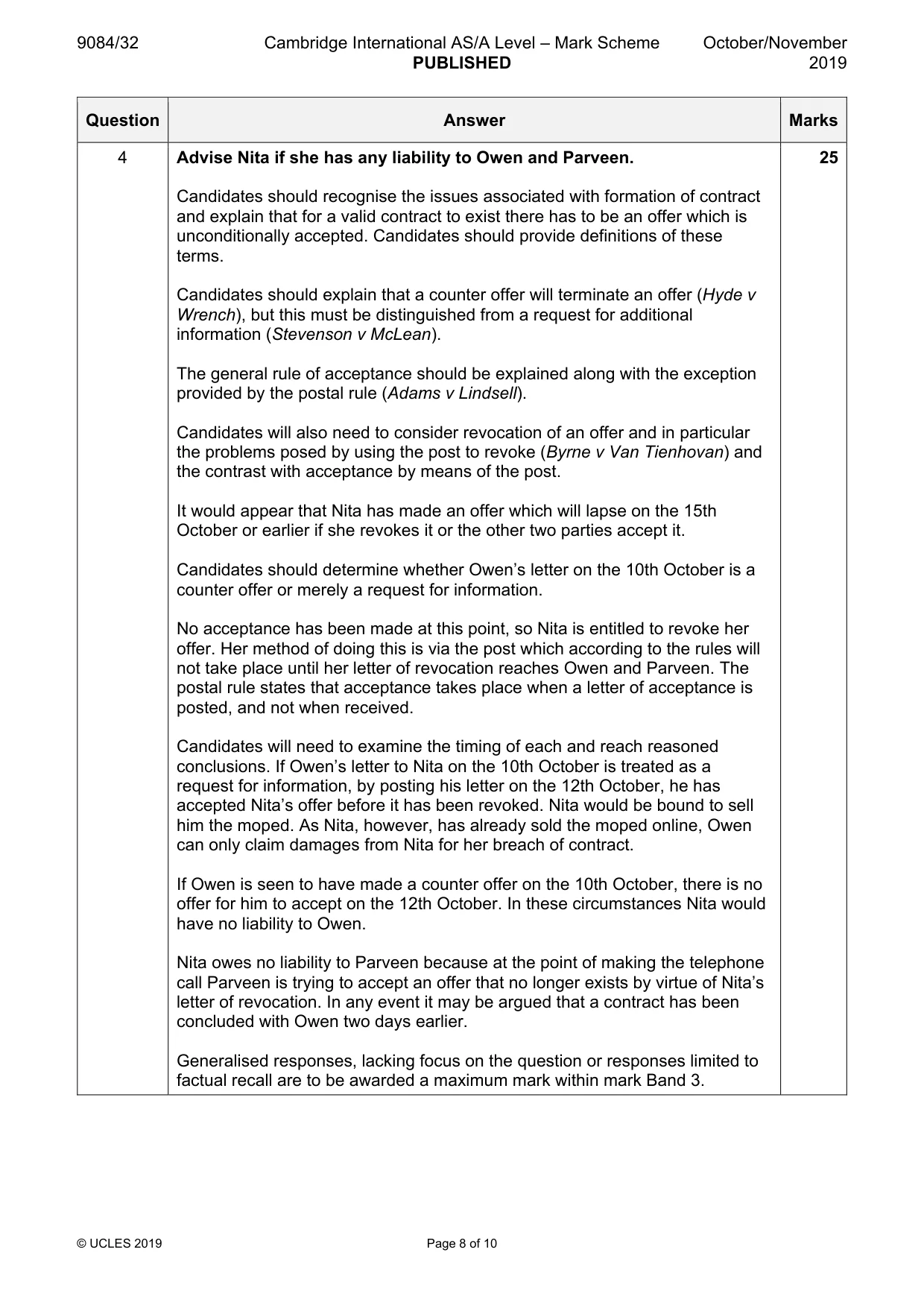
9084/32 Cambridge International AS/A Level – Mark Scheme PUBLISHED October/November 2019 © UCLES 2019 Page 8 of 10 Question Answer Marks 4 Advise Nita if she has any liability to Owen and Parveen. Candidates should recognise the issues associated with formation of contract and explain that for a valid contract to exist there has to be an offer which is unconditionally accepted. Candidates should provide definitions of these terms. Candidates should explain that a counter offer will terminate an offer (Hyde v Wrench), but this must be distinguished from a request for additional information (Stevenson v McLean). The general rule of acceptance should be explained along with the exception provided by the postal rule (Adams v Lindsell). Candidates will also need to consider revocation of an offer and in particular the problems posed by using the post to revoke (Byrne v Van Tienhovan) and the contrast with acceptance by means of the post. It would appear that Nita has made an offer which will lapse on the 15th October or earlier if she revokes it or the other two parties accept it. Candidates should determine whether Owen’s letter on the 10th October is a counter offer or merely a request for information. No acceptance has been made at this point, so Nita is entitled to revoke her offer. Her method of doing this is via the post which according to the rules will not take place until her letter of revocation reaches Owen and Parveen. The postal rule states that acceptance takes place when a letter of acceptance is posted, and not when received. Candidates will need to examine the timing of each and reach reasoned conclusions. If Owen’s letter to Nita on the 10th October is treated as a request for information, by posting his letter on the 12th October, he has accepted Nita’s offer before it has been revoked. Nita would be bound to sell him the moped. As Nita, however, has already sold the moped online, Owen can only claim damages from Nita for her breach of contract. If Owen is seen to have made a counter offer on the 10th October, there is no offer for him to accept on the 12th October. In these circumstances Nita would have no liability to Owen. Nita owes no liability to Parveen because at the point of making the telephone call Parveen is trying to accept an offer that no longer exists by virtue of Nita’s letter of revocation. In any event it may be argued that a contract has been concluded with Owen two days earlier. Generalised responses, lacking focus on the question or responses limited to factual recall are to be awarded a maximum mark within mark Band 3. 25
Mark scheme, page 9
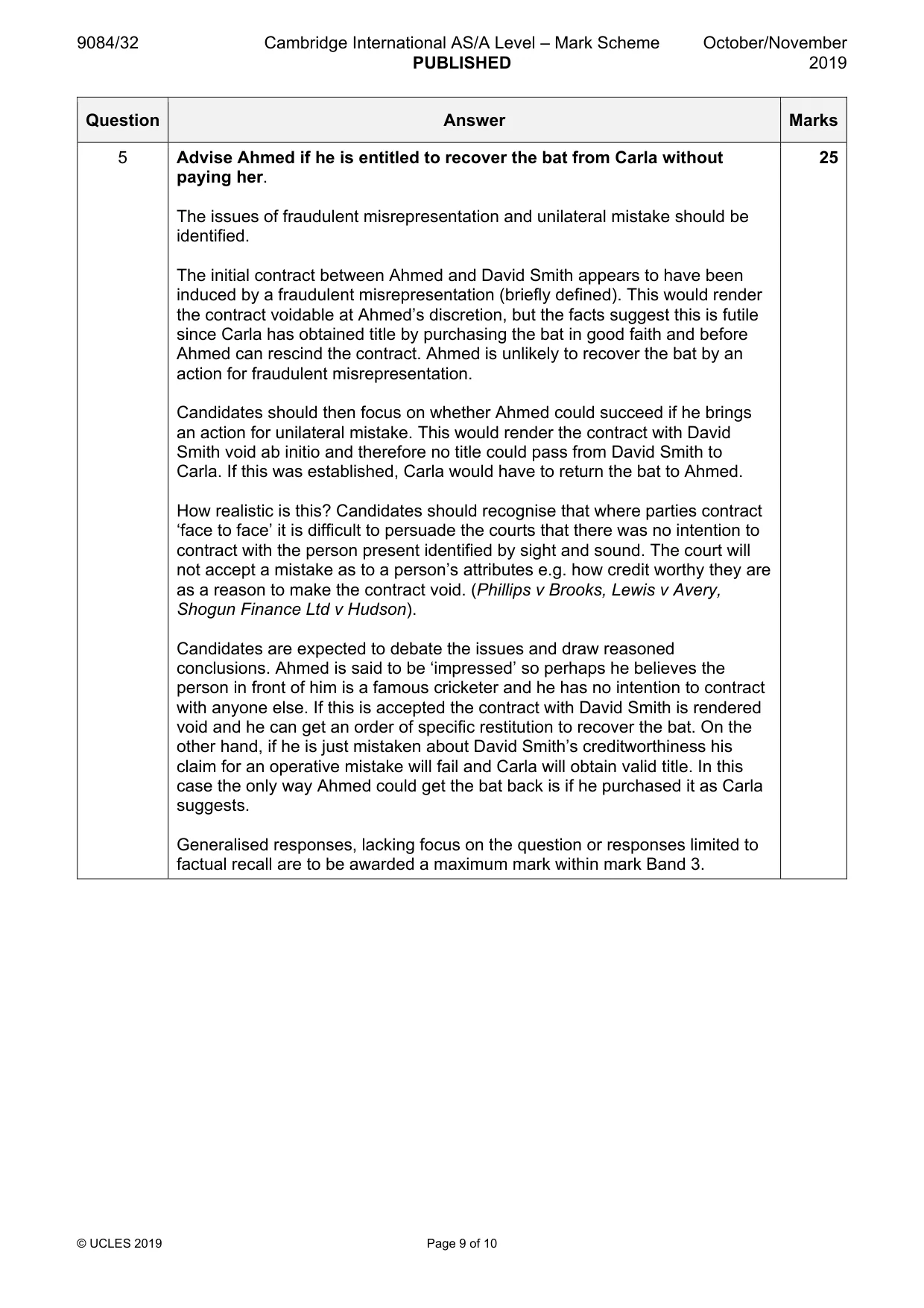
9084/32 Cambridge International AS/A Level – Mark Scheme PUBLISHED October/November 2019 © UCLES 2019 Page 9 of 10 Question Answer Marks 5 Advise Ahmed if he is entitled to recover the bat from Carla without paying her. The issues of fraudulent misrepresentation and unilateral mistake should be identified. The initial contract between Ahmed and David Smith appears to have been induced by a fraudulent misrepresentation (briefly defined). This would render the contract voidable at Ahmed’s discretion, but the facts suggest this is futile since Carla has obtained title by purchasing the bat in good faith and before Ahmed can rescind the contract. Ahmed is unlikely to recover the bat by an action for fraudulent misrepresentation. Candidates should then focus on whether Ahmed could succeed if he brings an action for unilateral mistake. This would render the contract with David Smith void ab initio and therefore no title could pass from David Smith to Carla. If this was established, Carla would have to return the bat to Ahmed. How realistic is this? Candidates should recognise that where parties contract ‘face to face’ it is difficult to persuade the courts that there was no intention to contract with the person present identified by sight and sound. The court will not accept a mistake as to a person’s attributes e.g. how credit worthy they are as a reason to make the contract void. (Phillips v Brooks, Lewis v Avery, Shogun Finance Ltd v Hudson). Candidates are expected to debate the issues and draw reasoned conclusions. Ahmed is said to be ‘impressed’ so perhaps he believes the person in front of him is a famous cricketer and he has no intention to contract with anyone else. If this is accepted the contract with David Smith is rendered void and he can get an order of specific restitution to recover the bat. On the other hand, if he is just mistaken about David Smith’s creditworthiness his claim for an operative mistake will fail and Carla will obtain valid title. In this case the only way Ahmed could get the bat back is if he purchased it as Carla suggests. Generalised responses, lacking focus on the question or responses limited to factual recall are to be awarded a maximum mark within mark Band 3. 25
Mark scheme, page 10
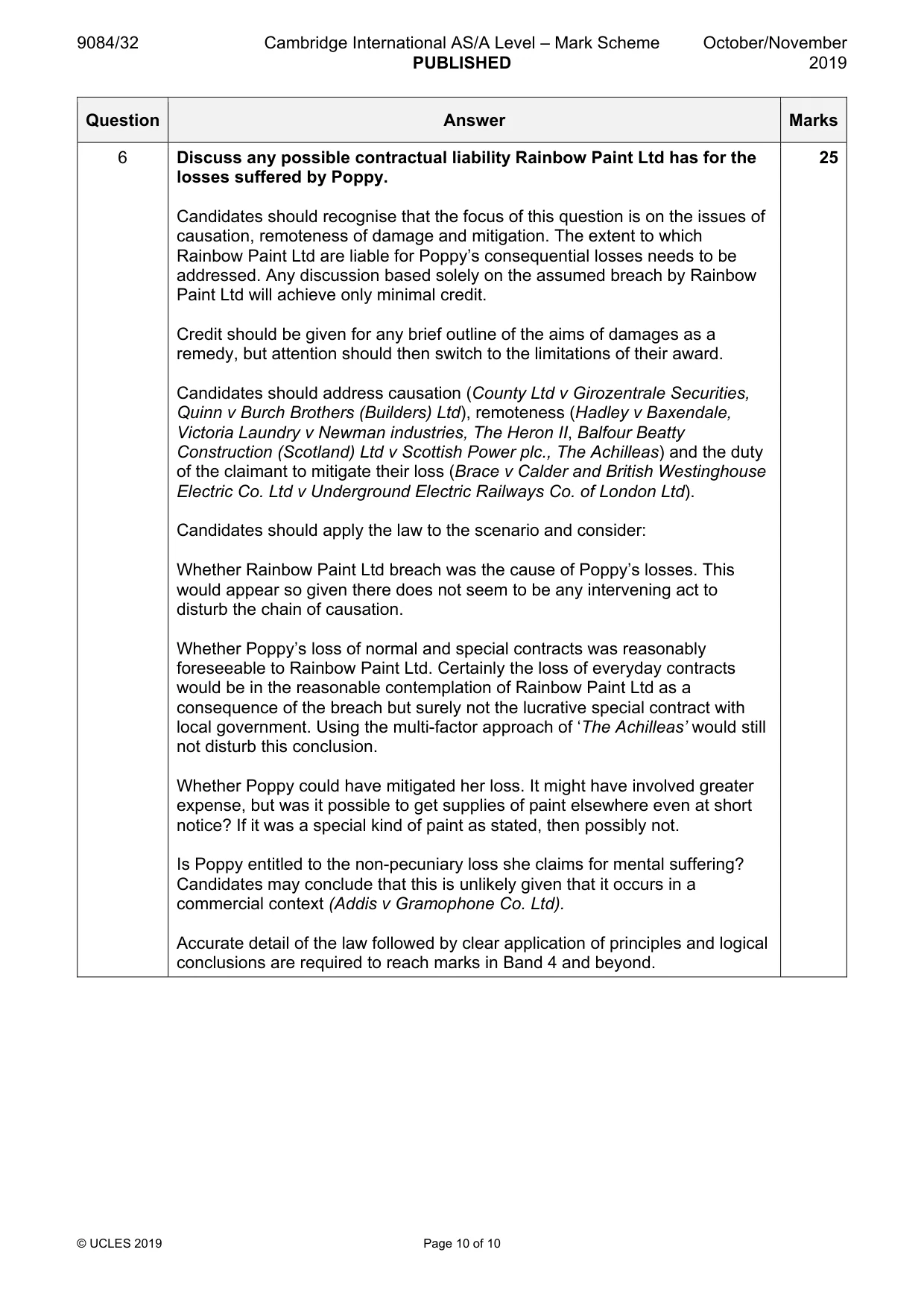
9084/32 Cambridge International AS/A Level – Mark Scheme PUBLISHED October/November 2019 © UCLES 2019 Page 10 of 10 Question Answer Marks 6 Discuss any possible contractual liability Rainbow Paint Ltd has for the losses suffered by Poppy. Candidates should recognise that the focus of this question is on the issues of causation, remoteness of damage and mitigation. The extent to which Rainbow Paint Ltd are liable for Poppy’s consequential losses needs to be addressed. Any discussion based solely on the assumed breach by Rainbow Paint Ltd will achieve only minimal credit. Credit should be given for any brief outline of the aims of damages as a remedy, but attention should then switch to the limitations of their award. Candidates should address causation (County Ltd v Girozentrale Securities, Quinn v Burch Brothers (Builders) Ltd), remoteness (Hadley v Baxendale, Victoria Laundry v Newman industries, The Heron II, Balfour Beatty Construction (Scotland) Ltd v Scottish Power plc., The Achilleas) and the duty of the claimant to mitigate their loss (Brace v Calder and British Westinghouse Electric Co. Ltd v Underground Electric Railways Co. of London Ltd). Candidates should apply the law to the scenario and consider: Whether Rainbow Paint Ltd breach was the cause of Poppy’s losses. This would appear so given there does not seem to be any intervening act to disturb the chain of causation. Whether Poppy’s loss of normal and special contracts was reasonably foreseeable to Rainbow Paint Ltd. Certainly the loss of everyday contracts would be in the reasonable contemplation of Rainbow Paint Ltd as a consequence of the breach but surely not the lucrative special contract with local government. Using the multi-factor approach of ‘The Achilleas’ would still not disturb this conclusion. Whether Poppy could have mitigated her loss. It might have involved greater expense, but was it possible to get supplies of paint elsewhere even at short notice? If it was a special kind of paint as stated, then possibly not. Is Poppy entitled to the non-pecuniary loss she claims for mental suffering? Candidates may conclude that this is unlikely given that it occurs in a commercial context (Addis v Gramophone Co. Ltd). Accurate detail of the law followed by clear application of principles and logical conclusions are required to reach marks in Band 4 and beyond. 25
What you needed in this session
Cambridge’s own grade thresholds for 2019 Oct/Nov, Paper 3 · Variant 2. A higher threshold means an easier paper — the bar moves with how the cohort did.