Cambridge A Level Law 9084 — 2018 Oct/Nov Paper 3 · Variant 2
9084/32/O/N/18 · 75 marks · ≈84 min
The question paper and its mark scheme, free to read here and free to download. This is Cambridge’s own paper, exactly as it was sat.
Question paper4 pages

Mark scheme10 pages
Answers below. Sit the paper first if you are practising.
Paper as text
Question paper, page 1
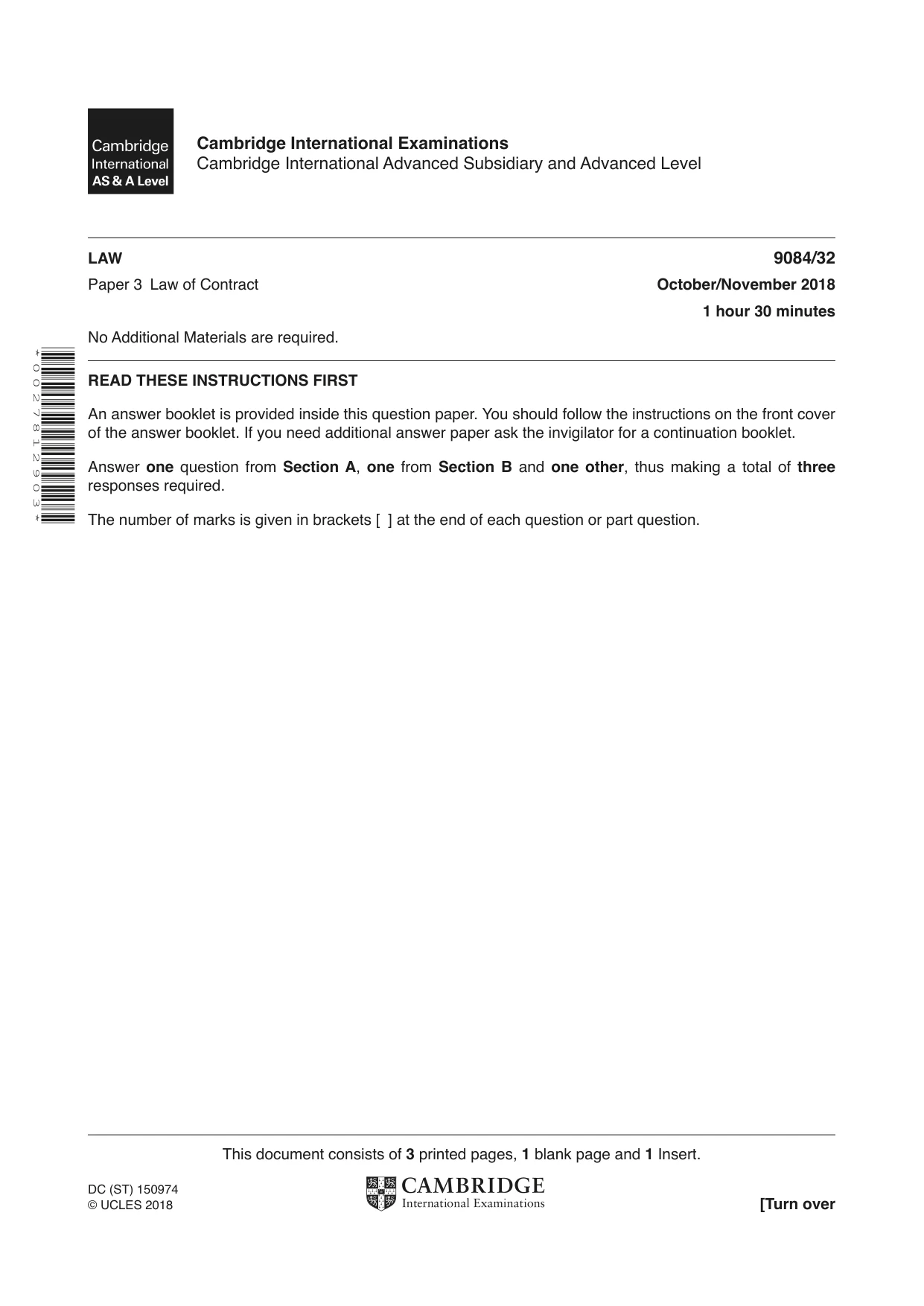
* 0 0 2 7 8 1 2 9 0 3 * This document consists of 3 printed pages, 1 blank page and 1 Insert. DC (ST) 150974 © UCLES 2018 [Turn over Cambridge International Examinations Cambridge International Advanced Subsidiary and Advanced Level LAW 9084/32 Paper 3 Law of Contract October/November 2018 1 hour 30 minutes No Additional Materials are required. READ THESE INSTRUCTIONS FIRST An answer booklet is provided inside this question paper. You should follow the instructions on the front cover of the answer booklet. If you need additional answer paper ask the invigilator for a continuation booklet. Answer one question from Section A, one from Section B and one other, thus making a total of three responses required. The number of marks is given in brackets [ ] at the end of each question or part question.
Question paper, page 2
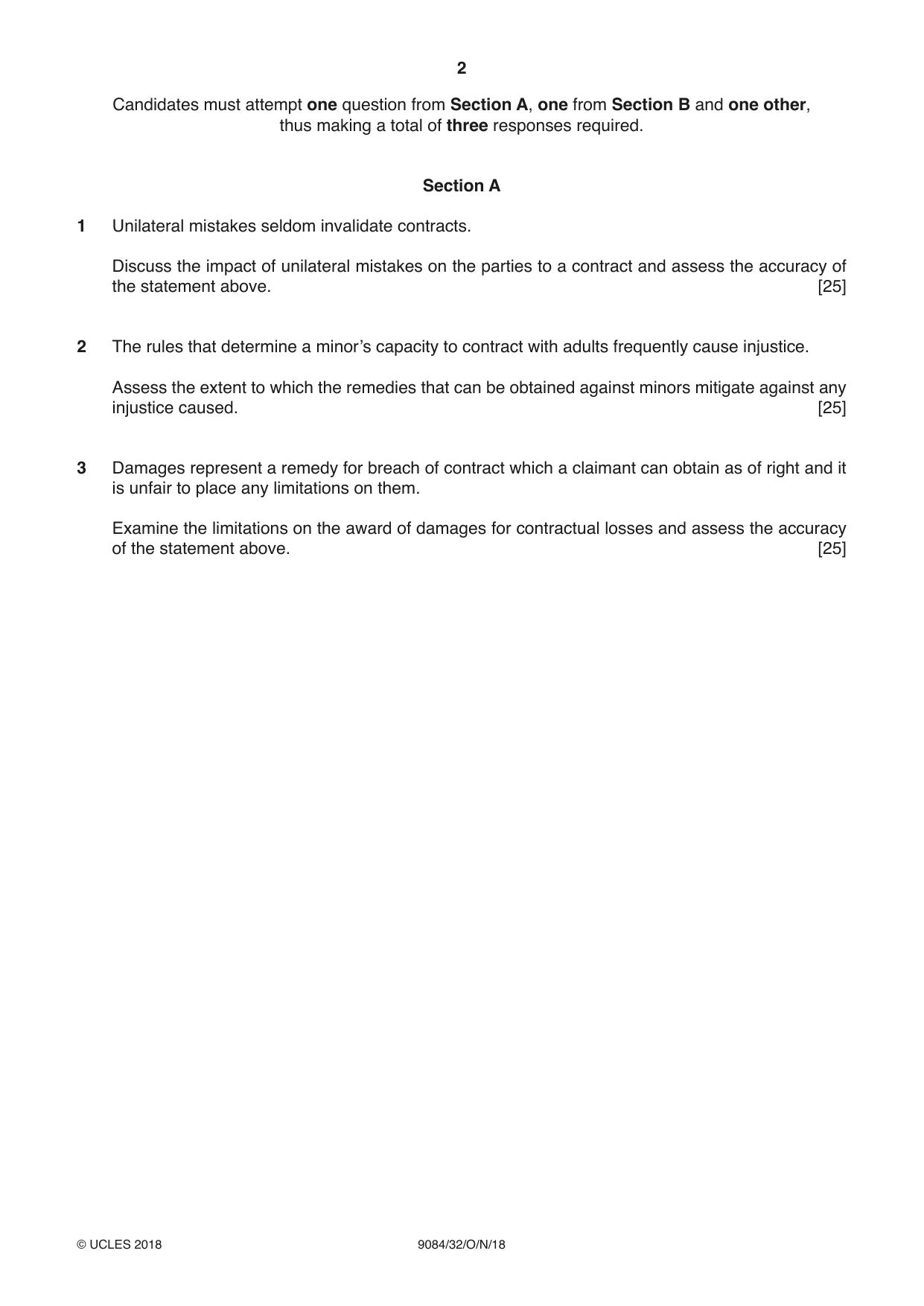
2 9084/32/O/N/18 © UCLES 2018 Candidates must attempt one question from Section A, one from Section B and one other, thus making a total of three responses required. Section A 1 Unilateral mistakes seldom invalidate contracts. Discuss the impact of unilateral mistakes on the parties to a contract and assess the accuracy of the statement above. [25] 2 The rules that determine a minor’s capacity to contract with adults frequently cause injustice. Assess the extent to which the remedies that can be obtained against minors mitigate against any injustice caused. [25] 3 Damages represent a remedy for breach of contract which a claimant can obtain as of right and it is unfair to place any limitations on them. Examine the limitations on the award of damages for contractual losses and assess the accuracy of the statement above. [25]
Question paper, page 3
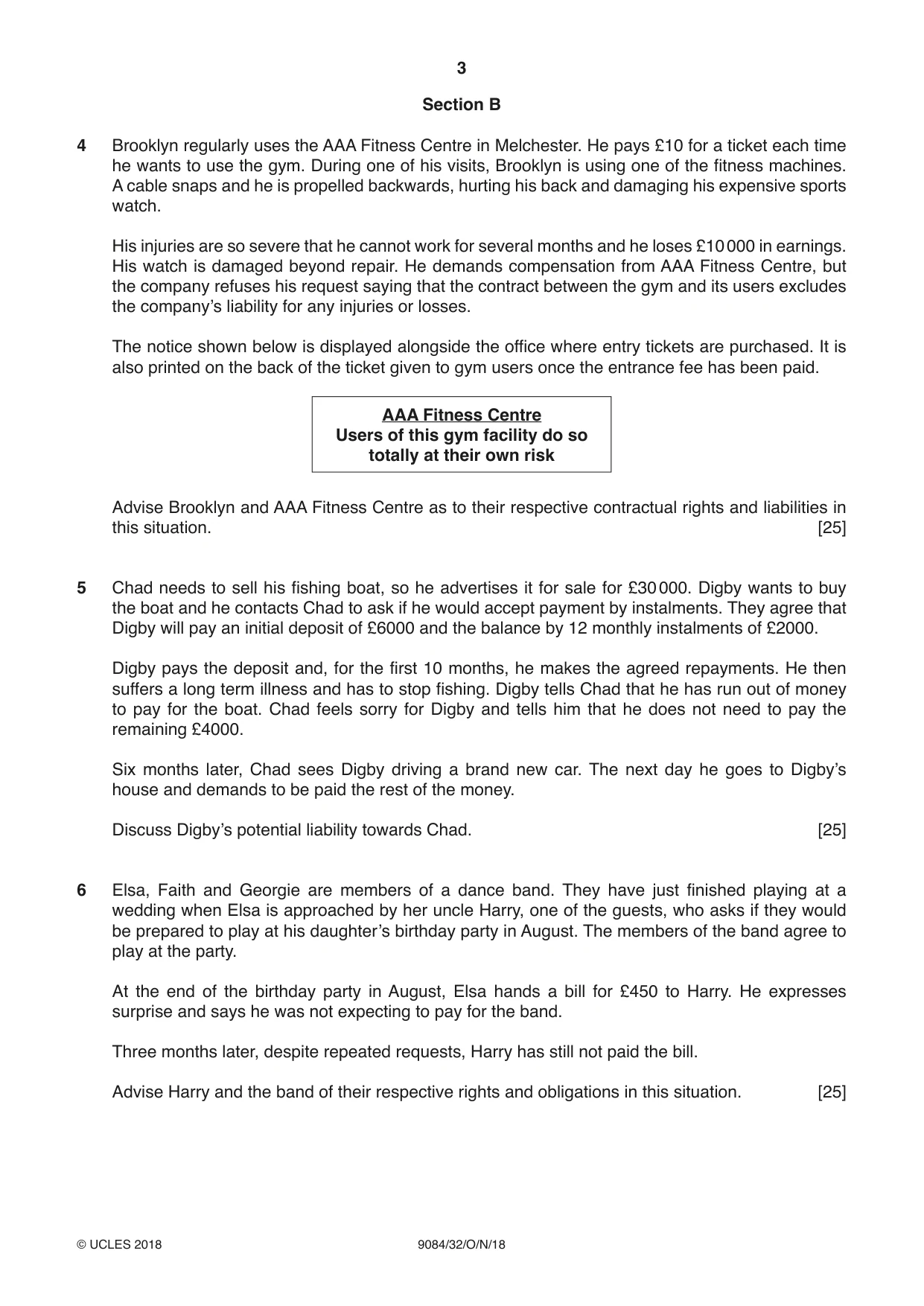
3 9084/32/O/N/18 © UCLES 2018 Section B 4 Brooklyn regularly uses the AAA Fitness Centre in Melchester. He pays £10 for a ticket each time he wants to use the gym. During one of his visits, Brooklyn is using one of the fitness machines. A cable snaps and he is propelled backwards, hurting his back and damaging his expensive sports watch. His injuries are so severe that he cannot work for several months and he loses £10 000 in earnings. His watch is damaged beyond repair. He demands compensation from AAA Fitness Centre, but the company refuses his request saying that the contract between the gym and its users excludes the company’s liability for any injuries or losses. The notice shown below is displayed alongside the office where entry tickets are purchased. It is also printed on the back of the ticket given to gym users once the entrance fee has been paid. AAA Fitness Centre Users of this gym facility do so totally at their own risk Advise Brooklyn and AAA Fitness Centre as to their respective contractual rights and liabilities in this situation. [25] 5 Chad needs to sell his fishing boat, so he advertises it for sale for £30 000. Digby wants to buy the boat and he contacts Chad to ask if he would accept payment by instalments. They agree that Digby will pay an initial deposit of £6000 and the balance by 12 monthly instalments of £2000. Digby pays the deposit and, for the first 10 months, he makes the agreed repayments. He then suffers a long term illness and has to stop fishing. Digby tells Chad that he has run out of money to pay for the boat. Chad feels sorry for Digby and tells him that he does not need to pay the remaining £4000. Six months later, Chad sees Digby driving a brand new car. The next day he goes to Digby’s house and demands to be paid the rest of the money. Discuss Digby’s potential liability towards Chad. [25] 6 Elsa, Faith and Georgie are members of a dance band. They have just finished playing at a wedding when Elsa is approached by her uncle Harry, one of the guests, who asks if they would be prepared to play at his daughter’s birthday party in August. The members of the band agree to play at the party. At the end of the birthday party in August, Elsa hands a bill for £450 to Harry. He expresses surprise and says he was not expecting to pay for the band. Three months later, despite repeated requests, Harry has still not paid the bill. Advise Harry and the band of their respective rights and obligations in this situation. [25]
Question paper, page 4
4 9084/32/O/N/18 © UCLES 2018 BLANK PAGE Permission to reproduce items where third-party owned material protected by copyright is included has been sought and cleared where possible. Every reasonable effort has been made by the publisher (UCLES) to trace copyright holders, but if any items requiring clearance have unwittingly been included, the publisher will be pleased to make amends at the earliest possible opportunity. To avoid the issue of disclosure of answer-related information to candidates, all copyright acknowledgements are reproduced online in the Cambridge International Examinations Copyright Acknowledgements Booklet. This is produced for each series of examinations and is freely available to download at www.cie.org.uk after the live examination series. Cambridge International Examinations is part of the Cambridge Assessment Group. Cambridge Assessment is the brand name of University of Cambridge Local Examinations Syndicate (UCLES), which is itself a department of the University of Cambridge.
Mark scheme, page 1
This document consists of 10 printed pages. © UCLES 2018 [Turn over Cambridge Assessment International Education Cambridge International Advanced Subsidiary and Advanced Level LAW 9084/32 Paper 3 October/November 2018 MARK SCHEME Maximum Mark: 75 Published This mark scheme is published as an aid to teachers and candidates, to indicate the requirements of the examination. It shows the basis on which Examiners were instructed to award marks. It does not indicate the details of the discussions that took place at an Examiners’ meeting before marking began, which would have considered the acceptability of alternative answers. Mark schemes should be read in conjunction with the question paper and the Principal Examiner Report for Teachers. Cambridge International will not enter into discussions about these mark schemes. Cambridge International is publishing the mark schemes for the October/November 2018 series for most Cambridge IGCSE™, Cambridge International A and AS Level components and some Cambridge O Level components.
Mark scheme, page 2
9084/32 Cambridge International AS/A Level – Mark Scheme PUBLISHED October/November 2018 © UCLES 2018 Page 2 of 10 Generic Marking Principles These general marking principles must be applied by all examiners when marking candidate answers. They should be applied alongside the specific content of the mark scheme or generic level descriptors for a question. Each question paper and mark scheme will also comply with these marking principles. GENERIC MARKING PRINCIPLE 1: Marks must be awarded in line with: • the specific content of the mark scheme or the generic level descriptors for the question • the specific skills defined in the mark scheme or in the generic level descriptors for the question • the standard of response required by a candidate as exemplified by the standardisation scripts. GENERIC MARKING PRINCIPLE 2: Marks awarded are always whole marks (not half marks, or other fractions). GENERIC MARKING PRINCIPLE 3: Marks must be awarded positively: • marks are awarded for correct/valid answers, as defined in the mark scheme. However, credit is given for valid answers which go beyond the scope of the syllabus and mark scheme, referring to your Team Leader as appropriate • marks are awarded when candidates clearly demonstrate what they know and can do • marks are not deducted for errors • marks are not deducted for omissions • answers should only be judged on the quality of spelling, punctuation and grammar when these features are specifically assessed by the question as indicated by the mark scheme. The meaning, however, should be unambiguous. GENERIC MARKING PRINCIPLE 4: Rules must be applied consistently e.g. in situations where candidates have not followed instructions or in the application of generic level descriptors. GENERIC MARKING PRINCIPLE 5: Marks should be awarded using the full range of marks defined in the mark scheme for the question (however; the use of the full mark range may be limited according to the quality of the candidate responses seen). GENERIC MARKING PRINCIPLE 6: Marks awarded are based solely on the requirements as defined in the mark scheme. Marks should not be awarded with grade thresholds or grade descriptors in mind.
Mark scheme, page 3
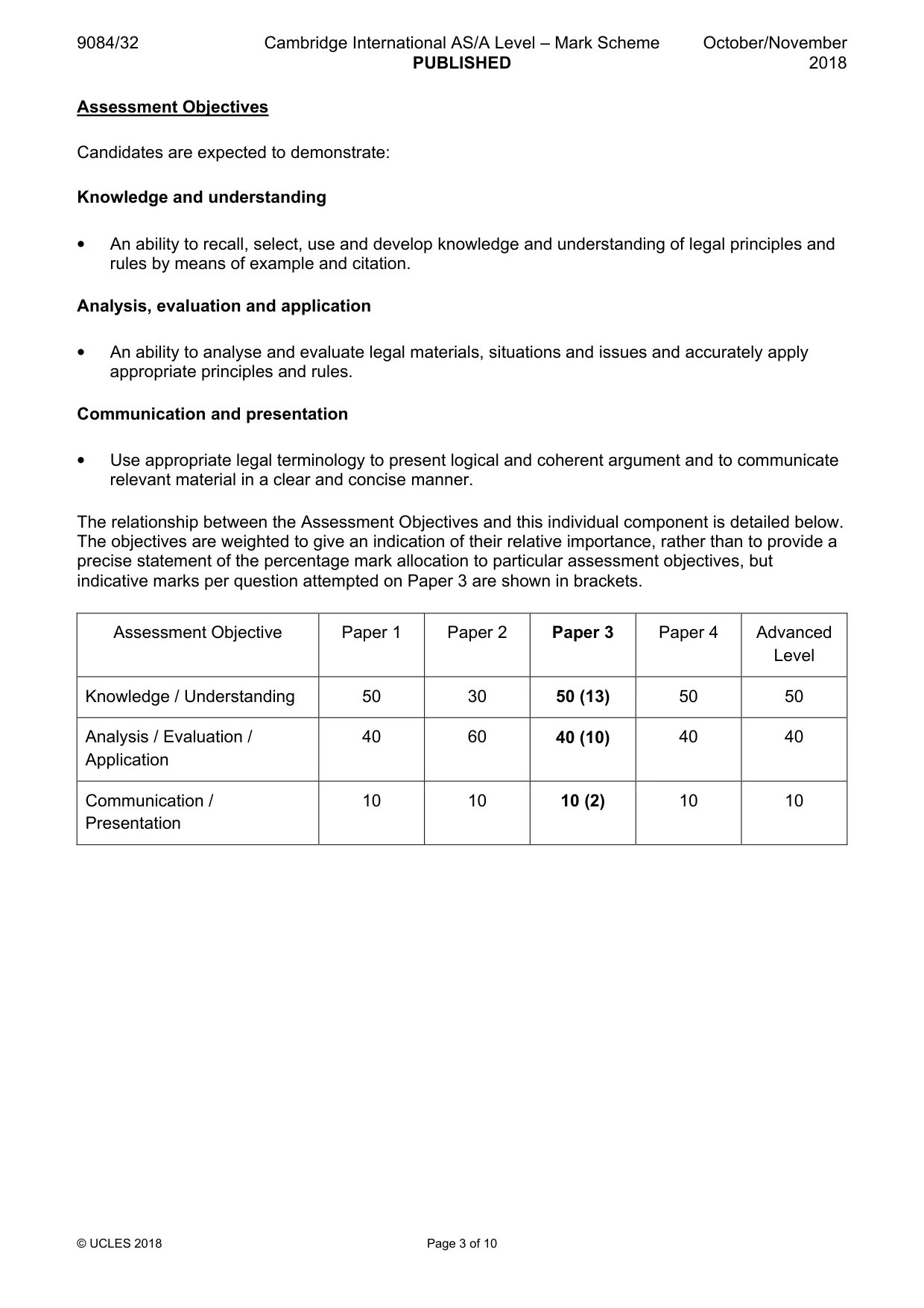
9084/32 Cambridge International AS/A Level – Mark Scheme PUBLISHED October/November 2018 © UCLES 2018 Page 3 of 10 Assessment Objectives Candidates are expected to demonstrate: Knowledge and understanding • An ability to recall, select, use and develop knowledge and understanding of legal principles and rules by means of example and citation. Analysis, evaluation and application • An ability to analyse and evaluate legal materials, situations and issues and accurately apply appropriate principles and rules. Communication and presentation • Use appropriate legal terminology to present logical and coherent argument and to communicate relevant material in a clear and concise manner. The relationship between the Assessment Objectives and this individual component is detailed below. The objectives are weighted to give an indication of their relative importance, rather than to provide a precise statement of the percentage mark allocation to particular assessment objectives, but indicative marks per question attempted on Paper 3 are shown in brackets. Assessment Objective Paper 1 Paper 2 Paper 3 Paper 4 Advanced Level Knowledge / Understanding 50 30 50 (13) 50 50 Analysis / Evaluation / Application 40 60 40 (10) 40 40 Communication / Presentation 10 10 10 (2) 10 10
Mark scheme, page 4
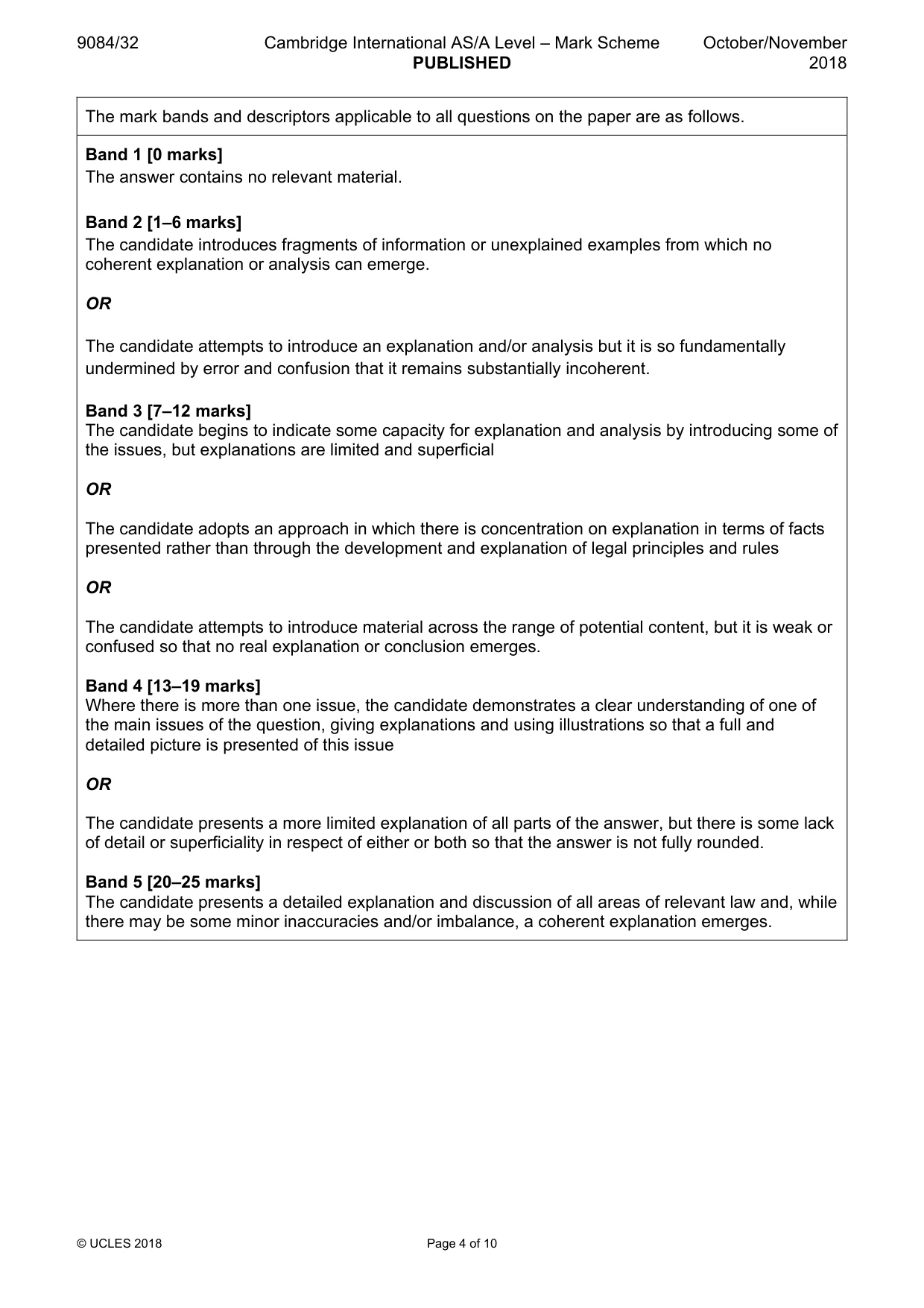
9084/32 Cambridge International AS/A Level – Mark Scheme PUBLISHED October/November 2018 © UCLES 2018 Page 4 of 10 The mark bands and descriptors applicable to all questions on the paper are as follows. Band 1 [0 marks] The answer contains no relevant material. Band 2 [1–6 marks] The candidate introduces fragments of information or unexplained examples from which no coherent explanation or analysis can emerge. OR The candidate attempts to introduce an explanation and/or analysis but it is so fundamentally undermined by error and confusion that it remains substantially incoherent. Band 3 [7–12 marks] The candidate begins to indicate some capacity for explanation and analysis by introducing some of the issues, but explanations are limited and superficial OR The candidate adopts an approach in which there is concentration on explanation in terms of facts presented rather than through the development and explanation of legal principles and rules OR The candidate attempts to introduce material across the range of potential content, but it is weak or confused so that no real explanation or conclusion emerges. Band 4 [13–19 marks] Where there is more than one issue, the candidate demonstrates a clear understanding of one of the main issues of the question, giving explanations and using illustrations so that a full and detailed picture is presented of this issue OR The candidate presents a more limited explanation of all parts of the answer, but there is some lack of detail or superficiality in respect of either or both so that the answer is not fully rounded. Band 5 [20–25 marks] The candidate presents a detailed explanation and discussion of all areas of relevant law and, while there may be some minor inaccuracies and/or imbalance, a coherent explanation emerges.
Mark scheme, page 5
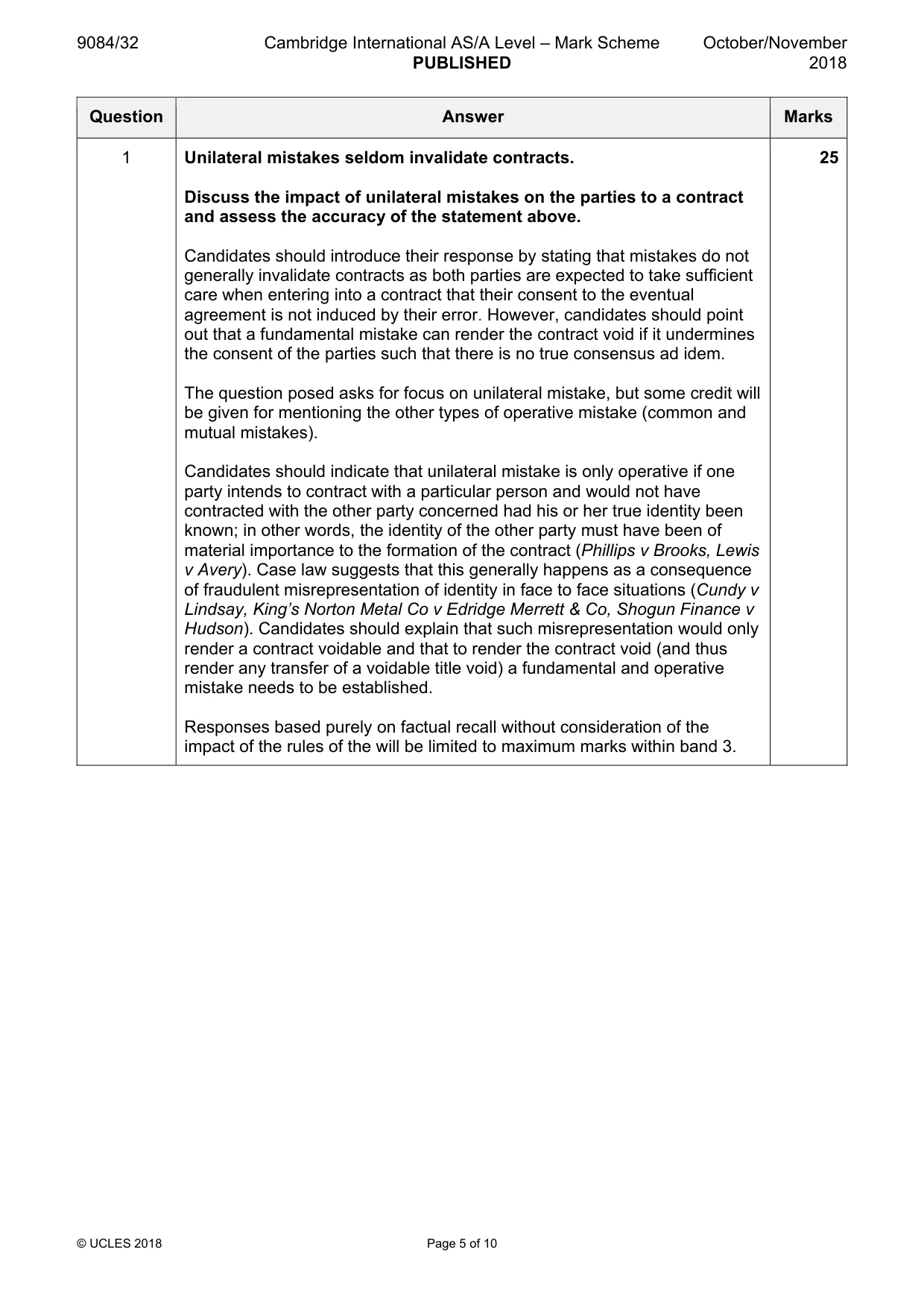
9084/32 Cambridge International AS/A Level – Mark Scheme PUBLISHED October/November 2018 © UCLES 2018 Page 5 of 10 Question Answer Marks 1 Unilateral mistakes seldom invalidate contracts. Discuss the impact of unilateral mistakes on the parties to a contract and assess the accuracy of the statement above. Candidates should introduce their response by stating that mistakes do not generally invalidate contracts as both parties are expected to take sufficient care when entering into a contract that their consent to the eventual agreement is not induced by their error. However, candidates should point out that a fundamental mistake can render the contract void if it undermines the consent of the parties such that there is no true consensus ad idem. The question posed asks for focus on unilateral mistake, but some credit will be given for mentioning the other types of operative mistake (common and mutual mistakes). Candidates should indicate that unilateral mistake is only operative if one party intends to contract with a particular person and would not have contracted with the other party concerned had his or her true identity been known; in other words, the identity of the other party must have been of material importance to the formation of the contract (Phillips v Brooks, Lewis v Avery). Case law suggests that this generally happens as a consequence of fraudulent misrepresentation of identity in face to face situations (Cundy v Lindsay, King’s Norton Metal Co v Edridge Merrett & Co, Shogun Finance v Hudson). Candidates should explain that such misrepresentation would only render a contract voidable and that to render the contract void (and thus render any transfer of a voidable title void) a fundamental and operative mistake needs to be established. Responses based purely on factual recall without consideration of the impact of the rules of the will be limited to maximum marks within band 3. 25
Mark scheme, page 6
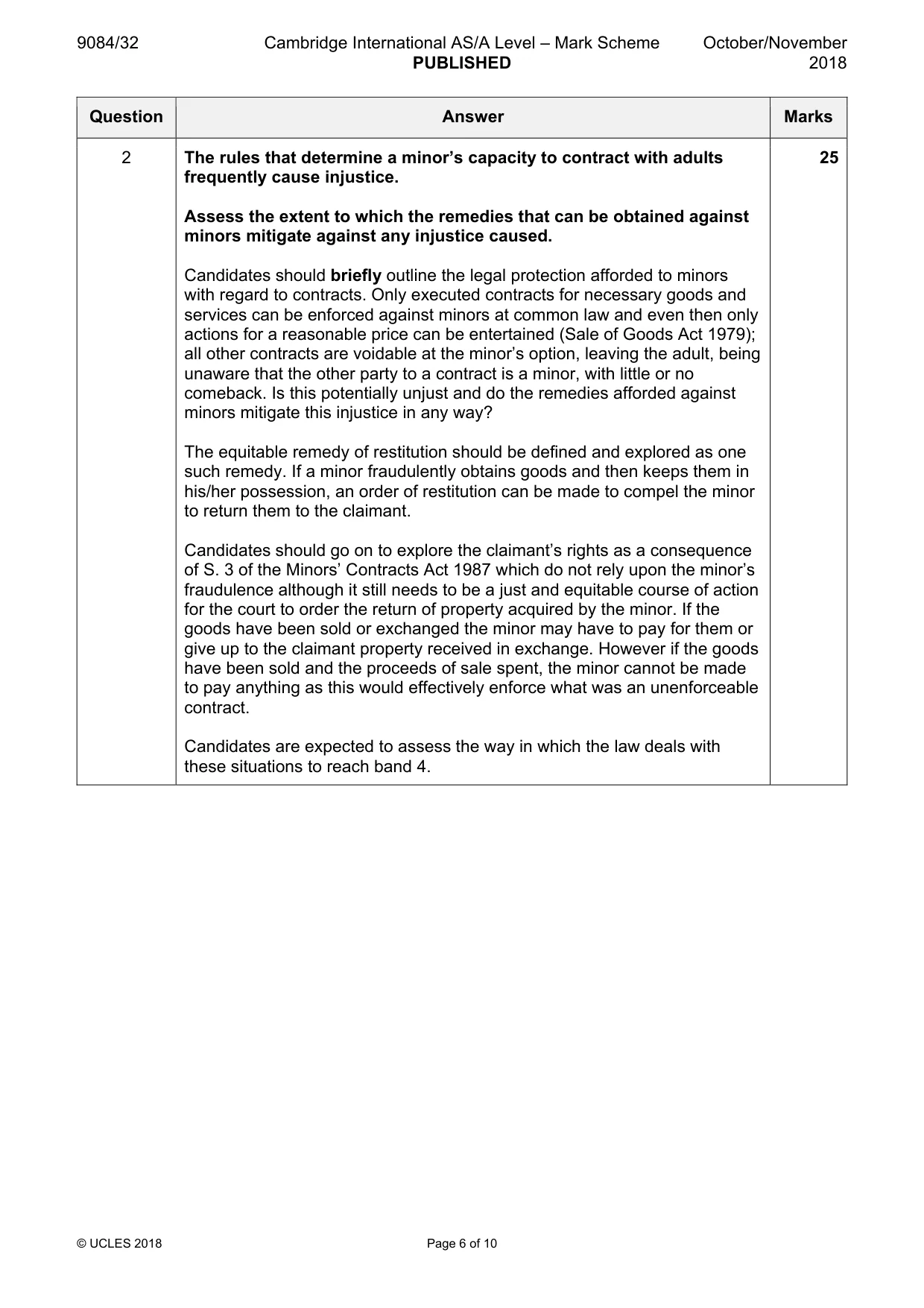
9084/32 Cambridge International AS/A Level – Mark Scheme PUBLISHED October/November 2018 © UCLES 2018 Page 6 of 10 Question Answer Marks 2 The rules that determine a minor’s capacity to contract with adults frequently cause injustice. Assess the extent to which the remedies that can be obtained against minors mitigate against any injustice caused. Candidates should briefly outline the legal protection afforded to minors with regard to contracts. Only executed contracts for necessary goods and services can be enforced against minors at common law and even then only actions for a reasonable price can be entertained (Sale of Goods Act 1979); all other contracts are voidable at the minor’s option, leaving the adult, being unaware that the other party to a contract is a minor, with little or no comeback. Is this potentially unjust and do the remedies afforded against minors mitigate this injustice in any way? The equitable remedy of restitution should be defined and explored as one such remedy. If a minor fraudulently obtains goods and then keeps them in his/her possession, an order of restitution can be made to compel the minor to return them to the claimant. Candidates should go on to explore the claimant’s rights as a consequence of S. 3 of the Minors’ Contracts Act 1987 which do not rely upon the minor’s fraudulence although it still needs to be a just and equitable course of action for the court to order the return of property acquired by the minor. If the goods have been sold or exchanged the minor may have to pay for them or give up to the claimant property received in exchange. However if the goods have been sold and the proceeds of sale spent, the minor cannot be made to pay anything as this would effectively enforce what was an unenforceable contract. Candidates are expected to assess the way in which the law deals with these situations to reach band 4. 25
Mark scheme, page 7
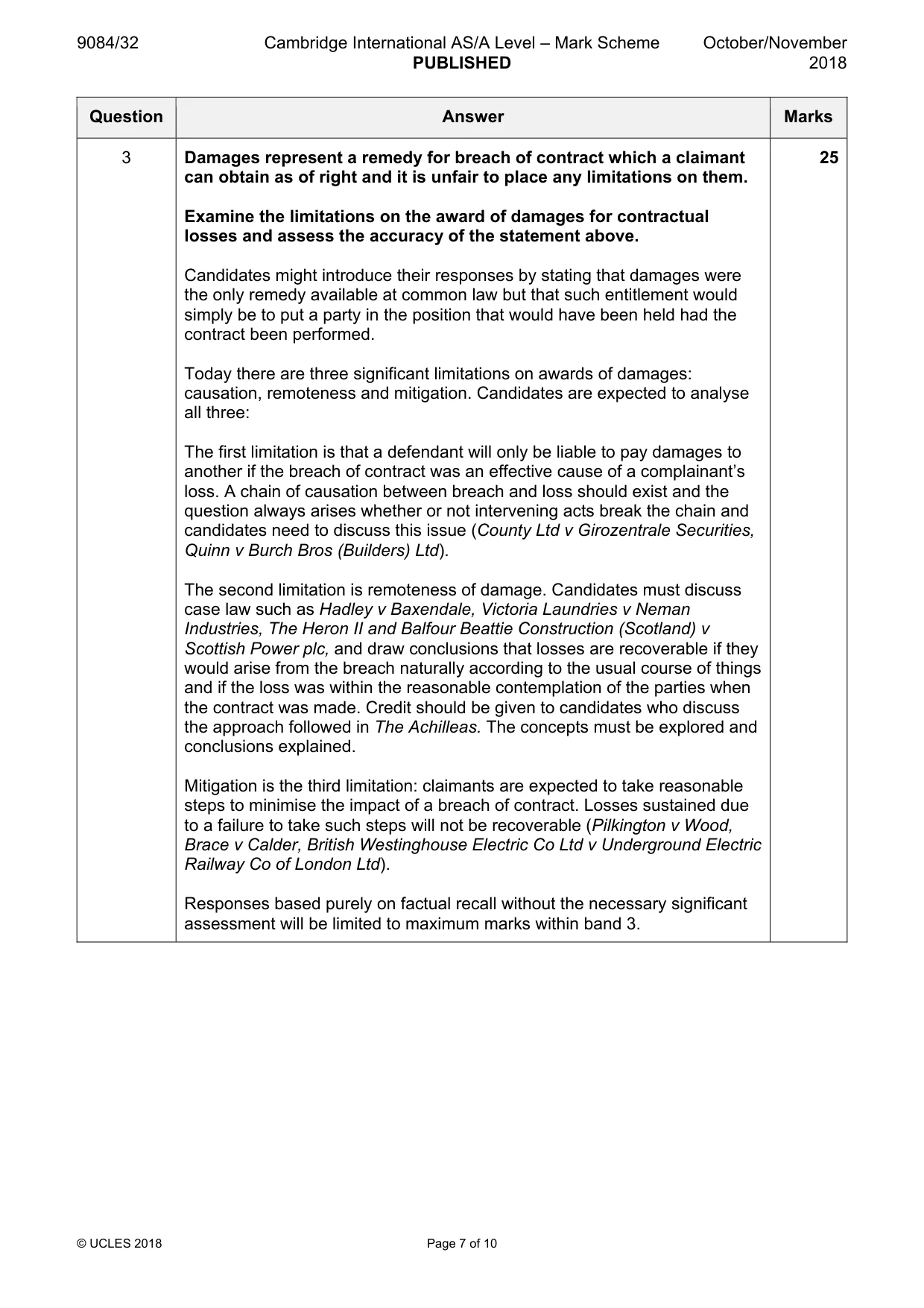
9084/32 Cambridge International AS/A Level – Mark Scheme PUBLISHED October/November 2018 © UCLES 2018 Page 7 of 10 Question Answer Marks 3 Damages represent a remedy for breach of contract which a claimant can obtain as of right and it is unfair to place any limitations on them. Examine the limitations on the award of damages for contractual losses and assess the accuracy of the statement above. Candidates might introduce their responses by stating that damages were the only remedy available at common law but that such entitlement would simply be to put a party in the position that would have been held had the contract been performed. Today there are three significant limitations on awards of damages: causation, remoteness and mitigation. Candidates are expected to analyse all three: The first limitation is that a defendant will only be liable to pay damages to another if the breach of contract was an effective cause of a complainant’s loss. A chain of causation between breach and loss should exist and the question always arises whether or not intervening acts break the chain and candidates need to discuss this issue (County Ltd v Girozentrale Securities, Quinn v Burch Bros (Builders) Ltd). The second limitation is remoteness of damage. Candidates must discuss case law such as Hadley v Baxendale, Victoria Laundries v Neman Industries, The Heron II and Balfour Beattie Construction (Scotland) v Scottish Power plc, and draw conclusions that losses are recoverable if they would arise from the breach naturally according to the usual course of things and if the loss was within the reasonable contemplation of the parties when the contract was made. Credit should be given to candidates who discuss the approach followed in The Achilleas. The concepts must be explored and conclusions explained. Mitigation is the third limitation: claimants are expected to take reasonable steps to minimise the impact of a breach of contract. Losses sustained due to a failure to take such steps will not be recoverable (Pilkington v Wood, Brace v Calder, British Westinghouse Electric Co Ltd v Underground Electric Railway Co of London Ltd). Responses based purely on factual recall without the necessary significant assessment will be limited to maximum marks within band 3. 25
Mark scheme, page 8
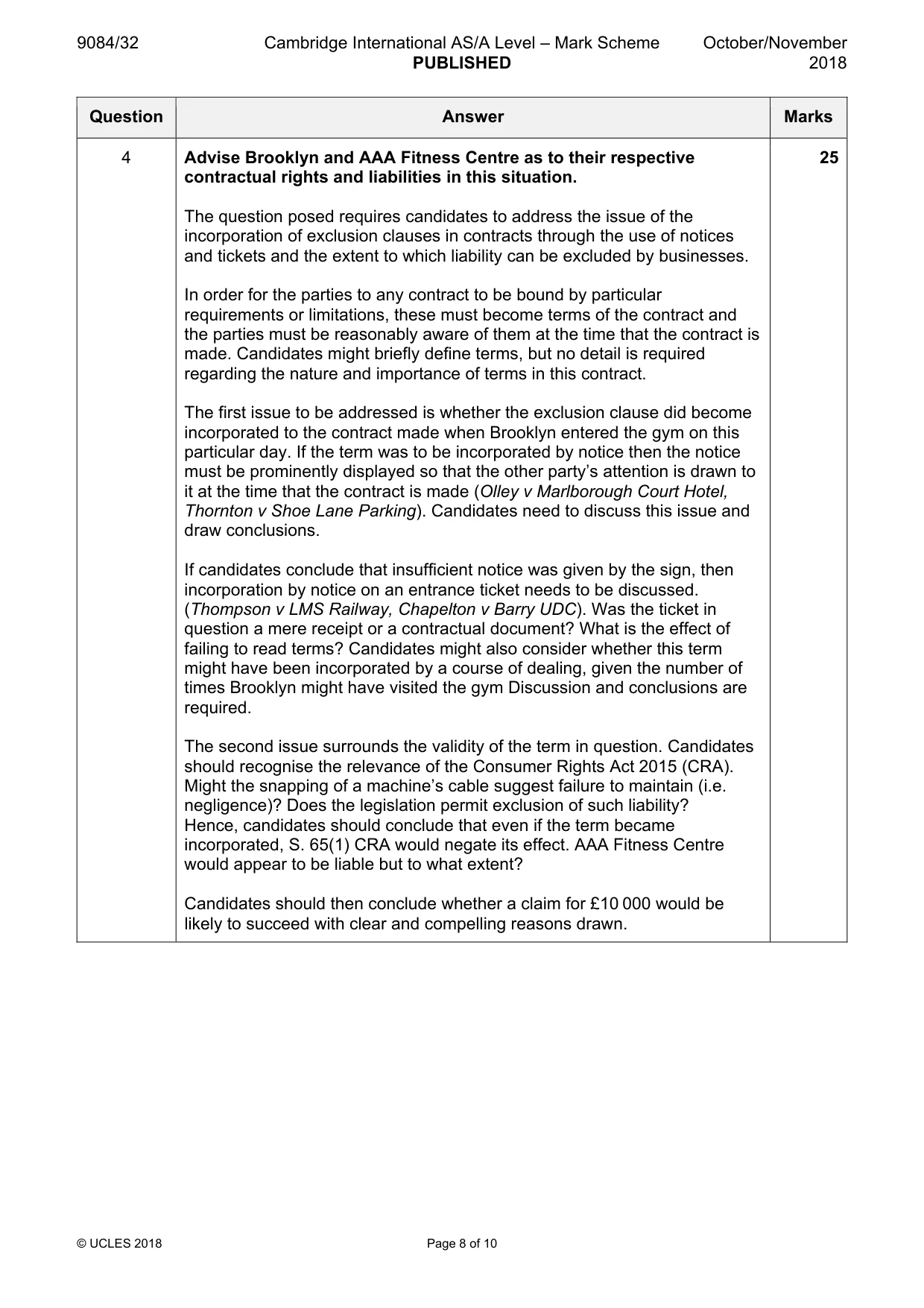
9084/32 Cambridge International AS/A Level – Mark Scheme PUBLISHED October/November 2018 © UCLES 2018 Page 8 of 10 Question Answer Marks 4 Advise Brooklyn and AAA Fitness Centre as to their respective contractual rights and liabilities in this situation. The question posed requires candidates to address the issue of the incorporation of exclusion clauses in contracts through the use of notices and tickets and the extent to which liability can be excluded by businesses. In order for the parties to any contract to be bound by particular requirements or limitations, these must become terms of the contract and the parties must be reasonably aware of them at the time that the contract is made. Candidates might briefly define terms, but no detail is required regarding the nature and importance of terms in this contract. The first issue to be addressed is whether the exclusion clause did become incorporated to the contract made when Brooklyn entered the gym on this particular day. If the term was to be incorporated by notice then the notice must be prominently displayed so that the other party’s attention is drawn to it at the time that the contract is made (Olley v Marlborough Court Hotel, Thornton v Shoe Lane Parking). Candidates need to discuss this issue and draw conclusions. If candidates conclude that insufficient notice was given by the sign, then incorporation by notice on an entrance ticket needs to be discussed. (Thompson v LMS Railway, Chapelton v Barry UDC). Was the ticket in question a mere receipt or a contractual document? What is the effect of failing to read terms? Candidates might also consider whether this term might have been incorporated by a course of dealing, given the number of times Brooklyn might have visited the gym Discussion and conclusions are required. The second issue surrounds the validity of the term in question. Candidates should recognise the relevance of the Consumer Rights Act 2015 (CRA). Might the snapping of a machine’s cable suggest failure to maintain (i.e. negligence)? Does the legislation permit exclusion of such liability? Hence, candidates should conclude that even if the term became incorporated, S. 65(1) CRA would negate its effect. AAA Fitness Centre would appear to be liable but to what extent? Candidates should then conclude whether a claim for £10 000 would be likely to succeed with clear and compelling reasons drawn. 25
Mark scheme, page 9
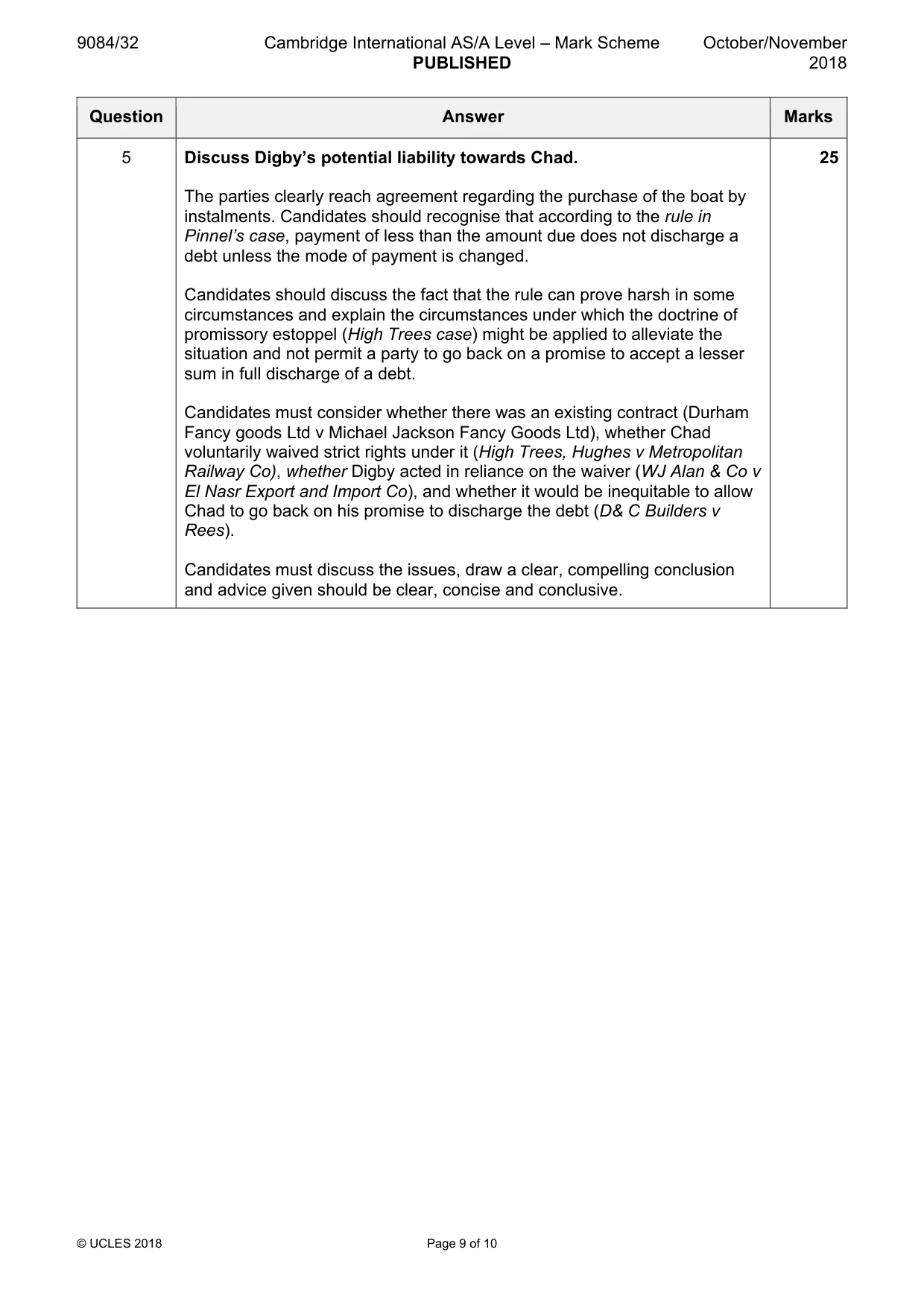
9084/32 Cambridge International AS/A Level – Mark Scheme PUBLISHED October/November 2018 © UCLES 2018 Page 9 of 10 Question Answer Marks 5 Discuss Digby’s potential liability towards Chad. The parties clearly reach agreement regarding the purchase of the boat by instalments. Candidates should recognise that according to the rule in Pinnel’s case, payment of less than the amount due does not discharge a debt unless the mode of payment is changed. Candidates should discuss the fact that the rule can prove harsh in some circumstances and explain the circumstances under which the doctrine of promissory estoppel (High Trees case) might be applied to alleviate the situation and not permit a party to go back on a promise to accept a lesser sum in full discharge of a debt. Candidates must consider whether there was an existing contract (Durham Fancy goods Ltd v Michael Jackson Fancy Goods Ltd), whether Chad voluntarily waived strict rights under it (High Trees, Hughes v Metropolitan Railway Co), whether Digby acted in reliance on the waiver (WJ Alan & Co v El Nasr Export and Import Co), and whether it would be inequitable to allow Chad to go back on his promise to discharge the debt (D& C Builders v Rees). Candidates must discuss the issues, draw a clear, compelling conclusion and advice given should be clear, concise and conclusive. 25
Mark scheme, page 10
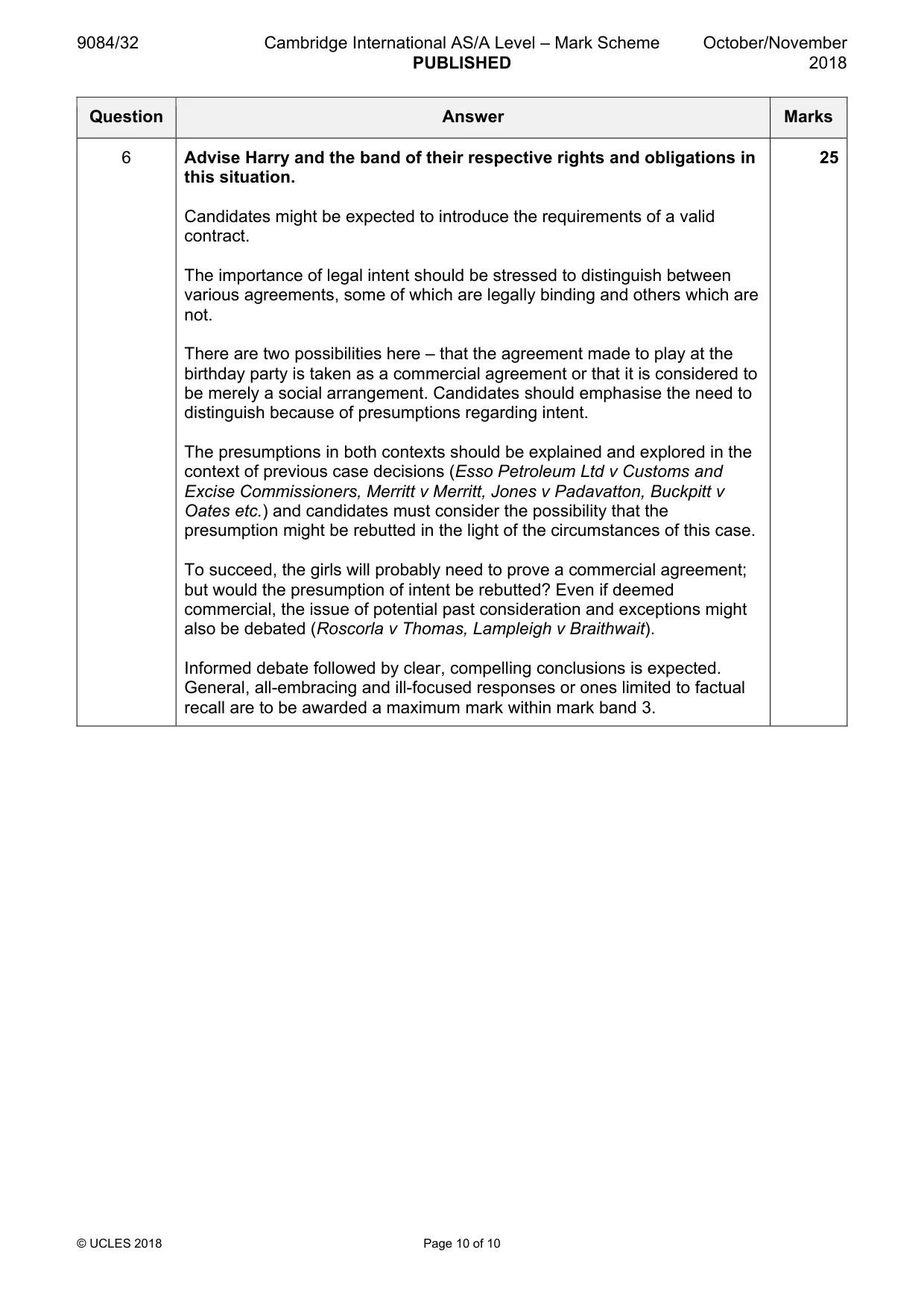
9084/32 Cambridge International AS/A Level – Mark Scheme PUBLISHED October/November 2018 © UCLES 2018 Page 10 of 10 Question Answer Marks 6 Advise Harry and the band of their respective rights and obligations in this situation. Candidates might be expected to introduce the requirements of a valid contract. The importance of legal intent should be stressed to distinguish between various agreements, some of which are legally binding and others which are not. There are two possibilities here – that the agreement made to play at the birthday party is taken as a commercial agreement or that it is considered to be merely a social arrangement. Candidates should emphasise the need to distinguish because of presumptions regarding intent. The presumptions in both contexts should be explained and explored in the context of previous case decisions (Esso Petroleum Ltd v Customs and Excise Commissioners, Merritt v Merritt, Jones v Padavatton, Buckpitt v Oates etc.) and candidates must consider the possibility that the presumption might be rebutted in the light of the circumstances of this case. To succeed, the girls will probably need to prove a commercial agreement; but would the presumption of intent be rebutted? Even if deemed commercial, the issue of potential past consideration and exceptions might also be debated (Roscorla v Thomas, Lampleigh v Braithwait). Informed debate followed by clear, compelling conclusions is expected. General, all-embracing and ill-focused responses or ones limited to factual recall are to be awarded a maximum mark within mark band 3. 25
What you needed in this session
Cambridge’s own grade thresholds for 2018 Oct/Nov, Paper 3 · Variant 2. A higher threshold means an easier paper — the bar moves with how the cohort did.