Cambridge A Level Law 9084 — 2017 Oct/Nov Paper 3 · Variant 1
9084/31/O/N/17 · 75 marks · ≈84 min
The question paper and its mark scheme, free to read here and free to download. This is Cambridge’s own paper, exactly as it was sat.
Question paper4 pages

Mark scheme8 pages
Answers below. Sit the paper first if you are practising.
Paper as text
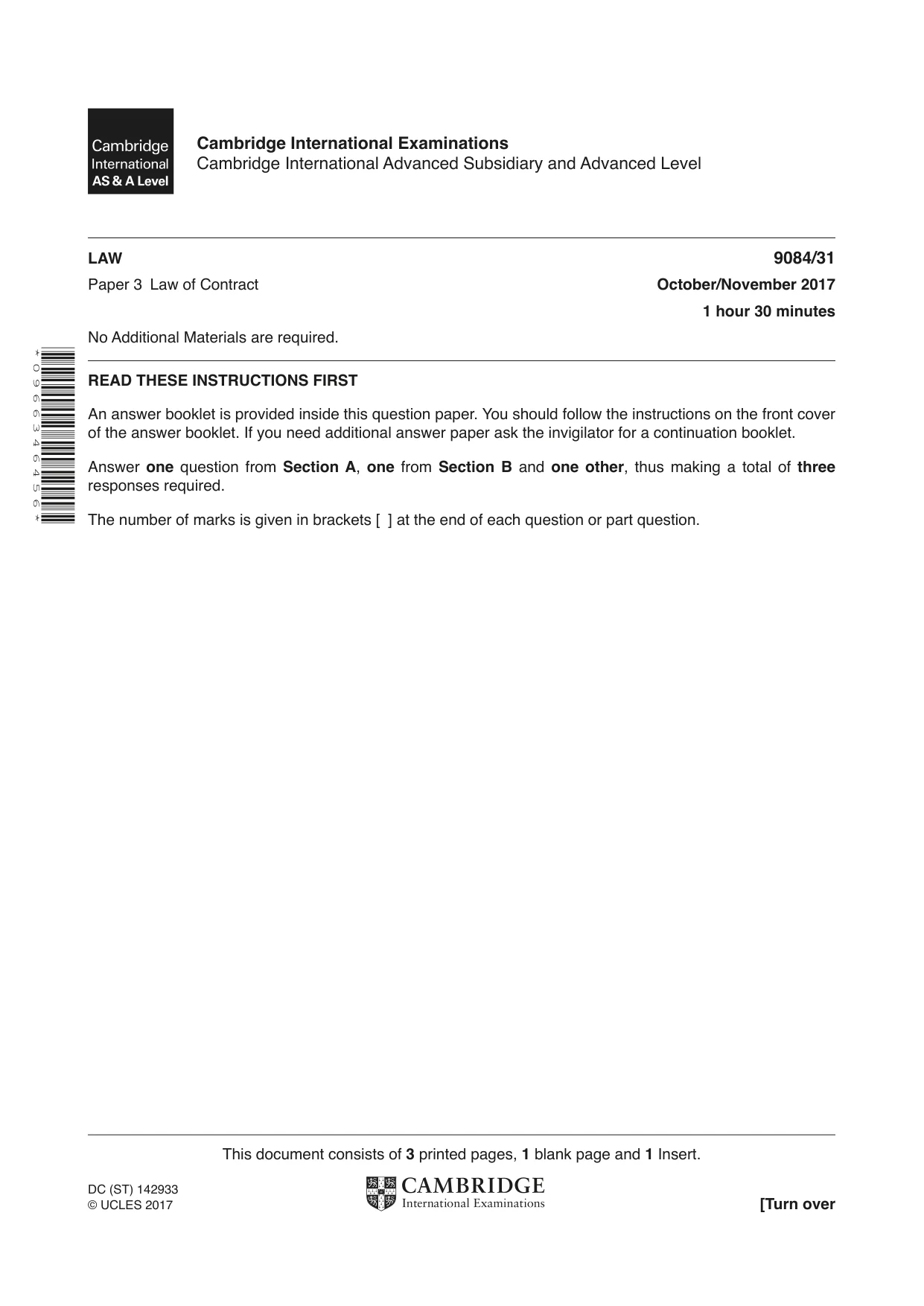
Question paper, page 1
* 0 9 6 6 3 4 6 4 5 6 * This document consists of 3 printed pages, 1 blank page and 1 Insert. DC (ST) 142933 © UCLES 2017 [Turn over Cambridge International Examinations Cambridge International Advanced Subsidiary and Advanced Level LAW 9084/31 Paper 3 Law of Contract October/November 2017 1 hour 30 minutes No Additional Materials are required. READ THESE INSTRUCTIONS FIRST An answer booklet is provided inside this question paper. You should follow the instructions on the front cover of the answer booklet. If you need additional answer paper ask the invigilator for a continuation booklet. Answer one question from Section A, one from Section B and one other, thus making a total of three responses required. The number of marks is given in brackets [ ] at the end of each question or part question.
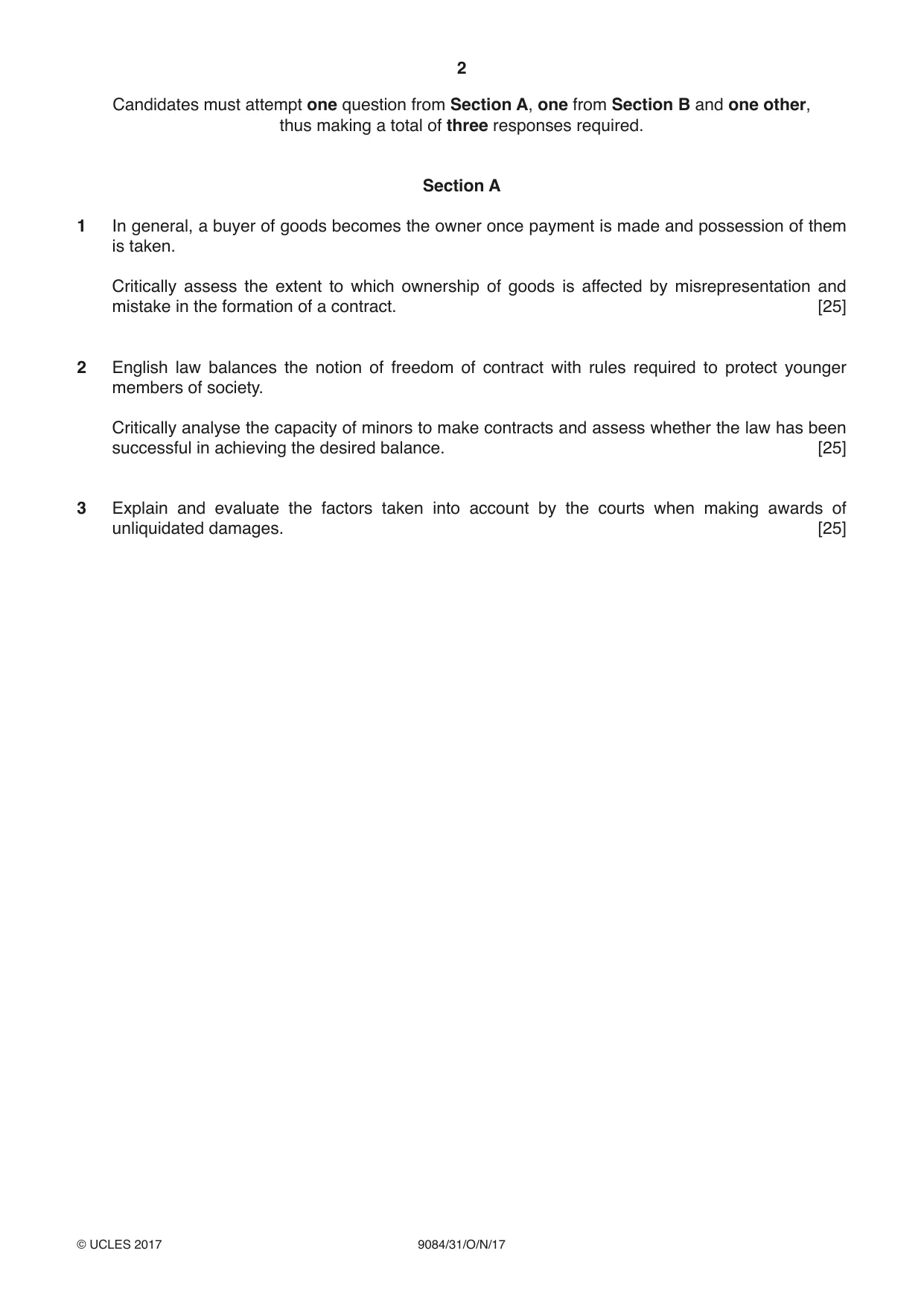
Question paper, page 2
2 9084/31/O/N/17 © UCLES 2017 Candidates must attempt one question from Section A, one from Section B and one other, thus making a total of three responses required. Section A 1 In general, a buyer of goods becomes the owner once payment is made and possession of them is taken. Critically assess the extent to which ownership of goods is affected by misrepresentation and mistake in the formation of a contract. [25] 2 English law balances the notion of freedom of contract with rules required to protect younger members of society. Critically analyse the capacity of minors to make contracts and assess whether the law has been successful in achieving the desired balance. [25] 3 Explain and evaluate the factors taken into account by the courts when making awards of unliquidated damages. [25]
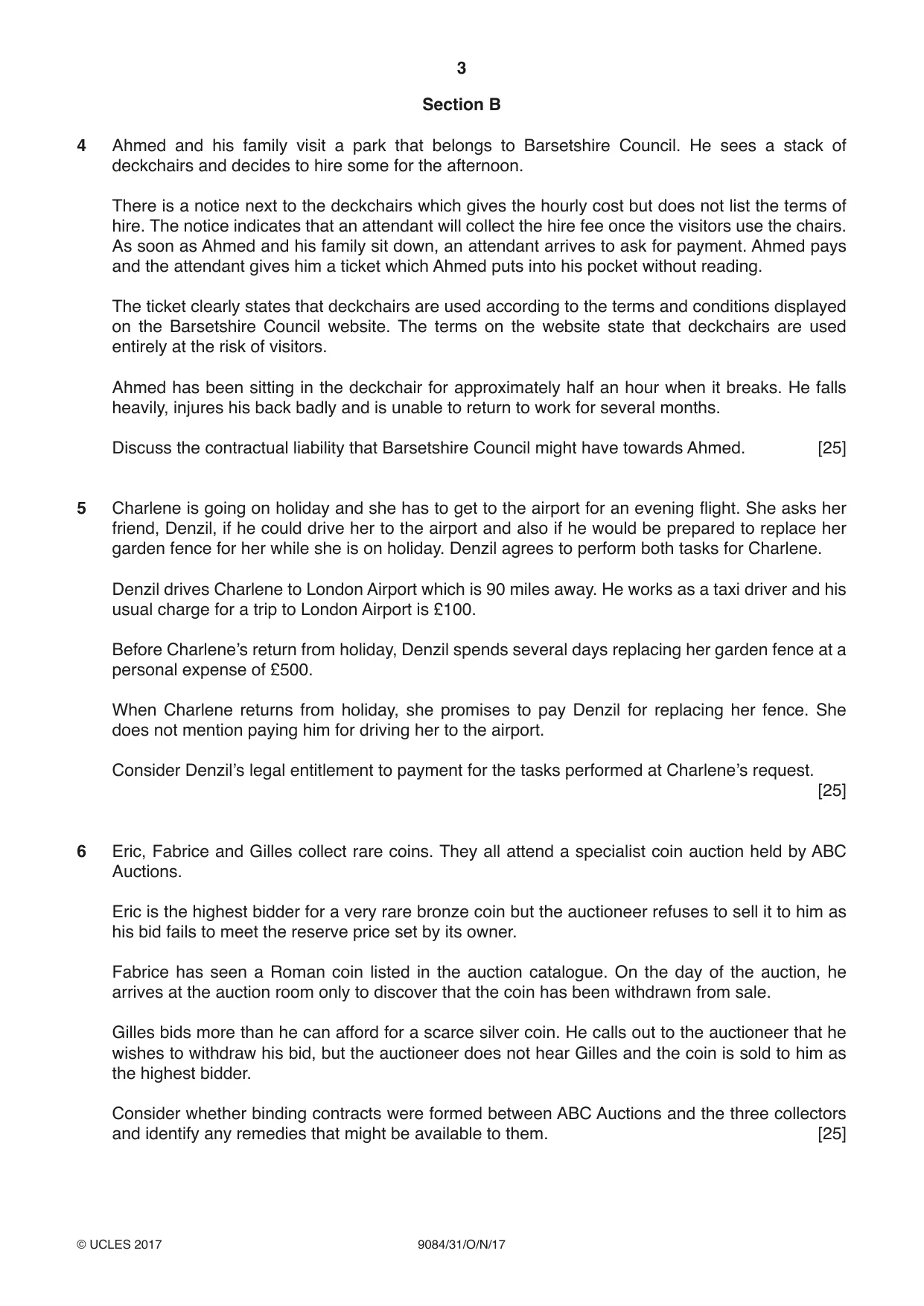
Question paper, page 3
3 9084/31/O/N/17 © UCLES 2017 Section B 4 Ahmed and his family visit a park that belongs to Barsetshire Council. He sees a stack of deckchairs and decides to hire some for the afternoon. There is a notice next to the deckchairs which gives the hourly cost but does not list the terms of hire. The notice indicates that an attendant will collect the hire fee once the visitors use the chairs. As soon as Ahmed and his family sit down, an attendant arrives to ask for payment. Ahmed pays and the attendant gives him a ticket which Ahmed puts into his pocket without reading. The ticket clearly states that deckchairs are used according to the terms and conditions displayed on the Barsetshire Council website. The terms on the website state that deckchairs are used entirely at the risk of visitors. Ahmed has been sitting in the deckchair for approximately half an hour when it breaks. He falls heavily, injures his back badly and is unable to return to work for several months. Discuss the contractual liability that Barsetshire Council might have towards Ahmed. [25] 5 Charlene is going on holiday and she has to get to the airport for an evening flight. She asks her friend, Denzil, if he could drive her to the airport and also if he would be prepared to replace her garden fence for her while she is on holiday. Denzil agrees to perform both tasks for Charlene. Denzil drives Charlene to London Airport which is 90 miles away. He works as a taxi driver and his usual charge for a trip to London Airport is £100. Before Charlene’s return from holiday, Denzil spends several days replacing her garden fence at a personal expense of £500. When Charlene returns from holiday, she promises to pay Denzil for replacing her fence. She does not mention paying him for driving her to the airport. Consider Denzil’s legal entitlement to payment for the tasks performed at Charlene’s request. [25] 6 Eric, Fabrice and Gilles collect rare coins. They all attend a specialist coin auction held by ABC Auctions. Eric is the highest bidder for a very rare bronze coin but the auctioneer refuses to sell it to him as his bid fails to meet the reserve price set by its owner. Fabrice has seen a Roman coin listed in the auction catalogue. On the day of the auction, he arrives at the auction room only to discover that the coin has been withdrawn from sale. Gilles bids more than he can afford for a scarce silver coin. He calls out to the auctioneer that he wishes to withdraw his bid, but the auctioneer does not hear Gilles and the coin is sold to him as the highest bidder. Consider whether binding contracts were formed between ABC Auctions and the three collectors and identify any remedies that might be available to them. [25]
Question paper, page 4
4 9084/31/O/N/17 © UCLES 2017 Permission to reproduce items where third-party owned material protected by copyright is included has been sought and cleared where possible. Every reasonable effort has been made by the publisher (UCLES) to trace copyright holders, but if any items requiring clearance have unwittingly been included, the publisher will be pleased to make amends at the earliest possible opportunity. To avoid the issue of disclosure of answer-related information to candidates, all copyright acknowledgements are reproduced online in the Cambridge International Examinations Copyright Acknowledgements Booklet. This is produced for each series of examinations and is freely available to download at www.cie.org.uk after the live examination series. Cambridge International Examinations is part of the Cambridge Assessment Group. Cambridge Assessment is the brand name of University of Cambridge Local Examinations Syndicate (UCLES), which is itself a department of the University of Cambridge. BLANK PAGE
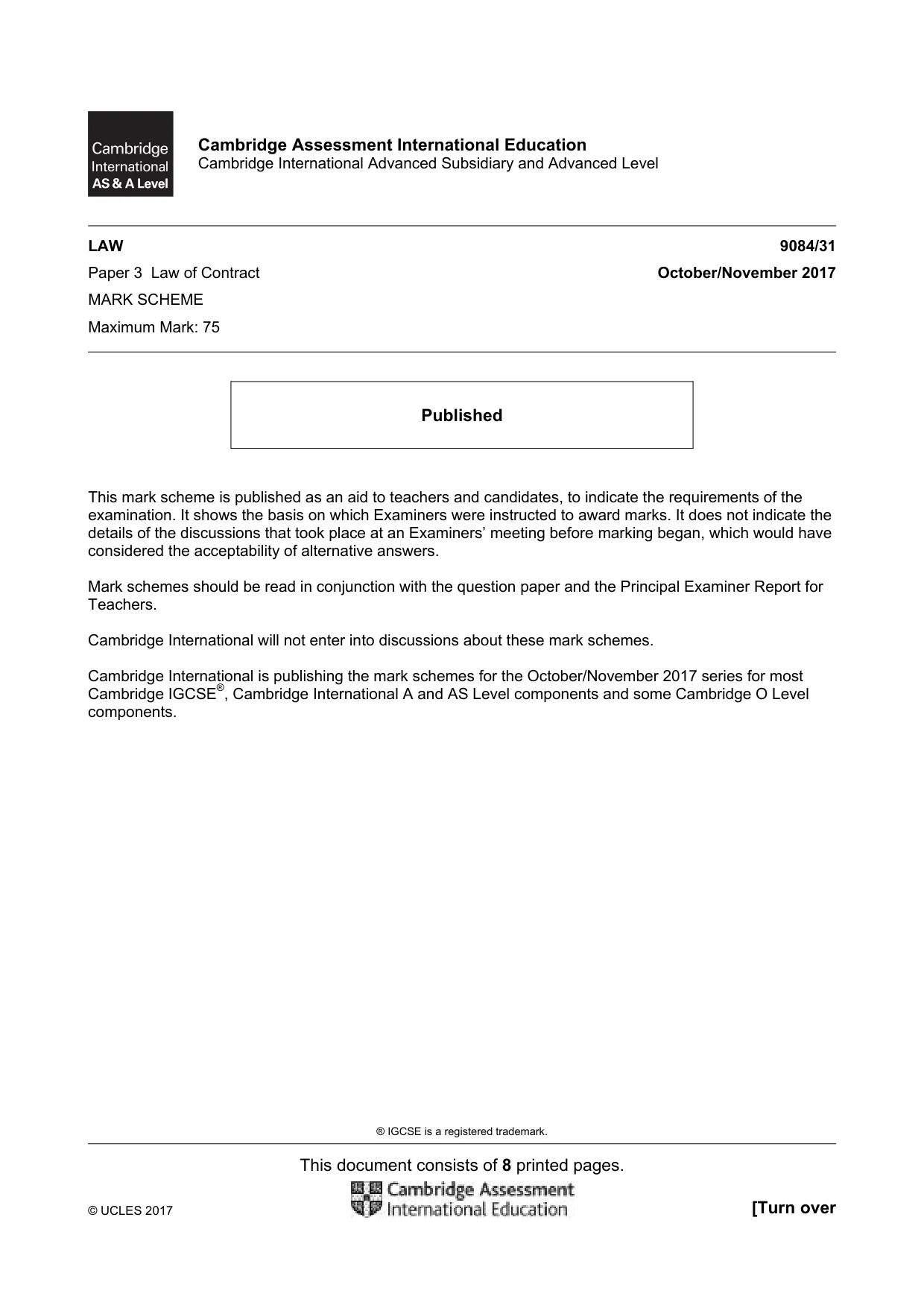
Mark scheme, page 1
® IGCSE is a registered trademark. This document consists of 8 printed pages. © UCLES 2017 [Turn over Cambridge Assessment International Education Cambridge International Advanced Subsidiary and Advanced Level LAW 9084/31 Paper 3 Law of Contract October/November 2017 MARK SCHEME Maximum Mark: 75 Published This mark scheme is published as an aid to teachers and candidates, to indicate the requirements of the examination. It shows the basis on which Examiners were instructed to award marks. It does not indicate the details of the discussions that took place at an Examiners’ meeting before marking began, which would have considered the acceptability of alternative answers. Mark schemes should be read in conjunction with the question paper and the Principal Examiner Report for Teachers. Cambridge International will not enter into discussions about these mark schemes. Cambridge International is publishing the mark schemes for the October/November 2017 series for most Cambridge IGCSE®, Cambridge International A and AS Level components and some Cambridge O Level components.
Mark scheme, page 2
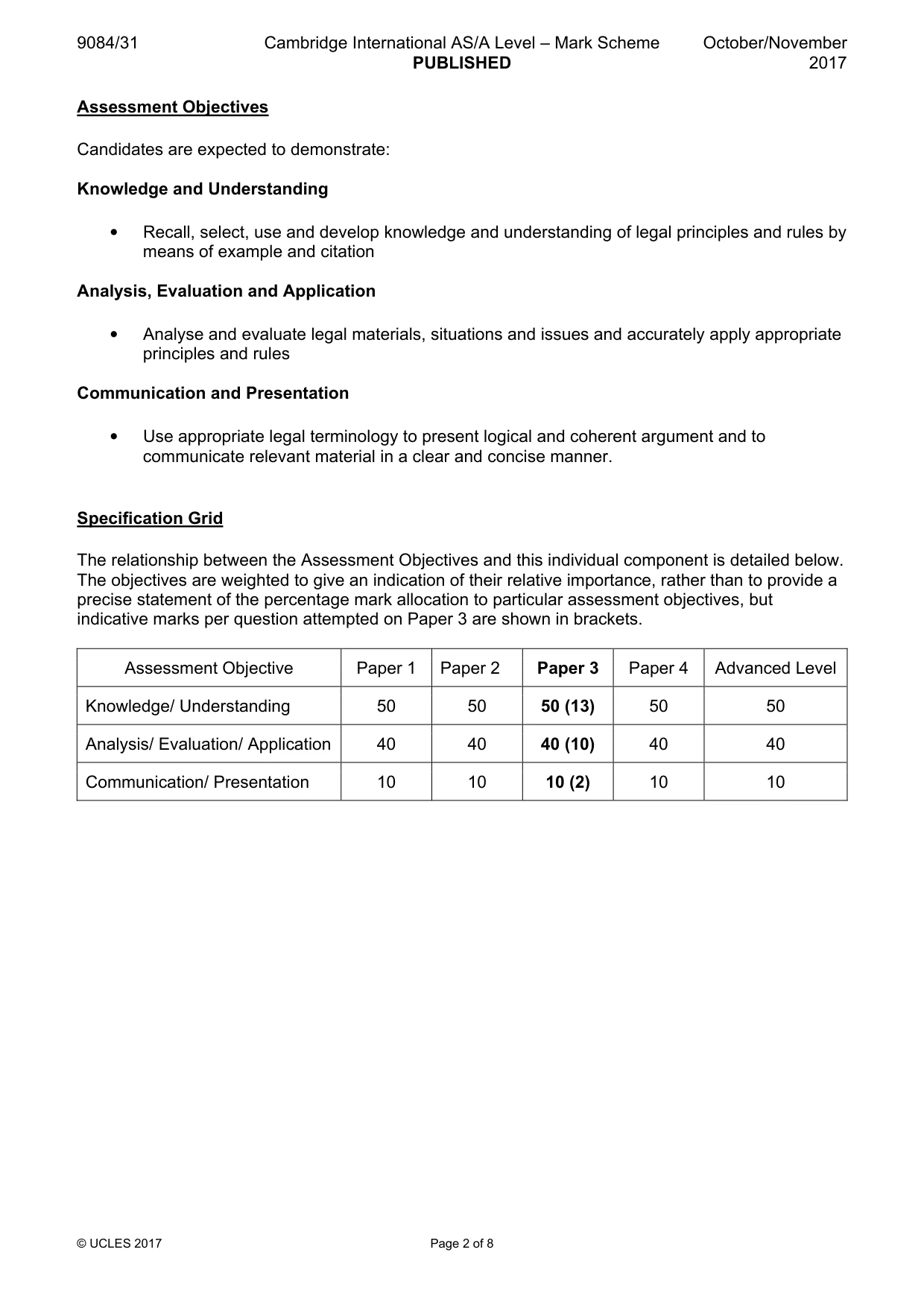
9084/31 Cambridge International AS/A Level – Mark Scheme PUBLISHED October/November 2017 © UCLES 2017 Page 2 of 8 Assessment Objectives Candidates are expected to demonstrate: Knowledge and Understanding • Recall, select, use and develop knowledge and understanding of legal principles and rules by means of example and citation Analysis, Evaluation and Application • Analyse and evaluate legal materials, situations and issues and accurately apply appropriate principles and rules Communication and Presentation • Use appropriate legal terminology to present logical and coherent argument and to communicate relevant material in a clear and concise manner. Specification Grid The relationship between the Assessment Objectives and this individual component is detailed below. The objectives are weighted to give an indication of their relative importance, rather than to provide a precise statement of the percentage mark allocation to particular assessment objectives, but indicative marks per question attempted on Paper 3 are shown in brackets. Assessment Objective Paper 1 Paper 2 Paper 3 Paper 4 Advanced Level Knowledge/ Understanding 50 50 50 (13) 50 50 Analysis/ Evaluation/ Application 40 40 40 (10) 40 40 Communication/ Presentation 10 10 10 (2) 10 10
Mark scheme, page 3
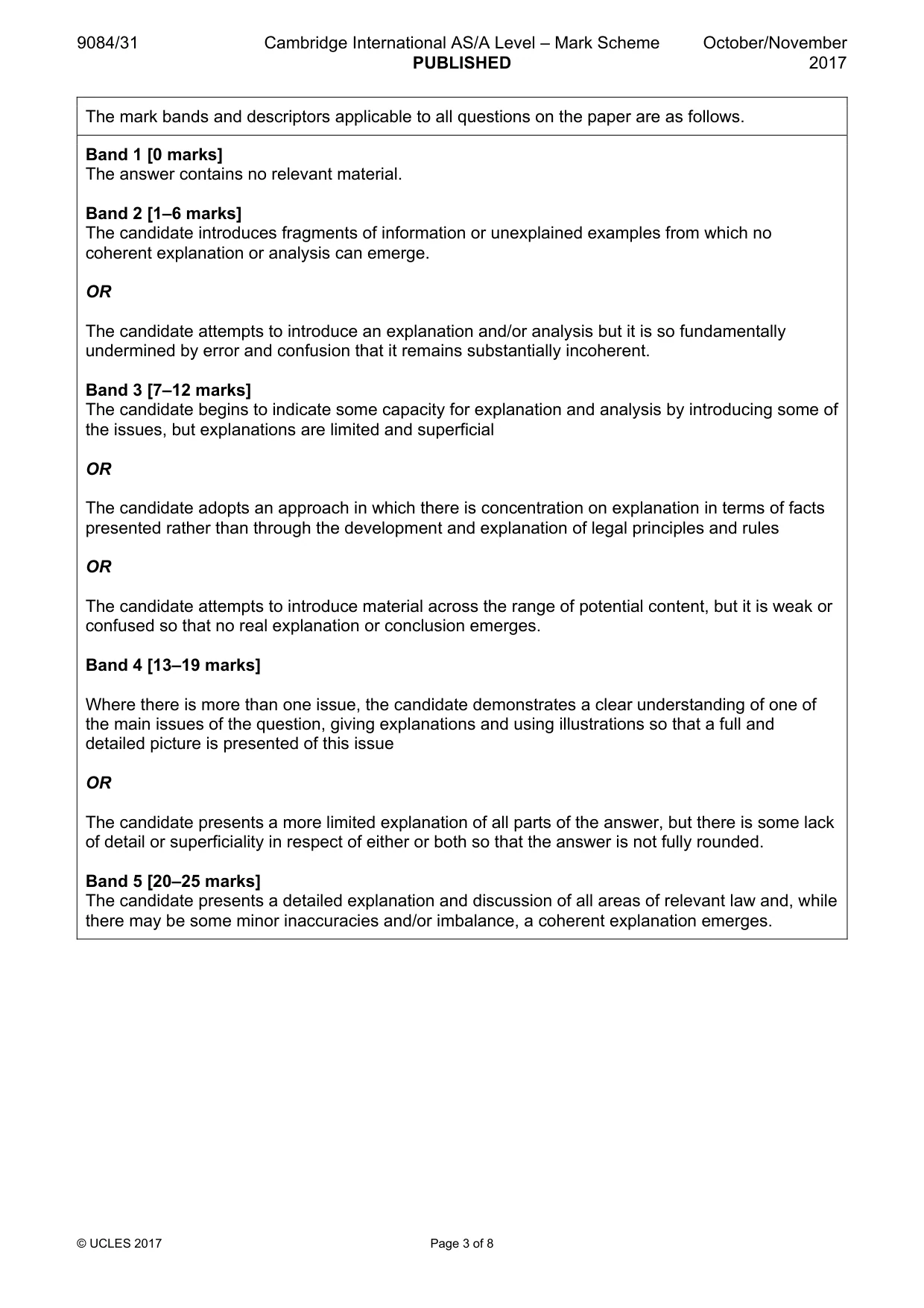
9084/31 Cambridge International AS/A Level – Mark Scheme PUBLISHED October/November 2017 © UCLES 2017 Page 3 of 8 The mark bands and descriptors applicable to all questions on the paper are as follows. Band 1 [0 marks] The answer contains no relevant material. Band 2 [1–6 marks] The candidate introduces fragments of information or unexplained examples from which no coherent explanation or analysis can emerge. OR The candidate attempts to introduce an explanation and/or analysis but it is so fundamentally undermined by error and confusion that it remains substantially incoherent. Band 3 [7–12 marks] The candidate begins to indicate some capacity for explanation and analysis by introducing some of the issues, but explanations are limited and superficial OR The candidate adopts an approach in which there is concentration on explanation in terms of facts presented rather than through the development and explanation of legal principles and rules OR The candidate attempts to introduce material across the range of potential content, but it is weak or confused so that no real explanation or conclusion emerges. Band 4 [13–19 marks] Where there is more than one issue, the candidate demonstrates a clear understanding of one of the main issues of the question, giving explanations and using illustrations so that a full and detailed picture is presented of this issue OR The candidate presents a more limited explanation of all parts of the answer, but there is some lack of detail or superficiality in respect of either or both so that the answer is not fully rounded. Band 5 [20–25 marks] The candidate presents a detailed explanation and discussion of all areas of relevant law and, while there may be some minor inaccuracies and/or imbalance, a coherent explanation emerges.
Mark scheme, page 4
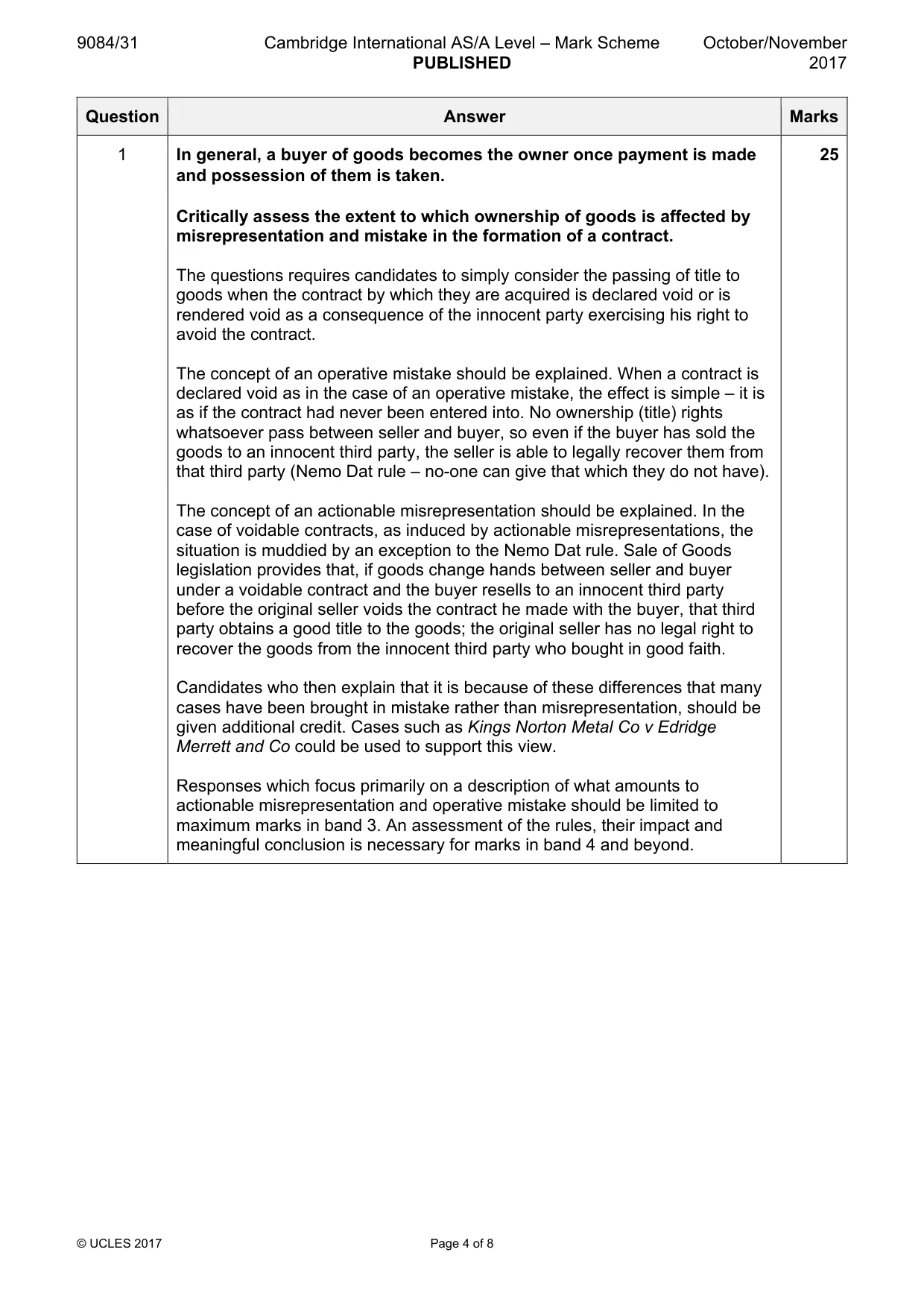
9084/31 Cambridge International AS/A Level – Mark Scheme PUBLISHED October/November 2017 © UCLES 2017 Page 4 of 8 Question Answer Marks 1 In general, a buyer of goods becomes the owner once payment is made and possession of them is taken. Critically assess the extent to which ownership of goods is affected by misrepresentation and mistake in the formation of a contract. The questions requires candidates to simply consider the passing of title to goods when the contract by which they are acquired is declared void or is rendered void as a consequence of the innocent party exercising his right to avoid the contract. The concept of an operative mistake should be explained. When a contract is declared void as in the case of an operative mistake, the effect is simple – it is as if the contract had never been entered into. No ownership (title) rights whatsoever pass between seller and buyer, so even if the buyer has sold the goods to an innocent third party, the seller is able to legally recover them from that third party (Nemo Dat rule – no-one can give that which they do not have). The concept of an actionable misrepresentation should be explained. In the case of voidable contracts, as induced by actionable misrepresentations, the situation is muddied by an exception to the Nemo Dat rule. Sale of Goods legislation provides that, if goods change hands between seller and buyer under a voidable contract and the buyer resells to an innocent third party before the original seller voids the contract he made with the buyer, that third party obtains a good title to the goods; the original seller has no legal right to recover the goods from the innocent third party who bought in good faith. Candidates who then explain that it is because of these differences that many cases have been brought in mistake rather than misrepresentation, should be given additional credit. Cases such as Kings Norton Metal Co v Edridge Merrett and Co could be used to support this view. Responses which focus primarily on a description of what amounts to actionable misrepresentation and operative mistake should be limited to maximum marks in band 3. An assessment of the rules, their impact and meaningful conclusion is necessary for marks in band 4 and beyond. 25
Mark scheme, page 5
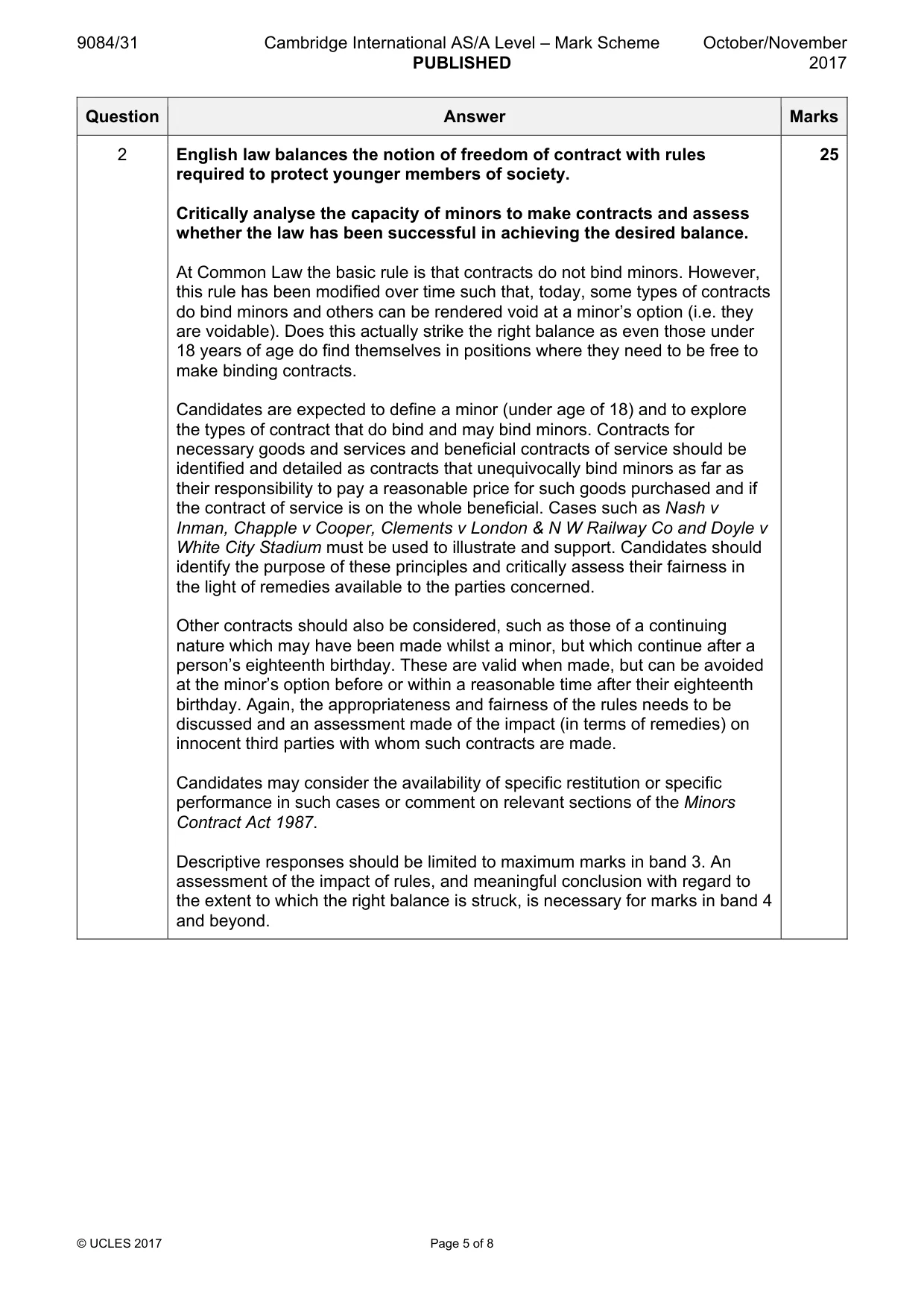
9084/31 Cambridge International AS/A Level – Mark Scheme PUBLISHED October/November 2017 © UCLES 2017 Page 5 of 8 Question Answer Marks 2 English law balances the notion of freedom of contract with rules required to protect younger members of society. Critically analyse the capacity of minors to make contracts and assess whether the law has been successful in achieving the desired balance. At Common Law the basic rule is that contracts do not bind minors. However, this rule has been modified over time such that, today, some types of contracts do bind minors and others can be rendered void at a minor’s option (i.e. they are voidable). Does this actually strike the right balance as even those under 18 years of age do find themselves in positions where they need to be free to make binding contracts. Candidates are expected to define a minor (under age of 18) and to explore the types of contract that do bind and may bind minors. Contracts for necessary goods and services and beneficial contracts of service should be identified and detailed as contracts that unequivocally bind minors as far as their responsibility to pay a reasonable price for such goods purchased and if the contract of service is on the whole beneficial. Cases such as Nash v Inman, Chapple v Cooper, Clements v London & N W Railway Co and Doyle v White City Stadium must be used to illustrate and support. Candidates should identify the purpose of these principles and critically assess their fairness in the light of remedies available to the parties concerned. Other contracts should also be considered, such as those of a continuing nature which may have been made whilst a minor, but which continue after a person’s eighteenth birthday. These are valid when made, but can be avoided at the minor’s option before or within a reasonable time after their eighteenth birthday. Again, the appropriateness and fairness of the rules needs to be discussed and an assessment made of the impact (in terms of remedies) on innocent third parties with whom such contracts are made. Candidates may consider the availability of specific restitution or specific performance in such cases or comment on relevant sections of the Minors Contract Act 1987. Descriptive responses should be limited to maximum marks in band 3. An assessment of the impact of rules, and meaningful conclusion with regard to the extent to which the right balance is struck, is necessary for marks in band 4 and beyond. 25
Mark scheme, page 6
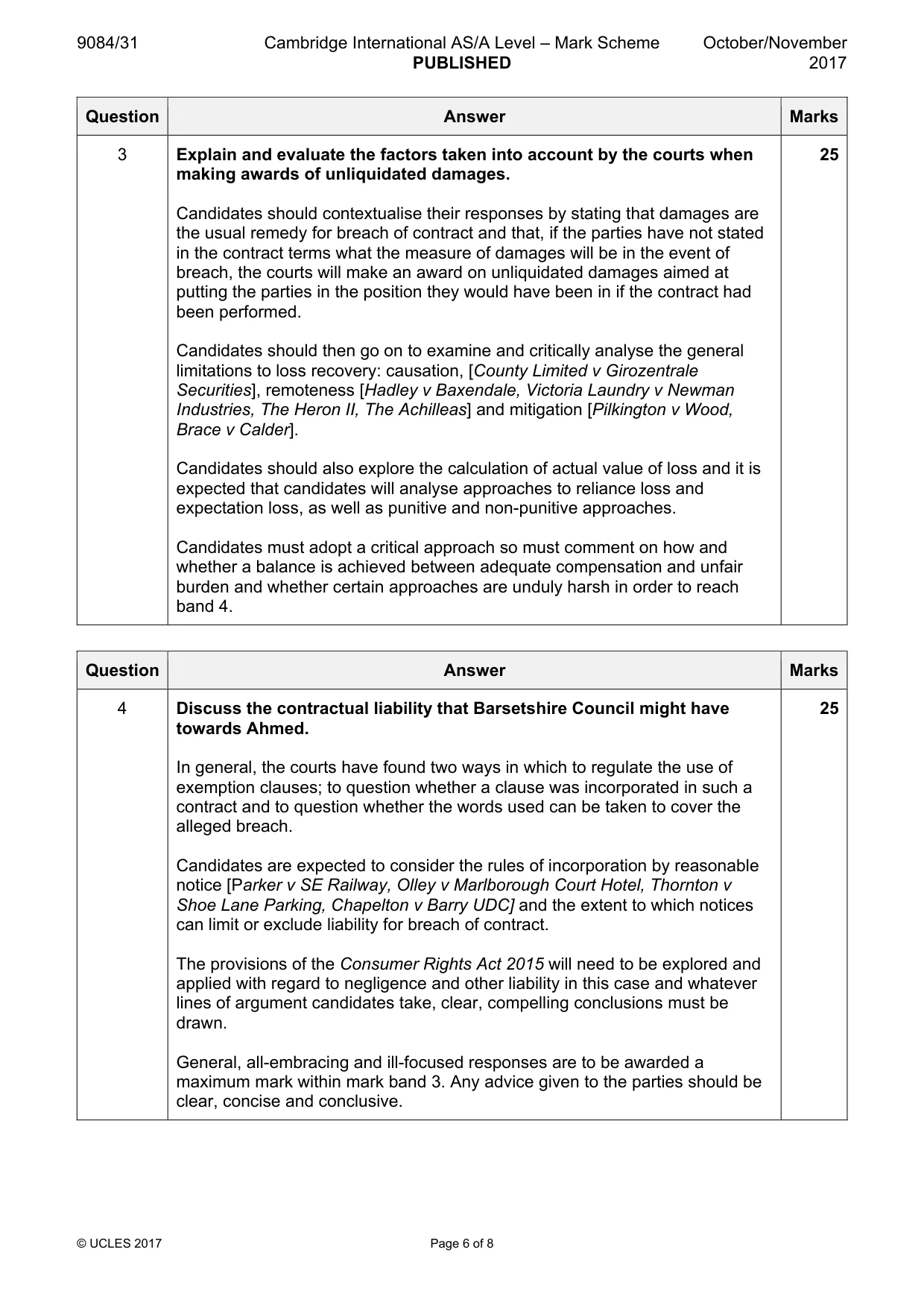
9084/31 Cambridge International AS/A Level – Mark Scheme PUBLISHED October/November 2017 © UCLES 2017 Page 6 of 8 Question Answer Marks 3 Explain and evaluate the factors taken into account by the courts when making awards of unliquidated damages. Candidates should contextualise their responses by stating that damages are the usual remedy for breach of contract and that, if the parties have not stated in the contract terms what the measure of damages will be in the event of breach, the courts will make an award on unliquidated damages aimed at putting the parties in the position they would have been in if the contract had been performed. Candidates should then go on to examine and critically analyse the general limitations to loss recovery: causation, [County Limited v Girozentrale Securities], remoteness [Hadley v Baxendale, Victoria Laundry v Newman Industries, The Heron II, The Achilleas] and mitigation [Pilkington v Wood, Brace v Calder]. Candidates should also explore the calculation of actual value of loss and it is expected that candidates will analyse approaches to reliance loss and expectation loss, as well as punitive and non-punitive approaches. Candidates must adopt a critical approach so must comment on how and whether a balance is achieved between adequate compensation and unfair burden and whether certain approaches are unduly harsh in order to reach band 4. 25 Question Answer Marks 4 Discuss the contractual liability that Barsetshire Council might have towards Ahmed. In general, the courts have found two ways in which to regulate the use of exemption clauses; to question whether a clause was incorporated in such a contract and to question whether the words used can be taken to cover the alleged breach. Candidates are expected to consider the rules of incorporation by reasonable notice [Parker v SE Railway, Olley v Marlborough Court Hotel, Thornton v Shoe Lane Parking, Chapelton v Barry UDC] and the extent to which notices can limit or exclude liability for breach of contract. The provisions of the Consumer Rights Act 2015 will need to be explored and applied with regard to negligence and other liability in this case and whatever lines of argument candidates take, clear, compelling conclusions must be drawn. General, all-embracing and ill-focused responses are to be awarded a maximum mark within mark band 3. Any advice given to the parties should be clear, concise and conclusive. 25
Mark scheme, page 7
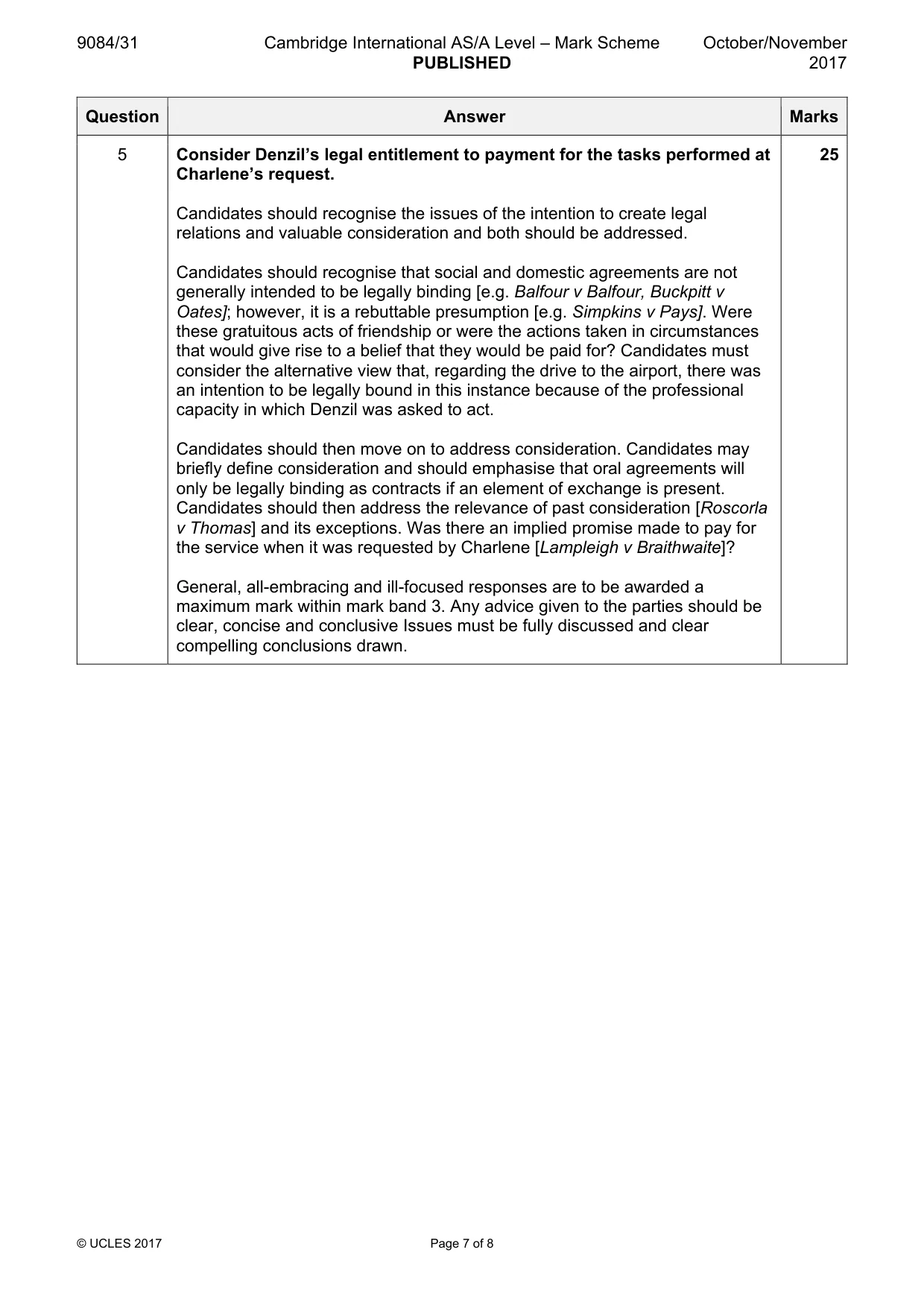
9084/31 Cambridge International AS/A Level – Mark Scheme PUBLISHED October/November 2017 © UCLES 2017 Page 7 of 8 Question Answer Marks 5 Consider Denzil’s legal entitlement to payment for the tasks performed at Charlene’s request. Candidates should recognise the issues of the intention to create legal relations and valuable consideration and both should be addressed. Candidates should recognise that social and domestic agreements are not generally intended to be legally binding [e.g. Balfour v Balfour, Buckpitt v Oates]; however, it is a rebuttable presumption [e.g. Simpkins v Pays]. Were these gratuitous acts of friendship or were the actions taken in circumstances that would give rise to a belief that they would be paid for? Candidates must consider the alternative view that, regarding the drive to the airport, there was an intention to be legally bound in this instance because of the professional capacity in which Denzil was asked to act. Candidates should then move on to address consideration. Candidates may briefly define consideration and should emphasise that oral agreements will only be legally binding as contracts if an element of exchange is present. Candidates should then address the relevance of past consideration [Roscorla v Thomas] and its exceptions. Was there an implied promise made to pay for the service when it was requested by Charlene [Lampleigh v Braithwaite]? General, all-embracing and ill-focused responses are to be awarded a maximum mark within mark band 3. Any advice given to the parties should be clear, concise and conclusive Issues must be fully discussed and clear compelling conclusions drawn. 25
Mark scheme, page 8
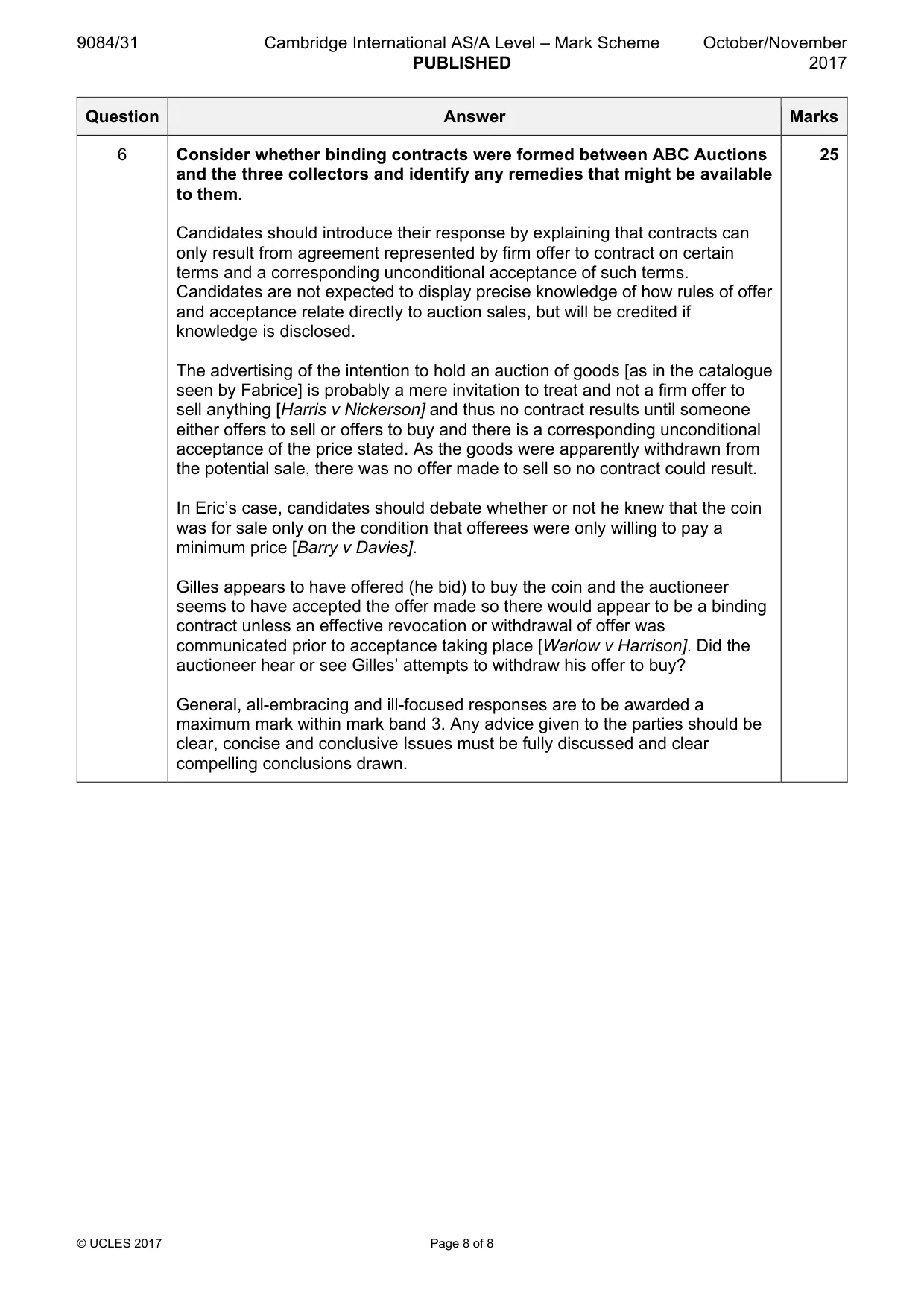
9084/31 Cambridge International AS/A Level – Mark Scheme PUBLISHED October/November 2017 © UCLES 2017 Page 8 of 8 Question Answer Marks 6 Consider whether binding contracts were formed between ABC Auctions and the three collectors and identify any remedies that might be available to them. Candidates should introduce their response by explaining that contracts can only result from agreement represented by firm offer to contract on certain terms and a corresponding unconditional acceptance of such terms. Candidates are not expected to display precise knowledge of how rules of offer and acceptance relate directly to auction sales, but will be credited if knowledge is disclosed. The advertising of the intention to hold an auction of goods [as in the catalogue seen by Fabrice] is probably a mere invitation to treat and not a firm offer to sell anything [Harris v Nickerson] and thus no contract results until someone either offers to sell or offers to buy and there is a corresponding unconditional acceptance of the price stated. As the goods were apparently withdrawn from the potential sale, there was no offer made to sell so no contract could result. In Eric’s case, candidates should debate whether or not he knew that the coin was for sale only on the condition that offerees were only willing to pay a minimum price [Barry v Davies]. Gilles appears to have offered (he bid) to buy the coin and the auctioneer seems to have accepted the offer made so there would appear to be a binding contract unless an effective revocation or withdrawal of offer was communicated prior to acceptance taking place [Warlow v Harrison]. Did the auctioneer hear or see Gilles’ attempts to withdraw his offer to buy? General, all-embracing and ill-focused responses are to be awarded a maximum mark within mark band 3. Any advice given to the parties should be clear, concise and conclusive Issues must be fully discussed and clear compelling conclusions drawn. 25
What you needed in this session
Cambridge’s own grade thresholds for 2017 Oct/Nov, Paper 3 · Variant 1. A higher threshold means an easier paper — the bar moves with how the cohort did.