Cambridge A Level Law 9084 — 2016 Oct/Nov Paper 3 · Variant 1
9084/31/O/N/16
The question paper and its mark scheme, free to read here and free to download. This is Cambridge’s own paper, exactly as it was sat.
Question paper4 pages
Mark scheme6 pages
Answers below. Sit the paper first if you are practising.
Paper as text
Question paper, page 1
This document consists of 3 printed pages, 1 blank page and 1 insert. DC (RW) 117608/2 © UCLES 2016 [Turn over Cambridge International Examinations Cambridge International Advanced Subsidiary and Advanced Level * 9 3 5 8 5 1 5 7 1 2 * LAW 9084/31 Paper 3 Law of Contract October/November 2016 1 hour 30 minutes No Additional Materials are required. READ THESE INSTRUCTIONS FIRST An answer booklet is provided inside this question paper. You should follow the instructions on the front cover of the answer booklet. If you need additional answer paper ask the invigilator for a continuation booklet. Answer one question from Section A, one from Section B and one other, thus making a total of three responses required. The number of marks is given in brackets [ ] at the end of each question or part question.
Question paper, page 2
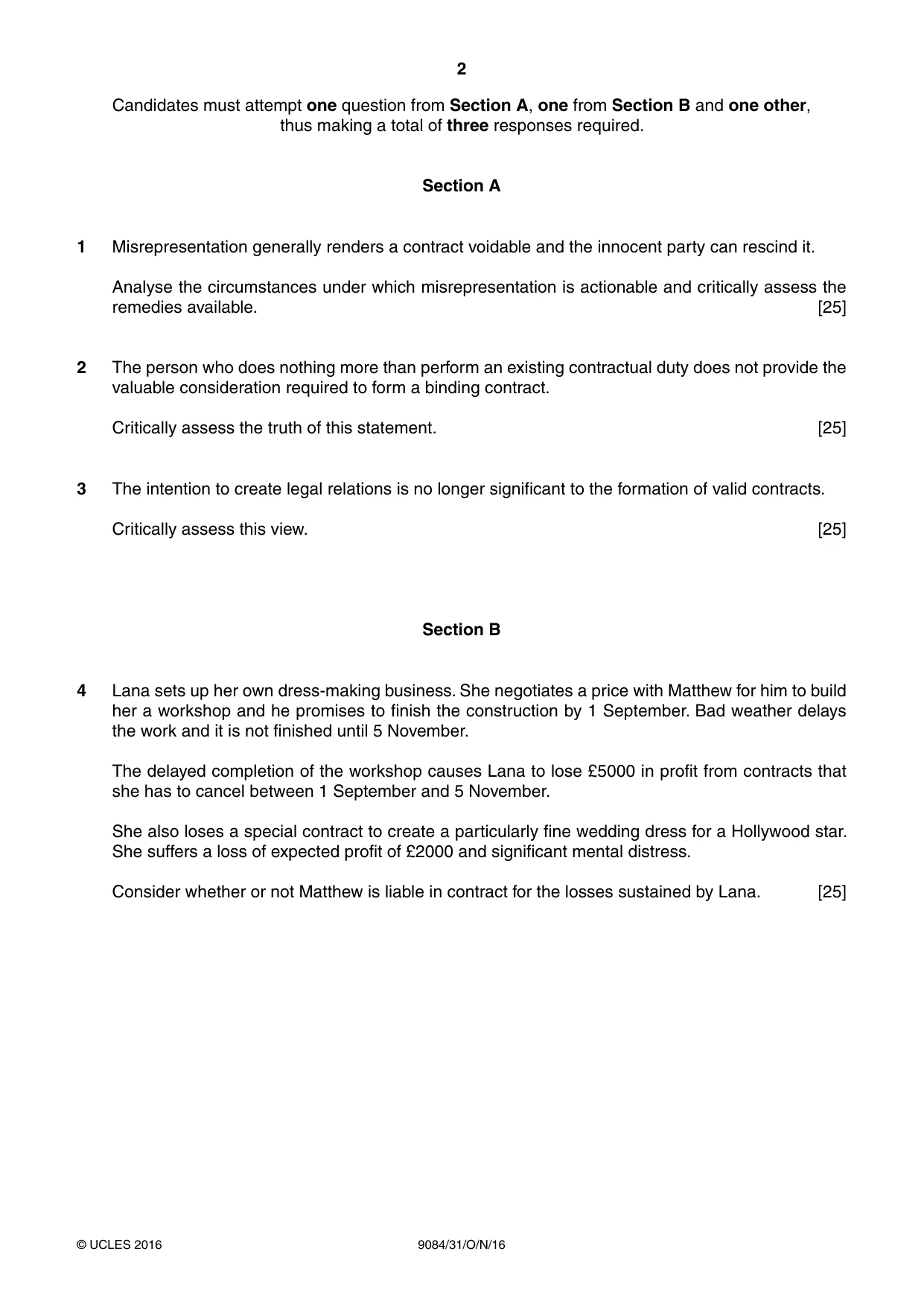
2 9084/31/O/N/16 © UCLES 2016 Candidates must attempt one question from Section A, one from Section B and one other, thus making a total of three responses required. Section A 1 Misrepresentation generally renders a contract voidable and the innocent party can rescind it. Analyse the circumstances under which misrepresentation is actionable and critically assess the remedies available. [25] 2 The person who does nothing more than perform an existing contractual duty does not provide the valuable consideration required to form a binding contract. Critically assess the truth of this statement. [25] 3 The intention to create legal relations is no longer significant to the formation of valid contracts. Critically assess this view. [25] Section B 4 Lana sets up her own dress-making business. She negotiates a price with Matthew for him to build her a workshop and he promises to finish the construction by 1 September. Bad weather delays the work and it is not finished until 5 November. The delayed completion of the workshop causes Lana to lose £5000 in profit from contracts that she has to cancel between 1 September and 5 November. She also loses a special contract to create a particularly fine wedding dress for a Hollywood star. She suffers a loss of expected profit of £2000 and significant mental distress. Consider whether or not Matthew is liable in contract for the losses sustained by Lana. [25]
Question paper, page 3
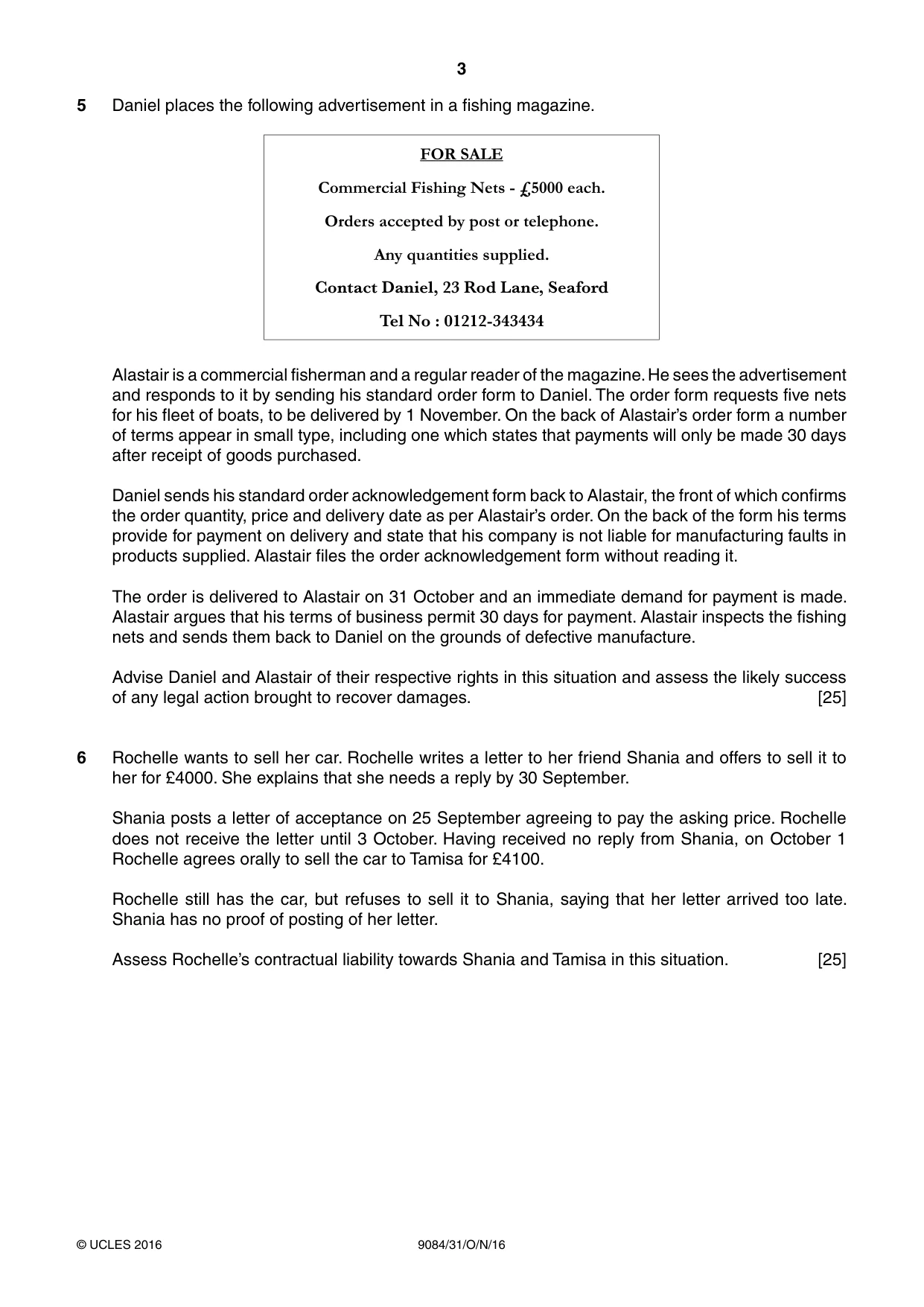
3 9084/31/O/N/16 © UCLES 2016 5 Daniel places the following advertisement in a fishing magazine. FOR SALE Commercial Fishing Nets - £5000 each. Orders accepted by post or telephone. Any quantities supplied. Contact Daniel, 23 Rod Lane, Seaford Tel No : 01212-343434 Alastair is a commercial fisherman and a regular reader of the magazine. He sees the advertisement and responds to it by sending his standard order form to Daniel. The order form requests five nets for his fleet of boats, to be delivered by 1 November. On the back of Alastair’s order form a number of terms appear in small type, including one which states that payments will only be made 30 days after receipt of goods purchased. Daniel sends his standard order acknowledgement form back to Alastair, the front of which confirms the order quantity, price and delivery date as per Alastair’s order. On the back of the form his terms provide for payment on delivery and state that his company is not liable for manufacturing faults in products supplied. Alastair files the order acknowledgement form without reading it. The order is delivered to Alastair on 31 October and an immediate demand for payment is made. Alastair argues that his terms of business permit 30 days for payment. Alastair inspects the fishing nets and sends them back to Daniel on the grounds of defective manufacture. Advise Daniel and Alastair of their respective rights in this situation and assess the likely success of any legal action brought to recover damages. [25] 6 Rochelle wants to sell her car. Rochelle writes a letter to her friend Shania and offers to sell it to her for £4000. She explains that she needs a reply by 30 September. Shania posts a letter of acceptance on 25 September agreeing to pay the asking price. Rochelle does not receive the letter until 3 October. Having received no reply from Shania, on October 1 Rochelle agrees orally to sell the car to Tamisa for £4100. Rochelle still has the car, but refuses to sell it to Shania, saying that her letter arrived too late. Shania has no proof of posting of her letter. Assess Rochelle’s contractual liability towards Shania and Tamisa in this situation. [25]
Question paper, page 4
4 9084/31/O/N/16 © UCLES 2016 BLANK PAGE Permission to reproduce items where third-party owned material protected by copyright is included has been sought and cleared where possible. Every reasonable effort has been made by the publisher (UCLES) to trace copyright holders, but if any items requiring clearance have unwittingly been included, the publisher will be pleased to make amends at the earliest possible opportunity. To avoid the issue of disclosure of answer-related information to candidates, all copyright acknowledgements are reproduced online in the Cambridge International Examinations Copyright Acknowledgements Booklet. This is produced for each series of examinations and is freely available to download at www.cie.org.uk after the live examination series. Cambridge International Examinations is part of the Cambridge Assessment Group. Cambridge Assessment is the brand name of University of Cambridge Local Examinations Syndicate (UCLES), which is itself a department of the University of Cambridge.
Mark scheme, page 1
® IGCSE is the registered trademark of Cambridge International Examinations. This document consists of 6 printed pages. © UCLES 2016 [Turn over Cambridge International Examinations Cambridge International Advanced Subsidiary and Advanced Level LAW 9084/31 Paper 3 October/November 2016 MARK SCHEME Maximum Mark: 75 Published This mark scheme is published as an aid to teachers and candidates, to indicate the requirements of the examination. It shows the basis on which Examiners were instructed to award marks. It does not indicate the details of the discussions that took place at an Examiners’ meeting before marking began, which would have considered the acceptability of alternative answers. Mark schemes should be read in conjunction with the question paper and the Principal Examiner Report for Teachers. Cambridge will not enter into discussions about these mark schemes. Cambridge is publishing the mark schemes for the October/November 2016 series for most Cambridge IGCSE®, Cambridge International A and AS Level components and some Cambridge O Level components.
Mark scheme, page 2
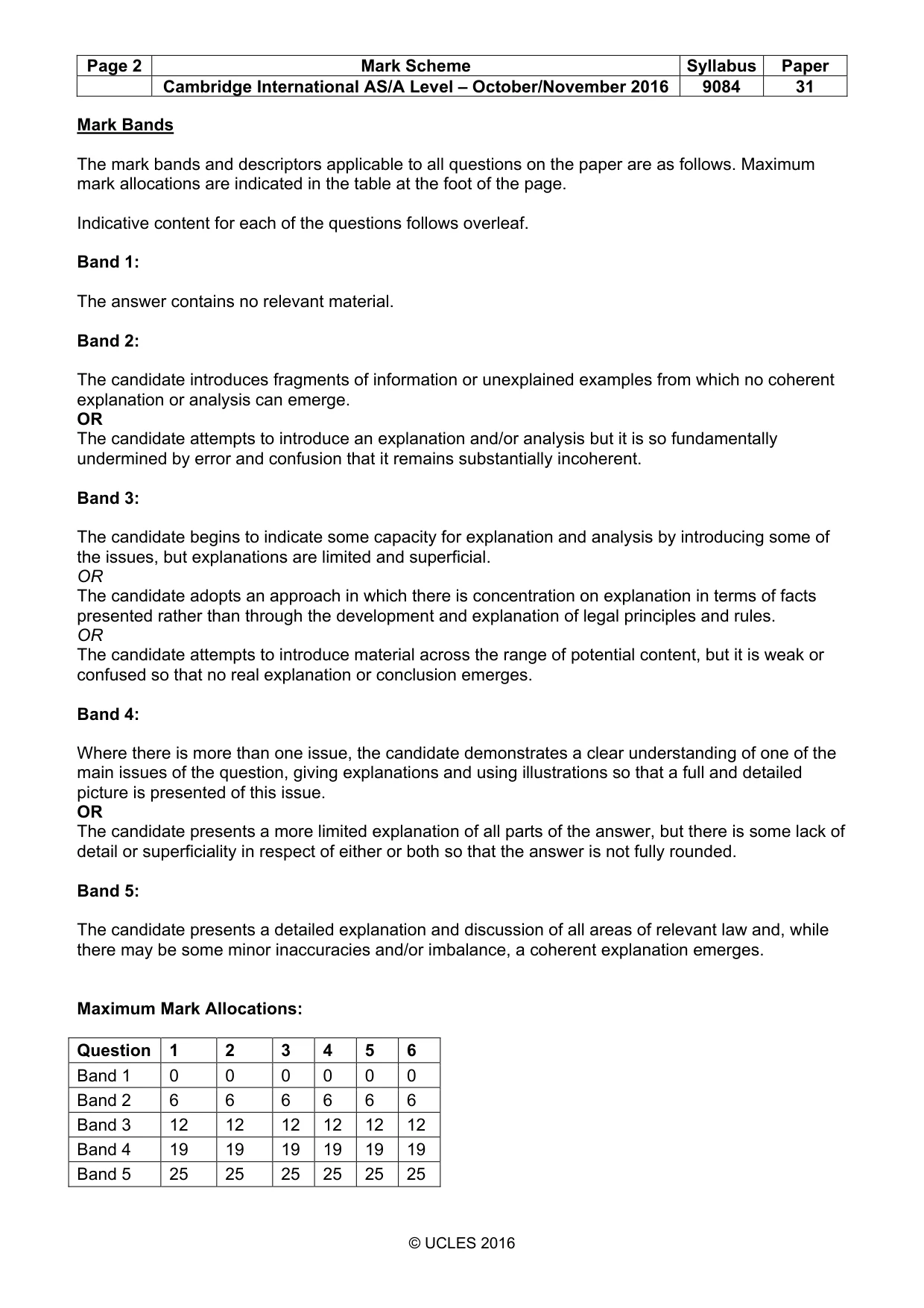
Page 2 Mark Scheme Syllabus Paper Cambridge International AS/A Level – October/November 2016 9084 31 © UCLES 2016 Mark Bands The mark bands and descriptors applicable to all questions on the paper are as follows. Maximum mark allocations are indicated in the table at the foot of the page. Indicative content for each of the questions follows overleaf. Band 1: The answer contains no relevant material. Band 2: The candidate introduces fragments of information or unexplained examples from which no coherent explanation or analysis can emerge. OR The candidate attempts to introduce an explanation and/or analysis but it is so fundamentally undermined by error and confusion that it remains substantially incoherent. Band 3: The candidate begins to indicate some capacity for explanation and analysis by introducing some of the issues, but explanations are limited and superficial. OR The candidate adopts an approach in which there is concentration on explanation in terms of facts presented rather than through the development and explanation of legal principles and rules. OR The candidate attempts to introduce material across the range of potential content, but it is weak or confused so that no real explanation or conclusion emerges. Band 4: Where there is more than one issue, the candidate demonstrates a clear understanding of one of the main issues of the question, giving explanations and using illustrations so that a full and detailed picture is presented of this issue. OR The candidate presents a more limited explanation of all parts of the answer, but there is some lack of detail or superficiality in respect of either or both so that the answer is not fully rounded. Band 5: The candidate presents a detailed explanation and discussion of all areas of relevant law and, while there may be some minor inaccuracies and/or imbalance, a coherent explanation emerges. Maximum Mark Allocations: Question 1 2 3 4 5 6 Band 1 0 0 0 0 0 0 Band 2 6 6 6 6 6 6 Band 3 12 12 12 12 12 12 Band 4 19 19 19 19 19 19 Band 5 25 25 25 25 25 25
Mark scheme, page 3
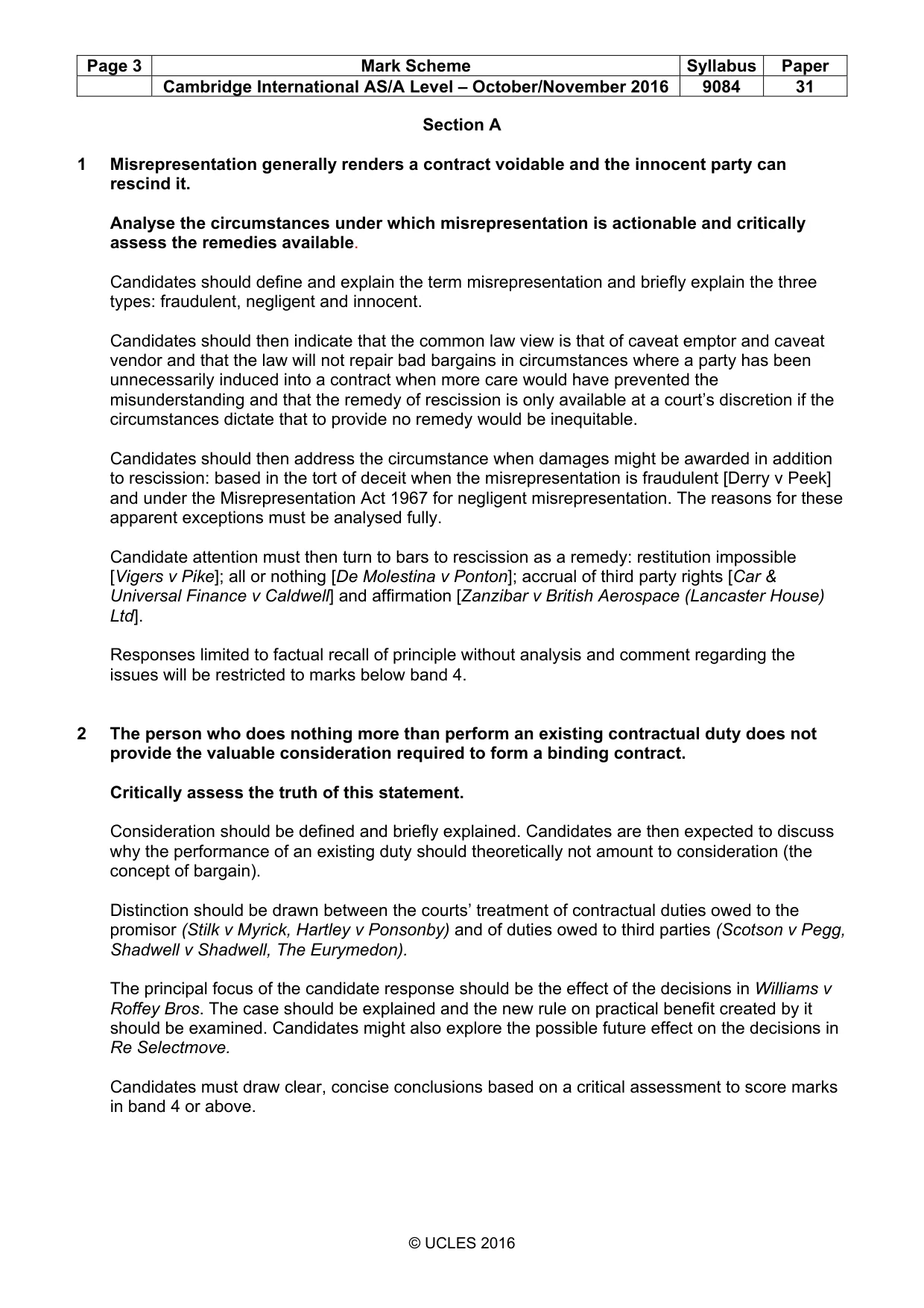
Page 3 Mark Scheme Syllabus Paper Cambridge International AS/A Level – October/November 2016 9084 31 © UCLES 2016 Section A 1 Misrepresentation generally renders a contract voidable and the innocent party can rescind it. Analyse the circumstances under which misrepresentation is actionable and critically assess the remedies available. Candidates should define and explain the term misrepresentation and briefly explain the three types: fraudulent, negligent and innocent. Candidates should then indicate that the common law view is that of caveat emptor and caveat vendor and that the law will not repair bad bargains in circumstances where a party has been unnecessarily induced into a contract when more care would have prevented the misunderstanding and that the remedy of rescission is only available at a court’s discretion if the circumstances dictate that to provide no remedy would be inequitable. Candidates should then address the circumstance when damages might be awarded in addition to rescission: based in the tort of deceit when the misrepresentation is fraudulent [Derry v Peek] and under the Misrepresentation Act 1967 for negligent misrepresentation. The reasons for these apparent exceptions must be analysed fully. Candidate attention must then turn to bars to rescission as a remedy: restitution impossible [Vigers v Pike]; all or nothing [De Molestina v Ponton]; accrual of third party rights [Car & Universal Finance v Caldwell] and affirmation [Zanzibar v British Aerospace (Lancaster House) Ltd]. Responses limited to factual recall of principle without analysis and comment regarding the issues will be restricted to marks below band 4. 2 The person who does nothing more than perform an existing contractual duty does not provide the valuable consideration required to form a binding contract. Critically assess the truth of this statement. Consideration should be defined and briefly explained. Candidates are then expected to discuss why the performance of an existing duty should theoretically not amount to consideration (the concept of bargain). Distinction should be drawn between the courts’ treatment of contractual duties owed to the promisor (Stilk v Myrick, Hartley v Ponsonby) and of duties owed to third parties (Scotson v Pegg, Shadwell v Shadwell, The Eurymedon). The principal focus of the candidate response should be the effect of the decisions in Williams v Roffey Bros. The case should be explained and the new rule on practical benefit created by it should be examined. Candidates might also explore the possible future effect on the decisions in Re Selectmove. Candidates must draw clear, concise conclusions based on a critical assessment to score marks in band 4 or above.
Mark scheme, page 4
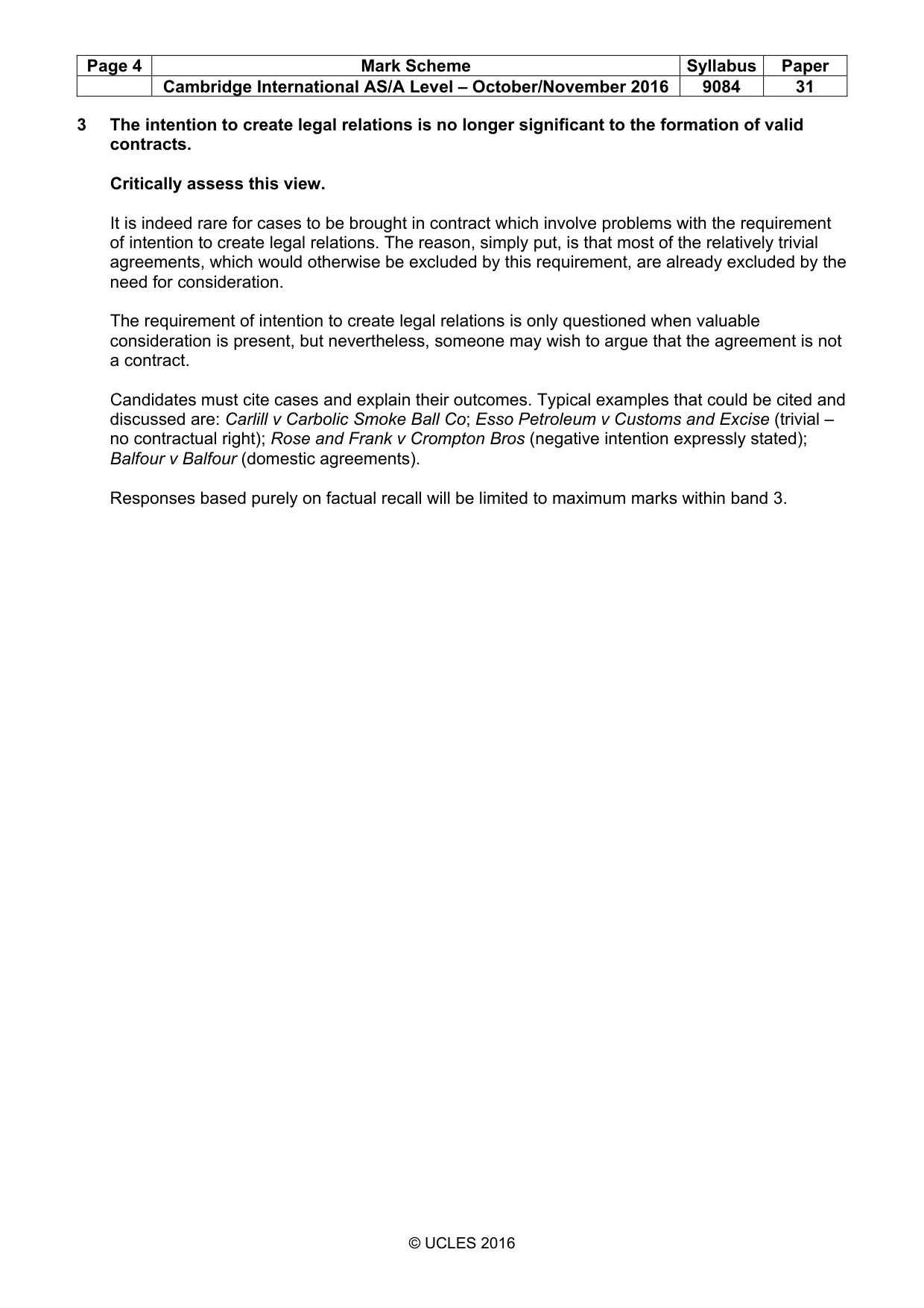
Page 4 Mark Scheme Syllabus Paper Cambridge International AS/A Level – October/November 2016 9084 31 © UCLES 2016 3 The intention to create legal relations is no longer significant to the formation of valid contracts. Critically assess this view. It is indeed rare for cases to be brought in contract which involve problems with the requirement of intention to create legal relations. The reason, simply put, is that most of the relatively trivial agreements, which would otherwise be excluded by this requirement, are already excluded by the need for consideration. The requirement of intention to create legal relations is only questioned when valuable consideration is present, but nevertheless, someone may wish to argue that the agreement is not a contract. Candidates must cite cases and explain their outcomes. Typical examples that could be cited and discussed are: Carlill v Carbolic Smoke Ball Co; Esso Petroleum v Customs and Excise (trivial – no contractual right); Rose and Frank v Crompton Bros (negative intention expressly stated); Balfour v Balfour (domestic agreements). Responses based purely on factual recall will be limited to maximum marks within band 3.
Mark scheme, page 5
Page 5 Mark Scheme Syllabus Paper Cambridge International AS/A Level – October/November 2016 9084 31 © UCLES 2016 Section B 4 Consider whether or not Matthew is liable in contract for the losses sustained by Lana. The focus of this question should be the issues of causation and remoteness of damage and mitigation, even if candidates do introduce terms and the issue of whether a breach of contract actually occurred. Assuming that terms had been communicated and that Matthew was indeed in breach, the main issue is the extent to which Matthew might be held liable for the consequential losses sustained by Lana. Candidates should identify damages as the principal remedy for breach of contract and explain that their aim is to compensate for losses that result from not receiving the performance that was bargained for. The general rule is that, subject to certain limitations, innocent parties are entitled to such damages as will put them in the position that they would have been in had the contract been performed. The issue here would seem to revolve around whether any of the limitations would be applicable to the facts of this case or whether Matthew would simply be liable for the losses that Lana has allegedly sustained. Was Matthew’s breach the cause of Lana’s losses? On the face of it, it would appear that they were as there was no obvious intervening act to break the chain of causation (County Ltd v Girozentrale Securities). Were Lana’s losses too remote from their cause to be recoverable? Were they reasonably foreseeable consequences of the breach (Hadley v Baxendale; The Heron II) or were they losses arising from special circumstances that could not have been foreseen (Victoria Laundry (Windsor) Ltd v Newman Industries Ltd)? Did Lana do all that she could do to mitigate the effects of the breach (Brace v Calder)? Two of the losses sustained were pecuniary ones and provided that the above tests are satisfied, compensation should be granted. However it would seem likely that any claim for the mental distress that she has suffered would not be compensated as it is a commercial contract (Addis v Gramaphone Co Ltd). Informed debate followed by clear, compelling conclusions is expected. Generalised responses, lacking focus on the question, are to be awarded a maximum mark within band 3.
Mark scheme, page 6
Page 6 Mark Scheme Syllabus Paper Cambridge International AS/A Level – October/November 2016 9084 31 © UCLES 2016 5 Advise Daniel and Alastair of their respective rights in this situation and assess the likely success of any legal action brought to recover damages. Candidates should identify the key issue in this question as contract negotiation and the ‘battle of the forms’. Candidates should recognize that when negotiation of a contract becomes protracted, it can become more problematic to identify exactly when an offer has been made and unequivocally accepted. In such cases, the courts look at the entire course of negotiation to decide whether has ever been reached and, if so, when. Candidates should recognize that in ‘battles of the forms’ it is a general rule that the ‘last shot’ wins the battle. The first form is counted as the offer and each subsequent form is a counter offer, such that when one party performs its obligations – delivering the commercial fishing nets in this case – it is seen as acceptance of terms specified on the final form to change hands (e.g. British Road Services v Arthur V. Crutchley & Co Ltd, Butler Machine Tool Ltd v Ex-Cell-O Corp (England) Ltd). If the court was to follow the last shot approach, clearly the goods were supplied on the basis of Daniel’s terms contained in the order acknowledgement. The question then arises as to the validity of the exclusion clause printed on the back. Candidates need to refer to UCTA 1977 and draw conclusions. Knowledge and application of the Consumer Rights Act 2015 will be credited, but is not yet expected. Generalised responses, lacking focus on the question, are to be awarded a maximum mark within mark band 3. Any advice given to the parties should be clear, concise and conclusive. 6 Assess Rochelle’s contractual liability towards Shania and Tamisa in this situation. An outline of the essentials of a valid contract may serve as an introduction; emphasis is expected on the formation of contract and the rules relating to the communication of firm offers, to what amounts to unconditional acceptance and to the communication of acceptance. Binding contracts require definite offer and corresponding, unconditional acceptance. There was an apparent firm offer to sell made to Shania which she purported to accept by post. But was post the proper means of acceptance? If not – effective upon receipt. If yes, then the posting rule applies –properly stamped and addressed and posted in the proper manner: was it and is there any evidence? Candidates to consider the effect of compliance and non-compliance with the rule. Discussion should be case law referenced (e.g. Henthorn v Fraser, Household Fire Insurance v Grant, Byrne v Van Tienhoven etc.) The issues must be discussed fully and clearly and compelling conclusions must be drawn. Responses limited to factual recall of principle will be restricted to marks below band 4.