Cambridge A Level Law 9084 — 2024 May/June Paper 4 · Variant 2
9084/42/M/J/24 · 75 marks · ≈84 min
The question paper and its mark scheme, free to read here and free to download. This is Cambridge’s own paper, exactly as it was sat.
Question paper4 pages

Mark scheme14 pages
Answers below. Sit the paper first if you are practising.
Paper as text
Question paper, page 1
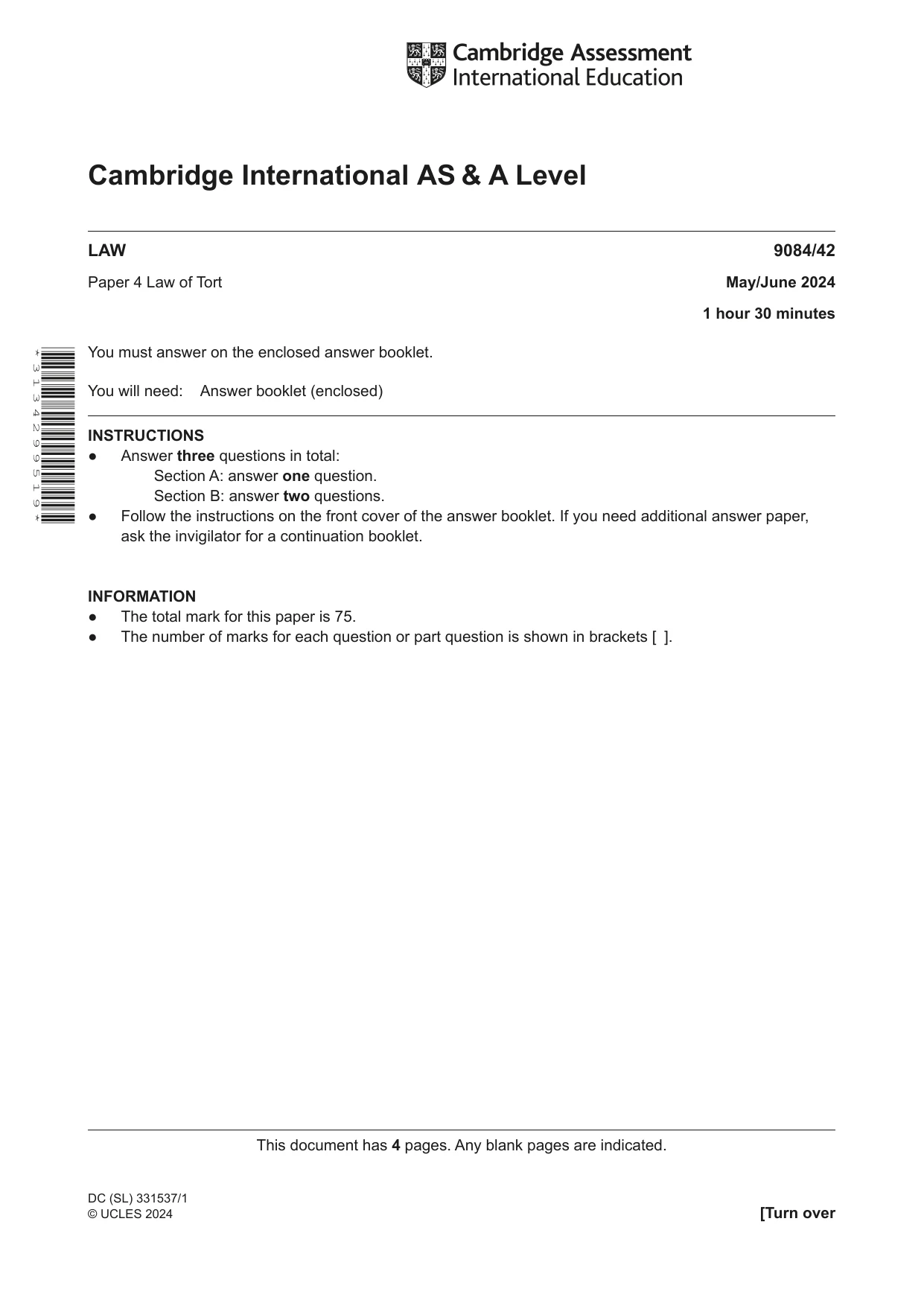
This document has 4 pages. Any blank pages are indicated. [Turn over Cambridge International AS & A Level LAW 9084/42 Paper 4 Law of Tort May/June 2024 1 hour 30 minutes You must answer on the enclosed answer booklet. You will need: Answer booklet (enclosed) INSTRUCTIONS ● Answer three questions in total: Section A: answer one question. Section B: answer two questions. ● Follow the instructions on the front cover of the answer booklet. If you need additional answer paper, ask the invigilator for a continuation booklet. INFORMATION ● The total mark for this paper is 75. ● The number of marks for each question or part question is shown in brackets [ ]. * 3 1 3 4 2 9 9 5 1 9 * DC (SL) 331537/1 © UCLES 2024
Question paper, page 2
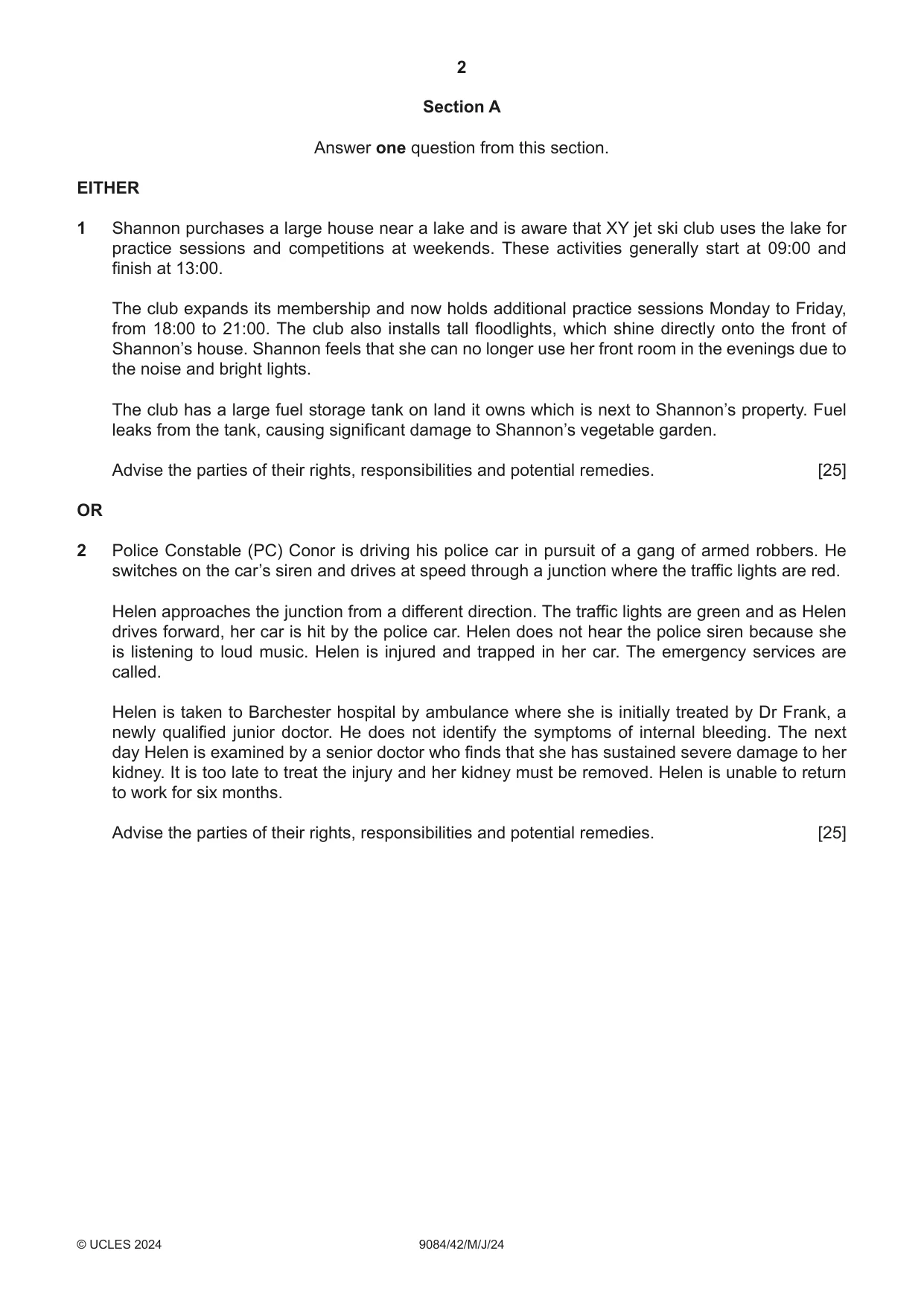
2 9084/42/M/J/24 © UCLES 2024 Section A Answer one question from this section. EITHER 1 Shannon purchases a large house near a lake and is aware that XY jet ski club uses the lake for practice sessions and competitions at weekends. These activities generally start at 09:00 and finish at 13:00. The club expands its membership and now holds additional practice sessions Monday to Friday, from 18:00 to 21:00. The club also installs tall floodlights, which shine directly onto the front of Shannon’s house. Shannon feels that she can no longer use her front room in the evenings due to the noise and bright lights. The club has a large fuel storage tank on land it owns which is next to Shannon’s property. Fuel leaks from the tank, causing significant damage to Shannon’s vegetable garden. Advise the parties of their rights, responsibilities and potential remedies. [25] OR 2 Police Constable (PC) Conor is driving his police car in pursuit of a gang of armed robbers. He switches on the car’s siren and drives at speed through a junction where the traffic lights are red. Helen approaches the junction from a different direction. The traffic lights are green and as Helen drives forward, her car is hit by the police car. Helen does not hear the police siren because she is listening to loud music. Helen is injured and trapped in her car. The emergency services are called. Helen is taken to Barchester hospital by ambulance where she is initially treated by Dr Frank, a newly qualified junior doctor. He does not identify the symptoms of internal bleeding. The next day Helen is examined by a senior doctor who finds that she has sustained severe damage to her kidney. It is too late to treat the injury and her kidney must be removed. Helen is unable to return to work for six months. Advise the parties of their rights, responsibilities and potential remedies. [25]
Question paper, page 3
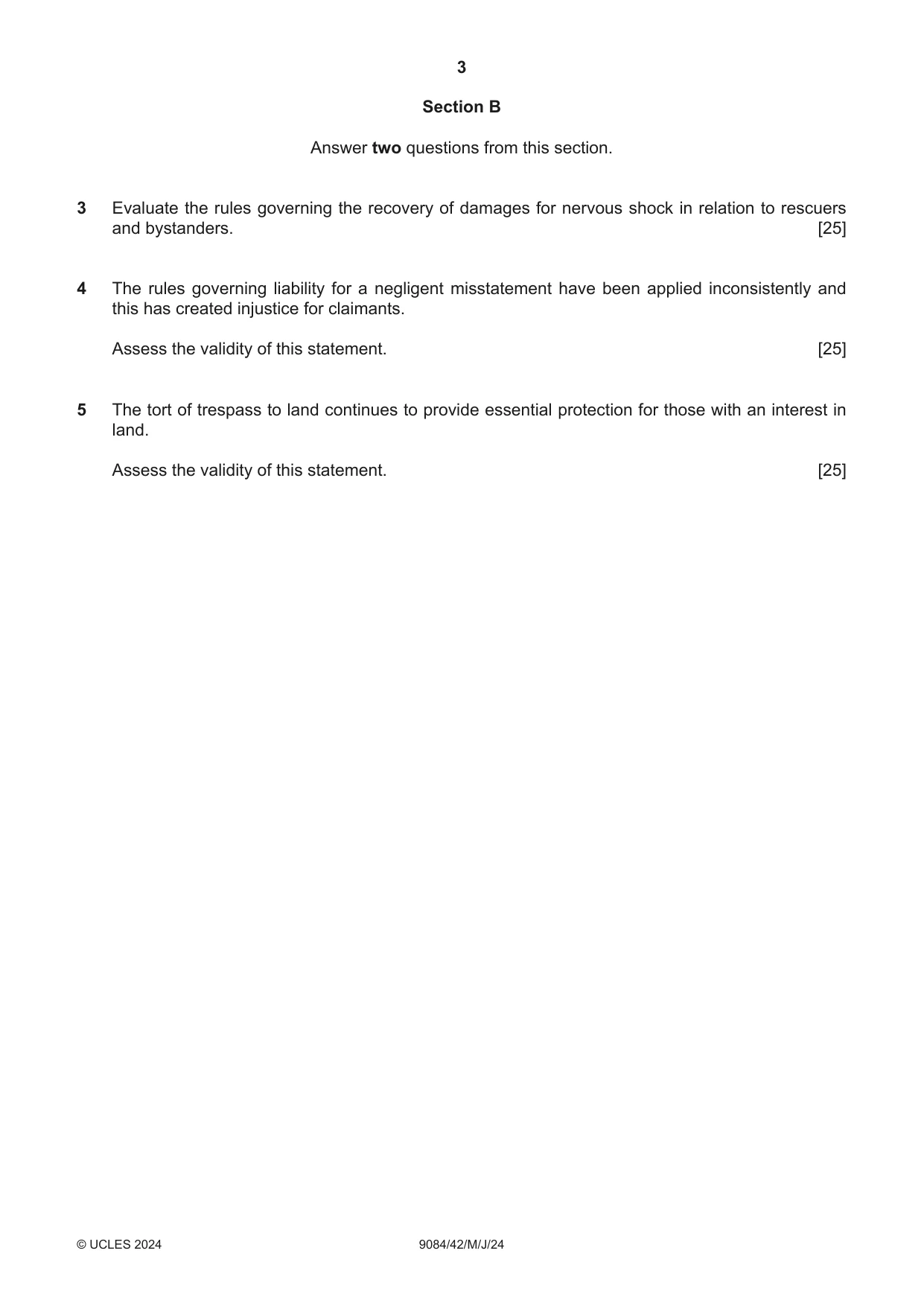
3 9084/42/M/J/24 © UCLES 2024 Section B Answer two questions from this section. 3 Evaluate the rules governing the recovery of damages for nervous shock in relation to rescuers and bystanders. [25] 4 The rules governing liability for a negligent misstatement have been applied inconsistently and this has created injustice for claimants. Assess the validity of this statement. [25] 5 The tort of trespass to land continues to provide essential protection for those with an interest in land. Assess the validity of this statement. [25]
Question paper, page 4
4 9084/42/M/J/24 © UCLES 2024 Permission to reproduce items where third-party owned material protected by copyright is included has been sought and cleared where possible. Every reasonable effort has been made by the publisher (UCLES) to trace copyright holders, but if any items requiring clearance have unwittingly been included, the publisher will be pleased to make amends at the earliest possible opportunity. To avoid the issue of disclosure of answer-related information to candidates, all copyright acknowledgements are reproduced online in the Cambridge Assessment International Education Copyright Acknowledgements Booklet. This is produced for each series of examinations and is freely available to download at www.cambridgeinternational.org after the live examination series. Cambridge Assessment International Education is part of Cambridge Assessment. Cambridge Assessment is the brand name of the University of Cambridge Local Examinations Syndicate (UCLES), which is a department of the University of Cambridge. BLANK PAGE
Mark scheme, page 1
This document consists of 14 printed pages. © Cambridge University Press & Assessment 2024 [Turn over Cambridge International AS & A Level LAW 9084/42 Paper 4 May/June 2024 MARK SCHEME Maximum Mark: 75 Published This mark scheme is published as an aid to teachers and candidates, to indicate the requirements of the examination. It shows the basis on which Examiners were instructed to award marks. It does not indicate the details of the discussions that took place at an Examiners’ meeting before marking began, which would have considered the acceptability of alternative answers. Mark schemes should be read in conjunction with the question paper and the Principal Examiner Report for Teachers. Cambridge International will not enter into discussions about these mark schemes. Cambridge International is publishing the mark schemes for the May/June 2024 series for most Cambridge IGCSE, Cambridge International A and AS Level and Cambridge Pre-U components, and some Cambridge O Level components.
Mark scheme, page 2
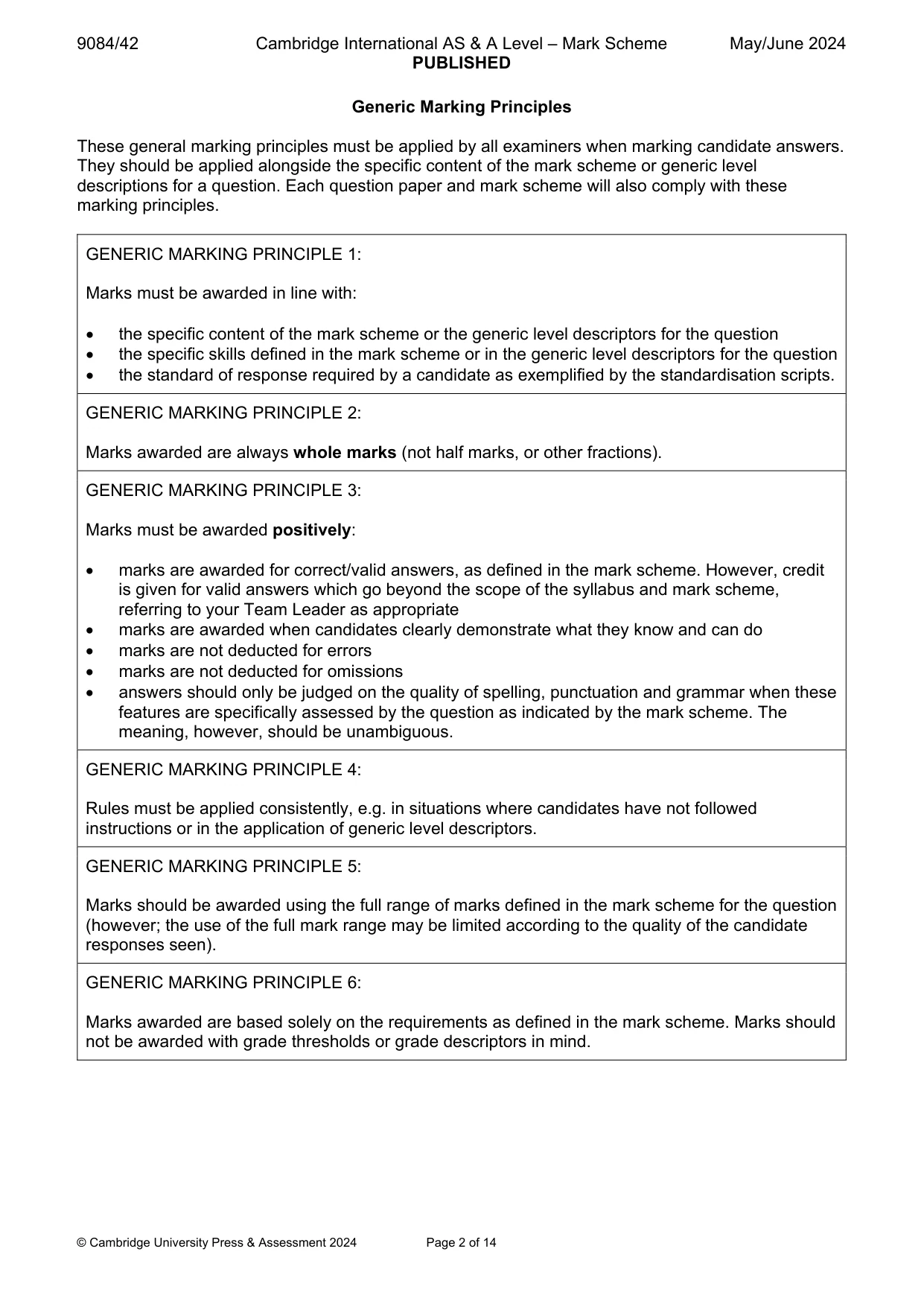
9084/42 Cambridge International AS & A Level – Mark Scheme PUBLISHED May/June 2024 © Cambridge University Press & Assessment 2024 Page 2 of 14 Generic Marking Principles These general marking principles must be applied by all examiners when marking candidate answers. They should be applied alongside the specific content of the mark scheme or generic level descriptions for a question. Each question paper and mark scheme will also comply with these marking principles. GENERIC MARKING PRINCIPLE 1: Marks must be awarded in line with: the specific content of the mark scheme or the generic level descriptors for the question the specific skills defined in the mark scheme or in the generic level descriptors for the question the standard of response required by a candidate as exemplified by the standardisation scripts. GENERIC MARKING PRINCIPLE 2: Marks awarded are always whole marks (not half marks, or other fractions). GENERIC MARKING PRINCIPLE 3: Marks must be awarded positively: marks are awarded for correct/valid answers, as defined in the mark scheme. However, credit is given for valid answers which go beyond the scope of the syllabus and mark scheme, referring to your Team Leader as appropriate marks are awarded when candidates clearly demonstrate what they know and can do marks are not deducted for errors marks are not deducted for omissions answers should only be judged on the quality of spelling, punctuation and grammar when these features are specifically assessed by the question as indicated by the mark scheme. The meaning, however, should be unambiguous. GENERIC MARKING PRINCIPLE 4: Rules must be applied consistently, e.g. in situations where candidates have not followed instructions or in the application of generic level descriptors. GENERIC MARKING PRINCIPLE 5: Marks should be awarded using the full range of marks defined in the mark scheme for the question (however; the use of the full mark range may be limited according to the quality of the candidate responses seen). GENERIC MARKING PRINCIPLE 6: Marks awarded are based solely on the requirements as defined in the mark scheme. Marks should not be awarded with grade thresholds or grade descriptors in mind.
Mark scheme, page 3
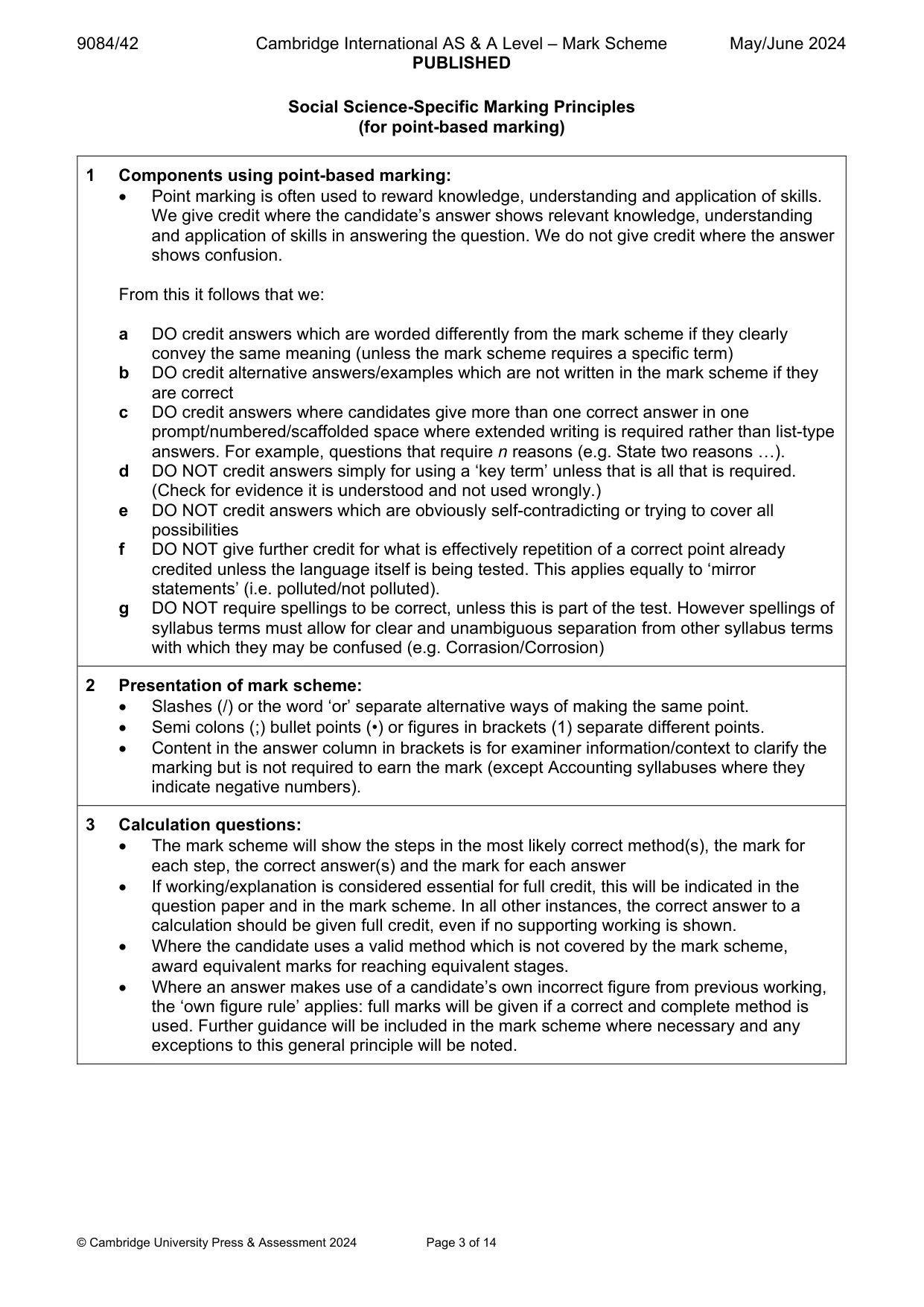
9084/42 Cambridge International AS & A Level – Mark Scheme PUBLISHED May/June 2024 © Cambridge University Press & Assessment 2024 Page 3 of 14 Social Science-Specific Marking Principles (for point-based marking) 1 Components using point-based marking: Point marking is often used to reward knowledge, understanding and application of skills. We give credit where the candidate’s answer shows relevant knowledge, understanding and application of skills in answering the question. We do not give credit where the answer shows confusion. From this it follows that we: a DO credit answers which are worded differently from the mark scheme if they clearly convey the same meaning (unless the mark scheme requires a specific term) b DO credit alternative answers/examples which are not written in the mark scheme if they are correct c DO credit answers where candidates give more than one correct answer in one prompt/numbered/scaffolded space where extended writing is required rather than list-type answers. For example, questions that require n reasons (e.g. State two reasons …). d DO NOT credit answers simply for using a ‘key term’ unless that is all that is required. (Check for evidence it is understood and not used wrongly.) e DO NOT credit answers which are obviously self-contradicting or trying to cover all possibilities f DO NOT give further credit for what is effectively repetition of a correct point already credited unless the language itself is being tested. This applies equally to ‘mirror statements’ (i.e. polluted/not polluted). g DO NOT require spellings to be correct, unless this is part of the test. However spellings of syllabus terms must allow for clear and unambiguous separation from other syllabus terms with which they may be confused (e.g. Corrasion/Corrosion) 2 Presentation of mark scheme: Slashes (/) or the word ‘or’ separate alternative ways of making the same point. Semi colons (;) bullet points (•) or figures in brackets (1) separate different points. Content in the answer column in brackets is for examiner information/context to clarify the marking but is not required to earn the mark (except Accounting syllabuses where they indicate negative numbers). 3 Calculation questions: The mark scheme will show the steps in the most likely correct method(s), the mark for each step, the correct answer(s) and the mark for each answer If working/explanation is considered essential for full credit, this will be indicated in the question paper and in the mark scheme. In all other instances, the correct answer to a calculation should be given full credit, even if no supporting working is shown. Where the candidate uses a valid method which is not covered by the mark scheme, award equivalent marks for reaching equivalent stages. Where an answer makes use of a candidate’s own incorrect figure from previous working, the ‘own figure rule’ applies: full marks will be given if a correct and complete method is used. Further guidance will be included in the mark scheme where necessary and any exceptions to this general principle will be noted.
Mark scheme, page 4
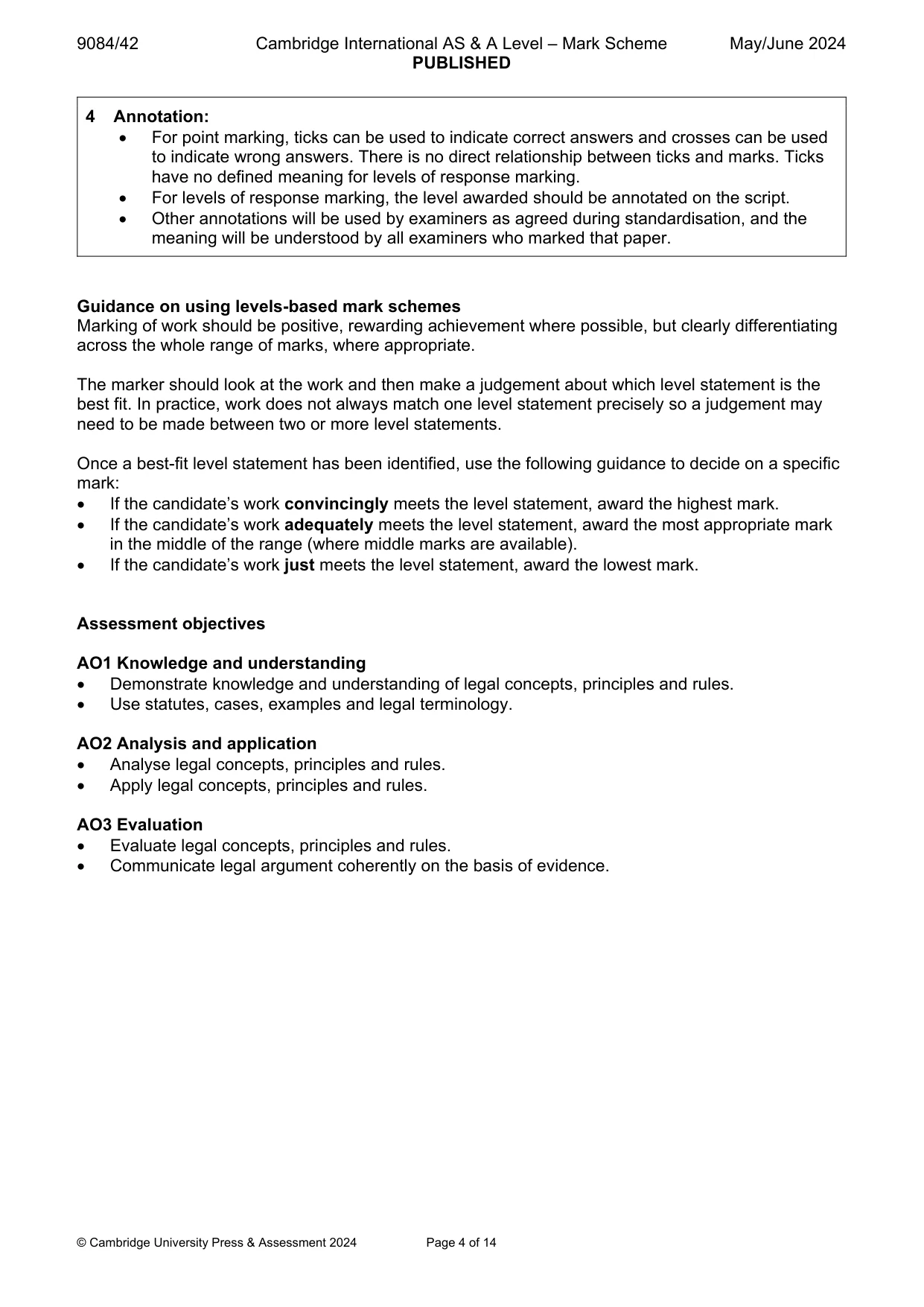
9084/42 Cambridge International AS & A Level – Mark Scheme PUBLISHED May/June 2024 © Cambridge University Press & Assessment 2024 Page 4 of 14 4 Annotation: For point marking, ticks can be used to indicate correct answers and crosses can be used to indicate wrong answers. There is no direct relationship between ticks and marks. Ticks have no defined meaning for levels of response marking. For levels of response marking, the level awarded should be annotated on the script. Other annotations will be used by examiners as agreed during standardisation, and the meaning will be understood by all examiners who marked that paper. Guidance on using levels-based mark schemes Marking of work should be positive, rewarding achievement where possible, but clearly differentiating across the whole range of marks, where appropriate. The marker should look at the work and then make a judgement about which level statement is the best fit. In practice, work does not always match one level statement precisely so a judgement may need to be made between two or more level statements. Once a best-fit level statement has been identified, use the following guidance to decide on a specific mark: If the candidate’s work convincingly meets the level statement, award the highest mark. If the candidate’s work adequately meets the level statement, award the most appropriate mark in the middle of the range (where middle marks are available). If the candidate’s work just meets the level statement, award the lowest mark. Assessment objectives AO1 Knowledge and understanding Demonstrate knowledge and understanding of legal concepts, principles and rules. Use statutes, cases, examples and legal terminology. AO2 Analysis and application Analyse legal concepts, principles and rules. Apply legal concepts, principles and rules. AO3 Evaluation Evaluate legal concepts, principles and rules. Communicate legal argument coherently on the basis of evidence.
Mark scheme, page 5
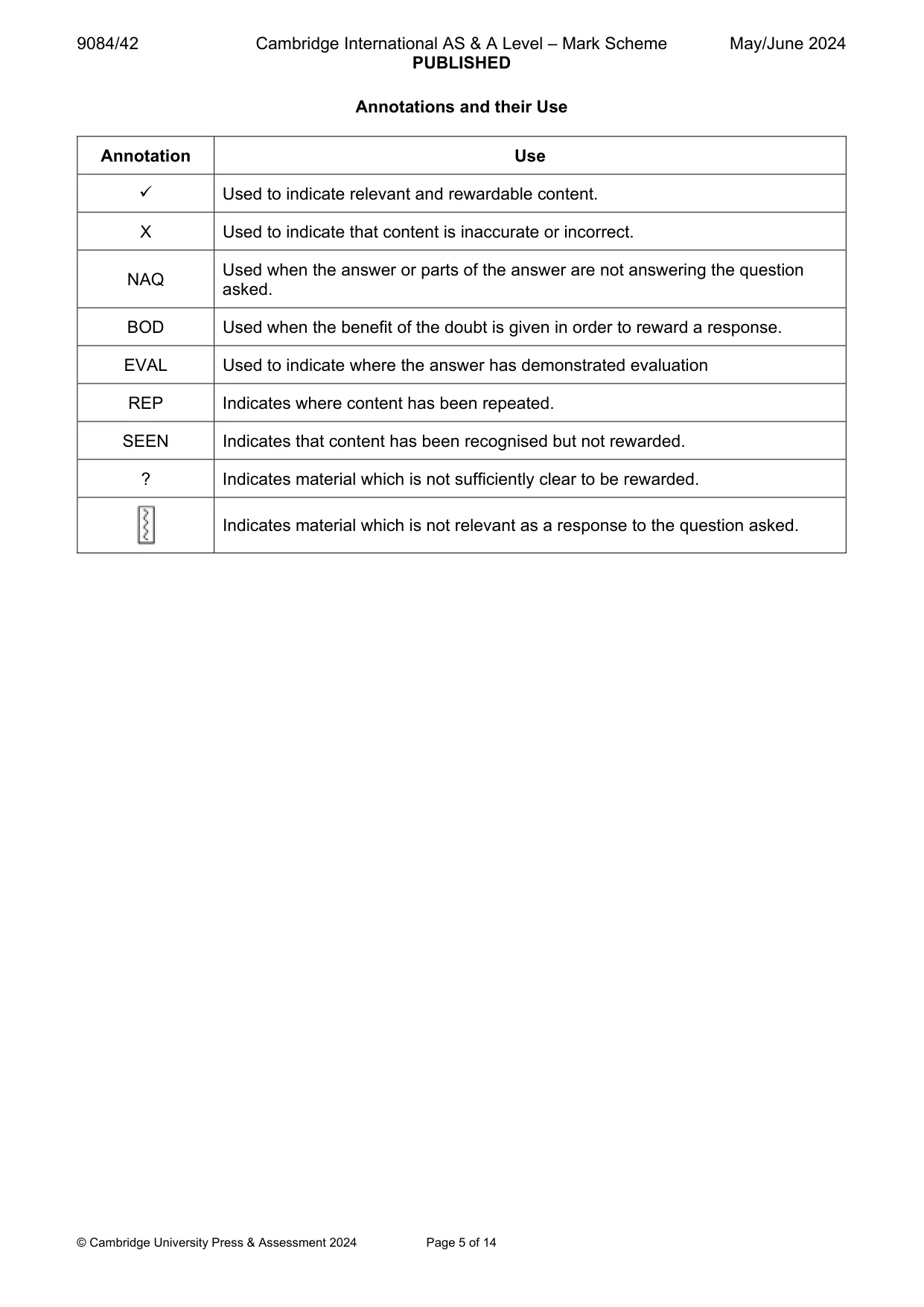
9084/42 Cambridge International AS & A Level – Mark Scheme PUBLISHED May/June 2024 © Cambridge University Press & Assessment 2024 Page 5 of 14 Annotations and their Use Annotation Use Used to indicate relevant and rewardable content. X Used to indicate that content is inaccurate or incorrect. NAQ Used when the answer or parts of the answer are not answering the question asked. BOD Used when the benefit of the doubt is given in order to reward a response. EVAL Used to indicate where the answer has demonstrated evaluation REP Indicates where content has been repeated. SEEN Indicates that content has been recognised but not rewarded. ? Indicates material which is not sufficiently clear to be rewarded. Indicates material which is not relevant as a response to the question asked.
Mark scheme, page 6
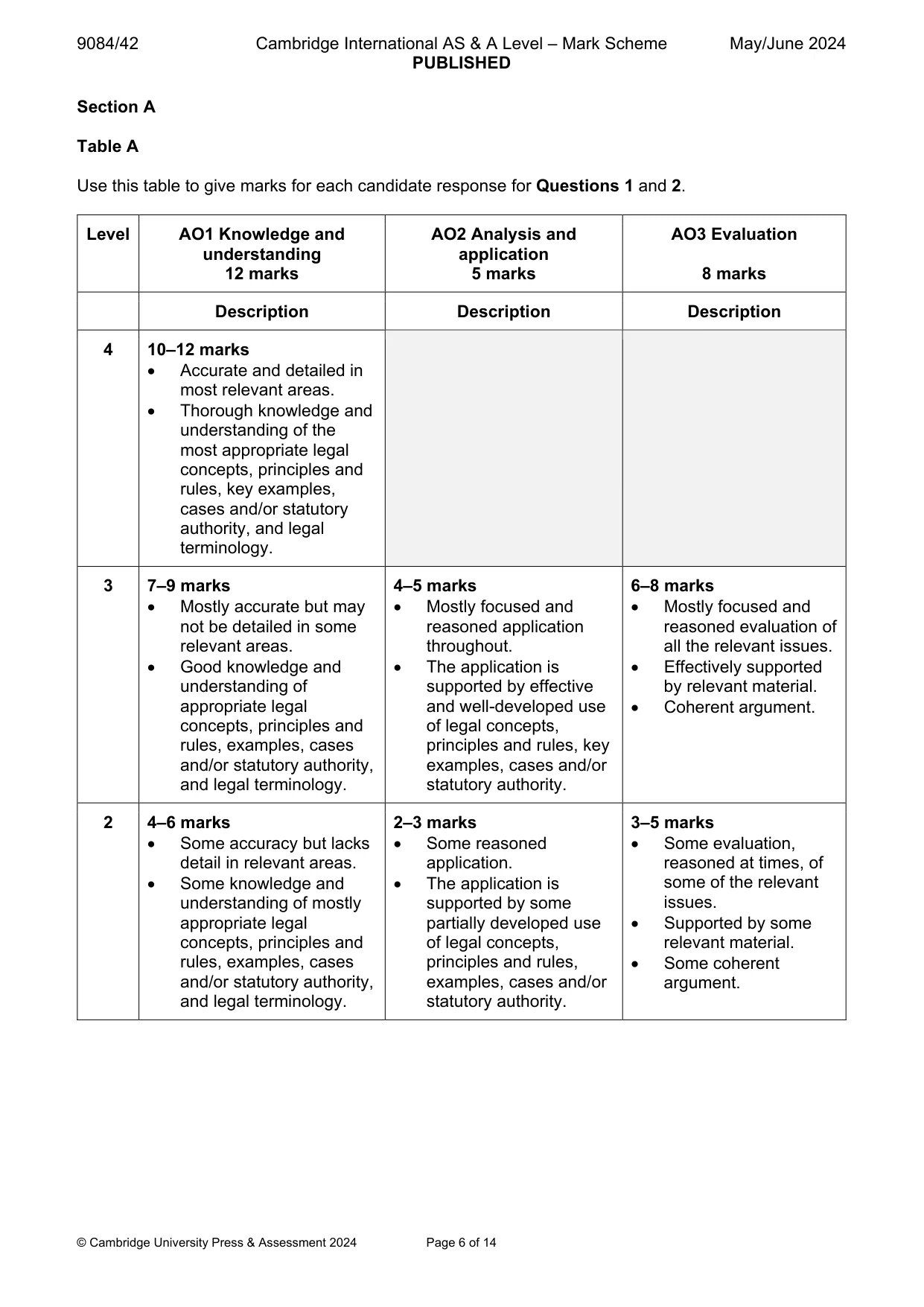
9084/42 Cambridge International AS & A Level – Mark Scheme PUBLISHED May/June 2024 © Cambridge University Press & Assessment 2024 Page 6 of 14 Section A Table A Use this table to give marks for each candidate response for Questions 1 and 2. Level AO1 Knowledge and understanding 12 marks AO2 Analysis and application 5 marks AO3 Evaluation 8 marks Description Description Description 4 10–12 marks Accurate and detailed in most relevant areas. Thorough knowledge and understanding of the most appropriate legal concepts, principles and rules, key examples, cases and/or statutory authority, and legal terminology. 3 7–9 marks Mostly accurate but may not be detailed in some relevant areas. Good knowledge and understanding of appropriate legal concepts, principles and rules, examples, cases and/or statutory authority, and legal terminology. 4–5 marks Mostly focused and reasoned application throughout. The application is supported by effective and well-developed use of legal concepts, principles and rules, key examples, cases and/or statutory authority. 6–8 marks Mostly focused and reasoned evaluation of all the relevant issues. Effectively supported by relevant material. Coherent argument. 2 4–6 marks Some accuracy but lacks detail in relevant areas. Some knowledge and understanding of mostly appropriate legal concepts, principles and rules, examples, cases and/or statutory authority, and legal terminology. 2–3 marks Some reasoned application. The application is supported by some partially developed use of legal concepts, principles and rules, examples, cases and/or statutory authority. 3–5 marks Some evaluation, reasoned at times, of some of the relevant issues. Supported by some relevant material. Some coherent argument.
Mark scheme, page 7
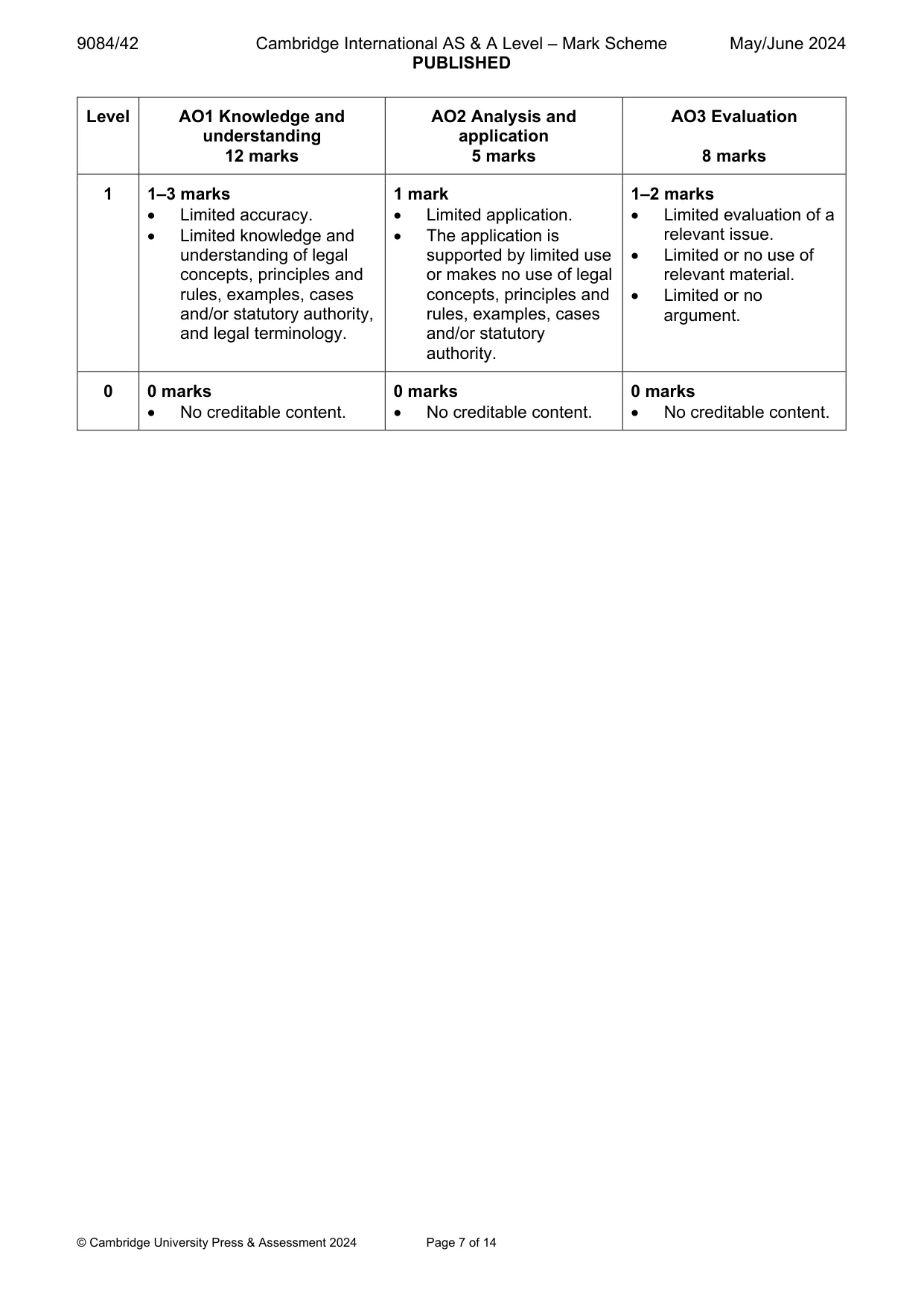
9084/42 Cambridge International AS & A Level – Mark Scheme PUBLISHED May/June 2024 © Cambridge University Press & Assessment 2024 Page 7 of 14 Level AO1 Knowledge and understanding 12 marks AO2 Analysis and application 5 marks AO3 Evaluation 8 marks 1 1–3 marks Limited accuracy. Limited knowledge and understanding of legal concepts, principles and rules, examples, cases and/or statutory authority, and legal terminology. 1 mark Limited application. The application is supported by limited use or makes no use of legal concepts, principles and rules, examples, cases and/or statutory authority. 1–2 marks Limited evaluation of a relevant issue. Limited or no use of relevant material. Limited or no argument. 0 0 marks No creditable content. 0 marks No creditable content. 0 marks No creditable content.
Mark scheme, page 8
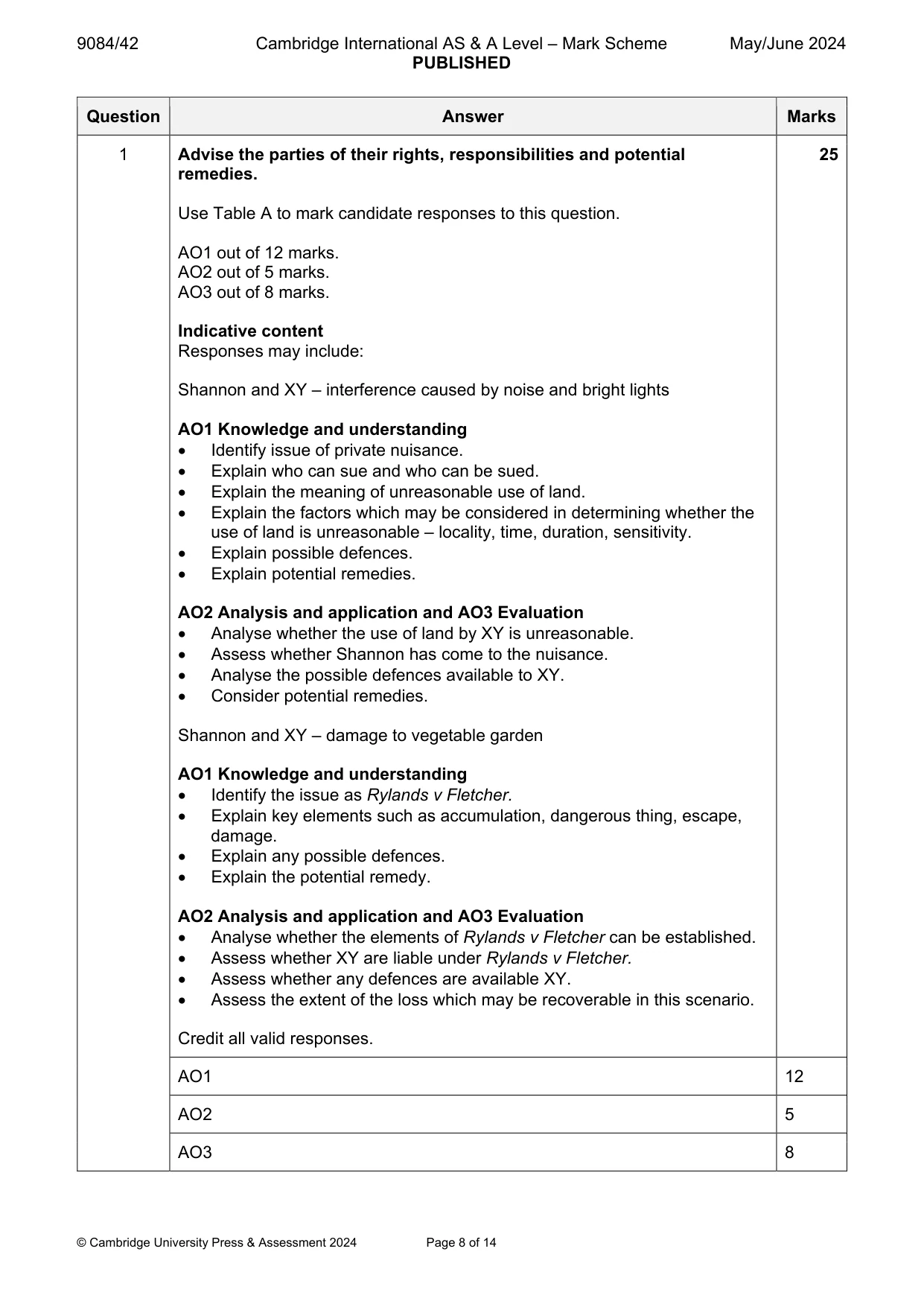
9084/42 Cambridge International AS & A Level – Mark Scheme PUBLISHED May/June 2024 © Cambridge University Press & Assessment 2024 Page 8 of 14 Question Answer Marks 1 Advise the parties of their rights, responsibilities and potential remedies. Use Table A to mark candidate responses to this question. AO1 out of 12 marks. AO2 out of 5 marks. AO3 out of 8 marks. Indicative content Responses may include: Shannon and XY – interference caused by noise and bright lights AO1 Knowledge and understanding Identify issue of private nuisance. Explain who can sue and who can be sued. Explain the meaning of unreasonable use of land. Explain the factors which may be considered in determining whether the use of land is unreasonable – locality, time, duration, sensitivity. Explain possible defences. Explain potential remedies. AO2 Analysis and application and AO3 Evaluation Analyse whether the use of land by XY is unreasonable. Assess whether Shannon has come to the nuisance. Analyse the possible defences available to XY. Consider potential remedies. Shannon and XY – damage to vegetable garden AO1 Knowledge and understanding Identify the issue as Rylands v Fletcher. Explain key elements such as accumulation, dangerous thing, escape, damage. Explain any possible defences. Explain the potential remedy. AO2 Analysis and application and AO3 Evaluation Analyse whether the elements of Rylands v Fletcher can be established. Assess whether XY are liable under Rylands v Fletcher. Assess whether any defences are available XY. Assess the extent of the loss which may be recoverable in this scenario. Credit all valid responses. 25 AO1 12 AO2 5 AO3 8
Mark scheme, page 9
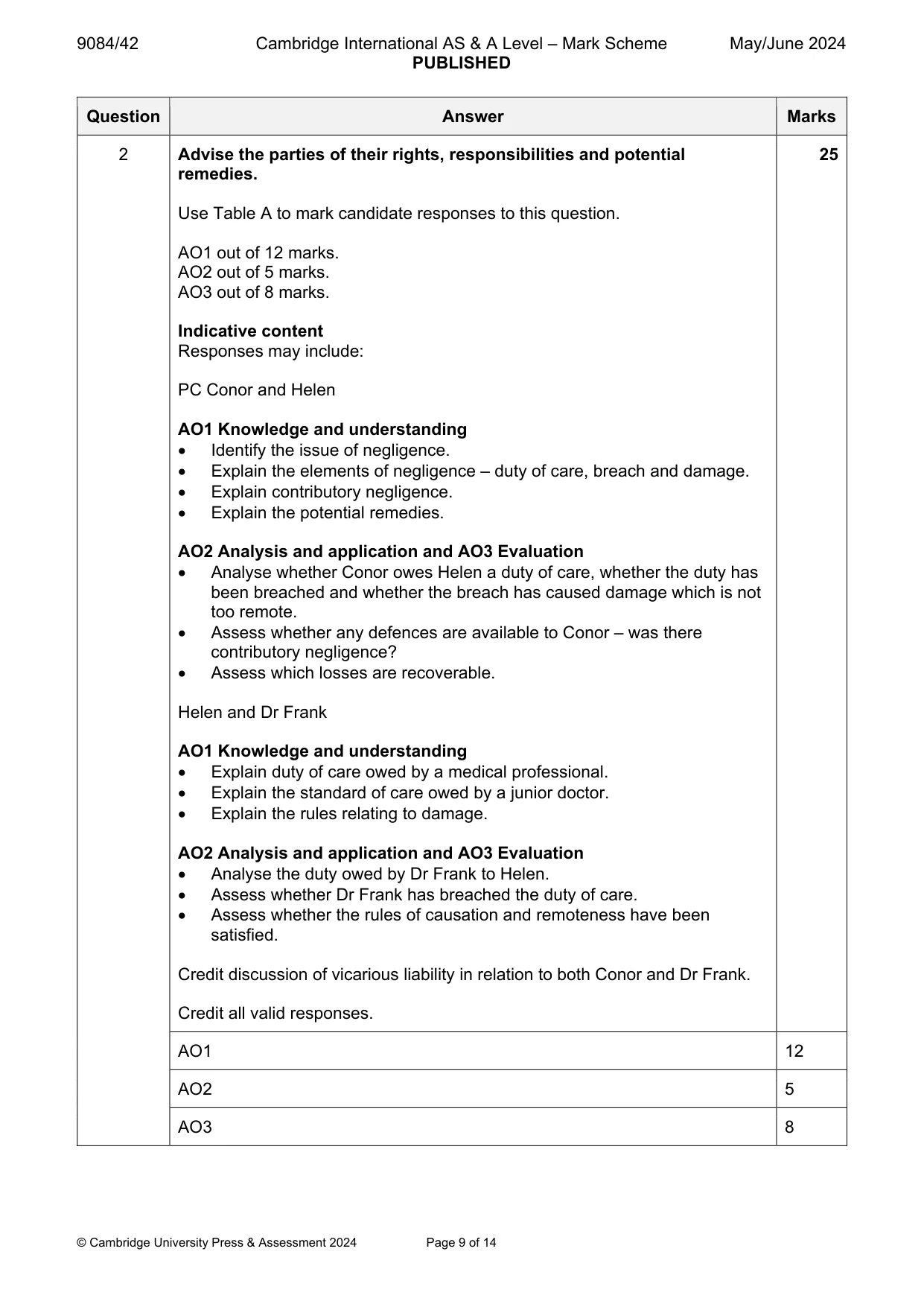
9084/42 Cambridge International AS & A Level – Mark Scheme PUBLISHED May/June 2024 © Cambridge University Press & Assessment 2024 Page 9 of 14 Question Answer Marks 2 Advise the parties of their rights, responsibilities and potential remedies. Use Table A to mark candidate responses to this question. AO1 out of 12 marks. AO2 out of 5 marks. AO3 out of 8 marks. Indicative content Responses may include: PC Conor and Helen AO1 Knowledge and understanding Identify the issue of negligence. Explain the elements of negligence – duty of care, breach and damage. Explain contributory negligence. Explain the potential remedies. AO2 Analysis and application and AO3 Evaluation Analyse whether Conor owes Helen a duty of care, whether the duty has been breached and whether the breach has caused damage which is not too remote. Assess whether any defences are available to Conor – was there contributory negligence? Assess which losses are recoverable. Helen and Dr Frank AO1 Knowledge and understanding Explain duty of care owed by a medical professional. Explain the standard of care owed by a junior doctor. Explain the rules relating to damage. AO2 Analysis and application and AO3 Evaluation Analyse the duty owed by Dr Frank to Helen. Assess whether Dr Frank has breached the duty of care. Assess whether the rules of causation and remoteness have been satisfied. Credit discussion of vicarious liability in relation to both Conor and Dr Frank. Credit all valid responses. 25 AO1 12 AO2 5 AO3 8
Mark scheme, page 10
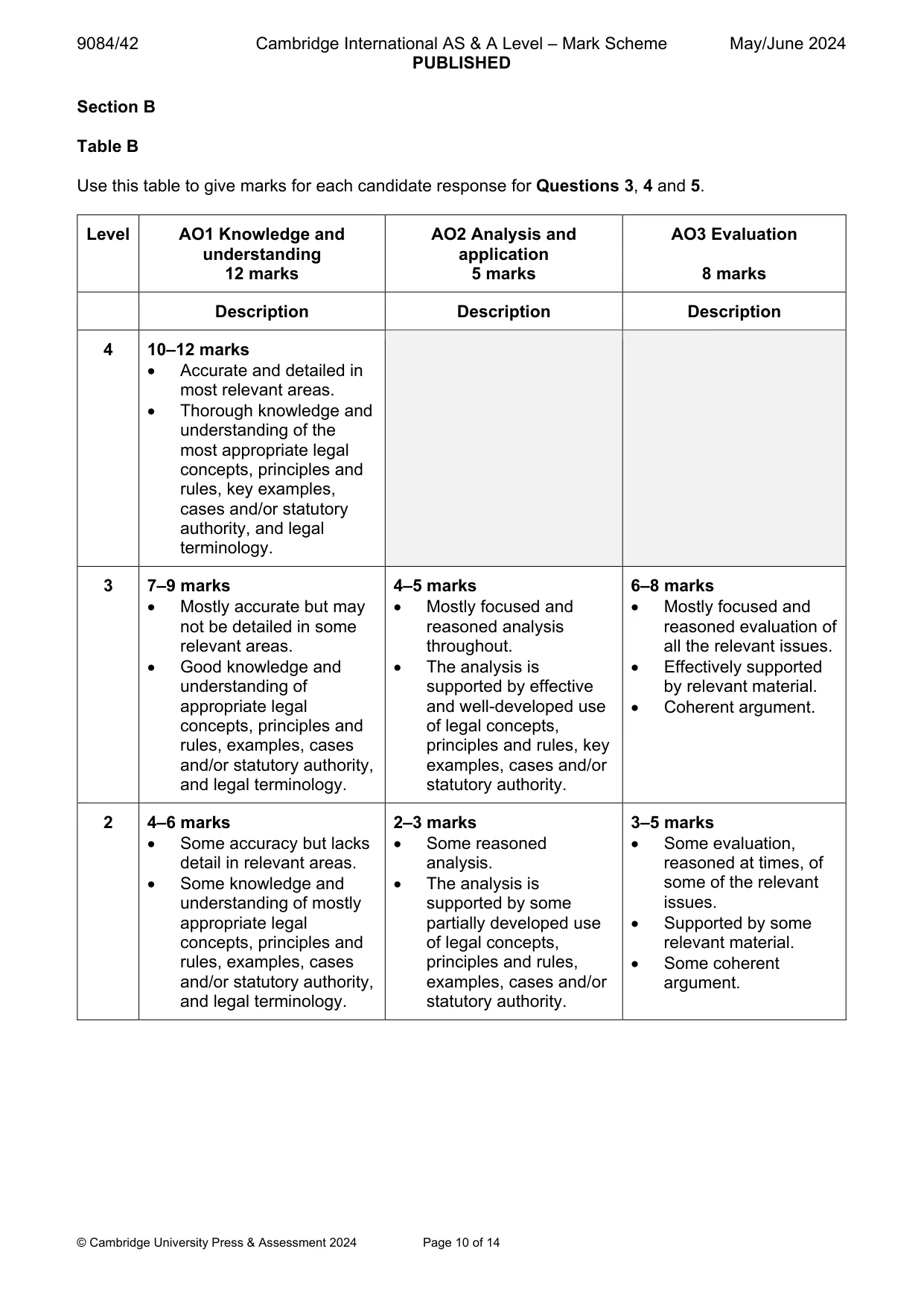
9084/42 Cambridge International AS & A Level – Mark Scheme PUBLISHED May/June 2024 © Cambridge University Press & Assessment 2024 Page 10 of 14 Section B Table B Use this table to give marks for each candidate response for Questions 3, 4 and 5. Level AO1 Knowledge and understanding 12 marks AO2 Analysis and application 5 marks AO3 Evaluation 8 marks Description Description Description 4 10–12 marks Accurate and detailed in most relevant areas. Thorough knowledge and understanding of the most appropriate legal concepts, principles and rules, key examples, cases and/or statutory authority, and legal terminology. 3 7–9 marks Mostly accurate but may not be detailed in some relevant areas. Good knowledge and understanding of appropriate legal concepts, principles and rules, examples, cases and/or statutory authority, and legal terminology. 4–5 marks Mostly focused and reasoned analysis throughout. The analysis is supported by effective and well-developed use of legal concepts, principles and rules, key examples, cases and/or statutory authority. 6–8 marks Mostly focused and reasoned evaluation of all the relevant issues. Effectively supported by relevant material. Coherent argument. 2 4–6 marks Some accuracy but lacks detail in relevant areas. Some knowledge and understanding of mostly appropriate legal concepts, principles and rules, examples, cases and/or statutory authority, and legal terminology. 2–3 marks Some reasoned analysis. The analysis is supported by some partially developed use of legal concepts, principles and rules, examples, cases and/or statutory authority. 3–5 marks Some evaluation, reasoned at times, of some of the relevant issues. Supported by some relevant material. Some coherent argument.
Mark scheme, page 11
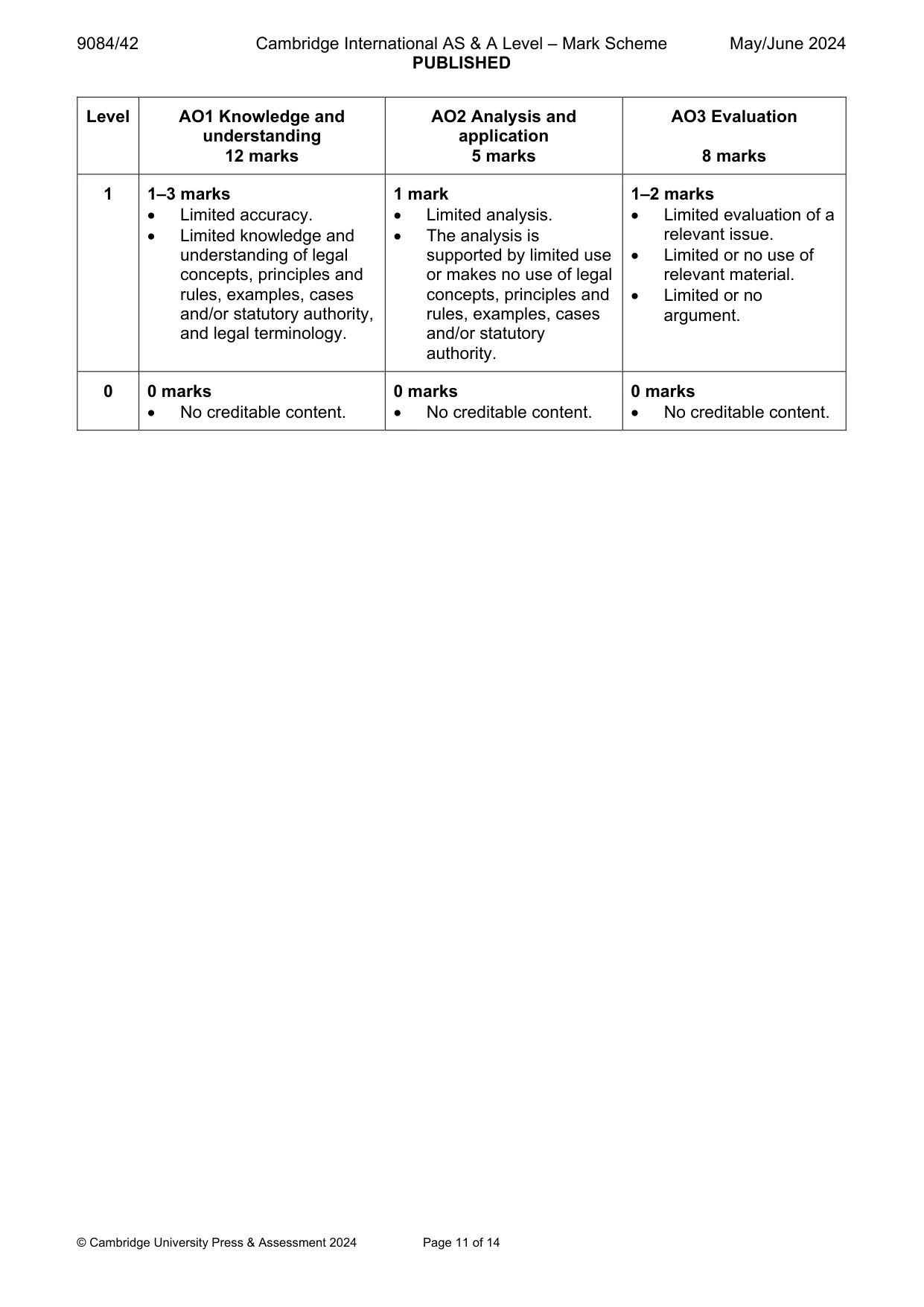
9084/42 Cambridge International AS & A Level – Mark Scheme PUBLISHED May/June 2024 © Cambridge University Press & Assessment 2024 Page 11 of 14 Level AO1 Knowledge and understanding 12 marks AO2 Analysis and application 5 marks AO3 Evaluation 8 marks 1 1–3 marks Limited accuracy. Limited knowledge and understanding of legal concepts, principles and rules, examples, cases and/or statutory authority, and legal terminology. 1 mark Limited analysis. The analysis is supported by limited use or makes no use of legal concepts, principles and rules, examples, cases and/or statutory authority. 1–2 marks Limited evaluation of a relevant issue. Limited or no use of relevant material. Limited or no argument. 0 0 marks No creditable content. 0 marks No creditable content. 0 marks No creditable content.
Mark scheme, page 12
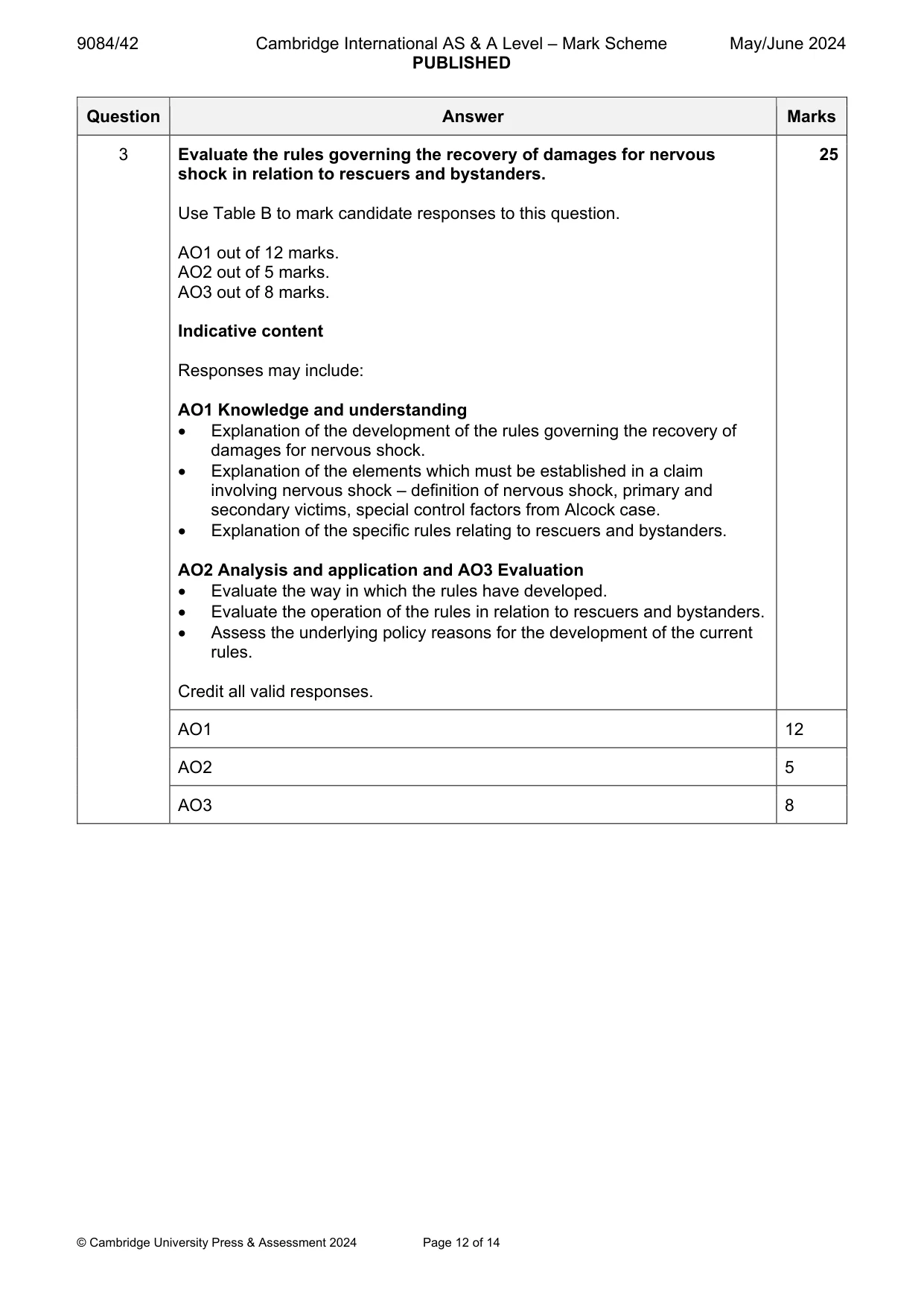
9084/42 Cambridge International AS & A Level – Mark Scheme PUBLISHED May/June 2024 © Cambridge University Press & Assessment 2024 Page 12 of 14 Question Answer Marks 3 Evaluate the rules governing the recovery of damages for nervous shock in relation to rescuers and bystanders. Use Table B to mark candidate responses to this question. AO1 out of 12 marks. AO2 out of 5 marks. AO3 out of 8 marks. Indicative content Responses may include: AO1 Knowledge and understanding Explanation of the development of the rules governing the recovery of damages for nervous shock. Explanation of the elements which must be established in a claim involving nervous shock – definition of nervous shock, primary and secondary victims, special control factors from Alcock case. Explanation of the specific rules relating to rescuers and bystanders. AO2 Analysis and application and AO3 Evaluation Evaluate the way in which the rules have developed. Evaluate the operation of the rules in relation to rescuers and bystanders. Assess the underlying policy reasons for the development of the current rules. Credit all valid responses. 25 AO1 12 AO2 5 AO3 8
Mark scheme, page 13
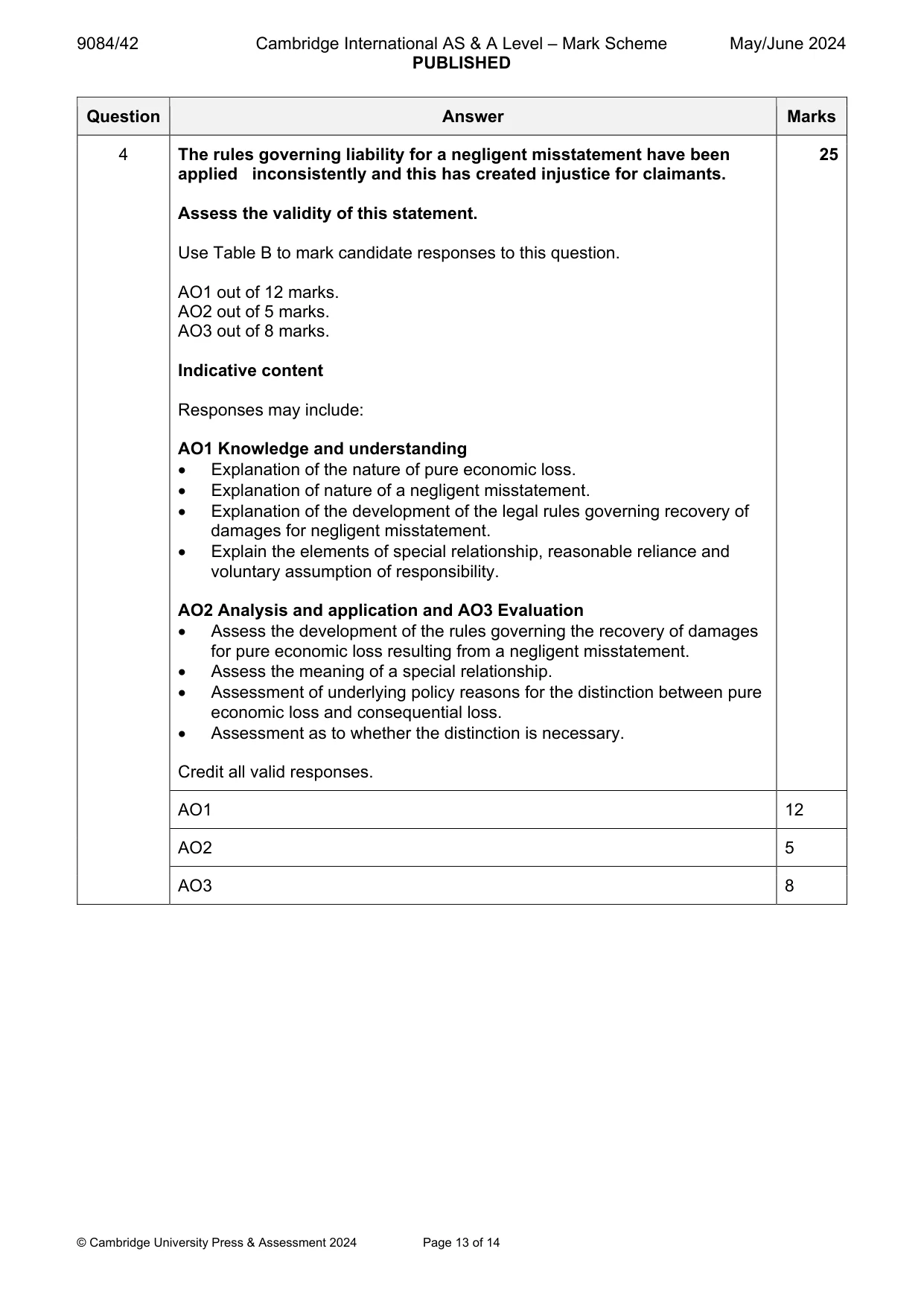
9084/42 Cambridge International AS & A Level – Mark Scheme PUBLISHED May/June 2024 © Cambridge University Press & Assessment 2024 Page 13 of 14 Question Answer Marks 4 The rules governing liability for a negligent misstatement have been applied inconsistently and this has created injustice for claimants. Assess the validity of this statement. Use Table B to mark candidate responses to this question. AO1 out of 12 marks. AO2 out of 5 marks. AO3 out of 8 marks. Indicative content Responses may include: AO1 Knowledge and understanding Explanation of the nature of pure economic loss. Explanation of nature of a negligent misstatement. Explanation of the development of the legal rules governing recovery of damages for negligent misstatement. Explain the elements of special relationship, reasonable reliance and voluntary assumption of responsibility. AO2 Analysis and application and AO3 Evaluation Assess the development of the rules governing the recovery of damages for pure economic loss resulting from a negligent misstatement. Assess the meaning of a special relationship. Assessment of underlying policy reasons for the distinction between pure economic loss and consequential loss. Assessment as to whether the distinction is necessary. Credit all valid responses. 25 AO1 12 AO2 5 AO3 8
Mark scheme, page 14
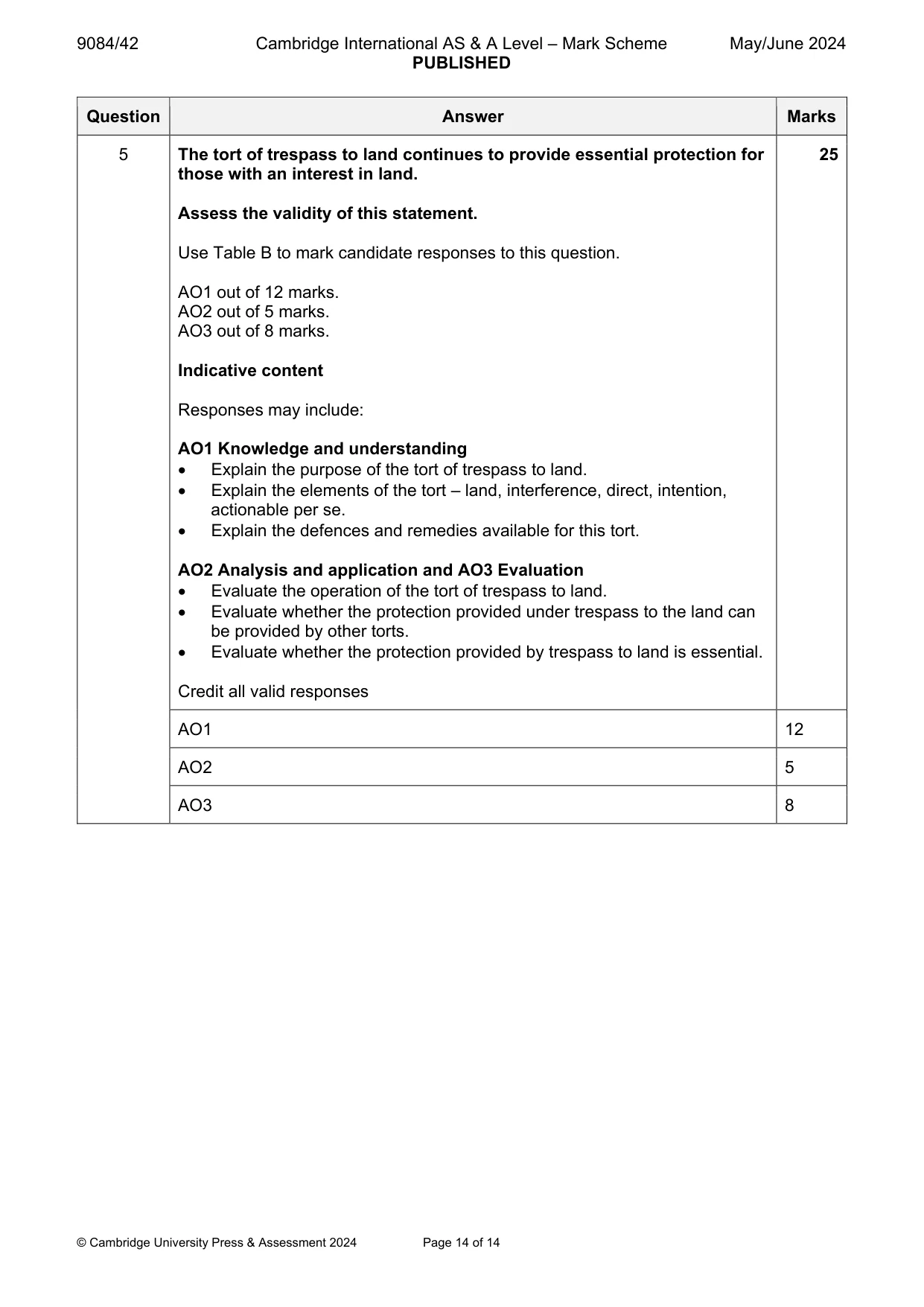
9084/42 Cambridge International AS & A Level – Mark Scheme PUBLISHED May/June 2024 © Cambridge University Press & Assessment 2024 Page 14 of 14 Question Answer Marks 5 The tort of trespass to land continues to provide essential protection for those with an interest in land. Assess the validity of this statement. Use Table B to mark candidate responses to this question. AO1 out of 12 marks. AO2 out of 5 marks. AO3 out of 8 marks. Indicative content Responses may include: AO1 Knowledge and understanding Explain the purpose of the tort of trespass to land. Explain the elements of the tort – land, interference, direct, intention, actionable per se. Explain the defences and remedies available for this tort. AO2 Analysis and application and AO3 Evaluation Evaluate the operation of the tort of trespass to land. Evaluate whether the protection provided under trespass to the land can be provided by other torts. Evaluate whether the protection provided by trespass to land is essential. Credit all valid responses 25 AO1 12 AO2 5 AO3 8
What you needed in this session
Cambridge’s own grade thresholds for 2024 May/June, Paper 4 · Variant 2. A higher threshold means an easier paper — the bar moves with how the cohort did.