Cambridge A Level Law 9084 — 2014 Oct/Nov Paper 1 · Variant 2
9084/12/O/N/14 · 75 marks · ≈84 min
The question paper and its mark scheme, free to read here and free to download. This is Cambridge’s own paper, exactly as it was sat.
Question paper4 pages


Mark scheme4 pages
Answers below. Sit the paper first if you are practising.
Paper as text
Question paper, page 1
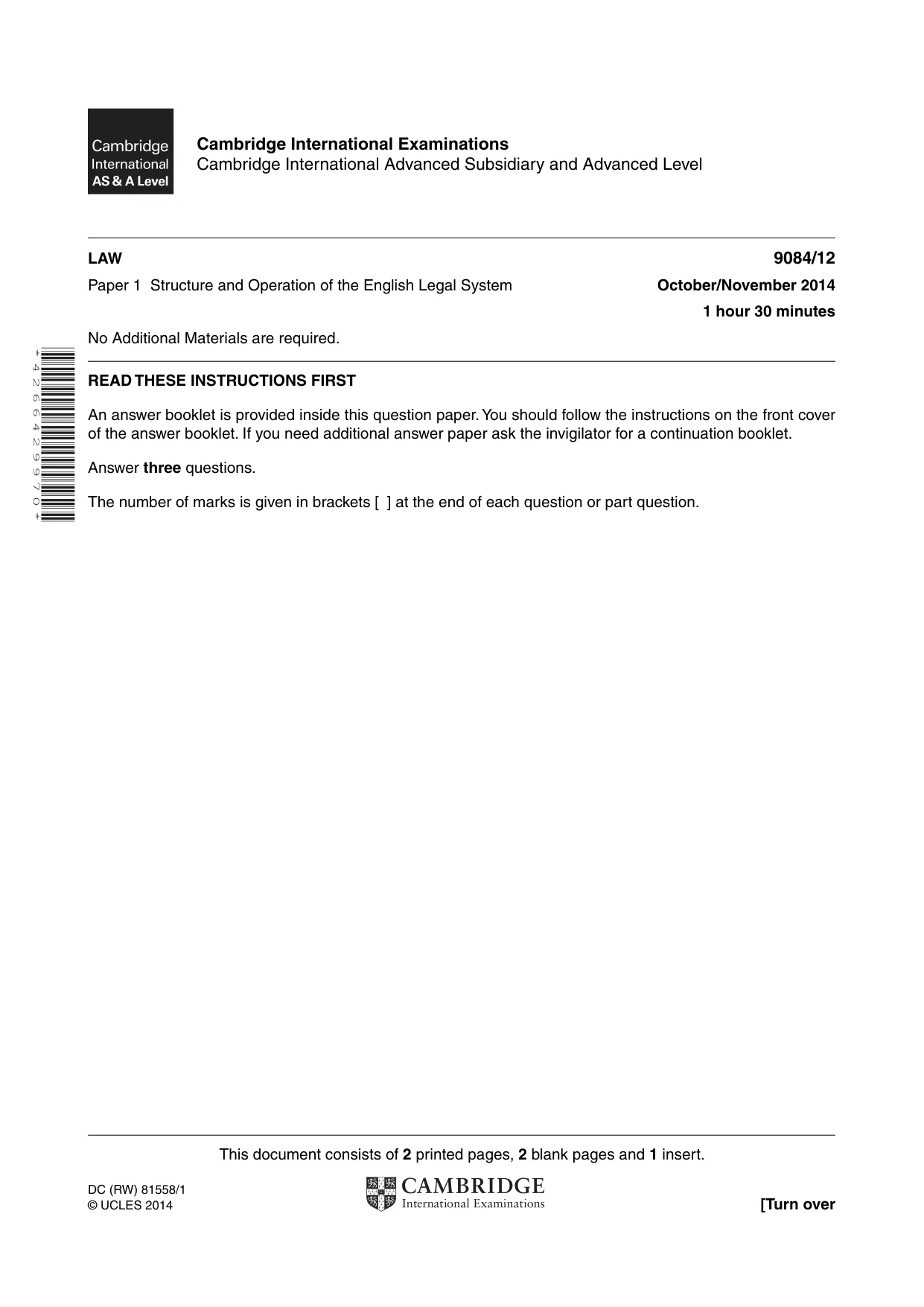
This document consists of 2 printed pages, 2 blank pages and 1 insert. DC (RW) 81558/1 © UCLES 2014 [Turn over Cambridge International Examinations Cambridge International Advanced Subsidiary and Advanced Level * 4 2 6 6 4 2 9 9 7 0 * LAW 9084/12 Paper 1 Structure and Operation of the English Legal System October/November 2014 1 hour 30 minutes No Additional Materials are required. READ THESE INSTRUCTIONS FIRST An answer booklet is provided inside this question paper. You should follow the instructions on the front cover of the answer booklet. If you need additional answer paper ask the invigilator for a continuation booklet. Answer three questions. The number of marks is given in brackets [ ] at the end of each question or part question.
Question paper, page 2
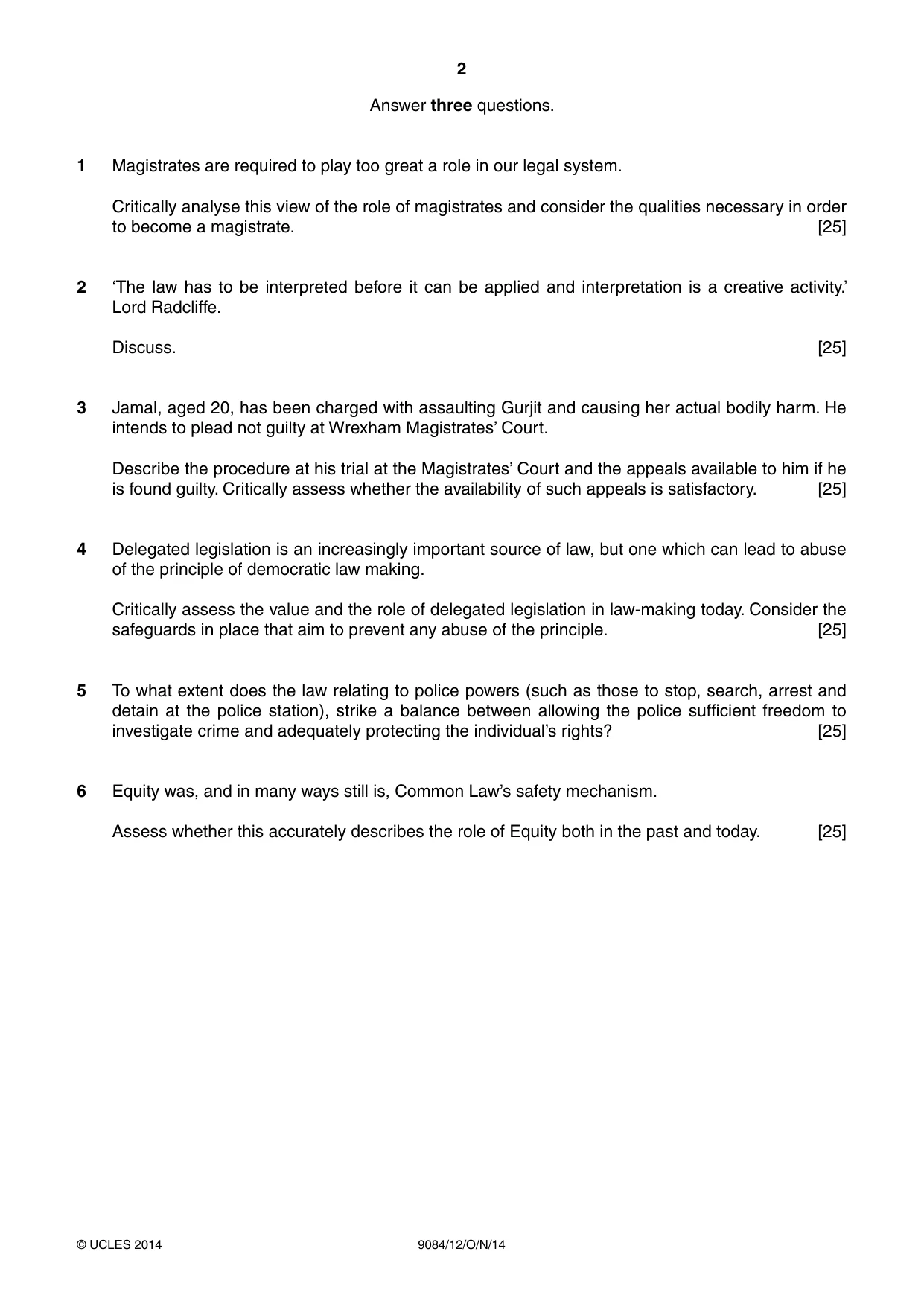
2 9084/12/O/N/14 © UCLES 2014 Answer three questions. 1 Magistrates are required to play too great a role in our legal system. Critically analyse this view of the role of magistrates and consider the qualities necessary in order to become a magistrate. [25] 2 ‘The law has to be interpreted before it can be applied and interpretation is a creative activity.’ Lord Radcliffe. Discuss. [25] 3 Jamal, aged 20, has been charged with assaulting Gurjit and causing her actual bodily harm. He intends to plead not guilty at Wrexham Magistrates’ Court. Describe the procedure at his trial at the Magistrates’ Court and the appeals available to him if he is found guilty. Critically assess whether the availability of such appeals is satisfactory. [25] 4 Delegated legislation is an increasingly important source of law, but one which can lead to abuse of the principle of democratic law making. Critically assess the value and the role of delegated legislation in law-making today. Consider the safeguards in place that aim to prevent any abuse of the principle. [25] 5 To what extent does the law relating to police powers (such as those to stop, search, arrest and detain at the police station), strike a balance between allowing the police sufficient freedom to investigate crime and adequately protecting the individual’s rights? [25] 6 Equity was, and in many ways still is, Common Law’s safety mechanism. Assess whether this accurately describes the role of Equity both in the past and today. [25]
Question paper, page 3
3 9084/12/O/N/14 © UCLES 2014 BLANK PAGE
Question paper, page 4
4 9084/12/O/N/14 © UCLES 2014 Permission to reproduce items where third-party owned material protected by copyright is included has been sought and cleared where possible. Every reasonable effort has been made by the publisher (UCLES) to trace copyright holders, but if any items requiring clearance have unwittingly been included, the publisher will be pleased to make amends at the earliest possible opportunity. Cambridge International Examinations is part of the Cambridge Assessment Group. Cambridge Assessment is the brand name of University of Cambridge Local Examinations Syndicate (UCLES), which is itself a department of the University of Cambridge. BLANK PAGE
Mark scheme, page 1
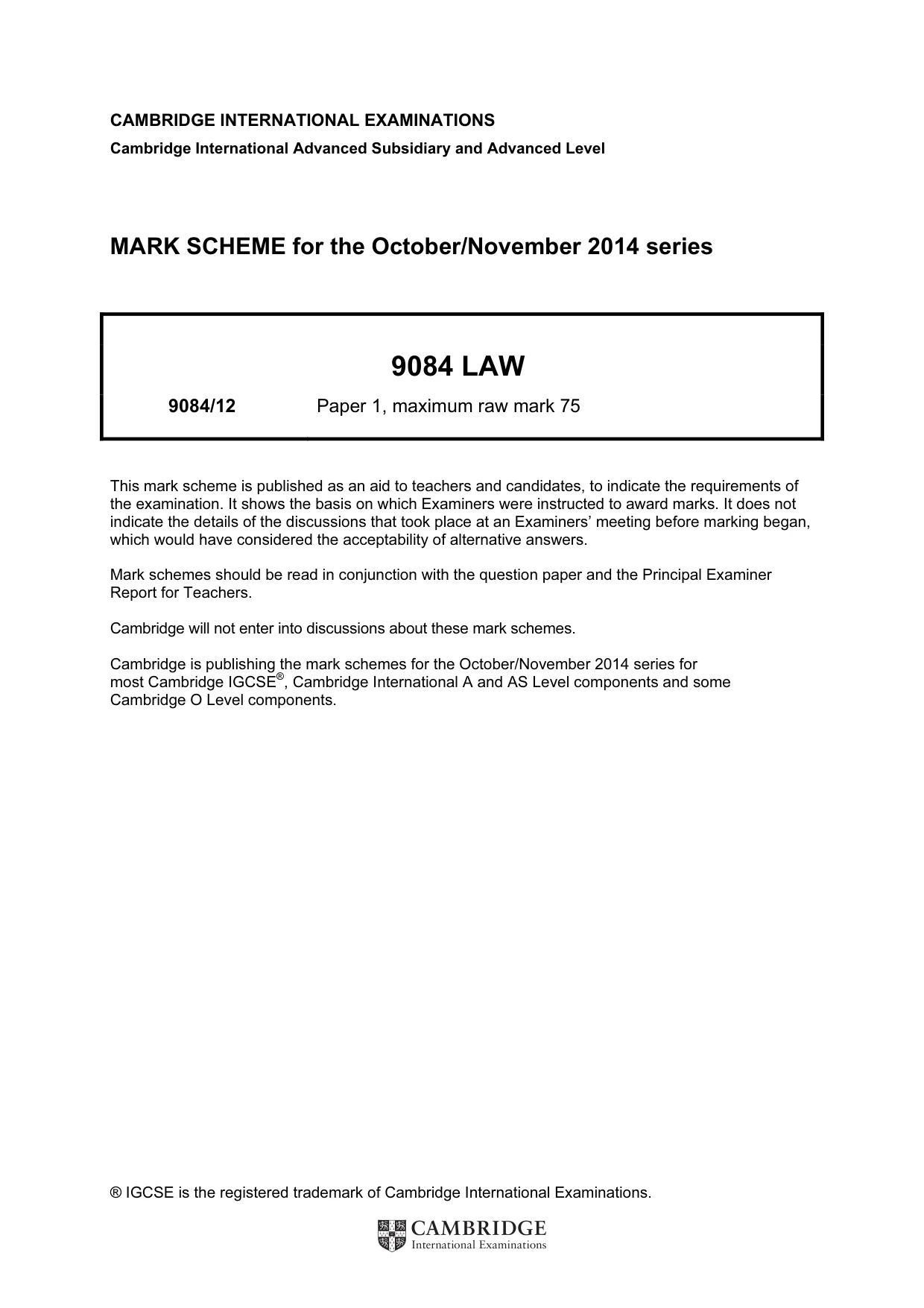
® IGCSE is the registered trademark of Cambridge International Examinations. CAMBRIDGE INTERNATIONAL EXAMINATIONS Cambridge International Advanced Subsidiary and Advanced Level MARK SCHEME for the October/November 2014 series 9084 LAW 9084/12 Paper 1, maximum raw mark 75 This mark scheme is published as an aid to teachers and candidates, to indicate the requirements of the examination. It shows the basis on which Examiners were instructed to award marks. It does not indicate the details of the discussions that took place at an Examiners’ meeting before marking began, which would have considered the acceptability of alternative answers. Mark schemes should be read in conjunction with the question paper and the Principal Examiner Report for Teachers. Cambridge will not enter into discussions about these mark schemes. Cambridge is publishing the mark schemes for the October/November 2014 series for most Cambridge IGCSE®, Cambridge International A and AS Level components and some Cambridge O Level components.
Mark scheme, page 2
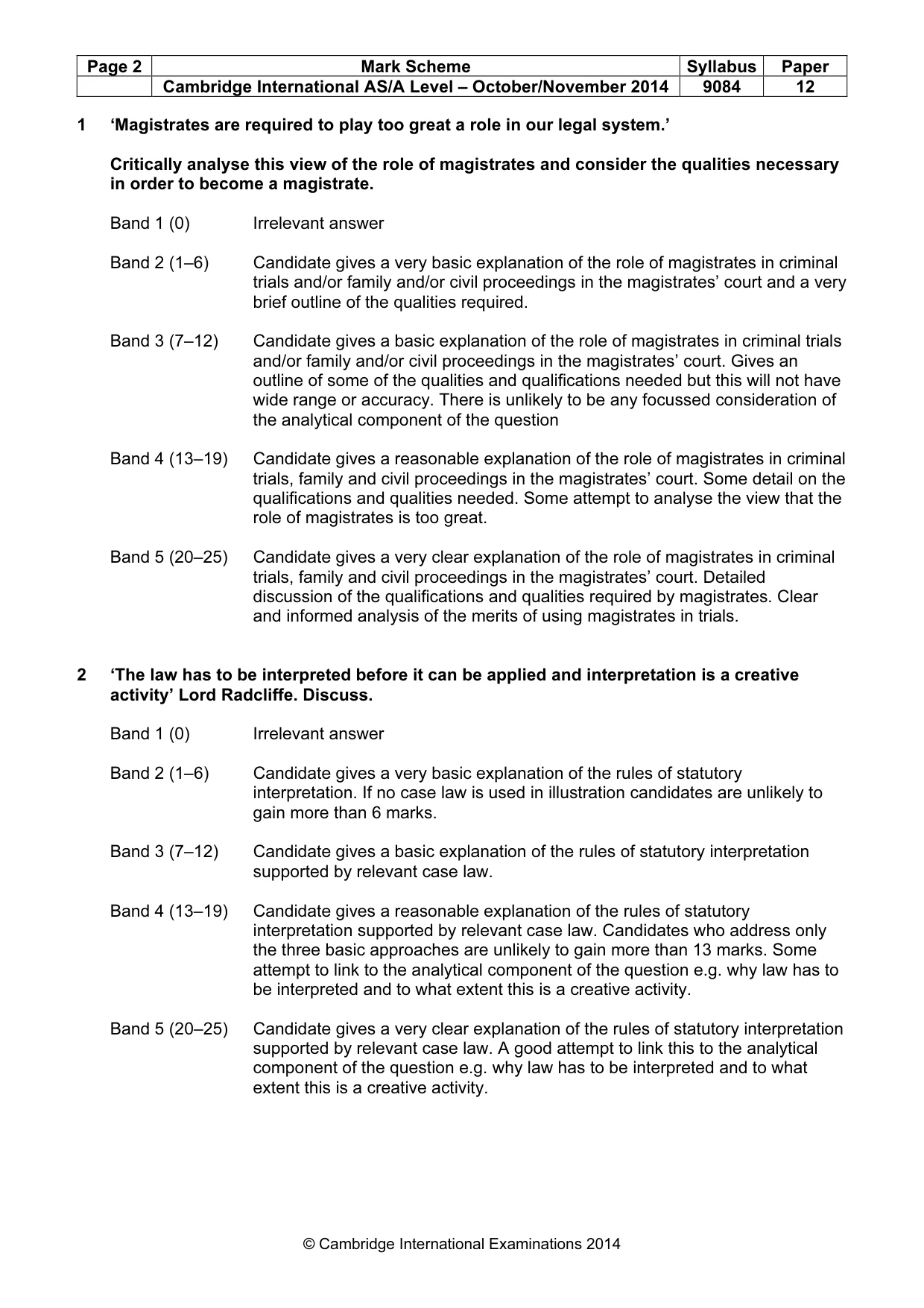
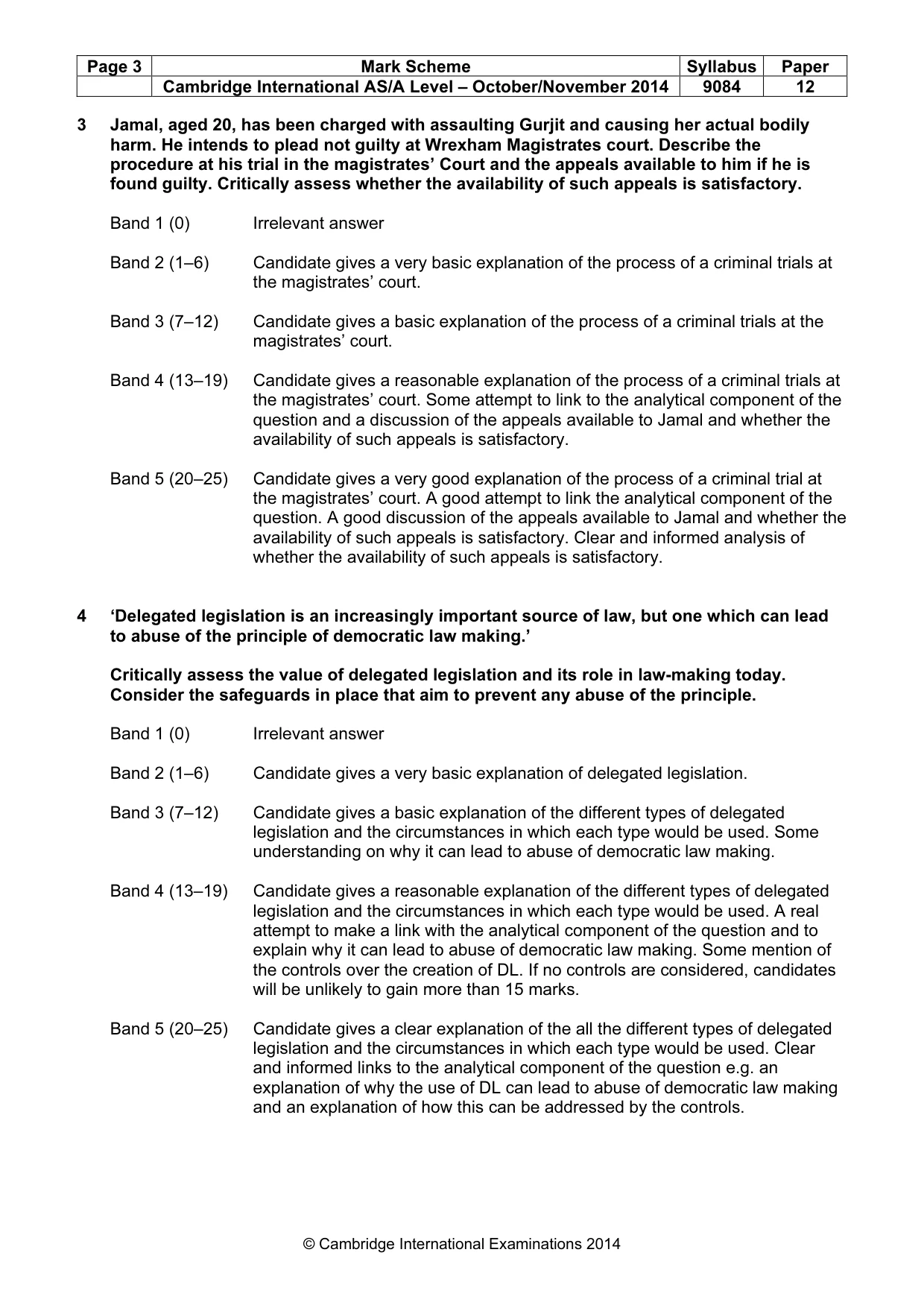
Page 2 Mark Scheme Syllabus Paper Cambridge International AS/A Level – October/November 2014 9084 12 © Cambridge International Examinations 2014 1 ‘Magistrates are required to play too great a role in our legal system.’ Critically analyse this view of the role of magistrates and consider the qualities necessary in order to become a magistrate. Band 1 (0) Irrelevant answer Band 2 (1–6) Candidate gives a very basic explanation of the role of magistrates in criminal trials and/or family and/or civil proceedings in the magistrates’ court and a very brief outline of the qualities required. Band 3 (7–12) Candidate gives a basic explanation of the role of magistrates in criminal trials and/or family and/or civil proceedings in the magistrates’ court. Gives an outline of some of the qualities and qualifications needed but this will not have wide range or accuracy. There is unlikely to be any focussed consideration of the analytical component of the question Band 4 (13–19) Candidate gives a reasonable explanation of the role of magistrates in criminal trials, family and civil proceedings in the magistrates’ court. Some detail on the qualifications and qualities needed. Some attempt to analyse the view that the role of magistrates is too great. Band 5 (20–25) Candidate gives a very clear explanation of the role of magistrates in criminal trials, family and civil proceedings in the magistrates’ court. Detailed discussion of the qualifications and qualities required by magistrates. Clear and informed analysis of the merits of using magistrates in trials. 2 ‘The law has to be interpreted before it can be applied and interpretation is a creative activity’ Lord Radcliffe. Discuss. Band 1 (0) Irrelevant answer Band 2 (1–6) Candidate gives a very basic explanation of the rules of statutory interpretation. If no case law is used in illustration candidates are unlikely to gain more than 6 marks. Band 3 (7–12) Candidate gives a basic explanation of the rules of statutory interpretation supported by relevant case law. Band 4 (13–19) Candidate gives a reasonable explanation of the rules of statutory interpretation supported by relevant case law. Candidates who address only the three basic approaches are unlikely to gain more than 13 marks. Some attempt to link to the analytical component of the question e.g. why law has to be interpreted and to what extent this is a creative activity. Band 5 (20–25) Candidate gives a very clear explanation of the rules of statutory interpretation supported by relevant case law. A good attempt to link this to the analytical component of the question e.g. why law has to be interpreted and to what extent this is a creative activity.
Mark scheme, page 3
Page 3 Mark Scheme Syllabus Paper Cambridge International AS/A Level – October/November 2014 9084 12 © Cambridge International Examinations 2014 3 Jamal, aged 20, has been charged with assaulting Gurjit and causing her actual bodily harm. He intends to plead not guilty at Wrexham Magistrates court. Describe the procedure at his trial in the magistrates’ Court and the appeals available to him if he is found guilty. Critically assess whether the availability of such appeals is satisfactory. Band 1 (0) Irrelevant answer Band 2 (1–6) Candidate gives a very basic explanation of the process of a criminal trials at the magistrates’ court. Band 3 (7–12) Candidate gives a basic explanation of the process of a criminal trials at the magistrates’ court. Band 4 (13–19) Candidate gives a reasonable explanation of the process of a criminal trials at the magistrates’ court. Some attempt to link to the analytical component of the question and a discussion of the appeals available to Jamal and whether the availability of such appeals is satisfactory. Band 5 (20–25) Candidate gives a very good explanation of the process of a criminal trial at the magistrates’ court. A good attempt to link the analytical component of the question. A good discussion of the appeals available to Jamal and whether the availability of such appeals is satisfactory. Clear and informed analysis of whether the availability of such appeals is satisfactory. 4 ‘Delegated legislation is an increasingly important source of law, but one which can lead to abuse of the principle of democratic law making.’ Critically assess the value of delegated legislation and its role in law-making today. Consider the safeguards in place that aim to prevent any abuse of the principle. Band 1 (0) Irrelevant answer Band 2 (1–6) Candidate gives a very basic explanation of delegated legislation. Band 3 (7–12) Candidate gives a basic explanation of the different types of delegated legislation and the circumstances in which each type would be used. Some understanding on why it can lead to abuse of democratic law making. Band 4 (13–19) Candidate gives a reasonable explanation of the different types of delegated legislation and the circumstances in which each type would be used. A real attempt to make a link with the analytical component of the question and to explain why it can lead to abuse of democratic law making. Some mention of the controls over the creation of DL. If no controls are considered, candidates will be unlikely to gain more than 15 marks. Band 5 (20–25) Candidate gives a clear explanation of the all the different types of delegated legislation and the circumstances in which each type would be used. Clear and informed links to the analytical component of the question e.g. an explanation of why the use of DL can lead to abuse of democratic law making and an explanation of how this can be addressed by the controls.
Mark scheme, page 4
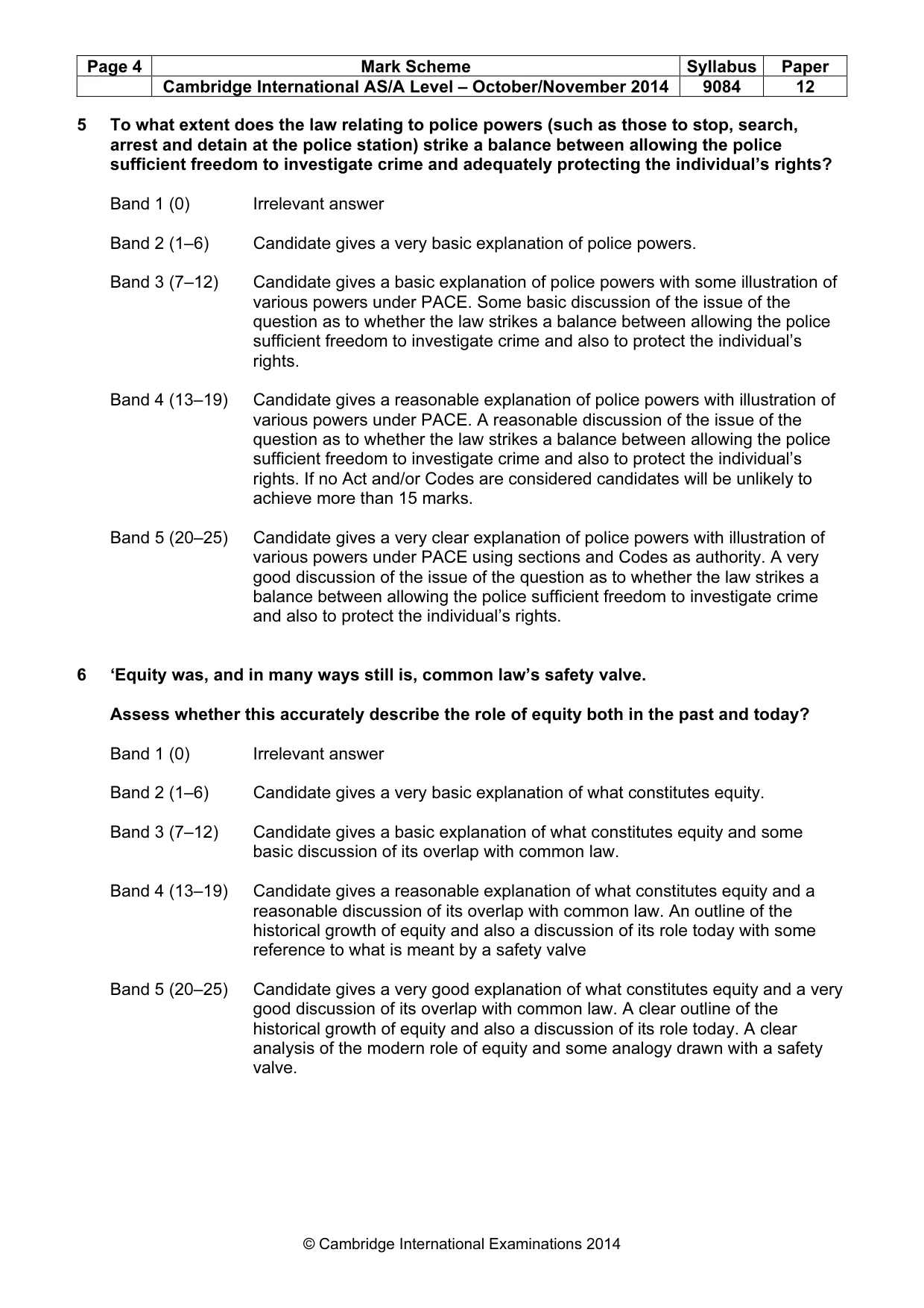
Page 4 Mark Scheme Syllabus Paper Cambridge International AS/A Level – October/November 2014 9084 12 © Cambridge International Examinations 2014 5 To what extent does the law relating to police powers (such as those to stop, search, arrest and detain at the police station) strike a balance between allowing the police sufficient freedom to investigate crime and adequately protecting the individual’s rights? Band 1 (0) Irrelevant answer Band 2 (1–6) Candidate gives a very basic explanation of police powers. Band 3 (7–12) Candidate gives a basic explanation of police powers with some illustration of various powers under PACE. Some basic discussion of the issue of the question as to whether the law strikes a balance between allowing the police sufficient freedom to investigate crime and also to protect the individual’s rights. Band 4 (13–19) Candidate gives a reasonable explanation of police powers with illustration of various powers under PACE. A reasonable discussion of the issue of the question as to whether the law strikes a balance between allowing the police sufficient freedom to investigate crime and also to protect the individual’s rights. If no Act and/or Codes are considered candidates will be unlikely to achieve more than 15 marks. Band 5 (20–25) Candidate gives a very clear explanation of police powers with illustration of various powers under PACE using sections and Codes as authority. A very good discussion of the issue of the question as to whether the law strikes a balance between allowing the police sufficient freedom to investigate crime and also to protect the individual’s rights. 6 ‘Equity was, and in many ways still is, common law’s safety valve. Assess whether this accurately describe the role of equity both in the past and today? Band 1 (0) Irrelevant answer Band 2 (1–6) Candidate gives a very basic explanation of what constitutes equity. Band 3 (7–12) Candidate gives a basic explanation of what constitutes equity and some basic discussion of its overlap with common law. Band 4 (13–19) Candidate gives a reasonable explanation of what constitutes equity and a reasonable discussion of its overlap with common law. An outline of the historical growth of equity and also a discussion of its role today with some reference to what is meant by a safety valve Band 5 (20–25) Candidate gives a very good explanation of what constitutes equity and a very good discussion of its overlap with common law. A clear outline of the historical growth of equity and also a discussion of its role today. A clear analysis of the modern role of equity and some analogy drawn with a safety valve.
What you needed in this session
Cambridge’s own grade thresholds for 2014 Oct/Nov, Paper 1 · Variant 2. A higher threshold means an easier paper — the bar moves with how the cohort did.