Cambridge A Level Law 9084 — 2013 May/June Paper 3 · Variant 2
9084/32/M/J/13 · 75 marks · ≈84 min
The question paper and its mark scheme, free to read here and free to download. This is Cambridge’s own paper, exactly as it was sat.
Question paper4 pages

Mark scheme9 pages
Answers below. Sit the paper first if you are practising.
Paper as text
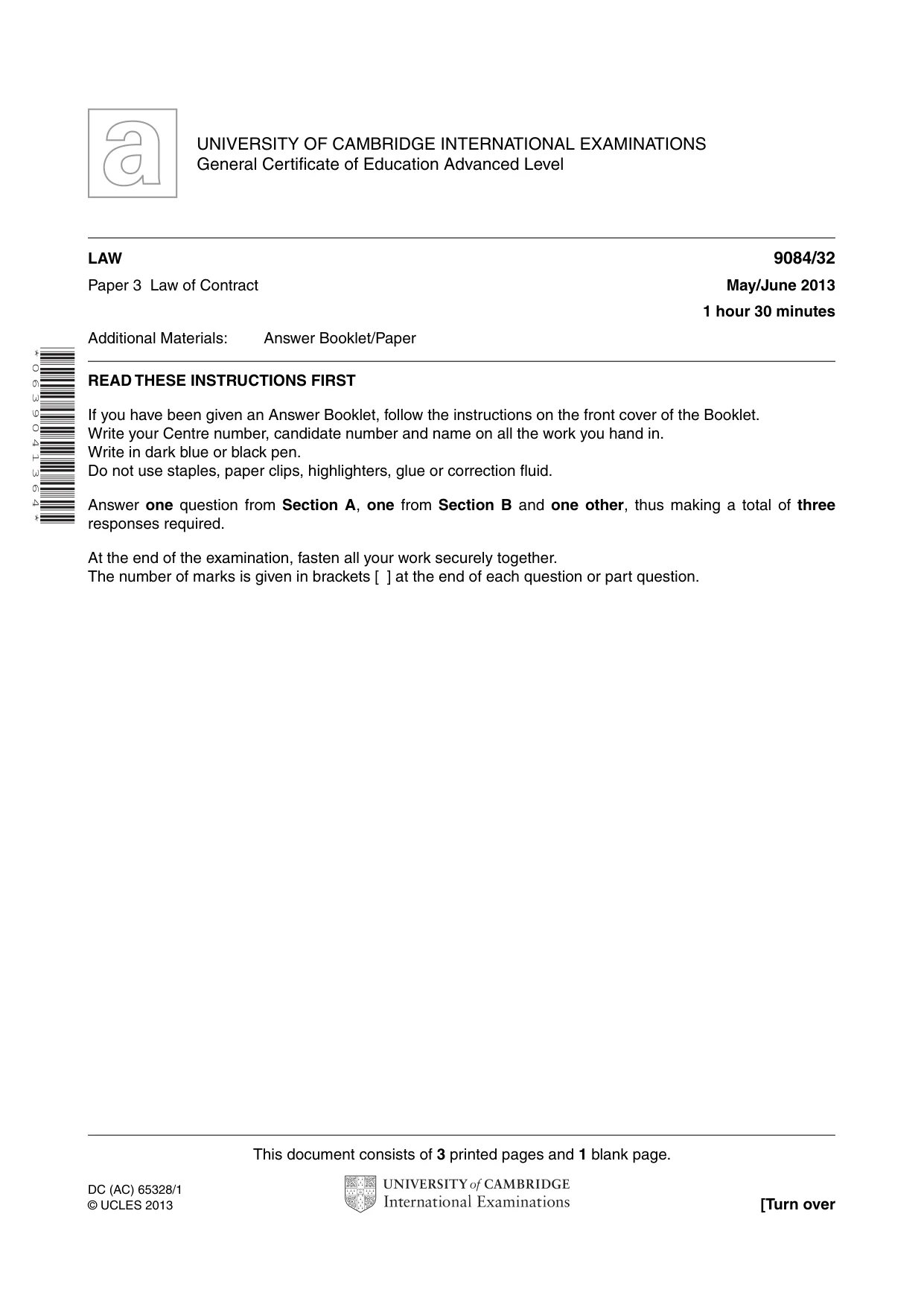
Question paper, page 1
This document consists of 3 printed pages and 1 blank page. DC (AC) 65328/1 © UCLES 2013 [Turn over UNIVERSITY OF CAMBRIDGE INTERNATIONAL EXAMINATIONS General Certificate of Education Advanced Level * 0 6 3 9 0 4 1 3 6 4 * LAW 9084/32 Paper 3 Law of Contract May/June 2013 1 hour 30 minutes Additional Materials: Answer Booklet/Paper READ THESE INSTRUCTIONS FIRST If you have been given an Answer Booklet, follow the instructions on the front cover of the Booklet. Write your Centre number, candidate number and name on all the work you hand in. Write in dark blue or black pen. Do not use staples, paper clips, highlighters, glue or correction fluid. Answer one question from Section A, one from Section B and one other, thus making a total of three responses required. At the end of the examination, fasten all your work securely together. The number of marks is given in brackets [ ] at the end of each question or part question.
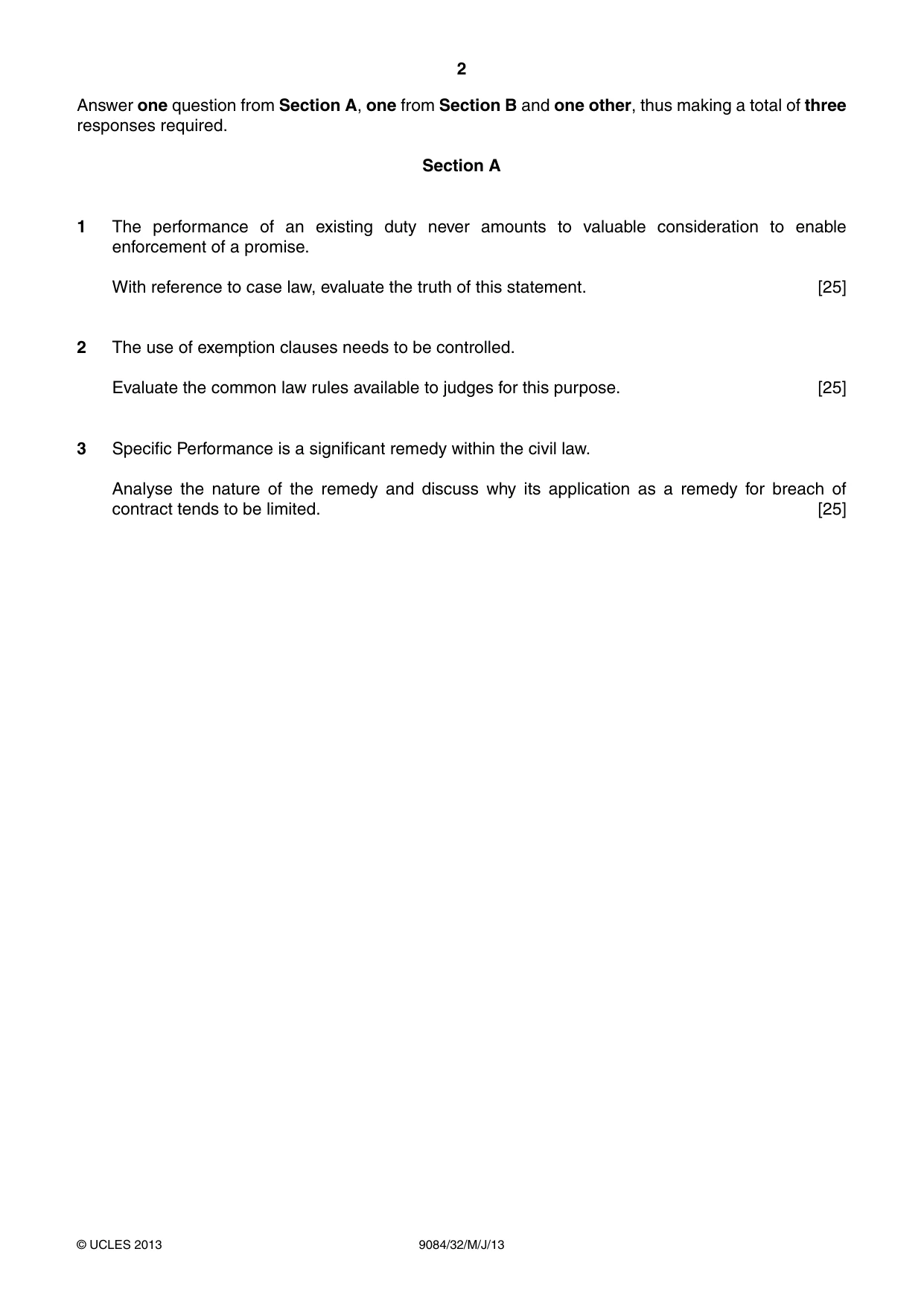
Question paper, page 2
2 9084/32/M/J/13 © UCLES 2013 Answer one question from Section A, one from Section B and one other, thus making a total of three responses required. Section A 1 The performance of an existing duty never amounts to valuable consideration to enable enforcement of a promise. With reference to case law, evaluate the truth of this statement. [25] 2 The use of exemption clauses needs to be controlled. Evaluate the common law rules available to judges for this purpose. [25] 3 Specific Performance is a significant remedy within the civil law. Analyse the nature of the remedy and discuss why its application as a remedy for breach of contract tends to be limited. [25]
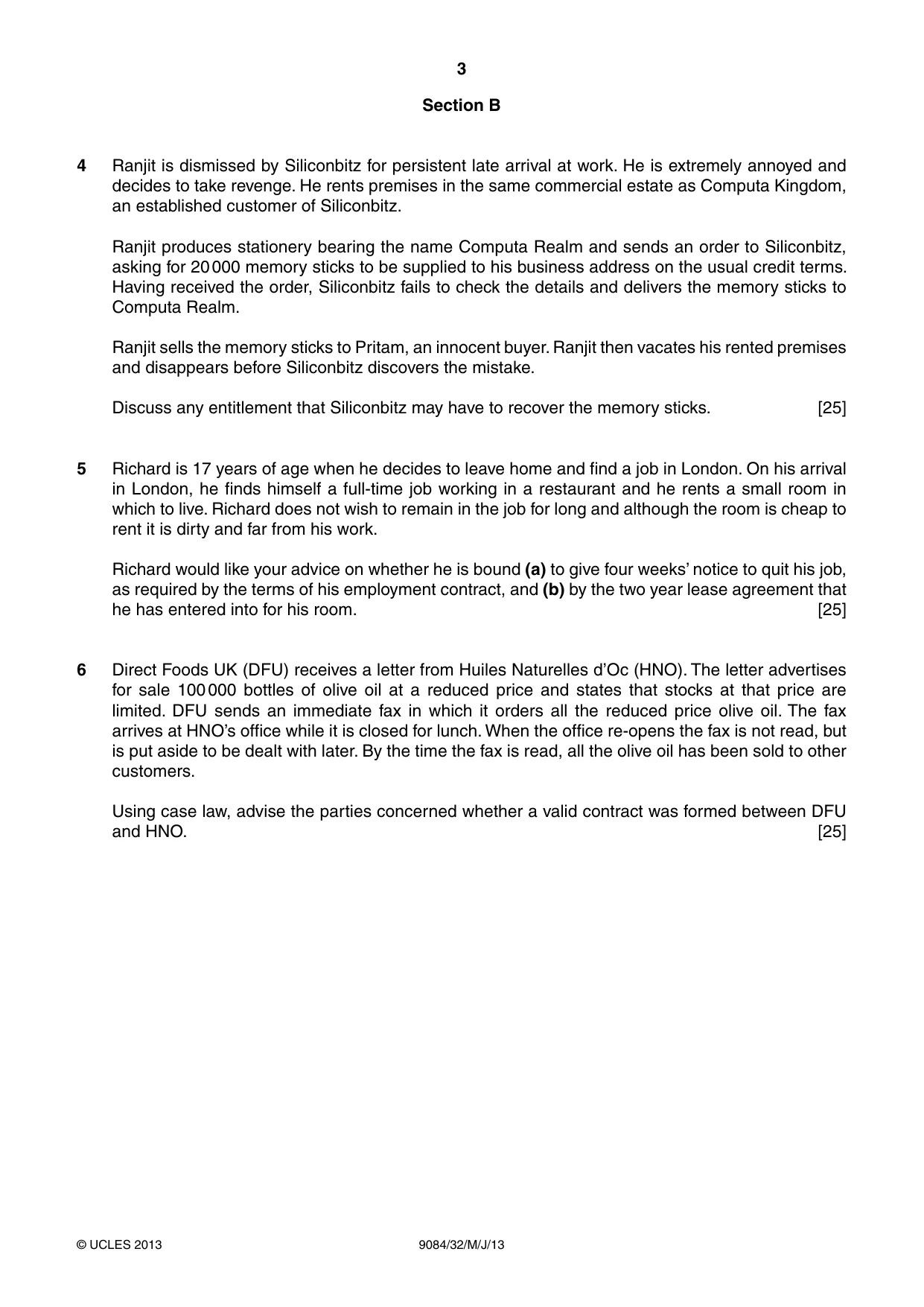
Question paper, page 3
3 9084/32/M/J/13 © UCLES 2013 Section B 4 Ranjit is dismissed by Siliconbitz for persistent late arrival at work. He is extremely annoyed and decides to take revenge. He rents premises in the same commercial estate as Computa Kingdom, an established customer of Siliconbitz. Ranjit produces stationery bearing the name Computa Realm and sends an order to Siliconbitz, asking for 20 000 memory sticks to be supplied to his business address on the usual credit terms. Having received the order, Siliconbitz fails to check the details and delivers the memory sticks to Computa Realm. Ranjit sells the memory sticks to Pritam, an innocent buyer. Ranjit then vacates his rented premises and disappears before Siliconbitz discovers the mistake. Discuss any entitlement that Siliconbitz may have to recover the memory sticks. [25] 5 Richard is 17 years of age when he decides to leave home and find a job in London. On his arrival in London, he finds himself a full-time job working in a restaurant and he rents a small room in which to live. Richard does not wish to remain in the job for long and although the room is cheap to rent it is dirty and far from his work. Richard would like your advice on whether he is bound (a) to give four weeks’ notice to quit his job, as required by the terms of his employment contract, and (b) by the two year lease agreement that he has entered into for his room. [25] 6 Direct Foods UK (DFU) receives a letter from Huiles Naturelles d’Oc (HNO). The letter advertises for sale 100 000 bottles of olive oil at a reduced price and states that stocks at that price are limited. DFU sends an immediate fax in which it orders all the reduced price olive oil. The fax arrives at HNO’s office while it is closed for lunch. When the office re-opens the fax is not read, but is put aside to be dealt with later. By the time the fax is read, all the olive oil has been sold to other customers. Using case law, advise the parties concerned whether a valid contract was formed between DFU and HNO. [25]
Question paper, page 4
4 9084/32/M/J/13 © UCLES 2013 Permission to reproduce items where third-party owned material protected by copyright is included has been sought and cleared where possible. Every reasonable effort has been made by the publisher (UCLES) to trace copyright holders, but if any items requiring clearance have unwittingly been included, the publisher will be pleased to make amends at the earliest possible opportunity. University of Cambridge International Examinations is part of the Cambridge Assessment Group. Cambridge Assessment is the brand name of University of Cambridge Local Examinations Syndicate (UCLES), which is itself a department of the University of Cambridge. BLANK PAGE
Mark scheme, page 1
CAMBRIDGE INTERNATIONAL EXAMINATIONS GCE Advanced Level MARK SCHEME for the May/June 2013 series 9084 LAW 9084/32 Paper 3, maximum raw mark 75 This mark scheme is published as an aid to teachers and candidates, to indicate the requirements of the examination. It shows the basis on which Examiners were instructed to award marks. It does not indicate the details of the discussions that took place at an Examiners’ meeting before marking began, which would have considered the acceptability of alternative answers. Mark schemes should be read in conjunction with the question paper and the Principal Examiner Report for Teachers. Cambridge will not enter into discussions about these mark schemes. Cambridge is publishing the mark schemes for the May/June 2013 series for most IGCSE, GCE Advanced Level and Advanced Subsidiary Level components and some Ordinary Level components.
Mark scheme, page 2
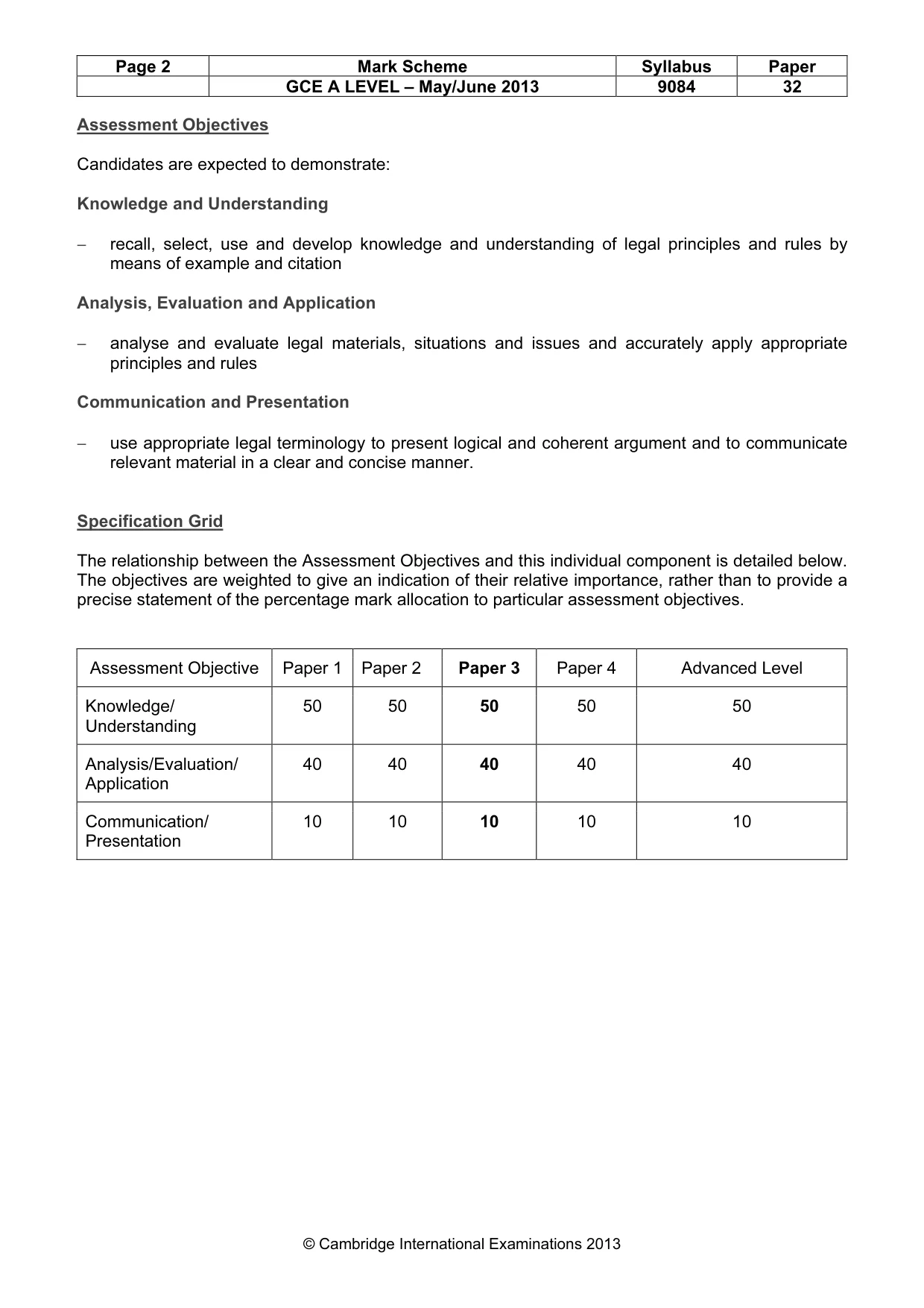
Page 2 Mark Scheme Syllabus Paper GCE A LEVEL – May/June 2013 9084 32 © Cambridge International Examinations 2013 Assessment Objectives Candidates are expected to demonstrate: Knowledge and Understanding − recall, select, use and develop knowledge and understanding of legal principles and rules by means of example and citation Analysis, Evaluation and Application − analyse and evaluate legal materials, situations and issues and accurately apply appropriate principles and rules Communication and Presentation − use appropriate legal terminology to present logical and coherent argument and to communicate relevant material in a clear and concise manner. Specification Grid The relationship between the Assessment Objectives and this individual component is detailed below. The objectives are weighted to give an indication of their relative importance, rather than to provide a precise statement of the percentage mark allocation to particular assessment objectives. Assessment Objective Paper 1 Paper 2 Paper 3 Paper 4 Advanced Level Knowledge/ Understanding 50 50 50 50 50 Analysis/Evaluation/ Application 40 40 40 40 40 Communication/ Presentation 10 10 10 10 10
Mark scheme, page 3
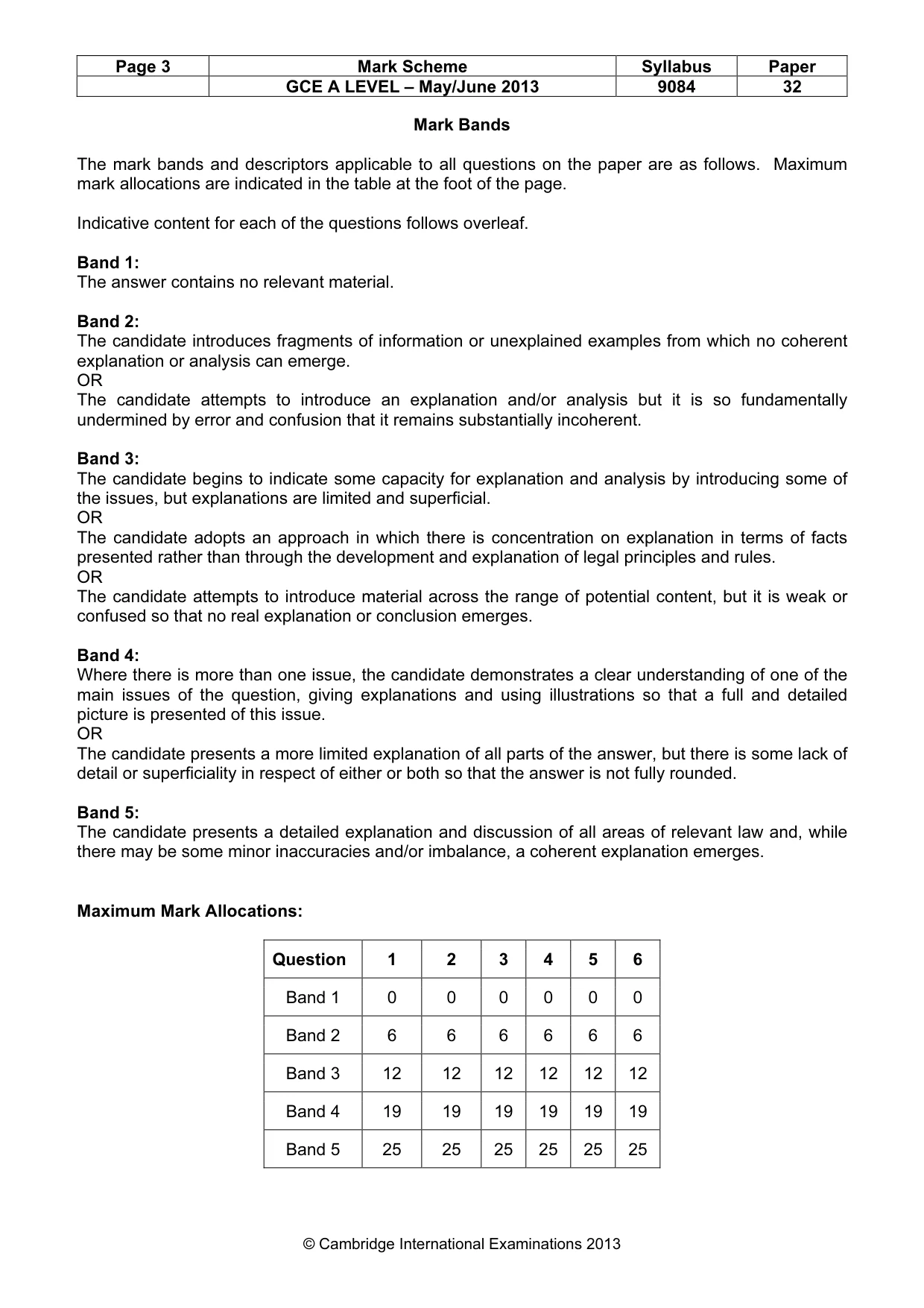
Page 3 Mark Scheme Syllabus Paper GCE A LEVEL – May/June 2013 9084 32 © Cambridge International Examinations 2013 Mark Bands The mark bands and descriptors applicable to all questions on the paper are as follows. Maximum mark allocations are indicated in the table at the foot of the page. Indicative content for each of the questions follows overleaf. Band 1: The answer contains no relevant material. Band 2: The candidate introduces fragments of information or unexplained examples from which no coherent explanation or analysis can emerge. OR The candidate attempts to introduce an explanation and/or analysis but it is so fundamentally undermined by error and confusion that it remains substantially incoherent. Band 3: The candidate begins to indicate some capacity for explanation and analysis by introducing some of the issues, but explanations are limited and superficial. OR The candidate adopts an approach in which there is concentration on explanation in terms of facts presented rather than through the development and explanation of legal principles and rules. OR The candidate attempts to introduce material across the range of potential content, but it is weak or confused so that no real explanation or conclusion emerges. Band 4: Where there is more than one issue, the candidate demonstrates a clear understanding of one of the main issues of the question, giving explanations and using illustrations so that a full and detailed picture is presented of this issue. OR The candidate presents a more limited explanation of all parts of the answer, but there is some lack of detail or superficiality in respect of either or both so that the answer is not fully rounded. Band 5: The candidate presents a detailed explanation and discussion of all areas of relevant law and, while there may be some minor inaccuracies and/or imbalance, a coherent explanation emerges. Maximum Mark Allocations: Question 1 2 3 4 5 6 Band 1 0 0 0 0 0 0 Band 2 6 6 6 6 6 6 Band 3 12 12 12 12 12 12 Band 4 19 19 19 19 19 19 Band 5 25 25 25 25 25 25
Mark scheme, page 4
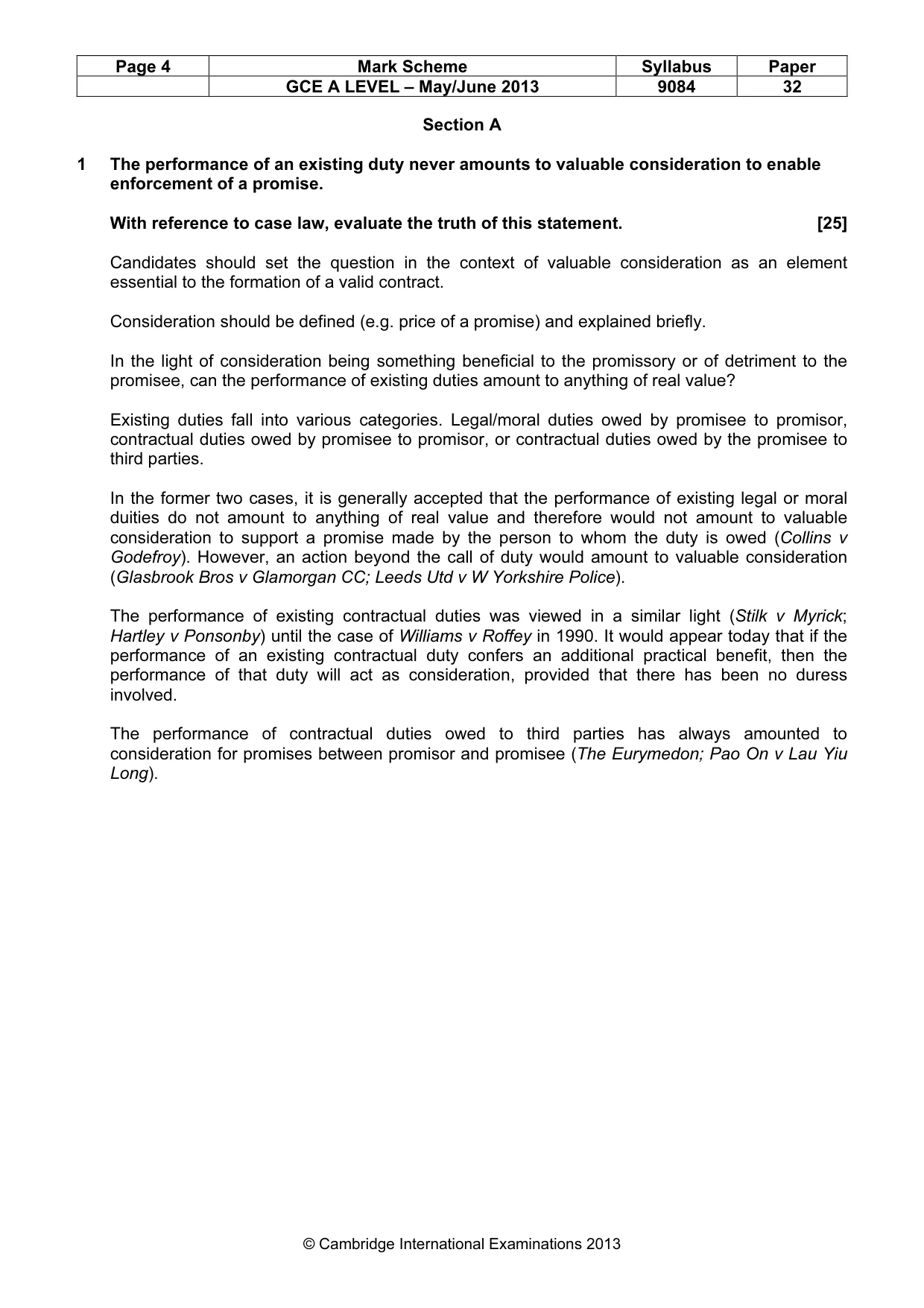
Page 4 Mark Scheme Syllabus Paper GCE A LEVEL – May/June 2013 9084 32 © Cambridge International Examinations 2013 Section A 1 The performance of an existing duty never amounts to valuable consideration to enable enforcement of a promise. With reference to case law, evaluate the truth of this statement. [25] Candidates should set the question in the context of valuable consideration as an element essential to the formation of a valid contract. Consideration should be defined (e.g. price of a promise) and explained briefly. In the light of consideration being something beneficial to the promissory or of detriment to the promisee, can the performance of existing duties amount to anything of real value? Existing duties fall into various categories. Legal/moral duties owed by promisee to promisor, contractual duties owed by promisee to promisor, or contractual duties owed by the promisee to third parties. In the former two cases, it is generally accepted that the performance of existing legal or moral duities do not amount to anything of real value and therefore would not amount to valuable consideration to support a promise made by the person to whom the duty is owed (Collins v Godefroy). However, an action beyond the call of duty would amount to valuable consideration (Glasbrook Bros v Glamorgan CC; Leeds Utd v W Yorkshire Police). The performance of existing contractual duties was viewed in a similar light (Stilk v Myrick; Hartley v Ponsonby) until the case of Williams v Roffey in 1990. It would appear today that if the performance of an existing contractual duty confers an additional practical benefit, then the performance of that duty will act as consideration, provided that there has been no duress involved. The performance of contractual duties owed to third parties has always amounted to consideration for promises between promisor and promisee (The Eurymedon; Pao On v Lau Yiu Long).
Mark scheme, page 5
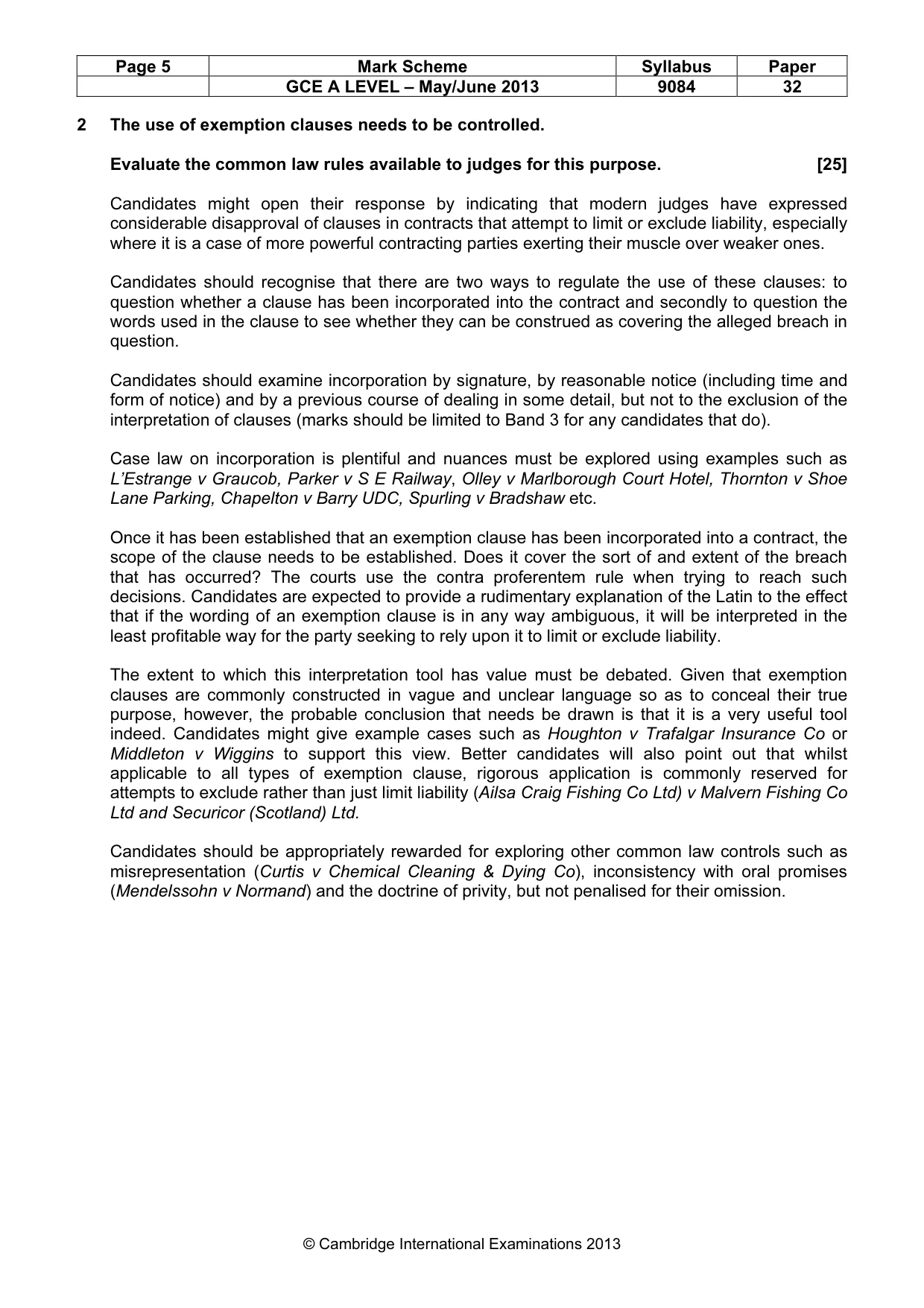
Page 5 Mark Scheme Syllabus Paper GCE A LEVEL – May/June 2013 9084 32 © Cambridge International Examinations 2013 2 The use of exemption clauses needs to be controlled. Evaluate the common law rules available to judges for this purpose. [25] Candidates might open their response by indicating that modern judges have expressed considerable disapproval of clauses in contracts that attempt to limit or exclude liability, especially where it is a case of more powerful contracting parties exerting their muscle over weaker ones. Candidates should recognise that there are two ways to regulate the use of these clauses: to question whether a clause has been incorporated into the contract and secondly to question the words used in the clause to see whether they can be construed as covering the alleged breach in question. Candidates should examine incorporation by signature, by reasonable notice (including time and form of notice) and by a previous course of dealing in some detail, but not to the exclusion of the interpretation of clauses (marks should be limited to Band 3 for any candidates that do). Case law on incorporation is plentiful and nuances must be explored using examples such as L’Estrange v Graucob, Parker v S E Railway, Olley v Marlborough Court Hotel, Thornton v Shoe Lane Parking, Chapelton v Barry UDC, Spurling v Bradshaw etc. Once it has been established that an exemption clause has been incorporated into a contract, the scope of the clause needs to be established. Does it cover the sort of and extent of the breach that has occurred? The courts use the contra proferentem rule when trying to reach such decisions. Candidates are expected to provide a rudimentary explanation of the Latin to the effect that if the wording of an exemption clause is in any way ambiguous, it will be interpreted in the least profitable way for the party seeking to rely upon it to limit or exclude liability. The extent to which this interpretation tool has value must be debated. Given that exemption clauses are commonly constructed in vague and unclear language so as to conceal their true purpose, however, the probable conclusion that needs be drawn is that it is a very useful tool indeed. Candidates might give example cases such as Houghton v Trafalgar Insurance Co or Middleton v Wiggins to support this view. Better candidates will also point out that whilst applicable to all types of exemption clause, rigorous application is commonly reserved for attempts to exclude rather than just limit liability (Ailsa Craig Fishing Co Ltd) v Malvern Fishing Co Ltd and Securicor (Scotland) Ltd. Candidates should be appropriately rewarded for exploring other common law controls such as misrepresentation (Curtis v Chemical Cleaning & Dying Co), inconsistency with oral promises (Mendelssohn v Normand) and the doctrine of privity, but not penalised for their omission.
Mark scheme, page 6
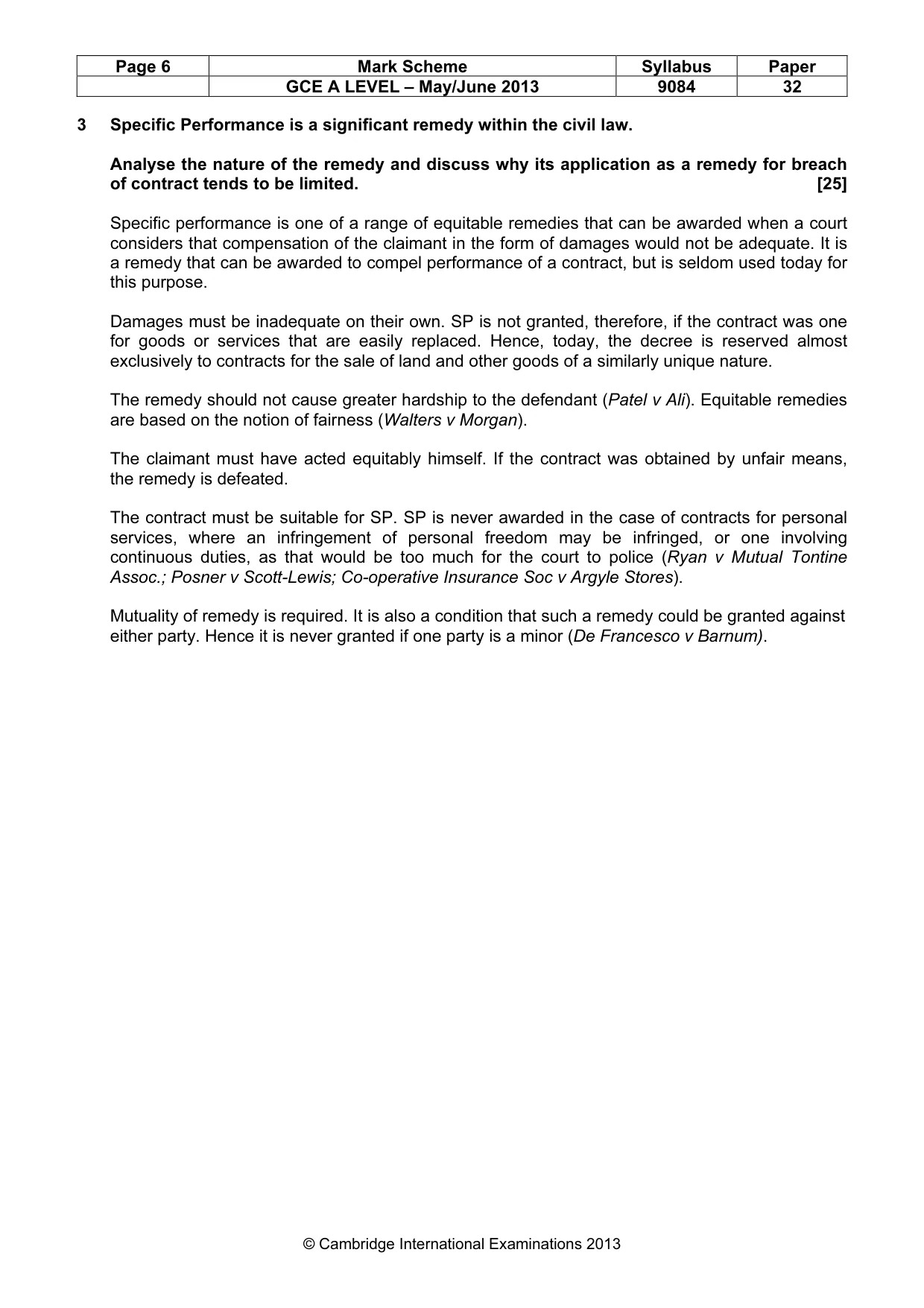
Page 6 Mark Scheme Syllabus Paper GCE A LEVEL – May/June 2013 9084 32 © Cambridge International Examinations 2013 3 Specific Performance is a significant remedy within the civil law. Analyse the nature of the remedy and discuss why its application as a remedy for breach of contract tends to be limited. [25] Specific performance is one of a range of equitable remedies that can be awarded when a court considers that compensation of the claimant in the form of damages would not be adequate. It is a remedy that can be awarded to compel performance of a contract, but is seldom used today for this purpose. Damages must be inadequate on their own. SP is not granted, therefore, if the contract was one for goods or services that are easily replaced. Hence, today, the decree is reserved almost exclusively to contracts for the sale of land and other goods of a similarly unique nature. The remedy should not cause greater hardship to the defendant (Patel v Ali). Equitable remedies are based on the notion of fairness (Walters v Morgan). The claimant must have acted equitably himself. If the contract was obtained by unfair means, the remedy is defeated. The contract must be suitable for SP. SP is never awarded in the case of contracts for personal services, where an infringement of personal freedom may be infringed, or one involving continuous duties, as that would be too much for the court to police (Ryan v Mutual Tontine Assoc.; Posner v Scott-Lewis; Co-operative Insurance Soc v Argyle Stores). Mutuality of remedy is required. It is also a condition that such a remedy could be granted against either party. Hence it is never granted if one party is a minor (De Francesco v Barnum).
Mark scheme, page 7
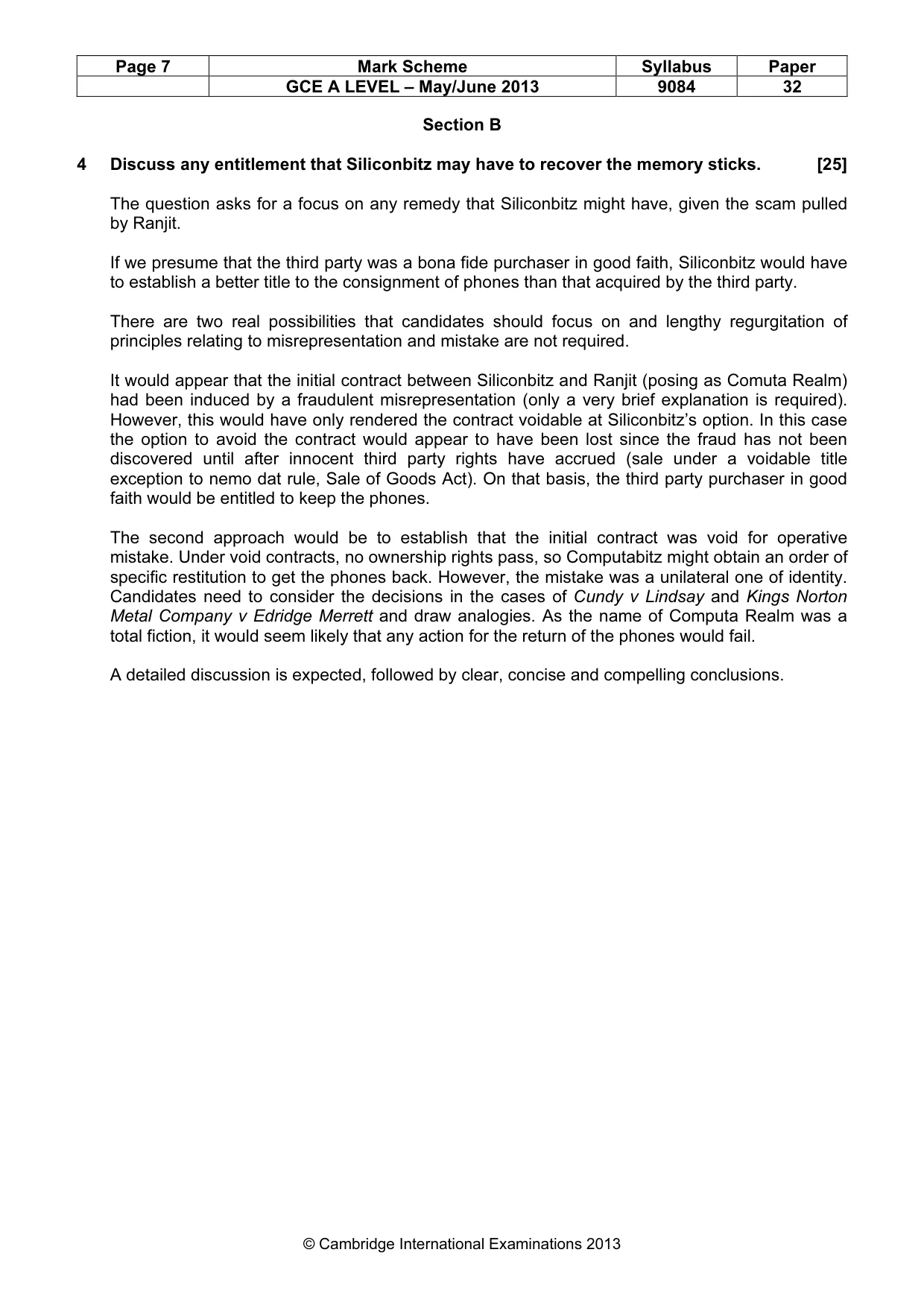
Page 7 Mark Scheme Syllabus Paper GCE A LEVEL – May/June 2013 9084 32 © Cambridge International Examinations 2013 Section B 4 Discuss any entitlement that Siliconbitz may have to recover the memory sticks. [25] The question asks for a focus on any remedy that Siliconbitz might have, given the scam pulled by Ranjit. If we presume that the third party was a bona fide purchaser in good faith, Siliconbitz would have to establish a better title to the consignment of phones than that acquired by the third party. There are two real possibilities that candidates should focus on and lengthy regurgitation of principles relating to misrepresentation and mistake are not required. It would appear that the initial contract between Siliconbitz and Ranjit (posing as Comuta Realm) had been induced by a fraudulent misrepresentation (only a very brief explanation is required). However, this would have only rendered the contract voidable at Siliconbitz’s option. In this case the option to avoid the contract would appear to have been lost since the fraud has not been discovered until after innocent third party rights have accrued (sale under a voidable title exception to nemo dat rule, Sale of Goods Act). On that basis, the third party purchaser in good faith would be entitled to keep the phones. The second approach would be to establish that the initial contract was void for operative mistake. Under void contracts, no ownership rights pass, so Computabitz might obtain an order of specific restitution to get the phones back. However, the mistake was a unilateral one of identity. Candidates need to consider the decisions in the cases of Cundy v Lindsay and Kings Norton Metal Company v Edridge Merrett and draw analogies. As the name of Computa Realm was a total fiction, it would seem likely that any action for the return of the phones would fail. A detailed discussion is expected, followed by clear, concise and compelling conclusions.
Mark scheme, page 8
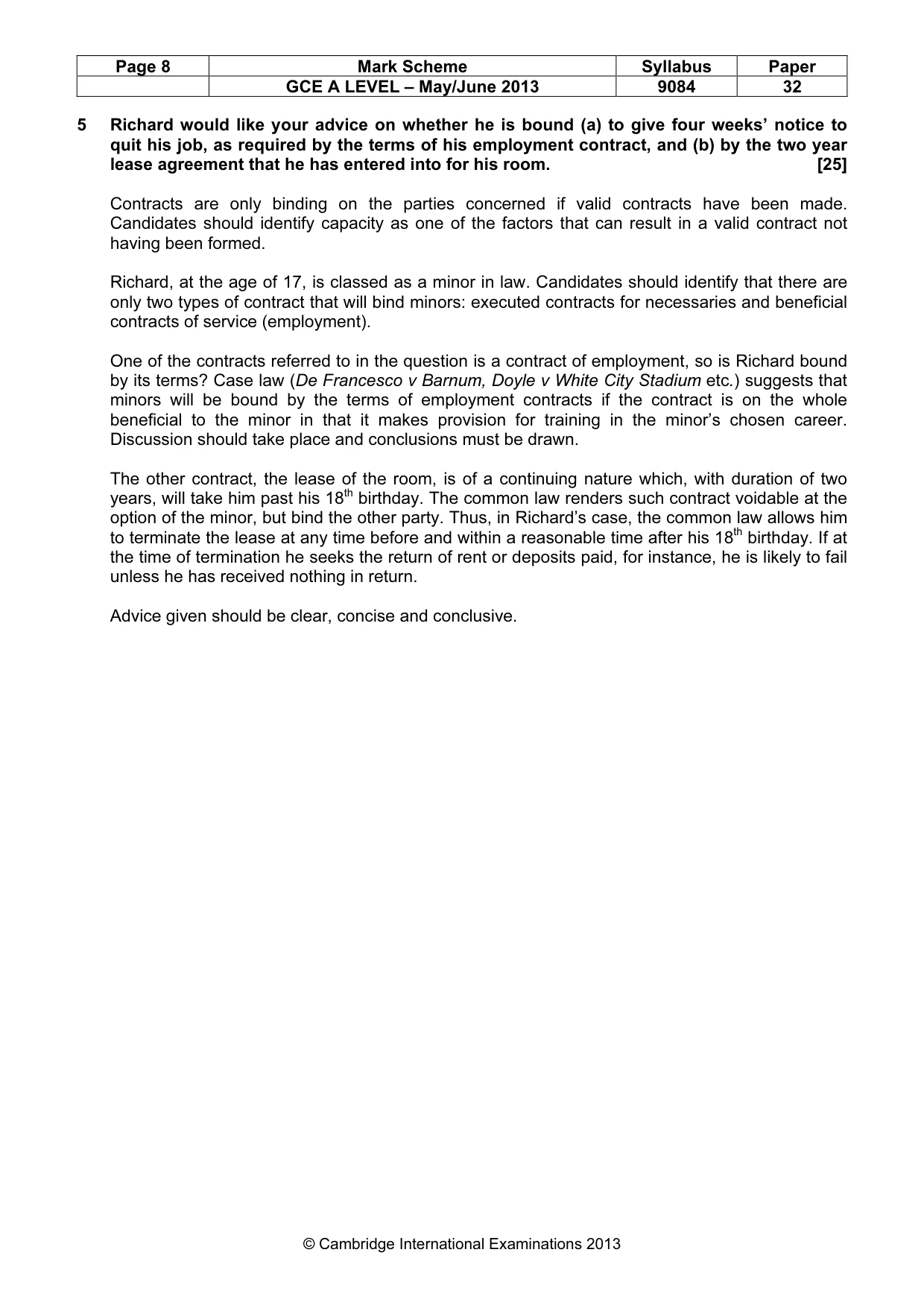
Page 8 Mark Scheme Syllabus Paper GCE A LEVEL – May/June 2013 9084 32 © Cambridge International Examinations 2013 5 Richard would like your advice on whether he is bound (a) to give four weeks’ notice to quit his job, as required by the terms of his employment contract, and (b) by the two year lease agreement that he has entered into for his room. [25] Contracts are only binding on the parties concerned if valid contracts have been made. Candidates should identify capacity as one of the factors that can result in a valid contract not having been formed. Richard, at the age of 17, is classed as a minor in law. Candidates should identify that there are only two types of contract that will bind minors: executed contracts for necessaries and beneficial contracts of service (employment). One of the contracts referred to in the question is a contract of employment, so is Richard bound by its terms? Case law (De Francesco v Barnum, Doyle v White City Stadium etc.) suggests that minors will be bound by the terms of employment contracts if the contract is on the whole beneficial to the minor in that it makes provision for training in the minor’s chosen career. Discussion should take place and conclusions must be drawn. The other contract, the lease of the room, is of a continuing nature which, with duration of two years, will take him past his 18th birthday. The common law renders such contract voidable at the option of the minor, but bind the other party. Thus, in Richard’s case, the common law allows him to terminate the lease at any time before and within a reasonable time after his 18th birthday. If at the time of termination he seeks the return of rent or deposits paid, for instance, he is likely to fail unless he has received nothing in return. Advice given should be clear, concise and conclusive.
Mark scheme, page 9
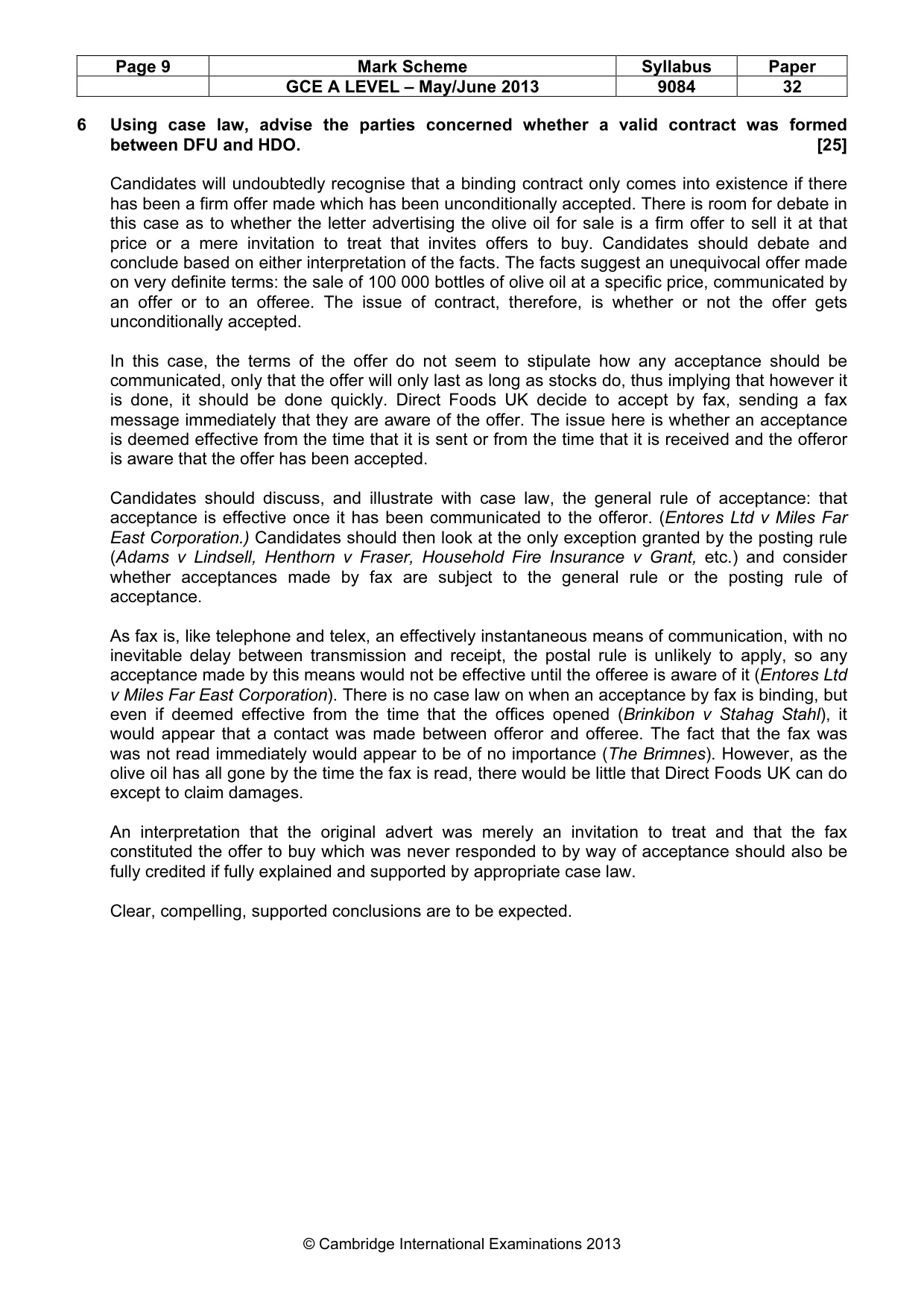
Page 9 Mark Scheme Syllabus Paper GCE A LEVEL – May/June 2013 9084 32 © Cambridge International Examinations 2013 6 Using case law, advise the parties concerned whether a valid contract was formed between DFU and HDO. [25] Candidates will undoubtedly recognise that a binding contract only comes into existence if there has been a firm offer made which has been unconditionally accepted. There is room for debate in this case as to whether the letter advertising the olive oil for sale is a firm offer to sell it at that price or a mere invitation to treat that invites offers to buy. Candidates should debate and conclude based on either interpretation of the facts. The facts suggest an unequivocal offer made on very definite terms: the sale of 100 000 bottles of olive oil at a specific price, communicated by an offer or to an offeree. The issue of contract, therefore, is whether or not the offer gets unconditionally accepted. In this case, the terms of the offer do not seem to stipulate how any acceptance should be communicated, only that the offer will only last as long as stocks do, thus implying that however it is done, it should be done quickly. Direct Foods UK decide to accept by fax, sending a fax message immediately that they are aware of the offer. The issue here is whether an acceptance is deemed effective from the time that it is sent or from the time that it is received and the offeror is aware that the offer has been accepted. Candidates should discuss, and illustrate with case law, the general rule of acceptance: that acceptance is effective once it has been communicated to the offeror. (Entores Ltd v Miles Far East Corporation.) Candidates should then look at the only exception granted by the posting rule (Adams v Lindsell, Henthorn v Fraser, Household Fire Insurance v Grant, etc.) and consider whether acceptances made by fax are subject to the general rule or the posting rule of acceptance. As fax is, like telephone and telex, an effectively instantaneous means of communication, with no inevitable delay between transmission and receipt, the postal rule is unlikely to apply, so any acceptance made by this means would not be effective until the offeree is aware of it (Entores Ltd v Miles Far East Corporation). There is no case law on when an acceptance by fax is binding, but even if deemed effective from the time that the offices opened (Brinkibon v Stahag Stahl), it would appear that a contact was made between offeror and offeree. The fact that the fax was was not read immediately would appear to be of no importance (The Brimnes). However, as the olive oil has all gone by the time the fax is read, there would be little that Direct Foods UK can do except to claim damages. An interpretation that the original advert was merely an invitation to treat and that the fax constituted the offer to buy which was never responded to by way of acceptance should also be fully credited if fully explained and supported by appropriate case law. Clear, compelling, supported conclusions are to be expected.
What you needed in this session
Cambridge’s own grade thresholds for 2013 May/June, Paper 3 · Variant 2. A higher threshold means an easier paper — the bar moves with how the cohort did.