Cambridge A Level Law 9084 — 2012 Oct/Nov Paper 1 · Variant 2
9084/12/O/N/12 · 75 marks · ≈84 min
The question paper and its mark scheme, free to read here and free to download. This is Cambridge’s own paper, exactly as it was sat.
Question paper2 pages
Mark scheme3 pages
Answers below. Sit the paper first if you are practising.
Paper as text
Question paper, page 1
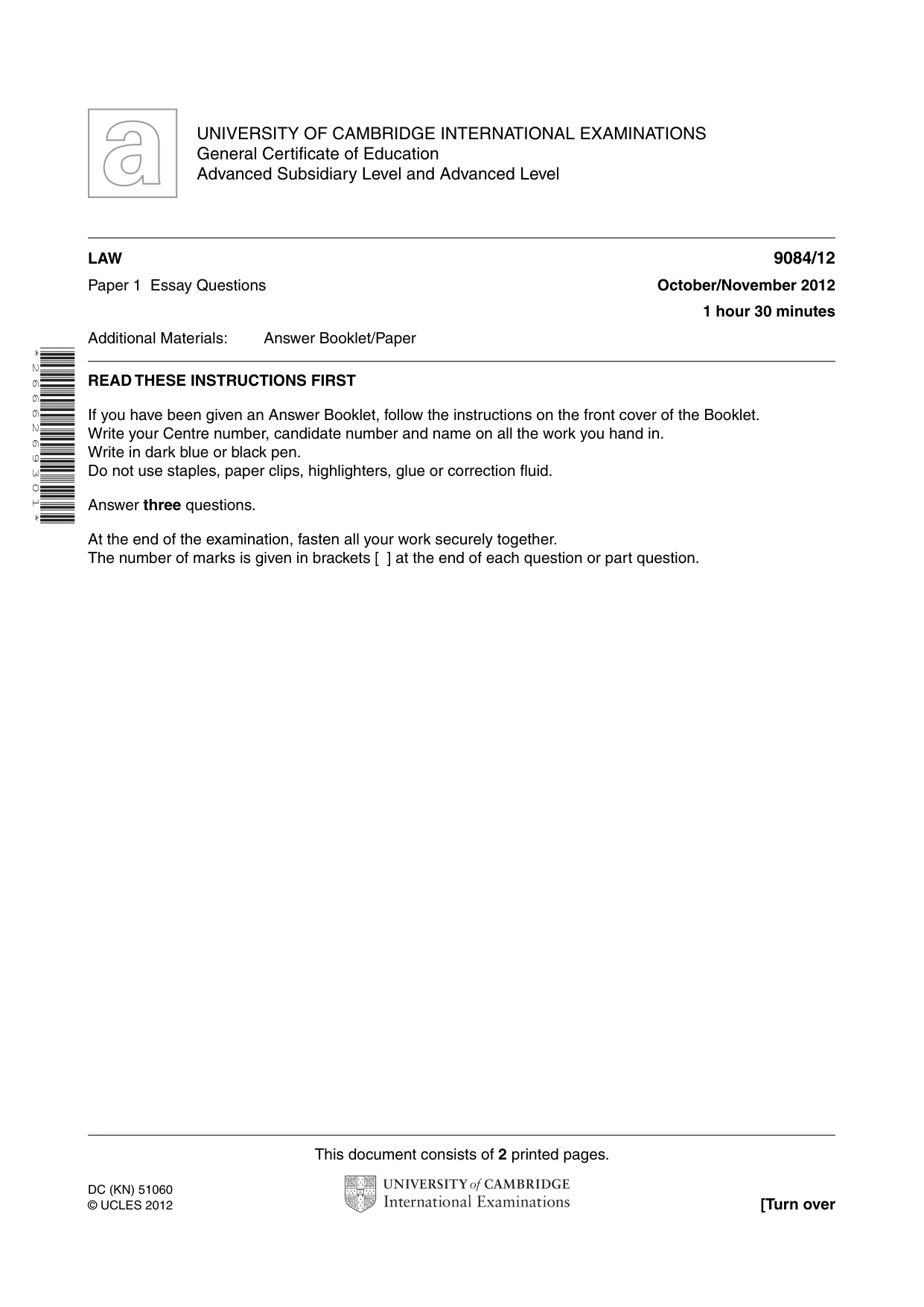
This document consists of 2 printed pages. DC (KN) 51060 © UCLES 2012 [Turn over UNIVERSITY OF CAMBRIDGE INTERNATIONAL EXAMINATIONS General Certificate of Education Advanced Subsidiary Level and Advanced Level * 2 6 6 6 2 6 9 3 0 1 * LAW 9084/12 Paper 1 Essay Questions October/November 2012 1 hour 30 minutes Additional Materials: Answer Booklet/Paper READ THESE INSTRUCTIONS FIRST If you have been given an Answer Booklet, follow the instructions on the front cover of the Booklet. Write your Centre number, candidate number and name on all the work you hand in. Write in dark blue or black pen. Do not use staples, paper clips, highlighters, glue or correction fluid. Answer three questions. At the end of the examination, fasten all your work securely together. The number of marks is given in brackets [ ] at the end of each question or part question.
Question paper, page 2
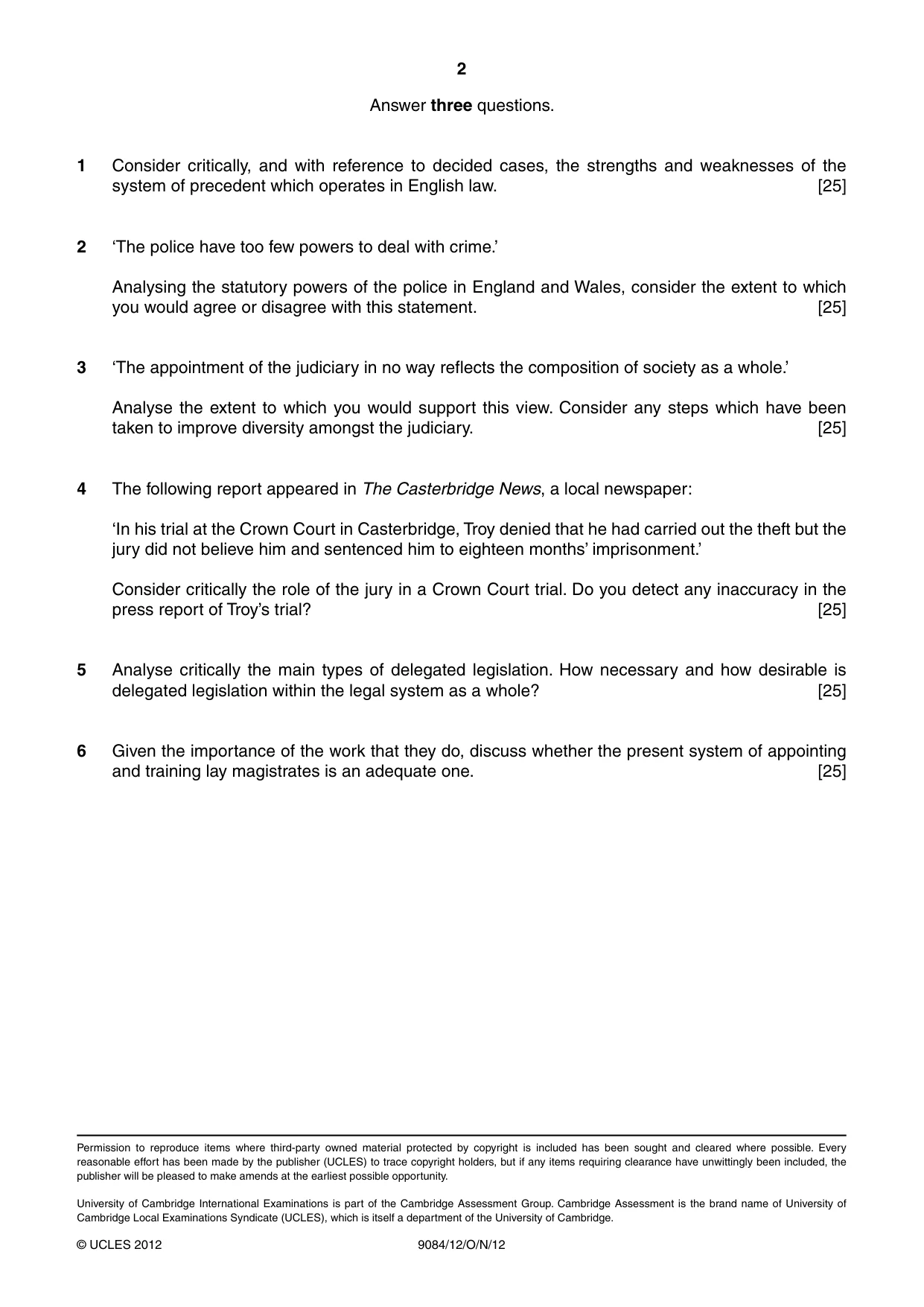
2 9084/12/O/N/12 © UCLES 2012 Permission to reproduce items where third-party owned material protected by copyright is included has been sought and cleared where possible. Every reasonable effort has been made by the publisher (UCLES) to trace copyright holders, but if any items requiring clearance have unwittingly been included, the publisher will be pleased to make amends at the earliest possible opportunity. University of Cambridge International Examinations is part of the Cambridge Assessment Group. Cambridge Assessment is the brand name of University of Cambridge Local Examinations Syndicate (UCLES), which is itself a department of the University of Cambridge. Answer three questions. 1 Consider critically, and with reference to decided cases, the strengths and weaknesses of the system of precedent which operates in English law. [25] 2 ‘The police have too few powers to deal with crime.’ Analysing the statutory powers of the police in England and Wales, consider the extent to which you would agree or disagree with this statement. [25] 3 ‘The appointment of the judiciary in no way reflects the composition of society as a whole.’ Analyse the extent to which you would support this view. Consider any steps which have been taken to improve diversity amongst the judiciary. [25] 4 The following report appeared in The Casterbridge News, a local newspaper: ‘In his trial at the Crown Court in Casterbridge, Troy denied that he had carried out the theft but the jury did not believe him and sentenced him to eighteen months’ imprisonment.’ Consider critically the role of the jury in a Crown Court trial. Do you detect any inaccuracy in the press report of Troy’s trial? [25] 5 Analyse critically the main types of delegated legislation. How necessary and how desirable is delegated legislation within the legal system as a whole? [25] 6 Given the importance of the work that they do, discuss whether the present system of appointing and training lay magistrates is an adequate one. [25]
Mark scheme, page 1
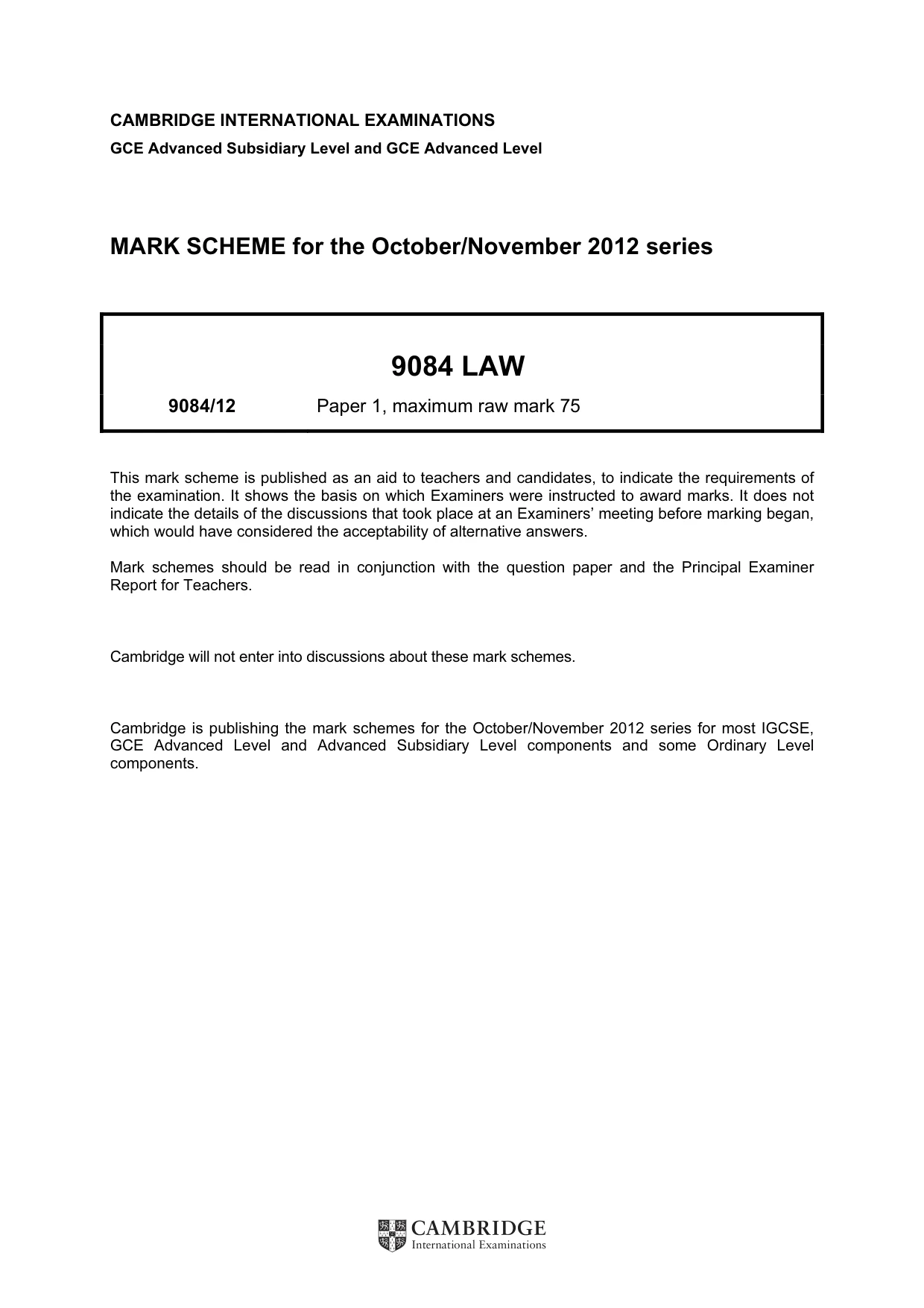
CAMBRIDGE INTERNATIONAL EXAMINATIONS GCE Advanced Subsidiary Level and GCE Advanced Level MARK SCHEME for the October/November 2012 series 9084 LAW 9084/12 Paper 1, maximum raw mark 75 This mark scheme is published as an aid to teachers and candidates, to indicate the requirements of the examination. It shows the basis on which Examiners were instructed to award marks. It does not indicate the details of the discussions that took place at an Examiners’ meeting before marking began, which would have considered the acceptability of alternative answers. Mark schemes should be read in conjunction with the question paper and the Principal Examiner Report for Teachers. Cambridge will not enter into discussions about these mark schemes. Cambridge is publishing the mark schemes for the October/November 2012 series for most IGCSE, GCE Advanced Level and Advanced Subsidiary Level components and some Ordinary Level components.
Mark scheme, page 2
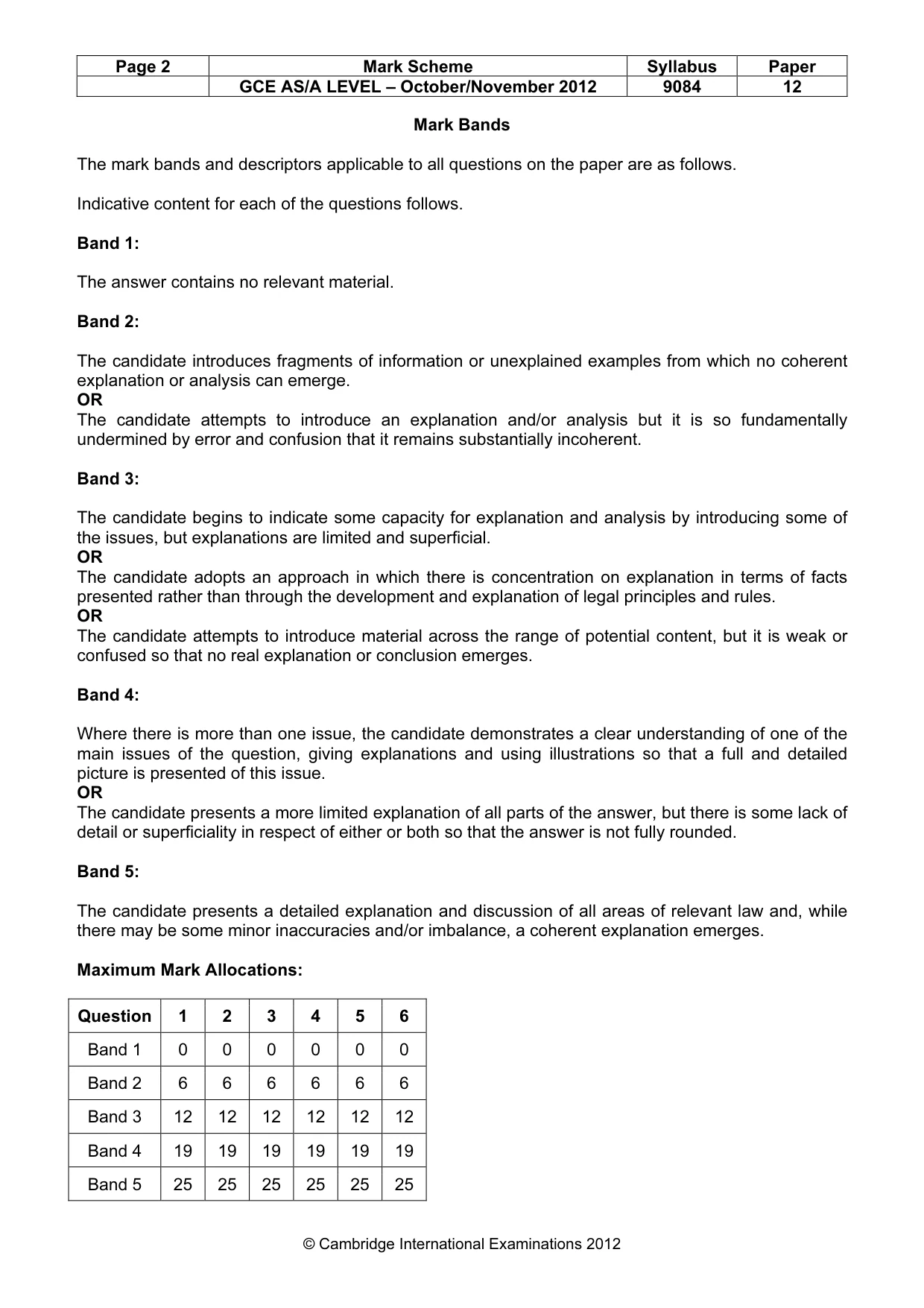
Page 2 Mark Scheme Syllabus Paper GCE AS/A LEVEL – October/November 2012 9084 12 © Cambridge International Examinations 2012 Mark Bands The mark bands and descriptors applicable to all questions on the paper are as follows. Indicative content for each of the questions follows. Band 1: The answer contains no relevant material. Band 2: The candidate introduces fragments of information or unexplained examples from which no coherent explanation or analysis can emerge. OR The candidate attempts to introduce an explanation and/or analysis but it is so fundamentally undermined by error and confusion that it remains substantially incoherent. Band 3: The candidate begins to indicate some capacity for explanation and analysis by introducing some of the issues, but explanations are limited and superficial. OR The candidate adopts an approach in which there is concentration on explanation in terms of facts presented rather than through the development and explanation of legal principles and rules. OR The candidate attempts to introduce material across the range of potential content, but it is weak or confused so that no real explanation or conclusion emerges. Band 4: Where there is more than one issue, the candidate demonstrates a clear understanding of one of the main issues of the question, giving explanations and using illustrations so that a full and detailed picture is presented of this issue. OR The candidate presents a more limited explanation of all parts of the answer, but there is some lack of detail or superficiality in respect of either or both so that the answer is not fully rounded. Band 5: The candidate presents a detailed explanation and discussion of all areas of relevant law and, while there may be some minor inaccuracies and/or imbalance, a coherent explanation emerges. Maximum Mark Allocations: Question 1 2 3 4 5 6 Band 1 0 0 0 0 0 0 Band 2 6 6 6 6 6 6 Band 3 12 12 12 12 12 12 Band 4 19 19 19 19 19 19 Band 5 25 25 25 25 25 25
Mark scheme, page 3
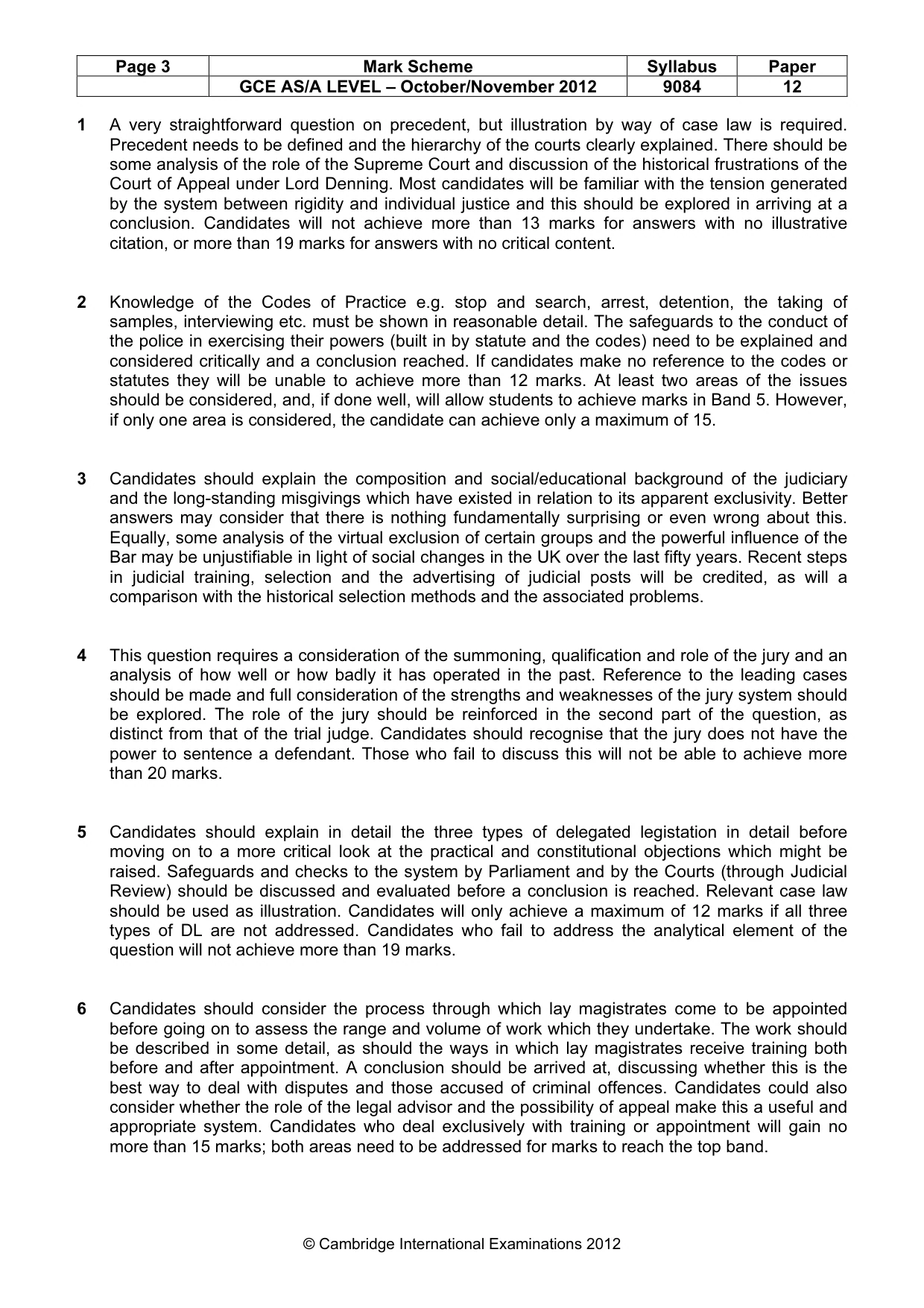
Page 3 Mark Scheme Syllabus Paper GCE AS/A LEVEL – October/November 2012 9084 12 © Cambridge International Examinations 2012 1 A very straightforward question on precedent, but illustration by way of case law is required. Precedent needs to be defined and the hierarchy of the courts clearly explained. There should be some analysis of the role of the Supreme Court and discussion of the historical frustrations of the Court of Appeal under Lord Denning. Most candidates will be familiar with the tension generated by the system between rigidity and individual justice and this should be explored in arriving at a conclusion. Candidates will not achieve more than 13 marks for answers with no illustrative citation, or more than 19 marks for answers with no critical content. 2 Knowledge of the Codes of Practice e.g. stop and search, arrest, detention, the taking of samples, interviewing etc. must be shown in reasonable detail. The safeguards to the conduct of the police in exercising their powers (built in by statute and the codes) need to be explained and considered critically and a conclusion reached. If candidates make no reference to the codes or statutes they will be unable to achieve more than 12 marks. At least two areas of the issues should be considered, and, if done well, will allow students to achieve marks in Band 5. However, if only one area is considered, the candidate can achieve only a maximum of 15. 3 Candidates should explain the composition and social/educational background of the judiciary and the long-standing misgivings which have existed in relation to its apparent exclusivity. Better answers may consider that there is nothing fundamentally surprising or even wrong about this. Equally, some analysis of the virtual exclusion of certain groups and the powerful influence of the Bar may be unjustifiable in light of social changes in the UK over the last fifty years. Recent steps in judicial training, selection and the advertising of judicial posts will be credited, as will a comparison with the historical selection methods and the associated problems. 4 This question requires a consideration of the summoning, qualification and role of the jury and an analysis of how well or how badly it has operated in the past. Reference to the leading cases should be made and full consideration of the strengths and weaknesses of the jury system should be explored. The role of the jury should be reinforced in the second part of the question, as distinct from that of the trial judge. Candidates should recognise that the jury does not have the power to sentence a defendant. Those who fail to discuss this will not be able to achieve more than 20 marks. 5 Candidates should explain in detail the three types of delegated legistation in detail before moving on to a more critical look at the practical and constitutional objections which might be raised. Safeguards and checks to the system by Parliament and by the Courts (through Judicial Review) should be discussed and evaluated before a conclusion is reached. Relevant case law should be used as illustration. Candidates will only achieve a maximum of 12 marks if all three types of DL are not addressed. Candidates who fail to address the analytical element of the question will not achieve more than 19 marks. 6 Candidates should consider the process through which lay magistrates come to be appointed before going on to assess the range and volume of work which they undertake. The work should be described in some detail, as should the ways in which lay magistrates receive training both before and after appointment. A conclusion should be arrived at, discussing whether this is the best way to deal with disputes and those accused of criminal offences. Candidates could also consider whether the role of the legal advisor and the possibility of appeal make this a useful and appropriate system. Candidates who deal exclusively with training or appointment will gain no more than 15 marks; both areas need to be addressed for marks to reach the top band.
What you needed in this session
Cambridge’s own grade thresholds for 2012 Oct/Nov, Paper 1 · Variant 2. A higher threshold means an easier paper — the bar moves with how the cohort did.