Cambridge A Level Law 9084 — 2012 Oct/Nov Paper 1 · Variant 1
9084/11/O/N/12 · 75 marks · ≈84 min
The question paper and its mark scheme, free to read here and free to download. This is Cambridge’s own paper, exactly as it was sat.
Question paper2 pages
Mark scheme4 pages
Answers below. Sit the paper first if you are practising.

Paper as text
Question paper, page 1
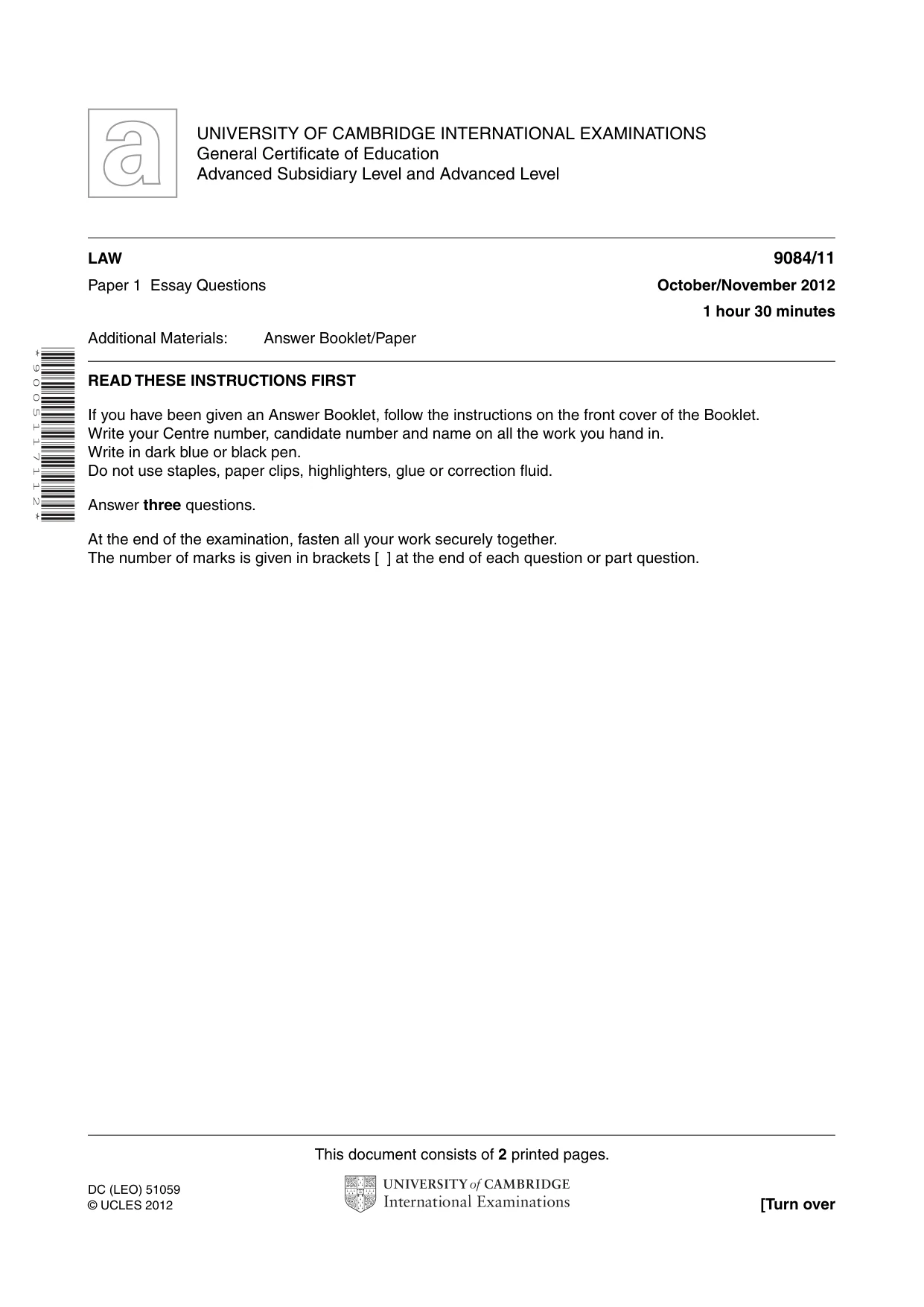
This document consists of 2 printed pages. DC (LEO) 51059 © UCLES 2012 [Turn over UNIVERSITY OF CAMBRIDGE INTERNATIONAL EXAMINATIONS General Certificate of Education Advanced Subsidiary Level and Advanced Level * 9 0 0 5 1 1 7 1 1 2 * LAW 9084/11 Paper 1 Essay Questions October/November 2012 1 hour 30 minutes Additional Materials: Answer Booklet/Paper READ THESE INSTRUCTIONS FIRST If you have been given an Answer Booklet, follow the instructions on the front cover of the Booklet. Write your Centre number, candidate number and name on all the work you hand in. Write in dark blue or black pen. Do not use staples, paper clips, highlighters, glue or correction fluid. Answer three questions. At the end of the examination, fasten all your work securely together. The number of marks is given in brackets [ ] at the end of each question or part question.
Question paper, page 2
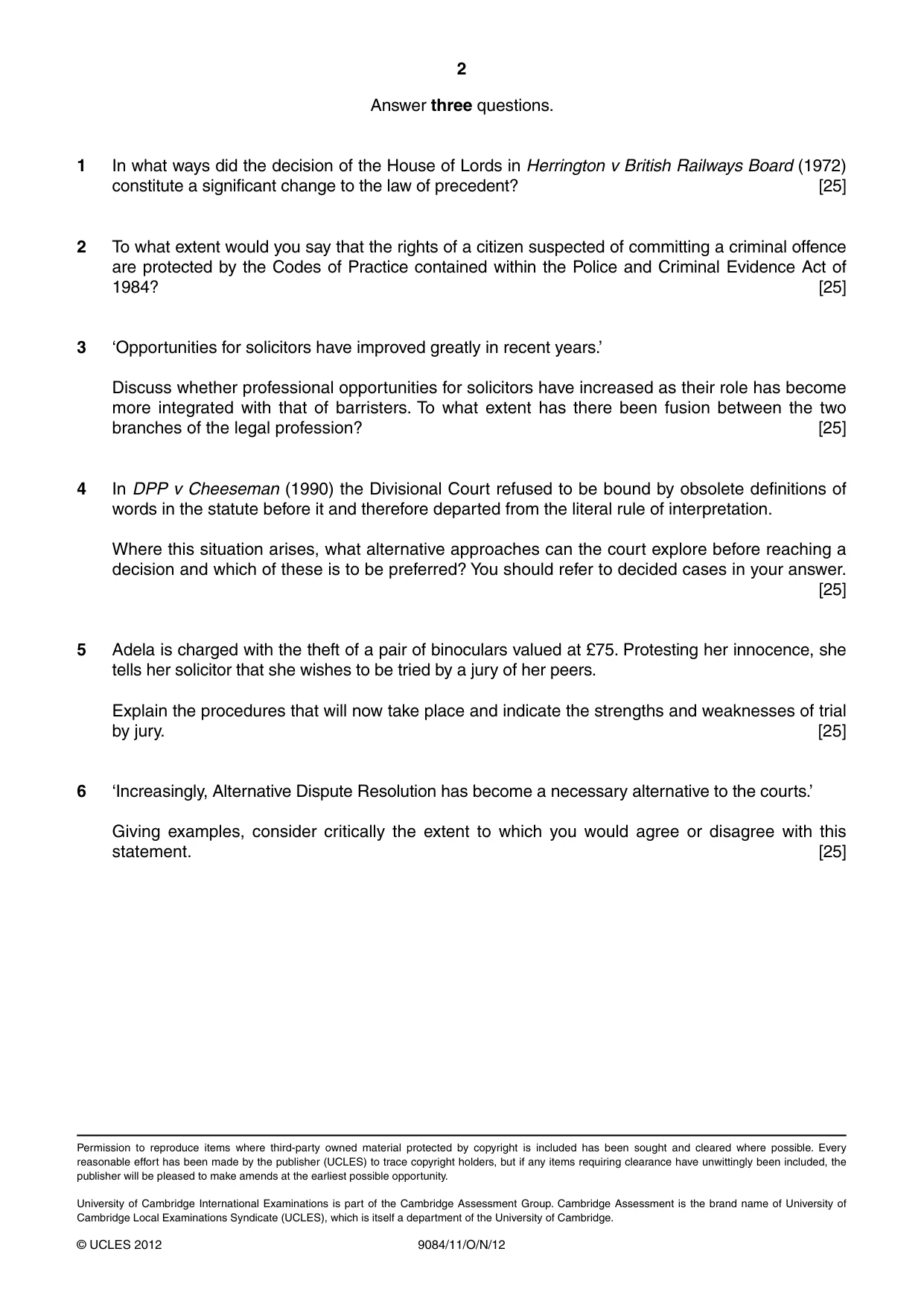
2 9084/11/O/N/12 © UCLES 2012 Permission to reproduce items where third-party owned material protected by copyright is included has been sought and cleared where possible. Every reasonable effort has been made by the publisher (UCLES) to trace copyright holders, but if any items requiring clearance have unwittingly been included, the publisher will be pleased to make amends at the earliest possible opportunity. University of Cambridge International Examinations is part of the Cambridge Assessment Group. Cambridge Assessment is the brand name of University of Cambridge Local Examinations Syndicate (UCLES), which is itself a department of the University of Cambridge. Answer three questions. 1 In what ways did the decision of the House of Lords in Herrington v British Railways Board (1972) constitute a significant change to the law of precedent? [25] 2 To what extent would you say that the rights of a citizen suspected of committing a criminal offence are protected by the Codes of Practice contained within the Police and Criminal Evidence Act of 1984? [25] 3 ‘Opportunities for solicitors have improved greatly in recent years.’ Discuss whether professional opportunities for solicitors have increased as their role has become more integrated with that of barristers. To what extent has there been fusion between the two branches of the legal profession? [25] 4 In DPP v Cheeseman (1990) the Divisional Court refused to be bound by obsolete definitions of words in the statute before it and therefore departed from the literal rule of interpretation. Where this situation arises, what alternative approaches can the court explore before reaching a decision and which of these is to be preferred? You should refer to decided cases in your answer. [25] 5 Adela is charged with the theft of a pair of binoculars valued at £75. Protesting her innocence, she tells her solicitor that she wishes to be tried by a jury of her peers. Explain the procedures that will now take place and indicate the strengths and weaknesses of trial by jury. [25] 6 ‘Increasingly, Alternative Dispute Resolution has become a necessary alternative to the courts.’ Giving examples, consider critically the extent to which you would agree or disagree with this statement. [25]
Mark scheme, page 1
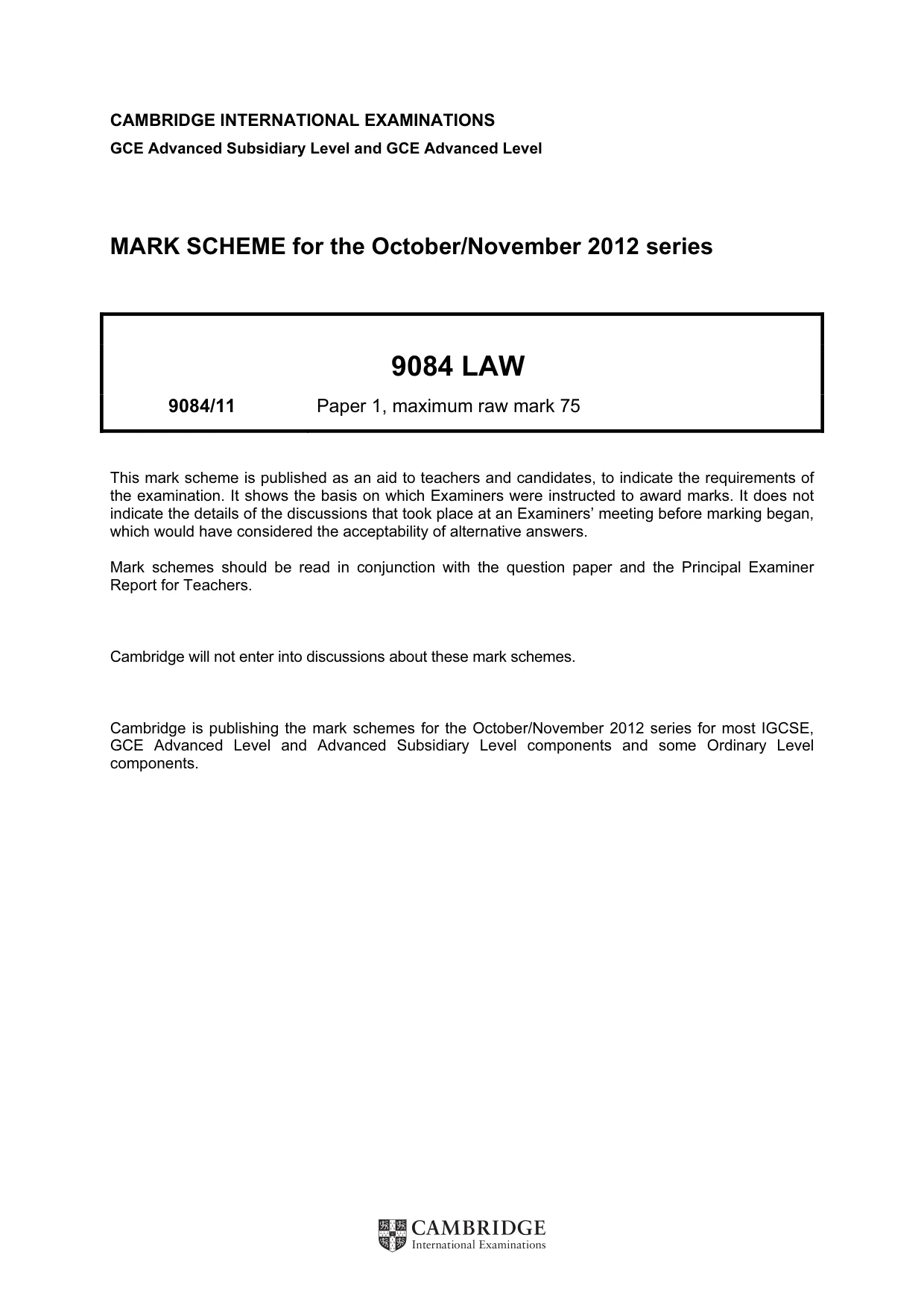
CAMBRIDGE INTERNATIONAL EXAMINATIONS GCE Advanced Subsidiary Level and GCE Advanced Level MARK SCHEME for the October/November 2012 series 9084 LAW 9084/11 Paper 1, maximum raw mark 75 This mark scheme is published as an aid to teachers and candidates, to indicate the requirements of the examination. It shows the basis on which Examiners were instructed to award marks. It does not indicate the details of the discussions that took place at an Examiners’ meeting before marking began, which would have considered the acceptability of alternative answers. Mark schemes should be read in conjunction with the question paper and the Principal Examiner Report for Teachers. Cambridge will not enter into discussions about these mark schemes. Cambridge is publishing the mark schemes for the October/November 2012 series for most IGCSE, GCE Advanced Level and Advanced Subsidiary Level components and some Ordinary Level components.
Mark scheme, page 2
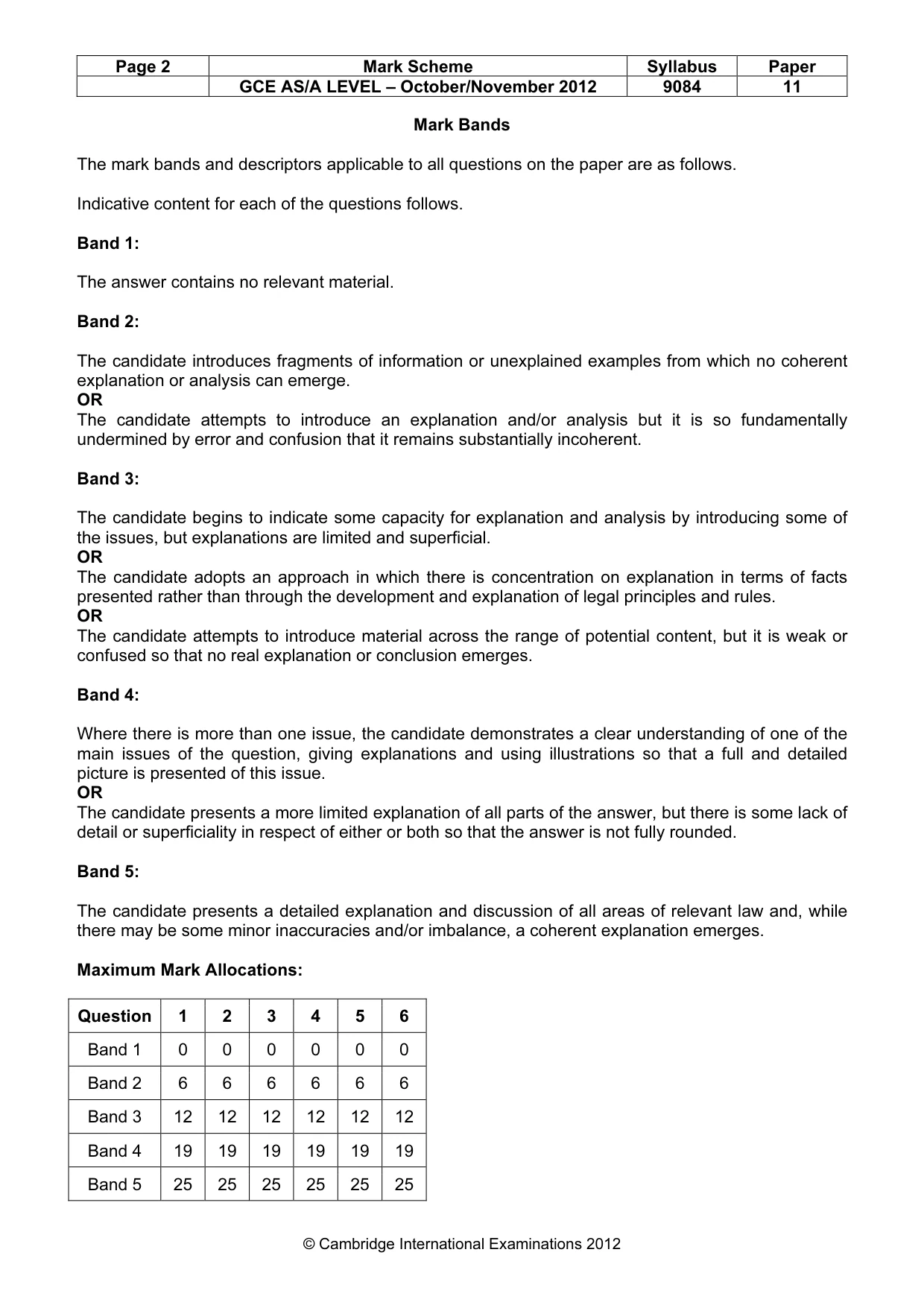
Page 2 Mark Scheme Syllabus Paper GCE AS/A LEVEL – October/November 2012 9084 11 © Cambridge International Examinations 2012 Mark Bands The mark bands and descriptors applicable to all questions on the paper are as follows. Indicative content for each of the questions follows. Band 1: The answer contains no relevant material. Band 2: The candidate introduces fragments of information or unexplained examples from which no coherent explanation or analysis can emerge. OR The candidate attempts to introduce an explanation and/or analysis but it is so fundamentally undermined by error and confusion that it remains substantially incoherent. Band 3: The candidate begins to indicate some capacity for explanation and analysis by introducing some of the issues, but explanations are limited and superficial. OR The candidate adopts an approach in which there is concentration on explanation in terms of facts presented rather than through the development and explanation of legal principles and rules. OR The candidate attempts to introduce material across the range of potential content, but it is weak or confused so that no real explanation or conclusion emerges. Band 4: Where there is more than one issue, the candidate demonstrates a clear understanding of one of the main issues of the question, giving explanations and using illustrations so that a full and detailed picture is presented of this issue. OR The candidate presents a more limited explanation of all parts of the answer, but there is some lack of detail or superficiality in respect of either or both so that the answer is not fully rounded. Band 5: The candidate presents a detailed explanation and discussion of all areas of relevant law and, while there may be some minor inaccuracies and/or imbalance, a coherent explanation emerges. Maximum Mark Allocations: Question 1 2 3 4 5 6 Band 1 0 0 0 0 0 0 Band 2 6 6 6 6 6 6 Band 3 12 12 12 12 12 12 Band 4 19 19 19 19 19 19 Band 5 25 25 25 25 25 25
Mark scheme, page 3
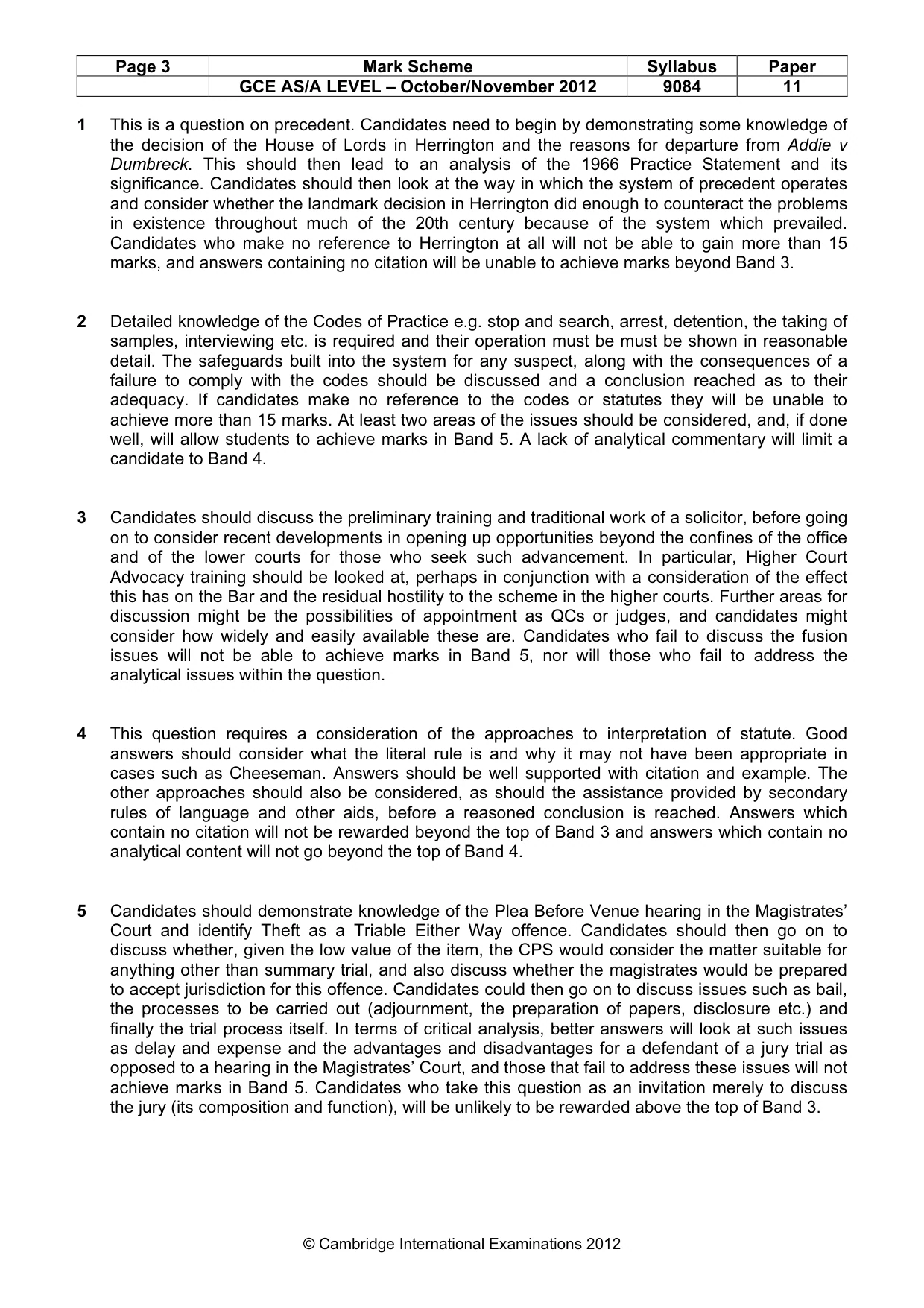
Page 3 Mark Scheme Syllabus Paper GCE AS/A LEVEL – October/November 2012 9084 11 © Cambridge International Examinations 2012 1 This is a question on precedent. Candidates need to begin by demonstrating some knowledge of the decision of the House of Lords in Herrington and the reasons for departure from Addie v Dumbreck. This should then lead to an analysis of the 1966 Practice Statement and its significance. Candidates should then look at the way in which the system of precedent operates and consider whether the landmark decision in Herrington did enough to counteract the problems in existence throughout much of the 20th century because of the system which prevailed. Candidates who make no reference to Herrington at all will not be able to gain more than 15 marks, and answers containing no citation will be unable to achieve marks beyond Band 3. 2 Detailed knowledge of the Codes of Practice e.g. stop and search, arrest, detention, the taking of samples, interviewing etc. is required and their operation must be must be shown in reasonable detail. The safeguards built into the system for any suspect, along with the consequences of a failure to comply with the codes should be discussed and a conclusion reached as to their adequacy. If candidates make no reference to the codes or statutes they will be unable to achieve more than 15 marks. At least two areas of the issues should be considered, and, if done well, will allow students to achieve marks in Band 5. A lack of analytical commentary will limit a candidate to Band 4. 3 Candidates should discuss the preliminary training and traditional work of a solicitor, before going on to consider recent developments in opening up opportunities beyond the confines of the office and of the lower courts for those who seek such advancement. In particular, Higher Court Advocacy training should be looked at, perhaps in conjunction with a consideration of the effect this has on the Bar and the residual hostility to the scheme in the higher courts. Further areas for discussion might be the possibilities of appointment as QCs or judges, and candidates might consider how widely and easily available these are. Candidates who fail to discuss the fusion issues will not be able to achieve marks in Band 5, nor will those who fail to address the analytical issues within the question. 4 This question requires a consideration of the approaches to interpretation of statute. Good answers should consider what the literal rule is and why it may not have been appropriate in cases such as Cheeseman. Answers should be well supported with citation and example. The other approaches should also be considered, as should the assistance provided by secondary rules of language and other aids, before a reasoned conclusion is reached. Answers which contain no citation will not be rewarded beyond the top of Band 3 and answers which contain no analytical content will not go beyond the top of Band 4. 5 Candidates should demonstrate knowledge of the Plea Before Venue hearing in the Magistrates’ Court and identify Theft as a Triable Either Way offence. Candidates should then go on to discuss whether, given the low value of the item, the CPS would consider the matter suitable for anything other than summary trial, and also discuss whether the magistrates would be prepared to accept jurisdiction for this offence. Candidates could then go on to discuss issues such as bail, the processes to be carried out (adjournment, the preparation of papers, disclosure etc.) and finally the trial process itself. In terms of critical analysis, better answers will look at such issues as delay and expense and the advantages and disadvantages for a defendant of a jury trial as opposed to a hearing in the Magistrates’ Court, and those that fail to address these issues will not achieve marks in Band 5. Candidates who take this question as an invitation merely to discuss the jury (its composition and function), will be unlikely to be rewarded above the top of Band 3.
Mark scheme, page 4
Page 4 Mark Scheme Syllabus Paper GCE AS/A LEVEL – October/November 2012 9084 11 © Cambridge International Examinations 2012 6 This is a broad question on ADR, where candidates should define the various types and give examples of each. They should account for the popularity of these systems but also consider whether it truly offers a useful alternative to the more traditional court system and its attendant problems. The composition and powers of the various systems should be considered, along with their expertise, or otherwise, as should practical issues of representation, timeliness, costs and appeals. Answers which give no examples or illustration will not receive more than 15 marks. Only answers which include critical analysis should reach Band 5.
What you needed in this session
Cambridge’s own grade thresholds for 2012 Oct/Nov, Paper 1 · Variant 1. A higher threshold means an easier paper — the bar moves with how the cohort did.